As diabetes mellitus has reached pandemic status, infectious complications related to diabetic foot ulcers are understandably rising sharply. [
1-
3] It is estimated that 4% of the US population has been diagnosed with diabetes, [
3] and that 15% to 25% of patients with diabetes will develop foot ulcers over the course of their lives. [
2] Subsequent complications of these ulcers, driven by ischemia and infection, result in frequent hospitalizations and amputations. [
4-
7]
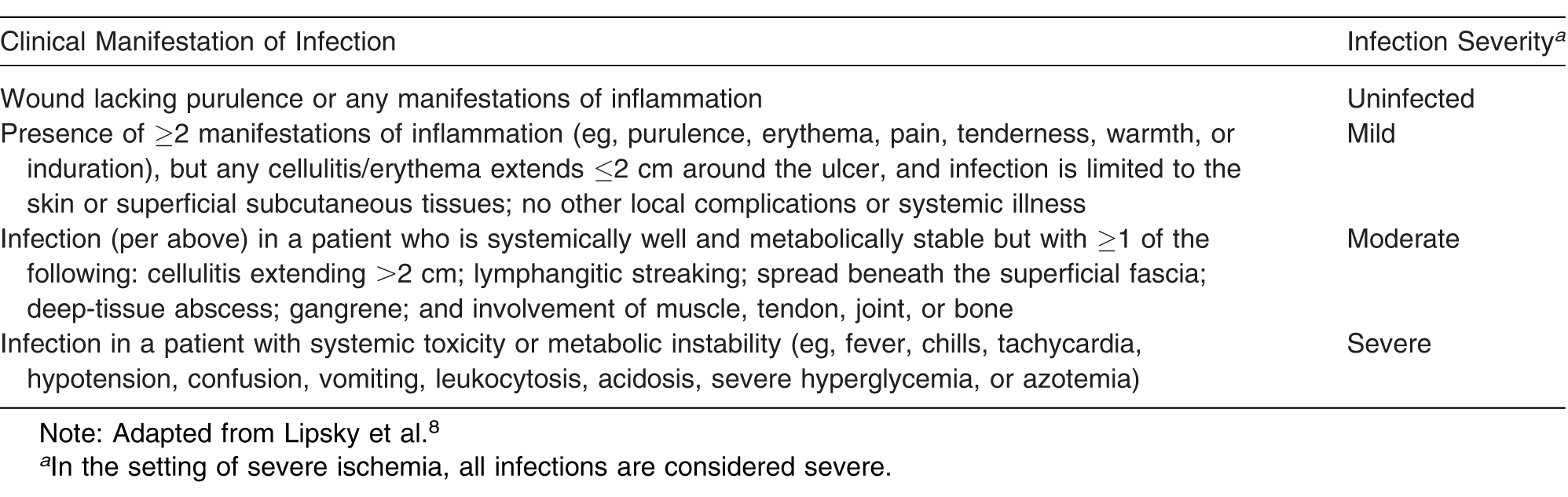
The Infectious Diseases Society of America 2012 guidelines on treating diabetic foot ulcer infections support the use of a validated classification system to grade the severity of diabetic foot infections (
Table 1). [
8] Factors including depth of a wound, size of surrounding erythema, presence and extent of infection, and presence of systemic toxicity are used to stratify such infections into mild, moderate, or severe categories. Although severe infections nearly uniformly require surgical debridement and systemic intravenous antimicrobial therapy, the use of oral therapy has been supported for many mild and some moderate diabetic foot infections. [
9] However, the diagnosis and accurate classification of moderate or severe infection, even with underlying abscess or osteomyelitis, can at times be challenging based on physical examination alone. Clinical signs often belie the significance and severity of underlying infection. [
10-
12] Often, a combination of laboratory assessment, radiographic findings, physical examination, and deep-tissue culture data is required to determine the true extent and severity of infection.
Table 1.
Classification of Severity of Diabetic Foot Infection
Table 1.
Classification of Severity of Diabetic Foot Infection
The guidelines for lower extremity care in patients with diabetes have focused on the prevention of ulceration and the management of infected ulcers but have not emphasized the importance of ulcer care in the prevention of systemic infection in these patients. Diabetes mellitus has been identified as an independent risk factor for community-acquired and nosocomial bloodstream infection, but studies have not elucidated strategies to prevent these infections. [
13-
16] The role of infected foot ulcers as portals of entry for bacteremia and subsequent life-threatening infections at sites distant from the foot has not been emphasized. [
17] A recent study, however, noted an association between foot ulcers in patients with diabetes that persisted after initial medical care and the subsequent development of morbid, potentially life-threatening systemic deep-seated infections with organisms previously isolated from the foot ulcer. [
18]
We report here the case of a diabetic man with delayed healing of an infected diabetic foot ulcer, which subsequently resulted in life-threatening infection. This sequence highlights the role of infected foot ulcers in the causality of invasive infections and the importance of accurate initial diagnostics and appropriately aggressive therapy to eradicate infection and achieve healing of foot ulcers in patients with diabetes. Prompt healing of foot ulcers—which if persistently open may otherwise serve as a portal for subsequent systemic infections—should be a health-care priority for patients with diabetes.
Case Report
A 57-year-old man presented to the emergency department (ED) with 2 days of erythema and swelling of the right foot, and 6 hours of fevers, chills, and rigors. His medical history was notable for poorly controlled type 2 diabetes mellitus complicated by peripheral neuropathy (most recent hemoglobin A1c value, 9.8%; the patient was on metformin and insulin), hypertension, obesity, obstructive sleep apnea, and prior tobacco abuse. He worked in the construction industry and lived with his wife. His family history was notable in that both parents had obesity and poorly controlled type 2 diabetes mellitus.
Four months before presentation, he sustained an ulcer beneath the right second metatarsophalangeal joint (MPJ) after burning his foot on hot sand while walking on the beach. Despite 3 months of regular wound care, the ulcer failed to heal and signs of an infection developed at the ulcer site. Culture of the infected ulcer grew methicillin-resistant Staphylococcus aureus (MRSA) and Pseudomonas aeruginosa. Oral antibiotics were administered. A radiograph showed no evidence of osteomyelitis, but the second metatarsal was elongated and was thought to be contributing to the inability of the ulcer to heal with conservative therapy. One month before his presentation, a right second metatarsal shortening osteotomy with screw placement for stability was performed in an attempt to relieve weightbearing and achieve ulcer healing. Methicillin-resistant S aureus was again isolated from the second MPJ plantar ulcer. The infected ulcer was treated with oral ciprofloxacin and trimethoprim–sulfamethoxazole. Two days before the current presentation, he noticed purulent, bloody discharge from the right foot surgical incision.
In the ED, his vital signs revealed the following: temperature, 103.0°F; heart rate, 102/min; blood pressure, 144/60 mm Hg; respiratory rate, 20/min; and oxygen saturation, 99% on room air. Physical examination revealed a large, diaphoretic-appearing man. There was a holosystolic murmur on cardiac examination. The right foot examination showed brisk pulses, decreased sensation, and a purulent, dehisced surgical wound with surrounding erythema and edema. The wound extended to bone. The second MPJ plantar ulceration was healing. There were no signs of congestive heart failure or peripheral stigmata of endocarditis. The patients laboratory values were as follows: white blood cell count, 8.2 × 10
6 cells/μL with 85% neutrophils and 0% bands; hemoglobin, 12.7 g/dL; and platelet count, 176 × 10
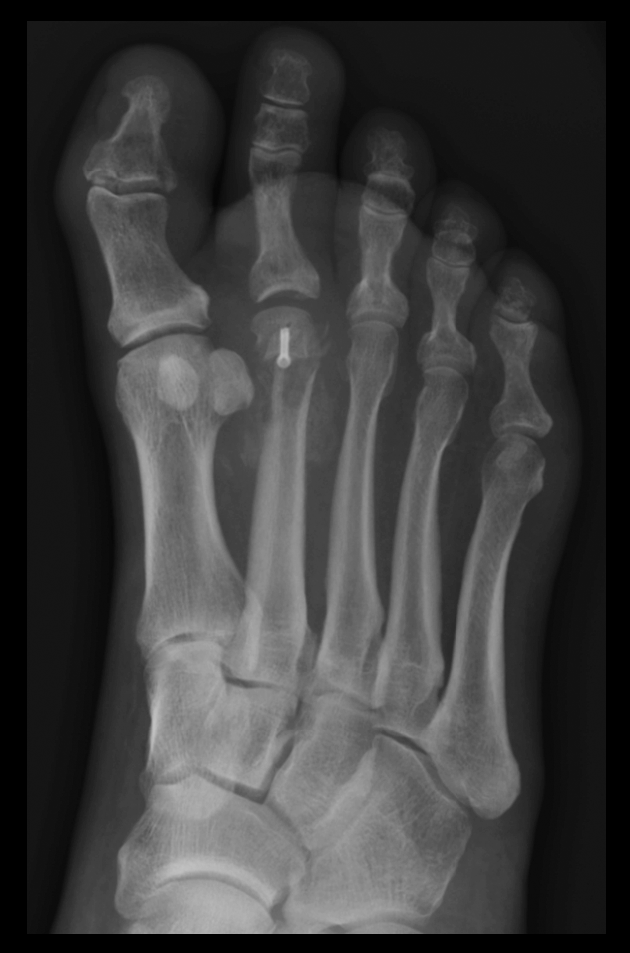
6 cells/μL. The patient's serum creatinine value was 1.6 mg/dL (from a baseline of 1.1 mg/dL) and his C-reactive protein level was 239 mg/L. The right foot radiograph was notable for periosteal reaction and lucency at the site of the prior second metatarsal osteotomy, concerning for osteomyelitis (
Fig. 1).
Figure 1.
Radiograph of the right foot shows evidence of prior osteotomy with screw fixation in the second metatarsal head, with bony resorption and periosteal reaction at the surgical site concerning for osteomyelitis.
Figure 1.
Radiograph of the right foot shows evidence of prior osteotomy with screw fixation in the second metatarsal head, with bony resorption and periosteal reaction at the surgical site concerning for osteomyelitis.
Empiric intravenous vancomycin (15 mg/kg every 12 hours to achieve a trough concentration of 15–20 μg/mL) and piperacillin–tazobactam were administered. All blood cultures drawn in the ED yielded MRSA within 24 hours. On hospital day 2, he underwent an incision and drainage of the prior right foot surgical wound. Frank purulence was encountered and the screw was removed. The wound was packed and left open. Intraoperative deep-tissue cultures also grew MRSA. Piperacillin–tazobactam was discontinued and vancomycin was continued as monotherapy, with goal troughs achieved. A transesophageal echocardiogram showed a 3-mm vegetation on the posterior mitral valve leaflet, diagnostic of infective endocarditis. Because of ongoing fevers and continued purulence in the foot, he was taken back to the operating room 2 days later, where he underwent further surgical debridement and resection of the second metatarsal head. This was followed by clinical improvement. Histopathologic examination of tissue from his second debridement demonstrated acute osteomyelitis of the second metatarsal head. Blood cultures were negative by hospital day 3. He completed a 6-week course of intravenous vancomycin with resolution of all symptoms and healing of the right foot incision. Although the 2015 American Heart Association Infective Endocarditis guidelines recommend an echocardiogram at the conclusion of antibiotic therapy to establish the new baseline anatomy and function of the infected valve, the study was not performed in this patient. [
19]
Discussion
That foot ulcers cause a large burden of local disease among patients with diabetes mellitus is widely recognized. However, their role in the causation of subsequent severe systemic infections, as illustrated in our patient, is not widely appreciated.
A recent study assessed the long-term risk for invasive systemic infection in 819 patients hospitalized 1,212 times for initial treatment of a unique diabetic foot ulcer. [
18] This study documented the ongoing high risk of invasive infection in these patients. Within this cohort, there were 172 subsequent episodes of life-threatening, nonfoot infection caused by organisms that were previously present in the foot ulcer. These severe infections, 57% of which were caused by MRSA, included bacteremia, septic arthritis, osteomyelitis, deep abscesses, and endocarditis, and occurred over a 2-year follow-up period after initial treatment for the ulcer. These systemic infections were independently associated with a statistically significant increase in mortality. Patients with ulcers that remained open for prolonged periods, particularly greater than 145 days, or that were initially culture-positive for MRSA, were at highest risk of subsequent invasive infection and mortality. Of the 196 patients with ulcers that did not heal promptly and were infected by MRSA, 51 (26%) experienced subsequent invasive systemic infection. Debridement of the ulcer and surgical wound closure as part of early ulcer treatment was independently associated with a significant reduction in invasive systemic infection. These data suggest that nonhealing ulcers serve as a portal of entry for bacterial invasion, particularly MRSA, and subsequent hematogenous seeding of remote sites.
The case presented, a 57-year-old diabetic man who developed MRSA endocarditis presumably caused by bacteremia from an infected diabetic foot ulcer that failed to heal despite prolonged treatment, illustrates the hazards of the nonhealing ulcer scenario. Available data to date suggest that the life-threatening infections that complicate foot ulcers, and their associated mortality risk, may be averted by more aggressive therapy to achieve prompt ulcer healing and eradication of MRSA. [
4,
5,
20,
21] Accurate initial risk-stratification of diabetic foot ulcers, aggressive treatment to eradicate infections, and enhanced efforts to achieve ulcer closure, including augmentation of arterial blood flow when appropriate, are necessary to prevent life-threatening complications. We suggest that clinicians incorporate the risk of diabetic foot ulcer–related systemic infection into decision-making when planning the treatment of patients such as the one described herein.