Next Article in Journal
The American Association of Colleges of Podiatric Medicine. 50 Years of Professional, Political, and Public Health Influence
Previous Article in Journal
Methicillin-Resistant Staphylococcus aureus Endocarditis from a Diabetic Foot Ulcer. Understanding and Mitigating the Risk
 
 
Journal of the American Podiatric Medical Association is published by MDPI from Volume 116 Issue 1 (2026). Previous articles were published by another publisher in Open Access under a CC-BY (or CC-BY-NC-ND) licence, and they are hosted by MDPI on mdpi.com as a courtesy and upon agreement with American Podiatric Medical Association.
Article

Efficacy of Ultrasound-Guided Pulsed Radiofrequency for Recalcitrant Metatarsalgia. A Case Report

Department of Physical Medicine and Rehabilitation, Tri-Service General Hospital, School of Medicine, National Defense Medical Center, 11490 Taipei, Taiwan
*
Author to whom correspondence should be addressed.
J. Am. Podiatr. Med. Assoc. 2018, 108(6), 532-534; https://doi.org/10.7547/17-147
Published: 1 November 2018

Abstract

Metatarsalgia is characterized by pain in the forefoot, which is associated with increased stress over the metatarsal head region. Despite the availability of a variety of conservative or surgical treatments for this condition, a few cases have demonstrated relapse or poor response to treatment. Pulsed radiofrequency (PRF) can provide pain relief in patients with diverse chronic conditions without causing neural injury. Recently, studies have shown that ultrasound-guided PRF may be beneficial for adhesive capsulitis, carpal tunnel syndrome, tarsal tunnel syndrome, and recalcitrant plantar fasciitis. Here, we describe a successful case of significant pain relief achieved by using ultrasound-guided PRF targeting the posterior tibial nerve (PTN) at the ankle of a 67-year-old woman with recalcitrant metatarsalgia. Ten minutes after ultrasound-guided PRF was applied at the PTN, the patient reported decreased pain (from 8 to 3 on a visual analogue scale) and did not exhibit any particular side effects. Three months after PRF application, the patient's visual analogue scale score remained more than 50% below the baseline, and she did not need additional conservative treatment during the follow-up period. To the best of our knowledge, we present the first case report using ultrasound-guided PRF at the PTN for treatment of recalcitrant metatarsalgia. We hypothesize that ultrasound-guided PRF at the PTN may be a potentially novel approach for treating recalcitrant metatarsalgia.

Metatarsalgia is characterized by pain in the forefoot that is associated with increased stress over the metatarsal head region. The precise location of the metatarsalgia comprises pain in the area across the plantar forefoot and is usually located beneath the second, third, and fourth metatarsal heads. The average prevalence of metatarsal pain is approximately 80% during a lifetime and occurs predominantly in the older age group and in women.[1] Metatarsalgia is more common in people from certain professions, such as athletes, runners, or people wearing shoes with spikes (eg, baseball or track cleats).[1,2] Metatarsalgia may be treated either by conservative treatments (eg, physical therapy, medications, steroid injection, manipulation, or occupational therapy such as shoe modification or metatarsal pads) or by surgical management.[3] Despite undergoing a variety of treatments, approximately 20% of patients with metatarsalgia relapse or respond poorly to treatment even after surgery.[4]
Compared to conventional radiofrequency, pulsed radiofrequency (PRF) may generate heat bursts in neural tissue by maintaining the temperature below 42°C for pain alleviation without causing nerve damage.[5] The effectiveness of PRF for pain reduction has been demonstrated in many studies on various chronic pain conditions. Recent studies have shown the advantages of using ultrasound-guided PRF targeting in a peripheral nerve for adhesive capsulitis and carpal tunnel syndrome.[6,7] In 2014, a study by Chon et al first reported the long-term effects of ultrasound-guided PRF targeting in the posterior tibial nerve (PTN) in two patients with recurrent tarsal tunnel syndrome.[8] Moreover, we revealed that ultrasound-guided PRF stimulation at the PTN is effective for treating recalcitrant plantar fasciitis.[9] Here, we report a successful case of the significant effects of ultrasound-guided PRF in bilateral PTN in a patient with recalcitrant metatarsalgia.

Case Report

A 67-year-old woman had bilateral forefoot pain, and the symptom exacerbated with weightbearing since May of 2016. She had no history of trauma or other systemic disease. Physical examination showed tenderness over the plantar forefoot beneath the second, third, and fourth metatarsal heads without limited dorsiflexion and plantarflexion or other abnormal findings in metatarsophalangeal joints. Radiography of the feet showed no abnormality, and ultrasonography showed no obvious effusion or bursitis over metatarsophalangeal joints. Based on the above symptoms/signs and physical examinations, bilateral metatarsalgia was diagnosed. Initially, she demonstrated a relatively fair response to physical therapy, analgesic agents, and use of a metatarsal pad. Since October of 2016, her symptoms worsened; she exhibited progressive difficulty in walking, and reported a score of 8 on the visual analogue scale (VAS). She underwent many conservative treatment procedures, including local injection; however, the effects were short lived. To provide effective pain relief, we informed her about the new treatment approach involving PRF application under ultrasound guidance, and she agreed to try this novel treatment.
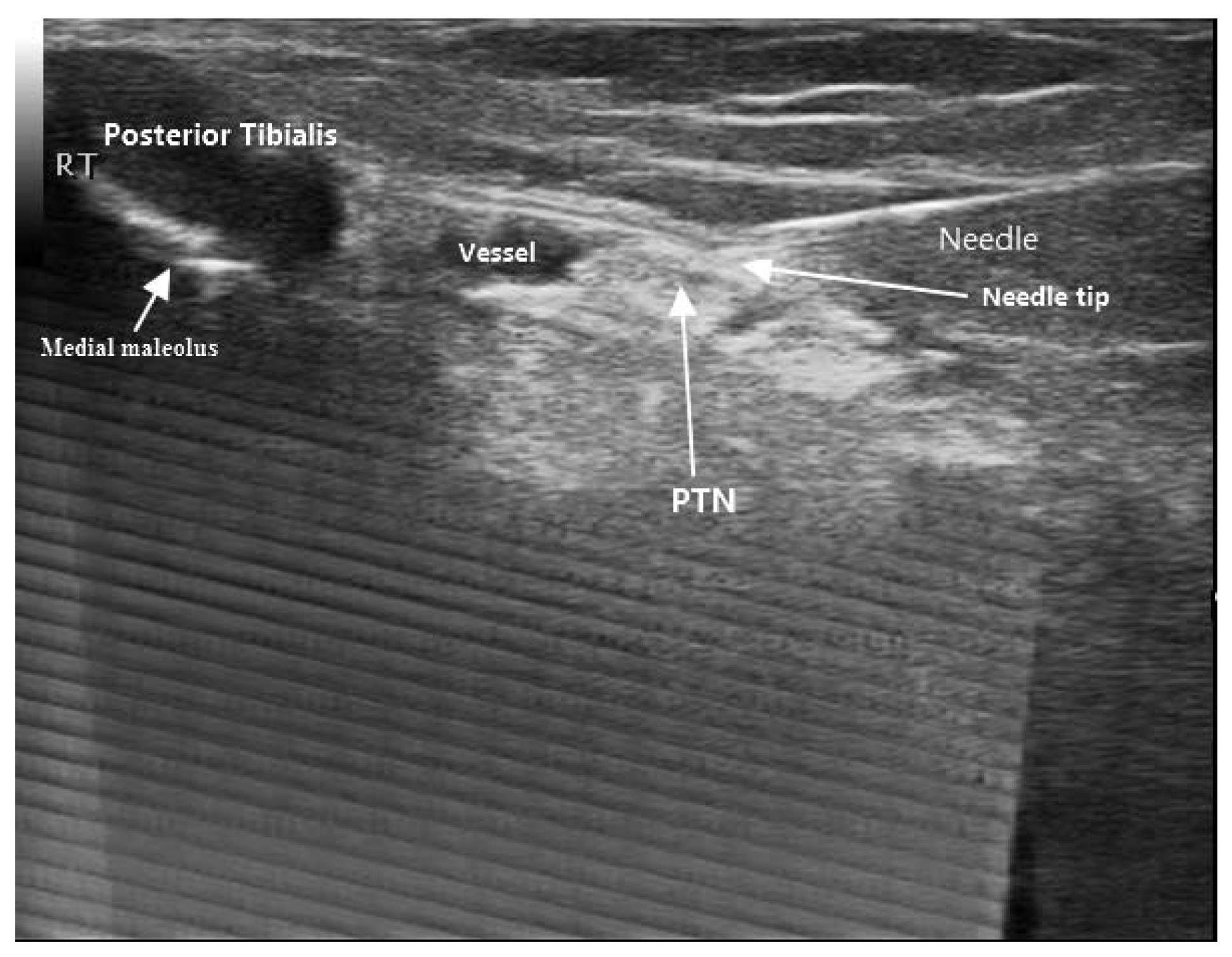
In April of 2017, ultrasound-guided PRF was performed. The patient was placed in the prone position and musculoskeletal ultrasonography (MyLab25Gold; Esaote SpA, Genova, Italy) was used for guidance. A high-frequency linear probe was placed immediately posterior to the left medial malleolus. The left PTN, vein, and artery were identified. At first, 2 cc of 2% lidocaine was injected and infiltrated at the intradermal and subcutaneous layer of the targeted PRF puncture site. Subsequently, a 54-mm radiofrequency probe with a 4-mm active tip was inserted in-plane near the left PTN (Fig. 1). When the needle tip was clearly visualized, the sensory stimulation (50–100 Hz, 1-msec pulse width, up to 0.5 V) was tested, and the patient reported paresthesia in the metatarsal region. After performing motor stimulation (2 Hz, 1-msec pulse width, up to 1 V), spontaneous plantar flexion was observed. In the next step, PRF lesioning was performed for 120 sec with 2 Hz, 30-msec pulse width at 42°C at the two sites (superior and inferior to the PTN).[6,7] After that, the procedure was repeated at the right PTN. The entire procedure proceeded smoothly, and no particular side effects were observed. The patient soon reported reduced pain (VAS score reduced from 8 to 3) and improved walking ability. Three months after PRF therapy, the patient reported sustained pain relief (>50% decrease in VAS score compared with baseline), and no additional conservative treatment was required during the follow-up period.
Figure 1. Real-time imaging of needle insertion for ultrasound-guided pulsed radiofrequency treatment. PTN, posterior tibial nerve; Rt, right.
Japma 108 00532 g001

Discussion

The chief symptom of metatarsalgia is sharp pain on the plantar surface of the foot in the area of the distal metatarsal. The medial and lateral plantar nerves, which arise as branches of the PTN, comprise the sensory innervation of the forefoot. Although PTN block using narcotic agents or steroid for regional anesthesia or pain relief has been reported for a decade,[10,11] this is the first report of the significant effects (≥3 months) of ultrasound-guided PRF in a patient with recalcitrant metatarsalgia.
The application of PRF in peripheral nerves has been shown by several studies. Recently, ultrasound-guided PRF was also used for median nerve (carpal tunnel syndrome),[6] suprascapular nerve (adhesive capsulitis),[7] interscalene brachial plexus (neoplastic plexopathic pain),[12] intercostal nerve,[13] trigeminal nerve (trigeminal neuralgia),[14] sciatic nerve (chronic knee pain),[15] and pudendal nerve (chronic pelvic pain).[16] Although the mechanism of PRF has not been definitely clarified, it has recently been reported that PRF may modify neuronal membranes.[5] Moreover, it appears that the biological effects of PRF selectively act on small-diameter C and Aδ fibers.[17] Furthermore, researchers have observed increases in c-Fos immunoreactivity in the dorsal horn up to 1 week after treatment in a rat cervical dorsal root ganglia.[18]
A study by Chon et al in 2014 demonstrated the first instance of ultrasound-guided PRF targeting in the PTN in two patients with recurrent tarsal tunnel syndrome. The effects persisted for 8 to 12 months after lesioning.[8] In 2017, we showed that ultrasound-guided PRF stimulation at the PTN was a novel strategy to reduce the symptom of recalcitrant plantar fasciitis, and that the effect persists for at least 3 months.[9] In contrast with the above two studies, the site of pain in metatarsalgia is farther from the PRF targeting site compared with that in tarsal tunnel syndrome or plantar fasciitis. Theoretically, the effects of PRF diminish with an increase in distance between the targeting nerve and site of pain. Significant effects of at least 3 months' duration after ultrasound-guided PRF were also observed for metatarsalgia. We hypothesize that ultrasound-guided PRF lesioning at the PTN may be a potentially novel approach for treating recalcitrant metatarsalgia.

Conclusions

We first demonstrated significant effects after ultrasound-guided PRF lesioning at the PTN for treating recalcitrant metatarsalgia and hypothesized it be a potentially novel intervention for treating recalcitrant metatarsalgia.
Financial Disclosure: None reported.
Conflict of Interest: None reported.

References

  1. Bardelli M, Turelli L, Scoccianti G: Definition and classification of metatarsalgia. Foot Ankle Surg9: 79, 2003.
  2. Arie EK, Moreira NS, Freire GS, et al: Study of the metatarsal formula in patient with primary metatarsalgia. Rev Bras Ortop50: 438, 2015.
  3. Espinosa N, Brodsky JW, Maceira E: Metatarsalgia. J Am Acad Orthop Surg18: 474, 2010.
  4. Barouk P: Recurrent metatarsalgia. Foot Ankle Clin19: 407, 2014.
  5. Cosman ERJr, Cosman ERSr: Electric and thermal field effects in tissue around radiofrequency electrodes. Pain Med6: 405, 2005.
  6. Chen LC, Ho CW, Sun CH, et al: Ultrasound-guided pulsed radiofrequency for carpal tunnel syndrome: a single-blinded randomized controlled study. PLoS One10: e0129918, 2015.
  7. Wu YT, Ho CW, Chen YL, et al: Ultrasound-guided pulsed radiofrequency stimulation of the suprascapular nerve for adhesive capsulitis: a prospective, randomized, controlled trial. Anesth Analg119: 686, 2014.
  8. Chon JY, Hahn YJ, Sung CH, et al: Pulsed radiofrequency under ultrasound guidance for the tarsal tunnel syndrome: two case reports. J Anesth28: 924, 2014.
  9. Wu YT, Chang CY, Chou YC, et al: Ultrasound-guided pulsed radiofrequency stimulation of posterior tibial nerve: a potential novel intervention for recalcitrant plantar fasciitis. Arch Phys Med Rehabil98: 964, 2017.
  10. Tallia AF, Cardone DA: Diagnostic and therapeutic injection of the ankle and foot. Am Fam Physician68: 1356, 2003.
  11. Wassef MR: Posterior tibial nerve block. A new approach using the bony landmark of the sustentaculum tali. Anaesthesia46: 841, 1991.
  12. Arai YC, Nishihara M, Aono S, et al: Pulsed radiofrequency treatment within brachial plexus for the management of intractable neoplastic plexopathic pain. J Anesth27: 298, 2013.
  13. Akkaya T, Ozkan D: Ultrasound-guided pulsed radiofrequency treatment of the intercostal nerve: three cases. J Anesth27: 968, 2013.
  14. Nader A, Bendok BR, Prine JJ, et al: Ultrasound-guided pulsed radiofrequency application via the pterygopalatine fossa: a practical approach to treat refractory trigeminal neuralgia. Pain Physician18: E411, 2015.
  15. E Djibilian Fucci R, Pascual-Ramírez J, Martínez-Marcos A, et al: Ultrasound-guided sciatic nerve pulsed radiofrequency for chronic knee pain treatment: a novel approach. J Anesth27: 935, 2013.
  16. Ozkan D, Akkaya T, Yildiz S, et al: Ultrasound-guided pulsed radiofrequency treatment of the pudendal nerve in chronic pelvic pain. Anaesthesist65: 134, 2016.
  17. Hamann W, Abou-Sherif S, Thompson S, et al: Pulsed radiofrequency applied to dorsal root ganglia causes a selective increase in ATF3 in small neurons. Eur J Pain10: 171, 2006.
  18. Van Zundert J, de Louw AJ, Joosten EA, et al: Pulsed and continuous radiofrequency current adjacent to the cervical dorsal root ganglion of the rat induces late cellular activity in the dorsal horn. Anesthesiology102: 125, 2005.