Chronic nonhealing wounds, including diabetic foot ulcers (DFUs), venous leg ulcers (VLUs), pressure ulcers, ischemic ulcers, surgical wounds, and traumatic wounds, pose a substantial economic burden on society. Human amniotic membrane has been used in a variety of surgical procedures and in wound healing for many decades. Amniotic membrane is a nonvascular tissue consisting of epithelium cells, basement membrane, a thick compact layer, and a fibroblast layer. The fibrous layer contains cell-anchoring collagen types I, III, IV, V, and VII.[
1] The biochemical properties of the membrane help modulate inflammation and enhance healing.[
1]
PURION processed dehydrated human amnion/chorion membrane (dHACM) allografts (EpiFix and AmnioFix; MiMedx Group Inc, Marietta, Georgia) have been shown to contain nonviable cells that retain the cellular and pericellular components necessary for biological activities related to wound healing, including the potential to positively affect four distinct and pivotal physiologic processes intimately involved in wound healing: cell proliferation, inflammation, metalloproteinase activity, and recruitment of progenitor cells.[
2] Terminal sterilization of the dHACM allograft tissue reduces the risk of disease transmission. The dHACM allografts are commercially available and distributed in a variety of sizes, with a 5-year shelf life under ambient conditions. The dHACM allografts have become a popular treatment modality for nonhealing lower-extremity wounds, and efficacy is supported by multiple randomized controlled trials.[
3-
7] The purpose of the present study is to report our experience with using dHACM in treating refractory nonhealing wounds of various etiologies.
Methods
We conducted a retrospective review of deidentified data from patients receiving care in an outpatient podiatric surgery clinic in a single medical center over a 2-year period. Approval for this data review was granted by the internal ethics committee composed of attending physicians from the podiatric medicine department at the Jesse Brown VA Medical Center (Chicago, Illinois). From the electronic medical record system we identified all of the patients with lower-extremity wounds of various etiologies treated with dHACM. Patients treated with dHACM had failed to show at least a 50% reduction in wound size after a minimum of 4 weeks of wound-type appropriate standard of care or were deemed to be at high risk for nonhealing by the treating clinician (obesity, poor nutrition, alcoholism, smoking, uncontrolled diabetes, immunocompromised), had a history of chronic wounds, or had wounds that had failed to respond to other advanced treatments. Advanced treatment with dHACM was initiated in the outpatient wound clinic and consisted of weekly application of the allograft in micronized or sheet formulation. The clinician selected to use either sheet or micronized dHACM allograft material based on the wound characteristics of tunneling or irregular wound areas. Because the allograft is available in multiple sizes, an appropriately sized graft was selected to minimize waste of graft material. After removal from the sterile pouch or vial, the allograft was placed or sprinkled in the wound after sharp/mechanical debridement as deemed necessary to achieve a well-vascularized, stable wound bed with minimal exudate. If necessary, the allograft was hydrated with sterile saline. A nonadherent contact layer was placed over the allograft, followed by appropriate moisture management dressings. Patients were instructed to keep dressings clean, dry, and undisturbed. Off-loading, compression therapy, and vascular surgical intervention/ArtAssist (ACI Medical Management Inc, San Marcos, California) were used as appropriate for the wound type and the patient's clinical presentation. As the standard of care, patients were seen weekly for dressing change and wound assessment. Patients could receive up to 12 applications of dHACM in a 12-week period. Treatment with dHACM was discontinued after 12 weeks if the wound remained unhealed or if the wound failed to reduce in size within 4 weeks of treatment with dHACM. Wound measurements were obtained weekly, after debridement. Wound area was calculated as length × width. Healing was defined as complete reepithelization of the wound.
Patient demographic characteristics, wound history and measurements, and treatment outcomes were collected. Patients who healed or who remained unhealed but discontinued treatment with dHACM were defined as completers. For patients completing treatment, the rate of wound closure, time to closure, and number of dHACM applications to closure were calculated overall and for each wound type: DFUs, VLUs, pressure ulcers, ischemic ulcers, surgical wounds, and traumatic wounds.
Results
We reviewed deidentified data from 117 patients with nonhealing wounds treated with dHACM. Of those 117 patients, 16 were still receiving treatment at the time of data collection, and 101 had completed dHACM treatment either healed or unhealed. Overall, the dHACM-treated population consisted of 97.4% male patients with a mean ± SD age of 68.8 ± 10.4 years and a mean ± SD hemoglobin A
1c level of 7.5% ± 1.6
%; 45.3% were tobacco users. As would be expected in a retrospective review of recalcitrant wounds, clinicians used a variety of treatments in addition to routine wet to dry dressings, debridement, off-loading, and compression (as applicable to wound type) before use of dHACM, yet these had failed to result in complete healing. Because these patients were not participants in a clinical trial, clinicians were free to choose a treatment based on their preferences or clinical judgment. Previous treatments may have included Acell, Amniox, Apligraf, Dermagraft, Endoform, Grafix, Iodoform, Medihoney, Oasis, Prisma, Profore, Santyl, and SNAP. For all of the wound types, mean ± SD wound duration before dHACM treatment was 13.3 ± 21.2 weeks (median, 6 weeks; range, 1–144 weeks), with a mean ± SD wound area of 8.6 ± 46.6 cm
2 (median, 1.4 cm
2; range, 0.05–500 cm
2). In the population studied, 34% of patients had DFUs, 25% had VLUs, 20% had surgical wounds, 14% had pressure ulcers, 6% had ischemic wounds, and 2% had traumatic wounds. Patient demographic and wound characteristics are presented by wound type in
Table 1.
Table 1.
Patient Demographic and Wound Characteristics.
Table 1.
Patient Demographic and Wound Characteristics.
Overall, of the 101 patients completing treatment with dHACM, 92 (91.1%) healed and nine (8.9%) were unhealed when dHACM was discontinued. Overall, across all of the wound types, the mean ± SD number of weekly applications per healed wound was 5.1 ± 4.2. Most patients (52.5%; 53 of 101) received allograft in sheet form only, 15 (14.8%) received the allograft in micronized form only, and 33 (32.7%) received both sheet and micronized allograft at various times during their healing course. Rate of complete healing by wound type and mean number of weekly applications per healed wound are presented in
Table 2. All of the wound types except ischemic ulcers exhibited a healing rate of more than 90% with dHACM.
Table 2.
Healing Metrics with dHACM Treatment.
Table 2.
Healing Metrics with dHACM Treatment.
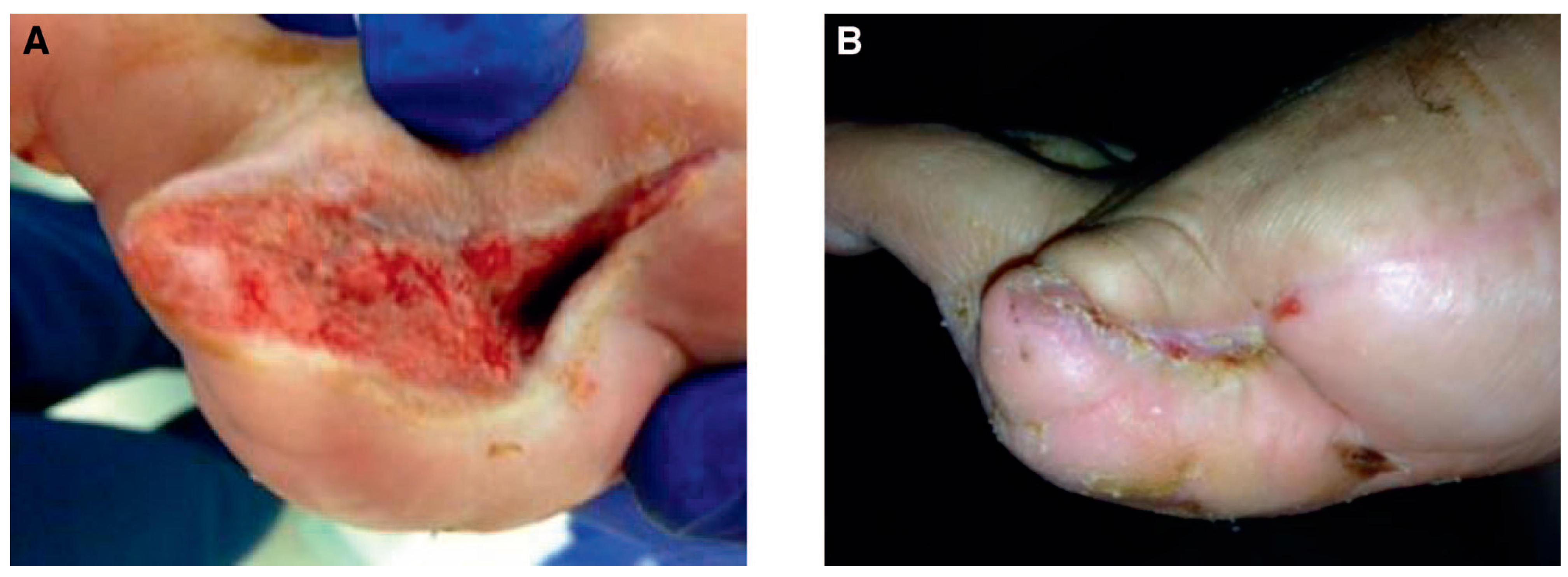
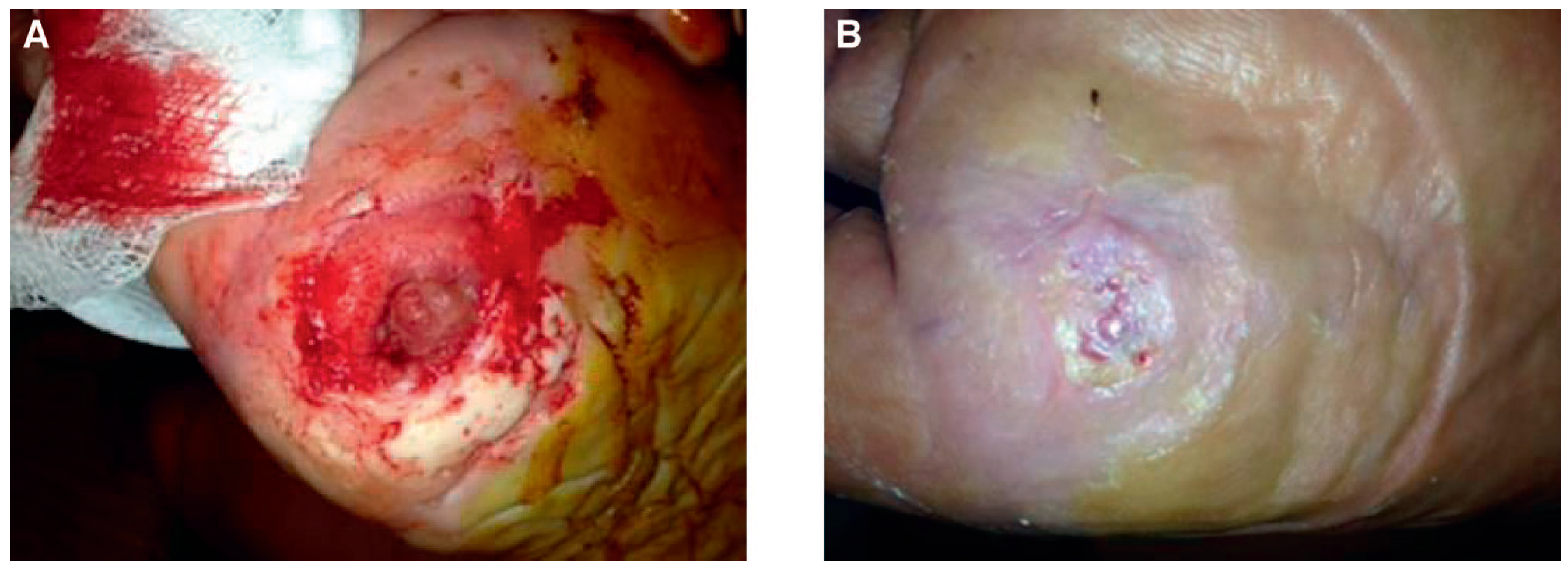
Examples of results achieved with dHACM are presented in
Figures 1 and
2.
Figure 1 shows an 8.74-cm
2 surgical wound resulting from partial first-ray amputation due to gas gangrene in a 55-year-old man. The wound failed to heal with good wound-care practices, including appropriate dressings, debridement, off-loading, and treatment with SNAP negative pressure wound therapy (Acelity, San Antonio, Texas), but once dHACM was initiated, the wound healed completely after 5 weekly applications.
Figure 2 shows a 0.35-cm
2 DFU in a 65-year-old man. The DFU failed to heal after 8 weeks of treatment with good wound-care practices, including appropriate dressings, debridement, off-loading, and Dermagraft (Organogenesis Inc, Canton, Massachusetts) and Medihoney (Derma Sciences, Princeton, New Jersey) yet went on to heal completely with 7 weekly applications of dHACM.
Figure 1.
Case 1. Surgical patient with an 8.74-cm2 wound before dehydrated human amnion/chorion membrane (dHACM) treatment (A) and healed after five dHACM applications (B).
Figure 1.
Case 1. Surgical patient with an 8.74-cm2 wound before dehydrated human amnion/chorion membrane (dHACM) treatment (A) and healed after five dHACM applications (B).
Figure 2.
Case 2. A 0.35-cm2 diabetic foot ulcer (DFU) that failed to heal over 8 weeks with treatment with Dermagraft and Medihoney. A, Deep nonhealing DFU before dehydrated human amnion/chorion membrane (dHACM) treatment. B, Healed DFU after seven dHACM applications.
Figure 2.
Case 2. A 0.35-cm2 diabetic foot ulcer (DFU) that failed to heal over 8 weeks with treatment with Dermagraft and Medihoney. A, Deep nonhealing DFU before dehydrated human amnion/chorion membrane (dHACM) treatment. B, Healed DFU after seven dHACM applications.
Discussion
Evidence from randomized controlled trials determines the efficacy of a treatment or intervention under precise conditions, whereas observational studies often include patients who would have been excluded from the initial studies. The results of the present observational study provide important data regarding the effectiveness of dHACM in a variety of wound types. More than 90% of patients with DFUs, VLUs, pressure ulcers, surgical wounds, and traumatic wounds achieved complete healing of their wounds when dHACM was used adjunctively with good wound care.
In the diabetic population, DFUs are a common complication. Management of a patient with a lower-extremity ulcer significantly increases health-care costs. Because diabetic ulcers heal slowly, they are often complicated by infection, which in turn leads to more serious complications, such as cellulitis or osteomyelitis with subsequent physician visits, hospitalization, or amputation. Treatments that promote rapid and complete wound healing can help reduce the risk of infections and amputations. In 2010, approximately 73,000 nontraumatic lower-limb amputations were performed in adults 20 years or older with diagnosed diabetes in the United States. Approximately 60% of nontraumatic lower-limb amputations in people 20 years or older occur in people with diagnosed diabetes.[
8]
Of the 33 patients with DFUs described herein, 90.9% achieved complete healing with weekly applications of dHACM, a rate that compares favorably with the 92% rate of complete healing reported by Zelen et al[
3] in the pivotal study comparing treatment with dHACM (n = 12) with standard wound care (n = 13) in patients with DFUs.
Venous stasis (VLUs) poses a substantial economic burden on society. Standard of care includes multilayer compression therapy with dressings and pumps. In a 4-week randomized trial, Serena et al[
7] showed that application of even one dHACM allograft in addition to multilayer compression results in an accelerated rate of wound closure compared with compression alone, suggesting the effectiveness of dHACM as a treatment for VLUs. Our experience supports these early results, with our patients achieving a complete healing rate of 92.9% for VLUs treated with weekly application of dHACM in addition to multilayer compression.
Not surprisingly, only 40% of our patients with ischemic wounds treated with dHACM went on to heal. Ischemia, along with deep infection and uncontrolled deformity, are often recognized as factors influencing a wound's ability to heal.[
9] In patients with ischemic wounds who are not candidates for revascularization, studies are needed that examine the use of advanced treatments such as dHACM in conjunction with hyperbaric oxygen or other medical management geared toward improving peripheral perfusion.
Randomized trials have focused on the use of dHACM for the treatment of difficult-to-heal DFUs and VLUs,[
3-
7] although in clinical practice its use is not, and should not, be limited to those wound types alone. In our clinic we use dHACM to treat nonhealing wounds of various etiologies. Other authors have also published their experience with using dHACM as a treatment for pressure wounds, surgical wounds, and traumatic wounds.[
10-
14] The results we observed from our larger data set further support the use of dHACM.
We appreciate that there are limitations inherent to any retrospective data analysis. These data represent our experience and may not be duplicated in situations when different clinical protocols are in place or practice of a consistent high level of standard wound care is not adhered to. Because we made our observations from data collected in the clinical setting and not within a rigid study protocol, we were unable to determine whether variations existed in patient compliance and in how certain procedures such as debridement, off-loading, wound dressing, or wound measurement were performed during the 2-year period, and how these potential variations may have influenced healing rates with treatments received before dHACM. There remains value though in observational data to evaluate how a treatment performs in patients who perhaps would not have met the strict criteria used in a randomized controlled trial. In these consecutive dHACM-treated patients, we were encouraged to observe treatment outcomes with dHACM, which were similar to those reported in prospective studies. Because we did not compare our results with dHACM with other advanced treatment modalities, we cannot say with certainty that the outcomes we observed were due to only dHACM or would have been similar with other advanced wound-care products. We do not know and cannot control for the role that clinical judgment played in the decision to use dHACM versus other products or treatments, and whether this instilled bias into the results. In our experience, we do believe that proper wound preparation with sharp debridement had a positive effect on the results and is vital for treatment success. Note that the complexity of wound etiology, the presence of comorbidities and microvascular disease or infection, and patient factors such as noncompliance, smoking, body mass, and nutrition will continue to influence the ultimate healing outcomes, regardless of treatment modality.
In conclusion, we believe that treatment with dHACM can significantly expedite healing in refractory wounds of varying etiologies.