Next Article in Journal
The Ring Verruca Plantaris in Cantharidin Use. A Case Report
Previous Article in Journal
Retained Wooden Foreign Body in the Second Metatarsal
 
 
Journal of the American Podiatric Medical Association is published by MDPI from Volume 116 Issue 1 (2026). Previous articles were published by another publisher in Open Access under a CC-BY (or CC-BY-NC-ND) licence, and they are hosted by MDPI on mdpi.com as a courtesy and upon agreement with American Podiatric Medical Association.
Article

Diffuse Pigmented Villonodular Synovitis Around the Ankle

by
Keiichi Muramatsu
*,
Ryuta Iwanaga
,
Yasuhiro Tominaga
,
Takahiro Hashimoto
and
Toshihiko Taguchi
Department of Orthopedic Surgery, Yamaguchi University School of Medicine, Ube, Japan
*
Author to whom correspondence should be addressed.
J. Am. Podiatr. Med. Assoc. 2018, 108(2), 140-144; https://doi.org/10.7547/16-100
Published: 1 March 2018

Abstract

Background: Pigmented villonodular synovitis (PVNS) is a rare disorder around the ankle joint. The optimal treatment for diffuse-type PVNS is still controversial because of the high incidence of recurrence. We present the clinical features of our patients and review the current diagnostic and treatment modalities. Methods: Five patients with PVNS located around the ankle were surgically treated. In three patients, diffuse PVNS arose from the ankle joint, and in the other two it arose from the calcaneocuboid and intercuneiform joints. The average follow-up time after surgery was 2.9 years (range, 2–4.6 years). Results: The average time between onset of pain and diagnosis of PVNS was 6.4 years (range, 4–10 years). Arthrotomic tumor resection was performed in all of the patients. In the three patients with ankle joint PVNS, both medial and lateral approaches were used. One patient experienced mild infection at the surgical site, but this healed conservatively. No tumor recurrences had occurred after minimum follow-up of 2 years, although mild pain persisted in the three patients with ankle PVNS. Conclusions: Diagnosis of diffuse PVNS is frequently delayed due to vague symptoms and variable growth patterns. Orthopedic clinicians should be aware of the existence of this lesion, and it should be suspected in patients with persistent ankle swelling. To prevent tumor recurrence, accurate evaluation of tumor location and careful operative planning are mandatory. A combined surgical approach involving medial and lateral incision is necessary to expose the entire joint cavity.

Pigmented villonodular synovitis (PVNS) was first described by Jaffe et al[1] in 1941 as an idiopathic benign lesion of the synovial tissue. It most frequently affects patients in the third to fifth decades of life, with no significant sex difference.[2] The most common location is the knee joint, accounting for 75% of PVNS, followed by the hip joint, ankle, and foot.[3,4] The incidence of PVNS in the ankle joint is approximately 2.5%,[5] but occurrence in the subtalar joint, talonavicular joint, and tasometatarsal bones is very rare. To our knowledge, several reports have described PVNS in the foot and ankle.[6,7,8,9] Mavrogenis et al[10] presented the case of a 40-year-old man with PVNS arising from the distal tibiofibular joint. Bisbinas et al[11] reported the largest series to date of nine patients with PVNS in the foot and ankle. In their series, the localized type was more frequent and often occurred in children. Carpintero et al[9] presented five patients with PVNS in the rearfoot.
The etiology of PVNS has been the subject of much speculation. Several authors have suggested chronic inflammation,[12] a neoplastic origin,[13] lipid metabolism disturbance or trauma, and recurrent hemorrhage as possible causes.[14] Chromosomal abnormalities have also been suggested.[12] The mechanism of bony involvement is also uncertain. Oehler et al[15] proposed that chronic inflammation increased articular bleeding, leading to altered iron processing by synovial macrophages. Recently, the presence of specific matrix metalloproteinases produced by PVNS tissue has been demonstrated.[16] These have the potential to cause osteochondral destruction. Uchibori et al[17] showed that collagenase I and collagenase IV were expressed in PVNS and hypothesized that these metalloproteinases may be partially responsible for PVNS pathology.
Pigmented villonodular synovitis can radiate from a primary point to surrounding joints, ligaments, fascial planes, tendons, and neurovascular bundles. Granowitz et al[18] classified PVNS into three categories with similar histology. The first category comprises isolated lesions occurring in a tendon sheath, most commonly in the hand. The second category comprises localized PVNS, most commonly found in the knee. The third category comprises diffuse PVNS, which most commonly arises in the hip and ankle.
The PVNS lesions can also be divided into diffuse or local, and either intra-articular or extra-articular.[19] Diffuse PVNS involves the entire joint synovium, whereas the localized type involves a more discrete nodular, lobulated mass. Intra-articular PVNS most commonly occurs in the knee joint, and extra-articular PVNS arises in the hip and ankle joint.
Early clinical diagnosis of foot and ankle PVNS is a challenging problem. Diagnosis is frequently delayed due to vague symptom concerns by patients. The optimal surgical treatment is still controversial. The recurrence rate has been reported to be unexpectedly high,[5] and the complication rate is increased in the revision surgery. In this study, we reviewed five patients with diffuse PVNS arising in the foot and ankle. We present the clinical features of these patients and assess the surgical outcomes. We also review the current diagnostic and treatment modalities for this difficult lesion.

Patients and Methods

Since 2010, five patients with PVNS located around the ankle were treated surgically in the Department of Orthopedic Surgery, Yamaguchi University School of Medicine, Yamaguchi, Japan: four women and one man aged 32 to 56 years (average age, 47 years). In three patients, diffuse PVNS arose from the ankle joint, and in the other two it arose from the calcaneocuboid and intercuneiform joints.
Preoperative diagnosis was made using clinical findings, plain film radiographs, computed tomography (CT), and magnetic resonance imaging (MRI). All of the patients underwent surgical excision by one surgeon (K.M.). Mean follow-up after surgery was 2.9 years (range, 2–4.6 years).

Results

Clinical Symptoms and Diagnosis of PVNS

The main symptoms associated with PVNS arising in the ankle joint were similar to those encountered with common osteoarthritis, namely, pain and persistent swelling. This could not always be controlled by nonsteroidal anti-inflammatory drugs. The range of motion of the affected ankle joint was limited in three patients. All of the patients had bony erosion of the tarsal bones on plain film radiographs and CT scans.
The mean time from onset of pain to diagnosis of PVNS was 6.4 years (range, 4–10 years). The diagnosis of diffuse PVNS was obtained by MRI showing a heterogeneous lesion with low signal on T1-weighted images and high signal on T2-weighted images. Open biopsy was performed in two patients before surgical resection, and this confirmed a diagnosis of PVNS. In the other three patients, PVNS was confirmed during surgery.

Operative Outcomes

Arthrotomic tumor resection was performed in all of the patients. In the three patients with ankle joint PVNS, both medial and lateral approaches were used to reveal the whole joints. Diffuse PVNS caused enlargement of the anterior and posterior joint space and invaded all of the ligaments and the capsule, making it difficult to resect completely. For the other two patients, PVNS was carefully resected after longitudinal incision. The diagnosis of PVNS was confirmed by histopathologic analysis. One case experienced mild infection at the surgical site, but this healed conservatively. There were no tumor recurrences after minimum follow-up of 2 years, although mild pain persisted in the three patients with ankle PVNS.

Representative Case Presentation (Case 2)

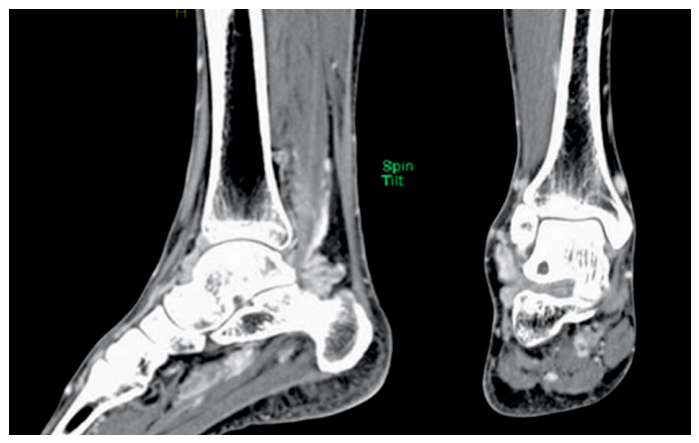
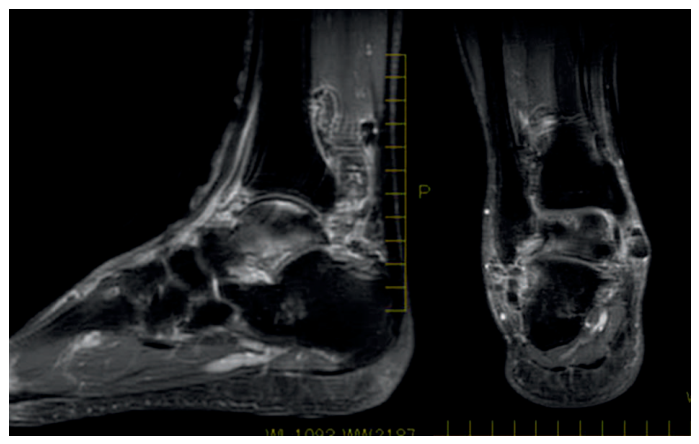
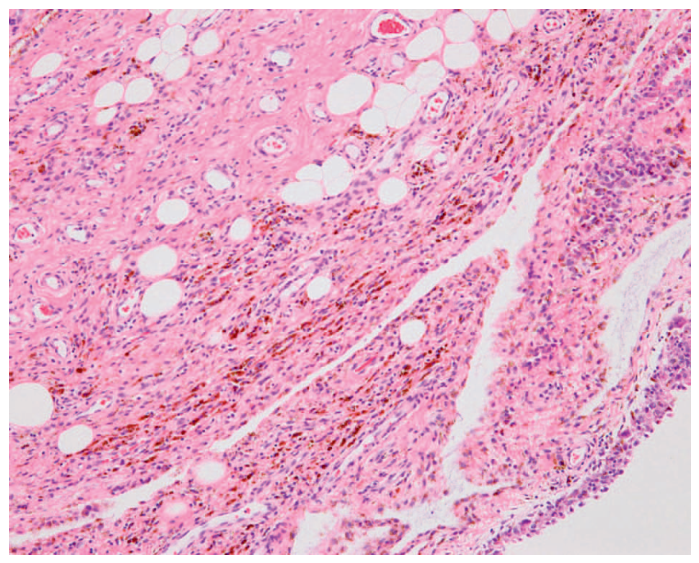
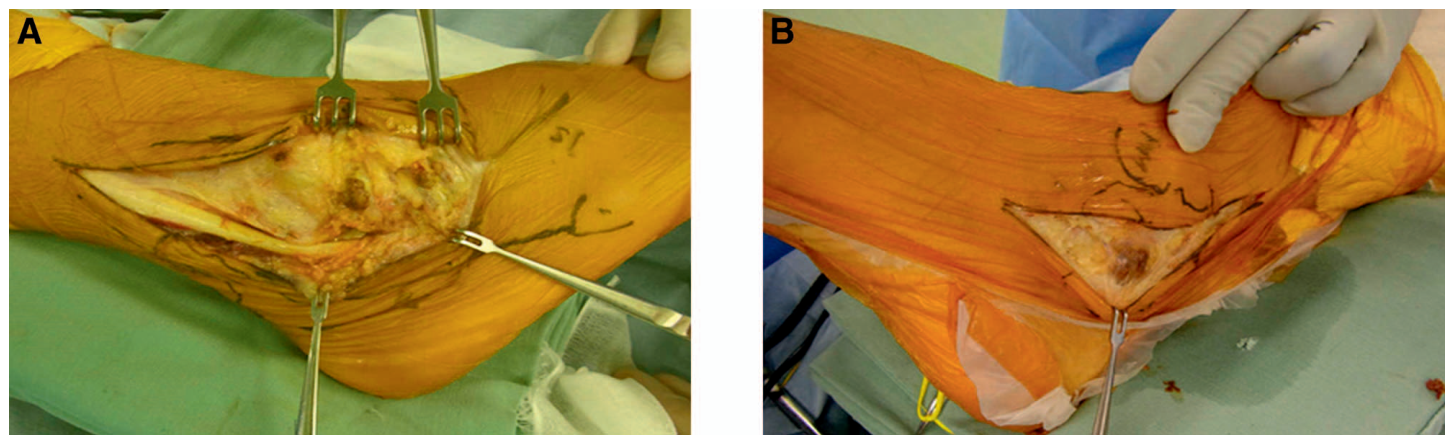
A 55-year-old man presented to an orthopedic clinic with swelling and pain of the left ankle joint that began 10 years earlier. He was subsequently referred to our university hospital. Range of motion was limited, with extension of 08 and flexion of 408. Radiographs showed mild swelling around the ankle joint, and CT showed narrowing of the joint space (Figure 1). An MRI revealed an intra-articular diffuse lesion located in both the anterior and posterior, medial and lateral ankle joints (Figure 2). The intensity of the diffuse lesion was heterogeneous, with low signal on T1-weighted images and high signal on T2weighted images. The preoperative diagnosis was intra-articular diffuse synovitis with suspected PVNS. To obtain a definitive diagnosis, open biopsy was performed, and subsequent histologic examination confirmed PVNS (Figure 3). Open surgery was performed from both the lateral (Figure 4A) and medial (Figure 4B) sides, with removal of as much as possible of the PVNS. The joint cartilage was not smooth due to the invasion of PVNS. Two years after open surgery, the ankle joint showed limited range of motion and mild pain, but no sign of tumor recurrence.

Discussion

Early clinical diagnosis of ankle PVNS is a challenging problem.[9] The five patients described herein noted nonspecific symptoms. Examination revealed diffuse swelling of the ankle joint and limited range of motion. Orthopedic surgeons are mostly unfamiliar with this rare lesion.
As highlighted by Kallas et al,[20] diagnosis is frequently delayed due to vague symptom cooncerns by patients, together with variable growth patterns and tumor extension. The time lag between onset of symptoms and diagnosis of PVNS about the ankle has been reported to be 28 to 38 months on average. In the present patients, the mean time from onset of pain to diagnosis of PVNS was 6.4 years. The lengthy timespan suggests that PVNS of the ankle joint can easily be misdiagnosed as other conditions. The differential diagnosis includes osteoarthritis, rheumatoid arthritis, hemophilic arthritis, and synovial hemangioma.
As first described by Kottal et al[21] and Maldjian and Rosenberg,[22] MRI is the modality of choice for the diagnosis of PVNS. We diagnosed PVNS of the ankle by MRI and confirmed it by histologic analysis. Specimens can be obtained by either biopsy or surgical excision. Histopathologic analysis showed fibrous stroma, hemosiderin deposits, histiocyte infiltration, foam cells, and multinucleated giant cells. In diffuse-type PVNS, thin villous processes with vascular channels and hemosiderin deposits are visible in the synovial membrane. Orthopedic clinicians should be aware of the existence of this lesion, and it should be suspected in patients with persistent and localized swelling of the foot and ankle.
The optimal treatment for PVNS is still controversial. The localized type is well controlled by wide surgical excision. However, PVNS around the ankle can be a challenging clinical problem, particularly when there is diffuse involvement and, hence, the potential for progressive tissue destruction.[23] Diffuse PVNS in the foot and ankle often involves more than one joint in the same area. Aggressive surgical debridement is recommended to prevent local recurrence. In the five patients described herein, diffuse PVNS invaded the ligament complexes about the ankle, and bony invasion had also occurred. The recurrence rate for diffuse PVNS may be as high as 50%.[23] If the tumor recurs, revision surgery is more technically demanding and the complication rate is increased.
To prevent tumor recurrence, accurate evaluation of tumor location and careful operative planning are mandatory. Complete excision of diffuse PVNS at the ankle joint is technically very difficult because of the unique features of this condition.[24] A combined surgical approach involving medial and lateral incision is necessary to expose the entire joint cavity. Because it is less invasive, cryotherapy may be an effective adjuvant therapy,[25] although we have no experience with this method. Preoperative or postoperative irradiation could also be a useful adjuvant therapy.[26,27] However, we do not use radiotherapy for benign tumors, especially in young patients, owing to the potential for secondary induced cancer.

Funding

None reported.

Conflicts of Interest

None reported.

References

  1. JAFFE, H.; LICHTENSTEIN, L. SUTRO C: Pigmented villonodular synovitis, bursitis and tenosynovitis. Arch Pathol 1941, 31, 731. [Google Scholar]
  2. DORWART, R.H.; GENANT, H.K.; JOHNSTON, W.H.; et al. Pigmented villonodular synovitis of synovial joints: clinical, pathologic, and radiologic features. Am J Roentgenol 1984, 143, 877. [Google Scholar] [CrossRef]
  3. KLOMPMAKER, J.; VETH, R.P.; ROBINSON, P.H. ET AL: Pigmented villonodular synovitis. Arch Orthop Trauma Surg 1990, 109, 205. [Google Scholar] [CrossRef]
  4. MYERS, B.W.; MASI, A.T.; FEIGENBAUM, S.L. Pigmented villonodular synovitis and tenosynovitis: a clinical and epidemiologic study of 166 cases and literature review. Medicine 1980, 59, 223. [Google Scholar] [CrossRef]
  5. HELLER, S.L.; O’LOUGHLIN, P.F.; DI CARLO, G.; et al. Pigmented villonodular synovitis about the ankle: two case reports. Foot Ankle Int 2008, 29, 527. [Google Scholar] [CrossRef] [PubMed]
  6. DUNCAN, N.; RAJAN, R. Case report of pigmented villonodular synovitis arising from the calcaneocuboid joint in a 12 year old male. Foot (Edinb) 2015, 25, 59. [Google Scholar] [CrossRef] [PubMed]
  7. STEVENSON, J.D.; JAISWAL, A.; GREGORY, J.J.; et al. Diffuse pigmented villonodular synovitis (diffuse-type giant cell tumour) of the foot and ankle. Bone Joint J 2013, 95-B, 384. [Google Scholar] [CrossRef]
  8. HAO, D.P.; ZHANG, J.Z.; XU, W.J.; et al. Pigmented villonodular synovitis of the ankle: radiologic characteristics. JAPMA 2011, 101, 252. [Google Scholar] [CrossRef] [PubMed]
  9. CARPINTERO, P.; GASCON, E.; MESA, M.; et al. Clinical and radiologic features of pigmented villonodular synovitis of the foot: report of eight cases. JAPMA 2007, 97, 415. [Google Scholar] [CrossRef]
  10. Mavrogenis, A.F.; Papaparaskeva, K.T.; Galanakos, S. Clin Podiatr Med Surg 2011, 28, 589. [CrossRef]
  11. BISBINAS, I.; DE SILVA, U.; GRIMER, R.J. Pigmented villonodular synovitis of the foot and ankle: a 12-year experience from a tertiary orthopedic oncology unit. J Foot Ankle Surg 2004, 43, 407. [Google Scholar] [CrossRef] [PubMed]
  12. SAKKERS, R.J.; DEJONG, D. VAN DER HEUL RO: X-chromosome inactivation in patients who have pigmented villonodular synonitis. J Bone Joint Surg Am 1991, 73, 1532. [Google Scholar] [CrossRef]
  13. CHOONG, P.F.; WILLEN, H.; NILBERT, M.; et al. Pigmented villonodular synonitis: monoclonality and metastasis—a case for neoplastic origin? Acta Orthop Scand 1995, 66, 64. [Google Scholar] [CrossRef] [PubMed]
  14. SINGH, R.; GREWAL, D.S.; CHAKRAVARTI, R.N. Experimental production of pigmented villonodular synovitis in the knee and ankle joints of rhesus monkeys. J Pathol 1969, 98, 137. [Google Scholar] [CrossRef]
  15. OEHLER, S.; FASSBENDER, H.G.; NEUREITER, D.; et al. Cell populations involved in pigmented villonodular synovitis of the knee. J Rheumatol 2000, 27, 463. [Google Scholar]
  16. O’KEEFE, R.J.; ROSIER, R.N.; TEOT, L.A.; ET, A.L. Cytokine and matrix metalloproteinase expression in pigmented villonodular synovitis may mediate bone and cartilage destruction. Iowa Orthop J 1998, 18, 26. [Google Scholar]
  17. UCHIBORI, M.; NISHIDA, Y.; TABATA, I.; et al. Expression of matrix metalloproteinases and tissue inhibitors of metalloproteinases in pigmented villonodular synovitis suggests their potential role for joint destruction. J Rheumatol 2004, 31, 110. [Google Scholar]
  18. GRANOWITZ, S.P.; D’ANTONIO, J.; MANKIN. HL: The pathogenesis and long-term end results of pigmented villonodular synovitis. Clin Orthop Relat Res 1976, 114, 335. [Google Scholar]
  19. VILLANI, C.; TUCCI, G.; DI MILLE, M.; et al. Extra-articular localized nodular synovitis (giant cell tumor of tendon sheath origin) attached to the subtalar joint. Foot Ankle Int 1996, 17, 413. [Google Scholar] [CrossRef]
  20. KALLAS, K.M.; VAUGHAN, L.; HAGHIGHI, P. ET AL: Pigmented villonodular synovitis of the hip presenting as a retroperitoneal mass. Skeletal Radiol 2001, 30, 469. [Google Scholar] [CrossRef]
  21. KOTTAL, R.A.; VOGLER, J.B., III; MATAMOROS, A. ET AL: Pigmented villonodular synovitis: a report of MR imaging in two cases. Radiology 1987, 163, 551. [Google Scholar] [CrossRef] [PubMed]
  22. MALDJIAN, C.; ROSENBERG, Z.S. MR imaging features of tumors of the ankle and foot. Magn Reson Imaging Clin North Am 2001, 9, 639. [Google Scholar] [CrossRef]
  23. KORIM, M.T.; CLARKE, D.R.; ALLEN, P.E.; et al. Clinical and oncological outcomes after surgical excision of pigmented villonodular synovitis at the foot and ankle. Foot Ankle Surg 2014, 20, 130. [Google Scholar] [CrossRef]
  24. SCHWEITZER, K.M., JR.; PAREKH, S.G. Pigmented villonodular synovitis of the ankle: an anterior-posterior technique for excision. Foot Ankle Spec 2013, 6, 232. [Google Scholar] [CrossRef]
  25. MOHLER, D.G.; KESSLER, B.D. Open synovectomy with cryosurgical adjuvant for treatment of diffuse pigmented villonodular synovitis of the knee. Bull Hosp Jt Dis 2000, 59, 99. [Google Scholar] [PubMed]
  26. BRIEN, E.W.; SACOMAN, D.M.; MIRRA, J.M. Pigmented villonodular synovitis of the foot and ankle. Foot Ankle Int 2004, 25, 908. [Google Scholar] [CrossRef] [PubMed]
  27. LEE, M.; MAHROOF, S.; PRINGLE, J.; et al. Diffuse pigmented villonodular synovitis of the foot and ankle treated with surgery and radiotherapy. Int Orthop 2005, 29, 403. [Google Scholar] [CrossRef]
Figure 1. Case 2 is a 55-year-old man with swelling and pain of the left ankle joint that began 10 years earlier. Computed tomography shows joint space narrowing and bony erosion of the tarsal bone.
Japma 108 00140 g001
Figure 2. Magnetic resonance imaging reveals an intra-articular diffuse lesion located in both the anterior and posterior, medial and lateral ankle joints. The lesion was enhanced with gadolinium.
Japma 108 00140 g002
Figure 3. Pathology findings demonstrate several synovial villi containing histiocytes and foamy macrophages. The histologic diagnosis was pigmented villonodular synovitis (H&E, 3100).
Japma 108 00140 g003
Figure 4. Open surgery was performed from both the lateral (A) and medial (B) sides to expose the entire joint cavity.
Japma 108 00140 g004