Next Article in Journal
Diffuse Pigmented Villonodular Synovitis Around the Ankle
Previous Article in Journal
A Survey of Patient Care Handoff and Sign-Out Practices Among Podiatric Surgical Residency Programs
 
 
Journal of the American Podiatric Medical Association is published by MDPI from Volume 116 Issue 1 (2026). Previous articles were published by another publisher in Open Access under a CC-BY (or CC-BY-NC-ND) licence, and they are hosted by MDPI on mdpi.com as a courtesy and upon agreement with American Podiatric Medical Association.
Article

Retained Wooden Foreign Body in the Second Metatarsal

Bridgeport Hospital, Yale New Haven Health System, Bridgeport, CT
*
Author to whom correspondence should be addressed.
J. Am. Podiatr. Med. Assoc. 2018, 108(2), 168-171; https://doi.org/10.7547/16-095
Published: 1 March 2018

Abstract

The foot is considered the second most common location for foreign bodies. The most common foreign bodies include needles, metal, glass, wood, and plastic. Although metallic foreign bodies are readily seen on plain film radiographs, radiolucent bodies such as wood are visualized poorly, if at all. Although plain radiography is known to be ineffective for demonstrating radiolucent foreign bodies, it is often the first imaging modality used. In such cases, complete surgical extraction cannot be guaranteed, and other imaging modalities should be considered. We present a case of a retained toothpick of the second metatarsal in a young male patient who presented with pain in the right foot of a few weeks’ duration. Plain radiography showed an oval cyst at the base of the second metatarsal of the right foot. Magnetic resonance imaging revealed a toothpick penetrating the second metatarsal. The patient recalled stepping on a toothpick 8 years previously. Surgical exploration revealed a 2-cm toothpick embedded inside the second metatarsal.

Foreign bodies of the foot are common problems. If not removed, a foreign body may result in inflammatory or severe infectious complications, including cellulitis, abscess, draining sinuses, osteomyelitis, and septic arthritis.[1,2,3,4,5] Missed foreign bodies are common, and one study suggests that approximately 38% of patients had foreign bodies that were missed on the initial encounter.[6] Furthermore, retained foreign bodies are also one of the most common reasons for lawsuits against emergency department physicians.[7]
There are several challenges in diagnosing, localizing, and retrieving retained foreign bodies.[8] A high level of suspicion is the key to diagnosis. Laboratory investigations are usually noncontributory. A retained foreign body may present with a sudden onset of pain. It is also not uncommon for patients to report having removed the foreign body in its entirety, with resolution of pain at the time.
Because of its availability and effectiveness in detecting radiopaque objects, plain radiography is the initial test of choice in the investigation of foreign bodies in the foot.[9] However, organic foreign bodies tend not to be radiopaque, and plain films are usually negative unless there is a bone reaction.[9] The radiographic appearance of retained foreign bodies in the bone can mimic osteomyelitis or bone tumors,[10,11,12,13] as wood can induce osteolytic lesions of the metatarsal bones. Studies have shown that plain radiographs can detect approximately 80% of foreign bodies[14] but are negative in 86% of patients with wooden foreign bodies.[6]
The detectability of foreign bodies on conventional radiography depends on their physical basis. The higher the density and effective atomic number, the greater the amount of x-ray beams that are absorbed and subsequently the better the detectability.[15] The density of soft tissue is closer to water. Metal, stone, and graphite have remarkably higher density than soft tissues and consequently are radiopaque and easily detectable by radiography if they are surrounded by soft tissue.[9] The same applies to glass; however, detection of glass can be compromised in situations such as small size of the fragment and overlapping structures. The density of wood, acrylics, and plastics is similar to the surrounding soft tissue; therefore, they are radiolucent.[9]
Ultrasound is an excellent imaging modality for detecting radiolucent foreign bodies of the musculoskeletal system. It does not involve ionizing radiation and is widely available.[1] Foreign bodies of the musculoskeletal system usually show hyperechogenicity.[16] If the surface of a foreign body is irregular or curved, it will produce ‘‘clean’’ posterior shadowing. If the surface of the foreign body is smooth and flat, it will produce ‘‘dirty’’ shadowing. This has been described for glass, metal fragments, and plastic.[16]
In the setting of an inflammatory reaction, a hypoechoic rim surrounding the foreign body can be seen, which shows increased vascularity on power Doppler imaging.[17] Gas in soft tissues could result from the penetrating injury or may be an early sign of necrotic infection. Gas in soft tissues will produce a reverberation artifact on grayscale imaging.[18]
Computed tomography (CT) is an optimum modality for precise localization of radiopaque foreign bodies. Radiolucent foreign bodies (eg, wood) are moderately hyperattenuating and best visualized at a wide window setting.[1] Furthermore, CT may help in material identification on the basis of attenuation. One study demonstrated that glass has a relatively high density value of 2000 HU.[19] Another study demonstrated that lead, gold, and silver had values of 30,000, 22,000, and 11,000 HU, respectively.[20] Additionally, CT may demonstrate osseous reactions adjacent to longstanding foreign bodies, including lysis and sclerosis.[1]
Magnetic resonance imaging (MRI) is very reliable in localizing foreign bodies in the foot, especially in chronic and complicated cases. Foreign bodies will demonstrate hypointensity on both T1- and T2-weighted imaging.[10] The most important factor in localization of recently entered foreign bodies is a surrounding rim of fluidrich, T2-weighted, high-signal-intensity granulation tissue. Other inflammatory reactions include abscess formation, muscle edema, and indurated inflammatory mass. In the event that infection occurs, draining sinuses can appear as tracks with enhancing walls on contrast-enhanced T1-weighted images.
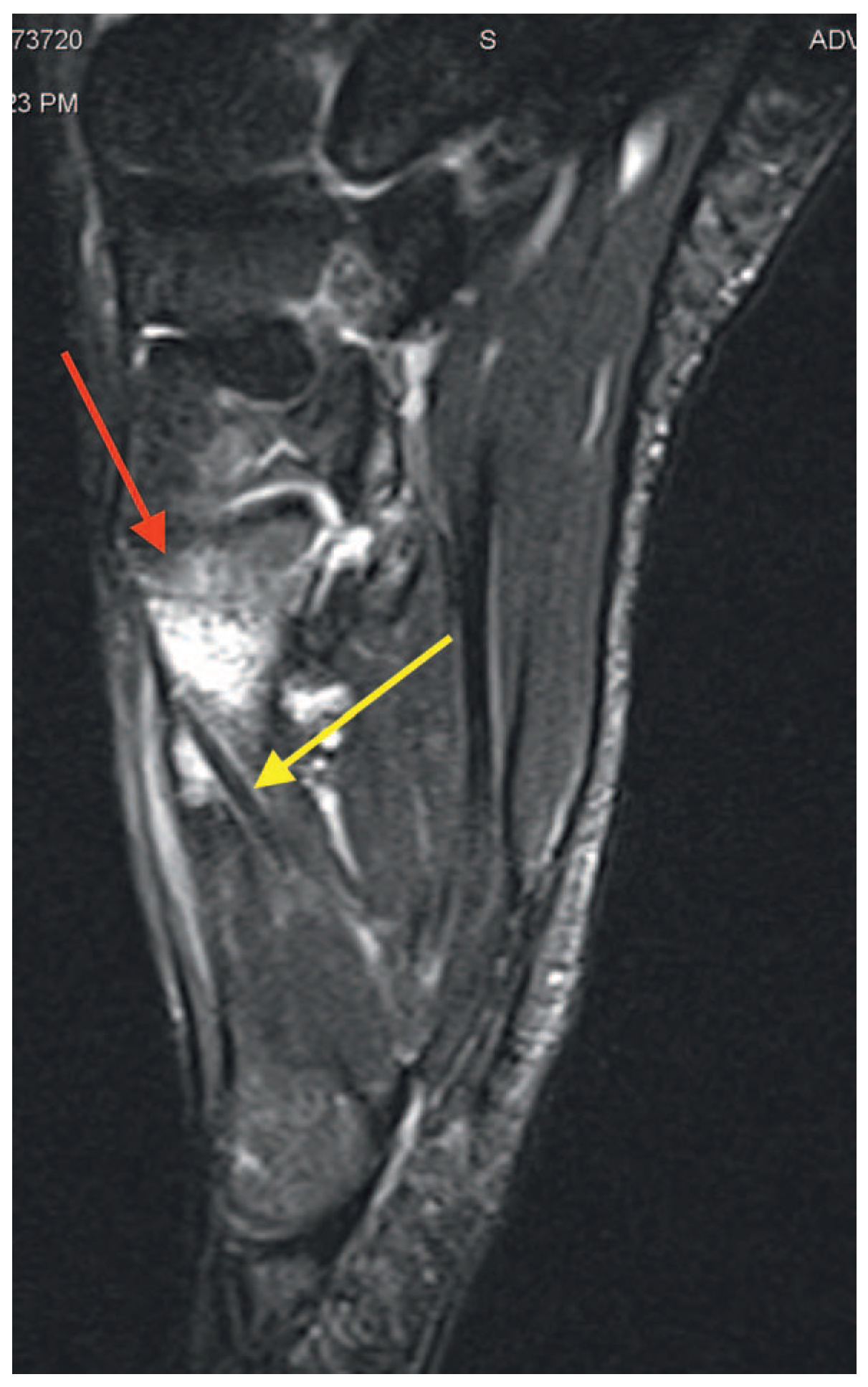
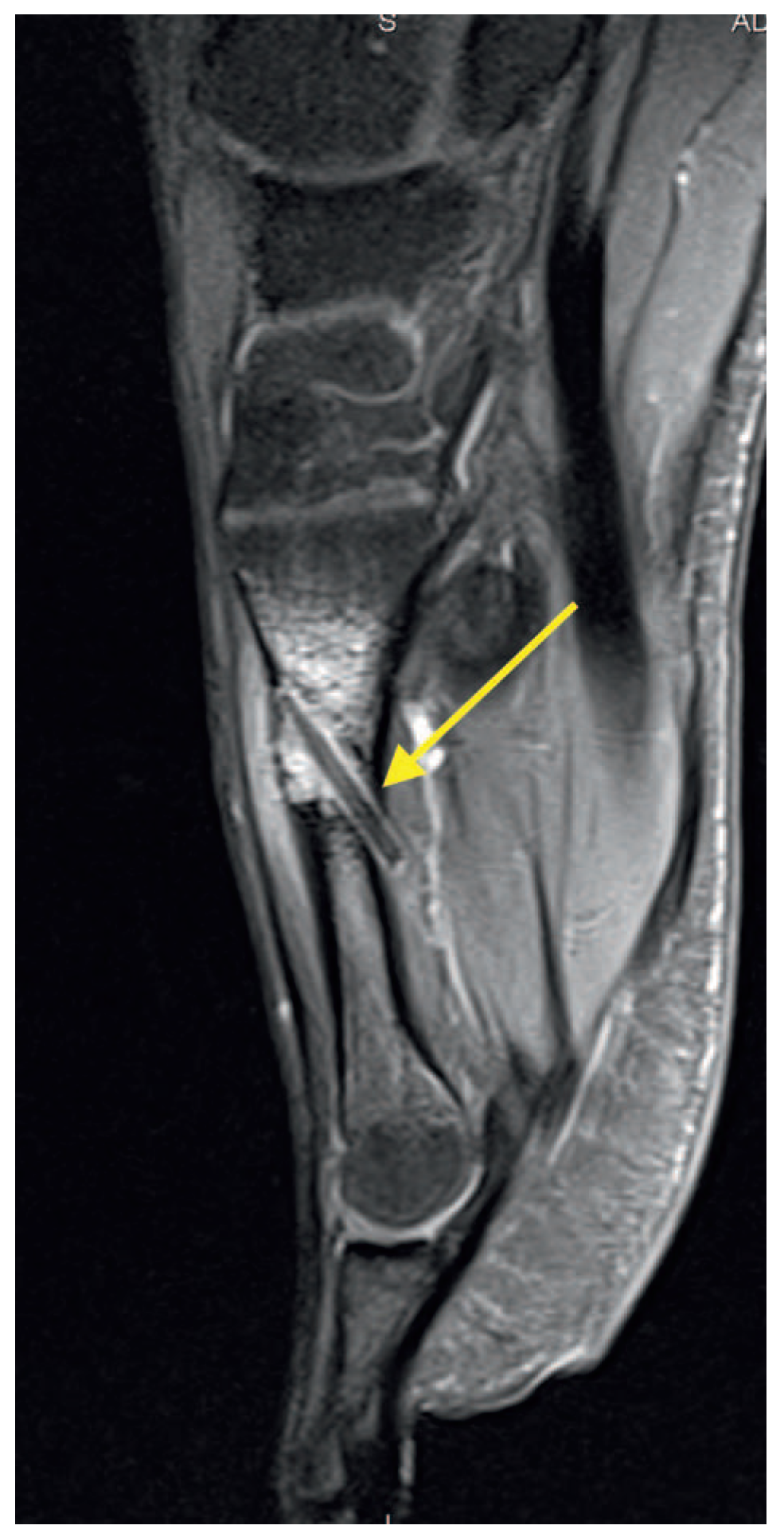
In our case, the toothpick appeared as a T1-weighted hypointense structure penetrating the right second metatarsal. There is associated intramedullary signal abnormalities, extensive bone marrow edema, soft-tissue edema, and some attenuation of the dorsal cortex.

Discussion

A healthy 17-year-old male patient presented to the podiatry office with concern about pain in the right foot. He stated that this had been going on for the past few weeks more intensely but reported some discomfort before that. Physical examination revealed a healthy patient with no evidence of neuromuscular disorder. Locally, there was no swelling, but there was some tenderness on firm examination at the base of the second metatarsal of the right foot.
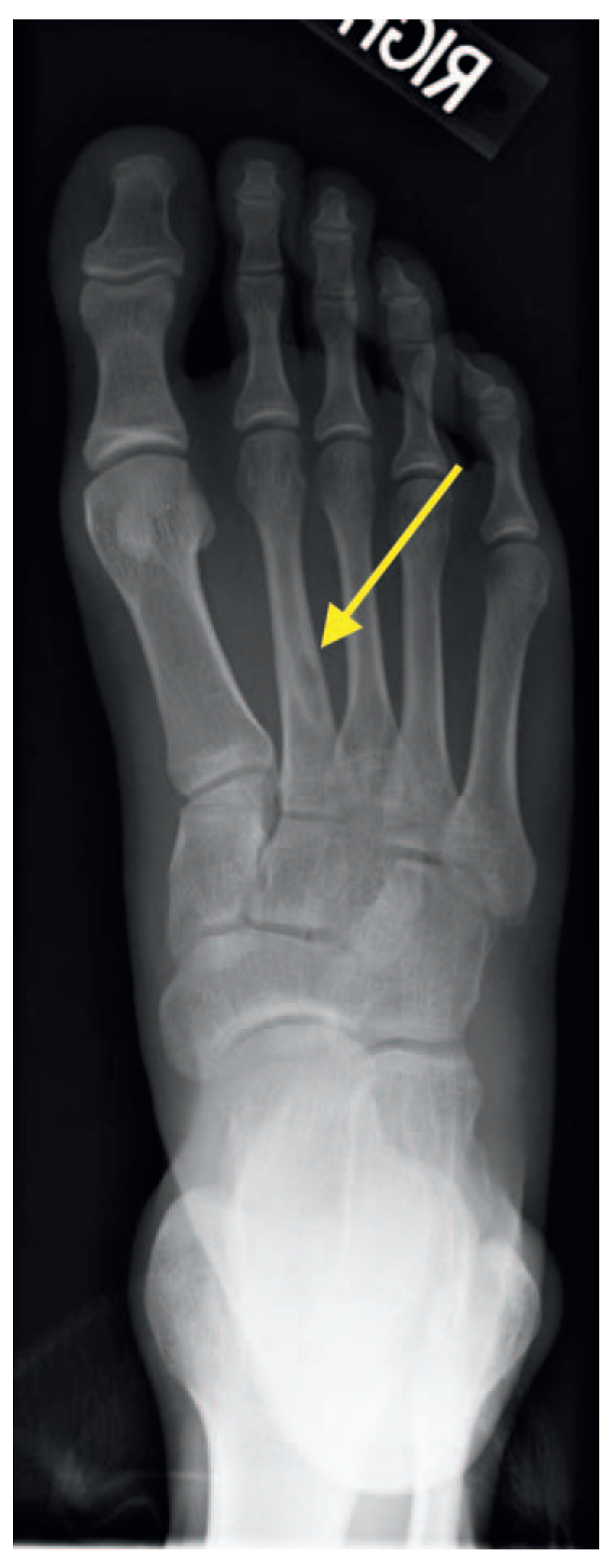
Plain films of the foot revealed an oval atypical osteolytic lesion approximately 2 cm in length at the base of the second metatarsal bone (Figure 1). Magnetic resonance imaging of the foot revealed intense bone marrow edema throughout the majority of the second metatarsal (Figure 2). On T1-weighted fatsaturated contrast-enhanced images, the toothpick was seen as a 2.2 3 0.3-cm hypointense linear foreign body penetrating the proximal second metatarsal bone obliquely toward the midshaft (Figure 3). These findings are consistent with the fact that the patient recalled having stepped on a toothpick 8 years previously.
The patient returned to the office, where removal of the foreign body was discussed. It was suggested that the most appropriate treatment was to remove the foreign body because it was possible that the patient had bone infection.
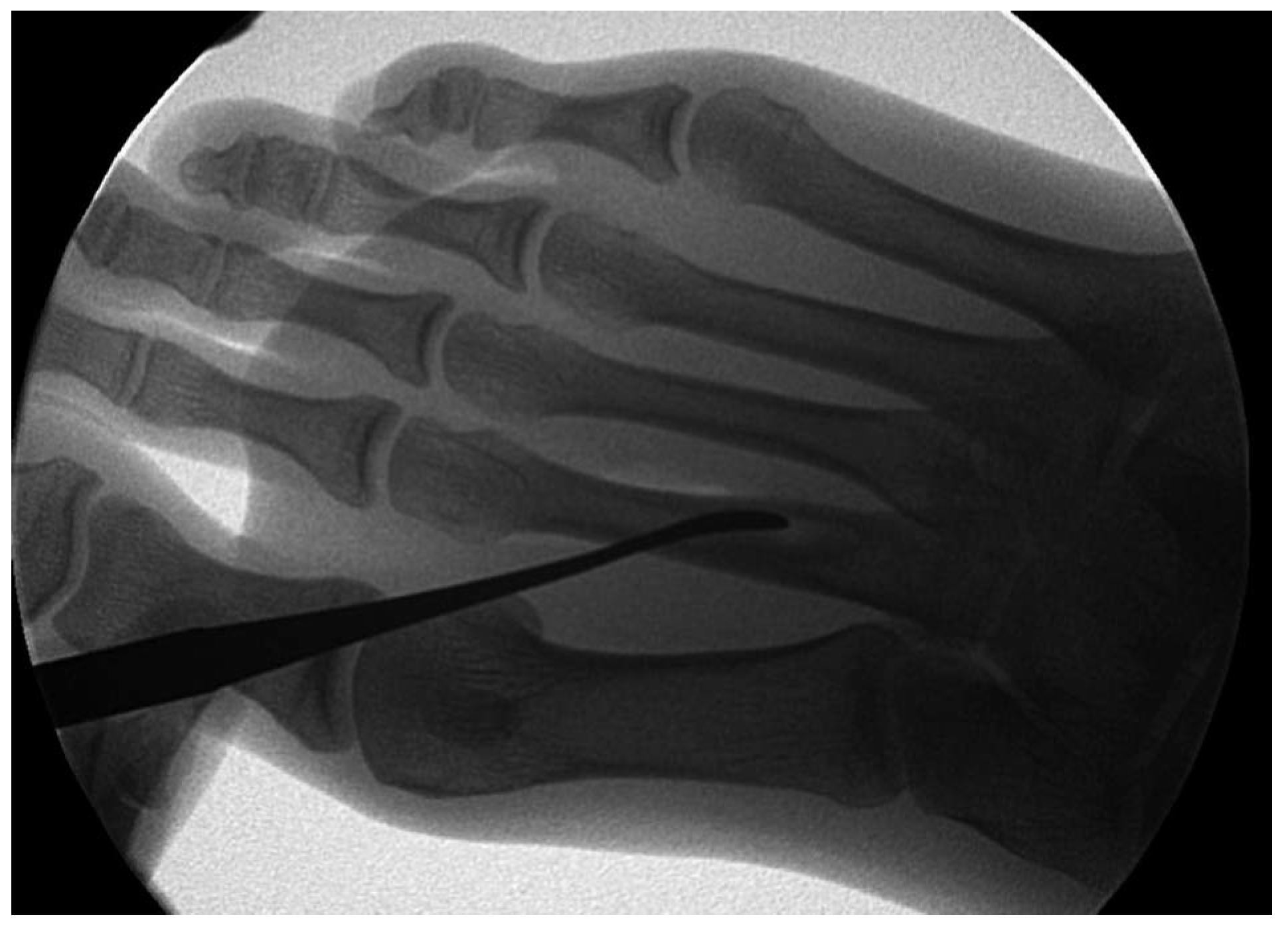
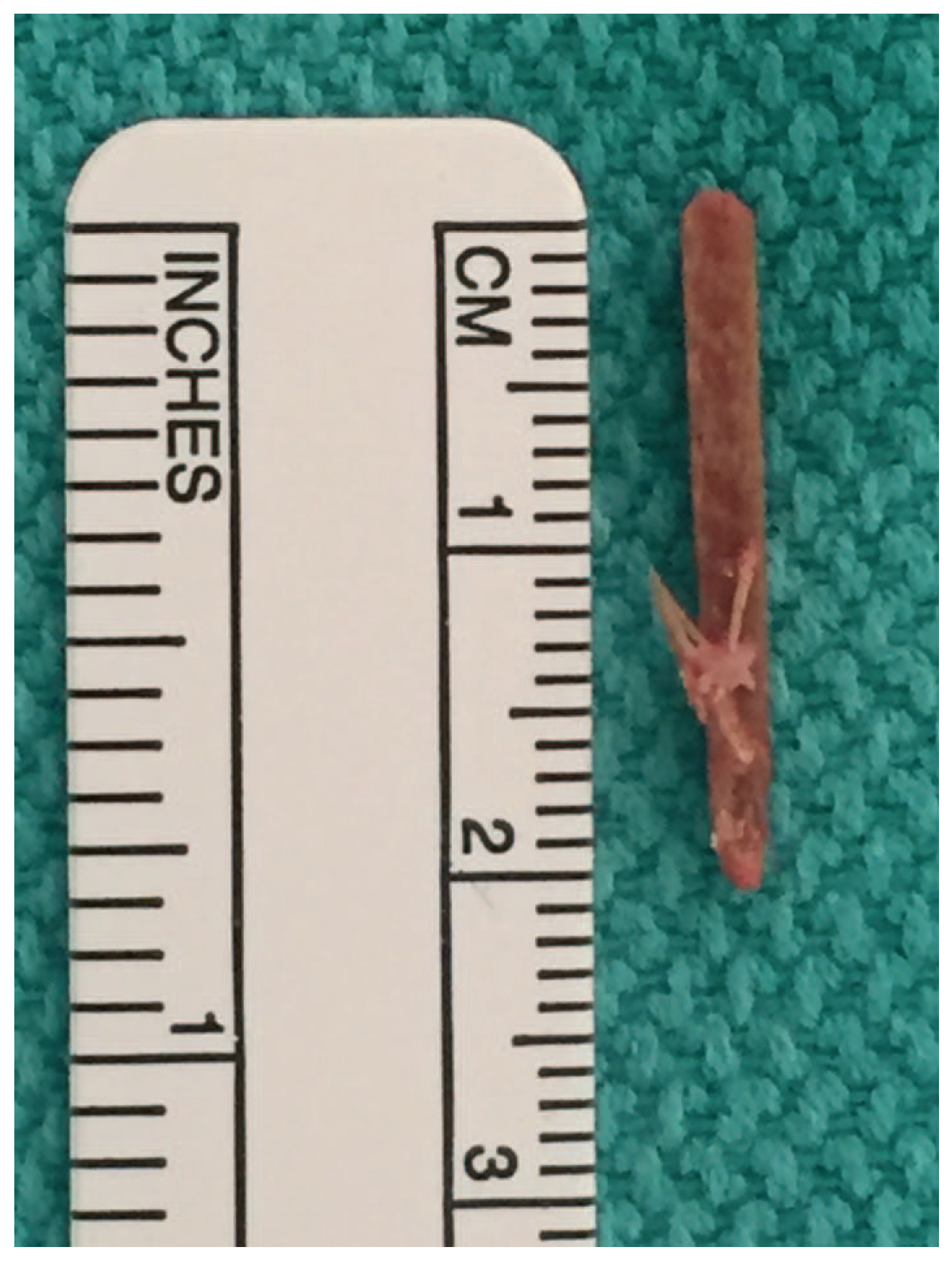
Surgical exploration through a dorsal approach to the proximal half of the second metatarsal bone revealed intact bone with no signs of foreign bodies. At this point, a C-arm was used and revealed a small area of radiolucency, which was marked (Figure 4). A small window was created in the second metatarsal that revealed wooden debris. Further exploration revealed a 2-cm linear piece of wood, which was removed and sent for pathologic examination (Figure 5). The lesion was irrigated. No bone graft was inserted into the residual cavity.
The pathologic findings were consistent with tan, woodlike material measuring 2.1 × 0.3 × 0.3 cm. There was no evidence of osteomyelitis on pathologic examination.

Conclusions

Foreign body identification by imaging can be difficult. Our case had an atypical osteolytic lesion on plain films, and MRI showed a foreign body with cortical destruction 8 years after the original injury. Negative plain films should not prevent further imaging with MRI if there is a high level of clinical suspicion.

Funding

None reported.

Conflicts of Interest

None reported.

References

  1. PETERSON, J.J.; BANCROFT, L.W.; KRANSDORF, M.J. Wooden foreign bodies: imaging appearance. AJR Am J Roent-genol 2002, 178, 557. [Google Scholar] [CrossRef] [PubMed]
  2. ANDO, A.; HATORI, M.; HAGIWARA, Y.; et al. Imaging features of foreign body granuloma in the lower extremities mimicking a soft tissue neoplasm. Ups J Med Sci 2009, 114, 46. [Google Scholar] [CrossRef] [PubMed]
  3. CHAN C, SALAM GA: Splinter removal. Am Fam Physician 2003, 7, 2557.
  4. BORGIA CA: An unusual bone reaction to an organic foreign body in the hand. Clin Orthop Relat Res 1963, 30, 188.
  5. LEVINE, M.R.; GORMAN, S.M.; YOUNG, C.F.; et al. Clinical characteristics and management of wound foreign bodies in the ED. Am J Emerg Med 2008, 26, 918. [Google Scholar] [CrossRef]
  6. ANDERSON, MA; NEWMEYER, WL, 3RD; KILGORE, ES, HR. Diagnosis and treatment of retained foreign bodies in the hand. Am J Surg 1982, 144, 63. [Google Scholar]
  7. KAISER, C.W.; SLOWICK, T.; SPURLING, K.P.; et al. Retained foreign bodies. J Trauma 1997, 43, 107. [Google Scholar] [CrossRef]
  8. KOBS, J.K.; HANSEN, A.R. KEEFE B: A retained wooden foreign body in the foot detected by ultrasonography. J Bone Joint Surg Am 1992, 74, 296. [Google Scholar] [CrossRef]
  9. ARAS, M.H.; MILOGLU, O.; BARUTCUGIL, C.; et al. Comparison of the sensitivity for detecting foreign bodies among conventional plain radiography, computed tomography and ultrasonography. Dentomaxillofac Radiol 2010, 39, 72. [Google Scholar] [CrossRef] [PubMed]
  10. MONU, J.U.; MCMANUS, C.M.; WARD, W.G.; et al. Soft-tissue masses caused by long-standing foreign bodies in the extremities: MR imaging findings. AJR Am J Roentgenol 1995, 165, 395. [Google Scholar] [CrossRef] [PubMed]
  11. IMRAY, T.J.; HIRAMATSU, Y. Radiographic manifestations of Japanese acupuncture. Radiology 1975, 115, 625. [Google Scholar] [CrossRef] [PubMed]
  12. LAOR, T.; BARNEWOLT, C.E. Nonradiopaque penetrating foreign body: ‘‘a sticky situation. Pediatr Radiol 1999, 29, 702. [Google Scholar] [PubMed]
  13. SWISCHUK, L.E.; JORGENSON, F.; JORGENSON, A.; et al. Wooden splinter induced ‘‘pseudotumors’’ and ‘‘osteomyelitis-like lesions’’ of bone and soft tissue. Am J Roentgenol Radium Ther Nucl Med 1974, 122, 176. [Google Scholar] [CrossRef] [PubMed]
  14. DONALDSON J: Radiographic imaging of foreign bodies in the hand. Hand Clin 1991, 7, 125. [CrossRef]
  15. ROBERTS, W.C. Radiographic characteristics of glass. AMA Arch Ind Health 1958, 18, 470. [Google Scholar] [PubMed]
  16. HORTON, L.K.; JACOBSON, J.A.; POWELL, A.; et al. Sonography and radiography of soft-tissue foreign bodies. AJR Am J Roentgenol 2001, 176, 1155. [Google Scholar] [CrossRef] [PubMed]
  17. DAVAE, K.C.; SOFKA, C.M.; DICARLO, E.; et al. Value of power Doppler imaging and the hypoechoic halo in the sonographic detection of foreign bodies: correlation with histopathologic findings. J Ultrasound Med 2003, 22, 1309. [Google Scholar] [CrossRef] [PubMed]
  18. HOSEK, W.T.; GULLETT, J. Soft tissue ultrasound and the comet tail artifact. Acad Emerg Med 2010, 17, e41. [Google Scholar] [CrossRef] [PubMed]
  19. HOFFSTETTER, P.; FRIEDRICH, C.; FRAMME, C.; et al. Detection of intraorbital foreign material using MDCT [in German]. Rofo 2011, 183, 543. [Google Scholar] [CrossRef] [PubMed]
  20. RUDER, T.D.; THALI, Y.; BOLLIGER, S.A.; et al. Material differentiation in forensic radiology with single-source dual-energy computed tomography. Forensic Sci Med Pathol 2013, 9, 163. [Google Scholar] [CrossRef] [PubMed]
Figure 1. Anteroposterior view of plain radiograph of the right foot showing the 2-cm oval osteolytic lesion at the base of the second metatarsal (yellow arrow).
Japma 108 00168 g001
Figure 2. Sagittal short tau inversion recovery magnetic resonance image showing bone marrow edema of the second metatarsal (red arrow). The foreign body appears as a hypointense linear structure embedded within the second metatarsal bone (yellow arrow).
Japma 108 00168 g002
Figure 3. Sagittal T1-weighted contrast-enhanced magnetic resonance imaging scan of the right foot showing linear hypointense structure in the base of the second metatarsal representing the wooden foreign body (yellow arrow).
Japma 108 00168 g003
Figure 4. C-arm frontal view of the forefoot demonstrating the 2-cm lucent lesion at the base of the second metatarsal. A radiopaque marker was used to localize the lesion.
Japma 108 00168 g004
Figure 5. Photograph of the removed 2-cm tooth-pick.
Japma 108 00168 g005