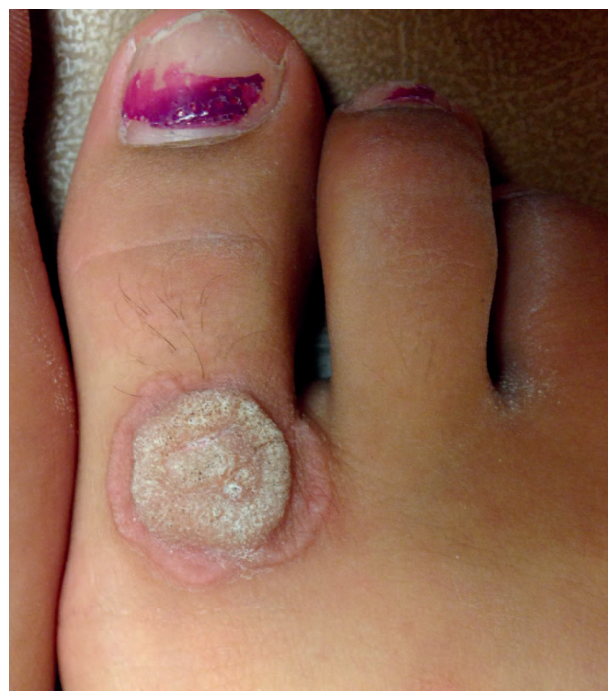
Verrucae (warts), affecting 7% to 10% of the general population, are among the most common viral infections of the skin, cause by the human papilloma virus (HPV). Although there are 100 types, HPV type 1 is most commonly associated with the plantar aspect of the foot (in addition to HPV types 2, 3, 4, 27, 29, and 57).[
1] The lesions are the most common dermatologic infections, have a peak incidence between ages 12 and 16 years, are seen in 3.9% to 33% of children and adolescents, and affect girls more than boys.[
1,
2]
Inoculation usually occurs in moist environments (eg, communal bathing/swimming areas) where the virus exists, passing through breaks in the epidermis and resulting in infection.[
1] It can also be spread directly between humans.[
1] Typically, a verruca presents as a raised, hyperkeratotic papule or plaque with an irregular board, found either in isolate or mosaic multiple pattern.[
2] Histologically, this is an infiltration of the basal keratinocytes of epithelium, with replication in the upper epidermal layers and rare penetration to the deeper basal levels.[
1,
2] On physical examination, pain on direct or side-to-side pressure and pinpoint bleeding on sharp debridement are hallmarks of this pathologic condiction.[
1] Differential diagnoses include corns, callus, keratosis, lichen planus, molluscum contagiosum, foreign body granuloma, and malignant growth (eg, squamous cell carcinoma).[
1]
Multiple treatments exist to assist in both primary and recalcitrant/recurrent eradication of the lesion, as there is no single treatment for plantar warts, and no single treatment is 100% effective. Articles have cited the use of sharp surgical excision (curettage), ablative modalities (cryotherapy, cautery), topical medications (acids, cytotoxins, antivirals), injections, oral medications, duct tape, and herbal supplements.[
1] Despite the physician’s best effort, up to one-third of nongenital warts become recalcitrant, with plantar and periungual types leading this category.
One commonly used treatment is Cantharone Plus (Dormer Laboratories, Inc, Toronto, ON, Canada).[
3] This product is a topical liquid mixture containing 30% salicylic acid, 2% podophyllin BP, and 1% cantharidin. Although the exact mechanism of action is unknown, each component has a key property acting in a keratolytic (removing wart virus in epithelial cells), caustic (destruction of tissue), and vesicant (exfoliation/blistering of the wart tumor) manner, respectively. (This product is found in limited quantities in the United States because of the US Food and Drug Administration, and should only be used by physicians in an office setting.[
4]) Specifically, cantharidin is thought to work through absorption into the lipid layers of epidermal cells, causing the activation of proteases that results in acantholysis and intraepidermal blistering.[
4,
5] These agents have been used in isolation and in this formulation to treat warts. Although having a very high cure rate (as high as 96% when used appropriately), cantharidin has multiple side effects, occurring in 6% to 46% of patients, including blistering, pain, erythema, swelling, bleeding, pruritus, and postinflammatory pigmentation abnormality.[
6,
7,
8] Included is the presentation of ring warts that often develop weeks after what appears to be clearing of the primary/initial manifestation.[
2,
4,
6,
9,
10,
11] In this article, we present a case of this pathologic condition, a review of the literature, and the rationale for this development.
Case Reports
Case 1
A 24-year-old man presented to the senior author’s (J.R.M.) office with the chief complaint of a single wart-like lesion on the right arch. The patient stated that the lesion had been present for more than 4 years, with failed resolution after various over-the counter treatments. Physical examination confirmed the suspicion of a wart with pain on mediolateral compression and punctuate bleeding on debridement. After discussion of treatment options, Cantharone Plus was applied, and after a second treatment, on the third follow-up appointment (approximately 3 weeks between each application/debridement), the lesion had cleared.
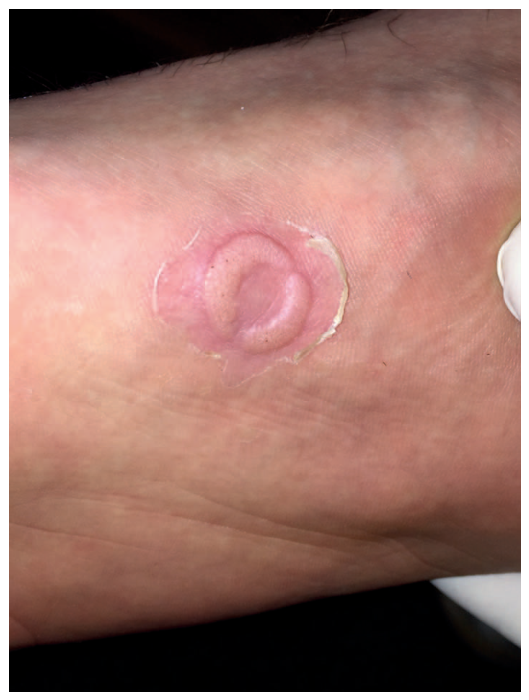
Four weeks later, the patient returned, stating that over the previous week, a ring-like raised lesion developed in the area around where the previously treated wart existed (
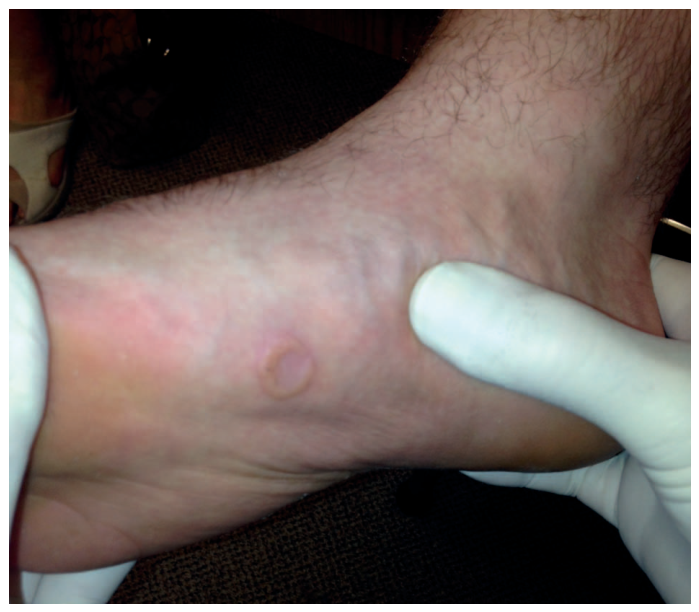
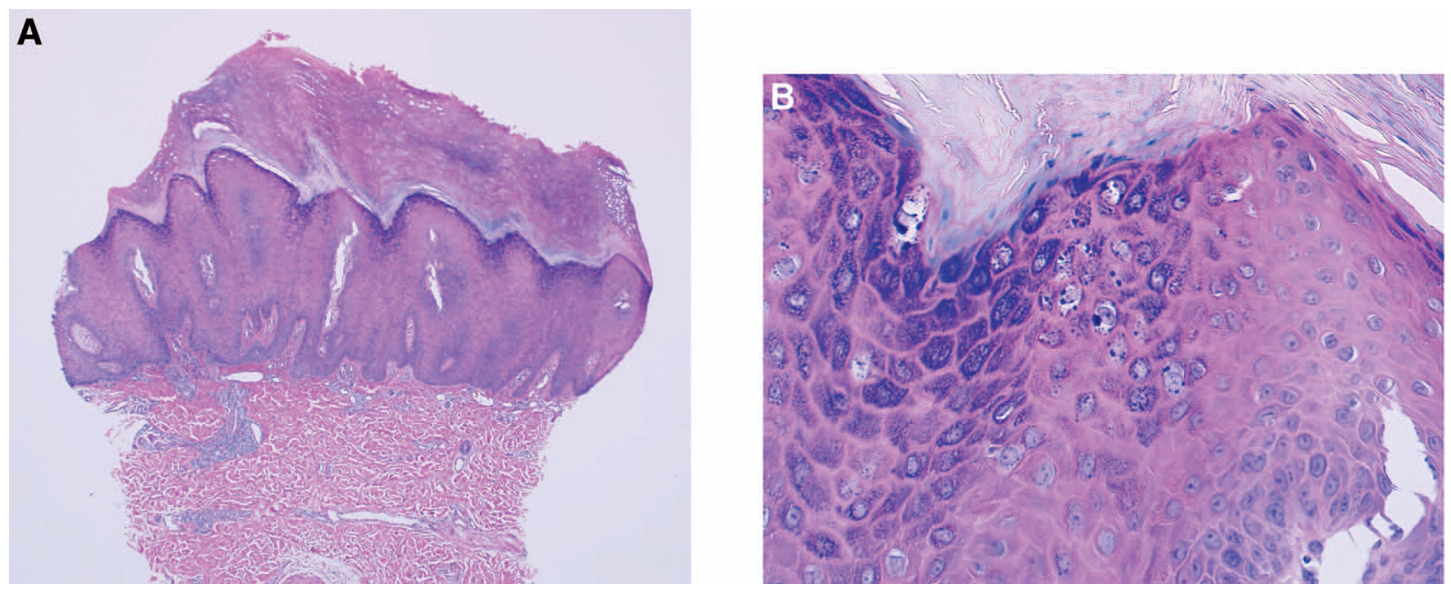
Figure 1). Suspicious of a recalcitrant wart and spread around the originally cleared site, over the next 8 weeks, three more debridement and Cantharone Plus treatments were applied to the wart ring, the centrally cleared site, and the surrounding 2- to 3-mm periphery. Before the second application, a biopsy specimen was taken to confirm that the treatments were appropriate and that this was not a different pathologic condition. The biopsy diagnosed a superficial (mosaic) palmoplantar wart (
Figure 2). At the end of this 8-week period, it was recommended that the patient seek outside referral to a foot and ankle dermatologic specialist because of an inability to cure (
Figure 3). Additionally, oral diindolylmethane (BioResponse DIM, BioResponse Nutrients, Boulder, CO), administered at 6 mg/kg divided over two doses daily for 3 to 4 months, was suggested.
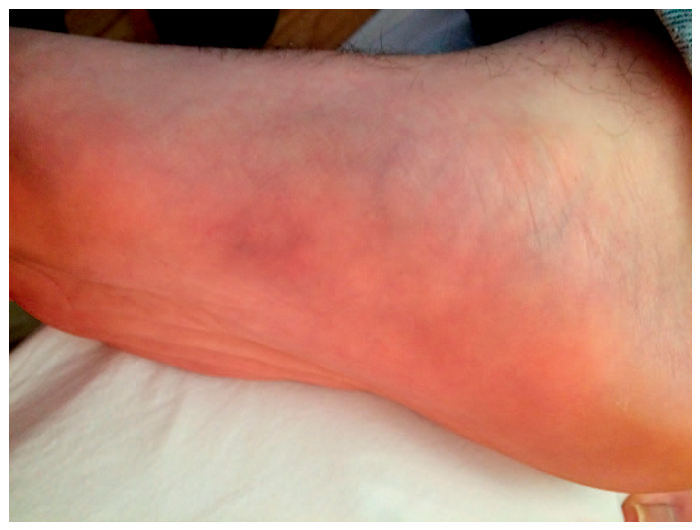
The patient decided to continue treatment with the oral diindolylmethane as prescribed (300 mg orally AM, and 150 mg orally PM) along with once-perweek PedEgg (Telebrands, Fairfield, New Jersey) abrasion to the lesion. The patient did not seek a second opinion. Between 2 and 3 months after the last office visit, the patient stated that clearing had started to occur to the wart. By 4 months, it was completely resolved. Medication was continued for an additional month (5 months total), with no recurrence to date (
Figure 4).
Case 2
An 11-year-old girl presented to the senior author’s (J.R.M.) office with a 3-year-old left dorsal hallux wart that failed over-the-counter treatments. At the first visit, it measured 5 3 4 3 2 mm. The lesion underwent four rounds of debridement and application of Cantharone Plus over five office visits. Application was to the wart, outer ring, and surrounding 2- to 3-mm periphery. On the fourth visit, the observed ring wart lesion began to appear circumferentially around the central wart, which had still not yet cleared, with the total size increasing to 7 × 7 × 2 mm (
Figure 5). At the last follow-up, the size increased to 10 × 10 × 2 mm. Again, it was suggested that the patient seek outside referral and treat the condition with oral diindolylmethane.
The patient decided to forego oral medications and underwent examination by a fellowship-trained foot and ankle dermatologist 8 weeks later. During this office visit, the patient was instructed to allow the wart to desquamate, as there were already some signs of clearing. Approximately 6 weeks later, the wart had fallen off and the skin was healed to a normal appearance, without recurrence to date.
Discussion
One additional complication, specifically cited in very few instances with the use of cantharidin and cryotherapy for verruca, is development of a ring wart around the initial treatment site.[
2,
4,
6,
9,
10,
11,
12,
13,
14] Of the studies that report on ring warts, complication rates are cited at 1% (Rosenberg[
10]; n ¼ 100), 4.9% (Epstein and Epstein[
9]; n ¼ 61), and 6% (Panzer[
15]; n ¼ 122).[
4,
6]
For completion, the ring wart differs from describing it as an annular wart, which suggests a circleshaped lesion without central clearing.[
16] This report presents two cases experienced in the past year. As described in the aforementioned articles, the lesions appeared as raised (papule/plaque) and ring shaped, with the raised section hyperkeratotic and similar in wart appearance. Both patients’ lesions formed around the area where the central clearing of the primary wart previously existed and where initial treatments were focused and applied. When encountered, they can appear commonly as a ring formed by a single wart or a mosaic confluence of smaller warts.[
4] Despite never seeing the ring wart previously, on first clinical examination, we were suspicious of this being a wart recurrence in ring form. A literature review was performed to determine whether this had been documented before.[
2,
4,
9,
10,
11,
12] A biopsy, as performed here, should be considered, as recalcitrant or recurrent warts have the potential for malignant transformation or an atypical malignant appearance (eg, squamous cell carcinoma).[
1]
Only one of the cited articles gives a rationale for this finding.[
2,
4,
9,
10,
11,
12] Findlay states that ‘‘this phenomenon seem[s] to represent an intraepidermal autoinoculation of the wart virus through the blister cavity, with development of the wart in the site of the outer angle of the blister cavity within a few weeks.’’[
12] It can be surmised that one reason for this presentation when using cantharidin is inappropriate application by the user. This is more a recurrence or incomplete resolution (‘‘persistence’’) of the primary lesion rather than a new presentation. The cantharidin product guide suggests applying the liquid to the lesion and an additional 1 to 3 mm around the margins, waiting for drying, and applying an occlusive dressing for a minimum of 8 hours.[
3] Reported literature differs in description of application (to surpass or not to surpass lesion margins) and may cause confusion for the treating physician regarding the correct application method.[
8,
17] A second rationale could be the Koebner phenomenon, which is a latent activation of potentially infected cells by trauma (ie, cantharidin application).[
16,
18]
Peripheral application is the key step in prevention of ring warts. Placing the material only directly onto the wart allows for this circumferential spreading and need for continued follow-up treatments. Because of the caustic nature of the product, physicians may be afraid to place the liquid on normal skin for fear of scarring or harming unaffected tissues. Cantharidin scarring is not a sequela of the blisters formed from application according to the literature as current as 2011.[
4,
9,
11,
17] In a study treating various callus lesions with a cantharidin product (direct application along with 1 to 2 mm of the margins), there were no incidents of scarring (n¼ 72) once the blisters healed, 4 to 7 days after application.[
17] It is this exact practice (0-mm marginal application) or apprehensions (fear of scar) that can result in the ring wart after primary treatments have been initiated. Because of this, it is important to institute strict adherence to the 1- to 3-mm peripheral application along with dressing under occlusion (eg, layered paper tape under Tenoplast; BNS Medical, Luxembourg).
Conclusions
The presentation of ring warts is an uncommon side effect of wart treatment. Although this could occur with the use of various treatment modalities, the few cited examples in the literature found were included in reviews of cantharidin as the primary treatment. This finding should not alarm the treating physician that they are on the wrong path of treatment. However, a biopsy may be warranted to confirm diagnosis and subsequent treatment. When found, suggestions include either a wider application of the topical therapy, combining topical and oral therapies, or a complete switch to a more invasive treatment when cure is desired.