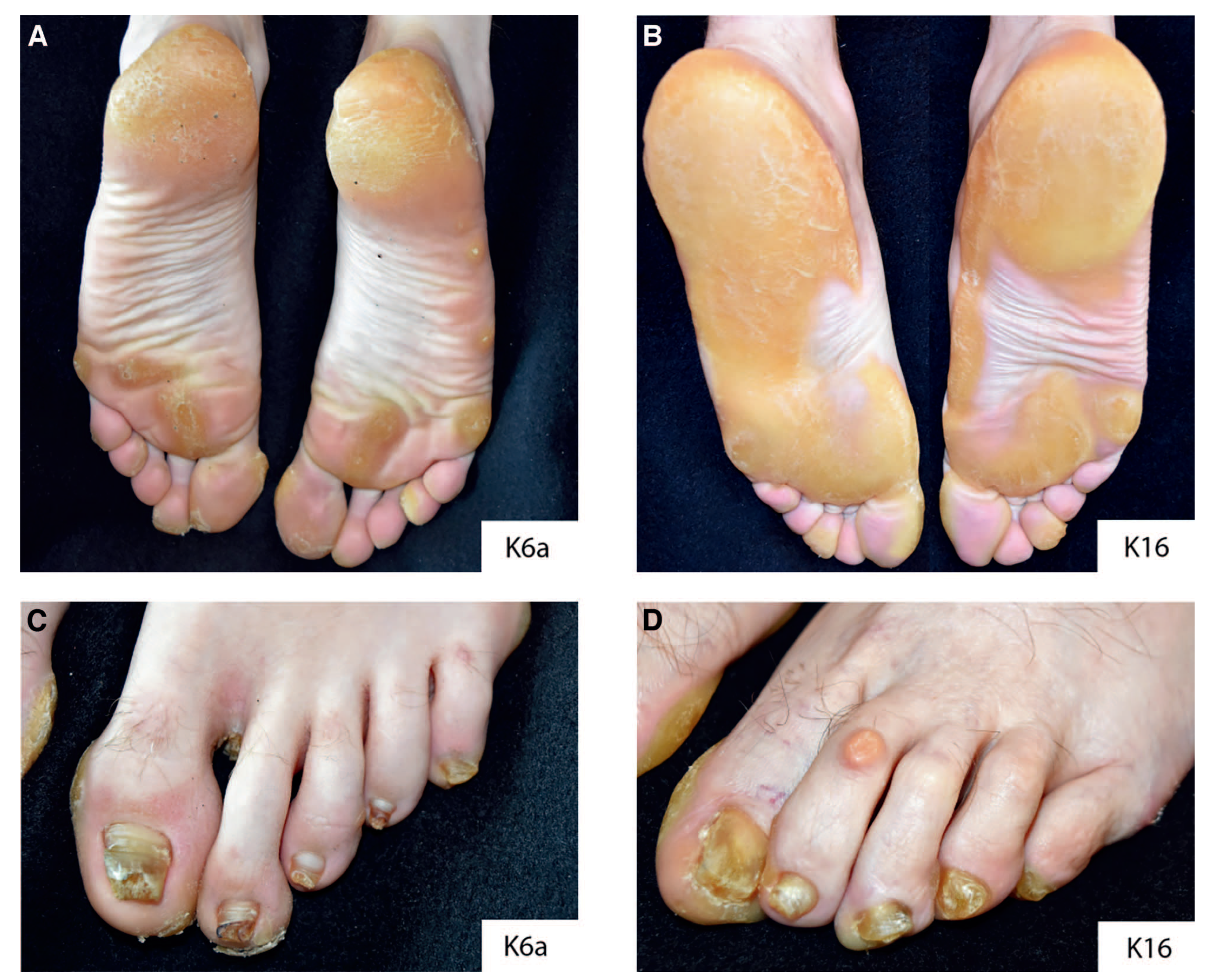
Management of Plantar Keratodermas. Lessons from Pachyonychia Congenita

Abstract
Clinical Presentation
Genetics
Pathogenesis
Treatment of PC


The Future Management of Keratoderma in PC
Conclusions
Acknowledgments
Financial Disclosure
Conflicts of Interest
References
- CANDI, E.; SCHMIDT, R.; MELINO, G. The cornified envelope: a model of cell death in the skin. Nat Rev Mol Cell Biol 2005, 6, 328. [Google Scholar] [CrossRef] [PubMed]
- CAO, Y.A.; HICKERSON, R.P.; SEEGMILLER, B.L. ET AL: Gene expression profiling in pachyonychia congenita skin. J Dermatol Sci 2015, 77, 156. [Google Scholar] [CrossRef]
- HAS C, TECHNAU-HAFSI K: Palmoplantar keratodermas: clinical and genetic aspects. J Dtsch Dermatol Ges 2016, 14, 123. [CrossRef] [PubMed]
- JADASSOHN, J.; LEWANDOWSKI, P. ‘Pachyonychia Congenita: Keratosis Disseminata Circumscripts (Follicularis). Tylomata: Leukokeratosis Linguae,’’ in Ikonographia Dermatologica; edited by A Neisser, E Jacobi, p 29, Urban and Schwarzenberg: Berlin, 1906. [Google Scholar]
- JACKSON, A.D.; LAWLER, S.D. Pachyonychia congenita; a report of six cases in one family, with a note on linkage data. Ann Eugen 1951, 16, 142. [Google Scholar] [CrossRef]
- ELIASON, M.J.; LEACHMAN, S.A.; FENG, B.J. ET AL: A review of the clinical phenotype of 254 patients with genetically confirmed pachyonychia congenita. J Am Acad Dermatol 2012, 67, 680. [Google Scholar] [CrossRef]
- SHAMSHER, M.K.; NAVSARIA, H.A.; STEVENS, H.P. ET AL: Novel mutations in keratin 16 gene underly focal nonepidermolytic palmoplantar keratoderma (NEPPK) in two families. Hum Mol Genet 1995, 4, 1875. [Google Scholar] [CrossRef]
- SMITH, F.J.; FISHER, M.P.; HEALY, E.; et al. Novel keratin 16 mutations and protein expression studies in pachyonychia congenita type 1 and focal palmoplantar keratoderma. Exp Dermatol 2000, 9, 170. [Google Scholar] [CrossRef] [PubMed]
- LEACHMAN, S.A.; KASPAR, R.L.; FLECKMAN, P.; et al. Clinical and pathological features of pachyonychia congenita. J Investig Dermatol Symp Proc 2005, 10, 3. [Google Scholar] [CrossRef] [PubMed]
- LANE, E.B.; MCLEAN, W.H. Keratins and skin disorders. J Pathol 2004, 204, 355. [Google Scholar] [CrossRef]
- MOLL, R.; FRANKE, W.W.; SCHILLER, D.L.; ET, A.L. The catalog of human cytokeratins: patterns of expression in normal epithelia, tumors and cultured cells. Cell 1982, 31, 11. [Google Scholar] [CrossRef]
- WILSON, N.J.; LEACHMAN, S.A.; HANSEN, C.D. ET AL: A large mutational study in pachyonychia congenita. J Invest Dermatol 2011, 131, 1018. [Google Scholar] [CrossRef]
- WILSON, N.J.; MESSENGER, A.G.; LEACHMAN, S.A. ET AL: Keratin K6c mutations cause focal palmoplantar keratoderma. J Invest Dermatol 2010, 130, 425. [Google Scholar] [CrossRef]
- SWENSSON, O.; LANGBEIN, L.; MCMILLAN, J.R. ET AL: Specialized keratin expression pattern in human ridged skin as an adaptation to high physical stress. Br J Dermatol 1998, 139, 767. [Google Scholar] [CrossRef] [PubMed]
- STEINERT, P.M.; MAREKOV, L.N. The proteins elafin, filaggrin, keratin intermediate filaments, loricrin, and small proline-rich proteins 1 and 2 are isodipeptide crosslinked components of the human epidermal cornified cell envelope. J Biol Chem 1995, 270, 17702. [Google Scholar] [CrossRef]
- GOLDBERG, I.; SPRECHER, E.; SCHWARTZ, M.E.; et al. Comparative study of high-resolution multifrequency ultrasound of the plantar skin in patients with various types of hereditary palmoplantar keratoderma. Dermatology 2013, 226, 365. [Google Scholar] [CrossRef]
- LESSARD, J.C.; COULOMBE, P.A. Keratin 16-null mice develop palmoplantar keratoderma, a hallmark feature of pachyonychia congenita and related disorders. J Invest Dermatol 2012, 132, 1384. [Google Scholar] [CrossRef]
- LESSARD, J.C.; PINA-PAZ, S.; ROTTY, J.D. ET AL: Keratin 16 regulates innate immunity in response to epidermal barrier breach. Proc Natl Acad Sci U S A 2013, 110, 19537. [Google Scholar] [CrossRef]
- YUSPA, S.H.; HARRIS, C.C. Altered differentiation of mouse epidermal cells treated with retinyl acetate in vitro. Exp Cell Res 1974, 86, 95. [Google Scholar] [CrossRef]
- BLUMENBERG, M.; CONNOLLY, D.M.; FREEDBERG, I.M. Regulation of keratin gene expression: the role of the nuclear receptors for retinoic acid, thyroid hormone, and vitamin D3. J Invest Dermatol 1992, 98 (suppl), 42S. [Google Scholar] [CrossRef] [PubMed]
- GRUBER, R.; EDLINGER, M.; KASPAR, R.L.; et al. An appraisal of oral retinoids in the treatment of pachyonychia congenita. J Am Acad Dermatol 2012, 66, e193. [Google Scholar] [CrossRef]
- SWARTLING C, VAHLQUIST A: Treatment of pachyonychia congenita with plantar injections of botulinum toxin. Br J Dermatol 2006, 154, 763. [CrossRef] [PubMed]
- SWARTLING, C.; KARLQVIST, M.; HYMNELIUS, K. ET AL: Botulinum toxin in the treatment of sweat-worsened foot problems in patients with epidermolysis bullosa simplex and pachyonychia congenita. Br J Dermatol 2010, 163, 1072. [Google Scholar] [CrossRef]
- Gonzalez-Ramos J, Sendagorta-Cudos E, Gonzalez-Lopez G. ET AL: Efficacy of botulinum toxin in pachyonychia congenita type 1: report of two new cases. Dermatol Ther 2016, 29, 32. [Google Scholar] [CrossRef]
- LEACHMAN, S.A.; HICKERSON, R.P.; SCHWARTZ, M.E. ET AL: First-inhuman mutation-targeted siRNA phase Ib trial of an inherited skin disorder. Mol Ther 2010, 18, 442. [Google Scholar] [CrossRef]
- WILSON, N.J.; O’TOOLE, E.; MILSTONE, L.M.; et al. The molecular genetic analysis of the expanding pachyonychia congenita case collection. Br J Dermatol 2014, 171, 343. [Google Scholar] [CrossRef]
- WONG, P.; COLUCCI-GUYON, E.; TAKAHASHI, K.; ET, A.L. Introducing a null mutation in the mouse K6alpha and K6beta genes reveals their essential structural role in the oral mucosa. J Cell Biol 2000, 150, 921. [Google Scholar] [CrossRef]
- FU, D.J.; THOMSON, C.; LUNNY, D.P. ET AL: Keratin 9 is required for the structural integrity and terminal differentiation of the palmoplantar epidermis. J Invest Dermatol 2014, 134, 754. [Google Scholar] [CrossRef]
- VAN STEENSEL, M.A.; COULOMBE, P.A.; KASPAR, R.L. ET AL: Report of the 10th Annual International Pachyonychia Congenita Consortium Meeting. J Invest Dermatol 2014, 134, 588. [Google Scholar] [CrossRef]
- KIM, S.; WONG, P. COULOMBE PA: A keratin cytoskeletal protein regulates protein synthesis and epithelial cell growth. Nature 2006, 441, 362. [Google Scholar] [CrossRef]
- HICKERSON, R.P.; LEAKE, D.; PHO, L.N.; ET, A.L. Rapamycin selectively inhibits expression of an inducible keratin (K6a) in human keratinocytes and improves symptoms in pachyonychia congenita patients. J Dermatol Sci 2009, 56, 82. [Google Scholar] [CrossRef]
- HAEMEL, A.K.; O’BRIAN, A.L.; TENG, J.M. Topical rapamycin: a novel approach to facial angiofibromas in tuberous sclerosis. Arch Dermatol 2010, 146, 715. [Google Scholar] [CrossRef] [PubMed]


|
|
|
© 2017 American Podiatric Medical Association
Share and Cite
Porter, R.M.; Bravo, A.A.; Smith, F.J.D. Management of Plantar Keratodermas. Lessons from Pachyonychia Congenita. J. Am. Podiatr. Med. Assoc. 2017, 107, 428-435. https://doi.org/10.7547/16-043
Porter RM, Bravo AA, Smith FJD. Management of Plantar Keratodermas. Lessons from Pachyonychia Congenita. Journal of the American Podiatric Medical Association. 2017; 107(5):428-435. https://doi.org/10.7547/16-043
Chicago/Turabian StylePorter, Rebecca M., Albert A. Bravo, and Frances J.D. Smith. 2017. "Management of Plantar Keratodermas. Lessons from Pachyonychia Congenita" Journal of the American Podiatric Medical Association 107, no. 5: 428-435. https://doi.org/10.7547/16-043
APA StylePorter, R. M., Bravo, A. A., & Smith, F. J. D. (2017). Management of Plantar Keratodermas. Lessons from Pachyonychia Congenita. Journal of the American Podiatric Medical Association, 107(5), 428-435. https://doi.org/10.7547/16-043