Next Article in Journal
Atypical Melanocytic Proliferation in a Pediatric Patient with Double Advancement Flap Repair
Previous Article in Journal
Management of Plantar Keratodermas. Lessons from Pachyonychia Congenita
 
 
Journal of the American Podiatric Medical Association is published by MDPI from Volume 116 Issue 1 (2026). Previous articles were published by another publisher in Open Access under a CC-BY (or CC-BY-NC-ND) licence, and they are hosted by MDPI on mdpi.com as a courtesy and upon agreement with American Podiatric Medical Association.
Communication

Motor-Evoked Potentials of the Abductor Hallucis Muscle and Their Relationship with Foot Arch Functional Anatomy

by
Tyrone Mayorga
1,
Erato Giokas
1,
Anaida Abagyan
1,
Dhaval Patel
1,
Yasmin Sarraf
1,
Michael Paula
1,
Eileen Chusid
1,
Anthony D'Antoni
2 and
Fortunato Battaglia
3,*
1
New York College of Podiatric Medicine, New York, NY
2
The Sophie Davis School of Biomedical Education, City University of New York, New York, NY
3
School of Health and Medical Sciences, Seton Hall University, South Orange, NJ
*
Author to whom correspondence should be addressed.
J. Am. Podiatr. Med. Assoc. 2017, 107(5), 467-470; https://doi.org/10.7547/16-049
Published: 1 September 2017

Abstract

Background: The present study aimed to investigate the correlation between abductor hallucis (AH) muscle motor evoked potential (MEP) amplitude and foot arch anatomy. Methods: Twelve healthy individuals underwent foot arch measurement using a digital photographic technique and measurements of cortical excitability using transcranial magnetic stimulation applied on the cortical representation area of the right AH muscle. Truncated foot length and dorsal height were then measured and used to create the arch height index (AHI). Resting motor threshold, MEP amplitude (using a stimulation intensity of 110% resting motor threshold), and cortical silent period duration were also measured. Results: Mean ± SE values were as follows: truncated foot length, 16.72 ± 0.3 cm; dorsal height, 5.62 ± 0.13 cm; AHI, 0.34 ± 0.01; resting motor threshold, 81.6% ± 2.12%; MEP amplitude, 0.71 ± 0.1 mV; and cortical silent period duration, 108.05 ± 0.45 msec. A significant correlation was found between MEP amplitude and AHI (Spearman’s rho: P < .01). Conclusions: These results indicate that AH muscle functional neuroanatomy measurements are reliable and might be used by clinicians and therapists to investigate foot arch physiology and monitor the efficacy of treatments and rehabilitative protocols. (J Am Podiatr Med Assoc 107(5): 467-470, 2017).

The abductor hallucis (AH) is a postural muscle and a dynamic elevator of the arch during stance and gait [1,2]. To date, the AH muscle cortical functional neuroanatomy and its relationship with foot arch morphology has yet to be characterized.
Many studies have used transcranial magnetic stimulation (TMS) as a highly effective means of investigating the link between the strength of corticospinal connections and the functional anatomy of a range of muscles [3]. In this study, we used single-pulse TMS to investigate several electrophysiologic parameters and to correlate them with the arch height index (AHI), a measure of the height of the medial longitudinal arch. Because no study to date has addressed this issue, we attempted to identify a functional neuroanatomical biomarker to be used for the investigation of AH muscle plastic changes in response to training and pathologic disorders affecting the foot arch.

Methods

Participants

Twelve right-handed [4] healthy volunteers (seven men and five women; mean ± SD age, 26.3 ± 4.5 years) were enrolled in the study. The participants provided written consent before the study, which was approved by the New York College of Podiatric Medicine ethics committee and conducted in accordance with the Declaration of Helsinki.

Digital Foot Arch Measurement

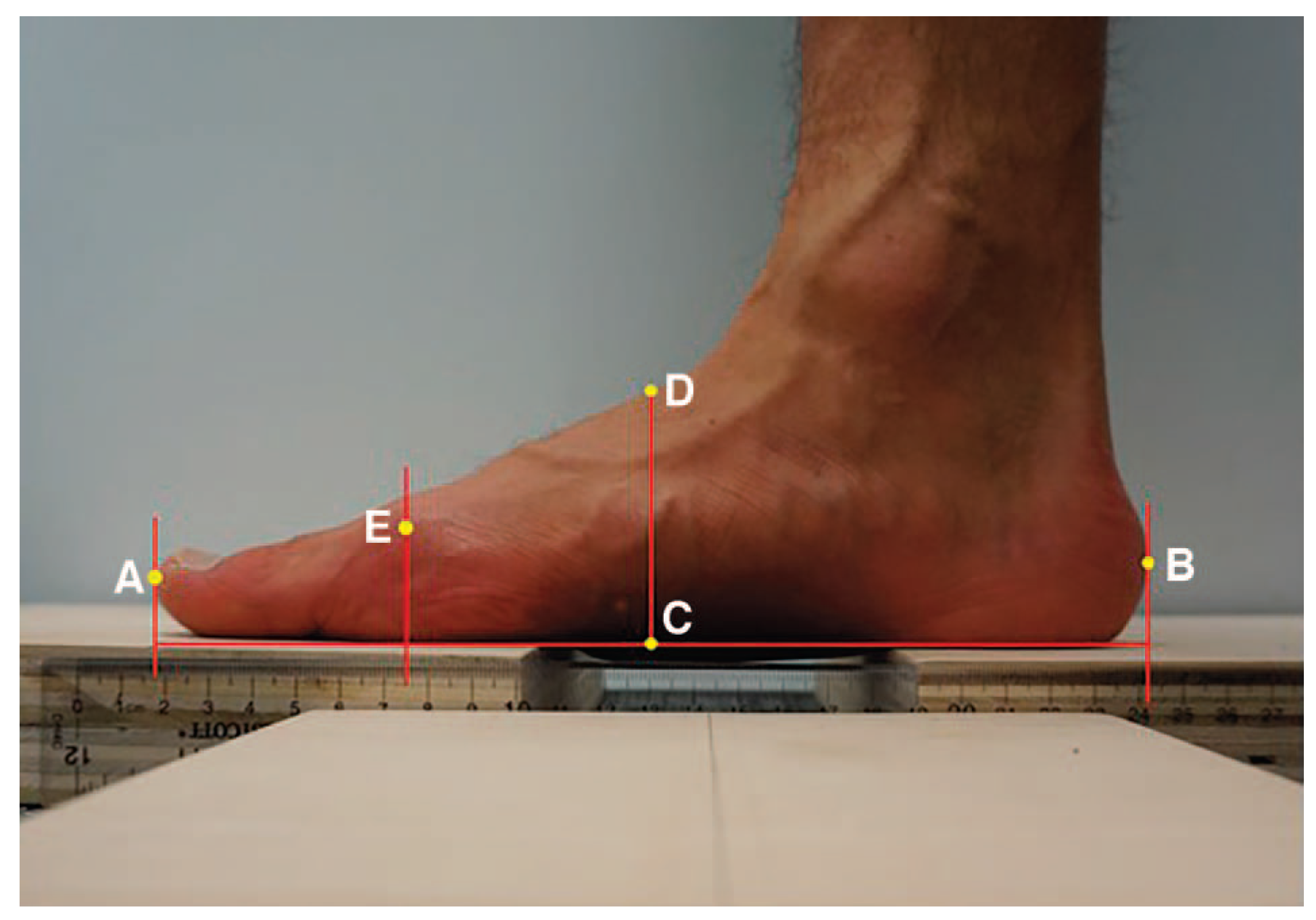
Participants were seated in an armchair with their right hip, knee, and ankle joints at 908. Two wooden blocks (thickness = 4.0 cm) were placed under the heel and metatarsal heads of the right foot, leaving the arch unsupported. The left foot was placed 15 cm medial to the right foot on a wooden block (thickness = 4.5 cm) and positioned to ensure a clear view of the medial aspect of the right foot, which was required to take a photograph. A digital camera (Sony NEX-3; Sony Corporation of America, New York, New York) was positioned on a block (height = 4 cm) at a fixed distance of 55 cm from the medial border of the right foot and 10 cm forward of the back of the heel. Digital photographs were collected and processed using ImageJ software (National Institutes of Health, Bethesda, Maryland) to determine the AHI. First, we measured the foot length (FL) and truncated foot length (TFL) (distance from the heel to the first metatarsal head). Then a vertical liner was positioned at 50% of the FL and was subsequently used to measure the dorsal arch height (DH). The AHI was calculated as the ratio DH:TFL (Figure 1) [5].

Transcranial Magnetic Stimulation

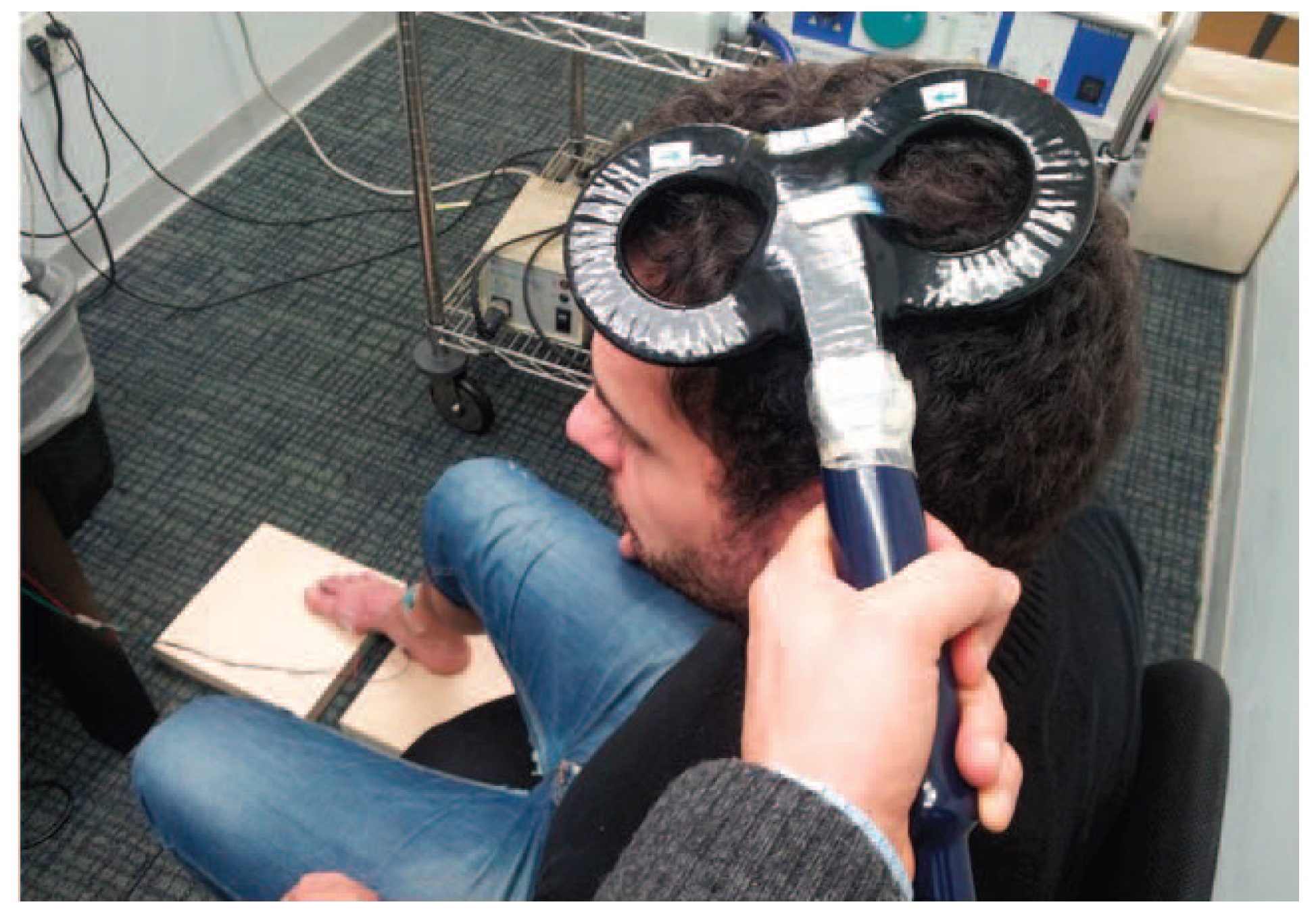
Participants were seated in the same position as for digital foot arch measurement. The TMS was delivered using a figure-of-eight coil (diameter = 70 mm) and a single-pulse stimulator (Magstim 200; Magstim Co Ltd, Whitland, England). The motor evoked potentials (MEPs) were recorded using surface electromyographic electrodes positioned over the right AH muscle, contralateral to the stimulated hemisphere (Figure 2). We first detected the right AH muscle (hot spot) and resting motor threshold (RMT) [6]. Then, ten MEPs were recorded using a stimulation intensity of 110% RMT, and their peak-to-peak amplitudes were averaged. A cortical silent period (CSP) was induced with stimuli (ten) delivered at an intensity of 110% RMT during AH muscle contraction. The participants had their right leg and foot positioned in a plastic boot to limit unwanted movements, and they were required to perform isometric AH muscle contractions at approximately 50% of their maximal voluntary contraction assessed using a handheld dynamometer (Hoggan Health Industries, Salt Lake City, Utah). The CSP duration was measured according to a published method [7].

Statistical Analysis

Statistical testing was performed using a statistical software program (IBM SPSS Statistics for Windows, Version 20.0; IBM Corp, Armonk, New York). Correlations between electrophysiologic variables and foot arch measurements were assessed using Spearman’s correlation coefficient. The level of significance was set as P < .05. Data are given as mean ± SE.
Japma 107 00467 i001

Results

Ten of 12 individuals completed the study; in the remaining two individuals it was not possible to evoke consistent MEPs using the figure-of-eight TMS coil. The mean ± SE RMT was 81.6% ± 2.12%; MEP amplitude, 0.71 ± 0.1 mV; CSP duration, 108.05 ± 0.45 msec; TFL, 16.72 ± 0.3 cm; DH, 5.62 ± 0.13 cm; and AHI, 0.34 ± 0.01.
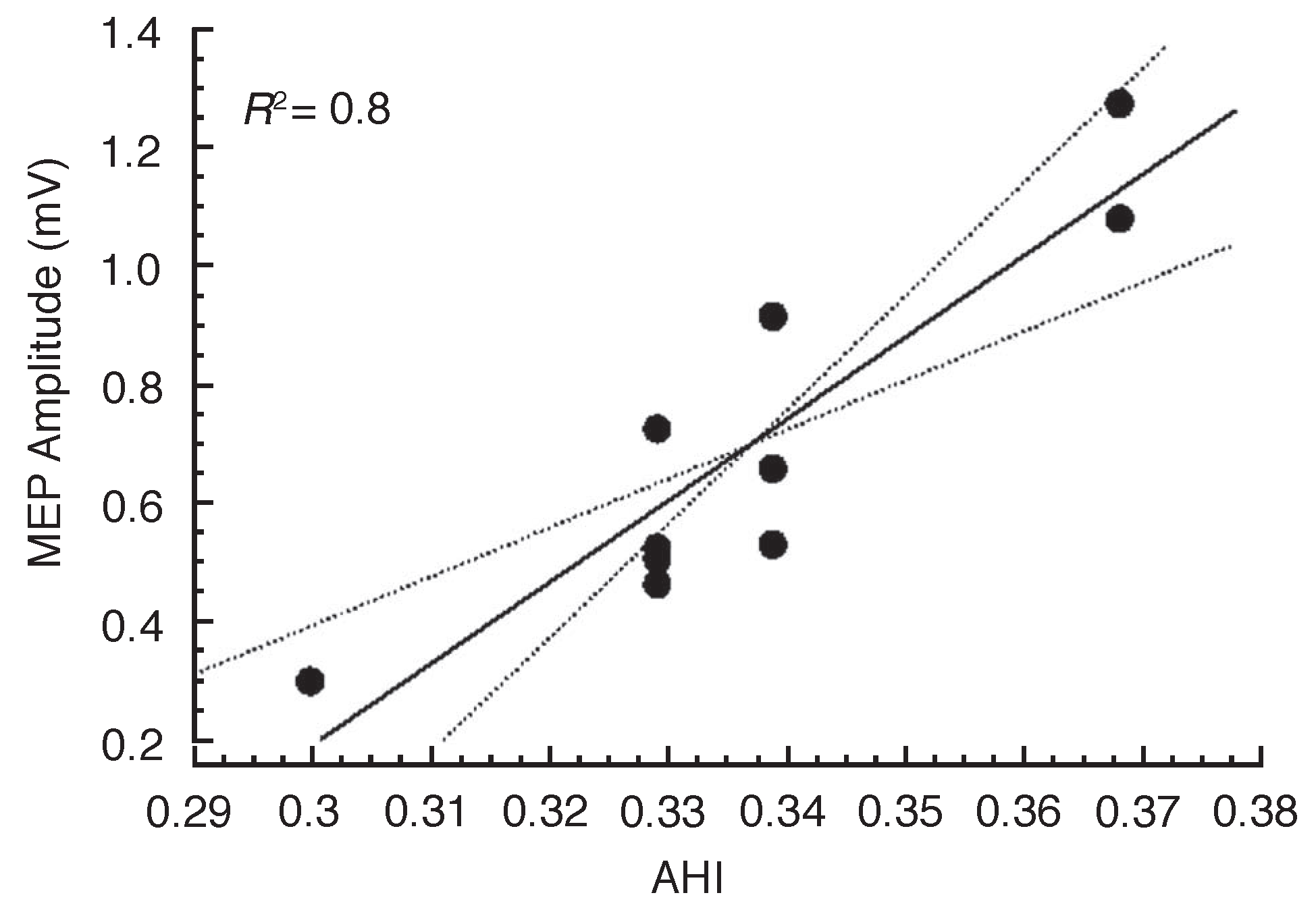
There was a strong positive correlation between AH muscle MEP amplitude and AHI, indicating that individuals with higher foot arch show increased AH muscle corticospinal excitability (Table 1). The other parameters did not correlate with the AHI (P = .05). A scatterplot summarizes the results (R2 = 0.86) (Figure 3).

Discussion

We demonstrated a correlation between the strength of the corticospinal connections to the AH muscle and foot arch morphology. To our knowledge, this is the first study to explore the relationships between the corticospinal tract functional neuroanatomy (MEPs) of an intrinsic foot muscle and foot arch morphology. Motor evoked potentials are generated by descending waves (corticospinal volleys) induced by transsynaptic activation of corticospinal neurons and interneurons and are regulated by several neurotransmitters. This parameter reflects the excitability (strength) of corticospinal output to the target muscle [3]. There is compelling evidence that muscle supraspinal control is drastically modified by the initial position of the limbs [8]. The present findings are in line with this hypothesis and are further supported by the fact that the excitability of the corticospinal pathway to the leg muscles changes with different postures and these changes take place primarily at the primary motor cortex and intracortical inhibitory circuits [9]. The present results might be explained with a different pattern of AH muscle activation related to the different arch height. Because the AH muscle is not (or is minimally) active at rest and is recruited during loading of the foot and stance phase [10], the present finding could also be described as cortical, activity-dependent plastic adaptation in response to different patterns of activation during gait. This finding is further supported by the fact that ablation of AH muscle activity after tibial nerve block with anesthetic injection decreased the height of the arch (navicular drop) [11].
This study has important limitations. Owing to a higher RMT, we did not investigate intracortical excitability using the paired-pulse TMS paradigm. In addition, these data need to be replicated in larger studies.

Conclusions

The MEP amplitude to the AH muscle might be used to probe the functional role of structures that contribute to the support of the arch and the effects of medical, surgical, and rehabilitative interventions to the plantar region of the foot.

Acknowledgments

We thank the students who participated in this study.

Financial Disclosure

None reported.

Conflicts of Interest

None reported.

Dual Publication

Preliminary results were presented as a poster at the 2016 American College of Foot and Ankle Surgeons Annual Meeting; Austin, TX.

References

  1. THORDARSON, D.B.; SCHMOTZER, H.; CHON, J. ET AL: Dynamic support of the human longitudinal arch: a biomechanical evaluation. Clin Orthop Relat Res 1995, 316, 165. [Google Scholar] [CrossRef]
  2. WONG, YS. Influence of the abductor hallucis muscle on the medial arch of the foot: a kinematic and anatomical cadaver study. Foot Ankle Int 2007, 28, 617. [Google Scholar] [CrossRef] [PubMed]
  3. DI LAZZARO, V.; ZIEMANN, U.; LEMON, R.N. State of the art: physiology of transcranial motor cortex stimulation. Brain Stimul 2008, 1, 345. [Google Scholar] [CrossRef] [PubMed]
  4. OLDFIELD, RC. The assessment and analysis of handedness: the Edinburgh inventory. Neuropsychologia 1971, 9, 97. [Google Scholar] [CrossRef] [PubMed]
  5. WILLIAMS, D.S.; MCCLAY, I.S. Measurements used to characterize the foot and the medial longitudinal arch: reliability and validity. Phys Ther 2000, 80, 864. [Google Scholar] [CrossRef] [PubMed]
  6. ROTHWELL, J.C.; HALLETT, M.; BERARDELLI, A.; ET, A.L. International Federation of Clinical Neurophysiology: Magnetic stimulation: motor evoked potentials. Electroencephalogr Clin Neurophysiol Suppl 1999, 52, 97. [Google Scholar]
  7. DASKALAKIS, Z.J.; MOLNAR, G.F.; CHRISTENSEN, B.K. ET AL: Anautomated method to determine the transcranial magnetic stimulation-induced contralateral silent period. Clin Neurophysiol 2003, 114, 938. [Google Scholar] [CrossRef] [PubMed]
  8. DOMINICI, F.; POPA, T.; GINANNESCHI, F. ET AL: Corticomotoneuronal output to intrinsic hand muscles is differentially influenced by static changes in shoulder positions. Exp Brain Res 2005, 164, 500. [Google Scholar] [CrossRef] [PubMed]
  9. BUNDAY, K.L.; TAZOE, T.; ROTHWELL, J.C. ET AL: Subcortical control of precision grip after human spinal cord injury. J Neurosci 2014, 34, 7341. [Google Scholar] [CrossRef] [PubMed]
  10. KELLY, L.A.; CRESSWELL, A.G.; RACINAIS, S. ET AL: Intrinsic foot muscles have the capacity to control deformation of the longitudinal arch. J R Soc Interface 2014, 11, 20131188. [Google Scholar] [CrossRef] [PubMed]
  11. FIOLKOWSKI, P.; BRUNT, D.; BISHOP, M. ET AL: Intrinsic pedal musculature support of the medial longitudinal arch: an electromyography study. J Foot Ankle Surg 2003, 42, 327. [Google Scholar] [CrossRef] [PubMed]
Figure 1. Right foot arch measurements using a digital photographic method with the participant in a sitting position. Point A is the distal end of the hallux; B, the most posterior aspect of the posterior heel; C, 50% of the foot length, A–B; E, the first metatarsal head. The vertical distance between points C and D represents the arch height; the horizontal stance between B and E, the truncated foot length.
Japma 107 00467 g001
Figure 2. Transcranial magnetic stimulation was applied over the left abductor hallucis muscle cortical representation, and motor evoked potentials were recorded over the contralateral leg.
Japma 107 00467 g002
Figure 3. Bivariate scatterplot (with 95% confidence intervals) indicating a positive correlation between abductor hallucis muscle motor evoked potentials (MEPs) and the arch height index (AHI).
Japma 107 00467 g003
Table 1. Spearman’s Rank Correlation Coefficients Between Electrophysiologic Parameters and Digital Foot Arch Measurements.
Japma 107 00467 i001