Specific structures may contribute to limb-length discrepancies (LLDs), such as differences in length or shape between the right and left femur or tibia contractures or differences in alignment at the hip, knee, and ankle; or joint space narrowing at one or more specific joints of the lower extremity [
1]. The foot is one component to limb-length discrepancy that can be easily overlooked, and to the author’s knowledge, has not been accurately quantified. A simple measurement, termed the total foot height (TFH), can be used to accurately determine the foot’s contribution to limb-length discrepancy.
Methods
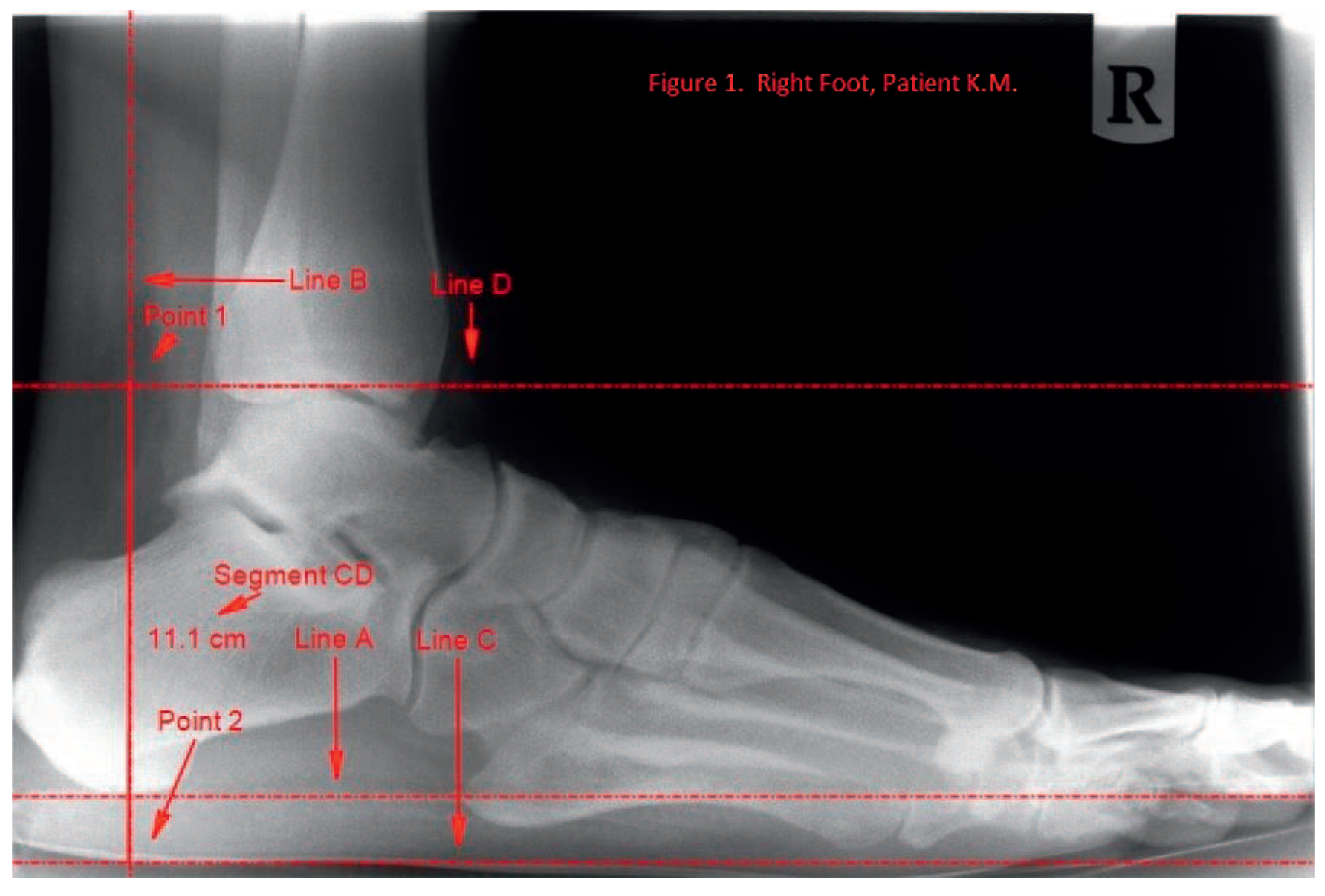
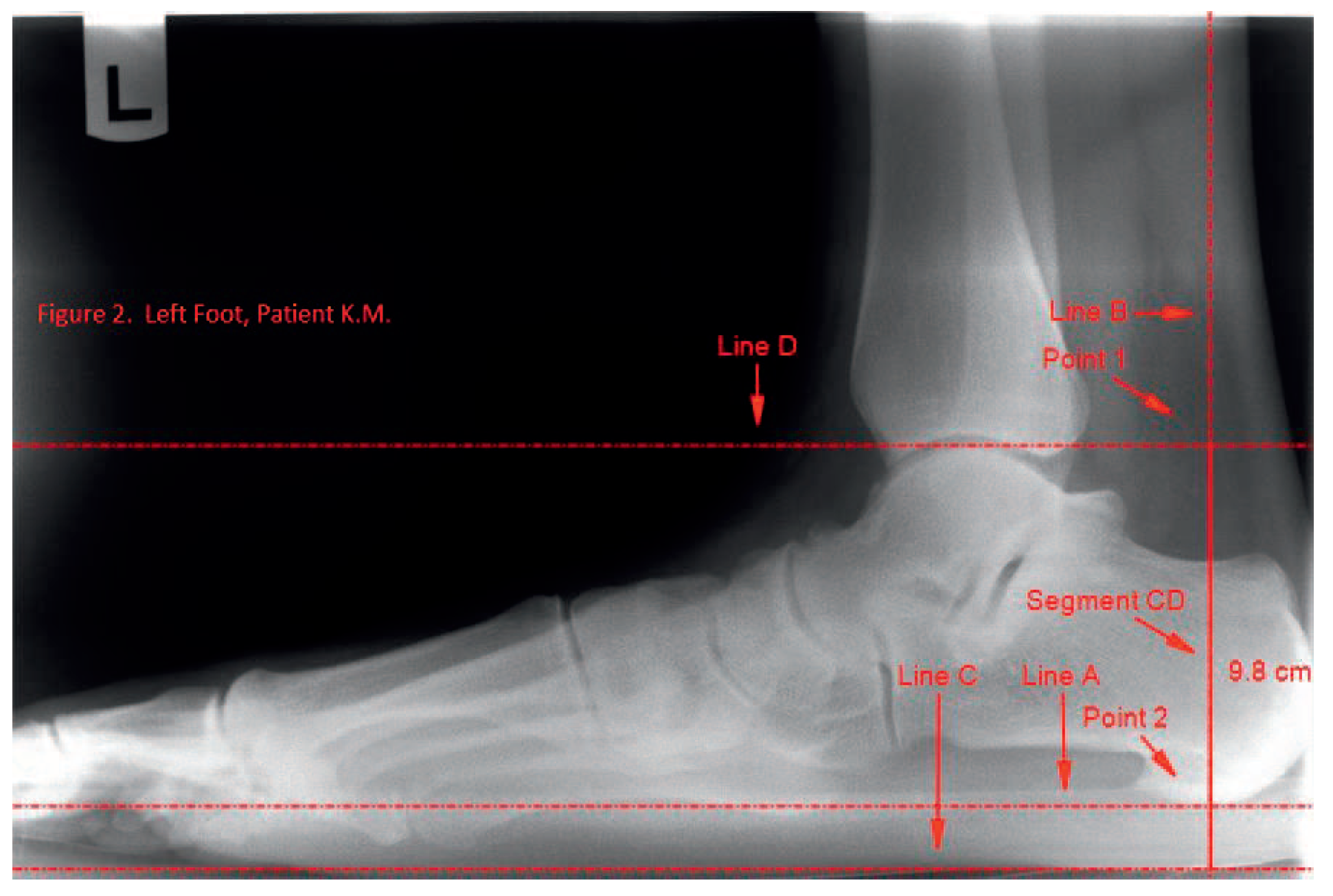
Standard full weightbearing lateral view radiographs are taken of both feet. On each of these images, a horizontal line is drawn tangential to the most inferior point of the calcaneal tuberocity (Line A). A vertical line is then drawn from this tangent point (Line B). From where this vertical line intersects with the skin under the calcaneal fat pad, another horizontal line is drawn tangential to the skin line (Line C). Line C represents the bottom of the foot. A horizontal line is then drawn tangential to the most superior aspect of the talar dome (Line D). The measurement of the distance (Segment CD) between the intersection of lines B and D (Point 1) and the intersection of lines B and C (Point 2), is defined as the TFH (
Figure 1 and
Figure 2). The measured difference between the right TFH and left TFH is the foot’s contribution to the limb-length discrepancy. In the example provided, the TFH difference is 1.3 cm.
Discussion
The findings from such an evaluation have practical applications; specifically, they can contribute to the method of treatment selected, as well as the effects of treatment. For example, from the data obtained, one can take comparison views to assess net changes in foot height before versus after flatfoot reconstruction, barefoot versus in orthotics, or before versus after physical therapy modalities. Total foot height measurements can be useful in tracking potential changes over time attributable to Charcot’s foot deformity or adult acquired flatfoot. Furthermore, this measurement has the potential to be an additional useful parameter for clinicians and researchers to consider when evaluating outcomes of particular surgical procedures such as flatfoot or Charcot foot reconstructions.
Conclusions
Total foot height measurement is a novel method to determine the contribution of the foot to limb-length discrepancies. The use of this simple technique can help podiatric clinicians better assess and treat these conditions.