Next Article in Journal
Remote Ischemic Conditioning: Promising Potential in Wound Repair in Diabetes?
Previous Article in Journal
Synovial Lipoma of the Subtalar Joint: A Rare Case Report
 
 
Journal of the American Podiatric Medical Association is published by MDPI from Volume 116 Issue 1 (2026). Previous articles were published by another publisher in Open Access under a CC-BY (or CC-BY-NC-ND) licence, and they are hosted by MDPI on mdpi.com as a courtesy and upon agreement with American Podiatric Medical Association.
Article

Lower-Leg and Foot Contributions to Turnout in University-Level Female Ballet Dancers: A Preliminary Investigation

by
Sarah L. Carter
1,*,
Alan R. Bryant
1 and
Luke S. Hopper
2
1
Podiatric Medicine and Surgery Division M422, School of Allied Health, The University of Western Australia, 35 Stirling Hwy, Crawley WA 6009, Australia
2
Western Australian Academy of Performing Arts, Edith Cowan University, Perth, Australia
*
Author to whom correspondence should be addressed.
J. Am. Podiatr. Med. Assoc. 2017, 107(4), 292-298; https://doi.org/10.7547/15-142
Published: 1 July 2017

Abstract

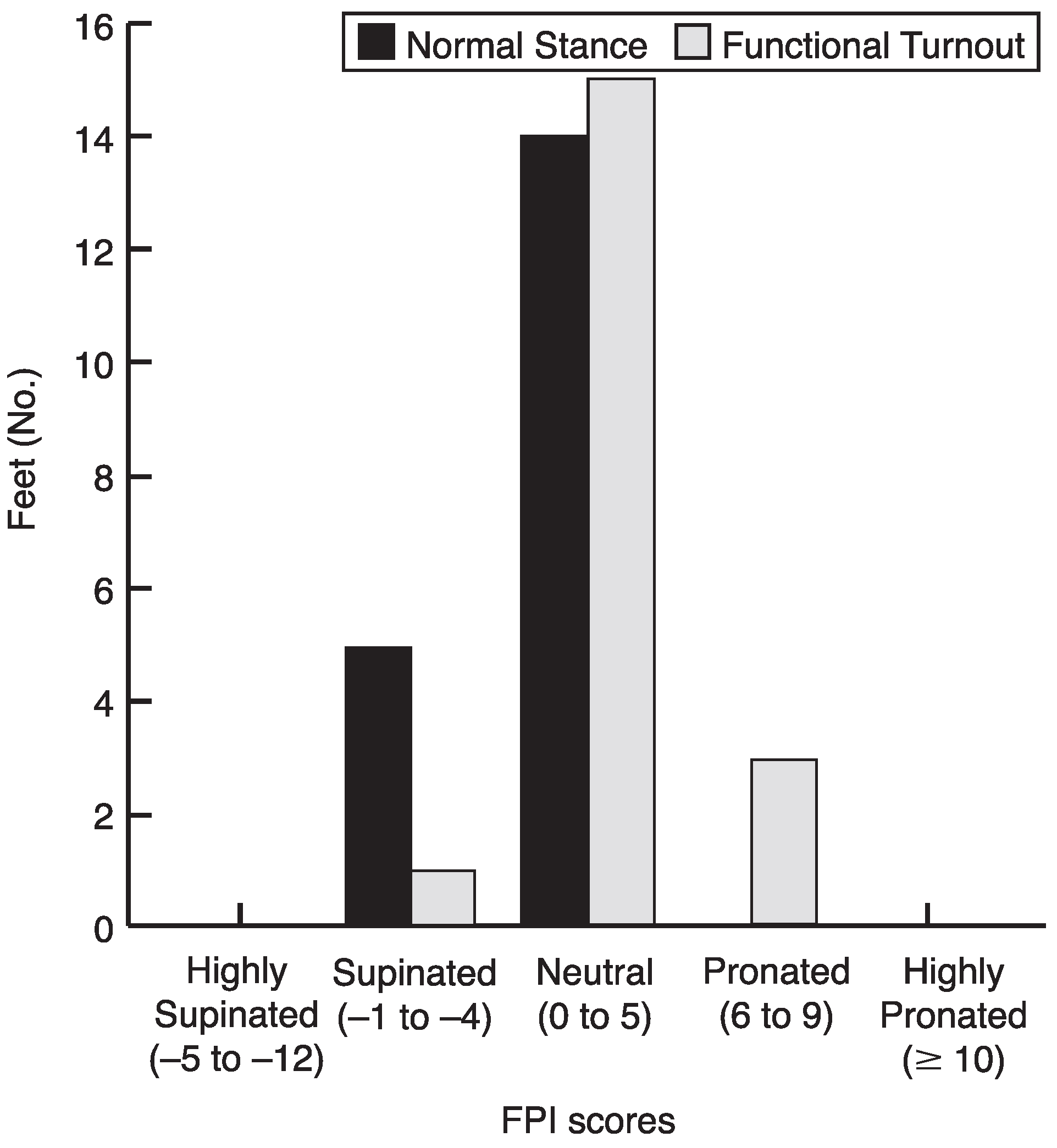
Background: Turnout in ballet is produced through summation of the joint structure characteristics and ranges of motion at the hip, knee, ankle, and foot. Contributions of the hip joint to functional turnout in dancers have received extensive examination, whereas little is known about contributions from the knee, ankle, and foot. The aim of this study was to explore the nonhip components of turnout to dancers’ functional turnout in first position by assessing passive external tibiofemoral rotation and active measures of foot pronation, ie, navicular drop and Foot Posture Index. Methods: Nineteen female university-level dance students aged 16 to 19 years participated in this descriptive correlational study. External tibiofemoral rotation, navicular drop, Foot Posture Index, and functional turnout were measured for the participants’ right and left legs. Results: Regression analyses revealed a weak relationship between passive external tibiofemoral rotation and functional turnout. Correlation analysis revealed a moderate negative relationship between passive tibiofemoral external rotation and the Foot Posture Index in functional turnout. Conclusions: These findings suggest that the lower leg does contribute to dancers’ overall position of functional turnout. However, current methods are not useful in predicting a dancer’s lower-leg contribution and alignment in functional turnout in first position.