

Next Article in Journal
Synovial Lipoma of the Subtalar Joint. A Rare Case Report
Previous Article in Journal
Evaluating Quality of Life in Patients with Hallux Abducto Valgus Deformity After a Taping Technique
 
 
Journal of the American Podiatric Medical Association is published by MDPI from Volume 116 Issue 1 (2026). Previous articles were published by another publisher in Open Access under a CC-BY (or CC-BY-NC-ND) licence, and they are hosted by MDPI on mdpi.com as a courtesy and upon agreement with American Podiatric Medical Association.
Article

Onychomycosis Infections. Do Polymerase Chain Reaction and Culture Reports Agree?

by
Aditya K. Gupta
1,2,* and
Kerry-Ann Nakrieko
1
1
Department of Medicine, University of Toronto, Toronto, Ontario, Canada
2
Mycology Section, Mediprobe Research Inc, London, Ontario, Canada
*
Author to whom correspondence should be addressed.
J. Am. Podiatr. Med. Assoc. 2017, 107(4), 280-286; https://doi.org/10.7547/15-136
Published: 1 July 2017

Abstract

Background: Mycological culture is the traditional method for identifying infecting agents of onychomycosis despite high false-negative results, slower processing, and complications surrounding nondermatophyte mold (NDM) infections. Molecular polymerase chain reaction (PCR) methods are faster and suited for ascertaining NDM infections. Methods: To measure agreement between culture and PCR methods for identification of infecting species of suspected onychomycosis, single toenail samples from 167 patients and repeated serial samples from 43 patients with suspected onychomycosis were processed by culture and PCR for identification of 16 dermatophytes and five NDMs. Agreement between methods was quantified using the kappa statistic (κ). Results: The methods exhibited fair agreement for the identification of all infecting organisms (single samples: κ = 0.32; repeated samples: κ = 0.38). For dermatophytes, agreement was moderate (single samples: κ = 0.44; repeated samples: κ = 0.42). For NDMs, agreement was poor with single samples (κ = 0.16) but fair with repeated samples (κ = 0.25). Excluding false-negative reports from analyses improved agreement between methods in all cases except the identification of NDMs from single samples. Conclusions: Culture was three or four times more likely to report a false-negative result compared with PCR. The increased agreement between methods observed by excluding false-negative reports statistically clarifies and highlights the major discord caused by false-negative cultures. The increased agreement of NDM identification from poor to fair with repeated sampling along with their poor agreement in the single samples, with and without false-negatives, affirms the complications of NDM identification and supports the recommendation that serial samples help confirm the diagnosis of NDM infections.

The fungal infections of onychomycosis disease most commonly reside in toenails. The disease prevalence is estimated to be 10% of the global population [1,2]. Standard laboratory test procedures for suspected onychomycosis are direct microscopic examination and culture of nails, but molecular-based methods have been developed [3-14]. Culture theoretically permits all infecting organisms to be identified by specialized technical personnel, but it is limited by cases of atypical morphology [14], controversy associated with nondermatophyte mold (NDM) identification [15], mixed infections [14], 1- to 4-week turnaround times, and up to 40% false-negative reports [7,16-18]. Molecular polymerase chain reaction (PCR)–based methods are free of morphological taxonomy demands and offer a faster means of identifying infecting agents of onychomycosis because typical turnaround times are within 24 to 48 hours. Molecular approaches are not subjective because species may be verified by DNA sequence analysis [16] and yield comparative false-positive rates but much lower false-negative rates compared with culture or direct microscopic examination as the gold standard [16]. Moreover, when sampling methods are substandard or unknown, it is more likely that the infectious agent will be identified by molecular methods [10,13]. However, these methods cost more, and, due to the stability of DNA, the main drawback is the potential positive identification of nonviable organisms.
Comparisons between molecular and conventional identification have been limited to the detection rates of dermatophytes [16,19] or the validation of molecular methods [15,17]. The level of agreement between the methods for the identification of infecting organisms within the suspected onychomycosis population is the necessary precursor to molecular methods complementing or replacing conventional methods as the laboratory gold standard. The present study aims to quantify the agreement between the two techniques for the identification of dermatophytes and common NDMs while also accounting for the effect of false-negative results and single and serial sampling recommendations for the identification of NDMs.

Materials and Methods

Clinical Samples and Reference Organisms

After obtaining verbal informed consent from the participants, a single sample (n = 167) and serial samples (n = 43) including scrapings of the nail plate and subungual debris were obtained from the great toenail of patients (n = 167) in southwestern Ontario, Canada, suspected of having onychomycosis. No patient-specific identifiable information was collected, and the patient's privacy and safety were ensured in accordance with the Declaration of Helsinki. The serial samples were collected 2 to 10 months after the first sample collection and ranged from two to seven time points (two samples from 14 patients, three samples from 14 patients, four samples from eight patients, five samples from four patients, six samples from two patients, and seven samples from one patient). Nail samples (∼20–50 mg) were split equally four ways for analyses: one portion for direct microscopy, one portion for molecular techniques, and two portions for culture. The following organisms were used as reference strains: Trichophyton rubrum (American Type Culture Collection [ATCC] MYA-4438, Manassas, Virginia), Trichophyton mentagrophytes (ATCC MYA-4439), Microsporum canis (ATCC 32507), Trichophyton tonsurans (ATCC 10217), Acremonium spinosum (ATCC 9471), Aspergillus fumigatus (ATCC KM8001), Scopulariopsis brevicaulis (ATCC 52175), Fusarium oxysporum (ATCC 26225), and Scytalidium dimidiatum (ATCC 46921). Malassezia furfur ST 8036 (Oxoid Inc, Nepean, Ontario, Canada) was used as a quality control reference for direct examination by fluorescence microscopy.

Potassium Hydroxide Preparation

Samples were incubated in a 20% potassium hydroxide (KOH)/10% glycerol solution. On clearing, the whole preparation was mixed with 1 to 2 drops of BactiDrop Calcofluor White (Remel, Dartford, England) and was examined for the presence of fungal filaments under a fluorescence microscope (Axiovert 200; Carl Zeiss Microscopy GmbH, Oberkochen, Germany) with a 365-nm excitation and a greater than 396-nm emission filter set.

Culture and Identification of Infecting Microorganisms

Samples were cultured on Sabouraud's agar containing chloramphenicol, cycloheximide, and gentamicin (MP1920; Oxoid Inc) and on Sabouraud's agar containing chloramphenicol and gentamicin (MP1930; Oxoid Inc) at 28°C for 7 to 28 days. Cultures were identified from biochemical assays, colony morphology, and microscopic characterization. Subcultures onto potato dextrose agar (BJ0056; Biomedia Unlimited, Brampton, Ontario, Canada) or bromocresol purple with milk solids and glucose agar (SDM4000; Bio-Media Unlimited) were performed when required.

DNA Isolation and Molecular Determination of Infecting Microorganisms

Samples or approximately 5 mg of each reference organism was suspended in 100 to 250 μL of QuickExtract DNA 1.0 extraction solution (Epicentre; Madison, Wisconsin), incubated at 65°C for 45 min, boiled for 2 min, and cooled to room temperature. Reference and sample DNA (1–5 μL) was used for PCR–restriction fragment length polymorphisms and nested PCRs [20]. Table 1 summarizes the genes targeted, the molecular techniques used for the identification of dermatophyte and NDM species, and their references.
Table 1. Summary of Molecular Methods Used for the Identification of Infecting Organisms of Onychomycosis 
Japma 107 00280 t001

Statistical Analysis

Data were categorically coded. Results from repeated samples were summarized into a single entry as follows: KOH positive if positive in one sample (KOH negative if negative in all samples); dermatophyte(s) species positive if positive in one sample (dermatophyte negative if negative in all samples); and NDM species positive if positive in two or more samples (NDM negative if positive in one sample or negative in all samples).
Coded data were analyzed using IBM SPSS Statistics for Windows, Version 20.0 (IBM Corp, Armonk, New York). To comparatively measure PCR versus culture results for the identification of dermatophytes or NDMs, the categorical parameters were assessed for interrater agreement with the kappa statistic (κ) and were scored for poor (<0.20), fair (0.21–0.40), moderate (0.41–0.60), good (0.61–0.80), and very good (0.81–1.00) agreement [21]. A P < .05 was considered significant. The KOH reports were used as the gold standard (true-negative or true-positive test status) for the determination of culture and PCR reports of false-negative values.

Results

Of the 167 individuals providing single samples, 93 (56%) were female and 74 (44%) were male, with a mean age of 52 years (age range, 8–88 years). Of the 43 individuals with serial sample data, 21 (49%) were female and 22 (51%) were male, with a mean age of 51 years (age range, 10–82 years). For simplicity, the term PCR encompasses all molecular results that are products of nested PCRs and PCR–restriction fragment length polymorphisms.

Culture versus PCR Results for the Detection of Infectious Agents in Toenails from Patients Suspected of Having Onychomycosis

The two methods exhibited fair agreement for the identification of all infecting organisms, including negative results (single samples: κ = 0.32; serial samples: κ = 0.38) (Table 2). The total rate of agreement between methods for the single and repeated data sets was 60% (101 of 167) and 58% (25 of 43), respectively (Table 2).
Table 2. Summary of Kappa (κ) Scores for Agreement Between Polymerase Chain Reaction and Culture for the Identification of Infecting Organisms in Suspected Onychomycosis in Single and Repeated Samples 
Japma 107 00280 t002

Culture versus PCR for the Identification of Dermatophytes in Toenails from Patients Suspected of Having Onychomycosis

For the single sample data set, the detection rate for dermatophytes was 42% (70 of 167) by PCR and 22% (36 of 167) by culture. For the identification of dermatophytes, the agreement between PCR and culture was moderate (κ = 0.44) (Table 2). The same result was shared by both methods in 73% of samples (122 of 167): 56% (94 of 167) identified a negative dermatophyte result and 17% (28 of 167) identified the same dermatophyte, where 15% (25 of 167) were T rubrum and 2% (three of 167) were T mentagrophytes. Polymerase chain reaction identified 23% of samples (38 of 167) as dermatophyte positive when culture was dermatophyte negative. Culture identified 2% of samples (three of 167) as T rubrum positive when PCR was dermatophyte negative. The other 2% disagreement (four of 167) was as follows: one was T rubrum by PCR and T mentagrophytes by culture, one was mixed T rubrum and S brevicaulis by PCR and T tonsurans by culture, one was T rubrum and T mentagrophytes by PCR and T rubrum by culture, and one was ambiguous dermatophyte by PCR and T tonsurans by culture. In six cases in which the same dermatophyte was identified, total agreement between the two methods was lacking.
For the repeated samples, the detection of dermatophytes was 56% (24 of 43) by PCR and 30% (13 of 43) by culture. The agreement between PCR and culture was also moderate (κ = 0.42) (Table 2). The same dermatophyte result was detected by both methods in 65% of patients (28 of 43) suspected of having onychomycosis: 42% (18 of 43) negative, 21% (nine of 43) T rubrum, and 2% (one of 43) T mentagrophytes. The main disagreements were 28% of samples (12 of 43) that were culture negative and PCR positive for a dermatophyte. The other 7% disagreement (three of 43) was as follows: one sample was identified as T rubrum by PCR and T tonsurans by culture, one sample T rubrum by PCR and T mentagrophytes by culture, and one sample ambiguous dermatophyte by PCR and T tonsurans by culture. In one case in which the same dermatophyte was identified, the total agreement between the two methods was lacking.

Culture versus PCR for the Detection of NDMs in Toenails from Patients Suspected of Having Onychomycosis

For the single sample data set, detection of NDMs was 15% (25 of 167) by PCR versus 5% (nine of 167) by culture. For NDM identification, the agreement between PCR and culture was poor (κ = 0.16) (Table 2) for the single sample data set, although the same result was reported by both methods in 83% of samples (139 of 167): 81% (136 of 167) identified a negative NDM result and 2% (three of 167) identified the same NDM. Of the four similarly identified NDMs, two cases were in total agreement (one identified as Acremonium spp and the other as mixed T mentagrophytes and S brevicaulis) and two cases in which the same NDM was identified were lacking total agreement (one identified as T rubrum and F oxysporum by PCR and as Fusarium by culture, the other identified as T mentagrophytes, Acremonium spp, F oxysporum, and S brevicaulis by PCR and as T mentagrophytes and S brevicaulis by culture). The 16% disagreement (26 of 167) was as follows: PCR identified 13% of samples (21 of 167) as NDM positive when culture was NDM negative and culture identified 3% of samples (five of 167) as NDM positive when PCR was NDM negative.
The repeated sample data set was 23% positive (ten of 43) by PCR and 7% positive (three of 43) by culture for the detection of NDMs. For NDM identification, the agreement between PCR and culture was fair (κ = 0.25) (Table 2). The methods agreed at a rate of 79% (34 of 43): 74% (32 of 43) negative and 5% (two of 43) the same NDM (where one sample was in total agreement). The disagreement was 19% (eight of 43) PCR positive for an NDM and culture negative and 2% (one of 43) culture positive and PCR negative.

Comparison of False-Negative Rates in the Detection of Infecting Agents in Patients Suspected of Having Onychomycosis and Effect on Agreement Between PCR and Culture for the Identification of Infecting Agents

With the KOH report as the gold standard for true-positive or true-negative test results, the false-negative rates for PCR and culture were determined and are summarized in Table 3. With respect to KOH, in the single sample data set, PCR was 17% false-negative (14 of 82) and culture was 54% false-negative (44 of 82). In the repeated sample data set, PCR was 11% false-negative (three of 28) and culture was 50% false-negative (14 of 28).
Table 3. Comparison of Polymerase Chain Reaction (PCR) and Culture False-Negative Rates 
Japma 107 00280 t003
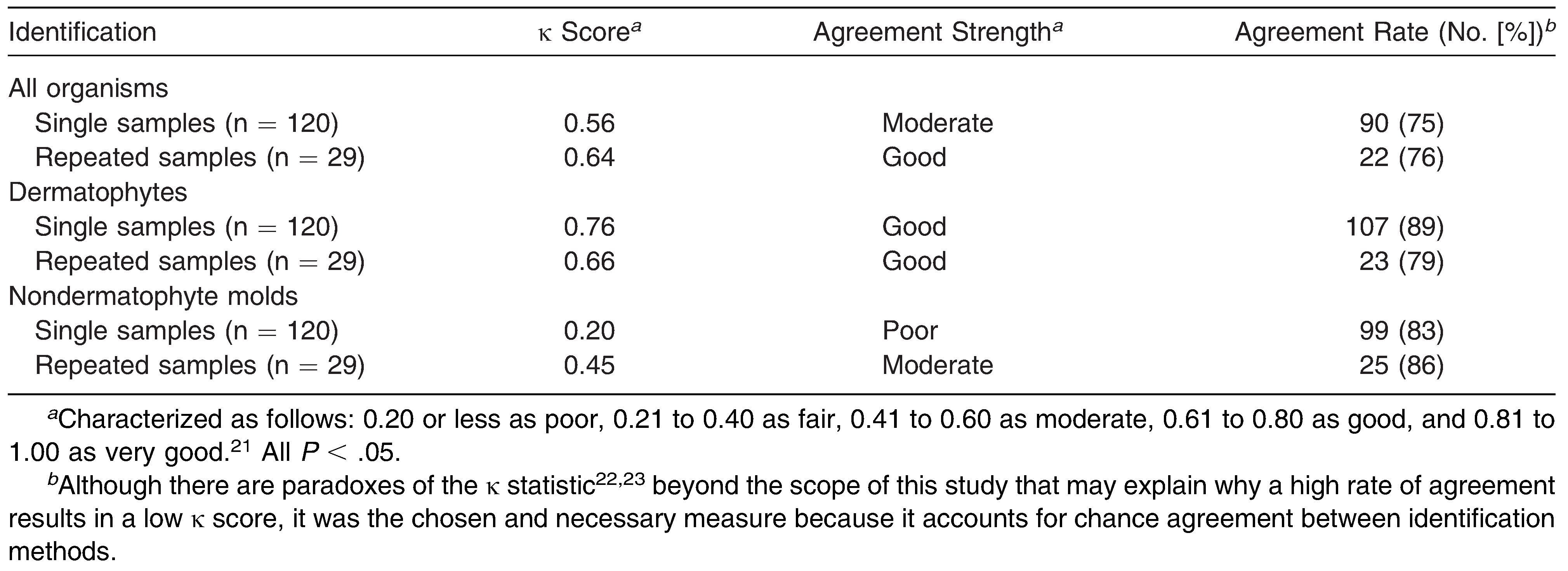
With the KOH report as the gold standard for true-positive or true-negative test results, the false-negative results were removed from the data sets and, thus, a major component of the lack of agreement between methods was eliminated, leaving a single sample data set of 120 and a repeated sample data set of 29 for comparison between identification methods (Table 4). For both the single and repeated sample data sets, agreement improves in all cases with the removal of false-negative reports, except for the identification of NDMs in the single sample data set: for the identification of all organisms, agreement is moderate for single samples (κ = 0.56) and good for repeated samples (κ = 0.64); for dermatophyte identification, agreement increases to good (κ = 0.76 and κ = 0.66, respectively); and for identification of NDMs, agreement remains poor for the single sample data set (κ = 0.20) but increases to moderate for the repeated sample data set (κ = 0.45) (Table 4).
Table 4. Summary of Kappa (κ) Scores for Agreement Between Polymerase Chain Reaction and Culture for the Identification of Infecting Organisms in Suspected Onychomycosis in Single and Repeated Samples with False-Negative Results Removed for Comparison 
Japma 107 00280 t004

Discussion

Establishing the causative agent in patients with onychomycosis before the administration of antifungal agents is essential due to risks associated with oral antifungal therapy, such as hepatotoxicity [24,25]. Our aim was to compare conventional culture and molecular methods for the identification of dermatophytes and the most commonly occurring NDMs while taking into account single and repeated sampling and the effect of false-negative results.
Repeated sampling increases confidence that the detected organism is the causal agent of onychomycosis [26]. Because NDMs may be likely environmental contaminants, repeated sampling ensures the accuracy of definitive diagnosis of onychomycosis. In this study, repeated sampling had no effect on the agreement between methods for the identification of dermatophytes: both the single and repeated sample data sets moderately agreed between the two methods. For NDM identification, repeated sampling increases the confidence of definitive diagnosis as agreement between methods increased from poor to fair with repeated sampling.
Of the specimens whose diagnosis was in disagreement between methods, most were culture negative and PCR positive (culture false-negative). This was also reported in a study that compared the identification of common NDMs (excluding Scytalidium spp) and dermatophytes but limited the culture and PCR identification to microscopy-positive samples [7]. The discord where culture was false-negative was 38% [7], drawing close attention to the limitations of the culture method. False-negative culture rates in this study were comparably high at 54% and 50% for single and repeated sampling, respectively, and reinforce culture limitations because, paradoxically, half the nail sample was dedicated to culture (culture bias).
By using KOH results as the gold standard (with false-negative reports of approximately 5% [2]) for the presence/absence of an infection and removing false-negative results from the data sets to further compare agreement between methods, the discord was clarified by the agreement increases: for all organisms, agreement went from fair to moderate (single sampling) or good (repeated sampling); for dermatophytes, agreement went from moderate to good; and for NDMs, agreement went from poor to fair in only the repeated sampling data set. The lack of increased agreement with false-negative results removed from the data set for comparison highlights the complications of NDM identification in suspected onychomycosis and also supports the recommendation that repeated sampling be performed to confirm NDM infections.
Although culture remains the gold standard for the identification of infectious agents of onychomycosis, the present study suggests that PCR identification methods are better able to report the accurate disease status of the patient suspected of having onychomycosis. In this study, the cost of consumables for culture ($2–$5 per sample) was lower than that for PCR ($3–$10 per sample), but the PCR advantages of lower false-negative rates (Table 3) and faster turnaround times may outweigh the disadvantage of a higher processing cost and the inability to determine the viability of the organism. Altogether, serious consideration should be given to replacing culture methods with PCR methods for the rapid and accurate identification of infecting agents of onychomycosis. The underlying limitations of each method remain, but they have been clarified along with the controversy surrounding the detection of NDMs [24]. Repeated sampling of NDMs is a key recommendation [2,24,26,27], allowing the practitioner to have more confidence that the NDM is a causative agent rather than a contaminant.

Acknowledgments

Bharat Gandhi, BSc, for his technical expertise.

Financial Disclosure

None reported.

Conflicts of Interest

None reported.

References

  1. Thomas J, Jacobson GA, Narkowicz CK, et al: Toenail onychomycosis: an important global disease burden. J Clin Pharm Ther35: 497, 2010.
  2. Summerbell RC, Cooper E, Bunn U, et al: Onychomycosis: a critical study of techniques and criteria for confirming the etiological significance of nondermatophytes. Med Mycol43: 39, 2005.
  3. Gupta AK, Jain HC, Lynde CW, et al: Prevalence and epidemiology of onychomycosis in patients visiting physicians' offices: a multicenter Canadian survey of 15000 patients. J Am Acad Dermatol43: 244, 2000.
  4. Jackson CJ, Barton RC, Evans EG: Species identification and strain differentiation of dermatophyte fungi by analysis of ribosomal-DNA intergenic spacer regions. J Clin Microbiol37: 931, 1999.
  5. Gupta AK, Zaman M, Singh J: Fast and sensitive detection of Trichophyton rubrum DNA from the nail samples of patients with onychomycosis by a double-round polymerase chain reaction-based assay. Br J Dermatol157: 698, 2007.
  6. Litz CE, Cavagnolo RZ: Polymerase chain reaction in the diagnosis of onychomycosis: a large, single-institute study. Br J Dermatol163: 511, 2010.
  7. Bontems O, Hauser PM, Monod M: Evaluation of a polymerase chain reaction-restriction fragment length polymorphism assay for dermatophyte and nondermatophyte identification in onychomycosis. Br J Dermatol161: 791, 2009.
  8. Ebihara M, Makimura K, Sato K, et al: Molecular detection of dermatophytes and nondermatophytes in onychomycosis by nested polymerase chain reaction based on 28S ribosomal RNA gene sequence. Br J Dermatol161: 1038, 2009.
  9. Brillowska-Dabrowska A, Swiekowska A, Lindhardt Saunte DM, et al: Diagnostic PCR tests for Microsporum audouinii, M. canis and Trichophyton infections. Med Mycol48: 486, 2010.
  10. Savin C, Huck S, Rolland C, et al: Multicenter evaluation of a commercial PCR–enzyme-linked immunosorbent assay diagnostic kit (Onychodiag) for diagnosis of dermatophytic onychomycosis. J Clin Microbiol45: 1205, 2007.
  11. Arabatzis M, Bruijnesteijn van Coppenraet LES, Kuijper EJ, et al: Diagnosis of common dermatophyte infections by a novel multiplex real-time polymerase chain reaction detection/identification scheme. Br J Dermatol157: 681, 2007.
  12. Machouart-Dubach M, Lacroix C, Feuilhade De Chauvin M, et al: Rapid discrimination among dermatophytes, Scytalidium spp., and other fungi with a PCR-restriction fragment length polymorphism ribotyping method. J Clin Microbiol39: 685, 2001.
  13. Menotti M, Machouart M, Benderdouche C, et al: Polymerase chain reaction for diagnosis of dermatophyte and Scytalidium spp. onychomycosis. Br J Dermatol151: 518, 2004.
  14. Dobrowolska A, Staczek P: PCR—RFLP analysis of the dermatophytes isolated from patients in Central Poland. J Dermatol Sci42: 71, 2006.
  15. Kardjeva V, Summerbell R, Kantardjiev T, et al: Forty-eight-hour diagnosis of onychomycosis with subtyping of Trichophyton rubrum strains. J Clin Microbiol44: 1419, 2006.
  16. Kondori N, Abrahamsson AL, Ataollahy N, et al: Comparison of a new commercial test, Dermatophyte-PCR kit, with conventional methods for rapid detection and identification of Trichophyton rubrum in nail specimens. Med Mycol48: 1005, 2010.
  17. Chandran NS, Pan JY, Pramono ZAD, et al: Complementary role of polymerase chain reaction test in the diagnosis of onychomycosis. Australas J Dermatol54: 105, 2013.
  18. Davies RR: Mycological tests and onychomycosis. J Clin Pathol21: 729, 1968.
  19. Uchida T, Makimura K, Ishihara K, et al: Comparative study of direct polymerase chain reaction, microscopic examination and culture-based morphological methods for detection and identification of dermatophytes in nail and skin samples. J Dermatol36: 202, 2009.
  20. Gupta AK, Nakrieko KA: Molecular determination of mixed infections of dermatophytes and nondermatophyte molds in individuals with onychomycosis. JAPMA104: 330, 2014.
  21. Altman DG: Practical Statistics for Medical Research, p404, Chapman and Hall/CRC, Boca Raton, FL, 1991.
  22. Feinstein A, Cicchetti D: High agreement but low Kappa: I. The problems of two paradoxes. J Clin Epidemiol43: 543, 1990.
  23. Feinstein A, Cicchetti D: High agreement but low Kappa: II. Resolving the paradoxes. J Clin Epidemiol43: 551, 1990.
  24. Shemer A, Davidovici B, Grunwald MH, et al: New criteria for the laboratory diagnosis of nondermatophyte moulds in onychomycosis. Br J Dermatol160: 37, 2009.
  25. Rich P, Elewski B, Scher RK, et al: Diagnosis, clinical implications, and complications of onychomycosis. Semin Cutan Med Surg32(suppl 1): S5, 2013.
  26. Gupta AK, Drummond-Main C, Cooper EA, et al: Systematic review of nondermatophyte mold onychomycosis: diagnosis, clinical types, epidemiology, and treatment. J Am Acad Dermatol66: 494, 2012.
  27. Moreno G, Arenas R: Other fungi causing onychomycosis. Clin Dermatol28: 160, 2010.

