The master knot of Henry was initially described by Dr. Arnold Henry, a surgeon in Egypt, as an intertendinous communication between the flexor hallucis longus (FHL) and flexor digitorum longus (FDL) tendons in his 1946 text
Extensile Exposure Applied to Limb Surgery.[
1] It occurs in the plantar midfoot musculature as the FDL passes relatively superficial to the FHL, distal to the tarsal tunnel and deep to the abductor hallucis muscle belly. Specifically at the crossing, the two tendons are covered by a thin, semitransparent fibrous tissue, and frequently the two tendons communicate through the sharing of fibrous slips. Most often, the FHL sends a slip to one or more of the digital tendons of the FDL, although a variety of patterns are possible between the two.[
2-
8] In addition, the quadratus plantae (QP) muscle belly lies in close anatomical proximity to the master knot. This muscle takes its origin from the medial calcaneus and typically inserts onto the tendon of the FDL distal to the master knot.[
2]
This structural anatomy has biomechanical, functional, and surgical implications. First, the FHL has the potential for independent action on the lesser digits, with a greater effect on the medial lesser digits (second and third) than the lateral lesser digits (fourth and fifth).[
2-
4,
9-
17] In addition, this potential communication has importance with respect to foot and ankle reconstructive procedures, namely, the FDL tendon transfer used for the flexible pes valgus deformity and the FHL tendon transfer for chronic Achilles tendinopathy.[
18-
20] Transection of one of the tendons used for a transfer proximal to the master knot may result in continued normal function and action of the digits as a result of these interconnections, and some surgeons may also choose to tenodese the harvested tendon stump into the other intact tendon at this location in an attempt to preserve distal function.
This anatomy may also have an effect on the progression and treatment of diabetic foot infections. It is important to have an appreciation of lower-extremity anatomical relationships before undertaking diabetic foot surgery. Specifically, with respect to acute deep space infection, potential sources of bacterial transmission along deep fascial planes and soft-tissue structures should guide incision planning, the intraoperative surgical course, and the degree of resected tissue.[
21-
30] This should include a detailed understanding of the fascial compartments of the plantar foot and the courses of the relatively avascular extrinsic tendons traveling between the leg and the foot through these compartments. This general surgical concept may be particularly applicable to the medial plantar foot compartment and the FHL tendon. The first metatarsophalangeal joint is a common source of increased plantar pressure and a common location to develop a diabetic foot ulceration. If a deep-space infection develops in this anatomical location, then the sheath of the FHL represents a possible source of infection transmission and progression proximally into the medial plantar foot compartment.
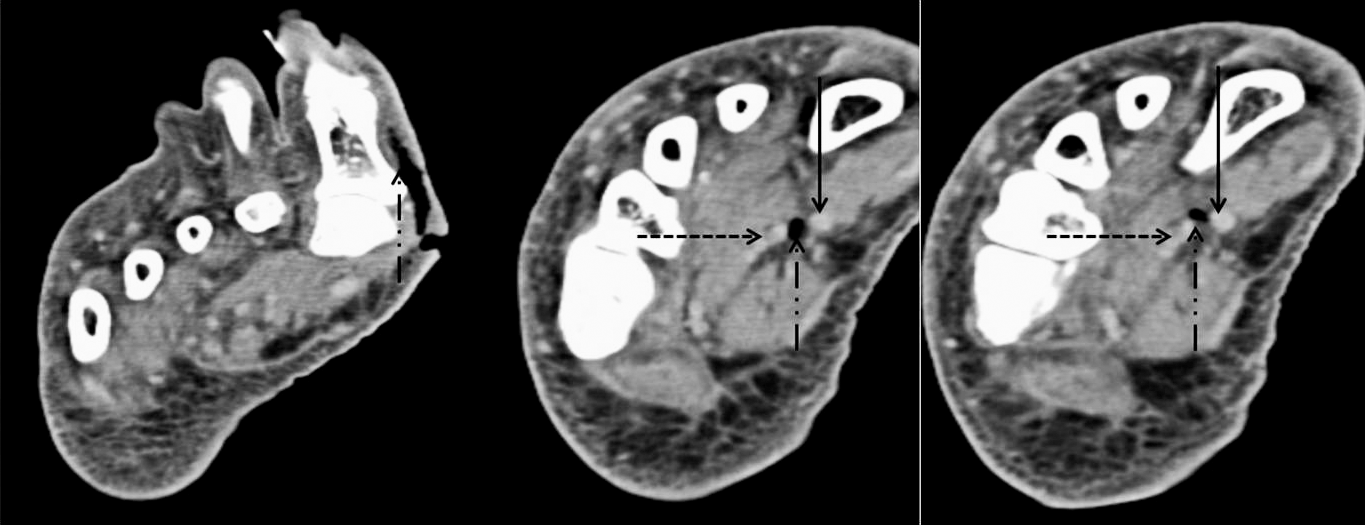
We are aware that there are many sources of potential intercompartmental communication when considering diabetic foot infections, but we are unaware of any previous anatomical description of this occurring at the master knot via the FHL tendon sheath. We have, however, observed a clinical case involving the CT scan of a diabetic foot infection that demonstrated the presence of soft-tissue emphysema originating at the first metatarsophalangeal joint, extending proximally along the FHL tendon sheath to the knot of Henry, and subsequently involving the FDL tendon sheath at this location (
Fig. 1). The objectives of this article are to evaluate the potential for communication of the FHL tendon with other pedal tendons and plantar foot compartments at the master knot of Henry and to provide readers with cadaveric images and CT scans of such communications.
Figure 1.
Clinical case of communication between the flexor hallucis longus (FHL) and flexor digitorum longus (FDL) tendons at the master knot of Henry. These CT scans are from a patient with an infection initiating at the first metatarsophalangeal joint and demonstrate soft-tissue emphysema (vertical dash-dot arrows) initially at a soft-tissue ulceration, then extending proximally along the FHL tendon sheath (solid arrow) to the knot of Henry, and subsequently into the FDL tendon sheath (horizontal shorter dashed arrows).
Figure 1.
Clinical case of communication between the flexor hallucis longus (FHL) and flexor digitorum longus (FDL) tendons at the master knot of Henry. These CT scans are from a patient with an infection initiating at the first metatarsophalangeal joint and demonstrate soft-tissue emphysema (vertical dash-dot arrows) initially at a soft-tissue ulceration, then extending proximally along the FHL tendon sheath (solid arrow) to the knot of Henry, and subsequently into the FDL tendon sheath (horizontal shorter dashed arrows).
Methods
To evaluate the potential for communication of the FHL tendon sheath at the first metatarsophalangeal joint with proximal and lateral foot structures, we performed computed tomographic scans (CT) and subsequent anatomical dissection on six embalmed cadaveric limbs. After cannulation of the FHL tendon sheath at the level of the sesamoids of the hallux, 5 to 10 mL of a 1:4 dilution of iohexol (Omnipaque 300; GE Healthcare, Little Chalfont, United Kingdom) and normal saline was injected. The CT scans were subsequently obtained in the axial plane using a Siemens Sensation 16 multidetector CT scanner (Siemens Healthcare USA, Malvern, Pennsylvania), with sagittal and coronal reformatted images. Dissection of the limbs was then performed for specific evaluation of the known variable intertendinous connections between the FHL and FDL/QP muscles.
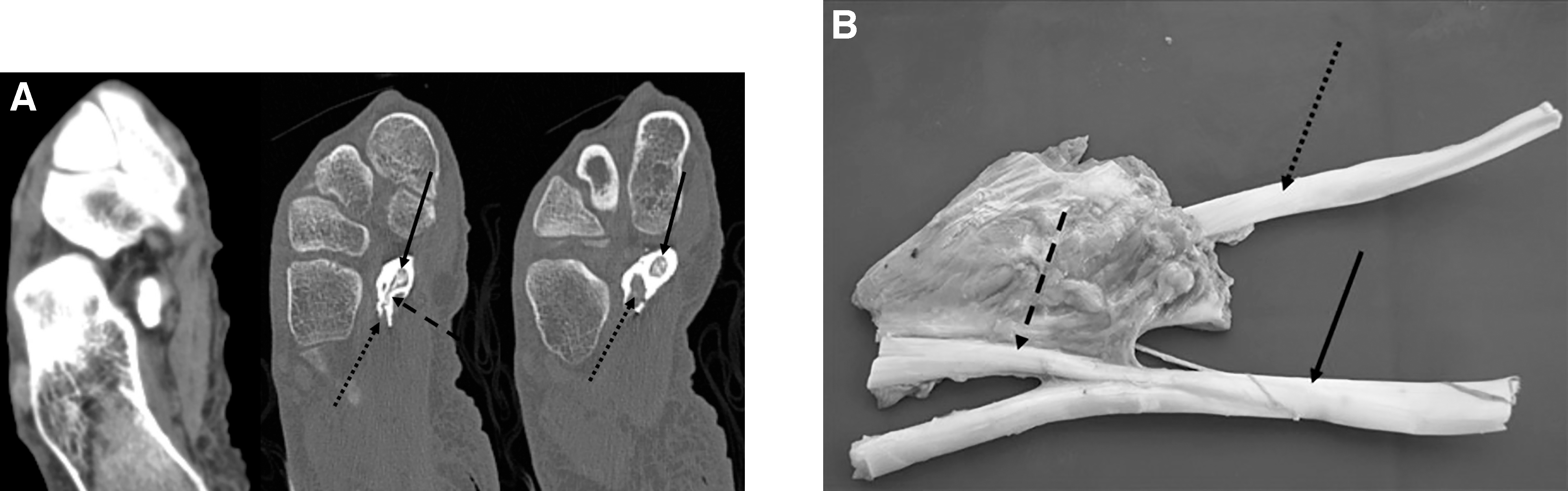
In one case, retrograde flow into four of the individual tendons of the FDL was observed on CT (
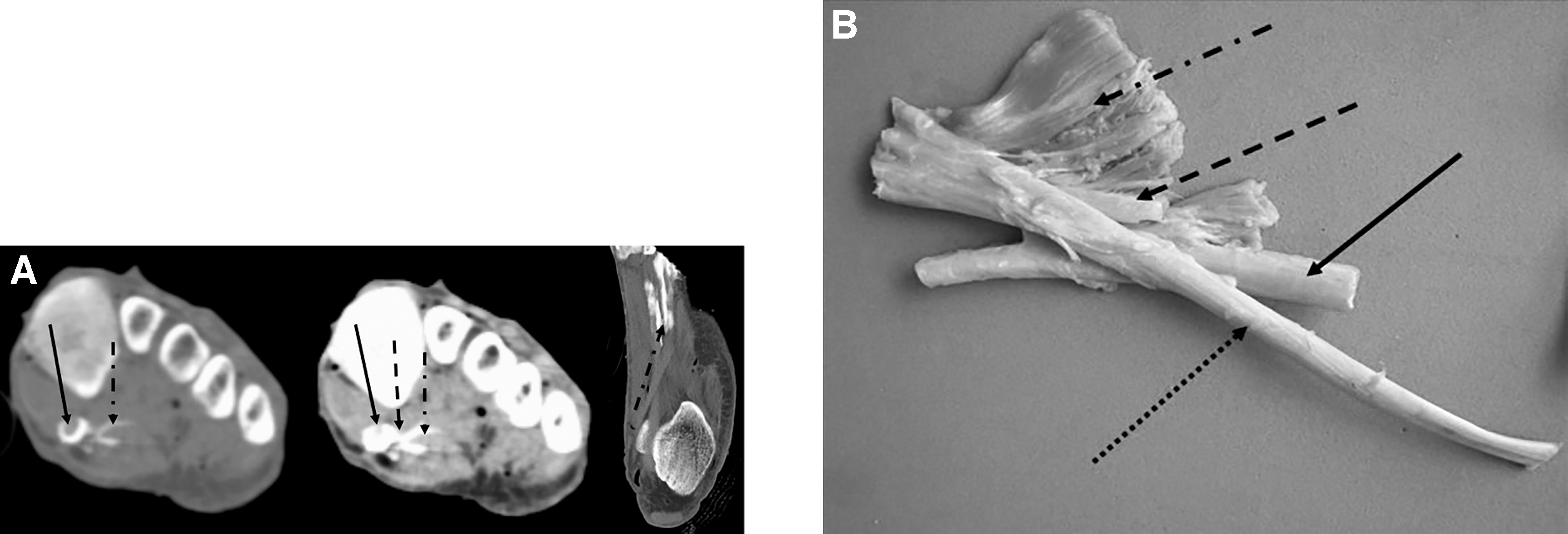
Fig. 2). On dissection, this specimen was noted to have a large communicating intertendinous slip between the FHL and FDL. A second cadaver had contrast filling in the QP muscle on CT with an associated intertendinous slip between the FHL and QP on dissection (
Fig. 3). The other four cadavers demonstrated no retrograde contrast filling of the FDL or QP on CT and demonstrated only small communications on dissection.
Figure 2.
Communication between the flexor hallucis longus (FHL) and flexor digitorum longus (FDL) tendons on computed tomography (CT) and anatomically at the master knot of Henry. A, Axial CT scans of the midfoot viewed at soft-tissue and bone windows. B, The corresponding gross anatomical specimen viewed from the dorsal aspect. These images demonstrate radiographic and anatomical communication between the FHL (solid arrows) and FDL (shorter dashed arrows), with one or two intertendinous communicating slips between the two (longer dashed arrows). On the CT scans, note the contrast filling from the FHL to the slips of the FDL through this communication at the knot of Henry, with contrast seen in the tendon fibers and the tendon sheaths.
Figure 2.
Communication between the flexor hallucis longus (FHL) and flexor digitorum longus (FDL) tendons on computed tomography (CT) and anatomically at the master knot of Henry. A, Axial CT scans of the midfoot viewed at soft-tissue and bone windows. B, The corresponding gross anatomical specimen viewed from the dorsal aspect. These images demonstrate radiographic and anatomical communication between the FHL (solid arrows) and FDL (shorter dashed arrows), with one or two intertendinous communicating slips between the two (longer dashed arrows). On the CT scans, note the contrast filling from the FHL to the slips of the FDL through this communication at the knot of Henry, with contrast seen in the tendon fibers and the tendon sheaths.
Figure 3.
A and B, Communication between the flexor hallucis longus (FHL) and quadratus plantae (QP) tendons on computed tomography (CT) and anatomically at the master knot of Henry. A, Coronal (left and middle images) and axial (right image) CT scans. B, The corresponding gross anatomical specimens viewed from the plantar aspect. These images demonstrate radiographic and clinical communication between the FHL (solid arrows) and QP (dash-dot arrows), with significant communication at the knot of Henry (longer dashed arrows) between the FHL, FDL (smaller dashed arrow), and QP. On the CT scans, contrast filling is observed retrograde from the FHL to the QP and to the FDL (dash-dot arrow in the CT scan on the right).
Figure 3.
A and B, Communication between the flexor hallucis longus (FHL) and quadratus plantae (QP) tendons on computed tomography (CT) and anatomically at the master knot of Henry. A, Coronal (left and middle images) and axial (right image) CT scans. B, The corresponding gross anatomical specimens viewed from the plantar aspect. These images demonstrate radiographic and clinical communication between the FHL (solid arrows) and QP (dash-dot arrows), with significant communication at the knot of Henry (longer dashed arrows) between the FHL, FDL (smaller dashed arrow), and QP. On the CT scans, contrast filling is observed retrograde from the FHL to the QP and to the FDL (dash-dot arrow in the CT scan on the right).
Conclusions
Although there are many potential sources of intracompartmental communication of infection in the plantar foot, and we cannot comment on what is more or less likely to serve as a source of communication for a given clinical situation, these images provide an original description of the master knot of Henry as another potential source of communication via the FHL tendon sheath. These images indicate that the master knot of Henry (the location in the plantar aspect of the midfoot where the FHL and FDL tendons decussate, with the FDL passing superficially over the FHL) has at least the potential to serve as one source of communication in diabetic foot infections from the FHL and medial plantar compartment to the central and lateral plantar compartments via the FDL and to the rearfoot via the QP.
The images produced from this anatomical exercise could lead to future formal investigations studying the specific patterns of intracompartmental communication of infection in the diabetic foot. For this application, we used retrograde contrast flow as an analogue for the spread of infection in embalmed limbs through a cannulated tendon sheath. This contrast agent is used by our institution when performing CT scans with contrast to evaluate for infection and has been described for the clinical evaluation of septic tenosynovitis of the extremities.[
31] Perhaps, however, a different construct and imaging agent would produce a better representation of the contiguous extension and soft-tissue damage produced by acute soft-tissue infection in the ulcerated diabetic foot. The use of fresh frozen limbs as opposed to embalmed limbs might have also produced different images with different patterns of communication at the master knot of Henry. We radiographically observed retrograde contrast flow in only two of six specimens. These two specimens were associated with relatively larger intertendinous communicating slips, whereas only smaller communicating slips were observed in the other specimens. A formal investigation could elucidate whether the presence or size of specific intertendinous communications is associated with intracompartmental communication in this location. Although the observed patterns of intertendinous connections in this anatomical area have been described as variable, their complete absence is rare.[
2,
10,
11]
Based on these images, we believe that diabetic foot surgeons should have a full appreciation of the anatomy of the master knot of Henry while performing procedures for infection in this anatomical location and involving these soft-tissue structures.