The lower limbs are extensions from the trunk specialized in supporting the body weight. Their main function is locomotion, that is, the ability to move from place to place and maintain balance. The lower limb has six major parts or regions: gluteal region, thigh or femur, knee, leg, ankle, and foot.[
1]
Viladot[
2] defines the foot as an essential support for the human bipedal posture, with its variable three-dimensional structure, the base of the antigravity servomechanism is a fundamental piece for human walking.
Podiatric medicine is a science that has reached its peak and has full authority to detect and treat all of the features related to the lower limb. Many foot disorders in adults begin in childhood. Therefore, the identification and treatment of such illnesses in that period serve to prevent or at least minimize many foot ailments in adults.[
3] At present, the Spanish Public Health Educational Chart does not include podiatric medical interventions in schools in its objectives. Establishment of podiatric medical screening in schools would allow early detection of podiatric biomechanical alterations susceptible to receiving a therapeutic treatment instead of late detection at an advanced phase of the illness that could receive only palliative treatments.
Screening, in its broadest sense, can be defined as the application of selection procedures (questionnaire, physical examination, test) in populations of apparently healthy individuals. Its aim is to detect, in the lag phase, those who may be ill or who have an increased possibility of developing a certain disease because they present a particular risk factor. In other words, it is to be able to differentiate people who seem to be in good health but who it is almost certain have a disease or a risk factor from healthy people who possibly do not have the disease or the risk factor.[
4]
The Foot Posture Index (FPI) is a tool for clinical diagnosis with the purpose of quantifying neutral, pronated, or supinated foot position grade. Its aim is to develop an easy six-factor method for rating foot posture by using a simple quantitative result. It was described by Dr. Anthony Redmond[
5] in 2005 and translated into Spanish by Pascual et al,[
6] teachers at the Miguel Hernández University of Alicante (Spain). The FPI measures and, therefore, quantifies the position of the foot at the hindfoot, midfoot, and forefoot. It is one of the few impartial and validated tests that exists in podiatric medicine.
Furthermore, we have the body mass index (BMI; the weight in kilograms divided by the square of the height in meters). Designed by Belgian statistician J. Quetelet, it is also known as the Quetelet Index. It is one of the resources to assess nutritious status according to the values proposed by the World Health Organization. The currently used definition of BMI and its benchmarks were agreed on in 1997 and published by the World Health Organization in 2000. It states that there is malnutrition when the BMI is less than 18.5, adequate nutritional status when the BMI is 18.5 to 24.9, overweight when the BMI is 25.0 to 29.9, and obesity when the BMI is 30.0 or higher.[
7] The BMI is a simple indicator of the relationship between weight and height that is commonly used for identification of overweight and obesity in adults. The value obtained is not constant but varies with age (infants and adults) and depends also on the proportions of muscle and adipose tissue. In 2010, approximately 40 million children younger than 5 years were overweight.[
8]
At present, BMI is the main diagnostic tool used to incorporate pediatric patients into the Integral Plan of Child Obesity in Andalucia (2007–2012).[
9] This plan has been developed to stop the gradual increase in childhood obesity in the population, to reduce the appearance of problems, and to improve the quality of life of the overweight. Activation of this plan by public institutions shows the consequences of obesity in our environment and its effects on different levels: social, health, and economy. The present study is presented in a context in which there is a gradual increase in childhood obesity, so the purpose is to evaluate in a pediatric population the various positions of the foot in relation to sex, age, and anthropometric determinants such as height, weight, BMI, and foot size.
Methods
Study Design and Participants
This cross-sectional descriptive study included 150 participants aged 8 to 13 years with no pathologic feet from the primary school of San Francisco de Mijas (Malaga, Spain). The inclusion criteria were 1) asymptomatic feet, 2) symmetry in the feet without joint deformities, and 3) aged 8 to 13 years. The exclusion criteria were 1) joint or bone disease, 2) surgery in the lower limbs, 3) morphologic alterations in the feet, and 4) alterations in the skin of the feet and plantar verruca.
Study Variables
The dependent (result) variable was the FPI. The independent (predictor) variables were sex, age, height, weight, BMI, and foot size (European).
Measurement of the FPI
Participants remained in a standing position for approximately 2 minutes with their arms relaxed on both sides and looking straight ahead. Because the FPI has proven good intraobserver reliability but only moderate interobserver reliability, the same examiner took all of the measurements. We used the six criteria used for the FPI: palpation of the astragalus head, inframalleolar and supramalleolar curvature, the position of the calcaneus in the frontal plane, the prominence of the astragalus-scaphoid articulation, and abduction-adduction of the forefoot. The rating on each criterion can be –2, –1, 0, 1, or 2.
Data Collection Procedure
Two reviewers performed the examinations, and the results were accompanied by audiovisual support (videos and photographs). Each participant was examined individually and following a process of exploration established previously by both reviewers (examination guide). After the examinations, we gave the tutors/parents of participants who were detected as or suspected of having any type of alteration or pathology a consultation request form for visiting a podiatric physician, pediatrician, or orthopedist to confirm the pathology or alteration and administer the appropriate treatment.
The materials used for the study included 1) released and completed questionnaires before the intervention, 2) podiatric medicine measurement instruments (compass reading, Perthes ruler, hip level, three podoscopes, measuring tape, and scales), 3) exploration guide, 4) stretcher for examinations, 5) digital camera, and 6) consultation request form for the advised specialist.
Statistical Methods
To determine the FPI values we used descriptive statistics such as the mean ± SD. Sex differences were examined using the Student t test for independent samples. To assess the proportion of different types of feet, contingency tables and the χ2 test were constructed to determine whether there were any sex differences. Age, sex, weight, height, foot size, and BMI were used as independent variables in a multiple regression analysis to predict all values of the FPI as the dependent variable.
Because there are no differences in FPI between the right and left feet in asymptomatic individuals and to maintain the independence of the data, the FPI variable refers to measures on the right foot only.
Ethical Aspects
The study was approved by the principal of the school. To include participants and taking into account that the sample is composed of children, their parents and tutors provided written informed consent. They were also sent a survey about podiatric medical habits essential to participate in the study, which they had to complete and sign, guarding confidentiality of the data according to the current Organic Law 15/1999 of 13 December, of personal data protection.[
10]
Results
The mean ± SD participant age was 10.2 ± 1.0 years (range, 8–13 years), the mean ± SD height was 1.43 ± 0.1 cm (range, 1.2–1.6 cm), the mean ± SD weight was 41.1 ± 9.8 kg (range, 22–70 kg), the mean ± SD BMI was 19.6 ± 3.4 (range, 19.6–31.5), and the mean ± SD foot size (European) was 36.5 ± 2.3 (range, 30–42). The characteristics of the total sample and by sex are listed in
Table 1.
Table 1.
Characteristics of the Total Sample and by Sex
Table 1.
Characteristics of the Total Sample and by Sex
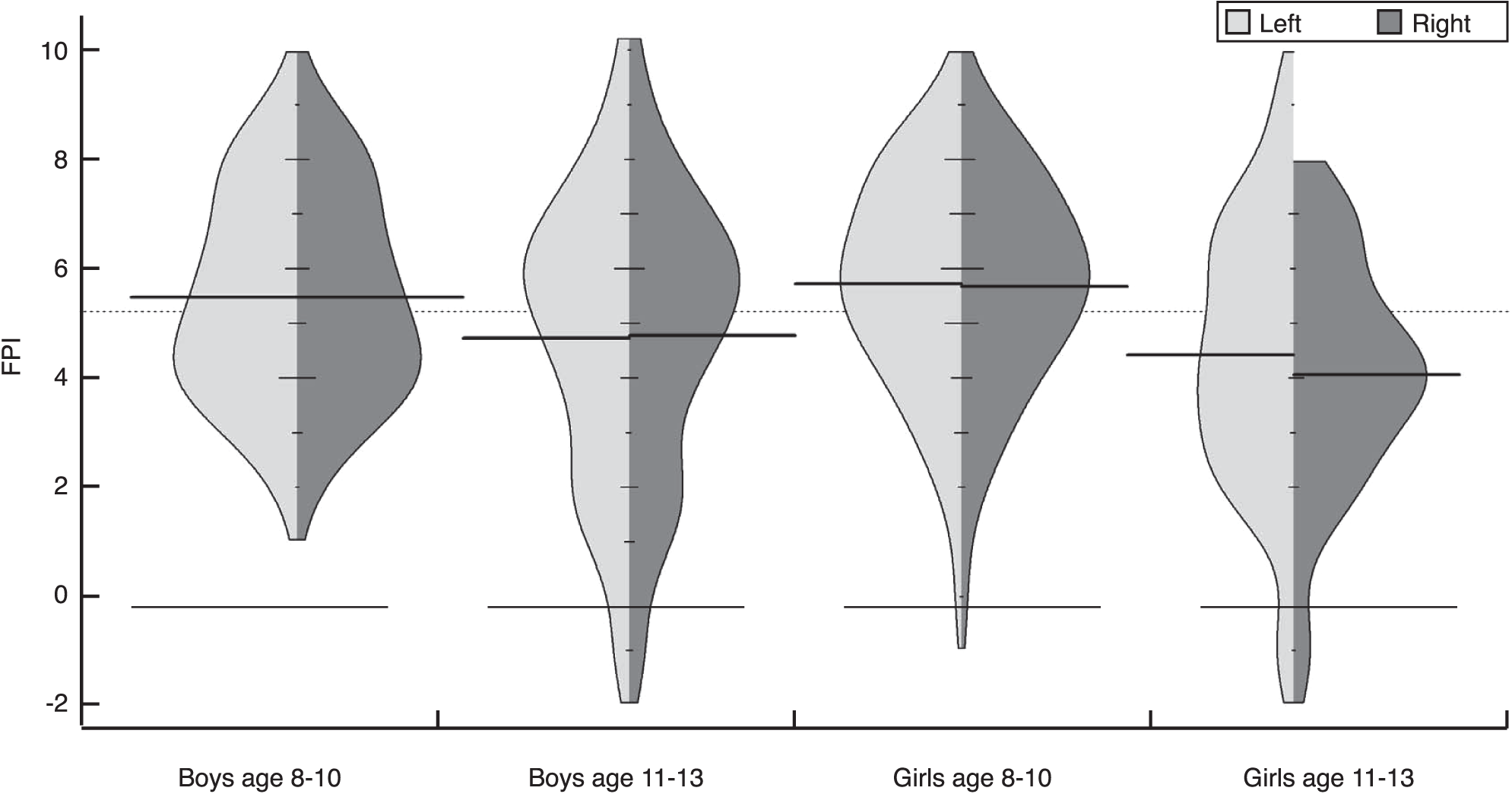
The mean ± SD FPI was 5.1 ± 2.1 for the total sample, 5.1 ± 2.2 for boys, and 5.2 ± 2.0 for girls, so there were no significant differences by sex (P = .636). Values of FPI were divided into two age groups: 8 to 10 years and 11 to 13 years. The mean ± SD FPI value for 8- to 10-year-olds was 5.5 ± 1.8 and for 11- to 13-year-olds was 4.5 ± 2.4 (P = .005).
Figure 1 shows the FPI values for the full sample grouped by age and sex. Age decreases the FPI values in both sexes.
Figure 1 also expresses the values on the right and left feet, not obtaining relevant differences.
Figure 1.
Foot Posture Index (FPI) values grouped by age and sex.
Figure 1.
Foot Posture Index (FPI) values grouped by age and sex.
Of the 150 feet examined, none obtained FPI values of highly supinated or highly pronated, two were supinated (1.3%), 76 were neutral (50.7%), and 72 were pronated (48.0%). The proportion of boys and girls who obtained the FPI value for the neutral foot was similar, and a slightly higher proportion of girls had pronated feet compared with boys. The χ
2 test shows that these differences between the sexes are not significant (
P = .423). The 8- to 10-year-olds have 46.7% neutral feet and 53.3% pronated feet. The 11- to 13-year-olds have 3.4% supinated feet, 56.9% neutral feet, and 39.7% pronated feet (
P = .072) (
Table 2).
Table 2.
Distribution of Foot Posture by Age and Sex
Table 2.
Distribution of Foot Posture by Age and Sex
Table 3 shows that 7.7% of the total FPI values can be explained by anthropometric variables such as height, weight, and foot size (
r2 = 0.077;
P <.010). Neither age nor BMI explained the variations in the FPI.
Table 3.
Multiple Regression Analysis for the Foot Posture Index and Anthropometric Variables (N = 150)
Table 3.
Multiple Regression Analysis for the Foot Posture Index and Anthropometric Variables (N = 150)
Discussion
During puberty, a point of inflection occurs in physical development in boys and girls as a result of differences in hormone levels. Until then, no sex differences were noted. The onset of puberty may vary from age 8 to 13 years in girls and from age 9 to 15 years in boys (puberty usually begins approximately 2 years earlier in girls than in boys).
It is in this time when the blood testosterone level increases 10-fold in boys, causing a marked increase in muscle mass, while girls go through an increase in the production of estrogens, which causes a growth of fat storage in the body, breast development, and widening of the hips. Although muscle mass in girls continues to increase during adolescence, it happens at a slower rate than in boys due to hormonal differences. With the increase in muscle mass there is also an increase in muscle strength. The ability to produce force is essentially the same in boys and girls during preadolescence. Hormonal differences during puberty are responsible for the acceleration of the strength development in boys and the continuation of girls' similar rate of force development shown during preadolescence.[
11]
An important factor for the expression of muscle strength in boys is the development and maturation of the nervous system. If there has been myelination of the nerve fibers, or it is too incomplete, then quick reactions and skillful movements cannot be executed properly, and it is impossible to achieve high levels of strength and power. The myelination of many motor nerves is not complete until reaching sexual maturation.[
11]
The difference in hormone levels and its effect on development through physical or somatic maturation, which starts with puberty, explains the results described in an adult population by Sánchez et al.[
12] Women are attributed a higher value of FPI than men, although the difference was not statistically significant. The difference in the FPI values obtained between men and women in the adult population studied is justified by the presence in women of an increased laxity of the lateral ankle ligaments,[
13] and a reduced muscle strength responsible for keeping the height of the inner longitudinal arch (ILA),[
14] resulting in an overall greater degree of pronation in women.[
15] All of this is a consequence of the hormonal difference and its effects on muscles and ligaments.
The results of this study indicate that there are no significant differences in the value of FPI in relation to sex in pediatric populations. This may be because the age range of the population included in this study did not reach the age at which puberty begins, and from the somatic point of view, the differences between the sexes are relatively minimal until they reach 11 years old,[
16] the average age for the start of puberty when the hormone differences described previously herein are first observed.
On the other hand, we did not appreciate an influence of age on the FPI values for the age range of this population. However, we observed differences between the pediatric and adult populations if we compare the present results, with a predominance of neutral and pronated foot postures over other positions (highly pronated, supinated, and highly supinated), with the results of Sánchez et[
12] referring to an adult population in which the neutral stance posture predominates compared with the pronated and supinated foot. The increase in muscle mass, the myelination of motor nerves, and, eventually, the increase in muscle strength that start with puberty allow better support of the ILA, increasing the cases of neutral foot and decreasing the cases of pronated foot in relation to the pediatric population.
Moreover, the bone of a child is more flexible than that of an adult because the Haversian canals are higher and, therefore, the bone is more porous. This allows a greater degree of flexibility and further deformation[
17] that could maintain the ILA so that larger deformation leads to bigger pronation. The percentage of neutral feet obtained in the present study is slightly higher than pronated ones. This higher percentage can be explained if we consider that the age range of the population is close to the average age at which puberty begins, so it is possible that part of the population studied is already experiencing skeletal and nervous muscle maturation, thereby strengthening the ILA support. We observed no influence of the BMI on the FPI, which coincides with the results of the study by Evans.[
18]
There are no significant data to justify the influence of the anthropometric variables of height, weight, and size of the foot on the FPI. Based on the results obtained we could deduce that the FPI in the pediatric population is independent of the studied variables (BMI, weight, height, foot size, age, and sex), with a predominance of the neutral and pronated foot, whereas in the adult population (based on the study by Sanchez et al[
12]) there is a predominance of the neutral foot over the pronated and supinated foot, and there is an influence of sex on the FPI marked by ligament and muscle differences. The major limitation of this research is the high interobserver variability intrinsic to the FPI.