Flat feet pose only a seemingly insignificant problem that concerns more than 70% of adults and 30% of children [
1]. Flat feet in children often cause parental anxiety and lead to numerous consultations with the pediatric orthopedist [
2]. A significant percentage of children have asymptomatic flat feet that, according to many researchers, do not need to be treated [
3,
4]. However, some other scientists contend that lowered longitudinal arches collapse due to decreased performance of the foot muscles [
5] and may result in worse postural balance [
6] and can increase the risk of knee injuries [
7] or cause low back pain [
8]. The course of the flatfoot therapeutic intervention in children is still problematic, and proper shoes, orthotic devices, and rehabilitation exercises are most frequently recommended [
9]. Promotion of healthy eating habits is still not sufficient, although many authors have already mentioned some correlations between excessive body weight and pes planus [
10,
11]. Stretching the gastrocnemius and soleus muscles is often recommended in the case of flat feet [
12].
The purpose of the study was to assess the prevalence of flat feet in 10- to 12- year-olds (ie, at the age when the development of foot arching is practically completed) [
13] and to measure ankle dorsiflexion range of motion (ROM) in those with normal and flat feet. Foot arch height in participants with normal and excessive weight was also compared.
Materials and Methods
The study group consisted of 400 children (190 girls [47.5%] and 210 boys [52.5%]) aged 10 to 12 years (mean ± SD age, 11.03 ± 0.82 years) from three randomly selected primary schools. Sex did not differentiate the age of participants. Before the study began, written informed consent was obtained from each participant's parent or legal guardian, and the Bioethical Committee at the Regional Medical Chamber in Tarnow, Poland, provided approval. Children with disability certifications and those who had sustained injuries to their musculoskeletal system within 12 months of the study were excluded.
All of the participants were measured undressed to their underwear, and all of the measurements followed the same procedures and were performed by an experienced physiotherapist (A.J.-S.). Body height was measured within 1 mm with a calibrated anthropometer (Alumet, Warsaw, Poland) from the base of support to the highest point on the head. For the measurements, all of the participants stood with their feet together and their sight directed straight ahead. Body weight was measured on Tanita scales (Tanita Corporation of America Inc, Arlington Heights, Illinois) to an accuracy of 0.1 kg. The same scales were used to assess body fat percentage using bioelectrical impedance analysis. Body mass index (BMI, ie, the weight in kilograms divided by the square of the height in meters) was calculated, and the participants' weight status was categorized as normal weight, overweight, or obesity according to the norms of Cole et al [
14].
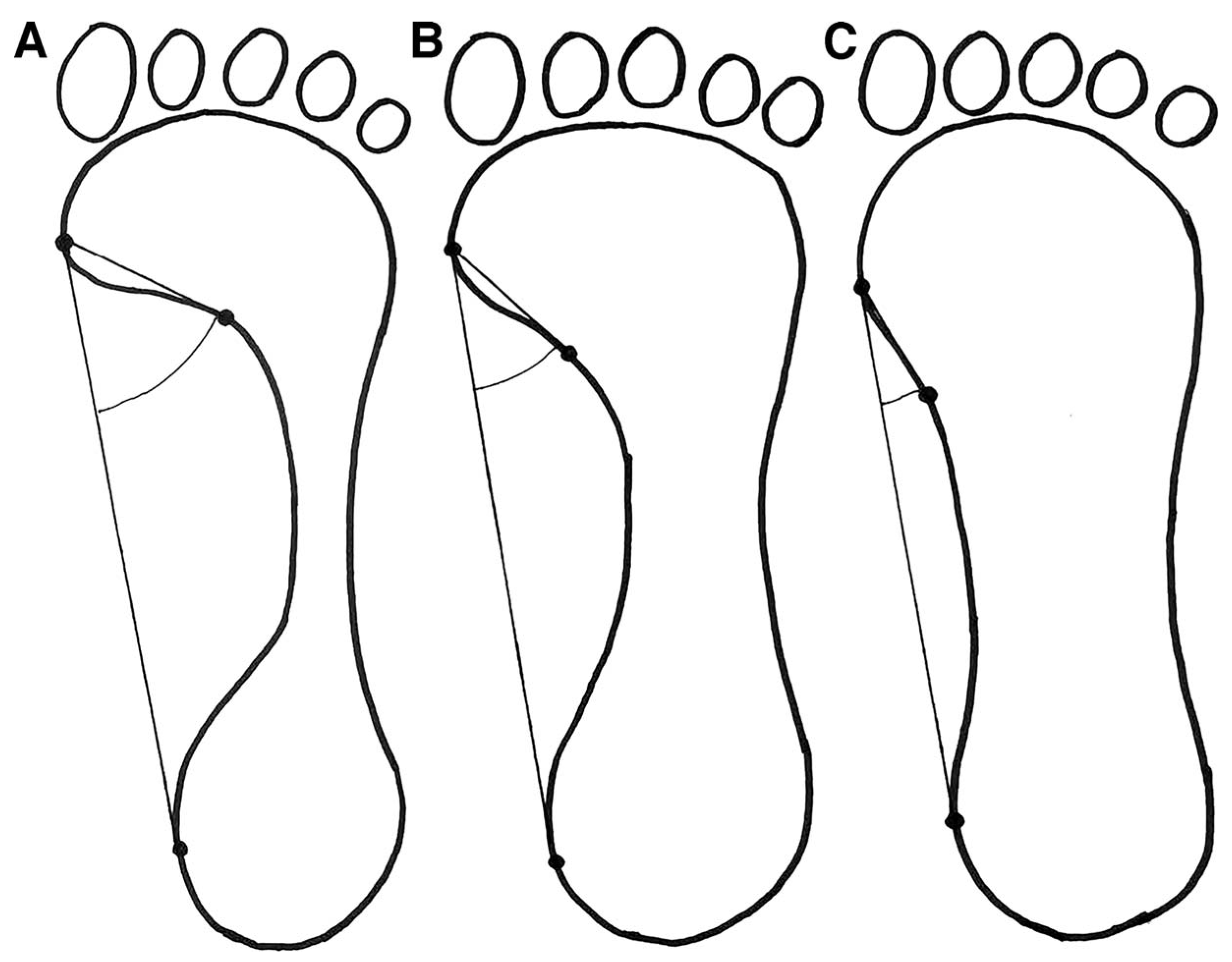
Measurements of the longitudinal arch of the foot were performed with the child in the standing position with both feet placed firmly on the computerized podoscope (CQ Elektronik System, Wisniowa, Poland) and are given in Clarke's angles (CA) (
Fig.1). Clarke's angular values were calculated automatically when on the footprint the following three points were marked: two most medially located points on the forefoot and hindfoot and one point in the highest arch on the metatarsus. These points were marked by the physiotherapist who conducted the test. The footprint analysis method was selected because of its low cost, speed, simplicity, noninvasiveness, and reliability [
15]. The foot arch was normal if CA was between 42° and 54°. Values less than 42° denoted flat feet, and those greater than 54° denoted high-arched feet [
16].
Figure 1.
Clarke's angle (CA) measurement method: high-arched foot, CA greater than 54° (A); normal-arched foot, CA between 42° and 54° (B); and flatfoot, CA less than 42° (C).
Figure 1.
Clarke's angle (CA) measurement method: high-arched foot, CA greater than 54° (A); normal-arched foot, CA between 42° and 54° (B); and flatfoot, CA less than 42° (C).
Active nonweightbearing dorsiflexion ROM was assessed with a manual goniometer (Stanley-Med. s.c., Poznan, Poland). The measurement was taken with the children in the sitting position on a chair with their knees and ankles 90° flexed and their feet placed on the support base. The axis of the goniometer was placed approximately 1.5 cm inferior to the lateral malleolus with the stationary arm parallel to the longitudinal axis of the fibula and the movable arm parallel to the fifth metatarsal bone and to the floor. The participant performed dorsiflexion of the foot. The mobile arm of the goniometer was moved by the therapist along with the upward movement of the forefoot, and the score was given in degrees. Limited ROM was identified when the participant did not reach the 20° range of dorsiflexion [
17].
The arithmetic mean and standard deviation were used to analyze the data, and the normal distribution of variables was assessed by means of the Shapiro-Wilk test. The intergroup differences were calculated using the Mann-Whitney U test (comparison of two groups) or the Kruskal-Wallis and post hoc Tukey tests (comparison of three groups). The level of significance was accepted at P = .05.
Results
The Quality of Foot Arching
Based on CA values, a normal right foot arch was discovered in 226 participants (56.5%) (113 girls [59.5%] and 113 boys [53.8%]), and a normal left foot arch in 218 participants (54.5%) (110 girls [57.9%] and 108 boys [51.4%]). Flatfoot was seen in 68 girls (35.8%) in the right foot and in 72 girls (37.9%) in the left foot, and in 78 boys (37.1%) in the right foot and in 86 boys (41.0%) in the left foot, ie, in 146 participants (36.5%) in the right foot and in 158 participants (39.5%) in the left foot. A right high-arched foot was disclosed in 28 participants (7.0%): nine girls (4.7%) and 19 boys (9.0%). A left high-arched foot was observed in 24 participants (6.0%): eight girls (4.2%) and 16 boys (7.6%).
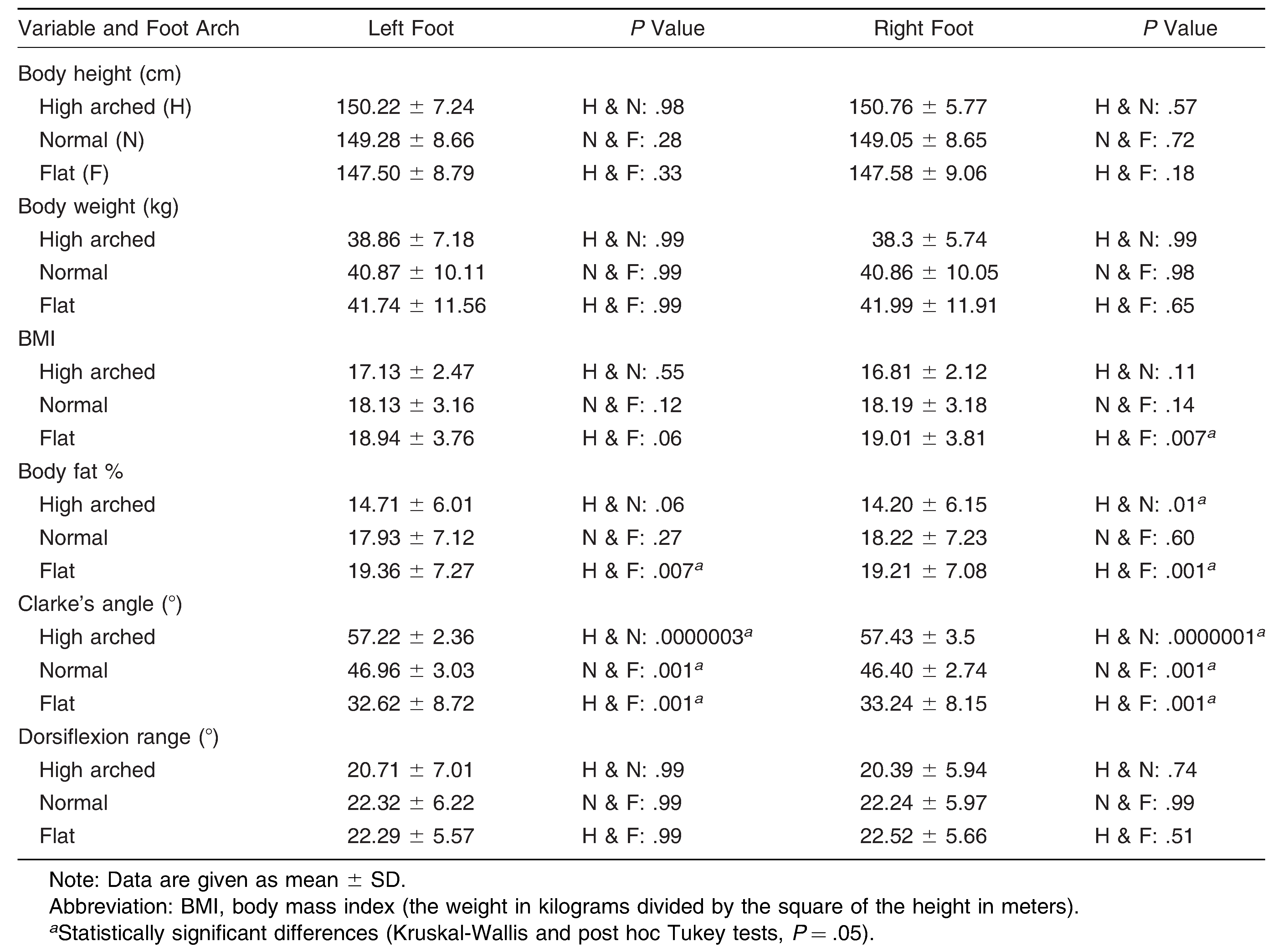
The arch of the right foot was different in children with high-arched feet than in those with normal foot arching by 11.03° and in the left foot by 10.26°. Between the groups with normal and flat feet, that difference was 13.16° for the right foot and 14.34° for the left foot (
Table 1). The longitudinal foot arching status did not differentiate participants' height or weight. The mean CA values for the right and left feet were slightly smaller in girls than in boys (girls: right CA = 41.93° and left CA = 41.38°; boys: 42.76° and 42.39°, respectively).
Table 1.
Comparison of Selected Variables in the Foot Arching Status Groups.
Table 1.
Comparison of Selected Variables in the Foot Arching Status Groups.
Participants with high-arched feet had the smallest BMI, and those with flat feet had the greatest BMI (statistically significant difference). Participants with high-arched feet had less body fat than those with normal foot arching (the difference was 4.0% for the right foot and 3.2% for the left foot) and flat feet (the difference was 5.0% for the right foot and 4.6% for the left foot). Dorsiflexion ROM for the right and left feet was slightly smaller in children with high-arched feet than in the remaining groups. However, the division of participants by foot arching status did not significantly differentiate dorsiflexion ROM.
Dorsiflexion ROM
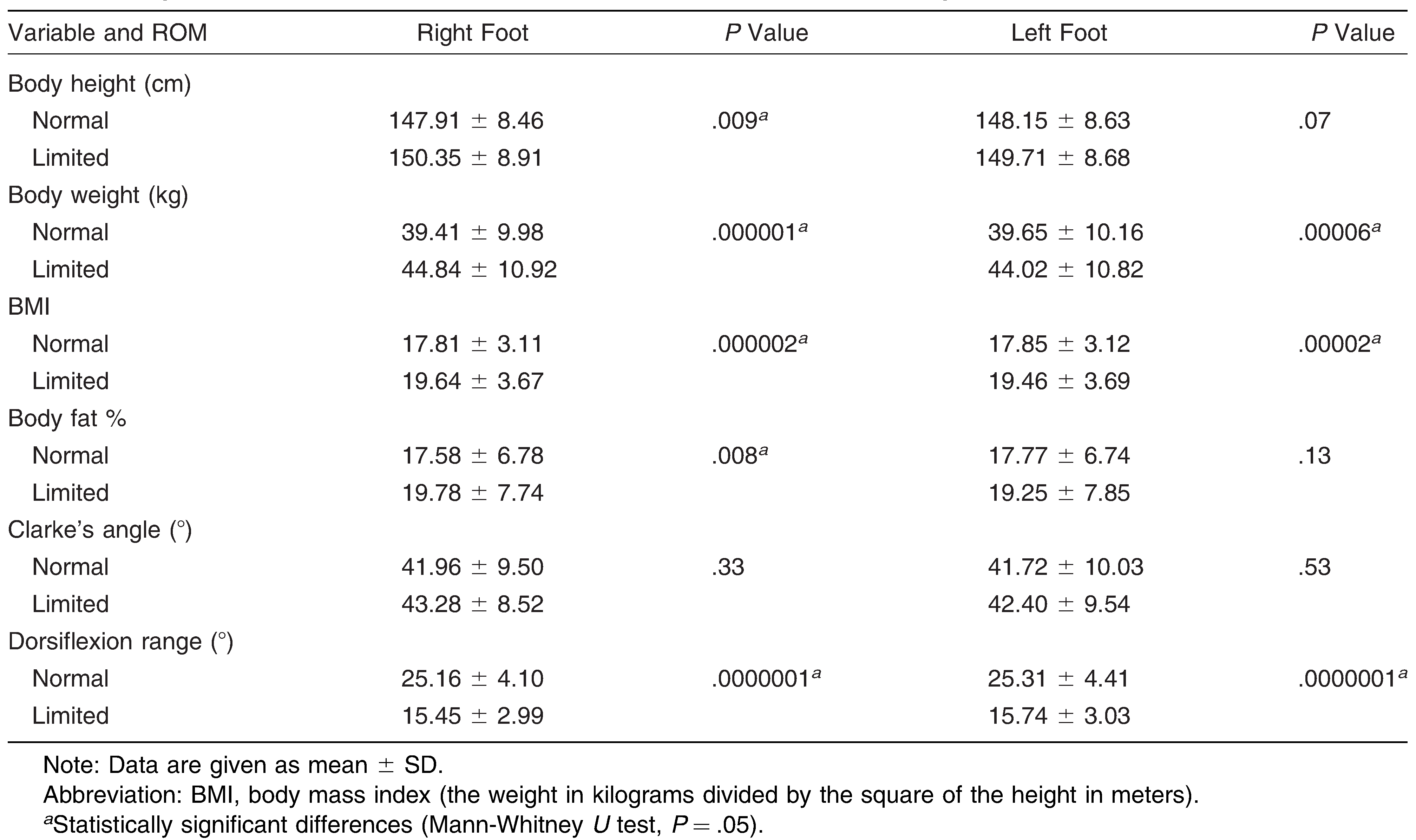
Normal dorsiflexion ROM was found in 279 participants (69.7%) in the right foot and in 271 (67.7%) in the left foot, and limited dorsiflexion was found in 121 participants (30.2%) in the right foot and in 129 (32.2%) in the left foot. Those with decreased dorsiflexion ROM were higher, heavier, and their BMI and body fat were significantly greater than in participants with normal dorsiflexion ROM. Clarke's angular values for the right and left feet did not differ in children with normal and limited ROM. The mean values showed a slightly lower longitudinal arch of the foot in participants with normal ROM (
Table 2). Dorsiflexion ROM was notably greater in girls in the right and left feet (by 2.12° and 2.57°, respectively) and were statistically significant (
P < .01).
Table 2.
Comparison of Selected Variables in the Dorsiflexion ROM Status Groups.
Table 2.
Comparison of Selected Variables in the Dorsiflexion ROM Status Groups.
Participants' Weight Status and Body Fat Content
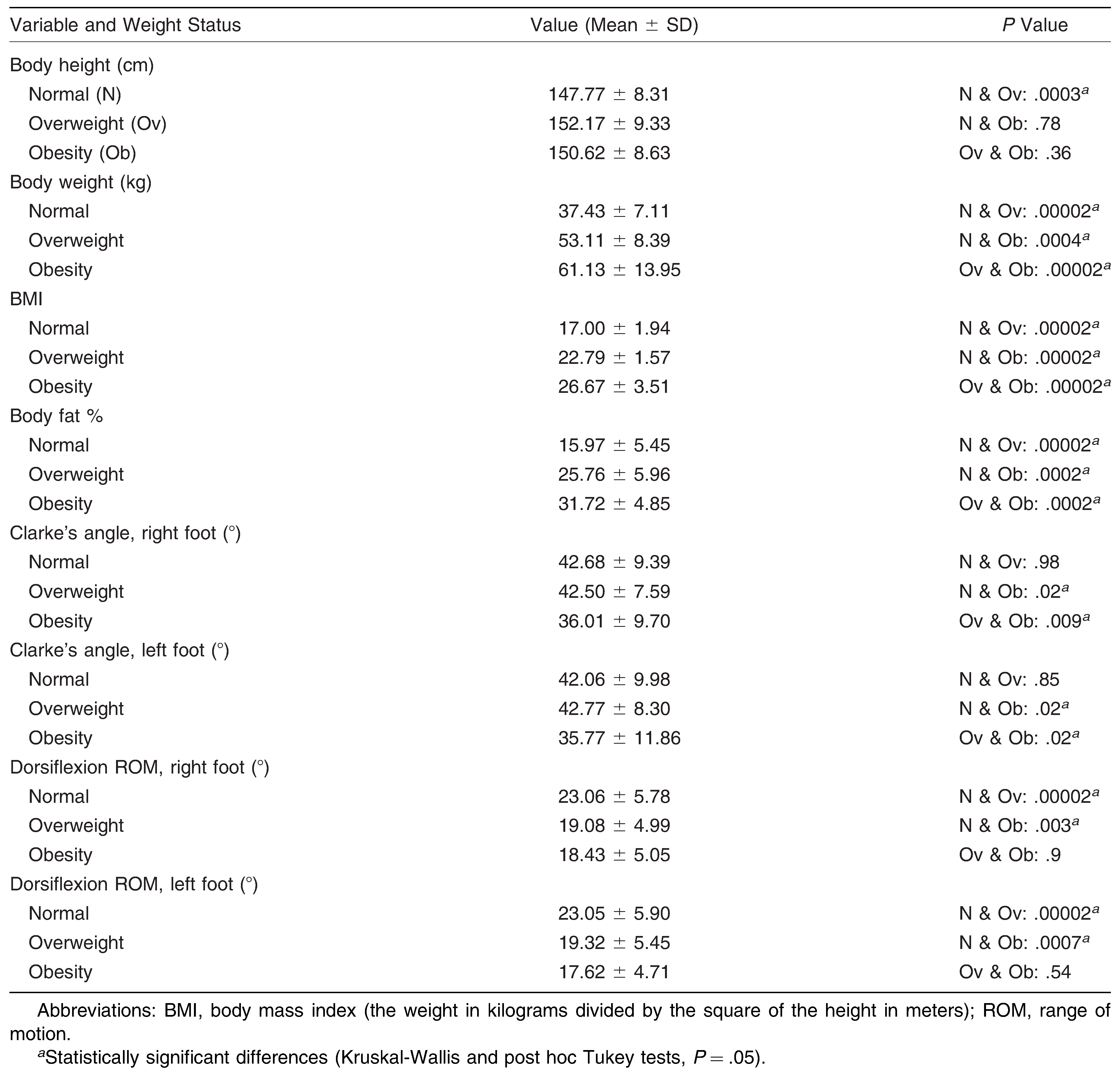
Normal body weight was discovered in 316 participants (79.0%): 152 girls (80.0%) and in 164 boys (78.1%). Overweight was disclosed in 67 participants (16.8%): 31 girls (16.3%) and 36 boys (17.1%). Obesity was typical of 17 participants (4.3%): seven girls (3.7%) and ten boys (4.8%). Those with normal weight were notably taller (4.4-cm difference) than the overweight children. The weight difference was 15.7 kg between children with normal weight and those who are overweight and 8 kg between overweight participants and obese participants. Body fat was greater in the group of obese participants by approximately 6% than in the overweight ones and by 9.8% than in those who exhibited normal weight. Girls' and boys' BMIs did not differ significantly. The fatty tissue content was greater in girls by approximately 5.5% compared with boys. Participants with a high-arched foot had the least body fat content, and those with flatfoot, in the case of the right and left feet, had the greatest body fat content. It was also revealed that participants with normal dorsiflexion ROM had less body fat than those with limited ROM (statistically significant difference for the right foot).
The arch of the right and left feet was notably lower in obese participants than in those with normal weight (the CA difference was 6.67° for the right foot and 6.29° for the left foot) and overweight participants (a 6.49° difference for the right foot and 7.0° for the left foot) (
Table 3). Dorsiflexion ROM was significantly greater in those with normal weight than in overweight children (a 3.98° difference for the right foot and 3.73° for the left foot) and obese children (a 4.63° difference for the right foot and 5.43° for the left foot). Of 249 participants with normal dorsiflexion ROM in both feet, 216 (86.7%) boasted normal body weight, 28 (11.2%) were overweight, and five (2.1%) were obese. Limited ROM in the right and left feet was disclosed in 100 participants: 59 were normal weight, 32 were overweight, and nine were obese.
Table 3.
Comparison of Selected Variables in Weight Status Groups.
Table 3.
Comparison of Selected Variables in Weight Status Groups.
Discussion
This study showed that flat feet prevailed in approximately 36% of primary school children, which was similar to the findings of Homayouni et al [
18] (35%) and considerably greater than that observed in Nigerian children (11.5%) by Umar and Tafida [
19]. Szczepanowska-Wołowiec et al [
20] examined body posture in 191 children aged 10 to 12 years. They found flat feet in 32.2% of girls and 34.8% of boys, and it was the third most frequently prevailing sign of poor posture. Only shoulder and pelvis asymmetry were more common. In adolescents, lowered foot arches were discovered less frequently. This was confirmed by Tenenbaum et al,[
21] who in a group of 17-year-old participants revealed lowered foot arches in 11.7% of females and 16.2% of males. In the present study, flat feet were also more common in boys.
One should pay attention to correlations between excessive weight and lowered foot arches in both sexes. Such a correlation was confirmed many times in preschool children,[
22,
23] in junior school children,[
24,
25] and in adolescents.[
21] Ezema et al[
26] discovered that flat feet prevailed 3.5 times more frequently in obese 6- to 10-year-olds than in their peers with normal body weight. According to Maggio et al,[
27] orthopedic pathologies, including foot malformations, were the most common and troublesome obesity-related complications in children.
Foot arching depends, most of all, on the position of the tarsal and metatarsal bones and on muscle and ligament tension.[
28] Many authors showed some correlations between increased tension of the calf muscles and the height of the foot arches.[
29,
30] A great proportion of participants disclosed limited ankle dorsiflexion ROM in both (25%) or one (12%) ankle joint. However, no connections between the longitudinal arch of the foot and the range of ankle dorsiflexion were observed. Limited motion incidence was even more frequent in children with normal foot arches. Those observations were contrary to the reports of some other authors.[
31] Shibuya et al,[
32] who examined 85 adults at age approximately 47 years, discovered that dorsiflexion ROM was smaller in participants with flat feet. However, that difference was not statistically significant.[
32] On the other hand, Burns and Crosbie,[
33] in their study also conducted on adults, revealed that dorsiflexion ROM measured in a weightbearing condition was smallest in participants with high-arched feet and greatest in those with flat feet. Shultz et al[
34] noticed also that overweight children had a reduced mean ± SD range of active dorsiflexion at 90° of knee flexion than those with normal body weight (19.57° ± 5.17° and 29.07° ± 3.06°, respectively). The present study confirmed these previous observations. It seems advisable to supplement the foot shape assessment (especially in overweight children) with the ankle dorsiflexion assessment.