Next Article in Journal
Perioperative Posterior Heel Pain Caused by Multiple Etiologies Including a Neuroma in Continuity of the Posterior Branch of the Sural Nerve
Previous Article in Journal
“Step Up for Foot Care”
 
 
Journal of the American Podiatric Medical Association is published by MDPI from Volume 116 Issue 1 (2026). Previous articles were published by another publisher in Open Access under a CC-BY (or CC-BY-NC-ND) licence, and they are hosted by MDPI on mdpi.com as a courtesy and upon agreement with American Podiatric Medical Association.
Review

Placebo Cure Rates in the Treatment of Onychomycosis

by
Aditya K. Gupta
1,2,* and
Maryse Paquet
2
1
Department of Medicine, University of Toronto, Toronto, ON, Canada
2
Mediprobe Research Inc, London, ON, Canada
*
Author to whom correspondence should be addressed.
J. Am. Podiatr. Med. Assoc. 2014, 104(3), 277-282; https://doi.org/10.7547/0003-0538-104.3.277
Published: 1 May 2014

Abstract

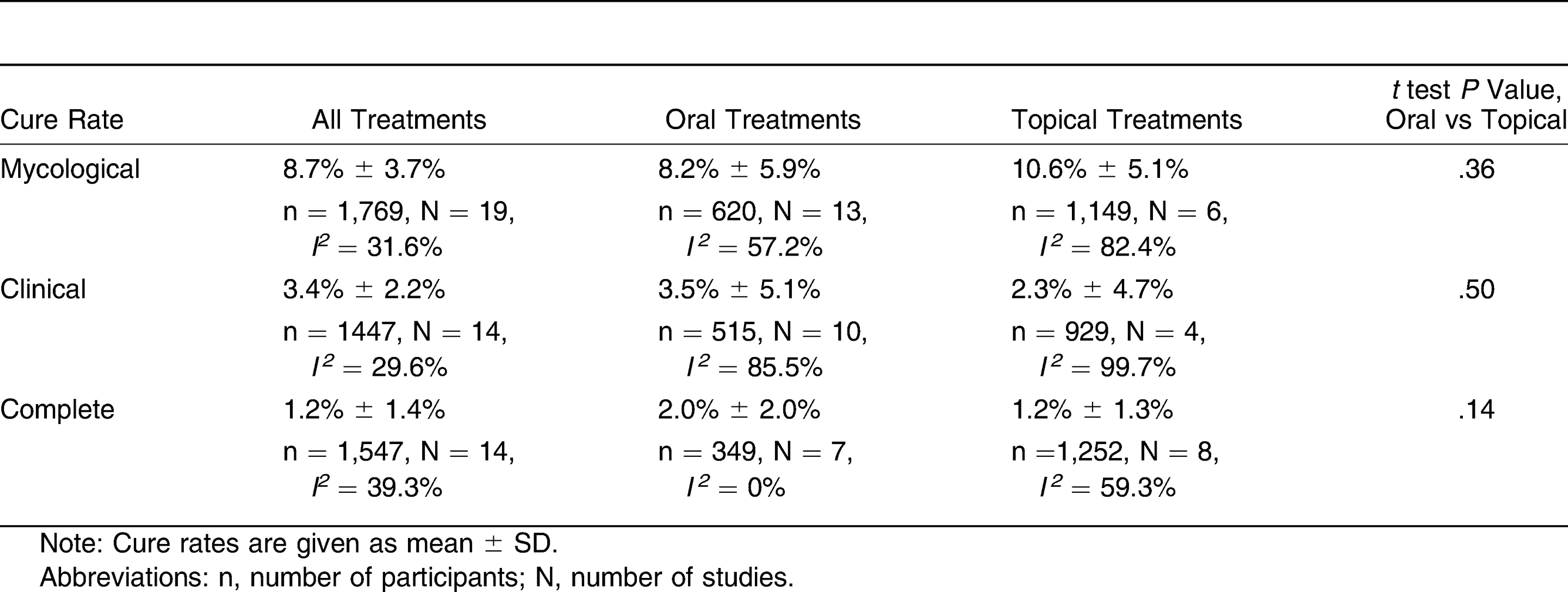
Placebo cure rates vary among randomized clinical trials for onychomycosis, but the factors influencing these cure rates have not been systematically investigated. The PubMed database and reference sections of relevant publications were searched for randomized controlled trials of dermatophyte toenail onychomycosis that included a placebo control and that assessed cure rates. From 21 studies, the pooled mean ± SD placebo cure rates regarding mycological, clinical, and complete cure were 8.7% ± 3.7%, 3.4% ± 2.2%, and 1.2% ± 1.4%, respectively. There was no statistically significant difference between oral and topical treatments. None of the cure rates significantly correlated with any of the participant or study design characteristics analyzed. Placebo cure rates in randomized controlled trials of toenail onychomycosis are relatively low and are independent of the study characteristics.

Onychomycosis is a fungal infection of the nail caused predominantly by dermatophytes.[1] Prevalence rates for onychomycosis vary between 2% and 14% globally, with higher rates being associated with confounding factors, including increasing age and comorbid disease.[1]
Randomized controlled trials often use a placebo control when measuring the effectiveness of a new treatment or treatment regimen.[2] Placebo effects have largely been studied in the context of pain research and have recently begun receiving attention in other clinical conditions.[3] The purpose of this study was to review the placebo cure rates in randomized controlled trials of toenail onychomycosis.

Methods

Inclusion and Exclusion Criteria

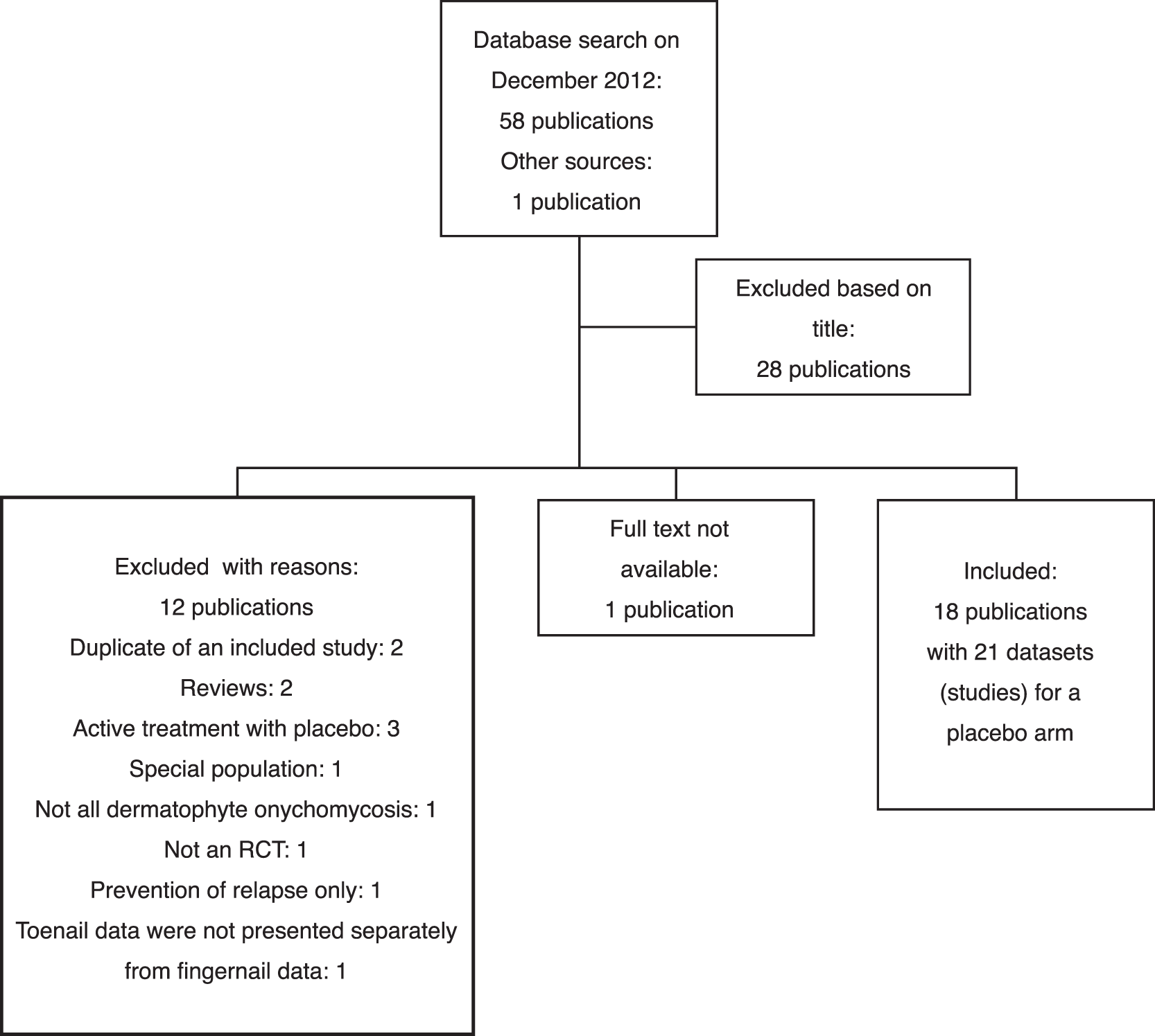
We searched the PubMed database using the following search strategy: (placebo OR vehicle) AND onychomycosis, with no filter, in December 2012. Randomized clinical trials were selected from the search results. In addition, the reference sections of relevant published articles were screened for further trials. The exclusion criteria were review studies, placebo therapy combined with active treatment (ie, placebo topical with active oral), inseparable toenail and fingernail data, trials conducted in special populations, inseparable dermatophyte and nondermatophyte data, cure rates not reported, and duplication of study. The details of the selection process are given in Figure 1.
Figure 1. Flowchart of the literature search and study selection for inclusion. RCT, randomized controlled trial.
Japma 104 00277 g001
The quality of included studies was assessed using the scale developed by Gupta et al.[4] This scale evaluates 12 parameters on a scale from 0 to 2, for a maximum score of 20 points.[4]

Data Extraction

The information recorded for each study could be divided into five categories: 1) study identification: first author and year of study publication; 2) evaluation of the quality of the studies: randomization, blinding, aims clearly defined, sample size calculation, inclusion/exclusion criteria, baseline comparability of the groups, demographics given, interventions clearly defined, efficacy parameters clearly defined, compliance assessed, intention-to-treat analysis, and statistical analyses specified[4]; 3) cure rates for placebo therapies: absolute numbers (where available); mycological, clinical, and complete cure rates; and definitions of mycological, clinical, and complete cures; 4) participant characteristics: sex ratio, mean age and age range, disease duration, disease severity, and primary organism of infection; and 5) study characteristics: single center versus multicenter trial, total sample size, placebo group sample size, antifungal therapy group sample size, antifungal therapy–placebo sample size ratio, type of antifungal therapy (terbinafine, etc), type of placebo treatment (oral or topical), treatment duration, study duration (weeks), and number of clinic visits after the baseline assessment.

Analysis

Data analysis was conducted with Microsoft Excel (Microsoft Corp, Redmond, Washington), SPSS (SPSS Inc, Chicago, Illinois), and GraphPad Prism (GraphPad Software Inc, La Jolla, California) software. Frequencies were calculated for the following variables: study quality parameters, study duration, disease severity, and disease duration.
Descriptive statistical analysis was performed on the following: total patients enrolled (total sample size), number of patients who received placebo therapies (placebo group sample size), percentage of male participants, and mean age. Pooled placebo cure rates were calculated using a modified DerSimonian and Laird random effects model. In studies with no placebo cure (ie, zero value), 0.5 was added to the number of patients cured and the number of patients not cured to avoid problems with computation of pooled effects or standard deviation. The heterogeneity of the studies was assessed using the I2 test. Negative values for the I2 test were considered as 0% heterogeneity. Independent t tests were performed for subgroup analyses of oral versus topical treatments and antifungal therapy–placebo sample size ratios. The relationships between placebo cure rates and different participant or study design characteristics were explored using correlation analysis (Pearson product moment coefficients).

Results

A total of 21 studies from 18 articles were included in the analysis: 17 were identified directly via a PubMed search in December 2012[5-21] and one was found via bibliographic searches[22] (Fig. 1). One publication presented three separate studies.[7] Two of these studies were already included.[15,17] Most of the studies (19 of 21) included one part with randomized treatment/placebo, and two studies[19,21] were designed with two parts: part I with randomized treatment/placebo and part II with treatment for part I nonresponders (treated and placebo). Data from these studies were extracted from part I only.
The range of quality scores was 10 to 19 (mean ± SD, 15 ± 2). Scores were limited to the upper half of the scale, likely owing to the stringent inclusion criteria of randomized placebo-controlled trials. A larger review conducted on 45 studies of onychomycosis that was not restricted to randomized controlled trials found a lower mean quality score of 11.5.[4] Consequently, all of the studies were included in this analysis.

Placebo Cure Rates

The definition of mycological cure was consistently reported as negative results of potassium hydroxide microscopy and fungal culture, except for a single study that used calcofluor white microscopy and culture. The definition of clinical cure varied from clear or markedly improved to 100% improvement (or equivalent). Complete cure was defined as mycological cure plus clinical cure (or equivalents) in all studies reporting this efficacy outcome (Table 1).
Table 1. Placebo Mycological, Clinical, and Complete Cure Rates of the 21 Included Studies
Japma 104 00277 t001
Table 1. continued
Table 1. continued
Japma 104 00277 t002
Decreasing mean ± SD values were found for mycological (8.7% ± 3.7%), clinical (3.4% ± 2.2%), and complete (1.2% ± 1.4%) placebo pooled cure rates (Table 2). Low heterogeneity (29.6%–39.3%) among the studies was found for the mycological, clinical, and complete cure rates (Table 2). The individual cure rates are presented in Table 1. Mycological cure rates varied from 0% to 28.4%, clinical cure rates from 0% to 9.6%, and complete cure rates from 0% to 6%.
Table 2. Pooled Placebo Cure Rates
Japma 104 00277 t003
Most studies (13 of 21) investigated oral antifungals, including terbinafine,[6,8,10,12,19,21] itraconazole,[7,15,17,22] fluconazole,[16,18] ravuconazole,[14] and posaconazole.[10] The remaining eight studies used the topical treatments 2% butenafine/5% Melaleuca alternifolia oil in cream,[20] ciclopirox nail lacquer,[5,13] topical terbinafine hydrochloride nail solution,[9] and 10% efinaconazole nail solution.[11] No statistically significant difference was observed for pooled mycological, clinical, and complete placebo cure rates between topical and oral treatments for onychomycosis (Table 2). Moreover, higher heterogeneity between studies was generally observed when segregating the studies by type of treatment (I2 values in Table 2).

Effect of Participant Characteristics on Placebo Cure Rates

The percentage of male participants varied between studies from 37% to 80%, and the mean age varied from 30 to 55 years. Seven studies reported the mean disease duration, which varied from 1.2 to 12.8 years. The severity of the disease reported by 13 studies as mean percentage of nail area affected varied from 36% to 80%.
None of the patient characteristics analyzed had a significant correlation with the three placebo cure rates assessed (data not shown). The best correlation obtained was between placebo clinical cure rates and the percentage of nail area affected at baseline (r2 = 0.6531, n = 6).

Effect of Study Design Characteristics on Placebo Cure Rates

All of the studies included were double-blinded and randomized. Only one study was not a multicenter trial, so we could not investigate whether the multiplicity of study centers could influence the placebo cure rates. The total and placebo sample sizes of the studies varied from 42 to 870 participants and from 14 to 258 participants, respectively. The sample size ratio between the antifungal therapy and placebo groups ranged from 1:1 to 6:1 and did not influence the placebo cure rates (data not shown). The treatment duration was 8 to 52 weeks, and the study duration was 24 to 78 weeks. Finally, the number of post-baseline visits varied from three to 21. Again, none of the study characteristics analyzed showed significant correlation with the three placebo cure rates (data not shown).

Discussion

Interest surrounding the placebo effect has been increasing during the past three decades. A PubMed search for citations on “the placebo effect” rose from 214 in 1977 to 1,675 in 2006.[23] Placebo effects have largely been studied in the fields of pain and analgesia and in other areas that depend largely on self-reported measures.[3] To our knowledge, this is the first report to review the cure rates of patients with onychomycosis receiving placebo therapy. An understanding of the efficacy of placebo interventions enables physicians and researchers to better evaluate the efficacy rates of treatment with antifungal agents.
In onychomycosis studies, the pooled clinical (3.4%) and complete (1.2%) placebo cure rates were low, whereas the pooled mycological cure rate was higher (8.7%). These cure rates should be considered when evaluating cure rates of antifungal therapies. The placebo mycological cure rates for oral (0%–28.4%, 13 studies) and topical (5.5%–16.9%, 6 studies) treatments were lower or similar to the placebo cure rates reported for two other fungal skin infections: tinea versicolor and tinea pedis. Indeed, the placebo mycological cure rates for oral and topical treatment of tinea versicolor varied from 5% to 20% (two studies) and from 0% to 64% (16 studies), respectively.[24] For tinea pedis, the placebo mycological cure rate varied from 0% to 8% (two studies) and from 0% to 100% (36 studies) for oral[25] and topical[26] treatments, respectively.
It is possible that the few successful cases of placebo cure in patients with onychomycosis may have been individuals with mild pretherapy disease. This is supported by the moderate correlation between placebo clinical cure rates and the percentage of nail area affected at baseline. Thus, lower baseline severity may increase the probability of a placebo clinical cure.
False-negative mycological results could also result from inappropriate collection of specimens or diagnosis.[27] These false-negative results might explain the placebo mycological cure rates obtained in the treatment of onychomycosis. If this is the case, the number of false-negative cures would not be influenced by the sample size because no correlation with sample size was observed for the placebo cure rates.
An increase over time in conversion to negative mycological cultures in patients receiving placebo during clinical trials was previously reported.[5,6,16] No correlation was found between the mycological, clinical, and complete cure rates and the study duration. Moreover, no positive correlation was found between mycological cure rates and the number of visits at the clinic. Thus, repeated professional grooming of the nails during these visits does not contribute to this conversion to negative culture by reducing the fungal mass available for diagnosis.

Conclusions

Placebo cure rates in randomized clinical trials of toenail onychomycosis are relatively low, and none of the analyzed participant and study characteristics significantly influenced these rates.
Financial Disclosure: None reported.
Conflict of Interest: None reported.

References

  1. ElewskiBE:Onychomycosis: pathogenesis, diagnosis, and management. Clin Microbiol Rev11: 415, 1998.
  2. HowlandRH:Understanding the placebo effect: part 1. Placebo use in clinical trials. J Psychosoc Nurs Ment Health Serv46: 17, 2008.
  3. PriceDD, FinnissDG, BenedettiF:A comprehensive review of the placebo effect: recent advances and current thought. Ann Rev Psychol59: 565, 2008.
  4. GuptaAK, RyderJE, BluhmR, et al: Onychomycosis: quality of studies. J Cutan Med Surg7: 312, 2003.
  5. BaranR, TostiA, HartmaneI, et al: An innovative water-soluble biopolymer improves efficacy of ciclopirox nail lacquer in the management of onychomycosis. J Eur Acad Dermatol Venereol23: 773, 2009.
  6. DrakeLA, ShearNH, ArletteJP, et al: Oral terbinafine in the treatment of toenail onychomycosis: North American multicenter trial. J Am Acad Dermatol37: 740, 1997.
  7. ElewskiBE, ScherRK, AlyR, et al: Double-blind, randomized comparison of itraconazole capsules vs. placebo in the treatment of toenail onychomycosis. Cutis59: 217, 1997.
  8. ElewskiBE, El CharifM, CooperKD, et al: Reactivity to trichophytin antigen in patients with onychomycosis: effect of terbinafine. J Am Acad Dermatol46: 371, 2002.
  9. ElewskiBE, GhannoumMA, MayserP, et al: Efficacy, safety and tolerability of topical terbinafine nail solution in patients with mild-to-moderate toenail onychomycosis: results from three randomized studies using double-blind vehicle-controlled and open-label active-controlled designs. J Eur Acad Dermatol Venereol27: 287, 2013.
  10. ElewskiB, PollakR, AshtonS, et al: A randomized, placebo- and active-controlled, parallel-group, multicentre, investigator-blinded study of four treatment regimens of posaconazole in adults with toenail onychomycosis. Br J Dermatol166: 389, 2012.
  11. ElewskiBE, RichP, PollakR, et al: Efinaconazole 10% solution in the treatment of toenail onychomycosis: two phase III multicenter, randomized, double-blind studies. J Am Acad Dermatol68: 600, 2013.
  12. GoodfieldMJ, AndrewL, EvansEG:Short term treatment of dermatophyte onychomycosis with terbinafine. BMJ304: 1151, 1992.
  13. GuptaAK, FleckmanP, BaranR:Ciclopirox nail lacquer topical solution 8% in the treatment of toenail onychomycosis. J Am Acad Dermatol43: S70, 2000.
  14. GuptaA, LeonardiC, StoltzR, et al: A phase I/II randomized, double-blind, placebo-controlled, dose-ranging study evaluating the efficacy, safety and pharmacokinetics of ravuconazole in the treatment of onychomycosis. J Eur Acad Dermatol Venereol19: 437, 2005.
  15. JonesHE, ZaiasN:Double-blind, randomized comparison of itraconazole capsules and placebo in onychomycosis of toenail. Int J Dermatol35: 589, 1996.
  16. LingMR, SwinyerLJ, JarrattMT, et al: Once-weekly fluconazole (450 mg) for 4, 6, or 9 months of treatment for distal subungual onychomycosis of the toenail. J Am Acad Dermatol38: S95, 1998.
  17. OdomR, DanielCR, AlyR:A double-blind, randomized comparison of itraconazole capsules and placebo in the treatment of onychomycosis of the toenail. J Am Acad Dermatol35: 110, 1996.
  18. ScherRK, BrenemanD, RichP, et al: Once-weekly fluconazole (150, 300, or 450 mg) in the treatment of distal subungual onychomycosis of the toenail. J Am Acad Dermatol38: S77, 1998.
  19. SvejgaardEL, BrandrupF, KragballeK, et al: Oral terbinafine in toenail dermatophytosis: a double-blind, placebo-controlled multicenter study with 12 months' follow-up. Acta Derm Venereol77: 66, 1997.
  20. SyedTA, QureshiZA, AliSM, et al: Treatment of toenail onychomycosis with 2% butenafine and 5% Melaleuca alternifolia (tea tree) oil in cream. Trop Med Int Health4: 284, 1999.
  21. WatsonA, MarleyJ, EllisD, et al: Terbinafine in onychomycosis of the toenail: a novel treatment protocol. J Am Acad Dermatol33: 775, 1995.
  22. GuptaAK, MaddinS, ArletteJ, et al: Itraconazole pulse therapy is effective in dermatophyte onychomycosis of the toenail: a double-blind placebo-controlled study. J Dermatol Treat11: 33, 2000.
  23. MillerFG, KaptchukTJ:The power of context: reconceptualizing the placebo effect. J R Soc Med101: 222, 2008.
  24. HuSW:Pityriasis versicolor: a systematic review of interventions. Arch Dermatol146: 1132, 2010.
  25. Bell-SyerSEM, KhanSM, TorgersonDJ:Oral treatments for fungal infections of the skin of the foot. Cochrane Database Syst Rev10: CD003584, 2012.
  26. CrawfordF, HarrisR, WilliamsHC:Are placebo-controlled trials of creams for athlete's foot still justified?Br J Dermatol159: 773, 2008.
  27. DanielCR III:The diagnosis of nail fungus infection revisited. Arch Dermatol136: 1162, 2000.