Total talar dislocation, ie, disruption of the talus from the calcaneus, navicula, and tibia, is an extremely rare and severe injury. The talus is known to have no muscular attachments. This makes it unique in the lower extremity and predisposes it to dislocations. Although in the literature there are some reports about peritalar dislocation [
1–
4], isolated and closed total dislocations accounts for a limited number of these cases [
5,
6]. Most of the cases reported previously are about dislocations, either accompanied by fractures of surrounding bones or extrusion of the talus from the body [
1–
4,
7]. In this report, we present a case of closed peritalar dislocation without any accompanying fractures and discuss the conflicts encountered in this rare injury.
Case Report
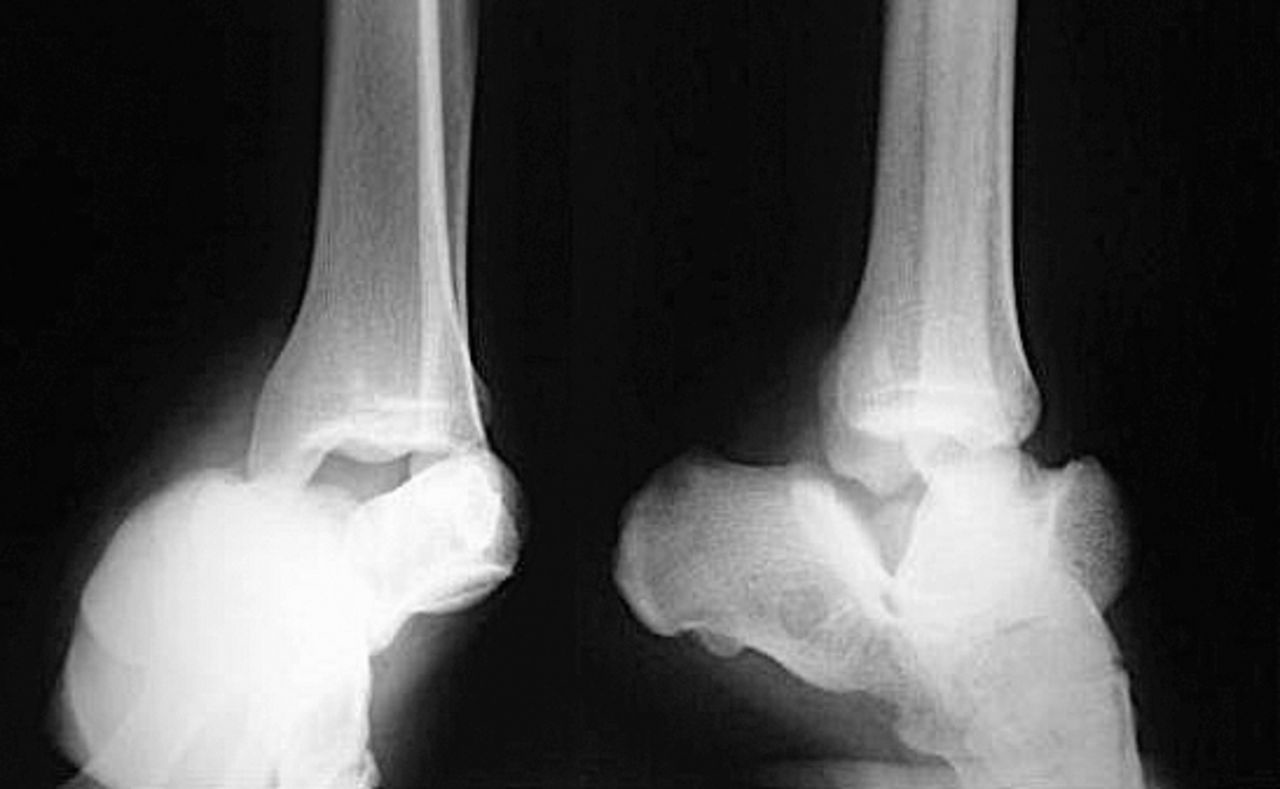
A 25-year-old male patient presented with severe pain, swelling, and deformity in his right ankle within 30 minutes of a fall from a height. There were no wounds around the ankle, and no neurovascular impairment was evident. The talus could be palpated under the skin in the anterolateral aspect of the ankle. The foot had an equinus posture and was shifted medially. Anteroposterior and lateral radiographs revealed that the talus was disrupted from the calcaneus, navicula, and tibia moving in the anterolateral direction (
Fig. 1). No accompanying fractures were seen in either the talus or the surrounding bones.
The choice of treatment was urgent closed reduction under spinal anesthesia, and the patient was taken into the operating room in the first hour after the injury. A closed reduction maneuver with manual distraction was not successful, and the reduction could not be achieved. A further decision was open reduction through a lateral curved incision. It was seen that the interposed joint capsula was preventing reduction. An additional anteromedial incision was required to reduce the talus to its original position. The articular surface of the talus was assessed, and although the integrity of the cartilage was intact, contusion was obvious in the superolateral aspect of the talus. After reduction with manual distraction, the joint capsula was repaired. The stability of the ankle was checked in passive dorsiflexion, plantarflexion, and forced eversion and inversion and was found to be satisfactory, so no fixation material was used. The leg was placed in a below-the-knee cast for 6 weeks. After removal of the cast, physical rehabilitation was initiated to improve range of motion of the ankle, and full weightbearing was allowed. No complications were seen during follow-up.
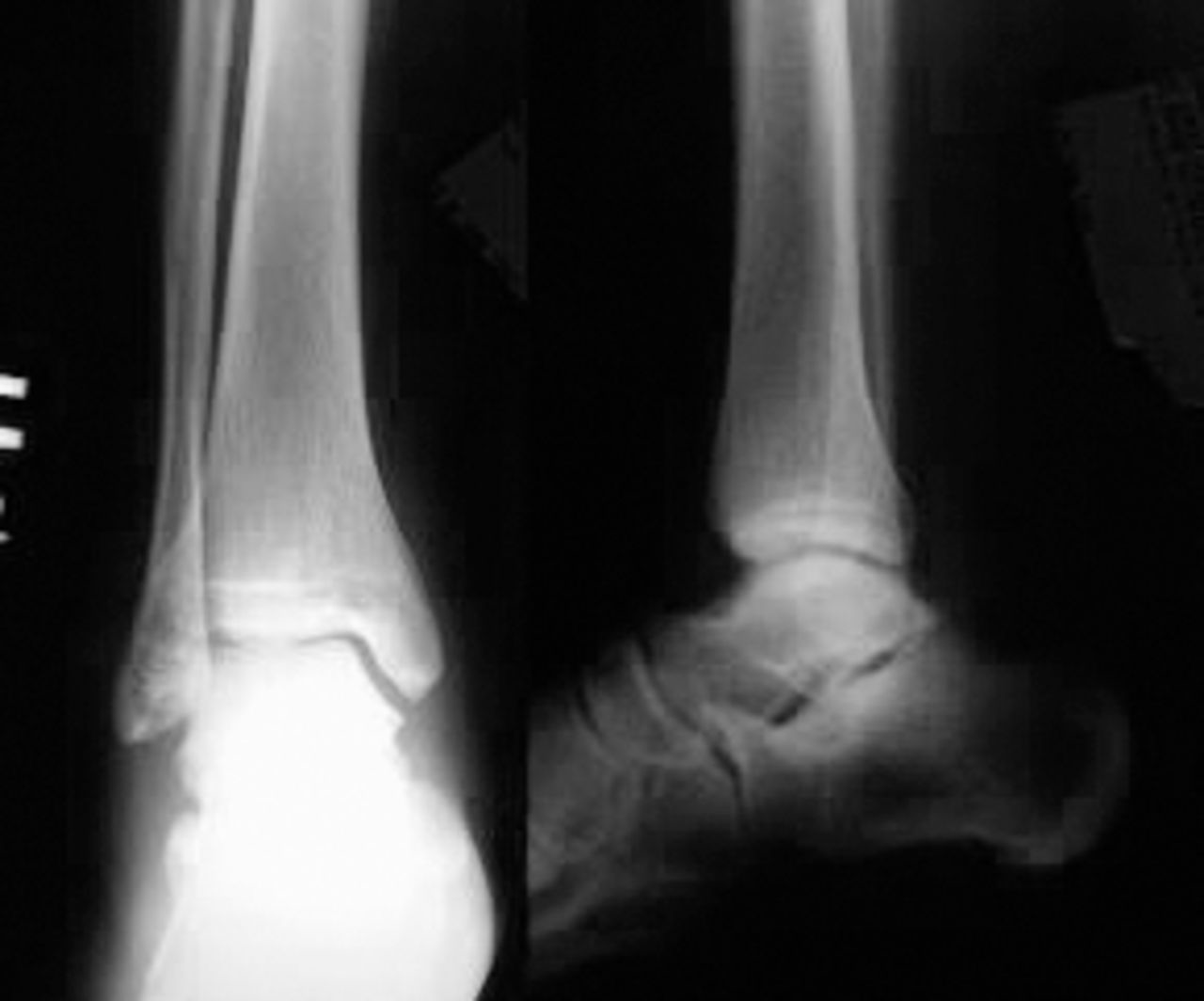
It has been 2 years since the initial injury, and the patient is functioning very well, with no pain. The ankle has the same range of motion as the unaffected side. No signs of an avascular necrosis or sclerosis can be seen on the final radiographs (
Fig. 2).
Discussion
Peritalar dislocation is a rarely encountered entity. In the literature, there are reports about talar dislocations, but identical cases are very few. Most of these cases are about either peritalar dislocations accompanied by fractures of surrounding bones or total extrusion of the talus [
1–
4,
7]. Closed peritalar dislocations account for a small number of these cases [
5,
6]. However, the talus has no muscular attachments; it has rather stable localization, and dislocation of the talus can occur only as a result of a high-energy trauma. Thus it is not confusing to see accompanying fractures or burst-type open wounds in such cases. In the present patient, dislocation of the talus was also due to a high-energy trauma, but it was a pure dislocation, and no open wounds or fractures were evident.
In patients with peritalar dislocation, a variety of complications, such as avascular necrosis of the talus or surrounding bones, infection, and post-traumatic arthrosis, can be seen depending on the severity of the injury [
1–
3,
7]. Complications are more common in patients with open wounds or accompanying fractures [
1,
3,
7]. Wagner et al [
2] described six patients with total dislocation of the talus, and avascular necrosis was observed in five to some extent. In two different reports by Assal and Stern [
1] and Brewster and Maffulli [
3], the authors reported arthritic changes in the ankles of the patients they treated for total dislocation of the talus with open wounds. The most catastrophic complication after treatment of a totally dislocated talus was reported by Ely et al [
7], and their patient had to undergo a below-the-knee amputation procedure owing to resistant infection at the injury site. In the literature, one of the few cases identical to the present one was presented by Taymaz and Gunal [
5]. Their patient had closed total dislocation of the talus, and after treatment by closed reduction, the final outcome was good, and no complications were observed. We also have not seen any complications during follow-up of the present patient, and the functional results were completely satisfying. Because the patient does not have any symptoms, control magnetic resonance imaging was not needed.
The interval between the time of the injury and the surgical intervention was less than an hour in the present case, and reduction was urgently achieved. In our opinion, avascular necrosis could be avoided because there were no open wounds at the time of presentation and successful urgent reduction was achieved. Thus, we concluded that early reduction is mandatory to minimize the possibility of complications. For a successful result, a closed reduction maneuver should be attempted as the first choice. In the case of failure, open reduction could be needed, as it was in the case reported by Korovessis et al [
6] and also in the present case. The talus has good stability in its original position, although it has no muscular attachments. The surrounding ligaments and the congruency of its articular surfaces support this stability. That is why in cases of peritalar dislocation, no internal fixation should be necessary after reduction unless there is a burst-type open wound or an accompanying fracture. Still, Korovessis et al [
6] used a Steinman pin to fix the talus in its original place. For the present case, we applied only a below-the-knee cast for 6 weeks after reduction, and full weightbearing was allowed afterward.
Closed total dislocation of the talus without any accompanying fractures is a rare entity. The injury is open to various important complications, such as avascular necrosis, infection in patients with open wounds, and arthritic changes. To achieve a good outcome, early reduction of the dislocation has key importance.