Osteomyelitis generally complicates 10% to 20% of mild and moderate infections and 50% to 60% of severe infections in the feet of diabetic patients.[
1] To make a definitive diagnosis of osteomyelitis and identify the etiologic agent, bone samples are needed for histologic and microbiological analyses.[
2]
Several studies performed on animals or on groups from which diabetic individuals were excluded have shown the histopathologic features of bone infection.[
3–
5] Bone infection that occurs in the feet of diabetic patients is frequently defined as “chronic osteomyelitis,” based more on the long-term course of foot ulcers but without necessarily being able to identify the exact type of inflammatory infiltration occurring in the bone.[
6] Findings on bone abnormalities in the feet of diabetic patients are scarce or incidental.[
7,
8] Animal trials, in particular, are unlikely to be informative because the conditions and complications associated with diabetic foot are not reproduced.[
9]
Several studies have provided data on the histopathologic features of infected bone in the feet of diabetic patients. One study was undertaken to verify the reliability of magnetic resonance imaging when diagnosing osteomyelitis.[
10] Another was performed to observe the pathologic features of bone samples from diabetic patients who had undergone an amputation,[
9] and a series of studies consisting of 185 surgical patients have provided knowledge of the histopathologic types of bone infection in the diabetic foot.[
6]
Histopathologic analysis is routinely performed in the Diabetic Foot Unit of the University Podiatric Clinic (Universidad Complutense de Madrid, Mardrid, Spain) as part of the surgical protocol, and the diagnostic criteria used by the pathologist have been previously reported.[
6,
7,
11–
13] However, in our experience, we have encountered cases in which fibrosis was the most noticeable element. In such cases, osteomyelitis had always been suspected before the operation, and there was subsequently microbiological confirmation of bone infection. To our knowledge, this finding has not been previously reported, and neither have cell clusters associated with each histopathologic type of osteomyelitis been described. We began to assemble a group of patients in whom bone infection had been confirmed by histopathologic analysis for the purpose of assessing the characteristics of histopathologic changes and the cell lines observed in the surgical biopsy sample and to evaluate whether there is an association between the histopathologic and clinical variables found in the different patients.
Methods
An observational prospective study was performed on diabetic patients with foot ulcers treated as outpatients in the Diabetic Foot Unit of the University Podiatric Clinic (Complutense University of Madrid, Madrid, Spain) between January 1, 2007, and July 22, 2009. The definition of a diabetic patient was according to the criteria established by the World Health Organization.[
14] Ulcerated foot was defined according to the World Health Organization criteria regarding ulcers located below the malleoli. Of the 617 patients treated in the Diabetic Foot Unit during the research period, 211 (34.2%) underwent surgical treatment; 165 patients (26.7%) were suspected of having osteomyelitis before the operation.
A preoperative diagnosis of suspected osteomyelitis was based on the combination of clinical signs, probe-to-bone test results, and radiologic study findings, as has been previously reported.[
15] Patients with ulcers without clinical signs of infections in which probe-to-bone test results or radiographic findings suggested osteomyelitis also underwent surgical treatment.
All of the patients underwent the following vascular assessments: pulse examination, ankle-brachial Doppler index testing, and transcutaneous oxygen pressure measurement. Peripheral arterial disease was diagnosed if one or more of the following findings were present: absence of both distal foot pulses or an ankle-brachial index less than 0.8; critical ischemia was diagnosed according to the Inter-Society Consensus for the Management of Peripheral Arterial Disease.[
16]
The neurologic examination was undertaken using Semmes-Weinstein monofilaments, 5.07 to 10 g[
17] (Novalab Ibérica S.A.L, Alcalá de Henares, Madrid, Spain), for testing protective sensitivity and using Horwell’s Biotensiometer or Neurotensiometer (Novalab Ibérica S.A.L, Alcalá de Henares, Madrid, Spain) for analyzing vibratory sensitivity. Patients were considered to have their vibratory sensitivity affected when they did not feel vibration in the hallux at 25 V.[
18] Patients who did not feel one of the two tests were diagnosed as having neuropathy.
Ulcers were classified according to the University of Texas classification[
19] and were categorized as neuropathic or neuroischemic. We defined neuropathic ulcers as those affecting neuropathic patients but without showing any of the aforementioned ischemia criteria. Neuroischemic ulcers were defined as those in which ischemia and neuropathy criteria were found.[
20] Patients who had critical ischemia criteria according to the Inter-Society Consensus for the Management of Peripheral Arterial Disease[
16] were excluded from this study.
Previous antibiotic drug therapy and the period during which antibiotic drugs were given were recorded. The surgical intervention was scheduled within 48 hours of the first visit to the practice, and antibiotic therapy was not discontinued before surgery. All of the patients underwent surgery under ankle block anesthesia by the same podiatric surgeon (JLL).
Conservative bone surgery was defined as the procedure whereby only the infected bone was removed, meaning that no amputation proximal to the infected bone fragment was undertaken and the distal tissue was not removed. We defined minor amputation as cases in which the nonviable infected bone tissue was extirpated and the devitalized soft tissue was removed, leading to the loss of one or more toes. The surgery performed on the patients removed the whole portion of the affected bone; this means that if osteomyelitis was located at the head of a metatarsal, we removed the whole head. The rest of the procedures were performed the same way when they were located at the head or base of a phalange or the distal part of a toe phalange. We had only four patients with ulcers located at the middle of the foot, on which a partial resection of the affected bone was performed (two at the navicular bone and two at the cuboid bone).
After removing the bone, a piece of the affected bone was sampled under sterile conditions in the microbiological laboratory, and the rest of the removed bone was sent to the pathology laboratory. Microbiological samples were transported in a swab culture (Stuart agar gel medium, single plastic swab [Copan Innovation, Brescia, Italy]). The following data concerning the patient were included on the request form: name, surname, clinical record number, location of the bone infection, and previous antibiotic drug treatment.
Pathologic samples were sent to the laboratory in 10% buffered formalin, and the following data concerning the patient were included on the request form: name, surname, clinical record number, location of the bone infection, and clinical diagnosis. The sample obtained was fixed in 10% buffered formalin for 24 to 48 hours. After this, the sample underwent a decalcification process by immersion in liquid water softener for 2 to 7 days according to the size and hardness of the bone sampled. The tissue was carved to a maximum of 5 mm thick and 2 cm in diameter. Paraffin embedding and microtome cutting were performed. The samples were stained with hematoxylin-eosin and then were viewed with an optical microscope.
The slides were studied sequentially by two independent pathologists. Both pathologists were from outside our department. They were blind to the clinical data of the patients. The histopathologic diagnosis made by the pathologists involved in the study was defined according to the diagnostic criteria previously reported.[
6,
7,
11–
13]
Acute osteomyelitis (AO) was diagnosed in patients with a multifocal infiltrate consisting of lymphocytes, plasma cells, and polymorphonuclear neutrophils at the level of the bone marrow, with clear polymorphonuclear predominance, and in which there was a variable proportion of necrosis concentrations. Chronic osteomyelitis (CO) was diagnosed in patients with a multifocal infiltrate consisting almost entirely of lymphocytes and plasma cells, with mononuclear predominance at the bone marrow level, where some concentrations of reshaped bone with a variable osteoid formation and variable fibrosis could be observed. Chronic AO (CAO) was diagnosed when there was a polymorphonuclear neutrophil infiltrate over a background of CO. The fibrosis stage was diagnosed when there was bone marrow fibrosis with few or no lymphocytic infiltrates present at the level of the bone marrow. A definitive histopathologic diagnosis was made from the report of the senior pathologist.
After surgical intervention, drug treatment was provided in the form of painkillers (ibuprofen and paracetamol) and antibiotic drug therapy with amoxicillin–clavulanic acid, except in the case of patients allergic to penicillin, who were treated with ciprofloxacin. The antibiotic drug treatment was modified according to the results of the bone culture. The duration of antibiotic drug treatment was variable, and treatment was discontinued when the ulcer bed was covered by granulation tissue or the bone was not exposed.
Postoperative management was performed as follows: dressing changes every 48 to 72 hours using activated charcoal dressings with silver (Actisorb Plus 25; Johnson & Johnson Wound Management, Somerville, New Jersey), off-loading using felted foam (15 mm), and the use of a postsurgical shoe until complete epithelialization of the ulcer or surgical wound. This was the date recorded as the healing date.
Patients gave their written informed consent, and the study was approved by the ethical committee of San Carlos Clinic Hospital (Madrid, Spain). A descriptive statistical analysis was performed with a software program (SPSS for Windows, version 15.0; SPSS Inc, Chicago, Illinois). The Student t test was used to study the association of quantitative variables to compare independent averages. The χ2 test was used to study the association of qualitative variables and to compare proportions. University of Texas classes were divided into IIIA + IIIC (without infection) and IIIB + IIID (with infection) by performing χ2 tests with 3 df. Interobserver variability was assessed by multiobserver kappa statistics. One-factor analysis of variance was performed with a view to comparing the kappa samples. A P < .05 was set as the threshold of statistical significance.
Results
The 165 patients (116 men [70.3%] and 49 women [29.7%]) included in this study had histopathologically proved diagnoses. The mean ± SD evolution time from the onset of diabetes was 16.6 ± 10.6 years. Insulin treatment was being given to 62.4% of the patients, and oral hypoglycemic agents were administered to the remaining 37.6%. The mean ± SD duration of the ulcer at the time of admission to the diabetic foot unit was 25.2 ± 28 weeks. A total of 146 patients (88.5%) had radiologic signs of osteomyelitis. The probe-to-bone test result was positive in 163 patients (98.8%), and 112 patients (67.9%) had clinical signs of infection. Of the patients without signs of infection (32.1%), 88.7% had positive radiologic signs, 98.1% had positive probe-to-bone test results, and 81.1% were culture positive.
Eighty-three percent of patients were being given oral antibiotic drugs before initiating treatment at the Diabetic Foot Unit, and the mean ± SD length of treatment was 6.2 ± 4.1 weeks; amoxicillin–clavulanic acid was the antibiotic drug most frequently prescribed.
Bacteria were isolated in 136 patients (82.4%). Staphylococcus aureus was the most frequently isolated microorganism (63.9% of bacteria), 9.5% of which was methicillin resistant. Staphylococcus epidermidis was the second most frequent bacterium isolated (16.1%), and Pseudomonas aeruginosa (11%) was third. Monomicrobial infections were found in 74.5% of patients, and in the remaining 25.5% they were polymicrobial. Cultures were positive in 87.8% of the patients to whom previous antibiotic drug treatment had been given and in 61.8% of naive patients (P < .001). The mean ± SD duration of antibiotic drug treatment was 6.56 ± 4.2 weeks in patients with positive bone cultures and 4.66 ± 4.6 weeks in patients with negative bone cultures (P = .034).
The inflammatory infiltrates found in each of the different types of osteomyelitis are shown in
Table 1. The predominantly mononuclear infiltrate was associated with CO in 98.6% of patients (
P < .001) and with fibrosis stage in 100% (
P < .001). The predominantly polymorphonuclear infiltrate was associated with AO in 97.8% of patients (
P > .001) and with CAO in 85.7% (
P < .001). The mean duration of the ulcer was not associated with the type of cell clusters found in the bone inflammatory infiltrate (
P = .102). The histopathologic findings according to the type of osteomyelitis are shown in
Table 2.
Table 1.
Inflammatory Infiltrate Found in the Bone Biopsy Sample and the Histopathologic Findings According to the Characteristics of the Different Types of Osteomyelitis
Table 1.
Inflammatory Infiltrate Found in the Bone Biopsy Sample and the Histopathologic Findings According to the Characteristics of the Different Types of Osteomyelitis
According to the results of this study, osteomyelitis was classified into four well-defined histopathologic types on the basis of the cell clusters involved and the histopathologic changes, as follows. Acute osteomyelitis (n = 46; 27.9%) is characterized by the presence of a multifocal infiltrate consisting of lymphocytes, plasma cells, and polymorphonuclear neutrophils, as well as histiocytes at the bone marrow level in 32.6% of patients. We found a clear predominance of the polymorphonuclear neutrophil infiltrate, where there was a variable extent of necrosis with signs of bone remodeling and formation of osteoid. In addition, periostitis and variable fibrosis were observed in some cases at the bone marrow level. Chronic osteomyelitis (n = 73; 44.2%) is characterized by the presence of an inflammatory infiltrate at the bone marrow level that consists almost exclusively of lymphocytes and plasma cells, with a clear predominance of a mononuclear infiltrate. There is little bone necrosis; there is bone remodeling of varying extent, osteoid formation, and varying degrees of bone marrow fibrosis. Chronic acute osteomyelitis (n = 14; 8.5%) is characterized by a multifocal infiltrate at the bone marrow level consisting of lymphocytes, plasma cells, and polymorphonuclear neutrophils, with a predominantly polymorphonuclear inflammatory infiltrate. Bone necrosis was observed, with slight bone remodeling and osteoid formation as well as bone marrow fibrosis. Fibrosis stage (n = 32; 19.4%) is characterized by the presence of little lymphocytic-type inflammatory infiltrate (which is accompanied by a few plasma cells in some cases) at the bone marrow level. There is no necrosis, bone remodeling, or osteoid formation, but there is bone marrow fibrosis. No cell clusters were observed in the advanced stages since they were replaced by significant bone marrow fibrosis with variable fibrosis at the level of the periosteum.
Table 2.
Histopathologic Findings According to the Characteristics of the Different Types of Osteomyelitis
Table 2.
Histopathologic Findings According to the Characteristics of the Different Types of Osteomyelitis
Interobserver correlation between pathologists was as follows: kappa index = 0.97 (P < .001) for diagnosing AO, 0.951 (P < .05) for diagnosing CO, 0.917 (P < .001) for diagnosing CAO, and 0.919 (P < 0.001) for diagnosing fibrosis stage.
The mean ± SD duration of the ulcer on hospital admission was 15.4 ± 23 weeks for patients with AO, 28.6 ± 22.4 weeks for patients with CO, 35 ± 31.3 weeks for patients with CAO, and 27.5 ± 27.3 weeks for patients with the fibrosis stage (P = .03). Bacteria were found in 40 of 46 patients (87.0%) with AO, 61 of 73 (83.5%) with CO, 11 of 14 (78.6%) with CAO, and 25 of 32 (78.1%) with fibrosis. No significant correlation between histopathologic type and isolation of bacteria from the bone culture was found (P = .74). The mean ± SD duration of previous antibiotic drug therapy according to histopathologic type was 4.43 ± 4.1 weeks for AO, 7.3 ± 4.1 weeks for CO, 6.36 ± 5.1 weeks for CAO, and 6.28 ± 4.3 weeks for fibrosis (P = .006).
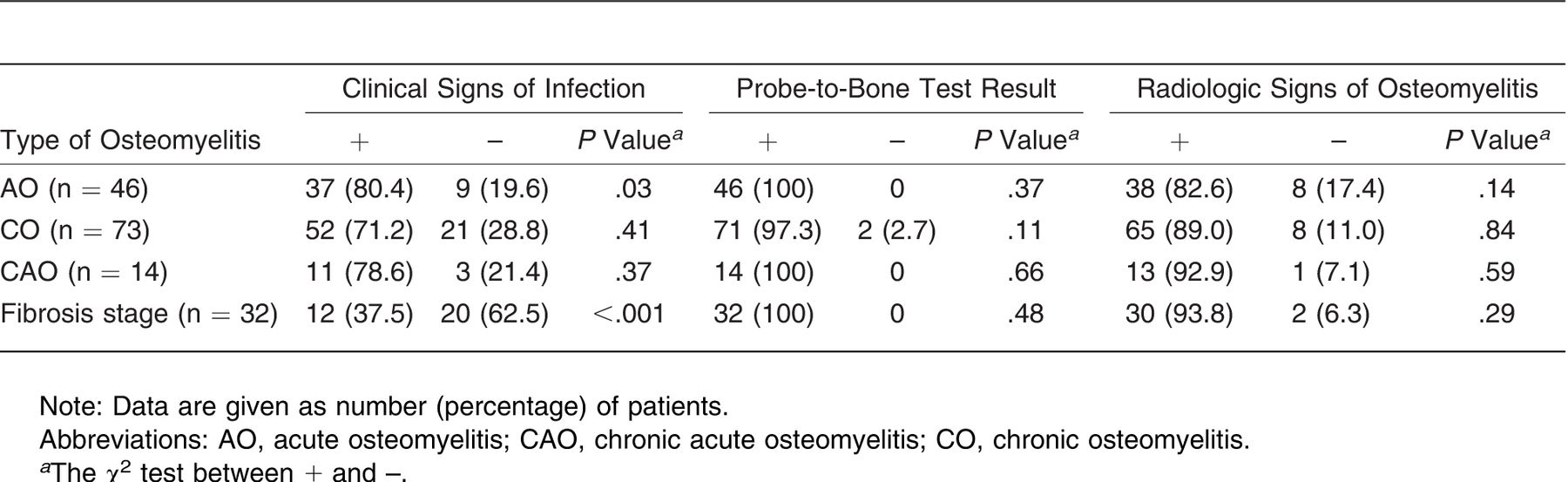
The association between the diagnostic criteria and the histopathologic types of osteomyelitis is shown in
Table 3, and the distribution of the histopathologic types of osteomyelitis according to the presence of ischemia and University of Texas classification is shown in
Table 4.
Median ± SD time to healing was 12 ± 9.7 weeks for AO, 11.4 ± 10.1 weeks for CO, 16.5 ± 11.1 weeks for CAO, and 10.2 ± 6 weeks for the fibrosis stage (analysis of variance: P = .26). According to the predominant inflammatory infiltrate, the median ± SD time to healing was 11.2 ± 9.3 weeks for the mononuclear cases and 13.5 ± 10.3 weeks for the polymorphonuclear cases (P = .18).
Table 3.
Relationship Between the Diagnosis Criteria and the Different Histopathologic Types of Osteomyelitis
Table 3.
Relationship Between the Diagnosis Criteria and the Different Histopathologic Types of Osteomyelitis
Discussion
Waldvogel, et al[
4] classified osteomyelitis into three types on the basis of its etiology: hematogenous osteomyelitis, osteomyelitis secondary to a contiguous focus of infection, and osteomyelitis associated with peripheral vascular disease. In their report, diabetic patients were included in the group of patients with vascular insufficiency and foot infection, using a sample of 25. Neither comprehensive histopathologic study nor type of cell clusters existing in the samples was included in the report. The authors recognized that there was some ambiguity between the histopathologic findings and the clinical manifestations of the lesion. They found that the histopathologic patterns varied greatly in the different stages of any lesion. We identified four clearly defined histopathologic types according to the cell clusters and histopathologic changes found in the samples: acute, chronic, chronic acute, and fibrosis. Other authors[
6,
7] have also described the three most frequent histopathologic types found in the present series but not fibrosis. Craig et al[
7] did not explain the histopathologic criteria for defining each type of osteomyelitis, and what they described as the acute chronic type was the most frequently found. Aragón-Sánchez et al[
6] described more details about the histopathologic criteria that were used, and AO was the most frequent diagnosis. The most frequent type found in the present study was CO. The nature of the group on which the study by Aragón-Sánchez et al[
6] was performed may explain the disparity with the present results. In their predominantly inpatient series, they included many patients with severe soft-tissue infections.[
6] In the present study, we found a clear relationship between the duration of the ulcer and the characteristics of the type of osteomyelitis diagnosed. Fibrosis was present in lesions with positive osteomyelitis diagnostic tests as other types of osteomyelitis described, but especially in lesions with a long time of evolution and absence of clinical signs of infection (
P < .001). The absence of clinical inflamatory signs could probably be related to the avascular state of the surrounding tissue and bone marrow. Therefore, it would be difficult to diagnose lesions in the levels of care that normally will serve these patients.
Table 4.
Distribution of the Histopathologic Types of Osteomyelitis According to the Presence of Ischemia and the University of Texas Classification
Table 4.
Distribution of the Histopathologic Types of Osteomyelitis According to the Presence of Ischemia and the University of Texas Classification
We found that in 19.4% of the present patients, fibrosis was the only histopathologic element. Bone marrow fibrosis of varying extent was found in 75% of patients. In one study comparing histologic and microbiological evaluation of percutaneous biopsy samples, another group of authors described bone marrow fibrosis, but diabetic patients with foot osteomyelitis were not included in this study.[
21] In other reports, fibrosis was not identified as an independent pathologic form in diabetic foot osteomyelitis.[
6,
7] Fibrosis is sometimes considered as a pathologic type in which there is a predominance of collagen formation, but others consider it to be the final stage of any type of osteomyelitis in which the damaged bone is subsequently replaced by fibrosis as part of the healing process.[
13] If the latter explanation is adopted, it would be logical to think that these patients could be operated on unnecessarily. In our opinion, there is no doubt about the infectious nature of the fibrosis stage because the microbiological data showed that bone culture was positive in 25 of 32 patients (78.1%) in whom fibrosis had been diagnosed. There were no differences among the four histopathologic types according to the isolation of bacteria from the cultures. We hypothesize that for all forms of osteomyelitis, there are cases where there is restitution of bone tissue by fibrosis and that sometimes during this process a nidus of bacteria is trapped inside the fibrous tissue. Because fibrous tissue does not contain blood vessels, antibiotic drugs cannot penetrate to the site of the infection. These conditions permit the bacteria to grow, and persistent infection is often found. Fibrosis in cases in which cultures were negative may be interpreted as a noninfectious bone disease, ie, neuroarthropathy. Charcot’s foot is a progressive disease of the bone and joints that is often seen in acute and chronic phases. The pattern of bone destruction in patients with Charcot’s foot is different from that found in osteomyelitis.[
22] Radiographs from patients with Charcot’s foot show no cortical destruction but fragmentation involving multiple bones.[
23] Furthermore, the clinical presentation of Charcot’s foot differs from that seen in osteomyelitis. Acute Charcot’s foot displays redness and swelling, but a point of entry of the infection (ie, an ulcer) is not usually present.[
23] It is very difficult to gain knowledge of histopathologic features in Charcot’s foot because when neuroarthropathy is in the acute phase, an open biopsy is not performed. Aragón-Sánchez et al[
6] reported a case of Charcot’s foot in the acute phase. The histopathologic changes were not compatible with osteomyelitis, being, rather, typical of acute fractures. Aragón-Sánchez[
24] recently reported the histopathologic features of a patient with toe osteomyelitis and chronic neuroarthropathy of the metatarsal head. The two bones were removed. Bone infection and neuroarthropathy were clearly differentiated.[
24]
We suggest that after the bone infection starts, a polymorphonuclear cell infiltrate is often found. After the acute phase, if the infection is not resolved, a chronic phase is maintained, which may eventually lead to fibrosis or become acute with the presence of polymorphonuclear cells over a background of chronic infiltrate. We think that the osteomyelitis is not a sequential process because we have found that the duration of the ulcer before the development of fibrosis is no greater than that before development of the chronic phase of osteomyelitis. In this study, CO and fibrosis were the most prevalent histopathologic types. In our opinion, bone infections in the fibrosis stage are more difficult to diagnose because inflammatory and clinical infection signs are not present or are less obvious.
With this research, it has been demonstrated that bone infections appear in different ways depending on their evolution throughout time and that, sometimes, certain types of osteomyelitis can be underdiagnosed, whether because the pathologist does not contemplate fibrosis as a chronic process of bone infection or because clinicians do not suspect the presence of infection because there are no significant inflammatory clinical signs in these patients. This circumstance delays the recommendation for adequate treatment (medical or surgical), entrusting the evolution of the lesion to the local handling of the ulcer. We suggest that new studies should identify cases of fibrosis to allow comparison with the present results.