Next Article in Journal
Effect of a Forefoot Off-loading Postoperative Shoe on Muscle Activity, Posture, and Static Balance
Previous Article in Journal
Histopathologic Characteristics of Bone Infection Complicating Foot Ulcers in Diabetic Patients
 
 
Journal of the American Podiatric Medical Association is published by MDPI from Volume 116 Issue 1 (2026). Previous articles were published by another publisher in Open Access under a CC-BY (or CC-BY-NC-ND) licence, and they are hosted by MDPI on mdpi.com as a courtesy and upon agreement with American Podiatric Medical Association.
Article

Radiologic Morphology of the Calcaneus. A Study of Radiologic Angles in a Pediatric Population

by
Pedro Gutierrez
1,*,
Manuel Navarro
2 and
Margarita Ojeda
3
1
Department of Orthopedic Surgery, Hospital General Alcoy, Novelda, Spain
2
Department of Orthopedic Surgery, Hospital General Universitario Alicante, Alicante, Spain
3
Department of Trauma and Orthopedic Surgery, Hospital General Alcoy, Alcoy, Spain
*
Author to whom correspondence should be addressed.
J. Am. Podiatr. Med. Assoc. 2013, 103(1), 32-35; https://doi.org/10.7547/1030032
Published: 1 January 2013

Abstract

Background: The Fowler-Philip, calcaneal pitch, and total calcaneal angles define the radiologic morphology of the rearfoot. We studied these angles in healthy adolescents. Methods: We studied 141 feet. Patients with inflammatory or traumatic injuries were excluded. The mean participant age was 11.5 years. The Fowler-Philip, calcaneal pitch, and total calcaneal angles were measured on lateral weightbearing radiographs. The statistics included descriptive, sample size (α=0.05 and β=0.20), the Student t test, and analysis of variance; P < .05 was considered significant. Results: The samples were 141 and 35 radiographs for the Fowler-Philip and calcaneal pitch angles, respectively. Ninety percent, 25.1%, and 97.4% of the adolescents had normal Fowler-Philip, calcaneal pitch, and total calcaneal angles, respectively. In addition, 9.9%, 74.9%, and 2.6% of the values were outside the reference ranges, respectively. The Fowler-Philip angle decreased and the calcaneal pitch angle increased significantly with age (P = .0005). The total calcaneal angle did not change with age (P = .65). Conclusions: The mean angle values in a pediatric population did not differ from those in adults. We found a high percentage of calcaneal pitch angles outside the reference range. Age influenced the Fowler-Philip and calcaneal pitch angles but not the total calcaneal angle. (J Am Podiatr Med Assoc 103(1): 32–35, 2013)

The morphology of the calcaneus is important for the rearfoot because it influences the static and dynamic aspects of walking.[14] A lateral radiograph of the foot shows three characteristic angles: the Fowler-Philip (FPA), calcaneal pitch (CPA), and total calcaneal (TCA) angles. These angles are useful for diagnosing disease conditions such as Haglund’s disease, talalgia, insertional Achilles tendonitis, and flat and cavus feet.[510] Some authors define the TCA as the sum of the FPA and the CPA. They argue that this definition is more consistent and better reflects the general morphology of the calcaneus.[5,7,1113] Many studies have defined reference values for these angles, but for most studies, the study population included adults only.[11,1418] We sought to study these angles in healthy pediatric and adolescent populations to determine whether differences existed in these angles compared with those of an adult population.

Materials and Methods

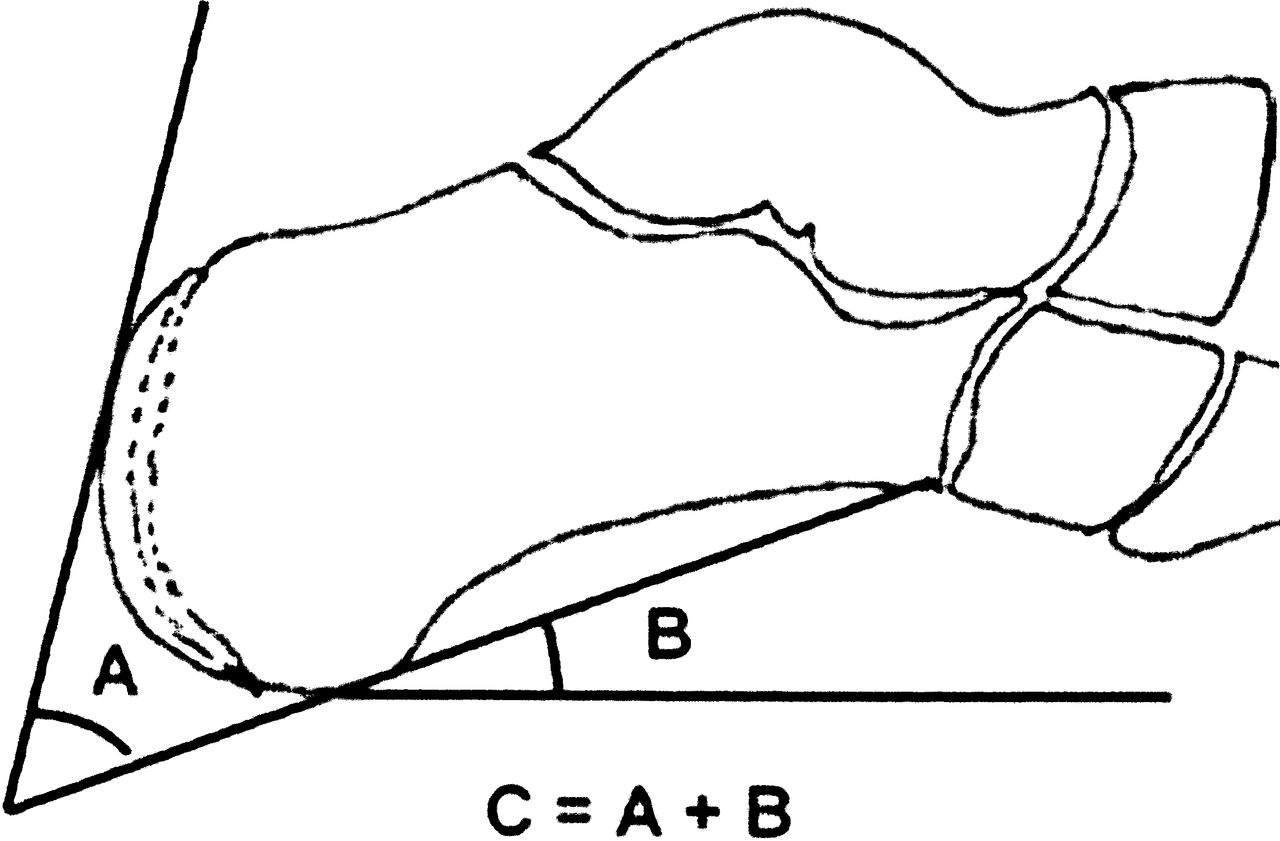
This study was approved by the Comite de Ética e Investigación Clínica. Radiologic studies were conducted with informed consent from all of the patients. Between January 1, 2007, and December 31, 2009, we studied 78 patients. Sixty-three individuals were examined bilaterally and 15 unilaterally, for a total of 141 feet. We excluded individuals with traumatic injuries, such as fractures, talalgia, and Sever’s disease. We also excluded girls who were younger than 9 years and boys who were younger than 11 years. Individuals with signs of inflammatory or rheumatic processes were also excluded. The mean participant age was 11.5 years (11.4 years for boys and 11.6 years for girls; range, 9.0–14.9 years). There were 48 feet from boys (34%) and 93 from girls (66%). There were 72 right-side cases (51%) and 69 left-side cases (49%). We conducted lateral weightbearing radiographs of each foot following standard techniques.[2,13,14,1922] Reference lines were delineated through the use of Picture Archiving and Communication System (PACS) digital software to define the FPA and the CPA.[15,16] The sum of both angles was taken as the TCA. The FPA is formed by the intersection of the line tangent to the posterior tuberosity of the calcaneus and the line that joins the plantar tuberosity with the calcaneal-cuboid joint (Fig. 1, angle A). Angles of 44° to 69° were considered normal.[5,6,1113,16,17] The CPA is formed by the line tangent to the plantar surface of the calcaneus that unites the plantar tuberosity with the medial or horizontal sesamoid (Fig. 1, angle B).[2,6,11,13,16,19,2225] Angles of 15° to 18° were considered normal. The TCA is the sum of both angles (Fig. 1, angle C), and values of 64° to 89° were considered normal.[5,13] The measurement error of the informatics system was calculated using the standard deviation from five successive measurements of the same angle.[26] Two of us (P.G. and M.N.) measured both angles for all of the cases to calculate the intraobserver and interobserver coefficients. We calculated the sample size for α = 0.05 and β = 0.20. The statistical tests included descriptive statistics, a Kolmogorov-Smirnov test to determine whether the distribution was normal, the Student t test between quantitative paired values, a Pearson correlation between age and the FPA and CPA, quantitative variables, and a one-factor analysis of variance. A P < .05 was considered significant.
Figure 1. The radiologic angles measured in this study. A indicates the Fowler-Philip angle; B, the calcaneal pitch angle; and C, the total calcaneal angle.
Japma 103 00032 g001

Results

The measurement error was 0.75° for the FPA and 1.3° for the CPA. The sample sizes were 141 radiographs for the FPA and 35 for the CPA. All of the variables were adjusted to a normal distribution. The intraobserver and interobserver correlations were 0.70 and 0.89 for the FPA and 0.77 and 0.84 for the CPA, respectively. The values obtained for the FPA, CPA, and TCA from all of the participants are shown in Table 1. In 58.0% of the participants, the FPA was greater than 55° to 65°, 29.0% had an FPA greater than 65° to 75°, 12.2% had an FPA of 45° to 55°, and 0.8% had an FPA greater than 75°. In 39.7% of the participants, the CPA was greater than 15° to 20°, 27.0% had a CPA greater than 10° to 15°, 16.7% had a CPA greater than 20° to 25°, 10.3% had a CPA greater than 25°, and 6.3% had a CPA of 4° to 10°. The TCA was normal in 97.4% of the participants, the FPA in 90.1%, and the CPA in 25.1%. Overall, 65.0% of the participants had a TCA of 75° to 85° and 2.6% had a TCA greater than 89° and 9.9%, 74.9%, and 2.6% of the values were outside the reference ranges, respectively. The FPA (r = −0.39, P = .0005) and the CPA (r = 0.38, P = .0005) were significantly dependent on age and were significantly related to each other (r =−0.54, P = .0005). The Pearson correlation between age-angles and the TCA did not significantly change with age (r =−0.04, P =.65), but it was significantly related to the FPA (r = 0.54, P = .0005) and the CPA (r = 0.41, P = .0005). The analysis of variance study showed that both angles varied in older patients. More specifically, the FPA decreased (P =.001) and the CPA increased (P = .0005).
Table 1. Angle Values in All of the Patients and by Sex and Side
Japma 103 00032 i001

Discussion

According to the literature, the radiologic morphology of the calcaneus seems to influence pathologic conditions such as plantar fasciitis, Haglund’s disease, juvenile hallux valgus, and talalgia.[5,16,2730] The FPA and the CPA represent radiologic morphologies of the posterior and plantar surfaces of the calcaneus, respectively. These angles have advantages and disadvantages regarding their usefulness as reference values. The FPA values of 44° to 69° are considered normal,[16,17] and 1° greater than 75° is considered a pathologic abnormality.[6,12,13] However, the disadvantage of this angle is that it does not precisely reflect the position of the calcaneus with respect to the ground, and variations can occur when the calcaneus is in a vertical position or when a shoe heel is elevated.[2,6,12] We found that more than 90% of adolescents had FPA values within the reference range. For individuals whose values were outside the reference FPA range, 1.5% had FPA values less than 45° and 8% had values greater than 70°. A reference CPA value is 15° to 21°,[7,24,31,32] and it reflects the height of the medial longitudinal arch. In other words, a flat foot would have a CPA less than 10°, and a cavus foot would have a CPA greater than 25°.[1921,33,34] The CPA could also indicate greater or lesser pronation or supination of the rearfoot,[1,4] variations that are related to deformities such as hallux valgus[23] or variations in different phases of walking, with a decrease in the takeoff phase.[2,4,14,1921,3234] The CPA is also useful for evaluating the results of a particular surgical technique[9,10,22] and the pathologic factors in a Jones fracture[24] and for showing variations according to race.[14] Of the present patients, only 26% had CPA values within the reference range. Of the patients who had CPA values outside the reference range, 33% had angles less than 15° (flat feet) and 10% had angles greater than 25° (cavus feet). The sample size studied was appropriate for the calculated α and β errors.
The use of software for digital measurements of angles in foot radiographs was previously found to be more precise than manual measurements, so we used the digital method in this study.[13,14] The measurement precision was less than 1°. The interobserver and intraobserver agreement was 0.70 to 0.89. The agreement was significant, and the values were similar to those reported previously, where these values ranged from 0.68 to 0.99.[2,14] The TCA is considered normal at 64° to 89°,[5,13] and is abnormal at values greater than 89°[11,12] We found that 97% of the adolescents had normal TCA values and that only 3% had angles greater than 89°. We hypothesized that patients with angles greater than 89° would be more likely to develop talalgia, Achilles tendinitis, Sever’s disease, and other complications. Studies with a larger number of participants are needed to confirm this hypothesis. According to the present results, age was an important factor given that the FPA decreased and the CPA increased with age. The increase in the CPA likely reflects the increase in medial longitudinal arch height that occurs between infancy and adolescence. This event was reported in other studies of the plantar print index. These studies found that 36% to 60% of a pediatric population with children who were 5 years old or younger had flat feet. There was an increase in medial longitudinal arch height in the same population when the children were 9 to 11 years of age.[35,36] Overall, the evolving radiologic variation of these angles (the FPA and the CPA) and its correlation with age has not been described previously. However, the TCA was not changed by age, which is why the TCA is a better angle for determining the reference range of the posterior and plantar surfaces of the calcaneus. Therefore, from our point of view, we think that the TCA could be useful in clinical practice to value the radiographic morphology of the hindfoot.

Conclusions

The mean values of the FPA, CPA, and TCA in a pediatric population were similar to those found in adults, and few cases deviated from the reference values for the FPA and the TCA. However, there was more variation in the CPA values. We believe that the TCA could be a useful radiographic clinical reference value because it does not change with age and it incorporates the FPA and CPA measurements.

Financial Disclosure

None reported.

Conflict of Interest

None reported.

References

  1. Perlman, P, PDubois, VSiskind. :Validating the process of taking lateral foot x-rays. JAPMA 86: 317, 1996.
  2. Perlman, P, VSiskind, AJorgensen, et al. :Changes in the calcaneal pitch during stance phase of gait: a fluoroscopic analysis. JAPMA 86: 322, 1996.
  3. Sealy, R, MMyerson, AMolloy, et al. :Sagittal plane motion of the hindfoot following ankle arthrodesis: a prospective analysis. Foot Ankle Int 30: 187, 2009.
  4. Wearing, S, SUrry, PPerlman, et al. :Serial measurement of calcaneal pitch during midstance. JAPMA 89: 188, 1999.
  5. Chauveaux, D, PLiet, JCLe Huec, et al. :A new radiologic measurement for the diagnosis of Haglund’s deformity. Surg Radiol Anat 13: 39, 1991.
  6. Heneghan, M, TWallace. :Heel pain due to retrocalcaneal bursitis-radiographic diagnosis (with an historical footnote on Sever’s disease). Pediatr Radiol 15: 119, 1985.
  7. Jardé, O, PQuenot, JLTrinquier-Lautard, et al. :Maladie de Haglund traitée par résection tubérositaire simple: etude angulaire et thérapeutique: a propos de 74 cas avec deux ans de recul. Rev Chir Orthop 83: 566, 1997.
  8. Maffulli, N, JWong, LAlmekinders. :Types and epidemiology of tendinopathy. Clin Sports Med 22: 675, 2003.
  9. Maynou, C, HMestdagh, HDubois, et al. :L’Ostéotomie calcanéenne est-elle justifiée dans la maladie de Haglund?Rev Chir Orthop 84: 734, 1998.
  10. Miyamoto, W, MTakao, YUchio. :Calcaneal osteotomy for the treatment of plantar fasciitis. Arch Orthop Trauma Surg 130: 151, 2010.
  11. Stephens, M. :Haglund’s deformity and retrocalcaneal bursitis. Orthop Clin North Am 25: 41, 1994.
  12. Vega, MR, DJCavolo, RMGreen, et al. :Haglund’s deformity. JAPMA 74: 129, 1984.
  13. Castro-Aragon, O, SVallurupalli, MWarner, et al. :Ethnic radiographic foot differences. Foot Ankle Int 30: 57, 2009.
  14. Lu, Ch, YCheng, YFu, et al. :Angle analysis of Haglund syndrome and its relationship with osseous variations and Achilles tendon calcification. Foot Ankle Int 28: 181, 2007.
  15. Nottari, MA, BEMittler. :An investigation of Fowler-Philip’s angle in diagnosing Haglund’s deformity. JAPMA 74: 486, 1984.
  16. Coughlin, M, AKaz. :Correlation of Harris mats, physical exam, pictures, and radiographic measurements in adult flatfoot deformity. Foot Ankle Int 30: 604, 2009.
  17. Kalen, V, ABrecher. :Relationship between adolescent bunions and flatfeet. Foot Ankle Int 8: 331, 1988.
  18. Raikin, S, NSlenker, BRatigan. :The association of a varus hindfoot and fracture of the fifth metatarsal metaphyseal-diaphyseal junction: the Jones fracture. Am J Sports Med 36: 1367, 2008.
  19. Takao, M, FKomatsu, KOae, et al. :Proximal oblique-domed osteotomy of the first metatarsal for the treatment of hallux valgus associate with flat foot: effect to the correction of the longitudinal arch of the foot. Arch Orthop Trauma Surg 127: 685, 2007.
  20. Toolan, B, BSangeorzan, SHansen. :Complex reconstruction for the treatment of dorsolateral peritalar subluxation of the foot: early results after distraction arthrodesis of the calcaneocuboid joint in conjunction with stabilization of, and transfer of the flexor digitorum longus tendon to, the midfoot to treat acquired pes planovalgus in adults. J Bone Joint Surg Am 81: 1545, 1999.
  21. Child, B, JHix, ACatanzariti, et al. :The effect of hindfoot realignment in triple arthrodesis. J Foot Ankle Surg 48: 285, 2009.
  22. Griffin, L. :Common sports injuries of the foot and ankle seen in children and adolescents. Orthop Clin North Am 25: 83, 1994.
  23. Houshian, S, TTscherning, PRiegels-Nielsen. :The epidemiology of Achilles tendon rupture in a Danish county. Injury 29: 651, 1998.
  24. Micheli, L. :Overuse injuries in children’s sports: the growth factor. Orthop Clin North Am 14: 337, 1983.
  25. Paulov, H, MHeneghan, AHersh, et al. :The Haglund syndrome: initial and differential diagnosis. Radiology 144: 83, 1982.
  26. Norkin, C, DWhite. :Measurement of Joint Motion: A Guide to Goniometry, Marbán SL, Madrid, 2006.
  27. Kanatli, U, HYetkin, ECila. :Footprint and radiographic analysis of the feet. J Pediatr Orthop 21: 225, 2001.
  28. Lee, M, JVanore, JThomas, et al. :Diagnosis and treatment of adult flatfoot. J Foot Ankle Surg 44: 78, 2005.
  29. Pehlivan, O, FCilli, MMahirogullari, et al. :Radiographic correlation of symptomatic and asymptomatic flexible flatfoot in young male adults. Int Orthop 33: 447, 2009.
  30. Procyk, S, JHusson, AMasse. :Maladie de Haglund et tendinopathie d’Achille. Med Chir Pied 5: 31, 1989.
  31. Younger, A, BSawatzky, PDryden. :Radiographic assessment of adult flatfoot. Foot Ankle Int 26: 820, 2005.
  32. Knupp, M, RSchuh, SStufken, et al. :Subtalar and talonavicular arthodesis through a simple medial approach for the correction of severe plano valgus deformity. J Bone Joint Surg Br 91: 612, 2009.
  33. Yoo, W, CChung, IChoi, et al. :Calcaneal lengthening for the planovalgus foot deformity in children with cerebral palsy. J Pediatr Orthop 25: 781, 2005.
  34. Farber, DC, JKDe Orio, MWSteel. :Goniometric versus computerized angle measurement in assessing hallux valgus. Foot Ankle Int 26: 234, 2005.
  35. Forriol, F, JPascual. :Footprint analysis between three and seventeen years of age. Foot Ankle 11: 101, 1990.
  36. Staheli, L, DChew, MCorbett. :The longitudinal arch: a survey of eight hundred and eighty-two feet in normal children and adults. J Bone Joint Surg Am 69: 426, 1987.