In the past few decades, an increase in the incidence of acute Achilles tendon rupture has been reported. This has been attributed by some authors [
1–
5] to greater participation in recreational sports, with 70% of all current Achilles tendon ruptures being associated with physical activity (60% for ball games alone). Most acute Achilles tendon ruptures are unilateral and are diagnosed in men in the third or fourth decade of life.
Treatment modalities for acute Achilles tendon rupture can be divided into operative and nonoperative. Nonoperative treatments include casts and functional braces. There are many different operative techniques for repairing acute Achilles tendon rupture, and they can be all divided according to surgical approach as open versus percutaneous.
The major drawback of nonoperative treatment is repeated tendon rupture, which is reported to occur at a rate of 20% compared with 1.4% to 3.5% in patients who undergo open surgery. [
6–
11] The reported complications of surgery, including wound infection, wound-healing problems (5.3%–14.6%), posterior heel pain, sural nerve injury, and lengthening or shortening of the Achilles tendon (5.7%–8.9%), are more prevalent in open surgery. [
6–
11]
Percutaneous surgery is a minimally invasive technique based on stump juxtaposition with no need for rupture site exposure. This offers good functional results in terms of low rates of repeated ruptures (2.1%–6.6%), fewer wound-healing complications (5.0%–9.9%), less scarring, and faster recovery than open surgery. [
11–
15] Clinical trials [
12–
15] that compared percutaneous and open surgery have not demonstrated significant differences in repeated rupture incidence. The aim of this study was to contribute to the relatively sparse data on the outcome of patients treated by percutaneous surgery for acute repair of Achilles tendon rupture.
Materials and Methods
We retrospectively searched the Sheba Medical Center records for all consecutive patients treated by a percutaneous repair for acute Achilles tendon rupture between January 1, 1997, and December 31, 2004, and who had been followed up for at least 1 year. Excluded were patients with an open rupture, a major systemic illness (diabetes, rheumatoid arthritis, etc), a pathologic abnormality in the nonoperated leg, previous Achilles tendon rupture, and those who used oral corticosteroids. The institutional ethics committee of Sheba Medical Center approved this study, and all of the participants were examined after signing an informed consent form.
Percutaneous Surgery Technique
The patient is placed in a prone position. The leg is prepared and draped. A lidocaine, 2%, and bupivacaine, 0.5%, mixture is used for local anesthesia. Three incisions are performed along the midline posterior aspect of the Achilles tendon: the first above the level of the rupture site, the second 5 cm proximally, and the third 5 cm distally. Initially at Sheba Medical Center, a modified Kessler-type suture was used. As of 1999, the procedure has been performed as described by Webb and Bannister. [
12]
After the skin incisions are made, a small hemostat is used to define the track into the tendon itself. A double-loop polydioxanone No. 1 suture is passed through the middle incision into the tendon substance to exit at the proximal incision. The needle is then reintroduced through the proximal incision, taken out through the middle incision, and reintroduced into the middle incision to follow the same technique to capture that part of the tendon. A second polydioxanone No. 1 suture is passed in the same way. A hemostat is used through the incisions to ensure that the sutures do not catch skin or subcutaneous tissue. The suture knot is tied by comparing the degree of passive plantarflexion in the healthy leg at 45° of knee flexion with that in the operated leg to avoid excessive tension or tendon lengthening. The skin is closed with 4-0 nylon sutures.
Twenty-seven patients (93%) enrolled in this study were operated on according to the Webb and Bannister technique. After surgery, the leg was immobilized in the sutured position with a nonweightbearing cast for 3 weeks. At 3 weeks, the patient was examined, a new cast was applied in the neutral position, and partial weightbearing was initiated. After 6 weeks, patients began a program of physical therapy for approximately 3 months. It consisted of 6 weeks of active range-of-motion exercises followed by passive range-of-motion exercises, Achilles tendon stretching, and gastrocnemius strengthening.
Evaluating Treatment Results
We examined and compared demographic data, subjective and objective evaluation results, and isokinetic analysis results. Two scoring methods were used: the American Orthopaedic Foot and Ankle Society Ankle-Hindfoot Scale and the modified Boyden score, the latter having been specifically designed to evaluate Achilles tendon rupture treatment results. [
16–
18]
The collected data included age, sex, working habits, physical activity frequency before injury, the nature of the physical activity at the time of injury, side of injury, interval between injury and diagnosis, time until regaining full physical activity postoperatively, and complications. The subjective evaluation included the following items: pain (on a 0–10 visual analog scale) during everyday activity and at the peak of physical activity, stiffness, satisfaction with surgery, postoperative function in leisure and everyday activities, need for walking aids, maximal walking distance, walking on different surfaces, footwear restrictions, and driving difficulties.
The objective evaluation included physical examination of the surgical scars, sensation, range of motion in the sagittal plane, range of motion in the hindfoot (eversion/inversion), differences in motion range between the ankles, and ankle stability and alignment. The isokinetic evaluation of the calf muscles was performed with a Cybex II dynamometer (Computer Sports Medicine Inc, Stoughton, Massachusetts). [
19,
20] Before the examination, the patient performed an ergometric warm-up on a bicycle for 10 min, followed by a series of stretching exercises. The patient was examined while lying in a prone position. Peak torque was measured for dorsiflexion and for plantarflexion of the ankle at three different angular velocities (30°, 90°, and 240°/sec) in both feet. At each velocity, the patient first performed four repeats for training and then five repeats per measurement, from which we calculated average peak torque. We calculated the difference in the results between the operated and nonoperated legs as percentages for all three angular velocities for each patient.
Statistical Analysis
The operated and healthy legs were compared with the Wilcoxon signed rank test. All presented P values are 2-sided. Significance was defined as a P < .05.
Results
Sixty-two patients fulfilled the study entry requirements and had minimum follow-up of 1 year. Nine patients did not meet the entry criteria, and ten patients were lost to follow-up. Twenty-nine of the remaining 43 patients (67%) agreed to be examined and to participate in the study. Their mean (SD) age at the time of injury was 42.9 (9.2) years (range, 24–58 years), 25 were men (86%), and the tendon of the left foot was ruptured in 16 (55%). The mean (SD) interval between surgery and follow-up examination was 31.8 (17.4) months (range, 12–80 months). The mean (SD) time between injury and diagnosis of an Achilles tendon rupture was 4 (10.9) days (range, 1–60 days), although the injury was diagnosed in less than 1 day in more than 65% of the cases.
Activity Level
Level of physical activity before injury was as follows: 16 patients (55%) were engaged in physical activity several times a week, four (14%) once a week, two (7%) once a month, and seven (24%) were not physically active. More than 80% of the Achilles tendon ruptures had occurred during a physical activity, most commonly while playing soccer (ten of 29, 34%).
Three patients (10%) had not returned to their pre-injury physical activity level at the time of follow-up. For the remaining 26 patients (90%), a mean (SD) of 5.5 (3.3) months (range, 1–12 months) was needed after completing the physical therapy program to regain the same level of physical activity as that before surgery.
Pain Assessment
Evaluation of pain by visual analog scale was twofold: the mean (SD) visual analog scale score during routine everyday activity was 0.3 (1.1) (range, 0–4), and the mean (SD) score at the peak of physical activity was 1.7 (2.6) (range, 0–8).
Range of Motion
There were several differences in passive range of motion between the operated and nonoperated legs. Mean (SD) plantarflexion in the operated leg was 35.1° (7.2°) (range, 20°–47°) compared with 37.3° (9.1°) (range, 23°–57°) in the nonoperated leg. Mean (SD) dorsiflexion in the operated leg was 29.2° (6.1°) (range, 10°–42°) compared with 23.4° (6.5°) (range, 10°–35°) in the nonoperated leg. Mean (SD) loss of plantarflexion was 4.3° (4.0°) (range, 0°–18°), and the mean (SD) addition to dorsiflexion was 7.8° (6.2°) (range, 0°–22°) in the operated leg. The loss of plantarflexion and the addition of dorsiflexion compared with the nonoperated leg of each patient were significant (P < .0001 for each).
We did not find clinical evidence of anterior ankle impingement associated with added dorsiflexion. The overall mean (SD) arc of motion of the ankle was 64.3° (10.1°) (range, 40°–81°) in the operated leg and 60.7° (10.7°) (range, 40°–78°) in the nonoperated leg. The mean (SD) difference in range of motion between the two sides was 4.8° (5.2°) (range, 0°–20°; P < .0001).
Scoring Scales
The mean (SD) overall score according to the modified Boyden score was 74.3 (11.9) (range, 50–95) (
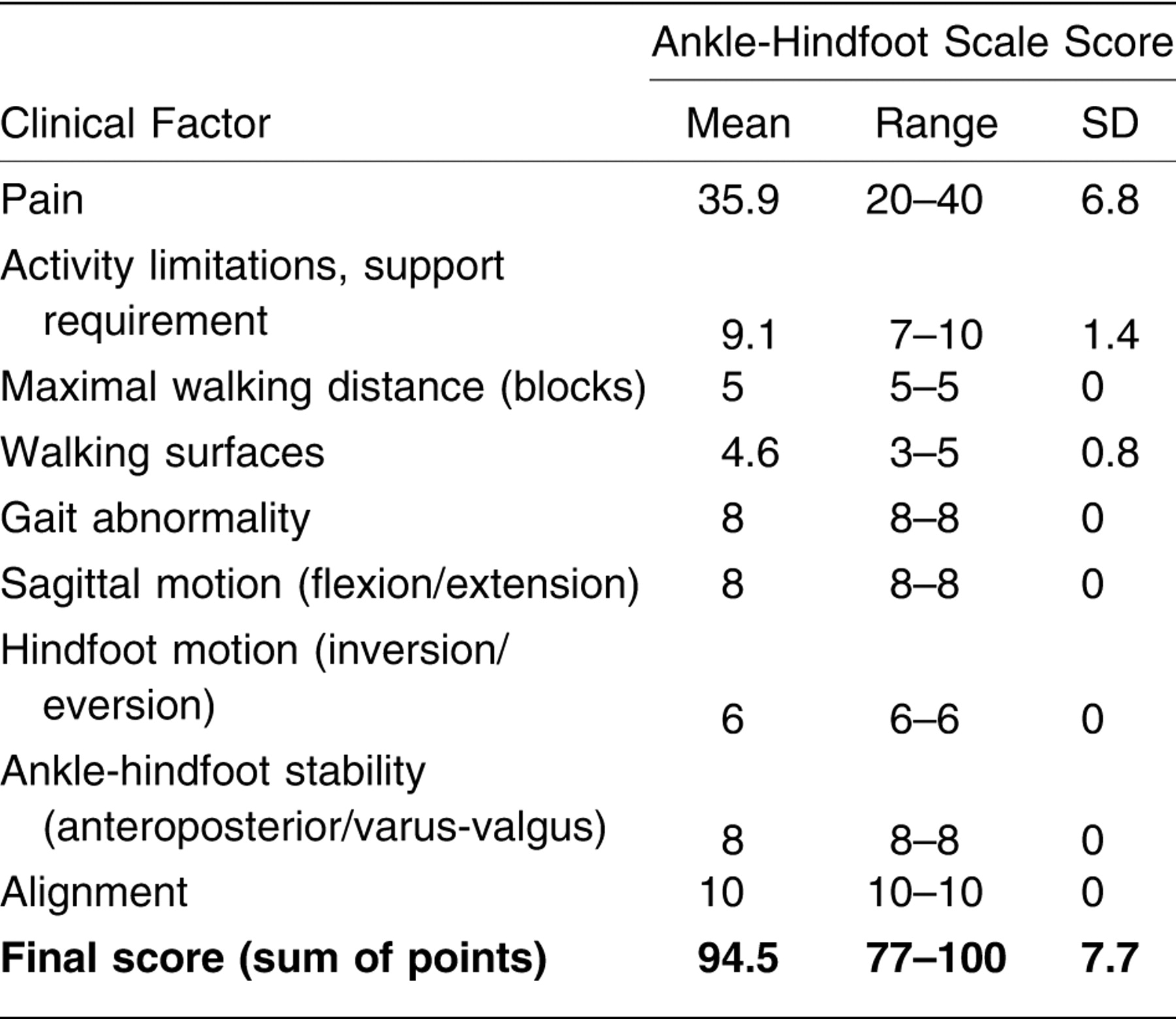
Table 1), whereas the mean (SD) overall score according to the Ankle-Hindfoot Scale was 94.5 (7.7) (range, 77–100) (
Table 2).
Table 1.
Results of Scoring According to the Modified Boyden Score.
Table 1.
Results of Scoring According to the Modified Boyden Score.
Table 2.
Results of Scoring According to American Orthopaedic Foot and Ankle Society Ankle-Hindfoot Scale.
Table 2.
Results of Scoring According to American Orthopaedic Foot and Ankle Society Ankle-Hindfoot Scale.
Isokinetic Evaluation of Calf Muscles
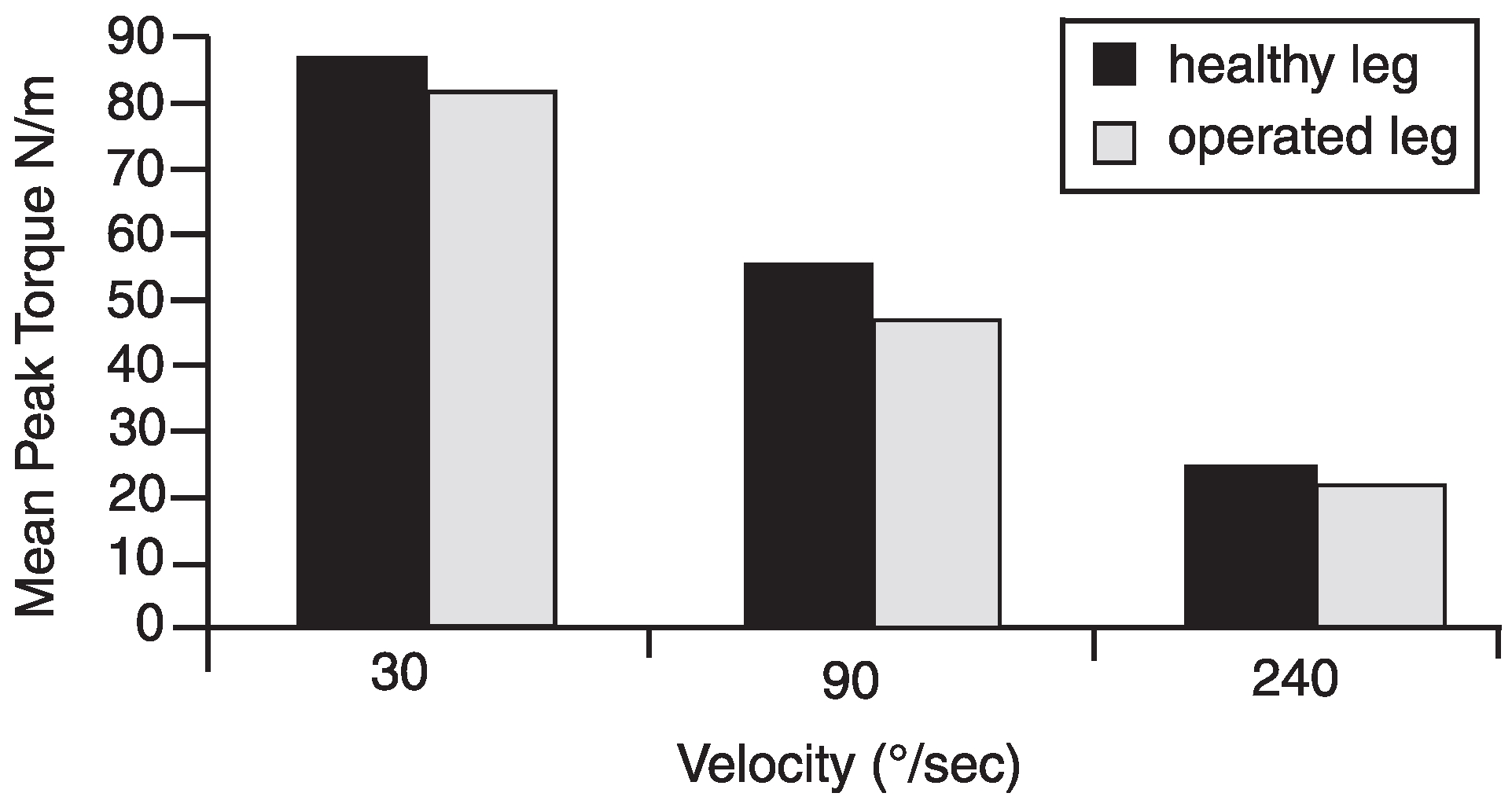
Plantarflexion at an angular velocity of 90°/sec was approximately 15% significantly weaker in the operated leg (45.6 N/m) than in the nonoperated leg (54.3 N/m) (
P < .0001). Plantarflexion at an angular velocity of 30° and 240°/sec was approximately 7.6% and 10.6%, respectively, weaker in the operated leg than in the nonoperated leg. The differences between the two sides did not reach a level of significance for these angular velocities (
P = .039 and .068, respectively) (
Fig. 1). Finally, there were no significant differences in dorsiflexion torque between the operated and nonoperated legs in any of the angular velocities, as expected.
Figure 1.
Results of isokinetic evaluation. Comparison of muscle strength in plantarflexion between the operated and healthy legs at different angular velocities: 30°, 90°, and 240°/sec.
Figure 1.
Results of isokinetic evaluation. Comparison of muscle strength in plantarflexion between the operated and healthy legs at different angular velocities: 30°, 90°, and 240°/sec.
Complications
Two patients experienced superficial infection. Six patients (21%) had sural nerve sensory disturbances; all were minimal and did not require further treatment. There were no deep infections or thromboembolic events, and neither were there any cases of repeated rupture (
Table 3).
Table 3.
Complication Rates in the 29 Study Patients.
Table 3.
Complication Rates in the 29 Study Patients.
Discussion
We describe our experience with repair of acute Achilles tendon rupture via a percutaneous approach. These results, reflected as functional outcome, complications, range of motion, and isokinetic evaluation, are compatible with the published literature and support this surgical approach as a valid treatment option. Although the percutaneous approach has been advocated as an alternative to open repair owing to the theoretical advantage of a reduction in wound-healing issues, it is, nevertheless, traditionally associated with a few shortcomings, mainly repeated ruptures and sural nerve injuries. [
11,
13,
14]
The reported repeated rupture rates after percutaneous surgery varied from 0% to 10%, although a 33% repeated rupture rate has been reported as well. [
11,
13,
21–
23] The rate of complications other than repeated rupture is reported to be 9% to 21.4%, the latter being mostly attributed to sural nerve injury (3%–7.1%). [
14,
20–
23]
None of the patients in this series experienced a second rupture. The rate of sural nerve disturbance was 21%; one case occurred with the early modified Kessler suture technique. Because four of the six patients with this complication belong to the first half of patients treated by this approach, we attribute this relatively high rate of sural nerve injury to an operative technique learning curve.
Majewski et al [
24] described an 18% rate of sural nerve injury when it was not exposed during percutaneous surgery and noted that the injury was avoided when the sural nerve was exposed and protected during surgery. We have no experience with exposure of the sural nerve as part of this surgical technique. It is our opinion that emphasis on placement of the proximal incision at the midline or even slightly medial to the tendon midline is sufficient to avoid entrapment of the sural nerve.
Metz et al [
23] reported the mean visual analog scale score at 1 year to be 0.5 for patients treated via percutaneous suture. They also noted that 24 of 36 patients (67%) returned to their former level of activity within 1 year. In comparison, most of the present study patients (90%) regained a similar pre-injury level of physical activity within a short period (mean, 5.5 months) after completion of a physical therapy program in this study.
After surgery, we found that there was a mean (SD) gain in ankle range of motion between the operated and nonoperated sides of 4.8° (5.2°) (range, 0°–20°;
P < .0001). Gigante et al [
13] described mean (SD) arc of motion measurements after percutaneous repair of 51.4° (10.9°) at 4 months and 55.3° (6.9°) at 12 months.
The dorsiflexion gain is attributed to the fact that the percutaneous technique does not restore the tendon length anatomically as does open surgery. However, we found no correlation between changes in range of motion and function, surgery outcome satisfaction, questionnaires scores, or isokinetic evaluation results. We believe that although the difference in the range-of-motion arc reached a level of statistical significance, a loss or gain of a few degrees to an approximately 60° arc of motion has limited functional significance.
Active range of motion as recorded by the isokinetic measuring instrument while performing plantarflexion was smaller in the operated leg than in the nonoperated leg in seven of the 29 patients (24%), even when there was no difference in passive range of motion. The literature search failed to find evidence of loss of active range of motion in association with the percutaneous approach. One possible explanation is that a restricted range of motion acts as a defense mechanism. When patients were asked why they did not use the operated leg as freely as they did the nonoperated one, they expressed concern about recurrent rupture of the tendon or pain.
The results of the isokinetic evaluation demonstrate that only an angular velocity of 90°/sec yielded a significant weakness of 15% in plantarflexion (
P < .0001). At an angular velocity of 30° and 240°/sec, the operated leg was weaker than the nonoperated leg in plantarflexion, but this difference did not reach statistical significance. This finding is in accordance with most studies showing that a difference in the plantar flexor muscle–tendon unit function between the operated and nonoperated sides remains after Achilles tendon acute rupture regardless of the chosen treatment modality. [
20,
25,
26]
Although isokinetic technology is well accepted for evaluating dynamic muscle function, pure isokinetic movement seldom occurs in actual human performance tasks. We are unaware of studies showing a correlation between strength results and functional outcome. Therefore, we cannot determine whether this measured muscle weakness has meaningful functional consequence to these patients, none of whom participated in professional sports. This conclusion is supported by the high scores of functional evaluation obtained in the questionnaires, in the scoring methods, and by the prompt return to pre-injury physical activity levels.
Many studies refrain from using independent scoring methods altogether, and when scoring methods are used, their variety makes it difficult to compare the results among studies. There is no preferred single scoring method for all investigators to use so results are amenable to comparison.
We are encouraged by the results of this relatively small patient cohort study. We demonstrated that for the common “weekend warrior,” a percutaneous suture technique can produce high patient satisfaction and functional results.