


Abstract
Background: Rheumatoid arthritis is an autoimmune disease that causes chronic, progressive joint inflammation; it commonly affects the joints of the feet. Biomechanical alterations and daily pain in the foot are the common outcomes of the disease. Earlier studies focusing on plantar pressure in such patients reported increased vertical loading along with peak pressure-pain associations. However, footwear designed according to the pressure profiles did not relieve symptoms effectively. We examined plantar shear and pressure distribution in patients with rheumatoid arthritis and compared the findings with those of controls, and we investigated a potential relationship between foot pain and local shear stresses. Methods: A custom-built platform was used to collect plantar pressure and shear stress data from nine patients with rheumatoid arthritis and 14 control participants. Seven patients reported the presence of pain under their feet. Pressure-time and shear-time integral values were also calculated. Results: Peak pressure, pressure-time integral, resultant shear-time integral, and mediolateral shear stress magnitudes were higher in the complication group (P < .05). An association between peak shear-time integral and maximum pain locations was observed. Conclusions: Increased mediolateral shear stresses under the rheumatoid foot might be attributable to gait instability in such patients. A correlation between the locations of maximum shear-time integral and pain indicate the clinical significance of plantar shear in patients with rheumatoid arthritis.
The prevalence of rheumatoid arthritis in the United States is approximately 1%, and many of these patients (90%) develop chronic foot problems. [1] The metatarsophalangeal joints are generally the most affected area of the foot in rheumatoid arthritis, with metatarsalgia being the initial symptom. [2] The foot deformities seen in rheumatoid arthritis can include hallux valgus, hallux varus, hammer or claw toes, and intermetatarsal deviations or widening. [3,4]
The joint destruction caused by rheumatoid arthritis can lead to joint instability by causing bony erosions and destroying smooth articular surfaces. Erosion of the bones in the foot, especially the metatarsal heads, reduces the available area for load bearing, which results in alteration of the intrinsic and interface foot stresses. [5,6] A variety of studies [3,6–9] have reported such biomechanical alterations and impaired ambulation. Tuna et al [3] observed a vertical loading shift toward the lateral forefoot, in particular the fifth metatarsophalangeal joint. Plantar pressure under the metatarsophalangeal joints of patients with rheumatoid arthritis has been observed to increase. [7–9] A change in the spatiotemporal characteristics of gait has also been reported. [9] Patients with juvenile rheumatoid arthritis were also shown to have foot pain and gait deviations along with elevated plantar pressure values. [8] A potential relationship between foot pain and plantar pressure was also explored by several investigators. A study by Hodge et al [7] revealed an association between pain ratings of patients with rheumatoid arthritis and average pressure under the second metatarsal head area.
Foot orthoses with customized designs and materials have been found to reduce pressure and pain in 30% to 70% of patients; however, these interventions were not completely effective because pain relief was not achieved in many individuals. [6] Such an outcome may be tied to the lack of plantar shear distribution assessment and designs that did not account for frictional shear stresses.
The significance of triaxial plantar stress distribution has been revealed in recent studies [10,11] that examined diabetic neuropathic patients prone to foot ulcers. These articles have reported that patterns of vertical and shear loading under the diabetic foot are quite different. The availability of such information is believed to be beneficial in assessing and handling the diabetic foot syndrome. Similarly, assessment of plantar shear distribution in a common foot disorder (ie, rheumatoid foot) may result in a better understanding of how the foot functions in such patients.
Assessment of plantar pressure alone provides limited insight into the pathologic abnormality or foot function in various disorders, including the rheumatoid foot. Thus, the purpose of this study was to investigate plantar shear stress distribution in patients with rheumatoid arthritis and reveal a more comprehensive analysis of foot function. Furthermore, as a secondary aim, a potential association between foot pain and shear stress was explored.
Methods
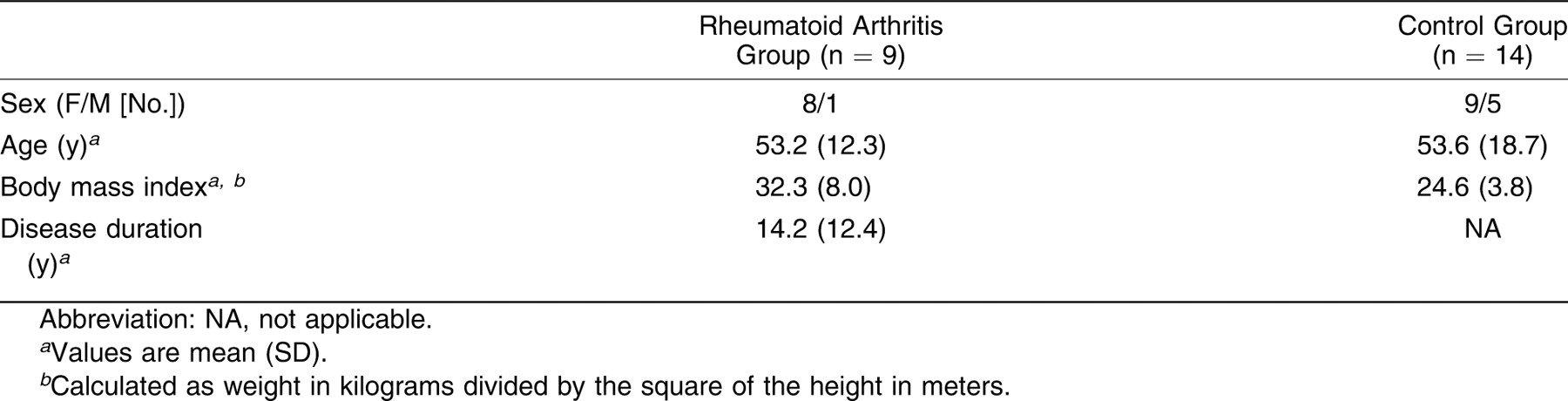
Of 23 volunteers recruited for the study, nine were diagnosed as having rheumatoid arthritis (Table 1). All of the patients were referred to a podiatric physician for rheumatoid foot complications. The control group consisted of 14 healthy volunteers. The exclusion criterion for the partcipants was having previous surgeries in both feet. Foot pain was not an inclusion criterion for patients with rheumatoid arthritis, despite the fact that seven patients had antalgic gait. The study was explained to the volunteers before their participation, and they signed an informed consent form that was approved by the Institutional Review Board of the Cleveland Clinic.
Table 1.
Characteristics of the 23 Volunteers.
Patients with foot pain were asked to complete a pain evaluation form that was adapted from the scale developed by Budiman-Mak et al [12] in 1991. Patients marked the foot pain they experienced at specific plantar sites on a visual analog scale that comprised a 10-cm-long horizontal line with the phrases “no pain” and “worst pain” on opposite ends. These marks were quantified and recorded.
The custom-built pressure-shear device was set flush with the ground, measuring 11.4 × 14.2 cm, with 1.5 mm of space between each sensor. [13] Eighty sensors were arranged in an 8 × 10 array. Each sensor measured 1.25 × 1.25 cm, generating an effective area of 1.6 cm2. Sensors consisted of two components: an s-shaped cantilever and a hollow cylinder. [14] Each sensor was calibrated under static and dynamic conditions with various vertical, anteroposterior, and mediolateral loads. Calibration experiments revealed an overall average error percentage of 1.0%, 4.6%, and 5.0% for pressure, anteroposterior, and mediolateral shear channels, respectively.
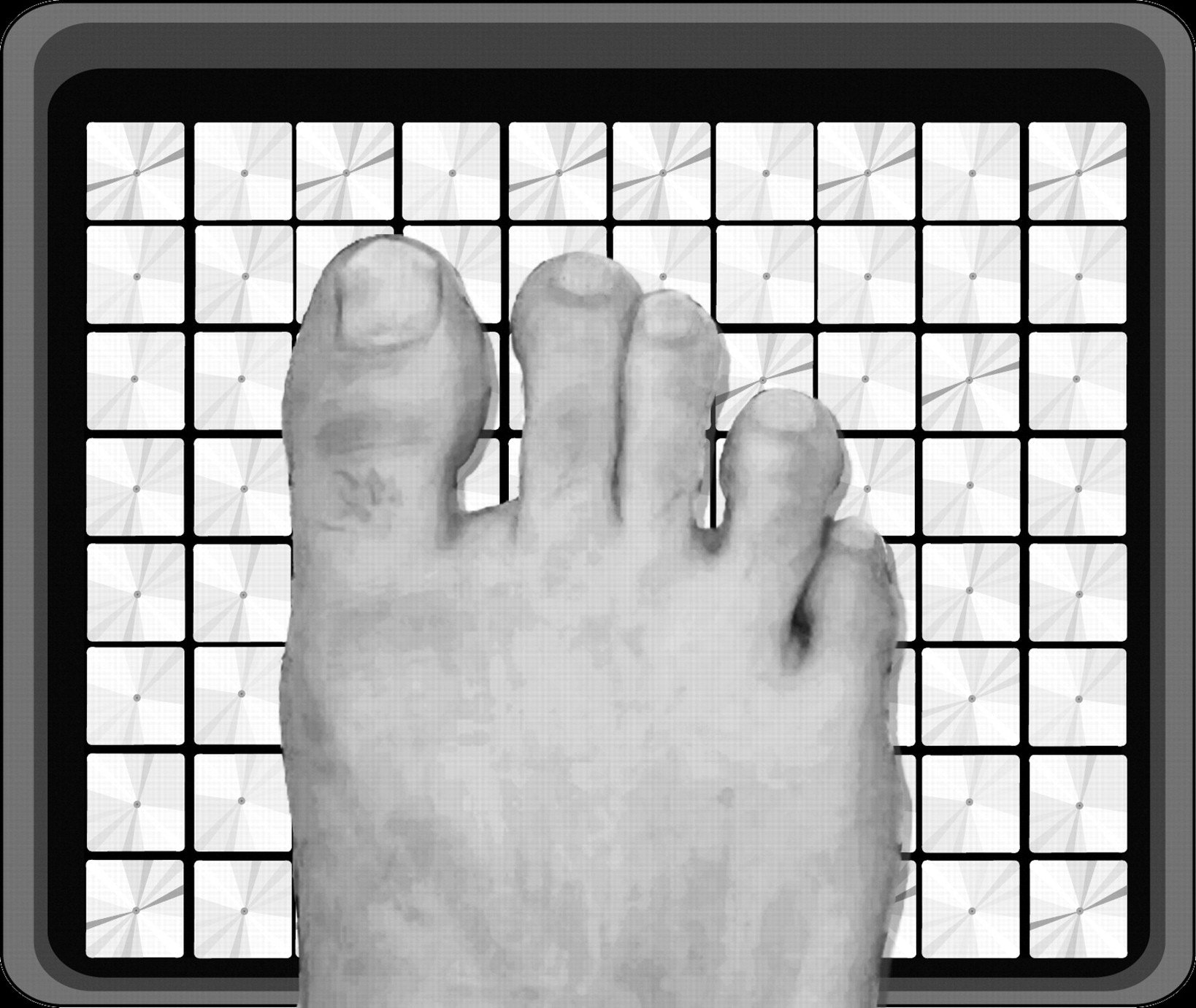
Although the overall size of the device was not large enough to permit force measurements under the entire plantar foot, it was large enough to examine the forefoot area (Fig. 1). This region is of primary interest because the pathologic abnormality of interest mostly occurs in the forefoot area. The two-step method, which was shown to produce results similar to those of midgait methods, was preferred in data acquisition. [15] Although ground reaction forces may depend on gait speed, imposition of a certain speed on the participants might cause alterations in gait styles. For this reason, barefoot participants were asked to walk at self-selected speeds. The tests were performed for only one surgery-free foot (left or right), and three trials were obtained for each participant. Data were collected at 50 Hz for 2 sec.
Figure 1.
Foot placement on the platform.
A custom-written Matlab (The MathWorks Inc, Natick, Massachusetts) code was used to mask five anatomical regions of the foot: the hallux, the lesser toes, the first metatarsal head, the central metatarsal head area (which includes the second and third metatarsal heads), and the lateral metatarsal head region (which comprises the fourth and fifth metatarsal heads). For each region, peak pressure, peak resultant shear stress, peak-to-peak anteroposterior shear, peak-to-peak mediolateral shear, peak propulsive shear, peak resultant shear-time integral, and peak pressure-time integral values were determined. Resultant shear forces were calculated by vector addition of anteroposterior and mediolateral forces. Stress values were obtained by division of forces by sensor surface. Pressure-time integral and shear-time integral values were calculated by implementing the trapezoidal rule over the stress curves. Peak-to-peak anteroposterior shear and peak-to-peak mediolateral shear quantities were determined by subtracting the minimum from the maximum shear values for each transducer. [16] Stance duration was calculated as the time difference between the last instance of the push-off phase and the initial phase of the forefoot contact phase.
Data were analyzed with repeated-measures analysis of variance. Pairwise comparisons of group-site interaction were performed for each variable. The Tukey-Kramer test was used for the multiple pairwise comparisons. An α = 0.05 was used for statistical significance. Stance duration and body mass index values were analyzed with a 2-sample t test. A statistical package (Minitab; Minitab Inc, State College, Pennsylvania) was used to perform the statistical analyses.
Results
Mean forefoot stance phase duration and body mass index values for both groups were similar and did not reveal statistical differences (P = .704 and P = .053, respectively). Peak pressure was seen to be significantly increased in patients with rheumatoid arthritis (P = .004). Global peak pressure was recorded under the central metatarsal head area in both groups, with a magnitude of 460.0 kPa for patients with rheumatoid arthritis and 432.2 kPa for control participants (Table 2).
Table 2.
Mean (SD) Pressure and Shear Values in Five Anatomical Regions of the Foot for the Control and RA Groups.
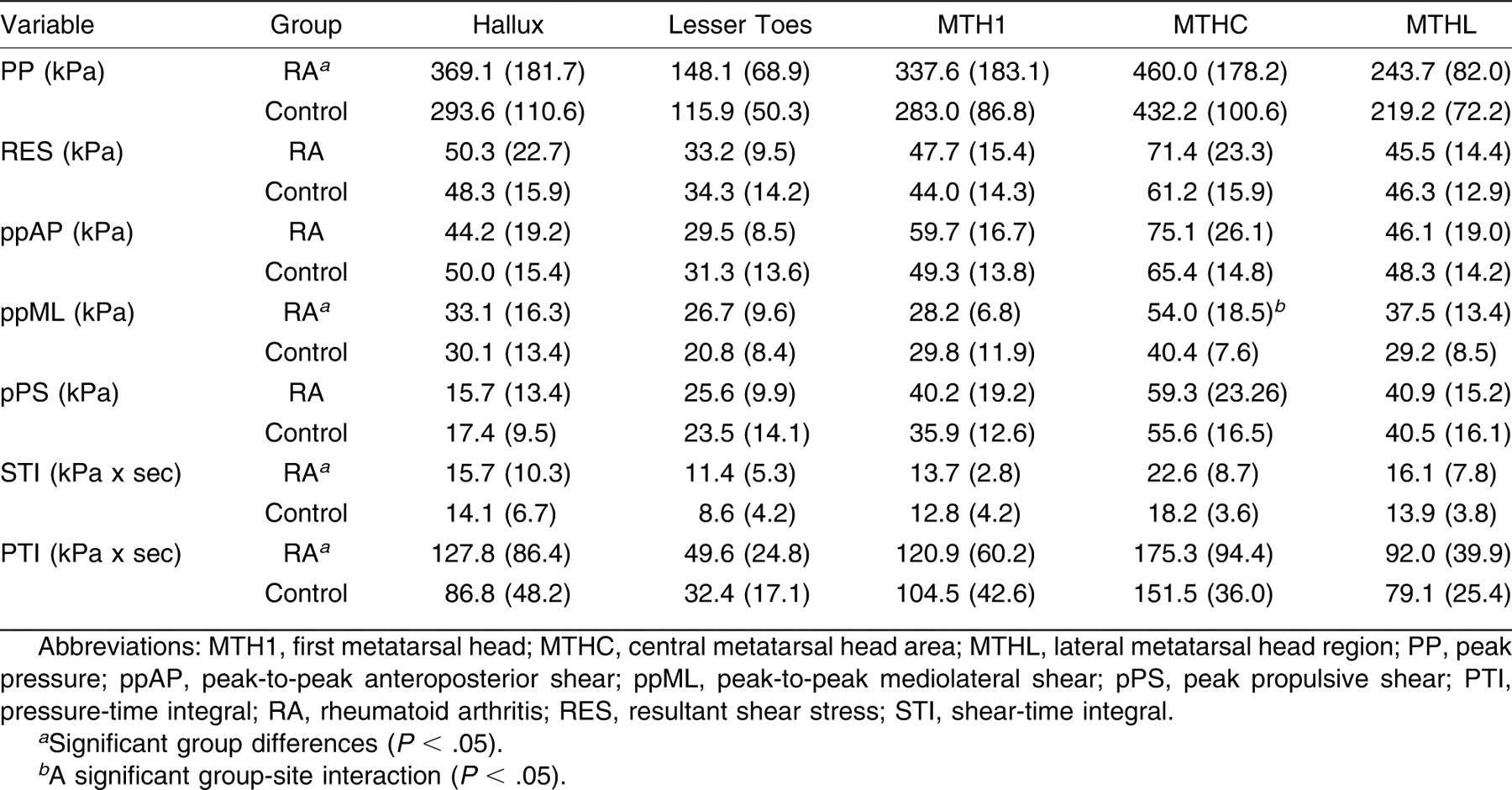
Peak resultant shear stress and peak-to-peak anteroposterior shear did not differ significantly between groups (P > .05). On the other hand, peak-to-peak mediolateral shear and shear-time integral values were higher in the rheumatoid arthritis group (P < .01). Mediolateral shear stresses at the central metatarsal head area in patients with rheumatoid arthritis were 33% higher (P < .05) than individuals in the control group. Shear-time integral was elevated under each region of the feet of individuals with rheumatoid arthritis, with a maximum increase of 33% under the lesser toes; however, none of these foot sites exhibited significant differences. Pressure-time integral was significantly different in the rheumatoid arthritis group compared with the control group (P = .001). However, considering foot region comparisons, no significant difference was observed. Propulsive shear stresses in both groups were similar (P > .05).
In 22% of the patients with rheumatoid arthritis, global peak pressure and resultant shear stress occurred at different foot regions. Similarly, the pressure-time integral and shear-time integral locations deviated in 33% of the patients. Maximum pain site experienced highest pressures in 71% of the patients. This rate was 57% for resultant shear stress, 86% for shear-time integral, and 71% for pressure-time integral.
Discussion
Several investigators [17,18] have discussed the clinical relevance of local shear stresses in patients with rheumatoid arthritis despite the fact that shear distribution remained an unknown for a relatively long time. As a result, assessment of the complication and related corrective procedures have depended on only one-dimensional data (ie, pressure), whereas the human foot experiences forces in all three dimensions.
The present study revealed the value of shear stress distribution as a tool for assessing patients with rheumatoid foot and possibly designing better therapeutic footwear for patients with metatarsalgia because maximum shear-time integral sites were seen to be highly correlated with the location of maximal foot pain. Shear-time integral reveals the combined effect of resultant shear stresses that act under the foot during ground contact.
Moreover, shear-time integral and peak-to-peak mediolateral shear magnitudes were significantly higher in patients with rheumatoid arthritis. Elevated peak-to-peak mediolateral shear values might be an indicator of gait instability in individuals with rheumatoid arthritis. It is thought that the patients might have tried to avoid pain at certain foot regions, which might have resulted in a mediolateral swinging action. This finding may be clinically important because it may also mean an increased potential risk of falls in elderly patients with rheumatoid arthritis.
Limitations of the present study include the spatial resolution and overall size of the pressure-shear platform. Furthermore, only barefoot locomotion was assessed. Partial skin contact with a sensor was assumed to be full contact, which might have resulted in underestimation of some of the stress values.
It is critical to assess the functional needs of a specific patient with rheumatoid arthritis, including pressure and shear distribution in the rheumatoid foot. This study aimed to reveal the clinical value of shear stress distribution in patients with rheumatoid arthritis. The results indicated an association between plantar shear and pain in such patients. It is thought that measurement of plantar shear stresses may be useful in designing therapeutic orthotic devices for patients with rheumatoid arthritis and in assessing the efficacy of these interventions. Further research with more patients with rheumatoid arthritis are needed to further advance this field of rheumatoid foot biomechanics.
Conclusions
Plantar shear stress values were significantly higher in patients with rheumatoid arthritis and foot complications than individuals in the control group. This may be due to localized stresses as a result of bony erosions in the metatarsal heads. Furthermore, an association between the locations of maximum pain and the shear-time integral value was observed. Future research should aim at investigating the relationship between pain and shear stress distribution in a larger sample of patients.
Acknowledgment
Gordon Hirschman and Lynn Bardsley of Infoscitex Inc, Dr. May Azem, and Joan Lannoch for their input during this study.
Financial Disclosure
This research was supported by grant 2R44DK061164 from the National Institutes of Health.
Conflicts of Interest
None reported.
References
- van der Leeden M, Steultjens M, Dekker JH, et al: Forefoot joint damage, pain and disability in rheumatoid arthritis patients with foot complaints: the role of plantar pressure and gait characteristics. Rheumatology (Oxford)45: 465, 2006.
- Turner DE, Helliwell PS, Emery P, et al: The impact of rheumatoid arthritis on foot function in the early stages of the disease: a clinical case series. BMC Musculoskelet Disord7: 102, 2006.
- Tuna H, Birtane M, Tastekin N, et al: Pedobarography and its relation to radiologic erosion scores in rheumatoid arthritis. Rheumatol Int26: 42, 2005.
- Farrow SJ, Kingsley GH, Scott DL: Interventions for foot disease in rheumatoid arthritis: a systematic review. Arthritis Rheum53: 593, 2005.
- Davys HJ, Turner DE, Helliwell PS, et al: Debridement of plantar callosities in rheumatoid arthritis: a randomized controlled trial. Rheumatology (Oxford)44: 207, 2005.
- Conrad KJ, Budiman-Mak E, Roach KE, et al: Impacts of foot orthoses on pain and disability in rheumatoid arthritics. J Clin Epidemiol49: 1, 1996.
- Hodge MC, Bach TM, Carter GM: novel Award First Prize Paper: orthotic management of plantar pressure and pain in rheumatoid arthritis. Clin Biomech (Bristol, Avon)14: 567, 1999.
- Orlin M, Stetson K, Skowronski J, et al: Foot pressure distribution: methodology and clinical application for children with ankle rheumatoid arthritis. Clin Biomech (Bristol, Avon)12: S17, 1997.
- Minns RJ, Craxford AD: Pressure under the forefoot in rheumatoid arthritis: a comparison of static and dynamic methods of assessment. Clin Orthop Relat Res187: 235, 1984.
- Yavuz M, Erdemir A, Botek G, et al: Peak plantar pressure and shear locations: relevance to diabetic patients. Diabetes Care30: 2643, 2007.
- Yavuz M, Tajaddini A, Botek G, et al: Temporal characteristics of plantar shear distribution: relevance to diabetic patients. J Biomech41: 556, 2008.
- Budiman-Mak E, Conrad KJ, Roach KE: The foot function index: a measure of foot pain and disability. J Clin Epidemiol44: 561, 1991.
- Yavuz M, Botek G, Davis BL: Plantar shear stress distributions: comparing actual and predicted frictional forces at the foot-ground interface. J Biomech40: 3045, 2007.
- Davis BL, Perry JE, Neth DC, et al: A device for simultaneous measurement of pressure and shear force distribution on the plantar surface of the foot. J Appl Biomech14: 93, 1998.
- McPoil TG, Cornwall MW, Dupuis L, et al: Variability of plantar pressure data: a comparison of the two-step and midgait methods. JAPMA89: 495, 1999.
- Yavuz M, Tajaddini A, Botek G, et al: Temporal characteristics of plantar shear distribution: relevance to diabetic patients. J Biomech41: 556, 2008.
- Gould JS: Conservative management of the hypersensitive foot in rheumatoid arthritis. Foot Ankle2: 224, 1982.
- Spence WR, Shields MN: Prevention of blisters, callosities and ulcers by absorption of shear forces. JAPA58: 428, 1968.
© 2010 American Podiatric Medical Association