1. Introduction
Non-performing financing (NPF) is an important indicator of asset quality deterioration and financial risk in Islamic banking systems. This issue is particularly relevant in the Gulf Cooperation Council (GCC), where Islamic banking represents a major component of the regional financial system. Understanding the factors associated with NPF is therefore important for both financial institutions and regulators seeking to strengthen banking stability and improve risk management practices.
The GCC provides a distinctive setting for examining financing risk. Although member countries have made considerable progress in economic diversification, their economies remain strongly influenced by hydrocarbon revenues, sovereign expenditure, public investment, and large infrastructure programmes. Changes in oil revenues and government spending may affect economic activity, corporate cash flows, public sector contracts, and the repayment capacity of borrowers. These effects may eventually be reflected in the quality of Islamic banking financing portfolios.
Real estate and infrastructure cycles provide additional channels through which uncertainty may influence financing quality. During periods of strong public investment and economic expansion, construction activity, property development, and government-related projects may support borrower income and improve repayment performance. However, fiscal adjustment, project delays, declining property values, or tighter financing conditions may weaken the financial position of firms and households. As a result, NPF may respond not only to banking system characteristics but also to broader regional and macroeconomic conditions.
External uncertainty is also relevant to GCC economies. Global economic policy uncertainty may influence investment, trade, business confidence, and financing conditions, while uncertainty surrounding U.S. monetary policy may affect interest rates, liquidity, capital flows, and borrowing costs. Because GCC financial systems are closely connected to international markets, these external factors may be associated with changes in financing quality. However, their effects may not be uniform across all levels of NPF.
Previous studies have examined Islamic bank performance, efficiency, asset quality, and the macroeconomic factors associated with problem financing. Nevertheless, two important gaps remain. First, much of the existing literature relies on mean-based estimation methods, which assume that explanatory variables have the same effect across the entire NPF distribution. Such models may conceal important differences between low- and high-risk conditions. Second, limited attention has been given to the joint role of Islamic banking system characteristics, domestic macroeconomic conditions, and external uncertainty within a distribution-sensitive framework (
Abdelbaki, 2019;
Farooq et al., 2019;
Naifar, 2016;
Jawadi et al., 2017;
Chowdhury et al., 2017;
Kumar et al., 2023).
This study contributes to the literature in three ways. First, it provides comparative evidence on NPF across the six GCC Islamic banking systems. Second, it incorporates global economic policy uncertainty and U.S. monetary policy uncertainty alongside banking system and domestic macroeconomic variables. Third, it examines whether these relationships vary across the NPF distribution, thereby identifying patterns that may not be visible in conventional mean-based models. The findings offer cautious implications for financing risk monitoring, liquidity management, and macroprudential policy and supervision.
The remainder of this paper is organized as follows.
Section 2 reviews the relevant literature and develops the hypotheses.
Section 3 describes the data and methodology.
Section 4 presents and discusses the empirical results and robustness checks.
Section 5 concludes this study and outlines its policy implications, limitations, and directions for future research.
2. Literature Review
2.1. Islamic Banking and Non-Performing Financing
Islamic banking is based on Sharia principles that prohibit interest, excessive uncertainty, and speculative transactions. Islamic financial institutions use financing arrangements such as Murabaha, Musharakah, and Ijara, which connect financial transactions to underlying assets and economic activities. These characteristics distinguish Islamic financing from conventional lending and may influence the way financing risk develops and is managed. In particular, the quality of Islamic financing depends on borrower repayment capacity, the value of the underlying assets, the structure of the financing contract, and the effectiveness of monitoring and governance (
Rahman, 2010;
Hassan & Lewis, 2007;
Hasan & Dridi, 2010).
Non-performing financing is widely used to assess deterioration in the quality of Islamic financing portfolios. It reflects both the financial condition of borrowers and the quality of financing decisions made by Islamic financial institutions. Higher NPF may result from weak credit assessment, inadequate monitoring, poor portfolio diversification, or adverse economic conditions. The literature therefore treats NPF as an outcome of both internal banking practices and external macroeconomic developments (
Alandejani & Abdulaziz, 2014;
Muhammad et al., 2020;
Widarjono & Rudatin, 2021;
Almuraikhi, 2022).
2.2. Determinants of Non-Performing Financing
Non-performing financing is one of the main indicators of declining asset quality in Islamic banking. It reflects financing facilities for which scheduled payments have become overdue or are unlikely to be fully recovered. The level of non-performing financing is influenced by both conditions within the banking system and developments in the broader economy.
Banking system factors include profitability, capital adequacy, size, liquidity, governance, and the quality of financing assessment and monitoring. Macroeconomic factors influence non-performing financing through their effects on household income, corporate cash flows, financing costs, investment, and collateral values. This distinction is important in the present study because the analysis is based on aggregate Islamic banking system data for each GCC country rather than data from individual banks. Therefore, return on assets, capital adequacy, size, and liquidity represent the overall financial conditions of the Islamic banking system in each country, while economic growth, inflation, global economic policy uncertainty, and United States monetary policy uncertainty represent domestic and external economic conditions.
2.2.1. Banking System Factors
Previous studies commonly associate problem financing with weaknesses in screening, monitoring, governance, and operational efficiency. According to the bad management hypothesis, weak managerial practices and inadequate financing assessment increase the probability that financing is granted to borrowers with limited repayment capacity. Non-performing financing should therefore be viewed not only as a consequence of adverse economic conditions but also as an outcome of the quality of risk management within the banking system (
Alandejani & Abdulaziz, 2014;
Muhammad et al., 2020;
Widarjono & Rudatin, 2021).
The literature generally classifies the determinants of problem financing into two broad groups. The first consists of internal financial characteristics, including profitability, capital adequacy, liquidity, and size. The second includes macroeconomic factors, particularly economic growth and inflation. However, the direction and strength of these relationships often differ across countries, periods, and institutional environments (
Almuraikhi, 2022).
Profitability, usually measured by return on assets, may influence non-performing financing through two different channels. Higher profitability may indicate effective management, stronger monitoring, and greater capacity to absorb provisions and financing losses. From this perspective, profitable banking systems are expected to report lower levels of non-performing financing. Previous Islamic banking studies have therefore identified profitability as an important factor associated with financial stability and asset quality (
Chowdhury & Rasid, 2016;
Chowdhury et al., 2017).
However, high profitability does not always indicate low risk. In some cases, profitability may result from rapid financing expansion, greater exposure to high return activities, or increased concentration in risky sectors. Current profitability may therefore be accompanied by higher future financing impairment. Evidence from GCC banking systems also shows that profitability, efficiency, and risk taking are closely related rather than separate aspects of bank performance (
Hidayat et al., 2021). The relationship between profitability and non-performing financing may consequently differ between banking systems with low levels of impairment and those experiencing more severe asset quality problems.
Capital adequacy is another important determinant of financing risk. A strong capital position provides protection against unexpected losses and allows banks to absorb adverse shocks without disrupting their financing activities. Higher capital adequacy may also improve market confidence and encourage more responsible risk management. These arguments suggest that capital adequacy should reduce non-performing financing.
Nevertheless, the relationship may not always be negative. Well capitalized banks may have greater capacity to expand financing or invest in riskier activities, particularly when governance and regulatory controls are weak. Research on GCC banks suggests that capital interacts with governance arrangements and managerial behavior in shaping risk and financial performance (
Al-Malkawi & Pillai, 2018). Capital levels may also affect the recognition of impaired financing and the amount of provisions recorded by banks (
Elfergani et al., 2024). Capital adequacy should therefore be treated as an empirical determinant whose effect may vary according to the level of risk within the banking system.
The size of the banking system may also affect non-performing financing through competing mechanisms. Larger banking systems may benefit from broader diversification, advanced technology, stronger information systems, and more developed risk management practices. These advantages may improve financing assessment and reduce exposure to individual borrowers or sectors.
At the same time, greater size may increase organizational complexity and weaken effective monitoring. Large banking systems may also have stronger incentives to take risks if they expect government support during periods of financial difficulty. Studies comparing Islamic and conventional banks in GCC countries indicate that size may reflect differences in business models, market power, financing structures, and governance rather than scale alone (
Khediri et al., 2015;
Hadriche, 2015). Its effect on non-performing financing may therefore vary across different levels of financial distress (
Jawadi et al., 2017).
Liquidity is central to the stability of Islamic banking systems because it enables banks to meet short term obligations and continue financing activities without being forced to sell assets under unfavorable conditions. Adequate liquidity may reduce non-performing financing by allowing banks to manage temporary funding pressures and restructure viable financing facilities when borrowers experience short-term financial difficulties.
However, high liquidity may also encourage rapid financing expansion or weaker screening standards. When excess liquidity is directed towards high return but risky activities, it may contribute to future financing impairment. Evidence from GCC banking systems indicates that liquidity management is closely connected to financing structure, profitability, and risk exposure (
Belkhaoui et al., 2020;
Hidayat et al., 2021). Liquidity may therefore strengthen financial resilience in some circumstances while increasing risk taking in others.
Overall, the literature does not establish a single and consistent relationship between banking system characteristics and non-performing financing. Profitability, capital adequacy, size, and liquidity can strengthen financial stability but they may also reflect aggressive financing strategies or greater risk exposure. This ambiguity supports the use of an empirical method that allows their effects to differ across low, moderate, and high levels of non-performing financing.
2.2.2. Macroeconomic and External Factors
Macroeconomic conditions influence non-performing financing mainly through their effects on borrowers’ ability to meet their financial obligations. Strong economic growth improves household income, business revenues, employment, and investment. These improvements strengthen repayment capacity and reduce the likelihood that financing facilities become impaired.
During economic downturns, lower demand, weaker profits, unemployment, delayed investment, and reduced government expenditure may place pressure on borrowers’ cash flows. These conditions can increase payment delays and lead to higher levels of non-performing financing. Studies of GCC banking systems identify economic growth and credit cycle conditions as important determinants of impaired assets, particularly during periods of economic and financial instability (
Abdelbaki, 2019;
Farooq et al., 2019). Other studies also show that domestic economic conditions interact with international financial developments in influencing asset quality in GCC countries (
Kumar et al., 2023).
Economic growth is therefore generally expected to reduce non-performing financing. However, the strength of this relationship may depend on the structure of the economy, the level of public expenditure, and the sectors in which bank financing is concentrated.
Inflation may affect non-performing financing through several channels. Higher prices reduce household purchasing power and increase the operating costs of firms. When wages and business revenues do not rise at the same rate as prices, borrowers may find it more difficult to meet their financing obligations. Inflation can also lead to tighter monetary conditions and higher financing costs, placing additional pressure on highly indebted households and businesses.
Nevertheless, the effect of inflation may vary across countries and periods. Moderate inflation may reduce the real value of nominal financial obligations or occur during periods of strong economic demand. GCC research therefore treats inflation as an important macroeconomic determinant, although its effect depends on economic conditions, financing arrangements, and institutional characteristics (
Abdelbaki, 2019).
In addition to domestic economic conditions, GCC Islamic banking systems are exposed to changes in global economic policy uncertainty. Global economic policy uncertainty refers to uncertainty surrounding economic, fiscal, regulatory, and trade policies across major economies. Higher uncertainty may discourage investment, delay consumption, weaken business confidence, and increase the cost of external financing.
During uncertain periods, firms may postpone investment projects and households may reduce spending. Banks may also respond by holding more liquid assets, tightening financing standards, and reducing exposure to borrowers considered vulnerable to economic shocks (
Berger et al., 2022;
Nguyen & Dang, 2024). Although these actions may protect bank balance sheets, they may also reduce borrowers’ access to refinancing and worsen existing cash flow difficulties. Global economic policy uncertainty may therefore increase non-performing financing through both weaker borrower performance and tighter financing conditions.
The effect of uncertainty may be stronger when asset quality is already deteriorating. Quantile-based studies indicate that global risks and macroeconomic shocks can have different effects under normal and stressed financial conditions (
Naifar, 2016;
Jawadi et al., 2017). Evidence from Islamic and conventional banks in the wider Middle East and North Africa region also suggests that policy uncertainty is associated with changes in impaired assets (
Aledeimat & Bein, 2025). This supports the possibility that global economic policy uncertainty has a stronger effect at higher levels of non-performing financing.
United States monetary policy uncertainty is a more specific source of external risk. It refers to uncertainty regarding the future direction of Federal Reserve policy and its possible economic effects. Such uncertainty can influence global liquidity, interest rates, financing costs, capital flows, and investor confidence.
This form of uncertainty is particularly relevant to GCC countries because their monetary and financial conditions are closely linked to United States interest rate developments and international dollar markets. Uncertainty about future United States monetary policy may raise financing costs, discourage investment, and create difficulties for borrowers that depend on external funding or refinancing. Islamic banks may also respond by adopting more cautious liquidity and financing policies.
United States monetary policy uncertainty can therefore affect non-performing financing through its influence on borrower cash flows, investment decisions, funding conditions, and banking system behavior. However, it should be distinguished from global economic policy uncertainty. Global economic policy uncertainty captures broad uncertainty related to economic and regulatory policies, while United States monetary policy uncertainty focuses specifically on uncertainty surrounding monetary policy decisions. Their effects on non-performing financing may therefore differ in timing, magnitude, and statistical significance.
2.2.3. Sectoral Financing Exposure in GCC Economies
The effect of macroeconomic conditions on non-performing financing also depends on the sectors in which Islamic banking financing is concentrated. This issue is particularly important in GCC countries, where banks are closely involved in financing property development, construction, infrastructure, logistics, and government-related enterprises.
Property development and construction are sensitive to economic growth, government expenditure, financing costs, and changes in real estate demand. A decline in property prices may weaken developers’ cash flows and reduce the value of assets used as collateral. Construction companies may also experience delayed payments, higher material costs, project postponements, and cost overruns. These conditions can reduce their ability to meet financing obligations and increase the level of non-performing financing.
Infrastructure and logistics projects usually require large amounts of long-term financing. Their performance may be affected by project delays, changes in government investment priorities, higher construction costs, supply chain disruptions, and lower than expected demand. Although some projects may benefit from government support, their size and long maturity can create concentration and refinancing risks for Islamic banks.
Government-related enterprises also play an important role in GCC economies. They are widely involved in energy, transport, utilities, infrastructure, property development, and national diversification projects. Their financial performance is often linked to government expenditure, oil revenues, and public investment policies. A decline in government revenue or a change in public spending priorities may delay projects and payments, which can affect both contractors and banks.
Sectoral financing exposure therefore represents an important channel through which macroeconomic shocks are transmitted to Islamic banking systems. For example, weaker economic growth may have a stronger effect on non-performing financing when bank portfolios are concentrated in construction and real estate. Inflation may increase project costs, while global and monetary policy uncertainty may raise refinancing costs and delay investment decisions.
Consistent quarterly data on sectoral financing are not available for all GCC Islamic banking systems over the full study period. Therefore, sector specific variables are not included directly in the empirical model. Nevertheless, these sectoral characteristics are important for interpreting the estimated effects of economic growth, inflation, and external uncertainty on non-performing financing.
2.2.4. Literature Synthesis and Research Motivation
The reviewed literature provides three main conclusions. First, non-performing financing is shaped by both banking system conditions and macroeconomic developments. Profitability, capital adequacy, size, and liquidity influence financial resilience, financing decisions, and risk taking. Economic growth, inflation, and external uncertainty affect borrower cash flows, investment, financing costs, and collateral values.
Second, the effects of these determinants are not necessarily constant. A factor that strengthens financial stability under normal conditions may have a different effect when the banking system is experiencing high levels of impaired financing. For example, strong capital or liquidity may provide protection against shocks, but it may also support greater risk taking and financing expansion.
Third, the structure of GCC economies affects the transmission of macroeconomic shocks to Islamic banking systems. Financing exposure to property development, construction, infrastructure, logistics, and government-related enterprises may increase the sensitivity of asset quality to changes in economic growth, public expenditure, inflation, and global financial conditions.
Despite these findings, much of the previous literature examines banking factors and macroeconomic determinants separately. Bank level studies may not fully capture country wide economic transmission, while aggregate studies may not explain the internal financial mechanisms through which Islamic banking systems respond to shocks. Previous studies also tend to focus on average effects and give limited attention to the possibility that determinants may have different effects at different levels of non-performing financing.
The present study addresses these limitations by combining banking system characteristics, domestic macroeconomic conditions, and external uncertainty measures within a single framework for GCC Islamic banking systems. The use of fixed effects and panel quantile regression makes it possible to examine both average relationships and differences across low, moderate, and high levels of non-performing financing. This approach is appropriate for GCC countries because variations in sectoral exposure, government expenditure, institutional arrangements, and sensitivity to global uncertainty may cause the determinants of financing impairment to differ across countries and financial conditions.
2.3. Research Gap
Despite extensive evidence on GCC banking efficiency and performance (
El Moussawi & Obeid, 2011;
Hadriche, 2015) and a growing macro literature on impaired assets in GCC economies (
Farooq et al., 2019;
Abdelbaki, 2019), there remains limited GCC Islamic bank evidence that models
non-performing financing (NPF) explicitly while jointly incorporating bank fundamentals (ROA, CAR, size, liquidity), domestic macro conditions (growth and inflation), and
global economic policy uncertainty (GEPU) and U.S. monetary policy uncertainty (MPU), with allowance for heterogeneous effects across risk regimes. This matters because Islamic banks’ financing distress can respond asymmetrically under stress and uncertainty, as suggested by regime-sensitive and quantile-oriented evidence in Islamic finance and banking (
Naifar, 2016;
Jawadi et al., 2017) and by recent findings that policy uncertainty is linked to impaired assets in Islamic and conventional banks (
Aledeimat & Bein, 2025).
Addressing these gaps is important because Islamic banks may respond differently under normal and stressed conditions. A determinant that appears weak or insignificant on average may become important in the upper tail of the NPF distribution, where financial distress is more severe. Therefore, a distribution-sensitive framework is needed to identify how risk drivers behave across NPF regimes. This study responds to this need by combining fixed-effects estimation with panel quantile regression and by incorporating both domestic macro-financial variables and external uncertainty indicators into the analysis of GCC Islamic bank financing risk.
2.4. Hypotheses Development
H1
(Profitability and NPF). Higher profitability improves screening and monitoring capac-ity and strengthens internal buffers, which should reduce financing distress in Islamic banks; therefore, return on assets is expected to be negatively associated with NPF (Chowdhury & Rasid, 2016; Chowdhury et al., 2017; Muhammad et al., 2020). H2
(banking system characteristics and NPF). Stronger capital adequacy, greater liquidity, and larger banking system size may improve loss absorption, financial resilience, and risk management. Therefore, capital adequacy, liquidity, and size are expected to be negatively associated with NPF (Al-Malkawi & Pillai, 2018; Khediri et al., 2015; Hidayat et al., 2021). H3
(macroeconomic conditions and NPF). Stronger economic activity improves borrower cash flows and repayment capacity, whereas higher inflation may increase financial pressure on households and firms. Therefore, GDP is expected to be negatively associated with NPF, while inflation is expected to be positively associated with NPF (Abdelbaki, 2019; Farooq et al., 2019). H4
(external uncertainty and NPF). Greater global economic policy uncertainty and U.S. monetary policy uncertainty may weaken investment, increase financing costs, and reduce borrower repayment capacity. Therefore, GEPU and MPU are expected to be positively associated with NPF (Naifar, 2016; Husted et al., 2020; Aledeimat & Bein, 2025). 3. Data and Methodology
This study adopts a structured panel econometric framework combining fixed effects (FE) and panel quantile regression to examine the determinants of non-performing financing (NPF) in GCC Islamic bank systems. The methodological design is grounded in established panel data theory and distribution-sensitive estimation techniques to ensure robust and policy-relevant inference.
3.1. Econometric Framework
This study adopts a structured panel econometric framework combining fixed-effects estimation and panel quantile regression to examine the determinants of non-performing financing (NPF) in GCC Islamic banks. The methodological design allows for capturing both average effects and distributional heterogeneity, which is particularly relevant in modeling credit risk dynamics.
Quantile regression, originally developed by
Koenker and Bassett (
1978) and extended to panel data by
Koenker (
2004), provides a robust alternative to conventional mean-based estimators. Unlike ordinary least squares (OLS), which focuses on the conditional mean, quantile regression evaluates the impact of explanatory variables across different points of the conditional distribution of the dependent variable. This is particularly important when the distribution of NPF is non-normal, skewed, or characterized by heavy tails.
3.2. Quantile Regression Specification
Let
denote a random sample, where
represents non-performing financing (NPF), and
is a vector of explanatory variables. The linear quantile regression model is specified as:
The conditional quantile function is defined as:
where
represents the quantile level,
is the conditional distribution function, and
is the vector of parameters to be estimated.
The estimator
is obtained by solving the following minimization problem:
where the loss function
is defined as:
This formulation minimizes weighted absolute deviations, making the estimator robust to outliers and heteroskedasticity.
3.3. Panel Quantile Regression Model
To account for unobserved heterogeneity across banks, the model is extended to a panel setting as follows:
where
indexes banks and
denotes time. The term
captures unobserved bank-specific effects, and
includes bank-specific and macroeconomic variables.
The empirical model is specified as:
The model is estimated for multiple quantiles , allowing the effects of explanatory variables to vary across different levels of NPF.
3.4. Fixed-Effects Estimation
As a baseline, this study employs a fixed-effects (FE) model to estimate the average relationship between NPF and its determinants:
The FE estimator controls for unobserved heterogeneity across banks, ensuring that the estimated coefficients reflect within-bank variation over time. The selection of the FE model is supported by the F test for individual effects and the Hausman test, confirming that unobserved effects are correlated with the regressors.
3.5. Cross-Sectional Dependence and Cointegration
To validate the econometric framework, this study first applies
Pesaran’s (
2004) cross-sectional dependence (CD) test to examine whether panel units are affected by common shocks. The results indicate no significant cross-sectional dependence, supporting the use of first-generation panel techniques.
Subsequently,
Kao (
1999)’s and
Pedroni (
1999)’s panel cointegration tests are employed to assess the existence of a long-run equilibrium relationship among the variables. The results do not provide strong evidence of cointegration, suggesting that NPF dynamics are primarily driven by short-run adjustments rather than long-run equilibrium relationships.
3.6. Methodological Justification
The combined use of fixed-effects and quantile regression provides a comprehensive framework for analyzing credit risk dynamics. While the FE model captures average effects, quantile regression reveals heterogeneous and regime-dependent relationships across different levels of NPF.
This dual approach is particularly suitable in the context of GCC Islamic banking, where credit risk behavior may vary significantly across institutions and economic conditions. The absence of cointegration further supports the focus on short-run and distributional dynamics, rather than imposing a restrictive long-run structure.
From a financial risk management perspective, this approach is useful because it identifies whether risk drivers become stronger, weaker, or change direction when banks move from normal financing conditions to elevated NPF regimes.
3.7. Data and Sample
This study investigates the determinants of non-performing financing (NPF) in Islamic banking systems across the Gulf Cooperation Council (GCC) countries. The analysis covers the period from 2014Q4 to 2024Q3 and is based on a panel of six GCC countries Bahrain, Kuwait, Oman, Qatar, Saudi Arabia, and the United Arab Emirates. These countries constitute the core of the global Islamic banking industry and share broadly comparable regulatory frameworks and institutional characteristics, making them particularly well-suited for cross-country comparative analysis.
Table 1 represents bank-specific data obtained from the Islamic Financial Services Board (
IFSB, 2019,
2022,
2024), which provides indicators for Islamic banks consistent with Shariah-compliant financial reporting standards. Macroeconomic variables are sourced from the World Bank’s World Development Indicators, ensuring cross-country comparability. Global economic policy uncertainty is measured using the global economic policy uncertainty (GEPU) index and U.S. monetary policy uncertainty (MPU) index, which capture uncertainty related to global economic and policy developments.
3.8. Results and Analysis
Descriptive statistics summarize the central tendency, dispersion, and shape of a dataset’s distribution, as presented in the table below.
Table 2 presents the descriptive statistics for 239 country–quarter observations. The results show substantial variation across GCC Islamic banking systems, particularly in NPF, banking system size, uncertainty indicators, and GDP. NPF has a mean of 0.0381 and a median of 0.0221, indicating that relatively high NPF values are concentrated in a smaller number of observations.
Most variables are positively skewed, especially capital adequacy, NPF, MPU, and GDP, while ROA and inflation are negatively skewed. The high kurtosis values for ROA and CAR indicate heavy tails and the presence of extreme observations, whereas GDP and inflation are closer to a normal distribution in terms of kurtosis.
The Jarque–Bera test rejects normality for all variables at conventional significance levels. These distributional differences support the use of quantile regression, as the relationships between NPF and its explanatory variables may vary across different parts of the NPF distribution rather than being fully captured by a single average effect.
Table 3 shows that the pairwise correlations among the study variables are generally moderate, suggesting that the selected determinants capture different dimensions of financing risk in GCC Islamic banks. NPF is negatively correlated with CAR (−0.1438), SIZE (−0.1757), LIQU (−0.2639), GEPU (−0.3265), MPU (−0.0030), GDP (−0.2963), and INF (−0.0117), while its correlation with ROA is weakly positive (0.0631). The strongest negative associations are observed with GEPU, GDP, and LIQU, implying that changes in macroeconomic conditions, uncertainty, and liquidity may be linked to variation in non-performing financing. Among the explanatory variables, ROA is strongly negatively correlated with CAR (−0.7479), which may signal possible multicollinearity and should therefore be checked in the regression analysis. SIZE is also strongly and positively associated with GDP (0.7792) and GEPU (0.6020), indicating that the bank scale tends to move closely with broader macro-financial conditions. Overall, the correlation matrix supports the inclusion of bank-specific, macroeconomic, and uncertainty-related variables in the empirical model, while also suggesting the need for careful econometric testing to separate their overlapping effects.
The panel unit root results reported in
Table 4 show that the variables are not uniformly stationary at level form. Under the level specification, most variables fail to reject the null hypothesis of a unit root across the alternative assumptions of constant, constant with trend, and no constant or trend. Only a few variables, particularly LIQU, GEPU, MPU, and in some cases CAR, show evidence of stationarity under selected specifications, while NPF, ROA, SIZE, and GDP remain non-stationary in levels. This indicates that the level data generally retain persistent time-series properties and that the evidence at levels is mixed rather than conclusive.
After taking first differences, however, the results improve markedly. Nearly all differenced variables become statistically significant at the 1% or 5% levels under most specifications, confirming that they are stationary after differencing. This suggests that the majority of the series are integrated of order one, I(1), although a small number may be level stationary under certain model assumptions. Overall, the findings support the view that the variables follow the common pattern of macro-financial panel data, where non-stationarity in levels is corrected once the data are transformed into first differences.
Table 5 reports the results of the Pesaran cross-sectional dependence test. The test produced a statistic of −0.223 and a probability value of 0.8233. Since the probability value exceeds the 5% significance level, the null hypothesis of cross-sectional independence cannot be rejected. Thus, the results provide no statistically significant evidence of residual cross-sectional dependence among the six GCC Islamic banking systems. This finding supports the use of specified panel estimators. Nevertheless, it is interpreted cautiously because the limited number of cross-sectional units may reduce the power of the test to detect dependence arising from common regional or global shocks.
Table 6 represents the model selection tests used to choose between pooled OLS, random effects, and fixed effects. The F test for individual effects strongly rejects the pooled OLS specification in favor of fixed effects (F = 165.74,
p = 0.0000), confirming the presence of significant unobserved country-specific heterogeneity. By contrast, the Breusch–Pagan LM test fails to reject the null hypothesis that the variance of the random effect is zero (chibar
2 = 0.00,
p = 1.0000), indicating that the random-effects specification is not supported. Finally, the Hausman test rejects the null hypothesis that the difference in coefficients is not systematic (χ
2 = 182.00,
p = 0.0000), implying that the random-effects estimator is inconsistent and that the fixed-effects estimator is preferred. Taken together, these results provide clear evidence that the fixed-effects model is the most appropriate baseline specification for analyzing non-performing financing in GCC Islamic banks.
Table 7 shows that the study variables are unevenly distributed across the sample, with substantial dispersion between the lower and upper percentiles. This is particularly clear for NPF, SIZE, GDP, GEPU, and MPU, all of which increase markedly as one moves from the 1st to the 99th percentile. Such wide percentile gaps indicate substantial heterogeneity across country–year observations and suggest that the sample is characterized by notable asymmetry rather than a uniform distribution.
The distribution of NPF is especially informative. NPF rises from only 0.0003 at the 1st percentile to 0.0225 at the median and further to 0.1395 at the 99th percentile, showing that non-performing financing is concentrated more heavily in the upper tail of the distribution. By contrast, ROA remains within a relatively narrower range, moving from −0.0475 to 0.0297, which suggests that profitability is more stable across observations, although the negative lower-tail values still reflect episodes of weak bank performance. CAR and LIQU also display moderate variation across most percentiles, but CAR increases sharply at the top end, indicating the presence of a small number of highly capitalized banks.
The macroeconomic and uncertainty indicators also reveal pronounced variation. GDP rises from 3.17 × 10¹⁰ at the 1st percentile to 8.64 × 10¹¹ at the 99th percentile, confirming large differences in economic scale across GCC countries. Similarly, GEPU and MPU increase substantially across the percentile distribution, while INF ranges from negative to relatively high positive values, reflecting diverse inflation conditions over the sample period. Overall, the percentile structure confirms strong dispersion and upper-tail concentration in several variables, which supports the use of quantile regression because the relationship between the regressors and NPF is unlikely to be adequately captured by a single average effect.
Table 8 reveals substantial heterogeneity in the determinants of non-performing financing (NPF) across the conditional distribution of financing distress, which confirms the appropriateness of quantile regression for the present analysis. The increase in pseudo-
from 0.1174 at q10 to 0.3736 at q90 indicates that the explanatory variables become progressively more informative in higher distress regimes, suggesting that the drivers of NPF are not constant across the distribution. This pattern is consistent with the quantile regression literature, which shows that the effect of covariates may differ materially between the lower, middle, and upper tails of the dependent variable rather than remaining fixed at the conditional mean (
Koenker & Bassett, 1978;
Koenker, 2005,
2017).
With respect to H1, which predicts that higher profitability should reduce NPF because more profitable Islamic banks are expected to possess stronger screening capacity, better monitoring quality, and larger internal buffers, the results do not support the theoretical expectation. ROA is positive and statistically significant across all quantiles. These findings suggest that profitability and capital adequacy may proxy for risk-taking incentives rather than purely reflecting financial strength, as well as in both the OLS and fixed-effects models. This may reflect that, in the GCC Islamic banking sample, higher profitability is associated with higher rather than lower financing impairment. A plausible interpretation is that more profitable banks may expand financing more aggressively, thereby increasing their subsequent exposure to financing deterioration. This finding runs contrary to the theoretical argument that stronger profitability should improve asset quality, as suggested in prior Islamic banking studies such as
Chowdhury and Rasid (
2016) and related work emphasizing the role of bank performance in supporting financial soundness. The positive effects of ROA and CAR suggest that stronger profitability and capitalization may coincide with greater risk taking, aggressive financing expansion, or delayed recognition of asset quality deterioration rather than purely reflecting financial strength, particularly in higher risk regimes.
Regarding H2, the theoretical expectation is likewise not supported. The hypothesis proposes that stronger capital adequacy should reduce NPF by enhancing loss absorption capacity and strengthening balance sheet resilience. However, the estimated coefficient of CAR is positive and statistically significant in most quantiles and remains positive and significant in the OLS model, although it becomes insignificant in the fixed-effects specification. This pattern suggests that higher capital ratios are associated with higher NPF rather than lower financing distress. One possible explanation is that capital adjustment in GCC Islamic banks may be reactive rather than preventive, with banks strengthening their capital positions in response to rising credit risk. This interpretation is compatible with evidence showing that the relationship between capital and asset quality may be more complex than the conventional stabilizing view implies, even though the theoretical expectation in the Islamic banking literature is that stronger capitalization should improve resilience and reduce financing impairment. This finding may reflect reverse causality and procyclical behavior, whereby banks increase capitalization and report higher profitability during periods of elevated risk, rather than these variables acting as purely ex ante stabilizing factors.
By contrast, the results provide strong support for H3, which predicts that improved macroeconomic conditions reduce NPF by strengthening borrower cash flow and repayment capacity. GDP enters with a negative and statistically significant coefficient across all quantiles and in the OLS model, although it is insignificant in the fixed-effects estimate. The consistency of the negative GDP effect across the conditional distribution indicates that stronger economic activity plays a broadly protective role in mitigating financing distress in GCC Islamic banks. Moreover, the absolute magnitude of the coefficient tends to become larger toward the upper quantiles, implying that favorable macroeconomic conditions are particularly important when banks operate in higher NPF regimes. This finding is fully in line with the broader banking literature, which argues that stronger economic growth improves borrower solvency and reduces financing impairment, whereas weak macroeconomic conditions intensify repayment problems and asset quality deterioration (
Abdelbaki, 2019;
Farooq et al., 2019).
The control variables provide further insight into the distributional nature of financing risk. LIQU is insignificant in the lower tail but becomes negative and strongly significant from the middle to the upper quantiles, and it is also negative and significant in OLS. This suggests that liquidity buffers do not materially affect NPF in low distress states, but they become an important stabilizing mechanism once banks move into higher risk conditions. INF, in contrast, is not a robust determinant of NPF. Although it is significant at a few isolated quantiles, its sign is unstable, and it remains insignificant in both OLS and fixed effects, indicating that inflation does not exert a systematic influence on financing quality in this sample. The uncertainty indicators are also state-dependent. H4 is not supported, with GEPU becoming negative and significant only at the upper quantiles and in OLS, implying that global uncertainty matters mainly when financing distress is already elevated, whereas MPU is largely insignificant across the quantiles and only weakly significant in OLS. Taken together, these results reinforce the conclusion that the determinants of NPF in GCC Islamic banks are regime-specific and that quantile regression provides a more informative framework than mean-based estimators alone.
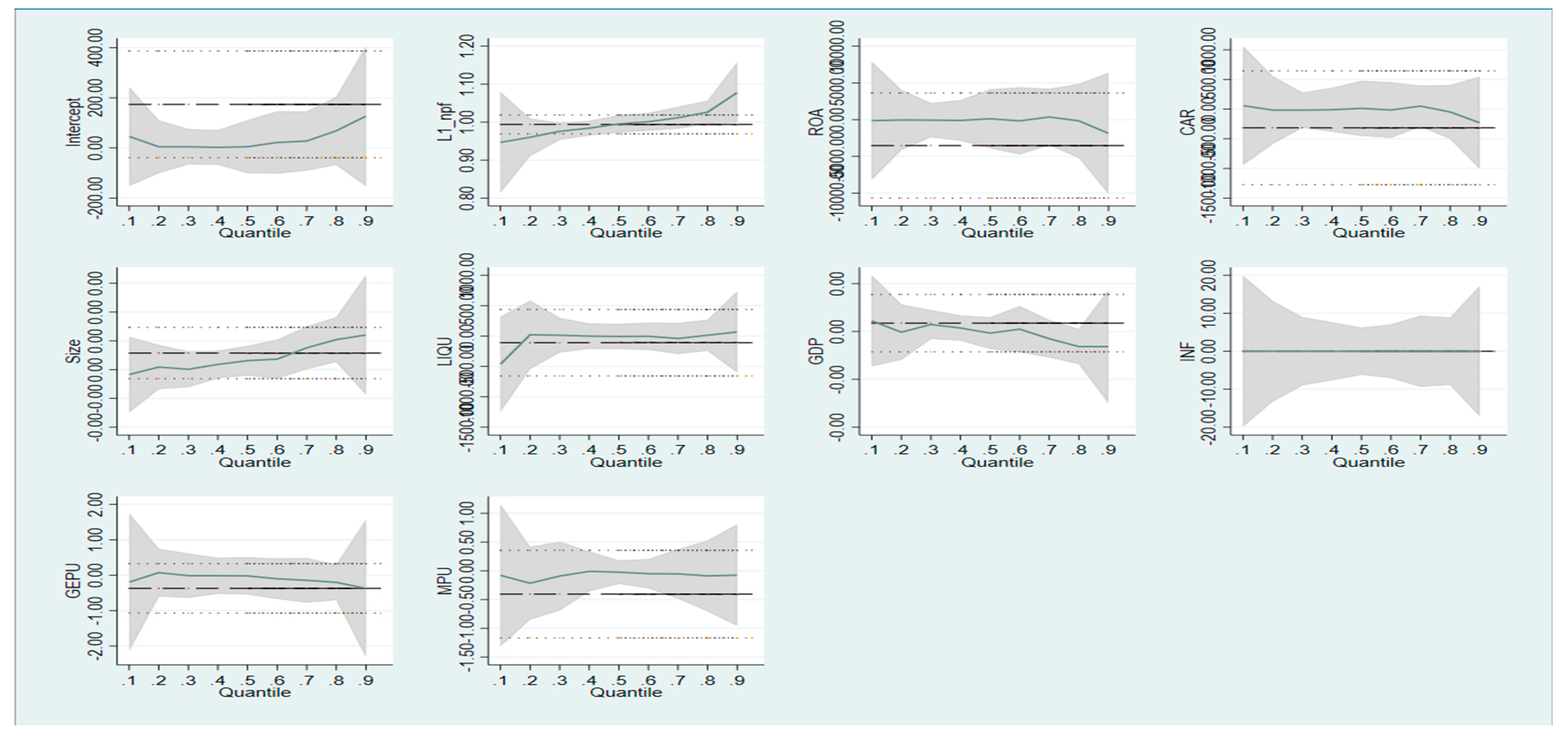
Figure 1 provides visual confirmation of the quantile regression results by illustrating how the estimated coefficients vary across the conditional distribution of NPF. The figure reveals clear heterogeneity in the effects of the explanatory variables, with SIZE showing a mild upward tendency toward higher quantiles, suggesting that the influence of bank scale becomes more pronounced under higher financing distress. In contrast, LIQU exhibits a progressively more negative pattern in the upper quantiles, reinforcing its stabilizing role particularly in high-risk regimes. GDP maintains a consistently negative effect across most quantiles, although its magnitude slightly weakens at the extreme upper tail, indicating that macroeconomic growth generally reduces NPF but may be less effective under severe distress. ROA and CAR display relatively nonlinear and fluctuating patterns, confirming that their effects are not uniform across the distribution. Meanwhile, INF remains largely flat and insignificant, while GEPU and MPU show modest but varying effects, with some upward movement in the middle-to-upper quantiles. Overall, the figure highlights substantial distributional asymmetry and reinforces the suitability of quantile regression, as mean-based estimates would obscure these regime-dependent relationships.
4. Discussion
The findings show that the determinants of non-performing financing do not operate uniformly across the NPF distribution. The variation in the ROA and liquidity coefficients is particularly relevant because it indicates that relationships observed under relatively low-risk conditions may weaken or change as financing impairment increases. Nevertheless, these estimates represent conditional statistical associations and should not be interpreted as evidence that the explanatory variables directly cause changes in NPF.
The positive association between ROA and NPF is strongest in the lower and middle quantiles and becomes insignificant in the upper quantiles. Similarly, capital adequacy is positively associated with NPF throughout the distribution, although its coefficient declines as NPF rises. These results do not necessarily imply that profitability and capital strength encourage risk taking. In GCC Islamic banking systems, higher profitability may coincide with earlier financing expansion, while stronger capital ratios may partly represent a regulatory response to recognized or anticipated asset quality deterioration. Delayed provisioning and the timing of impaired financing recognition may also cause profitability, capital, and NPF to move together. Because the analysis uses national banking system aggregates, it cannot distinguish among these competing explanations.
The positive and stable association between banking system size and NPF may reflect the institutional and spatial structure of GCC financial systems. Larger Islamic banking systems often have greater exposure to property development, construction, infrastructure, logistics, and government-related enterprises. These sectors are closely connected to sovereign development strategies, public investment programs, and hydrocarbon-financed expenditure. Greater size may therefore capture not only diversification and market development but also organizational complexity and concentration in large cyclical projects. The coefficient should consequently be interpreted as an aggregate scale association rather than evidence that expansion itself causes financing deterioration.
Liquidity is insignificant at the lower and middle quantiles but becomes positive and significant in the upper tail. This finding differs from the conventional view that liquidity necessarily protects asset quality. One possible explanation is that banking systems increase liquid asset holdings after financing conditions weaken or when opportunities for new financing decline. Elevated liquidity may therefore be a response to deteriorating asset quality rather than its cause. It may also coincide with periods of weaker financing demand, delayed infrastructure projects, property market adjustment, or more cautious bank behavior. These possible mechanisms are consistent with the institutional setting, but they cannot be established directly from the reported estimates.
The negative association between GDP and NPF is consistent with the importance of macroeconomic conditions for borrower repayment capacity. In GCC economies, hydrocarbon revenues, sovereign expenditure, and public infrastructure investment influence corporate cash flows, employment, project activity, and government-related payments. Stronger economic conditions may therefore reduce financing impairment, particularly in portfolios concentrated in construction, property, infrastructure, and related services. However, the weaker significance of GDP in the fixed-effects model suggests that part of the quantile relationship may reflect persistent differences in country size and economic scale rather than only changes within each country over time. The GDP result should therefore be interpreted as supportive but not conclusive evidence of a within-country macroeconomic effect.
Inflation is positively associated with NPF across the distribution, with a modestly larger coefficient in the upper quantiles. Higher prices may increase household expenses, firms’ operating costs, construction expenses, and the cost of completing long-term projects. These pressures can be particularly important in financing portfolios exposed to real estate, infrastructure, and government-linked activities. Nevertheless, the coefficient does not identify a direct causal channel and may also capture broader crisis period conditions or policy responses occurring alongside inflation.
The negative GEPU coefficient contradicts the hypothesis that greater global policy uncertainty increases NPF, while MPU remains statistically insignificant. The GEPU result may indicate that banks tighten financing standards, reduce exposure, or adopt more precautionary balance sheet policies during uncertain periods. Alternatively, it may reflect common macroeconomic developments, timing differences, measurement limitations, or omitted institutional factors. It should therefore be described as an inverse conditional association, not as evidence that uncertainty improves financing quality. The absence of a significant MPU effect likewise suggests that U.S. monetary policy uncertainty does not have an independently identifiable relationship with NPF after controlling for the other variables.
Overall, the findings are consistent with the view that NPF in GCC Islamic banking systems is shaped by the interaction of banking conditions, sovereign-led development, hydrocarbon-dependent economic cycles, property and infrastructure exposure, and regulatory responses. The results do not establish policy causality. Rather, they identify patterns that may help regulators and banking institutions determine where further monitoring is required, especially in higher NPF regimes. Future research using individual-bank, sectoral financing, provisioning, and crisis period data would be needed to distinguish more clearly between risk taking, regulatory adjustment, aggregation effects, and macroeconomic transmission mechanisms.
5. Conclusions
This study examined the determinants of non-performing financing (NPF) in GCC Islamic banks using a balanced panel and a dual empirical strategy that combines fixed-effects estimation with panel quantile regression. The quantile approach is particularly suitable in this setting because the data display non-normality, heterogeneity, and clear distributional asymmetry, while the estimated explanatory power increases notably toward the upper tail of the NPF distribution. Taken together, these features indicate that financing risk in GCC Islamic banks is regime-dependent and cannot be adequately understood through mean-based estimators alone.
The empirical findings yield three central conclusions. First, the results do not support the theoretical expectations underlying H1 and H2. Profitability, proxied by ROA, enters with a positive and statistically significant coefficient across all quantiles as well as in the OLS and fixed-effects models, while capital adequacy is also positive and significant across most quantiles and in OLS. Rather than indicating stronger resilience, these results suggest that higher profitability and stronger capitalization may coincide with more aggressive financing expansion, delayed recognition of asset quality deterioration, or prudential adjustment in response to already rising risk. Second, H3 is supported: GDP consistently exerts a negative and statistically significant effect across all quantiles and in OLS, confirming that stronger macroeconomic conditions improve borrower repayment capacity and mitigate financing impairment. Third, H4 is not supported. GEPU is negatively associated with NPF, contrary to the predicted positive relationship, while MPU is statistically insignificant. These results should be interpreted as conditional associations rather than evidence that uncertainty improves financing quality. The remaining covariates show clear state dependence. Liquidity becomes increasingly negative and significant in the middle and upper quantiles, indicating that liquidity buffers matter most under elevated distress, whereas inflation is not a robust determinant. The uncertainty variables also display selective effects, with GEPU becoming more relevant in the upper tail and MPU showing only limited significance.
Overall, the findings show that financing risk in GCC Islamic banks is not driven solely by traditional bank-level and macroeconomic determinants. Instead, NPF is shaped by nonlinear and regime-dependent interactions between internal bank behavior, liquidity conditions, economic growth, and external policy uncertainty. This highlights the need for risk management frameworks that account for distributional heterogeneity rather than relying only on average effects. Therefore, the main implication of this study is that Islamic bank risk assessment should not rely only on average relationships; instead, regulators and bank managers should use distribution-aware risk monitoring to identify vulnerabilities that emerge under high NPF conditions.
The policy implications should be interpreted cautiously because the estimates identify statistical associations rather than causal effects. Nevertheless, the distributional results suggest that GCC supervisory authorities could strengthen risk monitoring by distinguishing between Islamic banking systems operating at low, moderate, and high levels of non-performing financing. Supervisory attention should focus particularly on upper risk conditions, where several relationships become more pronounced.
First, regulators should complement conventional profitability and capital indicators with direct measures of asset quality, provisioning adequacy, financing concentration, and sectoral exposure. The positive associations of ROA, CAR, and banking system size with NPF indicate that strong financial ratios do not necessarily imply lower financing risk. Supervisors could therefore apply sectoral financing limits and enhanced exposure monitoring for real estate, construction, infrastructure, logistics, and government-related enterprises, especially where portfolios are highly concentrated.
Second, the positive liquidity association at the upper quantiles indicates that higher liquidity does not automatically reduce financing impairment. Supervisory assessments should therefore examine the composition, quality, and use of liquid assets rather than relying only on liquidity ratios. Countercyclical provisioning, forward-looking expected loss assessments, and stress tests linked to oil price declines, higher interest rates, weaker property prices, and delays in public infrastructure expenditure would provide more operational tools for identifying vulnerabilities.
Third, the negative association between GDP and NPF and the positive inflation effect support the inclusion of macroeconomic conditions in early warning frameworks. Coordination among central banks, fiscal authorities, development planning institutions, and financial supervisors would help assess how changes in hydrocarbon revenues, public expenditure, sovereign development programs, and financing conditions may affect borrower repayment capacity and Islamic banking system asset quality.
Finally, the negative GEPU coefficient should not be interpreted as evidence that uncertainty improves financing quality, and the insignificant MPU result does not establish that external monetary uncertainty is irrelevant. These indicators may still be included in scenario analysis and surveillance systems, but they should be treated as contextual risk signals rather than direct causal drivers of NPF. All policy recommendations should therefore remain conditional on the robustness of the corrected empirical results and should be supported by further bank-level and sectoral analysis.
6. Future Research Prospects
Several avenues remain open for future research. First, subsequent studies may extend the present framework by incorporating governance-related variables, including board structure, Sharīʿah supervisory board characteristics, ownership concentration, and risk governance quality. These institutional dimensions may help explain why profitability and capital adequacy fail to operate as protective factors in the current sample. Second, future research may disaggregate financing portfolios by contract type, such as murābaḥah, ijārah, mushārakah, and muḍārabah, in order to determine whether the drivers of NPF differ across Sharīʿah-compliant financing structures. Such an extension would deepen the Islamic banking contribution of this study beyond standard bank-level indicators.
Third, future work could adopt dynamic Islamic bank panel specifications, including dynamic panel estimators or dynamic quantile models, to capture persistence and adjustment mechanisms in non-performing financing. Given that asset quality deterioration often evolves gradually, a dynamic treatment may provide additional insight into whether current NPF is driven more strongly by lagged financing impairment, macroeconomic shocks, or internal bank characteristics. Fourth, comparative research between Islamic and conventional banks in the GCC would be especially valuable for identifying whether the asymmetric patterns documented here are specific to Islamic banking or reflect broader regional banking dynamics. Finally, broader samples spanning additional MENA jurisdictions or longer post-crisis periods could help assess the external validity of the present findings and clarify how regulatory differences, oil dependence, and external policy uncertainty shape financing risk across institutional settings.