
Does ESG Practices Influence Financial Companies’ Performance? The Moderating Role of AI Use


Abstract
1. Introduction
2. Theoretical Framework
3. Hypotheses Development
3.1. Financial Performance and ESG
3.2. The Moderating Effect of AI Use
4. Sample and Research Design
4.1. Sample
4.2. Measure of Variables
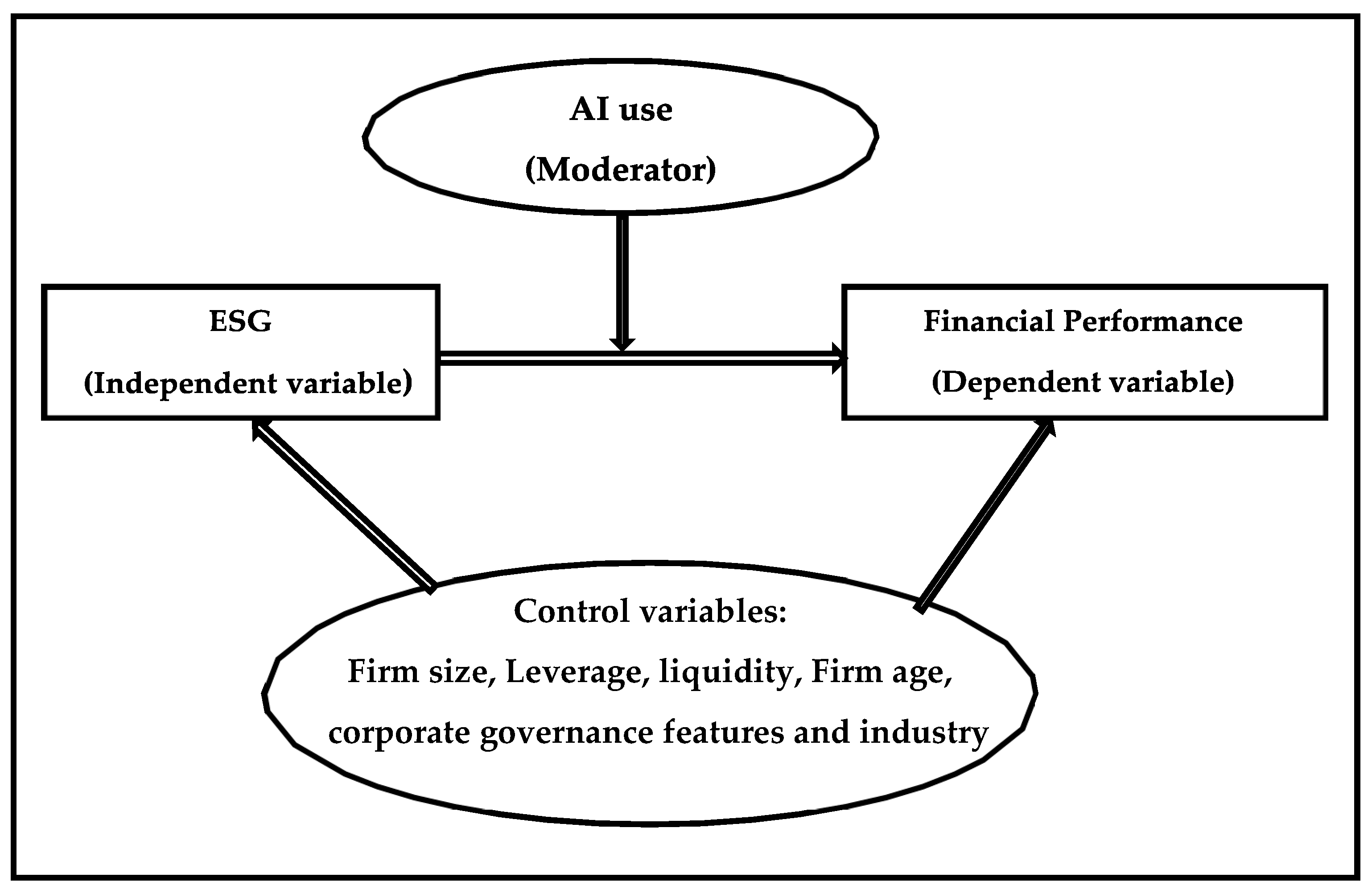
4.3. Research Model
- FP as measured by ROE: The direct effect of ESGROEit = β0 + β1 ESGit + β2 FSit + β3 LEVit + β4 LIQit + β5 BSit + β6 BIit + β7 FAGEit + B8 INDUSTRY + FIRM
and YEAR Fixed effect + εit ----------Model A
+ B10 INDUSTRY + FIRM and YEAR Fixed effect + εit -------Model B
- FP as measured by TQ: The direct effect of ESGTQit = β0 + β1 ESGit + β2 FSit + β3 LEVit + β4 LIQit + β5 BSit + β6 BIit + β7 FAGEit + B8 INDUSTRY + FIRM and
YEAR Fixed effect + εit ---------Model C
B10 INDUSTRY + FIRM and YEAR Fixed effect + εit -------Model D
5. Discussion
5.1. Descriptive Statistics
5.2. Correlation Matrix and Multicollinearity Diagnosis
5.3. Regression Results
5.3.1. Direct Effects of ESG on Financial Performance
5.3.2. Role of AI and the ESG–AI Interaction
5.3.3. Insights from Control Variables
5.4. Endogeneity Analysis: GMM Robustness Test
5.5. Robustness Test: Alternative AI Implementation Intensity Measure
6. Conclusions
Author Contributions
Funding
Institutional Review Board Statement
Informed Consent Statement
Data Availability Statement
Conflicts of Interest
References
- Ab Aziz, N. H., Alshdaifat, S. M., & Al Amosh, H. (2025). ESG controversies and firm performance in ASEAN: Do board gender diversity and sustainability committee matter? Business Strategy & Development, 8(1), e70094. [Google Scholar] [CrossRef]
- Abu Afifa, M., Nguyen, N. M., Vo, D. T. T., Van Bui, D., & Van, H. V. (2025). Environmental, social and governance practices: A new perspective from Asian developing countries. Corporate Social Responsibility and Environmental Management, 32(1), 1079–1095. [Google Scholar] [CrossRef]
- Acharya, A., & Arnold, Z. (2019). Chinese public AI R&D spending: Provisional findings (Vol. 12). Center for Security and Emerging Technology. [Google Scholar]
- Adams, R. B., & Ferreira, D. (2007). A theory of friendly boards. Journal of Finance, 62(1), 217–250. [Google Scholar] [CrossRef]
- Aladwey, L. (2026). Artificial intelligence and unethical financial practices: Examining the mediating role of environmental, social, and governance (ESG) performance in the Saudi financial sector. Borsa Istanbul Review, 26, 100784. [Google Scholar] [CrossRef]
- Aladwey, L., & Alsudays, R. (2023). Does the cultural dimension influence the relationship between firm value and board gender diversity in Saudi Arabia, mediated by ESG scoring? Journal of Risk and Financial Management, 16, 512. [Google Scholar] [CrossRef]
- Aladwey, L. M. (2026). Does board diversity influence green revenue and firm value? Evidence from an emerging market. Emerging Science Journal, 10(1), 503–520. [Google Scholar] [CrossRef]
- Alahdal, W. M., Hashim, H. A., Almaqtari, F. A., Salleh, Z., & Pandey, D. K. (2024). The moderating role of board gender diversity in ESG and firm performance: Empirical evidence from Gulf countries. Business Strategy & Development, 7(3), e70004. [Google Scholar] [CrossRef]
- Al Ayyash, S. (2024). The formation and evolution of entrepreneurial teams during incubation: A longitudinal exploratory study within a Saudi technology incubator [Doctoral dissertation, Dublin City University]. [Google Scholar]
- Al-Baity, H. H. (2023). The artificial intelligence revolution in digital finance in Saudi Arabia: A comprehensive review and proposed framework. Sustainability, 15(18), 13725. [Google Scholar] [CrossRef]
- Albitar, K., Al-Shaer, H., & Liu, Y. S. (2023). Corporate commitment to climate change: The effect of eco-innovation and climate governance. Research Policy, 52(2), 104697. [Google Scholar] [CrossRef]
- Alhassan, A., & Asutay, M. (2021). Artificial intelligence and digital transformation in Islamic finance: Opportunities and challenges. In M. M. Billah (Ed.), Islamic FinTech (pp. 171–190). Palgrave Macmillan. [Google Scholar]
- Alodat, A. Y., & Hao, Y. (2025). Environmental, social and governance (ESG) disclosure and firm performance: Moderating role of board gender diversity and sustainability committee. Sustainable Development, 33(1), 636–651. [Google Scholar]
- Alotaibi, K. O., & Hussainey, K. (2016). Determinants of CSR disclosure quantity and quality: Evidence from non-financial listed firms in Saudi Arabia. International Journal of Disclosure and Governance, 13(4), 364–393. [Google Scholar] [CrossRef]
- Alraddadi, A. S. (2023). Developing an abstraction framework for managing and controlling Saudi banks’ cybersecurity threats based on the NIST cybersecurity framework and ISO/IEC 27001. Journal of Software Engineering and Applications, 16(12), 695–713. [Google Scholar] [CrossRef]
- Al-Shammari, B. (2022). Corporate governance and ESG reporting in the Gulf: Progress and challenges. Journal of Governance and Regulation, 11(3), 45–59. [Google Scholar]
- Alshdaifat, S. M., Alharasis, E. E., Ab Aziz, N. H., Bataineh, I., & Al Amosh, H. (2025). Governance in crisis: Do different types of ownership influence firm performance in GCC countries amid COVID-19? Cogent Business & Management, 12(1), 2463576. [Google Scholar] [CrossRef]
- Andrieș, A. M., & Sprincean, N. (2023). ESG performance and banks’ funding costs. Finance Research Letters, 54, 103811. [Google Scholar] [CrossRef]
- Arellano, M., & Bover, O. (1995). Another look at the instrumental variable estimation of error-components models. Journal of Econometrics, 68(1), 29–51. [Google Scholar] [CrossRef]
- Atan, R., Alam, M. M., Said, J., & Zamri, M. (2018). The impacts of environmental, social, and governance factors on firm performance: Panel study of Malaysian companies. Management of Environmental Quality: An International Journal, 29(2), 182–194. [Google Scholar] [CrossRef]
- Azmi, W., Hassan, M. K., Houston, R., & Karim, M. S. (2021). ESG activities and banking performance: International evidence from emerging economies. Journal of International Financial Markets, Institutions and Money, 70, 101277. [Google Scholar] [CrossRef]
- Bag, S., Wood, L. C., Mangla, S. K., & Luthra, S. (2020). Procurement 4.0 and its implications on business process performance in a circular economy. Resources, Conservation and Recycling, 152, 104502. [Google Scholar] [CrossRef]
- Barney, J. (1991). Firm resources and sustained competitive advantage. Journal of Management, 17(1), 99–120. [Google Scholar] [CrossRef]
- Bătae, O. M., Dragomir, V. D., & Feleagă, L. (2020). Environmental, social, governance (ESG), and financial performance of European banks. Accounting and Management Information Systems, 19(3), 480–501. [Google Scholar] [CrossRef]
- Besiroglu, T., Emery-Xu, N., & Thompson, N. (2024). Economic impacts of AI-augmented R&D. Research Policy, 53(7), 105037. [Google Scholar] [CrossRef]
- Bissoondoyal-Bheenick, E., Brooks, R., & Do, H. X. (2023). ESG and firm performance: The role of size and media channels. Economic Modelling, 121, 106203. [Google Scholar] [CrossRef]
- Bolton, B. J. (2013). Corporate social responsibility and bank performance. Available online: https://ssrn.com/abstract=2277912 (accessed on 27 June 2026).
- Brenner, S. N., & Cochran, P. (1991). The stakeholder theory of the firm: Implications for business and society theory and research. Proceedings of the International Association for Business and Society, 2, 897–933. [Google Scholar] [CrossRef]
- Brooks, C., & Oikonomou, I. (2018). The effects of environmental, social and governance disclosures and performance on firm value: A review of the literature in accounting and finance. The British Accounting Review, 50(1), 1–15. [Google Scholar] [CrossRef]
- Capital Market Authority (CMA). (2019). Corporate governance regulations. CMA.
- Chatterjee, S., Rana, N. P., Tamilmani, K., & Sharma, A. (2021). The effect of AI-based CRM on organization performance and competitive advantage: An empirical analysis in the B2B context. Industrial Marketing Management, 97, 205–219. [Google Scholar] [CrossRef]
- Chen, D., Esperança, J. P., & Wang, S. (2022). The impact of artificial intelligence on firm performance: An application of the resource-based view to e-commerce firms. Frontiers in Psychology, 13, 884830. [Google Scholar] [CrossRef] [PubMed]
- Crisóstomo, V. L., de Souza Freire, F., & Cortes de Vasconcellos, F. (2011). Corporate social responsibility, firm value and financial performance in Brazil. Social Responsibility Journal, 7(2), 295–309. [Google Scholar] [CrossRef]
- Cui, H., Xiao, L., & Zhang, X. (2021). Application of mobile big data and artificial intelligence in the efficiency of e-commerce industry. Mobile Information Systems, 2021(1), 4825643. [Google Scholar] [CrossRef]
- Dalton, D. R., Daily, C. M., Ellstrand, A. E., & Johnson, J. L. (1998). Meta-analytic reviews of board composition, leadership structure, and financial performance. Strategic Management Journal, 19(3), 269–290. [Google Scholar] [CrossRef]
- Davis, F. D. (1989). Technology acceptance model: TAM. In M. N. Al-Suqri, & A. S. Al-Aufi (Eds.), Information seeking behavior and technology adoption (Vol. 5, pp. 205–219). IGI Global. [Google Scholar]
- Devinney, T. M. (2009). Is the socially responsible corporation a myth? The good, the bad, and the ugly of corporate social responsibility (pp. 44–56). Academy of Management. [Google Scholar]
- DiMaggio, P. J., & Powell, W. W. (1983). The iron cage revisited: Institutional isomorphism and collective rationality in organizational fields. American Sociological Review, 48(2), 147–160. [Google Scholar] [CrossRef]
- Di Tommaso, C., & Thornton, J. (2020). Do ESG scores affect bank risk taking and value? Evidence from European banks. Corporate Social Responsibility and Environmental Management, 27(5), 2286–2298. [Google Scholar] [CrossRef]
- Domini, B., Dewi, A. S., & Cesna, G. P. (2023). Assessing the effects of artificial intelligence on startup performance: An analysis of transformational initiatives. IAIC Transactions on Sustainable Digital Innovation (ITSDI), 5(1), 24–38. [Google Scholar] [CrossRef]
- Dormann, C. F., Elith, J., Bacher, S., Buchmann, C., Carl, G., Carré, G., Marquéz, J. R. G., Gruber, B., Lafourcade, B., Leitão, P. J., Münkemüller, T., McClean, C., Osborne, P. E., Reineking, B., Schröder, B., Skidmore, A. K., Zurell, D., & Lautenbach, S. (2013). Collinearity: A review of methods to deal with it and a simulation study evaluating their performance. Ecography, 36(1), 27–46. [Google Scholar] [CrossRef]
- Ebnaoof, A. (2026). The role of artificial intelligence in shaping ESG disclosure: Evidence from listed companies in Saudi Arabia. Frontiers in Sustainability, 7, 1797708. [Google Scholar] [CrossRef]
- Eccles, R. G., Ioannou, I., & Serafeim, G. (2014). The impact of corporate sustainability on organizational processes and performance. Management Science, 60(11), 2835–2857. [Google Scholar] [CrossRef]
- Eisenhardt, K. M., & Martin, J. A. (2000). Dynamic capabilities: What are they? Strategic Management Journal, 21(10–11), 1105–1121. [Google Scholar] [CrossRef]
- Elgharbawy, A., & Aladwey, L. M. A. (2025). ESG performance, board diversity and tax avoidance: Empirical evidence from the UK. Journal of Financial Reporting and Accounting. ahead-of-print. [Google Scholar] [CrossRef]
- Ersoy, E., Swiecka, B., Grima, S., Özen, E., & Romanova, I. (2022). The impact of ESG scores on bank market value: Evidence from the US banking industry. Sustainability, 14(15), 9527. [Google Scholar] [CrossRef]
- Eskandarany, A. (2024a). Adoption of artificial intelligence and machine learning in banking systems: A qualitative survey of board of directors. Frontiers in Artificial Intelligence, 7, 1440051. [Google Scholar] [CrossRef]
- Eskandarany, A. (2024b). Emerging trends of fintech services in Industry 5.0 and its role in achievement of SDGs: A critical review of present trends and roadmap for future research agenda. In Business development via AI and digitalization: Volume 2 (pp. 297–306). Springer. [Google Scholar]
- Eugster, N., Kowalewski, O., & Śpiewanowski, P. (2024). Internal governance mechanisms and corporate misconduct. International Review of Financial Analysis, 92, 103109. [Google Scholar] [CrossRef]
- Fama, E. F., & Jensen, M. C. (1983). Separation of ownership and control. The journal of law and Economics, 26(2), 301–325. [Google Scholar] [CrossRef]
- Fischer, T. M., & Sawczyn, A. A. (2013). The relationship between corporate social performance and corporate financial performance and the role of innovation: Evidence from German listed firms. Journal of Management Control, 24(1), 27–52. [Google Scholar] [CrossRef]
- Freeman, R. E. (1999). Divergent stakeholder theory. Academy of Management Review, 24(2), 233–236. [Google Scholar] [CrossRef]
- Friede, G., Busch, T., & Bassen, A. (2015). ESG and financial performance: Aggregated evidence from more than 2000 empirical studies. Journal of Sustainable Finance & Investment, 5(4), 210–233. [Google Scholar] [CrossRef]
- Friedman, A. L., & Miles, S. (2002). Developing stakeholder theory. Journal of Management Studies, 39(1), 1–21. [Google Scholar] [CrossRef]
- Fu, T., & Li, J. (2023). An empirical analysis of the impact of ESG on financial performance: The moderating role of digital transformation. Frontiers in Environmental Science, 11, 1256052. [Google Scholar] [CrossRef]
- García-Amate, A., Ramírez-Orellana, A., Rojo-Ramírez, A. A., & Casado-Belmonte, M. P. (2023). Do ESG controversies moderate the relationship between CSR and corporate financial performance in oil and gas firms? Humanities and Social Sciences Communications, 10(1), 749. [Google Scholar] [CrossRef]
- García-Meca, E., García-Sánchez, I. M., & Martínez-Ferrero, J. (2015). Board diversity and its effects on bank performance: An international analysis. Journal of Banking & Finance, 53, 202–214. [Google Scholar] [CrossRef]
- Gholami, A., Sands, J., & Rahman, H. U. (2022). Environmental, social and governance disclosure and value generation: Is the financial industry different? Sustainability, 14(5), 2647. [Google Scholar] [CrossRef]
- Global Innovation Index. (2023). Available online: https://www.wipo.int/en/web/global-innovation-index/2023/index (accessed on 25 June 2026).
- Gunawan, E. (2023). Liquidity ratio analysis in financing short term liabilities. International Journal of Health, Economics, and Social Sciences (IJHESS), 5(2), 157–162. [Google Scholar] [CrossRef]
- Hair, J. F., Black, W. C., Babin, B. J., & Anderson, R. E. (2019). Multivariate data analysis (8th ed.). Cengage Learning. [Google Scholar]
- Halid, S., Rahman, R. A., Mahmud, R., Mansor, N., & Wahab, R. A. (2023). A literature review on ESG score and its impact on firm performance. International Journal of Academic Research in Accounting Finance and Management Sciences, 13(1), 272–282. [Google Scholar] [CrossRef]
- Hamdouni, A. (2025). The role of artificial intelligence in enhancing ESG outcomes: Insights from Saudi Arabia. Journal of Risk and Financial Management, 18(10), 572. [Google Scholar] [CrossRef]
- Hayes, A. F. (2018). Introduction to mediation, moderation, and conditional process analysis: A regression-based approach (2nd ed.). The Guilford Press. [Google Scholar]
- Hayes, A. F., & Rockwood, N. J. (2017). Regression-based statistical mediation and moderation analysis in clinical research: Observations, recommendations, and implementation. Behaviour Research and Therapy, 98, 39–57. [Google Scholar] [CrossRef] [PubMed]
- Hussain, M. A., Alsayegh, M. F., & Boshnak, H. A. (2024). The impact of environmental, social, and governance disclo-sure on the performance of Saudi Arabian companies: Evidence from the top 100 non-financial companies listed on Tadawul. Sustainability, 16(17), 7660. [Google Scholar] [CrossRef]
- Huynh, T. L. D., Hille, E., & Nasir, M. A. (2020). Diversification in the age of the 4th industrial revolution: The role of artificial intelligence, green bonds and cryptocurrencies. Technological Forecasting and Social Change, 159, 120188. [Google Scholar] [CrossRef]
- Ioannou, I., & Serafeim, G. (2019). Corporate sustainability: A strategy? (Working Paper No. 19-065). Harvard Business School. [Google Scholar]
- Khan, M. A. (2022). ESG disclosure and firm performance: A bibliometric and meta-analysis. Research in International Business and Finance, 61, 101668. [Google Scholar] [CrossRef]
- Khan, P. A., & Johl, S. K. (2019). Nexus of comprehensive green innovation, environmental management system-14001-2015 and firm performance. Cogent Business & Management, 6(1), 1691833. [Google Scholar] [CrossRef]
- Kokina, J., & Davenport, T. H. (2017). The emergence of artificial intelligence: How automation is changing auditing. Journal of Emerging Technologies in Accounting, 14(1), 115–122. [Google Scholar] [CrossRef]
- Kotsantonis, S., & Pinney, C. (2022). ESG and corporate regulation: Global trends and challenges. Journal of Applied Corporate Finance, 34(2), 20–33. [Google Scholar]
- Li, H., Zhang, X., & Zhao, Y. (2022). ESG and firm’s default risk. Finance Research Letters, 47, 102713. [Google Scholar] [CrossRef]
- Li, Y., Sun, H., Li, D., Song, J., & Ding, R. (2022). Effects of digital technology adoption on sustainability performance in construction projects: The mediating role of stakeholder collaboration. Journal of Management in Engineering, 38(3), 04022016. [Google Scholar] [CrossRef]
- Lins, K. V., Servaes, H., & Tamayo, A. (2017). Social capital, trust, and firm performance: The value of corporate social responsibility during the financial crisis. The Journal of Finance, 72(4), 1785–1824. [Google Scholar] [CrossRef]
- Liu, L., Xu, H., Dao, M., & Sun, H. (2023). Pilot CEOs and tax avoidance: Evidence from machine learning methods. Asia-Pacific Journal of Accounting & Economics, 30(1), 14–29. [Google Scholar]
- McKinsey Global Institute. (2024). Available online: https://www.mckinsey.com/industries/financial-services/our-insights/capturing-the-full-value-of-generative-ai-in-banking (accessed on 25 June 2026).
- McWilliams, A., & Siegel, D. (2000). Corporate social responsibility and financial performance: Correlation or misspecification? Strategic Management Journal, 21(5), 603–609. [Google Scholar] [CrossRef]
- Mervelskemper, L., & Streit, D. (2017). Enhancing market valuation of ESG performance: Is integrated reporting keeping its promise? Business Strategy and the Environment, 26(4), 536–549. [Google Scholar]
- Mikalef, P., & Gupta, M. (2021). Artificial intelligence capability: Conceptualization, measurement calibration, and empirical study on its impact on organizational creativity and firm performance. Information & Management, 58(3), 103434. [Google Scholar] [CrossRef]
- Miralles-Quirós, M. M., Miralles-Quirós, J. L., & Redondo Hernández, J. (2019). ESG performance and shareholder value creation in the banking industry: International differences. Sustainability, 11(5), 1404. [Google Scholar] [CrossRef]
- Narwane, V. S., & Priyadarshinee, P. (2025). Examining the effect of AI-BDA on manufacturing firm performance: An Indian approach. International Journal of Information Management Data Insights, 5(1), 100306. [Google Scholar] [CrossRef]
- Nollet, J., Filis, G., & Mitrokostas, E. (2016). Corporate social responsibility and financial performance: A non-linear and disaggregated approach. Economic Modelling, 52, 400–407. [Google Scholar] [CrossRef]
- Oduro, S., De Nisco, A., & Mainolfi, G. (2023). Do digital technologies pay off? A meta-analytic review of the digital technologies/firm performance nexus. Technovation, 128, 102836. [Google Scholar] [CrossRef]
- Peteraf, M. A. (1993). The cornerstones of competitive advantage: A resource-based view. Strategic Management Journal, 14(3), 179–191. [Google Scholar] [CrossRef]
- Petruzzelli, A. M., Ardito, L., & Savino, T. (2018). Maturity of knowledge inputs and innovation value: The moderating effect of firm age and size. Journal of Business Research, 86, 190–201. [Google Scholar] [CrossRef]
- Rana, N. P., Chatterjee, S., Dwivedi, Y. K., & Akter, S. (2022). Understanding dark side of artificial intelligence (AI) integrated business analytics: Assessing firm’s operational inefficiency and competitiveness. European Journal of Information Systems, 31(3), 364–387. [Google Scholar] [CrossRef]
- Riyadh AI Declaration. (2024). Available online: https://www.mcit.gov.sa/en/news/saudi-arabia-announces-riyadh-declaration-inclusive-innovative-and-impactful-ai-all (accessed on 27 June 2026).
- Rosa, M. B., & Kubota, L. C. (2025). Artificial intelligence: Where does Brazil stand in global scientific production and what are the main technical determinants of adoption by Brazilian companies. EconomiA, 26(3), 358–374. [Google Scholar] [CrossRef]
- Salvi, A., Vitolla, F., Giakoumelou, A., Raimo, N., & Rubino, M. (2020). Intellectual capital disclosure in integrated reports: The effect on firm value. Technological Forecasting and Social Change, 160, 120228. [Google Scholar] [CrossRef]
- Sathyanarayana, S., & Mohanasundaram, T. (2025). Moderation analysis in business research: Concepts, methodologies, applications and emerging trends. Asian Journal of Economics, Business and Accounting, 25(3), 357–378. [Google Scholar] [CrossRef]
- Saudi Data and Artificial Intelligence Authority (SDAIA). (2020). National strategy for data and artificial intelligence (NSDAI). SDAIA.
- Saudi Exchange (Tadawul). (2021). ESG disclosure guidelines for issuers. Tadawul. [Google Scholar]
- Schober, P., Christa, B., & Schwarte, L. A. (2018). Correlation coefficients: Appropriate use and interpretation. Anesthesia and Analgesia, 126(5), 1763–1768. [Google Scholar] [CrossRef] [PubMed]
- Scott, W. R. (2014). Institutions and organizations: Ideas, interests, and identities (4th ed.). Sage Publications. [Google Scholar]
- Shafique, I., Khan, T., Rana, S., & Ferraris, A. (2026). The role of AI-powered big data analytics in enhancing firm ESG performance: Mediating and moderating effects. Behaviour & Information Technology, 1–13. [Google Scholar] [CrossRef]
- Shakil, M. H., Mahmood, N., Tasnia, M., & Munim, Z. H. (2019). Do environmental, social and governance performance affect the financial performance of banks? A cross-country study of emerging market banks. Management of Environmental Quality: An International Journal, 30(6), 1331–1344. [Google Scholar] [CrossRef]
- Shen, Y. (2023). ESG and firm performance: A literature review. BCP Business & Management, 46, 283–288. [Google Scholar] [CrossRef]
- Shieh, G. (2009). Detection of interactions between a dichotomous moderator and a continuous predictor in moderated multiple regression with heterogeneous error variance. Behavior Research Methods, 41(1), 61–74. [Google Scholar] [CrossRef] [PubMed]
- Singh, A. K., Kumar, V. P., Shoaib, M., Adebayo, T. S., & Irfan, M. (2023). A strategic roadmap to overcome blockchain technology barriers for sustainable construction: A deep learning-based dual-stage SEM-ANN approach. Technological Forecasting and Social Change, 194, 122716. [Google Scholar] [CrossRef]
- Siueia, T. T., Wang, J., & Deladem, T. G. (2019). Corporate social responsibility and financial performance: A comparative study in the Sub-Saharan Africa banking sector. Journal of Cleaner Production, 226, 658–668. [Google Scholar] [CrossRef]
- Soana, M.-G. (2011). The relationship between corporate social performance and corporate financial performance in the banking sector. Journal of Business Ethics, 104, 133–148. [Google Scholar] [CrossRef]
- Song, D., Deng, Z., & Wang, B. (2025). Are companies better off with AI? The effect of AI service failure events on firm value. Industrial Management & Data Systems, 125(2), 504–534. [Google Scholar]
- Tang, Q., Chen, H., & Lin, Z. (2016). How to measure country-level financial reporting quality? Journal of Financial Reporting and Accounting, 14(2), 230–265. [Google Scholar] [CrossRef]
- Teece, D. J., Pisano, G., & Shuen, A. (1997). Dynamic capabilities and strategic management. Strategic Management Journal, 18(7), 509–533. [Google Scholar] [CrossRef]
- Varsha, P., Akter, S., Kumar, A., Gochhait, S., & Patagundi, B. (2021). The impact of artificial intelligence on branding: A bibliometric analysis (1982–2019). Journal of Global Information Management (JGIM), 29(4), 221–246. [Google Scholar] [CrossRef]
- Venkatesh, V., & Davis, F. D. (2000). A theoretical extension of the technology acceptance model: Four longitudinal field studies. Management Science, 46(2), 186–204. [Google Scholar] [CrossRef]
- Vinuesa, R., Azizpour, H., Leite, I., Balaam, M., Dignum, V., Domisch, S., Felländer, A., Langhans, S. D., Tegmark, M., & Fuso Nerini, F. (2020). The role of artificial intelligence in achieving the sustainable development goals. Nature Communications, 11(1), 233. [Google Scholar] [CrossRef] [PubMed]
- Vision 2030. (2021). A sustainable Saudi vision. Kingdom of Saudi Arabia. Available online: https://vision2030.gov.sa (accessed on 27 June 2026).
- Vitolla, F., Raimo, N., Rubino, M., & Garzoni, A. (2019). The impact of national culture on integrated reporting quality. A stakeholder theory approach. Business Strategy and the Environment, 28(8), 1558–1571. [Google Scholar] [CrossRef]
- Wamba-Taguimdje, S.-L., Wamba, S. F., Kamdjoug, J. R. K., & Wanko, C. E. T. (2020). Influence of artificial intelligence (AI) on firm performance: The business value of AI-based transformation projects. Business Process Management Journal, 26(7), 1893–1924. [Google Scholar] [CrossRef]
- Wernerfelt, B. (1984). A resource-based view of the firm. Strategic Management Journal, 5(2), 171–180. [Google Scholar] [CrossRef]
- Wintoki, M. B., Linck, J. S., & Netter, J. M. (2012). Endogeneity and the dynamics of internal corporate governance. Journal of Financial Economics, 105(3), 581–606. [Google Scholar] [CrossRef]
- World Bank. (2024). Available online: https://www.worldbank.org/ext/en/topic/digital-and-ai (accessed on 25 June 2026).
- Wu, M.-W., & Shen, C.-H. (2013). Corporate social responsibility in the banking industry: Motives and financial performance. Journal of Banking & Finance, 37(9), 3529–3547. [Google Scholar] [CrossRef]
- Yamashita, I., Murakami, A., Cairns, S., & Galindo-Rueda, F. (2021). Measuring the AI content of government-funded R&D projects: A proof of concept for the OECD Fundstat initiative (pp. 1–106). OECD Science, Technology and Industry Working Papers No. 2021/09. OECD Publishing. [Google Scholar]
- Zaman, R., Jain, T., Samara, G., & Jamali, D. (2022). Corporate governance meets corporate social responsibility: Mapping the interface. Business & Society, 61(3), 690–752. [Google Scholar]
- Zhang, C., & Yang, J. (2024). Artificial intelligence and corporate ESG performance. International Review of Economics & Finance, 96, 103713. [Google Scholar] [CrossRef]


| Description | No. of Companies | No. of Obs. |
|---|---|---|
| The whole dataset | 62 | 248 |
| minus, missing or incomplete observations | (6) | (24) |
| The sample dataset | 56 | 224 |
| Variable | Measures | Sources |
|---|---|---|
| Dependent variable; Firm performance (FP) | It is measured by two measures. First, ROE evaluates a firm’s efficiency in using shareholders’ equity to generate profit, calculated as net income divided by total equity. Second, Tobin’s Q (TQ), a market-based performance indicator, is the ratio of the market value of equity plus total liabilities to total assets. | Alahdal et al. (2024); Ab Aziz et al. (2025); García-Amate et al. (2023); Alshdaifat et al. (2025) |
| Independent variable; (ESG) | It is a proxy of companies’ sustainable performance. | The Refinitiv Eikon database. |
| Moderating variable; (AI intensity) | It is measured using an index that captures variation in the scope of AI implementation across firms. | Rosa and Kubota (2025) |
| Control variables | ||
| Firm size (SIZE) | It is measured as the natural logarithm of total assets at yead end. | Elgharbawy and Aladwey (2025) |
| Leverage (LEV) | It is the ratio of total liabilities to total assets—captures financial risk. | Wintoki et al. (2012); L. Aladwey and Alsudays (2023) |
| Liquidity (LIQ) | It is calculated as current assets divided by current liabilities, indicating short-term financial health. | Gunawan (2023) |
| Firm age (FAGE) | It is representing the natural logarithm of number of years since incorporation, is used to capture organizational maturity. | Petruzzelli et al. (2018). |
| Board size (BS) | It is representing the natural logarithm of total number of directors. | L. Aladwey and Alsudays (2023) |
| Board independence (BI) | It is calculated as the proportion of independent directors. | L. Aladwey and Alsudays (2023) |
| Industry effect (INDUSTRY) | It is utilized by including dummies for each financial sector-REITs; diversified financials; insurance and banks. | Abu Afifa et al. (2025) |
| Firm size (SIZE) | It is measured as the natural logarithm of total assets at yead end. | Elgharbawy and Aladwey (2025) |
| Panel A: Descriptive Analysis for Utilized Variables | ||||||
| Variable | Obs | Mean | Std. Dev. | Min | Max | |
| ROE | 224 | 0.079 | 0.363 | −0.934 | 2.002 | |
| TQ | 224 | 0.207 | 0.306 | 0 | 0.85 | |
| ESG | 224 | 12.691 | 20.301 | 0 | 72.95 | |
| FS | 224 | 19.935 | 2.284 | 12.89 | 23.412 | |
| LEV | 224 | 5.595 | 17.311 | 0.212 | 114.642 | |
| LIQ | 224 | 2.908 | 2.433 | 0.011 | 9.875 | |
| FAGE | 224 | 1.219 | 0.343 | 0.477 | 1.839 | |
| BS | 224 | 1.99 | 0.355 | 1.099 | 2.639 | |
| BI | 224 | 3.065 | 1.341 | 0 | 7 | |
| Panel B: The number of AI’s observation per industry | ||||||
| AI | REITs | Diversified Financials | Insurance | Banks | Total | |
| 0 | 30 | 16 | 36 | 68 | 150 | |
| 1 | 14 | 8 | 16 | 36 | 74 | |
| total | 44 | 24 | 52 | 104 | 224 | |
| Variables | Panel A: Pairwise Correlation | Panel B: VIF Diagnosis | |||||||||
|---|---|---|---|---|---|---|---|---|---|---|---|
| (1) | (2) | (3) | (4) | (5) | (6) | (7) | (8) | (9) | VIF | 1/VIF | |
| (1) ROE | 1.000 | 1.12 | 0.893 | ||||||||
| (2)TQ | 0.055 | 1.000 | 1.86 | 0.536 | |||||||
| (0.417) | |||||||||||
| (3) ESG | 0.183 | 0.585 | 1.000 | 1.45 | 0.680 | ||||||
| (0.006) | (0.000) | ||||||||||
| (4) FS | −0.044 | −0.262 | 0.001 | 1.000 | 1.30 | 0.767 | |||||
| (0.516) | (0.000) | (0.991) | |||||||||
| (5) LEV | −0.003 | −0.151 | −0.150 | −0.313 | 1.000 | 1.26 | 0.794 | ||||
| (0.967) | (0.024) | (0.025) | (0.000) | ||||||||
| (6) LIQ | 0.032 | −0.474 | −0.177 | 0.233 | 0.217 | 1.000 | 1.29 | 0.778 | |||
| (0.629) | (0.000) | (0.008) | (0.000) | (0.001) | |||||||
| (7) FAGE | 0.063 | 0.380 | 0.453 | −0.137 | −0.070 | −0.128 | 1.000 | 1.53 | |||
| (0.350) | (0.000) | (0.000) | (0.040) | (0.297) | (0.056) | ||||||
| (8) BS | 0.126 | 0.485 | 0.488 | −0.146 | −0.092 | −0.065 | 0.234 | 1.000 | 2.21 | 0.452 | |
| (0.060) | (0.000) | (0.000) | (0.029) | (0.169) | (0.332) | (0.100) | |||||
| (9) BI | −0.156 | 0.077 | 0.246 | 0.009 | −0.020 | 0.185 | 0.561 | 0.285 | 1.000 | 1.59 | 0.630 |
| (0.019) | (0.252) | (0.000) | (0.895) | (0.766) | (0.005) | (0.000) | (0.015) | ||||
| Variables | Panel A: Direct Effect | Panel B: Moderation Effect | ||
|---|---|---|---|---|
| Model A: ROE Coefficient/Sig. | Model B: TQ Coefficient/Sig | Model C: ROE Coefficient/Sig. | Model D: TQ Coefficient/Sig | |
| ESG | 0.005 *** | 0.004 ** | 0.007 *** | 0.001 |
| FS | −0.008 | −0.006 | −0.007 | 0.008 * |
| LEV | 0.030 | 0.000 | 0.000 | −0.002 *** |
| LIQ | 0.015 | 0.015 | 0.016 | −0.001 |
| FAGE | 0.024 | −0.031 | 0.058 | 0.002 |
| BS | 0.315 *** | 0.306 *** | 0.312 *** | 0.036 |
| BI | −0.122 *** | −0.103 *** | −0.102 *** | 0.001 |
| INDUSTRY | 0.331 * | 0.130 * | 0.137 * | −0.588 *** |
| AI Intensity | 0.301 | 0.041 | ||
| AI Intensity × ESG | −0.014 * | −0.021 | ||
| Constant | −0.369 * | −0.242 * | 0.368 * | 0.496 *** |
| Overall R-squared | 0.146 | 0.152 | 0.156 | 0.202 |
| Number of Obs. | 224 | 224 | 224 | 224 |
| Hausman Test | 0.8783 | 0.7420 | ||
| Panel A. GMM Model results | ||||
| Variable | Model E: L.ROE | Model F: L.TQ | ||
| Coef | p-value | Coef | p-value | |
| L.ROE/L.TQ | 0.964 | 0.000 | 0.080 | 0.01 |
| ESG | 0.109 | 0.090 | 0.091 | 0.024 |
| FS | −0.006 | 0.796 | −0.002 | 0.032 |
| LEV | 0.050 | 0.912 | 0.001 | 0.001 |
| LIQ | 0.020 | 0.174 | −0.032 | −0.032 |
| FAGE | 0.605 | 0.059 | 0.013 | 0.013 |
| BS | 0.216 | 0.000 | 0.233 | 0.03 |
| BI | −0.132 | 0.000 | −0.546 | 0.03 |
| AI | 0.343 | 0.06 | −0.254 | 0.000 |
| ESG × AI | −0.011 | 0.048 | −0.382 | 0.021 |
| Panel B. GMM Model Diagnostics | ||||
| Diagnostic Test | Statistic | p-Value | Statistic | p-Value |
| Arellano-Bond AR(1) | z = −0.89 | 0.373 | z = −0.92 | 0.113 |
| Arellano-Bond AR(2) | z = −0.24 | 0.810 | z = −0.24 | 0.310 |
| Sargan Test | χ2(16) = 23.41 | 0.103 | χ2(16) = 11.41 | 0.110 |
| Hansen J Test (Robust) | χ2(16) = 51.44 | 0.200 | χ2(16) = 31.44 | 0.110 |
| Variables | Model G: ROE Coefficient/Sig. | Model H: TQ Coefficient/Sig |
|---|---|---|
| ESG | 0.007 *** | 0.002 |
| FS | −0.007 | 0.011 ** |
| LEV | 0.000 | −0.002 *** |
| LIQ | 0.016 | 0.001 |
| FAGE | 0.058 | −0.032 |
| BS | 0.312 *** | 0.013 |
| BI | −0.102 *** | 0.000 |
| INDUSTRY | 0.137 * | −0.454 *** |
| Constant | 0.368 * | 0.582 *** |
| Overall R-squared | 0.156 | 0.315 |
| Number of Obs. | 224 | 224 |
| AI | 0.037 | 0.008 |
| AI×ESG | −0.005 * | −0.030 |
Disclaimer/Publisher’s Note: The statements, opinions and data contained in all publications are solely those of the individual author(s) and contributor(s) and not of MDPI and/or the editor(s). MDPI and/or the editor(s) disclaim responsibility for any injury to people or property resulting from any ideas, methods, instructions or products referred to in the content. |
© 2026 by the authors. Licensee MDPI, Basel, Switzerland. This article is an open access article distributed under the terms and conditions of the Creative Commons Attribution (CC BY) license.
Share and Cite
Zehri, F.; Alsudays, R.; Aladwey, L. Does ESG Practices Influence Financial Companies’ Performance? The Moderating Role of AI Use. J. Risk Financial Manag. 2026, 19, 535. https://doi.org/10.3390/jrfm19070535
Zehri F, Alsudays R, Aladwey L. Does ESG Practices Influence Financial Companies’ Performance? The Moderating Role of AI Use. Journal of Risk and Financial Management. 2026; 19(7):535. https://doi.org/10.3390/jrfm19070535
Chicago/Turabian StyleZehri, Fatma, Raghad Alsudays, and Laila Aladwey. 2026. "Does ESG Practices Influence Financial Companies’ Performance? The Moderating Role of AI Use" Journal of Risk and Financial Management 19, no. 7: 535. https://doi.org/10.3390/jrfm19070535
APA StyleZehri, F., Alsudays, R., & Aladwey, L. (2026). Does ESG Practices Influence Financial Companies’ Performance? The Moderating Role of AI Use. Journal of Risk and Financial Management, 19(7), 535. https://doi.org/10.3390/jrfm19070535