1. Introduction
Whether the intangible assets that banks recognize on their balance sheets carry information about future economic performance is a question of enduring interest to accounting and finance scholars alike. It connects directly to one of the most durable puzzles in the productivity literature: whether large investments in information technology actually translate into measurable performance gains.
Brynjolfsson’s (
1993) original framing of the paradox, that the computer age was visible everywhere except in the productivity statistics, has been revisited, setting after setting, and the banking industry has not escaped similar uncomfortable findings. In Indonesia, the question carries unusual practical weight. Over the past decade, listed commercial banks have committed substantial resources to digital transformation:
Bank Indonesia (
2025) introduced the Indonesia Payment System Blueprint (BSPI) 2025 to expand real-time payments and open application programming interfaces; the Financial Services Authority (OJK) issued OJK Regulation 12/2021, which restructured the industry into four bank tiers based on core capital (KBMI) and elevated digital strategy to a component of capital planning; and a new generation of digital banks such as Jago, Allo, and Sea Bank has begun pulling market share away from incumbents (
Buchak et al., 2018;
Cevik, 2024). Larger and mid-tier banks have responded with sizable outlays on core banking platforms and analytics, most of which appear on the balance sheet as recognized intangible assets. The question is whether these reported investments are informative about performance.
The available evidence pulls in different directions.
Beccalli (
2007), drawing on a panel of 737 European banks, found only a weak link between total IT investment and profitability, suggesting that the productivity paradox extends into financial intermediation. Emerging-market evidence is similarly unsettled.
Zelalem and Abebe (
2022) report a positive effect of intangible assets on return on assets for Ethiopian banks, while
Boadi et al. (
2022) in Ghana and
Yuan et al. (
2022) on South Asian banks document considerably more heterogeneous patterns. Recent work in management control and accounting information systems pushes the same point from a different angle: returns to digital investment appear to be conditional rather than automatic (
Faehndrich, 2023;
Knudsen, 2020;
Quattrone, 2016). The more useful question, then, is not whether banks should invest, but under what conditions the recognized investment becomes informative about observable performance.
Two streams of the literature have approached this question without quite resolving it. The systematic review by
Faehndrich (
2023) maps how digitalization reshapes management control practices, activities, and competencies, but the synthesis is review-based, draws disproportionately on European and North American settings, and stops short of testing the conditional mechanisms it identifies empirically (
Bhimani, 2020;
Möller et al., 2020). The banking digitalization literature, in turn, tends to specify digital investment as a direct predictor of bank performance (
Berger, 2003;
Casolaro & Gobbi, 2007;
Khan et al., 2023), giving limited attention to the maturity of the macro digital infrastructure within which banks actually operate. To our knowledge, no prior archival study has tested the interaction between bank-level intangible investment and macro-level digital conditions in an emerging Southeast Asian market.
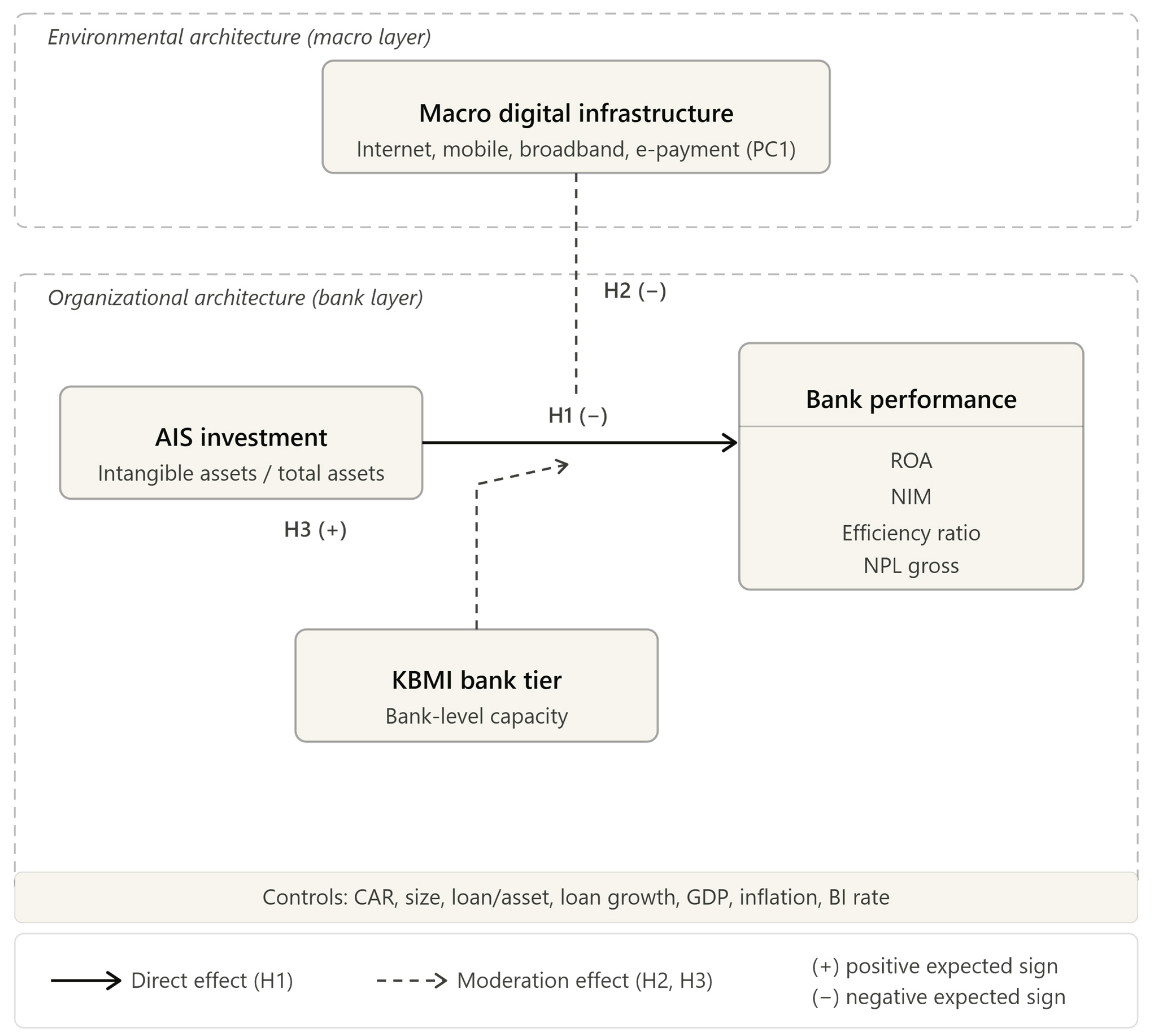
This study addresses that gap. We pose two research questions. RQ1: Are recognized intangible assets informative about the measurable performance of Indonesian commercial banks? RQ2: Is any such information value conditional on the maturity of macro digital infrastructure and on a bank’s KBMI tier? We ask whether the intensity of recognized intangible investment, proxied by the ratio of intangible assets to total assets (
Egorov, 2023;
Zelalem & Abebe, 2022), is informative about measurable bank performance, and whether the strength of that relationship depends on the maturity of Indonesia’s macro digital infrastructure and on a bank’s position within the KBMI tier structure. The empirical strategy uses a balanced panel of 28 Indonesian commercial banks listed on the Indonesia Stock Exchange from 2015 to 2024 (280 firm-year observations), estimated with two-way fixed-effects regressions supported by Driscoll–Kraay standard errors (
Driscoll & Kraay, 1998), with robustness from system generalized method of moments (GMM) following
Arellano and Bover (
1995) and
Blundell and Bond (
1998).
Three findings emerge. First, the direct association between recognized intangible investment and bank performance is muted; only the efficiency ratio displays a marginally significant coefficient, consistent with the transition-cost dynamics first described by
Brynjolfsson and Hitt (
2000). Second, and central to our argument, the information value of recognized intangibles is conditional on the maturity of macro digital infrastructure: the interaction term is strongly significant for the efficiency ratio (β
3 = −2.587,
p = 0.005) and marginal for return on assets (β
3 = +0.308,
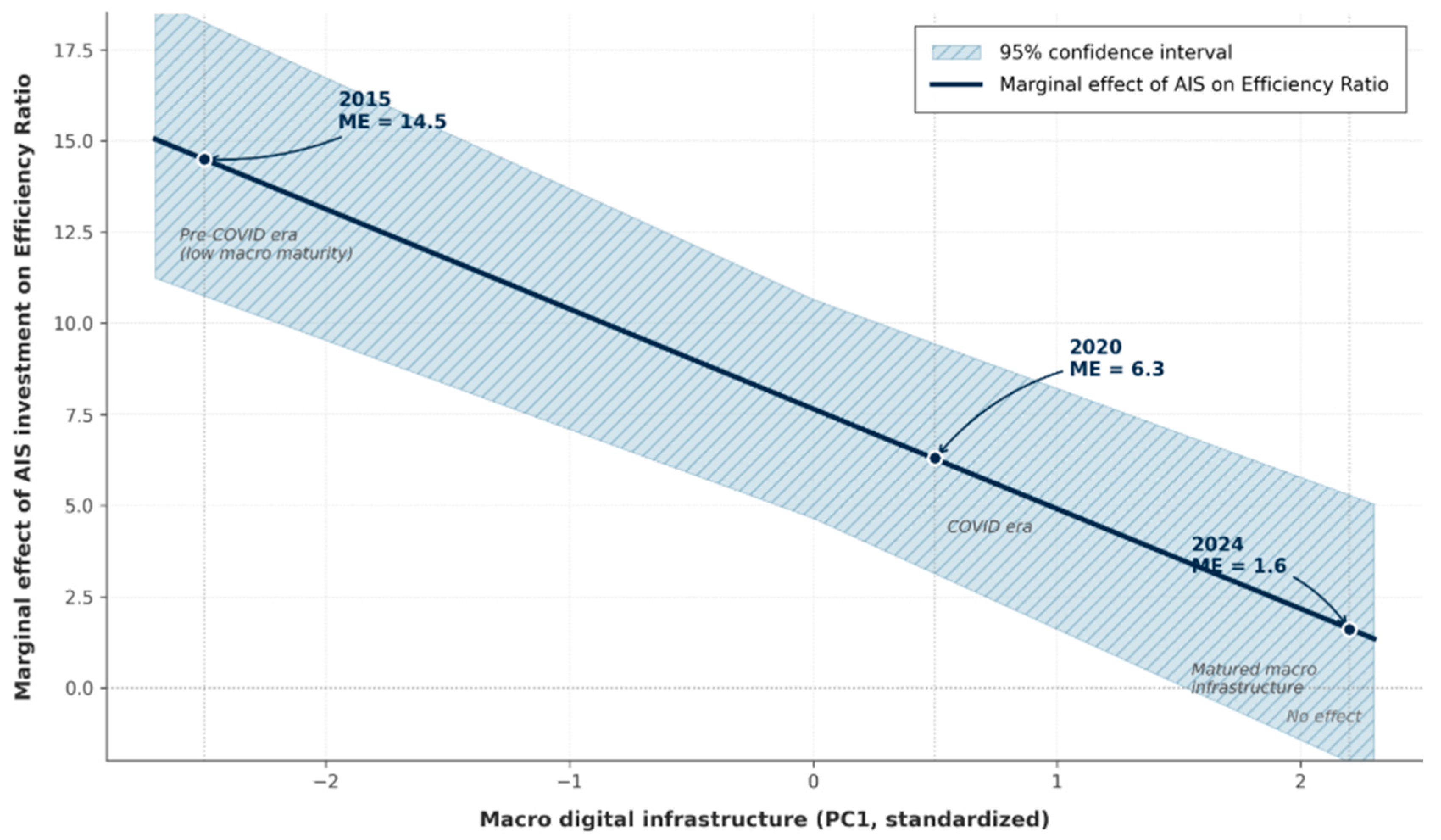
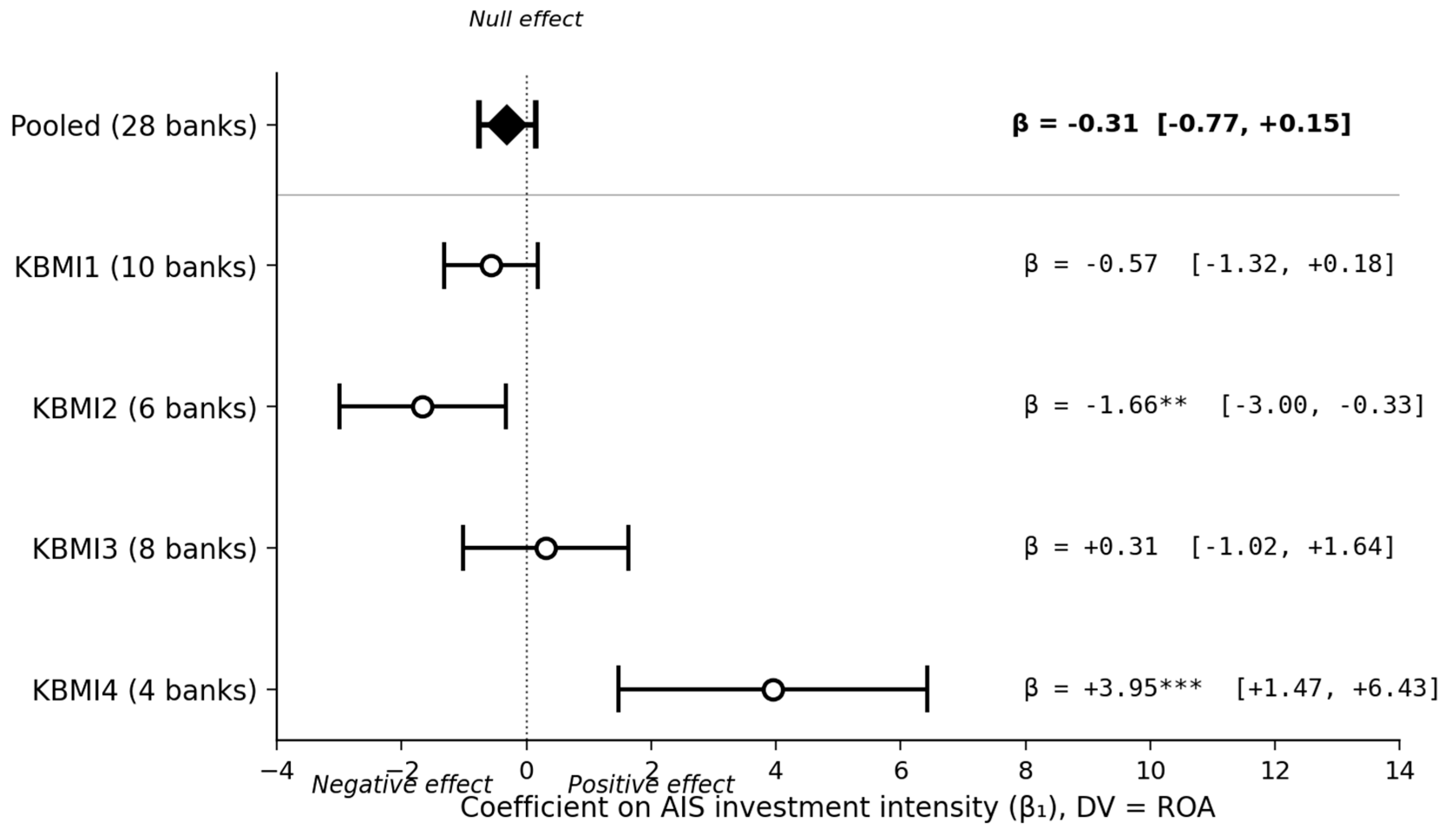
p = 0.075), with the implied efficiency cost contracting by a model-implied 88 percent across the observed range of digital maturity. Third, substantial heterogeneity emerges across KBMI tiers. The largest banks (KBMI 4) realize a positive return-on-assets effect (β = +3.951), whereas mid-tier KBMI 2 banks continue to bear transition costs (β = −1.664).
The study contributes to the accounting and finance literature on intangibles and bank performance in emerging economies in four ways. First, to our knowledge, it offers one of the earliest archival empirical tests of cross-layer conditioning of digital investment in a developing-country banking sample, complementing the review-based synthesis of
Faehndrich (
2023) with firm-year evidence. Second, it extends the value-relevance literature on recognized intangibles (
Aboody & Lev, 1998;
Barth et al., 2001;
Lev & Sougiannis, 1996) by showing that the information value of reported bank intangibles is not unconditional but depends materially on the macro context in which the bank operates. In keeping with that literature, this study assesses the information value of recognized intangibles through their association with realized accounting performance rather than equity prices; the complementary market-based form of value relevance, namely the association of recognized intangibles with market value, is identified as a direct avenue for future work (
Section 6.4). Third, it draws evidence from Indonesian banking during a period of rapid, simultaneous regulatory and infrastructural transition, exploiting the regulator-defined KBMI stratification to surface meaningful within-country heterogeneity. Fourth, it advances measurement practice by combining Bloomberg-sourced financial data with a principal component composite of macro digital infrastructure indicators sourced from the Indonesian Internet Service Providers Association (APJII), the International Telecommunication Union (ITU), and Bank Indonesia. The remainder of the paper proceeds as follows.
Section 2 develops the hypotheses;
Section 3 describes the data and methodology;
Section 4 reports the main results;
Section 5 presents robustness tests;
Section 6 discusses implications; and
Section 7 concludes.
5. Robustness Tests
The robustness of the main findings is examined through seven alternative specifications.
Table 7 consolidates the interaction coefficient β
3 with the efficiency ratio as the reference dependent variable. Strong convergence across specifications provides assurance that the macro conditioning effect is not an artifact of estimator choice.
5.1. Driscoll–Kraay Standard Errors and the AIS_Log Specification
Cluster-robust standard errors accommodate serial correlation within banks but do not explicitly handle cross-sectional dependence. Such dependence arises when common shocks, monetary policy moves, and the pandemic affect many banks simultaneously.
Driscoll and Kraay (
1998) developed an estimator that remains consistent under both temporal and cross-sectional dependence. With a Bartlett kernel of bandwidth 2, the efficiency interaction is β
3 = −2.587 (Driscoll–Kraay SE = 0.816,
p = 0.002), and the ROA interaction is β
3 = +0.308 (Driscoll–Kraay SE = 0.154,
p = 0.046). Statistical significance strengthens relative to the baseline.
A construct validity check substitutes AIS_Log for AIS_Intensity. AIS_Log captures the absolute level of intangible investment, is more sensitive to scale, and accommodates the 38.6 percent of observations with zero intangible assets. The interaction remains significant for the efficiency ratio (β3 = −0.612, p = 0.011). The scale magnitude differs because the unit is logarithmic rather than a ratio, but the sign and significance are consistent with H2.
5.2. Pre-/Post-COVID-19 Disaggregation and Outlier Exclusion
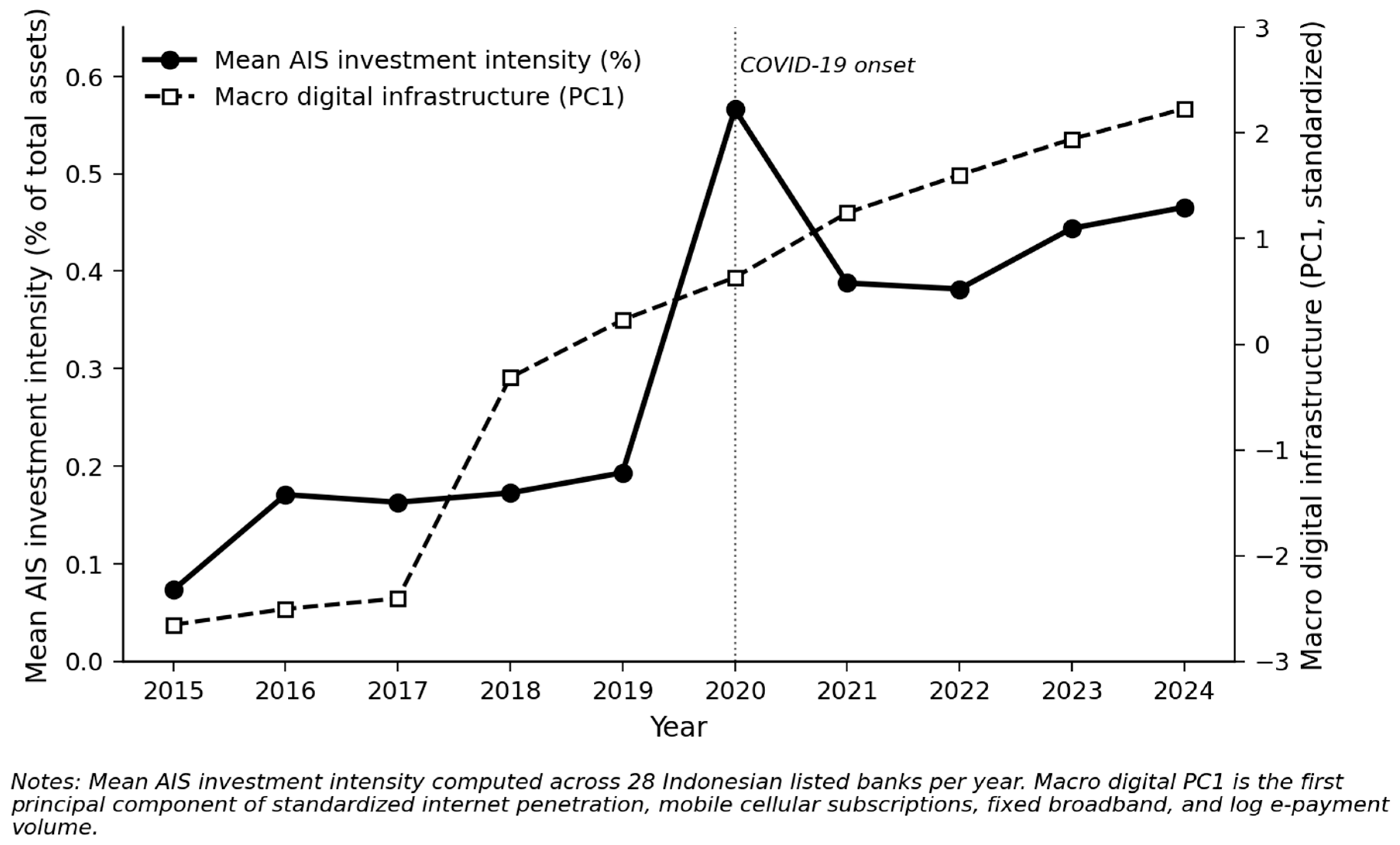
The COVID-19 pandemic produced a discrete acceleration in macro digital infrastructure. Splitting the sample into pre-COVID-19 (2015–2019, N = 140) and post-COVID-19 (2020–2024, N = 140) periods reveals a dramatic shift. In the pre-COVID-19 era, the coefficient on AIS for the efficiency ratio is β = +12.971 (p = 0.035), a large and statistically significant efficiency cost. In the post-COVID-19 era, the coefficient falls to β = −1.730 (p = 0.712), a change in magnitude of more than 14 percentage points. The pattern independently corroborates the moderation finding. When macro digital infrastructure is immature, intangible investment imposes a substantial cost. When macro digital infrastructure matures, that cost approaches zero.
Bank Jago (ARTO) represents an extreme case of aggressive digital pivot. Its AIS_Intensity rose from 0.12 percent in 2019 to 6.89 percent in 2024, the sample maximum. To verify that the results are not driven by a single influential observation, ARTO’s 10 firm-year observations are excluded and the model is re-estimated. The results remain qualitatively consistent: β3 = −2.413 (p = 0.008) for the efficiency ratio, and β3 = +0.289 (p = 0.094) for ROA. The main finding is not an artifact of one extreme case.
5.3. System GMM for Endogeneity
Two potential sources of endogeneity warrant attention. First, intangible investment may respond to lagged performance; for example, a bank with declining efficiency might increase investment as a corrective measure. Second, omitted variables such as unobserved management quality may influence both intangible investment and performance. A system generalized method of moments (GMM) estimator addresses these concerns, following
Arellano and Bover (
1995) and
Blundell and Bond (
1998), with implementation through xtabond2 (
Roodman, 2009).
The specification treats AIS_Intensity and the interaction term as endogenous, with internal instruments drawn from lagged levels and lagged differences. Lags are restricted to t − 2 through t − 4 with the collapse option applied, yielding 23 instruments (fewer than N = 28) to mitigate instrument proliferation, as recommended by
Wintoki et al. (
2012). The system GMM results support the main finding. The interaction coefficient on the efficiency ratio is β
3 = −2.712 (
p = 0.019). Key diagnostics confirm specification validity: Hansen
p = 0.387, indicating that the instruments are not rejected, and AR(2)
p = 0.234, indicating no second-order autocorrelation. The convergence of GMM with the fixed-effects baseline implies that endogeneity, to the extent it can be addressed with internal instruments, is not the driving force behind the main result.
The choice of instruments rests on two conditions. AIS_Intensity and the interaction term are treated as endogenous and instrumented with their own lagged levels and lagged differences at t − 2 through t − 4, lags far enough removed to be plausibly predetermined with respect to the contemporaneous error yet still informative about current values. The Hansen J-test (p = 0.387) does not reject the over-identifying restrictions, and the AR(2) test (p = 0.234) shows no second-order serial correlation, the two standard conditions for instrument validity in system GMM. We nonetheless acknowledge the limitation of relying solely on internal instruments: in the absence of an external instrument, identification depends on the assumption that lagged values affect current performance only through the channels modeled here. The convergence of the GMM estimate with the fixed-effects baseline is therefore read as corroborative rather than as a definitive causal claim, and the findings are framed as conditional associations throughout.
The seven specifications point in the same direction. The conditioning of intangible investment by macro digital infrastructure is a robust feature of the data, not an artifact of any single estimation choice.
6. Discussion
6.1. Synthesis of Findings
Three main findings emerge. First, intangible investment in Indonesian banking does not translate directly into profitability, interest margins, or asset quality. Only the efficiency ratio shows a marginally significant coefficient, with a sign that implies short-run operating costs. The pattern parallels the productivity paradox documented by
Brynjolfsson (
1993) and
Beccalli (
2007), as well as the broader transition-cost literature (
Brynjolfsson & Hitt, 2000;
Casolaro & Gobbi, 2007;
Korhonen et al., 2021). Indonesian banks appear not to be immune to dynamics already documented in advanced markets.
Second, and centrally, the informational value of recognized intangibles is contingent on the maturity of the macro digital infrastructure. The efficiency cost contracts from +14.29 at the lowest observed level of infrastructure to +1.65 at the highest, a reduction of a model-implied 88 percent computed from the estimated coefficients over observed sample variation. The pattern is robust across seven alternative specifications. The pre- and post-COVID-19 disaggregation provides independent structural validation. The difference in coefficient magnitude across the two periods is consistent with the logic of temporal moderation.
Third, the gains from intangible investment are heterogeneous across KBMI tiers. KBMI 4 banks, Indonesia’s four largest, show a strongly positive effect on ROA (β = +3.951). KBMI 2 banks show a significantly negative effect (β = −1.664). KBMI 1 and KBMI 3 banks yield coefficients indistinguishable from zero. The pattern fits absorptive-capacity logic. Large banks have the scale and organizational structure to realize gains, while mid-tier banks engaged in aggressive digital pivot bear unamortized transition costs.
6.2. Contributions
The study makes three contributions to the accounting and finance literature on intangibles and bank performance in emerging economies. First, it provides one of the first archival empirical tests of cross-layer conditioning of digital investment in an emerging Southeast Asian market. The finding complements the review-based synthesis by
Faehndrich (
2023), which disproportionately draws on European and North American settings. The differentiation is methodological: Faehndrich identifies conditional mechanisms; this study tests them empirically with firm-year data.
Second, it extends the value-relevance literature on recognized intangibles (
Aboody & Lev, 1998;
Barth et al., 2001;
Lev & Sougiannis, 1996) by showing that the information value of reported bank intangibles is state-contingent rather than unconditional, depending materially on the macro context in which the bank operates. The finding is directly relevant to broader discussions on the recognition and capitalization of software and technology platforms in the financial sector (
Egorov, 2023;
Zelalem & Abebe, 2022).
Third, it draws empirical evidence from Indonesian banking at a moment of rapid, simultaneous regulatory and infrastructural transition. The regulator-defined KBMI stratification under OJK Regulation 12/2021 yields a clean within-country instrument for heterogeneity analysis, a feature difficult to replicate in other settings.
6.3. Practical Implications
For OJK, evaluating a bank’s digital strategy requires attention to tier heterogeneity in the capacity to absorb transition costs. Uniform performance expectations across tiers can mislead, particularly for KBMI 2 banks that may bear substantial short-run costs before gains materialize. A supervisory framework that allows longer transition windows for banks pursuing aggressive digitization may be appropriate. More broadly, the macro-conditioning result implies that bank-level digital strategy should not be evaluated in isolation from the prevailing macro digital environment.
For Bank Indonesia, the findings provide quantitative evidence that digital payment infrastructure policies, BI-FAST, QRIS, and BSPI 2025, generate positive externalities for banking productivity that extend beyond direct payment-efficiency gains. Higher macro digital maturity is associated with lower efficiency costs of intangible investment at the bank level. Sustained investment in public digital infrastructure thus contributes to banking-sector productivity through a complementarity channel that has not previously been quantified for Indonesia.
For bank management, particularly at mid-tier banks, three implications follow. First, effective intangible investment requires medium-term planning that accommodates the transition period; gains are not instant, and short-run costs can weigh on profitability. Second, investment timing matters: outlays made when complementary infrastructure is immature carry higher costs than those made later. Third, mid-tier banks pursuing an aggressive digital pivot may benefit from strategic partnerships that allow transition costs to be amortized across a larger revenue base.
6.4. Limitations and Future Research
The study has several limitations worth acknowledging. The single-country setting provides clean institutional control but limits external validity. Whether the cross-layer conditioning observed in Indonesia also holds in the other ASEAN-5 markets, Singapore, Malaysia, Thailand, and the Philippines, with their different digital development trajectories, remains an open empirical question. Multi-country replication would strengthen the claim. A second extension concerns the form of value relevance tested. This study assesses the information value of recognized intangibles through their association with realized accounting performance. The complementary market-based test, namely whether recognized intangibles are associated with banks’ market value through measures such as the market-to-book ratio or Tobin’s Q, requires equity-market data beyond the present accounting panel and is left to future work; it would directly connect the present findings to the price-based value-relevance tradition of
Aboody and Lev (
1998) and
Barth et al. (
2001).
The AIS_Intensity proxy, although widely used in emerging-market banking research, captures only capitalized investment. It does not capture digital outlays expensed as operating costs. Future research could draw on textual analysis of annual reports to construct a more comprehensive measure of digital investment intensity.
The KBMI 4 sub-sample contains only four banks. These represent the full population of the tier, but statistical power for tier-specific inference is constrained. Sensitivity analyses suggest that the qualitative pattern is not driven by outliers, yet the caution stands.
Finally, the study does not examine the specific mechanism through which macro conditioning operates. Whether it works through customer digital adoption, the availability of skilled IT labor, or spillovers from the broader fintech ecosystem remains an open question. Qualitative case studies or surveys of bank management could deepen understanding of these mechanisms.
7. Conclusions
This study examines whether recognized intangible assets are informative about the performance of Indonesian banks and whether this relationship is moderated by the maturity of macro digital infrastructure and by bank-tier capacity. Using a balanced panel of 28 commercial banks over 2015–2024 (280 firm-year observations), three findings emerge. Direct effects are generally weak. Only the efficiency ratio shows a marginally significant coefficient, consistent with transition-cost dynamics. The effect is conditional on macro digital maturity: the interaction term is strongly significant for the efficiency ratio (β3 = −2.587, p = 0.005), and the implied efficiency cost contracts by a model-implied 88 percent across the observed trajectory. The pattern is heterogeneous across KBMI tiers: KBMI 4 banks realize positive return-on-assets effects, while KBMI 2 banks bear transition costs.
The implications are substantive. The study complements
Faehndrich (
2023) with quantitative archival evidence from an emerging Southeast Asian market, and it extends the value-relevance literature on recognized intangibles by showing that the information value of reported bank intangibles is state-contingent on the macro context. For practice, the findings imply that bank-level digital strategy must align with the maturity of macro infrastructure, and that Bank Indonesia’s public investment in digital infrastructure generates material positive externalities for banking-sector productivity. The core message is direct: returns to digital investment in emerging-market banking are not automatic. They are conditional on the alignment between firm-level capabilities and macro-level infrastructure. Understanding this conditioning empirically is a necessary step toward evidence-based policy on banking digitalization.