Article

Rational Inattention in Government Bond Auctions: Evidence from Yield Spreads in Armenian Treasury Auctions

1
Faculty of Economics and Management, Yerevan State University, Yerevan 0025, Armenia
2
Faculty of Mathematics and Mechanics, Yerevan State University, Yerevan 0025, Armenia
*
Author to whom correspondence should be addressed.
J. Risk Financ. Manag. 2026, 19(7), 532; https://doi.org/10.3390/jrfm19070532
Submission received: 12 May 2026 / Revised: 9 July 2026 / Accepted: 10 July 2026 / Published: 17 July 2026
(This article belongs to the Section Financial Markets)

Abstract

Investors’ behavior in the auctions for government bonds is closely associated with the processing and valuing of information. This study explores investors’ behavior in relation to information in the context of the sovereign debt market in Armenia in August 2017 to December 2025. Armenia has a small financial market, which is relatively deep and involves only a small number of investors. This particular situation allows for testing the applicability of the rational inattention theory. While information in a small open economy can be abundant, it does not follow that information is valued in the same way. Investors in a small open economy focus their attention on monitoring some salient policy variables, including the central bank policy interest rate and headline inflation but ignore some more specific signals such as demand dynamics. We suggest that the spread between the cut-off yield and the weighted average yield in the auction can be used as a measure of information inattention. According to the rational inattention theory, investors allocate their attention strategically and focus on those signals that can be obtained easily and publicly. Therefore, our hypothesis is that the auction spread is consistent with partial information processing, whereby demand signals are underweighted relative to the policy rate. Indeed, the analysis suggests that the cut-off yield remains correlated with the policy rate, whereas the spread does not increase. This is consistent with the hypothesis that yield spreads reflect bounded rationality in attention allocation. During the periods of increased need for government borrowing, auctions become the key sources of signaling and thus need to be studied.

1. Introduction

Government bond auctions are widely utilized for financing public debt and signaling monetary policy. According to the standard auction theory, bid patterns and auction outcomes are driven by public information and changes in market demand. Changes in demand are anticipated to create dispersion in bids, resulting in the growing spread between the cut-off yield and the weighted-average yield. However, there is another phenomenon in the Armenian case. For all types of auctions conducted by the country’s treasury, the spread is closely related to the central bank’s policy rate, and the yield spread remains low. There is hardly any influence of demand on the bid distribution. According to Habib and Ziegler (2007), when information and evaluation costs are low, the sellers prefer to engage in auctions rather than sell using posted prices. Government securities are highly standardized and liquid, meaning that their information cost is low. Thus, this type of products is sold via auctions. It is clear why government bonds are traded using auctions.
The cut-off price is defined as the minimum bid price, and all bids above this price will be executed in an auction. The next price rejected in the sequence of bid ranking is referred to as the highest rejected price or the lowest rejected yield. As a rule, rejection prices are not published during auctions, but they are relevant to the analysis of the present paper. It has been shown that for non-monotonic utility of the auctioneer, the optimal rejection price is lower than the bliss-point revenue in the first price auction and equals to it in the second price auction. Shui (2023) proved this fact by assuming a non-monotonic utility function for the auctioneer. When the auctioneer is risk averse, then the first-price auction is superior to the second-price auction. The first-price auction is common in procurement auctions and treasury bond auctions.
For auctions of the government’s securities, two types of auctions are mainly used: discriminatory (multiple-price) auctions and uniform-price (Dutch) auctions. Under discriminatory auctions, participants submit their quantities along with their yields. The government accepts bids until it reaches its targeted volume of bonds. Uniform-price auctions require all bidders to obtain the same yield that equals the cut-off yield, i.e., the highest accepted yield. To examine the impact of the choice between discriminatory and uniform-price auctions, Barbosa et al. (2022) perform an empirical test. By analyzing the data of auctions by the Chinese Development Bank and Export-Import Bank, they conclude that there is no economic difference between these methods.
This paper applies the framework to the Armenian government bond market, arguing that the spread between the cut-off yield and the weighted average yield reflects selective attention among bidders who anchor on the central bank’s policy rate while underweighting auction-specific demand signals. The application of this theory to government bond auction outcomes in small emerging markets remains largely unexplored. Using data from Armenian treasury auctions over August 2017 to December 2025, we propose the yield spread as an empirical proxy for information inattention and provide supporting evidence through both descriptive analysis and simulation.

2. Literature Review

2.1. Theoretical Underpinning

Traditional auction theory assumes that bidders are fully informed and can process all available information. This might not be the case in reality. The theory of Rational Inattention, proposed by Sims (2003, 2006), relaxes this presumption by recognizing that economic agents incur costs in obtaining and processing information. According to this theory, agents optimally allocate attention to different sources of information. This framework is especially important in the context of government bond auctions. Although government bonds are highly standardized and information on macroeconomic conditions is abundant, bidders are required to process a large amount of noisy information in a short time frame. Sims (2003) models decision-makers as subject to an information-processing constraint formalized via Shannon mutual information. Agents cannot process all available information with full precision. Instead, they choose what to pay attention to, balancing the benefits of processing more information against the costs of doing so. Sims (1998) suggests that slow adaptation of macroeconomic variables could arise not from rationality, but from informational limitations. This offers an alternative explanation for stickiness by arguing that actors are perfectly rational but have limitations on their attention and information processing capabilities, which results in slow decision revisions. Sims (2010) examines rational inattention framework in the context of monetary economics. One of the main conclusions is that the effectiveness of monetary policy depends not only on the actual policy rate but also on how much attention agents allocate to policy signals. If the agents do not pay enough attention to either interest rates or statements made by central banks, then the impact of monetary policy changes will be limited. This is particularly important for bond markets.
Angeletos and Sastry (2025) develop a general equilibrium model in which agents are inattentive to macroeconomic shocks and do not continuously process all available information. Their results show that limited attention leads to coordination failures in expectations, forecast errors and that expectation formation itself is distorted by inattention, which is exactly what matters in bond auctions where bidders are forming expectations about inflation, demand, policy rate and yields. The main implication of the paper is that macroeconomic fluctuations may arise not only from fundamental shocks but also variations in attention. Caplin and Dean (2015) propose a revealed preference theory of rational inattention, characterizing conditions under which stochastic behavior can be considered rational and costly information search. The paper characterizes the conditions under which stochastic behavior can be considered rational by agents who optimally choose how much information to acquire subject to information-processing costs. Caplin et al. (2019) develop a rational inattention framework that links limited information processing to stochastic choice behavior. This framework allows agents to optimally choose not only how much information to process but also which alternatives to consider.
Maćkowiak et al. (2023) argue that rational inattention models offer explanations for systematic effects such as responses to changes in information, differences in prices, and state-dependent attention. As authors mention, the most interesting aspect of rational inattention models is that they differ from traditional models with noisy or incomplete information, as they endogenize the structure of information. Bordalo et al. (2020) examine how agents form macroeconomic expectations when attention is limited. They show that economic agents overweight salient or recent information rather than prominent signals, resulting in forecast errors and expectation revisions. This framework is closely related to rational inattention. Their work provides a theoretical foundation for understanding yield dispersion and heterogeneity in investor beliefs observed in government bond markets.
Recent studies explored what determines the cut-off price or yield in government bond auctions, as well as the spread between the average price and the cut-off. These price differences can be interpreted as indicators of market tension, information asymmetry, or excess demand. In this research article, we will try to focus on the role of information in government bond auctions.

2.2. Empirical Literature

Jiao (2024) provides a conceptual overview of the rational inattention framework and focuses on a review of experimental studies. It is stressed that people face limited cognitive capacity and optimally allocate attention across competing information sources, leading to stochastic choices and incomplete adjustment to new information. Hortaçsu and McAdams (2010) show that in thin emerging market treasury auctions, bidders tend to coordinate on common signals rather than processing private demand information.
Recent literature examines information acquisition in auctions more explicitly, bidders choose how much information to acquire before bidding, making the information structure endogenous. Atakan and Ekmekci (2024) for instance, endogenize information choice by bidders and show how costly information shapes bidding strategies and outcomes. They were the first to demonstrate the value of information in an analytically tractable auction model. The authors build on two fundamental papers on auction theory: Milgrom and Weber (1982) on the value of information in sealed-bid auctions and Engelbrecht-Wiggans et al. (1983) on how proprietary information affects bidding.
Kim and Koh (2022) examine auctions where bidders make their own choices about the precision of information before bidding. In this study, bidders make decisions on how much costly information to gather about the value of the project being auctioned before bidding. The researchers show that the precision of bidders’ private information can be optimally determined by bidders, and this affects the results of bidding in an auction since the outcome of bidding is not only dependent on fundamentals but also on information acquisition strategies.
Lee (2024) examines bidder behavior in auctions with a randomly drawn cut-off price, where bidders must bid close to the random cut-off. For this purpose, the transformer model is employed as an empirical method to anticipate the random cut-off. Available information can affect the behavior of both buyers and sellers, affect market expectations, influencing their choices. To investigate whether attention responds rationally to strategic incentives, Almog and Martin (2024) were the first to provide experimental evidence of strategic rational inattention, implement a buyer-seller game, by extending rational inattention theory into strategic environments, showing that players actively adjust attentional resources based on strategic inference rather than exogenous information cost. Nyborg et al. (2002) analyze bidder behavior in Swedish multiunit treasury auctions and show that bid dispersion and the spread between average and marginal prices are systematically related to auction-specific demand conditions. Goldreich (2007) finds that the spread between the average yield and the cut-off yield is a meaningful indicator of auction tension and information asymmetry.
In classical auction theory, the outcome of a uniform-price auction-especially the difference between the cut-off yield and the weighted average yield-should, under full attention and rational expectations, reflect information about both public and private signals, including demand pressure, bond maturity, macroeconomic outlook and policy rate. In the context of government bond auctions, public information such as the central bank’s policy rate is relatively cheap to observe and interpret, whereas auction-specific information such as total demand or bid distribution may be noisier, less visible in real time, and harder to process.
This gives rise to our central hypothesis:
H1. 
The spread between the cut-off yield and the weighted average yield in a government bond auction reflects the extent of information inattention among bidders.
Under rational inattention, we expect that:
  • The cut-off yield should closely follow the policy rate, which is a salient public signal.
  • If bidders fully processed demand-side information, the spread (cut-off minus weighted average yield) should increase with relative demand, reflecting steeper competition and greater bid dispersion.
However, if bidders ignore or underweight demand, the spread will not increase, and may even decline slightly, despite rising relative demand.

3. Data and Methodology

3.1. Defining an Empirical Proxy for Information Inattention

To empirically evaluate the role of informational attention in government bond auctions, we propose a novel proxy based on auction pricing data: the yield spread between the cut-off yield and the weighted average yield. This measure is introduced in the present study as a proxy for information inattention and does not follow a pre-existing definition in the literature. The spread captures the dispersion in bids around the marginal (cut-off) yield and reflects the extent to which bidders anchor on commonly observed public signals versus processing deeper, less accessible auction-specific information.
We define the spread in auction t as:
Spread t = Cut - off   Yield t Weighted   Average   Yield t
This spread reflects how concentrated or dispersed the bids are. In a setting with full information processing, where all investors observe and react to both public and private signals (e.g., aggregate demand, macro volatility, auction maturity), we expect higher auction demand to generate wider spreads. Intuitively, as demand increases, aggressive bidding should pull the average yield further below the marginal (cut-off) yield, widening the spread.
Formally, if attention is rational and costless, we would expect:
  Spread t   Relative   Demand t > 0
However, under rational inattention, investors allocate attention selectively, prioritizing low-cost, high impact signals such as the central bank’s policy rate. In such a setting, auction-specific variables like demand may be partially or fully ignored, leading to:
  Spread t   Relative   Demand t 0
This inverse or null relationship suggests that market participants coordinate their expectations around public benchmarks, ignoring potentially valuable private information. Notably, several alternative explanations for a compressed yield spread-including policy-rate anchoring, common-value bidding and market concentration-are themselves consistent with, or arise as consequence of, rational inattention. In the Armenian bond market data, we observe precisely such a pattern: the spread remains stable or narrows even as relative demand increases, which contradicts the full-attention benchmark and supports the rational inattention hypothesis.
In sum, the yield spread serves as a tractable and interpretable proxy for aggregate attention allocation among auction participants. It enables an indirect test of bounded rationality in markets without requiring individual-level data or experimental interventions. To rationalize this empirical finding, we now integrate auction bidding behavior into a model of costly information processing. The key idea is that the observed sensitivity of the spread to relative demand can be seen as a function of the degree to which bidders attend to auction-specific information relative to public benchmarks. In full information processing, bidders make their yield decision conditional on the state of the auction, including demand realizations. However, in models of costly information processing, bidders may optimally focus on public variables such as the central bank policy rate. The sensitivity of spreads to demand therefore emerges endogenously from the bidder’s information constraint. We formalize the role of rational inattention in government bond auctions. We adopt a stylized decision-theoretic framework in the spirit of Sims (2003) and Matějka and McKay (2015), which provides a logit representation of optimal probabilistic choice.

3.2. Rational Inattention and Selective Attention in Auction Bidding

One of the consequences of rational inattention is the issue of selective attention, which is associated with the fact that the cost of the agent’s attention is constant, hence, the person chooses the signals from which he gets more information. In the financial market, publicly available and verifiable information usually receives more attention than any non-public or difficult-to-verifiable one. When analyzing the government bonds auction, the bidder faces a few important factors related to making the final decision. The first factor in this case is the central bank policy rate, which is publicly available and thus easy to use as a benchmark for the bond price. The second factor relates to the specific conditions of the auction, including the demand level represented by the number of the bids made. With a limited amount of attention, the bidder would be more likely to pay attention to the policy rate and ignore the auction-specific information.
The described mechanism of the formation of decisions affects the distribution of bids made by the participants. Namely, if they take into account all the available data, the resulting distribution of bids is going to be broader compared to the situation when the bidders take into account only publicly available signals and thus have their bids concentrated around these signals.
Additionally, in uncertain environments characterized by the lack of information about the preferences of other players, any common information acts as a natural anchor in terms of expectation coordination. The role of public information in shaping strategic behavior among market participants is also explored by Daher and Damrah (2024), who show that when insiders and market makers share access to public signals, strategic anchoring around common benchmarks emerges endogenously. The central bank policy rate used for bond pricing might be considered common information in this case since other participants of the auction would also anchor their expectations on this rate. With attention being limited, people would be more likely to choose publicly available information as the basis for expectation formation.
Next, the following section includes a simulation model of the treasuries auctions with different attention towards demand signals.

3.3. Simulation of Rational vs. Rational Inattentive Bidders

It is important to emphasize that the simulation presented in this section is a stylized theoretical illustration and does not constitute empirical proof of the rational inattention hypothesis. By construction, the model assumes that bidders exhibit rational inattention and then shows the outcomes that follow from this assumption. This is a deliberate design choice: the simulation serves to demonstrate the theoretical mechanism through which limited attention compresses bid distributions and yield spreads, not to validate the hypothesis against the data.
To support our theoretical argument that the spread in government bond auctions reflects the degree of attention that bidders dedicate to the available information, we propose a stylized simulation of uniform price auctions. The simulation is intended to illustrate the theoretical mechanism through which limited attention compresses bid distributions and yield spreads.
The simulation illustrates the impact of the level of attention on the distribution of bids, where bidders’ reliance on available information and the tendency to underprocess auction-specific information causes bids to converge to a common level, resulting in a compressed distribution of bids and a small spread between the cut-off and the average yield.
We simulated 100 auctions with the following structure:
  • Number of bidders: 50
  • Bonds allocated per auction: 25 units
  • Public signal: Policy rate R t N ( 7.0,1.0 )
  • Private signal: Demand shock D t N ( 0,1 )
  • Noise term: ϵ i N ( 0,0.2 )
The parameter choices are stylized rather than formally calibrated. The policy rate is modeled as N ( 7.0,1.0 ) , reflecting the approximate average Central Bank of Armenia refinancing rate over the sample period. The attention parameter λ is varied across a range from near-zero to 2.0 to illustrate the full spectrum from complete inattention to full information processing.
We begin by modeling two distinct behavioral regimes:
1.
Fully attentive (rational) bidders, who process both public and private information:
y i t = R t + β 1 D t + ϵ i
2.
Rationally inattentive bidders, who focus only on the public signal:
We extend the model by adding a parameter that reflects how much bidders use auction-specific information. In a rational inattention model, agents allocate their limited capacity to process information among available signals. In this case, this implies that bidders might attach different importance to demand conditions in comparison to the publicly available policy rate.
We capture this mechanism in reduced form by allowing the bid to depend on the demand signal with intensity λ :
y i t = R t + λ γ i β 1 D t + ϵ i
where λ represents the degree of attention allocated to the demand signal.
When λ is small, bidders place little weight on demand and bids cluster around the policy rate. When λ increases, bidders incorporate more auction-specific information and bid dispersion increases. To capture realistic heterogeneity in bidding behavior, we allow bidders to differ in how strongly they react to auction-specific demand conditions. In practice, auction participants may interpret demand signals differently due to differences in market expectations, portfolio constraints, liquidity needs, or information sets. To reflect this heterogeneity, we introduce a bidder-specific sensitivity parameter γ i , that scales the impact of the demand shock on each bidder’s valuation. γ i is drawn from a normal distribution centered around one. This formulation ensures that when attention to demand increases, bidders respond differently to the same demand signal, generating dispersion in bids. In contrast, when attention is low ( λ 0 ), bids are largely anchored on the common public signal R t , producing tightly clustered bids and small auction spreads.
Across 100 simulations with 50 bidders and 25 bond units allocated per auction, we compute the:
  • Cut-off yield: the highest accepted bid,
  • Weighted average yield: mean of accepted bids,
  • Spread: cut-off minus average yield.
We observe the following:
  • Under low λ, bid distributions are compressed, and cut-off and average yields are similar—indicating low information heterogeneity.
  • As λ increases, bids spread out, and the yield spread grows. This reflects increased processing of latent demand signals and supports our theoretical expectations.
To analyze how attention affects auction outcomes, we vary the attention parameter over:
λ { 0.1,0.3,0.5,1.0,2.0 }
and summarize how yield spreads and bid dispersion evolve. Our results reveal:
  • Mean spread increases monotonically with λ,
  • Standard deviation of bids also rises with λ,
  • Distributions become wider and more skewed, indicating heterogeneity in valuation.
We present:
  • A table summarizing spread statistics for each λ,
  • A panel of histograms visualizing bid distributions across attention levels.
These results support the interpretation of spread as an empirical proxy for attentional compression.

4. Findings and Interpretation

4.1. Armenian Bond Market Overview

To understand the relationship between market conditions and auction pricing, it is important to examine developments in government bond demand, especially the variation in relative demand.
The dataset covers 421 Armenian government bond auctions; variable definitions and sample periods are provided in Table 1. The codes and data used in this study are available as Supplementary Materials.
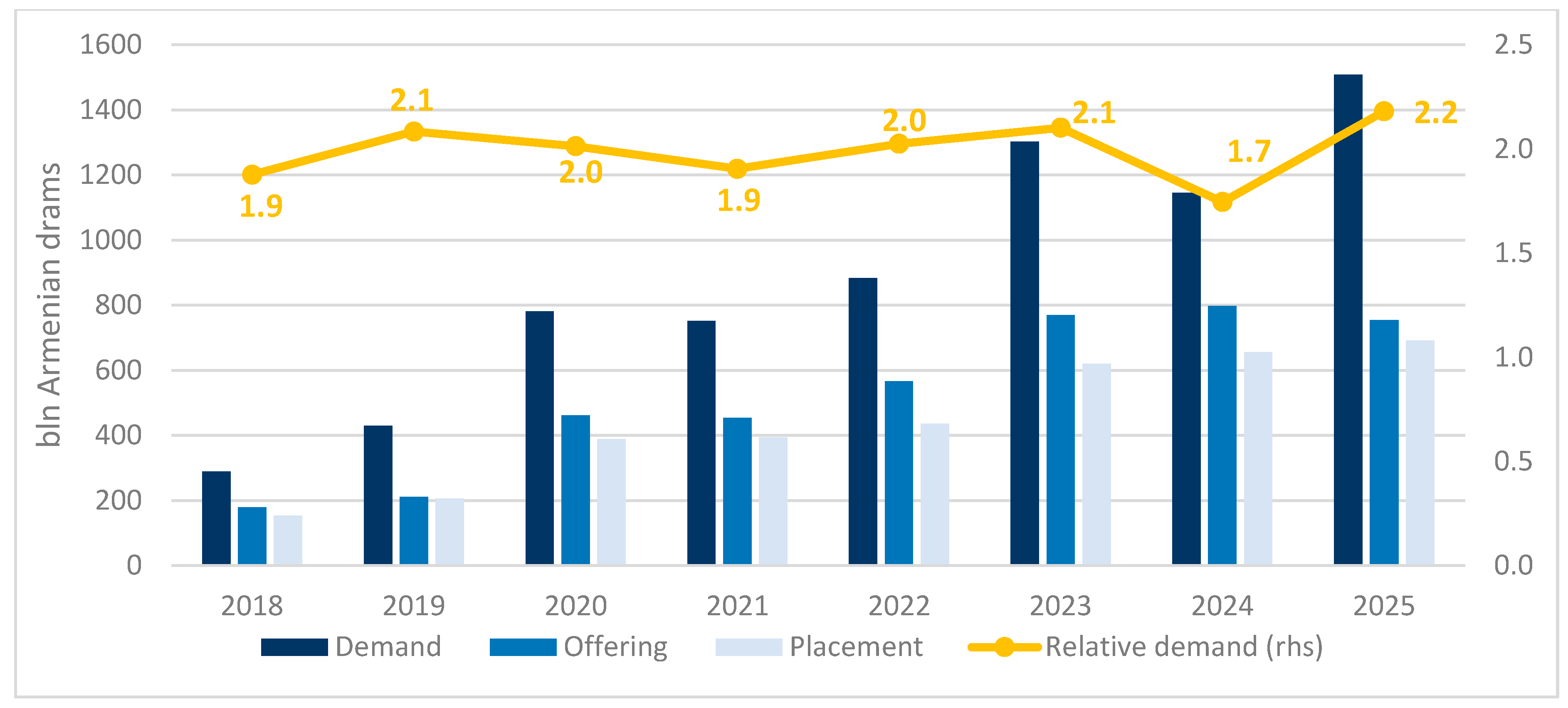
Figure 1 shows the dynamics of demand, offering amount, placement and relative demand in the Armenian government bond market over the period 2018 to 2025. Over the observed time horizon data reveal consistently high demand relative to the volume offered, with the relative demand ratio being close to 2. Moreover, this demand indicator was high regardless of the allocated volume.
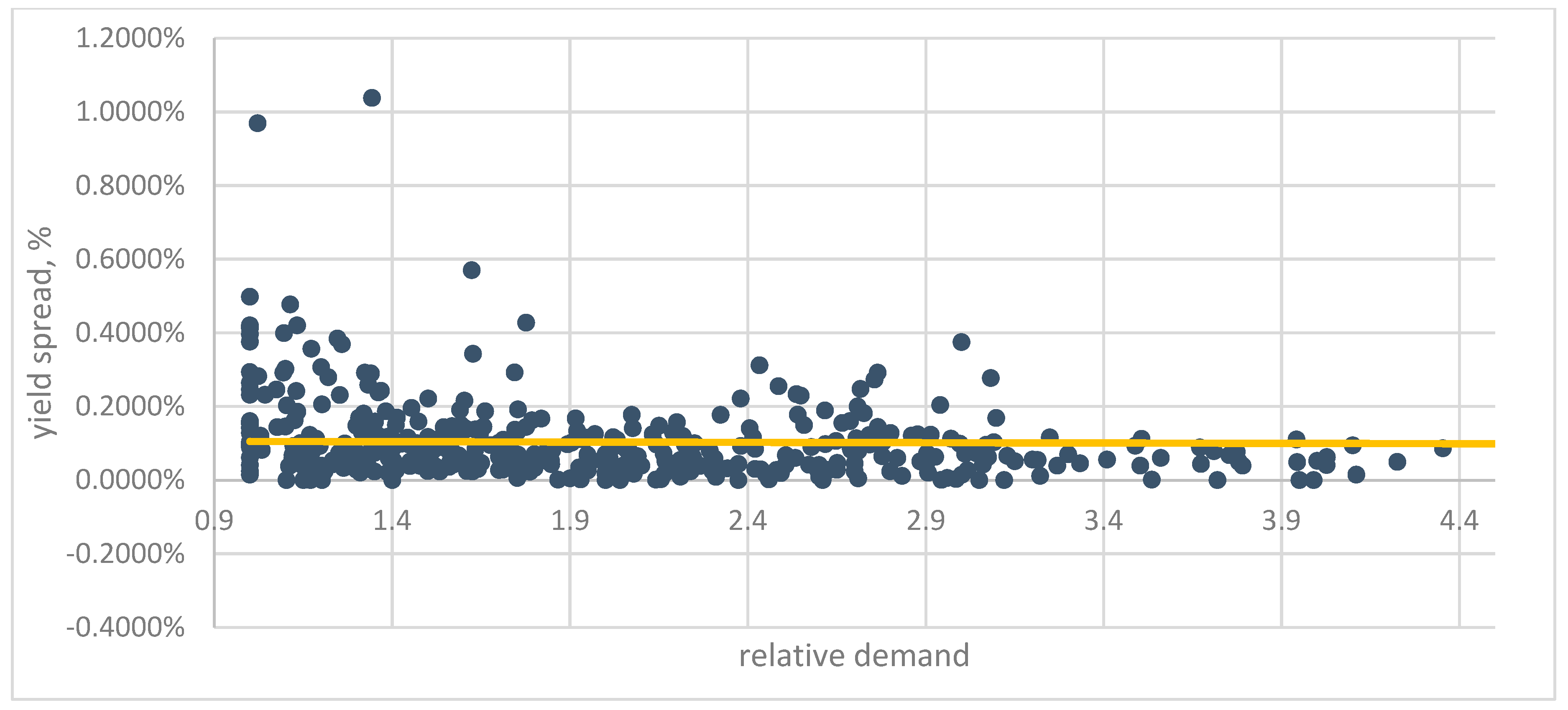
Figure 2 illustrates the relationship between relative demand and yield spreads1 in Armenian government bond auctions from August 2017 to December 2025. The scatter plot indicates a very weak negative relationship between these variables, suggesting that the yield spread shows no systematic increase in response to rising relative demand.
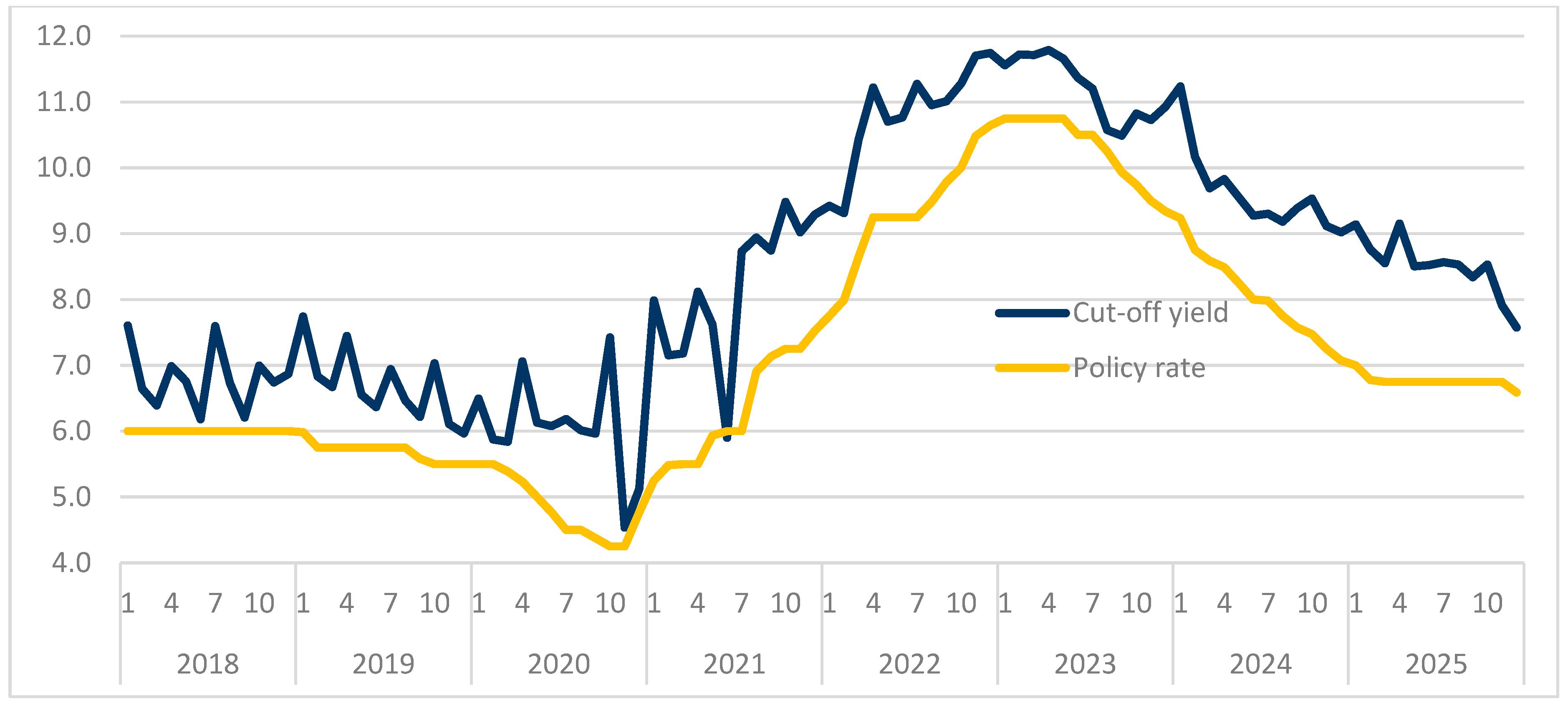
Figure 3 highlights the strong co-movement between the CBA’s policy rate and average monthly cut-off yields. Besides the overall trend, average cut-off yields show short-term volatility, which can be explained by auction characteristics, such as bond maturity, issuance volumes, auction frequencies and macroeconomic conditions. The chart below suggests that auction outcomes are influenced by monetary policy conditions.
To empirically examine the determinants of the yield spread, we estimate an auction-level OLS regression with White (HC1) heteroscedasticity-consistent standard errors. The results are reported in Table 2. The dependent variable is the yield spread, and the explanatory variables are relative demand, change in policy rate, offering amount and maturity. Our hypothesis is that the only variable to which bidders pay meaningful attention is the central bank’s policy rate, which serves as the dominant public benchmark. Under rational inattention, the effect of relative demand on the spread should be zero or negative. A negative coefficient would carry a specific interpretation: when auction demand rises-that is, when more participants are actively bidding-rather than incorporating this demand information into their pricing, bidders increasingly coordinate around the common benchmark. The auction becomes more competitive, the cost of deviating from the public benchmark rises, reinforcing anchoring behavior. Beyond relative demand and the policy rate, auction size may also influence spread dynamics: larger auctions may generate greater heterogeneity in bidder valuations.
Initially, a broader set of variables was included in the regression, comprising inflation, maturity, auction frequency, and year dummies. Inflation and auction frequency were statistically insignificant across all tested specifications and were excluded from the final model. Maturity was tested as dummy variables for medium- and long-term segments, with short-term auctions serving as the benchmark category; both dummies were found to be insignificant. The final specification therefore retains only the variables with statistically significant effects. The robustness check with maturity dummies is reported in the Appendix A (Table A1).
S p r e a d t = β 0 + β 1 log R e l a t i v e   D e m a n d t + β 2 d ( log P o l i c y   R a t e t ) + β 3 log O f f e r i n g   A m o u n t + ε t
The coefficient on relative demand is negative and statistically significant ( β 1 = 0.062 , p < 0.001 ), consistent with the interpretation that higher demand is associated with the coordination around the policy rate benchmark. The coefficient on policy rate is positive and significant ( β 2 = 0.585 ,   p = 0.05 ), indicating a directional influence of the policy rate on spread levels. The coefficient on offering amount is positive and highly significant ( β 3 = 0.03 ,   p < 0.001 ), indicating that larger auctions tend to generate wider spreads, potentially reflecting greater heterogeneity in bidder valuations.
The overall model fit is modest ( R 2 = 0.15 ), which is expected given that rational inattention itself implies limited systematic variation in spreads across auctions. Taken together, these results are consistent with the rational inattention hypothesis.
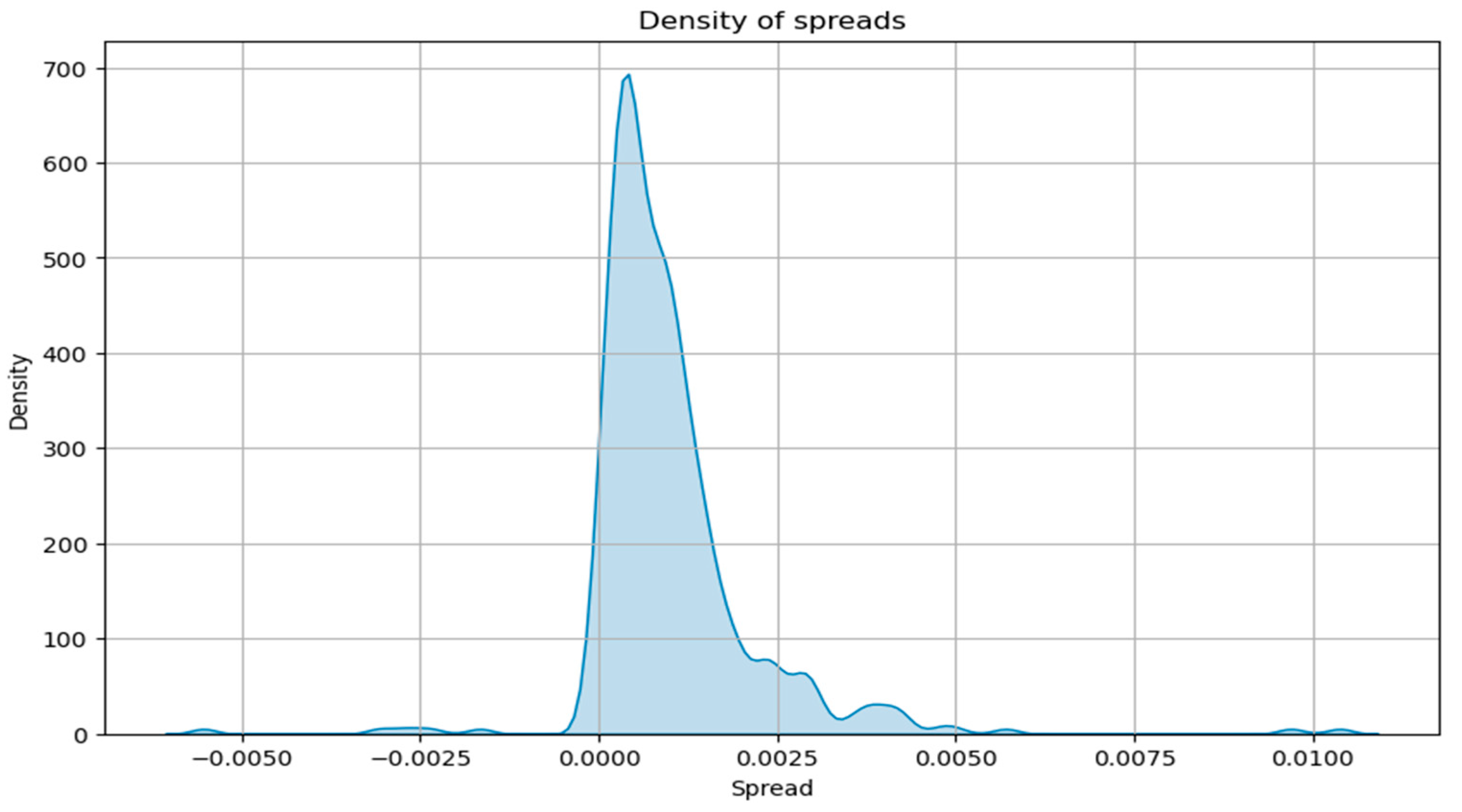
Figure 4 shows the distribution function of spreads. This gives a visual overview of where spreads have been concentrated over time. The distribution is sharply concentrated around zero, with a pronounced peak at very small positive values. This indicates that in most cases, the cut-off yield and the weighted average yield are closely aligned, leaving little room for large deviations. The distribution is skewed, which makes it unlikely to be Gaussian (normal). This suggest that market participants may not respond to all available information, instead they can focus on benchmark rates or policy targets, which is consistent with rational inattention theory.
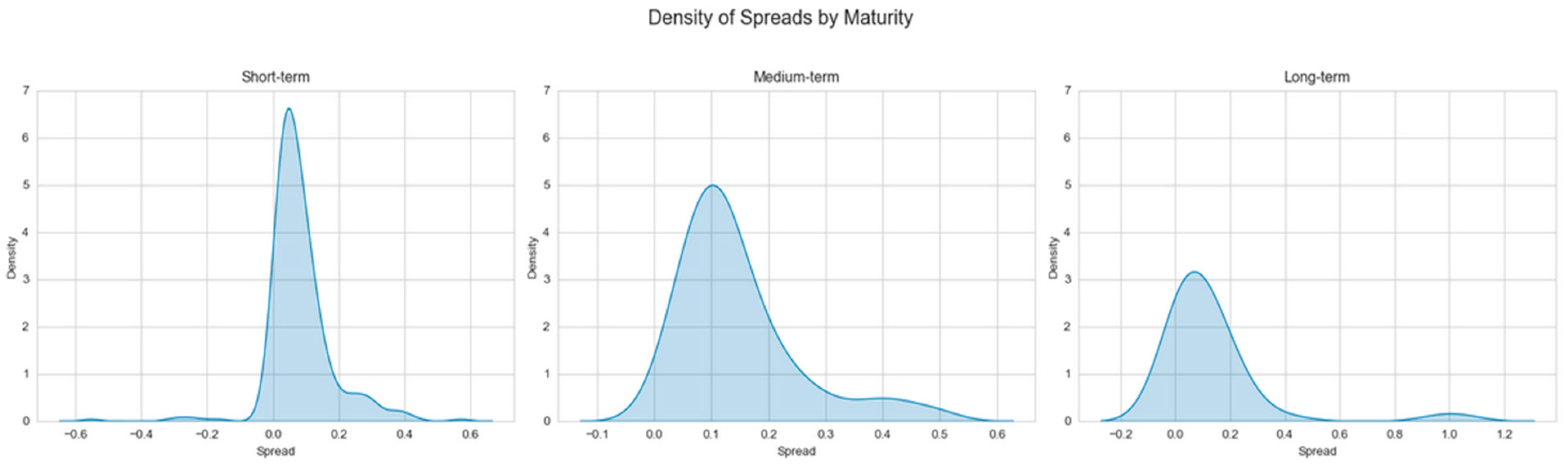
Figure 5 further decomposes these spreads by maturity segments, as defined in Table 1. The short-term auctions display a very tight, narrow distribution centered near zero, indicating relatively homogeneous bidding behavior. For medium-term maturities, the distribution becomes wider and slightly shifted toward positive values, reflecting greater dispersion in bidding strategies. Finally, the long-term segment shows a flatter and more dispersed pattern, with spreads extending over a broader range. This increasing dispersion with maturity may suggest that uncertainty and information-processing costs grow with horizon length, prompting greater heterogeneity in participants’ attention and pricing.
Overall, these results indicate that information inattention is not uniform across maturities: it is most pronounced in short-term auctions, where bidders anchor closely to policy signals, and somewhat weaker in longer-term ones, where the complexity of valuation and information asymmetries are higher.

4.2. Simulation Evidence

The simulation produces a clear attention-dispersion relationship. When attention to auction-specific demand is minimal ( λ close to 0), bidders effectively anchor on the public policy rate, and bid distributions remain tightly clustered. In this regime, the auction spread is small and stable (mean spread 0.115 ; IQR 0.026 ). As λ increases, bidders incorporate demand conditions more strongly, leading to greater heterogeneity in bids and wider spreads. For example, the mean spread increases to 0.137 at λ = 0.5 and to 0.182 at λ = 1.0 , while bid dispersion rises from 0.150   ( λ = 0 ) to 0.238   ( λ = 1.0 ) . Under high attention ( λ = 2.0 ), both spread magnitude and variability rise substantially (mean spread 0.296 ; IQR 0.231 ; bid dispersion 0.388 ). These results illustrate the theoretical mechanism underlying our empirical interpretation. We caution that the simulation assumes rational inattention by construction and therefore cannot serve as independent empirical support for the hypothesis-it is best understood as a visualization of the predicted relationship between attention and spread dynamics.
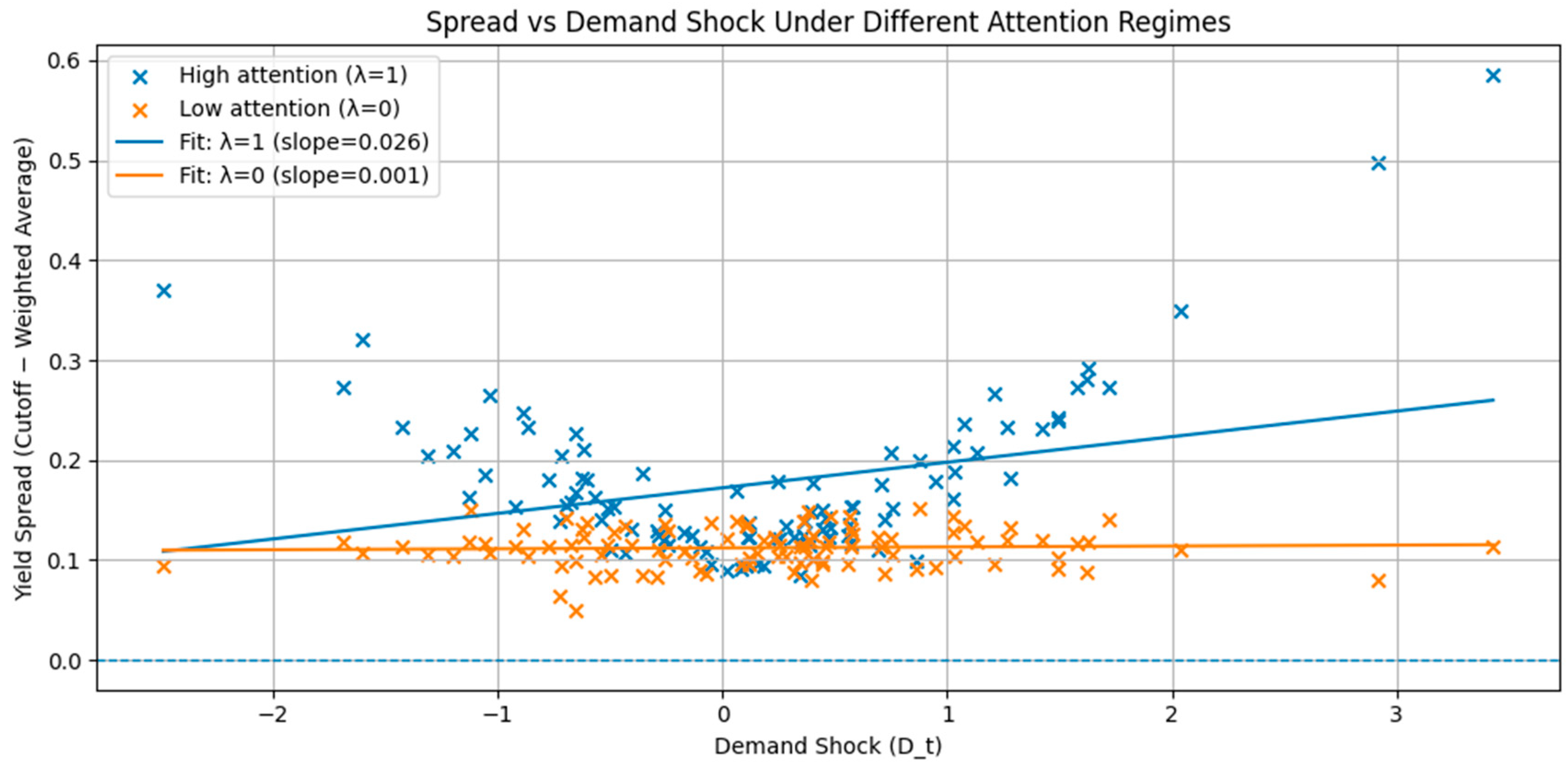
The behavior of the spreads as a result of demand shock in the two attention cases is shown by Figure 6. With regard to the case of high attention, the bidder takes into account both the policy interest rates and the demand, and this leads to heterogeneous bids and spread being proportional to demand shock. In the case of rational inattention, the bidders focus only on the policy interest rate, and thus spreads are small and constant.
Thus, the spread is more responsive to the nature of the informational process, which is consistent with our earlier theoretical predictions about the yield spread dynamics. Indeed, if market players exhibit rational inattention, then the spread is significantly smaller than in case of full information processing because in such situations, auction bids are anchored around some public benchmarks, e.g., the central bank policy rate. If, on the other hand, market participants engage in a more complete processing of available auction-related information, we observe larger spreads that fluctuate based on certain auction-specific factors such as demand conditions.
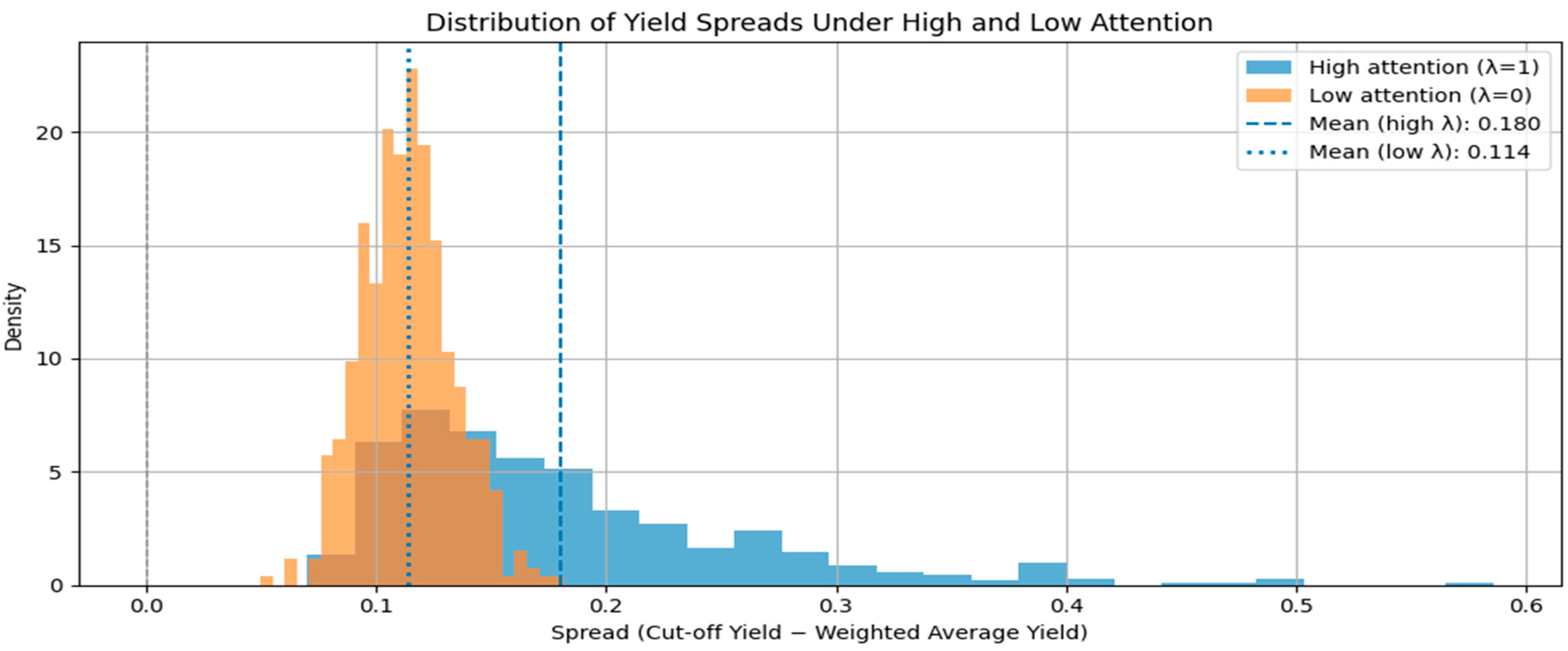
As can be seen from Figure 7, there are significant differences in terms of the simulated distribution of the yield spread. Specifically, if bidders pay less attention to demand information (λ ≈ 0), then their bids are mostly anchored to some common public policy rate. Thus, bid dispersion becomes quite small, which means that the auction spread also becomes smaller since the distribution of the difference between cut-off yields and the weighted average yield becomes more concentrated around zero. However, with an increase in bidders’ attention to demand information, they become more responsive to the relevant auction-related information included in the bids, which implies a more dispersed bid distribution and a relatively dispersed and right-skewed distribution of spreads at the same time. For relatively high levels of bidders’ attention to demand information (λ = 1 and λ = 2), auction spreads become larger and more dispersed.
In general, bidders’ attention to demand information leads to larger auction spreads. In contrast, when auction bids are mostly anchored to some common public benchmarks, spreads tend to be smaller.

5. Discussions

This study looks at the behavior of bidders at auctions of Armenian government bonds from the point of view of rational inattention, considering the spread between the cut-off yield and the weighted average yield as a reduced form measure of selective attention allocation. According to the empirical findings of this paper, the cut-off yield and weighted average yield at treasury auctions in Armenia are close to each other and close to the central bank policy rate. Besides, the gap between the two rates is compressed and largely insensitive to auction-specific demand fluctuations. That observation fits into the theoretical framework proposed by Sims (2003, 2006). When bidders pay relatively low attention to signals about specific demand conditions at auctions, their bid distributions are close to those seen in the data on Armenian treasury auctions. As argued by Maćkowiak et al. (2023), rational inattention models endogenize the information structure, therefore the anchoring behavior observed among auction participants is optimal given the cost of processing specific information. This paper makes an important contribution to the existing literature by showing that rational inattention model can work in a small emerging sovereign debt market.
Several alternative explanations for the observed pattern deserve consideration. Market concentration among a small number of primary dealers, liquidity constraints, and uniform-price auction rules could each independently compress yield spreads. First, market concentration would predict that spreads are stable regardless of demand conditions precisely because dealers coordinate on a common price-an outcome that is observationally equivalent to, and indeed a manifestation of, rational inattention in thin markets. The significant positive coefficient on offering amount in the regression suggests that auction size does influence spread dynamics, with larger auctions associated with wider spreads, consistent with greater heterogeneity in bidder valuations at higher issuance volumes. Third, the spread between the cut-off and the weighted average yield is still free to vary with the distribution of submitted bids, meaning the auction format alone cannot explain the consistently narrow spreads.

6. Conclusions

In conclusion, the results of this paper suggest that the difference between the cut-off yield and the weighted average yield is consistent with a reduced-form measure. The simulation results show that behavior consistent with rational inattention implies that when the weight assigned by bidders to demand information is low, bid distributions tend to be tight and the spread stays low.
It should be emphasized that this study is deliberately simplified in order to highlight the main mechanisms that underlie attention allocation effects on auction results. Future research could focus on generalizing this framework in several dimensions, including the consideration of more complex auction settings or structural identification of information-processing costs and attention allocation in financial markets. This may help understand better the implications of information-processing limitations in debt market operations. The findings of this paper have practical value. They imply that issuing debt instruments at the right time according to policy rate information may be more efficient in controlling financing costs than managing offering sizes.

Supplementary Materials

The codes and the data for the codes can be downloaded at: https://github.com/AlisaTanyan/Rational-inattention.git, accessed on 9 July 2026.

Author Contributions

Conceptualization, R.G.; methodology, R.G.; validation, A.T.; formal analysis, R.G. and A.T.; resources, A.T.; writing—review and editing, R.G. and A.T.; visualization, A.T. All authors have read and agreed to the published version of the manuscript.

Funding

This research received no external funding.

Institutional Review Board Statement

Not applicable.

Informed Consent Statement

Not applicable.

Data Availability Statement

Data is available at https://github.com/AlisaTanyan/Rational-inattention.git (accessed on 12 May 2026).

Acknowledgments

During the preparation of this article, the authors used Chat GPT, version GPT-5.5 for the purposes of text writing and interpretation of data. The authors have reviewed and edited the output and take full responsibility for the content of this publication.

Conflicts of Interest

The authors declare no conflicts of interest.

Abbreviations

The following abbreviations are used in this manuscript:
CBACentral Bank of Armenia
IQRInterquartile Range
OLSOrdinary Least Squares

Appendix A

Table A1. OLS Regression with Maturity Dummies.
Dependent Variable: SPREAD
Method: Least Squares
Date: 7 July 2026 Time: 18:39
Sample (adjusted): 2 421
Included observations: 420 after adjustments
VariableCoefficientStd. Errort-StatisticProb.
LOG(RELATIVE_DEMAND)−0.0624920.011166−5.5966690.0000
D(LOG(POLICY_RATE))0.5889690.2984351.9735210.0491
LOG(OFFERING)0.0270670.0074843.6165970.0003
DUMMEDIUM0.0113910.0197510.5767330.5644
DUMLONG0.0072040.0244930.2941040.7688
C−0.4627850.161365−2.8679340.0043
R-squared0.151207 Mean dependent var0.099304
Adjusted R-squared0.140956 S.D. dependent var0.120294
S.E. of regression0.111494 Akaike info criterion−1.535509
Sum squared resid5.146397 Schwarz criterion−1.477791
Log likelihood328.4570 Hannan-Quinn criter.−1.512697
F-statistic14.75033 Durbin-Watson stat1.590115
rob(F-statistic)0.000000

Note

1
Yield spreads were calculated as the difference between cut-off yields and weighted average yields.

References

  1. Almog, D., & Martin, D. (2024). Rational inattention in games: Experimental evidence. Experimental Economics, 27(4), 715–742. [Google Scholar] [CrossRef] [Scilit]
  2. Angeletos, G. M., & Sastry, K. A. (2025). Inattentive economies. Journal of Political Economy, 133(7), 2265–2319. [Google Scholar] [CrossRef] [Scilit]
  3. Atakan, A. E., & Ekmekci, M. (2024). The role of information in auctions. Journal of Mathematical Economics, 114, 103027. [Google Scholar] [CrossRef] [Scilit]
  4. Barbosa, K., De Silva, D. G., Yang, L., & Yoshimoto, H. (2022). Auction mechanisms and treasury revenue: Evidence from the Chinese experiment. American Economic Journal: Microeconomics, 14(4), 394–419. [Google Scholar] [CrossRef] [Scilit]
  5. Bordalo, P., Gennaioli, N., Ma, Y., & Shleifer, A. (2020). Overreaction in macroeconomic expectations. American Economic Review, 110(9), 2748–2782. [Google Scholar] [CrossRef] [Scilit]
  6. Caplin, A., & Dean, M. (2015). Revealed preference, rational inattention, and costly information acquisition. American Economic Review, 105(7), 2183–2203. [Google Scholar] [CrossRef] [Scilit]
  7. Caplin, A., Dean, M., & Leahy, J. (2019). Rational inattention, optimal consideration sets, and stochastic choice. Review of Economic Studies, 86(3), 1061–1094. [Google Scholar]
  8. Daher, W., & Damrah, S. (2024). Strategic competition between insiders with public information and overconfident market makers. Journal of Dynamics and Games, 16. [Google Scholar] [CrossRef] [Scilit]
  9. Engelbrecht-Wiggans, R., Milgrom, P. R., & Weber, R. J. (1983). Competitive bidding and proprietary information. Journal of Mathematical Economics, 11(2), 161–169. [Google Scholar] [CrossRef] [Scilit]
  10. Goldreich, D. (2007). Underpricing in discriminatory and uniform-price treasury auctions. Journal of Financial and Quantitative Analysis, 42(2), 443–466. [Google Scholar] [CrossRef] [Scilit]
  11. Habib, M. A., & Ziegler, A. (2007). Why government bonds are sold by auction and corporate bonds by posted-price selling. Journal of Financial Intermediation, 16(3), 343–367. [Google Scholar] [CrossRef] [Scilit]
  12. Hortaçsu, A., & McAdams, D. (2010). Mechanism choice and strategic bidding in divisible good auctions: An empirical analysis of the Turkish treasury auction market. Journal of Political Economy, 118(5), 833–865. [Google Scholar] [CrossRef] [Scilit]
  13. Jiao, P. (2024). Experiments on rational inattention. Social Science Research Network, 5027356. [Google Scholar] [CrossRef] [Scilit]
  14. Kim, K., & Koh, Y. (2022). Auctions with flexible information acquisition. Games and Economic Behavior, 133, 256–281. [Google Scholar] [CrossRef] [Scilit]
  15. Lee, J. H. (2024). Competitive bidding strategy in an auction with random cutoff—Randomness is always unpredictable? Computational Economics, 1–30. [Google Scholar] [CrossRef] [Scilit]
  16. Maćkowiak, B., Matějka, F., & Wiederholt, M. (2023). Rational inattention: A review. Journal of Economic Literature, 61(1), 226–273. [Google Scholar] [CrossRef] [Scilit]
  17. Matějka, F., & McKay, A. (2015). Rational inattention to discrete choices: A new foundation for the multinomial logit model. American Economic Review, 105(1), 272–298. [Google Scholar] [CrossRef] [Scilit]
  18. Milgrom, P. R., & Weber, R. J. (1982). A theory of auctions and competitive bidding. Econometrica, 50, 1089–1122. [Google Scholar] [CrossRef] [Scilit]
  19. Nyborg, K. G., Rydqvist, K., & Sundaresan, S. M. (2002). Bidder behavior in multiunit auctions: Evidence from Swedish treasury auctions. Journal of Political Economy, 110(2), 394–424. [Google Scholar] [CrossRef] [Scilit]
  20. Shui, Z. (2023). Rejection prices and an auctioneer with non-monotonic utility. International Journal of Game Theory, 52(3), 925–951. [Google Scholar] [CrossRef] [Scilit]
  21. Sims, C. A. (1998). Stickiness. In Carnegie-rochester conference series on public policy (Vol. 49, pp. 317–356). North-Holland. [Google Scholar]
  22. Sims, C. A. (2003). Implications of rational inattention. Journal of Monetary Economics, 50(3), 665–690. [Google Scholar] [CrossRef] [Scilit]
  23. Sims, C. A. (2006). Rational inattention: Beyond the linear-quadratic case. American Economic Review, 96(2), 158–163. [Google Scholar] [CrossRef] [Scilit]
  24. Sims, C. A. (2010). Rational inattention and monetary economics. In Handbook of monetary economics (Vol. 3, pp. 155–181). Elsevier. [Google Scholar]
Figure 1. Placement, offering, demand and relative demand volumes in the Armenian government bond market (January 2018 to December 2025). Source: https://minfin.am/en/page/summary_of_placement_and_buyback_auctions/ and authors’ calculations, accessed on 10 July 2026.
Jrfm 19 00532 g001
Figure 2. The relationship between relative demand and yield spreads over August 2017 to December 2025. Source: https://minfin.am/en/page/results_of_the_latest_issuances_/ and authors’ calculations, accessed on 10 July 2026.
Jrfm 19 00532 g002
Figure 3. Dynamics of policy rate and auction cut-off yields, % (January 2018 to December 2025). Source: https://old.cba.am/stat/stat_data_arm/8_policy_rates_arm.xlsx and author’s calculations, accessed on 10 July 2026.
Jrfm 19 00532 g003
Figure 4. Density function of spreads over August 2017 to December 2025.
Jrfm 19 00532 g004
Figure 5. Density function of yield spreads by maturities over August 2017 to December 2025.
Jrfm 19 00532 g005
Figure 6. Spread vs. Demand Shock for Rational and Inattentive Bidders.
Jrfm 19 00532 g006
Figure 7. Distribution of auction spreads under different attention regimes.
Jrfm 19 00532 g007
Table 1. Definition and Description of Variables.
VariableDefinitionUnitSample Period
Cut-off yieldThe highest accepted yield in a uniform-price auction.% per annumAugust 2017–December 2025
Weighted Average YieldThe demand-weighted mean yield of all accepted bids.% per annumAugust 2017–December 2025
Relative DemandRatio of total demand for bonds to the amount of bonds issued in the auction.RatioJanuary 2018–December 2025
Policy RateRefinancing rate% per annumJanuary 2018–December 2025
Note: All auctions follow a uniform-price rule. Auctions are classified into three maturity segments: short-term (≤1 year, n = 288), medium-term (1–5 years, n = 82) and long-term (>5 years, n = 51).
Table 2. The determinants of the yield spread: OLS estimates.
Dependent Variable: SPREAD
Method: Least Squares
Date: 29 June 2026 Time: 19:17
Sample (adjusted): 2 421
Included observations: 420 after adjustments
VariableCoefficientStd. Errort-StatisticProb.
LOG(RELATIVE_DEMAND)−0.0626800.010903−5.7487320.0000
D(LOG(POLICY_RATE))0.5853750.2970231.9708110.0494
LOG(OFFERING AMOUNT)0.0299730.0045516.5865040.0000
C−0.5239810.100537−5.2118310.0000
R-squared0.150520 Mean dependent var0.099304
Adjusted R-squared0.144394 S.D. dependent var0.120294
S.E. of regression0.111271 Akaike info criterion−1.544223
Sum squared resid5.150567 Schwarz criterion−1.505745
Log likelihood328.2869 Hannan-Quinn criter.−1.529015
F-statistic24.57037 Durbin-Watson stat1.590093
Prob(F-statistic)0.000000
Disclaimer/Publisher’s Note: The statements, opinions and data contained in all publications are solely those of the individual author(s) and contributor(s) and not of MDPI and/or the editor(s). MDPI and/or the editor(s) disclaim responsibility for any injury to people or property resulting from any ideas, methods, instructions or products referred to in the content.