1. Introduction
With the rapid advancement of a new wave of technological revolution and industrial transformation, artificial intelligence, as a representative technology of the new generation of information technologies, is profoundly reshaping firms’ production modes, management practices, and governance structures. At the national strategic level, “AI+” has been clearly identified as a key policy instrument for cultivating new quality productive forces and promoting high-quality development. In July 2017, the State Council issued the “Development Plan for the Next Generation of Artificial Intelligence,” which emphasized the need to “take the overall national development context into account, accurately assess global trends in artificial intelligence, identify key breakthroughs and priority areas, comprehensively strengthen the foundational capabilities for scientific and technological innovation, fully expand the depth and breadth of applications in key fields, and comprehensively enhance the level of intelligence in economic and social development as well as national defense applications.” Under this policy framework, AI has been endowed with a strategic role that goes beyond a purely technical tool, becoming a critical technological foundation for driving transformations in quality, efficiency, and growth momentum.
At the firm level, the application of AI is no longer limited to localized improvements in operational efficiency but increasingly triggers digital restructuring across production factors and business processes. On the one hand, the integration of AI into research and development, production, and supply chain management facilitates the transition from experience-driven operations to data-driven decision-making and from reactive responses to predictive management, thereby improving resource allocation efficiency and organizational resilience (
Song et al., 2024). On the other hand, AI encourages firms to undertake systematic adjustments in organizational structures, business processes, and governance mechanisms, promoting the transformation and upgrading of traditional industries while fostering new AI-native business models and emerging forms of economic activity. Through these processes, AI provides sustained momentum for achieving transformations in quality, efficiency, and growth dynamics. Therefore, in the broader context of high-quality development and industrial upgrading, examining how AI affects corporate internal governance systems has both important practical relevance and theoretical value.
Internal control is a process implemented by the board of directors, management, and other employees to provide reasonable assurance regarding the achievement of operational objectives, the reliability of financial reporting, and compliance with applicable laws and regulations (
Doyle et al., 2007). High-quality internal control helps mitigate agency conflicts, reduce operational risks, and enhance long-term firm value. Existing studies generally suggest that internal control quality is shaped by multiple factors, including the external institutional environment, corporate governance structures, and the characteristics of managers and employees. However, as business environments become increasingly complex and corporate processes become more digitally integrated, traditional internal control models that rely largely on human judgment and ex post monitoring are facing new challenges. Firms therefore increasingly rely on emerging technologies to enhance the effectiveness and adaptability of internal control systems. Against the backdrop of the widespread adoption of AI, an important question arises: whether and how AI influences corporate internal control quality.
Compared with many other countries, China possesses distinctive advantages in AI adoption, digital infrastructure development, and the implementation of AI technologies across industrial scenarios, providing a rich and representative context for examining the governance implications of AI (
H. Jiang & Murmann, 2022). Chinese A-share listed companies constitute a large and diverse sample across industries and have been actively advancing digital transformation and internal control system development (
Q. Wu et al., 2025;
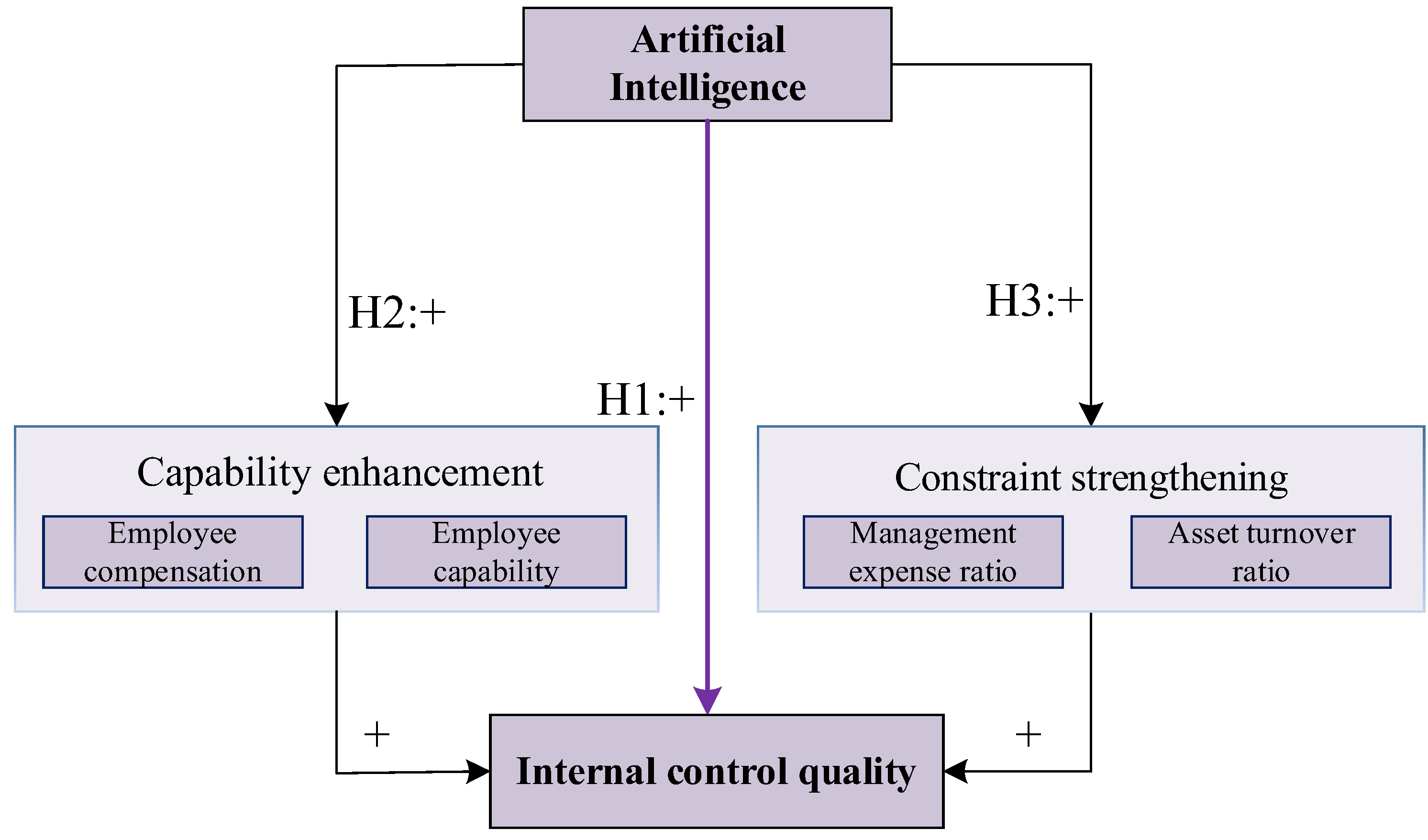
Xue & Jin, 2025). This setting offers a valuable opportunity to systematically identify the impact of AI on corporate internal control quality and its underlying mechanisms. Based on data from Chinese A-share listed companies from 2016 to 2024, this study examines how AI affects internal control quality and explores the mechanisms through which this effect occurs. The results show that AI significantly improves corporate internal control quality, and that the enhancement of human capital and the reduction in agency costs serve as important channels through which AI exerts this influence. Heterogeneity analysis further indicates that the positive effect of AI is more pronounced among manufacturing firms, firms with higher levels of information transparency, and firms operating in regions with more developed digital infrastructure.
Although some studies have begun to examine the relationship between AI and internal corporate governance,
Monteiro et al. (
2023) found that AI adoption intensity significantly improves the quality of internal control systems and further enhances accounting information system quality. However, their analysis is mainly based on survey data, and the authors explicitly note that the sample is based on convenience and non-probability sampling, which limits the external validity of their findings. Therefore, further evidence based on large-scale archival data is still needed to clarify whether AI can systematically improve internal control quality in broader firm settings. Against this background, this study makes three main contributions.
First, it extends the literature on the economic consequences of AI from the perspective of internal corporate governance. Existing studies primarily focus on the economic effects of AI in terms of resource allocation efficiency (
Czarnitzki et al., 2023;
Babina et al., 2024), operational risk (
Liu & Wang, 2025), corporate strategy (
Neiroukh et al., 2025;
Doshi et al., 2025), and macro-level outcomes such as industrial upgrading and international competitiveness (
Kumar et al., 2025). In contrast, relatively little attention has been paid to AI’s impact on institutional governance arrangements such as internal control systems. By linking AI with corporate internal control quality, this study deepens the understanding of how AI can promote high-quality development through governance mechanisms. In addition, compared with prior survey-based research, this study conducts empirical tests using a large sample of listed companies, offering broader sample coverage and greater robustness and generalizability.
Second, this study enriches the literature on the determinants of internal control quality. Prior research has examined the influence of macro-level factors such as institutional constraints and market supervision (
H. Chen et al., 2019), economic policy environments (
B. Zhang et al., 2025), and ownership structures (
Ong et al., 2024), as well as micro-level factors such as organizational structures and managerial capabilities (
Lisic et al., 2016;
Zhou & Liu, 2022). However, technological drivers such as AI have received relatively limited attention, despite their transformative role in the ongoing technological and industrial revolution. By examining the role of AI in shaping internal control quality, this study provides new insights into the technological determinants of corporate governance. Beyond systematically examining the effect of AI on internal control quality, this study further explores the underlying mechanisms, thereby providing a more detailed account of the pathways through which AI affects internal corporate governance.
Third, this study provides micro-level empirical evidence on how AI can enhance corporate governance and internal control systems. By identifying the mechanisms and heterogeneous effects through which AI improves internal control quality, the findings offer useful implications for policymakers seeking to refine “AI+” policies and for firms aiming to promote the coordinated upgrading of technological application and governance capacity. The results may also provide valuable references for other countries seeking to advance the application of AI in corporate governance.
7. Conclusions and Implications
7.1. Conclusions
Enhancing corporate governance capacity is a crucial foundation for promoting high-quality development, and the accelerated application of artificial intelligence (AI) provides a new technological pathway for optimizing internal governance structures and improving internal control quality. Using data from Chinese A-share listed companies from 2016 to 2024, this study systematically examines the impact of AI on corporate internal control quality and its underlying mechanisms. The main findings are as follows. First, AI significantly improves corporate internal control quality, and this conclusion remains robust after a series of robustness checks and endogeneity tests. Second, AI enhances internal control quality by promoting the upgrading of human capital structure and reducing agency costs. Third, the effect of AI on internal control quality exhibits significant heterogeneity, with stronger effects observed in manufacturing firms, firms with higher levels of digital infrastructure, and firms operating in environments with greater information transparency. Based on these findings, this study proposes policy and managerial implications on how firms can strengthen governance capacity to support high-quality development.
7.2. Implications for Policy and Practice
First, from the government perspective, the AI policy framework should be further improved to guide the deeper application of artificial intelligence in corporate governance and internal control. Current policies mainly focus on the role of AI in promoting industrial upgrading and technological innovation. In the future, institutional design should place greater emphasis on the governance functions of AI in areas such as risk prevention, compliance management, and internal supervision. By improving supporting regulations and incentive mechanisms, policymakers can encourage firms to integrate AI technologies with the construction of internal control systems, thereby promoting the coordinated development of new quality productive forces and the modernization of governance capacity.
Second, from the corporate perspective, the application of AI should be elevated from a tool for improving operational efficiency to an important driver of internal governance optimization. In the process of intelligent transformation, firms should embed AI into key management processes such as budgeting, internal auditing, risk identification, and process control, thereby enhancing the timeliness, precision, and traceability of internal control through data-driven and intelligent analysis. At the same time, firms should promote adjustments in organizational structures and management models and strengthen human–machine collaboration, avoiding an overemphasis on technology while neglecting governance, to fully realize the institutional benefits of AI for improving internal control quality.
Third, greater attention should be paid to the supporting role of digital infrastructure and human capital in enabling the governance effects of AI. The results show that the improvement in internal control quality driven by AI is more pronounced in firms with stronger digital infrastructure, indicating that the governance effect of AI exhibits certain threshold characteristics. Governments and firms should therefore increase coordinated investment in digital infrastructure and AI-related talent development. By strengthening data governance capabilities, algorithm application capabilities, and the digital literacy of managers, a solid foundation can be established for AI to effectively empower internal control systems.
Fourth, while promoting the application of AI, it is also important to address the potential governance risks associated with technology and ensure the coordinated development of technological application and institutional regulation. Although AI can improve the efficiency of internal control, it may also introduce new challenges, such as algorithmic opacity, data compliance issues, and unclear accountability. Regulators and firms should therefore improve internal accountability mechanisms and risk assessment systems alongside the adoption of AI technologies, ensuring that AI operates within a framework that is secure, controllable, and explainable, thereby achieving a balance between efficiency improvement and risk prevention.
7.3. Limitations and Future Research
Despite providing new evidence on the relationship between artificial intelligence (AI) and corporate internal control quality, this study has several limitations that suggest directions for future research.
First, this study uses AI patents as a proxy for firm-level AI adoption. Although AI patents can reflect firms’ technological accumulation and innovation activities related to artificial intelligence, they may not fully capture the actual extent to which AI technologies are adopted and embedded in firms’ daily operations, management processes, and internal control systems. Some firms may adopt AI through external procurement, cloud-based platforms, software services, or cooperation with technology providers without generating AI patents. Conversely, some AI patents may reflect technological reserves rather than actual business application. Therefore, the measurement of AI adoption in this study may not fully capture the intensity, depth, and specific scenarios of firm-level AI use. Future research could address this limitation by constructing more comprehensive and multidimensional measures of AI adoption. For example, researchers may combine AI patent data with textual information from annual reports, AI-related software investment, digital technology expenditure, AI-related job postings, procurement data, survey data, or case-based evidence. Such measures would help distinguish between AI innovation, AI adoption, and AI application intensity, and would provide a more accurate understanding of how AI is integrated into corporate governance and internal control processes.
Second, the sample of this study is limited to Chinese A-share listed companies. Listed firms generally possess stronger governance structures, better information disclosure, and more abundant technological resources than small and medium-sized enterprises (SMEs). Therefore, the findings of this study may have limited applicability to non-listed firms or SMEs. Future research could incorporate data from non-listed firms to provide a more comprehensive understanding of how AI affects internal control across different types of enterprises.
Finally, the analysis is confined to the Chinese. China has a unique stage of digital transformation, which may influence both the adoption of AI and the functioning of internal control systems. As a result, the conclusions drawn in this study may not be directly generalized to other countries. Future studies could extend this research framework to firms operating in different institutional and economic environments in order to conduct cross-country comparisons and examine whether the governance effects of AI vary across contexts.



_Zheng.png)