1. Introduction
Digital transformation has emerged as a central driver of financial efficiency, operational resilience, and competitive performance across both developed and transition economies (
Okuyan, 2022;
Rosak-Szyrocka & Wolniak, 2025). In rural and structurally fragmented economic systems, where firms frequently operate under infrastructural constraints, weak institutional coordination, and fragmented value chains, digitalisation is increasingly promoted as a strategic instrument to improve productivity, organisational responsiveness, and long-term economic sustainability (
Siatan et al., 2024;
Sunel & Grundke, 2025).
Despite its growing relevance, the empirical literature remains fragmented in theory and methodologically inconsistent in assessing the extent to which digital transformation generates measurable financial and economic returns.
A substantial proportion of existing studies continues to assume a predominantly linear relationship between digital adoption and firm performance, implicitly suggesting that technological investments automatically translate into proportional productivity gains and financial improvements. Such assumptions may be insufficient in transition and rural economies characterised by heterogeneous organisational capacities, limited absorptive capabilities, and uneven integration structures (
Hamilton et al., 2025;
Rustiadi et al., 2023). Under these conditions, digital technologies may yield only marginal economic benefits when firms lack the coordination mechanisms and organisational embeddedness needed to convert technological adoption into operational and financial efficiency. Consequently, digital transformation may function less as an autonomous productivity driver and more as a structurally conditioned coordination mechanism, with effectiveness fundamentally dependent on broader integration capacities (
Trippl et al., 2024).
Recent theoretical and empirical developments increasingly support this coordination-based interpretation of digital transformation. Emerging evidence from rural, agricultural, and agritourism systems suggests that the economic and financial benefits of digitalisation arise primarily from enhanced supply chain integration, organisational synchronisation, stakeholder coordination, and inter-organisational connectivity, rather than from technological adoption alone (
Golinska-Dawson et al., 2023;
Safarov et al., 2024). Firms that integrate suppliers, operational processes, and market interactions more efficiently appear substantially more likely to translate digital capabilities into superior financial performance, more efficient resource allocation, and greater organisational resilience (
Cumming et al., 2013;
Trippl et al., 2024).
These observations imply the presence of threshold-dependent and regime-specific dynamics. In structurally weak environments with low socio-economic integration, digitalisation tends to remain fragmented and economically inefficient, yielding limited productivity and financial returns. By contrast, once firms exceed critical levels of organisational embeddedness and coordination capacity, digital technologies may operate within more coherent, financially productive organisational systems, substantially enhancing operational efficiency, market responsiveness, and strategic adaptability. Similar threshold-like development dynamics have been observed in studies of structural transformation, regional resilience, and diversification processes, where benefits tend to emerge only after certain institutional and organisational capacities are achieved (
Saviotti, 2020;
Trippl et al., 2024;
Hamilton et al., 2025). The financial and economic returns of digital transformation may therefore intensify considerably after specific structural thresholds are surpassed.
Despite the growing importance of these dynamics, empirical studies explicitly examining threshold relationships between integration mechanisms and financial–economic performance remain scarce, particularly in rural transition economies. Existing research has predominantly focused either on the direct linear effects of digitalisation or on mediation frameworks that link technology adoption to organisational performance. By comparison, relatively little attention has been devoted to the possibility that digital integration becomes economically productive only when structural and coordination conditions are sufficiently developed.
Against this background, the present study investigates the threshold relationship between supply chain integration and financial and economic performance in the context of digital transformation, using a threshold regression framework.
Northern Albania represents a rural transition context characterised by structural transformation, fragmented agricultural systems, and increasing reliance on tourism. Despite recent development efforts, rural areas continue to face challenges related to competitiveness, infrastructure, and uneven digital adoption among small enterprises (
Zhllima et al., 2022;
Uku et al., 2026). These conditions make the region a suitable setting for examining how supply chain integration influences the financial and economic returns of digital transformation (
Baraku et al., 2026).
Drawing on firm-level evidence from rural Northern Albania and complementary macro-level evidence from Western Balkan economies, the study advances a managerial-financial and coordination-based interpretation of digital transformation. By integrating threshold econometrics, organisational coordination theory, and structural embeddedness perspectives, the study contributes to the broader literature by demonstrating that the financial and economic impacts of digitalisation depend fundamentally on integration efficiency, organisational coordination capacity, and socio-economic embeddedness, rather than on technological diffusion alone. Rural Northern Albania provides a particularly relevant setting because it combines characteristics commonly associated with Western Balkan transition economies, including structural transformation, fragmented rural production systems, growing dependence on tourism, and uneven digital development (
Kristo, 2014;
Burucs, 2025;
Živković et al., 2025).
Table 1 positions Northern Albania within the broader landscape of Western Balkan rural transition economies. Rather than representing a unique or exceptional case, the region reflects many of the structural conditions that characterise rural development across the Western Balkans, including economic restructuring, coordination challenges, and uneven integration processes. This comparative positioning strengthens the external relevance of the study and supports the broader applicability of the proposed threshold framework beyond the Albanian context. Consequently, the findings may provide insights for other rural transition economies facing similar challenges in leveraging digital transformation and supply chain integration to improve financial and economic performance.
2. Literature Review
2.1. Digitalisation and Economic Performance
Digitalisation increasingly serves as a strategic driver of operational efficiency, financial performance, and competitive restructuring across both developed and emerging economies. In rural and institutionally fragmented regions, digital technologies are widely regarded as tools for improving market connectivity, supply chain coordination, and organisational productivity (
Ivanov et al., 2019;
Dolgui & Ivanov, 2021;
Lioutas & Charatsari, 2021). Existing research generally reports positive associations between digitalisation and economic performance, driven by enhanced information flows, operational synchronisation, and integration capacity (
Verdouw et al., 2021;
Deng et al., 2024).
The literature remains fragmented in its theoretical understanding of the mechanisms by which digital transformation yields measurable financial and economic returns. Most studies continue to assume relatively homogeneous and linear effects of digitalisation across firms and economic systems. Recent evidence, by contrast, suggests that the performance effects of digitalisation are highly conditional on organisational coordination capacity, absorptive capabilities, and broader structural conditions (
Kamble et al., 2020;
Deng et al., 2024). Firms with weak integration structures and limited coordination efficiency frequently struggle to translate digital investments into tangible productivity and financial gains, suggesting that digitalisation alone may be insufficient to sustain improvements in economic performance.
These benefits are not uniformly distributed across firms and regions, as they depend on institutional quality, resource availability, and firms’ capacity to absorb and utilise digital innovations effectively (
Okuyan, 2022;
Trippl et al., 2024). In rural and peripheral regions, digital transformation is increasingly viewed as a mechanism supporting long-term competitiveness and adaptive development rather than merely technological modernisation (
Sunel & Grundke, 2025).
Early digital transformation research largely assumed direct and homogeneous performance effects. More recent perspectives emphasise coordination, integration, and organisational capabilities as key mechanisms through which digital technologies generate value, leading to context-dependent and heterogeneous economic outcomes (
Kamble et al., 2020;
Golinska-Dawson et al., 2023;
Trippl et al., 2024).
2.2. Digitalisation, Integration, and Coordination Mechanisms
Recent research increasingly argues that the economic and financial benefits of digital transformation arise primarily from coordination and integration mechanisms rather than technological adoption alone. Digitalisation functions less as an autonomous productivity driver and more as a coordination-enabling infrastructure that supports organisational synchronisation, supply chain efficiency, and operational resilience (
Golinska-Dawson et al., 2023). Similarly, resilience-based perspectives emphasise that digital capabilities become economically productive when embedded within coordinated organisational systems capable of adapting to structural change and external shocks (
Trippl et al., 2024;
Cumming et al., 2013).
This perspective is particularly relevant in rural and agritourism economies, where fragmented value chains and weak institutional coordination frequently constrain firms’ ability to convert digital investments into measurable productivity and financial gains. From a broader systems perspective, coordination mechanisms also strengthen adaptive capacity and resilience by reducing structural mismatches among interconnected stakeholders (
Cumming et al., 2013).
2.3. Threshold Dynamics and Regime-Dependent Effects
The assumption of homogeneous linear effects has been increasingly challenged in contemporary economic and financial research (
Acemoglu et al., 2005). Threshold models show that economic relationships often vary across structural regimes and intensify once critical thresholds are surpassed. Prior studies show that growth dynamics are strongly conditioned by factors such as institutional quality, financial development, and structural capacity (
M. S. Khan & Senhadji, 2001;
Law & Singh, 2014). Applying this perspective to digital transformation is particularly relevant in rural and transition economies, where fragmented coordination and weak organisational integration often constrain firms’ ability to realise financial and productivity gains from digital investments. Consequently, the economic effects of digitalisation are likely to remain regime-dependent and structurally threshold. Economic development is often characterised by regime-dependent transitions, with the benefits of structural change becoming evident only after critical organisational and institutional thresholds are surpassed (
Saviotti, 2020;
Hamilton et al., 2025). This provides a theoretical rationale for threshold-based analyses of digital transformation and firm performance.
2.4. Rural Transition Economies and Structural Heterogeneity
The threshold dynamics of digital transformation are particularly pronounced in transition economies such as the Western Balkans, where rural firms frequently operate under infrastructural constraints, fragmented supply chains, institutional instability, and uneven technological capabilities (
Dolgui & Ivanov, 2021;
Ferrari et al., 2022;
Ndhlovu & Dube, 2024). This structural heterogeneity substantially shapes firms’ ability to translate digital investments into operational efficiency and financial performance gains (
Ivona et al., 2021).
While some firms operate within relatively integrated and collaborative economic systems, others remain embedded in fragmented environments marked by weak coordination and limited connectivity (
Kyriakopoulos, 2024;
A. Khan et al., 2020;
Shah, 2025). Consequently, the economic effects of digitalisation are unlikely to be uniform across firms, rendering conventional linear models insufficient to capture the structural complexity of digital transformation. Threshold regression frameworks, therefore, offer a more appropriate analytical approach for identifying regime-dependent integration and performance dynamics.
The Western Balkans represent a suitable context for examining digital transformation due to ongoing structural transformation, regional disparities, and heterogeneous digital capacities. These conditions generate substantial variation in firms’ integration capabilities and, consequently, in the economic returns of digitalisation (
Burucs, 2025;
Rustiadi et al., 2023;
Sudaryanto et al., 2023).
2.5. Financial Efficiency and Managerial Coordination Under Digital Transformation
Recent literature increasingly emphasises that the economic and financial value of digital transformation extends beyond technological adoption and depends fundamentally on the efficiency of managerial coordination and organisational integration.
From a managerial finance perspective, digitalisation may enhance firm performance by lowering coordination costs, improving resource allocation, increasing operational predictability, and strengthening organisational resilience.
Supply chain integration, therefore, serves not only as an operational mechanism but also as a strategic coordination structure that can improve financial efficiency and reduce transaction inefficiencies (
Ivanov et al., 2019;
Jing & Fan, 2024). These dynamics are particularly relevant in rural and transition economies, where fragmented value chains and institutional constraints frequently limit firms’ ability to convert digital investments into sustainable financial and economic returns. Stronger collaborative networks enhance organisational resilience, operational flexibility, and financial sustainability, particularly under conditions of structural change (
Trippl et al., 2024;
Cumming et al., 2013).
2.6. Research Gap and Theoretical Positioning
Despite the expanding literature on digital transformation and firm performance, important theoretical and empirical gaps remain. Existing studies predominantly rely on linear frameworks that assume homogeneous effects of digitalisation across firms, while threshold relationships between integration mechanisms and financial–economic performance remain comparatively underexplored. Moreover, research has largely focused on developed economies and industrial sectors, leaving rural and transition economies insufficiently examined. Current literature rarely integrates digitalisation, organisational embeddedness, and supply chain coordination within a unified threshold-based framework. Against this background, the present study applies a threshold regression approach to investigate whether the economic and financial returns of digital transformation intensify only after firms surpass critical levels of organisational integration and socio-economic embeddedness. Despite growing research on rural revitalisation and agritourism development, little attention has been paid to whether the performance effects of digital transformation depend on organisational or socio-economic integration thresholds (
Cheer, 2024;
Funduk et al., 2024;
Safarov et al., 2024;
Živković et al., 2025). As a result, regime-dependent digital performance remains underexplored.
2.7. Conceptual Framework
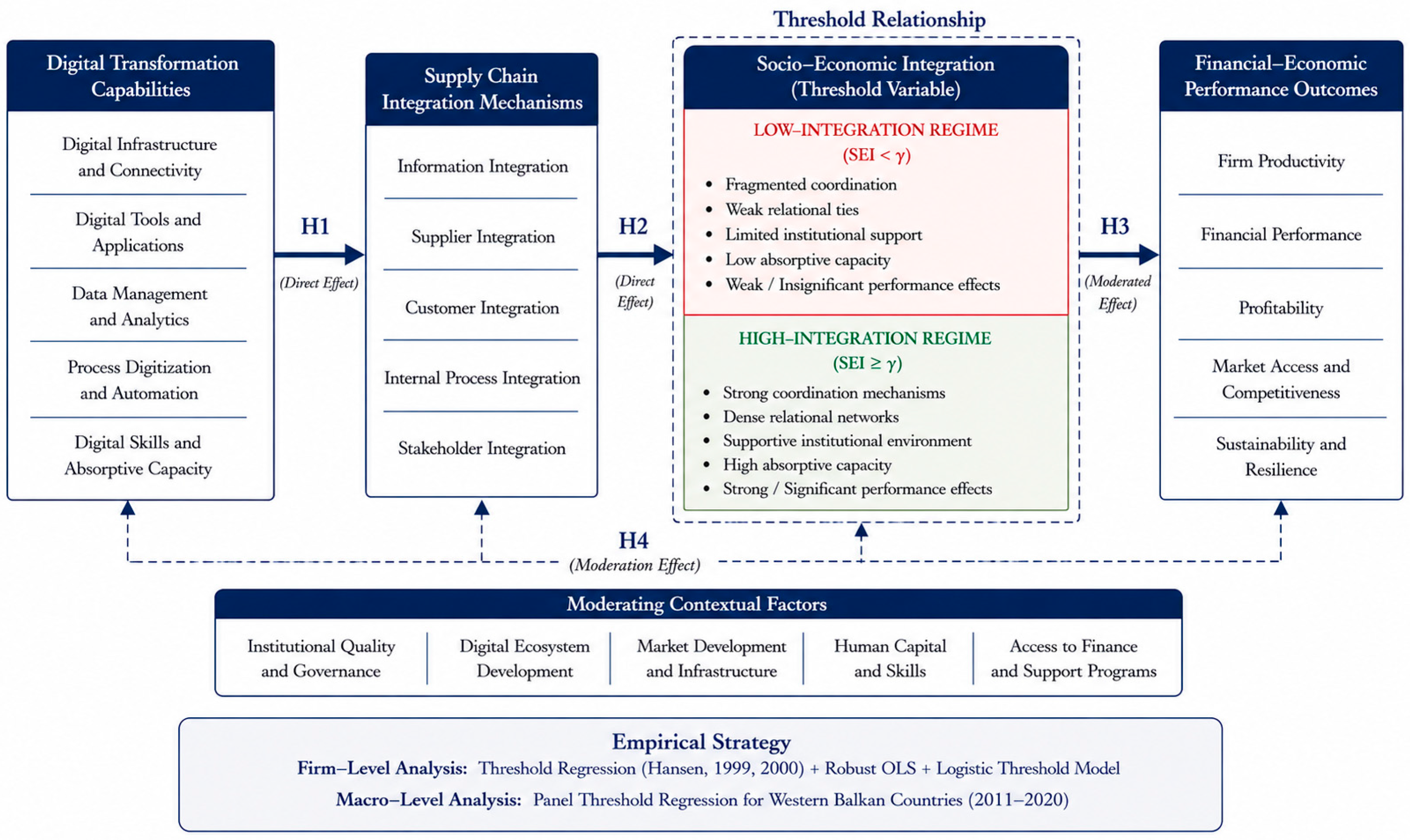
The conceptual framework conceptualises digital transformation as a threshold-based coordination mechanism that shapes firm-level financial and economic performance. Rather than generating homogeneous productivity gains, the framework assumes that the financial effects of digitalisation depend on firms’ levels of organisational integration, cooperative effectiveness, and socio-economic embeddedness. In structurally fragmented environments, digital adoption is expected to yield limited operational and financial benefits because of weak integration capacity and inefficient coordination structures. Conversely, once firms surpass critical integration thresholds, digital technologies become substantially more effective at improving operational synchronisation, transaction-cost efficiency, resource allocation, and financial resilience.
The framework, therefore, positions supply chain integration and organisational coordination as the primary mechanisms through which digital transformation generates sustainable managerial and financial performance outcomes within rural and transition economies.
Figure 1 illustrates the proposed threshold-based coordination framework linking digital transformation, supply chain integration, and financial–economic performance.
Conceptually, the study proposes the following threshold-dependent relationship: digital transformation influences financial–economic performance through supply chain integration, with the strength of this relationship conditioned by socio-economic integration:
According to this specification, the impact of digitalisation is expected to vary across low- and high-adoption regimes. Consequently, the framework enables the detection of structural shifts in the relationship between digitalisation and performance, offering clearer insight into how digital transformation operates in rural and transition economies.
Drawing upon the threshold framework, the study addresses the following research questions:
RQ1: Under which structural conditions does digital transformation, through supply chain integration, generate measurable financial and economic performance gains in rural firms?
RQ2: Does the relationship between supply chain integration under digital transformation and firm performance exhibit threshold and regime-dependent dynamics?
RQ3: Is there a critical socio-economic integration threshold beyond which digital integration becomes financially and operationally productive?
RQ4: How do supply chain integration and organisational coordination mechanisms shape the effectiveness of digital transformation in rural transition economies?
Building on the preceding literature, the economic value of digital transformation is increasingly understood as contingent upon firms’ integration capacity and organisational context.
Empirical studies have shown that digital technologies generate stronger performance gains when accompanied by higher levels of supply chain integration, organisational coordination, and digital maturity (
Kamble et al., 2020;
Golinska-Dawson et al., 2023). As a result, the performance effects of digitalisation may differ across structural regimes, suggesting the existence of threshold-dependent dynamics. These arguments provide the conceptual basis for the hypotheses developed below. The hypotheses are developed to provide empirical tests of the four research questions, linking digital transformation, organisational integration, and threshold-dependent performance dynamics within a unified analytical framework.
H1. Digital transformation positively influences firms’ financial and economic performance through enhanced supply chain integration and organisational coordination.
H2. The relationship between supply chain integration under digital transformation and financial–economic performance exhibits threshold-dependent effects across organisational and socio-economic regimes.
H3. A critical threshold of organisational and socio-economic integration exists beyond which the financial and operational effects of digital transformation intensify significantly.
H4. The financial and economic benefits of digital transformation become substantially stronger in firms characterised by higher levels of supply chain integration, coordination efficiency, and socio-economic embeddedness.
3. Materials and Methods
The empirical analysis draws on firm-level data collected from 80 agricultural, agritourism, and tourism-related businesses operating in rural Northern Albania, across the mountain regions, including Theth, Valbonë, Vermosh, Lepushë, Bogë, Tamarë, Razëm, Çerem, Dedaj, Dragobi, Lekbibaj, Reç, and Selcë. The final sample represents approximately 74.8% of the identified study population (107 active firms), providing a high level of population coverage and a robust basis for analysing digital transformation, organisational integration, and financial–economic performance in a rural transition context for examining threshold dynamics.
Given the relatively small population size and the objective of maximising coverage, a purposive population-based sampling approach was employed, targeting all eligible firms operating within the study area.
Participation was voluntary, and observations with incomplete information were excluded from the final analytical sample. The sample shows substantial variation in digital adoption, organisational integration, and coordination capacity, providing an appropriate setting for threshold and regime-based analysis.
The research design combines descriptive, threshold, and logistic modelling techniques to address the four research questions. RQ1 is examined through threshold and logistic regression models linking supply chain integration to financial–economic performance. RQ2 and RQ3 are addressed through threshold estimation procedures that identify regime-dependent effects and critical socio-economic integration thresholds. RQ4 is examined through additional diagnostic analyses evaluating the role of supply chain integration, stakeholder engagement, and coordination mechanisms in shaping the effectiveness of digital transformation.
Northern Albania was selected because it exhibits key characteristics commonly associated with rural transition economies, including structural transformation, fragmented value chains, tourism expansion, and heterogeneous digital development (
Burucs, 2025;
Hamilton et al., 2025). A single regional setting was used to ensure consistency and comparability across firms.
The study relies on cross-sectional firm-level survey data. Primary data were obtained through structured questionnaires administered directly to business owners and managers during field visits. The survey captured information on digitalisation practices, supply chain integration, socio-economic integration, stakeholder engagement, collaboration intensity, and financial–economic performance. Following data collection, responses were screened for completeness and consistency, and observations with missing or unreliable information were excluded from the final analytical sample.
The dependent variable, financial and economic performance (FP), is specified as a binary indicator of firms’ ability to achieve superior operational and organisational outcomes under digital transformation. The variable distinguishes firms exhibiting higher levels of performance from those characterised by lower performance outcomes, capturing variation in productivity, operational efficiency, and coordination effectiveness across comparable rural environments. The principal explanatory variable is supply chain integration (SCI), constructed from survey indicators measuring coordination intensity, information exchange, operational synchronisation, and inter-organisational integration capacity across business activities. The threshold variable, socio-economic integration (SEI), is derived from indicators capturing firms’ degree of structural embeddedness within local economic and organisational networks, collaborative relationships, and market integration. Additional controls include stakeholder engagement (SE), measuring firms’ participation in local coordination and development processes, and collaboration intensity (CI), both included to account for heterogeneity in coordination structures and inter-organisational interactions across firms. Together, these variables account for heterogeneity in organisational coordination structures and structural conditions affecting digital transformation outcomes.
The analytical strategy was implemented sequentially to address the four research questions. First, descriptive statistics were used to assess variation in integration and performance indicators across firms. Second, threshold estimation procedures were employed to identify the critical socio-economic integration level and define structural regimes. Third, threshold OLS and logistic regression models were estimated to evaluate regime-dependent performance effects. Finally, marginal effects, predicted probabilities, classification diagnostics, and complementary macro-level analyses were used to assess the robustness, predictive validity, and broader applicability of the identified threshold mechanism.
3.1. Econometric Framework: Threshold Regression Approach
To examine regime-dependent performance dynamics, the study employs
Hansen’s (
1999,
2000) threshold regression methodology. Threshold models are particularly appropriate when the relationship between integration mechanisms and financial–economic performance is expected to vary across distinct structural regimes. Unlike conventional linear specifications, threshold estimation allows regression coefficients to change endogenously once observations exceed a critical threshold, thereby capturing structural heterogeneity and threshold adjustment dynamics.
The approach is theoretically justified because the financial and operational effects of digital integration are unlikely to be uniform across firms. Businesses with weak socio-economic embeddedness and fragmented coordination structures may realise limited returns on digital investments, whereas firms operating within more integrated organisational environments are expected to achieve substantially stronger productivity, operational synchronisation, and financial performance.
3.2. Model Specification
The baseline threshold specification is expressed as follows:
where:
denotes firm-level economic performance;
represents supply chain integration;
is the socio-economic integration threshold variable;
denotes the estimated threshold value;
represents the regime indicator function;
is the vector of control variables;
is the stochastic error term.
Under this specification, the coefficient captures the effect of supply chain integration within the low-integration regime, while measures the effect within the high-integration regime.
The principal objective is to test whether:
which would indicate the presence of regime-dependent effects and structural heterogeneity in the integration–performance relationship.
3.3. Threshold Estimation Procedure
The threshold value (
) is estimated endogenously via a grid-search procedure that minimises the residual sum of squares (RSS). Following
Hansen (
1999), the procedure evaluates all admissible threshold values within a predefined interval and selects the value that yields the best model fit.
The estimation process classifies observations into low- and high-regime groups using the estimated threshold and then estimates separate slope coefficients for each group. This enables the model to detect structural changes in how supply chain integration affects different levels of socio-economic embeddedness.
To ensure robust statistical inference, heteroskedasticity-consistent (HC1) standard errors are used throughout the estimation procedure. This adjustment reduces potential bias arising from heteroskedastic disturbances commonly observed in firm-level datasets.
In addition to the standard threshold OLS model, the study estimates threshold logistic regression models because the dependent variable is binary. This logistic approach provides a probabilistic interpretation of firm performance and allows analysis of how integration effects vary across socio-economic regimes.
The logistic threshold model is specified as:
where
and
represent regime-specific integration variables constructed according to the estimated threshold value.
3.4. Additional Financial and Regime Diagnostic Specification
To further assess the financial and managerial implications of the estimated threshold effects, additional regime-based diagnostic models were estimated in R using logistic marginal effects and predicted-probability specifications. The extended specification evaluates how supply chain integration affects the probability of achieving higher financial and economic performance across different socio-economic integration regimes.
The additional probabilistic specification is expressed as:
where:
denotes the probability of achieving higher financial and economic performance;
and represent regime-specific supply chain integration effects below and above the estimated threshold;
denotes the vector of control variables;
represents the intercept term;
captures the effects of additional explanatory variables.
To complement the threshold estimates, marginal effects and regime-specific predicted probabilities were also estimated to assess how integration intensity and socio-economic embeddedness affect operational efficiency, organisational coordination, and financial performance across different structural regimes. This complementary diagnostic approach enhances the managerial-financial interpretation of the threshold framework and strengthens the robustness of the empirical analysis. The binary performance indicator captures broader firm-level financial and economic outcomes related to operational efficiency, productivity improvements, coordination effectiveness, and organisational performance during digital transformation.
3.5. Additional Macro-Level Financial and Regime Diagnostic Specification
To further assess the structural and financial implications of digital transformation at the regional level, additional regime-based diagnostics were estimated using threshold-interaction and predicted-response specifications, implemented in R. The extended macro-level framework examines whether the economic contribution of digitalisation varies across structural digitalisation regimes within Western Balkan economies.
The complementary macro-level specification is expressed as:
where:
denotes gross domestic product per capita;
and represent digitalisation effects below and above the estimated threshold level;
denotes tourism receipts;
represents agricultural value added;
captures lagged economic persistence effects;
denotes country-specific structural effects;
represents the stochastic error term.
Additional regime diagnostics, marginal response estimates, and predicted structural effects were computed to assess how digital penetration interacts with sectoral integration and structural coordination across digitalisation regimes. This complementary specification enhances the financial and managerial interpretation of the macro-level threshold analysis by identifying whether digital transformation contributes to greater economic efficiency and regional performance under different structural conditions.
3.6. Robustness and Model Validity
Several procedures were implemented to strengthen the robustness, financial interpretation, and econometric validity of the empirical estimates.
First, control variables capturing stakeholder engagement and collaboration intensity were included to reduce omitted-variable bias and account for structural heterogeneity across firms.
Second, heteroskedasticity-consistent HC1 robust standard errors were used to improve the reliability of inference for threshold cross-sectional estimates characterised by heterogeneous organisational structures and uneven operational efficiency. Third, complementary macro-level threshold estimates were conducted using Western Balkan panel data to assess whether the identified threshold-based coordination dynamics persist across broader regional economic systems.
Additional diagnostics, including marginal effects, predicted probabilities, classification performance indicators, and regime-based estimates, implemented in R, were used to reinforce the managerial-financial interpretation of the threshold framework.
The threshold specification itself enhances model validity by explicitly accommodating coefficient heterogeneity across structural regimes, rather than imposing homogeneous linear performance effects across firms. Nevertheless, the findings should be interpreted primarily as evidence of regime-dependent associations between financial and organisational performance, rather than as definitive causal relationships. Given the cross-sectional nature of the dataset, potential endogeneity and reverse causality cannot be fully ruled out. Future research may therefore benefit from dynamic, threshold panel approaches and longitudinal specifications of financial performance to strengthen causal identification.
4. Results
The descriptive statistics reveal substantial heterogeneity across firms in socio-economic embeddedness, coordination intensity, and organisational integration, providing empirical justification for the application of threshold estimation techniques. The final sample comprises 80 firms operating within rural economic systems characterised by varying levels of digital integration and collaborative coordination. The dependent variable, financial and economic performance (FP), has a mean of 0.375, indicating that approximately 37.5% of firms achieved higher operational and performance outcomes under the binary specification. Supply chain integration (SCI) shows considerable variation across observations (Mean = 0.245; SD = 0.405), reflecting substantial differences in coordination efficiency and operational synchronisation among firms. Similarly, socio-economic integration (SEI) exhibits notable dispersion (Mean = 0.097; SD = 0.466), suggesting heterogeneous levels of organisational embeddedness and structural connectivity. Stakeholder engagement (SE) shows a relatively high mean (Mean = 0.688), although significant variation persists across firms. The Collaboration Index (CI) displays a moderate average value (Mean = 0.490), indicating that cooperative relationships and inter-organisational linkages are present across the sample, although their intensity varies considerably among firms.
The descriptive statistics presented in
Table 2 reveal substantial heterogeneity across firms in socio-economic embeddedness, coordination intensity, and integration capacity.
Overall, the descriptive evidence indicates the presence of structurally differentiated organisational regimes rather than homogeneous, linear performance dynamics.
This heterogeneity provides preliminary support for the threshold framework. It suggests that the financial and economic effects of supply chain integration are likely to vary across levels of organisational coordination and socio-economic embeddedness.
4.1. Threshold Estimation
The threshold estimation procedure was first used to identify the critical socio-economic integration threshold and then to evaluate whether the integration–performance relationship varies across structural regimes, addressing RQ1, RQ2 and RQ3. The threshold estimation procedure identified a critical socio-economic integration threshold value of:
This result confirms the existence of distinct structural regimes among the sampled rural firms, suggesting that the economic effects of supply chain integration vary across structural regimes but are conditional on the level of socio-economic integration achieved by firms. To assess the threshold structure of the integration–performance relationship, both threshold OLS and threshold logistic regression models were estimated with heteroskedasticity-robust standard errors.
Table 3 reports the threshold OLS estimation results examining the threshold relationship between supply chain integration and financial–economic performance across structural regimes.
The OLS threshold estimations reveal a clear threshold-dependent relationship between supply chain integration and financial–economic performance across structurally distinct organisational regimes. Below the estimated socio-economic integration threshold, the coefficient on supply chain integration remains statistically insignificant, indicating that firms operating in weakly embedded, fragmented coordination environments generally cannot translate integration efforts into measurable operational or financial gains. By contrast, once firms exceed the estimated threshold level, supply chain integration becomes strongly positive and highly significant (, ).
These findings suggest that integration mechanisms become economically and financially productive only under sufficiently developed organisational and socio-economic conditions.
The results support a regime-dependent interpretation of digital coordination efficiency, implying that the financial returns of integration are conditional upon broader structural embeddedness and organisational capacity rather than uniformly distributed across firms.
4.2. Threshold Logistic Regression Results
Threshold logistic regression was estimated to examine the regime-dependent probability of achieving superior financial–economic performance in order to further address RQ1 and RQ2. Given that the dependent variable is a binary performance outcome, logistic threshold estimation was used as the primary specification.
The logistic framework provides a more appropriate probabilistic interpretation of firm-level performance dynamics. The threshold logistic regression estimates presented in
Table 4 provide probabilistic evidence of regime-dependent performance dynamics.
The threshold logistic estimations provide strong evidence of regime-dependent performance dynamics. The coefficient associated with the high socio-economic integration regime is strongly positive and highly significant (, ), indicating that firms operating above the estimated structural threshold have substantially higher probabilities of achieving superior financial and economic performance when supply chain integration mechanisms are in place. By contrast, the low-regime integration coefficient remains statistically insignificant, suggesting that integration efforts alone generate limited operational and financial returns under weakly coordinated socio-economic conditions. An additional important result concerns stakeholder engagement. The negative and statistically significant coefficient associated with stakeholder participation (, ) indicates that stakeholder involvement does not automatically enhance organisational performance. Instead, excessive stakeholder complexity may increase coordination costs and operational inefficiencies when not supported by sufficiently integrated organisational structures. Consequently, the findings challenge the conventional assumption that stakeholder participation universally improves firm outcomes, suggesting instead that stakeholder engagement is economically productive only within coherent, financially efficient coordination systems.
4.3. Financial Efficiency Diagnostics and Regime Probability Analysis
Additional diagnostic analyses were conducted to evaluate how supply chain integration, stakeholder engagement, and coordination mechanisms influence organisational and financial performance across regimes, addressing RQ4.
The additional probabilistic diagnostics substantially reinforce the threshold interpretation of the main empirical findings. The estimated logistic threshold model indicates that firms operating in the high-integration regime have significantly higher probabilities of achieving superior economic and financial performance.
Specifically, the coefficient associated with the high-regime integration variable (
) was positive and highly statistically significant (
,
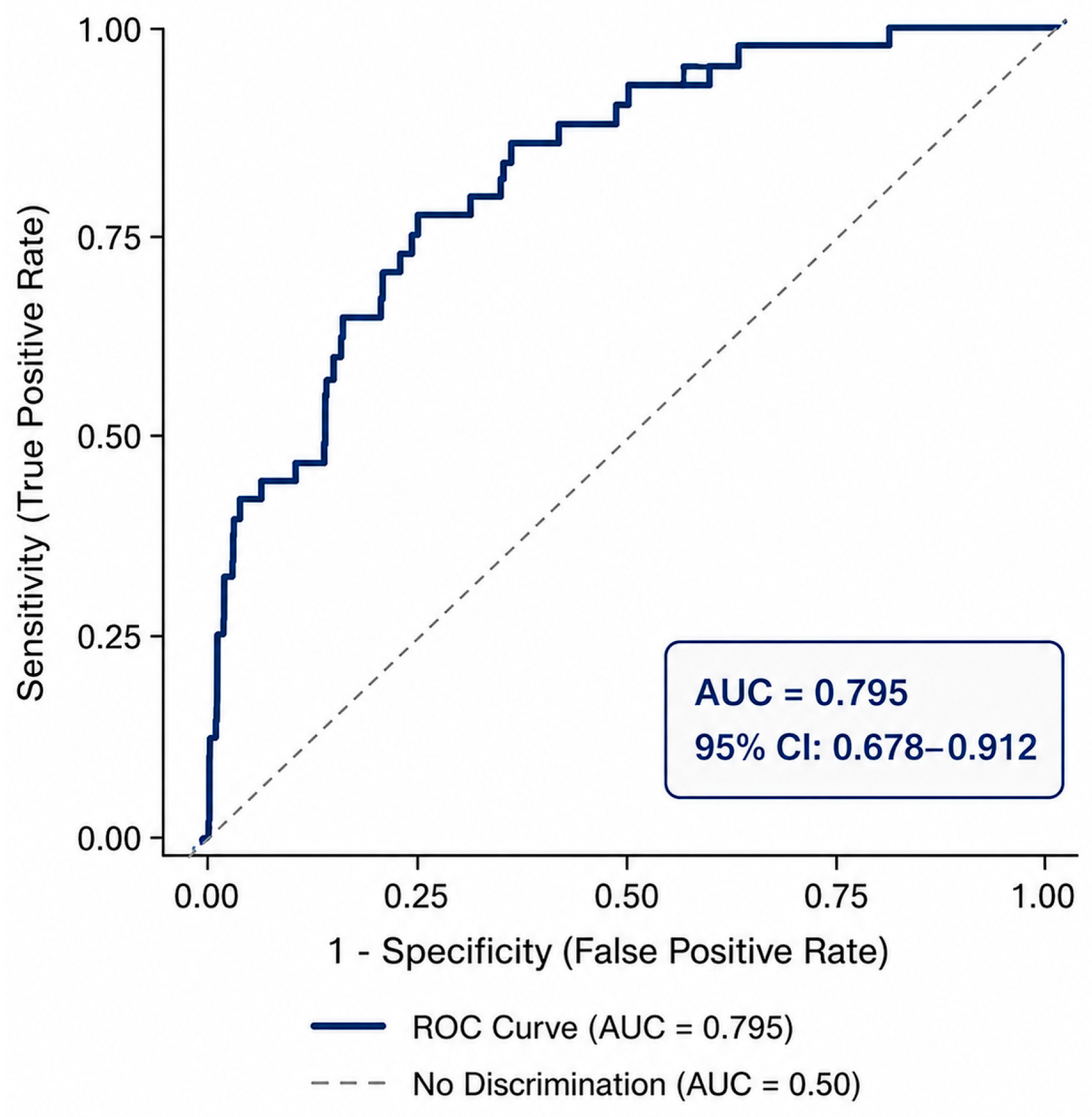
), while the corresponding average marginal effect reached 0.870, indicating a strong threshold-dependent association with the probability of superior financial–economic performance. This result is consistent with the overall predictive performance of the threshold-logit model (AUC = 0.795; McFadden pseudo-R
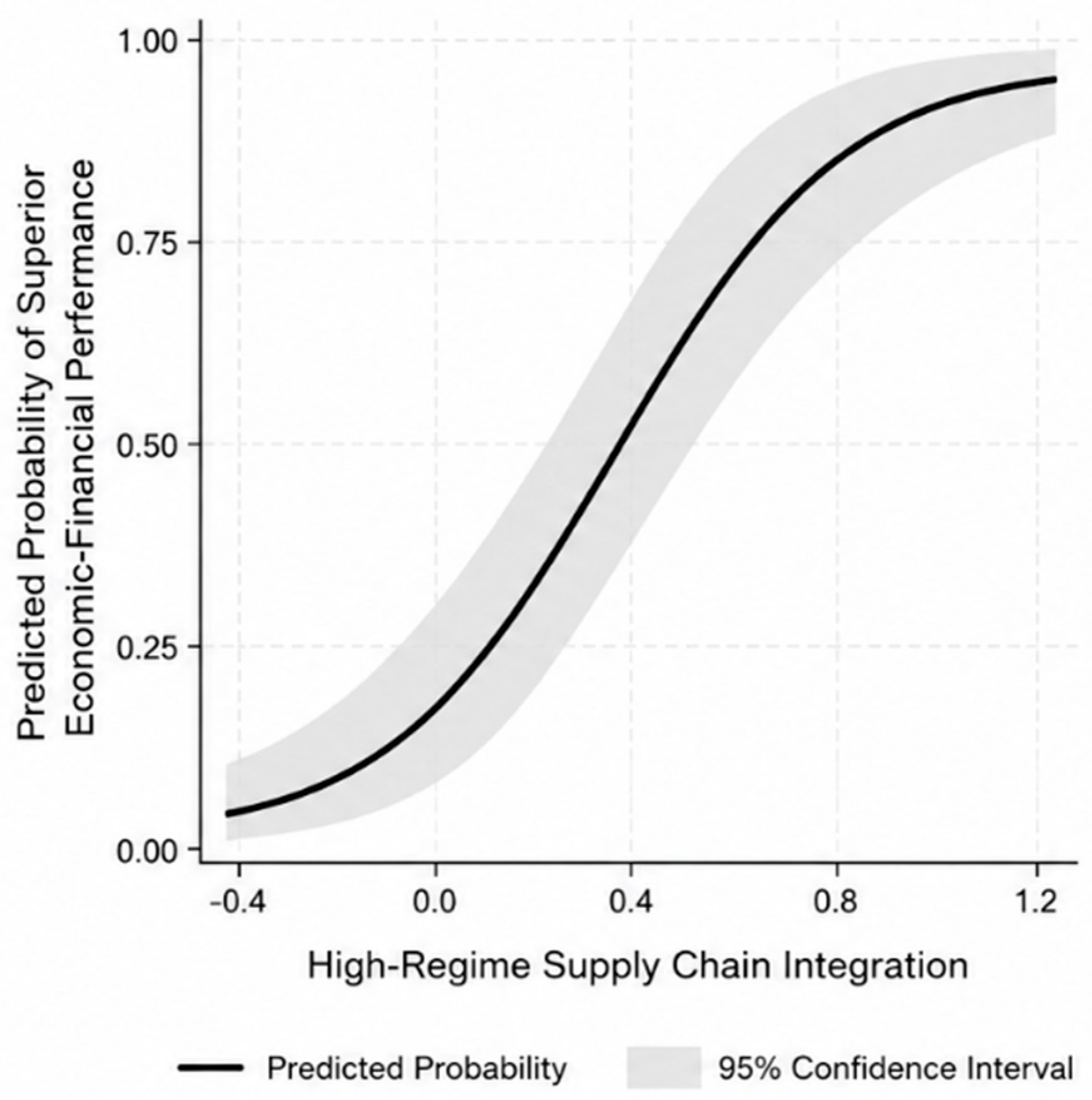
2 = 0.207). Given the regime-specific specification and sample size, the estimate should be interpreted as indicative of the strength of the threshold relationship rather than a universally applicable probability change. Further validation using larger datasets is warranted. By contrast, the low-regime integration effect remained statistically insignificant, further supporting the existence of regime-dependent dynamics. Predicted probability estimates reveal a notable threshold-escalation pattern across integration levels, emphasising the importance of thresholds. Firms operating at low levels of integration exhibited predicted performance probabilities below 10%, whereas firms characterised by high integration intensity displayed probabilities approaching 97%. Additional regime comparisons further demonstrate that firms operating above the estimated threshold exhibited substantially higher average predicted performance probabilities (
) compared with firms remaining below the threshold regime (
). Collectively, these findings strongly support the argument that digital and organisational integration becomes economically productive primarily once firms have achieved sufficient levels of socio-economic embeddedness and coordination capacity.
Table 5 presents the additional threshold diagnostics and average marginal effects associated with the regime-specific integration variables. The predicted probabilities across alternative high-integration regimes are reported in
Table 6.
Figure 2 illustrates a threshold increase in predicted probabilities of superior financial–economic performance across high-integration regimes. The additional probabilistic and diagnostic estimations substantially reinforce the threshold interpretation of the empirical findings. The logistic threshold model exhibited satisfactory predictive performance, with an Area Under the Curve (
) value of 0.795 and an overall classification accuracy of 73.8%, indicating strong discriminatory capacity across performance regimes. The model also demonstrated high specificity (86%), indicating strong effectiveness in identifying firms operating in lower-performance structural regimes. The estimated marginal effects further confirmed the presence of strong regime-dependent dynamics. Specifically, the average marginal effect associated with the high-regime integration variable (
) reached 0.870 (
), indicating that stronger supply chain integration substantially increases the probability of superior economic–financial performance once firms surpass the estimated threshold level. By contrast, the low-regime integration effect remained statistically insignificant.
The predicted probability estimates reveal a clear threshold effect, with firms below the threshold having about a 23.8% chance and those above exceeding 54.2%, highlighting the importance of thresholds for policymakers (p < 0.01).
Collectively, these findings strongly support the argument that digital and organisational integration becomes economically productive primarily once firms have achieved sufficient levels of socio-economic embeddedness and coordination capacity. The logistic threshold model diagnostics presented in
Table 7 indicate satisfactory classification and discriminatory performance.
Table 8 compares financial and organisational efficiency indicators across low- and high-integration regimes. The ROC curve presented in
Figure 3 further confirms the strong predictive performance of the threshold logistic model.
4.4. Robustness and Regime Interaction Analysis
To better evaluate the stability of the threshold mechanism, an interaction-based regime model was estimated. The results confirm positive regime-amplification effects, but the interaction coefficient remains statistically insignificant under robust standard errors. As a result, the threshold logistic model was retained for its greater empirical stability, lower information-criterion scores, and clearer regime interpretation, thereby reinforcing its robustness.
4.5. Main Empirical Contribution
Taken together, the results provide evidence relevant to all four research questions and indicate that the economic value of digital transformation depends on integration capacity, organisational coordination, and socio-economic embeddedness. Empirical evidence shows that supply chain integration does not inherently produce economic benefits for all firms. Instead, its impact depends on firms surpassing a certain socio-economic integration threshold, emphasising the need for systemic coordination. The findings confirm that integration dynamics vary across regimes within rural economic systems and that structural embeddedness is a crucial prerequisite for developing effective coordination mechanisms, underscoring its relevance for regional development.
4.6. Regional Macro-Level Threshold Evidence from the Western Balkans
Before estimating the regional threshold model, descriptive analysis was performed to explore the structural features of the Western Balkans panel dataset. The macro-level sample included 50 country-year observations from five Western Balkan economies between 2011 and 2020. It encompasses indicators on economic performance, digital penetration, tourism activity, and agricultural value added. The descriptive statistics reveal significant differences among countries regarding both digitalisation and economic development. The average GDP per capita was about USD 6103, highlighting notable disparities across the region. Digital penetration varied widely, with internet usage rates spanning from roughly 36% to over 81% of the population. This range indicates the presence of structurally distinct digitalisation regimes in Western Balkan economies. Tourism receipts and agricultural value added further highlight the region’s mixed economic structure. Although tourism has grown substantially in several economies, agriculture still plays a crucial role in economic output, especially in semi-rural and transitional areas.
The descriptive statistics for the Western Balkans macro-level panel dataset are presented in
Table 9.
The variation in digitalisation levels, sectoral structures, and income changes provides initial evidence for the use of threshold-based estimation methods. Notably, the wide range of internet penetration rates suggests that the economic impacts of digitalisation may vary across low- and high-digitalisation regimes, rather than affecting all economies equally. To complement the firm-level analysis, an exploratory macro-level threshold model was estimated using panel data from five Western Balkan economies covering 2011–2020. This additional analysis aimed to determine whether the threshold dynamics observed within individual firms also appear in broader regional development trends.
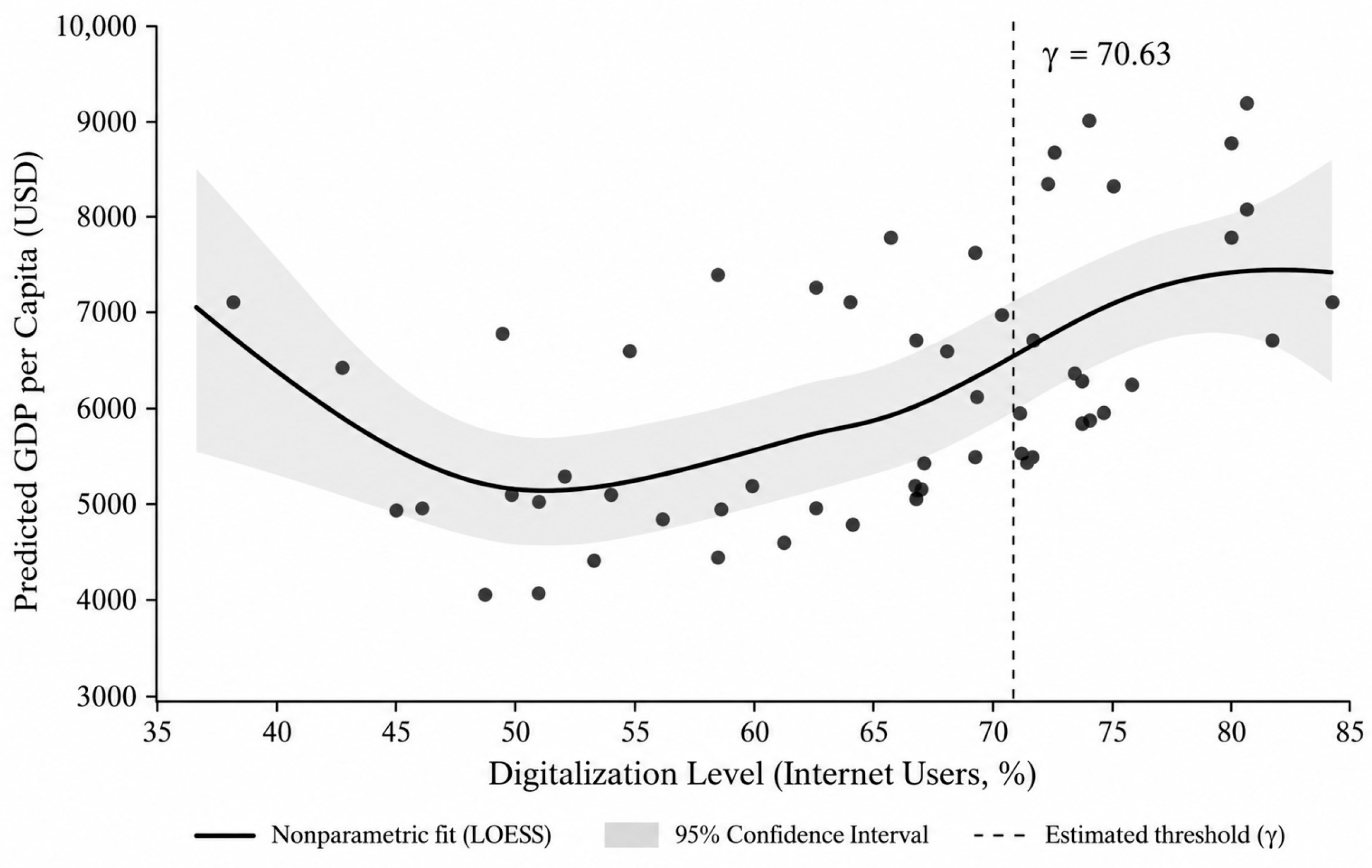
The macro-level model included lagged GDP per capita, tourism receipts, agricultural value added, and digital penetration rates measured via internet usage levels. The threshold estimation identified a critical digitalisation level of approximately [70% internet penetration], indicating distinct regimes among Western Balkan economies.
This indicates the presence of different digitalisation regimes among Western Balkan economies. Economies with internet penetration exceeding around 70% likely function under significantly different structural conditions than those with lower digital connectivity.
Table 10 reports the macro-level threshold regression results for Western Balkan economies.
The macro-level evidence highlights several key findings. First, the coefficient on lagged GDP per capita remains highly positive and statistically significant, indicating persistence and path dependence in regional economic development. This means that historical structural factors continue to significantly shape current economic performance in Western Balkan economies. Second, tourism receipts stand out as an especially influential factor in driving GDP per capita growth.
The notably positive and statistically significant tourism coefficient aligns with existing research highlighting the strategic importance of tourism in transforming regional economies and boosting incomes in transition economies.
Agricultural value added shows a positive and statistically significant impact, highlighting agriculture’s ongoing important developmental role despite structural changes. This is especially relevant for rural and semi-rural economies with hybrid tourism–agriculture systems.
By contrast, the threshold digitalisation coefficients stay statistically insignificant in both low- and high-digitalisation regimes. Although the estimated threshold indicates varying levels of digital penetration across economies, the findings imply that digitalisation alone does not necessarily lead to improved macroeconomic performance.
This finding aligns closely with the earlier firm-level threshold analysis. While those results showed that integration mechanisms only become economically effective once they cross a socio-economic threshold, macro-level evidence suggests that digital diffusion alone might not be sufficient to generate significant economic benefits in economies with structural constraints.
Overall, the findings from both micro and macro levels support a broader view of digital transformation as a structural change. The results indicate that technological adoption yields significant economic benefits, primarily when supported by well-established integration, coordination, and institutional frameworks. Therefore, the study questions purely technological views of digital development, highlighting the critical role of socio-economic embeddedness and effective coordination mechanisms in turning digital transformation into tangible economic improvements instead.
4.7. Regional Financial Efficiency and Digitalisation Regime Diagnostics in Western Balkan Economies
To further strengthen the macro-level threshold interpretation, additional financial-efficiency diagnostics and regime-based predicted-response estimations were implemented using panel data from Western Balkan economies covering the period 2011–2020. The extended specification evaluated whether regional economic performance differs systematically across alternative digitalisation regimes while accounting for tourism intensity, agricultural value added, and lagged economic persistence effects.
Figure 4 illustrates predicted GDP per capita across alternative digitalisation regimes within Western Balkan economies.
The estimated digitalisation threshold was identified at:
Following the threshold estimation procedure, separate low- and high-regime digitalisation specifications were estimated, along with interaction diagnostics, to evaluate whether the macroeconomic contribution of digitalisation intensifies in stronger structural coordination environments. The additional macro-level threshold diagnostics and interaction estimations are reported in
Table 11.
The additional diagnostics revealed substantial differences in predicted macroeconomic performance across digitalisation regimes. Although the direct digitalisation coefficients remained statistically insignificant, the predicted-response estimates showed that economies operating above the estimated digitalisation threshold achieved considerably higher predicted GDP per capita than those remaining below the threshold. Predicted GDP per capita across low- and high-digitalisation regimes is presented in
Table 12.
The regime difference diagnostics reported in
Table 13 confirm statistically significant differences in predicted macroeconomic performance across digitalisation regimes. The regime diagnostics, therefore, reinforce the broader threshold-dependent interpretation advanced throughout the study. Economies characterised by stronger digitalisation regimes exhibited substantially higher predicted regional economic performance, indicating that digital transformation is economically productive primarily under sufficiently coordinated structural environments. These findings support the interpretation of digitalisation not as an isolated technological mechanism, but rather as a broader structural coordination infrastructure capable of amplifying regional financial and economic efficiency once critical digitalisation thresholds are surpassed.
5. Discussion
Digital transformation has important managerial and financial implications that extend beyond technological modernisation alone. The findings suggest that integration mechanisms improve transaction-cost efficiency, operational financial efficiency, and resource allocation capacity across interconnected production systems. In fragmented rural economies, these coordination structures appear particularly important for reducing operational inefficiencies, strengthening organisational responsiveness, and improving financial resilience amid structural uncertainty. Consequently, the economic value of digitalisation increasingly depends on firms’ ability to transform digital capabilities into integrated, financially efficient coordination systems rather than on technological adoption alone. In relation to RQ1 and RQ4, the observed pattern accords with coordination-based perspectives of digital transformation and with recent empirical evidence emphasising the importance of organisational integration and network embeddedness in translating digital adoption into superior performance outcomes (
Kamble et al., 2020;
Golinska-Dawson et al., 2023;
Trippl et al., 2024).
Firms operating below the estimated socio-economic threshold experience limited performance improvements from integration mechanisms, whereas firms embedded within stronger coordination environments generate substantially greater operational and financial returns. These findings challenge technology-centred interpretations of rural development, suggesting that digital investments alone may yield weak economic outcomes when organisational embeddedness and coordination capacity remain underdeveloped. Instead, the financial productivity of digital transformation appears to be conditional on broader structural integration and managerial operational synchronisation.
Consistent with RQ2, the estimated threshold effects indicate that the relationship between digitalisation and financial–economic performance is inherently regime-dependent. This pattern accords with threshold and structural transformation perspectives, which emphasise heterogeneous outcomes across organisational and socio-economic contexts rather than uniformly distributed digitalisation effects (
Saviotti, 2020;
Hamilton et al., 2025;
Trippl et al., 2024).
The economic impact of integration intensifies significantly once firms surpass critical levels of socio-economic embeddedness, indicating that marginal returns to digital coordination are not uniformly distributed across firms.
This finding extends the broader threshold literature beyond traditional macroeconomic applications by demonstrating that regime dynamics also characterise firm-level integration and coordination systems within rural transition economies. The results, therefore, support a structurally grounded interpretation of digital transformation in which coordination quality, operational synchronisation, and organisational integration function as central determinants of financial and economic performance. Addressing RQ3, Addressing RQ3, the estimated threshold effects indicate the presence of regime-dependent organisational dynamics. This pattern accords with threshold perspectives of economic transformation, which posit that performance effects intensify after critical transition points are surpassed rather than emerging uniformly across firms (
Saviotti, 2020;
Hamilton et al., 2025). The observed threshold differentiation is also consistent with recent evidence suggesting that the economic returns to digital transformation depend on organisational embeddedness and integration capacity rather than digital adoption alone (
Trippl et al., 2024).
An important contribution of the study lies in its interpretation of the “digitalisation paradox.” The findings suggest that digital technologies frequently fail to generate substantial economic returns because firms remain structurally fragmented and organizationally disconnected. In such environments, digital adoption may occur operationally without producing deeper structural transformation or meaningful efficiency gains. By contrast, firms operating within integrated economic systems appear substantially more capable of converting digitalisation into cost optimisation, improvements in managerial performance, and sustainable financial resilience.
The macro-level evidence from Western Balkan economies reinforces this interpretation. Although the threshold estimates identified differentiated digitalisation regimes, digital penetration alone did not yield statistically significant growth effects. Instead, tourism activity and agricultural value added remained the principal drivers of regional economic performance. This divergence between technological diffusion and economic outcomes further suggests that digitalisation becomes financially productive only when embedded in broader systems of organisational coordination, sectoral integration, and structural efficiency.
6. Conclusions
The study examined the threshold relationship between digital transformation, supply chain integration, and financial–economic performance within rural and transition economies using a threshold regression framework.
Drawing upon firm-level evidence from rural Northern Albania and complementary macro-level evidence from Western Balkan economies, the analysis advances a managerial-financial interpretation of digital transformation grounded in organisational coordination, integration efficiency, and structural embeddedness.
The empirical findings strongly support the proposed hypotheses and research questions. First, the results confirm that supply chain integration positively influences firms’ financial and economic performance, supporting the first hypothesis.
These effects are not homogeneous across firms. Instead, the economic returns of digital integration vary substantially with firms’ socio-economic embeddedness, coordination efficiency, and organisational integration capacity.
Second, the threshold estimations provide clear evidence of regime-dependent dynamics, confirming the second hypothesis and demonstrating that the financial and operational effects of integration intensify significantly once firms surpass critical structural thresholds. Third, the results validate the existence of a distinct threshold effect, confirming that digital transformation is financially productive primarily in sufficiently integrated organisational environments.
From a managerial finance perspective, the findings indicate that digital transformation improves performance not merely through technological adoption itself, but also through enhanced governance structures, more efficient allocation of managerial resources, financial coordination mechanisms, and operational synchronisation across interconnected economic systems. Integration mechanisms appear particularly important for improving transaction-cost efficiency, strengthening operational financial efficiency, optimising resource allocation, and reducing organisational inefficiencies under structurally fragmented conditions. Consequently, digital transformation should be understood less as an autonomous technological process and more as a strategic coordination mechanism that strengthens financial resilience and managerial performance.
The macro-level evidence further reinforces this interpretation. Although the threshold estimates identified differentiated digitalisation regimes across Western Balkan economies, digital penetration alone did not yield statistically significant macroeconomic effects. Instead, tourism activity and agricultural value added remained the principal drivers of regional economic performance. These findings suggest that technological diffusion alone may yield limited economic benefits when not embedded in broader systems of organisational coordination, sectoral integration, and institutional efficiency.
The study contributes theoretically by extending threshold econometric approaches beyond traditional macroeconomic applications toward firm-level digital transformation and coordination systems in rural economies. It also advances the growing literature emphasising coordination efficiency, governance structures, and integration mechanisms as central pathways through which digitalisation generates measurable financial and economic outcomes.
From a policy and strategic management perspective, the findings imply that digital transformation strategies should prioritise not only technological infrastructure and digital adoption but also governance quality, collaborative coordination systems, managerial integration capacity, and ecosystem-level organisational efficiency. Firms embedded in integrated coordination systems appear substantially more capable of converting digital investments into sustainable financial performance, operational resilience, and long-term competitiveness than firms operating in fragmented organisational environments.