Article

Carry Signals and Bond Returns in the Indonesian Government Bond Market

1
School of Business, IPB University, Bogor 16151, Indonesia
2
International Business School, IPMI Institute, Jakarta 12750, Indonesia
*
Author to whom correspondence should be addressed.
J. Risk Financial Manag. 2026, 19(7), 469; https://doi.org/10.3390/jrfm19070469 (registering DOI)
Submission received: 31 May 2026 / Revised: 21 June 2026 / Accepted: 24 June 2026 / Published: 26 June 2026
(This article belongs to the Special Issue Financial Funds, Risk and Investment Strategies)

Abstract

Carry strategies in developed markets are well studied, but their effectiveness in emerging government bond markets remains less well understood. This study analyzes cross-curve carry strategies in the Indonesian government bond market from June 2009 to June 2025. The findings indicate that a term spread-based carry long–short portfolio delivers positive returns and exhibits persistence across rolling 10-year horizons throughout the sample period. However, performance tends to weaken during episodes of local currency depreciation. Duration-matched long-only carry portfolios also outperform the market benchmark after transaction costs, indicating practical value for investors. Overall, the findings suggest that carry strategies can be effective in the Indonesian government bond market and that the term spread-based carry measure provides a more robust signal than the alternative specification that incorporates roll-down effects.

1. Introduction

In the past decade, research on return predictability in advanced government bond markets has shifted from macroeconomic explanations to factor-based approaches, mirroring trends in equity markets. Consistent with de Silva (2023), security returns are driven not only by macroeconomic variables but also by style factors. Style factors refer to systematic investment characteristics or factor-related asset attributes that may explain differences in expected returns across securities (Brooks et al., 2018). This shift is evident in practice: global investor confidence in factor investing for fixed income rose from 61% in 2016 to 92% in 2022 (Invesco, 2022). The alignment of academic and practitioner views highlights the need to assess whether factor strategies that have proven effective in developed government bond markets, including the United States, European markets, Japan, and Australia (Bektić et al., 2020), also perform well in emerging economies.
Factor investing draws investor interest due to its strong theoretical and empirical basis for explaining persistent excess returns (Bartram et al., 2021). Elton et al. (2014) describe it as a practical application of the Arbitrage Pricing Theory (APT) by Ross (1976). It is recognized as a third pillar of investment, alongside active and passive strategies (Warren & Quance, 2019). Following the 2008 global financial crisis, which exposed the limits of traditional diversification, institutional investors adopted factor-based allocation to focus on common risk and return drivers rather than conventional asset classes (Martellini & Milhau, 2018).
One factor that has attracted particular attention in fixed-income markets is the carry factor. Categorized as a style premium by Brooks et al. (2018), carry stands out for its computational simplicity (Bektić et al., 2020). Conceptually, it represents the expected return under the assumption that the yield curve remains unchanged (Martens et al., 2019). According to Koijen et al. (2018), in practice, carry can be approximated as the sum of the slope—the difference between a bond’s yield and the risk-free rate—and the potential price appreciation arising from roll-down effects if the yield curve remains stable. In environments characterized by upward-sloping yield curves, investors can benefit from multiple sources of return, including coupon income and potential capital gains. Even when bond prices remain broadly unchanged, the continued accrual of interest income can generate positive returns over time.
The practical relevance of carry is also reflected in its adoption by major index providers. In response to increasing investor demand, FTSE Russell developed the FTSE Nomura Carry and Roll Down (CaRD) World Government Bond Index, providing an investable benchmark for carry-oriented bond strategies in global fixed-income markets (FTSE Russell, 2025). This development reflects the growing recognition of carry as an investable fixed-income factor.
Empirical evidence shows that carry-based strategies have delivered significant returns in developed government bond markets (Koijen et al., 2018; Coche et al., 2018; Martens et al., 2019). However, research on curve-carry strategies, which exploit yield differences across maturities within a single government bond yield curve, remains limited in Asian emerging economies. Current literature lacks a comprehensive analysis of carry performance, persistence, risk-based explanations, and trading frictions, such as transaction costs, in these markets.
Moreover, the literature remains divided on the appropriate measurement of carry. Brooks et al. (2018) and Ilmanen et al. (2021) propose a parsimonious measure that defines carry solely in terms of the term spread. The choice between these two carry specifications is particularly relevant in emerging markets, where inflation volatility tends to be higher than in developed markets (Fong & Wu, 2020), potentially increasing uncertainty regarding future monetary policy and yield-curve dynamics. Unexpected shifts in the yield curve may substantially reduce or even reverse the anticipated capital gains associated with roll-down effects. Consequently, in more volatile market environments, a term spread-based carry measure may provide a more robust signal, as its performance depends less on the stability of the yield curve and the realization of roll-down gains. These considerations motivate a comparative investigation into which specification provides a more reliable and practically implementable carry signal.
Indonesia provides an appropriate setting for examining carry investing in emerging government bond markets. As Southeast Asia’s largest issuer of local currency treasury and government bonds (Asian Development Bank, 2025a) and an investment-grade sovereign rated BBB by Fitch Ratings, Indonesia offers both scale and credit stability. Its government bond market is relatively liquid (Chernov et al., 2023), although liquidity remains uneven across maturities. It consistently exhibits an upward-sloping yield curve (Affandi et al., 2020). Prior to the COVID-19 pandemic, non-resident investors consistently held more than one-third of tradable government bonds for several consecutive years (Asian Development Bank, 2025a), highlighting the role of global capital flows in shaping market dynamics. Regionally, Indonesia shares several characteristics with other major ASEAN bond markets, particularly Malaysia and Thailand, including investment-grade sovereign credit ratings, comparable local currency government bond market liquidity (Asian Development Bank, 2025b; Chernov et al., 2023), and exposure to some similar macro-financial risks that influence yield-curve dynamics (Gadanecz et al., 2014; Tjandrasa et al., 2020).
Motivated by these characteristics, this study examines whether cross-curve carry strategies can be effective in an emerging government bond market. It also evaluates the relative effectiveness of alternative carry measures, explores how carry premia vary across changing market conditions, and investigates whether the resulting investment signals remain economically implementable in the presence of transaction costs. Cross-curve carry investing offers a systematic approach to identifying bonds to overweight or underweight within an existing portfolio, providing an alternative to passive benchmark-tracking strategies and discretionary investment approaches that rely on interest-rate forecasts and market-timing decisions. This framework is particularly relevant for institutional investors, including asset managers, pension funds, and insurance companies, whose mandates require substantial allocations to government securities. For these investors, the key investment decision is often not whether to invest in government bonds, but how to allocate capital across individual bonds within an existing portfolio.
The study contributes to both the factor investing and fixed-income literature in four ways. First, it extends the evidence on cross-curve carry investing to an emerging government bond market, a setting that has received considerably less attention than advanced markets. Second, the paper provides evidence that term spread-based carry measures may offer a more robust and practically implementable signal than carry specifications incorporating roll-down effects in the Indonesian government bond market. Third, the study contributes to the risk-based interpretation of carry premia by showing that carry strategy performance weakens during periods of exchange-rate depreciation. Fourth, the study demonstrates that duration-matched long-only carry strategies remain economically viable after accounting for transaction costs. Together, these findings contribute to a deeper understanding of curve-based factor strategies in emerging government bond markets and their practical implications for portfolio management.
We structure the paper as follows: Section 2 reviews the literature; Section 3 describes the materials and methods; Section 4 presents the results; Section 5 discusses the results; and Section 6 concludes with implications for future research.

2. Literature Review

2.1. Theoretical Foundation and Basic Concepts of Carry Strategies

The concept of carry originates in the foreign exchange (FX) market, where investors exploit interest rate differentials between currencies, earning positive returns if exchange rate movements do not offset these gains (Baltas, 2017). In practice, this strategy involves borrowing in a low-interest-rate currency and investing in a higher-interest-rate currency. This mechanism—harvesting yield differentials under relatively stable market conditions—provides the theoretical foundation for carry strategies across various asset classes, including fixed-income securities. Over time, the carry concept has been extended beyond FX to encompass bonds, commodities, and other yield-bearing assets, reflecting its broad applicability as a cross-asset return driver (Koijen et al., 2018).
In the bond market, the logic parallels the concept of riding the yield curve (FTSE Russell, 2019). This concept is an active investment strategy in which investors intentionally mismatch their holding period with the maturity of the bonds they purchase (Osteryoung et al., 1981). Under a normal, upward-sloping yield curve, investors can earn additional returns by purchasing longer-term bonds and selling them before maturity, thereby capturing both coupon income and capital appreciation as bonds “roll down” the yield curve (Dyl & Joehnk, 1981).
The upward slope of the yield curve can be explained by classical theories such as the liquidity preference and preferred habitat frameworks. According to liquidity preference theory, investors demand higher yields to compensate for holding longer-term securities, which entail greater uncertainty about interest rates and inflation (Fabozzi, 2021). Similarly, the preferred habitat theory (Baz et al., 2015) posits that investors have a structural preference for short-term maturities and therefore require an additional premium to hold longer-term bonds. These perspectives jointly suggest that a positive term spread compensates investors for bearing liquidity, duration, inflation, and broader macroeconomic risks (Baltas, 2017).

2.2. Carry Measurement Specifications and Global Empirical Evidence

In the existing literature, two main approaches are commonly used to measure carry. The first adopts a comprehensive definition that combines yield accrual and roll-down effects (Koijen et al., 2018; Coche et al., 2018; Martens et al., 2019). Studies employing this approach provide consistent evidence that comprehensive carry measures contain information about future bond returns. For example, Koijen et al. (2018) documented superior risk-adjusted performance in U.S. Treasuries, while Coche et al. (2018) showed that higher carry signals are associated with higher realized returns in Japanese government bonds. Extending the evidence beyond individual markets, Martens et al. (2019) reported robust and diversified carry returns across 13 developed countries.
The second approach employs a more parsimonious specification that measures carry solely via the term spread, assuming constant yields over the holding period (Brooks et al., 2018; Ilmanen et al., 2021). Technically, Brooks et al. (2018) define the term spread as the difference between a government bond yield and the local short-term interest rate, whereas Baltussen et al. (2022) define it as the difference between a bond yield and the risk-free rate. Economically, the term spread represents the additional compensation investors receive for holding longer-maturity bonds rather than short-term instruments. Baltussen et al. (2022) use the term spread to measure relative value among government bonds, particularly when comparing bonds with similar maturities across countries, while acknowledging its close conceptual relationship to carry.
Despite excluding the roll-down component, empirical studies continue to show that the term spread alone possesses significant predictive power for future bond returns. For example, Brooks et al. (2018) showed that higher term spreads are associated with higher subsequent bond returns, while Ilmanen et al. (2021) demonstrated that long–short portfolios constructed from term spreads on 10-year government bonds across 13 countries yielded positive and statistically significant performance. Taken together, these findings suggest that a substantial share of the predictive information embedded in carry measures may already be captured by the term spread alone, even without explicitly incorporating the roll-down component.
The predictive power of both specifications is well documented; however, the incremental contribution of the roll-down component remains unclear. Unlike the term spread, which is directly observable from current market yields, the roll-down component relies on assumptions about the future evolution of the yield curve. As a result, its predictive value may depend on the extent to which future yield-curve movements can be anticipated. This issue is particularly relevant in emerging government bond markets, including Indonesia, where higher inflation volatility and greater sensitivity to capital flows may make future yield-curve movements more difficult to anticipate, potentially reducing the incremental predictive power of roll-down estimates. Consequently, whether the roll-down component provides meaningful information beyond that already contained in the term spread remains an open empirical question.

2.3. Dynamics of Carry Strategies in Emerging Markets

One of the few studies that includes Indonesia is Lim (2020), who examines the role of Value, Carry, and Momentum in explaining yield-curve dynamics and excess returns in the government bond markets of China, India, and Indonesia. The study shows that carry is a relevant determinant of excess returns and yield-curve premia, and that it is particularly important in the Indonesian market. However, carry is examined primarily as an explanatory factor rather than as an investable signal. Consequently, the study does not evaluate whether carry can be systematically exploited through portfolio construction, whether alternative carry specifications differ in effectiveness, whether carry premia persist over time, or whether carry-based strategies remain economically viable after accounting for transaction costs. These unresolved issues motivate the present study, which evaluates the performance and practical implementation of alternative carry frameworks in the Indonesian government bond market.

2.4. Systemic Risk and the Influence of Macroeconomic Conditions

Because the carry strategy assumes that the yield curve remains unchanged—or that “nothing happens but for the passage of time” (Brooks et al., 2018)—its main risk arises when economic conditions shift in ways that disrupt its stability. For example, Martens et al. (2019) reported that the performance of carry strategies tends to weaken during monetary tightening cycles. In particular, cross-curve carry long–short strategies often involve long positions in shorter-maturity bonds and short positions in longer-maturity bonds. When central banks raise policy rates, short-term yields typically increase more rapidly than long-term yields, causing the yield curve to flatten. As a result, shorter-maturity bonds may underperform relative to longer-maturity bonds, negatively affecting carry strategy performance. In such environments, losses arising from adverse yield movements may offset gains generated from carry and roll-down.
Similarly, Hamdan et al. (2016) noted that historical evidence cautions against using carry trades during periods of market stress or liquidity shortages, as such conditions can lead to substantial drawdowns. Consistent with this view, Aghassi et al. (2023) attribute the carry premium to exposure to adverse market states (commonly referred to as bad times). From a risk-based perspective, this factor yields higher returns to compensate for lower payoffs or losses during bad times (Ang, 2014). Taken together, these insights suggest that carry premia reflect both a reward for stable market environments and compensation for exposure to systemic risk, thereby motivating a closer examination of their behavior in the more volatile context of emerging bond markets such as Indonesia.

2.5. Hypothesis Development

2.5.1. Performance of Carry Strategies in the Indonesian Government Bond Market

Performance is evaluated using two criteria adapted from Coche et al. (2018): continuousness, which examines whether stronger carry signals are consistently associated with higher realized returns, and persistence, which assesses whether the strategy’s profitability remains stable over time.
Regarding continuousness, global empirical evidence suggests that stronger carry signals are systematically associated with higher realized returns in government bond markets. For example, Coche et al. (2018) document that bonds with higher carry tend to outperform bonds with lower carry in the Japanese government bond market. To evaluate whether such return differences reflect a genuine carry premium, this study employs a long–short portfolio approach. In the factor-investing literature, the long–short portfolio is widely regarded as a pure method for harvesting factor premia (Ilmanen, 2022) because they focus on return differences attributable to the factor itself rather than overall market movements. A key advantage of the long–short approach is that it exploits both sides of the factor signal (Blitz et al., 2020). By simultaneously benefiting from the relative outperformance of high-carry bonds and the relative underperformance of low-carry bonds, the strategy provides a cleaner estimate of the carry premium. Consequently, a positive and statistically significant long–short return would provide evidence of a carry premium in the Indonesian government bond market.
With respect to persistence, prior studies suggest that factor premia should not be driven by a limited number of favorable periods but should remain observable across different market environments (Baltussen et al., 2022). If carry reflects a systematic source of expected bond returns, its profitability should persist through time rather than being concentrated in isolated episodes. Consequently, a long–short carry strategy is expected to exhibit relatively stable performance and a high success rate in rolling-window evaluations. Moreover, the Indonesian government bond market has historically exhibited an upward-sloping yield curve, providing a structural environment conducive to generating carry returns. Based on these considerations, the following hypothesis is proposed:
H1. 
The long–short cross-curve carry strategy generates positive and persistent performance in the Indonesian government bond market.

2.5.2. Comparison Between Comprehensive and Parsimonious Carry Specifications

The carry literature offers two alternative specifications. Although both measures aim to capture expected bond returns, they differ in their dependence on future yield-curve dynamics. Because the profitability of the roll-down component relies heavily on the assumption that the yield curve remains static over the holding period, its performance is highly sensitive to unexpected shifts in the curve. In contrast, a term spread-based measure depends primarily on the yield differential observed at portfolio formation and therefore may provide a more consistent signal over time.
These considerations may be particularly important in emerging government bond markets. Higher inflation volatility in emerging economies (Fong & Wu, 2020), combined with the Indonesian market’s sensitivity to capital flows driven by the relatively high participation of non-resident investors (IMF, 2021), may increase uncertainty regarding future yield-curve dynamics. Consequently, such conditions may reduce the reliability of roll-down-based carry signals. Based on these arguments, the following hypothesis is proposed:
H2. 
The term spread-based carry strategy exhibits stronger continuousness and persistence than the carry strategy incorporating roll-down effects in the Indonesian government bond market.

2.5.3. The Influence of Macroeconomic Conditions on Carry Strategies

According to Ang (2014), the basic intuition of the CAPM is that the risk premium compensates investors for losses incurred during adverse economic states. Consistent with this view, factor premiums are often interpreted as compensation for bearing risks that become more pronounced during unfavorable economic environments (Aghassi et al., 2023). If carry premia partly compensate investors for exposure to risks that materialize during periods of heightened risk aversion, the returns to carry strategies should vary with changes in macroeconomic conditions (Aghassi et al., 2023). Consequently, adverse states such as monetary tightening (Martens et al., 2019), exchange-rate depreciation and global crises that may trigger capital outflows (IMF, 2021), and equity-market drawdowns associated with deteriorating economic conditions (Baltussen et al., 2021) are expected to reduce the returns to carry strategies. This interpretation is consistent with Hamdan et al. (2016), who find that carry strategies tend to perform poorly during periods of market stress. Based on this reasoning, the following hypothesis is proposed:
H3. 
The performance of carry strategies is negatively affected by adverse macroeconomic conditions, consistent with the risk-based interpretation of factor returns.

2.5.4. Practical Implementation and Economic Value of the Strategy

To evaluate the economic effectiveness of carry strategies for institutional investors, who are typically constrained by long-only mandates, the strategy must be assessed within a realistic investment framework. If carry contains information about expected bond returns, a portfolio that allocates relatively greater weight to high-carry bonds and relatively less to low-carry bonds should outperform a passive benchmark. To ensure that any performance differences are attributable to carry exposure rather than interest-rate risk, the portfolio is constructed subject to a duration-matching constraint relative to the benchmark. Furthermore, the economic viability of an active strategy can only be established if it generates outperformance after accounting for transaction costs.
Given the liquidity of the Indonesian government bond market (Chernov et al., 2023) and the portfolio’s construction exclusively from the de jure benchmark bonds (Remolona & Yetman, 2022), transaction costs are expected to be sufficiently low to keep the strategy economically viable. This expectation is consistent with Martens et al. (2019), who demonstrate that duration-matched long-only bond portfolios can remain economically viable after accounting for transaction costs. Therefore, a duration-matched long-only portfolio that maximizes exposure to the carry signal is expected to outperform a passive equally weighted benchmark on a net-of-transaction-cost basis. Based on these considerations, the final hypothesis is proposed:
H4. 
After accounting for transaction costs, a duration-matched long-only portfolio that maximizes exposure to the carry signal outperforms an equally weighted benchmark constructed from the same bond universe.

3. Materials and Methods

3.1. Data

This study uses monthly data on Indonesian government bonds from June 2009 to June 2025. The sample period encompasses several major episodes of financial market stress relevant to emerging market economies (see Harikrishnan et al., 2023), thereby enabling a more rigorous assessment of the persistence and robustness of carry performance across different market regimes.
The analysis focuses on de jure benchmark bonds—officially designated local currency benchmark series issued by the Ministry of Finance—with maturities of 5, 10, 15, and 20 years. According to Remolona and Yetman (2022), benchmark bonds, as the most liquid instrument, play an important role in price discovery. Restricting the sample to four benchmarks ensures that the analysis is based on bonds that are readily tradable by institutional investors and minimizes distortions from illiquid or infrequently traded bonds. This approach is supported by evidence from the Annual Bond Market Liquidity Survey (Asian Development Bank, 2016, 2017, 2018, 2019, 2021, 2022, 2023, 2024), which consistently shows that on-the-run benchmark bonds—the most recently issued bonds—trade with significantly narrower bid–ask spreads than off-the-run bonds. The list of benchmark series used in this study is reported in Table 1.
On average, these bonds account for about 15% of the total outstanding local currency government bonds each year. Information on bond series, coupon rates and maturities is obtained from the Ministry of Finance’s official website, while the Bank Indonesia policy rate (BI Rate) is obtained from the Bank Indonesia’s official website and expressed annually. Bond prices, the Jakarta Composite Index, and the IDR/USD exchange rate are sourced from Bloomberg. The dataset contains no missing observations or extreme outliers.

3.2. Empirical Framework

The empirical framework of this study is structured to systematically evaluate the effectiveness of carry-based strategies across five main phases of analysis, drawing on the methodologies of Coche et al. (2018), Martens et al. (2019), and Baltussen et al. (2022). The first phase focuses on estimating the two carry-signal specifications (comprehensive and parsimonious) and calculating bond excess returns, followed by applying the duration-adjustment approach of Martens et al. (2019) to both measures, thereby expressing carry signals and excess returns per unit of interest-rate risk. The second phase involves portfolio formation based on duration-adjusted carry rankings and the construction of long–short strategies to test for a carry premium in the Indonesian government bond market, following Coche et al. (2018). The third phase examines the robustness of the long–short portfolios through persistence analysis using the rolling-window approach of Baltussen et al. (2022). The fourth phase conducts a sensitivity analysis of portfolio performance to macroeconomic risk, following the framework of Martens et al. (2019) and Baltussen et al. (2022). The final phase simulates duration-matched long-only portfolios that incorporate transaction costs to assess the strategy’s economic feasibility for institutional investors, as in Martens et al. (2019). With this structure, the study links the theoretical framework of factor premia with their practical implementation under realistic market conditions.
The methodological procedures outlined above are applied in the following chapter, which begins with an overview of the Indonesian government bond yield curve. This overview provides background on market conditions over the sample period and serves as a foundation for the subsequent evaluation of the performance of carry strategy.

3.2.1. Carry Measurement

Following Martens et al. (2019), the annualized Carry 1 for bond m in month t is estimated as follows:
C a r r y   1 t m y t T m r t f D t m o d , m y t T m 1 y t T m
where m denotes the maturity-group index, taking values from 1 to 4, corresponding to the 5-year, 10-year, 15-year, and 20-year bond groups, respectively. T m represents the time to maturity in years, y t T m is the yield of the bond m with maturity T m , y t T m 1   is the interpolated yield corresponding to a maturity that is one year shorter than T m , D t m o d , m   denotes the modified duration of the bond m , and r t f is the prevailing risk-free rate at the beginning of the month t . The Bank Indonesia (BI) Rate is used as a proxy for the risk-free rate (Nia et al., 2025).
The value of y t T m 1 is obtained by linearly interpolating the yield curve over a one-year roll-down horizon. Specifically, the slope between two adjacent maturity groups is assumed to be constant, such that the yield one year ahead is approximated by subtracting the per-year slope from the current yield:
y t T m 1   = y t T m y t T m y t T m 1 T t m T t m 1
where T t m denotes the time to maturity of the bond m in month t, and T t m 1 represents the time to maturity of the preceding maturity group in the sequence. For example, when (m = 4) (20-year bonds), the corresponding (m − 1 = 3) refers to the 15-year bond group. Similarly, when (m = 3) (15-year bonds), (m − 1 = 2) refers to the 10-year bond group, and when (m = 2) (10-year bonds), (m − 1 = 1) refers to the 5-year bond group. For the 5-year bond group (m = 1), where no shorter-maturity benchmark exists, y t T m 1 is proxied by the risk-free rate, which is assumed to have a maturity of three months (0.25 years).
Given that the term spread is defined as the difference between a bond’s yield and the risk-free rate (Baltussen et al., 2022), the term spread measure used in this study, referred to as Carry 2, is calculated as follows:
C a r r y 2 t m = y t T m r t f
In Equation (1), the first term on the right-hand side, ( y t T m r t f ) , corresponds to the term spread (Carry 2), while the second term captures the roll-down component.

3.2.2. Bond Returns Measurement

This stage computes monthly bond returns and excess returns for each bond in the sample. The monthly bond return represents the total return obtained from holding a bond over a one-month period. The return is calculated by assuming that the bond is purchased at the beginning of the month at the previous month-end closing price and sold at the end of the month at the current month-end closing price. Following Teplova et al. (2020), coupon reinvestment was not considered due to the short holding horizon. The monthly return incorporates changes in the clean price, accrued interest, and coupon payments received during the holding period, and is computed as follows:
r t m = P t m + A I t m + C t m P t 1 m + A I t 1 m P t 1 m + A I t 1 m
where r t m represents the monthly return of the bond m in month t, P t m and P t 1 m denote the clean prices at the end of months t and t − 1, respectively, A I t m and A I t 1 m represent accrued interest at the end of the corresponding months, and C t m denotes coupon payments, if any, received during month t.
The monthly return measure is subsequently used to compute excess returns relative to the risk-free rate, as follows:
e r t m = r t m r t f 12
where e r t m denotes the excess return of the bond m in month t. The risk-free rate is divided by 12 to convert the annual rate into a monthly equivalent and ensure consistency with the monthly return measure.

3.2.3. Duration Adjustment

Under a normal upward-sloping yield curve, longer-duration bonds systematically exhibit higher yields and term spreads to compensate for greater interest-rate risk. Consequently, raw carry signals may favor longer maturities, reflecting differences in duration rather than relative attractiveness. To ensure a meaningful cross-sectional comparison, this study follows Martens et al. (2019) by dividing both carry measures and excess returns by modified duration. The resulting variables, denoted by the prefix A d j , represent carry and excess returns per unit of interest-rate risk and are computed as follows:
A d j   C a r r y   1 t m =   C a r r y   1 t m D t m o d , m  
A d j   C a r r y   2 t m = C a r r y   2 t m D t m o d , m
A d j   e r t m =   e r t m D t m o d , m
For the sake of clarity and brevity, time and maturity indices for certain variables may be omitted in subsequent equations where the context is unambiguous (e.g., y instead of y t T m in general duration calculations). Following Adams and Smith (2019), modified duration is computed from Macaulay duration, MacDur , as follows:
D m o d = M a c D u r 1 + y
where M a c D u r is calculated using the following general formula (Adams & Smith, 2019):
M a c D u r = 1 h H × C 1 + y 1 h H + 2 h H × C 1 + y 2 h H + + N h H × C + F V 1 + y N h H C 1 + y 1 h H + C 1 + y 2 h H + + C + F V 1 + y N h H
where h is the number of days from the last coupon payment to the settlement date, H is the number of days in the coupon period, h H denotes the proportion of the coupon period that has elapsed since the last coupon payment, C is the coupon payment per period, F V is the future value paid at maturity, or the par value of the bond, y is the yield to maturity (market discount rate), per period, and N is the number of evenly spaced periods remaining to maturity at the beginning of the current coupon period.
The modified duration of each bond is estimated using Microsoft Excel with the following syntax: MDURATION (settlement, maturity, coupon, yld, frequency, [basis]).
In the original framework of Martens et al. (2019), this adjustment is applied to a comprehensive carry measure that includes both term spread and roll-down components. In this study, however, the approach is extended to all considered carry specifications, including the term spread-only measure.
Under this approach, portfolio weights become inversely proportional to duration—assigning smaller weights to longer-maturity bonds and larger weights to shorter-maturity bonds—in line with Koijen et al. (2018). For illustration, consider two government bonds with modified durations of 4 and 8, respectively. Under the standard duration approximation, Δ P / P D M o d Δ y , a 1% increase in yields would result in approximate price declines of 4% and 8%. Consequently, an equal-notional long–short position would be disproportionately exposed to the higher-duration bond. To achieve duration neutrality, portfolio weights are adjusted in inverse proportion to duration. In this example, the position in the bond with a duration of 4 must be twice as large as the position in the bond with a duration of 8, so that duration exposures are equalized 2 × 4 = 1 × 8 . This extension ensures that differences in performance across carry specifications reflect the underlying signal rather than duration-related interest-rate exposure.

3.2.4. Factor Portfolio Construction

Following Martens et al. (2019), we construct duration-adjusted long–short portfolios (hereafter, factor portfolios) to evaluate the performance of carry-based strategies in the Indonesian government bond market.
At the beginning of each month, the carry per unit of duration for each bond is computed using data from the previous month-end. The four available benchmark bonds are then ranked cross-sectionally from B1 (lowest carry) to B4 (highest carry). Two equally weighted portfolios are formed: Portfolio P1 (low-carry), comprising bonds ranked B1 and B2, and Portfolio P2 (high-carry), comprising bonds ranked B3 and B4. The factor portfolio is then constructed by taking long positions in high-carry bonds (B3 and B4) and short positions in low-carry bonds (B1 and B2), representing the spread between high- and low-carry exposures.
To isolate the pure carry effect, the factor portfolio is designed to be duration neutral. Following Martens et al. (2019), the weights assigned to each bond in the factor portfolio are specified as follows:
w t m = z t r a n k C a r r y t m D t m o d , m N t + 1 2
where w t m is the portfolio weight of the bond m in month t , C a r r y t m   is Carry 1 or Carry 2, N t is the number of bonds available in that month, and z t   is a scaling factor that ensures the total weights of the long and short positions sum to +1 and −1, respectively, so the net portfolio exposure equals zero. The scaling factor rescales the ranked portfolio positions in proportion while preserving their relative order. Because the carry signal is first adjusted by modified duration, the resulting long and short portfolio legs exhibit more comparable interest-rate exposure across maturities. As a result, the portfolio is expected to be duration-neutral as the long and short legs are each matched to a one-year duration. All portfolios are rebalanced monthly based on updated carry signals.
After calculating the excess return per unit of duration for each bond and classifying the bonds into their respective carry-ranked groups (B1–B4), an ANOVA test is performed to examine whether mean excess returns per unit of duration differ significantly across the individual bond groups. This stage further employs Sharpe ratio comparisons to evaluate the risk-adjusted performance of the individual bonds within each carry-ranked group. The objective is to assess whether bonds with higher carry signals tend to exhibit superior risk-adjusted performance than bonds with lower carry signals. The Sharpe ratio, S h , is calculated using the following formula as follows:
S h i = E e r i σ i  
where i denotes either an individual bond m or a portfolio ( p r ), E e r i   is the average excess return, and σ i is the standard deviation of excess returns.
Subsequently, excess returns per unit of duration are calculated for each portfolio at the end of each month. To assess whether carry-sorted portfolios generate abnormal performance, the excess return of each portfolio is regressed on the excess return of the duration-adjusted benchmark portfolio. A passive duration-adjusted benchmark portfolio (hereafter, passive benchmark) is constructed as the equally weighted average of the excess returns of all available bonds per unit of duration. By design, the passive benchmark has the same average duration as the ranked bonds (R1–R4) and the portfolios P1 and P2, thereby enabling direct and meaningful performance comparisons.
The passive benchmark represents the return of a passive investment in the government bond market and serves as a proxy for systematic market risk. Accordingly, it provides a reference against which the performance of the carry-sorted portfolios can be evaluated. The intercept term (alpha) from the regression captures the component of portfolio performance that cannot be explained by exposure to the passive benchmark. A positive and statistically significant alpha indicates that the portfolio generates returns beyond those implied by its passive benchmark exposure, thereby outperforming the market on a risk-adjusted basis (Bodie et al., 2014). Conversely, a negative and statistically significant alpha indicates risk-adjusted underperformance relative to the passive benchmark.
Following Coche et al. (2018), Sharpe ratio comparisons are used to evaluate the risk-adjusted performance of carry-based strategies. The analysis focuses on whether portfolios formed from high-carry bonds deliver superior risk-adjusted returns relative to portfolios formed from low-carry bonds and whether factor portfolios further enhance risk-adjusted performance compared with the passive benchmark. The objective is not to maximize Sharpe ratios in isolation but to assess the relative effectiveness of carry signals in generating risk-adjusted returns.
Hypothesis 1 (H1) is then partially evaluated by examining whether the factor portfolios generate excess returns per unit of duration that are statistically different from zero in the Indonesian government bond market.

3.2.5. Time Persistence of Factor Portfolio Performance

To assess the temporal stability of the carry premium, this study uses a 10-year rolling-window analysis with monthly updates, following Baltussen et al. (2022). For each window, the rolling alpha is estimated by regressing the factor portfolio’s performance on the passive benchmark.
Each window is classified as successful if the estimated alpha exceeds zero and is statistically significant at the 5% level, indicating consistent profitability during that subperiod. The success rate is calculated as the proportion of successful windows among all rolling windows. A higher success rate implies stronger persistence. This persistence test provides complementary evidence supporting Hypothesis 1 (H1), which posits that the factor portfolio generates persistent excess returns in the Indonesian government bond market.
As an additional robustness check, the study evaluates the cumulative performance of the factor portfolio following Baltussen et al. (2022). Specifically, the cumulative value of an initial investment of IDR 1 is obtained by compounding the portfolio’s monthly excess returns per unit of duration over the sample period. This analysis complements the rolling-window evaluation by illustrating how the strategy’s profitability evolves through time and whether its performance is sustained throughout the sample period.

3.2.6. Risk and State-Dependent Performance Analysis

Risk-based explanations of asset-pricing anomalies suggest that expected factor returns may vary over time because factor risks and risk premia themselves are state-dependent and influenced by prevailing macroeconomic and financial conditions (Baltussen et al., 2021). Under this view, the performance of factor portfolios may differ between favorable and adverse market environments, reflecting compensation for bearing risks that become more pronounced during periods of economic and financial stress (Ang, 2014).
First, factor portfolio returns are regressed on the passive benchmark to assess the extent to which factor returns co-move with aggregate bond market movements, following Baltussen et al. (2022). This analysis provides evidence on whether factor performance is related to systematic risk in the bond market.
Second, to examine whether factor portfolios’ performance exhibits state dependence across different macro-financial conditions, this study follows Baltussen et al. (2021, 2022) by classifying observations into good and bad states and comparing the average returns of the factor portfolio across the two states. The indicators are evaluated separately rather than combined into a single adverse-state measure, consistent with Baltussen et al. (2021, 2022), to assess whether factor returns respond differently to distinct sources of macro-financial stress. The bad-state indicators include periods of central bank rate hikes (Martens et al., 2019), periods of global crises and bear markets in equity (Baltussen et al., 2021, 2022), and episodes of exchange-rate depreciation. The inclusion of exchange-rate movements is particularly relevant in emerging markets, where currency depreciation is often associated with capital outflows and heightened financial stress (IMF, 2021). These indicators are selected because they have been widely used in the government bond literature as proxies for adverse market conditions under which bond risk premia may behave differently (Martens et al., 2019; Baltussen et al., 2021, 2022).
Following Martens et al. (2019), a period is classified as a rate-hike state if the central bank increases its policy rate in the current or subsequent month. A period is classified as a global-crisis state if it falls within one of the crisis episodes affecting emerging markets documented by Harikrishnan et al. (2023). These episodes include the European Debt Crisis (July–November 2011), Taper Tantrum (May–September 2013), Commodity Price Declines and Global Growth Concerns (November 2014–March 2015), Renminbi Devaluation and China Slowdown (May–September 2015), U.S. Elections (August–December 2016), Trade Tensions and Fed Tightening (April–August 2018), the COVID-19 Pandemic (January–May 2020), and the Acceleration of Monetary Tightening in Advanced Economies (June–October 2022). A period is classified as a bear-market state when the Jakarta Composite Index (JCI) experiences a drawdown of at least 20% from its previous peak (Dabrowski, 2022). Finally, a period is classified as an exchange-rate depreciation state when the domestic currency depreciates by more than 0.7% in a given month, following Valogo et al. (2023).

3.2.7. Duration-Matched Long-Only Portfolio Construction

The earlier construction of the factor portfolio rests on the assumption that investors can take short positions or employ leverage, conditions that are not easily operationalized in the Indonesian government bond market. Moreover, the earlier specification abstracts from transaction costs, which can materially affect realized returns.
In this section, we construct long-only portfolios that explicitly account for transaction costs and are designed for implementation without leverage. Transaction costs are incorporated at each monthly rebalancing by adding a trading cost to purchase prices and subtracting it from sale proceeds. Following Coche et al. (2018), we assume a cost of 2.5 basis points (0.025%) per trade, equivalent to 5 basis points per round-trip transaction. This assumption is consistent with evidence from the Asian Development Bank’s annual liquidity surveys, which document that bid–ask spreads for on-the-run Indonesian government bonds typically range from 3.3 to 5.3 basis points (Asian Development Bank, 2016, 2017, 2018, 2019, 2021, 2022, 2023, 2024). As such, the assumed round-trip transaction cost provides a conservative yet realistic representation of trading costs in the Indonesian government bond market. To examine the impact of less favorable trading conditions, portfolio performance is re-estimated under alternative transaction-cost assumptions ranging from 5 to 7 basis points. This approach provides a more comprehensive assessment of the strategy’s practical viability under varying market liquidity conditions.
To provide a reference for comparison, we first construct a market benchmark portfolio by equally weighting all bonds in the sample (hereafter, the market benchmark) and measure its performance as the average excess return across these securities. We then construct a duration-matched long-only portfolio (hereafter, the DM portfolio) with the same duration as the market benchmark, enabling a direct and meaningful performance comparison. Bond weights in the DM portfolio are determined by solving an optimization problem that maximizes carry subject to duration-matching and non-negativity constraints.
Adapting the methodology of Martens et al. (2019), this optimization is expressed as follows:
M a x m = 1 M w t m ×   C a r r y t m
subject to
m = 1 M w t m   = 1 ,   w t m   0
m = 1 M w t m   × D t m =   D t B  
where w t m denotes the weight of the bond m in month t, C a r r y t m is either Carry 1 or Carry 2, D t m is the duration of the bond m and D t B represents the duration of the market benchmark. The first constraint (Equation (14)) ensures full investment and prohibits short positions, while the second (Equation (15)) enforces duration matching with the market benchmark. This framework enables evaluation of carry-based performance under realistic market constraints.
The next step is to estimate alpha by regressing the DM portfolio’s performance on the market benchmark. A positive and statistically significant alpha would provide empirical support for Hypothesis 4 (H4), which posits that DM portfolios constructed using the optimal carry measure outperform the market benchmark after accounting for transaction costs. To assess the consistency of this outperformance, a rolling-window persistence test is conducted, following the same procedure used for the factor portfolio in the previous section.
In addition to the Sharpe ratio, this study also incorporates the Sortino ratio, which explicitly accounts for downside risk. Unlike the Sharpe ratio, which penalizes both upside and downside volatility, the Sortino ratio focuses solely on downside volatility. According to Bodie et al. (2014), it is calculated as the ratio of the average excess return to the lower partial standard deviation (LPSD), where the LPSD represents the square root of the mean squared deviation of returns below the risk-free rate (or below zero in the case of excess returns). Formally, the Sortino Ratio is defined as follows:
S r = E e r 1 N o b s t = 1 N o b s min e r t , 0 2
where E e r denotes the average excess return, e r t represents the excess return in month t, and N o b s is the number of observations. The denominator corresponds to the lower partial standard deviation of excess returns.
Furthermore, this study also reports the maximum drawdown, a conventional measure of downside risk that captures the largest cumulative loss resulting from consecutive negative returns over a given historical period (Schulmerich et al., 2015). Together, these metrics allow the analysis to assess portfolio performance through the lens of risk, highlighting whether higher returns are achieved at the expense of greater downside volatility or drawdowns.

4. Results

4.1. Government Bond Yield Dynamics

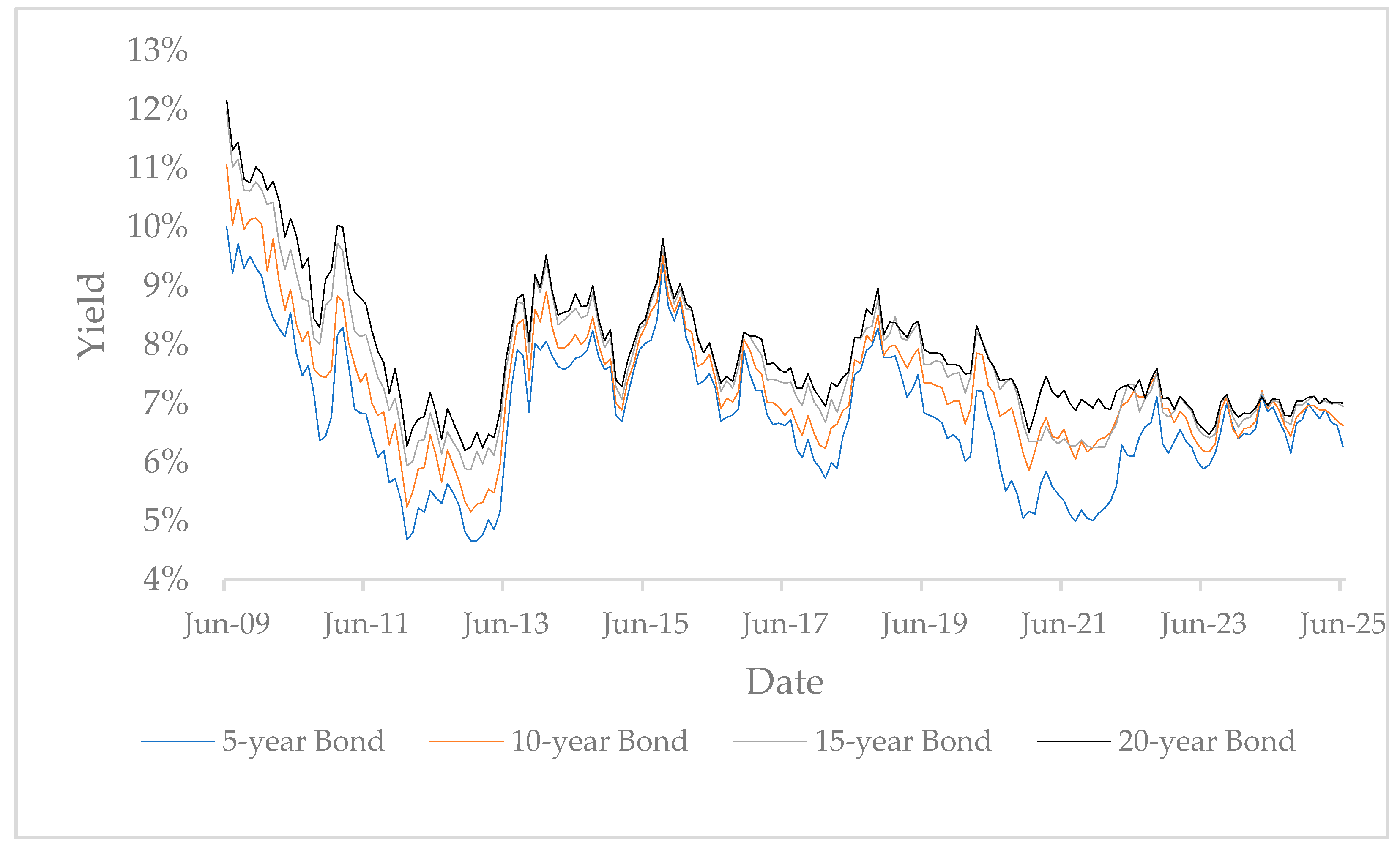
Figure 1 presents the evolution of government bond yields across the 5-, 10-, 15-, and 20-year benchmark maturities from June 2009 to June 2025. The figure shows that longer-maturity bonds generally exhibit higher yields than shorter-maturity bonds throughout the sample period. In most periods, yields increase monotonically with maturity, with the 20-year bond displaying the highest yield and the 5-year bond the lowest. The figure also reveals substantial variation in yield differences across maturities over time, indicating that the yield curve’s slope is not constant throughout the sample period.

4.2. Impact of the Duration Adjustment on Excess Return Dispersion

Table 2 presents descriptive statistics for excess returns before and after the duration adjustment. Prior to adjustment, mean excess returns and standard deviations both increase with maturity, from 2.02% and 5.27% for the 5-year bond to 5.24% and 11.49% for the 20-year bond. After adjusting for duration, however, mean excess returns per unit of duration become much more uniform across maturities, ranging from 0.50% to 0.55%. Standard deviations per unit of duration also converge, ranging from 1.22% to 1.36%.

4.3. Distribution of Carry Across the Yield Curve

Table 3 presents descriptive statistics for the Carry 1 and Carry 2 measures before and after the duration adjustment. Before adjustment, both measures increase with maturity: Carry 1 rises from 2.03% for the 5-year bond to 2.67% for the 20-year bond, and Carry 2 increases from 1.09% to 2.19%. After the duration adjustment, the pattern reverses. Carry 1 per unit of duration declines from 0.51% at 5 years to 0.28% at 20 years. Carry 2 per unit of duration decreases from 0.27% to 0.23%. The decline is gradual but not strictly monotonic.

4.4. Carry and Term Spread Effects on Bond Excess Returns

Table 4 presents the mean excess returns per unit of duration, standard deviations, and Sharpe ratios for bonds ranked by their carry per unit of duration, from low to high (B1–B4). For both carry measures, mean excess returns per unit of duration increase as the duration-adjusted carry rises. For Carry 1, mean excess returns per unit of duration increase from 0.36% for B1 to 0.71% for B4, while Sharpe ratios rise from 0.29 to 0.54. The B4 portfolio delivers a positive mean excess return per unit of duration, statistically significant at the 5% level. For Carry 2, mean excess returns per unit of duration increase from 0.21% for B1 to 0.88% for B4, with Sharpe ratios rising from 0.17 to 0.64. Similarly, the B4 portfolio exhibits a positive mean excess return per unit of duration, statistically significant at the 5% level. Nevertheless, ANOVA tests show that the differences in excess returns per unit of duration across the ranked bonds are not statistically significant.
To examine the distribution of signal ranks across maturities, Table 5 reports the average bond ranks for each maturity segment. Each month, bonds are sorted based on both carry signals and assigned ranks from 1 (highest signal) to 4 (lowest signal). The results indicate that carry rankings vary across maturities, with shorter-maturity bonds receiving more favorable carry rankings than longer-maturity bonds. Consistent with this observation, the Friedman test detects statistically significant differences in average ranks across maturities.

4.5. Performance of High-Carry and Factor Portfolios

To mitigate the impact of idiosyncratic noise at the individual-bond level, this section examines the performance of portfolios formed by sorting bonds by carry. Table 6 shows how the low-carry (P1), high-carry (P2), and factor portfolios performed based on carry rankings. The high-carry portfolio (P2) has a positive mean excess return per unit of duration, which is statistically significant at the 5% level. Although P2 has higher mean excess returns than P1, the difference between them is not statistically significant. Compared with the passive benchmark, P2 yields positive alpha, whereas P1 yields negative alpha; both are statistically significant at the 5% level. Factor portfolios also exhibit statistically significant mean excess returns per unit of duration: 0.32% for Carry 1 at the 5% significance level and 0.50% for Carry 2 at the 1% significance level. Relative to the passive benchmark, Carry 1 generates a positive alpha of 0.30%, which is statistically significant at the 5% level, while Carry 2 delivers a higher alpha of 0.46%, which is statistically significant at the 1% level. Overall, Carry 2 outperforms Carry 1, with a higher mean excess return per unit of duration and a larger and more statistically significant alpha.

4.6. Time Persistence Analysis

Table 7 reports the success ratios of factor portfolio performance across rolling windows for both carry measures. The analysis evaluates the temporal stability of the strategies using ten-year rolling regressions. The results show that the Carry 2 strategy achieves a 100% success rate, delivering positive, statistically significant alphas at the 5% level across all rolling windows. In contrast, Carry 1 shows lower consistency, with a success rate of 44.59%.
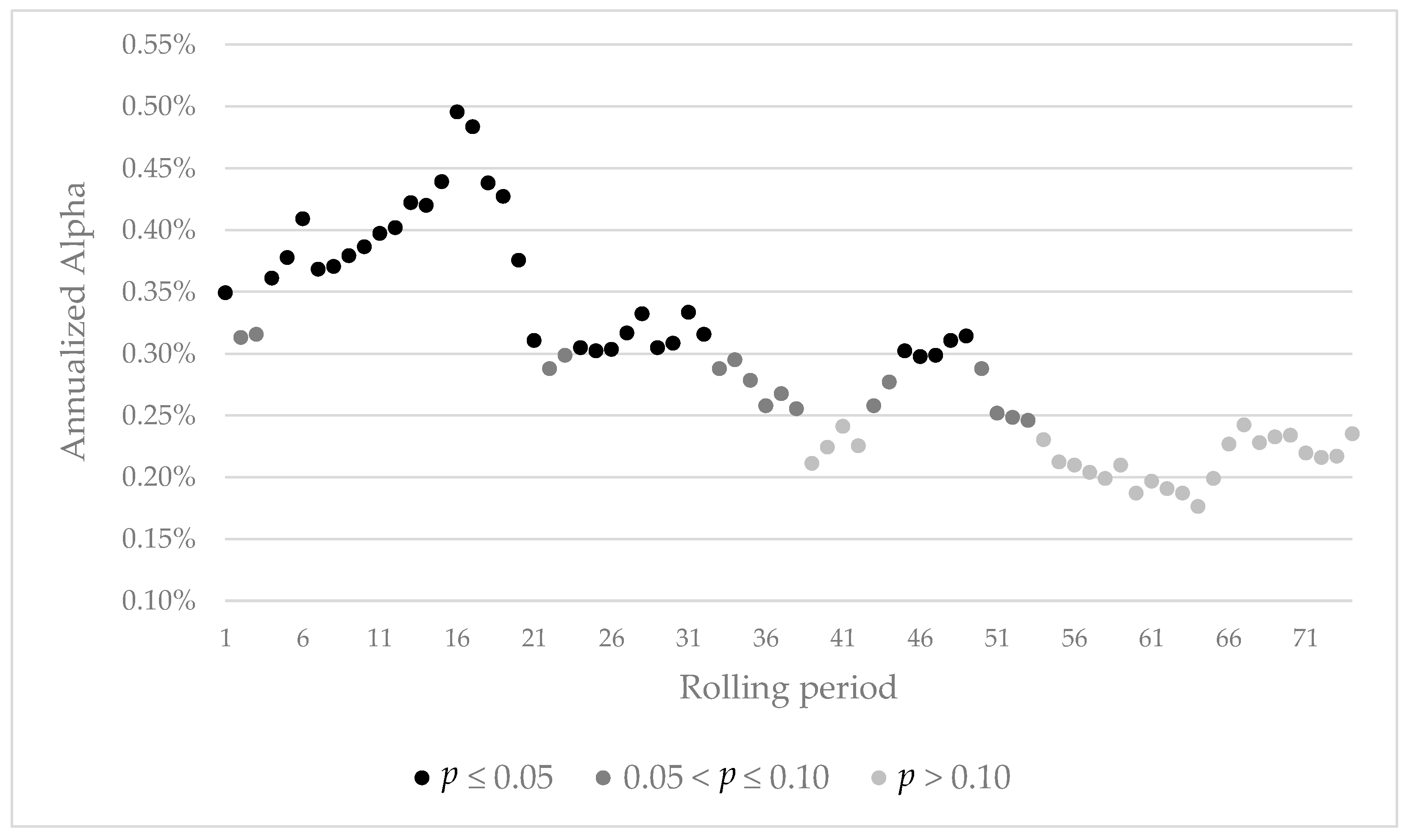
Figure 2 presents ten-year rolling-window alpha estimates for the Carry 1 strategy. The results indicate that statistically significant positive excess returns are observed mainly in earlier subperiods (p ≤ 0.05), while both the magnitude and statistical significance of alphas decline in later periods. This pattern suggests variability in Carry 1’s performance over time.
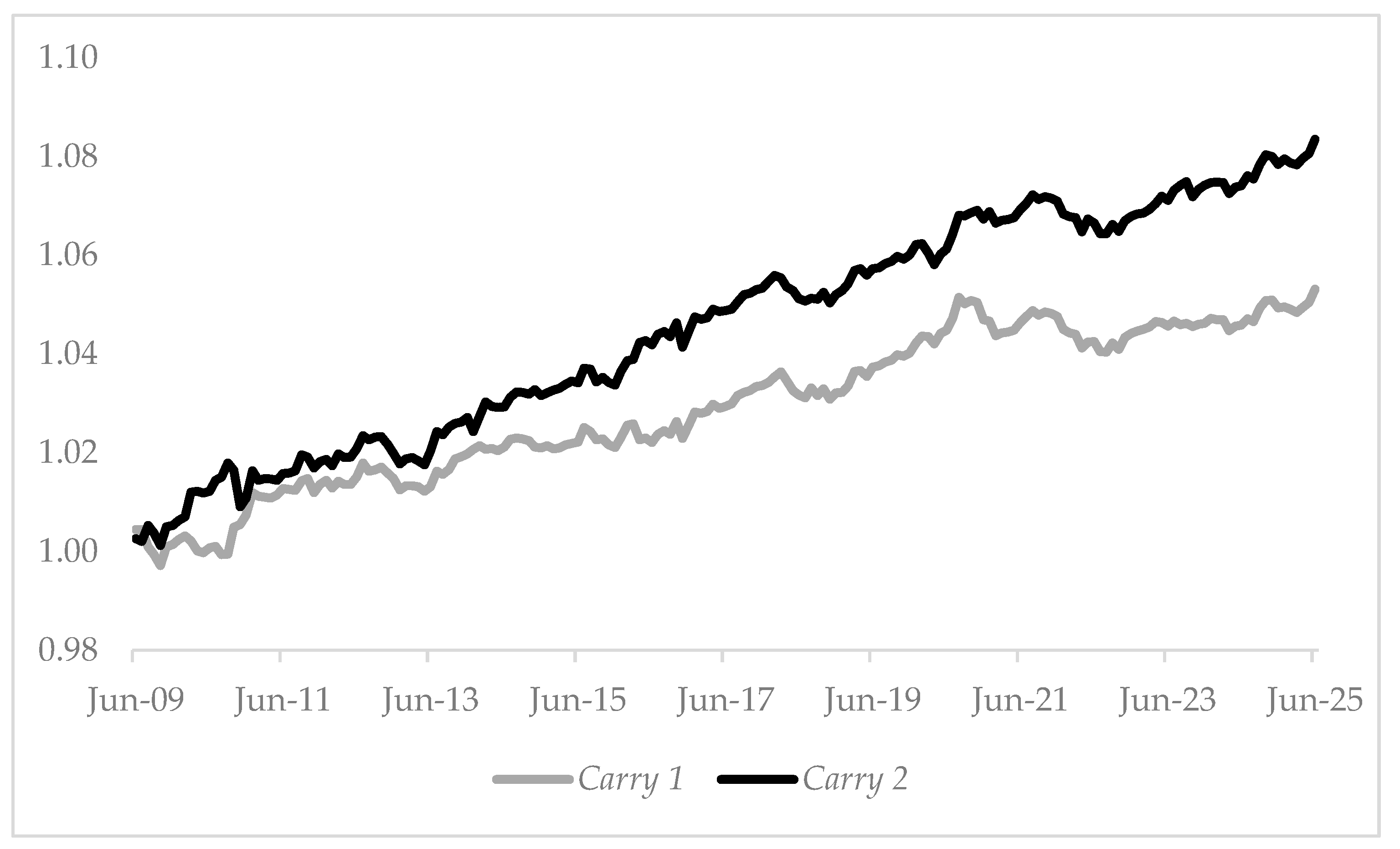
Figure 3 presents the cumulative performance of the factor portfolios over the June 2009–June 2025 sample period, assuming an initial investment value of IDR 1. Both carry specifications exhibit a generally upward trend, indicating that the portfolios generate positive cumulative excess returns over time. However, the portfolio based on Carry 2 consistently outperforms the portfolio based on Carry 1 throughout most of the sample period. Although both strategies experience temporary drawdowns, neither portfolio exhibits a prolonged deterioration in performance. Instead, cumulative returns continue to increase over time, suggesting that the profitability of the carry premium is not driven by a small number of isolated episodes. By the end of the sample period, the cumulative value of the Carry 2 portfolio reaches approximately IDR 1.08, compared with approximately IDR 1.05 for Carry 1. This result indicates that Carry 2 yields stronger, more persistent performance than Carry 1.

4.7. Risk Analysis of Factor Portfolio Performance

Table 8 presents the exposure of factor portfolio returns to broad bond market risk, based on regressions against the passive benchmark. For both definitions of carry, the intercepts are positive and statistically significant. The intercept is 0.02%, statistically significant at the 5% level for Carry 1, and 0.03%, statistically significant at the 1% level for Carry 2, indicating that carry strategies generate positive average excess returns after accounting for aggregate bond market movements.
Market exposure varies between the two definitions of carry. Carry 1 has a benchmark coefficient of 0.42%, which is not statistically significant, indicating no measurable sensitivity to the passive benchmark returns. Carry 2 exhibits a positive benchmark loading of 1.14%, which is statistically significant only at the 10% level.
Table 9 reports the performance of the Carry 1 and Carry 2 portfolios across different macro-financial states.
For Carry 1, annualized excess returns are lower during policy rate hike periods (0.14%) than during non-hike periods (0.36%). Similar patterns are observed for market drawdowns (0.25% versus 0.34%), IDR depreciation periods (−0.12% versus 0.60%), and global crisis episodes (0.10% versus 0.38%). Sharpe ratios are also lower during adverse states, with the lowest value recorded during IDR depreciation periods (−0.24).
Carry 2 exhibits a similar pattern. Annualized excess returns are lower during policy rate hike periods (0.22% versus 0.55%), market drawdowns (0.36% versus 0.53%), IDR depreciation periods (0.01% versus 0.81%), and global crisis episodes (0.12% versus 0.60%). The corresponding Sharpe ratios are likewise lower during adverse states, with the largest decline occurring during IDR depreciation periods, where the Sharpe ratio falls from 1.58 to 0.01. ANOVA results indicate that, for both carry measures, only the difference between depreciation and non-depreciation states is statistically significant at the 1% level. No statistically significant differences are detected between policy rate hike and non-hike periods, drawdown and non-drawdown periods, or crisis and non-crisis periods.

4.8. Performance of Duration-Matched Long-Only Portfolios

Having established the effectiveness of carry strategies in the long–short framework, the next step is to examine their performance in a realistic long-only setting. Table 10 reports the performance of DM portfolios based on the two carry specifications after round-trip transaction costs of 5 bps and compares their results with those of the market benchmark.
Carry 2 delivers the highest gross return at 10.80%, compared to 9.97% for Carry 1 and 9.40% for the market benchmark. After deducting annual transaction costs of 0.58%, Carry 2 maintains the highest net return at 10.21%, with Carry 1 at 9.38%.
Relative to the risk-free rate of 5.69%, Carry 2 achieves a net excess return of 4.52%, outperforming Carry 1 (3.69%) and the market benchmark (3.71%). Carry 2 also records the highest Sharpe ratio (0.51) and Sortino ratio (0.93). Its annualized alpha versus the market benchmark is 0.78%, statistically significant at the 5% level. Carry 1, by contrast, has a slightly negative and statistically insignificant alpha (−0.09%). In terms of downside risk, the standard deviation of negative net excess returns is 4.87% for Carry 2, lower than that of Carry 1 (5.04%) and the market benchmark (4.97%). Maximum drawdowns are similar across all strategies, ranging from −18.35% to −18.74%.
The persistence of the DM portfolio’s strategy performance is further examined using 10-year rolling windows (Table 11). The Carry 2 strategy achieves a success ratio of 71.62%. In contrast, Carry 1 records no successful windows (0%) across 74 observations.
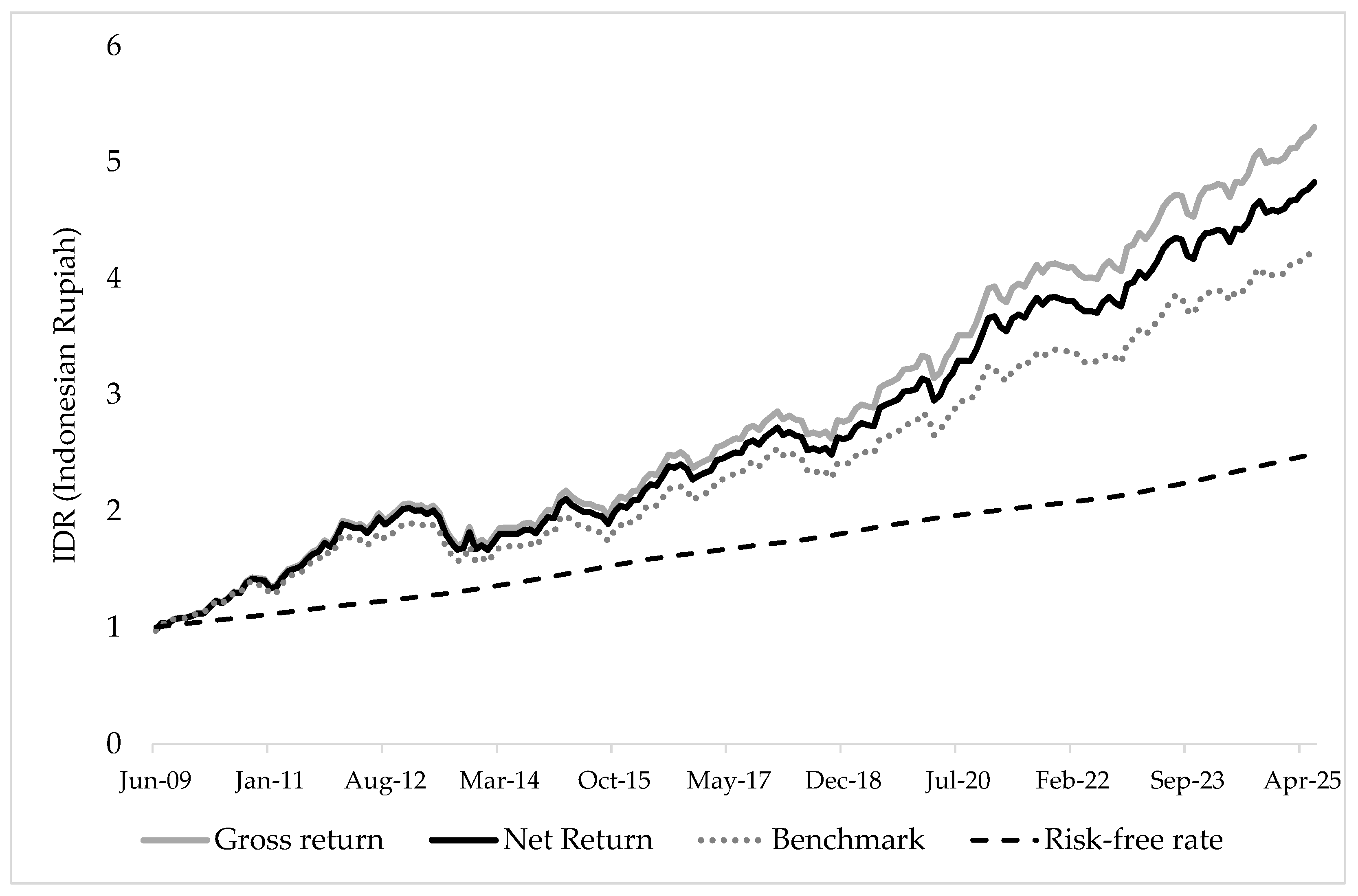
Finally, Figure 4 presents the cumulative growth of IDR 1 invested in the Carry 2 DM portfolio from June 2009 to June 2025, together with the market benchmark and the risk-free rate. Over the 16-year period, the Carry 2 portfolio consistently delivers higher cumulative returns than the market benchmark.
Table 12 reports the sensitivity of the Carry 2 DM portfolio to alternative transaction cost assumptions ranging from 5 to 7 basis points per trade. As expected, higher transaction costs gradually reduce portfolio performance. Net returns decline from 10.21% under the 5-basis-point assumption to 9.98% when transaction costs increase to 7 basis points. Similarly, net excess returns decrease from 4.52% to 4.29% across the same range of assumptions.
Despite higher trading costs, the portfolio continues to generate positive net outperformance relative to the market benchmark across all scenarios. Net outperformance declines progressively from 0.81% at 5 basis points to 0.58% at 7 basis points but remains positive throughout.
The estimated alpha also decreases as transaction costs rise, falling from 0.78% to 0.55%. Alpha remains statistically significant at the 5% level under transaction costs of 5 and 5.5 basis points and at the 10% level under transaction costs of 6 and 6.5 basis points. However, statistical significance disappears when transaction costs reach 7 basis points, where the t-statistic declines to 1.62.

5. Discussion

Figure 1 shows that longer-maturity bonds generally offer higher yields than shorter-maturity bonds throughout the sample period, indicating that the Indonesian yield curve generally maintains a positive slope, consistent with Affandi et al. (2020). However, the steepness of the curve, as reflected in the yield differentials between short- and long-maturity bonds, varies over time, indicating that the term structure is not stable throughout the sample period. This observation is relevant for the analysis of carry strategies because carry signals are derived from the shape of the yield curve.
While Figure 1 shows that longer-maturity bonds generally offer higher yields, higher yields do not necessarily imply superior risk-adjusted performance. To assess this issue, the analysis next compares bond returns before and after duration-scaled measures. Prior to the duration adjustment, longer-maturity bonds earn higher excess returns. After expressing returns on a per-unit-of-duration basis, excess returns become considerably more similar across maturities, and the monotonic pattern mostly disappears. At the same time, differences in volatility are substantially reduced. Together, these findings suggest that the higher excess returns at longer maturities mainly reflect more duration risk, not better risk-adjusted performance.
The smaller dispersion in excess returns and the more similar standard deviations observed after scaling by duration suggest that duration exposure accounts for an important share of the performance differences observed across maturities. By expressing both excess returns and carry signals per unit of duration, the analysis facilitates a more comparable assessment of bond performance across maturities. As a result, given the relatively homogeneous nature of the benchmark government bond sample, the remaining variation in returns and volatility becomes considerably smaller after scaling by duration.
The impact of the duration adjustment is not limited to bond returns but also extends to the cross-sectional behavior of carry signals. Before accounting for duration, carry increases with bond maturity, implying that higher carry is concentrated in longer-maturity bonds. However, once duration is accounted for, shorter-maturity bonds exhibit stronger carry per unit of duration. This finding suggests that the yield curve’s slope does not increase in proportion to duration. Consequently, the additional carry from extending maturity does not appear to increase in proportion to duration risk. As a result, shorter-maturity bonds provide greater carry compensation per unit of duration than longer-maturity bonds.
This mechanism applies to both carry specifications because the term spread is a component of each measure. For Carry 2, which is based solely on the term spread, the results indicate that shorter-maturity bonds offer higher term spreads relative to their duration risk. For Carry 1, the same effect may be further reinforced by the roll-down component. Martens et al. (2019) link this to a steeper yield curve at the short end. This allows shorter bonds to earn higher yields than funding rates, delivering stronger roll-down returns. As a result, higher carry per unit of duration tends to be found in the short- to medium-term part of the yield curve, not in the longest maturities.
It should be noted that duration adjustment controls only first-order interest-rate risk. Higher-order interest-rate risks, such as convexity risk, and uncertainty regarding future yield-curve dynamics may still differ across maturities. Accordingly, duration adjustment may isolate carry relative to duration risk, but it does not fully eliminate maturity-related risk.
Despite these limitations, the empirical analysis focuses on the relationship between duration-adjusted carry and excess returns. The point estimates suggest that bonds with higher carry per unit of duration tend to earn higher mean excess returns per unit of duration. Although the point estimates are broadly consistent with the carry hypothesis, the ANOVA tests do not provide sufficient statistical evidence to confirm systematic differences in excess returns at the individual-bond level. Nevertheless, the underlying economic pattern becomes more apparent after aggregation. By combining bonds into portfolios, portfolio formation reduces idiosyncratic volatility and security-specific noise, allowing the common component of the carry signal to emerge more clearly.
The opposite signs of the alphas for high-carry and low-carry portfolios suggest that carry captures economically meaningful differences in expected returns across bonds. Relative to the passive benchmark, higher-carry bonds tend to deliver superior risk-adjusted performance, whereas lower-carry bonds tend to underperform. Because alpha measures performance beyond what is explained by benchmark exposure, these findings suggest that carry contains information about expected returns that is not captured by the passive benchmark.
This interpretation is strengthened by the sample’s relative homogeneity, which consists exclusively of government bonds issued by the same sovereign and denominated in the same currency. Moreover, the duration adjustment may substantially reduce differences in conventional interest-rate risk exposure across maturities.
The long–short strategy generates statistically significant mean excess return per unit of duration and positive alphas under both carry measures. Although the differences in excess returns across the carry-sorted bonds (B1–B4) are not statistically significant, the signal-weighting approach defined in Equation (11) amplifies the strategy’s exposure to the most extreme carry signals. By overweighting the highest-carry bonds in the long leg and the lowest-carry bonds in the short leg, the return spread between the two groups widens and becomes statistically significant. These findings indicate that both carry strategies generate positive long–short returns in the Indonesian government bond market. However, only Carry 2 demonstrates the persistence required by Hypothesis 1 (H1). Therefore, H1 is confirmed for Carry 2 but not for Carry 1.
This asymmetric support for H1 indicates that the choice of carry definition materially influences strategy performance. Consistent with this observation, the higher mean excess returns per unit of duration, larger alphas, and stronger persistence of the long–short Carry 2 strategy compared to Carry 1 support Hypothesis 2 (H2), which predicts that the term spread-based carry measure (Carry 2) gives stronger, more consistent performance than the roll-down-inclusive measure (Carry 1). As an additional robustness check, both strategies generate positive cumulative returns over time, with Carry 2 outperforming Carry 1 throughout most of the sample period, providing further support for H2.
The evidence points to currency-related conditions as the most relevant state variable among those examined, while the evidence for the remaining state classifications appears less robust. This finding is particularly relevant in Indonesia, where foreign investors have historically accounted for a substantial share of the government bond market. According to the IMF (2021), Indonesia was among the emerging markets with the highest levels of foreign participation in local-currency government bonds before the COVID-19 pandemic and exhibited higher exchange-rate volatility than many other ASEAN economies. IMF (2021) further notes that many foreign investors evaluate returns in foreign-currency terms. Consequently, exchange-rate depreciation can reduce realized returns for foreign investors, potentially weakening the attractiveness of local-currency bonds and increasing the risk of capital outflows. Consistent with this mechanism, Gadanecz et al. (2014) note that unexpected currency depreciation may prompt investors to move away from assets denominated in the affected currency, contributing to fluctuations in cross-border capital flows. More broadly, IMF (2021) argues that a high share of nonresident holdings may increase the sensitivity of local-currency bond markets to shifts in global risk aversion, making bond yields more vulnerable to episodes of capital outflows during periods of financial stress and, in extreme cases, contributing to disorderly market conditions.
Although the carry portfolio is constructed to be duration-neutral, this neutrality is intended only to mitigate exposure to parallel shifts in the yield curve and does not eliminate other sources of market risk. In line with the vulnerabilities highlighted by the IMF (2021), periods of exchange-rate depreciation may create market conditions less favorable to carry strategies, thereby contributing to weaker carry performance. These findings suggest that the carry premium may partly compensate investors for bearing currency-related risks that become more pronounced during periods of exchange-rate depreciation, even after controlling for duration exposure.
To complement the long–short analysis and better assess the practical use of the carry signal, this study examines DM portfolios that include transaction costs. The results show that, between the two carry measures, only Carry 2 gives a reliable signal for forming long-only portfolios in the Indonesian government bond market. Portfolios built with Carry 2 consistently outperform both Carry 1 and the market benchmark on a risk-adjusted basis. This improved performance also manifests in higher Sharpe and Sortino ratios, indicating a more favorable return–risk balance. Importantly, this improvement comes without a major increase in downside risk. This finding, although limited to Carry 2, is consistent with Hypothesis 4 (H4), which predicts that duration-adjusted long-only portfolios constructed using an optimal carry measure should outperform a market benchmark after accounting for transaction costs.
Although Carry 1 generates slightly higher gross returns than the market benchmark, this advantage disappears after accounting for transaction costs, resulting in an insignificant negative alpha. This weaker performance may reflect the inclusion of the roll-down component, which implicitly assumes stable yield-curve dynamics. Given the generally upward-sloping yield curve observed in the Indonesian government bond market, the findings suggest that Carry 1’s weaker performance is unlikely to stem from a lack of roll-down opportunities. Rather, the results suggest that the roll-down component may become less effective when future yield-curve movements deviate from those implied by the current curve. Under such conditions, the expected roll-down gains may not be realized consistently, thereby limiting the strategy’s overall performance.
More insights appear from the persistence analysis. Using a rolling-window approach, the results show that Carry 2 has a success rate above 70% over 10-year periods. This means the strategy’s performance is not driven by a few rare events; rather, it remains stable across many market environments. These findings also support Hypothesis 2 (H2), which proposes that Carry 2 is more persistent and robust than Carry 1.
However, further results indicate that the Carry 2 strategy is moderately sensitive to higher transaction costs. As round-trip transaction costs increase from 5 to 7 basis points, both net outperformance and alpha decline gradually. Although the portfolio continues to generate positive net outperformance under all transaction-cost assumptions considered, the statistical significance of alpha weakens progressively. Alpha remains significant at the 5% level under transaction costs of 5 and 5.5 basis points, and at the 10% level under transaction costs of 6 and 6.5 basis points, but becomes statistically insignificant at 7 basis points. These findings suggest that the strategy may remain economically viable despite higher implementation costs, as net outperformance remains positive across all scenarios considered. Nevertheless, the declining statistical significance of alpha indicates that evidence of abnormal performance relative to the benchmark becomes less conclusive as transaction costs increase.
Overall, the evidence suggests that a term spread-based carry measure offers a practical and empirically robust representation of the carry factor within the benchmark segment of the Indonesian government bond market.

6. Conclusions and Future Research

The findings suggest that the cross-curve carry strategy generates economically meaningful performance in the Indonesian government bond market, although its effectiveness depends importantly on how carry is specified. The term spread-based measure (Carry 2) appears to provide a stronger and more robust signal than the composite carry-and-roll-down measure (Carry 1), offering evidence on an important methodological issue in the emerging-market bond literature. The results further indicate that carry returns tend to be weaker during periods of currency depreciation.
Most importantly, we translate this theoretical factor into a practical investment strategy, demonstrating that a long-only, duration-matched portfolio can harvest this premium after accounting for real-world frictions such as transaction costs. From an investment perspective, these findings suggest that carry is not merely a descriptive characteristic of the yield curve but a practical signal that can be incorporated into bond selection and portfolio construction decisions. Rather than relying solely on maturity exposure, investors may improve portfolio performance by systematically allocating bonds with higher term spreads while maintaining appropriate control over duration risk. Nevertheless, the practical implementation of the strategy remains subject to trading conditions. The sensitivity analysis further indicates that the strategy’s economic viability weakens as transaction costs rise, suggesting that profitability may be affected by unfavorable market conditions that drive them higher.
This study is subject to several limitations. First, the analysis is based on four de jure benchmark government bonds, reflecting a deliberate focus on the most liquid and tradable segment of the Indonesian bond market. While this choice enhances the practical relevance and implementability of the results, it limits the sample’s cross-sectional breadth and may reduce the statistical power to detect factor effects at the individual-security level. Consequently, the findings should be interpreted as evidence from the liquid benchmark segment rather than from the broader universe of Indonesian government bonds.
Second, the study uses the BI Rate as the risk-free-rate proxy. Although widely used in the Indonesian literature, the BI Rate is not directly investable. Consequently, the results should be interpreted subject to the assumption that the BI Rate provides an appropriate proxy for the risk-free rate.
Third, the analysis primarily relies on modified duration, a first-order measure of interest-rate sensitivity, to achieve risk parity and control for differences in interest-rate exposure across bonds. While this approach helps isolate the carry signal from broad interest-rate movements, it may not fully capture more complex sources of return variation.
Finally, the analysis focuses on a single-country setting. Although Indonesia shares several characteristics with other emerging government bond markets in Southeast Asia, the external validity of the findings remains uncertain. As noted by Fong and Wu (2020), government bond return predictability may be influenced by institutional structures, monetary policy frameworks, financial openness, political risk, and market liquidity. Therefore, caution is warranted when generalizing the results beyond Indonesia.
Future research could extend the analysis to a broader set of government securities. It could also incorporate higher-order measures of interest-rate risk to provide a more comprehensive assessment of the risk exposures underlying carry returns. In addition, comparative studies of ASEAN government bond markets may help distinguish country-specific effects from broader regional carry premia. Finally, multi-factor models incorporating value and momentum factors could provide further insight into whether the carry premium is independent of, and additive to, other fixed-income factors.


Author Contributions

Conceptualization, A.S.M.; data curation, A.S.M.; formal analysis, A.S.M.; methodology, A.S.M.; resources, A.S.M.; software, A.S.M.; validation, A.S.M.; visualization, A.S.M.; writing—original draft preparation, A.S.M.; writing—review and editing, A.S.M., N.A.A., R.S. and D.I.; supervision, N.A.A., R.S. and D.I. All authors have read and agreed to the published version of the manuscript.

Funding

This research received no external funding.

Institutional Review Board Statement

Not applicable.

Informed Consent Statement

Not applicable.

Data Availability Statement

The data used in this study are publicly available from relevant financial data providers and official sources.

Acknowledgments

During the preparation of this manuscript, the authors used ChatGPT (GPT-5.5) to refine the language. The authors have reviewed and taken full responsibility for the content of this publication.

Conflicts of Interest

The authors declare no conflicts of interest.

Abbreviations

The following abbreviations are used in this manuscript:
ADBAsian Development Bank
FTSEFinancial Times Stock Exchange
IMFInternational Monetary Fund

References

  1. Adams, J. F., & Smith, D. J. (2019). Fixed income analysis (4th ed.). CFA Institute Investment Series. John Wiley & Sons. [Google Scholar]
  2. Affandi, Y., Harahap, B., Bary, P., & Suryani, F. T. (2020). Natural yield curve: The case of Indonesia. Contemporary Economics, 14(2), 182–200. [Google Scholar] [CrossRef]
  3. Aghassi, M., Asness, C., Fattouche, C., & Moskowitz, T. J. (2023). Fact, fiction, and factor investing. Journal of Portfolio Management, 49(2), 57–94. [Google Scholar] [CrossRef]
  4. Ang, A. (2014). Asset management: A systematic approach to factor investing. Oxford University Press. [Google Scholar] [CrossRef]
  5. Asian Development Bank. (2016). Asia bond monitor: November 2016. Asian Development Bank. Available online: https://www.adb.org/sites/default/files/publication/213241/abm-nov-2016.pdf (accessed on 31 May 2026).
  6. Asian Development Bank. (2017). Asia bond monitor: November 2017. Asian Development Bank. [Google Scholar] [CrossRef]
  7. Asian Development Bank. (2018). Asia bond monitor: November 2018. Asian Development Bank. [Google Scholar] [CrossRef]
  8. Asian Development Bank. (2019). Asia bond monitor: November 2019. Asian Development Bank. [Google Scholar] [CrossRef]
  9. Asian Development Bank. (2021). Asia bond monitor: March 2021. Asian Development Bank. [Google Scholar] [CrossRef]
  10. Asian Development Bank. (2022). Asia bond monitor: March 2022. Asian Development Bank. [Google Scholar] [CrossRef]
  11. Asian Development Bank. (2023). Asia bond monitor: March 2023. Asian Development Bank. [Google Scholar] [CrossRef]
  12. Asian Development Bank. (2024). Asia bond monitor: March 2024. Asian Development Bank. [Google Scholar] [CrossRef]
  13. Asian Development Bank. (2025a). Asia bond monitor: June 2025. Asian Development Bank. [Google Scholar] [CrossRef]
  14. Asian Development Bank. (2025b). AsianBondsOnline. Available online: https://asianbondsonline.adb.org/ (accessed on 31 December 2025).
  15. Baltas, N. (2017). Optimizing cross-asset carry. In E. Jurczenko (Ed.), Factor investing: From traditional to alternative risk premia (pp. 317–364). Elsevier. [Google Scholar] [CrossRef]
  16. Baltussen, G., Martens, M., & Penninga, O. (2022). Factor investing in sovereign bond markets: Deep sample evidence. Journal of Portfolio Management, 48(2), 209–225. [Google Scholar] [CrossRef]
  17. Baltussen, G., Swinkels, L., & Van Vliet, P. (2021). Global factor premiums. Journal of Financial Economics, 142(3), 1128–1154. [Google Scholar] [CrossRef]
  18. Bartram, S. M., Lohre, H., & Pope, P. F. (2021). Navigating the factor zoo around the world: An institutional investor perspective. Journal of Business Economics, 91, 655–703. [Google Scholar] [CrossRef] [PubMed]
  19. Baz, J., Granger, N., Harvey, C. R., Le Roux, N., & Rattray, S. (2015). Dissecting investment strategies in the cross section and time series. SSRN Working Paper No. 2695101. SSRN. [Google Scholar] [CrossRef]
  20. Bektić, D., Hachenberg, B., & Schiereck, D. (2020). Factor-based investing in government bond markets: A survey of the current state of research. Journal of Asset Management, 21(2), 94–105. [Google Scholar] [CrossRef]
  21. Blitz, D., Baltussen, G., & van Vliet, P. (2020). When equity factors drop their shorts. Financial Analysts Journal, 76(4), 73–99. [Google Scholar] [CrossRef]
  22. Bodie, Z., Kane, A., & Marcus, A. J. (2014). Investments (10th ed.). McGraw-Hill Education. [Google Scholar]
  23. Brooks, J., Palhares, D., & Richardson, S. (2018). Style investing in fixed income. Journal of Portfolio Management, 44(4), 127–139. [Google Scholar] [CrossRef]
  24. Chernov, M., Creal, D., & Hördahl, P. (2023). Sovereign credit and exchange rate risks: Evidence from Asia-Pacific local currency bonds. Journal of International Economics, 140, 103692. [Google Scholar] [CrossRef]
  25. Coche, J., Knezevic, M., & Sahakyan, V. (2018). Carry on? In N. Bulusu, J. Coche, A. Reveiz, & F. Rivadeneyra (Eds.), Advances in the practice of public investment management (pp. 131–159). Palgrave Macmillan. [Google Scholar] [CrossRef]
  26. Dabrowski, P. (2022). Stock indices breakdown during the pandemic as the most dynamic bear market in history: Consequences for individual investors. Risks, 10(1), 1. [Google Scholar] [CrossRef]
  27. de Silva, H. (2023). On factor purity in investment portfolios. Journal of Portfolio Management, 49(2), 26–32. [Google Scholar] [CrossRef]
  28. Dyl, E. E., & Joehnk, M. D. (1981). Riding the yield curve: Does it work? Journal of Portfolio Management, 7(3), 13–17. [Google Scholar] [CrossRef]
  29. Elton, E. J., Gruber, M. J., Brown, S. J., & Goetzmann, W. N. (2014). Modern portfolio theory and investment analysis (9th ed.). Wiley. [Google Scholar]
  30. Fabozzi, F. J. (2021). Bond pricing, yield measures, and total return. In F. J. Fabozzi (Ed.), The handbook of fixed income securities (9th ed., pp. 63–95). McGraw-Hill. [Google Scholar]
  31. Fong, T. P. W., & Wu, S. T. (2020). Predictability in sovereign bond returns using technical trading rules. North American Journal of Economics and Finance, 51, 101105. [Google Scholar] [CrossRef]
  32. FTSE Russell. (2019). The carry concept. Available online: https://www.lseg.com/en/ftse-russell/research/ftse-fixed-income-factor-research-series-carry-concept.
  33. FTSE Russell. (2025). FTSE Nomura carry and roll-down (CaRD) world government bond index series ground rules (Version 1.9). Available online: https://www.lseg.com/content/dam/ftse-russell/en_us/documents/ground-rules/ftse-nomura-carry-and-roll-down-card-index-series-ground-rules.pdf (accessed on 26 October 2025).
  34. Gadanecz, B., Miyajima, K., & Shu, C. (2014). Exchange rate risk and local currency sovereign bond yields in emerging markets. BIS Working Paper No. 474. Bank for International Settlements. [Google Scholar]
  35. Hamdan, R., Pavlowsky, F., Roncalli, T., & Ban, G. (2016). A primer on alternative risk premia. SSRN Working Paper. SSRN. [Google Scholar] [CrossRef][Green Version]
  36. Harikrishnan, N., Benjamin, S., & Yoldas, E. (2023, October 4). U.S. interest rates and emerging market currencies: Taking stock 10 years after the taper tantrum. Board of Governors of the Federal Reserve System. [Google Scholar] [CrossRef]
  37. Ilmanen, A. (2022). Investing amid low expected returns. Wiley. [Google Scholar]
  38. Ilmanen, A., Israel, R., Lee, R., Moskowitz, T. J., & Thapar, A. (2021). How do factor premia vary over time? Journal of Investment Management, 19(4), 15–57. [Google Scholar] [CrossRef]
  39. IMF, Asia and Pacific Department. (2021). Indonesia: Selected issues (IMF Staff Country Report No. 2021/047). International Monetary Fund. [CrossRef]
  40. Invesco. (2022). Invesco global factor investing study. Available online: https://www.invesco.com/content/dam/invesco/jp/ja/pdf/global-factor-investing-study/2022/IGFIS-2022-Full-Report.pdf (accessed on 31 May 2026).
  41. Koijen, R. S. J., Moskowitz, T. J., Pedersen, L. H., & Vrugt, E. B. (2018). Carry. Journal of Financial Economics, 127(2), 197–225. [Google Scholar] [CrossRef]
  42. Lim, C. (2020). Style factors in emerging Asian government bond markets. SSRN. [Google Scholar] [CrossRef]
  43. Martellini, L., & Milhau, V. (2018). Smart beta and beyond: Maximising the benefits of factor investing. EDHEC-Risk Institute. Available online: https://climateinstitute.edhec.edu/publications/smart-beta-and-beyond-maximising-benefits-factor-investing (accessed on 31 May 2026).
  44. Martens, M., Beekhuizen, P., Duyvesteyn, J., & Zomerdijk, C. (2019). Carry investing on the yield curve. Financial Analysts Journal, 75(4), 51–63. [Google Scholar] [CrossRef]
  45. Nia, V. M., Siregar, H., Sembel, R., & Zulbainarni, N. (2025). Construction of an optimal portfolio of gold, bonds, stocks and bitcoin: An Indonesian case study. Journal of Risk and Financial Management, 18(12), 668. [Google Scholar] [CrossRef]
  46. Osteryoung, J. S., McCarty, D. E., & Roberts, G. S. (1981). Riding the yield curve with Treasury bills. The Financial Review, 16(3), 57–66. [Google Scholar] [CrossRef]
  47. Remolona, E., & Yetman, J. (2022). De jure benchmark bonds. International Journal of Central Banking, 18(3), 89–124. [Google Scholar]
  48. Ross, S. A. (1976). The arbitrage theory of capital asset pricing. Journal of Economic Theory, 13(3), 341–360. [Google Scholar] [CrossRef]
  49. Schulmerich, M., Leporcher, Y., & Eu, C. (2015). Applied asset and risk management. Springer. [Google Scholar] [CrossRef]
  50. Teplova, T., Sokolova, Y. V., & Munir, Q. (2020). Which investment strategy is profitable in bond market? Reverse or momentum? What about risk? In T. Teplova, Y. V. Sokolova, & Q. Munir (Eds.), Emerging bond markets: Shedding light on trends and patterns (pp. 290–304). Routledge. [Google Scholar] [CrossRef]
  51. Tjandrasa, B. B., Siagian, H., & Jie, F. (2020). The macroeconomic factors affecting government bond yield in Indonesia, Malaysia, Thailand, and the Philippines. Investment Management and Financial Innovations, 17(3), 111–121. [Google Scholar] [CrossRef]
  52. Valogo, M. K., Duodu, E., Yusif, H., & Baidoo, S. T. (2023). Effect of exchange rate on inflation in the inflation targeting framework: Is the threshold level relevant? Research in Globalization, 6, 100119. [Google Scholar] [CrossRef]
  53. Warren, B., & Quance, S. (2019). Foundational concepts for understanding factor investing. Invesco. Available online: https://assets.invescohub.com/invesco-eu/investment-campus/factor-investing.pdf (accessed on 31 May 2026).
Figure 1. Dynamics of Government Bond Yields across Maturities.
Jrfm 19 00469 g001
Figure 2. Ten-Year Rolling Alpha Estimates for Carry 1 Strategy. Note: Ten-year rolling-window estimates of annualized alpha for the Carry 1 strategy. Each point represents the estimated alpha from a 10-year rolling regression. Dots are colored according to their statistical significance levels: black for p ≤ 0.05, dark grey for 0.05 < p ≤ 0.10, and light grey for p > 0.10.
Jrfm 19 00469 g002
Figure 3. Cumulative Performance of Factor Portfolios.
Jrfm 19 00469 g003
Figure 4. Cumulative Return of IDR 1 Invested Using the Carry 2 Strategy, June 2009–June 2025.
Jrfm 19 00469 g004
Table 1. List of de jure benchmark bonds.
Year5-Year10-Year15-Year20-Year
2009FR0051FR0036FR0044FR0047
2010FR0027FR0031FR0040FR0052
2011FR0055FR0053FR0056FR0054
2012FR0060FR0061FR0059FR0058
2013FR0066FR0063FR0064FR0065
2014FR0069FR0070FR0071FR0068
2015FR0069FR0070FR0071FR0068
2016FR0053FR0056FR0073FR0072
2017FR0061FR0059FR0074FR0072
2018FR0063FR0064FR0065FR0075
2019FR0077FR0078FR0068FR0079
2020FR0081FR0082FR0080FR0083
2021FR0086FR0087FR0088FR0083
2022FR0090FR0091FR0093FR0092
2023FR0095FR0096FR0098FR0097
2024FR0101FR0100FR0098FR0097
2025FR0104FR0103FR0106FR0107
Table 2. Descriptive Statistics of Excess Returns Before and After the Duration Adjustment.
BeforeAfter
MaturityMean Excess ReturnStd. Dev.Mean Excess Return per Unit of DurationStd. Dev. per Unit of Duration
5-year bond2.02%5.27%0.50%1.36%
10-year bond3.39%8.81%0.51%1.32%
15-year bond4.19%10.32%0.50%1.23%
20-year bond5.24%11.49%0.55%1.22%
Note: Excess returns are computed monthly and averaged over the sample. “Per unit of duration” denotes excess return divided by the bond’s modified duration. All figures are annualized from monthly data. Means are multiplied by 12, and standard deviations are multiplied by   12 . All figures are rounded to two decimal places.
Table 3. Descriptive Statistics of Carry Measures Before and After the Duration Adjustment.
MaturityCarry 1Carry 2Carry 1 per Unit of DurationCarry 2 per Unit of Duration
5-year bond2.03%1.09%0.51%0.27%
10-year bond2.28%1.59%0.34%0.24%
15-year bond2.40%1.96%0.28%0.23%
20-year bond2.67%2.19%0.28%0.23%
Note: The carry measures are computed monthly and averaged over the sample. “Per unit of duration” denotes carry divided by the bond’s modified duration. All figures are rounded to two decimal places.
Table 4. Average Excess Returns Per Unit of Duration, Standard Deviations, And Sharpe Ratios by Rank.
MetricB1 (Lowest Carry)B2B3B4 (Highest Carry)
A. Carry 1
Mean (t-stat)0.36% (1.17)0.37% (1.18)0.61% (1.88) *0.71% (2.18) **
Std. deviation1.24%1.27%1.31%1.32%
Sharpe ratio0.290.290.470.54
B. Carry 2
Mean (t-stat)0.21% (0.70)0.48% (1.51)0.49% (1.57)0.88% (2.57) **
Std. deviation1.22%1.28%1.25%1.37%
Sharpe ratio0.170.380.390.64
Note: Mean (t-stat) denotes the average excess return per unit of duration, with t-statistics in parentheses. Means, standard deviations, and Sharpe ratios are annualized. All figures are rounded to two decimal places. Statistical significance is denoted by ** p < 0.05, * p < 0.10.
Table 5. Average Bond Ranks by Maturity.
Metric5-Year Bond10-Year Bond15-Year Bond20-Year Bond
A. Carry 1
Average rank1.782.422.793.01
B. Carry 2
Average rank1.982.492.662.87
Note: Average ranks are calculated monthly over the sample period for each maturity (5-, 10-, 15-, and 20-year). All figures are rounded to two decimal places.
Table 6. Performance of Carry-Sorted and Factor Portfolios.
MetricP1 (Low Carry)P2 (High Carry)Factor
(Long Short)
Passive
Benchmark
A. Carry 1
Mean (t-stat)0.37% (1.21)0.66% (2.10) **0.32% (2.54) **0.52% (1.68) *
Std. deviation1.22%1.27%0.51%1.23%
Sharpe ratio0.300.520.630.42
Alpha (t-stat)−0.14% (−2.55) **0.14% (2.55) **0.30% (2.38) **
B. Carry 2
Mean (t-stat)0.35% (1.14)0.68% (2.14) **0.50% (3.52) ***0.52% (1.68) *
Std. deviation1.22%1.28%0.57%1.23%
Sharpe ratio0.280.530.880.42
Alpha (t-stat)−0.15% (−2.77) **0.15% (2.77) **0.46% (3.74) ***
Note: Mean (t-stat) denotes the average excess return per unit of duration, with t-statistics in parentheses. Alpha (intercept) is estimated relative to the passive benchmark using Newey–West t-statistics. All series are stationary (as indicated by the ADF test at a 1% level). Means, standard deviations, Sharpe ratios, and alphas are annualized. All figures are rounded to two decimal places. Statistical significance is denoted by *** p < 0.01, ** p < 0.05, * p < 0.10.
Table 7. Success Ratios in 10-Year Rolling Periods of Factor Portfolios.
MetricCarry 1Carry 2
Success ratio44.59%100.00%
Number of observations7474
Note: “Success” is defined as a positive and statistically significant alpha at the 5% level within the window. Statistics are computed from monthly data. Standard errors are computed using OLS by default; the Newey–West method is applied only in windows for which residual diagnostics indicate heteroskedasticity and/or serial correlation. All figures are rounded to two decimal places.
Table 8. Market Risk Exposure of Carry Portfolios.
MetricCarry 1Carry 2
Constant (t-stat)0.02% (2.07) **0.03% (2.75) ***
Passive Benchmark (t-stat)0.42% (0.87)1.14% (1.75) *
Note: The dependent variable is the factor portfolio’s excess return. All series are stationary (as indicated by the ADF test at a 1% level). Coefficients are reported with t-statistics in parentheses, computed using Newey–West HAC standard errors. All figures are rounded to two decimal places. Statistical significance is denoted by *** p < 0.01, ** p < 0.05, * p < 0.10.
Table 9. State-Dependent Performance of Carry Portfolios.
Policy Rate Equity Market Currency RateGlobal Crisis
HikeNon-HikeDrawdownNon-DrawdownDepreciationNon-DepreciationCrisisNon-Crisis
Periods30163321617511840153
A. Carry 1
Mean0.14%0.36% ***0.25%0.34% **−0.12%0.60% ***0.10%0.38% ***
t-stat0.382.650.862.390.863.790.322.72
Std. Dev0.57%0.50%0.48%0.52%0.50%0.50%0.54%0.50%
Sharpe ratio0.240.720.530.65−0.241.210.180.76
B. Carry 2
Mean0.22%0.55% ***0.36%0.53% ***0.01%0.81% ***0.12%0.60% ***
t-stat0.543.661.093.361.094.960.353.89
Std. Dev0.64%0.56%0.55%0.58%0.62%0.51%0.63%0.55%
Sharpe ratio0.340.990.660.920.011.580.191.09
Note: A policy rate hike state is defined as a month in which the central bank increases its policy rate either in the current month or the subsequent month, following Martens et al. (2019). A market drawdown state is defined as a period during which the stock market declines by at least 20% from its previous peak. An IDR depreciation state is defined as a month in which the Indonesian rupiah depreciates by more than 0.7% against the U.S. dollar, following Valogo et al. (2023). Global crisis periods are identified based on the crisis episodes affecting emerging markets documented by Harikrishnan et al. (2023). Periods denote the number of monthly observations in each state. Mean and Std. Dev. denotes the annualized excess return and annualized standard deviation, respectively. The Sharpe ratio is calculated using annualized excess returns and annualized standard deviations. t-stat denotes the t-statistic of the mean excess return. Statistical significance is denoted by *** p < 0.01, ** p < 0.05.
Table 10. Duration-Matched Long-Only Portfolios Based on Carry.
MetricCarry 1Carry 2Market Benchmark
Gross return9.97%10.80%9.40%
Transaction cost0.58%0.58%
Net return9.38%10.21%
Risk-free rate5.69%5.69%5.69%
Net excess return3.69%4.52%3.71%
Standard deviation of the net excess return8.91%8.79%8.63%
Standard deviation of the negative net excess return5.04%4.87%4.97%
Sharpe ratio0.410.510.43
Sortino ratio0.730.930.75
Net outperformance−0.02%0.81%
Alpha from regression on the market benchmark−0.09%0.78% **
t-stat (alpha)−0.032.31
Maximum drawdown of the net excess return−18.74%−18.62%−18.35%
Average Duration7.507.507.50
Note: All returns and costs are calculated monthly, reported as sample averages, and annualized. Net return equals gross return minus transaction costs of 0.025% per trade (0.05% round-trip), while net excess return is computed by subtracting the risk-free rate. Maximum drawdown refers to the largest cumulative negative excess return over consecutive months and is not annualized. The Sortino ratio is defined as the net excess return divided by the standard deviation of negative net excess returns. Outperformance is measured as the difference between the long-only portfolio and the market benchmark. Alpha (annualized) is estimated from regressions on the market benchmark, with all series stationary at the 1% level based on the ADF test. All figures are rounded to two decimal places. Due to rounding of raw, unrounded data, some figures in the table may not sum or subtract exactly as shown visually. Statistical significance is denoted by ** p < 0.05.
Table 11. Success Ratios in 10-Year Rolling Periods of DM Portfolios.
MetricCarry 1Carry 2
Success ratio0.00%71.62%
Number of observations7474
Note: “Success” is defined as a positive and statistically significant alpha at the 5% level within the window. Statistics are computed from monthly data. Standard errors are calculated using OLS by default; the Newey–West method is applied only in windows where residual diagnostics indicate heteroskedasticity and/or serial correlation. All figures are rounded to two decimal places.
Table 12. Sensitivity of Carry 2 Performance to Round-Trip Transaction Costs.
Transaction Cost (bps)Net ReturnNet Excess ReturnNet OutperformanceAlphat-Stat Alpha
5.010.21%4.52%0.81%0.78% **2.31
5.510.15%4.46%0.75%0.73% **2.14
6.010.10%4.40%0.69%0.67% *1.96
6.510.04%4.34%0.63%0.61% *1.79
7.09.98%4.29%0.58%0.55%1.62
Note: All returns and costs are calculated monthly, reported as sample averages, and annualized. Net return equals gross return minus transaction costs, while net excess return is computed by subtracting the risk-free rate. Outperformance is measured as the difference between the long-only portfolio and the market benchmark. Alpha (annualized) is estimated from regressions on the market benchmark, with all series stationary at the 1% level based on the ADF test. All figures are rounded to two decimal places. Due to rounding of raw, unrounded data, some figures in the table may not sum or subtract exactly as shown visually. Statistical significance is denoted by ** p < 0.05, * p < 0.10.
Disclaimer/Publisher’s Note: The statements, opinions and data contained in all publications are solely those of the individual author(s) and contributor(s) and not of MDPI and/or the editor(s). MDPI and/or the editor(s) disclaim responsibility for any injury to people or property resulting from any ideas, methods, instructions or products referred to in the content.