Article

From Financial Literacy to Investment Intention: The Sequential Roles of Risk Perception and Trust


by
Jeffrey Bastanta Pelawi
1,2,*,
Sumiati Sumiati
1,
Kusuma Ratnawati
1 and
Himmiyatul Amanah Jiwa Juwita
1
1
Faculty of Economics and Business, Universitas Brawijaya, Malang 65145, Indonesia
2
Faculty of Business, Universitas Multimedia Nusantara, Tangerang 15810, Indonesia
*
Author to whom correspondence should be addressed.
J. Risk Financial Manag. 2026, 19(7), 467; https://doi.org/10.3390/jrfm19070467 (registering DOI)
Submission received: 23 April 2026 / Revised: 18 June 2026 / Accepted: 22 June 2026 / Published: 26 June 2026
(This article belongs to the Special Issue Behaviour in Financial Decision-Making)

Abstract

The relationship between financial literacy and capital market participation remains a central focus of both theoretical and empirical research in behavioral finance. However, existing research has predominantly relied on direct-effect, mediation, or moderation frameworks, thereby offering only a partial understanding of how individuals make investment decisions under uncertainty. To address this limitation, this study develops a sequential cognitive–affective framework by integrating the Theory of Planned Behavior (TPB) and the Risk-as-Feelings Hypothesis (RFH). Within this framework, investment intention is conceptualized as the outcome of cognitive evaluations and affective responses, with financial literacy influencing these processes by shaping perceived risk and institutional trust. Utilizing a multistage sampling strategy, survey data were collected from 449 individual investors and analyzed using Partial Least Squares Structural Equation Modeling (PLS-SEM). The results indicate that financial literacy is positively associated with investment intention, both directly and indirectly through a sequential mediation pathway. Specifically, higher financial literacy is associated with lower perceived risk, which subsequently strengthens trust in financial institutions and ultimately increases investment intention. These findings suggest that financial literacy functions not only as a cognitive resource but also as a psychological mechanism that influences how individuals interpret and respond to financial uncertainty. By validating a sequential cognition–affect pathway, this study provides a more comprehensive behavioral explanation for the inconsistent findings reported in prior research. The findings further suggest that financial literacy initiatives designed to address risk perceptions and institutional trust may be more effective in promoting capital market participation than programs focused solely on information provision.

1. Introduction

Capital markets play a fundamental role in modern economic systems by facilitating the efficient allocation of capital, strengthening corporate governance, and supporting sustainable economic growth (Beck et al., 2000; Levine & Zervos, 1998; Rajan & Zingales, 1998). Well-functioning capital markets also support effective price discovery and risk sharing, helping ensure that asset prices reflect both firm-level fundamentals and broader macroeconomic conditions (Beck & Levine, 2004; Levine, 2002; Fama, 1970). Despite these important functions, retail investor participation in capital markets remains limited in many countries (Arrondel et al., 2015; van Rooij et al., 2011). This challenge is especially evident in emerging economies, where the rapid expansion of digital financial services and supporting infrastructure has not been accompanied by a corresponding increase in retail investor participation (Demirguc-Kunt et al., 2022; Pazarbasioglu et al., 2020).
In advanced economies, higher levels of capital market participation are often supported by institutional mechanisms such as automatic enrolment policies, employer-sponsored retirement savings programs, and comprehensive financial inclusion initiatives (OECD, 2023; Guiso & Sodini, 2013; Choi et al., 2004; Madrian & Shea, 2001). In contrast, emerging economies generally experience lower participation rates and wider disparities in market access (Raut, 2020; Bongini et al., 2018). In Indonesia, for example, retail investors account for less than 5% of the total population despite substantial progress in financial digitalization and market accessibility (IDX, 2023). Moreover, investor participation remains concentrated among younger, urban, and highly educated individuals (OJK, 2023). This pattern is consistent with prior studies that highlight persistent disparities in capital market participation across socioeconomic groups (Arrondel et al., 2015; van Rooij et al., 2011).
Historically, limited participation in capital markets has been attributed primarily to structural and institutional barriers, including high transaction costs, limited access to financial products, regulatory constraints, and weak investor protection mechanisms (Guiso et al., 2003; Vissing-Jorgensen, 2002; Haliassos & Bertaut, 1995). While these barriers remain important, recent developments in behavioral finance have underscored the growing role of psychological factors in shaping how individuals interpret and respond to financial uncertainty (Hirshleifer, 2020; Barberis et al., 2018; Guiso & Sodini, 2013). Within this perspective, financial literacy, perceived risk, and institutional trust have emerged as important determinants of investment behavior, influencing how individuals evaluate investment opportunities, process uncertainty, and engage with financial markets (Georgarakos & Pasini, 2011; van Rooij et al., 2011; Guiso et al., 2008).
Financial literacy has been widely associated with greater market participation, enhanced portfolio diversification, and more effective long-term financial planning (Bucher-Koenen et al., 2017; Lusardi & Mitchell, 2014; van Rooij et al., 2011). Nevertheless, empirical findings remain mixed regarding the magnitude and consistency of this relationship. While some studies report a strong positive association between financial literacy and market participation, others suggest that this relationship depends on institutional, contextual, and psychological factors, particularly in emerging economies (Stolper & Walter, 2017; Fernandes et al., 2014). These divergent findings suggest that financial literacy serves not only as an informational resource but also as a behavioral mechanism that shapes how individuals interpret and respond to financial uncertainty.
Among the psychological factors associated with investment behavior, perceived risk and institutional trust are particularly important. Perceived risk reflects an individual’s subjective appraisal of uncertainty and the potential for financial loss, which may subsequently evoke affective responses (E. U. Weber et al., 2002; Loewenstein et al., 2001; Slovic, 1987). Consequently, higher levels of perceived risk are generally associated with lower participation in capital markets, especially in environments characterized by information asymmetry and market volatility (M. Weber et al., 2013; Guiso et al., 2003; Vissing-Jorgensen, 2002). Meanwhile, prior studies indicate that institutional trust helps mitigate perceived complexity and uncertainty, thereby fostering participation even in the presence of incomplete information (Georgarakos & Pasini, 2011; Guiso et al., 2008). Previous studies suggest that institutional trust may facilitate investment participation even when individuals face informational constraints, whereas low levels of trust can reduce the extent to which financial knowledge translates into investment behavior (Balloch et al., 2015; Christelis et al., 2010; Guiso et al., 2008).
Despite growing scholarly attention, the literature remains fragmented in two important respects. First, a substantial body of literature investigates financial literacy, perceived risk, and trust as separate or parallel determinants of investment behavior, frequently presuming their effects function independently and neglecting possible interrelationships among these variables (Mandić et al., 2026; Stolper & Walter, 2017; Lusardi & Mitchell, 2014). Second, studies investigating mediation mechanisms frequently treat perceived risk and trust as independent pathways rather than as interconnected components of a sequential cognition–affect process (Balloch et al., 2015; Georgarakos & Pasini, 2011; Guiso et al., 2008). Consequently, how cognitive appraisals of uncertainty shape subsequent affective responses during investment decision-making remains insufficiently understood.
Behavioral decision-making theories provide a useful foundation for addressing these limitations. The Theory of Planned Behavior (TPB) emphasizes the roles of cognitive evaluation and perceived behavioral control in forming behavioral intentions (Ajzen, 1991). Accordingly, TPB has been widely applied in financial research to explain how individuals form investment intentions under uncertain conditions (Raut, 2020; East, 1993). Complementing this perspective, the Risk-as-Feelings Hypothesis (RFH) posits that affective responses, including fear, anxiety, and trust, may influence decision-making either concurrently with or prior to deliberate cognitive processing (Loewenstein et al., 2001). Recent studies in behavioral finance further indicate that investment decisions are shaped by the interaction between cognitive and affective processes rather than by purely rational analysis alone (Slovic et al., 2004; Finucane et al., 2000), with recent evidence documenting how emotions and cognitive framing jointly influence financial risk-taking and investment choices (Brooks et al., 2023; Cantarella et al., 2023).
To address these theoretical and empirical gaps, this study develops and empirically tests a sequential cognition–affect framework in which financial literacy influences investment intention through perceived risk and trust. The proposed model suggests that higher levels of financial literacy diminish perceived risk, thereby reinforcing trust in financial institutions and ultimately augmenting investment intent (Lusardi & Mitchell, 2014; van Rooij et al., 2011; Loewenstein et al., 2001). Unlike previous studies that treat perceived risk and trust as independent or parallel mechanisms (Balloch et al., 2015; Georgarakos & Pasini, 2011; Guiso et al., 2008), this study argues that cognitive evaluations of uncertainty precede and inform the formation of trust. The underlying premise is that when individuals perceive financial uncertainty as more understandable and manageable, they are more likely to develop trust in financial institutions and market systems (Slovic et al., 2004; Loewenstein et al., 2001). By conceptualizing investment intention as the outcome of a structured cognition–affect process, this study seeks to clarify the mechanisms by which financial literacy shapes it.
Accordingly, this study examines the following research question: To what extent does financial literacy influence investment intention through a sequential process involving perceived risk and trust? The empirical analysis focuses on Indonesia, which is currently experiencing rapid digital transformation in the financial sector while continuing to exhibit substantial disparities in capital market participation and institutional trust (Abdurrahman, 2025; IDX, 2023; OJK, 2023; Sahay et al., 2020). This context is particularly suitable for examining how cognitive understanding and affective evaluations interact to shape investment intention under conditions of uncertainty.
This study makes three principal contributions to the behavioral finance literature. First, this study integrates cognitive and affective perspectives within a sequential explanatory framework of investment intention, thereby addressing the fragmentation that arises when the Theory of Planned Behavior (TPB) and the Risk-as-Feelings Hypothesis (RFH) are examined separately. Second, it advances understanding of financial literacy by reconceptualizing perceived risk as a subjective appraisal of uncertainty that influences subsequent affective responses, rather than solely as an objective assessment of potential loss. Third, it contributes to the trust literature by conceptualizing trust as an affective response shaped by prior cognitive appraisals of uncertainty rather than as an independent determinant of investment behavior. Taken together, these contributions provide a more comprehensive behavioral explanation of investment intention and offer practical insights for policies aimed at enhancing capital market participation.
The remainder of this paper is organized as follows. Section 2 reviews the relevant literature and develops the theoretical framework and research hypotheses. Section 3 describes the research methodology, including data collection procedures, construct measurement, and analytical methods. Section 4 presents and discusses the empirical findings. Finally, Section 5 summarizes the main findings, discusses the theoretical and practical implications, and outlines directions for future research.

2. Literature Review and Hypotheses Development

2.1. Theoretical Lens

This study is grounded in two complementary theoretical perspectives: the Theory of Planned Behavior (TPB) and the Risk-as-Feelings Hypothesis (RFH). Together, these theories provide a framework for examining how cognitive evaluations and affective responses jointly shape investment intention under conditions of uncertainty.
According to TPB, behavioral intentions are influenced by attitudes, subjective norms, and perceived behavioral control (Ajzen, 1991). In financial decision-making, perceived behavioral control is particularly important because investment activities require access to relevant information as well as confidence in navigating uncertain and volatile markets (Raut, 2020; East, 1993). Financial literacy strengthens perceived behavioral control by equipping individuals with the knowledge and skills needed to evaluate financial products, interpret market information, and manage uncertainty (Lusardi & Mitchell, 2014; van Rooij et al., 2011). However, while TPB explains deliberate and reasoned behavior effectively, it provides limited insight into the emotional responses individuals may experience when facing financial uncertainty.
The RFH addresses this limitation by proposing that responses to risk involve both cognitive appraisals and emotional reactions (Loewenstein et al., 2001). Within this framework, emotions such as fear, anxiety, and reassurance can shape decisions alongside—or even before—conscious reasoning (Slovic et al., 2004; Loewenstein et al., 2001). In financial settings, higher risk perception often generates negative emotions that discourage market participation (Balloch et al., 2015; Slovic et al., 2004; Haliassos & Bertaut, 1995). Within such an environment, trust functions as a positive affective response that helps reduce perceived complexity and emotional discomfort (Balloch et al., 2015; Georgarakos & Pasini, 2011; Guiso et al., 2008).
Based on this integrated perspective, investment intention emerges through a sequential process involving both cognitive and affective mechanisms. Within this framework, financial literacy influences how individuals appraise uncertainty, which subsequently shapes perceived risk and the development of institutional trust. This integrated perspective provides the theoretical foundation for examining how cognitive understanding and affective responses jointly influence investment intention.

2.2. Financial Literacy and Intention to Invest

Financial literacy is a critical determinant of individual financial behavior because it enhances the ability to understand, evaluate, and apply financial knowledge in decision-making processes (Lusardi & Mitchell, 2014; Huston, 2010; Noctor et al., 1992). This construct includes not only fundamental concepts such as compound interest, inflation, and risk diversification, but also a broader understanding of financial instruments, market mechanisms, and regulatory frameworks (Cossa et al., 2022; van Rooij et al., 2011; Huston, 2010). Financial literacy is therefore important in shaping how individuals interpret and respond to the complexities and uncertainties associated with financial decision-making (Kaiser et al., 2022; Fernandes et al., 2014; Hastings et al., 2013).
A substantial body of empirical research has shown that a higher level of financial literacy is associated with greater participation in capital markets, improved portfolio diversification, and more effective long-term financial planning (Kaiser et al., 2022; Bucher-Koenen et al., 2017; Dimmock et al., 2016; van Rooij et al., 2011). Nevertheless, the literature has focused predominantly on direct behavioral outcomes, providing comparatively limited insight into the psychological processes through which financial knowledge influences investment intention (Stolper & Walter, 2017; Fernandes et al., 2014).
Within TPB, the relationship between financial literacy and investment intention can be understood through perceived behavioral control (Raut, 2020; Ajzen, 1991). Perceived behavioral control refers to the extent to which individuals believe they possess the capability to act effectively under uncertain conditions. In this context, financial literacy strengthens perceived behavioral control by enhancing analytical skills and increasing confidence in managing complex financial situations (Kaiser et al., 2022; Lusardi & Mitchell, 2014; van Rooij et al., 2011).
Previous studies distinguish between objective and subjective financial literacy, with the latter often showing a stronger relationship with perceived behavioral control and investment confidence (Bellofatto et al., 2018; Allgood & Walstad, 2016; Xia et al., 2014). Individuals who perceive themselves as financially competent are more likely to view uncertainty as manageable and engage in financial decision-making, even under uncertain conditions (Allgood & Walstad, 2016; Fernandes et al., 2014; Bandura, 1997).
From a behavioral finance perspective, financial literacy reduces perceived barriers to market participation by enabling individuals to view financial decision-making as a process characterized by manageable uncertainty rather than overwhelming ambiguity (Lusardi & Mitchell, 2014; van Rooij et al., 2011; Heath & Tversky, 1991). As individuals become more capable of interpreting financial information and evaluating investment opportunities, their willingness to participate in capital market activities increases, even amid market volatility (Kaiser et al., 2022; Dimmock et al., 2016; Heath & Tversky, 1991). Taken together, these theoretical and empirical arguments suggest that financial literacy is positively associated with investment intention.
H1. 
Financial literacy is positively associated with investment intention.

2.3. Financial Literacy, Perceived Risk, and Investment Intention

Investment decisions are inherently characterized by uncertainty, making perceived risk an important determinant of how individuals interpret and respond to investment opportunities (E. U. Weber et al., 2002; Slovic, 1987). Perceived risk refers to an individual’s subjective appraisal of the likelihood and potential magnitude of financial loss (Sitkin & Weingart, 1995; Slovic, 1987; Bauer, 1960). Unlike objective risk, which is based on statistical probabilities, perceived risk reflects the subjective and psychological dimensions of uncertainty (E. U. Weber et al., 2002).
A substantial body of research suggests that higher levels of perceived risk are associated with lower investment intention and reduced participation in financial markets (M. Weber et al., 2013; Guiso et al., 2003; Vissing-Jorgensen, 2002). Individuals tend to become more cautious when potential losses are perceived as substantial or difficult to control (Loewenstein et al., 2001; Sitkin & Weingart, 1995; Kahneman & Tversky, 1979). Within the TPB framework, a higher level of risk perception can weaken perceived behavioral control by increasing uncertainty and reducing the perceived manageability of investment decisions, thereby decreasing investment intention (Raut, 2020; East, 1993; Ajzen, 1991).
Financial literacy plays an important role in shaping how individuals evaluate investment risk (Dimmock et al., 2016; Lusardi & Mitchell, 2014). In this context, highly literate individuals are generally better able to interpret market information, understand diversification strategies, and assess market volatility within the context of long-term investment decisions (Katnic et al., 2024; Kaiser et al., 2022; Stolper & Walter, 2017; van Rooij et al., 2011). As a result, they are more likely to perceive investment uncertainty as manageable and less threatening, which may reduce their subjective risk perceptions (Aren & Zengin, 2016).
Collectively, prior studies suggest that financially literate individuals are less likely to overestimate investment risk and are more likely to perceive uncertainty as understandable and manageable rather than inherently threatening (Aren & Zengin, 2016; Heath & Tversky, 1991). This perspective denotes that financial literacy contributes to a more balanced cognitive appraisal of uncertainty (Slovic et al., 2004; Loewenstein et al., 2001). Accordingly, perceived risk is expected to serve as a crucial mechanism through which financial literacy influences investment intent.
H2. 
Perceived risk mediates the association between financial literacy and investment intention.

2.4. Financial Literacy, Trust, and Investment Intention

Meanwhile, trust represents a critical psychological determinant of financial decision-making, particularly in environments characterized by complexity, uncertainty, and information asymmetry (Balloch et al., 2015; Georgarakos & Pasini, 2011; Guiso et al., 2008). In this study, trust is defined as an individual’s confidence in the reliability, integrity, and competence of financial institutions and market systems (Guiso et al., 2008; Fukuyama, 1996; Mayer et al., 1995).
From an affective perspective, trust reduces the psychological discomfort associated with making financial decisions under uncertainty (Slovic et al., 2004; Loewenstein et al., 2001). Prior studies show that individuals who have confidence in financial institutions and regulatory frameworks are more likely to invest, even when information is incomplete or control over outcomes is limited (Georgarakos & Pasini, 2011; Guiso et al., 2008). Empirical evidence further indicates that a higher level of trust is associated with greater market participation and a stronger willingness to allocate resources to financial assets (Kaustia et al., 2023; Balloch et al., 2015).
Within RFH, trust functions as a positive affective heuristic that enables individuals to act despite incomplete information and ongoing uncertainty (Slovic et al., 2002, 2004; Loewenstein et al., 2001). In this context, individuals may employ trust as a guiding mechanism when processing all relevant information proves difficult or costly, rather than relying solely on detailed cognitive evaluations (Georgarakos & Pasini, 2011; Guiso et al., 2008). Financial literacy can strengthen institutional trust by improving individuals’ understanding of investor protections, disclosure requirements, and regulatory oversight (Balloch et al., 2015; Kersting et al., 2015). Consequently, financially literate individuals are better able to assess the credibility of financial institutions and are less likely to develop distrust due to misinformation or uncertainty (Ng et al., 2016; Christelis et al., 2010; Tu & Bulte, 2010). Briefly, these arguments suggest that trust functions as an important affective mechanism through which financial literacy influences investment intention.
H3. 
Trust mediates the association between financial literacy and investment intention.

2.5. Serial Mediation of Perceived Risk and Trust

Although both perceived risk and trust influence investment intention, behavioral decision-making theories suggest that cognitive and affective processes are interdependent and often unfold sequentially (Loewenstein et al., 2001). Cognitive evaluations of uncertainty typically precede affective responses, implying that trust is partly shaped by prior cognitive appraisals of uncertainty (Slovic et al., 2004; Loewenstein et al., 2001; Sitkin & Weingart, 1995; Smith & Ellsworth, 1985).
Previous studies indicate that perceived risk and trust are closely interconnected. A higher level of uncertainty may undermine confidence within financial systems, whereas lower perceived risk fosters conducive conditions to trust establishment (Guiso et al., 2008; Siegrist et al., 2005; Das & Teng, 2004) When individuals perceive financial environments as less threatening and more understandable, their willingness to trust financial institutions and market mechanisms increases, thereby strengthening institutional trust (Georgarakos & Pasini, 2011; Heath & Tversky, 1991).
This sequential dynamic is consistent with the theoretical propositions of both the Theory of Planned Behavior (TPB) and the Risk-as-Feelings Hypothesis (RFH). Within the TPB framework, lower perceived risk enhances perceived behavioral control by making investment decisions appear more manageable (Ajzen, 1991). From the RFH perspective, reduced uncertainty fosters positive affective responses, such as trust, which subsequently encourage investment behavior even when some uncertainty remains (Loewenstein et al., 2001).
Empirical evidence further suggests that trust is less likely to develop in environments characterized by elevated volatility and perceived risk, highlighting the interdependence of cognitive and affective processes in decision-making (Kaustia et al., 2023; Kumar et al., 2024; Balloch et al., 2015). Taken together, these arguments suggest that financial literacy influences investment intention through a sequential mechanism through which cognitive appraisal of risk precedes and shapes the development of affective trust.
H4. 
Financial literacy is associated with investment intention through a sequential mediation pathway involving perceived risk and trust.

2.6. Conceptual Framework

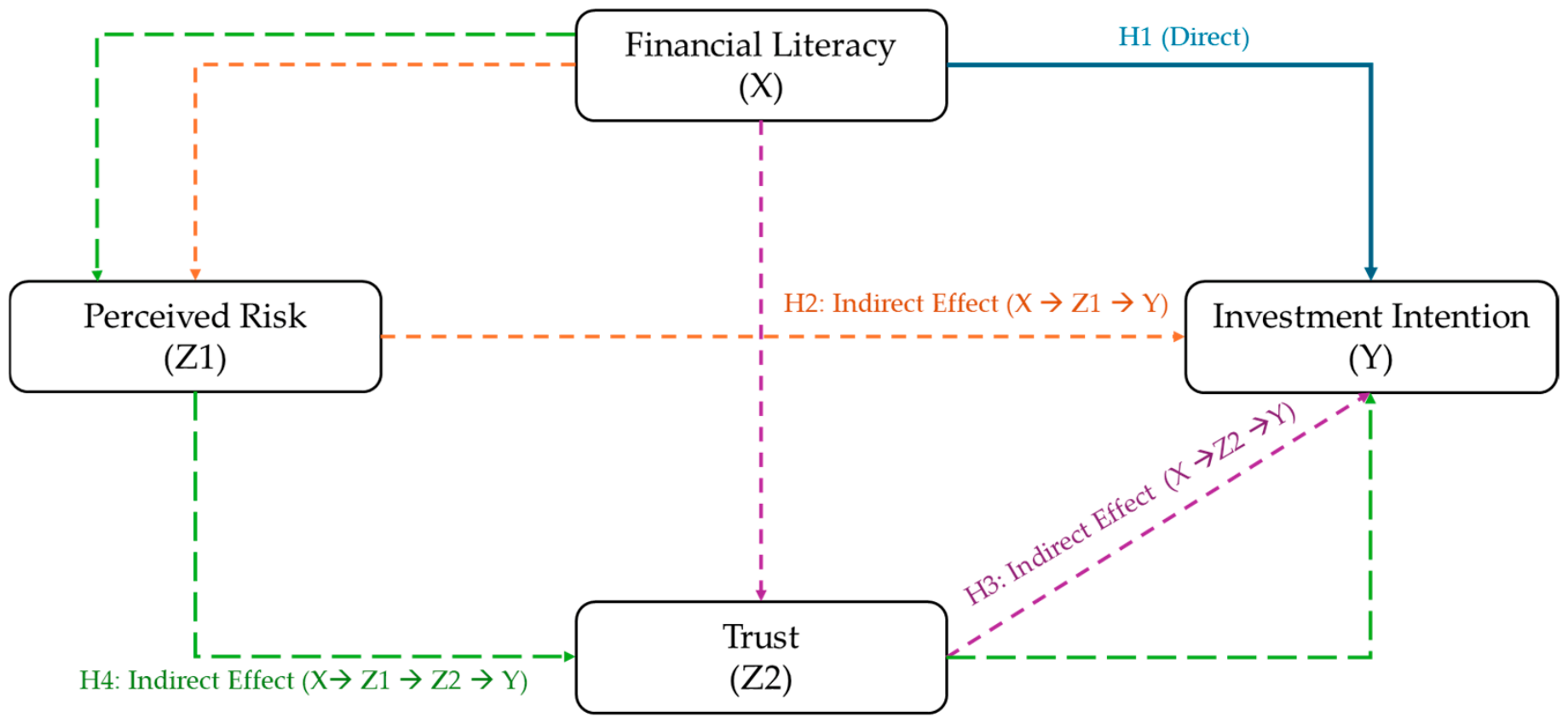
By integrating the Theory of Planned Behavior (TPB) and the Risk-as-Feelings Hypothesis (RFH), this study proposes a conceptual framework that explains the mechanisms through which financial literacy influences investment intention. Rather than treating cognitive and affective mechanisms as independent and parallel processes, the proposed framework emphasizes their sequential and interdependent roles in investment decision-making under uncertainty. The framework incorporates four principal pathways:
  • Direct pathway (H1), which represents the direct association between financial literacy and investment intention.
  • Cognitive mediation pathway (H2), which represents the indirect association between financial literacy and investment intention through perceived risk.
  • Affective mediation pathway (H3), which represents the indirect association between financial literacy and investment intention through institutional trust.
  • Sequential cognition–affect pathway (H4), which represents the sequential mediation mechanism linking financial literacy, perceived risk, institutional trust, and investment intention. This pathway is based on the premise that lower perceived risk provides a cognitive foundation for developing stronger affective trust, which in turn enhances investment intention.
By examining these pathways simultaneously, the framework captures the interdependence of cognitive evaluation and affective response in financial decision-making. The conceptual framework and corresponding hypotheses are presented in Figure 1.

3. Methodology

This study adopts a deductive research design to examine the cognitive and affective mechanisms underlying investment intention in capital markets. The proposed conceptual framework is grounded in the Theory of Planned Behavior (TPB) (Ajzen, 1991) and the Risk-as-Feelings Hypothesis (RFH) (Loewenstein et al., 2001), which collectively provide the theoretical basis for linking financial literacy, perceived risk, trust, and investment intention.
Drawing on these perspectives, the study conceptualizes investment intention as the outcome of both cognitive evaluations and affective responses. Specifically, TPB provides the rationale for examining the role of cognitive appraisal and perceived behavioral control, whereas RFH highlights the importance of affective responses in decision-making under uncertainty. Integrating these perspectives enables a more comprehensive understanding of how financial literacy influences investment intention through the sequential cognition–affect process proposed in this study.

3.1. Instrument Measurement

Investment intention is defined as an individual’s willingness to participate in capital market activities and to allocate financial resources to achieve long-term financial objectives (Raut, 2020; East, 1993; Ajzen, 1991). Consistent with prior studies, investment intention is conceptualized as a multidimensional behavioral construct encompassing market participation, investment decision-making, and long-term financial orientation (Indrawati et al., 2025; Raut, 2020; Mayfield et al., 2008). In this study, investment intention is measured using seven items adapted from existing literature, and assessed on a five-point Likert scale ranging from 1 (strongly disagree) to 5 (strongly agree).
Financial literacy refers to an individual’s capacity to understand and evaluate capital market products, investment mechanisms, and financial information (Lusardi & Mitchell, 2014; Huston, 2010). In this study, financial literacy is measured using six items adapted from van Rooij et al. (2011) and Sivaramakrishnan et al. (2017) on a five-point Likert scale. The construct comprises two dimensions: (1) familiarity with financial products and (2) familiarity with capital markets.
Perceived risk denotes an individual’s subjective evaluation of the likelihood of financial loss and uncertainty associated with investment activities (Sitkin & Weingart, 1995; Slovic, 1987; Bauer, 1960). Following Trang and Tho (2017), Munnukka et al. (2016), and Bhukya and Singh (2015), perceived risk is measured using six items representing three dimensions encompassing financial, security, and social risks. Although measured through multiple dimensions, perceived risk is modeled as a higher-order construct representing overall uncertainty associated with investment decisions.
Trust is defined as an investor’s confidence in the reliability, integrity, and competence of financial products and financial institutions (Guiso et al., 2008; Mayer et al., 1995; Fukuyama, 1996). Following Kaustia et al. (2023) and Nguyen et al. (2016), trust is measured using six items on a five-point Likert scale covering two dimensions: (1) confidence in financial products and (2) confidence in financial institutions.
All variables are specified as reflective constructs whereby observed indicators are assumed to reflect the underlying latent variables. Accordingly, changes in the latent constructs are expected to be consistently manifested across their respective indicators, consistent with established measurement theories and recommended practices in PLS-SEM. Table 1 summarizes the operational definitions, measurement items, and literature sources for each construct.

3.2. Sample Selection and Data Collection

The target population of this study comprises retail investors in the Indonesian capital markets. Given the large population of approximately 11.69 million registered investor accounts and their uneven geographical distribution (KSEI, 2023), a multistage sampling strategy is employed to improve the geographic representation of respondents across the principal regions of Indonesia.
Previous studies have shown that income level and financial capacity significantly affect participation in risky financial assets. Individuals with higher incomes generally face fewer liquidity constraints, and are therefore more likely to participate in capital market activities (Guiso et al., 2003; van Rooij et al., 2011; Vissing-Jorgensen, 2002; Haliassos & Bertaut, 1995). Accordingly, the first stage of the sampling process established a minimum monthly income threshold of IDR10 million. This criterion is intended to minimize the influence of liquidity constraints on investment decisions, and ensure that respondents possess sufficient financial capacity to participate in capital market activities (Vissing-Jorgensen, 2002; Haliassos & Bertaut, 1995). The selected threshold is broadly consistent with prior evidence indicating that Indonesian households with monthly incomes in the range of IDR 8–10 million generally experience fewer liquidity constraints and possess greater discretionary capacity to allocate resources to financial assets, equivalent to approximately three to six times the regional minimum wage (Tresnatri et al., 2025; Wardhani & Iramani, 2023).
In the second stage, the minimum sample size required for evaluating the proposed serial mediation model was determined. An initial estimate is calculated using the Slovin formula:
n = N 1 + N   e 2
where n is the required sample size, N is the population size, and e is the margin of error. Given that the number of registered investor accounts is 11,689,647 (KSEI, 2023), the Slovin formula with a 5% margin of error yields a minimum sample size of approximately 400 respondents. This calculation provides an initial estimate of the sample size required to obtain broad population coverage.
To further ensure methodological rigor, the minimum sample size is also evaluated against the requirements of Partial Least Squares–Structural Equation Modeling (PLS-SEM). According to the 20-time rule, the minimum sample size should exceed 20 times the number of indicators associated with the most complex construct or the largest number of structural paths directed toward a latent variable (Hair et al., 2021; Kock & Hadaya, 2018). Since the investment intention construct contains seven indicators, the recommended minimum sample size is 140 observations. Accordingly, the minimum sample size requirement ranges from 140 observations based on the PLS-SEM rule to approximately 400 observations based on the population coverage consideration.
In the third stage, a quota sampling method was implemented to determine the geographic distribution of respondents. Given the unequal distribution of investors across Indonesia, this approach was intended to improve the proportional representation across major regions of Indonesia. As shown in Table 2, the quotas were established based on KSEI investor distribution statistics (KSEI, 2023): Java accounts for 68.50% of the total investor population, followed by Sumatera (16.73%), Kalimantan (5.27%), Sulawesi (4.77%), Bali (3.50%), and Maluku and Papua (1.11%). Accordingly, regional quotas were established in proportion to these percentages using the minimum sample size of 400 respondents as the allocation baseline.
Primary data for this study were collected through an online survey administered from 1 February 2025 to 31 March 2025. Participants were recruited voluntarily via an online questionnaire distributed in collaboration with several investor communities and financial platforms, including the Indopremier Investment Forum (IPOT Buzz), the Phillip Securities Indonesia Investor Forum (Smart Trader), and the IDX Regional Development Information System (RDIS). To ensure informed and voluntary participation, the questionnaire included a comprehensive consent form outlining the study’s objectives and ethical considerations.
To safeguard respondent privacy and confidentiality, the questionnaire did not collect personally identifiable information, such as names, phone numbers, or email addresses. Instead, only demographic data—including age, gender, education, occupation, annual income, and area of residence—were collected for analytical and sampling purposes. This demographic information facilitated respondent profiling and allocation in accordance with the predetermined geographic quotas. Prior to completing the main questionnaire, participants were screened using preliminary questions to verify active participation in capital market investments and compliance with the minimum income threshold.
To achieve the minimum sample size recommended by the Slovin formula (400 observations), a total of 600 questionnaires were distributed to account for potential non-responses, incomplete submissions, and invalid responses, while ensuring adequate representation across regional quotas. Of the distributed questionnaires, 482 were returned, resulting in a gross response rate of approximately 81%. Following screening and validation, 449 complete and valid responses were retained for analysis. This final sample size exceeds the minimum requirements specified by both the PLS-SEM approach (140) and the Slovin formula (400), thereby providing adequate statistical power for serial mediation analysis and the broad geographic coverage of Indonesia’s registered investor population.
Table 3 presents the demographic characteristics of the final sample. Respondents generally possess high levels of education, adequate income, and substantial geographic diversity, thereby rendering the sample suitable for analyzing investment behavior in the Indonesian capital markets. The actual distribution of respondents closely corresponds to the regional quotas estimated using the Slovin formula, maintaining a precision range within 5% with only minor variations across regions. Consistent with prevailing investor concentration patterns, Java accounts for the largest proportion of the sample. Minor discrepancies between projected and actual quotas are attributable to differences in voluntary participation rates and survey accessibility. Overall, the final sample demonstrates broad geographic coverage and closely reflects the regional distribution of investors reported by KSEI (2023).

3.3. Data Analysis Technique

This study employs Partial Least Squares–Structural Equation Modeling (PLS-SEM) as the primary analytical technique. PLS-SEM is particularly appropriate for examining complex behavioral models involving multiple latent constructs, higher-order constructs, and indirect relationships (Hair et al., 2021; Sarstedt et al., 2017). Given the prediction-oriented nature of the study and its emphasis on testing sequential mediation relationships, PLS-SEM is considered more suitable than covariance-based structural equation modeling (Hair et al., 2019, 2021).
PLS-SEM offers several methodological advantages for our research. First, it is robust to violations of multivariate normality and produces reliable estimates with a medium-sized sample (Hair et al., 2021). Second, it enables the simultaneous assessment of measurement properties and structural relationships among latent variables (Hair et al., 2021; Sarstedt et al., 2017). Third, it is particularly effective for evaluating serial mediation models, which are central to the proposed cognition–affect framework (Hair et al., 2021; Nitzl et al., 2016).
The analysis is conducted in two stages. The first stage involves evaluating the measurement model through the assessments of reliability and validity. The second stage involves testing the structural model, including direct, indirect, and sequential mediation relationships specified in the proposed framework. However, given the cross-sectional nature of the data, the findings should be interpreted as evidence of structural associations within the theoretical model rather than as definitive evidence of causality (Maxwell & Cole, 2007).

3.4. Common Method Bias

Given that this study relies on self-reported survey data collected from a single source, common method bias (CMB) represents a potential methodological concern. Following the recommendations by Podsakoff et al. (2003), several procedural remedies are implemented to mitigate this risk. Respondents were assured of anonymity and confidentiality to reduce social desirability bias, and all measurement items were adapted from validated prior studies and randomized to minimize the likelihood that participants could infer the study’s hypotheses.
To statistically assess the presence of CMB, a full collinearity test is conducted using inner-model Variance Inflation Factor (VIF) values within the PLS-SEM framework. According to Kock (2015), a VIF value below 3.3 indicates that common method bias is unlikely to threaten the model validity. Our results show that all inner VIF values range from 1.000 to 2.038, well below the recommended threshold. Therefore, common method bias is unlikely to pose a significant threat to the validity of either the measurement model or the structural model.

4. Findings and Discussion

4.1. Measurement Model Assessment

This study operationalizes four reflective latent constructs: (1) financial literacy, (2) perceived risk, (3) trust, and (4) investment intention. The measurement model is assessed using established criteria for reliability, convergent validity, discriminant validity, and multicollinearity. The results of construct-level reliability and validity assessments are presented in Table 4.
As exhibited in Table 4, all indicator loadings exceed the recommended threshold of 0.70 (Hair et al., 2021), indicating satisfactory indicator reliability and supporting convergent validity. Internal consistency reliability is assessed using Cronbach’s alpha, rho_A (ρA), and composite reliability. The results show that all constructs exceed the recommended threshold of 0.70 (Dijkstra & Henseler, 2015; Nunnally & Bernstein, 1994). In addition, composite reliability values approach or exceed 0.90, confirming strong internal consistency reliability across all constructs (Hair et al., 2021).
Furthermore, convergent validity is evaluated using the Average Variance Extracted (AVE). Since all constructs exhibit AVE values above the recommended threshold of 0.50, our results indicate that the latent constructs explain a substantial proportion of the variances in their respective indicators (Sekaran & Bougie, 2016). These findings confirm satisfactory convergent validity. Meanwhile, potential multicollinearity is tested using the Variance Inflation Factor (VIF). All VIF values remain below the conservative threshold of 5.0 (Hair et al., 2021), with the highest observed value being 4.261. Therefore, multicollinearity is unlikely to pose a significant threat to the stability of parameter estimates.
Table 5 reports the discriminant validity assessment using the Heterotrait–Monotrait Ratio (HTMT) and the Fornell–Larcker criterion. As shown in Panel A, all HTMT values are below the recommended threshold of 0.90, indicating satisfactory discriminant validity among the latent constructs (Henseler et al., 2015). Panel B shows that the square root of AVE for each construct exceeds its correlations with other constructs (Fornell & Larcker, 1981), providing additional evidence of discriminant validity. Collectively, these findings indicate that the latent constructs are empirically distinct and that the measurement model satisfies established psychometric standards, thus providing a reliable foundation for subsequent evaluation of the structural model.

4.2. Model Fit and Predictive Assessment

Upon the validation of the measurement model, the structural model is evaluated with respect to model fit, explanatory power, and predictive relevance. The Standardized Root Mean Square Residual (SRMR) value of 0.031 is well below the recommended thresholds of 0.08 and 0.10, indicating a close correspondence between observed and model-implied correlations (Henseler et al., 2014; Hu & Bentler, 1999). In addition, the Normed Fit Index (NFI) value of 0.933 exceeds the recommended threshold of 0.90, providing additional evidence of satisfactory model fit (Hair et al., 2021; Henseler et al., 2016).
Furthermore, the model’s out-of-sample predictive capability is assessed using the PLSpredict procedure (Ringle et al., 2015). As reported in Table 6, all endogenous constructs exhibit positive Q2 predict values. These results indicate meaningful predictive relevance of the model. Furthermore, the comparisons between the Root Mean Square Error (RMSE) values of the PLS-SEM model and the linear regression benchmarks reveal that the PLS model performs comparably to or better than linear regression across several indicators. Following the guidelines of Shmueli et al. (2019), these results suggest moderate-to-high predictive performance.
Construct-level predictive relevance is further evaluated using the cross-validated redundancy measure (Q2). Investment intention (Q2 = 0.412) and institutional trust (Q2 = 0.406) demonstrate substantial predictive relevance, whereas perceived risk exhibits a lower Q2 value (0.190), indicating moderate predictive relevance (Hair et al., 2019). These findings suggest that perceived risk may be affected by additional factors beyond the current framework, including individual psychological characteristics, prior investment experiences, and broader environmental uncertainty. This interpretation is consistent with behavioral finance research, which conceptualizes risk perception as a multidimensional and context-dependent construct (Mandić et al., 2026).
The explanatory power of the model is assessed using the coefficient of determination (R2). The R2 values for investment intention (0.518) and institutional trust (0.509) indicate substantial explanatory power, while that for perceived risk (0.238) demonstrates moderate explanatory power (Cohen, 1992). These findings further suggest that perceived risk is affected by behavioral and situational factors beyond financial literacy alone.
Overall, the structural model demonstrates satisfactory fit, meaningful predictive relevance, and substantial explanatory power. Taken together, these findings support the adequacy of the proposed sequential cognition–affect framework for explaining retail investment intention in the Indonesian capital markets.

4.3. Structural Model Evaluation and Hypothesis Tests

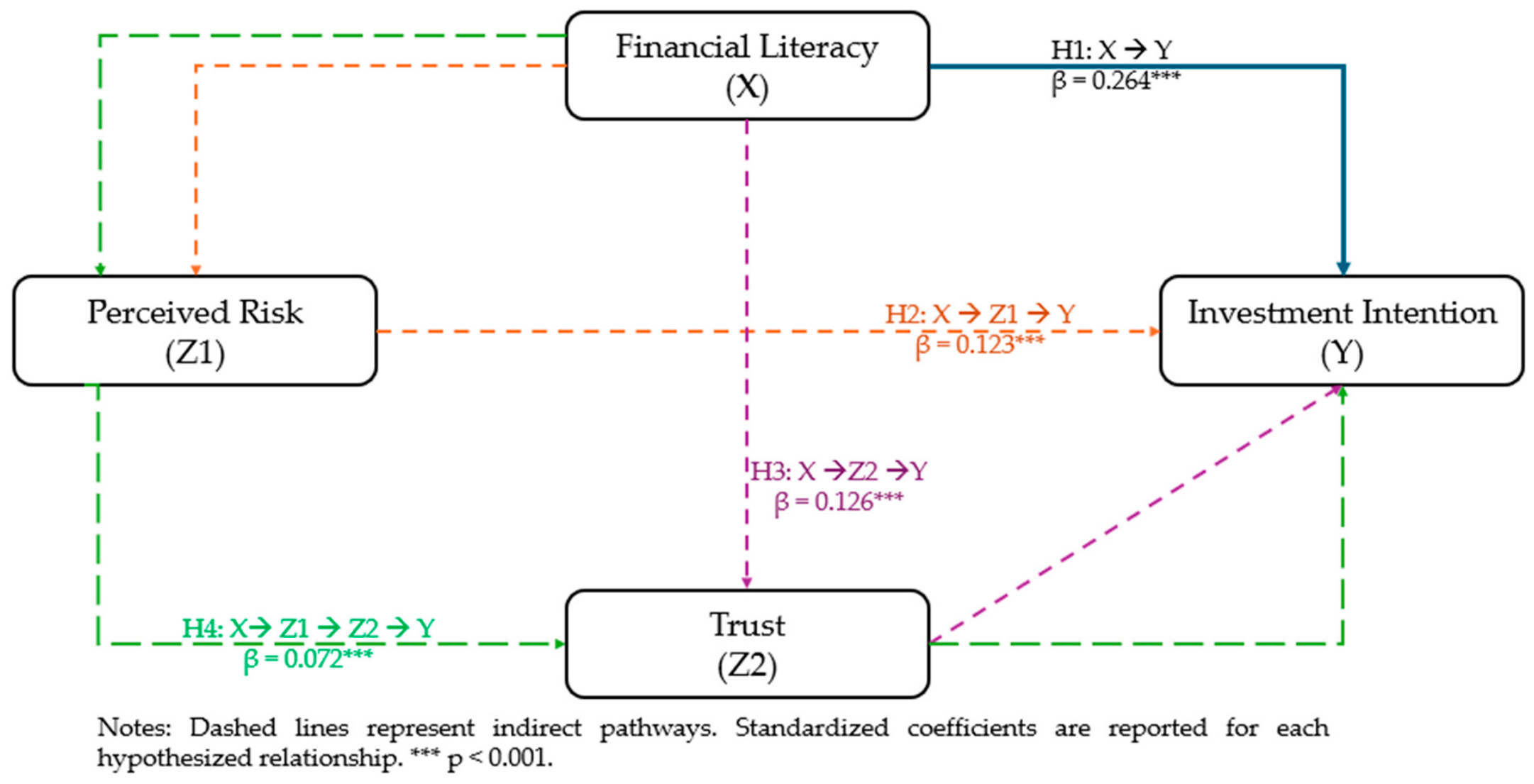
The structural model is evaluated using a bootstrapping procedure with 10,000 resamples to assess the significance of conjectured relationships, as suggested by Streukens and Leroi-Werelds (2016). Table 7 reports the estimated direct, indirect, and total effects, while Figure 2 illustrates the structural relationships among operationalized constructs. Consistent with Hypothesis 1, financial literacy exhibits a positive and significant association with investment intention (β = 0.264, p < 0.001). This finding suggests that individuals with higher levels of financial literacy are more inclined to participate in capital market activities. From the TPB perspective, this relationship implies that individual confidence increases as knowledge grows. Hence, financial literacy enhances perceived behavioral control by increasing individual confidence in managing complex financial environments.
The results further reveal that financial literacy is negatively associated with perceived risk (β = −0.488, p < 0.001) and positively associated with institutional trust (β = 0.379, p < 0.001). These findings suggest that individuals with greater financial knowledge are more likely to perceive market uncertainty as understandable and manageable. Meanwhile, these capabilities concurrently foster increased trust in financial institutions, as they better comprehend how financial markets operate. In addition, perceived risk is negatively associated with institutional trust (β = −0.447, p < 0.001) and investment intention (β = −0.251, p < 0.001), indicating that higher risk perception reduces both trust and the propensity to invest. Conversely, institutional trust is positively associated with investment intention (β = 0.332, p < 0.001), highlighting the pivotal role of confidence in financial institutions in fostering investment participation.
Collectively, these findings reveal two complementary mechanisms underlying investment intention: (1) a cognitive pathway involving the evaluation of market uncertainty and (2) an affective pathway involving institutional trust. These results support the integration of the Theory of Planned Behavior (TPB) and the Risk-as-Feelings Hypothesis (RFH) by demonstrating that cognitive appraisal and affective response jointly shape investment behavior under uncertainty.
The mediation analysis further identifies several distinct indirect pathways through which financial literacy influences investment intention. Specifically, financial literacy exhibits a significant indirect effect through perceived risk (β = 0.123, p < 0.001), supporting H2. Additionally, financial literacy yields a significant indirect effect through institutional trust (β = 0.126, p < 0.001), supporting H3. More importantly, the sequential mediation pathway involving both perceived risk and institutional trust is also statistically significant (β = 0.072, p < 0.001), thereby substantiating H4. These findings indicate that financial literacy affects investment intention through a structured cognition–affect sequence, in which lower perceived risk provides the cognitive foundation for the emergence of stronger affective trust. This represents the central theoretical contribution of our study, which demonstrates that the cognitive appraisal of uncertainty precedes and shapes affective trust in the investment decision-making process.
Finally, the total effect of financial literacy on investment intention is positive and significant (β = 0.585, p < 0.001), exceeding the magnitude of the direct effect alone (β = 0.264, p < 0.001). This indicates that the influence of financial literacy extends beyond the direct provision of financial knowledge, and operates through both cognitive and affective mechanisms. Taken together, the results reinforce the perspective that financial literacy functions not only as an informational resource but also as an important behavioral factor shaping how individuals interpret and respond to uncertainty in financial decision-making (Kaiser et al., 2022; Fernandes et al., 2014; Lusardi & Mitchell, 2014).

4.4. Discussion

4.4.1. Financial Literacy as a Cognitive Foundation of Investment Intention

Our findings reveal a positive and significant association between financial literacy and investment intention, thus supporting Hypothesis 1 (β = 0.264, p < 0.001). Within the TPB framework, this relationship reflects the role of financial literacy in strengthening perceived behavioral control, which refers to individual confidence in his/her ability to act effectively under uncertainty (Ajzen, 1991). Accordingly, financial literacy operates as an important cognitive resource that enables individuals to process financial information, evaluate investment alternatives, and make decisions in complex market environments (Che Hassan et al., 2023; Kaiser et al., 2022; Lusardi & Mitchell, 2014).
Capital markets are characterized by information asymmetry, uncertainty, and volatility, all of which may discourage the participation of less-informed investors (Guiso et al., 2003; Haliassos & Bertaut, 1995). In this context, financial literacy helps mitigate these barriers by improving individual ability to interpret financial information, assess investment opportunities, and understand market mechanisms (Kaiser et al., 2022; Lusardi & Mitchell, 2014; Hastings et al., 2013). This interpretation is consistent with prior studies that demonstrate that financial knowledge reduces the cognitive costs associated with market participation, and enhances individual confidence in financial decision-making (Stolper & Walter, 2017; Grohmann et al., 2015; van Rooij et al., 2011).
Our results are also consistent with recent empirical evidence across different financial contexts. A more recent study reports that financial literacy significantly increases the intention to invest in Islamic financial products among Pakistani investors (Naqvi et al., 2025). Similarly, Irfan et al. (2025) find that financial literacy positively affects investment intention through perceived behavioral control among Indonesian retail investors. Meanwhile, Eaw et al. (2024) demonstrate that financial literacy indirectly promotes green investment intention through attitudinal mechanisms. Collectively, these studies corroborate the notion that financial literacy serves not merely as an informational asset but as a broader psychological resource that supports financial participation.
More importantly, our study extends the existing literature by demonstrating that the effect of financial literacy cannot be fully understood solely through direct-effect models. Our findings show that although the direct association between financial literacy and investment intention is statistically significant, the total effect (β = 0.585) is substantially larger than the direct effect (β = 0.264). Such findings imply that financial literacy exerts much of its influence through additional psychological mechanisms. This helps reconcile the long-standing debate regarding the effectiveness of financial literacy in shaping financial behavior. Whereas some studies have questioned the behavioral impacts of financial education when examined in isolation (Fernandes et al., 2014), our results suggest that financial literacy becomes considerably more influential when its indirect effects are taken into account in how individuals interpret and respond to uncertainty. Accordingly, financial literacy should be viewed not only as a source of financial knowledge but also as a foundational cognitive capability that initiates broader behavioral mechanisms that lead to investment participation.

4.4.2. Financial Literacy and the Cognitive Recalibration of Perceived Risk

In addition to its direct association with investment intention, financial literacy exhibits a negative and significant relation with perceived risk, thereby supporting Hypothesis 2 (β = −0.488, p < 0.001). Moreover, perceived risk partially mediates the relationship between financial literacy and investment intention (β = 0.123, p < 0.001). These findings are consistent with both the TPB (Ajzen, 1991) and the RFH (Loewenstein et al., 2001), in which perceived risk operates primarily as a cognitive appraisal of uncertainty that subsequently affects behavioral intention. In this regard, the RFH complements the TPB by explaining how emotional response to uncertainty emerges from and interacts with cognitive appraisal in the formation of investment intention.
From a cognitive perspective, our results provide empirical support for the Competence Hypothesis (Heath & Tversky, 1991), which posits that subjective risk perception declines as domain-specific competence increases. In this sense, individuals with higher levels of financial literacy are better able to interpret market dynamics, understand diversification strategies, and distinguish temporary fluctuations from fundamental market trends (Kaiser et al., 2022; Lusardi & Mitchell, 2014; van Rooij et al., 2011). Consequently, uncertainty becomes more understandable and manageable rather than inherently threatening or ambiguous (Loewenstein et al., 2001; Heath & Tversky, 1991). This interpretation is consistent with prior evidence indicating that financial knowledge is associated with a more balanced evaluation of investment risk and a more informed response to market uncertainty (Kaiser et al., 2022; Stolper & Walter, 2017; Aren & Zengin, 2016).
Our research findings are also consistent with recent studies highlighting the mediating role of perceived risk in an investment context. In this regard, prior research reports that perceived risk mediates the relationship between product knowledge and investment intention (Hati et al., 2020). Meanwhile, several other studies find that perceived risk mediates crucial behavioral antecedents of online trading intention (Raut & Kumar, 2024, 2023). In a similar spirit, another study demonstrates that perceived risk functions as a key serial mediator linking investor behavior to investment performance (Subedi et al., 2025). Collectively, these findings corroborate the argument that perceived risk is an important psychological mechanism by which financial knowledge affects investment behavior.
More importantly, our findings offer a more nuanced understanding of the relationship between financial literacy and risk-taking behavior. Instead of encouraging indiscriminate risk-taking or speculative actions, financial literacy appears to facilitate a recalibration of subjective uncertainty. In this regard, financial knowledge enables individuals to align their risk assessments more closely with observable market conditions, thus supporting more informed and disciplined investment decisions. This interpretation is consistent with previous studies that associate financial literacy with more disciplined investment behavior (Kaiser et al., 2022; Stolper & Walter, 2017; van Rooij et al., 2011). This also reconciles conflicting findings in the literature. While financial literacy may increase market participation and trading activity (Glaser & Weber, 2007; Barber & Odean, 2000), our evidence suggests that its primary behavioral function is not to encourage greater risk-taking per se, but to promote a more accurate assessment of uncertainty and more informed investment decisions (Kaiser et al., 2022; Aren & Zengin, 2016; Lusardi & Mitchell, 2014).

4.4.3. Trust as an Affective Mechanism Translating Knowledge into Action

Whereas perceived risk primarily reflects cognitive evaluation, institutional trust functions as an affective mechanism that translates cognitive understanding into behavioral intention. The empirical findings indicate that financial literacy is positively associated with institutional trust (β = 0.379, p < 0.001) while trust is positively associated with investment intention (β = 0.332, p < 0.001). Subsequently, the indirect effect of financial literacy on investment intention through trust (β = 0.126, p < 0.001) provides support for Hypothesis 3, and highlights the important role of affective process in shaping financial decision-making.
From the RFH perspective, trust can be interpreted as a positive affective heuristic that reduces emotional discomfort under uncertain conditions (Slovic et al., 2004; Loewenstein et al., 2001). In institutional environments characterized by information asymmetry and regulatory complexity, trust serves as a psychological mechanism that facilitates actions despite incomplete information. To retail investors, confidence in financial institutions, regulatory bodies, and market infrastructure provides affective reassurance that complements cognitive analysis (Balloch et al., 2015; Georgarakos & Pasini, 2011; Guiso et al., 2008).
Our findings correspond with recent empirical evidence emphasizing the growing importance of institutional and technological trust within contemporary financial systems. A more recent study underscores that trust in financial institutions significantly strengthens the intention to participate in stock markets during macroeconomic uncertainty periods (Adil et al., 2023). Similarly, Tien et al. (2026) report that confidence in technology and automated financial systems is a key factor influencing investor willingness to adopt robo-advisory services. Taken together, those findings suggest that trust has become increasingly important within financial ecosystems, characterized by rapid digitalization, technological complexity, and evolving institutional structure.
More importantly, our results suggest that trust extends beyond rational expectations of institutional compliance, and encompasses a broader sense of psychological safety, whereby individuals feel sufficiently protected and supported to engage with uncertain financial environments. Consequently, highly literate individuals may still be reluctant to participate in capital markets if their trust toward financial systems remains weak. We highlight that investment intention is shaped not only by cognitive competence but also by affective assurance. Accordingly, knowledge alone may be insufficient to stimulate market participation unless it is accompanied by sufficient trust in the institutions that govern and support financial transactions.

4.4.4. The Cognition–Affect Sequence in Investment Decision-Making

The principal contribution of this study lies in providing empirical evidence for a sequential cognition–affect mechanism underlying the relationships among financial literacy, perceived risk, institutional trust, and investment intention. Consistent with Hypothesis 4 (β = 0.072, p < 0.001), this study’s findings document that financial literacy is related to lower perceived risk, which subsequently facilitates stronger institutional trust and ultimately enhances investment intention.
This sequential framework advances behavioral finance theory in several important respects. First, it demonstrates that affective trust is not independent of cognitive evaluation; instead, trust is shaped by prior cognitive appraisals of uncertainty. In this context, a higher level of perceived risk constrains the development of trust, consistent with risk-centered theories of trust (Guiso et al., 2008; Siegrist et al., 2005; Das & Teng, 2004). Meanwhile, trust is more likely to emerge when financial environments are perceived as understandable and manageable (Kersting et al., 2015; Heath & Tversky, 1991).
Second, our findings help explain why initiatives designed to strengthen investor confidence may be less effective when implemented independently of financial education programs. Institutional interventions focused exclusively on increasing public confidence are likely to have limited behavioral impacts if an individual lacks the cognitive capability necessary to evaluate investment-related uncertainty. This evidence suggests that financial literacy and institutional trust operate as complementary rather than substitutive mechanisms in promoting investment participation.
Third, our study extends mediation-based research on behavioral finance by demonstrating that cognitive and affective mechanisms operate in an interdependent sequence rather than in isolated or parallel processes. While previous studies typically examined perceived risk or trust as separate mediators (Raut & Kumar, 2024; Adil et al., 2023; Hati et al., 2020), we integrate these constructs within a unified cognition–affect framework. Consequently, this study contributes to the behavioral finance literature by illustrating that investment intention emerges through an interconnected process. We suggest that the cognitive evaluation of uncertainty shapes affective trust, which in turn influences behavioral intention.
Overall, our findings suggest that retail capital market participation reflects an interdependent psychological process in which cognitive understanding reduces perceived uncertainty, lower uncertainty facilitates trust formation, and trust subsequently strengthens investment intention. More broadly, the findings indicate that investment intention emerges not solely from financial knowledge or institutional confidence in isolation, but from the dynamic interaction between cognitive understanding and affective reassurance. This framework provides a theoretically grounded foundation for future behavioral finance research, and offers practical insights to policymakers seeking to promote broader and more inclusive participation in capital markets.

5. Conclusions and Future Research Agenda

5.1. Conclusions

This study examines the behavioral mechanisms underlying the relationship between financial literacy and investment intention in Indonesian capital markets. By integrating the Theory of Planned Behavior (TPB) and the Risk-as-Feelings Hypothesis (RFH), this study develops and examines a sequential cognition–affect framework to explain how financial knowledge affects individual willingness to participate in capital market activities amid uncertainty.
Our findings indicate that financial literacy is a significant determinant of investment intention, both directly and indirectly. More importantly, the results demonstrate that financial literacy affects investment intention through a sequential mechanism in which a higher level of financial literacy reduces perceived risk, lower perceived risk strengthens institutional trust, and stronger trust subsequently enhances investment intention. These findings suggest that financial literacy operates not only as a source of financial knowledge but also as a psychological mechanism that shapes how individuals interpret and respond to uncertainty.
This study contributes to the behavioral finance literature by addressing persistent inconsistency concerning the relationship between financial literacy and capital market participation. Rather than conceptualize financial literacy as an isolated informational resource, we demonstrate that its effect emerges through the interaction between cognitive and affective processes. Hence, this study extends existing literature by showing that perceived risk and trust are interconnected instead of independent mechanisms in the formation of investment intention.
Overall, we suggest that investment participation is not driven solely by financial knowledge or access to information. Instead, participation reflects a broader psychological process in which individuals first evaluate uncertainty and subsequently develop the confidence necessary to act. By highlighting this cognition–affect sequence, this study provides a more comprehensive behavioral explanation of investment intention and offers a foundation for future research examining the interplay between cognitive and affective factors in financial decision-making.

5.2. Theoretical Implications

This study contributes to behavioral finance and financial decision-making literature by advancing a sequential cognition–affect perspective of investment intention. While prior research has frequently examined cognitive and affective factors as independent or parallel determinants of financial behavior, the present findings demonstrate that these mechanisms operate in an interconnected and sequential manner. Specifically, financial literacy affects investment intention through a cognition–affect process in a sequential pathway. In this regard, perceived risk functions as a cognitive appraisal of uncertainty, while institutional trust emerges as an affective response that facilitates action under conditions of incomplete information.
First, this study extends the Theory of Planned Behavior (TPB) by demonstrating that the influence of financial literacy on investment intention cannot be fully understood through direct effects alone. Instead, perceived risk and institutional trust serve as sequential intervening mechanisms that underlie the relationship between financial literacy and behavioral intention. This enriches the TPB framework by highlighting how the cognitive evaluation of uncertainty interacts with subsequent affective responses in shaping investment-related decisions.
Second, the findings provide empirical support for the Risk-as-Feelings Hypothesis (RFH) within the context of an emerging capital market. The results indicate that risk perception is not merely an objective assessment of loss probability, but a subjective cognitive appraisal shaped by financial knowledge and prior understanding. Financial literacy enables individuals to interpret market uncertainty more effectively, thereby affecting both cognitive evaluations and subsequent affective reactions toward investment activities.
Third, the evidence supports the sequential mediation pathway among financial literacy, perceived risk, institutional trust, and investment intention. This finding contributes to the broader behavioral finance literature by clarifying how trust is psychologically formed. Rather than functioning as an isolated determinant of financial behavior, institutional trust is more likely to emerge from prior cognitive appraisals of uncertainty. This perspective provides a more integrated explanation of how confidence in financial institutions develops and influences investment decisions in capital markets.
More broadly, the findings suggest that investment intention cannot be adequately explained by the informational or rational framework alone. Instead, an investment decision emerges from the dynamic interaction between cognitive understanding and affective reassurance under uncertainty. By conceptualizing financial decision-making as a sequential cognition–affect process, this study provides a more comprehensive behavioral explanation of investment intention and offers a theoretical foundation for future research examining the interplay between cognitive and affective mechanisms in financial behavior.

5.3. Policy Implications

This study’s findings carry important implications for policymakers, particularly the Indonesian Financial Services Authority (OJK) and the Indonesia Stock Exchange (IDX), in designing initiatives aimed at expanding retail participation in capital markets. While existing financial literacy programs primarily emphasize technical knowledge, product familiarity, and numerical competence, the present findings suggest that such approaches may be insufficient when implemented in isolation. Financial literacy affects investment intention not only by increasing knowledge, but also by shaping how individuals perceive and respond to uncertainty.
Accordingly, future financial education initiatives should adopt a more comprehensive behavioral orientation. Beyond explaining investment products and market mechanisms, educational programs should be designed to reduce subjective perceptions of uncertainty and strengthen confidence in financial institutions. This may be achieved by increasing public awareness of investor protection systems, regulatory safeguards, dispute-resolution mechanisms, disclosure requirements, and market oversight frameworks. Such efforts can help individuals perceive investment-related risks as more understandable and manageable, thereby facilitating the development of institutional trust.
The findings also highlight the importance of aligning financial literacy policies with broader institutional trust-building initiatives. Since trust emerges from prior cognitive assessments of uncertainty, policies aimed solely at increasing public confidence may be less effective if individuals lack the knowledge needed to evaluate financial risks and opportunities. Similarly, financial education programs may fail to translate into greater market participation if confidence in financial institutions remains weak. Consequently, financial literacy and institutional trust should be viewed as complementary policy objectives rather than independent interventions.
More broadly, the results suggest that efforts to enhance financial inclusion should incorporate behavioral and psychological considerations alongside traditional informational approaches. Expanding retail participation in capital markets requires not only increasing access to financial knowledge but also fostering an environment in which individuals feel sufficiently informed, protected, and confident to engage with financial markets. By addressing both the cognitive and affective dimensions of investment decision-making, policymakers may be better positioned to promote broader, more sustainable, and inclusive participation in capital market activities.

5.4. Managerial and Industry Implications

The findings provide important implications to financial institutions, brokerage firms, investment managers, and digital investment platforms seeking to expand retail investor participation. The results indicate that institutional trust serves as a critical mechanism by which financial literacy translates into investment intention. Consequently, among individuals who already possess a basic level of financial knowledge, reluctance to participate in capital market activities is more likely to stem from concerns regarding uncertainty, institutional credibility, and platform reliability than from informational deficiencies alone.
Accordingly, investor engagement strategies should extend beyond the provision of financial information and focus on reducing perceived uncertainty while strengthening institutional trust. In addition to communicating investment opportunities and expected returns, financial institutions should emphasize transparency, regulatory compliance, investor protection mechanisms, cybersecurity safeguards, disclosure practices, and long-term institutional credibility. These initiatives can help investors perceive financial environments as more understandable, predictable, and trustworthy.
The findings further suggest that trust-building should not be viewed solely as a branding or reputation-management activity. Instead, trust is a strategic behavioral asset that enables investors to act under uncertainty. As such, organizations should integrate educational initiatives, transparent communication practices, and trust-building measures into a unified investor engagement strategy. This approach is likely to be more effective than relying exclusively on promotional messages that emphasize short-term financial performance.
These implications are particularly relevant within increasingly digitalized investment ecosystems characterized by online trading applications, mobile investment platforms, robo-advisory services, and AI-assisted financial technology. Financial interactions become increasingly mediated by digital systems, so technological trust, platform reliability, data security, and institutional credibility are anticipated to play an increasingly significant role in maintaining retail investor engagement. Firms that successfully combine financial education with trust-enhancing practices are more likely positioned to attract, retain, and engage retail investors in the long run.

5.5. Limitations and Future Research Agenda

Although this study provides both theoretical and empirical contributions, several limitations should be acknowledged, offering opportunities for future research. First, the sampling strategy is restricted to individuals with monthly incomes exceeding IDR10 million to ensure that respondents possess sufficient financial capacity to participate in capital market activities. While this approach enhances internal validity by minimizing the effect of liquidity constraints, it may limit the generalizability of the findings to a broader investor population. This caveat is particularly relevant since financial literacy, perceived risk, and institutional trust may operate differently among individuals facing stronger financial constraints and lower levels of financial inclusion. Future research should therefore examine whether the cognition–affect mechanism identified in this study is consistent across different income groups and socioeconomic strata.
Second, the cross-sectional design limits the ability to draw definitive causal inferences among the variables examined. The observed relationships are consistent with the proposed theoretical framework; however, experimental design, longitudinal or panel-based studies would enable researchers to inquire into how changes in financial literacy, perceived risk, and institutional trust affect investment intention over time. Such approaches would provide deeper insights into the dynamic evolution of cognitive and affective mechanisms in financial decision-making.
Third, this study relies on self-reported measures of investment intention rather than observed investment behavior. Although behavioral intention is a central construct in the Theory of Planned Behavior (TPB), prior research has consistently documented an intention–behavior gap. Therefore, future studies may benefit from employing experimental designs, direct observation of investment activities, or transaction-level data to determine whether the cognition–affect mechanism identified in this study is reflected in actual market participation and investment behavior.
Fourth, future research could extend the proposed framework to emerging digital financial environments, including robo-advisory services, AI-assisted investment platforms, social trading systems, and broader fintech-based investment ecosystems. In such contexts, investor decision-making is increasingly influenced by algorithmic processes and digital interactions. Consequently, constructs such as technological trust, algorithmic transparency, and digital financial literacy are likely to become increasingly important determinants of investment behavior. Future studies may explore whether technological trust serves as an affective mechanism analogous to institutional trust in a digital investment environment.
In summary, the limitations identified in this study provide several promising directions for future research. Future studies should examine whether the proposed cognition–affect mechanism operates similarly across socioeconomic groups, investigate its dynamic evolution using longitudinal research designs, and evaluate its influence on actual investment behavior rather than on behavioral intention alone. Furthermore, digitalization in financial services presents opportunities to extend the framework by incorporating constructs such as technological trust, algorithmic transparency, and digital financial literacy. Collectively, these research directions provide opportunities to further refine and extend the proposed cognition–affect framework across diverse populations, research settings, and financial environments, thereby advancing understanding of how cognitive and affective mechanisms jointly shape financial behavior under uncertainty.

Author Contributions

Conceptualization, J.B.P.; methodology, J.B.P. and S.S.; software, J.B.P.; validation, K.R. and S.S.; formal analysis, J.B.P. and H.A.J.J.; investigation, J.B.P.; resources, K.R.; data curation, J.B.P.; writing—original draft preparation, J.B.P.; writing—review and editing, K.R., S.S. and H.A.J.J.; visualization, H.A.J.J.; supervision, K.R. and S.S.; project administration, J.B.P. All authors have read and agreed to the published version of the manuscript.

Funding

This research received no external funding.

Institutional Review Board Statement

Ethical review and approval are waived for this study in accordance with institutional guidelines for minimal-risk research. This study involves the collection of anonymous survey responses related to financial perception and investment intention, without any form of experimental manipulation or intervention. No personally identifiable information (including name, organizational affiliation, address, or contact details) was collected at any stage. Participation was voluntary, and respondents were informed about the purpose of the study prior to providing their responses. As such, this study adheres to established ethical standards for research involving anonymous, non-sensitive data.

Informed Consent Statement

Informed consent was obtained from all subjects involved in the study.

Data Availability Statement

Data supporting the findings of this study are available from the corresponding author upon reasonable request. Public sharing of the dataset is restricted due to ethical considerations related to respondent confidentiality and the protection of anonymized survey data. While no personally identifiable information was collected, the dataset includes detailed demographic and perceptual responses that may pose indirect identification risk. Data access will be granted for academic purposes in accordance with ethical research standards.

Acknowledgments

The authors gratefully acknowledge Universitas Brawijaya and Universitas Multimedia Nusantara for their institutional support and academic resources, which contributed to the completion of this study. The authors also express their appreciation to the stock brokerage firms and the investment community for their assistance in facilitating data collection and access to retail investors. Finally, the authors sincerely thank all respondents who voluntarily participated in this study and provided valuable insights. Their contributions are essential to the successful completion of this research.

Conflicts of Interest

The authors declare no conflicts of interest.

References

  1. Abdurrahman, A. (2025). Extending the IBCDE framework to explore barriers and drivers in Indonesia’s digital economy. Journal of Digital Economy, 4, 123–143. [Google Scholar] [CrossRef]
  2. Adil, M., Singh, Y., Subhan, M., Saleh Al-Faryan, M. A., & Ansari, M. S. (2023). Do trust in financial institution and financial literacy enhances intention to participate in stock market among Indian investors during COVID-19 pandemic? Cogent Economics & Finance, 11(1), 2169998. [Google Scholar] [CrossRef]
  3. Ajzen, I. (1991). The theory of planned behavior. Organizational Behavior and Human Decision Processes, 50(2), 179–211. [Google Scholar] [CrossRef]
  4. Allgood, S., & Walstad, W. B. (2016). The effects of perceived and actual financial literacy on financial behaviors. Economic Inquiry, 54(1), 675–697. [Google Scholar] [CrossRef]
  5. Aren, S., & Zengin, A. N. (2016). Influence of financial literacy and risk perception on choice of investment. Procedia—Social and Behavioral Sciences, 235, 656–663. [Google Scholar] [CrossRef]
  6. Arrondel, L., Debbich, M., & Savignac, F. (2015). Stockholding in France: The role of financial literacy and information. Applied Economics Letters, 22(16), 1315–1319. [Google Scholar] [CrossRef]
  7. Balloch, A., Nicolae, A., & Philip, D. (2015). Stock market literacy, trust, and participation. Review of Finance, 19(5), 1925–1963. [Google Scholar] [CrossRef]
  8. Bandura, A. (1997). Self-efficacy: The exercise of control. Macmillan. [Google Scholar]
  9. Barber, B. M., & Odean, T. (2000). Trading is hazardous to your wealth: The common stock investment performance of individual investors. The Journal of Finance, 55(2), 773–806. [Google Scholar] [CrossRef]
  10. Barberis, N., Greenwood, R., Jin, L., & Shleifer, A. (2018). Extrapolation and bubbles. Journal of Financial Economics, 129(2), 203–227. [Google Scholar] [CrossRef]
  11. Bauer, R. A. (1960, June 15–17). Consumer behavior as risk taking. 43rd National Conference of the American Marketing Assocation, Chicago, IL, USA. [Google Scholar]
  12. Beck, T., & Levine, R. (2004). Stock markets, banks, and growth: Panel evidence. Journal of Banking & Finance, 28(3), 423–442. [Google Scholar] [CrossRef]
  13. Beck, T., Levine, R., & Loayza, N. (2000). Finance and the sources of growth. Journal of Financial Economics, 58(1–2), 261–300. [Google Scholar] [CrossRef]
  14. Bellofatto, A., D’Hondt, C., & De Winne, R. (2018). Subjective financial literacy and retail investors’ behavior. Journal of Banking & Finance, 92, 168–181. [Google Scholar] [CrossRef]
  15. Bhukya, R., & Singh, S. (2015). The effect of perceived risk dimensions on purchase intention: An empirical evidence from Indian private labels market. American Journal of Business, 30(4), 218–230. [Google Scholar] [CrossRef]
  16. Bongini, P., Iannello, P., Rinaldi, E. E., Zenga, M., & Antonietti, A. (2018). The challenge of assessing financial literacy: Alternative data analysis methods within the Italian context. Empirical Research in Vocational Education and Training, 10(1), 12. [Google Scholar] [CrossRef]
  17. Brooks, C., Sangiorgi, I., Saraeva, A., Hillenbrand, C., & Money, K. (2023). The importance of staying positive: The impact of emotions on attitude to risk. International Journal of Finance & Economics, 28(3), 3232–3261. [Google Scholar] [CrossRef]
  18. Bucher-Koenen, T., Lusardi, A., Alessie, R., & Van Rooij, M. (2017). How financially literate are women? An overview and new insights. The Journal of Consumer Affairs, 51(2), 255–283. [Google Scholar]
  19. Cantarella, S., Hillenbrand, C., & Brooks, C. (2023). Do you follow your head or your heart? The simultaneous impact of framing effects and incidental emotions on investment decisions. Journal of Behavioral and Experimental Economics, 107, 102124. [Google Scholar] [CrossRef]
  20. Che Hassan, N., Abdul-Rahman, A., Mohd Amin, S. I., & Ab Hamid, S. N. (2023). Investment intention and decision making: A systematic literature review and future research agenda. Sustainability, 15(5), 3949. [Google Scholar] [CrossRef]
  21. Choi, J. J., Laibson, D., Madrian, B. C., & Metrick, A. (2004). For better or for worse: Default effects and 401 (k) savings behavior. In Perspectives on the economics of aging (pp. 81–126). University of Chicago Press. [Google Scholar]
  22. Christelis, D., Jappelli, T., & Padula, M. (2010). Cognitive abilities and portfolio choice. European Economic Review, 54(1), 18–38. [Google Scholar] [CrossRef]
  23. Cohen, J. (1992). Statistical power analysis. Current Directions in Psychological Science, 1(3), 98–101. [Google Scholar] [CrossRef]
  24. Cossa, A., Madaleno, M., & Mota, J. (2022). Financial literacy environment scan in Mozambique. Asia Pacific Management Review, 27(4), 229–244. [Google Scholar] [CrossRef]
  25. Das, T. K., & Teng, B.-S. (2004). The risk-based view of trust: A conceptual framework. Journal of Business and Psychology, 19(1), 85–116. [Google Scholar] [CrossRef]
  26. Demirguc-Kunt, A., Klapper, L., Singer, D., & Ansar, S. (2022). The global findex database 2021: Financial inclusion, digital payments, and resilience in the age of COVID-19-chapter 2: Use of financial services. World Bank Publications. [Google Scholar]
  27. Dijkstra, T. K., & Henseler, J. (2015). Consistent partial least squares path modeling1. Management Information Systems Quarterly, 39(2), 297–316. [Google Scholar] [CrossRef]
  28. Dimmock, S. G., Kouwenberg, R., Mitchell, O. S., & Peijnenburg, K. (2016). Ambiguity aversion and household portfolio choice puzzles: Empirical evidence. Journal of Financial Economics, 119(3), 559–577. [Google Scholar] [CrossRef] [PubMed]
  29. East, R. (1993). Investment decisions and the theory of planned behaviour. Journal of Economic Psychology, 14(2), 337–375. [Google Scholar] [CrossRef]
  30. Eaw, H. C., Loebiantoro, I. Y., Jap, K. P., Shakur, E. S. A., & Voon, A. (2024). Green stock investment preferences among adult investors in east Malaysia. IOP Conference Series: Earth and Environmental Science, 1372(1), 12086. [Google Scholar] [CrossRef]
  31. Fama, E. F. (1970). Efficient capital markets: A review of theory and empirical work. The Journal of Finance, 25(2), 383–417. [Google Scholar] [CrossRef]
  32. Fernandes, D., Lynch, J. G., & Netemeyer, R. G. (2014). Financial literacy, financial education, and downstream financial behaviors. Management Science, 60(8), 1861–1883. [Google Scholar] [CrossRef]
  33. Finucane, M. L., Alhakami, A., Slovic, P., & Johnson, S. M. (2000). The affect heuristic in judgments of risks and benefits. Journal of Behavioral Decision Making, 13(1), 1–17. [Google Scholar] [CrossRef]
  34. Fornell, C., & Larcker, D. F. (1981). Structural equation models with unobservable variables and measurement error: Algebra and statistics. Journal of Marketing Research, 18(3), 382–388. [Google Scholar] [CrossRef]
  35. Fukuyama, F. (1996). Trust: The social virtues and the creation of prosperity. Simon and Schuster. [Google Scholar]
  36. Georgarakos, D., & Pasini, G. (2011). Trust, sociability, and stock market participation. Review of Finance, 15(4), 693–725. [Google Scholar] [CrossRef]
  37. Glaser, M., & Weber, M. (2007). Overconfidence and trading volume. The Geneva Risk and Insurance Review, 32(1), 1–36. [Google Scholar] [CrossRef]
  38. Grohmann, A., Kouwenberg, R., & Menkhoff, L. (2015). Childhood roots of financial literacy. Journal of Economic Psychology, 51, 114–133. [Google Scholar] [CrossRef]
  39. Guiso, L., Haliassos, M., & Jappelli, T. (2003). Household stockholding in Europe: Where do we stand and where do we go? Economic Policy, 18(36), 123–170. [Google Scholar] [CrossRef]
  40. Guiso, L., Sapienza, P., & Zingales, L. (2008). Trusting the stock market. The Journal of Finance, 63(6), 2557–2600. [Google Scholar] [CrossRef]
  41. Guiso, L., & Sodini, P. (2013). Chapter 21—Household finance: An emerging field (G. M. Constantinides, M. Harris, & R. M. Stulz, Eds.; Vol. 2, pp. 1397–1532). Elsevier. [Google Scholar] [CrossRef]
  42. Hair, J. F., Risher, J. J., Sarstedt, M., & Ringle, C. M. (2019). When to use and how to report the results of PLS-SEM. European Business Review, 31(1), 2–24. [Google Scholar] [CrossRef]
  43. Hair, J. F., Jr., Hult, G. T. M., Ringle, C. M., & Sarstedt, M. (2021). A primer on partial least squares structural equation modeling (PLS-SEM). Sage publications. [Google Scholar]
  44. Haliassos, M., & Bertaut, C. C. (1995). Why do so few hold stocks? The Economic Journal, 105(432), 1110–1129. [Google Scholar] [CrossRef]
  45. Hastings, J. S., Madrian, B. C., & Skimmyhorn, W. L. (2013). Financial literacy, financial education, and economic outcomes. Annual Review of Economics, 5, 347–373. [Google Scholar] [CrossRef] [PubMed]
  46. Hati, S. R. H., Wibowo, S. S., & Safira, A. (2020). The antecedents of Muslim customers’ intention to invest in an Islamic bank’s term deposits: Evidence from a Muslim majority country. Journal of Islamic Marketing, 12(7), 1363–1384. [Google Scholar] [CrossRef]
  47. Heath, C., & Tversky, A. (1991). Preference and belief: Ambiguity and competence in choice under uncertainty. Journal of Risk and Uncertainty, 4(1), 5–28. [Google Scholar] [CrossRef]
  48. Henseler, J., Dijkstra, T. K., Sarstedt, M., Ringle, C. M., Diamantopoulos, A., Straub, D. W., Ketchen, D. J., Hair, J. F., Hult, G. T. M., & Calantone, R. J. (2014). Common beliefs and reality about PLS: Comments on Rönkkö and Evermann (2013). Organizational Research Methods, 17(2), 182–209. [Google Scholar] [CrossRef]
  49. Henseler, J., Hubona, G., & Ray, P. A. (2016). Using PLS path modeling in new technology research: Updated guidelines. Industrial Management & Data Systems, 116(1), 2–20. [Google Scholar] [CrossRef]
  50. Henseler, J., Ringle, C. M., & Sarstedt, M. (2015). A new criterion for assessing discriminant validity in variance-based structural equation modeling. Journal of the Academy of Marketing Science, 43(1), 115–135. [Google Scholar] [CrossRef]
  51. Hirshleifer, D. (2020). Presidential address: Social transmission bias in economics and finance. The Journal of Finance, 75(4), 1779–1831. [Google Scholar] [CrossRef]
  52. Hu, L., & Bentler, P. M. (1999). Cutoff criteria for fit indexes in covariance structure analysis: Conventional criteria versus new alternatives. Structural Equation Modeling: A Multidisciplinary Journal, 6(1), 1–55. [Google Scholar] [CrossRef]
  53. Huston, S. J. (2010). Measuring financial literacy. Journal of Consumer Affairs, 44(2), 296–316. [Google Scholar] [CrossRef]
  54. IDX. (2023). Indonesian capital market statistics. Indonesian Stock Exchange. Available online: https://www.idx.id/en/market-data/statistical-reports/statistics/ (accessed on 18 November 2025).
  55. Indrawati, N. K., Muljaningsih, S., Juwita, H. A. J., Jazuli, A. M., Nurmasari, N. D., & Fahlevi, M. (2025). The mediator role of risk tolerance and risk perception in the relationship between financial literacy and financing decision. Cogent Business & Management, 12(1), 2468877. [Google Scholar] [CrossRef]
  56. Irfan, Sari, M., & Jufrizen. (2025). Exploring the roles of financial literacy, past behavior, and subjective norms in shaping investment intention: A mediation analysis. Investment Management and Financial Innovations, 22(4), 30–42. [Google Scholar] [CrossRef] [PubMed]
  57. Kahneman, D., & Tversky, A. (1979). On the interpretation of intuitive probability: A reply to Jonathan Cohen. Elsevier. [Google Scholar]
  58. Kaiser, T., Lusardi, A., Menkhoff, L., & Urban, C. (2022). Financial education affects financial knowledge and downstream behaviors. Journal of Financial Economics, 145(2), 255–272. [Google Scholar] [CrossRef]
  59. Katnic, I., Katnic, M., Orlandic, M., Radunovic, M., & Mugosa, I. (2024). Understanding the role of financial literacy in enhancing economic stability and resilience in montenegro: A data-driven approach. Sustainability, 16(24), 11065. [Google Scholar] [CrossRef]
  60. Kaustia, M., Conlin, A., & Luotonen, N. (2023). What drives stock market participation? The role of institutional, traditional, and behavioral factors. Journal of Banking & Finance, 148, 106743. [Google Scholar] [CrossRef]
  61. Kersting, L. M., Marley, R. N., & Mellon, M. J. (2015). The association between financial literacy and trust in financial markets among novice nonprofessional investors. Academy of Accounting and Financial Studies Journal, 19(3), 201. [Google Scholar]
  62. Kock, N. (2015). Common method bias in PLS-SEM: A full collinearity assessment approach. International Journal of E-Collaboration (IJEC), 11(4), 1–10. [Google Scholar] [CrossRef]
  63. Kock, N., & Hadaya, P. (2018). Minimum sample size estimation in PLS-SEM: The inverse square root and gamma-exponential methods. Information Systems Journal, 28(1), 227–261. [Google Scholar] [CrossRef]
  64. KSEI. (2023). Statistik pasar modal Indonesia/annual report 2023. KSEI. [Google Scholar]
  65. Kumar, P., Islam, M. A., Pillai, R., & Tabash, M. I. (2024). Risk perception-perceived investor performance Nexus: Evaluating the mediating effects of heuristics and prospects with gender as a moderator. Sage Open, 14(2), 21582440241256444. [Google Scholar] [CrossRef]
  66. Levine, R. (2002). Bank-based or market-based financial systems: Which is better? Journal of Financial Intermediation, 11(4), 398–428. [Google Scholar] [CrossRef]
  67. Levine, R., & Zervos, S. (1998). Stock markets, banks, and economic growth. The American Economic Review, 88(3), 537–558. [Google Scholar]
  68. Loewenstein, G. F., Weber, E. U., Hsee, C. K., & Welch, N. (2001). Risk as feelings. Psychological Bulletin, 127(2), 267. [Google Scholar] [CrossRef] [PubMed]
  69. Lusardi, A., & Mitchell, O. S. (2014). The economic importance of financial literacy: Theory and evidence. Journal of Economic Literature, 52(1), 5–44. [Google Scholar] [CrossRef] [PubMed]
  70. Madrian, B. C., & Shea, D. F. (2001). The power of suggestion: Inertia in 401(k) participation and savings behavior. The Quarterly Journal of Economics, 116(4), 1149–1187. [Google Scholar] [CrossRef]
  71. Mandić, A., Fotova Čiković, K., & Jakšić, T. (2026). From knowledge to choice: How financial literacy shapes decision making through behavioral finance mechanisms—A systematic bibliometric study. International Journal of Financial Studies, 14(4), 79. [Google Scholar] [CrossRef]
  72. Maxwell, S. E., & Cole, D. A. (2007). Bias in cross-sectional analyses of longitudinal mediation. Psychological Methods, 12(1), 23. [Google Scholar] [CrossRef] [PubMed]
  73. Mayer, R. C., Davis, J. H., & Schoorman, F. D. (1995). An integrative model of organizational trust. Academy of Management Review, 20(3), 709–734. [Google Scholar] [CrossRef]
  74. Mayfield, C., Perdue, G., & Wooten, K. (2008). Investment management and personality type. Financial Services Review, 17(3), 219–236. [Google Scholar] [CrossRef]
  75. Munnukka, J., Uusitalo, O., & Toivonen, H. (2016). Credibility of a peer endorser and advertising effectiveness. Journal of Consumer Marketing, 33(3), 182–192. [Google Scholar] [CrossRef]
  76. Naqvi, N. A., Siddiqui, D. A., & Mir, M. M. (2025). Financial literacy and investment decisions of investors of islamic banks in Pakistan: The role of intention to invest and religiosity. Interdisciplinary Journal of Management Studies, 18(2), 225–239. [Google Scholar] [CrossRef]
  77. Ng, A., Ibrahim, M. H., & Mirakhor, A. (2016). Does trust contribute to stock market development? Economic Modelling, 52, 239–250. [Google Scholar] [CrossRef]
  78. Nguyen, L. T. M., Gallery, G., & Newton, C. (2016). The influence of financial risk tolerance on investment decision-making in a financial advice context. Australasian Accounting, Business and Finance Journal, 10(3), 3–22. [Google Scholar] [CrossRef]
  79. Nitzl, C., Roldan, J. L., & Cepeda, G. (2016). Mediation analysis in partial least squares path modeling: Helping researchers discuss more sophisticated models. Industrial Management & Data Systems, 116(9), 1849–1864. [Google Scholar] [CrossRef]
  80. Noctor, M., Stoney, S., & Stradling, R. (1992). Financial literacy: A discussion of concepts and competences of financial literacy and opportunities for its introduction into young people’s learning (Report prepared for the National Westminster Bank). National Foundation for Educational Research. [Google Scholar]
  81. Nunnally, J. C., & Bernstein, I. H. (1994). Psychometric theory (3rd ed.). McGraw-Hill. [Google Scholar]
  82. OECD. (2023). Pensions at a glance 2023. OECD Publishing. [Google Scholar]
  83. OJK. (2023). Weekly statistics. OJK. [Google Scholar]
  84. Pazarbasioglu, C., Mora, A. G., Uttamchandani, M., Natarajan, H., Feyen, E., & Saal, M. (2020). Digital financial services. World Bank, 54(1), 1–54. [Google Scholar]
  85. Podsakoff, P. M., MacKenzie, S. B., Lee, J.-Y., & Podsakoff, N. P. (2003). Common method biases in behavioral research: A critical review of the literature and recommended remedies. Journal of Applied Psychology, 88(5), 879–903. [Google Scholar] [CrossRef] [PubMed]
  86. Rajan, R., & Zingales, L. (1998). Financial development and growth. American Economic Review, 88(3), 559–586. [Google Scholar]
  87. Raut, R. K. (2020). Past behaviour, financial literacy and investment decision-making process of individual investors. International Journal of Emerging Markets, 15(6), 1243–1263. [Google Scholar] [CrossRef]
  88. Raut, R. K., & Kumar, R. (2024). Role of perceived risk and computer self-efficacy in predicting online stock trading intention. International Journal of Business Information Systems, 47(4), 552–575. [Google Scholar] [CrossRef]
  89. Raut, R. K., & Kumar, S. (2023). An integrated approach of TAM and TPB with financial literacy and perceived risk for influence on online trading intention. Digital Policy, Regulation and Governance, 26(2), 135–152. [Google Scholar] [CrossRef]
  90. Ringle, C. M., Wende, S., & Becker, J.-M. (2015). SmartPLS3. SmartPLS. [Google Scholar]
  91. Sahay, M. R., von Allmen, M. U. E., Lahreche, M. A., Khera, P., Ogawa, M. S., Bazarbash, M., & Beaton, M. K. (2020). The promise of fintech: Financial inclusion in the post COVID-19 era. International Monetary Fund. [Google Scholar]
  92. Sarstedt, M., Ringle, C. M., & Hair, J. F. (2017). Treating unobserved heterogeneity in PLS-SEM: A multi-method approach BT—Partial least squares path modeling: Basic concepts, methodological issues and applications (H. Latan, & R. Noonan, Eds.; pp. 197–217). Springer International Publishing. [Google Scholar] [CrossRef]
  93. Sekaran, U., & Bougie, R. (2016). Research methods for business: A skill building approach. John Wiley & Sons. [Google Scholar]
  94. Shmueli, G., Sarstedt, M., Hair, J. F., Cheah, J.-H., Ting, H., Vaithilingam, S., & Ringle, C. M. (2019). Predictive model assessment in PLS-SEM: Guidelines for using PLSpredict. European Journal of Marketing, 53(11), 2322–2347. [Google Scholar] [CrossRef]
  95. Siegrist, M., Gutscher, H., & Earle, T. C. (2005). Perception of risk: The influence of general trust, and general confidence. Journal of Risk Research, 8(2), 145–156. [Google Scholar] [CrossRef]
  96. Sitkin, S. B., & Weingart, L. R. (1995). Determinants of risky decision-making behavior: A test of the mediating role of risk perceptions and propensity. Academy of Management Journal, 38(6), 1573–1592. [Google Scholar] [CrossRef] [PubMed]
  97. Sivaramakrishnan, S., Srivastava, M., & Rastogi, A. (2017). Attitudinal factors, financial literacy, and stock market participation. International Journal of Bank Marketing, 35(5), 818–841. [Google Scholar] [CrossRef]
  98. Slovic, P. (1987). Perception of risk. Science, 236(4799), 280–285. [Google Scholar] [CrossRef] [PubMed]
  99. Slovic, P., Finucane, M. L., Peters, E., & MacGregor, D. G. (2002). Risk as analysis and risk as feelings. Decision Research. Available online: https://www.trendfollowing.com/whitepaper/dr502.pdf (accessed on 18 November 2025).
  100. Slovic, P., Finucane, M. L., Peters, E., & MacGregor, D. G. (2004). Risk as analysis and risk as feelings: Some thoughts about affect, reason, risk, and rationality. Risk Analysis, 24(2), 311–322. [Google Scholar] [CrossRef] [PubMed]
  101. Smith, C. A., & Ellsworth, P. C. (1985). Patterns of cognitive appraisal in emotion. Journal of Personality and Social Psychology, 48(4), 813. [Google Scholar] [CrossRef] [PubMed]
  102. Stolper, O. A., & Walter, A. (2017). Financial literacy, financial advice, and financial behavior. Journal of Business Economics, 87(5), 581–643. [Google Scholar] [CrossRef]
  103. Streukens, S., & Leroi-Werelds, S. (2016). Bootstrapping and PLS-SEM: A step-by-step guide to get more out of your bootstrap results. European Management Journal, 34(6), 618–632. [Google Scholar] [CrossRef]
  104. Subedi, P. P., Sharma, D. R., & Sharma, B. (2025). Herding behavior, risk perception, and investment performance: A serial mediation analysis. Scientific Papers of the University of Pardubice, Series D, Faculty of Economics and Administration, 33(1), 2242. [Google Scholar] [CrossRef]
  105. Tien, P., Tham, H., Viet, N., & Thien, N. (2026). Global business & finance review factors influencing the intention to use robo-advisors by individual investors in the Vietnam stock market. Global Business & Finance Review, 31(4), 90–104. [Google Scholar]
  106. Trang, P. T. M., & Tho, N. H. (2017). Perceived risk, investment performance and intentions in emerging stock markets. International Journal of Economics and Financial Issues, 7(1), 269–278. [Google Scholar]
  107. Tresnatri, F., Dachlan, A. N., Wibowo, G. C., & Pasha, R. (2025). Stuck in the middle with you? An assessment of income dynamics in indonesia. International Monetary Fund. [Google Scholar]
  108. Tu, Q., & Bulte, E. (2010). Trust, market participation and economic outcomes: Evidence from rural China. World Development, 38(8), 1179–1190. [Google Scholar] [CrossRef]
  109. van Rooij, M., Lusardi, A., & Alessie, R. (2011). Financial literacy and stock market participation. Journal of Financial Economics, 101(2), 449–472. [Google Scholar] [CrossRef]
  110. Vissing-Jorgensen, A. (2002). Towards an explanation of household portfolio choice heterogeneity: Nonfinancial income and participation cost structures. National Bureau of Economic Research Cambridge. [Google Scholar] [CrossRef]
  111. Wardhani, A. C., & Iramani, R. (2023). Model perencanaan keuangan keluarga: Peran literasi, sikap keuangan dan pendapatan. Jurnal Ilmu Manajemen, 11, 473–481. [Google Scholar] [CrossRef]
  112. Weber, E. U., Blais, A.-R., & Betz, N. E. (2002). A domain-specific risk-attitude scale: Measuring risk perceptions and risk behaviors. Journal of Behavioral Decision Making, 15(4), 263–290. [Google Scholar] [CrossRef]
  113. Weber, M., Weber, E. U., & Nosić, A. (2013). Who takes risks when and why: Determinants of changes in investor risk taking. Review of Finance, 17(3), 847–883. [Google Scholar] [CrossRef]
  114. Xia, T., Wang, Z., & Li, K. (2014). Financial literacy overconfidence and stock market participation. Social Indicators Research, 119(3), 1233–1245. [Google Scholar] [CrossRef]
Figure 1. Proposed framework model.
Jrfm 19 00467 g001
Figure 2. Structural model and sequential mediation pathways.
Jrfm 19 00467 g002
Table 1. Operationalized Constructs and Measurement Items.
VariableDimensionItemsSource
Investment Intention
(Y)
Continuous Investment Intention
1.
I intend to invest regularly in capital markets.
2.
I intend to continue investing in capital markets.
Raut (2020)
Strategic Decision-Making
3.
I carefully evaluate investment alternatives before making investment decisions.
4.
I consider both short-term and long-term consequences when making investment decisions.
Indrawati et al. (2025)
Long-term Investment Orientation
5.
I intend to allocate a portion of my income to capital market investments.
6.
I intend to maintain a diversified portfolio consisting of various capital market assets (e.g., stocks, bonds, and mutual funds).
7.
I intend to invest consistently in long-term capital market assets.
Mayfield et al. (2008)
Financial Literacy
(X)
Product Familiarity
8.
I have a good understanding of investment products available in capital markets.
9.
Stocks generally exhibit a higher price fluctuation than do other investment instruments over time.
10.
Mutual funds allow investors to diversify investments across multiple financial assets simultaneously.
van Rooij et al. (2011)
Capital Market Familiarity
11.
I understand how capital markets operate.
12.
I possess sufficient knowledge about capital market activities and mechanisms.
13.
I understand the relationship between investment risk and expected return in capital markets
Sivaramakrishnan et al. (2017)
Perceived risk
(Z1)
Financial Risk
14.
I am concerned about the possibility of losing money when investing in capital markets.
15.
Investing in capital markets involves financial uncertainty that may negatively affect my investment outcomes.
Bhukya and Singh (2015)
Security Risk
16.
I believe that investing in capital markets involves substantial financial risk.
17.
I am concerned about fraudulent activities and institutional misconducts in capital markets.
Munnukka et al. (2016)
Social Risk
18.
Investing in capital markets may negatively influence how others perceive me.
19.
I worry that unsuccessful investment decisions may affect my social image among friends or relatives.
Trang and Tho (2017)
Trust
(Z2)
Trust in Financial Products
20.
I have confidence in financial products offered in capital markets.
21.
I trust the reputation of listed companies in capital markets.
22.
I believe that capital market investment products are generally reliable for investment purposes.
Nguyen et al. (2016)
Trust in Financial Institutions
23.
I have a high level of trust in financial institutions operating within capital markets.
24.
I have confidence in the regulators overseeing capital markets.
25.
I believe that the government will protect investors participating in capital markets.
Kaustia et al. (2023)
Table 2. Sample Size Determination and Regional Sample Distribution. This table shows the recommended sample size for each region, based on the distribution of respondents obtained through quota sampling. Investor size (%) indicates the geographic distribution of investors, based on the KSEI’s (2023) investor distribution statistics. Meanwhile, the sample size indicates the number of respondents in each region, based on KSEI investor distribution statistics, with a minimum sample size of 400 calculated using the Slovin formula.
RegionRepresentative ProvinceInvestor Size, %Sample Size
JavaDKI Jakarta68.50%274
West Java
Special Region of Yogyakarta
SumatraWest Sumatera16.75%67
North Sumatera
KalimantanEast Kalimantan5.25%21
SulawesiNorth Sulawesi4.75%19
Bali and Nusa TenggaraBali3.50%14
Maluku and PapuaMaluku1.25%5
Total100%400
Table 3. Demographic Characteristics of Respondents.
Demographic CharacteristicFrequencyPercentageDemographic CharacteristicFrequencyPercentage
Age Occupation
  ≤287817  Full-Time Trader7516.7
  29–4419644  Entrepreneur/Self-employed8719.4
  ≥4517539  Educator/Academic Professional4910.9
Gender   Private Sector Employee10824.1
  Male28363  State-owned Enterprise Employee/Civil Servant9420.9
  Female16637  Professional (e.g., Lawyer, Consultant, etc.)368
Levels of Education Domicile
  Doctoral Degree276  Java31770.6
  Master’s Degree9120.3  Sumatera7015.6
  Bachelor’s Degree25356.3  Kalimantan255.6
  Associate Degree or Lower7817.4  Sulawesi184
Annual Income   Bali and Nusa Tenggara163.6
  IDR120-180 Million31169  Maluku and Papua30.7
  >IDR180 Million13831
Table 4. Construct Validity and Reliability.
ConstructItemOuter LoadingCronbach’s AlphaρAComposite ReliabilityAVEVIF
Investment Intention (Y)Y10.9040.9590.9600.9660.8044.161
Y20.8984.021
Y30.8943.735
Y40.8903.808
Y50.9014.079
Y60.9024.261
Y70.8863.85
Financial Literacy (X)X10.9000.9050.9050.9600.8003.785
X20.8903.721
X30.8973.802
X40.9053.874
X50.8883.592
X60.8863.514
Perceived Risk (Z1)Z110.9050.9510.9520.9610.8043.941
Z120.9023.917
Z130.8923.538
Z140.8853.352
Z150.8973.791
Z160.8993.846
Trust (Z2)Z210.9020.9520.9520.9610.8053.967
Z220.8903.52
Z230.9043.903
Z240.9023.823
Z250.8963.802
Z260.8893.682
Table 5. Discriminant Validity.
Panel A. Discriminant Validity based on Heterotrait–Monotrait Ratio of Correlations Criteria.
XYZ1Z2
Financial Literacy (X)
Intention to Invest (Y)0.611
Perceived Risk (Z1)0.5130.617
Trust (Z2)0.6280.6780.664
Panel B. Discriminant Validity Based on Fornell–Larcker Criterion
XYZ1Z2
Financial Literacy (X)0.894
Intention to Invest (Y)0.5850.896
Perceived Risk (Z1)−0.488−0.5900.897
Trust (Z2)0.5980.649−0.6320.897
Table 6. Out-of-Sample Prediction. This table reports predictive capability classifications based on the PLSPredict assessment criteria proposed by Shmueli et al. (2019).
ConstructIndicatorPLSLMPLS-LMPredictive Capability
RMSEQ2 PredictRMSERMSE
Intention to InvestY11.0270.2721.031−0.004Moderate
Y21.0930.2591.102−0.009
Y31.0320.3141.0290.003
Y41.0040.2411.011−0.007
Y51.0620.2851.066−0.004
Y61.0020.2921.008−0.006
Y71.0150.2311.0140.001
Perceived RiskZ111.0230.1731.029−0.006High
Z121.0450.171.051−0.006
Z130.9880.1650.995−0.007
Z140.9880.2080.994−0.006
Z150.9620.1970.973−0.011
Z160.9450.2120.953−0.008
TrustZ210.9920.260.998−0.006High
Z221.0020.2811.012−0.01
Z231.010.3131.02−0.01
Z241.080.2851.088−0.008
Z251.0080.2951.018−0.01
Z261.0380.2631.043−0.005
Table 7. Path Coefficient Results. This table reports the estimated path coefficients obtained from the PLS-SEM analysis. Panel A presents the direct effects of the structural model, capturing the relationships among financial literacy, perceived risk, trust, and investment intention. Panel B reports the specific indirect effects, examining the mediating roles of perceived risk and trust, including the serial mediation effect. Panel C presents the total effect of financial literacy on investment intention, reflecting the combined direct and indirect effects. X denotes financial literacy, Z1 denotes perceived risk, Z2 denotes trust, and Y denotes investment intention. Statistical significances are assessed using 10,000 bootstrapping procedures. Reported values include path coefficients, bootstrapped standard errors, and t-statistics. ***, **, and * indicate significances at the 1%, 5%, and 10% levels, respectively.
PathCoefficientStandard ErrorT-Statisticsp-ValuesDecision
Panel A. Structural Model (Direct Effect)
Hypothesis 1X → Y0.2640.055.2430.000 ***Supported
X → Z1−0.4880.04411.0170.000 ***
X → Z20.3790.0517.4710.000 ***
Z1 → Z2−0.4470.058.9830.000 ***
Z1 → Y−0.2510.0524.8430.000 ***
Z2 → Y0.3320.0585.6770.000 ***
Panel B. Hypothesis Testing (Mediation)
Hypothesis 2X → Z1 → Y0.1230.0294.2770.000 ***Supported
Hypothesis 3X → Z2 → Y0.1260.034.2350.000 ***Supported
Hypothesis 4X → Z1 → Z2 → Y0.0720.0174.2720.000 ***Supported
Panel C. Total Effect
X → Y0.5850.03915.0050.000 ***
Disclaimer/Publisher’s Note: The statements, opinions and data contained in all publications are solely those of the individual author(s) and contributor(s) and not of MDPI and/or the editor(s). MDPI and/or the editor(s) disclaim responsibility for any injury to people or property resulting from any ideas, methods, instructions or products referred to in the content.