


Abstract
This study compares the performance of time-series (TS) and cross-sectional (CS) momentum strategies in the Taiwan stock market from January 1993 to December 2025. Using a sample of 1169 listed and delisted firms, we construct five TS and five CS momentum strategies across multiple lookback and holding periods, resulting in 80 TS and 80 CS strategy specifications. Strategy performance is evaluated using annualized average excess returns (AERs), certainty equivalent returns (CERs), CAPM alphas, and Fama–French three-factor (FF3) alphas. The results show that volatility-scaled strategies significantly outperform conventional momentum strategies. On average, TS strategies generate higher returns and superior risk-adjusted performance than CS strategies. Decomposition analysis indicates that momentum profits are primarily driven by long positions, while short positions become more important during market crash periods. Overall, the findings highlight the importance of volatility management in enhancing momentum profitability in the Taiwan stock market.
1. Introduction
Momentum investing is one of the most extensively documented and persistent anomalies in financial markets. The fundamental premise of momentum strategies is that assets with superior (inferior) past performance tend to continue outperforming (underperforming) in the future. Extensive empirical evidence supports the existence of momentum profits across equities, bonds, commodities, and foreign exchange markets. However, most studies focus on developed markets, particularly the United States and Europe, while relatively little attention has been devoted to emerging markets such as Taiwan. Given Taiwan’s unique market structure, investor composition, and trading environment, examining momentum strategies in this market may provide valuable insights into the sources and robustness of momentum profits.
Momentum is generally regarded as an empirical anomaly rather than a direct implication of traditional asset pricing theory. Modern Portfolio Theory (Markowitz, 1952), the Capital Asset Pricing Model (Sharpe, 1964; Lintner, 1965; Mossin, 1966), the Arbitrage Pricing Theory (Ross, 1976), and the Fama–French three-factor model (Fama & French, 1992, 1993) provide important frameworks for understanding expected returns and systematic risk. Nevertheless, these models do not predict the continuation of past returns. The seminal work of Jegadeesh and Titman (1993) documents that stocks with strong past performance continue to outperform stocks with weak past performance over intermediate horizons, thereby establishing momentum as one of the most important anomalies in finance. Carhart (1997) subsequently incorporated a momentum factor into the four-factor model, further highlighting its empirical importance in explaining asset returns.
From the perspective of market efficiency, the Efficient Market Hypothesis (Fama, 1970) implies that persistent abnormal returns should not exist. However, a large body of evidence suggests that momentum and reversal effects are widespread across financial markets (Blackburn & Cakici, 2017). Behavioral explanations attribute momentum profits to investor underreaction, overreaction, and gradual information diffusion, while risk-based explanations emphasize compensation for systematic risks (Daniel et al., 1998).
The momentum literature has evolved along two major dimensions: time-series momentum and cross-sectional momentum. Time-series momentum predicts future returns based on an asset’s own past performance (Moskowitz et al., 2012), whereas cross-sectional momentum exploits relative performance differences among assets (Jegadeesh & Titman, 1993). Both strategies have been shown to generate significant abnormal returns across markets and asset classes. While time-series momentum has demonstrated robustness across international markets (Lim et al., 2018; Pitkäjärvi et al., 2020), some studies suggest that its profitability is largely attributable to volatility scaling (Kim et al., 2016; Huang et al., 2020). Cross-sectional momentum has also been extensively documented in international equity markets (Rouwenhorst, 1998; Jegadeesh & Titman, 2001) and is often linked to behavioral biases and cross-asset covariance structures (Lewellen, 2002).
Recent studies have further advanced the momentum literature by incorporating macro-financial variables, behavioral mechanisms, and alternative measures of return persistence. For example, Li et al. (2022) and Zakamulin and Giner (2022) provide evidence on short-term predictability and intraday momentum dynamics, while Fernandez-Perez et al. (2023) demonstrate that incorporating macroeconomic variables enhances predictive performance. Theoretical developments, such as the belief heterogeneity model proposed by Kyle et al. (2023), offer deeper insights into the behavioral origins of momentum. At the same time, emerging research explores alternative momentum measures and decompositions, highlighting the complex and time-varying nature of momentum profitability (Buesing et al., 2024; Tomtosov, 2024; Stadtmüller et al., 2022).
Parallel to these developments, the cross-sectional momentum literature has increasingly emphasized factor-based and structural interpretations. Ehsani and Linnainmaa (2022) show that stock-level momentum is closely related to factor momentum, while Arnott et al. (2023) argue that factor momentum subsumes other forms of momentum. Recent evidence also highlights the role of cross-stock interactions and lead–lag effects in driving momentum profits (Yan & Yu, 2023). Furthermore, Kolari and Shin (2024) integrate momentum and reversal effects, demonstrating that both time-series and cross-sectional characteristics jointly influence asset returns.
Despite these advances, several important gaps remain. First, there is limited evidence on the comparative performance of time-series and cross-sectional momentum strategies in emerging markets such as Taiwan. Second, most studies focus on either strategy in isolation, rather than providing a unified framework for comparison. Third, relatively few studies incorporate portfolio optimization techniques, such as volatility scaling or risk parity, to enhance the risk-adjusted performance of momentum strategies.
This study contributes to the existing literature in several important ways. First, it provides new empirical evidence on the performance of both time-series and cross-sectional momentum strategies in the Taiwan stock market, thereby extending the momentum literature to a market with distinct institutional and behavioral characteristics. Second, unlike prior studies that typically examine a single strategy or a limited set of configurations, this study develops a comprehensive framework that simultaneously compares multiple momentum strategies across different lookback and holding periods. Specifically, a total of 80 time-series momentum strategies and 80 cross-sectional momentum strategies are constructed, allowing for a systematic and robust evaluation. Third, this study incorporates volatility scaling and risk parity concepts into the momentum framework, following Goyal and Jegadeesh (2018) and Asness et al. (2012), to improve risk-adjusted performance. By doing so, it bridges the gap between traditional momentum strategies and modern portfolio optimization techniques. Fourth, this study evaluates performance using a comprehensive set of metrics, including annualized excess returns, certainty equivalent returns (CER), CAPM alpha, and Fama–French three-factor alpha, providing a more complete assessment of both return and risk characteristics.
Overall, this study offers a unified and comprehensive analysis of momentum strategies by integrating time-series and cross-sectional perspectives, incorporating portfolio optimization techniques, and focusing on an underexplored market. The findings are expected to contribute not only to the academic literature on asset pricing and behavioral finance but also to practical investment strategies in emerging markets. The remainder of this paper is organized as follows. Section 2 describes the research methodology. Section 3 presents the data. Section 4 reports the empirical results. Section 5 concludes the study.
2. Methodology
This study investigates the performance of time-series and cross-sectional momentum strategies using the Taiwan stock market as the empirical setting. This section is organized into five subsections. Section 2.1 introduces volatility estimation methods. Section 2.2 and Section 2.3 present the time-series and cross-sectional momentum strategies, respectively. Section 2.4 describes the net long and net short position strategies. Finally, Section 2.5 outlines the performance evaluation metrics.
2.1. Volatility Calculation
The construction of both time-series and cross-sectional momentum strategies follows Goyal and Jegadeesh (2018). To account for the lower informational content of highly volatile stocks, this study adopts volatility scaling techniques to reduce the portfolio weights of such assets. Specifically, we employ ex ante volatility estimates and target volatility frameworks following Moskowitz et al. (2012) and Barroso and Santa-Clara (2015). In addition, we introduce an alternative target volatility based on the average volatility of individual stocks in the Taiwan market. Following Moskowitz et al. (2012), the ex ante volatility is defined as:
where 252 represents the number of trading days per year for annualization. The weighting scheme ensures that the weights sum to one, with , implying a decay factor centered around 60 days. The term denotes the exponentially weighted average return.
Alternatively, following Barroso and Santa-Clara (2015), volatility is estimated based on the returns of a zero-investment winner-minus-loser portfolio:
where the summation captures the squared daily returns over the past six months, and the factor of 2 annualizes the volatility. To simplify the presentation of the models, we define the following indicator function:
2.2. Time-Series Momentum
The baseline time-series momentum strategy follows Goyal and Jegadeesh (2018) and is defined as:
where the long position consists of stocks with non-negative past returns, while the short position includes stocks with negative past returns. The scaling factor ensures that long and short positions are equally weighted.
Let denote the cumulative excess return of stock i during the formation period, and represent the return during the holding period. The total number of stocks at time t is denoted by . We construct five time-series momentum strategies (TS1–TS5) as follows:
where denotes the return volatility of stock i at time t, and . TS1 is the baseline equal-weighted strategy; TS2 is volatility-scaled using Moskowitz et al. (2012) with 40% target volatility; TS3 is volatility-scaled using Barroso and Santa-Clara (2015) with 12% target volatility; TS4 is scaled using Taiwan market average volatility (proposed in this study); and TS5 is an equal-weighted benchmark without volatility scaling. These specifications allow us to evaluate the impact of volatility adjustment on strategy performance.
Note that the portfolio compositions of TS1–TS5 can be directly inferred from their return-generating formulas. Taking TS2 as an example, and assuming that each strategy starts with a normalized investment capital of $1 at the beginning of each period, each winner stock receives a long position of , while each loser stock is assigned a short position of . Portfolio profits and losses are realized at the end of the holding period. At the beginning of the next investment period, the portfolio is re-established using a new normalized investment capital of $1, and the long and short positions are reconstructed according to the corresponding momentum strategy. Therefore, the momentum strategies considered in this study do not involve continuous investment, wealth accumulation, or intertemporal portfolio rebalancing. Instead, each strategy’s return represents the standalone performance of an independently formed portfolio during a given investment period. The cross-sectional momentum strategies, described in the following subsection, are constructed in an analogous manner. Specifically, the long and short positions assigned to individual stocks are determined according to the corresponding cross-sectional ranking rules and portfolio-weighting schemes described in the next subsection.
2.3. Cross-Sectional Momentum
The cross-sectional momentum strategy is also based on Goyal and Jegadeesh (2018) and is defined as:
where stocks are sorted based on their relative performance. Winners (losers) are defined as those with returns above (below) the cross-sectional average. Similarly, five cross-sectional momentum strategies (CS1–CS5) are constructed:
where CS1 is the baseline model equal to Equation (5); CS2 and CS3 are volatility-scaled variants; CS4 is proposed Taiwan-based volatility scaling in this study; and CS5 is an equal-weighted benchmark.
2.4. Net Long and Net Short Position Investment Strategy
In addition to long–short portfolios, we decompose each momentum strategy into net long (L) and net short (S) positions, following Goyal and Jegadeesh (2018).
- Net long strategies invest only in winner portfolios;
- Net short strategies take positions only in loser portfolios.
This decomposition allows us to examine whether performance is driven primarily by the long or short side. In total, we construct 20 strategies: 10 net long portfolios (TS1L~TS5L and CS1L~CS5L) and 10 net short portfolios (TS1S~TS5S and CS1S~CS5S) across both time-series and cross-sectional frameworks, as follows.
2.5. Evaluating Investment Performance
To evaluate the performance of the proposed strategies, we employ four key metrics: average excess return, certainty equivalent return (CER), CAPM alpha (Jensen’s alpha), and Fama–French three-factor (FF3) alpha.
Let denote the risk-free rate, the portfolio return, and the market return. The excess return is defined as , and the Sharpe ratio is given by , where and are the mean and standard deviation of portfolio returns, respectively. The certainty equivalent return (CER) is defined as:
Finally, we estimate CAPM and FF3 alphas using the following regressions:
where SMB and HML represent size and value factors, respectively.
3. Data Description
This study compares the performance of time-series and cross-sectional momentum strategies using stocks listed on the Taiwan Stock Exchange (TWSE) as the empirical sample. The initial sample period spans January 1991 to December 2025. Since volatility estimation requires higher-frequency observations, both daily and monthly data are employed. To mitigate survivorship bias, the sample includes all listed and delisted firms during the sample period. The final dataset contains 1169 stocks.
The data are obtained primarily from the Taiwan Economic Journal (TEJ) database and include individual stock returns, market capitalization, book-to-price ratios, and returns on the Taiwan Capitalization Weighted Stock Index (TAIEX). The risk-free rate is proxied by the one-year time deposit rate offered by First Commercial Bank in Taiwan. Due to the requirements of volatility estimation, CAPM and Fama–French three-factor alpha calculations, and momentum portfolio formation based on lagged returns, the effective sample period for performance evaluation extends from January 1993 to December 2025, yielding 396 monthly observations. Data processing is initially conducted using Microsoft Excel and subsequently implemented in R for portfolio construction, performance evaluation, and statistical analysis.
Table 1 reports the descriptive statistics of the key variables used in this study, including market capitalization, book-to-price ratios, the risk-free rate, market returns, individual stock returns, factor returns (SMB and HML), and CAPM and FF3 alphas. The reported statistics include the mean, standard deviation, minimum, median, and maximum values.
Table 1.
Monthly descriptive statistics for Taiwan listed stocks.
The average market capitalization of listed firms is approximately NT$32 billion, while the median is only NT$5.74 billion, indicating a highly right-skewed distribution. The smallest firm (stock code 1222) had a market value of NT$8 million in December 2002, whereas the largest firm, Taiwan Semiconductor Manufacturing Company (TSMC, stock code 2330), reached approximately NT$40 trillion in December 2025. The average book-to-price ratio is 0.84, suggesting that market values generally exceed book values for Taiwanese listed firms.
The average monthly risk-free rate is 0.224%, with a standard deviation of 0.184%. The TAIEX generates an average monthly return of 0.770% and a standard deviation of 6.807%, while the corresponding average excess return is 0.545%, implying a monthly Sharpe ratio of approximately 0.080. Individual stocks exhibit a higher average monthly return of 1.244% but also substantially greater volatility, with a standard deviation of 13.138%. Their corresponding Sharpe ratio is approximately 0.082, slightly exceeding that of the market index.
The average monthly return of the size factor (SMB) is −0.88%, implying that large-cap stocks outperform small-cap stocks by approximately 10.6% annually. This finding contrasts with the conventional size effect documented in the literature. One possible explanation lies in the structural characteristics of Taiwan’s economy, where large-cap firms—particularly those in the semiconductor and electronics sectors—have experienced strong growth in recent years. Firms such as TSMC have significantly driven market performance, leading to higher returns for large-cap stocks. Similarly, the value factor (HML) exhibits an average monthly return of −3.40%, indicating that firms with low book-to-price ratios outperform those with high ratios by approximately 40.8% annually. This result deviates from the traditional value premium. While ex ante theory suggests that high book-to-price firms should command higher expected returns due to greater financial distress risk, an ex post interpretation offers a different perspective. Firms with strong performance tend to experience increases in both stock prices and market capitalization, which mechanically lowers their book-to-price ratios. As a result, low book-to-price firms may exhibit higher realized returns.
Finally, the average monthly CAPM alpha and FF3 alpha are 0.56% and 1.25%, respectively. The positive alpha estimates suggest that individual stock returns exceed the returns predicted by standard asset pricing models during the sample period. One possible explanation is that TAIEX returns are calculated on an ex-dividend basis, whereas individual stock returns assume dividend reinvestment, resulting in systematically higher measured stock returns and consequently positive alpha estimates.
4. Empirical Results
This section presents the empirical analysis of the five time-series (TS) and five cross-sectional (CS) momentum strategies examined in this study. The sample period spans from January 1993 to December 2025, yielding a total of 396 monthly observations. To provide a comprehensive evaluation of momentum performance, this section is organized into five subsections.
Section 4.1, Section 4.2, Section 4.3 and Section 4.4 examine four annualized performance measures: average excess returns (AERs), certainty equivalent returns (CERs), CAPM alphas (), and Fama–French three-factor alphas (). For all performance measures, four lookback periods (1, 3, 6, and 12 months) are considered. For the AER analysis, results are reported for four holding periods (1, 3, 6, and 12 months). To conserve space, however, the CER, , and results are presented only for holding periods of 1 and 6 months. To facilitate comparisons across strategies with different holding horizons, all performance measures are annualized by multiplying the corresponding returns by 12/H, where H denotes the holding period in months.
For notational convenience, TS(L,H) and CS(L,H) denote time-series and cross-sectional momentum strategies with a lookback period of L months and a holding period of H months, respectively. Each framework contains five strategy variants (TS1–TS5 and CS1–CS5), which differ in their portfolio-weighting and volatility-scaling schemes. Combined with four lookback periods and four holding periods, each framework generates 80 distinct strategy specifications. This rich experimental design allows for a comprehensive comparison of momentum profitability and risk-adjusted performance across alternative portfolio constructions and investment horizons.
The empirical results are presented as follows. Section 4.1 examines annualized average excess returns, Section 4.2 reports certainty equivalent returns, Section 4.3 presents CAPM alphas, Section 4.4 analyzes FF3 alphas, and Section 4.5 provides an overall comparison of the alternative momentum strategies.
4.1. Annualized Average Excess Returns (AERs)
Table 2 reports the annualized average excess returns (AERs) of all time-series (TS) and cross-sectional (CS) momentum strategies. On average, the 80 TS sub-strategies generate an annualized AER of 10.15%, compared with 6.90% for the 80 CS sub-strategies. Across the 16 combinations of lookback and holding periods, TS2 clearly outperforms the other TS strategies, generating an average annualized AER of 40.36%, substantially higher than those of TS1 (3.91%), TS3 (1.34%), TS4 (5.12%), and TS5 (−0.00%). Similarly, CS2 delivers the strongest performance among the CS strategies, with an average annualized AER of 27.11%, compared with 2.60%, 0.89%, 3.83%, and 0.10% for CS1, CS3, CS4, and CS5, respectively.
Table 2.
Annualized AERs (%) based on TS and CS strategies.
Among all specifications, TS2 and CS2 clearly outperform the other strategies, indicating that volatility scaling based on delivers the strongest performance. This finding highlights the importance of incorporating risk-adjusted weighting schemes into momentum portfolio construction. Several factors may explain the superior performance of TS2 and CS2. First, TS1, TS5, CS1, and CS5 do not incorporate volatility information into portfolio weights, potentially leading to excessive exposure to highly volatile stocks and less efficient risk–return trade-offs. Second, TS3 and CS3 employ a common volatility-scaling factor (), across all stocks, which does not adequately capture cross-sectional differences in individual stock risk. Third, TS4 and CS4 scale portfolio weights using the ratio , thereby partially accounting for firm-specific volatility. However, because the average market volatility () in Taiwan is generally lower than the 40% target volatility adopted in TS2 and CS2, the resulting portfolio exposures are relatively conservative, which may limit return potential. Finally, TS5 and CS5 generate annualized excess returns close to zero, suggesting that equal-weighted portfolio construction without volatility adjustment fails to fully exploit the information contained in cross-sectional differences in stock risk. Overall, the results indicate that volatility management plays a crucial role in enhancing momentum profitability. These findings are broadly consistent with Barroso and Santa-Clara (2015), who emphasize the importance of volatility scaling in improving the performance of momentum strategies.
To further examine the sources of momentum profits, we decompose each strategy into long-only and short-only components. For the TS strategies, the annualized AERs of the long portfolios (TS1L–TS5L) are 12.81%, 15.17%, 3.72%, 9.59%, and 0.01%, respectively, with an overall average of 8.26%. In contrast, the corresponding short portfolios (TS1S–TS5S) generate annualized AERs of −8.90%, 25.19%, −2.38%, −4.47%, and −0.02%, respectively, with an average of only 1.88%. These results indicate that more than 80% of total TS momentum profits are attributable to the long side of the portfolio. This finding suggests that time-series momentum primarily captures upward price continuation, which may reflect gradual information diffusion and investor underreaction. The CS strategies exhibit a somewhat different pattern. The long portfolios (CS1L–CS5L) generate annualized AERs of 12.63%, 9.90%, 3.61%, 6.23%, and 12.65%, respectively, with an average of 9.01%. In contrast, the short portfolios (CS1S–CS5S) yield annualized AERs of −10.03%, 17.21%, −2.72%, −2.41%, and −12.55%, with an average of −2.10%. These results indicate that the profitability of CS momentum strategies is almost entirely driven by the superior performance of winner stocks, while the contribution of loser stocks is generally weak or even negative. Overall, both TS and CS momentum profits are primarily generated by the long side of the portfolio, although the dominance of winner stocks is particularly pronounced in the CS framework.
Examining the role of lookback and holding periods, we find no monotonic relationship between lookback horizons and TS returns. Specifically, the average annualized AERs for TS strategies with lookback periods of 1, 3, 6, and 12 months are 10.20%, 11.84%, 10.08%, and 8.46%, respectively. In contrast, TS returns exhibit a mild decline as the holding period increases. The corresponding average annualized AERs for holding periods of 1, 3, 6, and 12 months are 11.26%, 10.64%, 9.70%, and 8.98%, respectively, suggesting that the profitability of time-series momentum strategies gradually weakens over longer investment horizons. For CS strategies, neither lookback periods nor holding periods exhibit a clear monotonic relationship with returns. This non-monotonic pattern suggests that momentum profitability is shaped by multiple interacting factors, including market conditions, investor behavior, and limits to arbitrage. Overall, long–short momentum strategies, particularly TS2 and CS2, consistently outperform their long-only and short-only counterparts. This finding is broadly consistent with the existing momentum literature, which emphasizes the importance of simultaneously exploiting winner continuation and loser underperformance. Finally, the top-performing strategies are TS2(3,12), TS2(3,6), and TS2(3,3) in the TS framework, and CS2(3,3), CS2(3,1), and CS2S(3,3) in the CS framework, all of which generate exceptionally high annualized excess returns. Interestingly, all six strategies share a three-month lookback period, suggesting that intermediate-term return information contains the strongest momentum signal. In contrast, excessively short or excessively long formation periods appear to weaken momentum profitability.
Following the seminal work of Jegadeesh and Titman (1993), momentum strategies have been widely documented to generate positive average returns. However, subsequent studies show that momentum profits are exposed to substantial crash risk, particularly during market rebounds following stressful market conditions (Barroso & Santa-Clara, 2015; Daniel & Moskowitz, 2016). Accordingly, to examine whether the main findings reported in Table 2 remain robust during market crash periods, Table 3 reports the annualized average excess returns (AERs) of time-series (TS) and cross-sectional (CS) momentum strategies during market downturns. Crash periods are defined as months in which the TAIEX excess return falls within the bottom 10% of its empirical distribution, resulting in a total of 40 crash months (40 out of 396 observations). Table 2 shows that TS2 and CS2 are the best-performing long–short strategies within the TS and CS frameworks, respectively. We find that, among the 16 combinations of lookback and holding periods in the TS framework, TS2 achieves the highest annualized AER in 7 cases and delivers relatively strong performance in most of the remaining cases. Similarly, among the 16 combinations in the CS framework, CS2 achieves the highest annualized AER in 6 cases and performs favorably in the majority of the remaining cases, with the exception of CS2(6,1). These results indicate that TS2 and CS2 continue to generate strong annualized AERs during market crash periods. In addition to TS2 and CS2, TS4 and CS5 also perform remarkably well during crash periods. Specifically, TS4 achieves the highest annualized AER in 6 of the 16 TS specifications and exhibits competitive performance in the remaining cases. Likewise, CS5 records the highest annualized AER in 7 of the 16 CS specifications, while generating positive annualized AERs in an additional four cases.
Table 3.
Annualized AERs (%) of TS and CS during crash periods.
Table 2 further indicates that the superior performance of TS2 is primarily driven by its long-only component rather than its short-only component. In contrast, Table 3 reveals that, during market crash periods, the strong performance of TS2 is mainly attributable to its short-only strategy. This finding is intuitive, as short-selling losing stocks tends to be particularly profitable during severe market downturns. For example, across all 240 (15 × 16) TS specifications, the average annualized AERs of the long–short, long-only, and short-only strategies are 8.39%, −0.39%, and 8.78%, respectively. Similarly, across all 240 CS specifications, the corresponding average annualized AERs are 5.05%, −1.01%, and 6.06%, respectively. Finally, the top-performing strategies during crash periods are TS1S(6,12), TS1S(6,6), and TS1S(6,3), which generate annualized AERs of 49.62%, 48.52%, and 48.48%, respectively, within the TS framework. In the CS framework, the best-performing strategies are CS1L(12,12), CS5S(6,1), and CS2(3,6), with annualized AERs of 43.18%, 36.89%, and 35.88%, respectively.
4.2. Annualized Certainty Equivalent Returns (CERs)
Based on Table 1, the Sharpe ratio of the TAIEX is approximately 0.08 (0.55/6.81). Accordingly, the certainty equivalent return (CER) for portfolio p can be expressed as . CER is a utility-based performance measure derived from the Capital Market Line (CML) that incorporates both expected return and risk. A higher CER indicates superior risk-adjusted performance, reflecting either higher average returns or lower return volatility. Compared with raw returns, CER provides a more comprehensive assessment of portfolio performance from the perspective of a risk-averse investor. Because momentum portfolios often exhibit substantial volatility, particularly when leverage or volatility scaling is employed, CER serves as an important complement to average excess returns in evaluating momentum profitability. Moreover, many individual stocks and momentum portfolios generate negative risk-adjusted returns during certain periods, resulting in negative CER values. Consequently, CER offers a more stringent measure of performance than average excess returns by explicitly accounting for the trade-off between return and risk.
Table 4 reports the annualized certainty equivalent returns (CERs) of the time-series (TS) and cross-sectional (CS) momentum strategies across different lookback periods (1, 3, 6, and 12 months) and holding periods (1 and 6 months). On average, the 40 TS sub-strategies generate an annualized CER of 3.90%, compared with 0.59% for the 40 CS sub-strategies, indicating superior risk-adjusted performance for the TS framework. Across the eight combinations of lookback and holding periods, the average annualized CERs for TS1–TS5 are −0.66%, 18.88%, 0.25%, 1.01%, and −0.01%, respectively. Among the TS strategies, TS2 clearly outperforms all other specifications, producing not only the highest average excess returns but also the highest CER. This finding suggests that volatility scaling based on substantially improves risk-adjusted performance. For the CS strategies, the corresponding annualized CERs for CS1–CS5 are −0.47%, 5.89%, 0.04%, 1.71%, and −4.22%, respectively. Consistent with the AER results reported in Table 2, CS2 achieves the highest CER among all CS strategies. Although CS4, which employs a similar volatility-scaling mechanism, ranks second, its CER is substantially lower than that of CS2. Overall, the CER results reinforce the conclusion that volatility-scaled momentum strategies, particularly TS2 and CS2, deliver superior risk-adjusted performance relative to alternative portfolio construction methods.
Table 4.
Annualized CERs (%) based on TS and CS strategies.
To further examine the sources of risk-adjusted performance, we decompose the momentum strategies into long-only and short-only components. For the TS strategies, the annualized CERs of the long portfolios (TS1L–TS5L) are 8.72%, 10.92%, 2.70%, 6.14%, and 0.01%, respectively, with an overall average of 5.70%. In contrast, the corresponding short portfolios (TS1S–TS5S) generate annualized CERs of −14.44%, 3.13%, −3.69%, −9.31%, and 0.01%, respectively, with an average of −4.87%. These results indicate that the risk-adjusted performance of TS momentum strategies is primarily driven by the long side of the portfolio, while short positions generally contribute negatively. A similar pattern is observed for the CS strategies. The long portfolios (CS1L–CS5L) generate positive CERs, with an average of 5.88%. In contrast, the short portfolios (CS1S–CS5S) produce predominantly negative CERs, with an average of −9.13%. Overall, the results suggest that the superior risk-adjusted performance of momentum strategies is largely attributable to winner portfolios rather than loser portfolios. From an economic perspective, these findings are consistent with the asymmetric nature of equity markets. While gains on long positions can accumulate over extended periods, short positions are often associated with higher volatility and greater downside risk, resulting in less favorable risk-adjusted performance. Consequently, although short selling may enhance raw momentum profits, its contribution to risk-adjusted returns appears to be considerably more limited.
Regarding the role of lookback and holding periods, no clear monotonic relationship is observed between lookback horizons and CERs for either the TS or CS strategies. Likewise, CERs do not exhibit a consistent pattern across different holding periods. These findings suggest that risk-adjusted momentum performance cannot be explained solely by investment horizons. Rather, it appears to be jointly influenced by several factors, including volatility dynamics, market conditions, investor behavior, and limits to arbitrage. Consequently, the profitability of momentum strategies depends not only on the choice of lookback and holding periods but also on how effectively risk is managed through portfolio construction and volatility scaling.
Overall, when CER is used as the performance metric, long positions clearly outperform short positions. This result can be explained by the fact that short-selling strategies are inherently associated with higher risk and lower risk-adjusted returns. Furthermore, TS strategies generally outperform CS strategies in terms of CER, reinforcing the superiority of time-series momentum from a risk-adjusted perspective. Finally, the top-performing strategies in terms of CER are TS2(3,6), TS2(1,1), and TS2(1,6) for TS, and CS5L(1,1), CS5L(12,1), and CS2S(1,6) for CS, all of which deliver substantially higher risk-adjusted returns.
Overall, when CER is used as the performance metric, long positions consistently outperform short positions. This finding suggests that the superior profitability of momentum strategies is primarily attributable to the long side of the portfolio from a risk-adjusted perspective. One possible explanation is that short positions tend to exhibit higher volatility and less favorable risk–return characteristics, resulting in lower CER values. Furthermore, TS strategies generally outperform CS strategies in terms of CER, indicating that time-series momentum delivers superior risk-adjusted performance. This result contrasts with the AER analysis, where TS and CS strategies exhibit more comparable levels of profitability, and highlights the importance of accounting for risk when evaluating momentum strategies. Finally, the top-performing strategies in terms of CER are TS2(3,6), TS2(1,1), and TS2(1,6) within the TS framework, and CS5L(1,1), CS5L(12,1), and CS2S(1,6) within the CS framework. These strategies generate substantially higher CERs than the remaining specifications, demonstrating that certain combinations of portfolio construction methods, lookback periods, and holding periods can produce exceptionally strong risk-adjusted performance.
4.3. Annualized CAPM Alpha (, Jensen’s Alpha)
According to the Capital Asset Pricing Model (CAPM), securities and portfolios should lie on the Security Market Line (SML) in equilibrium. Deviations from the SML are commonly measured by Jensen’s alpha, or CAPM alpha (), which represents abnormal returns after controlling for systematic market risk. A higher therefore indicates superior risk-adjusted performance.
Table 5 reports the annualized CAPM alphas of the time-series (TS) and cross-sectional (CS) momentum strategies across different lookback periods (1, 3, 6, and 12 months) and holding periods (1 and 6 months). On average, the 40 TS and 40 CS sub-strategies generate annualized CAPM alphas of 10.97% and 8.87%, respectively. Across the eight (L,H) combinations, the average annualized CAPM alphas for TS1–TS5 are 6.14%, 40.26%, 1.71%, 6.76%, and 0.00%, respectively. The corresponding values for CS1–CS5 are 3.94%, 32.00%, 1.21%, 4.08%, and 3.11%, respectively. Consistent with the AER and CER results, TS2 and CS2 clearly outperform the remaining specifications, highlighting the effectiveness of volatility scaling in generating abnormal returns.
Table 5.
Annualized CAPM alphas (%) based on TS and CS strategies.
To further investigate the sources of abnormal performance, we decompose each strategy into long-only and short-only components. For the TS strategies, the annualized CAPM alphas of TS1L–TS5L are 14.31%, 15.58%, 4.00%, 10.57%, and 0.02%, respectively, with an overall average of 8.90%. In contrast, the corresponding CAPM alphas of TS1S–TS5S are −8.18%, 24.69%, −2.30%, −3.81%, and −0.01%, respectively, with an average of only 2.08%. These findings indicate that abnormal returns in the TS framework are primarily generated by the long side of the portfolio. For the CS strategies, the annualized CAPM alphas of CS1L–CS5L are 13.86%, 9.83%, 3.93%, 6.41%, and 14.19%, respectively, with an overall average of 9.64%. The corresponding CAPM alphas of CS1S–CS5S are −9.92%, 22.46%, −2.72%, −2.33%, and −11.08%, respectively, with an average of −0.78%. Unlike the TS framework, the CS framework derives a substantial portion of its abnormal performance from the short side, particularly CS2S, which generates the highest CAPM alpha among all short-only CS strategies. This result suggests that cross-sectional momentum is more effective at identifying underperforming stocks after controlling for systematic market risk.
With respect to investment horizons, no monotonic relationship is observed between lookback periods and CAPM alphas. For TS long–short strategies, the average annualized CAPM alphas corresponding to lookback periods of 1, 3, 6, and 12 months are 11.26%, 12.03%, 11.47%, and 9.14%, respectively. The corresponding values for CS long–short strategies are 9.15%, 12.84%, 7.76%, and 5.72%, respectively. In contrast, CAPM alphas tend to decline as the holding period increases. When the holding period rises from 1 month to 6 months, the average annualized CAPM alpha decreases from 11.64% to 10.30% for TS strategies and from 10.99% to 6.74% for CS strategies. These findings suggest that abnormal momentum profits gradually diminish over longer investment horizons.
Overall, when CAPM alpha is used as the performance measure, long positions in winner stocks generally outperform short positions in loser stocks, consistent with the CER results. The superior performance of TS2 and CS2 further highlights the importance of volatility scaling in enhancing momentum profitability after controlling for systematic market risk. It is important to interpret the magnitude of the reported CAPM alphas with caution. In this study, TAIEX returns are calculated on an ex-dividend basis, whereas individual stock returns assume dividend reinvestment. This difference in return measurement may mechanically generate positive CAPM alphas for many stocks and portfolios. Nevertheless, the relative ranking of strategies remains informative and provides meaningful insights into the effectiveness of alternative momentum specifications. Finally, the top three TS strategies in terms of annualized CAPM alpha are TS2(3,6), TS2(3,1), and TS2(6,1), which generate alphas of 54.49%, 52.51%, and 45.06%, respectively. Within the CS framework, the best-performing strategies are CS2(3,1), CS2S(3,1), and CS2(3,6), with annualized CAPM alphas of 51.50%, 43.93%, and 29.16%, respectively. Notably, all of these top-performing strategies employ either three- or six-month lookback periods, suggesting that intermediate-term return information contains the strongest abnormal return signals after adjusting for market risk.
4.4. Annualized FF3 Alphas ()
Table 6 reports the annualized Fama–French three-factor alphas () of the time-series (TS) and cross-sectional (CS) momentum strategies across different lookback periods (1, 3, 6, and 12 months) and holding periods (1 and 6 months). This analysis evaluates momentum performance after controlling for market, size, and value risk factors. A positive indicates that a strategy generates abnormal returns beyond those explained by the Fama–French three-factor model.
Table 6.
Annualized FF3 alphas (%) based on TS and CS strategies.
The average annualized FF3 alphas of the 40 TS and 40 CS sub-strategies are 9.41% and 7.75%, respectively. Consistent with the results based on AERs, CERs, and CAPM alphas, TS strategies continue to outperform CS strategies on a risk-adjusted basis. Across the eight (L,H) combinations, the average annualized FF3 alphas for TS1–TS5 are 4.84%, 35.65%, 1.45%, 5.09%, and 0.00%, respectively. The corresponding values for CS1–CS5 are 3.39%, 29.20%, 0.96%, 4.00%, and 1.19%, respectively. As in the previous analyses, TS2 and CS2 clearly dominate their respective strategy groups, whereas TS5 and CS5 exhibit the weakest performance.
To further identify the sources of abnormal performance, the strategies are decomposed into long-only and short-only components. For the TS strategies, the annualized FF3 alphas of TS1L–TS5L are 14.38%, 16.45%, 4.15%, 10.39%, and 0.02%, respectively, with an overall average of 9.08%. The corresponding short-only strategies, TS1S–TS5S, generate annualized FF3 alphas of −9.54%, 19.21%, −2.70%, −5.30%, and −0.02%, respectively, with an average of only 0.33%. These findings indicate that FF3-adjusted abnormal returns in the TS framework are primarily generated by the long side of the portfolio. For the CS strategies, the annualized FF3 alphas of CS1L–CS5L are 14.74%, 9.26%, 4.17%, 5.91%, and 14.72%, respectively, with an overall average of 9.76%. In contrast, the corresponding short-only strategies, CS1S–CS5S, produce annualized FF3 alphas of −11.35%, 19.93%, −3.21%, −1.90%, and −13.53%, respectively, with an average of −2.01%. Similar to the CAPM alpha results, CS2S remains the strongest short-only strategy and contributes substantially to the abnormal performance of the CS framework. Nevertheless, the long side remains the dominant source of FF3-adjusted profits overall.
Regarding investment horizons, the annualized FF3 alphas of TS long–short strategies for lookback periods of 1, 3, 6, and 12 months are 12.84%, 7.44%, 7.07%, and 10.28%, respectively, indicating no monotonic relationship between lookback length and FF3-adjusted abnormal returns. However, as the holding period increases from 1 to 12 months, the annualized FF3 alphas of TS strategies decline from 10.33% to 8.49%, suggesting that TS abnormal performance weakens over longer holding horizons. For CS long–short strategies, the annualized FF3 alphas for lookback periods of 1, 3, 6, and 12 months are 9.99%, 12.28%, 3.50%, and 5.22%, respectively, again showing no clear monotonic pattern. Similarly, the holding-period results do not exhibit a stable monotonic relationship, implying that CS abnormal performance is shaped by more complex interactions among relative mispricing, investor behavior, and market frictions.
Regarding investment horizons, no clear monotonic relationship is observed between lookback periods and FF3-adjusted abnormal returns. For TS long–short strategies, the annualized FF3 alphas corresponding to lookback periods of 1, 3, 6, and 12 months are 12.84%, 7.44%, 7.07%, and 10.28%, respectively. Similarly, the annualized FF3 alphas of CS long–short strategies are 9.99%, 12.28%, 3.50%, and 5.22% for the four lookback periods, respectively. These findings suggest that FF3-adjusted momentum profitability is not systematically related to the length of the formation period. With respect to holding periods, TS abnormal performance exhibits a mild decline as the holding horizon increases. Specifically, the annualized FF3 alpha decreases from 10.33% for one-month holding periods to 8.49% for six-month holding periods, indicating that FF3-adjusted momentum profits gradually weaken over longer investment horizons. In contrast, the holding-period results for CS strategies do not exhibit a stable monotonic pattern, suggesting that cross-sectional momentum performance is influenced by more complex interactions among relative mispricing, investor behavior, and market frictions. Overall, these results indicate that FF3-adjusted momentum profitability is shaped by multiple factors and cannot be explained solely by the choice of lookback or holding periods.
Overall, the FF3 alpha results reinforce the conclusions obtained from the previous performance measures. Long positions generally outperform short positions, while volatility-scaled strategies, particularly TS2 and CS2, consistently deliver the strongest abnormal performance. The persistence of these results after controlling for market, size, and value factors provides strong evidence that volatility scaling plays a crucial role in enhancing momentum profitability. The top three TS strategies in terms of annualized FF3 alpha are TS2(1,1), TS2(1,6), and TS2(3,1), which generate FF3 alphas of 44.90%, 44.67%, and 40.58%, respectively. Within the CS framework, the best-performing strategies are CS2(3,1), CS2S(3,1), and CS2(3,6), with annualized FF3 alphas of 65.18%, 56.77%, and 41.26%, respectively. Notably, all six top-performing strategies employ relatively short-to-intermediate lookback periods, suggesting that recent return information contains the strongest FF3-adjusted momentum signals. Although the best individual strategies are found within the CS framework, TS strategies generate higher average FF3 alphas than CS strategies (9.41% versus 7.75%). This finding indicates that time-series momentum delivers more consistent abnormal performance on average, whereas cross-sectional momentum exhibits greater dispersion across strategy specifications. Overall, the results suggest that both TS and CS momentum strategies generate economically significant abnormal returns after controlling for market, size, and value factors, with volatility scaling playing a key role in enhancing performance.
4.5. Overall Performance Comparison
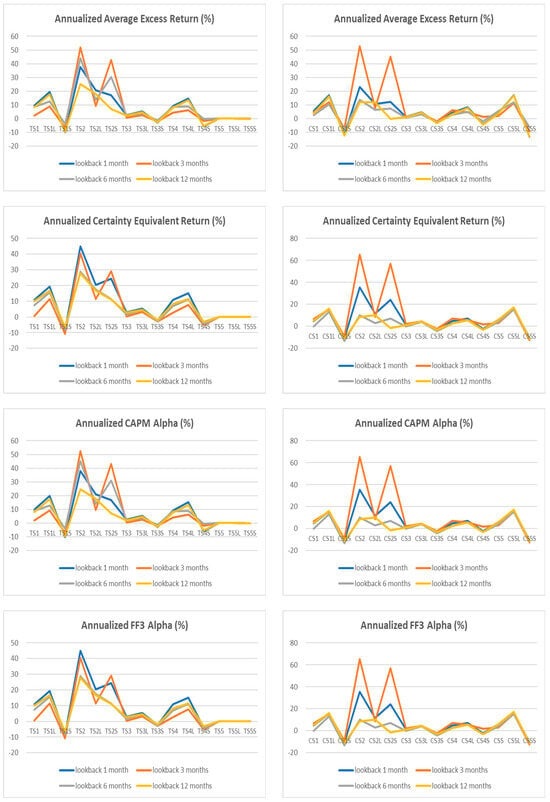
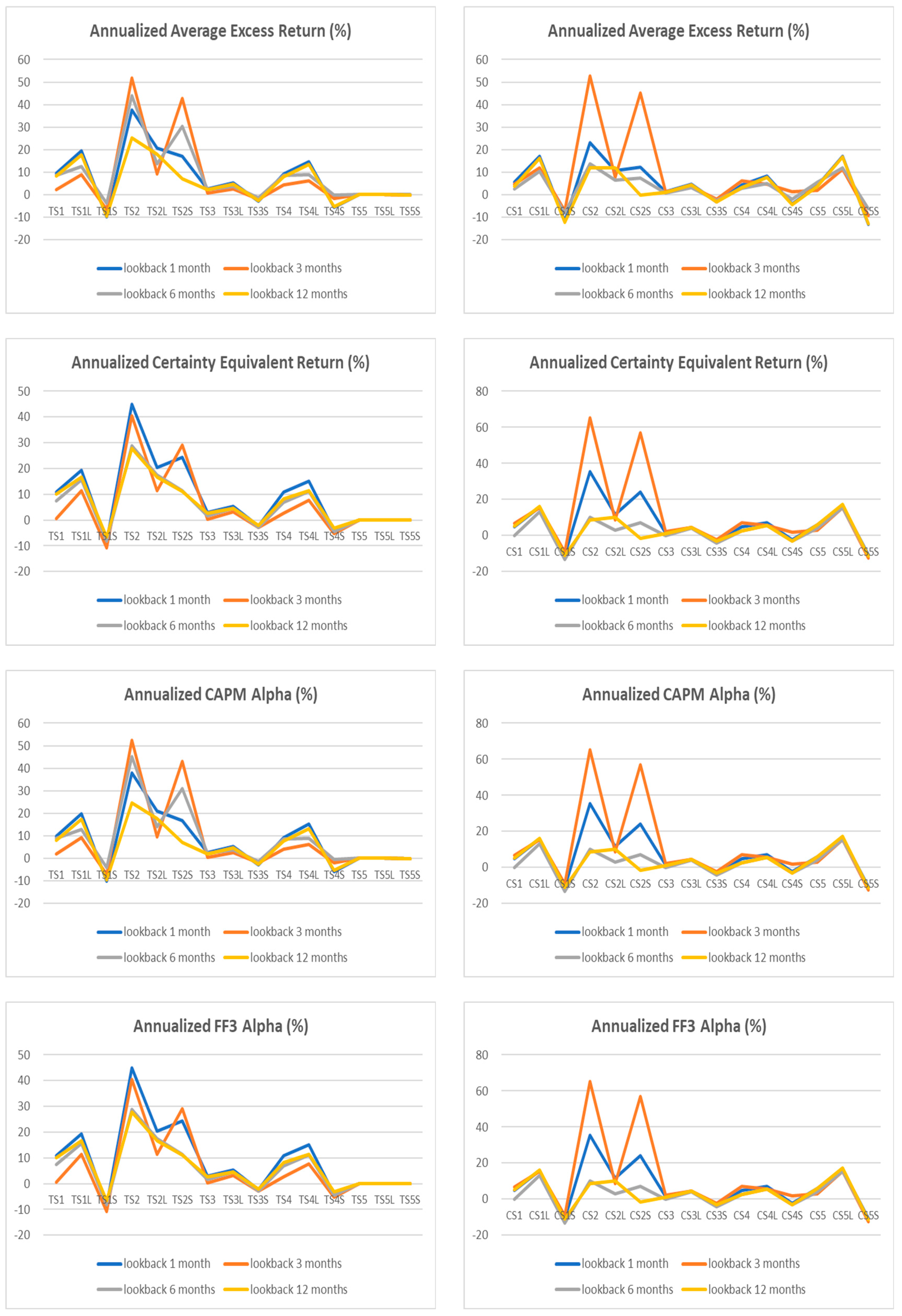
Figure 1 presents an overall performance comparison across the five time-series (TS) and five cross-sectional (CS) momentum strategies under a one-month holding period. Four performance measures are considered: annualized average excess returns (AERs), annualized certainty equivalent returns (CERs), annualized CAPM alphas, and annualized Fama–French three-factor (FF3) alphas. This comparison provides a comprehensive assessment of both raw profitability and risk-adjusted performance across different momentum specifications.
Figure 1.
Overall performance comparison across momentum strategies for a one-month holding period.
Several important findings emerge from Figure 1. First, volatility-scaled strategies exhibit superior performance across most indicators. In the TS framework, TS2 consistently generates the strongest performance, particularly when the lookback period is 3 months. TS2 produces the highest annualized AER and also performs strongly in terms of CER, CAPM alpha, and FF3 alpha. This suggests that volatility scaling substantially enhances the profitability and risk-adjusted performance of time-series momentum strategies.
Second, within the CS framework, CS2 also stands out as the dominant strategy. Similar to TS2, CS2 shows particularly strong performance under the 3-month lookback period and delivers high values across all four performance measures. This result indicates that incorporating volatility adjustment into cross-sectional momentum strategies improves both return performance and abnormal returns after controlling for market, size, and value risk factors. Third, the comparison between TS and CS strategies suggests that the strongest TS and CS strategies share a common feature: both rely on volatility scaling. However, the CS strategies generally display more pronounced peaks, especially for CS2, indicating that cross-sectional ranking combined with volatility adjustment may capture stronger relative mispricing effects among stocks. This finding supports the view that volatility-scaled cross-sectional momentum can provide particularly strong performance in the Taiwan stock market.
Fourth, strategies without effective volatility adjustment generally perform less favorably. TS3, TS5, CS3, and CS4 show weaker and less stable performance across the four indicators. Although some strategies occasionally generate positive returns, their performance is not as consistent as that of TS2 and CS2. This suggests that not all weighting schemes improve momentum performance; rather, the design of the volatility-scaling mechanism plays a crucial role. Finally, the consistency of the results across AER, CER, CAPM alpha, and FF3 alpha strengthens the robustness of the empirical findings. The strategies with higher average excess returns also tend to generate higher risk-adjusted returns and larger abnormal returns. Therefore, the superior performance of TS2 and CS2 is not merely driven by greater risk exposure, but reflects genuine improvements in momentum strategy design.
Overall, Figure 1 shows that volatility-scaled momentum strategies dominate conventional momentum specifications. Among all strategies, TS2 and CS2 emerge as the most effective approaches, with CS2 showing particularly strong overall performance in the cross-sectional framework. These findings highlight the importance of incorporating volatility scaling into momentum portfolio construction and provide further evidence that risk management significantly improves momentum performance in the Taiwan stock market.
5. Conclusions
This study compares the performance of time-series (TS) and cross-sectional (CS) momentum strategies in the Taiwan stock market over the period from January 1993 to December 2025. Using a comprehensive sample of 1169 listed and delisted firms, we construct five TS and five CS momentum strategies across multiple lookback and holding periods, resulting in 160 strategy specifications. To evaluate performance from both return and risk perspectives, we employ four measures: annualized average excess returns (AERs), certainty equivalent returns (CERs), CAPM alphas, and Fama–French three-factor (FF3) alphas.
Several important findings emerge from the empirical analysis. First, volatility scaling plays a crucial role in enhancing momentum profitability. Across all performance measures, TS2 and CS2, which employ a 40% target-volatility scaling mechanism, consistently outperform alternative specifications. This finding suggests that incorporating volatility information into portfolio construction substantially improves both raw returns and risk-adjusted performance.
Second, the results indicate that time-series momentum generally delivers more stable and consistent performance than cross-sectional momentum. Although the strongest individual strategies are occasionally found within the CS framework, TS strategies generate higher average AERs, CERs, CAPM alphas, and FF3 alphas across the full set of specifications. This evidence suggests that TS momentum provides more reliable abnormal returns, whereas CS momentum exhibits greater dispersion across strategy configurations.
Third, momentum profits are primarily generated by winner portfolios. The decomposition analysis shows that long-only positions account for the majority of momentum profits and risk-adjusted performance in both TS and CS frameworks. This finding is consistent with behavioral explanations of momentum, which emphasize gradual information diffusion and investor underreaction. However, during market crash periods, the contribution of short-only strategies increases substantially, indicating that momentum investors can benefit from identifying and shorting underperforming stocks during periods of severe market stress.
Fourth, the profitability of momentum strategies depends on both portfolio construction and investment horizons. While no clear monotonic relationship is observed between lookback periods and performance, the most successful strategies generally employ intermediate-term formation periods, particularly three- to six-month lookback horizons. In contrast, momentum profits tend to decline as holding periods increase, suggesting that return continuation effects gradually dissipate over time.
Overall, the findings demonstrate that momentum remains a profitable investment strategy in the Taiwan stock market. More importantly, the results suggest that effective risk management through volatility scaling is at least as important as stock selection itself. By integrating volatility-adjusted portfolio construction with traditional momentum signals, investors can achieve substantially higher returns and superior risk-adjusted performance.
Despite these contributions, several limitations remain and provide promising avenues for future research. First, although the results indicate that volatility-scaled strategies consistently outperform conventional momentum strategies, future studies may further investigate the economic mechanisms underlying this improvement rather than focusing solely on performance comparisons. In particular, researchers may examine whether the superior performance arises from enhanced risk management, improved behavioral timing, or changes in portfolio exposure across different market conditions. Second, the exceptionally high annualized returns and alpha estimates reported in some specifications warrant additional robustness analysis. Future research may conduct subperiod analyses, employ alternative asset-pricing models, examine different target-volatility levels, and exclude extreme observations to verify the stability of the findings. In addition, future studies may incorporate realistic transaction costs, short-selling constraints, and liquidity considerations to evaluate whether the documented profitability can be sustained under more practical trading environments. Third, because the profitability of several momentum strategies relies heavily on short positions, future research may further investigate the role of short-selling activity, borrowing costs, and market frictions in shaping momentum returns. Such analyses would provide a more comprehensive understanding of the economic feasibility of implementing momentum strategies in real-world markets. Finally, future studies may explore whether the effectiveness of momentum strategies varies across different market regimes, industries, macroeconomic environments, and international markets. Examining the interaction between market conditions and momentum profitability would contribute to a deeper understanding of the sources of momentum returns and help establish the external validity of the findings beyond the Taiwan stock market.
Author Contributions
Conceptualization, H.-H.H. and Y.-R.P.; Methodology, H.-H.H. and Y.-R.P.; Software, H.-H.H. and Y.-R.P.; Validation, H.-H.H., Y.-R.P. and C.-P.W.; Formal analysis, H.-H.H., Y.-R.P. and C.-P.W.; Investigation, H.-H.H., Y.-R.P. and C.-P.W.; Resources, H.-H.H. and C.-P.W.; Data curation, H.-H.H. and Y.-R.P.; Writing—original draft, H.-H.H. and Y.-R.P.; Writing—review & editing, H.-H.H., Y.-R.P. and C.-P.W.; Visualization, H.-H.H. and C.-P.W.; Supervision, H.-H.H. and C.-P.W.; Project administration, H.-H.H. and Y.-R.P.; Funding acquisition, C.-P.W. All authors have read and agreed to the published version of the manuscript.
Funding
This research received no external funding.
Institutional Review Board Statement
Not applicable.
Informed Consent Statement
Not applicable.
Data Availability Statement
The original contributions presented in this study are included in the article. Further inquiries can be directed to the corresponding authors.
Conflicts of Interest
The authors declare no conflict of interest.
References
- Arnott, R. D., Kalesnik, V., & Linnainmaa, J. T. (2023). Factor momentum. Review of Financial Studies, 36(8), 3034–3070. [Google Scholar] [CrossRef] [Scilit]
- Asness, C. S., Frazzini, A., & Pedersen, L. H. (2012). Leverage aversion and risk parity. Financial Analysts Journal, 68(1), 47–59. [Google Scholar] [CrossRef] [Scilit]
- Barroso, P., & Santa-Clara, P. (2015). Momentum has its moments. Journal of Financial Economics, 116(1), 111–120. [Google Scholar] [CrossRef] [Scilit]
- Blackburn, D. W., & Cakici, N. (2017). Overreaction and the cross-section of returns: International evidence. Journal of Empirical Finance, 42, 1–14. [Google Scholar] [CrossRef] [Scilit]
- Buesing, P., Mohrschladt, H., & Siedhoff, S. (2024). Decomposing momentum: The forgotten component. Journal of Banking & Finance, 168(11), 107292. [Google Scholar] [CrossRef] [Scilit]
- Carhart, M. M. (1997). On persistence in mutual fund performance. The Journal of Finance, 26(1), 57–82. [Google Scholar] [CrossRef]
- Daniel, K., Hirshleifer, D., & Subrahmanyam, A. (1998). Investor psychology and security market under- and overreactions. The Journal of Finance, 53(6), 1839–1885. [Google Scholar]
- Daniel, K., & Moskowitz, T. J. (2016). Momentum crashes. Journal of Financial Economics, 122(2), 221–247. [Google Scholar] [CrossRef] [Scilit]
- Ehsani, S., & Linnainmaa, J. T. (2022). Factor momentum and the momentum factor. Journal of Finance, 77(3), 1877–1919. [Google Scholar] [CrossRef] [Scilit]
- Fama, E. F. (1970). Efficient capital markets: A review of theory and empirical work. The Journal of Finance, 35(2), 383–417. [Google Scholar] [CrossRef] [Scilit]
- Fama, E. F., & French, K. R. (1992). The cross-section of expected stock returns. Journal of Finance, 47(2), 427–465. [Google Scholar] [CrossRef] [Scilit]
- Fama, E. F., & French, K. R. (1993). Common risk factors in the returns on stocks and bonds. Journal of Financial Economics, 33(1), 3–56. [Google Scholar] [CrossRef] [Scilit]
- Fernandez-Perez, A., Indriawan, I., & Xu, Y. H. (2023). Cross-asset time-series momentum: Crude oil volatility and global stock markets. Journal of Banking & Finance, 154, 106704. [Google Scholar] [CrossRef] [Scilit]
- Goyal, A., & Jegadeesh, N. (2018). Cross-sectional and time-series tests of return predictability: What is the difference? The Review of Financial Studies, 41(5), 1784–1824. [Google Scholar]
- Huang, D., Li, J., Wang, L., & Zhou, G. (2020). Time series momentum: Is it there? Journal of Financial Economics, 21(3), 774–794. [Google Scholar] [CrossRef] [Scilit]
- Jegadeesh, N., & Titman, S. (1993). Returns to buying winners and selling losers: Implications for stock market efficiency. The Journal of Finance, 48(1), 65–91. [Google Scholar] [CrossRef]
- Jegadeesh, N., & Titman, S. (2001). Profitability of momentum strategies: An evaluation of alternative explanations. The Journal of Finance, 56(2), 699–720. [Google Scholar] [CrossRef] [Scilit]
- Kim, A. Y., Tse, Y., & Wald, J. K. (2016). Time series momentum and volatility scaling. Journal of Financial Markets, 30, 103–124. [Google Scholar] [CrossRef] [Scilit]
- Kolari, J. W., & Shin, S. (2024). Momentum and reversal: Information from prior returns. Applied Economics, 56(3), 318–336. [Google Scholar]
- Kyle, A. S., Obizhaeva, A. A., & Wang, Y. J. (2023). Beliefs aggregation and return predictability. Journal of Finance, 78(1), 427–486. [Google Scholar]
- Lewellen, J. (2002). Momentum and autocorrelation in stock returns. The Review of Financial Studies, 31(2), 533–563. [Google Scholar] [CrossRef] [Scilit]
- Li, Z. M., Sakkas, A., & Urquhart, A. (2022). Intraday time series momentum: Global evidence and links to market characteristics. Journal of Financial Markets, 57, 100619. [Google Scholar] [CrossRef] [Scilit]
- Lim, B. Y., Wang, J., & Yao, Y. (2018). Time-series momentum in nearly 100 years of stock returns. Journal of Banking & Finance, 97(12), 283–296. [Google Scholar] [CrossRef] [Scilit]
- Lintner, J. (1965). Security prices, risk, and maximal gains from diversification. The Journal of Finance, 29(4), 587–615. [Google Scholar] [CrossRef] [Scilit]
- Markowitz, H. (1952). Portfolio selection. The Journal of Finance, 15(1), 77–91. [Google Scholar] [CrossRef] [Scilit]
- Moskowitz, T. J., Ooi, Y. H., & Pedersen, L. H. (2012). Time series momentum. Journal of Financial Economics, 23(2), 228–250. [Google Scholar] [CrossRef] [Scilit]
- Mossin, J. (1966). Equilibrium in a capital asset market. Econometrica, 16(4), 768–783. [Google Scholar] [CrossRef] [Scilit]
- Pitkäjärvi, A., Suominen, M., & Vaittinen, L. (2020). Cross-asset signals and time series momentum. Journal of Financial Economics, 23(1), 63–85. [Google Scholar] [CrossRef] [Scilit]
- Ross, S. A. (1976). The arbitrage theory of capital asset pricing. Journal of Economic Theory, 13(2), 341–360. [Google Scholar] [CrossRef] [Scilit]
- Rouwenhorst, K. G. (1998). International momentum strategies. The Journal of Finance, 18(1), 267–284. [Google Scholar] [CrossRef] [Scilit]
- Sharpe, W. F. (1964). Capital asset prices: A theory of market equilibrium under conditions of risk. The Journal of Finance, 19(3), 425–442. [Google Scholar] [CrossRef] [Scilit]
- Stadtmüller, I., Auer, B. R., & Schuhmacher, F. (2022). On the time-varying dynamics of stock and commodity momentum returns. Finance Research Letters, 46, 102385. [Google Scholar] [CrossRef] [Scilit]
- Tomtosov, A. (2024). Momentum on historical high. Finance Research Letters, 69, 106216. [Google Scholar] [CrossRef] [Scilit]
- Yan, J. D., & Yu, J. L. (2023). Cross-stock momentum and factor momentum. Journal of Financial Economics, 150(2), 103716. [Google Scholar] [CrossRef] [Scilit]
- Zakamulin, V., & Giner, J. (2022). Time series momentum in the US stock market: Empirical evidence and theoretical analysis. International Review of Financial Analysis, 82, 102173. [Google Scholar] [CrossRef] [Scilit]

Disclaimer/Publisher’s Note: The statements, opinions and data contained in all publications are solely those of the individual author(s) and contributor(s) and not of MDPI and/or the editor(s). MDPI and/or the editor(s) disclaim responsibility for any injury to people or property resulting from any ideas, methods, instructions or products referred to in the content. |
© 2026 by the authors. Licensee MDPI, Basel, Switzerland. This article is an open access article distributed under the terms and conditions of the Creative Commons Attribution (CC BY) license.