1. Introduction
How information enters stock prices, and through which assets and venues it travels, remains a central question in financial economics. In fragmented and internationally connected markets, price formation is not simply the outcome of isolated firm-level news. Rather, it emerges from a system of interacting securities. Within that system, shocks, order flow, liquidity conditions, and expectations are transmitted unevenly across assets and over time.
Two complementary fields of the literature motivate this perspective. The first is the connectedness literature, which treats financial markets as networks in which the structure of interdependence shapes the propagation and amplification of shocks (
Allen & Gale, 2000;
Battiston et al., 2012;
Diebold & Yilmaz, 2009,
2012,
2014). The second is the price discovery and market microstructure literature, which studies how information is incorporated into prices across competing venues. This literature emphasizes the role of trading frictions, liquidity, and informed order flow in determining where price adjustment occurs first (
Hasbrouck, 1995;
O’Hara, 1995;
Madhavan, 2000;
Foucault et al., 2013). Taken together, these traditions suggest that the informational hierarchy of an equity market is shaped not only by firm characteristics, but also by network position, market liquidity, trading venue, and the channels through which external shocks enter the system.
This perspective has generated a large body of empirical literature. Order-invariant variance decompositions and generalized impulse responses provide a tractable way to measure directional spillovers in multivariate systems (
Koop et al., 1996;
Pesaran & Shin, 1998). The Diebold–Yilmaz framework has transformed those decompositions into an empirical network representation of financial connectedness. It first introduced a variance-decomposition measure of spillovers (
Diebold & Yilmaz, 2009), then extended it in generalized form (
Diebold & Yilmaz, 2012), and later developed an explicit network topology of directional linkages (
Diebold & Yilmaz, 2014). Subsequent work has applied this framework to large-dimensional systems (
Demirer et al., 2018), international stock markets (
Antonakakis et al., 2020), commodity markets (
Kang et al., 2017), exchange rates (
Phylaktis & Ravazzolo, 2005), and frequency-domain spillovers (
Baruník & Křehlík, 2018).
At the same time, the cross-listing literature shows that price discovery is often displaced toward offshore venues when securities trade simultaneously across markets with different liquidity, institutional quality, and investor composition (
Hasbrouck, 1995;
Harris et al., 1995;
Eun & Sabherwal, 2003;
Grammig et al., 2005;
Pascual et al., 2006;
Putniņš, 2013). ADRs from emerging markets tend to benefit from deeper liquidity, lower trading costs, broader analyst coverage, and lower costs of capital. These advantages can strengthen the informational role of the offshore venue, particularly when domestic markets are smaller or less liquid (
Karolyi, 2002,
2006;
Eleswarapu & Venkataraman, 2006;
Gagnon & Karolyi, 2010).
Recent empirical work has extended the connectedness literature to post-pandemic and high-uncertainty environments. This literature shows that spillover structures in emerging markets are highly sensitive to global volatility, exchange-rate shocks, geopolitical risk, and crisis conditions.
Lawrence et al. (
2024) examine connectedness and shock propagation across South African equity sectors during extreme market conditions, while
Altinkeski et al. (
2024) document quantile-dependent connectedness between the VIX and global stock markets. Related studies show that exchange-rate and stock-market spillovers intensified during pandemic-related crises in BRICS economies (
Hussain et al., 2024), and that emerging-market sectoral indices are particularly exposed to global uncertainty and volatility shocks (
S. Khan et al., 2025;
Gökgöz et al., 2025;
Kasraoui et al., 2025). These contributions confirm the relevance of connectedness methods for studying emerging markets. However, most of this evidence remains concentrated on aggregate indices, sectoral portfolios, or large emerging economies. The Colombian case therefore offers complementary evidence from a smaller and less liquid emerging equity market, where cross-listing, thin trading, commodity exposure, and external risk interact at the individual-stock level.
The evidence for emerging markets broadly supports this intuition, but it remains incomplete in one important respect. Existing studies show that connectedness among emerging-market indices is economically meaningful and tends to intensify during crises or extreme market conditions (
M. Khan et al., 2023;
Khalfaoui et al., 2023;
Kakran et al., 2023;
Maquieira et al., 2025). For Latin America,
Gamba et al. (
2016) document volatility spillovers at the country-index level, while
Maquieira et al. (
2025) show that connectedness in the region widens substantially during crisis episodes. Yet, this literature is overwhelmingly conducted at the level of country indices or aggregate markets. As a result, we know much less about the intra-market informational hierarchy within individual small emerging markets. This gap is important because thin trading, ownership concentration, dual listing, and global risk exposure may jointly determine how information is transmitted within these markets. Even within-market applications of the connectedness framework have focused mainly on deep developed markets, such as the United States, rather than on small and illiquid exchanges with strong structural frictions (
Baruník & Křehlík, 2018).
Colombia is a particularly relevant setting in which to study these issues. The Colombian Stock Exchange (BVC) combines three features that make its informational structure especially interesting. First, liquidity differs sharply across stocks. Some securities exhibit very low zero-return frequencies, whereas others show prolonged sequences of non-trading. This pattern is consistent with large differences in effective transaction costs (
Lesmond, 2005). Second, the market is heavily shaped by conglomerate structures, especially Grupo Empresarial Antioqueño and Grupo Aval. Their cross-holdings may generate co-movement even in the absence of direct operating linkages (
Gutierrez et al., 2008;
Uribe & Fernández, 2014). Third, two of the market’s most important firms, Ecopetrol and Bancolombia, also trade as ADRs on the New York Stock Exchange. This creates a dual-listing structure in which the same underlying firms are priced simultaneously in venues with very different depth, institutional environment, and investor base.
These characteristics make the BVC a natural laboratory for studying whether ADR-listed securities act as dominant transmitters of return innovations to local BVC-listed shares. They also make it possible to examine whether offshore-to-onshore transmission changes when global risk increases. This question has direct implications for portfolio diversification, regulatory monitoring, and the design of regional market-integration initiatives such as MILA and nuam exchange.
In this paper, Colombia is understood as a small emerging equity market in a specific market-structure sense. Colombia is an emerging economy, but its stock market is substantially less deep and less liquid than the largest Latin American exchanges, such as Brazil and Mexico. The BVC is characterized by a relatively small universe of actively traded stocks, concentrated liquidity, high zero-return frequencies for many securities, and strong exposure to external financial and commodity shocks. This distinction is important because the mechanisms of information transmission in Colombia are likely to differ from those observed in larger regional markets. Larger markets usually have broader investor bases, higher turnover, and deeper domestic liquidity. Colombia therefore provides a useful setting to examine how informational leadership is shaped when domestic market depth is limited and when internationally traded securities may serve as key channels for external information.
Several transmission channels make such external informational dependence plausible. The first is a liquidity channel. In the classic microstructure models of
Kyle (
1985) and
Glosten and Milgrom (
1985), informed traders prefer deeper and more liquid venues because they can exploit private information at lower price impact. This implies that offshore markets may lead price adjustment when domestic trading is thin. The second is a cross-listing or venue-quality channel. When firms list abroad, they gain access to larger pools of international capital, improved analyst following, lower trading costs, and stronger institutional infrastructure. These conditions can shift the location of information incorporation toward the foreign exchange (
Karolyi, 2002,
2006;
Eleswarapu & Venkataraman, 2006;
Gagnon & Karolyi, 2010). The third is an arbitrage channel between ADRs and local shares. When identical cash-flow claims trade in overlapping sessions, arbitrageurs transmit information across venues, allowing the faster or deeper market to influence the slower one (
Harris et al., 1995;
Eun & Sabherwal, 2003;
Grammig et al., 2005;
Pascual et al., 2006). The fourth is a global-risk channel. Changes in volatility, capital flows, exchange rates, sovereign risk, and U.S. rates alter the relative weight of external versus local information in emerging markets (
Bekaert & Harvey, 2000;
Phylaktis & Ravazzolo, 2005;
Bekaert et al., 2007).
In Colombia, two additional channels are especially relevant. The first is a commodity channel, because Ecopetrol occupies a central role in both the stock market and the national economy. Through this channel, global oil-price information may enter domestic equity prices through Ecopetrol’s valuation (
Basher & Sadorsky, 2006;
Kilian, 2009). The second is a conglomerate channel, because shocks may spread across domestic firms through pyramidal ownership and common-control structures, even when there is no direct sectoral linkage (
Gutierrez et al., 2008;
Uribe & Fernández, 2014).
The Ecopetrol channel should therefore be interpreted as both firm-specific and commodity-related. It is firm-specific because Ecopetrol is one of Colombia’s most important listed firms and because its dual-listing structure allows a direct comparison between the NYSE-listed ADR and the locally traded share. However, it is also a broader commodity channel because Ecopetrol’s cash flows and valuation are closely linked to global oil-market conditions. For this reason, EC’s informational role may reflect not only the characteristics of Ecopetrol as an issuer, but also the transmission of internationally priced oil shocks into the Colombian equity market.
Despite these mechanisms, the Colombian literature has not yet identified the market’s informational architecture at the individual-stock level. Existing work has documented informed trading, volatility transmission, and dependence, but not the hierarchy of net information transmitters and receivers within the market.
Agudelo et al. (
2015) show that information asymmetry reduces liquidity and moves prices in the direction of private information across Latin American markets, including Colombia.
Cardona et al. (
2015) find strong unidirectional volatility transmission from the United States to Latin America, including Colombia, but at the aggregate market level.
Uribe and Fernández (
2014), in the closest firm-level antecedent, document strong tail dependence among BVC stocks, especially among firms connected to the GEA conglomerate. Their results imply that co-movement intensifies precisely when diversification is most needed. These studies are important, but they do not ask which individual Colombian stocks lead the process of information transmission, whether ADR-listed securities dominate their domestic counterparts, or whether that hierarchy is stable across global risk conditions. More broadly, the Colombian evidence has largely focused on correlation, volatility, or tail dependence, rather than on the market as a network of directional information transmission.
This paper addresses that gap by reconstructing the Colombian equity market as a multivariate network of informational spillovers. We analyze a five-asset system comprising Bancolombia’s ADR (CIB, NYSE), Ecopetrol’s ADR (EC, NYSE), the local Ecopetrol share (ECOPETROL.CL, BVC), ISA (ISA.CL), and Corficolombiana (CORFICOLCF.CL), using daily data for 2015–2024. To identify the direction and intensity of information transmission, we estimate a VAR with exogenous global controls and compute the generalized forecast error variance decomposition of
Pesaran and Shin (
1998) within the connectedness framework of
Diebold and Yilmaz (
2012,
2014).
This design is related to the price-discovery literature on cross-listed securities, but it does not estimate venue-specific contributions to a latent common efficient price in the Hasbrouck Information Share sense. Instead, it measures how shocks to one asset contribute to the forecast error variance of other assets. Accordingly, the empirical object of the paper is directional connectedness and informational leadership, rather than formal price-discovery shares. The use of generalized rather than orthogonalized decompositions avoids arbitrary ordering assumptions. Residual bootstrap inference allows us to distinguish systematic patterns from sampling variation. In addition, by conditioning the analysis on global risk regimes, we examine whether the market oscillates between relative local autonomy and stronger external informational dependence as the global environment changes.
The paper makes four specific contributions. First, it shifts the analysis of Colombian equity-market connectedness from the aggregate index level to the individual-stock level. This level of analysis allows liquidity differences, cross-listing status, and firm-specific exposure to external shocks to be observed more directly. Relative to the existing Colombian and Latin American literature, which has focused mainly on aggregate inter-market spillovers, informed trading, volatility transmission, or copula-based dependence, this firm-level approach identifies a hierarchy of net transmitters and receivers within the domestic equity system (
Agudelo et al., 2015;
Cardona et al., 2015;
Gamba et al., 2016;
Uribe & Fernández, 2014).
Second, it combines NYSE-listed ADRs and BVC-listed local shares in the same multivariate connectedness network. This design builds on the cross-listing literature, which shows that trading venue, liquidity, investor composition, and market depth can shape where information is incorporated into prices. However, the paper adapts that intuition to a connectedness-based framework rather than to formal price-discovery shares (
Hasbrouck, 1995;
Harris et al., 1995;
Eun & Sabherwal, 2003;
Grammig et al., 2005;
Pascual et al., 2006;
Gagnon & Karolyi, 2010;
Putniņš, 2013).
Third, it distinguishes between firm-specific and venue-driven leadership by re-estimating the network after excluding the local Ecopetrol share. This reduced-system test examines whether EC’s dominance is unique to Ecopetrol or whether leadership shifts to another ADR-listed security. The test therefore helps clarify whether informational leadership reflects the identity of a single issuer or the informational advantages associated with the offshore trading venue.
Fourth, it examines whether informational leadership is regime-dependent by comparing connectedness across low-, medium-, and high-VIX environments. Methodologically, the paper applies order-invariant generalized variance decompositions within the Diebold–Yilmaz framework and provides bootstrap inference for both full-sample and regime-specific connectedness (
Koop et al., 1996;
Diebold & Yilmaz, 2009,
2012,
2014). This regime-based design is consistent with the literature showing that emerging-market integration and cross-market transmission intensify under global risk, liquidity, and crisis conditions (
Bekaert & Harvey, 2000;
Bekaert et al., 2007;
Antonakakis et al., 2020;
Demirer et al., 2018;
Tiwari et al., 2020). In that sense, the paper contributes not only new evidence on Colombia, but also a portable framework for studying informational dependence in small emerging markets where illiquidity, cross-listing, global shocks, and ownership concentration interact.
The remainder of the paper is organized as follows.
Section 2 presents the empirical methodology.
Section 3 describes the data and sample construction.
Section 4 reports the main results.
Section 5 discusses the main findings and their broader implications.
Section 6 concludes.
2. Empirical Methodology
This study examines whether informational leadership within a segment of the Colombian equity market is associated with offshore listing status and whether such leadership varies with global risk conditions. Because price discovery among cross-listed securities is inherently a multivariate process, the empirical framework is built on a vector autoregressive system with exogenous global controls, a generalized forecast error variance decomposition, Diebold–Yilmaz connectedness measures, bootstrap-based inference, and regime-dependent estimation. This structure allows the analysis to identify which assets act as net transmitters of information and whether those roles are stable across market states.
2.1. Multivariate Return System
The return dynamics are modelled using a vector autoregressive specification, a standard framework for multivariate time-series analysis in financial applications (
Hamilton, 1994;
Lütkepohl, 2005) as:
denote the
vector of endogenous asset returns observed at time
, where
is the number of assets in the system. Let:
denote the
vector of exogenous global controls, where
is the number of external variables included to account for common international shocks.
The joint dynamics of the system are modelled through a VAR (
) with exogenous variables:
where
indexes time,
is the lag order of the VAR, and
is the lag index. The vector
contains intercept terms,
is the
matrix of autoregressive coefficients at lag
,
is the
matrix of coefficients associated with the exogenous controls,
is the
vector of reduced-form innovations, and
is the
variance–covariance matrix of innovations.
This specification is appropriate because informational leadership cannot be identified from isolated bilateral relations when several assets jointly incorporate common and idiosyncratic information. A multivariate VAR allows each asset return to depend on the lagged history of the full system and thus captures the endogenous feedback structure across trading venues. The inclusion of exogenous global controls is equally important, as it purges common international shocks and helps ensure that the estimated spillovers reflect relative informational leadership within the asset system rather than simple co-movement induced by external conditions.
The VAR admits the infinite-order moving-average representation:
where
is the implied mean vector of the process,
denotes the impulse-response horizon,
is the
moving-average coefficient matrix at horizon
, and
, with
denoting the
identity matrix. This representation forms the basis for the variance-decomposition analysis.
The exogeneity assumption is motivated by the relative size of the Colombian equity market vis-à-vis the global variables. The five BVC-related stocks in our system represent a negligible share of global equity-market capitalization, making it economically implausible that their return innovations would cause contemporaneous movements in the VIX, WTI crude oil prices, the EMBI index, or U.S. Treasury yields. The USDCOP exchange rate is the most plausible candidate for endogeneity, since capital flows into Colombian equities could affect the peso. To address this concern directly, we estimate an eight-variable VAR in which WTI crude oil futures, USDCOP, and EMBI are treated as endogenous variables. The results, reported in Robustness, show that EC’s net spillover increases from +7.23 in the baseline model to +30.30 when these controls are endogenized. This amplification is consistent with EC serving as an intermediary between global commodity markets and the domestic Colombian equity system. Therefore, the baseline specification with exogenous controls should be interpreted as conservative rather than as overstating EC’s informational role.
The lag order is selected using standard information criteria. The Bayesian Information Criterion (BIC) selects
, the Hannan–Quinn Information Criterion (HQIC) selects
, and the Akaike Information Criterion (AIC) selects
. We adopt
, selected by HQIC, as the principal specification following
Lütkepohl (
2005, Chapter 4), because it provides a balance between parsimony and dynamic flexibility. To ensure that the results are not driven by this choice, VAR(2) and VAR(5) specifications are reported as robustness checks.
2.2. Generalized Forecast Error Variance Decomposition
To quantify the contribution of shocks in one asset to the forecast error variance of another, the analysis employs the generalized forecast error variance decomposition (GFEVD) of
Pesaran and Shin (
1998) which is based on the generalized impulse-response approach of
Koop et al. (
1996). For forecast horizon
, the generalized variance share attributed to shocks in variable
for the
-step-ahead forecast error variance of variable
is defined as:
where
index the assets in the system,
is the forecast horizon, the superscript
denotes the generalized decomposition,
is a
selection vector with one in the
-th position and zeros elsewhere, and
is the
-th diagonal element of
.
Since the row sums of the raw generalized decomposition do not necessarily equal one, the variance shares are normalized as:
The generalized decomposition is preferred over orthogonalized alternatives because it is invariant to variable ordering. This property is essential in the present setting, where ADR-listed and domestically traded securities may react contemporaneously to common information and where no economically compelling recursive ordering is available. Accordingly, the GFEVD provides an economically coherent measure of cross-asset transmission in integrated markets characterized by overlapping trading hours and near-simultaneous price adjustment.
2.3. Connectedness and Spillover Measures
Using the normalized GFEVD, the paper computes the connectedness measures proposed by
Diebold and Yilmaz (
2009,
2012,
2014), including total, directional, and net spillover indices. The total spillover index is defined as:
where
measures the proportion of system-wide forecast error variance attributable to cross-asset shocks rather than own shocks. It therefore summarizes the overall degree of informational integration within the market.
Directional spillovers transmitted by asset
to all other assets are defined as:
where the symbol
denotes all other assets in the system.
Directional spillovers received by asset
from the rest of the system are given by:
The net spillover associated with asset
is then
Positive values of identify net transmitters of information, whereas negative values identify net receivers. This distinction is central to the empirical design because informational leadership is operationalized through persistent net transmission. Within this framework, an ADR-listed asset is interpreted as an informational leader in the connectedness sense if it contributes more to the forecast error variance of other assets than it receives from them on a systematic basis. This interpretation should be distinguished from standard market-microstructure measures of price discovery, such as Hasbrouck’s Information Share, which estimate each venue’s contribution to a common efficient price. The Diebold–Yilmaz framework instead identifies directional spillover leadership among observed return series.
2.4. Bootstrap-Based Inference
Because connectedness measures are nonlinear functions of estimated VAR parameters, inference is based on a recursive-design residual bootstrap, following the general bootstrap logic of
Efron (
1987) and the VAR bootstrap procedures discussed by
Kilian (
1998) and
Lütkepohl (
2005). Let:
denote the vector of estimated model parameters, and let
denote a generic connectedness statistic of interest, such as the total spillover index or a net spillover measure. For bootstrap replication
, the corresponding statistic is written as
where
indexes the bootstrap replication,
is the total number of bootstrap replications,
is the bootstrap estimate of the parameter vector in replication
, and
denotes the mapping from estimated model parameters to the connectedness statistic of interest.
The empirical bootstrap distribution is therefore:
from which confidence intervals and significance assessments can be derived. This inferential approach is appropriate because the finite-sample distribution of GFEVD-based connectedness measures is generally nonstandard, making bootstrap methods more reliable than simple asymptotic approximations for inference on spillover statistics.
2.5. Regime-Dependent Connectedness
To assess whether informational hierarchy changes with the global risk environment, the analysis is extended to a regime-dependent setting in which market states are defined according to the level of the VIX. Let
denote the regime indicator:
where
and
denote the lower and upper empirical quantile thresholds of the VIX distribution, and
,
, and
refer to low-, medium-, and high-risk regimes, respectively. Conditional on regime
, the return dynamics are represented by
In the regime-specific VAR estimations, the lag length is kept fixed at (
p = 3) across the low-, medium-, and high-VIX regimes. This choice preserves comparability across regimes and ensures that differences in connectedness are not mechanically driven by changes in the lag structure. Re-selecting the lag order separately within each regime could introduce specification heterogeneity and reduce the comparability of the regime-specific spillover measures. Consistent with the baseline specification and the parsimony principle in VAR modelling (
Lütkepohl, 2005), VAR(3) is therefore retained as the principal lag structure for all regime-specific estimations. Robustness checks using alternative VAR(2) and VAR(5) specifications are reported in Robustness check.
The GFEVD and the connectedness measures are then evaluated within each regime using the corresponding state-specific parameterization. This extension is economically relevant because offshore informational advantages may become stronger in periods of heightened uncertainty, when differences in liquidity, trading depth, and information-processing capacity across venues are more pronounced. Regime-dependent estimation therefore makes it possible to determine whether ADR leadership is stable across market conditions or instead intensifies under global stress.
The regime-dependent analysis is designed to assess whether the Colombian equity network moves between periods of relative local autonomy and periods of stronger external informational dependence as global conditions change. This design is consistent with the literature showing that financial connectedness and shock transmission intensify during periods of stress, uncertainty, and systemic risk (
Acemoglu et al., 2015;
Allen & Gale, 2000;
Antonakakis et al., 2020;
Demirer et al., 2018). The VIX is used to define these regimes because it is a widely used proxy for global risk appetite and investor uncertainty.
The VIX regimes are constructed from the empirical terciles of the VIX level over the sample period. Specifically, the low-risk regime includes observations with VIX below 14.07, corresponding to the 33rd percentile of the sample distribution; the medium-risk regime includes observations between 14.07 and 19.40; and the high-risk regime includes observations above 19.40, corresponding to the 67th percentile. This tercile-based classification produces three comparably sized regimes and allows the analysis to examine whether connectedness and informational leadership vary systematically with global risk conditions. As a robustness check, the regime analysis is also re-estimated using alternative 25th/75th percentile thresholds, as reported in Robustness check.
The use of a static VAR complemented by regime-dependent estimation is deliberate. It follows the canonical Diebold–Yilmaz connectedness framework, which facilitates comparison with the existing literature (
Diebold & Yilmaz, 2012,
2014), while avoiding the over-parameterisation that may arise in TVP-VAR or Markov-switching VAR models, particularly in a relatively small system with several global controls (
Antonakakis et al., 2020). To capture time variation without sacrificing parsimony, the full-sample VAR is complemented with VIX-regime estimates and 200-day rolling-window connectedness measures. These exercises provide evidence on state dependence while preserving the transparency of the baseline framework. Formal TVP-VAR or MS-VAR extensions therefore remain a useful direction for future research.
Overall, the empirical framework combines established methods rather than proposing a new econometric estimator. The methodological contribution of the paper lies in integrating VAR-based generalized variance decompositions, Diebold–Yilmaz connectedness measures, bootstrap inference, liquidity screening, and VIX-regime analysis to study informational leadership in a small, illiquid, and externally exposed emerging equity market.
3. Data
3.1. Data Sources and Sample Construction
The empirical analysis uses daily closing data from 2 January 2015 to 30 December 2024. Equity prices are obtained from Yahoo Finance for ten Colombian stocks: BOGOTA.CL, CELSIA.CL, CIB (Bancolombia ADR, NYSE), CORFICOLCF.CL, EC (Ecopetrol ADR, NYSE), ECOPETROL.CL, GEB.CL, GRUPOSURA.CL, ISA.CL, and NUTRESA.CL. The initial sample comprises 2607 trading days. In addition, five external variables are collected to capture global and macro-financial conditions: the CBOE Volatility Index (VIX), the J.P. Morgan EMBI Global Total Return Index (EMB), the U.S. 10-year Treasury yield (TNX), the Colombian peso exchange rate against the U.S. dollar (USDCOP), and WTI crude oil futures (CL = F).
The sample ends on 30 December 2024, which is the last trading day of the 2024 calendar year in the dataset. Observations after 2024 are excluded for three reasons. First, extending the sample into a partial 2025 period would introduce an incomplete final year and could distort both the VIX-based regime classification and the 200-day rolling-window analysis, since the final segment would contain fewer observations than previous periods. Second, the data were downloaded in early 2025, when the complete 2024 series had already been checked and verified, whereas 2025 observations were still subject to potential provider revisions. Third, the 2015–2024 period provides an exact ten-year window, which facilitates comparison between two symmetric five-year subsamples, 2015–2019 and 2020–2024. The resulting dataset should therefore be understood as a complete multivariate time-series sample, not as a balanced panel: all variables are observed over the same 2606 trading days after synchronization and cleaning.
Trading days are aligned using the intersection of the NYSE and BVC trading calendars. Only dates on which both exchanges were open are retained; when either exchange is closed for a holiday, the date is excluded from the sample for all variables. This intersection-calendar approach avoids stale-price artefacts that could arise under a union-calendar method, in which prices from a closed market would need to be carried forward. Time-zone differences are also considered. The BVC operates from 9:30 to 16:00 Colombia Time (COT, UTC-5), while the NYSE operates from 9:30 to 16:00 Eastern Time (ET, UTC-5 during standard time and UTC-4 during U.S. daylight saving time). During standard time, the two exchanges have identical trading hours. During U.S. daylight saving time, however, the BVC close occurs one hour after the NYSE close. Because the analysis uses daily closing prices, this one-hour offset allows the BVC closing price to incorporate information from the final hour of U.S. trading. If anything, this timing convention works against finding ADR leadership, since the domestic market has additional time to adjust before its closing price is recorded.
All raw series are aligned on a common daily calendar and inspected for data integrity prior to estimation. Seven anomalous observations in the USDCOP series were identified as Yahoo Finance data artefacts, as they implied implausible exchange-rate values below 500 COP per U.S. dollar. To verify that these values did not correspond to genuine market movements, they were checked against the official TRM series published by Banco de la República. The official TRM values during the 2015–2024 sample period remained far above those implausible observations, confirming that the values below 500 COP/USD were data-provider errors rather than extreme exchange-rate movements. These seven observations represent only 0.27% of the raw sample and were corrected to prevent spurious jumps from contaminating the return calculations and subsequent connectedness estimates. After cleaning, synchronization, and variable transformation, the final complete multivariate time-series sample contains 2606 observations per series.
3.2. Liquidity Screening and Sample Selection
A potential concern with this liquidity screen is that excluding highly illiquid stocks may introduce a form of liquidity-based selection bias. In particular, a connectedness network composed only of relatively more liquid securities could overstate the degree of systematic information transmission within the broader Colombian equity market, since very illiquid stocks may be more informationally segmented. We therefore interpret the baseline five-asset system as representing the most tradable segment of the BVC rather than the entire exchange. To assess whether the liquidity screen materially affects the results, the robustness analysis reports an expanded seven-asset system that adds CELSIA.CL and GRUPOSURA.CL, two stocks classified as highly illiquid according to the zero-return criterion.
Because liquidity is central to any analysis of price discovery in emerging equity markets, the sample is screened using the proportion of zero-return days. Following
Lesmond (
2005), zero-return frequency is treated as an informative proxy for trading frictions and effective illiquidity when direct transaction-cost measures are unavailable. Since consistent volume data are not available for all assets, the
Amihud (
2002) illiquidity ratio cannot be computed, making the zero-return metric the most appropriate screening device in this setting.
Table 1 reports the main illiquidity diagnostics for the ten candidate equities, including the proportion of zero-return days, the mean duration of zero-return streaks, and the maximum observed streak. Based on these diagnostics, the baseline system retains the five assets with zero-return fractions below 20%: CIB, EC, ECOPETROL.CL, ISA.CL, and CORFICOLCF.CL. A more restrictive 10% cutoff would retain only the two ADR-listed securities and would therefore be unsuitable for a connectedness framework requiring a multivariate network structure.
The 20% threshold offers a reasonable compromise between data quality and market representativeness in an emerging-market context. It preserves the most actively traded domestic names while maintaining sufficient cross-sectional variation to assess offshore versus local informational leadership. Importantly, the selected assets display a marked liquidity gradient: the two ADRs, CIB and EC, exhibit the lowest proportion of zero-return days, whereas the three locally traded stocks display substantially higher zero-return frequencies. This differential is economically relevant because it mirrors the contrast in market depth and trading activity that motivates the price-discovery analysis. The inclusion of both Ecopetrol’s ADR (EC) and its domestic listing (ECOPETROL.CL) is particularly valuable, as it allows a direct comparison of offshore and local information incorporation for the same underlying firm.
3.3. Variable Construction and Transformations
All price-based series are transformed into continuously compounded returns according to
where
denotes the closing value of series
on day
. This transformation is applied to all equity prices and to the control variables expressed in price levels, including EMB, USDCOP, and WTI crude oil futures.
More generally, all variables are transformed as necessary to ensure that the series entering the empirical model are stationary and suitable for multivariate time-series analysis. Variables rendered stationary through log-return transformation are retained in return form, whereas variables exhibiting persistence in levels are differenced before estimation. In particular, the VIX and TNX enter the model in first differences rather than in levels. For the VIX, this treatment preserves stationarity within the econometric specification while allowing the level of the index to remain economically meaningful for the classification of global risk regimes. TNX is likewise differenced prior to estimation in order to avoid introducing non-stationary interest-rate dynamics into the system.
Accordingly, the final dataset consists exclusively of transformed series that are stationary, comparable across assets and controls, and appropriate for dynamic multivariate estimation. These transformations are necessary to avoid spurious dependence driven by stochastic trends, to preserve the stability of the estimated system, and to ensure economically interpretable variance decompositions and spillover measures. Detailed unit-root and related diagnostic results are reported separately and are not discussed here in order to keep the data section focused on sample construction.
3.4. Descriptive Properties of the Final Sample
Table 2 reports summary statistics for the five return series retained in the baseline system. Several features are worth noting. First, average daily returns are economically small relative to their volatility, as is typical in daily equity data. Second, all series exhibit negative skewness and substantial excess kurtosis, indicating heavy tails and pronounced departures from Gaussianity. Third, zero-return frequencies remain non-negligible even within the selected sample, confirming that trading frictions continue to matter despite the liquidity screen.
Among the five assets, EC displays the highest standard deviation, consistent with Ecopetrol’s exposure to international oil-market conditions and global risk sentiment. By contrast, CORFICOLCF.CL exhibits the lowest return volatility, in line with the more domestically oriented profile of a financial holding company. Overall, the descriptive evidence confirms that the retained series display the empirical features commonly observed in emerging-market equity returns, including non-normality, illiquidity frictions, and time-varying volatility. These properties motivate the use of econometric methods that do not rely on Gaussian innovations or ordering-sensitive orthogonalization schemes.
4. Empirical Results
Table 3 reports the Diebold–Yilmaz spillover matrix for the baseline five-asset system. The total spillover index (TSI) is 25.2%, indicating that approximately one quarter of the system’s forecast error variance is attributable to cross-asset shocks rather than to own innovations. This magnitude points to a moderate level of informational integration: while the Colombian equity segment is clearly interconnected, a substantial fraction of return variation remains asset-specific, particularly for the less liquid domestic stocks. The high own-variance shares of ISA and CORFICOLCF are consistent with their relative informational isolation within the system.
The connectedness table reveals a sharply asymmetric informational hierarchy. EC is the dominant transmitter of information, with a “to others” spillover of 44.5% and a net spillover of +7.2%, the largest in the system by a wide margin. By contrast, CIB is close to informational balance, while ISA and CORFICOLCF are clear net receivers. ECOPETROL.CL occupies an intermediate position, reflecting its role as the domestic counterpart of EC but without emerging as a stable leader in the full-sample network. The strongest bilateral link is between EC and ECOPETROL.CL: EC explains 26.4% of the forecast error variance of ECOPETROL.CL, whereas the reverse contribution is 22.6%. Even for the same underlying firm, the offshore listing therefore dominates the domestic share as a source of directional return spillovers within the connectedness network.
Bootstrap inference confirms that this hierarchy is not a sampling artefact. The TSI remains statistically distinguishable from zero, and EC is the only asset that consistently emerges as a significantly positive net transmitter of information. By contrast, ISA and CORFICOLCF are significantly negative net spillover recipients, while CIB and ECOPETROL.CL have bootstrap confidence intervals that include zero, indicating that their net spillover positions are not statistically distinguishable from zero. Overall, the bootstrap evidence strengthens the interpretation that informational leadership in the baseline system is concentrated in Ecopetrol’s ADR rather than broadly across all ADR-listed securities in the baseline specification.
The baseline forecast horizon is set to
trading days, following the standard convention in the Diebold–Yilmaz connectedness literature (
Diebold & Yilmaz, 2012,
2014;
Demirer et al., 2018). This horizon is long enough to capture short-run equity-market spillovers while remaining sufficiently close to the trading horizon over which cross-listed arbitrage and portfolio rebalancing are likely to occur. To verify that the results are not driven by this choice, we also examine shorter and longer horizons. The horizon decomposition shows that 96.9% of total connectedness and 95% of EC’s net spillover leadership are already established at
, indicating very rapid transmission. Results at
,
, and
are therefore numerically very similar, confirming that the main conclusion is not sensitive to the ten-day forecast horizon.
The informational hierarchy is sharply regime-dependent. As reported in
Table 4, total connectedness increases from 17.5% in the low-VIX regime to 28.4% in the high-VIX regime, while EC’s net spillover moves from statistically indistinguishable from zero to strongly positive. At the same time, ECOPETROL.CL switches from a weak net emitter to a net receiver, indicating that directional information transmission becomes more strongly offshore-led as global risk rises.
Figure 1 provides a visual representation of this regime-dependent pattern by comparing the total spillover index across low-, medium-, and high-VIX environments. The figure shows that market-wide connectedness is not constant across global risk states; rather, it increases markedly when the VIX enters the high-risk regime. Colombian equities become less segmented and more jointly exposed to common external shocks during periods of elevated global uncertainty. In such episodes, diversification across domestic Colombian stocks may provide less protection because return innovations become more synchronized across the system.
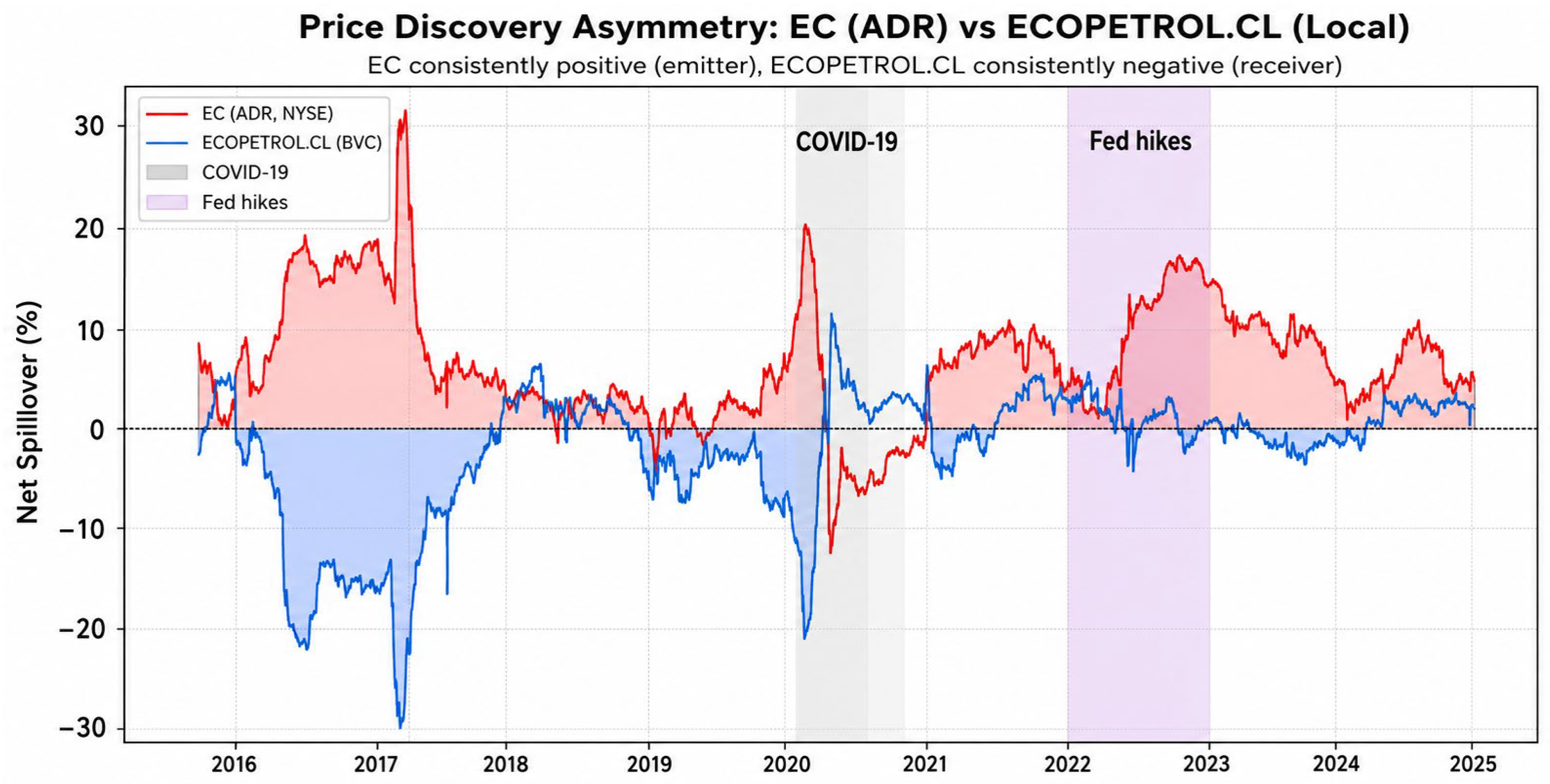
Figure 2 complements this evidence by showing the 200-day rolling-window net spillovers of EC, the NYSE-listed Ecopetrol ADR, and ECOPETROL.CL, the locally traded BVC share. The rolling estimates reveal that EC tends to occupy a stronger net-transmitting position during major stress episodes, including the 2016 oil-price collapse, the COVID-19 shock, and the 2022 U.S. monetary-tightening cycle. By contrast, ECOPETROL.CL tends to move toward a net-receiving position in periods of heightened stress. when global uncertainty increases, price-relevant information appears to be incorporated first through the offshore ADR market and then transmitted to the domestic Colombian listing. This pattern is consistent with an offshore-led informational hierarchy, in which the NYSE-listed security acts as the main channel through which global risk, oil-price news, and international investor expectations enter the local equity system.
Taken together,
Table 4 and
Figure 1 and
Figure 2 indicate that the Colombian equity network alternates between two informational regimes. In calmer periods, connectedness is lower and domestic assets retain more asset-specific variation. In high-risk periods, however, connectedness rises and offshore informational leadership becomes stronger. This suggests that the effective centre of information transmission shifts toward internationally traded securities precisely when external shocks become more important for local asset pricing.
An important identification question is whether EC’s leadership simply reflects firm-specific characteristics of Ecopetrol or instead captures a broader venue effect associated with offshore trading.
Table 5 addresses this issue by removing ECOPETROL.CL from the system. Once the domestic Ecopetrol share is excluded, EC’s net spillover falls to approximately zero, while CIB becomes the leading asset with a positive net spillover of +2.5%. In the high-VIX regime, CIB’s leadership strengthens further to +4.2%.
This result is difficult to reconcile with a purely firm-specific interpretation. If EC’s dominance were driven mainly by Ecopetrol’s own characteristics, EC should remain the informational leader even after the domestic share is removed. Instead, leadership shifts to another ADR-listed asset. The most plausible interpretation is therefore venue-based: assets traded on the NYSE benefit from deeper liquidity, broader international participation, and faster incorporation of globally relevant information. In that sense, the informational hierarchy appears to be driven less by the identity of the issuer than by the location and quality of the trading venue.
The reduced-system test also clarifies the quantitative importance of the EC–ECOPETROL.CL channel. Excluding ECOPETROL.CL lowers the TSI from 25.2% to 15.7%, implying that the dual-listed Ecopetrol pair accounts for a disproportionately large share of total system connectedness. This confirms that the strongest transmission mechanism in the sample is the arbitrage and information channel linking the NYSE ADR to the domestic BVC listing.
As a complementary assessment of pairwise predictive directionality,
Table 6 reports Granger-causality tests from the baseline VAR. The results are broadly consistent with, but more nuanced than, the system-wide connectedness evidence. The strongest bilateral relation in the sample is the EC → ECOPETROL.CL channel, with an F-statistic of 135.68, far exceeding the reverse direction. Although ECOPETROL.CL also Granger-causes EC, the asymmetry is substantial, indicating that information is transmitted more strongly from the ADR to the domestic listing than in the opposite direction.
More broadly, the two ADR-listed securities, EC and CIB, jointly Granger-cause several locally traded stocks, including ECOPETROL.CL, ISA.CL, and CORFICOLCF.CL. However, the Granger-causality evidence is not purely one-directional. Some local stocks also predict ADR returns, as shown by the significant ECOPETROL.CL → EC, ECOPETROL.CL → CIB, and CORFICOLCF.CL → CIB relations. These results point to feedback effects between the local and offshore markets rather than to a strictly unidirectional transmission process. These bilateral tests should not be interpreted as the primary identification device of the paper, since the main contribution rests on the multivariate connectedness framework. Taken together, the Granger-causality results support a qualified interpretation: offshore-listed securities dominate the strongest and most economically important predictive links, especially EC → ECOPETROL.CL, but local-to-ADR feedback is also present.
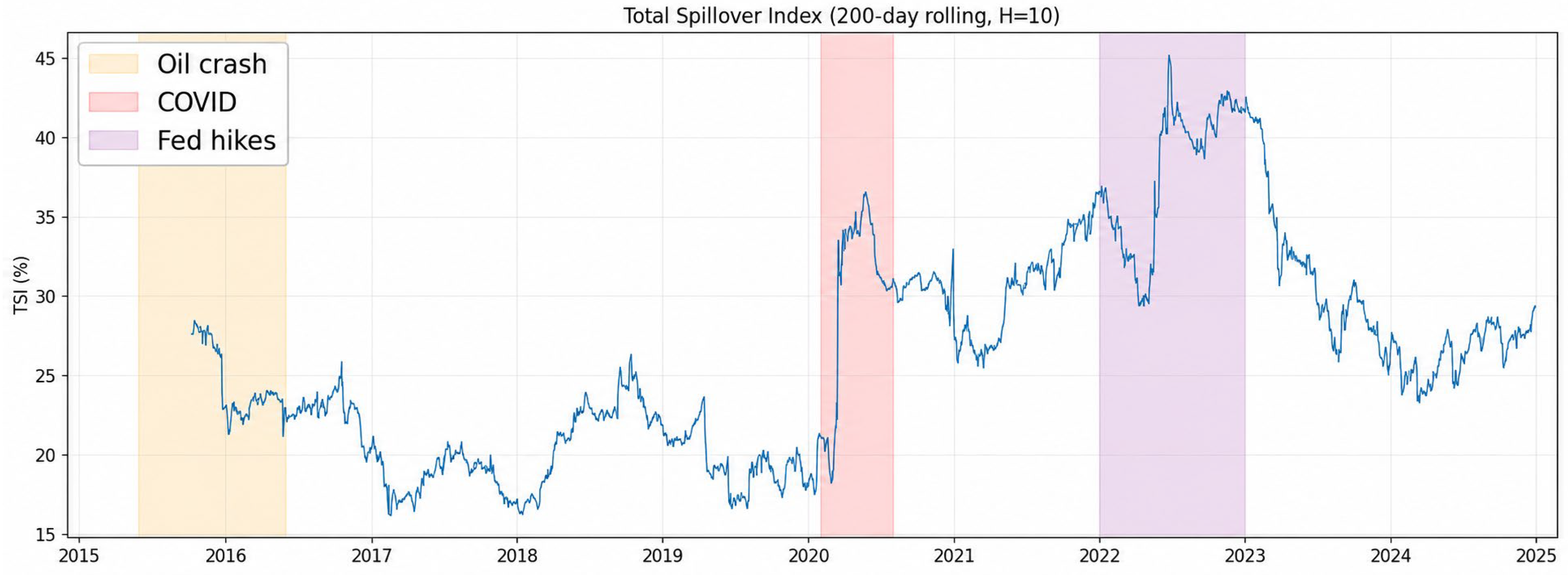
The regime results are further supported by the time-varying evidence. The rolling TSI ranges from 16.2% to 45.3%, with a mean of 26.5%, and exhibits three pronounced episodes of elevated connectedness: the 2016 oil-price collapse, the March–August 2020 pandemic shock, and the 2022 U.S. monetary tightening cycle. In each of these episodes, connectedness rises sharply, suggesting that external stress events amplify the degree of informational integration across Colombian equities. EC remains a positive net spillover transmitter for most of the sample, with its leadership most visible precisely during those high-stress episodes.
The horizon decomposition points to very rapid transmission. Specifically, 96.9% of total connectedness and 95% of EC’s leadership are already established at . This near-contemporaneous adjustment is consistent with the microstructure of ADR arbitrage. Because EC and ECOPETROL.CL trade in overlapping market hours, cross-venue price discrepancies can be exploited quickly, allowing globally relevant information to be incorporated almost immediately into the ADR and then transmitted to the local market. The daily frequency analysis therefore captures the net outcome of a process that likely unfolds within the trading day.
The main findings are robust across a wide set of alternative specifications.
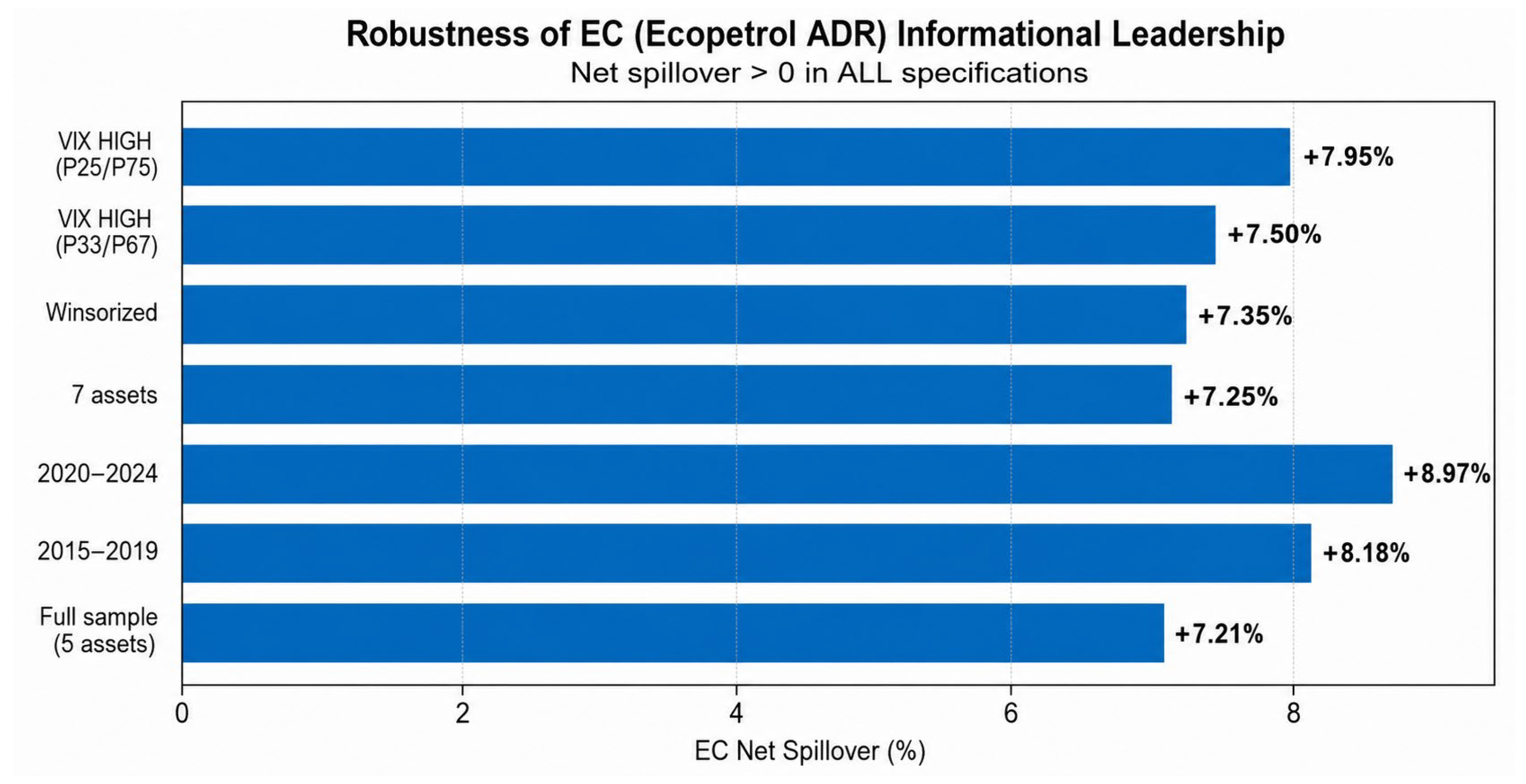
Table 7 shows that EC remains a positive net transmitter in 11 of 12 cases, with the only exception being the reduced four-asset system in which CIB becomes the leader. Importantly, in all 12 specifications the leading asset is ADR-listed. This is a strong result because it indicates that the offshore informational advantage is not tied to a single lag structure, data treatment, subsample, or regime definition.
The robustness exercises also clarify the economic interpretation of the baseline model. When oil, the exchange rate, and EMBI are treated as endogenous rather than exogenous variables, EC’s net spillover rises sharply, suggesting that the baseline specification provides a conservative estimate of its informational role. Likewise, the pre-2020 and post-2020 subsamples indicate a sizable increase in connectedness after the pandemic, consistent with a structural strengthening of cross-asset transmission in recent years. Taken together, the robustness analysis supports the conclusion that the dominant source of informational leadership in this market segment is not a particular stock per se, but the ADR trading venue.
The robustness analysis also addresses the possibility that the baseline liquidity screen overstates connectedness by excluding highly illiquid stocks. The expanded seven-asset system includes CELSIA.CL and GRUPOSURA.CL, two stocks classified as highly illiquid in
Table 1. The resulting total spillover index is 25.4%, virtually identical to the baseline value of 25.2%, and EC’s net spillover remains positive at +7.25. This suggests that the inclusion of additional illiquid stocks does not materially alter the network structure or the main finding that Ecopetrol’s ADR is the dominant net transmitter in the system.
Table 7 also evaluates the sensitivity of the results to alternative lag lengths. Although the baseline model uses VAR(3), selected by the Hannan–Quinn Information Criterion, the main finding is unchanged under VAR(2) and VAR(5) specifications: EC remains the dominant positive net transmitter.
Figure 3 condenses the robustness results by plotting EC’s net spillover across the alternative specifications. The message is clear: EC remains a positive net transmitter in 11 of 12 cases, and in the only exception leadership shifts to CIB, another ADR-listed asset. Thus, the informational leader is offshore-listed in all specifications, confirming that the venue-driven hierarchy is structural rather than specification-specific. The figure also makes visible the sharp amplification of EC’s role when oil, USDCOP, and EMBI are treated as endogenous, as well as the stronger connectedness observed in the post-2020 period.
5. Discussion
The evidence supports a clear conclusion: in small, illiquid, and externally exposed equity markets, informational leadership, measured through directional connectedness, is not evenly distributed across assets. Instead, it is concentrated in the most liquid and internationally connected securities, and that concentration strengthens when global risk rises. In our case, total connectedness is moderate in the full sample, at 25.2%, but increases sharply across risk regimes, from 17.5% in low-VIX periods to 28.4% in high-VIX periods, indicating that domestic assets become more tightly linked precisely when external shocks dominate local information. This pattern is consistent with the connectedness literature, which shows that crisis periods compress idiosyncratic variation and intensify spillovers (
Diebold & Yilmaz, 2012,
2014;
Antonakakis et al., 2020;
Demirer et al., 2018), and with evidence that dependence within the BVC becomes stronger during stress (
Uribe & Fernández, 2014).
The interpretation of these results is also consistent with recent empirical evidence showing that connectedness in emerging markets has become increasingly sensitive to global volatility, exchange-rate shocks, and crisis conditions.
Lawrence et al. (
2024) show that shock propagation across South African equity sectors intensifies during extreme market conditions, while
Altinkeski et al. (
2024) document strong VIX-related connectedness across global stock markets, especially in the tails of the distribution. Similarly,
Hussain et al. (
2024) find that exchange-rate and stock-market volatility connectedness intensified during pandemic-related crises in BRICS economies, and
S. Khan et al. (
2025),
Gökgöz et al. (
2025), and
Kasraoui et al. (
2025) show that emerging-market sectors and BRICS Plus markets remain highly exposed to global uncertainty, volatility, and geopolitical risk. Our findings complement this recent literature by showing that, in a smaller and less liquid emerging market, global-risk transmission is concentrated not only across markets or sectors, but also through specific offshore-listed securities.
The central result is that informational leadership appears to be strongly associated with the trading venue. It is not explained solely by firm identity. In the baseline system, EC is the dominant net transmitter, but once ECOPETROL.CL is removed, leadership shifts to CIB, another ADR-listed asset, rather than remaining with EC. This is the key empirical result: the relevant advantage seems to lie not only in the characteristics of a single firm, but also in the offshore trading venue. That interpretation is consistent with the cross-listing literature, which shows that price discovery tends to migrate toward the more liquid and institutionally stronger market (
Hasbrouck, 1995;
Harris et al., 1995;
Eun & Sabherwal, 2003;
Grammig et al., 2005;
Pascual et al., 2006;
Gagnon & Karolyi, 2010;
Karolyi, 2006). In our setting, the EC–ECOPETROL.CL pair accounts for a disproportionate share of connectedness, and the shift from EC to CIB in the reduced system suggests that offshore spillover leadership extends beyond a single ADR–local-share pair and affects the broader domestic network.
The offshore leadership documented in the results should be interpreted as the joint outcome of venue characteristics and investor composition. The NYSE provides deeper liquidity, lower transaction costs, broader analyst coverage, stronger institutional participation, and faster incorporation of globally relevant information than the domestic venue. At the same time, the investor base trading ADRs is likely to include a larger share of international institutional investors, arbitrageurs, and globally diversified funds, whereas the domestic market is more exposed to local liquidity constraints and a narrower investor base. The empirical design cannot fully separate venue infrastructure from investor composition, but the reduced four-asset test provides useful evidence: when the local Ecopetrol share is removed, leadership shifts from EC to CIB, another NYSE-listed ADR. This suggests that offshore informational leadership is not exclusively tied to Ecopetrol’s firm-specific characteristics, but is also associated with the informational advantages of the offshore trading venue.
The mechanism is also consistent with market microstructure theory. Informed traders prefer deeper and more transparent venues, where they can trade on information at lower price impact (
Kyle, 1985;
Glosten & Milgrom, 1985;
O’Hara, 1995). In small emerging markets, this venue effect is reinforced by cross-listing, by differences in institutional quality across exchanges, and by the role of internationally priced risk factors. In the Colombian case, the commodity channel is especially important: when oil is treated as endogenous, EC’s net spillover rises sharply, indicating that the ADR may intermediate the transmission of global oil-price information into the domestic equity system (
Basher & Sadorsky, 2006;
Kilian, 2009). More generally, the results suggest that less liquid domestic stocks do not simply react more slowly; they occupy structurally weaker positions in the informational hierarchy and behave mainly as net receivers.
A second major implication is that informational leadership is state-dependent. Under low global risk, offshore leadership is weak; under high VIX, it becomes large and statistically significant. ECOPETROL.CL shows the mirror image, shifting from weak emitter to net receiver as uncertainty rises. This suggests that small open equity markets can alternate between two informational regimes: a relatively more autonomous mode in calm periods and a more externally dependent mode in stressful periods. This interpretation accords with the broader literature on emerging-market integration, which argues that dependence on foreign markets varies with capital flows, global risk appetite, and financial conditions (
Bekaert & Harvey, 2000;
Bekaert et al., 2007;
Phylaktis & Ravazzolo, 2005).
The informational isolation of some domestic stocks is also consistent with their market structure. Purely local securities such as ISA.CL and CORFICOLCF.CL have lower trading intensity, higher zero-return frequencies, weaker international investor participation, and less direct exposure to cross-venue arbitrage than the ADR-listed firms. Their high own-variance shares in the spillover matrix indicate that a large fraction of their return variation remains asset-specific rather than system-driven. This does not imply that these firms are economically unimportant; rather, it suggests that their prices incorporate information more locally and less through the offshore transmission channel. Sectoral characteristics may also matter: EC is directly exposed to global oil markets, CIB is linked to international financial conditions, while ISA.CL and CORFICOLCF.CL are more domestically oriented. These differences help explain why purely domestic stocks tend to occupy weaker positions in the connectedness network.
The broader financial implication for markets with similar characteristics is straightforward. A portfolio may appear diversified by issuer or sector and still be informationally concentrated. When a small set of cross-listed or globally connected assets dominates the transmission process, the effective number of independent risk sources is lower than the number of holdings suggests. Diversification therefore becomes regime-dependent: it is more credible in calm periods and more fragile in stressed periods, when common external shocks dominate local pricing. For portfolio management in such markets, the practical lesson is to monitor the top informational nodes—typically cross-listed securities, commodity-linked firms, exchange-rate conditions, sovereign spreads, and global volatility—rather than treating domestic assets as independent bets.
The policy implication is equally general. In small open equity markets, surveillance confined to the domestic venue is incomplete if the relevant information is processed offshore. Regulators and exchanges should therefore treat cross-venue pricing gaps and offshore-listed securities as integral parts of the domestic informational system. More broadly, regional integration alone may not be sufficient to create autonomous local informational leadership if the most informative assets continue to be priced primarily abroad. In such markets, integration may improve access and liquidity, but not necessarily informational independence.
The findings also have implications for regional market-integration initiatives such as MILA and the more recent nuam exchange project. The literature on Latin American market integration suggests that regional platforms can improve market access, visibility, and potential liquidity, but that these effects are not automatic and depend on trading depth, market-making capacity, regulatory coordination, and the ability to attract institutional order flow (
Lizarzaburu Bolaños et al., 2015;
Campa et al., 2015;
Leraul, 2016;
Lukanima et al., 2021;
Muñoz Mendoza et al., 2022). From this perspective, regional integration could reduce offshore dependence if it increases local liquidity and strengthens price adjustment in dual-listed securities. However, it could also leave offshore informational leadership largely unchanged if the most liquid and internationally followed Colombian securities continue to incorporate global information primarily through their ADRs. A further possibility is that integration centralizes informational leadership around a small set of already liquid and internationally connected firms, while less liquid domestic stocks remain peripheral. For regulators, this suggests that regional integration should be accompanied by monitoring of ADR-local price gaps, cross-venue spillovers, liquidity conditions in dual-listed securities, and the effectiveness of local market-making arrangements. The results therefore do not imply that integration is ineffective; rather, they suggest that trading-platform integration alone may be insufficient to create autonomous local informational leadership unless it is accompanied by deeper local liquidity and stronger cross-venue surveillance.
6. Conclusions
This paper examines the informational hierarchy of the Colombian equity market using a VAR-based generalized forecast error variance decomposition within the Diebold–Yilmaz connectedness framework, complemented by bootstrap inference and regime-dependent analysis. The evidence points to three main conclusions. First, the Colombian market exhibits moderate average connectedness but a strongly asymmetric informational structure: in the full sample, total connectedness reaches 25.2%, and Ecopetrol’s ADR (EC) emerges as the dominant net transmitter of return innovations, while the less liquid domestically traded stocks behave mainly as net receivers. Second, this hierarchy is not only firm-specific but also venue-driven. When ECOPETROL.CL is removed from the system, leadership shifts from EC to CIB, another ADR-listed asset, suggesting that the key advantage is associated with the offshore trading venue rather than with the identity of a single issuer alone. Third, the hierarchy is state-dependent: connectedness rises from 17.5% in low-VIX periods to 28.4% in high-VIX periods, while EC’s net spillover increases from economically weak levels to strongly positive and statistically significant values, indicating that offshore informational leadership becomes stronger precisely when global uncertainty intensifies.
These findings contribute to the literature in both substantive and methodological terms. Substantively, they show that in a small, illiquid, and externally exposed market, informational leadership is not evenly distributed across assets, but concentrated in the most liquid and internationally connected securities. In this sense, the Colombian market behaves less as an autonomous centre of directional connectedness than as a system that absorbs and redistributes information first processed abroad. This extends the bilateral cross-listing evidence by showing that offshore leadership is not confined to the ADR–local-share pair, but also shapes the informational hierarchy of the broader domestic network. Methodologically, the paper provides an application of the Diebold–Yilmaz framework to individual Colombian stocks, combining ADRs and local shares within the same multivariate system and adding bootstrap-based inference and regime-specific estimation to identify whether connectedness and leadership are statistically meaningful and conditional on global risk.
The implications of these results extend beyond Colombia to small emerging equity markets with similar characteristics: uneven liquidity, ownership concentration, partial internationalization through cross-listings, and strong exposure to external risk factors. In such markets, the number of listed securities may overstate the number of genuinely independent information sources. Apparent diversification within the domestic exchange can therefore be fragile, especially during stress episodes, when the informational centre of gravity shifts offshore and local assets increasingly behave as receivers rather than originators of information. More broadly, the results suggest that regional integration or local trading reforms, by themselves, may not generate autonomous domestic price discovery if the most informative securities continue to be priced primarily in larger offshore venues.
For investors and market participants, the results imply that portfolio diversification in small and illiquid emerging equity markets should not be assessed only by the number of domestic securities held. Prior evidence shows that emerging markets are characterized by liquidity frictions, transaction costs, and zero-return episodes that affect how quickly information is incorporated into prices. In this context, portfolios that appear diversified by issuer or sector may remain exposed to a common information channel when cross-listed and internationally connected securities dominate the transmission of return innovations. This implication is consistent with the cross-listing literature, which shows that price discovery can be shared across domestic and offshore venues and that the more liquid or informationally efficient venue may play a disproportionate role in price adjustment. It is also consistent with evidence that market comovement and volatility spillovers tend to intensify during crisis periods, reducing the effective benefits of diversification precisely when protection is most valuable. Portfolio managers, traders, and risk officers should therefore monitor ADR-listed securities, global volatility, oil prices, exchange-rate conditions, and sovereign-risk indicators as part of their risk-management and allocation decisions.
Several limitations remain. The analysis is conducted at daily frequency and on a five-asset system constrained by liquidity considerations, which means that it cannot fully recover the intraday sequencing of cross-venue price adjustment or cover the full cross-section of Colombian equities. This limitation is important because the horizon decomposition indicates that most connectedness is established at the one-day horizon, suggesting that the underlying mechanism unfolds within the trading day. Future research could therefore extend the analysis using intraday data, frequency-domain connectedness methods, or time-varying parameter VAR models to further distinguish short-run from long-run spillovers and to trace more precisely how offshore information is transmitted into small domestic markets.
A final clarification concerns the scope of the evidence. The Diebold–Yilmaz connectedness framework used in this paper does not estimate formal venue-level price-discovery shares in the sense of Hasbrouck’s Information Share or related common-efficient-price methods. The results should therefore be interpreted as evidence of directional connectedness, net spillover transmission, and informational leadership among observed return series. Within that more precise interpretation, the evidence supports the conclusion that ADR-listed Colombian securities play a leading role in transmitting return innovations to the domestic equity market, especially during periods of elevated global risk.




 ,
,