1. Introduction
The accelerating integration of global financial markets has rendered emerging markets particularly susceptible to external macroeconomic shocks and sudden volatility spikes. In these markets, characterized by inherent high-risk premiums and currency uncertainty, the primary challenge for investors is not merely return maximization, but rather capital preservation during crises. Although traditional financial theories—such as Modern Portfolio Theory—advocate risk elimination through diversification, the rapid convergence of asset class correlations toward unity during systematic risk-dominated crises undermines the traditional downside mitigation function of diversification. This phenomenon accentuates the need for structurally sound and defensive asset classes capable of exhibiting a risk profile distinct from the broader index during market turbulence.
In recent years, the concept of sustainability has evolved from a mere ethical investment preference into a central component of financial risk management. The literature frequently debates the hypothesis that companies with robust environmental, social, and governance (ESG) standards maintain investor confidence during crises through superior corporate governance, thereby remaining less exposed to market-wide panic selling. However, the vast majority of existing studies analyze market dynamics using linear models, assuming that risk parameters remain constant over time. Yet, financial markets operate within non-linear processes where behaviors undergo radical shifts between tranquil and turbulent periods. Generalizing static risk coefficients calculated from the averages of “normal” periods to crisis episodes can lead investors to misleading conclusions and irreversible portfolio errors.
The primary objective of this study is to reveal how the financial character of the sustainability theme evolves contingent upon regimes (market states) in emerging markets subject to high volatility and currency shocks, using Borsa Istanbul (BIST) as a case study. While the study utilizes the BIST dataset as a “laboratory,” the findings are anticipated to offer universal insights for peer markets such as Brazil, South Africa, and Mexico, which share similar macroeconomic vulnerabilities. A distinguishing feature of this study is the construction of analyses using US Dollar (USD) denominated excess returns rather than raw local currency (TL) returns. By integrating a sovereign risk-free rate and looking beyond the “illusion” created by nominal returns in an inflationary environment, the study examines real changes in investors’ USD-based purchasing power and capital fluctuations during crises.
In terms of methodological approach, crisis periods were not defined by exogenous dates (e.g., limiting the scope solely to the pandemic); instead, the market’s “Normal” and “High Volatility” regimes were statistically decomposed using the Markov Regime Switching (MS-AR) model based on the data’s internal dynamics. Subsequently, the structural stability of the sustainable portfolio’s sensitivity to systematic risk (Beta) across these regimes was tested using a Regime-Switching CAPM framework based on excess returns, supplemented by Wald tests.
Furthermore, to validate the reliability of these empirical outcomes and to control for potential survivorship or firm-size biases, the study incorporates rigorous robustness checks. By comparatively evaluating the core equal-weighted portfolio against the broader, market-cap-weighted BIST Sustainability Index (XUSRD), the analysis explicitly isolates the “pure sustainability premium” from large-cap dominance.
In this context, the study investigates not only whether sustainable stocks act as an effective partial hedge during crises but also whether they support the “Low Beta Anomaly” theory through their performance in normal market conditions. The findings aim to provide a quantitative roadmap focused on structural diversification benefits and long-term capital preservation for fund managers and emerging market investors left vulnerable to volatility shocks.
2. Data Set and Variables
This study utilizes the daily closing prices of the BIST-100 Index, representing the broader market, alongside ten companies characterized by high financial depth that have maintained the longest tenure in the BIST Sustainability Index since its inception in 2014. The analysis period spans the trading days from the index’s launch in November 2014 through December 2025.
In constructing the dataset, a deliberate methodological choice was made to denominate all stock and index closing prices in US Dollars (USD). The daily effective buying rates provided by the Central Bank of the Republic of Turkey (CBRT) were employed for this conversion process. The primary rationale for structuring the analysis on USD-based prices rather than the local currency (TL) lies in the high inflation and exchange rate volatility observed in the Turkish economy throughout the examined period. In TL-denominated series, asset prices exhibit a continuous upward trend driven by inflationary effects, often masking the absence of real value appreciation. Such nominal distortions complicate the accurate detection of market regimes by volatility models (MS-AR) and may lead to significant biases in risk measurement. Furthermore, to comply with standard asset-pricing frameworks and accurately compute excess returns, the risk-free rate (Rf) was integrated into the dataset. The annualized yields of the 3-Month US Treasury Bill were retrieved from the US Department of the Treasury (via the FRED database) for the corresponding analysis period. Utilizing a US-based sovereign risk-free rate ensures absolute macroeconomic consistency with the USD-denominated equity return series.
2.1. Portfolio Construction
For the construction of the model portfolio, the equities that have maintained the longest uninterrupted tenure within the sustainability index were selected: Akbank and Garanti BBVA (Banking), Anadolu Efes (Beverage/Consumer Staples), Arçelik (Consumer Durables), Aselsan (Defense/Technology), Turkcell and Türk Telekom (Telecommunications), Tüpraş (Energy), alongside major multi-sectoral conglomerates (Koç Holding and Sabancı Holding). These selected constituents represent a highly diversified cross-section of the Turkish economy, covering the pivotal industries that serve as the locomotives of Borsa Istanbul. This structural and sectoral diversity ensures that the portfolio’s empirical performance is not driven by idiosyncratic sectoral shocks or biases, but rather reflects a generalized structural resilience.
While the limited number of constituents (10 companies) might initially appear as a constraint, this strict selection criterion isolates the most “persistently sustainable” firms. As explicitly validated in our Robustness Checks (
Section 6), expanding the portfolio to the entire market-cap-weighted index dilutes the downside mitigation effect. Therefore, from these selected assets, an “Equal-Weighted Portfolio” was constructed to ensure a homogeneous observation of diversification benefits and to prioritize the sustainability effect over the firm size (market capitalization) bias. The portfolio return at time
t (
Rp,t) was calculated by taking the arithmetic mean of the returns of the
N = 10 constituents:
2.2. Variable Definition and Transformation
To ensure stationarity and enhance the statistical properties of the price series, all variables employed in the analysis were transformed into daily logarithmic returns. The returns were calculated using the following formula:
where
Pt denotes the USD-denominated closing price of the respective asset on day
t.
To align with standard asset-pricing methodology and ensure the robustness of the Capital Asset Pricing Model (CAPM) estimations, these raw returns were subsequently converted into excess returns. The daily risk-free rate (
Rf,t) was obtained by converting the annualized yield on the 3-Month U.S. Treasury Bill into a daily rate consistent with a 252-trading-day convention, ensuring alignment with the daily frequency of the equity returns. The excess returns (
ERi,t) for the portfolio and the market index were calculated as follows:
The stationarity properties of the time series were examined using the Augmented Dickey–Fuller (ADF) test. The test results indicate that the null hypothesis of a unit root was rejected at the 1% significance level (p < 0.01) for both the BIST Index and Portfolio return series. Consequently, the series were statistically confirmed to be stationary at level (I(0)). This finding eliminates the risk of spurious regression in the econometric models established within the study.
In the analytical framework, the daily return of the equal-weighted portfolio (Rp) serves as the dependent variable. Conversely, the daily return of the BIST Index (Rm), representing the systematic risk of the broader market, is utilized as the independent and regime-determining variable. This variable functions dually: it is employed for the identification of regimes (Normal vs. Crisis) in the Markov Regime Switching model and acts as the systematic risk factor in the CAPM framework.
The final dataset comprises a total of 2798 trading day observations. All econometric analyses were conducted using the Python (version 3.12) programming language and the statsmodels library.
3. Literature Review
Academic literature frequently emphasizes that financial market behaviors can undergo abrupt shifts and that these new behaviors often exhibit persistence. Markov Regime Switching models serve as robust, non-linear time series analysis tools designed to capture these sudden shifts and unobservable market states (regimes).
Ang and Timmermann (
2011) posit that these models successfully characterize features such as fat tails in asset returns, time-varying variance (ARCH effects), and evolving correlations. Highlighting the predictive power of this methodology,
Durgun (
2023) notes its efficacy in analyzing financial crises and macroeconomic fluctuations. In a study focused on the Borsa Istanbul Tourism Index,
Kutlu and Karakaya (
2019) identified the presence of distinct high and low-risk regimes, establishing that volatility tends to be persistent in post-crisis periods.
Regarding the performance of sustainability indices, empirical results present a mixed picture.
Gök and Özdemir (
2017) compared the performance of the Sustainability Index with the BIST 100 and found no statistically significant difference in risk-adjusted returns; however, they observed that the systematic risk (beta) of the sustainability index was notably higher. Conversely,
Yilmaz et al. (
2020) demonstrated that inclusion in the sustainability index reduces total risk and provides protection against sharp equity declines during severe crises, such as the 2016 coup attempt.
Tosun and Özgen (
2023) similarly reported that companies within the sustainability index experienced fewer losses during the “Coronavirus Crash,” suggesting the index functions as a safe haven. Furthermore,
Kurum (
2025) determined that the inclusion of Turkish banks in the sustainability index creates a positive and significant short-term impact on stock prices, which investors interpret as a favorable market signal.
In the context of emerging markets,
Hasan et al. (
2025) found that ESG portfolios in India exhibit lower market risk compared to traditional portfolios and display greater resilience during market downturns.
Lin and Bali Swain (
2024) illustrated that negative-screening ESG indices can generate an “investor surplus” during crisis periods without compromising financial performance.
Drawing parallels with ethical investing,
Koy and Adıgüzel (
2025) examined the KATLM 30 (Islamic), BIST 30, and BIST 100 indices during the initial phase of the COVID-19 pandemic using the MS-ARMA-GARCH model. Their results proved that losses in traditional indices during high-volatility periods were 4 to 7 times greater than those in the Islamic index, confirming the superior resilience of participation index stocks during crises.
Bhattacharjee and De (
2023) corroborated this by confirming that Islamic portfolios in the US and Switzerland carry lower systematic risk in both tranquil and crisis periods.
Regarding macroeconomic linkages,
Oğuz (
2025) utilized Fourier-based cointegration tests to detect a long-term positive and significant relationship between the BIST Sustainability Index, inflation, and the industrial production index.
Moodley et al. (
2024,
2025) revealed that the impact of macroeconomic variables and investor sentiment in the South African market is asymmetric across bull and bear market regimes, with sentiment exerting a particularly negative and significant effect on the broader market during bear regimes.
Emerging markets exhibit a dynamic structure where linear models (such as Linear Regression or Standard CAPM) often fall short due to their higher sensitivity to macroeconomic shocks and frequent regime shifts compared to developed markets. Existing scholarship on Borsa Istanbul typically focuses on Conditional Heteroskedasticity (GARCH) models or defines crises using exogenous dates when examining crisis periods. However, there is a significant gap in the literature regarding the endogenous detection of crisis regimes via the data’s internal dynamics and the testing of structural breaks in the systematic risk parameter (Beta) under these regimes in a high-volatility emerging market.
This study is distinctive in its use of MS-AR and Regime-Switching CAPM frameworks, supplemented by Wald tests, to empirically validate the capability of a sustainable portfolio to asymmetrically mitigate systematic risk in a highly volatile market like Borsa Istanbul, where correlations typically spike during crises. By demonstrating that the portfolio’s systematic risk sensitivity (Beta) statistically diverges from the broader market during turmoil, effectively acting as a “partial hedge,” this study offers new empirical evidence to the emerging markets literature regarding the downside mitigation capacity of corporate sustainability.
4. Methodology
This study adopts the Markov Regime Switching approach developed by
Hamilton (
1989) to model non-linear dynamics and structural breaks inherent in financial time series. The analytical process unfolds in two stages: initially, market regimes are detected endogenously, and subsequently, the portfolio’s sensitivity to systematic risk (Beta) is tested under these identified regimes.
During the preparation of this work the authors used Gemini 3.1 Pro (Google) in order to improve the readability and academic tone of the manuscript, and assist in writing Python codes for data visualization. After using this tool/service, the authors reviewed and edited the content as needed and takes full responsibility for the content of the published article.
4.1. Detection of Market Regimes: The MS-AR(1) Model
The MS-AR literature is built upon a vast academic heritage, spanning from Hamilton’s seminal work in 1989 to contemporary advancements focused on improving estimation algorithms (EM, Bayesian), refining model selection criteria, and enhancing the comprehension of non-linear dynamics (
Ailliot & Monbet, 2012, p. 93;
Bauwens et al., 2017, p. 162;
Inayati et al., 2025, p. 3;
Psaradakis & Spagnolo, 2003, p. 237). The MS-AR model is widely employed in modeling macroeconomic variables such as GDP growth, inflation, exchange rates, stock market volatility, and interest rates (
Dufour & Luger, 2017, p. 713;
Lukianenko & Nasachenko, 2020, p. 82;
Park & Hong, 2013, p. 543). Markov Switching Autoregression (MS-AR) models serve as robust tools that generalize both Markov Models and autoregressive (AR) models to capture situations where time series exhibit distinct dynamic behaviors across different periods (
Ailliot & Monbet, 2012, p. 93).
In MS-AR models, the detection of a regime change relies on the probabilistic estimation of a latent (unobservable) variable (
Ailliot & Monbet, 2012, p. 93;
Ghezal, 2023, p. 66).
To account for volatility clustering and the autocorrelation structure inherent in BIST Index excess returns (ERm,t) the study employs a First-Order Autoregressive Markov Regime Switching Model (MS-AR(1)), where both the mean and variance are regime-dependent. Distinguished from the standard Markov model, a lagged return term is incorporated into the equation to address the issue of serial correlation in the residuals.
The index return at time
t is modeled contingent upon an unobservable state variable as follows:
Here,
St denotes the market regime at time
t (0: Normal/Low Volatility, 1: Crisis/High Volatility);
represents the mean return in the respective regime; and
represents the autoregressive coefficient. The error term
possesses a variance that changes depending on the regime:
In MS-AR models, transition probabilities constitute the fundamental mechanism governing the dynamic shift between regimes as a system moves from one time period to another. These probabilities define the likelihood of the system transitioning from a specific regime at time
t − 1 to a specific regime at time
t (
Latimier et al., 2020, p. 2). Transition probabilities are typically organized in the form of a transition matrix (
Bauwens et al., 2017, p. 163).
Transitions between regimes are defined by a fixed transition probability matrix (
P) governed by a first-order Markov chain.
pij expresses the probability of the market switching to regime
j today, given that it was in regime
i the previous day.
For model selection, the Bayesian Information Criterion (BIC) was utilized, and the structure that best explained the dataset was determined to be a 2-regime model (Normal and Crisis). Models with varying numbers of regimes are compared based on information criteria such as AIC and BIC, with the model yielding the lowest value (the optimal number of regimes) being selected (
Ailliot & Monbet, 2012, p. 95;
Latimier et al., 2020, p. 2;
Psaradakis & Spagnolo, 2003, p. 238). The BIC is regarded as a robust guide for selecting the most appropriate and parsimonious structure for the data (
Ailliot & Monbet, 2012, p. 94). When compared to other criteria (especially AIC), BIC imposes a stricter penalty on model complexity, thereby offering a more conservative selection (
Psaradakis & Spagnolo, 2003, p. 243). Unlike AIC, which tends to favor more complex models, BIC leans towards preferring simpler and more interpretable regime numbers (
Cheng, 2016, p. 2786).
4.2. Regime-Switching CAPM
Regime-switching models—particularly Markov regime-switching frameworks—offer a superior explanation of financial market dynamics compared to traditional models by acknowledging that the relationship between risk and return is neither linear nor time-invariant (
Brik, 2026, p. 1;
J. Chen & Kawaguchi, 2018, p. 2;
Korkmaz et al., 2010, p. 44;
Škrinjarić, 2014, p. 119). Financial markets exhibit a tendency for volatility clustering during specific periods (
Abdymomunov & Morley, 2011, p. 1464;
M. Wang et al., 2020, p. 2). These models link return processes to psychological shifts, positing that during periods of high volatility, investors concentrate their limited attention on macroeconomic news, leading to heightened risk aversion (uncertainty avoidance) (
Cao & Copeland, 2023, p. 483;
J. Wang et al., 2021, p. 292).
In contrast to static frameworks like the traditional Capital Asset Pricing Model (CAPM), this approach assumes that the market transitions between distinct states, such as “bull” and “bear” or “tranquil” and “turbulent” (
Abdymomunov & Morley, 2011, p. 1464;
Cao & Copeland, 2023, p. 483;
J. Chen & Kawaguchi, 2018, p. 2;
Huang, 2000, p. 573;
M. Wang et al., 2020, p. 7). While traditional models treat beta (the stock’s sensitivity to the market) as a constant, the regime-switching framework demonstrates that beta fluctuates significantly across regimes (
Abdymomunov & Morley, 2011, p. 1464;
Akinsomi et al., 2025, p. 493;
S.-W. Chen & Huang, 2007, p. 313). Specifically, these models reveal that beta typically increases during high-volatility periods, indicating that risk is repriced according to market conditions (
Abdymomunov & Morley, 2011, p. 1464;
S.-W. Chen & Huang, 2007, p. 319). Furthermore, empirical evidence suggests that while risk is rewarded with positive returns during low-volatility periods, this relationship may flatten—or even reverse into a penalty (negative risk premium)—during periods of financial stress or bear markets (
Brik, 2026, p. 9;
J. Chen & Kawaguchi, 2018, p. 2;
Korkmaz et al., 2010, p. 44;
Vendrame et al., 2018, p. 7).
Following the identification of market regimes, a Regime-Switching CAPM was constructed to test whether the equal-weighted portfolio’s sensitivity to systematic risk alters during crisis episodes. In accordance with standard asset-pricing methodology, the model utilizes the previously defined daily excess returns:
In this specification, ERp,t represents the excess return of the sustainability portfolio, and ERm,t denotes the excess return of the broader market index (BIST 100). Crucially, both the intercept (α(St)) capturing abnormal returns or pricing errors, and the beta coefficient (β(St)), capturing systematic risk sensitivity, are allowed to vary conditional on the prevailing market regime. The error term is denoted by εt.
To statistically validate the study’s core hypothesis of “decoupling during crises,” the Wald Test was employed. The Wald test serves as a diagnostic tool to assess the validity of parameter restrictions across regimes, such as whether coefficients are equal (
Torre & Lee, 2013, p. 357). Essentially, it verifies whether the parameters truly shift between regimes as assumed by the Markov dynamics. It is utilized to determine whether a specific parameter (e.g., a coefficient in one regime) is equal to zero or to the coefficient of another regime (
Ben Soltane & Naoui, 2021, p. 1616). As a fundamental specification test, the Wald test is crucial for determining the dynamic structure of the model and confirming the necessity of allowing for regime changes (
Cheng, 2016, p. 2792).
The hypotheses tested within the scope of the Wald test in this study are as follows:
The decision in the Wald test is made by observing whether the calculated statistic exceeds the critical Chi-square value and whether the resulting
p-value is statistically significant (at the 5% or 1% level) (
Cheng, 2016, p. 2796;
Gregory & Veall, 1985, p. 1465;
Naderpour et al., 2015).
5. Empirical Findings
This section presents the empirical results derived from the Markov Regime Switching models applied to the BIST Index and the constructed sustainable portfolio. The findings are examined under three distinct subsections: the statistical characteristics of market regimes, structural breaks in systematic risk, and the regime-dependent financial performance of the portfolio.
5.1. Detection of Market Regimes and Model Diagnostics
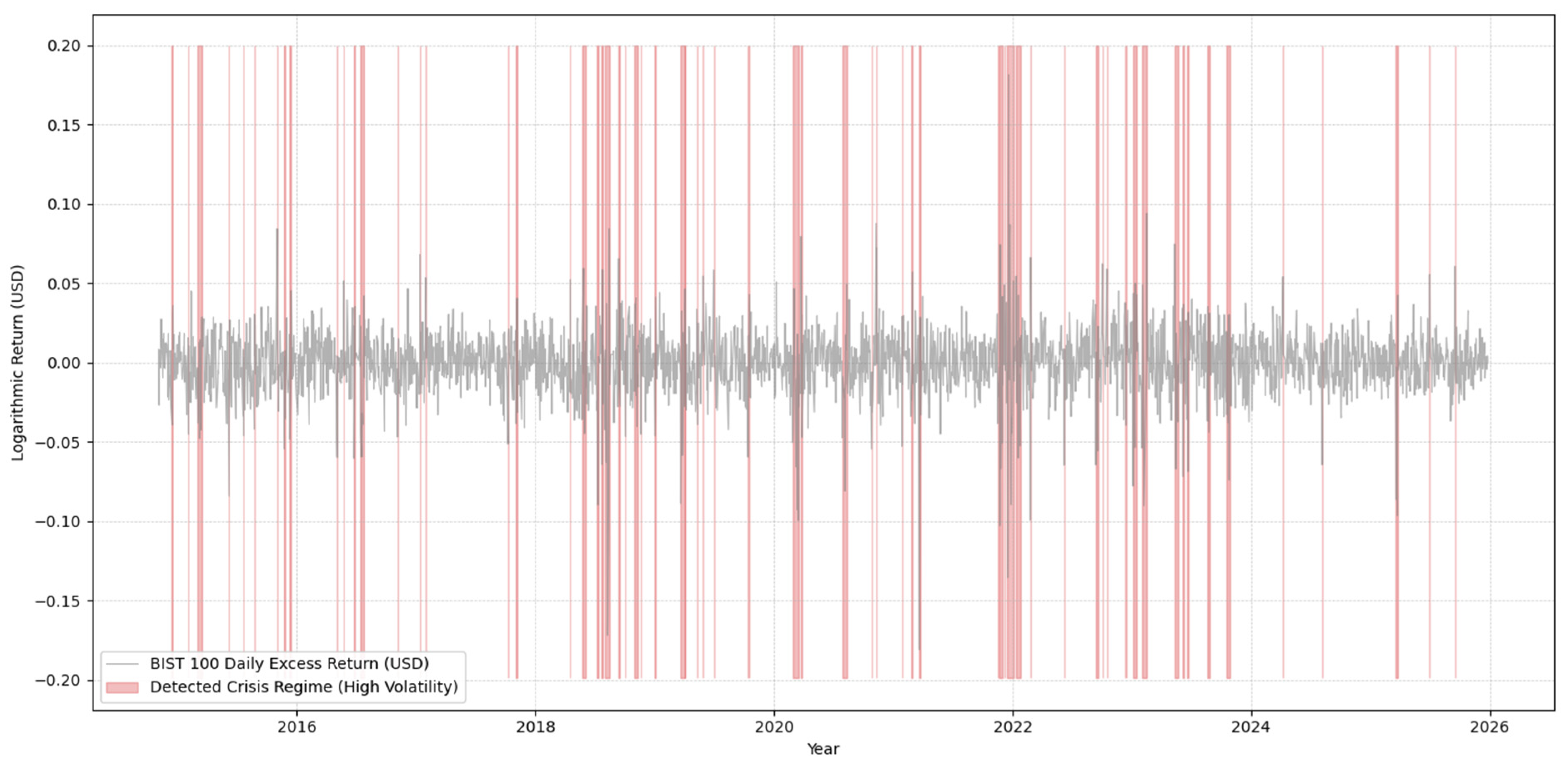
The estimation results of the MS-AR(1) model, established on USD-based BIST-100 Index excess returns, unequivocally demonstrate that the volatility of the Turkish market is characterized by two statistically distinct regimes. According to the estimated variance parameters, Regime 0 (Normal/Low Volatility) typifies periods where market variance (σ2 ≈ 0.0002) is extremely low and stable pricing mechanisms prevail. In sharp contrast, Regime 1 (Crisis/High Volatility) corresponds to episodes of severe financial stress, where market variance (σ2 ≈ 0.0017) exhibits an approximate 8.5-fold surge compared to the normal period. The magnitude of this variance differential in the USD-based analysis serves as evidence that during crises, the market does not merely decline; rather, it undergoes a complete dislocation in pricing behavior in dollar terms.
The statistical robustness of the model was validated through a battery of diagnostic tests. The Likelihood Ratio (LR) test results led to the rejection of the linearity hypothesis (
p < 0.001), confirming the necessity of employing regime-switching models (MS-AR) to adequately capture market dynamics. The Ljung–Box test applied to the residuals revealed no significant autocorrelation (
p = 0.4558 for Lag 10), indicating that the model successfully accounts for the serial dynamics of the market. Furthermore, the Regime Classification Measure (RCM), proposed by
Ang and Bekaert (
2002), was calculated as 21.51. This value, falling well below the critical threshold of 30, demonstrates the model’s high efficacy in sharply distinguishing between “Normal” and “Crisis” periods.
Figure 1 visualizes the daily USD-denominated excess return dynamics of the BIST Index spanning from 2014 to 2025, alongside the crisis regimes identified by the model. The red-shaded regions within the graph denote crisis episodes that were endogenously detected based on the surge in variance. A visual inspection reveals that the model successfully captures periods characterized by both local macroeconomic turbulence and diminished global risk appetite. The manifestation of crisis blocks as dense and intermittent clusters corroborates the “volatility clustering” property inherent in the market.
An examination of
Table 1 indicates that the persistence probability of the “Normal” regime (
P{00} ≈ 0.96) is remarkably high. This implies that once the market achieves stability, this state is maintained for an average duration of 26 trading days. Conversely, the persistence probability of the “Crisis” regime (
P{11} ≈ 0.74) is comparatively lower, limiting the average lifespan of this regime to a mere 3.8 trading days.
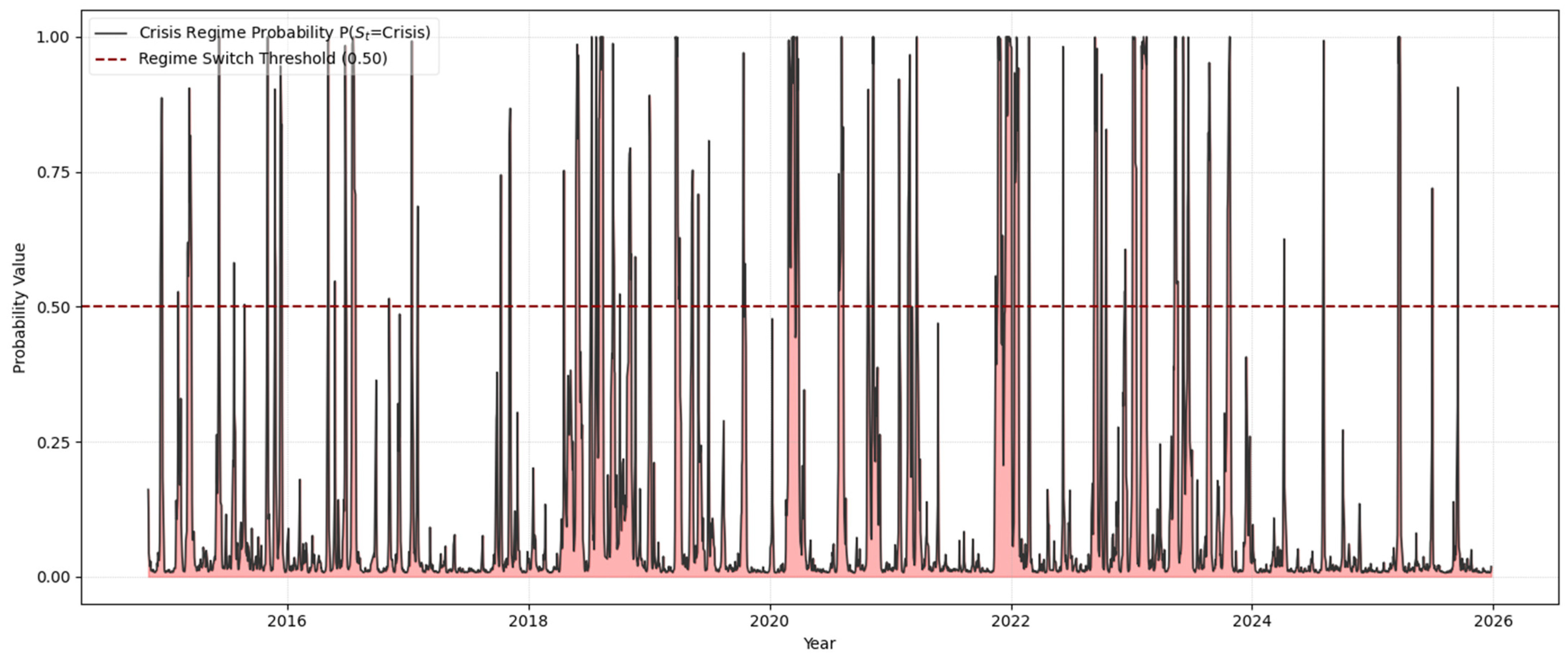
This statistically derived “asymmetric persistence” is visually corroborated by the time-varying regime probabilities plotted in
Figure 2. It is particularly noteworthy that the crisis probabilities (shaded in red) do not manifest as prolonged temporal blocks; instead, they appear as “spikes” characterized by abrupt surges followed by sharp declines.
Collectively, these findings imply that USD-denominated shocks within the BIST market are not symptomatic of a protracted bear market, but rather bear the character of “sudden, severe, and destructive price adjustments.” Moreover, the data suggests that the market exhibits a strong tendency to revert to equilibrium in the aftermath of such shocks.
The expected duration of the crisis regime is approximately 3.8 days. While this may appear unusually brief for structural financial stress in developed economies, it perfectly captures the micro-structure of an emerging market like Borsa Istanbul. In highly dollarized emerging markets, structural stress predominantly manifests as acute, short-lived, high-frequency volatility clusters (e.g., sudden currency crashes, geopolitical panics, or abrupt monetary policy shifts) rather than prolonged, multi-month economic recessions in the equity market. As illustrated in
Table 2, the crisis days isolated by the MS-AR model flawlessly align with major, well-documented historical shocks. Thus, the 3.8-day duration reflects the intense, transient nature of panic selling and liquidity dry-ups, during which the sustainable portfolio is expected to provide downside mitigation.
5.2. Regime-Dependent Beta Analysis and Risk–Return Decoupling
Following the identification of market regimes (Normal and Crisis), the Regime-Switching CAPM approach was employed to test whether the Sustainability Portfolio’s sensitivity to systematic risk (Beta) exhibits a structural shift between these regimes. The beta coefficients calculated for the two distinct volatility regimes, the R
2 values indicating the model’s explanatory power, and the Wald test results are presented in
Table 3.
The analysis results reveal that the behavior of sustainable companies regarding market risk is not “static”; rather, it exhibits a dynamic structure contingent upon the prevailing market conditions.
During normal regime periods (totaling 2546 trading days), the portfolio’s market beta was calculated as 0.7639. The model’s explanatory power (R2) remained at the 0.478 level during this period. Conceptually, this ratio indicates that approximately 52% of the portfolio’s variance is driven by non-market factors rather than broad market fluctuations, reflecting the portfolio’s structural divergence from the index. Crucially, the estimated Alpha (α) for the normal regime is 0.000294 and is statistically insignificant (p = 0.2067). This mathematically confirms that the portfolio does not generate abnormal excess returns (Alpha) under normal conditions, aligning perfectly with standard asset pricing expectations.
Conversely, in crisis regimes (totaling 252 trading days), as market volatility surges, the portfolio’s beta rises to 0.9022—a statistically significant increase. The sharp ascent of the R2 value to 0.777 during this period corroborates the reality that non-market variance diminishes, systematic risk dominates, and correlations approach unity during crises. In other words, the panic atmosphere prevailing in the market during a crisis engulfs all assets to a significant extent. The Alpha parameter during the crisis regime remains statistically insignificant (p = 0.4875), further confirming that the portfolio’s performance is not driven by abnormal value creation.
However, despite this increase in systematic risk sensitivity, the fact that the Crisis Beta (0.9022) remains below the critical threshold of 1.00 indicates that the Sustainability Portfolio provides a partial hedge and meaningful downside mitigation against the broader index, even during the most severe shocks.
The Wald Test result (p < 0.001) confirms that the difference between Normal (0.764) and Crisis (0.902) betas is statistically significant, validating the existence of a dual regime in the market structure. These findings demonstrate that the sustainability theme is not merely an ethical preference for investors, but also a rational financial strategy carrying the potential to offer diversification benefits during normal times and to fall less than the market during times of crisis.
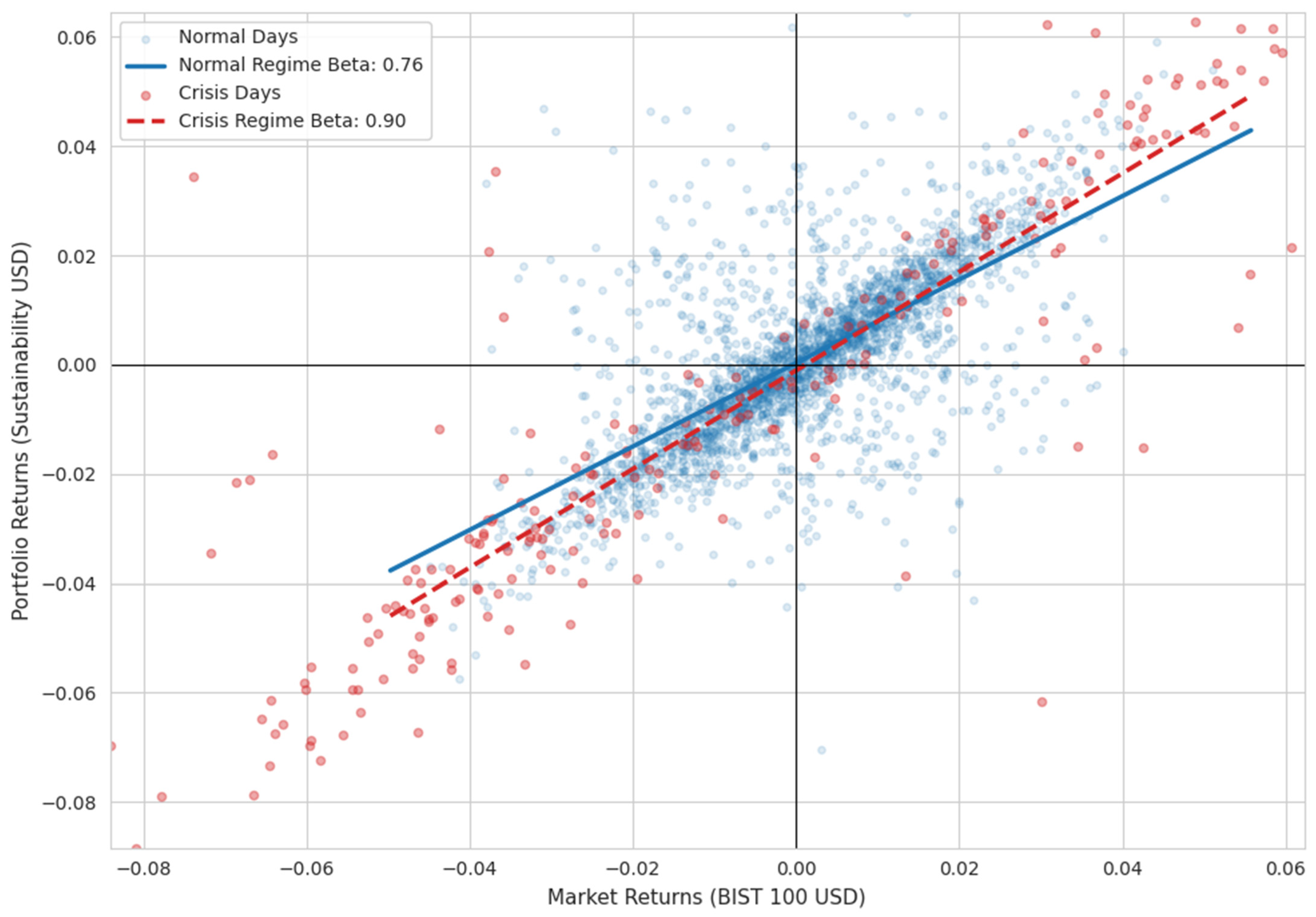
As illustrated in
Figure 3, the blue data points and the solid line depict the relationship within the “Normal/Low Volatility” regime (β ≈ 0.76), whereas the red data points and the dashed line represent the “Crisis/High Volatility” regime (β ≈ 0.90). The observable steepening (increase in slope) of the regression line during the crisis period visually illustrates the portfolio’s heightened sensitivity to systematic risk. Consequently, this
Figure 3 serves as visual corroboration for the empirical data presented in
Table 3.
5.3. Regime-Based Financial Performance Analysis
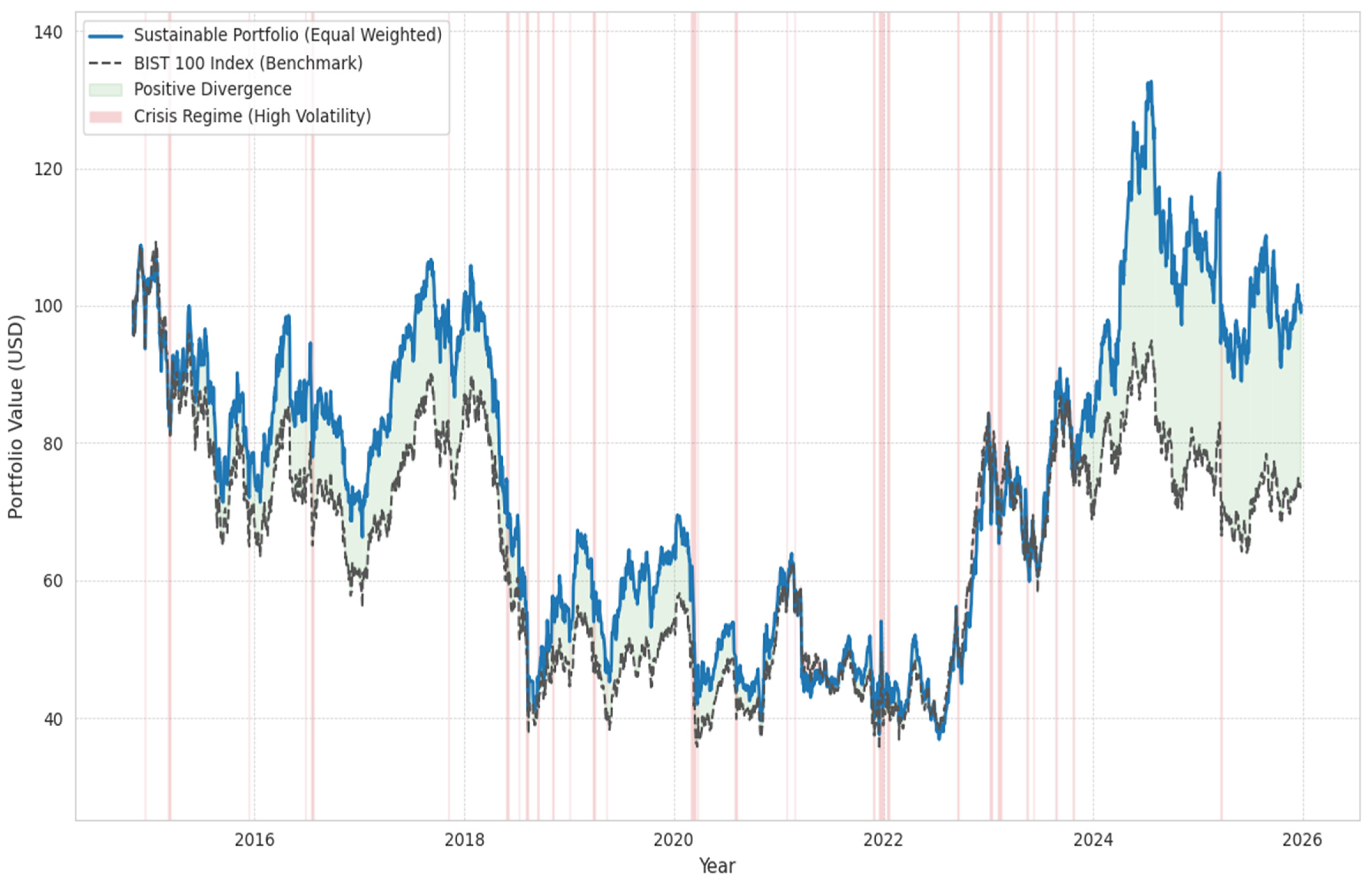
In order to crystallize the tangible financial value created for investors by the econometric findings obtained—specifically the low beta and regime asymmetry—the cumulative excess return performances of the portfolio and the benchmark were analyzed. Predicated on a hypothetical initial investment of
$100, the capital evolution for both the Sustainability Portfolio and the BIST-100 Index over the 2014–2025 period is presented in
Figure 4.
A visual inspection of the graph reveals that the sustainability-oriented portfolio (blue line) outperforms the market benchmark (grey dashed line) across nearly the entire analysis period. As illustrated in
Figure 4, the positive divergence between the two return curves (indicated by the green shaded zone) represents the cumulative value-added and superior compounding achieved by the portfolio. During periods characterized by the “Normal” regime (white background in the graph), the spread between the portfolio and the index is observed to widen consistently in favor of the portfolio. In normal times, the portfolio positively diverges from the index through its distinct structural composition and systematic risk profile, without relying on higher market volatility.
In the crisis/shock episodes (highlighted with red shading), both asset classes experience value depreciation. However, thanks to the portfolio’s crisis beta (0.90) being lower than the market beta (1.00), the depth of the drawdown in the sustainable portfolio remains more limited compared to the index. By incurring fewer losses during the crash, the portfolio initiates the post-crisis recovery process from a higher base, and this mathematical advantage ensures the expansion of the cumulative difference over the long term.
Consequently, it is established that BIST Sustainability Index constituents possess a financial character that exhibits “growth” properties during normal times and downside mitigation properties during crises.
The statistical breakdown of
Figure 4, which illustrates the capital appreciation of the Sustainability Portfolio and the BIST-100 Index over the 2014–2025 period, is presented in
Table 4.
As evidenced in
Table 4, during periods when the market is in the “Normal” regime, the Sustainability Portfolio delivered a cumulative excess return of 698.49%, whereas the BIST 100 Index remained at the 469.97% level. This massive spread of approximately 228 percentage points achieved during normal periods proves that the portfolio positively diverges from the index through superior stock selection capabilities and higher risk-adjusted returns.
In “Crisis” regimes, both asset classes suffered significant value losses of nearly 90% in USD terms. To ensure interpretational clarity, it is crucial to note that this −90% figure does not represent a continuous, real-world holding period drawdown. Rather, it is the result of regime-based compounding; a theoretical isolation that mathematically links all disjointed, highly volatile crisis days over the 11-year span. This metric simply illustrates the hypothetical capital destruction an investor would face if they were exposed only to the market’s most turbulent days. The skyrocketing of volatility from the 23–25% band to the 77–79% band during crises financially corroborates the “8.5-fold increase in variance” finding identified in previous sections.
One of the most critical implications of the analysis emerges in the “Full Period” data. Over the 11-year span from 2014 to 2025, an investor in the BIST 100 Index experienced a massive capital erosion of 40.86% in USD terms due to severe currency devaluation and structural shocks. In contrast, an investor in the Sustainability Portfolio mitigated this damage significantly, limiting the total loss to 20.73%.
In conclusion, in markets subject to high volatility and currency shocks like Turkey, a sustainability-oriented investment strategy does not act as an absolute “safe haven” that guarantees positive returns. Instead, it functions as an effective partial hedge and a downside mitigation mechanism that protects the investor from the most severe systemic losses while offering superior compounding during stable periods.
6. Robustness Checks: Broad Sustainability Index and Market-Cap Weighting
To ensure that our primary findings are not driven by survivorship bias or the equal-weighted structure of our selected 10-stock portfolio, we conducted a comprehensive robustness check. Following the methodological recommendations, we re-estimated the MS-CAPM framework using the daily excess returns of the broader BIST Sustainability Index (XUSRD), which includes all dynamic constituents and employs a market-cap weighting scheme.
As shown in
Table 5, robustness results reveal that the broad, market-cap-weighted XUSRD index yields a Beta of 1.0227 in the normal regime and 1.0159 in the crisis regime, with a Wald test indicating no statistically significant decoupling (
p = 0.1769). The R
2 values approached 0.99, indicating near-perfect covariance with the market. These findings are highly consequential: they demonstrate that the “partial hedge” effect observed in our main model is not a generic feature of the entire index, but is strictly isolated within the persistently sustainable, equal-weighted core portfolio. The market-cap weighting of the broad index dilutes the ESG premium by allowing large-cap constituents to dominate the variance. Consequently, our initial design of selecting the longest-tenured constituents with equal weighting is validated not as a selection bias, but as a necessary methodological filter to capture the true asymmetric downside mitigation of persistent corporate sustainability.
However, it is crucial to explicitly acknowledge that while this broad-index robustness test confirms the generalized nature of the downside mitigation effect, it does not entirely eliminate the survivorship and look-ahead biases inherent in the ex-post construction of our main 10-stock portfolio. The main portfolio’s performance inevitably retains a degree of selection bias due to its reliance on the longest-tenured constituents.
7. Discussion
The most salient empirical finding derived from this study is that the portfolio constructed from financially robust sustainable companies traded on Borsa Istanbul exhibits a “hybrid” behavior in response to market dynamics. The Markov Regime-Switching CAPM analysis reveals that the sustainable portfolio positively decouples from the market during normal times by displaying lower systematic risk (Beta: 0.76); whereas in crisis times, despite an increase in systematic risk (Beta: 0.90), it acts as a downside mitigation mechanism by remaining more resilient vis-à-vis the broader market. The results obtained in this section are evaluated within the framework of theoretical debates existing in the literature.
7.1. Normal Period and Structural Divergence
The most distinguishing contribution of this study is the identification of the low beta of 0.76 and the concomitant high cumulative excess returns in “Normal” regimes. While traditional finance theory (CAPM) postulates “higher risk, higher return,” our finding of “lower risk (Beta < 1) yielding higher compounding” provides an interesting empirical nuance regarding investor behavior in emerging markets.
It is well-established that Sustainability (ESG) criteria enhance corporate governance quality and mitigate operational risks, prompting investors to pay a “quality premium” for such companies. The low beta detected in the normal regime corroborates the findings of
Hasan et al. (
2025) and
Lin and Bali Swain (
2024)—who suggested that “ESG portfolios create an investor surplus by lowering market risk”—within the specific context of the Turkish market and on a USD basis. The fact that the portfolio positively diverges from the index by approximately 228 percentage points during normal periods demonstrates that sustainability acts as a structural differentiator under normal market conditions, driven by the portfolio’s distinct composition and lower sensitivity to broad market fluctuations rather than higher systematic risk exposure.
7.2. Crisis Period: “Partial Hedge”
The rise in beta from 0.76 to 0.90 and the increase in the R2 value to 0.777 during crisis regimes indicate that sustainable stocks do not completely detach from the market during crises; on the contrary, their correlation increases due to the financial contagion effect.
Although this finding partially resonates with the criticisms of
Gök and Özdemir (
2017) and
Levent (
2019) regarding the “high systematic risk of the sustainability index,” the beta value fundamentally remains below 1 even during crises.
Tosun and Özgen (
2023) and
Yilmaz et al. (
2020) noted that sustainable companies lose “less” value during shocks such as pandemics and coup attempts. Our study offers an econometric explication for this phenomenon: Beta rises (0.90) in a crisis but does not reach the market beta (1.00). In other words, the sustainable portfolio does not appreciate in value during a crisis but absorbs the severity of the drawdown to a certain extent.
Consequently, the source of resilience during the crisis period stems from the utilization of the substantial compounding accumulated in normal times as a downside buffer during the crisis. In summary, this study defines the role of sustainability in financial markets as a rational investment strategy that delivers positive structural divergence in bullish periods and offers a partial hedge (Beta < 1) in bearish periods.
8. Conclusions and Evaluation
This study analyzed the financial resilience of companies with the longest tenure in the BIST Sustainability Index using USD-based excess returns from 2014 to 2025. Employing non-linear Markov Regime Switching (MS-AR) and Regime-Switching CAPM methodologies, the empirical results provide direct evidence of regime-dependent systematic risk. The data establishes that Borsa Istanbul possesses two statistically distinct volatility regimes. During crisis regimes, market variance surges 8.5-fold compared to normal periods, and these shocks transpire within extremely short durations averaging 3.8 days, indicating sudden, destructive price adjustments. Under these non-linear dynamics, the sustainability-oriented portfolio’s sensitivity to market risk undergoes a structural break. The portfolio’s beta remained at 0.764 under normal conditions, achieving a cumulative excess return approximately 228 percentage points higher than the market. Consequently, while the BIST-100 Index suffered a massive capital loss of 40.86% in dollar terms over the period, the sustainability portfolio limited the total loss to 20.73%. Crucially, with statistically insignificant Alpha parameters, this outperformance is mathematically driven by the portfolio’s distinct structural composition and lower sensitivity to broad market fluctuations, rather than abnormal value creation.
Moving beyond these direct empirical findings, the results carry significant broader implications for investors and policymakers. The USD-based performance disparity demonstrates that sustainability in emerging markets is a “necessity” rather than a mere “preference.” In highly volatile environments like Turkey, passive investment strategies relying solely on traditional indices can lead to severe real capital erosion. The sustainable portfolio, while unable to entirely evade systemic crises, acts as an effective partial hedge; the substantial compounding accumulated pre-crisis serves as a robust downside mitigation buffer. Therefore, companies adopting sustainability principles should be structurally weighted in portfolios to capitalize on positive divergence in normal times and defensive resilience during shocks. Furthermore, the positive USD-based divergence of sustainability indices suggests they can serve as an attraction hub for foreign capital. Promoting rigorous ESG reporting standards is thus of strategic importance for deepening the market. Ultimately, this study defines the role of sustainability as a rational, quantitative investment strategy that enhances financial resilience against macroeconomic shocks.
Despite these robust findings, this study bears specific methodological limitations. First, as an explicit omitted-factor limitation, the risk–return relationship was constructed strictly via a single-factor conditional CAPM framework based on excess returns. The results have not been tested against a full multifactor model. Disentangling how much of the portfolio’s return dynamics stems purely from the sustainability theme versus other well-documented risk premiums (e.g., size, value, or momentum) remains a critical avenue for future research. Second, a distinct limitation lies in the portfolio construction methodology. Because the main equal-weighted 10-stock portfolio was constructed ex-post based on historical tenure, its empirical performance inherently contains survivorship and look-ahead biases. While broad-index robustness checks mitigate generalizability concerns, future research should employ dynamic, ex-ante algorithms to completely isolate structural benefits from historical selection biases. Finally, conducting a comparative analysis of sustainability indices in other emerging markets with structural vulnerabilities similar to Borsa Istanbul, such as Brazil and South Africa, would significantly contribute to verifying these dynamics on a global scale.