
Nonlinear Association Between Controlling Shareholders and Financial Reporting Integrity: An Explainable Optuna-Optimized Ensemble Learning Approach in Egypt and Saudi Arabia

Abstract
1. Introduction
2. Literature Review
2.1. Financial Reporting Integrity and Its Measurement
2.2. Ownership Structure and Corporate Governance
2.3. Explainable Machine Learning in Accounting
2.4. Hypothesis Development
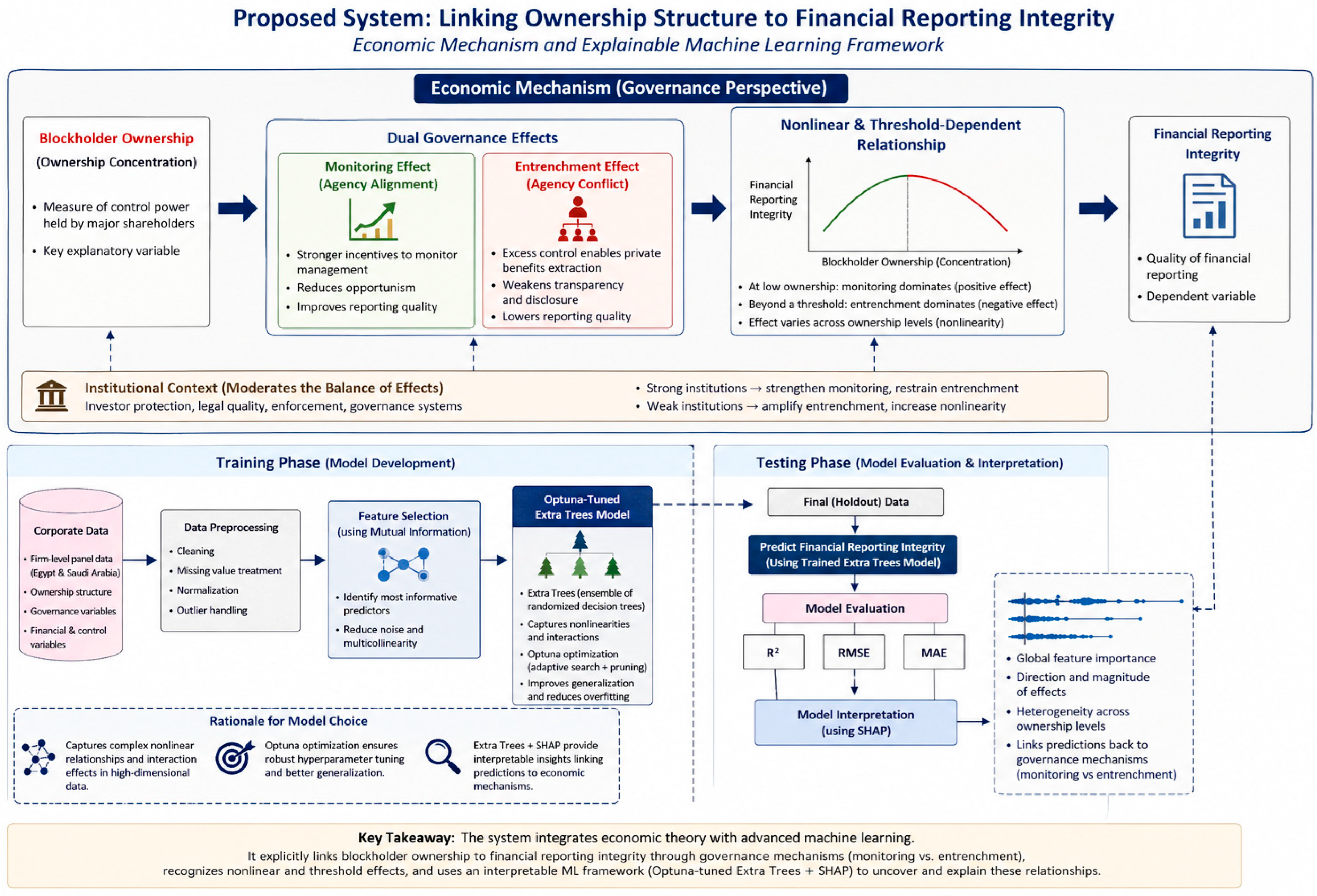
3. Research Framework
3.1. General Context
3.2. Phase 1: Data Preparation
3.3. Phase 2: Model Development
- (a)
- Extremely Randomized Trees (ET):
- (b)
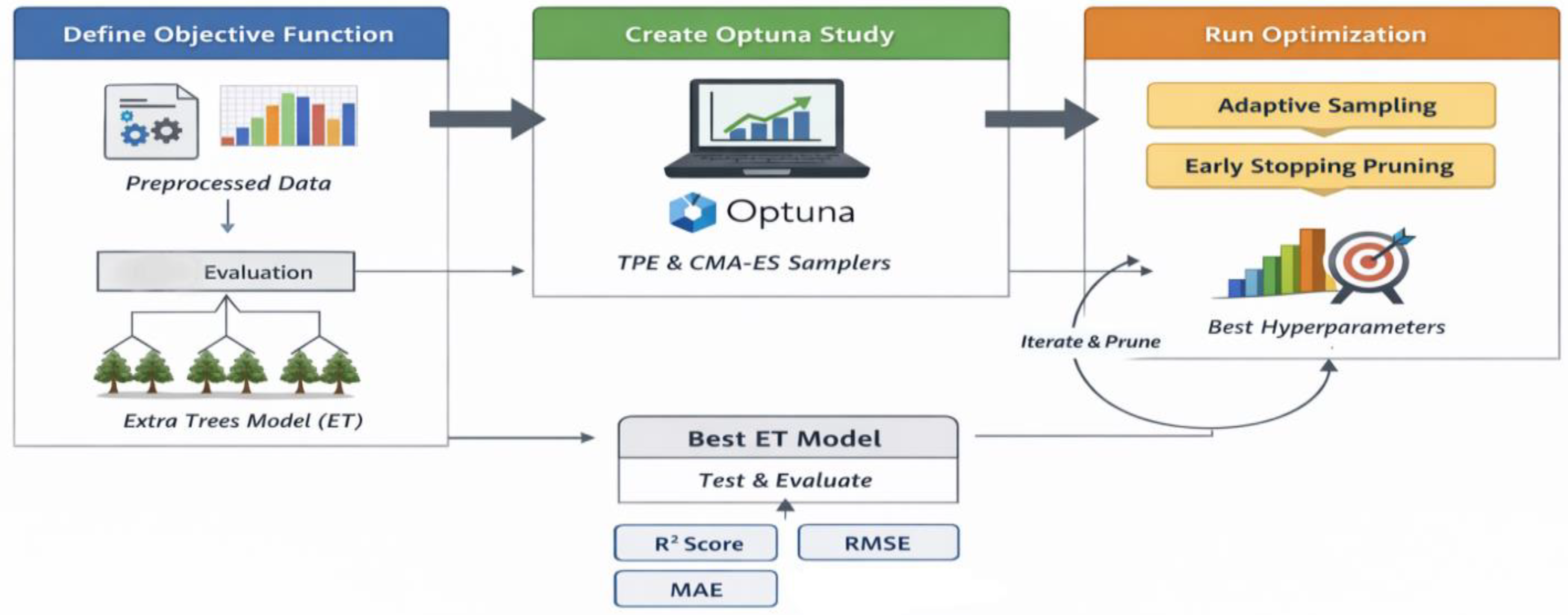
- Optuna Optimization:
3.4. Phase 3: Robustness Tests
4. Experimental Results and Discussion
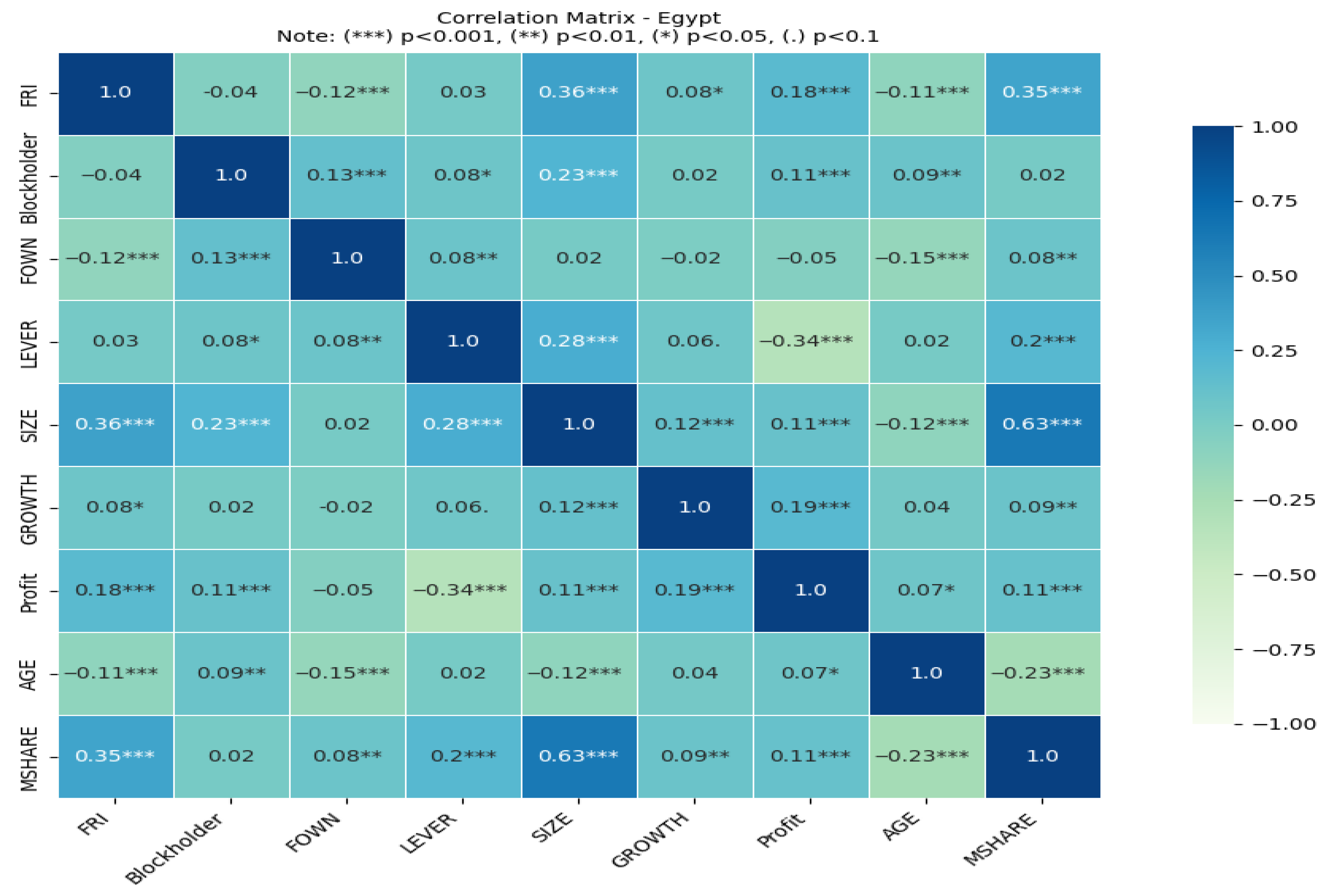
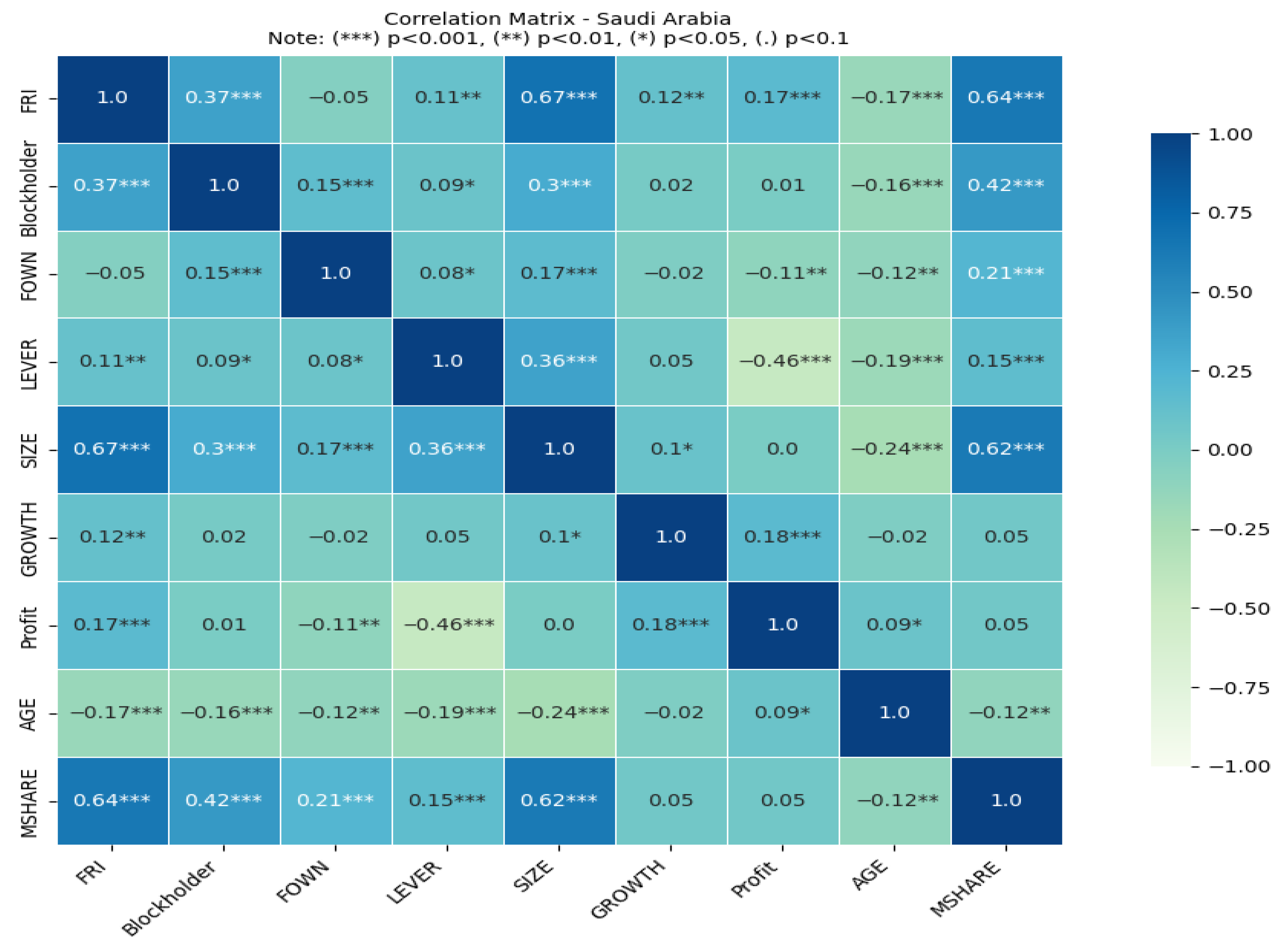
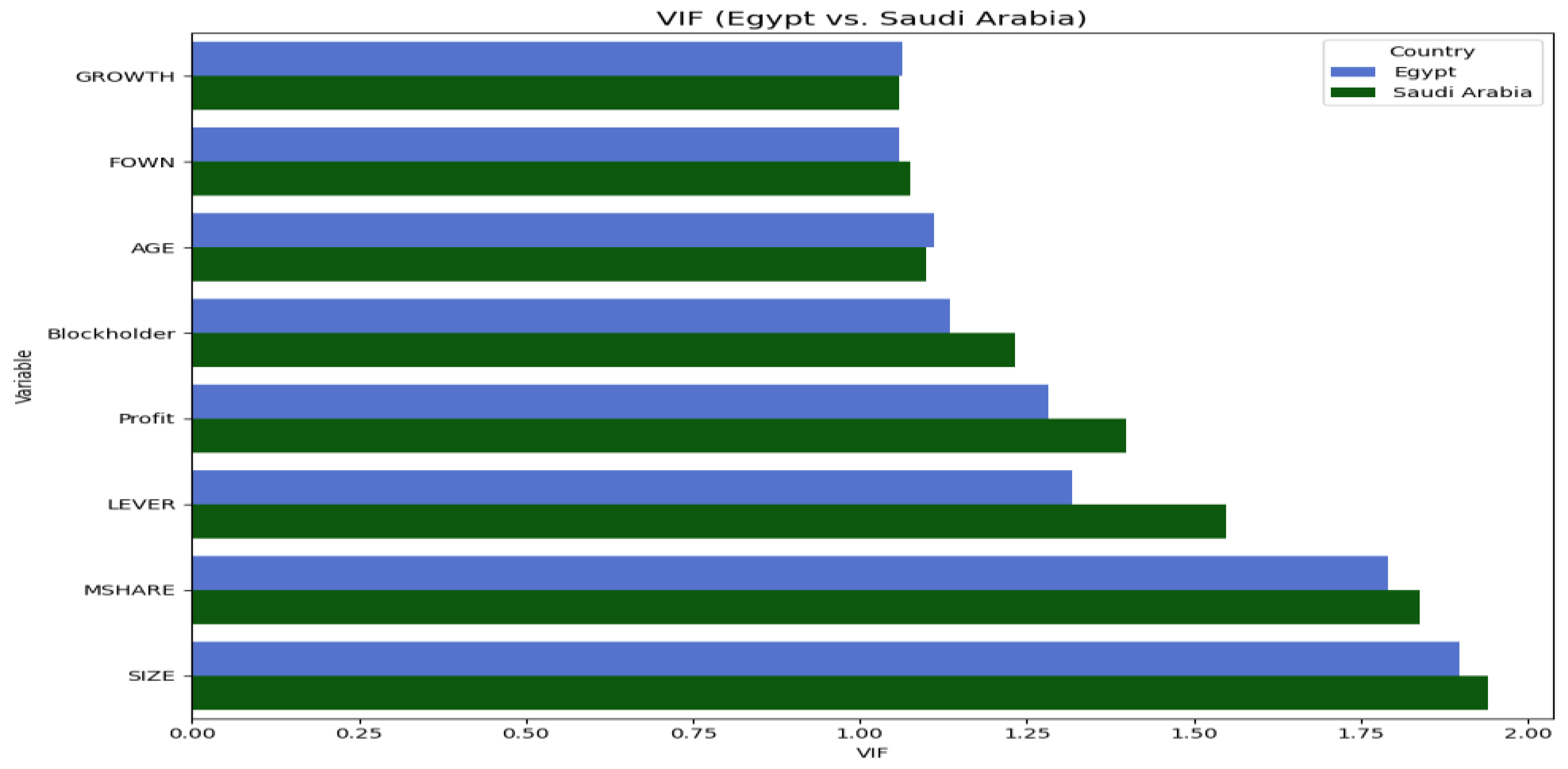
4.1. Descriptive Analysis
4.2. Performance Comparison of Various Statistical and ML Models
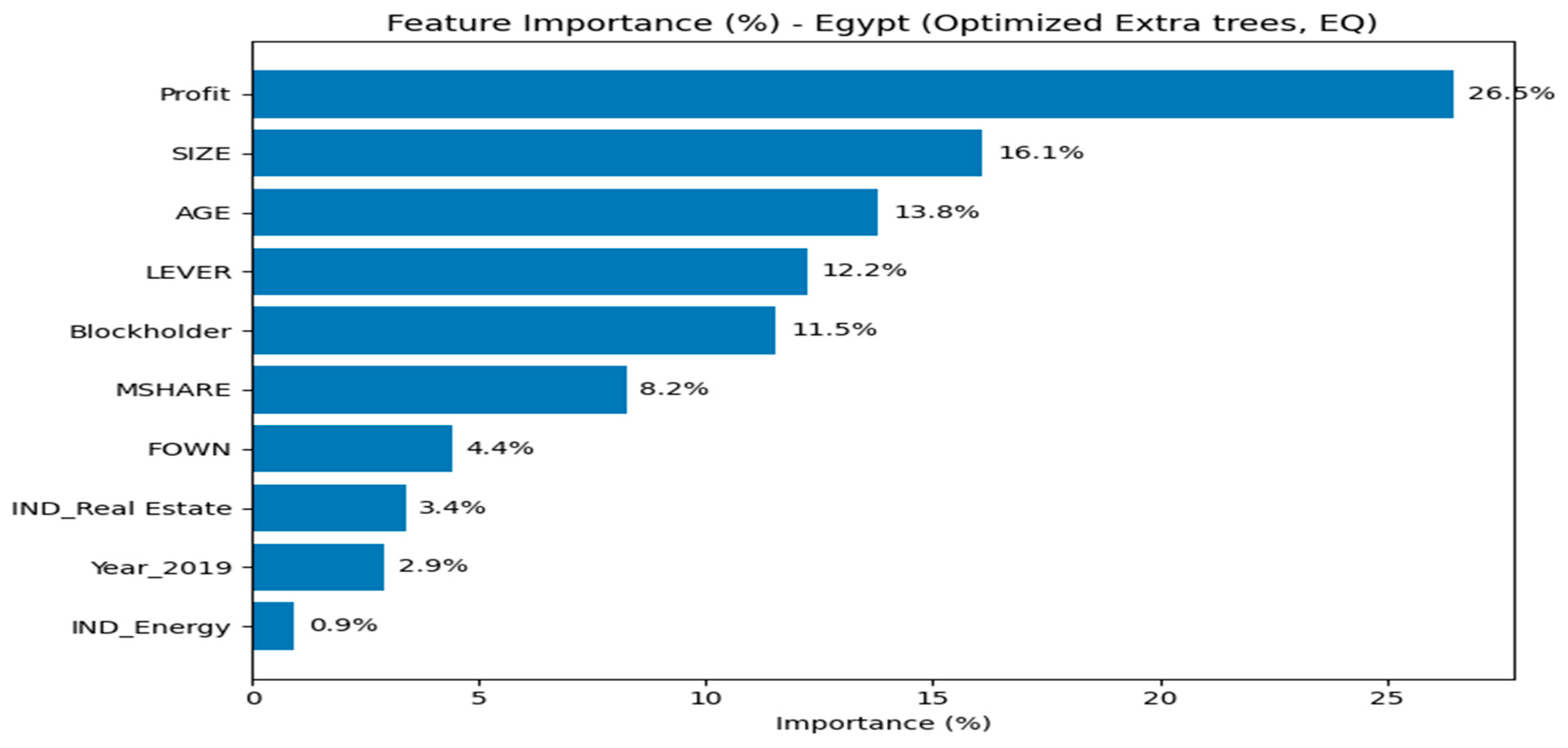
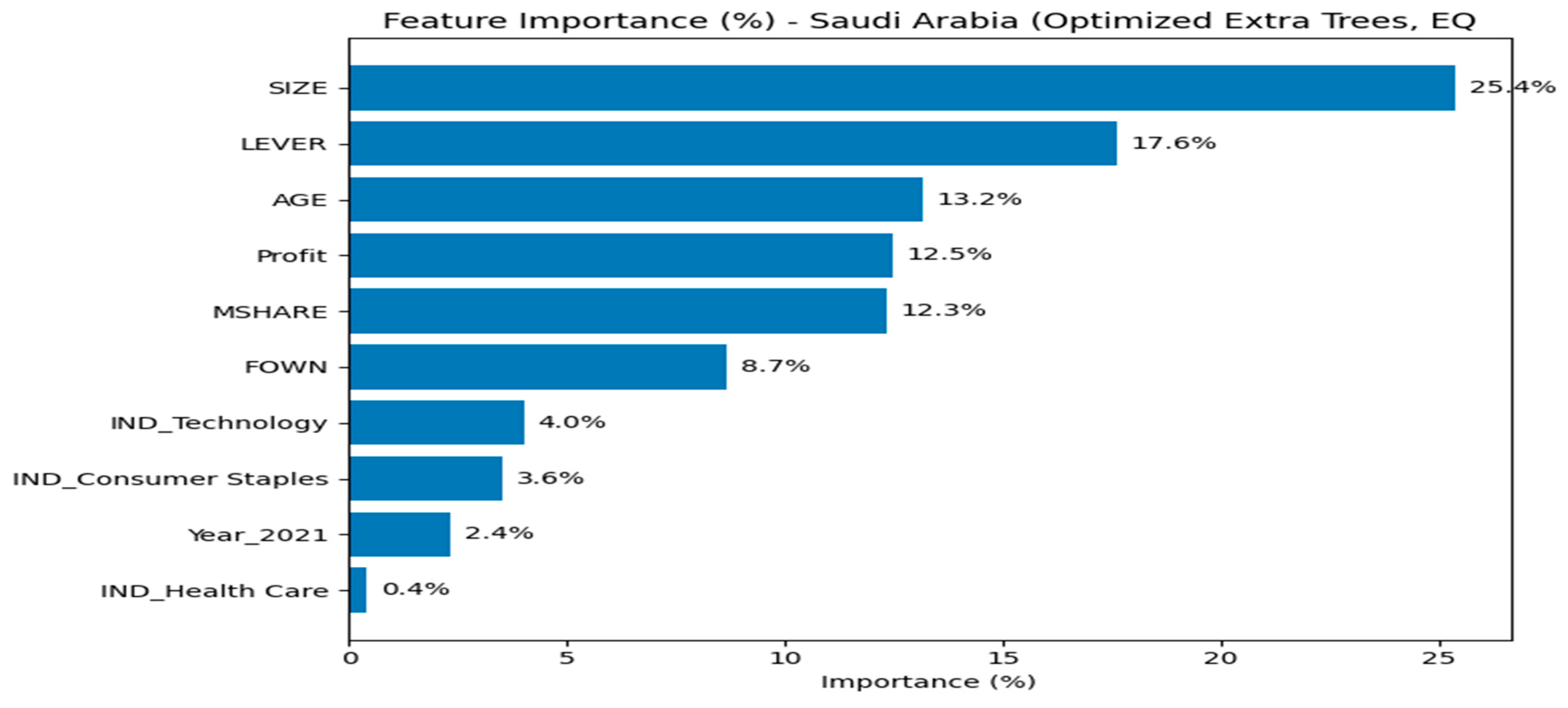
4.3. Feature Importance Analysis Using Optuna-Optimized Extra Trees
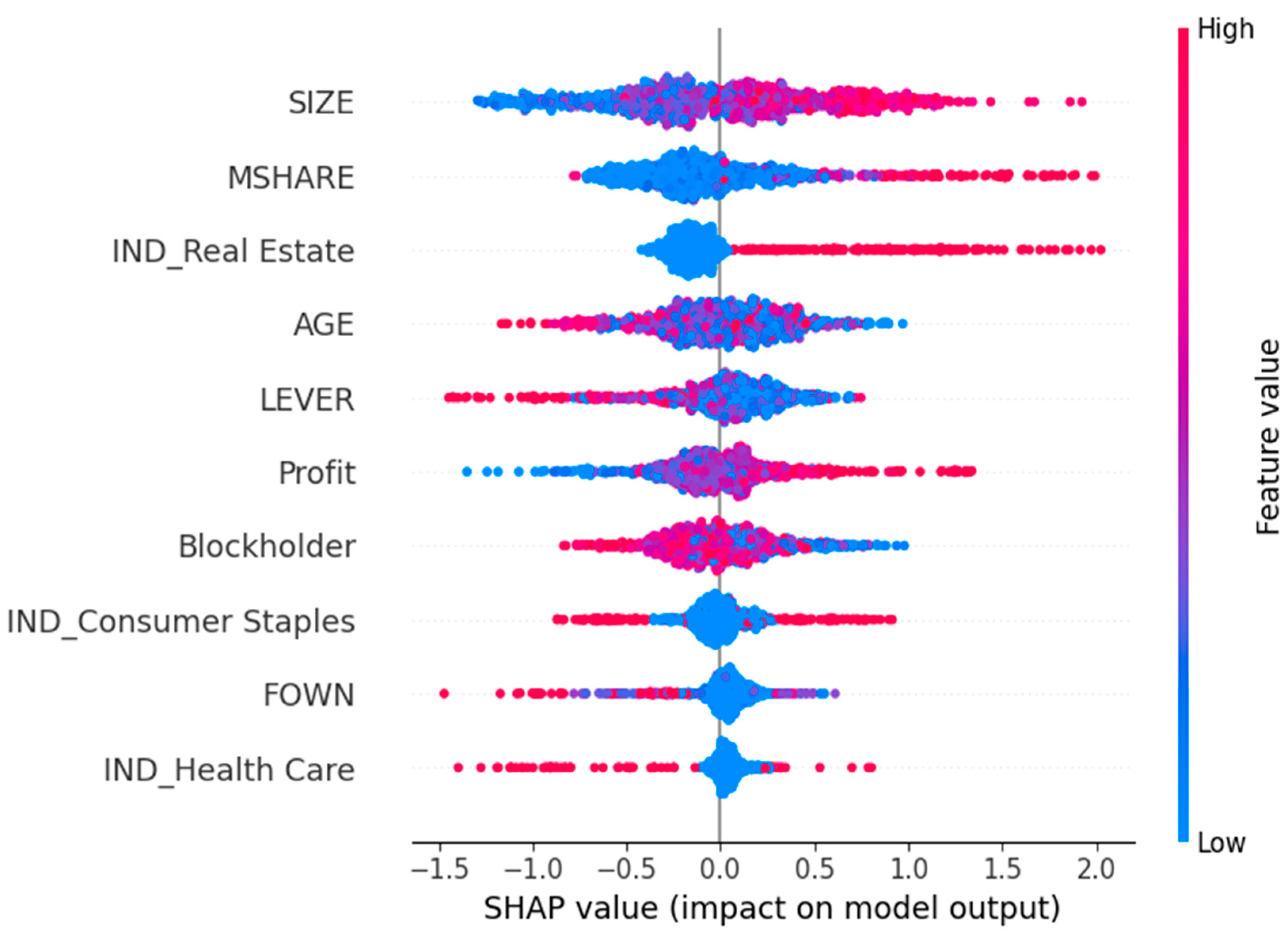
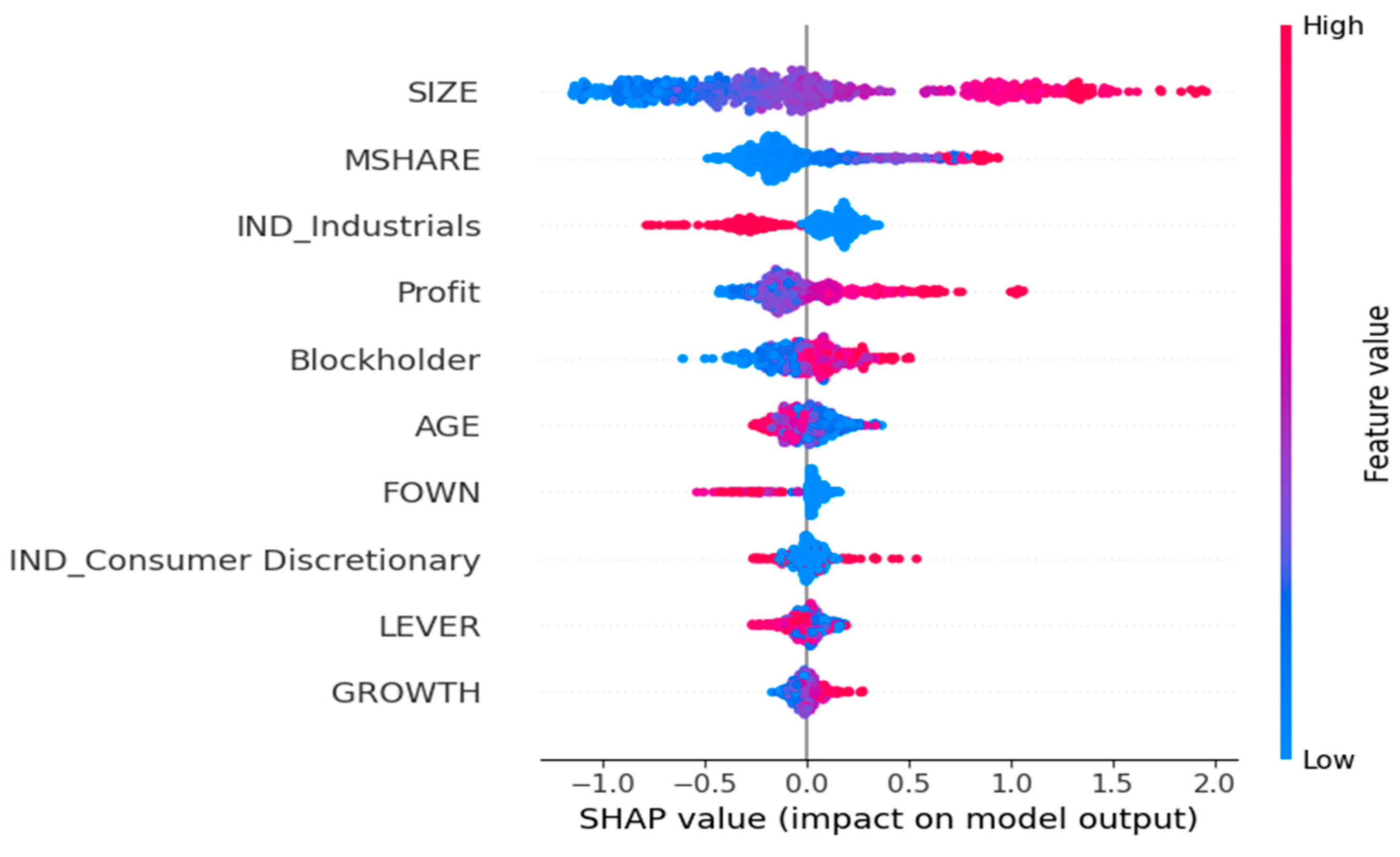
4.4. Model Explanation with SHapley Additive Explanations
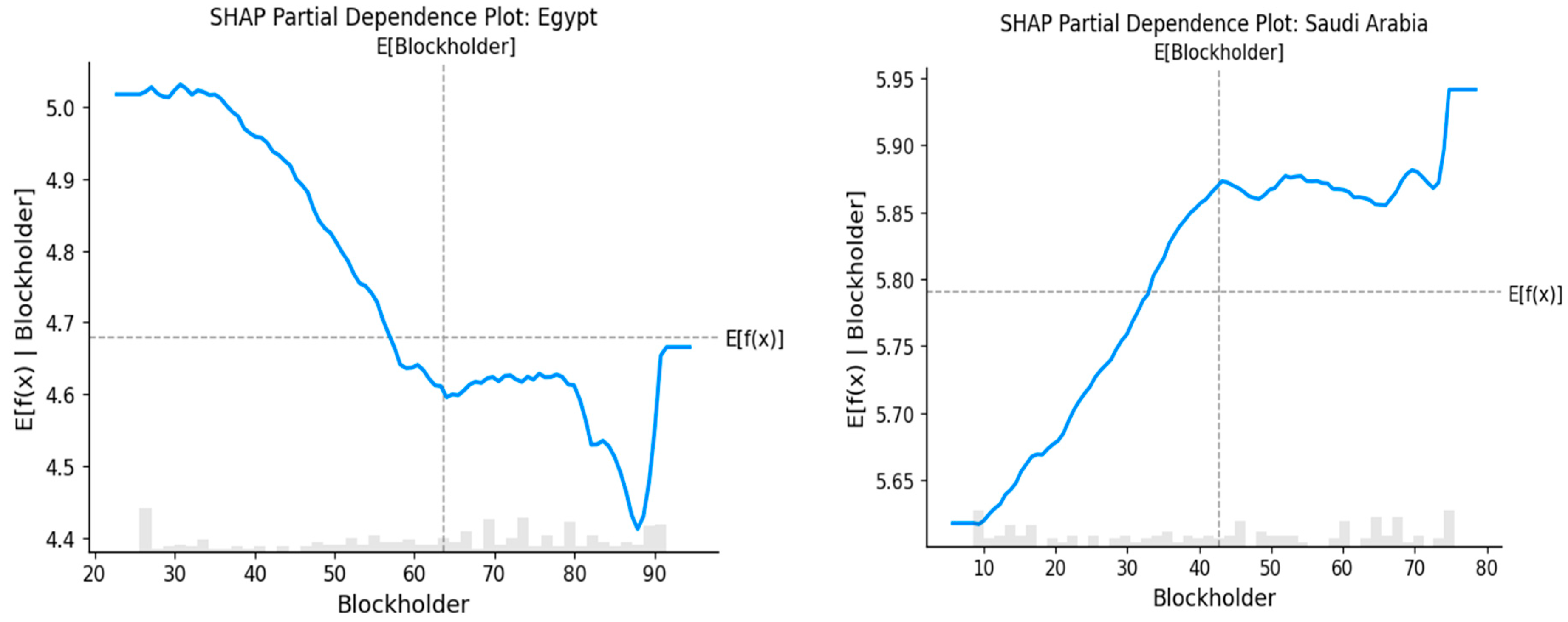
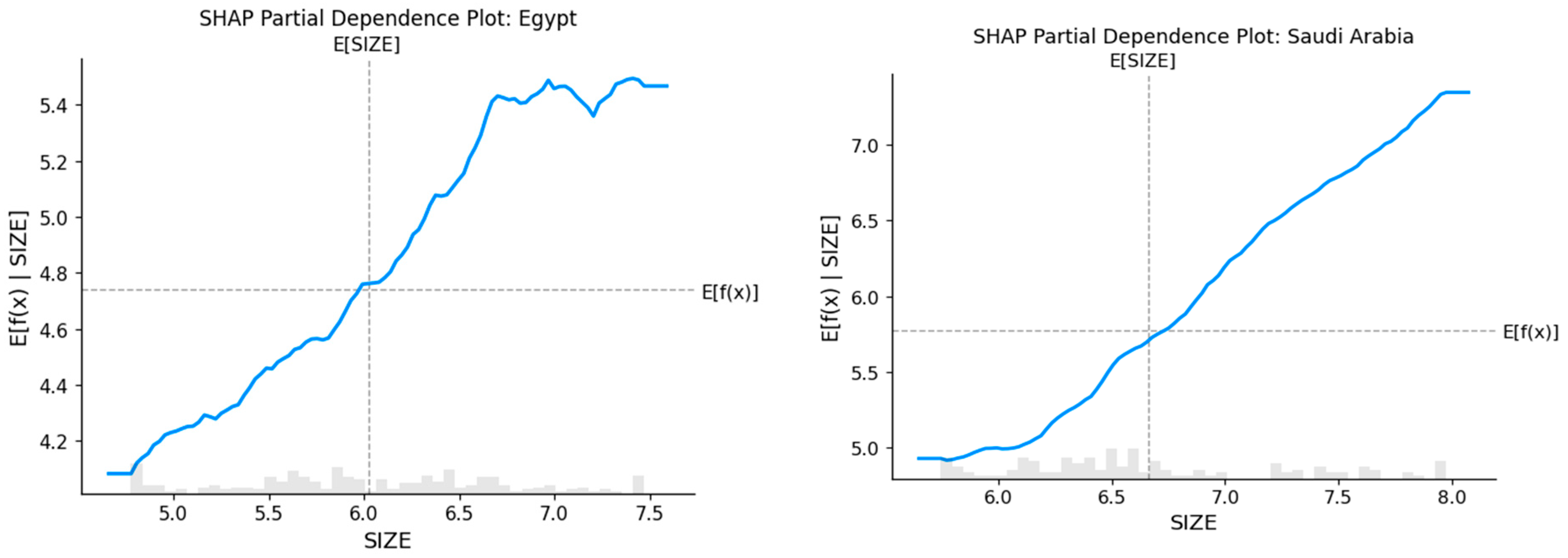
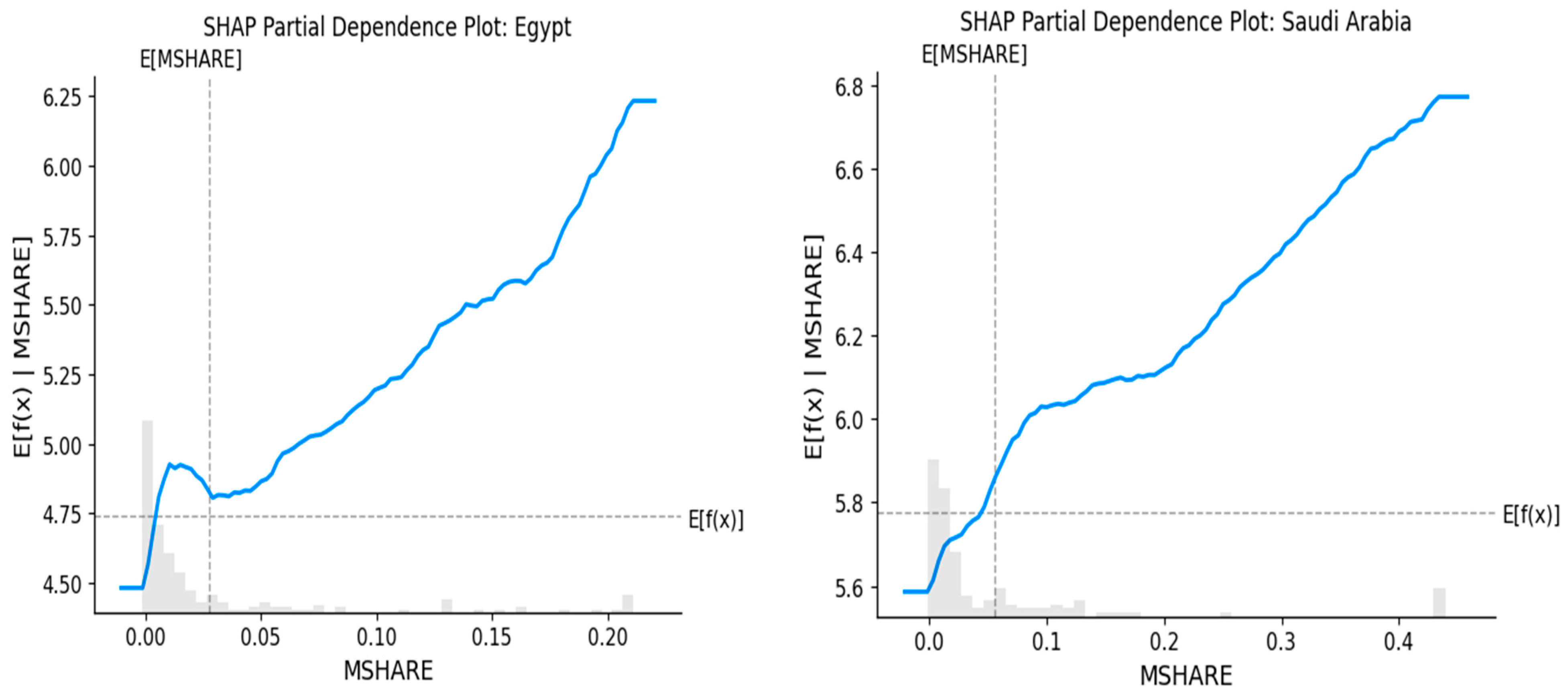
4.5. Partial Dependency Plots
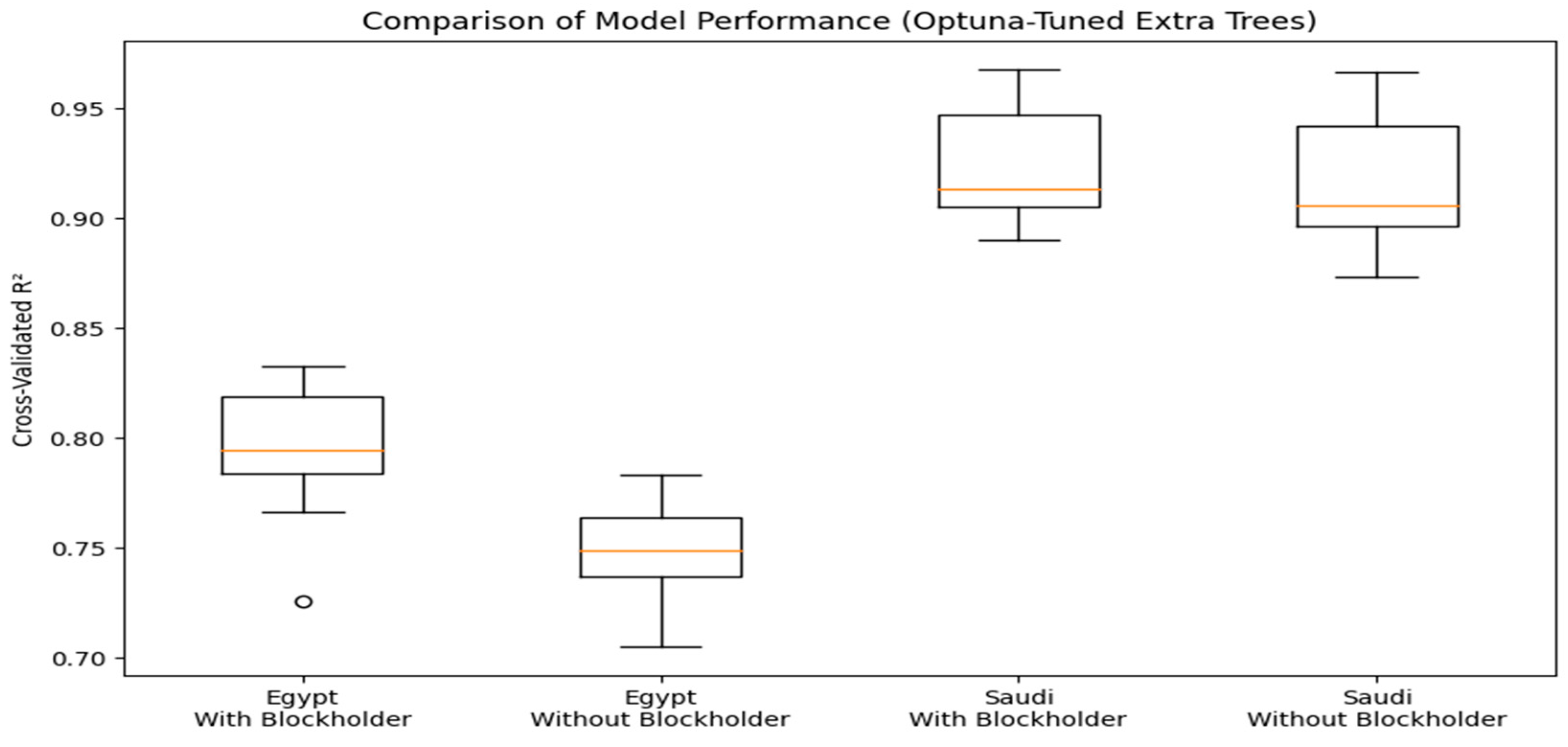
4.6. Performance Comparison of the Proposed Model with and Without Blockholder Ownership
4.7. Discussion of Main Results
5. Robustness and Complementary Econometric Analysis
5.1. Accounting-Based Measures of Financial Reporting Integrity
- 1.
- Feature Importance Analysis:
- 2.
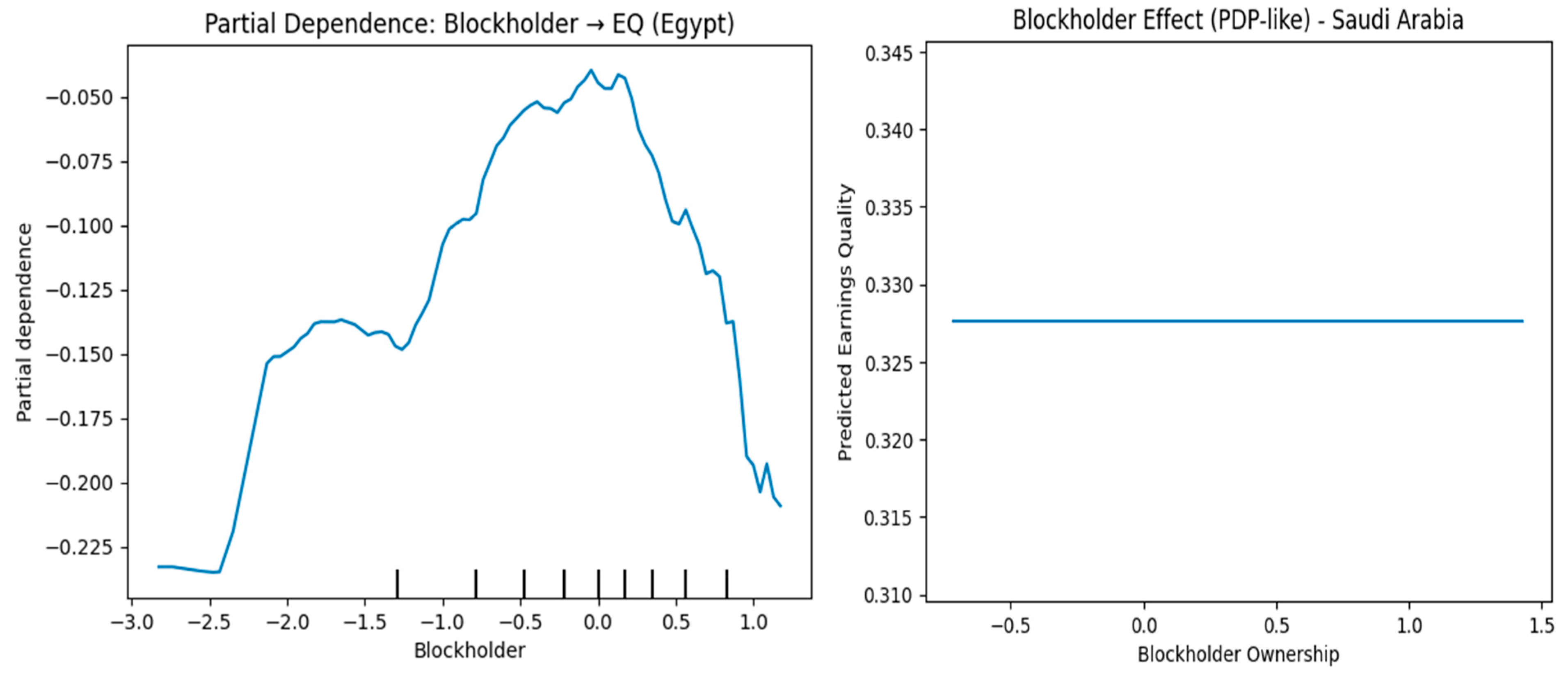
- Partial dependence analysis:
5.2. Panel Econometric Benchmark
5.3. Nonlinearity and Cross-Country Effects
6. Conclusions
Practical and Policy Implications
Author Contributions
Funding
Institutional Review Board Statement
Informed Consent Statement
Data Availability Statement
Conflicts of Interest
References
- Abogun, S., Adigbole, E. A., & Olorede, T. E. (2021). Income smoothing and firm value in a regulated market: The moderating effect of market risk. Asian Journal of Accounting Research, 6(3), 296–308. [Google Scholar] [CrossRef]
- Akiba, T., Sano, S., Yanase, T., Ohta, T., & Koyama, M. (2019, August 4–8). Optuna: A next-generation hyperparameter optimization framework. 25th ACM SIGKDD International Conference on Knowledge Discovery & Data Mining (pp. 2623–2631), Anchorage, AK, USA. [Google Scholar]
- Aldoseri, M. M., & Hussein, R. (2024). The impact of ownership structure and board characteristics on earnings quality: Evidence from Saudi Arabia. Journal of Statistics Applications and Probability, 13(1), 227–238. [Google Scholar] [CrossRef]
- Ali, G. M. (2026a). Enhancing project financial performance prediction: An explainable machine learning framework integrating frontier efficiency and super learner. Journal of Project Management, 11(1), 151–168. [Google Scholar] [CrossRef]
- Ali, G. M. (2026b). Firm valuation using accounting-based capital structure and cash holdings: An explainable machine learning approach. International Journal of Data and Network Science, 10(2), 577–596. [Google Scholar] [CrossRef]
- Ali, M. J., Biswas, P. K., Chapple, L., & Kumarasinghe, S. (2024). Institutional ownership and earnings quality: Evidence from China. Pacific-Basin Finance Journal, 84(3), 102275. [Google Scholar] [CrossRef]
- Almarzooq, H., & bin Waheed, U. (2024). Automating hyperparameter optimization in geophysics with Optuna: A comparative study. Geophysical Prospecting, 72(5), 1778–1788. [Google Scholar] [CrossRef]
- Alrobai, F., Alrashed, A. A., & Albaz, M. M. (2025). Earnings quality drivers: Do firm attributes and ownership structure matter in emerging stock markets? Risks, 13, 6. [Google Scholar] [CrossRef]
- Alsultan, A., & Hussainey, K. (2024). The moderating effect of ownership structure on the relationship between related party transactions and earnings quality: Evidence from Saudi Arabia. International Journal of Financial Studies, 12(3), 58. [Google Scholar] [CrossRef]
- Athey, S., & Imbens, G. W. (2019). Machine learning methods that economists should know about. Annual Review of Economics, 11(1), 685–725. [Google Scholar] [CrossRef]
- Attia, E. F., Khémiri, W., & Mehafdi, M. (2023). Does ownership structure reduce earnings manipulation practice of Egyptian listed firms? Evidence from a dynamic panel threshold model. Future Business Journal, 9(1), 34. [Google Scholar] [CrossRef]
- Ball, R., & Shivakumar, L. (2005). Earnings quality in UK private firms: Comparative loss recognition timeliness. Journal of Accounting and Economics, 39(1), 83–128. [Google Scholar] [CrossRef]
- Beaver, W. H., & Ryan, S. G. (2000). Biases and lags in book value and their effects on the ability of the book-to-market ratio to predict book return on equity. Journal of Accounting Research, 38(1), 127–148. [Google Scholar] [CrossRef]
- Bogaert, M., & Delaere, L. (2023). Ensemble methods in customer churn prediction: A comparative analysis of the State-of-the-Art. Mathematics, 11, 1137. [Google Scholar] [CrossRef]
- Breiman, L. (2001). Random forests. Machine Learning, 45(1), 5–32. [Google Scholar] [CrossRef]
- Chemmaa, A., & Ibrahimi, M. (2025). Two decades of research on earnings management and corporate governance: Insights from a bibliometric review. IBIMA Business Review, 2025, 320461. [Google Scholar] [CrossRef]
- Claessens, S., Djankov, S., Fan, J. P. H., & Lang, L. H. P. (2002). Disentangling the incentive and entrenchment effects of large shareholdings. The Journal of Finance, 57(6), 2741–2771. [Google Scholar] [CrossRef]
- Černevičienė, J., & Kabašinskas, A. (2024). Explainable artificial intelligence (XAI) in finance: A systematic literature review. Artificial Intelligence Review, 57(8), 216. [Google Scholar] [CrossRef]
- D’Amato, V., D’Ecclesia, R., & Levantesi, S. (2024). Firms’ profitability and ESG score: A machine learning approach. Applied Stochastic Models in Business and Industry, 40(2), 243–261. [Google Scholar] [CrossRef]
- Dechow, P., Ge, W., & Schrand, C. (2010). Understanding earnings quality: A review of the proxies, their determinants and their consequences. Journal of Accounting and Economics, 50(2–3), 344–401. [Google Scholar] [CrossRef]
- Dechow, P. M., Sloan, R. G., & Sweeney, A. P. (1995). Detecting earnings management. The Accounting Review, 70(2), 193–225. [Google Scholar] [CrossRef]
- Diebold, F. X., & Mariano, R. S. (1995). Comparing predictive accuracy. Journal of Business & Economic Statistics, 13(3), 253. [Google Scholar] [CrossRef]
- Edmans, A., & Holderness, C. G. (2017). Blockholders: A survey of theory and evidence. The Handbook of the Economics of Corporate Governance, 1, 541–636. [Google Scholar] [CrossRef]
- Erdebilli, B., & Devrim-İçtenbaş, B. (2022). Ensemble voting regression based on machine learning for predicting medical waste: A case from Turkey. Mathematics, 10, 2466. [Google Scholar] [CrossRef]
- Eugster, F., & Wagner, A. F. (2020). Value reporting and firm performance. Journal of International Accounting, Auditing and Taxation, 40, 100319. [Google Scholar] [CrossRef]
- European Bank for Reconstruction and Development. (2016). Corporate governance in transition economies: Egypt country report. European Bank for Reconstruction and Development. Available online: https://www.bing.com/ck/a?!&&p=9bbc225d6ff52de89d15f4ab69b1485cf62b841a9471aef9d59c5356f6c5e8fcJmltdHM9MTc3ODI4NDgwMA&ptn=3&ver=2&hsh=4&fclid=22d853b6-60fb-68aa-361d-449961f26930&psq=Corporate+Governance+in+Transition+Economies++Egypt+Country+Report++2017&u=a1aHR0cHM6Ly93d3cuZWJyZC5jb20vY29udGVudC9kYW0vZWJyZF9keHAvYXNzZXRzL3BkZnMvbGVnYWwtcmVmb3JtL2NvcnBvcmF0ZS1nb3Zlcm5hbmNlL3NlY3Rvci1hc3Nlc3NtZW50L2UvRWd5cHQtU1VNTUFSWS1GSU5BTF9yZXYucGRm (accessed on 23 April 2026).
- Fan, J. P., & Wong, T. J. (2002). Corporate ownership structure and the informativeness of accounting earnings in East Asia. Journal of Accounting and Economics, 33(3), 401–425. [Google Scholar] [CrossRef]
- Feltham, G. A., & Ohlson, J. A. (1995). Valuation and clean surplus accounting for operating and financial activities. Contemporary Accounting Research, 11(2), 689–731. [Google Scholar] [CrossRef]
- Francis, J., LaFond, R., Olsson, P., & Schipper, K. (2004). Costs of equity and earnings attributes. The Accounting Review, 79(4), 967–1010. [Google Scholar] [CrossRef]
- Francis, J., LaFond, R., Olsson, P., & Schipper, K. (2005). The market pricing of accruals quality. Journal of Accounting and Economics, 39(2), 295–327. [Google Scholar] [CrossRef]
- Geertsema, P., & Lu, H. (2019). Machine valuation [working paper]. Available online: https://papers.ssrn.com/sol3/papers.cfm?abstract_id=3447683 (accessed on 5 May 2026).
- Geertsema, P., & Lu, H. (2023). Relative valuation with machine learning. Journal of Accounting Research, 61(1), 329–376. [Google Scholar] [CrossRef]
- Geurts, P., Ernst, D., & Wehenkel, L. (2006). Extremely randomized trees. Machine Learning, 63(1), 3–42. [Google Scholar] [CrossRef]
- González, S., García, S., Del Ser, J., Rokach, L., & Herrera, F. (2020). A practical tutorial on bagging and boosting based ensembles for machine learning: Algorithms, software tools, performance study, practical perspectives and opportunities. Information Fusion, 64, 205–237. [Google Scholar] [CrossRef]
- Gu, S., Kelly, B., & Xiu, D. (2020). Empirical asset pricing via machine learning. The Review of Financial Studies, 33(5), 2223–2273. [Google Scholar] [CrossRef]
- Hadianti, S., & Kodri, W. A. G. (2023). Optimization of the machine learning approach using Optuna in heart disease prediction. Journal Medical Informatics Technology, 1, 59–64. [Google Scholar] [CrossRef]
- Healy, P. M., & Wahlen, J. M. (1999). A review of the earnings management literature and its implications for standard setting. Accounting Horizons, 13(4), 365–383. [Google Scholar] [CrossRef]
- Hezam, Y., Luong, H., & Anthonysamy, L. (2025). Machine learning in predicting firm performance: A systematic review. China Accounting and Finance Review, 27(3), 309–339. [Google Scholar] [CrossRef]
- Ismail, T. H., Samy El-Deeb, M., & Abd El-Hafiezz, R. H. (2024). Ownership structure and financial reporting integrity: The moderating role of earnings quality in Egyptian practice. Journal of Humanities and Applied Social Sciences, 6, 471–495. [Google Scholar] [CrossRef]
- Jensen, M. C., & Meckling, W. H. (1976). Theory of the firm: Managerial behavior, agency costs and ownership structure. Journal of Financial Economics, 3(4), 305–360. [Google Scholar] [CrossRef]
- Jiang, F., Ma, Y., & Wang, X. (2020). Multiple blockholders and earnings management. Journal of Corporate Finance, 64, 101689. [Google Scholar] [CrossRef]
- Kamel, H., & Shahwan, T. (2014). The association between disclosure level and cost of capital in an emerging market: Evidence from Egypt. Afro-Asian Journal of Finance and Accounting, 4(3), 203–225. [Google Scholar] [CrossRef]
- Koklev, P. S. (2022). Business valuation with machine learning. Finance: Theory and Practice, 26(5), 132–148. [Google Scholar] [CrossRef]
- Kunapuli, G. (2023). Ensemble methods for machine learning. Simon and Schuster. [Google Scholar]
- Lai, L. H., Lin, Y. L., Liu, Y. H., Lai, J. P., Yang, W. C., Hou, H. P., & Pai, P. F. (2024). The use of machine learning models with optuna in disease prediction. Electronics, 13(23), 4775. [Google Scholar] [CrossRef]
- La Porta, R., Lopez-de-Silanes, F., & Shleifer, A. (1999). Corporate ownership around the world. The Journal of Finance, 54(2), 471–517. [Google Scholar] [CrossRef]
- Leuz, C., Nanda, D., & Wysocki, P. D. (2003). Earnings management and investor protection: An international comparison. Journal of Financial Economics, 69(3), 505–527. [Google Scholar] [CrossRef]
- Liaras, E., Nerantzidis, M., & Alexandridis, A. (2024). Machine learning in accounting and finance research: A literature review. Review of Quantitative Finance and Accounting, 63(4), 1431–1471. [Google Scholar] [CrossRef]
- Liu, S., & Motani, M. (2025). Improving mutual information based feature selection by boosting unique relevance. Journal of Artificial Intelligence Research, 82, 1267–1292. [Google Scholar] [CrossRef]
- Lundberg, S. M., Erion, G., Chen, H., DeGrave, A., Prutkin, J. M., Nair, B., Katz, R., Himmelfarb, J., Bansal, N., & Lee, S.-I. (2020). From local explanations to global understanding with explainable AI for trees. Nature Machine Intelligence, 2(1), 56–67. [Google Scholar] [CrossRef] [PubMed]
- Lundberg, S. M., & Lee, S.-I. (2017). A unified approach to interpreting model predictions. Advances in Neural Information Processing Systems, 30. [Google Scholar] [CrossRef]
- McNichols, M. F., & Stubben, S. R. (2008). Does earnings management affect firms’ investment decisions? The Accounting Review, 83(6), 1571–1603. [Google Scholar] [CrossRef]
- Mienye, I. D., & Sun, Y. (2022). A survey of ensemble learning: Concepts, algorithms, applications, and prospects. IEEE Access, 10, 99129–99149. [Google Scholar] [CrossRef]
- Mohammed, A., & Kora, R. (2023). A comprehensive review on ensemble deep learning: Opportunities and challenges. Journal of King Saud University-Computer and Information Sciences, 35(2), 757–774. [Google Scholar] [CrossRef]
- Morck, R., Shleifer, A., & Vishny, R. W. (1988). Management ownership and market valuation: An empirical analysis. Journal of financial economics, 20, 293–315. [Google Scholar] [CrossRef]
- Mousa, G. A., Elamir, E. A. H., & Hussainey, K. (2022). The effect of annual report narratives on the cost of capital in the Middle East and North Africa: A machine learning approach. Research in International Business and Finance, 62, 101675. [Google Scholar] [CrossRef]
- Nguyen, X. C., Nguyen, T. T. H., La, D. D., Kumar, G., Rene, E. R., Nguyen, D. D., Chang, S. W., Chung, W. J., Nguyen, X. H., & Nguyen, V. K. (2021). Development of machine learning-based models to forecast solid waste generation in residential areas: A case study from Vietnam. Resources, Conservation and Recycling, 167, 105381. [Google Scholar] [CrossRef]
- Nuhu, M. S., Ahmad, Z., & Lim, Y. Z. (2024). The influence of external audit quality on discretionary accruals and real earnings management practices: An analysis of malaysian firms. Asian Academy of Management Journal, 29(2), 211–241. [Google Scholar] [CrossRef]
- Parekh, N., Sen, A., Rajasekaran, P., Jayaseeli, J. D. D., & Robert, P. (2024, December 17–18). Network intrusion detection system using optuna. 2024 International Conference on IoT Based Control Networks and Intelligent Systems (ICICNIS) (pp. 312–318), Bengaluru, India. [Google Scholar]
- Priyadarshi, P., & Kumar, P. (2024). Detecting insider trading in the Indian stock market: An optimized deep learning approach. Computational Economics, 65, 3923–3943. [Google Scholar] [CrossRef]
- Ranta, M., Ylinen, M., & Järvenpää, M. (2023). Machine learning in management accounting research: Literature review and pathways for the future. European Accounting Review, 32(3), 607–636. [Google Scholar] [CrossRef]
- Samaha, K., Dahawy, K., Hussainey, K., & Stapleton, P. (2012). The extent of corporate governance disclosure and its determinants in a developing market: The case of Egypt. Advances in Accounting, 28(1), 168–178. [Google Scholar] [CrossRef]
- Schmid, L., Gerharz, A., Groll, A., & Pauly, M. (2023). Tree-based ensembles for multi-output regression: Comparing multivariate approaches with separate univariate ones. Computational Statistics & Data Analysis, 179, 107628. [Google Scholar] [CrossRef]
- Shekhar, S., Bansode, A., & Salim, A. (2021, December 8–10). A comparative study of hyper-parameter optimization tools. 2021 IEEE Asia-Pacific Conference on Computer Science and Data Engineering (CSDE) (pp. 1–6), Brisbane, Australia. [Google Scholar]
- Shleifer, A., & Vishny, R. W. (1986). Large shareholders and corporate control. Journal of Political Economy, 94(3), 461–488. [Google Scholar] [CrossRef]
- Shleifer, A., & Vishny, R. W. (1997). A survey of corporate governance. The Journal of Finance, 52(2), 737–783. [Google Scholar] [CrossRef]
- Srinivas, P., & Katarya, R. (2022). hyOPTXg: OPTUNA hyper-parameter optimization framework for predicting cardiovascular disease using XGBoost. Biomedical Signal Processing and Control, 73, 103456. [Google Scholar] [CrossRef]
- Varian, H. R. (2014). Big data: New tricks for econometrics. Journal of Economic Perspectives, 28(2), 3–28. [Google Scholar] [CrossRef]
- Wang, M., Zhang, X., Yang, Y., & Wang, J. (2025). Explainable machine learning in risk management: Balancing accuracy and interpretability. Journal of Financial Risk Management, 14(3), 185–198. [Google Scholar] [CrossRef]



| Variable | Description |
|---|---|
| The Dependent Variable | |
| Financial reporting Integrity (FRI) | A market-based proxy for reporting quality, proxied by the market-to-book (M/B) ratio, defined as the market price per share divided by the book value per share. |
| The Independent Variable | |
| Controlling shareholders (Blockholder) | Blockholders’ ownership measured by the percentage of shares held by investors who own at least 5% of the total outstanding shares. |
| The Control Variables | |
| Foreign ownership | The percentage of shares owned by foreign investors to the total number of shares. |
| Firm size | The natural logarithm of total assets |
| Firm Leverage | Total debts divided by the total assets |
| Firm Age | The number of years from the company’s establishment to the start of the fiscal year being analyzed. |
| Profitability | Net income divided by total assets |
| Market Share | The ratio of a firm’s total revenue to the overall revenue of its industry within the same year, calculated by dividing firm revenue by total industry-year revenue |
| Sales Growth | The change in a firm’s sales revenue divided by its revenue from the previous period |
| Year | Dummy variables included to control for time-related effects. |
| Industry | Dummy variables used to control for industry-specific effects, covering sectors such as Basic Materials, Consumer Discretionary, Consumer Staples, Energy, Health Care, Industrials, Real Estate, Technology, Telecommunications, and Utilities. |
| Parameter | Definition | Egypt | Saudi Arabia |
|---|---|---|---|
| n_estimators | Total number of decision trees constructed in the ensemble. | 166 | 454 |
| max_depth | The maximum number of levels allowed in each decision tree. | 26 | 48 |
| min_samples_split | The minimum number of observations required to split an internal node. | 2 | 2 |
| min_samples_leaf | The minimum number of observations required at a terminal (leaf) node. | 1 | 1 |
| max_features | The number of features considered when searching for the best split. | sqrt | sqrt |
| bootstrap | Indicates whether bootstrap sampling is used when building the trees. | False | False |
| Variable | Mean | Median | Std. Dev. | Min | Max | Skewness | Kurtosis |
|---|---|---|---|---|---|---|---|
| FRI | 640.654 | 105.556 | 1084.470 | 0.858 | 3920.543 | 2.011 | 2.917 |
| Blockholder | 64.819 | 68.000 | 18.540 | 26.000 | 91.000 | −0.557 | −0.574 |
| FOWN | 7.169 | 0.000 | 17.084 | 0.000 | 65.000 | 2.591 | 5.535 |
| LEVER | 0.165 | 0.117 | 0.174 | 0.000 | 0.558 | 0.883 | −0.363 |
| SIZE | 6.007 | 5.981 | 0.748 | 4.793 | 7.449 | 0.155 | −0.841 |
| GROWTH | 0.137 | 0.095 | 0.395 | −0.586 | 1.113 | 0.613 | 0.552 |
| Profit | 0.044 | 0.038 | 0.075 | −0.107 | 0.205 | 0.216 | −0.106 |
| AGE | 34.706 | 32.000 | 16.162 | 13.000 | 72.000 | 0.739 | −0.332 |
| MSHARE | 0.031 | 0.006 | 0.055 | 0.000 | 0.209 | 2.301 | 4.177 |
| Variable | Mean | Median | Std. Dev. | Min | Max | Skewness | Kurtosis |
|---|---|---|---|---|---|---|---|
| FRI | 953.106 | 250.172 | 1562.458 | 36.667 | 5797.937 | 2.168 | 3.504 |
| Blockholder | 40.733 | 40.000 | 21.292 | 9.000 | 75.000 | 0.085 | −1.293 |
| FOWN | 2.403 | 0.000 | 7.233 | 0.000 | 28.000 | 2.908 | 6.937 |
| LEVER | 0.250 | 0.244 | 0.182 | 0.000 | 0.570 | 0.142 | −1.196 |
| SIZE | 6.646 | 6.519 | 0.599 | 5.759 | 7.958 | 0.657 | −0.460 |
| GROWTH | 0.037 | 0.022 | 0.222 | −0.337 | 0.597 | 0.711 | 0.552 |
| Profit | 0.041 | 0.031 | 0.069 | −0.082 | 0.196 | 0.454 | −0.113 |
| AGE | 27.884 | 27.000 | 12.835 | 9.000 | 54.000 | 0.284 | −0.862 |
| MSHARE | 0.056 | 0.017 | 0.101 | 0.001 | 0.435 | 2.881 | 7.665 |
| Model | R2 (±SD) | RMSE | MAE | DM Stat (Sig.) | |
|---|---|---|---|---|---|
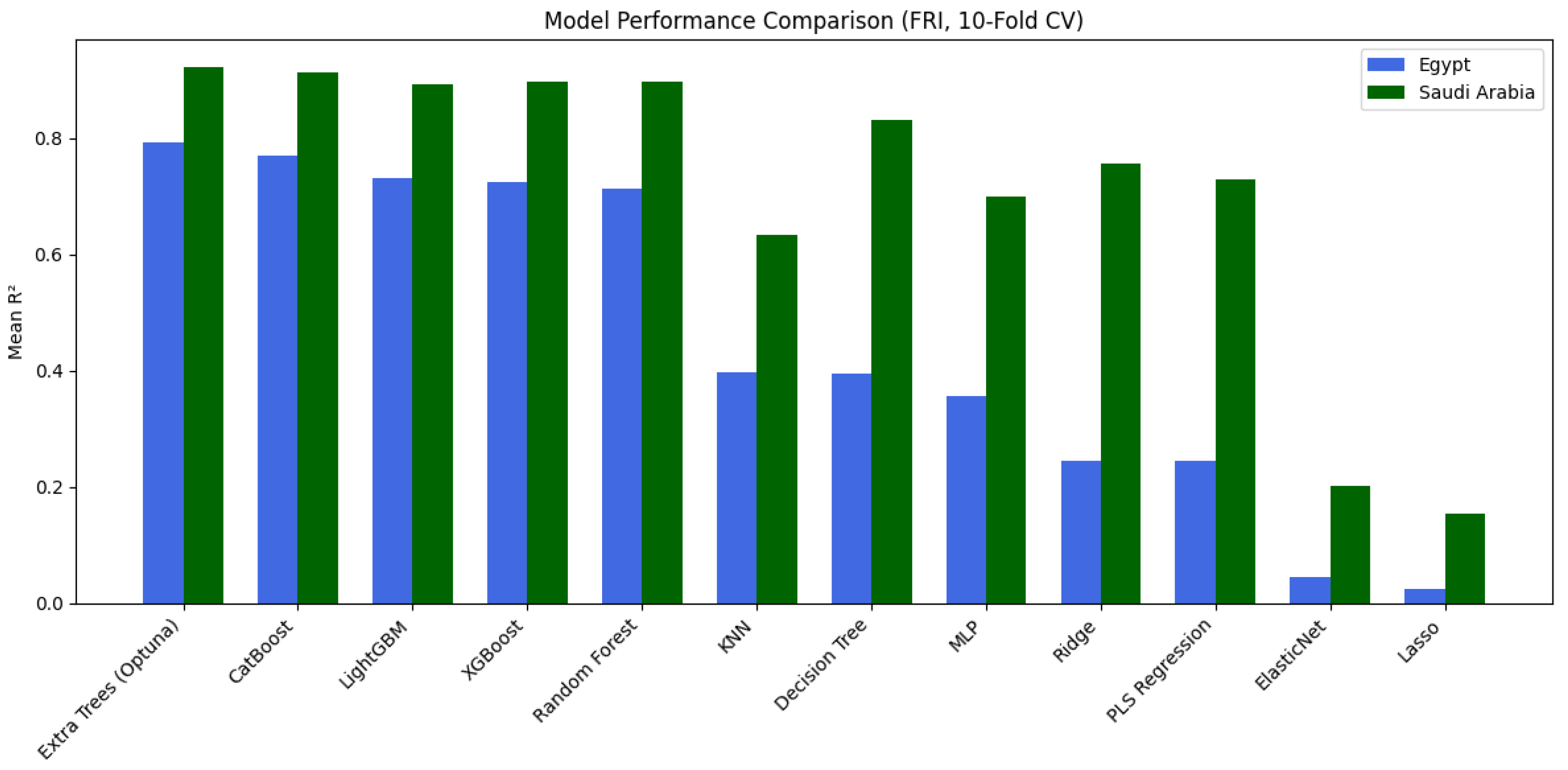
| Ensemble Models | Optuna Extra Trees | 0.7935 ± 0.0321 | 0.9884 | 0.6788 | ___ |
| CatBoost | 0.7697 ± 0.0298 | 1.0448 | 0.7421 | −3.3437 *** | |
| LightGBM | 0.7312 ± 0.0297 | 1.1277 | 0.8027 | −5.8500 *** | |
| XGBoost | 0.7250 ± 0.0525 | 1.1381 | 0.7996 | −5.5192 *** | |
| Random Forest | 0.7120 ± 0.0426 | 1.1681 | 0.8092 | −7.6679 *** | |
| Individual ML Models | KNN | 0.3971 ± 0.1033 | 1.6848 | 1.2708 | −13.8470 *** |
| Decision Tree | 0.3949 ± 0.1378 | 1.6876 | 0.9857 | −9.3096 *** | |
| MLP | 0.3557 ± 0.0850 | 1.7430 | 1.3940 | −19.0501 *** | |
| Statistical Models | Ridge | 0.2452 ± 0.0546 | 1.8908 | 1.5626 | −22.5508 *** |
| PLS Regression | 0.2451 ± 0.0515 | 1.8909 | 1.5516 | −22.6626 *** | |
| ElasticNet | 0.0451 ± 0.0271 | 2.1286 | 1.8067 | −26.5610 *** | |
| Lasso | 0.0247 ± 0.0250 | 2.1512 | 1.8248 | −26.6730 *** |
| Model | R2 (±SD) | RMSE | MAE | DM Stat (Sig.) | |
|---|---|---|---|---|---|
| Ensemble Models | Optuna Extra Trees | 0.9231 (±0.0267) | 0.3892 | 0.2908 | ___ |
| CatBoost | 0.9125 (±0.0316) | 0.4148 | 0.3087 | −3.4429 *** | |
| Random Forest | 0.8982 (±0.0392) | 0.4487 | 0.3192 | −3.7900 *** | |
| XGBoost | 0.8980 (±0.0373) | 0.4484 | 0.3275 | −4.2384 *** | |
| LightGBM | 0.8933 (±0.0401) | 0.4588 | 0.3359 | −4.8522 *** | |
| Individual ML Models | Decision Tree | 0.8303 (±0.0607) | 0.5804 | 0.4034 | −7.4350 *** |
| MLP | 0.6983 (±0.0695) | 0.7840 | 0.6103 | −12.8027 *** | |
| KNN | 0.6334 (±0.1368) | 0.8567 | 0.6350 | −10.5028 *** | |
| Statistical Models | Ridge | 0.7559 (±0.0679) | 0.7013 | 0.5353 | −10.8798 *** |
| PLS Regression | 0.7292 (±0.0614) | 0.7413 | 0.5757 | −13.5602 *** | |
| ElasticNet | 0.2022 (±0.0604) | 1.2855 | 1.0609 | −20.2302 *** | |
| Lasso | 0.1540 (±0.0579) | 1.3237 | 1.0974 | −20.9125 *** |
| Egypt | Saudi Arabia | |||
|---|---|---|---|---|
| Model Specification | R2 (±SD) | DM Statistic | R2 (±SD) | DM Statistic |
| With Blockholder | 0.7935 (±0.0321) | −6.0013 *** | 0.9231 (± 0.0267) | −2.9914 *** |
| Without Blockholder | 0.7507 (±0.0234) | 0.9173 (± 0.0307) | ||
| Country | Measure | Extra Trees R2 | Random Forest R2 | ΔR2 |
|---|---|---|---|---|
| Egypt | Earnings Quality | 0.460 | 0.387 | +0.073 |
| Persistence | 0.222 | 0.171 | +0.051 | |
| Volatility | 0.598 | 0.549 | +0.049 | |
| Saudi | Earnings Quality | 0.414 | 0.360 | +0.054 |
| Persistence | 0.180 | 0.151 | +0.029 | |
| Volatility | 0.520 | 0.373 | +0.147 |
| Country | Measure | DM Stat | p-Value |
|---|---|---|---|
| Egypt | Earnings Quality | −2.0489 | 0.0405 |
| Saudi | Earnings Quality | −2.3420 | 0.0192 |
| Country | R2 With | R2 Without | ΔR2 | DM Stat | p-Value |
|---|---|---|---|---|---|
| Egypt | 0.4787 | 0.4223 | +0.0563 | −3.0855 | 0.0020 |
| Saudi | 0.4412 | 0.4412 | 0 | - | - |
| Variables | Egypt (EQ) | Saudi (EQ) | Egypt (MTB) | Saudi (MTB) |
|---|---|---|---|---|
| Blockholder | 0.103 | — | 0.0001 | 0.0021 |
| (0.088) | (0.0044) | (0.0036) | ||
| SIZE | 0.266 | 0.454 | 0.469 | −1.029 *** |
| (0.448) | (0.394) | (0.323) | (0.383) | |
| LEVER | −0.083 *** | 0.250 * | −0.236 | 0.749 ** |
| (0.020) | (0.150) | (0.421) | (0.345) | |
| MSHARE | −0.013 | 0.001 | 2.467 | 5.016 *** |
| (0.017) | (0.068) | (3.675) | (1.613) | |
| AGE | 0.522 | 1.328 | −0.069 ** | 0.023 |
| (1.251) | (0.936) | (0.034) | (0.020) | |
| Profit | −0.007 | 0.031 | 0.200 | 2.510 *** |
| (0.056) | (0.041) | (0.696) | (0.457) | |
| FOWN | −0.000 | −0.011 ** | −0.008 | −0.012 |
| (0.002) | (0.005) | (0.006) | (0.016) | |
| GROWTH | — | — | 0.001 | — |
| (0.067) | ||||
| Observations | 599 | 375 | 1071 | 675 |
| R2 (Within) | 0.004 | −0.006 | 0.068 | 0.196 |
| Firm FE | Yes | Yes | Yes | Yes |
| Year FE | Yes | Yes | Yes | Yes |
| Variables | Market_to_Book | Earnings Quality |
|---|---|---|
| Blockholder | −0.0037 | 0.0515 |
| (0.0165) | (0.1071) | |
| Blockholder2 | 0.0000 | −0.0390 |
| (0.0001) | (0.0696) | |
| Blockholder × Country | 0.0124 | 0.2075 |
| (0.0193) | (0.3259) | |
| Blockholder2 × Country | −0.0002 | −0.1961 |
| (0.0002) | (0.2634) | |
| SIZE | 0.2496 | 0.4529 |
| (0.2909) | (0.3205) | |
| MSHARE | 4.2821 * | −0.0126 |
| (2.2820) | (0.0199) | |
| LEVER | 0.0008 | −0.0613 ** |
| (0.2842) | (0.0252) | |
| AGE | −0.0566 ** | 1.0885 |
| (0.0281) | (0.7570) | |
| FOWN | −0.0079 | −0.0010 |
| (0.0059) | (0.0021) | |
| Profit | 1.1129 ** | −0.0067 |
| (0.5202) | (0.0498) | |
| Observations | 1746 | 974 |
| Firm FE | Yes | Yes |
| Year FE | Yes | Yes |
| R2 (Within) | 0.0112 | −0.0222 |
Disclaimer/Publisher’s Note: The statements, opinions and data contained in all publications are solely those of the individual author(s) and contributor(s) and not of MDPI and/or the editor(s). MDPI and/or the editor(s) disclaim responsibility for any injury to people or property resulting from any ideas, methods, instructions or products referred to in the content. |
© 2026 by the authors. Licensee MDPI, Basel, Switzerland. This article is an open access article distributed under the terms and conditions of the Creative Commons Attribution (CC BY) license.
Share and Cite
Ali, G.M.; Alaskar, M.Z. Nonlinear Association Between Controlling Shareholders and Financial Reporting Integrity: An Explainable Optuna-Optimized Ensemble Learning Approach in Egypt and Saudi Arabia. J. Risk Financial Manag. 2026, 19, 356. https://doi.org/10.3390/jrfm19050356
Ali GM, Alaskar MZ. Nonlinear Association Between Controlling Shareholders and Financial Reporting Integrity: An Explainable Optuna-Optimized Ensemble Learning Approach in Egypt and Saudi Arabia. Journal of Risk and Financial Management. 2026; 19(5):356. https://doi.org/10.3390/jrfm19050356
Chicago/Turabian StyleAli, Gihan M., and Mohammad Zaid Alaskar. 2026. "Nonlinear Association Between Controlling Shareholders and Financial Reporting Integrity: An Explainable Optuna-Optimized Ensemble Learning Approach in Egypt and Saudi Arabia" Journal of Risk and Financial Management 19, no. 5: 356. https://doi.org/10.3390/jrfm19050356
APA StyleAli, G. M., & Alaskar, M. Z. (2026). Nonlinear Association Between Controlling Shareholders and Financial Reporting Integrity: An Explainable Optuna-Optimized Ensemble Learning Approach in Egypt and Saudi Arabia. Journal of Risk and Financial Management, 19(5), 356. https://doi.org/10.3390/jrfm19050356