Article

Psychological Traits, Social Influence, and Behavioural Bias in Cryptocurrency Investment Decisions: An SOR-Based Mediation Model


by
Bambang Leo Handoko
*,
Dezie Leonarda Warganegara
,
Arta Moro Sundjaja
and
Evelyn Hendriana
Management Department, Binus Business School Doctor of Research in Management, Bina Nusantara University, Jakarta 11480, Indonesia
*
Author to whom correspondence should be addressed.
J. Risk Financ. Manag. 2026, 19(5), 343; https://doi.org/10.3390/jrfm19050343
Submission received: 19 March 2026 / Revised: 6 May 2026 / Accepted: 7 May 2026 / Published: 11 May 2026
(This article belongs to the Section Financial Technology and Innovation)

Abstract

This study explains cryptocurrency investment decisions by integrating personality traits, influencer credibility, and social influence within the Stimulus–Organism–Response (SOR) framework. Openness, extraversion, conscientiousness, influencer credibility, and social influence are positioned as stimuli; heuristic bias and herding behaviour as organism states; and cryptocurrency investment decision as the response, with risk tolerance acting as a serial mediating mechanism. Data were collected from 367 Indonesian retail cryptocurrency investors through an online survey and analysed using SEM-PLS. The measurement model demonstrates adequate reliability and convergent validity, while discriminant validity is supported by HTMT values below the recommended threshold. The results indicate that personality traits significantly influence heuristic bias, while influencer credibility and social influence increase herding behaviour. Heuristic bias and herding behaviour both positively affect risk tolerance and cryptocurrency investment decisions, with heuristic bias showing the stronger effect. Risk tolerance also positively influences investment decisions and mediates the effects of heuristic bias and herding behaviour. The model explains a substantial portion of the variance in cryptocurrency investment decisions (Adjusted R2 = 0.623). These findings extend the SOR framework to cryptocurrency markets by highlighting how psychological traits and social cues shape risk tolerance and ultimately influence investment behaviour in volatile digital asset environments.

1. Introduction

Cryptocurrencies have emerged as one of the most disruptive innovations in financial markets, offering decentralized transactions and alternative investment opportunities. Bitcoin, introduced by Nakamoto in 2008, marked the beginning of a new era in peer-to-peer digital currency systems (Rubasinghe, 2017). This technological foundation has attracted increasing attention from both investors and regulators worldwide. However, cryptocurrency markets are characterized by extreme volatility and intense sensitivity to external events. For example, the collapse of FTX in November 2022 caused Bitcoin’s price to fall sharply to USD 17,200 (Briola et al., 2023). On the other hand, positive signals, such as the U.S. Securities and Exchange Commission’s approval of Bitcoin ETFs in January 2024, pushed prices above USD 49,000 (Macheel, 2024). Such fluctuations highlight the role of investor sentiment and behaviour in driving market dynamics.
The growth of cryptocurrency adoption has been particularly notable in emerging markets such as Indonesia, supported by regulatory developments and increasing participation from retail investors (Aprilia, 2023; Ricardo, 2023). At the same time, extreme price fluctuations, such as the Terra–Luna collapse, highlight the substantial risks associated with cryptocurrency investments (Briola et al., 2023). Unlike traditional financial markets, cryptocurrency markets are less regulated and heavily influenced by sentiment, information asymmetry, and social media dynamics, amplifying uncertainty in decision-making.
In uncertain environments, investors often rely on heuristics, or mental shortcuts, to simplify complex information. While useful, these shortcuts can lead to heuristic bias, producing systematic judgment errors that influence trading decisions (Sathishkumar & Vijayalakshmi, 2019). In addition, investors frequently exhibit herding behaviour, imitating others’ actions rather than analysing fundamentals, thereby contributing to market inefficiency (Rahyuda & Candradewi, 2023).
Social media has further amplified these behavioural tendencies. Studies have shown that information from influencers on platforms such as Twitter and TikTok can significantly affect trading decisions and even trigger buying frenzies in specific cryptocurrencies (Ye et al., 2022). Research also documents that social media influencers can influence not only brand consumption but also speculative investment behaviour (S. Li & Ma, 2024). These findings indicate that influencer credibility and social influence are essential drivers of herding in cryptocurrency markets.
Previous behavioural finance research in cryptocurrency markets has commonly treated heuristic bias and herding behaviour as antecedents of investment decisions (Kaur et al., 2023; Rahyuda & Candradewi, 2023). However, limited attention has been given to examining the factors that simultaneously influence both behavioural biases. In this study, heuristic bias and herding behaviour are positioned as mediating mechanisms rather than direct antecedents of investment decisions. Specifically, personality traits are examined as antecedents of heuristic bias (Baker et al., 2024; Treerotchananon et al., 2024), while influencer credibility and social influence are proposed as determinants of herding behaviour (Aren & Hamamci, 2024; Cialdini & Goldstein, 2004). Furthermore, prior studies rarely consider the sequential mechanisms by which heuristic bias and herding behaviour influence investment decisions through risk tolerance, despite its importance in determining investor responses to uncertainty (Gautam & Kumar, 2023).
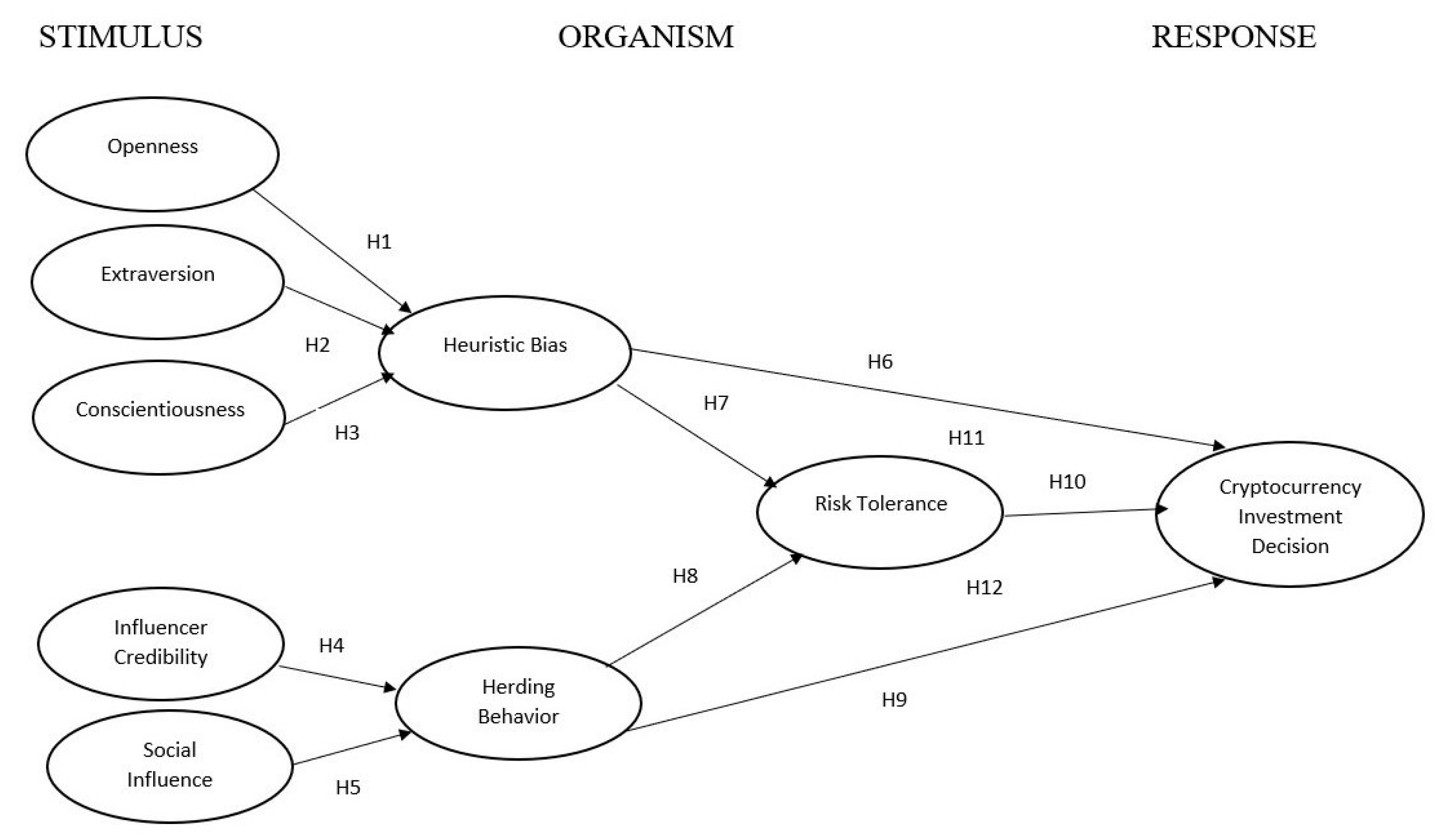
To address these gaps, this study adopts the Stimulus–Organism–Response (SOR) framework developed by Mehrabian and Russell (1974) to integrate personality traits, influencer credibility, and social influence as antecedents of heuristic and herding, with risk tolerance acting as a mediating mechanism linking these factors to cryptocurrency investment decisions. This approach aims to advance behavioural finance by explaining not only what investors do but also why and how psychological and social factors influence decision-making in volatile markets (Shiller, 2010; Tversky & Kahneman, 1974).
This study contributes to the literature not by introducing entirely new constructs but by reconfiguring existing variables into a more comprehensive and process-oriented model. Herding behavior is conceptualized as a mediating mechanism rather than an exogenous factor, and its antecedents are explicitly examined. In addition, integrating serial and parallel mediation pathways provides a more detailed understanding of how behavioral and social factors jointly influence investment decisions.

2. Literature Review and Hypothesis Development

2.1. Stimulus Organism Response Framework in Cryptocurrency Investment

Cryptocurrency refers to a digital currency that operates as a decentralized medium of exchange using cryptographic technology and blockchain systems (Ballis & Verousis, 2022; Gan et al., 2021). Unlike traditional financial systems, blockchain functions as a distributed ledger that records transactions across a network without centralized control (Herbert & Dixon, 2019; Kokina et al., 2017). As a peer-to-peer electronic system, cryptocurrency enables publicly verified and securely distributed transactions (Rubasinghe, 2017). Although initially developed as an alternative payment system, cryptocurrencies have evolved into a speculative investment asset characterized by high volatility and sensitivity to market sentiment (Rubasinghe, 2017).
Compared to traditional financial markets, cryptocurrency markets are less regulated, increasing exposure to risks such as fraud, market manipulation, and information asymmetry (Foley et al., 2019). These conditions foster behavioural patterns such as fear of missing out and speculative herding among investors (Song et al., 2024). While cryptocurrency differs from gambling in that it involves ownership of digital assets, its high volatility and susceptibility to hype often result in gambling-like behaviours, including short-term speculation and loss-chasing (Makarov & Schoar, 2020; Raphael & Stijn, 2018). These characteristics make cryptocurrency investment highly dependent on psychological and social influences, limiting the explanatory power of purely rational financial models.
Behavioural finance has been widely used to explain such decision-making processes by emphasizing cognitive biases such as heuristic bias, herding behaviour, and risk tolerance (Kasoga, 2021). However, this perspective primarily focuses on internal psychological processes and pays limited attention to the external stimuli that trigger these biases. In cryptocurrency markets, investor behaviour is also shaped by individual traits and social influences, including interactions on digital platforms and peer networks (Lin, 2012).
To address this limitation, this study adopts the Stimulus–Organism–Response (SOR) framework developed by Mehrabian and Russell (1974) as an overarching theoretical model. The SOR framework explains how external and internal stimuli (S) influence individuals’ cognitive and emotional states (O), which subsequently lead to behavioural responses (R) (Wang et al., 2025). This framework has been widely applied to analyse behaviour in emerging digital ecosystems, including blockchain and cryptocurrency markets (Jung et al., 2023).
In the context of this study, stimuli consist of both internal and external factors, including personality traits, influencer credibility, and social influence (Cialdini & Goldstein, 2004; Huang & Wu, 2024; Luo et al., 2024). These factors shape how investors process information and respond to uncertainty. The organism component represents internal cognitive mechanisms, particularly heuristic bias and herding behaviour, which influence decision-making under uncertainty (Kaur et al., 2023). Risk tolerance functions as a mediating mechanism that determines the extent to which these cognitive processes translate into investment behaviour (Murugappan et al., 2023). Finally, the response is reflected in cryptocurrency investment decisions.

2.2. Relationship Between Personality Traits and Heuristic Bias

Trait Theory, introduced by Costa and McCrae (1992), explains how individual personality differences influence information processing and judgment. Personality traits shape how individuals evaluate information and make decisions, which may in turn affect their susceptibility to cognitive shortcuts and heuristic biases. Previous studies suggest that personality traits can act as antecedents of several heuristic biases, such as availability, representativeness, anchoring, overconfidence, and the gambler’s fallacy. Within the Stimulus–Organism–Response (SOR) framework, personality traits function as the stimulus (S) that influences the organism (O), particularly the cognitive processes individuals use when making decisions in uncertain environments such as cryptocurrency markets.
Openness to experience reflects curiosity, creativity, and a willingness to explore new ideas and perspectives (Costa & McCrae, 1992). Individuals high in openness tend to seek novel approaches and alternative solutions, which may lead them to rely on intuitive judgments or heuristic shortcuts in complex, uncertain situations (Treerotchananon et al., 2024).
Extraversion is characterized by sociability, assertiveness, and a tendency to seek excitement and external stimulation (Chalissery et al., 2023). Highly extraverted individuals often prefer quick, confident decision-making and tend to rely on intuition or experience rather than extensive analysis. This tendency may increase their vulnerability to heuristic biases, especially in dynamic environments such as cryptocurrency markets, where rapid decisions are common (Jayawardena & Nanayakkara, 2025).
Conscientiousness refers to self-discipline, organization, and goal-directed behaviour (Obenza et al., 2024). Individuals with high conscientiousness generally make careful and structured decisions. However, in volatile environments such as cryptocurrency trading, time pressure and complexity may encourage even conscientious individuals to rely on heuristics to simplify information processing. This reliance may also relate to anchoring bias, where initial information or historical price references strongly influence subsequent judgments (Treerotchananon et al., 2024).
Drawing from the arguments presented, the hypotheses of the study are defined as follows:
H1: 
Openness positively influences heuristic bias.
H2: 
Extraversion positively influences heuristic bias.
H3: 
Conscientiousness positively influences heuristic bias.

2.3. Relationship Between Influencer Credibility and Herding Behaviour

Social media influencers play a central role in shaping herding behaviour in cryptocurrency markets, where investment decisions are often made under conditions of uncertainty and with limited fundamental information. Unlike stock markets, which rely on financial statements and analyst reports, cryptocurrency markets are heavily driven by signals and sentiments shared on social media (Wolk, 2019). Influencers on platforms such as Twitter, X, YouTube, and TikTok are credible sources of information, and their perceived expertise and trustworthiness strongly influence investors’ willingness to follow their recommendations (Ohanian, 1990). The rapid dissemination of information through social media marketing, hashtags, and trending discussions accelerates emotional contagion and fosters collective decision-making, often leading to herding (T. Li et al., 2023). In such contexts, credibility and social pressure function as external stimuli that elicit psychological responses, including herding, consistent with the SOR framework.
H4: 
Influencer credibility positively influences herding behaviour.

2.4. Relationship Between Social Influence and Herding Behaviour

Social influence refers to pressure or encouragement from peers, family, and colleagues that shapes individual decision-making (Cialdini & Goldstein, 2004). In cryptocurrency markets, where information is limited and uncertainty is high, investors often look to the behaviour and opinions of close social groups for guidance. These interpersonal influences can create conformity pressures that encourage individuals to follow the collective actions of their network, even without independent analysis (Bikhchandani & Sharma, 2001). Through mechanisms such as peer discussion, family endorsement, or workplace trends, social influence fosters imitation, which can translate into herding behaviour, particularly when investors seek validation and reassurance in volatile markets (Paseru et al., 2023).
H5: 
Social influence positively influences herding behaviour.

2.5. Relationship Between Heuristic Bias on Cryptocurrency Investment Decision and Risk Tolerance

Within the Stimulus–Organism–Response (SOR) framework, heuristic bias refers to the organism (O) component, the internal cognitive shortcuts that influence how investors process information and make decisions. Heuristic bias occurs when individuals rely on intuitive judgments or simple rules of thumb instead of thorough analytical evaluation (Tversky & Kahneman, 1974). This tendency becomes particularly relevant in highly uncertain and speculative environments such as cryptocurrency markets, where investors frequently face complex information, rapid price fluctuations, and limited regulatory structures (Kasoga, 2021).
In cryptocurrency trading, investors often rely on heuristics to simplify complex decision-making processes. However, these shortcuts may lead to systematic errors that influence both investment behaviour and risk perceptions (Badlani et al., 2023). For example, overconfidence bias can cause investors to overestimate their predictive abilities and underestimate potential risks, while availability bias leads them to place greater weight on recent or easily recalled market events when making investment decisions (Zain et al., 2022). These biases may lead to suboptimal investment decisions when investors rely more on intuition than on comprehensive analysis.
Heuristic biases also influence how investors perceive and tolerate risk. Biases such as anchoring and representativeness can distort risk perception by causing investors to rely on initial reference points or past trends when evaluating uncertain market conditions (Epley & Gilovich, 2001; Jain et al., 2023). As a result, investors may either underestimate or overestimate the level of risk they are willing to accept. Prior studies suggest that such cognitive shortcuts can significantly shape investors’ willingness to engage in risky financial activities, particularly in volatile markets such as cryptocurrency markets (Bouri et al., 2019).
Drawing from the arguments presented, the hypotheses of the study are defined as follows:
H6: 
Heuristic bias positively affects cryptocurrency investment decision.
H7: 
Heuristic bias positively affects risk tolerance.

2.6. Relationship Between Herding Behavior on Cryptocurrency Investment Decision and Risk Tolerance

Within the Stimulus–Organism–Response (SOR) framework, herding behaviour is categorized as the organism (O), representing internal psychological responses that arise when investors react to external social influences such as peer pressure, social norms, or prevailing market sentiment. Herding behaviour refers to the tendency of individuals to imitate others’ actions rather than conduct independent analysis (Ballis & Verousis, 2022; Bikhchandani & Sharma, 2001). In such uncertain environments, herding often serves as a coping mechanism, simplifying decision-making by following the perceived wisdom of the crowd. However, this behaviour may also distort investors’ judgment and risk awareness (Rahyuda & Candradewi, 2023). By relying on collective actions rather than independent evaluation, investors may contribute to price bubbles, panic selling, and heightened market volatility (Kyriazis, 2020). Empirical studies indicate that herding behaviour significantly influences cryptocurrency investment decisions, as investors often react to market trends, news, and other traders’ behaviour (Almansour et al., 2023).
In addition to affecting investment decisions, herding behaviour shapes investors’ risk tolerance. When individuals observe others engaging in similar investment actions, they may perceive reduced individual risk and become more willing to accept greater uncertainty (Akhtar & Das, 2020). Conversely, during negative market sentiment, collective selling behaviour may amplify fear and reduce investors’ willingness to bear risk (Bouri et al., 2019). These dynamics suggest that herding behaviour plays an important role in shaping investors’ attitudes toward risk in volatile markets, such as the cryptocurrency market (Sharma et al., 2024).
Drawing from the arguments presented, the hypotheses of the study are defined as follows:
H8: 
Herding behaviour positively affects cryptocurrency investment decision.
H9: 
Herding behaviour positively affects risk tolerance.

2.7. Relationship Between Risk Tolerance and Cryptocurrency Investment Decision

In the SOR framework, risk tolerance denotes an internal psychological state (O) that reflects the extent of uncertainty or potential loss an individual is willing to accept when making financial decisions. It is a critical factor influencing participation in speculative markets, such as cryptocurrency markets, where volatility and uncertainty predominate (Srinivasan & Karthikeyan, 2023). Individuals with higher risk tolerance are more inclined to invest in crypto assets, perceiving extreme fluctuations as opportunities for high returns, whereas those with low tolerance tend to avoid such investments (Grable & Lytton, 1999).
Empirical evidence highlights that risk tolerance directly shapes investment decisions in crypto markets. Investors with greater risk tolerance are more willing to withstand volatility, market manipulation, or hacking threats and may adopt long-term strategies despite short-term losses (Veerasingam & Teoh, 2023). Conversely, lower tolerance leads investors to seek safer instruments. Thus, risk tolerance emerges as a key determinant of cryptocurrency investment behaviour, influencing whether individuals choose to engage in or withdraw from this high-risk financial environment (Boubaker et al., 2024).
H10: 
Risk tolerance positively influences cryptocurrency investment decisions.

2.8. Mediating Effect of Risk Tolerance on Cryptocurrency Investment Decision

Risk tolerance represents an investor’s willingness to accept uncertainty and potential financial losses in pursuit of expected returns. It is an important psychological factor that influences investors to evaluate risk and make financial decisions (Aeknarajindawat, 2020). In cryptocurrency markets, which are characterized by high volatility and speculative dynamics, risk tolerance plays a critical role in shaping investment behaviour (Almansour et al., 2023).
Within the Stimulus–Organism–Response (SOR) framework, risk tolerance functions as a mediating mechanism that explains how cognitive and social factors influence investment decisions. Heuristic biases such as overconfidence, representativeness, and availability can distort investors’ perceptions of risk, which subsequently affects their willingness to take on risk and shapes their decision-making behaviour (Jain et al., 2023). Similarly, herding behaviour may influence investors’ perceptions of risk by creating a sense of collective assurance, encouraging individuals to follow prevailing market trends rather than rely on independent evaluation (Srinivasan & Karthikeyan, 2023).
Investors with higher risk tolerance are more likely to accept market uncertainty and align their decisions with heuristic judgments or collective market behaviour. Conversely, those with lower risk tolerance tend to rely more on cautious evaluation and independent judgment (Y. Singh et al., 2023). Therefore, risk tolerance acts as an intervening mechanism that transmits the influence of both heuristic bias and herding behaviour into cryptocurrency investment decisions (Grable & Lytton, 1999; Hussain & Rasheed, 2023).
Drawing from the arguments presented, the hypotheses of the study are defined as follows:
H11: 
Risk tolerance mediates the positive effect of heuristic bias on cryptocurrency investment decision.
H12: 
Risk tolerance mediates the positive effect of herding behaviour on cryptocurrency investment decision.
The overall research model is presented in Figure 1.

3. Material and Methods

This study adopts a quantitative research design to examine the relationships among the proposed variables. A survey method was employed to investigate how psychological and social factors influence cryptocurrency investment decisions, with statistical analysis applied to ensure objectivity and reliability (Hair et al., 2022). The independent variables include openness, extraversion, conscientiousness, influencer credibility, and social influence, while heuristic bias, herding behaviour, and risk tolerance serve as mediating variables. Cryptocurrency investment decisions are treated as the dependent variable. The questionnaire items were adapted from previously validated scales in the literature.
Primary data were collected through an online questionnaire distributed via Google Forms to retail investors with prior cryptocurrency trading experience. The questionnaire included demographic information (age, gender, and education), investment experience, and measurement items for the research variables, all assessed on a five-point Likert scale. Secondary data from academic journals and related literature were also reviewed to provide theoretical and contextual support.
The population of this study comprises retail cryptocurrency investors, a population that is considered unknown and dynamic. Therefore, purposive non-probability sampling was applied. Respondents were required to actively invest in cryptocurrency, follow at least one crypto influencer, and have been exposed to influencer-related content within the past three months. The minimum sample size was determined using G*Power version 3.1.9.6 (f2 = 0.15, α = 0.01, power = 0.95) for three predictors, yielding a required sample size of 157 respondents. In addition, the sample-to-variable ratio method proposed by Memon et al. (2020), based on 16 variables, suggested a minimum sample size of 320 respondents.
The variables in this study were measured using instruments adapted from scales previously validated in the literature. Personality traits: extraversion, openness, and conscientiousness, were each measured using four indicators derived from Treerotchananon et al. (2024). Extraversion reflects sociability and ease in social interactions, openness captures creativity and imaginative thinking, while conscientiousness represents organization, planning, and goal-oriented behaviour.
Influencer credibility was operationalized as a multidimensional construct comprising expertise, trustworthiness, attractiveness, and similarity, measured with items adapted from Aren and Hamamci (2024). Social influence, defined as the impact of peers and significant others on investment behaviour, was measured using four indicators adapted from Kala and Chaubey (2023).
Heuristic bias was modelled as a second-order construct comprising five dimensions, namely representativeness, availability, overconfidence, gambler’s fallacy, and anchoring and adjustment, adapted from Jain et al. (2023). Herding behaviour, defined as the tendency of investors to imitate others’ investment actions, was measured using five items from Kaur et al. (2023). Risk tolerance, referring to an individual’s willingness to accept financial uncertainty in investment decisions, was measured using five indicators derived from A. Singh and Biswas (2024). Finally, the cryptocurrency investment decision was measured using four indicators related to goal achievement, confidence in decision-making, independent judgment, and portfolio performance, adapted from Kaur et al. (2023).

4. Results and Discussion

4.1. Demographic of Respondents

This section provides a detailed overview of the demographic profile of the 367 respondents who were included in the final dataset. The demographic characteristics describe the composition of cryptocurrency investors who participated in this study and help contextualize the behavioural patterns observed in subsequent analyses. Demographic respondents were presented in Table 1.
Based on Table 1, most respondents were male (76.84%), confirming prior findings stating that men are more involved in speculative, technology-driven investments (Senkardes & Akadur, 2021). The age profile was dominated by young adults, particularly those aged 21–30 years (35.24%), consistent with studies showing that younger individuals adopt emerging financial technologies more quickly due to higher digital literacy and risk-taking tendencies (Fujiki, 2021).
By profession, students accounted for the largest share (40.60%), followed by private employees (29.97%), indicating strong participation among young and early-career individuals. Most respondents had relatively short investment experience: 41.96% had invested for 1–2 years, and 29.97% for less than 1 year, suggesting that the sample was largely composed of beginner investors (Hadan et al., 2024).
Regarding financial allocation, 64.31% of respondents invested less than 10% of their monthly income in cryptocurrency, while 29.97% allocated 11–25%. This pattern reflects a cautious investment approach and limited financial exposure to crypto assets (Meshkova et al., 2020).

4.2. Common Method Bias, Validity, and Construct Reliability

Common method bias (CMB) arises when a single data collection method inflates relationships among variables. To enhance the assessment’s robustness, the study did not rely on a single procedure but used two complementary methods to detect common method bias. First, Harman’s single-factor test in SPSS version 25 showed a variance of 34.8%, below the 50% threshold, indicating no dominant single factor (Kock, 2017). Followed by a marker variable, Attitude Toward the Colour Blue (ATCB), which was tested using a full collinearity assessment; all VIF values were below 3.3 (Miller & Simmering, 2022). Both results confirm that CMB was not a concern in this study.
Two constructs were modelled as higher-order reflective-to-reflective: Heuristic Bias (representativeness, anchoring and adjustment, availability, gambler’s fallacy, and overconfidence) and Influencer Credibility (similarity, attractiveness, trustworthiness, and expertise). Using a two-stage approach, lower-order latent variable scores were first generated via the PLS algorithm and then specified as reflective indicators of the higher-order constructs. Convergent validity and reliability were reassessed, and the results confirm a robust, theoretically consistent measurement model (Table 2).
Table 2 presents a confirmatory assessment of the measurement model, including outer loadings, convergent validity (AVE), and internal consistency reliability (Cronbach’s alpha and composite reliability). The results show that all indicators load adequately on their respective constructs and that each construct meets the recommended thresholds for reliability and convergent validity.
Similarly, a discriminant validity test was conducted using the Heterotrait–Monotrait (HTMT) ratio to ensure that the higher-order constructs were empirically distinct. The results of the HTMT analysis for the higher-order constructs are presented in Table 3. All HTMT values were below the recommended threshold of 0.90, indicating that the higher-order measurement model satisfied the criteria for discriminant validity.
Although heuristic bias, herding behaviour, and risk tolerance are conceptually related within behavioural finance, they represent distinct dimensions of investor behaviour. Heuristic bias reflects individual cognitive processing, herding behaviour captures social influence, and risk tolerance represents an internal evaluative disposition toward risk. The empirical results confirm that these constructs are sufficiently distinct, as indicated by discriminant validity and collinearity assessments, suggesting that the model does not suffer from problematic overlap despite their theoretical proximity.

4.3. Hypothesis Testing

After all lower-order and higher-order constructs meet the criteria in the confirmatory factor analysis, the next step is to conduct hypothesis testing. Hypothesis testing was conducted using SmartPLS version 4 bootstrapping to obtain t-statistics, p-values, and path coefficients, which served as the basis for determining whether to accept or reject the research hypothesis. Hypothesis testing was conducted using the bootstrapping procedure in SmartPLS with 5000 subsamples to obtain t-statistics, p-values, and path coefficients. A one-tailed significance test was applied, as all hypotheses were formulated with clear directional expectations based on prior theory and empirical findings. The results of this hypothesis testing are presented in Table 4.
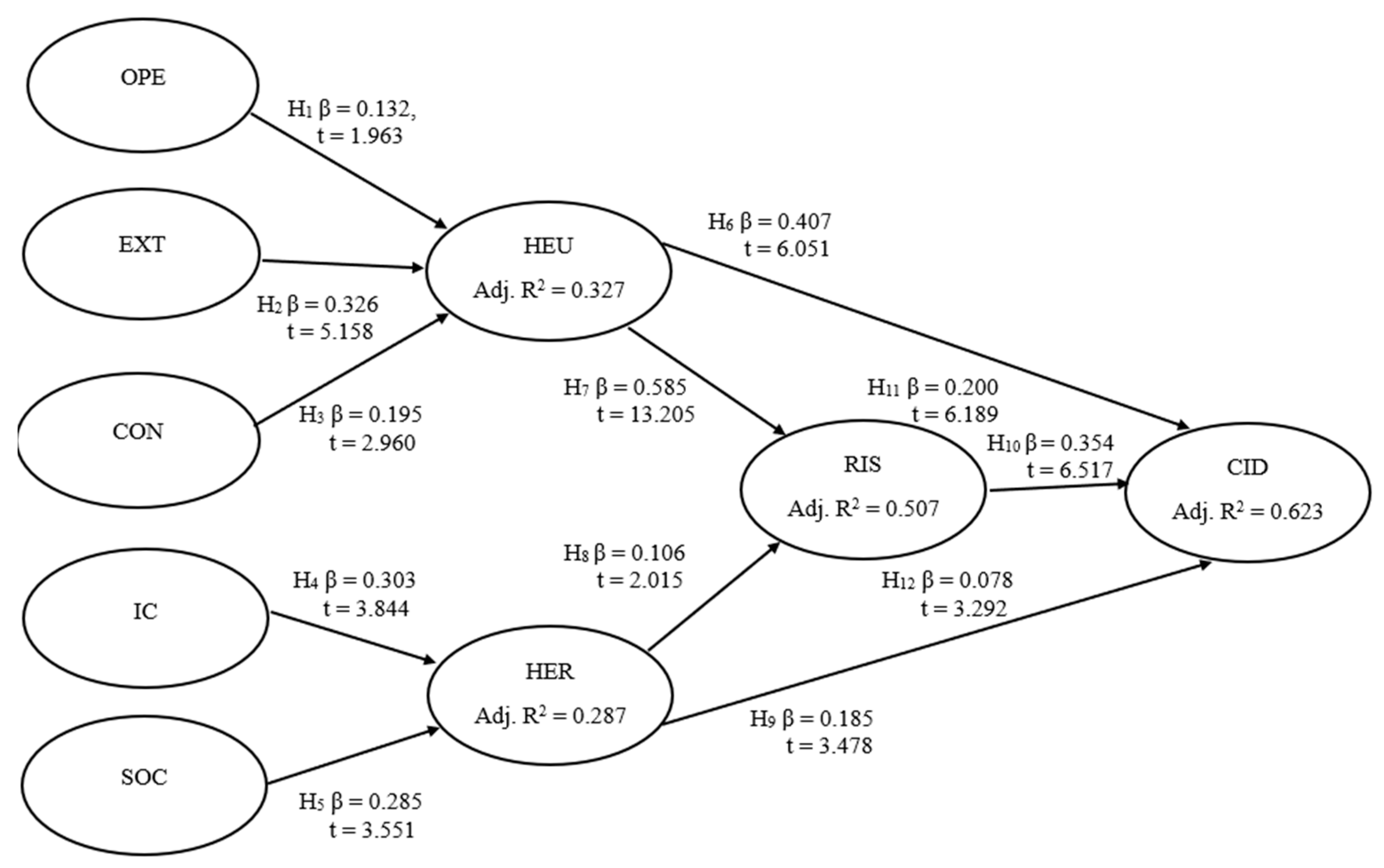
Bootstrapped results from SmartPLS support all hypothesized relationships (H1–H12). Personality traits significantly predict heuristic bias, with extraversion (β = 0.326, f2 = 0.082) and conscientiousness (β = 0.195, f2 = 0.027) showing meaningful effects, whereas openness (β = 0.132, f2 = 0.011) is significant but of negligible magnitude. Both influencer credibility (β = 0.303, f2 = 0.070) and social influence (β = 0.285, f2 = 0.062) significantly increase herding behaviour. Downstream, the heuristic bias strongly predicts risk tolerance (β = 0.585, f2 = 0.459) and investment decision (β = 0.407, f2 = 0.188), whereas herding has significant but small effects on investment decision (β = 0.106, f2 = 0.019) and risk tolerance (β = 0.185, f2 = 0.046). Risk tolerance also positively influences investment decisions (β = 0.354, f2 = 0.154) and significantly mediates the effects of heuristic bias (indirect β = 0.200) and herding (indirect β = 0.078) on investment decisions.
The standard error values range from 0.024 to 0.080, indicating an acceptable level of estimation precision across all structural paths. Most relationships exhibit relatively low standard errors compared to their corresponding path coefficients, suggesting stable and reliable estimates. However, for certain paths with smaller coefficients, such as openness to heuristic bias and herding behaviour to investment decision, the standard errors are relatively higher in proportion to the effect size, indicating weaker and less stable relationships. Overall, the results confirm that the model estimates are sufficiently precise and robust.
In terms of explanatory power, the model accounts for a moderate-to-strong proportion of the variance in cryptocurrency investment decisions (adjusted R2 = 0.623) and a moderate proportion of the variance in risk tolerance (adjusted R2 = 0.507). The explained variance is moderate for heuristic bias (0.327) and weak-to-moderate for herding behaviour (0.287), indicating that while the included personality and social stimuli are important, additional contextual factors likely also shape herding and heuristic formation in crypto markets. The path coefficient is presented in Figure 2.

4.4. PLS-Predict Assessment

To evaluate the model’s out-of-sample predictive performance, PLS-Predict was conducted following the procedure proposed by Shmueli et al. (2019). Given the non-normal distribution of prediction errors, Mean Absolute Error (MAE) was used as the primary evaluation metric. The results presented in Table 5 show that all indicators of Cryptocurrency Investment Decision exhibit positive Q2 predict values ranging from 0.205 to 0.229, indicating that the model is predictive. In comparing prediction errors between the PLS-SEM model and the linear model (LM) benchmark, the PLS-SEM model demonstrates lower MAE values for three indicators (CID.1–CID.3), while the LM benchmark performs slightly better for CID.4. Overall, these results suggest that the model exhibits moderate out-of-sample predictive power.

4.5. Discussion

This study explains cryptocurrency investment decisions using the Stimulus–Organism–Response (SOR) framework, where personality traits and social stimuli shape internal cognitive and social processes that ultimately influence investment behaviour (Mehrabian & Russell, 1974). The results show that openness, extraversion, and conscientiousness positively influence heuristic bias. Although the effect of openness on heuristic bias is statistically significant, its effect size is considered negligible. This indicates that, in practical terms, openness contributes only marginally to the formation of heuristic bias compared to other personality traits. In contrast, extraversion exerts a substantially stronger influence, likely due to its association with greater exposure to social interaction and external information sources, whereas conscientiousness plays a more stabilizing role through structured, disciplined decision-making.
Therefore, while openness may reflect a general tendency toward exploration, it does not meaningfully translate into biased decision-making in cryptocurrency investment. This finding suggests that practical interventions should prioritize managing socially driven and behavioral factors rather than focusing on exploratory personality traits. This finding suggests that individuals with higher openness tend to rely on intuitive and pattern-based judgments in uncertain environments (Akhtar & Das, 2020; Jayawardena & Nanayakkara, 2025). In speculative markets such as cryptocurrency, where information is complex and often incomplete, investors may rely more on intuitive reasoning than on systematic analysis (Treerotchananon et al., 2024). This tendency may also reflect the dominance of younger investors in cryptocurrency markets, particularly in Indonesia (Fujiki, 2021; Ismoyo, 2024).
Extraversion shows a stronger influence on heuristic bias, indicating that socially active and excitement-seeking individuals are more responsive to salient market signals and therefore more likely to rely on heuristic cues in fast-moving environments (Jayawardena & Nanayakkara, 2025). Conscientiousness also positively predicts heuristic bias, suggesting that even structured and goal-oriented investors may rely on simplifying cognitive shortcuts when faced with complex and time-sensitive information (James & Seranmadevi, 2024; Treerotchananon et al., 2024).
The findings further reveal that influencer credibility and social influence significantly increase herding behaviour. When influencers are perceived as credible, investors are more likely to imitate their actions, reinforcing collective behaviour in online investment communities (Aren & Hamamci, 2024; Wang & Chen, 2020). Similarly, social influence from peers and communities can create normative and informational pressures that encourage investors to conform to prevailing market trends, particularly in speculative environments where objective valuation is difficult (Bikhchandani & Sharma, 2001; Cialdini & Goldstein, 2004).
Heuristic bias has a strong positive effect on risk tolerance and a moderate positive effect on cryptocurrency investment decisions. This suggests that heuristic processing shapes investors’ perceptions of risk and increases their willingness to pursue uncertain investments (Kasoga, 2021). Biases such as overconfidence, availability, and representativeness may distort risk assessment, leading investors to underestimate potential losses and overestimate expected returns (Baker & Ricciardi, 2015; Jain et al., 2023).
Herding behaviour also positively affects both risk tolerance and investment decisions, although its direct effect on decisions is relatively small. This indicates that collective market behaviour influences investors but may weaken as investors gain experience and become more selective (Setiyono et al., 2013). The relatively lower explanatory power of herding behaviour suggests that this construct may be influenced by additional factors beyond those included in the current model. In this study, herding is conceptualised primarily as a socially driven behaviour shaped by influencer credibility and social influence. As such, the model captures the behavioural and social dimension of herding rather than market-driven dynamics. Other factors, such as price movements, volatility, or informational signals, may also contribute to herding behaviour but were not incorporated in the present study. This indicates that herding behaviour is a multidimensional construct, and future research may benefit from integrating both social and market-based determinants to enhance explanatory power.
Finally, risk tolerance significantly predicts cryptocurrency investment decisions and mediates the effects of heuristic bias and herding behaviour. This confirms that risk acceptance is a key mechanism linking cognitive biases and social influences on actual investment behaviour (Srinivasan & Karthikeyan, 2023). To further validate the role of risk tolerance, an alternative model specification was tested in which risk tolerance was treated as a moderating variable. The results show that the interaction effects are not statistically significant, indicating that risk tolerance does not strengthen or weaken the relationship between behavioural factors and investment decisions. This provides robustness support for the mediating role of risk tolerance. This finding reinforces the conceptualisation of risk tolerance as a mediating mechanism through which cognitive and social factors are translated into investment decisions, rather than as a boundary condition. Overall, the findings support the view that behavioural biases and social cues become more influential in volatile, sentiment-driven markets such as the cryptocurrency market (Shiller, 2010; Tversky & Kahneman, 1974).
While the statistical tests, including HTMT and discriminant validity assessments, provide strong support for the distinctiveness of the constructs, we acknowledge that heuristic bias, herding behaviour, and risk tolerance are conceptually close. These psychological and social mechanisms are deeply interrelated, particularly in the context of cryptocurrency investment decisions, where both individual cognitive biases and social influences often shape investor behaviour. The high correlation between these constructs reflects the complex and multifaceted nature of investment decision-making in volatile markets. This conceptual proximity suggests that, while statistically distinct, these constructs are likely influenced by shared underlying factors, warranting further exploration in future research.
In this study, we analysed the behavioural relationships among personality traits, heuristic bias, herding behaviour, and risk tolerance using SEM-PLS. While the statistical evidence supports the validity of these constructs, we acknowledge that the observed relationships are not entirely immune to fluctuations in market regimes or broader sentiment dynamics. The results may vary across different market conditions (bull vs. bear markets) and investor sentiment, which were not directly incorporated in our model. In future studies, we recommend examining how these external variables interact with the internal psychological mechanisms we identified, as such external factors may influence or even moderate the strength of the behavioural biases we observed.

5. Research Implication

5.1. Theoretical Implication

This study proposes an integrative SOR trait-based model that links personality traits, heuristic biases, social stimuli, herding behaviour, and risk tolerance to explain cryptocurrency investment decisions. The novelty of this study contributes to behavioural finance by integrating personality traits, social influence, and influencer credibility into a unified SOR framework to explain cryptocurrency investment decisions in emerging markets.
A key contribution is the extension of the Stimulus–Organism–Response framework to cryptocurrency investment behaviour (Mehrabian & Russell, 1974). The findings demonstrate that organism-level mechanisms, such as heuristic bias, herding behaviour, and risk tolerance, mediate the relationship between external stimuli and behavioural outcomes. Rather than directly triggering investment decisions, stimulus such as influencer credibility and social influence shape internal evaluations and risk perceptions that subsequently guide investment behaviour.
Positioning risk tolerance as a mediating mechanism also challenges traditional views that treat risk tolerance as a stable individual trait (Joo & Grable, 2004). The results suggest that risk tolerance is dynamically influenced by heuristic processing and social herding, particularly under conditions of uncertainty and information asymmetry (Jain et al., 2023). This highlights an important distinction between cryptocurrency markets and mature financial markets, where stronger regulation and standardized information reduce reliance on cognitive shortcuts (Shiller, 2010). In contrast, the absence of standardized valuation frameworks in cryptocurrency markets increases reliance on heuristics and socially transmitted signals, consistent with behavioural finance theories that emphasize biases under uncertainty (Tversky & Kahneman, 1974).
The significant influence of influencer credibility and social influence on herding behaviour also extends social learning and credibility theories to digital asset investment (Bandura, 1977; Hovland & Weiss, 1951). The findings suggest that credibility cues embedded in social media can function as powerful market stimuli, positioning influencers as informal experts and encouraging imitation among investors (Aren & Hamamci, 2024).
Finally, this study contributes to behavioural finance and trait theory by demonstrating that personality traits do not exert equal influence on heuristic bias. Extraversion and conscientiousness show stronger explanatory power, while openness appears to play a more limited role in speculative investment contexts. This suggests that the influence of personality traits on biased decision-making is contingent on market conditions, particularly volatility and information asymmetry (Costa & McCrae, 1992; Luo et al., 2024).

5.2. Practical Implication

The findings offer practical implications for stakeholders in the cryptocurrency ecosystem by translating empirical results into targeted behavioral interventions. Since heuristic bias shows the strongest influence on cryptocurrency investment decisions, cryptocurrency exchanges and fintech platforms should prioritize decision-support mechanisms that help investors evaluate information more regularly. These may include analytical dashboards, risk warnings, volatility alerts, and tools that encourage investors to reconsider impulsive decisions driven by cognitive shortcuts or market hype.
The significant role of influencer credibility and social influence in shaping herding behavior also highlights the need for stronger information governance. For regulators in Indonesia, such as Bappebti and the Financial Services Authority (OJK), the findings suggest the importance of clearer disclosure requirements for crypto-related promotional content, including paid endorsements, financial interests, and standardized risk statements. Such measures may reduce information asymmetry and protect retail investors from misleading or overly persuasive digital content.
For investment advisors and financial educators, the results indicate that investor education should not only focus on financial knowledge but also on behavioral awareness. Risk-profiling systems may incorporate indicators of susceptibility to heuristic bias, social influence, and herding tendencies. Educational programs should also include debiasing strategies, such as encouraging independent verification, predefined risk limits, and portfolio allocation discipline.
For influencers and digital content creators, the findings underscore the importance of responsible communication. Balanced explanations of both opportunities and risks, transparency regarding potential conflicts of interest, and avoidance of exaggerated claims are necessary to maintain credibility and reduce socially driven investment decisions.
Finally, for retail investors, the mediating role of risk tolerance suggests the need to align perceived risk with actual risk-taking behavior. Investors should be encouraged to define clear risk boundaries, avoid excessive reliance on social cues, and use disciplined investment rules before entering highly volatile cryptocurrency markets.

6. Conclusions

This study applies the Stimulus–Organism–Response (SOR) framework to explain cryptocurrency investment decisions by positioning personality traits (openness, extraversion, conscientiousness), influencer credibility, and social influence as stimuli; heuristic bias and herding behaviour as organisms; and cryptocurrency investment decisions as responses, with risk tolerance acting as a serial mediator. Based on SEM-PLS analysis of 367 retail investors, all hypotheses are supported. The model shows strong explanatory power for cryptocurrency investment decisions and moderate explanatory power for risk tolerance, indicating its suitability for analysing investment behaviour in volatile and sentiment-driven crypto markets.
The results show that openness, extraversion, and conscientiousness positively influence heuristic bias. The findings of this study reveal that personality traits do not exert equal influence within the proposed SOR framework. While openness, extraversion, and conscientiousness were initially positioned as parallel stimuli, the empirical results demonstrate a clear asymmetry in their effects.
Extraversion emerges as the most influential personality trait, exerting a substantial impact on heuristic bias, likely due to the high exposure of socially active investors to external information and influencer-driven content. In contrast, conscientiousness plays a more moderate, stabilizing role, reflecting its association with structured, disciplined decision-making.
Notably, openness shows a relatively small effect size, suggesting that although individuals with high openness are more inclined toward exploration, this trait does not translate into a significant increase in heuristic bias in cryptocurrency investment. This suggests that, in dynamic crypto markets, socially driven and impulsive tendencies (extraversion) and structured attempts to maintain control in complex situations (conscientiousness) are more likely to lead to reliance on cognitive shortcuts.
Influencer credibility and social influence also significantly increase herding behaviour. This finding indicates that herding among crypto investors is shaped not only by market trends but also by credible information sources and social pressure from peers and communities when investors face uncertainty.
Heuristic bias strongly affects risk tolerance and moderately influences investment decisions. Herding behaviour also positively affects risk tolerance and investment decisions, though its direct impact is relatively small. This suggests that cognitive mechanisms more strongly influence cryptocurrency investment decisions than by social imitation alone. Risk tolerance also significantly predicts investment decisions and mediates the effects of heuristic bias and herding behaviour.
However, this study has several limitations. Macroeconomic and contextual factors, such as market conditions (bullish or bearish), global sentiment, regulatory awareness, and external events (e.g., exchange scandals or tax policy changes), were not included in the model. Given that cryptocurrency markets are highly sensitive to news and sentiment, these factors may strengthen or weaken the influence of heuristic bias and herding behaviour.
This study focuses on Indonesian retail cryptocurrency investors, with a sample largely composed of younger, relatively less-experienced participants. While this reflects the demographic reality of many cryptocurrency markets, it may limit the generalisability of the findings to more experienced or institutional investors.
The behavioral patterns observed in this study may therefore be more representative of novice investor segments, where heuristic bias and social influence tend to be more prominent. Future research is encouraged to validate the proposed model across different countries, market environments, and investor profiles to enhance external validity.
This study is based on cross-sectional survey data, which limits the ability to draw causal inferences. Although the proposed model is theoretically grounded and specifies directional relationships, the empirical findings should be interpreted as associative rather than causal. Future research may adopt longitudinal designs, experimental methods, or instrumental variable approaches to better establish causal relationships among the constructs.
It is also important to consider the broader market context during the data collection period. At that time, the cryptocurrency market was influenced by major global developments, including the approval of the Bitcoin ETFs in January 2024. This event generated strong positive sentiment and heightened media attention, which may have increased investor optimism and participation.
Such conditions are likely to amplify socially driven behavior, including herding, as investors respond not only to market fundamentals but also to collective enthusiasm and external narratives. In this context, the observed influence of extraversion and social exposure may be partially shaped by the increased information flow and sentiment during this period. However, as market conditions were not explicitly modelled in this study, these interpretations should be viewed as contextual rather than associative. Future research may incorporate market phase variables or sentiment indicators to capture better the interaction between behavioral factors and evolving market dynamics.
Future research should consider incorporating these macro variables as moderators or controls. For example, future studies may examine whether bullish or bearish market conditions alter the influence of heuristics and herding on risk tolerance and investment decisions. Additionally, multi-group analysis could be conducted to compare investors with different levels of experience or generational characteristics, such as Gen Z and non-Gen Z investors, to determine whether behavioural mechanisms vary across investor groups.

Author Contributions

Conceptualization: B.L.H., A.M.S., E.H. and D.L.W.; methodology: A.M.S.; software: E.H.; validation: D.L.W.; formal analysis: B.L.H.; investigation: A.M.S. and E.H.; resources: B.L.H.; data curation: E.H. and A.M.S.; writing—original draft: B.L.H.; writing—review and editing: E.H. and A.M.S.; visualization: B.L.H.; supervision: D.L.W.; project administration: B.L.H., E.H., A.M.S. and D.L.W.; funding acquisition, B.L.H. All authors have read and agreed to the published version of the manuscript.

Funding

This research received no external funding.

Institutional Review Board Statement

The study was conducted in accordance with the Declaration of Helsinki and was approved by the Ethics Committee of Bina Nusantara University (No. 147/VR-RTT/VII/2025, 15 July 2025).

Informed Consent Statement

Informed consent was obtained from all subjects involved in the study.

Data Availability Statement

All datasets used in this study are available on https://zenodo.org/records/18887250 (accessed on 15 March 2026).

Conflicts of Interest

The authors declare no conflicts of interest.

References

  1. Aeknarajindawat, N. (2020). The combined effect of risk perception and risk tolerance on the investment decision making. Journal of Security and Sustainability Issues, 9(2), 807–818. [Google Scholar] [CrossRef] [Scilit]
  2. Akhtar, F., & Das, N. (2020). Investor personality and investment performance: From the perspective of psychological traits. Qualitative Research in Financial Markets, 12(3), 333–352. [Google Scholar] [CrossRef] [Scilit]
  3. Almansour, B. Y., Elkrghli, S., & Almansour, A. Y. (2023). Behavioral finance factors and investment decisions: A mediating role of risk perception. Cogent Economics and Finance, 11(2), 2239032. [Google Scholar] [CrossRef] [Scilit]
  4. Aprilia, Z. (2023). Sah! RI resmi punya bursa kripto. CNBC Indonesia. Available online: https://www.cnbcindonesia.com/market/20230721101229-17-456115/sah-ri-resmi-punya-bursa-kripto (accessed on 15 October 2025).
  5. Aren, S., & Hamamci, H. N. (2024). The direct and indirect effects of financial influencer credibility on investment intention. Croatian Review of Economic, Business and Social Statistics, 10(1), 57–69. [Google Scholar] [CrossRef] [Scilit]
  6. Badlani, B., Yadav, R. A., & Kumar, A. (2023). Psychological impact of cryptocurrency volatility on investor emotions and decision making. Journal for ReAttach Therapy and Developmental Diversities, 6(7), 204–214. [Google Scholar]
  7. Baker, H. K., Kathpal, S., & Akhtar, A. (2024). The Big 5 personality traits and investment biases: The role of financial literacy. Review of Behavioral Finance, 17(1), 172–197. [Google Scholar] [CrossRef] [Scilit]
  8. Baker, H. K., & Ricciardi, V. (2015). Understanding behavioral aspects of financial planning and investing. Journal of Financial Planning, 13(3), 22–26. [Google Scholar]
  9. Ballis, A., & Verousis, T. (2022). Behavioural finance and cryptocurrencies. Review of Behavioral Finance, 14(4), 545–562. [Google Scholar] [CrossRef] [Scilit]
  10. Bandura, A. (1977). Social learning theory. In Englewood cliffs. Prentice Hall. [Google Scholar] [CrossRef] [Scilit]
  11. Bikhchandani, S., & Sharma, S. (2001). Herd behavior in financial markets. IMF Staff Papers, 47(3), 279–310. [Google Scholar] [CrossRef] [Scilit]
  12. Boubaker, S., Karim, S., Naeem, M. A., & Rahman, M. R. (2024). On the prediction of systemic risk tolerance of cryptocurrencies. Technological Forecasting and Social Change, 198(3), 122963. [Google Scholar] [CrossRef] [Scilit]
  13. Bouri, E., Gupta, R., & Roubaud, D. (2019). Herding behaviour in cryptocurrencies. Finance Research Letters, 29(1), 216–221. [Google Scholar] [CrossRef] [Scilit]
  14. Briola, A., Vidal-Tomás, D., Wang, Y., & Aste, T. (2023). Anatomy of a Stablecoin’s failure: The Terra-Luna case. Finance Research Letters, 51(1), 103358. [Google Scholar] [CrossRef] [Scilit]
  15. Chalissery, N., Tabash, M. I., Nishad, T. M., Aburezeq, I. M., & Daniel, L. N. (2023). Does the investor’s trading experience reduce susceptibility to heuristic-driven biases? The moderating role of personality traits. Journal of Risk and Financial Management, 16(7), 325. [Google Scholar] [CrossRef] [Scilit]
  16. Cialdini, R. B., & Goldstein, N. J. (2004). Social influence: Compliance and conformity. Annual Review of Psychology, 55(1), 591–621. [Google Scholar] [CrossRef] [Scilit]
  17. Costa, P. T., & McCrae, R. R. (1992). The five-factor model of personality and its relevance to personality disorders. Journal of Personality Disorder, 6(4), 343–359. [Google Scholar] [CrossRef] [Scilit]
  18. Epley, N., & Gilovich, T. (2001). Putting adjustment back in the anchoring and adjustment heuristic: Differential processing of self-generated and experimenter-provided anchors. Psychological Science, 12(5), 391–396. [Google Scholar] [CrossRef] [Scilit] [PubMed]
  19. Foley, S., Karlsen, J. R., & Putnins, T. J. (2019). Sex, drugs, and Bitcoin: How much illegal activity is financed through cryptocurrencies? Review of Financial Studies, 32(5), 1798–1853. [Google Scholar] [CrossRef] [Scilit]
  20. Fujiki, H. (2021). Crypto asset ownership, financial literacy, and investment experience. Applied Economics, 53(39), 4560–4581. [Google Scholar] [CrossRef] [Scilit]
  21. Gan, J., Tsoukalas, G., & Netessine, S. (2021). Initial coin offerings, speculation, and asset tokenization. Management Science, 67(2), 914–931. [Google Scholar] [CrossRef] [Scilit]
  22. Gautam, S., & Kumar, P. (2023). Behavioral biases of investors in the cryptocurrency market. AIP Conference Proceedings, 2782(1), 20105. [Google Scholar] [CrossRef] [Scilit]
  23. Grable, J., & Lytton, R. H. (1999). Financial risk tolerance revisited: The development of a risk assessment instrument. Financial Services Review, 8(3), 163–181. [Google Scholar] [CrossRef] [Scilit]
  24. Hadan, H., Zhang-Kennedy, L., Nacke, L., & Mäkelä, V. (2024). Gamification and gaming in cryptocurrency education: A survey with cryptocurrency investors and potential investors. Simulation and Gaming, 55(2), 196–223. [Google Scholar] [CrossRef] [Scilit]
  25. Hair, J. F., Ringle, C. M., Hult, G. T. M., & Sarstedt, M. (2022). A primer on partial least squares structural equation modeling. SAGE Publications, Inc. [Google Scholar] [CrossRef] [Scilit]
  26. Herbert, J. B., & Dixon, J. (2019). Cryptocurrency: The next step in the noncash era? Judges’ Journal, 58(4), 37–39. [Google Scholar]
  27. Hovland, C. I., & Weiss, W. (1951). The influence of source credibility on communication effectiveness. Public Opinion Quarterly, 15(4), 635–650. [Google Scholar] [CrossRef] [Scilit] [PubMed]
  28. Huang, X., & Wu, F. (2024). What drives Chinese generation Z’s purchase intentions for new Chinese style apparel? A study from a stimulus-organism-response perspective. Journal of Fashion Marketing and Management, 29(2), 304–326. [Google Scholar] [CrossRef] [Scilit]
  29. Hussain, S., & Rasheed, A. (2023). Risk tolerance as mediating factor in individual financial investment decisions: A developing-country study. Journal for Studies in Economics and Econometrics, 47(2), 185–198. [Google Scholar] [CrossRef] [Scilit]
  30. Ismoyo, B. (2024). Crypto investors reach 18 million, 80 percent from generation Z to millennials. Tribunnews.com. [Google Scholar]
  31. Jain, J., Walia, N., Singla, H., Singh, S., Sood, K., & Grima, S. (2023). Heuristic biases as mental shortcuts to investment decision-making: A mediation analysis of risk perception. Risks, 11(4), 72. [Google Scholar] [CrossRef] [Scilit]
  32. James, A., & Seranmadevi, R. (2024). Unpacking the psychology of investment intention: The role of emotional intelligence, personality traits, and risk behaviour. International Research Journal of Multidisciplinary Scope, 5(1), 198–206. [Google Scholar] [CrossRef] [Scilit]
  33. Jayawardena, A. M. A., & Nanayakkara, N. S. (2025). How does loss aversion mediate the relationship between personality traits and efficiency of skills in investment decision-making? International Review of Management and Marketing, 15(1), 293–301. [Google Scholar] [CrossRef] [Scilit]
  34. Joo, S. H., & Grable, J. E. (2004). An exploratory framework of the determinants of financial satisfaction. Journal of Family and Economic Issues, 25(1), 25–50. [Google Scholar] [CrossRef] [Scilit]
  35. Jung, H. S., Lee, H., & Kim, J. H. (2023). Unveiling cryptocurrency conversations: Insights from data mining and unsupervised learning across multiple platforms. IEEE Access, 11, 130573–130583. [Google Scholar] [CrossRef] [Scilit]
  36. Kala, D., & Chaubey, D. S. (2023). Cryptocurrency adoption and continuance intention among Indians: Moderating role of perceived government control. Digital Policy, Regulation and Governance, 25(3), 288–304. [Google Scholar] [CrossRef] [Scilit]
  37. Kasoga, P. S. (2021). Heuristic biases and investment decisions: Multiple mediation mechanisms of risk tolerance and financial literacy—A survey at the Tanzania stock market. Journal of Money and Business, 1(2), 102–116. [Google Scholar] [CrossRef] [Scilit]
  38. Kaur, M., Jain, J., & Sood, K. (2023). “All are investing in Crypto, I fear of being missed out”: Examining the influence of herding, loss aversion, and overconfidence in the cryptocurrency market with the mediating effect of FOMO. Quality & Quantity, 58(1), 2237–2263. [Google Scholar] [CrossRef] [Scilit]
  39. Kock, N. (2017). Common method bias: A full collinearity assessment method for PLS-SEM BT—Partial least squares path modeling: Basic concepts, methodological issues and applications. In H. Latan, & R. Noonan (Eds.), Springer nature link (pp. 245–257). Springer International Publishing. [Google Scholar] [CrossRef] [Scilit]
  40. Kokina, J., Mancha, R., & Pachamanova, D. (2017). Blockchain: Emergent industry adoption and implications for accounting. Journal of Emerging Technologies in Accounting, 14(2), 91–100. [Google Scholar] [CrossRef] [Scilit]
  41. Kyriazis, N. A. (2020). Herding behaviour in digital currency markets: An integrated survey and empirical estimation. Heliyon, 6(8), e04752. [Google Scholar] [CrossRef] [Scilit] [PubMed]
  42. Li, S., & Ma, J. (2024). The impact of sentiment and engagement of Twitter posts on cryptocurrency price movement. Finance Research Letters, 65, 105598. [Google Scholar] [CrossRef] [Scilit]
  43. Li, T., Chen, H., Liu, W., Yu, G., & Yu, Y. (2023). Understanding the role of social media sentiment in identifying irrational herding behavior in the stock market. International Review of Economics & Finance, 87, 163–179. [Google Scholar] [CrossRef] [Scilit]
  44. Lin, H. (2012). How herding bias could be derived from individual investor types and risk tolerance? International Journal of Social, Behavioral, Educational, Economic, Business and Industrial Engineering, 6(6), 1395–1400. [Google Scholar]
  45. Luo, J., Cao, Q., & Zhang, S. (2024). How do personality traits affect investors’ decision on crypto market including cryptocurrencies and NFTs? Review of Behavioral Finance, 16(4), 600–619. [Google Scholar] [CrossRef] [Scilit]
  46. Macheel, T. (2024). Bitcoin rallies to 2-year high of $49,000 then fizzles as Crypto ETFs debut. Cnbc.com. Available online: https://www.cnbc.com/2024/01/10/bitcoin-falls-ether-surges-after-sec-greenlights-launch-of-us-bitcoin-etfs.html (accessed on 10 November 2025).
  47. Makarov, I., & Schoar, A. (2020). Trading and arbitrage in cryptocurrency markets. Journal of Financial Economics, 135(2), 293–319. [Google Scholar] [CrossRef] [Scilit]
  48. Mehrabian, A., & Russell, J. A. (1974). The basic emotional impact of environment. Perceptual and Motor Skills, 38, 283–301. [Google Scholar] [CrossRef] [Scilit]
  49. Memon, M. A., Ting, H., Cheah, J. H., Thurasamy, R., Chuah, F., & Cham, T. H. (2020). Sample size for survey research: Review and recommendations. Journal of Applied Structural Equation Modeling, 4(2), i–xx. [Google Scholar] [CrossRef] [Scilit]
  50. Meshkova, G., Akhmadeev, R., Lehoux, L., Yumashev, A., Meshkova, G., & Lukiyanova, M. (2020). Crypto asset assessment models in financial reposrting content typologies. Entrepreneurship and Sustainability Issues, 7(3), 2196–2212. [Google Scholar]
  51. Miller, B. K., & Simmering, M. J. (2022). Attitude toward the color blue: An ideal marker variable. Organizational Research Methods, 26(3), 409–440. [Google Scholar] [CrossRef] [Scilit]
  52. Murugappan, M., Nair, R., & Krishnan, S. (2023). Global market perceptions of cryptocurrency and the use of cryptocurrency by consumers: A pilot study. Journal of Theoretical and Applied Electronic Commerce Research, 18(4), 1955–1970. [Google Scholar] [CrossRef] [Scilit]
  53. Obenza, B., Torrefranca, J. P., Amarilla, J. D., Pandamon, J., Encarnacion, S., Getalado, G., & Azis, A. H. (2024). Personality traits and financial management behavior of university students. International Journal of Business and Applied Economics, 3(1), 1–20. [Google Scholar] [CrossRef] [Scilit]
  54. Ohanian, R. (1990). Construction and validation of a scale to measure celebrity endorsers’ perceived expertise, trustworthiness, and attractiveness. Journal of Advertising, 19(3), 39–52. [Google Scholar] [CrossRef] [Scilit]
  55. Paseru, A. K., De Valencia, C., & Hendratno, S. P. (2023). Analysis factors influencing Gen Z on investment decisions of cryptocurrency in Indonesia. In Proceedings of the 2023 6th international conference on computers in management and business, Macau, China, January 13–15 (pp. 37–42). Association for Computing Machinery. [Google Scholar] [CrossRef] [Scilit]
  56. Rahyuda, H., & Candradewi, M. R. (2023). Determinants of cryptocurrency investment decisions (study of students in Bali). Investment Management and Financial Innovations, 20(2), 193–204. [Google Scholar] [CrossRef] [Scilit]
  57. Raphael, A., & Stijn, C. (2018). Regulating cryptocurrencies: Assessing market reactions. In BIS quarterly review. BIS. [Google Scholar]
  58. Ricardo, E. (2023). RI punya bursa kripto, jual beli Bitcoin cs tak sebebas dulu? CNBC Indonesia. Available online: https://www.cnbcindonesia.com/research/20230724151844-128-456814/ri-punya-bursa-kripto-jual-beli-bitcoin-cs-tak-sebebas-dulu (accessed on 15 October 2025).
  59. Rubasinghe, D. I. (2017). Transaction verification model over double spending for peer-to-peer digital currency transactions based on blockchain architecture. International Journal of Computer Applications, 163(5), 24–31. [Google Scholar] [CrossRef] [Scilit]
  60. Sathishkumar, R., & Vijayalakshmi, P. (2019). Heuristic behaviour of individual investors on investment decision—A study with special reference to tirunelveli district. International Journal of Research and Analytical Reviews (IJRAR), 1, 120–125. [Google Scholar]
  61. Senkardes, C. G., & Akadur, O. (2021). A research on the factors affecting cryptocurrency investments within the gender context. Journal of Business, Economics and Finance, 10(4), 178–189. [Google Scholar] [CrossRef] [Scilit]
  62. Setiyono, Tandelilin, E., Hartono, J., & Hanafi, M. M. (2013). Detecting the existence of herding behavior in intraday data: Evidence from the indonesia stock exchange. Gadjah Mada International Journal of Business, 15(1), 27–44. [Google Scholar] [CrossRef] [Scilit]
  63. Sharma, D., Verma, R., Al-Bukari, M. B. H., Zaid, M. A. K., & Raghavan, P. (2024). Herding behavior in cryptocurrency market: Evidence from COVID-19, Russia–Ukraine war, and Palestine–Israel conflict. Cogent Economics and Finance, 12(1), 2437022. [Google Scholar] [CrossRef] [Scilit]
  64. Shiller, R. J. (2010). Measuring bubble expectations and investor confidence. Journal of Psychology and Financial Markets, 1(1), 37–41. [Google Scholar] [CrossRef] [Scilit]
  65. Shmueli, G., Sarstedt, M., Hair, J. F., Cheah, J. H., Ting, H., Vaithilingam, S., & Ringle, C. M. (2019). Predictive model assessment in PLS-SEM: Guidelines for using PLSpredict. European Journal of Marketing, 53(1), 2322–2347. [Google Scholar] [CrossRef] [Scilit]
  66. Singh, A., & Biswas, A. (2024). Dissecting investment frequency: Examining the role of social influence, investors’ perception of gender discrimination, involvement, access to information and risk tolerance. Social Responsibility Journal, 20(10), 2212–2236. [Google Scholar] [CrossRef] [Scilit]
  67. Singh, Y., Adil, M., & Haque, S. M. I. (2023). Personality traits and behaviour biases: The moderating role of risk-tolerance. Quality and Quantity, 57(4), 3549–3573. [Google Scholar] [CrossRef] [Scilit]
  68. Song, F., Graupensperger, S., Lostutter, T. W., & Larimer, M. E. (2024). Fear of missing out on financial gains: Associations between fear of missing out, problem gambling, and speculative trading in college students. Emerging Adulthood, 12(3), 387–397. [Google Scholar] [CrossRef] [Scilit]
  69. Srinivasan, K., & Karthikeyan, P. (2023). Investigating self-efficacy and behavioural bias on investment decisions. Finance, 26(4), 119–133. [Google Scholar] [CrossRef] [Scilit]
  70. Treerotchananon, A., Changchit, C., Cutshall, R., Lonkani, R., & Prasertsoontorn, T. (2024). The influence of personality traits on stock investment retention: Insights from Thai investors. Journal of Risk and Financial Management, 17(11), 486. [Google Scholar] [CrossRef] [Scilit]
  71. Tversky, A., & Kahneman, D. (1974). Judgment under uncertainty: Heuristics and biases. Science, 185(4157), 1124–1131. [Google Scholar] [CrossRef] [Scilit]
  72. Veerasingam, N., & Teoh, A. P. (2023). Modeling cryptocurrency investment decision: Evidence from Islamic emerging market. Journal of Islamic Marketing, 14(7), 1817–1835. [Google Scholar] [CrossRef] [Scilit]
  73. Wang, Y., & Chen, R. (2020). Cryptocurrency price prediction based on multiple market sentiment. In Proceedings of the annual Hawaii international conference on system sciences (pp. 1092–1100). IEEE Computer Society. [Google Scholar] [CrossRef] [Scilit]
  74. Wang, Y., Duong, N. T., Ying, C., Chang, Y., Wang, Y., Tien, N., Ying, C., & Chang, Y. (2025). What drives people’s cryptocurrency investment behavior what drives people’s cryptocurrency investment behavior. Journal of Computer Information Systems, 65(6), 688–705. [Google Scholar] [CrossRef] [Scilit]
  75. Wolk, K. (2019). Advanced social media sentiment analysis for short-term cryptocurrency price prediction. Expert System, 37, e12493. [Google Scholar] [CrossRef] [Scilit]
  76. Ye, Z., Wu, Y., Chen, H., Pan, Y., & Jiang, Q. (2022). A stacking ensemble deep learning model for Bitcoin price prediction using Twitter comments on Bitcoin. Mathematics, 10(8), 1307. [Google Scholar] [CrossRef] [Scilit]
  77. Zain, S., Qureshi, F., Iqbal, J., & Sultana, S. (2022). Overconfidence bias and investment performance: A mediating effect of risk propensity. Borsa Istanbul Review, 22(4), 780–793. [Google Scholar] [CrossRef] [Scilit]
Figure 1. Research Model.
Jrfm 19 00343 g001
Figure 2. Research Path Coefficient.
Jrfm 19 00343 g002
Table 1. Demographic Information of Respondents.
DemographicCategoryAmountPercentage
GenderMale28276.84
Female8523.16
AgeLess than 21 years8924.25
21–30 years13035.42
31–40 years7720.98
41–50 years4612.53
More than 50 years256.81
ProfessionStudent14940.60
Private employee11029.97
Entrepreneur5414.71
Professional318.45
Public employee164.36
Others71.91
Investment experienceLess than 1 year11029.97
1–2 years15441.96
3–4 years6818.53
5 years and above359.54
Percentage of IncomeLess than 10%23664.31
11–25%11029.97
26–50%174.63
More than 50%41.09
Crypto
Preference
Big caps25368.94
Low caps11431.06
Influencer backgroundContent creator19853.95
Educator8021.80
Analyst6116.62
Trader287.63
Social media platformInstagram19753.68
YouTube9926.98
TikTok5615.26
Twitter/X154.09
Table 2. Higher-Order Convergent Validity and Construct Reliability.
Variable/IndicatorLoading
Extraversion (AVE = 0.645, α = 0.816, CR = 0.879)
EXT.1I am interested in my surroundings0.800
EXT.2I feel comfortable around people0.785
EXT.3I am able to handle social situations0.792
EXT.4I am able to get along with new friends easily0.833
Openness (AVE = 0.631, α = 0.806, CR = 0.872)
OPE.1I like proposing new ideas0.756
OPE.2I am full of ideas0.832
OPE.3I am highly imaginative0.802
OPE.4I enjoy hearing new ideas0.786
Conscientiousness (AVE = 0.647, α = 0.818, CR = 0.880)
CON.1I am always prepared0.774
CON.2I am organized0.803
CON.3I make plans and follow through0.807
CON.4I carry out my plan as expected0.833
Influencer Credibility (AVE = 0.712, α = 0.866, CR = 0.908)
Latent Variable Attractiveness0.872
Latent Variable Expertise0.770
Latent Variable Trustworthiness0.845
Latent Variable Similarity0.884
Social Influence (AVE = 0.651, α = 0.821, CR = 0.882)
SOC.1People who influence my decision feel that I should invest in crypto0.825
SOC.2People whose opinion I appreciate advise me to invest in crypto0.790
SOC.3People who influence my behaviour share the positive aspect of crypto0.805
SOC.4My family motivates me to use crypto as an investment decision0.806
Heuristic Bias (AVE = 0.727, α = 0.906, CR = 0.930)
Latent Variable Representativeness0.865
Latent Variable Availability0.836
Latent Variable Overconfidence0.857
Latent variable Gambler’s Fallacy0.857
Latent Variable Anchoring and Adjustment0.851
Herding Behaviour (AVE = 0.636, α = 0.857, CR = 0.897)
HER.1Other investors’ decisions in cryptocurrency investment have influenced my investment decisions0.808
HER.2Other investors’ decisions regarding cryptocurrency volume have an impact on my investment decisions0.808
HER.3I usually react quickly to the changes in other investors’ decisions0.803
HER.4I usually follow other investors’ reactions to the crypto market0.756
HER.5Other investors’ decisions on buying and selling cryptocurrency have an impact on my investment decision0.810
Risk Tolerance (AVE = 0.628, α = 0.802, CR = 0.871)
RIS.1I am a bit sceptical when investing in new financial instruments0.793
RIS.2I prefer to continue with my current investments rather than try my hand at new investment avenues0.750
RIS.3I refrain from making risky investments0.812
RIS.4I usually invest money in financial instruments whose returns I am able to anticipate0.775
Cryptocurrency Investment Decision (AVE = 0.652, α = 0.733, CR = 0.849)
CID.1My cryptocurrency investment helps me achieve my investment goals0.784
CID.2I am confident that I can make accurate cryptocurrency investment decisions0.803
CID.3I make all cryptocurrency investment decisions myself0.795
CID.4My cryptocurrency portfolio returns justify my investment decisions0.743
Table 3. Heterotrait–Monotrait Ratio (HTMT).
CIDCONEXTHERHEUICOPERISSOC
CID
CON0.647
EXT0.6550.764
HER0.6650.4840.507
HEU0.8710.5650.6210.652
IC0.6620.6390.6110.5660.730
OPE0.6170.8390.8070.4840.5520.601
RIS0.8980.5100.5650.6610.8170.5760.551
SOC0.6800.5780.5380.5830.6050.7870.4920.558
CID: cryptocurrency investment decision; CON: conscientiousness; EXT: extraversion; HER: herding behaviour; HEU: heuristic bias; IC: influencer credibility; OPE: openness; RIS: risk tolerance; SOC: social influence.
Table 4. Hypothesis Testing.
HypothesisΒS.E.t-Valuep-ValueBCI-LLBCI-ULf2
H1: OPE → HEU0.1320.0661.9630.0250.0180.2410.011
H2: EXT → HEU0.3260.0635.1580.0000.2220.4280.082
H3: CON → HEU0.1950.0522.9600.0020.0850.3050.027
H4: IC → HER0.3030.0543.8440.0000.1830.4440.070
H5: SOC → HER0.2850.0633.5510.0000.1420.4050.062
H6: HEU → CID0.4070.0476.0510.0000.3020.5260.188
H7: HEU → RIS0.5850.07913.2050.0000.5140.6600.459
H8: HER → CID0.1060.0672.0150.0220.0140.1880.019
H9: HER → RIS0.1850.0543.4780.0000.0950.2680.046
H10: RIS → CID0.3540.0806.5170.0000.2600.4380.154
H11: HEU → RIS → CID0.2000.0326.1890.0000.1460.252-
H12: HER → RIS → CID0.0780.0243.2920.0010.0400.119-
CID: cryptocurrency investment decision; CON: conscientiousness; EXT: extraversion; HER: herding behaviour; HEU: heuristic bias; IC: influencer credibility; OPE: openness; RIS: risk tolerance; SOC: social influence. R2 Adjusted: CID: 0.623, HER: 0.287, HEU: 0.327, RIS: 0.507.
Table 5. PLS-Predict Results.
IndicatorQ2 PredictPLS SEM MAELM MAE∆ PLS SEM − LM
CID.10.2060.6280.631−0.003
CID.2 0.2050.6310.635−0.004
CID.30.2060.6430.663−0.020
CID.40.2290.6220.6180.004
CID: cryptocurrency investment decision.
Disclaimer/Publisher’s Note: The statements, opinions and data contained in all publications are solely those of the individual author(s) and contributor(s) and not of MDPI and/or the editor(s). MDPI and/or the editor(s) disclaim responsibility for any injury to people or property resulting from any ideas, methods, instructions or products referred to in the content.