1. Introduction
Over the past two decades, ESG ratings have become key instruments shaping investment decisions, corporate legitimacy, and sustainability strategies worldwide. Originally designed to complement traditional financial metrics and mitigate risks associated with environmental and social externalities, these ratings are increasingly promoted as tools that enhance transparency, long-term value creation, and stakeholder trust. Yet in many emerging markets, including Morocco, ESG ratings generate a paradox: while they are intended to improve accountability and support sustainable finance, they often produce opacity, inconsistencies, and symbolic compliance, particularly when global standards are applied to institutional contexts for which they were not designed.
In Morocco, the acceleration of sustainable finance initiatives has led to the progressive structuring of an ESG ecosystem involving several key institutional actors. The Casablanca Stock Exchange has played a central role through the launch of the MASI ESG index in 2018, which aims to promote transparency and highlight companies with strong sustainability performance. In parallel, the AMMC has strengthened the regulatory framework by introducing non-financial reporting requirements for listed companies, notably through its guidelines issued in 2019. These initiatives are complemented by the growing involvement of major Moroccan firms—such as OCP Group, Bank of Africa, and Taqa Morocco—in international ESG rating systems and sustainability reporting standards (GRI, TCFD, SASB).
Despite this institutional progress, several structural challenges persist, including methodological opacity, the limited contextualization of ESG criteria, unequal access to rating mechanisms between large firms and SMEs, and the increasing risk of greenwashing in response to rising expectations from global investors (
Kogi et al., 2025;
Janah & Sassi, 2023).
These tensions highlight the ambivalent—if not contradictory—effects of ESG ratings in the Moroccan context. For investors, they appear as credible signals that reduce information asymmetry and support long-term value creation. For companies, however, they can act as external constraints that impose significant administrative burdens, generate compliance pressures, and sometimes distort sustainability priorities. This duality illustrates a broader paradox in emerging markets: ESG ratings both reinforce legitimacy and create structural misalignments when global criteria collide with local realities marked by institutional voids, regulatory fragmentation, or varying levels of organizational maturity.
Against this backdrop, the present article seeks to understand how Moroccan economic actors—investors, business leaders, ESG officers, consultants, and regulatory institutions—perceive and interpret the benefits, constraints, and contradictions associated with ESG ratings. Despite the rapid diffusion of ESG practices in Morocco, existing research remains largely normative or quantitative, focusing on disclosure quality, financial performance, or regulatory reforms, while paying limited attention to how local actors themselves negotiate and make sense of ESG evaluation in practice. Little is known about the mechanisms through which global ESG frameworks are translated, adapted, or contested within an emerging market such as Morocco.
Despite the growing body of literature on ESG ratings, most existing studies have focused on developed markets, often assuming the comparability, neutrality, and effectiveness of ESG evaluation frameworks. In contrast, limited attention has been paid to how these instruments operate in emerging markets characterized by institutional gaps, regulatory fragmentation, and resource asymmetries. In particular, the paradoxical role of ESG ratings—simultaneously functioning as instruments of legitimacy and sources of constraint—remains underexplored in these contexts.
To address this gap, this study mobilizes a qualitative analysis of 31 semi-structured interviews to identify the institutional and organizational mechanisms underlying the ESG paradox and answer three interrelated questions: (1) How do Moroccan investors, companies, and institutional actors perceive the role and credibility of ESG ratings? (2) What benefits, constraints, and tensions do they associate with ESG evaluation processes? (3) How do these perceptions reveal the paradoxical nature of ESG ratings at the intersection of global standards and local institutional realities?
The remainder of the article is structured as follows:
Section 2 presents a three-part literature review covering the conceptual foundations of ESG ratings, their theoretical benefits for investors, and the challenges that they impose on companies.
Section 3 outlines the qualitative methodology and analytical approach.
Section 4 presents and discusses the empirical findings, highlighting the paradoxical effects of ESG ratings in the Moroccan context.
Section 5 concludes with key insights, theoretical and practical implications, limitations, and recommendations for a more context-sensitive implementation of ESG ratings in Morocco.
2. Literature Review
2.1. Theoretical and Conceptual Foundations of ESG Ratings
ESG ratings refer to non-financial evaluation systems that assess firms’ ability to integrate environmental, social, and governance dimensions into their strategy and operations. Beyond their technical function, ESG ratings are embedded in broader theoretical frameworks that explain why firms adopt, adapt, or resist such evaluation mechanisms.
It reflects the evolution of the financial paradigm: from a logic focused exclusively on profitability, we are moving towards a broader vision of performance, including environmental sustainability, social responsibility, and ethical governance (
Capelle-Blancard & Petit, 2013). Today, it is structured around international standards (GRI, SASB, TCFD), rating agencies (Sustainalytics, MSCI, LSEG, etc.), and specialized stock market indices (MASI ESG in Morocco, for example). This approach aims to provide investors with a more comprehensive view of corporate risk and sustainability.
However, the methodologies used by agencies vary greatly, leading to divergent ratings (
Berg et al., 2022). This lack of harmonization complicates the interpretation of ESG scores and can undermine local companies’ confidence in the relevance of the system.
To understand how Moroccan firms perceive, adopt, or resist these ratings, this study mobilizes three complementary theoretical approaches—legitimacy theory, institutional theory, and stakeholder theory—which together shed light on the underlying logics of ESG engagement.
First, legitimacy theory (
Suchman, 1995) considers that organizations seek to appear legitimate in the eyes of their institutional environment.
Suchman (
1995, p. 572) defines legitimacy as “a widespread perception that an entity’s actions are desirable, appropriate, or proper.” From this perspective, the adoption of ESG practices is seen as a means of complying with social expectations and strengthening institutional legitimacy, particularly among investors and regulators. Companies can thus use ESG ratings to build a responsible image, even if this does not necessarily imply a profound transformation of their practices.
Next, institutional theory (
DiMaggio & Powell, 1983) explains the homogenization of organizational practices through the phenomenon of isomorphism.
DiMaggio and Powell (
1983) distinguish three forms of isomorphism that are relevant to understanding the rise of ESG practices:
Coercive, imposed by regulations or public policies (such as the non-financial re-porting requirement imposed by the AMMC in Morocco);
Mimetic, as imitation of companies perceived as exemplary or leaders in their sector (this is generally the case for multinationals);
Normative, which constitutes an influence from consultants, audit firms, or ESG rating agencies disseminating technical standards that are often international.
This theory sheds light on how Moroccan companies, even in the absence of direct economic incentives, are aligning themselves with ESG practices in response to growing institutional pressure.
Finally, stakeholder theory (
Freeman, 1984) posits that a company’s performance depends on its ability to meet the expectations of all groups that influence or are influenced by its activities. ESG, as a tool for managing environmental, social, and governance expectations, becomes a lever for dialogue with these stakeholders (customers, employees, local communities, NGOs, public authorities, investors, etc.). In a Moroccan context marked by rising social and environmental issues, this theory helps to understand the trade-offs made by companies between financial imperatives and societal responsibilities.
Taken together, these conceptual and institutional developments give ESG ratings an appearance of technical neutrality and global applicability. However, much of the existing literature tends to treat ESG frameworks as relatively universal instruments, underplaying their contested nature and the power asymmetries embedded in their design. Legitimacy theory has been criticized for sometimes naturalizing “symbolic” compliance and decoupling between discourse and practice; institutional theory may overestimate the stabilizing effects of isomorphism in emerging markets marked by institutional voids; and stakeholder theory often underestimates the structural imbalance between global investors and local firms.
These blind spots are particularly salient in contexts such as Morocco, where ESG ratings are imported from external reference frameworks and may clash with local regulatory, organizational, and resource constraints. It is precisely this tension—between the global promise of ESG as a neutral risk-management tool and its locally ambivalent, sometimes destabilizing effects—that shapes the paradox explored in this article.
2.2. The Benefits of ESG Ratings for Investors
For investors, ESG ratings serve as a screening tool, a means of measuring non-financial risk, and a basis for strategic decisions on capital allocation. They play an increasingly central role in modern portfolio management, where the integration of sustainability considerations is perceived not as a moral preference but as a mechanism for risk-adjusted financial performance. Several studies highlight the strategic importance of ESG ratings in reducing reputational, regulatory, and operational risks, thus contributing to firms’ long-term financial resilience (
Fatemi et al., 2018;
Friede et al., 2015). ESG ratings allow institutional investors—such as pension funds, sovereign wealth funds, and SRI-oriented asset managers—to filter firms based on their exposure to environmental and social controversies, governance weaknesses, and long-term sustainability risks.
According to
Jo et al. (
2010), ESG ratings are now systematically integrated into socially responsible investment (SRI) strategies, exclusion principles, and sector-based screening, particularly in sensitive industries such as coal, arms, or tobacco. In this context, the rating becomes a “signal” that reduces information asymmetry between companies and external financiers—an important mechanism in markets where non-financial reporting is heterogeneous or still emerging.
Empirical studies also confirm that companies with higher ESG ratings enjoy several financial advantages: lower cost of capital, improved access to long-term institutional capital, and higher market valuations (
Maccarrone et al., 2024;
Eccles & Klimenko, 2019;
Krüger, 2015). These effects stem from the perception that high-ESG firms are better governed, more transparent, and more likely to anticipate future regulatory pressures or environmental liabilities. Investors thus view ESG ratings as proxies for managerial quality, organizational legitimacy, and capacity to manage complex stakeholder relationships.
In emerging markets such as Morocco, where financial markets are still developing, the role of ESG ratings is amplified. Institutions such as the Casablanca Stock Exchange and the AMMC actively encourage ESG integration through disclosure requirements, sector guidelines, and educational initiatives aimed at listed companies (
AMMC, 2019,
2023). For investors operating in such contexts, reliable ESG indicators are particularly valuable because traditional financial statements may not fully capture governance practices, environmental risks, or social controversies. ESG ratings therefore complement financial analysis, helping investors evaluate companies operating in environments characterized by regulatory gaps, institutional voids, or limited enforcement capacity.
Empirical studies conducted in other emerging markets provide valuable insights into the dynamics of ESG adoption. Evidence from Turkey indicates that the relationship between ESG practices and firm performance is heterogeneous and shaped by governance structures and institutional conditions (
Fettahoğlu, 2025). Similarly, research in Egypt highlights the importance of ESG-related disclosure and governance practices in influencing firm value and investor perception, while emphasizing the role of regulatory and institutional environments (
Samaha et al., 2012). More broadly, the literature suggests that ESG effectiveness in emerging markets is contingent upon factors such as disclosure quality, enforcement mechanisms, and institutional maturity, which jointly shape both investor behavior and corporate strategies (
El Ghoul et al., 2018). Taken together, these findings indicate that the tensions observed in Morocco are not unique but rather reflect broader structural challenges associated with the diffusion of ESG frameworks across emerging economies.
Finally, recent Moroccan empirical evidence reinforces this positive valuation effect.
Bellari and El Amraoui (
2025) show that listed Moroccan firms with strong CSR practices and high ESG ratings engage in significantly less earnings management. This finding suggests that CSR and ESG performance act as governance-enhancing mechanisms that discipline managerial discretion, reduce opportunistic accounting behaviors, and increase financial transparency. For investors, this association strengthens the signaling value of ESG ratings: a highly rated firm is not only aligned with sustainability norms but is also perceived as more trustworthy, less prone to manipulation, and more likely to generate long-term stable returns. This governance effect is particularly salient in emerging markets, where corporate transparency and disclosure quality vary widely.
Together, these results highlight the attractiveness of ESG ratings for investors: they reduce uncertainty, act as credibility signals, and provide a standardized—albeit imperfect—framework to compare companies in contexts where non-financial information remains fragmented or difficult to access.
Table 1 synthesizes the main advantages of ESG ratings for investors identified in the literature, highlighting the underlying mechanisms through which ESG information influences investment decisions and capital allocation.
The studies included in this synthesis were selected based on three criteria: (1) their direct relevance to ESG ratings and investor behavior, (2) their empirical or theoretical contribution to the understanding of ESG mechanisms, and (3) their academic influence, reflected in publication in peer-reviewed journals and citation impact.
2.3. The Negative Effects of ESG Ratings for Companies
From the perspective of companies—particularly in emerging markets such as Morocco—ESG ratings can generate significant constraints, both operational and strategic. While investors increasingly rely on ESG ratings as signals of transparency and long-term value, firms often experience them as externally imposed requirements that demand substantial resources, generate uncertainty, and sometimes lead to distortions in sustainability practices.
A first category of challenges concerns the costs and organizational complexity associated with ESG reporting and evaluation. The production of non-financial data, the formalization of internal policies, the establishment of monitoring systems, and the external verification of information all require substantial human and financial resources (
Ioannou & Serafeim, 2017). These costs are especially burdensome for SMEs or firms with limited internal governance structures, reinforcing an asymmetry between large, visible corporations—often better equipped to manage ESG processes—and smaller organizations that may lack dedicated sustainability teams.
Serafeim (
2020) notes that such disparities risk creating a two-speed ESG adoption pattern, where only firms with sufficient resources are able to fully comply with rating requirements. In Morocco, where SMEs constitute more than 90% of the economic fabric but often have limited formalization, these barriers are particularly salient.
A second set of challenges relates to the heterogeneity of rating agencies and the opacity of their methodologies. Agencies often rely on divergent frameworks, weightings, and data sources, leading to inconsistent results for the same company.
Berg et al. (
2022) show that ESG score divergence can be substantial—even contradictory—undermining the comparability and reliability of ratings. For firms, this heterogeneity produces uncertainty and frustration, as it becomes unclear which criteria to prioritize or how to align internal efforts with external expectations. The issue is further complicated in emerging markets, where non-financial information is often incomplete or evaluated through proxies that may not reflect local realities. Such opacity weakens firms’ trust in the system and fuels skepticism about the objectivity of ESG ratings.
These methodological inconsistencies also contribute to a third challenge: the risk of greenwashing and symbolic compliance. When rating criteria appear misaligned with operational realities or when scoring mechanisms reward formal disclosure over substantive impact, firms may be incentivized to focus on policies, certifications, or communication rather than on real sustainability transformation (
Delmas & Burbano, 2011).
Marquis et al. (
2016) describe this phenomenon as “selective disclosure,” where companies strategically report positive information while omitting or downplaying negative aspects.
Lyon Thomas and Maxwell (
2011), even find a positive correlation between greenwashing and short-term stock market performance, suggesting that ESG ratings can inadvertently reward superficial compliance. This dynamic is especially dangerous in emerging economies, where external pressures to conform to global standards may lead companies to adopt performative rather than transformative behaviors.
A fourth challenge emerges from normative pressures and forced alignment with international standards. Frameworks such as GRI, SASB, or TCFD—although globally recognized—were largely developed in OECD countries and do not always account for the institutional, regulatory, or socio-economic specificities of emerging markets. According to
DiMaggio and Powell (
1983), the concept of coercive and normative isomorphism helps explain how companies adopt ESG practices primarily to conform to external expectations rather than because such practices are strategically meaningful or feasible. In Morocco, this results in what some authors refer to as “institutional over-stretching,” where firms are evaluated against benchmarks they did not help establish and that may exceed their operational capacities. This contributes to a sense of unfairness and a perceived disconnect between global ESG frameworks and local realities.
Finally, firms face significant reputational risks when their ESG ratings are low or when inconsistencies emerge between different agencies. A negative or declining rating can damage investors’ trust, limit access to financing, and affect public perception—even when the underlying evaluation is based on incomplete data or methodology misalignment. Because ratings are often public and persistent, companies have limited opportunities to contextualize or contest these assessments, increasing their exposure to unjustified scrutiny or market penalties.
Table 2 summarizes the main constraints and unintended effects of ESG ratings for companies, highlighting the mechanisms through which ESG evaluation may generate costs, distortions, and strategic tensions, particularly in emerging market contexts.
The studies presented in this table were selected based on their relevance to the challenges and unintended effects of ESG ratings, with particular attention paid to contributions addressing emerging market contexts, methodological limitations, and organizational constraints.
While the literature highlights both the benefits of ESG ratings for investors and their constraints for firms, it rarely examines how these two dimensions interact within a unified analytical framework, particularly in emerging market contexts. Most studies tend to analyze ESG performance either from a financial or governance perspective, without fully capturing the tensions that arise when global ESG standards are implemented in environments characterized by institutional gaps, regulatory fragmentation, and resource asymmetries.
This limitation is especially relevant in emerging economies such as Morocco, where ESG ratings are increasingly adopted despite structural constraints. In this context, the paradoxical role of ESG ratings—simultaneously functioning as instruments of legitimacy and sources of organizational constraint—remains insufficiently explored.
Building on these gaps, this study seeks to answer the following research question: how do ESG ratings operate across different stakeholder groups in Morocco, and how do these perceptions reveal the underlying tensions between global ESG frameworks and local institutional realities?
This perspective is particularly relevant for emerging markets, where ESG frameworks are implemented under conditions of institutional asymmetry and regulatory fragmentation, and where bridging the gap between normative frameworks and practical implementation remains a central challenge.
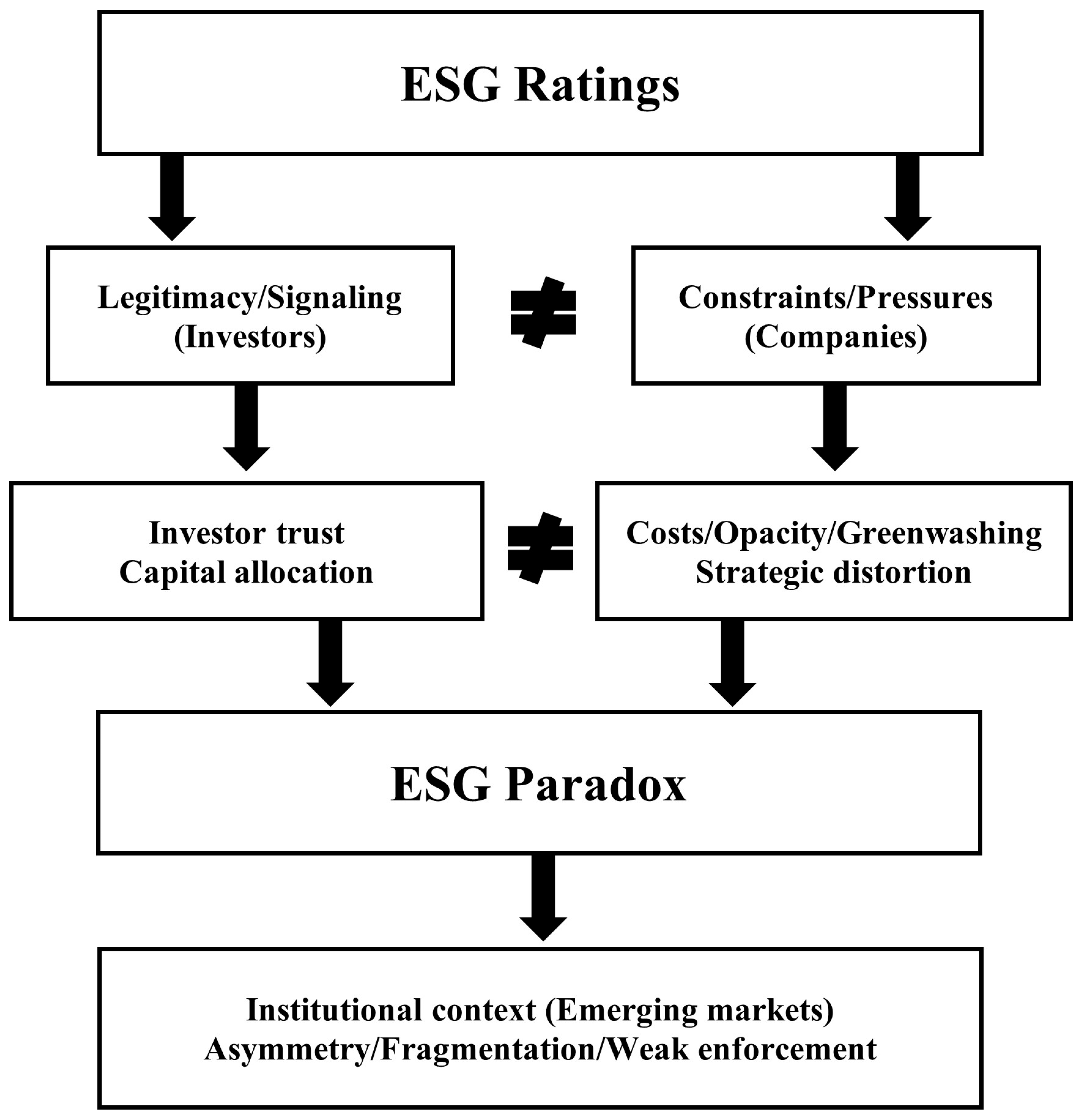
To synthesize the analytical logic of the study,
Figure 1 presents the conceptual framework underlying the ESG paradox identified in emerging markets.
3. Methodology
This work is part of a qualitative exploratory approach, which is particularly relevant when seeking to understand complex phenomena that have not yet been studied in depth in a specific context (
Yin, 2018). Indeed, the perception of Moroccan economic actors towards ESG ratings—between strategic leverage and operational constraint—is an emerging research topic, mobilizing symbolic, strategic, regulatory, and cultural dimensions. The study aims to bring out the representations, tensions, and contradictions surrounding this evaluation system, based on the discourse of directly concerned actors.
3.1. Description of the Methodological Approach
In order to achieve our objective, a field survey was conducted between September and December 2025, based on semi-structured interviews. This data collection technique was chosen for its flexibility in exploring respondents’ views in depth while ensuring the comparability of responses (
Miles et al., 2018).
The sample was selected based on the diversity of profiles and professional experience. It consists of 31 participants. The criteria used were related to the position held (ESG/CSR managers, financial managers, institutional investor representatives, ESG consultants/auditors, stock exchange representatives, etc.) and the nature of the organization (non-financial companies, banks, UCITS, etc.). This choice allowed for sectoral diversity while maintaining consistency with the subject of the study.
Participants were recruited using purposive sampling, targeting individuals directly involved in ESG-related decision-making, implementation, or evaluation. Access was facilitated through professional networks and institutional contacts, and subsequently extended via a snowball sampling approach to reach additional relevant experts. This strategy ensured both the relevance of profiles and diversity of perspectives.
We had to ensure that the size of the sample was not determined a priori on purely numerical grounds but rather followed a logic of theoretical saturation. Data collection and preliminary analysis were conducted iteratively, allowing emerging themes to be continuously compared across interviews. After approximately 26 interviews, no substantively new themes related to the research questions emerged, and the subsequent interviews mainly served to confirm and refine existing categories. The final sample of 31 interviews was therefore considered sufficient to capture the diversity of perceptions while ensuring analytical saturation within the Moroccan ESG context.
Interviews were conducted either in person or remotely, depending on participants’ availability and confidentiality constraints.
A semi-structured interview guide was developed, structured around four thematic areas: (1) General perceptions of ESG ratings; (2) Perceived benefits and opportunities of ESG ratings; (3) Constraints, obstacles, and criticisms related to ESG ratings; and, finally, (4) Prospects for improvement and future expectations. Each interview lasted between 40 and 70 min on average. All interviews were recorded (with permission) and transcribed in full.
The interviews were transcribed in full and then analyzed using thematic analysis (
Paillé & Mucchielli, 2016) to identify categories of meaning from the collected data. The coding was done manually, using a grid constructed on two levels: a priori categories, derived from the theoretical framework (legitimacy, isomorphism, stakeholders), and emerging categories, constructed inductively from the verbatim transcripts.
To enhance transparency, examples of the coding structure were developed using NVivo qualitative analysis software. First-order codes (e.g., “transparency”, “investor trust”, “reporting burden”, “greenwashing risk”) were derived directly from interview excerpts. These codes were subsequently grouped into second-order themes (e.g., legitimacy reinforcement, institutional misalignment), which were then aggregated into higher-level analytical dimensions aligned with the theoretical framework. This structured coding process enabled a systematic and traceable link between empirical material and theoretical interpretation.
The analysis revealed recurrences, sectoral variations, and narrative tensions, providing an in-depth understanding of the ambivalent perception of ESG ratings in the Moroccan context.
To enhance the reliability of the analysis, a subsample of ten interviews was independently coded by two researchers using the same coding grid. Inter-coder reliability was assessed using Cohen’s Kappa coefficient (κ = 0.855), indicating a high level of agreement and supporting the robustness and consistency of the thematic coding process. Discrepancies between coders were discussed and resolved through iterative comparison until consensus was reached.
In order to reinforce the validity of the results and limit the interpretation biases inherent in qualitative data, a methodological triangulation was implemented. This consisted of comparing the elements from the semi-structured interviews with a corpus of secondary institutional, normative, and operational sources. The following were used:
Circulars and guidelines from the Moroccan Capital Market Authority (AMMC) relating to non-financial reporting and ESG obligations for listed companies;
Strategic documents issued by the Casablanca Stock Exchange, in particular those governing the methodology for constructing the MASI ESG index;
Sector commitments and CSR reports issued by certain rated companies, notably OCP and Bank of Africa;
International standards used locally (GRI, TCFD, SASB), explicitly mentioned in the internal documents or sustainability reports consulted.
This documentary triangulation made it possible to compare the statements collected with formal institutional logic, while identifying discrepancies between prescribed standards and actual ESG reporting and compliance practices. This process allowed not only for validation of findings but also for refinement of emerging themes by confronting interview data with formal institutional evidence.
The triangulation process followed three analytical steps: (1) the identification and selection of relevant institutional and corporate documents; (2) a systematic comparison between interview data and documentary evidence to identify convergences and discrepancies; (3) the interpretation of these patterns to assess the alignment between formal ESG frameworks and actual practices. This procedure strengthened the internal validity of the findings by reducing reliance on a single data source.
3.2. Characteristics of Participants
According to
Whelan et al. (
2021), assessing the implementation of sustainability and responsible governance measures requires the direct involvement of strategic actors at the heart of decision-making processes. Applied to the field of ESG rating, this logic leads to a preference for profiles with visibility on internal governance issues, regulatory requirements, and investor expectations. This is why our sample is mainly composed of actors directly involved in the management, implementation, or evaluation of ESG initiatives.
However, our fieldwork revealed some reluctance on the part of highly exposed profiles (particularly within large listed companies), despite the use of professional and institutional networks to facilitate contact. In order to overcome these obstacles and ensure a diversity of viewpoints, we included in our sample complementary categories of stakeholders with recognized expertise in the fields of sustainable finance, strategic consulting, or regulation.
A total of 31 interviews were conducted with Moroccan stakeholders occupying strategic, operational, advisory, academic, and regulatory positions within the ESG ecosystem. As summarized in
Table 3, the sample combines actors directly subject to ESG evaluation with those involved in its production, interpretation, and regulation, ensuring a diversified yet analytically coherent set of perspectives.
This diversity of stakeholders made it possible to compare the perspectives of operational, strategic, academic, and institutional stakeholders, thereby enriching our understanding of the multiple representations associated with ESG ratings in the Moroccan context.
The sample is not intended to be statistically representative but is theoretically grounded, in line with qualitative research logic. It was constructed to capture the diversity of actors involved in the ESG ecosystem, including those subject to ESG evaluation (firms), those using ESG information (investors), and those contributing to its production and regulation (consultants, auditors, and institutional actors). This purposive design ensures that the analysis reflects a wide range of perspectives and allows for a comprehensive understanding of the mechanisms underlying the ESG paradox in the Moroccan context.
Table 3 presents the distribution of interviewees by professional category.
All respondents are based in the Casablanca–Rabat–Kenitra corridor, reflecting the regional scope of the study. Despite sustained efforts to recruit participants through professional and institutional networks, some reluctance was encountered among highly exposed profiles. To preserve analytical diversity, the sample was therefore expanded to include additional experts—such as consultants and academics—with recognized expertise in ESG-related issues.
Table 4 shows the distribution of these professionals according to their level of education.
Thus, more than 90% of those interviewed have a bachelor’s degree or higher (a high concentration compared to this level of education).
With regard to their professional experience, we were able to classify this factor as shown in
Table 5.
Analysis of the sample structure reveals that almost three-quarters of respondents have more than ten years of professional experience. This level of seniority is likely to influence how respondents perceive ESG ratings, particularly in terms of legitimacy, implementation, and strategic scope.
Indeed, this depth of experience gives respondents a comprehensive, structured, and often institutionalized view of ESG issues, rooted in compliance, risk management, and corporate governance. Their comments thus reflect a detailed understanding of regulatory constraints, stakeholder expectations, and the internal trade-offs that must be made to integrate ESG into strategy.
However, this professional seniority can also be accompanied by a form of methodological caution and an attachment to traditional management approaches, which are sometimes at odds with the more agile, innovative, or experimental approaches favored by more recent profiles. This institutional bias could explain a certain critical distance from ESG frameworks, which are perceived as too complex, prescriptive, or disconnected from operational realities, particularly in Moroccan SMEs.
3.3. Ethical Considerations
Given the qualitative nature of the study and the involvement of institutional and professional elites, particular attention was paid to issues of reflexivity and potential bias. The primary interviewer possesses prior academic and professional familiarity with ESG and the Moroccan financial ecosystem, which facilitated access to respondents and enriched contextual understanding but also carried the risk of implicit assumptions and social desirability effects. To mitigate these risks, the interview guide relied on neutral, open-ended questions; responses were systematically cross-checked across profiles; and reflexive memos were maintained throughout data collection and analysis. This reflexive approach aimed to ensure that interpretations remained grounded in participants’ discourse rather than in preconceived analytical frames.
In addition, particular attention was paid to the risk of self-reporting bias, as participants—especially those in strategic or highly visible positions—may present ESG practices in a more favorable light. To address this limitation, interview data were systematically triangulated with institutional and documentary sources, allowing for the identification of potential discrepancies between reported practices and formal ESG frameworks.
Furthermore, to uphold the ethical integrity of the research and ensure the protection of participants’ rights, a detailed informed consent form was provided and thoroughly explained to each participant prior to their involvement. Participation was entirely voluntary, and all participants were required to sign the consent form, which explicitly guaranteed the confidentiality and anonymity of their personal data. The form also specified that the information collected would be used exclusively for academic research and publication purposes. Participants were informed of their right to withdraw from the study at any point without any consequence.
In addition, comprehensive measures were implemented to safeguard the privacy and confidentiality of all collected data throughout the research process. Strict procedures ensured the secure handling and storage of data, and no identifying information was disclosed in the final analysis or reporting of results.
This study was conducted in full compliance with the ethical standards established by the Moroccan Charter of University Ethics and in accordance with Law No. 09-08 on the protection of individuals with regard to the processing of personal data. All participants provided their voluntary and informed consent prior to participation, consistent with these national ethical and legal requirements.
4. Presentation and Discussion of Research Results
This section presents the main results of the analysis of semi-structured interviews conducted with 31 Moroccan stakeholders involved in the governance, evaluation, or implementation of ESG initiatives. The objective is to understand how ESG ratings are perceived, interpreted, and integrated by the different profiles interviewed, while identifying the levers mobilized, the difficulties encountered, and the adaptation strategies.
The analysis followed a structured coding logic linking informant-centric expressions to higher-level analytical categories. First-order codes captured recurring ideas in participants’ discourse (e.g., transparency, investor trust, reporting burden, greenwashing risk). These codes were progressively grouped into second-order themes reflecting broader interpretive patterns (e.g., legitimacy reinforcement, institutional misalignment). At a higher level of abstraction, these themes were integrated into aggregate dimensions aligned with legitimacy, institutional, and stakeholder theories. The progression from first-order concepts (informant-centric expressions) to second-order themes and aggregate dimensions allows for a systematic abstraction of empirical data while preserving the richness of participants’ perspectives. This multi-level structure guided the interpretation of empirical material presented below.
Building on this multi-level coding process, the empirical results are organized around four analytical themes: (1) ESG ratings as instruments of legitimacy and signaling, (2) ESG ratings as tools of investor confidence and capital allocation, (3) ESG ratings as sources of organizational constraint and strategic distortion for firms, and (4) ESG ratings as contested instruments requiring contextual adaptation. Each theme is composed of several sub-themes derived from both deductive codes (legitimacy, institutional pressures, stakeholder expectations) and inductive categories emerging from the interviews (e.g., methodological opacity, symbolic compliance, reputational exposure). This structure makes it possible to move beyond descriptive accounts and to analyze the paradoxical effects of ESG ratings in the Moroccan context.
4.1. General Perceptions of ESG Ratings
This subsection addresses the first analytical theme of the study: ESG ratings as instruments of legitimacy and organizational signaling, revealing a relatively consistent understanding among participants, albeit with notable variations depending on the organizational profile, sector of activity, and level of CSR maturity.
Interview excerpts are used here as illustrative evidence to support analytical interpretations, rather than as direct representations of generalizable conclusions.
For many, ESG ratings are not just a technical indicator or an external label: they are seen as a genuine strategic management tool, embodying an organization’s ability to integrate sustainable development principles into its governance, operations, and internal culture.
“ESG ratings are our non-financial identity card. It reflects not only our CSR commitments, but also our ability to meet the expectations of the market and regulators.”
(P2)
This perception is in line with the work of
Bao et al. (
2024), which shows that ESG has gradually become a vehicle for integrating non-financial risk into models for assessing a company’s overall performance. Ratings thus become a tool for reducing information asymmetries, particularly for investors.
From a theoretical perspective, this signaling function is rooted in legitimacy theory (
Suchman, 1995), according to which companies strive to adapt their behavior to prevailing social norms in order to preserve or strengthen their legitimacy among stakeholders. In this context, ESG ratings appear to be a structuring tool for legitimacy, particularly for companies exposed to international markets or those with high media visibility.
This dual perception—ESG ratings as both credibility-enhancing signals and methodologically opaque instruments—already reveals the paradoxical nature of ESG evaluation in the Moroccan context.
Some respondents also highlight the performative nature of ratings: being rated leads to the transformation of internal practices, the structuring of CSR approaches, and even the gradual institutionalization of sustainability in decision-making processes.
However, several participants expressed methodological uncertainty regarding the methods used to calculate ESG scores. Some mentioned the opacity of the assessment grids and the heterogeneity of the methods used by the various agencies, which is consistent with the findings of
Berg et al. (
2022). These authors emphasize that the divergence in ratings between agencies can reach worrying levels, calling into question their comparability and therefore their practical usefulness.
“What we find problematic is not so much the principle of rating as the way in which it is done. Each agency has its own method, its own weightings… we no longer know which way to turn.”
(P5)
Finally, a more marginal but recurrent discourse—mainly expressed by consultants—concerns SMEs, for whom ESG ratings remain a vague or distant concept, often perceived as a top-down injunction or even a passing fad. This minority perspective reflects uneven institutional maturity and differential exposure to international markets, and reinforces the need for education and contextual adaptation of ESG standards at the national level.
These findings are consistent with prior studies emphasizing the role of ESG ratings as signaling mechanisms that enhance organizational legitimacy and reduce information asymmetry (
Suchman, 1995;
Eccles & Klimenko, 2019). However, in contrast to evidence from more mature markets, the Moroccan context reveals a stronger ambivalence, where ESG ratings simultaneously serve as credibility signals and as sources of uncertainty due to methodological opacity.
4.2. Perceived Advantages and Opportunities of ESG Ratings: Investors
From the perspective of investors, ESG ratings primarily function as instruments of confidence building, risk management, and capital allocation, giving rise to a largely positive and instrumental interpretation among institutional investors and the finance departments of large listed companies.
Several respondents from the financial world emphasize that ESG ratings have become an almost indispensable criterion for fundamental analysis, particularly in long-term investment strategies (pension funds, sovereign wealth funds, SRI UCITS).
“For us, ESG is a filtering tool. It is no longer a matter of philanthropy. We want to assess climate, social, and reputational risks and identify resilient companies.”
(P7)
This filtering function is consistent with the work of
Krüger (
2015) and
Eccles and Klimenko (
2019), which highlights that investors now incorporate ESG ratings to assess risk-adjusted performance. It also reduces the cost of gathering information in environments where non-financial data is still relatively inconsistent, such as in Morocco.
In this sense, ESG ratings function as a cognitive shortcut for investors, allowing them to standardize decision-making in contexts characterized by information asymmetry and uneven disclosure practices.
Based on stakeholder theory (
Freeman, 1984), ESG appears to be a synthetic indicator of a company’s ability to manage its relationships with its key stakeholders: employees, customers, suppliers, regulators, etc. This relational competence is perceived as a guarantee of stability and sustainable performance (
Shi, 2025).
“A company with a good ESG rating is a company that communicates with its employees, complies with regulations, and anticipates environmental risks. This inspires confidence.”
(P3)
From this perspective, ratings become a strategic legitimization tool, in line with the assumptions of legitimacy theory (
Suchman, 1995). They provide investors with visible proof of alignment with the sustainability standards expected by global markets.
In addition, several of the respondents directly link ESG ratings to financial incentives, such as reductions in the cost of capital, access to sustainable financing, or preferential terms on ESG-linked credit lines.
“Having a good ESG rating opens up access to certain investors who do not deal with poorly rated companies. It’s a passport.”
(P11)
This observation is supported by recent empirical work conducted by
Friede et al. (
2015),
Albuquerque et al. (
2020) and
Qu and Su (
2024), which confirm the existence of a positive correlation between high ESG scores and risk-adjusted stock market performance, particularly in times of crisis. ESG thus becomes a valuation tool as well as a risk indicator.
Nevertheless, a minority of respondents—mainly senior analysts and consultants advising international investors—expressed more cautious views. They acknowledged the usefulness of ESG ratings as screening tools but questioned their precision and comparability, noting that divergent scores across agencies can weaken confidence in individual ratings. For these actors, ESG indicators are viewed less as objective measures than as indicative signals that must be complemented by internal analysis and contextual knowledge.
Finally, ratings are seen as a differentiator in emerging markets. Several investors surveyed emphasize that, in a Moroccan context that is still relatively unregulated, a company’s good ESG score is a sign of maturity, transparency, and sound governance.
“A Moroccan company that voluntarily submits to ESG rating shows that it has a culture of transparency. That creates trust.”
(P5)
This strong investor reliance on ESG ratings, while enhancing trust and capital allocation efficiency, simultaneously contributes to increasing normative pressure on firms, thereby setting the stage for the organizational constraints and strategic tensions examined in the next subsection.
These findings converge with prior studies showing that ESG ratings play a central role in reducing information asymmetry and guiding investment decisions (
Friede et al., 2015;
Krüger, 2015). However, in contrast to evidence from more developed markets, respondents in this study emphasize a more cautious and contextualized use of ESG indicators, reflecting concerns about methodological divergence and limited comparability. This suggests that, in emerging markets such as Morocco, ESG ratings function less as fully standardized metrics and more as indicative signals that require complementary analysis and local expertise.
4.3. Negative Perceptions of ESG Ratings: Companies
In contrast to the predominantly positive investor discourse, company narratives reveal a more critical and ambivalent perception of ESG ratings. For firms operating in the Moroccan context, ESG ratings are frequently experienced as sources of organizational constraint, strategic distortion, and institutional pressure rather than purely as value-enhancing tools. The interviews highlight a set of interrelated structural, operational, and reputational challenges that together illustrate the constraining side of the ESG paradox.
4.3.1. Costs and Complexity of Compliance
A recurring criticism concerns the high cost of complying with ESG criteria, particularly for SMEs or companies with little formal governance. These costs relate to the production of ESG reports, the mobilization of internal resources (legal, CSR, audit), and the rating fees charged by agencies.
“Between reporting, internal audits, and external consulting, we’re talking about several hundred thousand dirhams. And that’s without any guarantee of a favorable rating.”
(P13)
These testimonials echo the findings of
Serafeim (
2020), according to which ESG integration is easier for large companies, while smaller companies may be excluded or penalized, despite their genuine efforts. The phenomenon of unequal access to ESG ratings thus reinforces a divide between companies, contradicting the supposed universality of the system.
4.3.2. Heterogeneity of Agencies and Lack of Transparency
Several executives express a loss of confidence due to the lack of harmonization between agencies. With equal scores on environmental issues, two agencies may arrive at very different overall ratings due to differing weightings or methodologies, as highlighted by
Berg et al. (
2022).
“We had two very different scores for the same period. Which one should we trust? This calls into question the credibility of the system.”
(P31)
The opaque nature of the criteria (weighting of E, S, or G dimensions, sector scoring, etc.) fuels suspicion of a system that lacks accountability and objectivity. This is accentuated by the commercial logic of certain agencies, which are paid by the companies they assess, fueling suspicion of collusion or greenwashing (
Lyon Thomas & Maxwell, 2011).
4.3.3. Risk of Strategic Greenwashing
Several respondents fear that ESG ratings, far from encouraging real transformation, encourage certain companies to adopt superficial compliance strategies. In an environment where ESG announcements are more visible than actual practices, there is a strong temptation to invest in communication rather than sustainable transformation.
“All you have to do is fill in the boxes, have a good consultant, and you’re done. It’s not the impact that counts, it’s the form.”
(P21)
This criticism echoes the work of
Lyon Thomas and Maxwell (
2011), which shows a correlation between greenwashing and short-term financial performance, illustrating an opportunistic drift: ESG ratings can become a tool for stock market valuation, with no tangible link to actual practices.
Taken together, these first three dimensions reveal a pattern of symbolic compliance under constraint. Faced with high implementation costs, methodological opacity, and strong reputational incentives, many firms adopt ESG practices primarily to satisfy external expectations rather than to drive substantive organizational change. This dynamic reflects a form of decoupling between formal ESG disclosure and operational reality, consistent with legitimacy theory’s distinction between symbolic and substantive conformity.
4.3.4. Normative Pressures and Forced Alignment
Another adverse effect highlighted concerns the growing normative pressure exerted by ESG logic on local companies. Many respondents mention the standardization of international frameworks (GRI, SASB, TCFD), which do not always take into account the economic, social, or cultural realities of Morocco.
“We are being forced to adopt frameworks modeled on Europe, without considering whether our companies have the means or the structure to follow them.”
(P18)
This refers to coercive isomorphism, where companies align themselves with dominant norms out of obligation, sometimes to the detriment of their own strategy (
DiMaggio & Powell, 1983). The result is a feeling of normative inferiority, where local companies are rated according to criteria that they did not help to define.
4.3.5. Reputational Risks in the Event of a Poor Rating
Finally, several managers highlight the reputational risk associated with an unfavorable ESG rating, especially when it is published without context. This type of rating can lead to a loss of confidence among investors, customers, or the general public, without the company having the opportunity to quickly correct the assessment.
“A poor ESG rating can scare away investors, even if it is temporary or unfounded. It’s a double-edged sword.”
(P15)
It should be noted, however, that a minority of respondents—mainly ESG managers in large, internationally exposed firms—expressed a more balanced view. These actors acknowledged the constraints associated with ESG ratings but emphasized their internal learning effects, particularly in structuring governance processes and formalizing sustainability practices. For these firms, ESG ratings were seen as constraining in the short term but potentially enabling in the longer run, provided that methodologies become more stable and contextualized.
These findings underscore the paradox at the heart of ESG ratings in emerging markets: while designed to promote transparency and accountability, they can simultaneously generate organizational rigidity, strategic misalignment, and symbolic compliance when applied in contexts marked by resource constraints and institutional asymmetries.
4.4. Prospects for Improvement and Future Expectations
Beyond criticism, the interviews also reveal a forward-looking discourse oriented toward the reform and appropriation of ESG ratings. Rather than rejecting the system, respondents articulate a set of proposals aimed at restoring the credibility, relevance, and operational usefulness of ESG evaluation in the Moroccan context. These prospects reflect an attempt to resolve the ESG paradox by transforming ratings from externally imposed constraints into locally embedded governance tools.
4.4.1. Need for Harmonization and Methodological Clarity
A strong demand expressed by the majority of participants concerns the need to harmonize ESG benchmarks and make rating methodologies more transparent and accessible. The lack of convergence between agencies is perceived as an obstacle to the understanding, comparability, and credibility of ESG scores, as already highlighted by
Berg et al. (
2022).
“We need a shared methodological foundation. The differences in ratings from one agency to another muddy the message and discourage companies from making a serious commitment.”
(P13)
This expectation is consistent with prior academic work emphasizing that the lack of convergence between ESG rating methodologies undermines their comparability and credibility, thereby limiting their effectiveness as decision-making tools (
Berg et al., 2022;
Kölbel et al., 2020). While international initiatives such as the Task Force on Climate-related Financial Disclosures, Global Reporting Initiative, and Sustainability Accounting Standards Board aim to address these issues, their practical implementation remains uneven, particularly in emerging market contexts.
4.4.2. National Contextualization of ESG Ratings
A second area for improvement concerns the adaptation of ESG criteria to Morocco’s socio-economic and sectoral realities. Several respondents believe that the current standards, often designed at the international level, do not take sufficient account of the specificities of the local productive fabric (in particular the constraints of SMEs or national regulatory realities).
“Morocco is neither Norway nor Germany. Our constraints are different, as are our margins for maneuver. We need more realistic ESG criteria for our companies.”
(P14)
This observation is in line with the logic of mimetic isomorphism discussed by
DiMaggio and Powell (
1983), according to which certain ESG practices are adopted more out of mimicry than strategic conviction. Local contextualization would make it possible to avoid the mechanical reproduction of unsuitable standards.
4.4.3. Strengthening Internal Capacities and Support
Many participants emphasized the need to strengthen internal skills in non-financial reporting and sustainability. In their view, the lack of profiles trained in ESG management is a major obstacle to the adoption of these practices. They call for the widespread implementation of ESG training, as recommended by
Serafeim (
2020) with regard to the upskilling of managers in emerging markets.
“Before being rated, you need to know what you’re talking about. However, in many companies, even senior executives have a vague understanding of what ESG really means.”
(P10)
Some also propose the creation of national support organizations or ESG units integrated into professional federations, similar to what European chambers of commerce are doing for the sustainable transition of SMEs.
Taken together, these first three avenues for improvement point to a common underlying mechanism: the need to rebalance ESG governance between global standardization and local operability. While harmonization enhances comparability and investor confidence, contextualization and capacity building are necessary to ensure substantive implementation. This tension reflects an institutional trade-off between legitimacy-seeking and operational feasibility in emerging markets.
4.4.4. Development of a National or Regional Rating System
Several institutional players interviewed put forward an ambitious proposal: the creation of a Moroccan ESG rating agency, or at least a regionalized benchmark supported by public or mixed organizations (such as Bank Al-Maghrib, AMMC, or CGEM).
“We need a credible, local entity that takes our realities into account and establishes a shared reference framework. This could accelerate corporate buy-in.”
(P20)
This type of approach would strengthen the perceived legitimacy of the rating and could promote the better integration of ESG dimensions into public policy, particularly in calls for tenders or preferential financing schemes (
Gong et al., 2025;
Passas et al., 2025).
From an institutional perspective, such an initiative would reduce dependence on external normative authorities and contribute to the endogenous construction of ESG legitimacy within the Moroccan market.
These recommendations are consistent with the broader literature on ESG in emerging markets, which emphasizes the need for contextualized frameworks and institutional alignment to ensure effective implementation (
Samaha et al., 2012;
El Ghoul et al., 2018). Cross-country evidence suggests that without such adaptation, ESG frameworks risk generating compliance pressures without delivering substantive sustainability outcomes.
4.4.5. Towards a Redefinition of Performance: Integrating Societal Value
A number of participants, particularly those from academia or strategic positions within large companies, emphasized that the ultimate goal of ESG rating should not be limited to responding to investor pressure but rather rethinking the value creation model as a whole.
“We can no longer think in purely financial terms. ESG is not just a marketing ploy. It must reflect our true contribution to society.”
(P9)
This perception is in line with the work of
Capelle-Blancard & Petit (
2013), who propose the sustainability triangle, linking financial, social, and environmental performance, calling for a break with communication focused exclusively on shareholders. From this perspective, societal value becomes a fundamental dimension of corporate evaluation, (
Edmans, 2011). It implies a broader interpretation of performance, encompassing all the positive or negative externalities that the company generates for its stakeholders. This finding echoes recent work on responsible digital innovation in emerging markets, which shows that governance tools only generate transformative effects when they are locally appropriated and embedded in institutional practices rather than adopted as purely symbolic or compliance-driven mechanisms (
Bellari et al., 2025).
This redefinition of performance directly challenges the instrumentalization of ESG ratings as mere signaling devices and repositions them as potential catalysts for substantive organizational transformation.
To be credible, this redefinition requires appropriate operational tools. Among the concrete proposals put forward by the participants are the following:
The widespread use of non-financial reporting, with standardized and quantified content;
Mandatory auditing by specialized firms, with validation at the general meeting (say on climate principle);
Specific training for auditors in the analysis of social and environmental performance.
These proposals are part of a logic of strengthening ESG governance, while ensuring greater transparency of companies’ real commitments to investors and citizens.
In short, these prospects for improvement are in line with the proposals of
Kölbel et al. (
2020) in favor of better standardization and alignment of ESG objectives with operational realities. They also resonate with the work of
Freeman (
1984) on the need to reconcile the expectations of internal and external stakeholders in a logic of shared value creation.
Overall, these future-oriented perspectives suggest that the ESG paradox identified in this study is not immutable. Rather, it can be attenuated through institutional learning, contextualized governance arrangements, and a shift from symbolic compliance toward substantive value creation. ESG ratings thus emerge not as inherently flawed instruments but as contested governance mechanisms whose effects depend critically on how they are designed, interpreted, and embedded in local institutional contexts.
To synthesize the main empirical findings and highlight their underlying mechanisms,
Table 6 presents a structured overview linking interview evidence, analytical interpretations, and theoretical frameworks.
This synthesis highlights the dual and often contradictory nature of ESG ratings, reinforcing the central paradox identified in this study.
5. Conclusions
The expansion of sustainable finance has profoundly reshaped corporate evaluation and governance by introducing ESG ratings as central instruments in investment and regulatory decision-making. In emerging markets such as Morocco, however, this transformation unfolds within institutional environments characterized by asymmetries in resources, regulatory maturity, and organizational capabilities. This study set out to explore how ESG ratings are perceived and operationalized by local actors and what tensions arise from their growing diffusion.
Drawing on 31 semi-structured interviews with Moroccan stakeholders, the findings reveal a structural paradox at the heart of ESG ratings. On one hand, ESG ratings operate as powerful instruments of legitimacy and signaling, enabling investors to reduce information asymmetry, manage non-financial risks, and allocate capital in line with sustainability objectives. On the other hand, for many companies—particularly SMEs—these same instruments function as sources of constraint, generating compliance costs, methodological uncertainty, reputational exposure, and incentives for symbolic adoption rather than substantive transformation.
Beyond documenting this duality, the study makes a theoretical contribution by showing that ESG ratings in emerging markets should not be understood as neutral measurement devices but rather as institutional governance mechanisms. Through the combined lenses of legitimacy, institutional, and stakeholder theories, the analysis demonstrates how ESG ratings simultaneously reinforce external legitimacy and produce internal decoupling between formal disclosure and operational practices. This finding refines the existing ESG literature by highlighting how global sustainability standards, when transposed into emerging contexts, may intensify institutional misalignment rather than automatically foster responsible behavior.
The study also yields actionable implications. Rather than advocating a rejection of ESG ratings, respondents emphasize the need for their contextual transformation. This includes greater methodological harmonization, national or regional benchmarking frameworks, targeted capacity building for firms, and stronger institutional mediation between global standards and local realities. Such measures would allow ESG ratings to evolve from externally imposed compliance tools into instruments that support learning, accountability, and long-term value creation.
Despite these contributions, several limitations must be acknowledged. First, while the qualitative design enabled an in-depth exploration of perceptions and mechanisms, it limits the generalizability of the findings beyond the Moroccan context. Second, the reliance on declarative data introduces potential self-reporting bias, particularly among actors exposed to investor scrutiny. Third, the absence of ESG rating agencies in the sample limits the ability to fully capture the production-side dynamics of ESG evaluation.
These limitations open several avenues for future research. First, to address the limited generalizability inherent in a single-country qualitative design, future studies could adopt comparative approaches across multiple emerging markets in order to examine the robustness of and variability in the ESG paradox under different institutional configurations. Second, to mitigate the constraints associated with self-reported data, subsequent research could employ mixed-method designs combining qualitative insights with quantitative analyses of ESG scores, disclosure practices, and financial performance indicators, thereby enabling a more objective assessment of the relationship between symbolic compliance and substantive outcomes. Third, to overcome the absence of ESG rating agencies in the present sample, future work could explicitly incorporate these actors by investigating their methodologies, governance structures, and incentive systems, thus providing a more comprehensive understanding of the production and standardization of ESG ratings.
In sum, ESG ratings are neither inherently beneficial nor intrinsically flawed. Their effects depend on how they are embedded within institutional contexts and interpreted by economic actors. Understanding ESG ratings as contested governance mechanisms rather than purely technical instruments is essential for advancing both theory and practice in sustainable finance, particularly in emerging markets such as Morocco.