Article

Safe Havens in Turbulent Times: Assessing the Role of Gold and the USD Against Global Stock Market Indices


by
Mukhriz Izraf Azman Aziz
1,
Daouia Chebab
2,
Baliira Kalyebara
3 and
Safwan Mohd Nor
4,5,*
1
School of Economics, Finance and Banking, Universiti Utara Malaysia, Sintok 06010, Kedah, Malaysia
2
Department of Economics and Finance, College of Business Administration, University of Bahrain, Sakhir, Zallaq 1054, Bahrain
3
Department of Accounting and Finance, School of Business, American University of Ras Al Khaimah, Seih Al Araibi, Ras Al Khaimah 72603, United Arab Emirates
4
Faculty of Business, Economics and Social Development, University of Malaysia Terengganu, Kuala Nerus 21030, Terengganu, Malaysia
5
Victoria Institute of Strategic Economic Studies, Victoria University, Melbourne, VIC 3000, Australia
*
Author to whom correspondence should be addressed.
J. Risk Financial Manag. 2026, 19(5), 308; https://doi.org/10.3390/jrfm19050308
Submission received: 17 January 2025 / Revised: 18 April 2026 / Accepted: 21 April 2026 / Published: 25 April 2026
(This article belongs to the Special Issue Econometrics of Financial Models and Market Microstructure)

Abstract

This study investigates the roles gold and the US dollar play as safe-haven, hedging, or diversifier assets relating to six important financial stock market indices: the S&P 500, FTSE 100, Hang Seng, CAC 40 (Paris), Shanghai Composite Index, and Nikkei 225. This paper applies the bivariate dynamic copula technique and the DCC-GARCH econometric advanced methods from January 2013 to July 2024 by focusing on four serious market crashes: the Chinese stock market meltdown (2015–2016), the trade war between the US and China (2018–2020), the COVID-19 pandemic (2020–2022), and the conflict between Russia and Ukraine (2022–2024). The results show that the US dollar displays reliable hedging and safe-haven characteristics with strong evidence mainly for its role as a safe-haven asset against the FTSE 100, Hang Seng, and S&P 500. Our findings support the idea that the US dollar serves consistently as a safe-haven asset. In contrast, gold showcased a twofold function, serving as a hedge for the FTSE 100 and the S&P 500 during crisis times and acting as a diversifier for the CAC 40 and the Shanghai Composite Index in times of market stability. This dynamic was specifically noticeable in the COVID-19 period, when gold’s hedging properties were outstanding and its role as a diversifier became more pronounced in the Paris and Shanghai markets. Our results suggest that the consistent reliability of the US dollar as a safe-haven asset combined with gold’s dual role presents a compelling argument for including both in well-diversified portfolios. This strategy enables investors to mitigate risk and safeguard their wealth, especially during periods of financial market volatility.

1. Introduction

In recent years, international financial markets have experienced significant changes and turbulence, leading to challenging decisions for portfolio managers, specifically concerning the global hedging strategies designed for use in investment portfolios. In this regard, scholars, investors, and policymakers have progressively become interested in instruments that protect financial stability in times of market turmoil. Gold and other commodities have been used successfully as diversifiers against the returns of stock markets in various emerging and developed markets (Henriksen, 2018; Wen & Cheng, 2018; Conover et al., 2010).
Both the global financial crisis (2007–2009) and the Eurozone Debt Crisis (2010–2012) witnessed extreme fluctuations in the return of the assets in global equity markets. These crises were then followed by the financial turmoil related to the Russian Financial Crisis (2014), the Chinese stock market crash (2015), and the Turkish Balance Payments Crisis (2018). Additionally, the recent COVID-19 pandemic which started in 2020 led the global financial system to be reshaped dramatically, aggravating existing financial instabilities and establishing new challenges (Goodell, 2020). The ongoing conflict between Russia and Ukraine further worsened the negative impact on the investor’s confidence (Boungou & Yatié, 2022). Therefore, the volatility and disturbance in global markets intensified, mainly in developing countries that depend more on commodities (Boubaker et al., 2022). The previously stated events indicate the importance of distinguishing the best safe-haven assets which may provide better protection against market instability.
A safe-haven asset is generally defined as an asset that is uncorrelated or negatively correlated with another asset or portfolio during periods of market distress (Baur & Lucey, 2010). While traditional studies have focused on gold and the US dollar, recent research has also examined cryptocurrencies, such as Bitcoin, as potential safe havens (Bouri et al., 2017b; Dyhrberg, 2016). These alternative assets are characterized by their unique risk–return profiles and may offer diversification benefits during crises, although their effectiveness remains subject to ongoing debate.
In this context, several studies have paid attention to the properties of safe-haven instruments (for instance, Chemkha et al., 2021; Hasan et al., 2021; Wen & Cheng, 2018; Ciner et al., 2013; Dimitriou & Kenourgios, 2013). To objectively assess which asset serves as a safe-haven asset in times of market stress and economic instability, it is important to first provide a clear explanation of what constitutes a safe haven. A safe-haven asset is an asset not correlated with another asset or portfolio during market instability (Baur & Lucey, 2010). Also, Baur and McDermott (2010) classified an asset that is uncorrelated with another asset or portfolio as a weak safe-haven asset, whereas a strong safe-haven asset is an asset correlated negatively with another asset or portfolio during bear stock market periods. This research includes gold and the US dollar as candidate safe-haven assets.
As noted by Todorova (2020), the US dollar has historically been considered a keystone of stability in global financial markets. During commodity price fluctuations and bad times of geopolitical uncertainty, the crucial role of the US dollar as a possible safe-haven asset has strengthened due to its recognized power and its status as the world’s primary reserve asset. Despite the focus of some studies not being on the properties of the safe haven of the US dollar, they examined the dependence structure between the US dollar and equities, which may have led to possible implications for hedging the stock’s extreme risks by utilizing the US dollar.
Furthermore, the gold market has been found to be a stable and safe place against the risk of macroeconomics (Batten et al., 2014; Reboredo, 2013). Earlier studies have demonstrated that gold is regarded as a sound safeguard against the stock market in times of financial turbulence and uncertainties (Shahzad et al., 2020; Dempster & Artigas, 2010; Green, 2007). However, the recent modern financial crises indicate that the role of this precious metal as a safe-haven asset is evolving. Moreover, a few studies like those of Bekiros et al. (2017) and Beckmann et al. (2015) stated that gold does not perform as a safe haven as robustly as scholars earlier thought, mainly in developing markets where its behavior prefers gradually riskier assets.
According to the current literature, there are mixed thoughts on the efficiency of the US dollar and gold as safe-haven instruments. During the conflict between Russia and Ukraine, the US dollar and gold appeared as significant safe-haven assets, highlighting investors’ reactions to financial market volatility, rising geopolitical risk, and price inflation. Triki and Maatoug (2021) stated that gold prices experienced a considerable rise as investors turned to hedge against market uncertainty, increasing energy prices and supply chain turmoil, indicating gold’s traditional role as a safe-haven instrument during market crises. Further, the Russia–Ukraine conflict has led the demand for the US dollar to increase and become stronger due to the dollar’s crucial role as a preferred currency in world trade and the global primary reserve currency.
Iuga et al. (2023) highlighted that several investors shifted their capital from fluctuated equity markets to US treasury bonds and US-based assets during previous geopolitical crises, which helped appreciate the US currency further. Moreover, the restrictions imposed on Russia involving its access to global financial markets have led to heightened demand for the American currency, the US dollar. This is because governments and companies prefer a steady and globally recognized currency for doing their transactions.
This interplay affirms the interdependent roles of the US dollar and gold, where gold acts as a store of value in the long term, mainly over inflation periods caused by market crises. However, the US dollar displays security, liquidity, and stability in international financial markets. For instance, Cheema et al. (2022) highlighted the limitations of gold in offering persistent protection in times of market turmoil, whereas Cheema et al. (2022) showed the US dollar’s role in alleviating the market risks during the period of the COVID-19 crisis. Another recent work conducted by Beckmann et al. (2015) demonstrated that the properties of gold as a safe haven may depend on the context, which varies among various asset classes and market conditions.
Given the discussion above, our study attempts to examine the roles of the US dollar and gold as safe havens, hedged assets, and diversifiers relating to six important stock market indices: the S&P 500, FTSE 100, Hang Seng, CAC 40 (Paris), Shanghai Composite Index, and Nikkei 225. The analysis of our research covers the period of January 2013 to July 2024 and involves four serious market crashes that affected the global market heavily: the conflict between Russia and Ukraine (2022–2024), the COVID-19 pandemic (2020–2022), the trade war between the US and China (2018–2020), and, lastly, the Chinese stock market meltdown (2015–2016). Each crisis offers special challenges and opportunities to investigate the role of gold and the US dollar in times of market turbulence. To achieve our objective, advanced econometric models are employed, involving the bivariate dynamic copula technique (Triki & Maatoug, 2021) and the dynamic conditional correlation (DCC)-GARCH methodology (Engle, 2002), to examine the dynamic conditional association between gold, the US dollar, and the chosen stock indices. This method helps us to examine the efficacy of the selected assets acting as safe-haven, hedge, and diversifier assets throughout market turmoil.
The contribution of our study will be beneficial for financial advisors, portfolio managers, and individual investors looking for the appropriate asset, gold or the US dollar, to serve as a safe-haven and hedge instrument against stock markets. This research contributes to the existing body of knowledge on safe-haven instruments by inclusive investigation of gold and the US dollar’s role within the selected six important global market indices, and by focusing on periods with market downturns. Unlike earlier studies that focused on a particular crisis or individual markets, our work includes various crises and markets, which helps to provide a comprehensive understanding of the performance of the selected assets across diversified scenarios. Our study fills a research gap by simultaneously examining four distinct periods of market turmoil—the Chinese Stock Market Crash, the US–China trade war, the COVID-19 pandemic, and the Russia–Ukraine conflict. This comprehensive approach allows us to compare the performance of traditional safe-haven assets, gold and the US dollar, under a variety of stress conditions and to better understand their dynamic roles.
The study is structured as follows: Section 2 reviews the relevant literature, providing a theoretical and empirical foundation for our analysis. Section 3 describes the data and methods used in the study. Section 4 presents our empirical findings and discusses their implications. Finally, Section 5 concludes with the main insights and suggests avenues for future research.

2. Literature Review

Gold is one of the most beautiful, dense, malleable, conductive, and brilliant non-destructive metals. In addition, gold is supposed to have the quality of a zero-beta asset with no risk to the market (McCown & Zimmerman, 2006). Across nearly every civilization over history, these special features mean gold has become a commodity desired by humans. In addition, Green (2007) reported that there have been active and efficient gold markets for 6000 years. Gold, as a store of value, money, or an investment, has attracted researchers, investors, and the financial media. Since this brilliant metal is unaffected by inflation and relatively stable, it has long been regarded as a distinguished channel for investors (Husnul et al., 2017). Furthermore, Baur and Lucey (2010) stated that gold particularly is counted as a safe-haven commodity, assuming its capability to hedge stock movements during economic turmoil. However, following the collapse of the Bretton Woods System, gold is no longer a keystone of the global monetary system.
Despite that, gold still receives significant attention from scholars and investors. This is because it offers more protection from risks such as inflation, default, and currency compared to other safe-haven instruments like bonds (Baur & McDermott, 2016). However, gold also has some unpleasant characteristics, like expensive storage costs, less liquidity, and price volatility. According to Baur and McDermott (2016), there is a behavioral interpretation for investors who prefer holding gold over bonds as a safe-haven instrument. That is, the focus of investors under difficult conditions is more on positive information over negative. Thus, a previous positive experience with gold during economic downturns dominates the perception of investors more than its negative features as a risky asset. In addition to that, Bear et al. (2020) suggested a ‘local thinking’ concept which means investors prefer sample possibilities and select the “what comes to mind” assets during difficult situations. This is due to the shortage of resources and time to find other alternative assets. Oftentimes, gold turns out to be a natural alternative due to previous experience.
The 2007 global financial crisis was the most severe worldwide economic crisis since the Great Depression, during which gold demonstrated its prominence as a driving safe-haven commodity mainly for equity investments. Moreover, in many countries, through extreme losses in the stock market, gold acts as a safe haven for foreign and domestic investors (Gürgün & Ünalmış, 2014). Several studies highlighted that gold has conventionally been considered a safe-haven instrument in times of market crises (Bouri et al., 2020; Ji et al., 2020; Ciner et al., 2013; Baur & Lucey, 2010).
For example, a study conducted by Beckmann et al. (2015) showed that gold was found to be a hedge for US and UK stocks and a safe haven for stocks in the UK, Germany, and the US. The analysis of this study demonstrated that gold was found to be a safe-haven commodity for stocks in extremely bearish stock markets only and not all the time; therefore, the safe-haven property was temporary. In another study, Shahzad et al. (2020) stated that gold serves as a hedge and safe-haven asset for the stock markets in G7 countries. Similarly, studies showed that, from 1978 to 2009, gold was found to be a safe-haven instrument for the UK, France, Germany, and the US stock indices. Additionally, the conditional correlations between gold and equities generally decrease in market turbulence compared to in a prosperous economy (Coudert & Raymond, 2011). In the long run, gold was found to be the best hedge for real state stocks in the US (Raza et al., 2018). However, a study conducted by Bouri et al. (2019) showed that gold is a weak safe-haven instrument for clean energy stock indices. On the other hand, in regions with religious factors like the Gulf Cooperation Council (GCC) and Malaysia, the domestic Islamic gold account supplies a safe haven and hedge to Sharia-compliant stocks (Mensi et al., 2016; Ghazali et al., 2015).
The relationship between gold and stocks has been investigated in many countries. For instance, Jain and Biswal (2016) showed a strong relationship between gold prices and stocks in India, suggesting the significance of involving gold in the portfolio for controlling the volatility of the stock market. Anand and Madhogaria (2012) assessed the association between gold and stocks in six developed and developing countries (i.e., China, Germany, India, the US, the UK, and Japan) from 2002 through 2011. The authors of this study demonstrated that stock prices Granger cause the prices of gold in developed countries, the US, Germany, the UK, and Japan, but, in developing economies (China and India), a reverse relationship was found. In the same line, Basher and Sadorsky (2016) found a positive relationship between gold and stocks in 23 emerging countries.
The study done by Bouri et al. (2017a) revealed a positive nonlinear link between stocks and gold in the Indian market. In another study by Beckmann et al. (2015), the authors utilized the monthly large data of 18 individual markets from 1970 to 2012 to examine the role of gold as both a safe-haven and a hedging asset. Using an exponential transition function, the study breaks the regression into two regimes: the first regime considers the average period to assess whether the gold is a hedge for equities or not, while the second regime examines whether gold is a safe haven for stock markets during extreme market stress. Their finding stated that gold acts as a safe-haven instrument, while its impact depends on particular market conditions. Similarly, Cheema et al. (2022) demonstrated that, during the COVID-19 disease outbreak, gold failed to act as a safe haven, suggesting that investors have lost their confidence in this precious metal due to excessive losses in gold prices from 2011 through 2015. The same results were found for stock markets in China during the COVID-19 pandemic, which means gold did not act as a safe-haven or hedging instrument for the equity market (Corbet et al., 2020).
The role of gold has also been explored within the context of the Russia–Ukraine war. Kayral et al. (2023) showed that gold shifted to being a diversifier during the war, effectively reducing G7 stock risk and outperforming Bitcoin in hedging. The recent study of Hoque et al. (2026) argued that fluctuations in gold prices serve as a key transmission channel linking economic policy uncertainty with ASEAN-5 stock markets. Alam et al. (2022) found that, during the invasion, gold and silver (along with major stock markets) primarily acted as shock receivers within the system. In terms of investment portfolios, Shaik et al. (2023) argued that gold provides strong diversification benefits and exhibits leading behavior relative to WTI and DJGI during market disruptions. Their finding is echoed in a recent study by Sharma et al. (2026), who documented that combining stocks with gold and crude oil offers superior diversification compared to other commodities.
In addition to gold, currencies are also taken into consideration as safe-haven instruments. For instance, the US dollar has acted as a safe-haven asset for several years. According to the literature, the US dollar has consistently been the go-to currency during uncertainty and market turmoil, trusted for its ability to retain value. Moreover, regarding currency fluctuation, the US dollar was the first choice for investors as a safe currency in times of market stress, particularly when trust in high-return currencies was weak and a safe-haven currency was being sought during periods of instability (Todorova, 2020). The US dollar was determined to be a reference currency due to its driving role as a key reserve currency and adequate liquidity, which led investors to invest their money in case of unanticipated risks. Wen and Cheng (2018) stated that the US dollar is a safe haven for stocks in emerging countries. The US dollar’s function as the world’s primary reserve currency endows it with exceptional liquidity and stability. These characteristics, along with its global acceptance, enable the USD to serve as an effective safe-haven asset during times of market stress. Studies such as that by Tronzano (2023) showed that the US dollar is the best safe-haven currency compared to the Swiss franc, euro, and yen. In contrast, while gold has traditionally been viewed as a store of value, its price can be subject to speculative pressures, thereby sometimes reducing its effectiveness as a safe haven.
In this context, several studies have assigned more attention to the characteristics of safe-haven assets (e.g., Chemkha et al., 2021; Hasan et al., 2021; Wen & Cheng, 2018; Dimitriou & Kenourgios, 2013; Ciner et al., 2013). For instance, Liu et al.’s (2016) study was among the first that were conducted to measure the advantages of safe-haven currencies in global stock markets. A multivariate extended skew-t copula model was employed to compare the role of gold with the US dollar in times of market turbulence by concentrating on the lower-tail dependence coefficients of the return series. Their findings stated that the US dollar is better hedged than gold in normal market situations, but, in times of market turmoil, both assets can serve as safe-haven assets. Interestingly, Dong et al. (2021) investigated the hedging capacities of gold and US dollar instruments within a group of Asian stock investments. They employed a multivariate DCC fractionally integrated asymmetric model and an unconditional quantile regression model. Their findings underscored that the US dollar is a preferable hedge asset for stock markets, whereas gold serves as a safe-haven instrument during serious financial crises.
Another empirical study conducted by Cheema et al. (2022) examined the ability of the US dollar to act as a safe-haven instrument for stocks in developed economies over the COVID-19 pandemic. His finding proved that the US dollar serves as a strong safe-haven instrument and its role might be sensitive across various markets and to any fluctuations over time. Similarly, Tachibana (2022) and Cho and Han (2021) found strong empirical support for the US dollar, Swiss franc, and yen as safe-haven assets in stocks internationally. Using a narrative approach and building on the development of a strong association between a broad US dollar metric and different global risk indicators, a recent study supported the international role of the US dollar as a safe-haven asset since the global stock market crisis (Lilley et al., 2022).
However, empirical evidence found by Cheema et al. (2022) indicated that, during the COVID-19 crisis, the safe-haven character of the US dollar was weaker than during the global financial crisis. The seminal contribution by Ji et al. (2020) implied that most currencies did not act as safe-haven assets during the pandemic period. Also, the International Herald Tribune indicated the same finding in its statement that the US dollar ‘loses its appeal as world’s “safe-haven” currency’ (Ronaldo & Soderlind, 2007).
Existing studies provide mixed results on the safe-haven characteristics of the US dollar and gold; few studies indicate that gold offers a robust safeguard during financial crises, whereas other researchers state that its performance changes among the various asset classes and market scenarios, particularly in times of crises like the COVID-19 pandemic and the global financial crisis. Regarding the US dollar, its role as a safe-haven currency has been widely debated, mainly over the COVID-19 pandemic. However, recent studies showed that the safe-haven properties of these assets might move as a consequence of geopolitical crises like the Russia–Ukraine conflict (Yilmazkuday, 2025).
The observed dynamic relationships can be interpreted within the framework of investor behavior under stress, often described by the ‘flight-to-quality’ phenomenon. During market turmoil, investors tend to reallocate their portfolios toward assets that offer perceived safety, such as the USD and gold. The theoretical underpinning for these shifts is rooted in risk-aversion theory and the liquidity preference of investors, which explain why certain assets demonstrate stronger safe-haven properties in turbulent times.
Despite prior studies that investigated the role of the US dollar and gold during financial crises and the COVID-19 pandemic resulting in downturns, limited studies have examined their relative durability during various types of market crises, particularly those caused by geopolitical volatility. Most of the existing research emphasized economic downturns or financial instability without paying attention to the reaction of the assets toward geopolitical shocks in comparison with financial crises (Iuga et al., 2023). Further, there is a lack of studies on the comprehensive assessment of how investor perception of these assets varies among various types of crashes.
The present study aims to bridge this gap by offering a comparative examination of the US dollar and gold’s role as safe-haven instruments during important market crises, including those driven by financial and geopolitical crashes. By including multiple crashes and a longer time frame, this study provides a broader understanding of how these assets perform across different scenarios.

3. Data and Method

3.1. Data

Daily data from 1 April 2013 to 31 July 2024 is utilized to analyze the performance of the USD, gold, and the S&P 500, FTSE 100, Shanghai Composite Index, CAC 40, Hang Seng, and Nikkei 225. This analysis covers the full sample period and includes four specific crisis sub-periods. These periods were selected due to their significant impact on global financial markets, with a focus on how these crises affected the correlation and volatility dynamics of the selected assets. The crisis sub-periods were selected based on significant market events. For example, the COVID-19 period is from March 2020 to February 2022, a timeframe chosen to capture both the initial market shock and the subsequent recovery. This approach enables us to investigate how the safe-haven properties of gold and the USD evolve as market conditions transition from extreme stress to gradual normalization. These sub-periods are as follows:
  • The Chinese equity market crash (12 June 2015, to 10 February 2016);
  • The US–China trade war (11 July 2018, to 15 January 2020);
  • The COVID-19 pandemic (4 March 2020, to 24 February 2022);
  • The Russian invasion of Ukraine (25 February 2022, to 31 July 2024).
In analyzing safe-haven assets, the focus is on the USD, measured using the daily US nominal dollar broad index, and gold, priced in USD per ounce. Additionally, major global stock indices such as the S&P 500, FTSE 100, Shanghai Composite, CAC 40, Hang Seng, and Nikkei 225 are considered, as they represent key components of the global equity markets. All data for this analysis is sourced from Yahoo Finance. Prior to estimation, we conducted Augmented Dickey–Fuller (ADF) tests on all log-return series. The test statistics were significantly below the critical values at the 1% level, indicating that all series are stationary.

3.2. Method

The indices are gauged using log returns, as expressed by the following formula:
X t = l n P t P t 1
where P t is the price at time t . The dependencies are modeled using conditionally elliptical dynamic copulas, where the time-varying correlation matrix R t + 1 evolves according to the DCC model introduced by Engle (2002). More specifically, we use the DCC model to capture time-varying correlations, which provides a consistent framework to track how asset relationships evolve across changing market conditions. In addition to capturing dynamic correlations, the DCC model facilitates the analysis of spillover effects. By monitoring how the correlations between assets evolve over time, we can infer the degree to which shocks in one asset or market are transmitted to others, thereby offering valuable insights into the interconnectedness of financial markets during periods of turmoil. Log returns of each index, defined as Δ l n P t = Δ X t = μ + h t ϵ t , serve as the basis for the analysis, where h t represents conditional variance and ϵ t denotes the innovations.
To account for the time-dependent relevance of the data, flexible probabilities with exponential decay are applied, with the half-life τ H L set at 120 days. The probability weight for each observation is given by p t τ H L p e l n 2 t * t / τ H L , ensuring that recent observations are weighted more heavily than older data. We conducted Engle’s (1982) ARCH-LM test on the log-return series to verify the presence of conditional heteroskedasticity. The test results indicate that the null hypothesis of homoskedasticity is rejected at the 99% significance level, confirming that the data exhibits significant time-varying volatility. This supports the adoption of a GARCH(1,1) model to accurately capture the conditional variance dynamics, formulated as follows:
h i , t = ω i + p = 1 P i α i , p Δ x i , t p μ i 2 + q = 1 Q i β i , q h i , t q
where h i , t is the conditional variance, Δ x i , t p denotes lagged log returns, and ω i , α i , p , and β i , q are model parameters. The residuals u i , t are subsequently standardized to derive the time-varying correlation matrix R t , expressed as
R t = diag { Q t } 1 / 2 Q t diag { Q t } 1 / 2
where Q t is the quasi-correlation matrix evolving as follows:
Q t = 1 a b Q ¯ + a u t 1 u t 1 + b Q t 1
Here, Q ¯ is the unconditional correlation matrix, and a and b measure the persistence of short- and long-term correlations, respectively.
For each copula, the marginal distributions of innovations are calibrated using weighted maximum likelihood, leveraging flexible probabilities. The study evaluates tail dependencies to select between Gaussian and Student’s t copulas, with the marginal innovations transformed into standard realizations via
ξ i , t Φ ν 1 F ϵ i ϵ i , t
where Φ ν 1 is the quantile function for a standard Student’s t distribution with ν degrees of freedom, and F ϵ i represents the cumulative distribution function of the innovations. This methodology integrates the dynamic modeling of volatilities and correlations while addressing empirical tail dependencies, providing a robust framework for analyzing the interdependencies in this study.
Finally, we also explore the expectation–unconditional covariance ellipsoid, which represents the set of points x R n satisfying the following:
z X x 2 = x E [ X ] C X 1 x E [ X ] = 1
where E [ X ] is the mean vector, and C X is the covariance matrix. This ellipsoid encapsulates the dispersion and dependency structure of a random vector X , providing a geometric framework for analyzing risk and correlations across multivariate data.
Our methodological approach follows that of Martiradonna et al. (2023), ensuring consistency and comparability with prior studies. For alternative frameworks, including Lévy copulas, as well as elaboration and different specifications of the DCC model, interested readers are referred to the following studies: Barndorff-Nielsen and Lindner (2007), Kallsen and Tankov (2006), Tankov (2010, 2016), and Grothe and Nicklas (2013).

4. Results

4.1. Sample Statistics

Table 1 presents the descriptive statistics for the log returns of the USD, gold, and the following stock market indices: the S&P 500, the FTSE 100, Shanghai, Paris, the Hang Seng, and the Nikkei 225. The mean values for all assets are close to zero, with the S&P 500 and Nikkei 225 showing the highest averages at 0.0005. The minimum and maximum values show a wide range of fluctuations, particularly for the S&P 500 and FTSE 100, with the S&P 500 reaching a minimum of −0.1277 and a maximum of 0.0897, highlighting significant variability in returns. Standard deviations indicate the level of volatility, with Shanghai and the Nikkei 225 having the highest volatility at 0.0136 and 0.0137, respectively. In contrast, the USD has the lowest volatility at 0.0045, indicating relative stability. Skewness is mostly negative across the assets, except for in the case of the Hang Seng, which has a slight positive skewness of 0.0634. This suggests that negative returns are more common, especially in indices like the S&P 500 and FTSE 100, which have skewness values of −0.9556 and −0.7825, respectively. Kurtosis values exceed 3 for all assets, indicating leptokurtic distributions with fatter tails. The S&P 500 has the highest kurtosis at 16.4869, followed by the FTSE 100 and Paris, reflecting a higher probability of extreme returns. The Jarque–Bera test strongly rejects normality for all assets, with the S&P 500 and FTSE 100 showing particularly high JB values, confirming the non-normal distribution of returns characterized by negative skewness and leptokurtosis.
Table 2 provides the descriptive statistics for log returns across four distinct sub-intervals: the Chinese stock market crash, the US–China trade war, the COVID-19 period, and the Russia–Ukraine conflict. During the Chinese stock market crash, the mean returns for all assets were negative, particularly for Shanghai and the Hang Seng, with Shanghai exhibiting the lowest mean return at −0.0042. The maximum values for returns across this period indicate that the Nikkei 225 had the highest positive return at 0.0743, while the minimum return was seen in Shanghai at −0.0891. The standard deviations show that volatility was highest in Shanghai at 0.0304, with the USD remaining the least volatile at 0.0061.
In the period of the US–China trade war, the mean returns were generally close to zero, except for in the case of gold, which had a slightly higher mean return of 0.0007. Maximum returns were lower compared to the previous period, with Shanghai reaching a maximum of 0.0545. The minimum returns show that the Hang Seng experienced the largest decline at −0.0599. Volatility, as indicated by the standard deviation, was lower in this period, with Shanghai again being the most volatile at 0.0127. During the COVID-19 period, the mean returns for most assets were positive, with the S&P 500 showing the highest mean return of 0.0008. The maximum return was observed in the S&P 500 at 0.0897, while the minimum return, the lowest among all intervals, was also in the S&P 500 at −0.1277. The standard deviation for the S&P 500 was the highest at 0.0178, indicating greater volatility, whereas the USD remained the least volatile at 0.0044.
In the Russia–Ukraine conflict interval, the mean returns were close to zero for most assets, with Shanghai showing a slight negative mean return of −0.0003. The maximum return was highest for the Hang Seng at 0.0869, and the minimum return was observed in the same index at −0.0657. The standard deviations indicate that volatility remained elevated for the Hang Seng at 0.0173, with the USD having the lowest volatility at 0.0050. Comparing the USD and gold across these intervals, the USD consistently showed lower volatility, with standard deviations ranging from 0.0033 to 0.0061, highlighting its relative stability. In contrast, gold exhibited higher volatility, with standard deviations between 0.0076 and 0.0125, indicating that gold experiences greater price fluctuations. The contrasting roles of gold and the US dollar in times of market turmoil are confirmed through the difference in behavior. In comparison, gold, which often acts as a safe-haven instrument, shows more of a reflection of the market situation, whereas the US dollar tends to be more stable and consistent with the market conditions.

4.2. Dynamic Conditional Correlation

Table 3 presents the DCC between the US dollar and several assets, including gold and the FTSE 100, Hang Seng, S&P 500, Shanghai, Nikkei 225, and Paris indices during various periods. The results of the estimations suggest that, for the whole sample, there is a negative correlation between gold and the US dollar with an average DCC of −0.283. This finding argues that, generally, gold serves as a hedge against the US dollar, which is in line with the results obtained by Baur and Lucey (2010), who indicated that gold acts as a hedge against stocks mainly in a steady market. The negative correlation between gold and the US dollar falls significantly to −0.3318, which demonstrates that this contrasting correlation is more severe in times of market stress like the conflict between Russia and Ukraine. This implies that gold acts as a safe-haven asset to safeguard investors during market crashes since its negative correlation becomes deeper during difficult market conditions.
Our finding confirms the definition of a safe-haven asset given by Baur and Lucey (2010), which states that, during market turmoil, any asset uncorrelated or negatively correlated with another asset is a safe-haven instrument. On the contrary, the correlations between the US dollar and other indices of stocks like the FTSE 100 and S&P 500 change more significantly across various periods.
During the Chinese stock market crash, our estimation indicates that the US dollar was positively correlated with the other stock indices, with DCC values of 0.4235 for the FTSE 100 and 0.2962 for the S&P 500. This reveals that the US dollar served as a diversifier over this period, providing certain risk-level alleviation and not a hedge or a safe haven. However, during the conflict between Russia and Ukraine, we found a sharp, negative relationship between the US dollar and the FTSE 100 (−0.2994) and the S&P 500 (−0.3167). These results imply that the US dollar shifted into being a hedging asset and provided a safeguard since these markets witnessed turbulence. During the US–China trade war, the US dollar appeared to act as a diversifier, whereas the results show a moderate positive correlation (0.0452) with the S&P 500 and FTSE 100 (0.1198). This suggests that the US dollar serves as a diversifier in these markets by preserving low correlations but does not offer strong protection against losses. This behavior is similar to the diversifier role described by Baur and Lucey (2010), where an asset maintains a positive but less-than-perfect correlation with another asset, reducing overall portfolio risk without providing the specific downside protection associated with a hedge.
Regarding the COVID-19 pandemic, our estimations show that the US dollar was negatively correlated with various stock indices, mainly the Nikkei 225 (−0.2283) and the Hang Seng (−0.2658). This implies that the US dollar served as a hedge over this pandemic to protect investors from heavy losses. The strong negative relationship between gold and the US dollar (−0.3031) during this pandemic more strongly supported the safe-haven role of gold, offering a safe investment option as markets around the world experienced heightened volatility and uncertainty.
To summarize the previous results, our analysis demonstrates that, depending on the market conditions, the role of the US dollar varies, acting as a diversifier, hedge, and sometimes a safe haven. Gold, on the other hand, consistently acts as a hedge against the USD in general and transitions into being a safe haven during periods of extreme market stress. These findings align with the definitions provided by Baur and Lucey (2010), where a hedge is uncorrelated or negatively correlated on average, a diversifier is positively correlated on average, and a safe haven is negatively correlated during periods of market turmoil.
Table 4 provides an overview of the dynamic conditional correlations between gold and various stock indices, namely, the S&P 500, FTSE 100, Shanghai, Paris, Hang Seng, and Nikkei 225 indices, across different market periods. For the full sample, the correlation between gold and these stock indices is generally positive, albeit weak. The average DCC for gold and the S&P 500 is 0.0515, indicating that gold has a slight positive correlation with the US stock market on average. This suggests that, during stable market conditions, gold does not fully serve as a hedge or safe haven against the movements of the S&P 500, aligning more closely with the role of a diversifier, where the correlation is positive but not strong enough to offer significant protection.
During the Chinese stock market crash, however, the correlation between gold and all considered stock indices became notably negative. The average DCC for gold and the FTSE 100 dropped to −0.2790, and, for gold and Paris, it fell even further to −0.3220. This negative correlation indicates that gold shifted towards a safe-haven role during this period, providing a buffer against the downturn in these equity markets. The behavior of gold during this market crash is consistent with the safe-haven properties discussed by Baur and Lucey (2010), where gold is uncorrelated or negatively correlated with other assets during periods of extreme market stress.
The US–China trade war period further supports gold’s role as a safe haven. The DCC for gold and the S&P 500 was −0.1812, and, for the FTSE 100, it was −0.1749, demonstrating that gold continued to offer protection against declining stock prices during this geopolitical tension. This negative correlation during a period of heightened uncertainty suggests that gold provided a refuge for investors, reinforcing its reputation as a safe haven in times of market distress.
Interestingly, during the COVID-19 pandemic, the relationship between gold and these indices shifted again. The correlation between gold and Shanghai, for example, became strongly positive, with an average DCC of 0.1546, suggesting that gold’s role as a safe haven diminished, and aligned more with global market movements. This positive correlation indicates that, during the COVID-19 crisis, gold may have acted less as a hedge or safe haven and more as a correlated asset with certain equity markets, possibly due to the global nature of the pandemic’s economic impact.
Throughout the Russia–Ukraine conflict, our results found a positive correlation between gold and most stock indices, where gold and the FTSE 100 assign an average DCC of 0.1613. This implies that the safe-haven role of gold was less significant during this period than in previous crises, but it kept offering some diversification advantages. This positive relationship states that gold did not provide full protection against stock market losses but shifted more in tandem with equity markets.
In summary, the dynamic nature of gold’s correlations with major indices in various periods demonstrates its role as a hedge, diversifier, or safe haven. For instance, throughout extreme market turmoil, like the US–China trade war and the Chinese stock market crash, gold served more as a safe haven to protect the apposed downside market, whereas, during the Russia–Ukraine conflict and the COVID-19 pandemic, the correlation between gold and major equity markets turned out to be more positive, which reveals that gold moved away from its traditional role as a safe-haven asset. The study’s results are in line with those of Baur and Lucey (2010), who argued that the properties of gold as a safe haven are inconstant and might change according to the market situation.
Table 3 and Table 4 show the significant and improving roles of gold and the US dollar as diversifiers, hedges, or safe havens among multiple global stock markets over specific periods. Our estimation results demonstrate that the US dollar acts as a better significant safe-haven instrument, mainly in times of market turmoil. In contrast, gold reveals a complicated behavior, fluctuating between serving as a safe haven, hedge, and diversifier according to general events and the conditions of the market. Additionally, Table 3 highlights the US dollar’s role as a safe-haven asset over various periods.
During the Chinese stock market crash, there was a strong positive correlation between the US dollar and important indices like the FTSE 100 and S&P 500, implying that the US dollar acted as a safe-haven currency over this period. Similarly, during the US–China trade war, the USD maintained a significant negative correlation with gold (−0.3104) and other indices, reinforcing its role as a protective asset during times of geopolitical tension. The results also indicate that, during the COVID-19 pandemic, the USD’s correlation with major stock indices like the S&P 500 and FTSE 100 remained negative, further solidifying its status as a safe-haven asset. However, during the Russia–Ukraine conflict, the USD exhibited a mix of negative and positive correlations, which reflects its continued utility as a hedge or safe haven, but with varying intensity across different markets.
Table 4 focuses on the dynamic conditional correlations between gold and various global stock indices. Throughout the full sample, gold generally maintains weak positive correlations with most indices, indicating its role as a diversifier under normal market conditions. However, during the Chinese stock market crash, gold exhibited strong negative correlations with all considered indices, with the FTSE 100 and Paris markets showing the most pronounced negative correlations (−0.2790 and −0.3220, respectively). This behavior underscores gold’s function as a safe haven during periods of extreme market stress, consistent with the findings of Baur and Lucey (2010), who identified gold as a refuge in times of crisis.
During the US–China trade war, gold continued to exhibit negative correlations with most stock indices, albeit with a less pronounced intensity compared to during the Chinese stock market crash. This suggests that, while gold still provided some protection, its safe-haven role was less dominant during this period. The role of gold shifted again during the COVID-19 pandemic, where it demonstrated a more positive correlation with, for example, Shanghai (0.1546) and the Hang Seng (0.1746) stock indices, indicating that its safe-haven status was somewhat diminished, and it acted more as a diversifier.
Lastly, during the conflict between Russia and Ukraine, our finding shows a positive correlation between gold and major indices, mainly the FTSE 100 (0.1613) and Paris (0.1764). This outcome implies that gold serves as a diversifier, whereas its role as a safe haven was further decreased, which is in line with the movements of global stock markets over the period of uncertainty and turmoil.
In conclusion, both Table 3 and Table 4 indicate that the US dollar acts as a significant safe-haven asset among different stock markets and periods, whereas gold plays a flexible role, moving from safe-haven to hedge to diversifier according to the global market situations. Our estimation implies that gold’s role as a safe haven can appear during excessive market environments, and its impact changes among various market and period situations. This contrasts with the USD’s more stable and predictable safe-haven role and aligns with Baur and Lucey’s (2010) findings on the conditional nature of gold’s safe-haven properties, especially during times of severe financial stress.

4.3. Expectation–Unconditional Covariance Ellipsoids

In this section, we graph covariance ellipsoids for every index pair during the Russia–Ukraine conflict. We concentrate on the Russia–Ukraine conflict as it represents the latest ongoing geopolitical disturbance impacting financial markets. The ellipsoid visualization complements our earlier DCC computations.
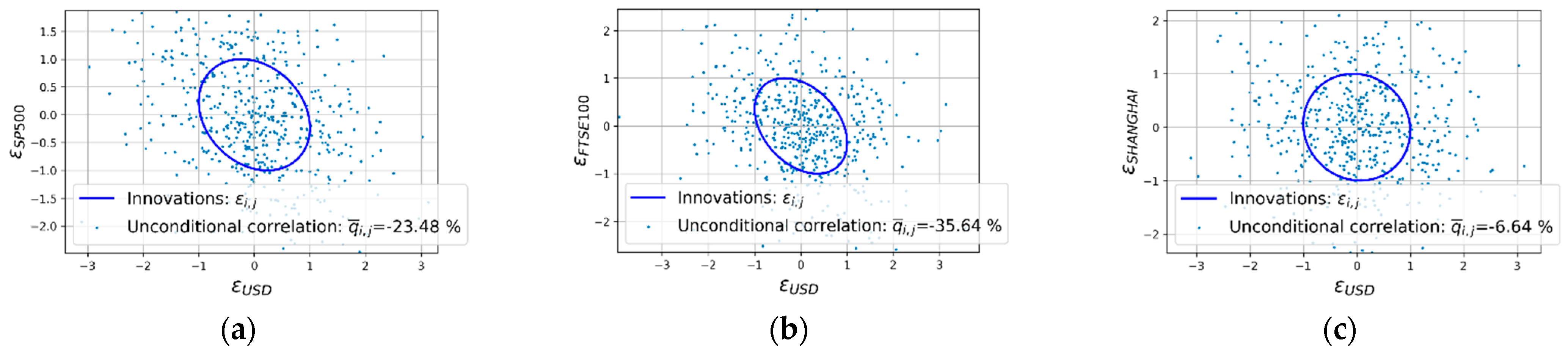
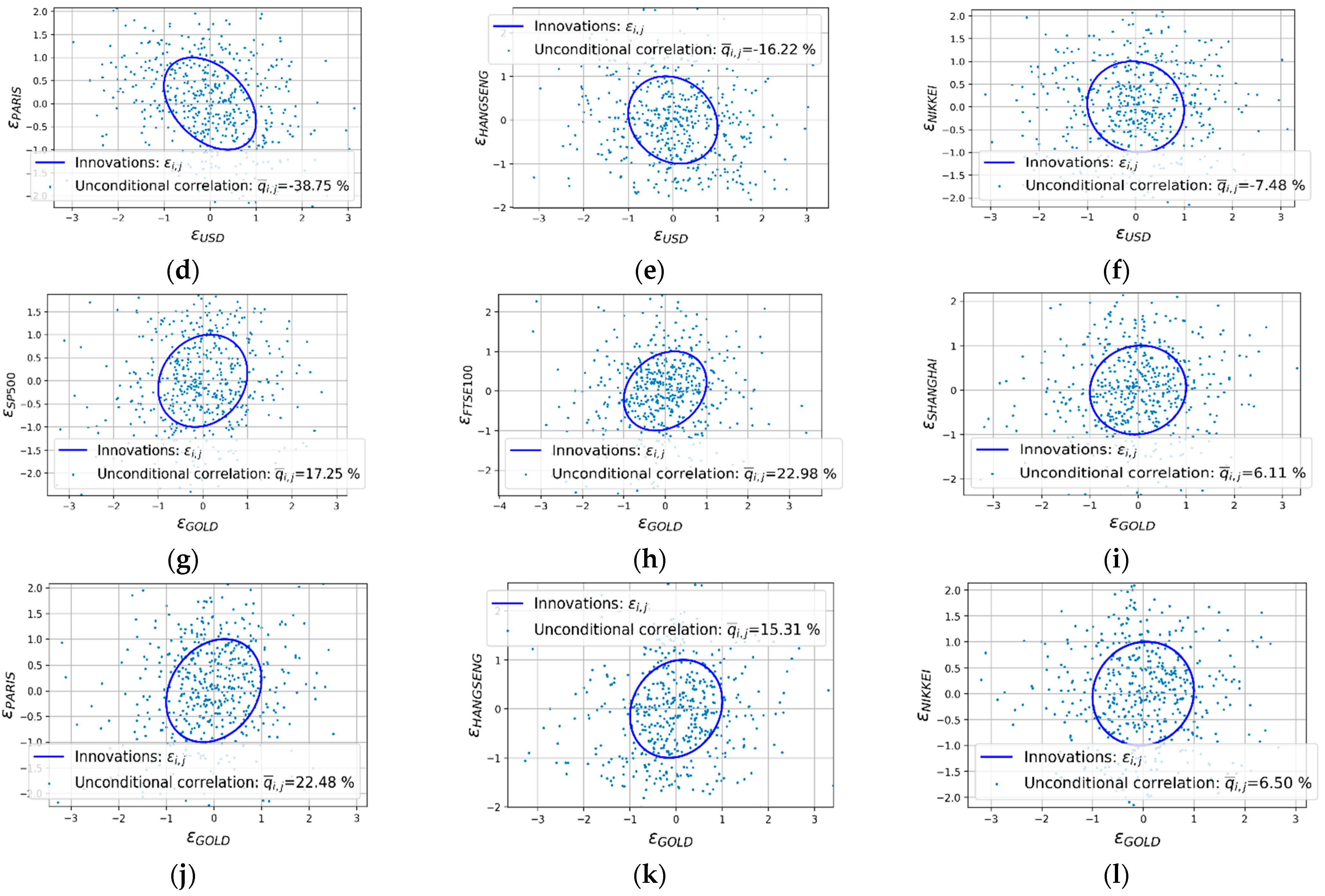
Unconditional correlation between two data series (element q i j of the matrix Q ) is used to calculate the ellipsoid. The ellipsoids are plotted for all possible pairs of indices (i,j) for the sub-period covering the Russia–Ukraine conflict. In general, ellipsoids with larger correlations are more elongated, whereas those with fewer correlations are more circular. Further, a positive correlation results in a rightward tilt of the ellipsoid, while a negative correlation results in a leftward tilt.
Drawing from the DCC estimates in Table 3, the sub-period of the Russian invasion of Ukraine highlights a consistent negative correlation between the USD and the considered market indices. The unconditional correlations shown by the ellipsoids in Figure 1 further support this relationship. The ellipsoids for various indices, depicted in Panels (a) through (f), are within the negative domain. The correlation values range from −38.75% to −6.64%. For gold, the unconditional correlation deviates from the negative spectrum, reaching positive values, and this occurs for all indices except for the Shanghai index. This shift is distinctly illustrated in Panels (g) through (l), which illustrate the dynamic interrelations of gold and the considered markets.
From the detailed analysis presented in Figure 1, a clear pattern emerges regarding the roles of the USD and gold. The USD consistently exhibits the characteristics of a safe-haven investment, especially when we consider its negative correlation with most of the indices. Gold, in contrast, plays a multifaceted role. It serves as both a hedge and a diversifier among the indices. The ellipsoids in Figure 2 further reinforce these conclusions. Visual representation from the ellipsoids shows strong negative unconditional correlations with the USD. In its turn, gold exhibits different kinds of relationships with these markets, resulting in a positive range of correlations, except for in the case of Shanghai. For the sake of brevity, the ellipsoid plots for other sub-intervals are not presented, but will be made available on request.

4.4. Rolling Correlation

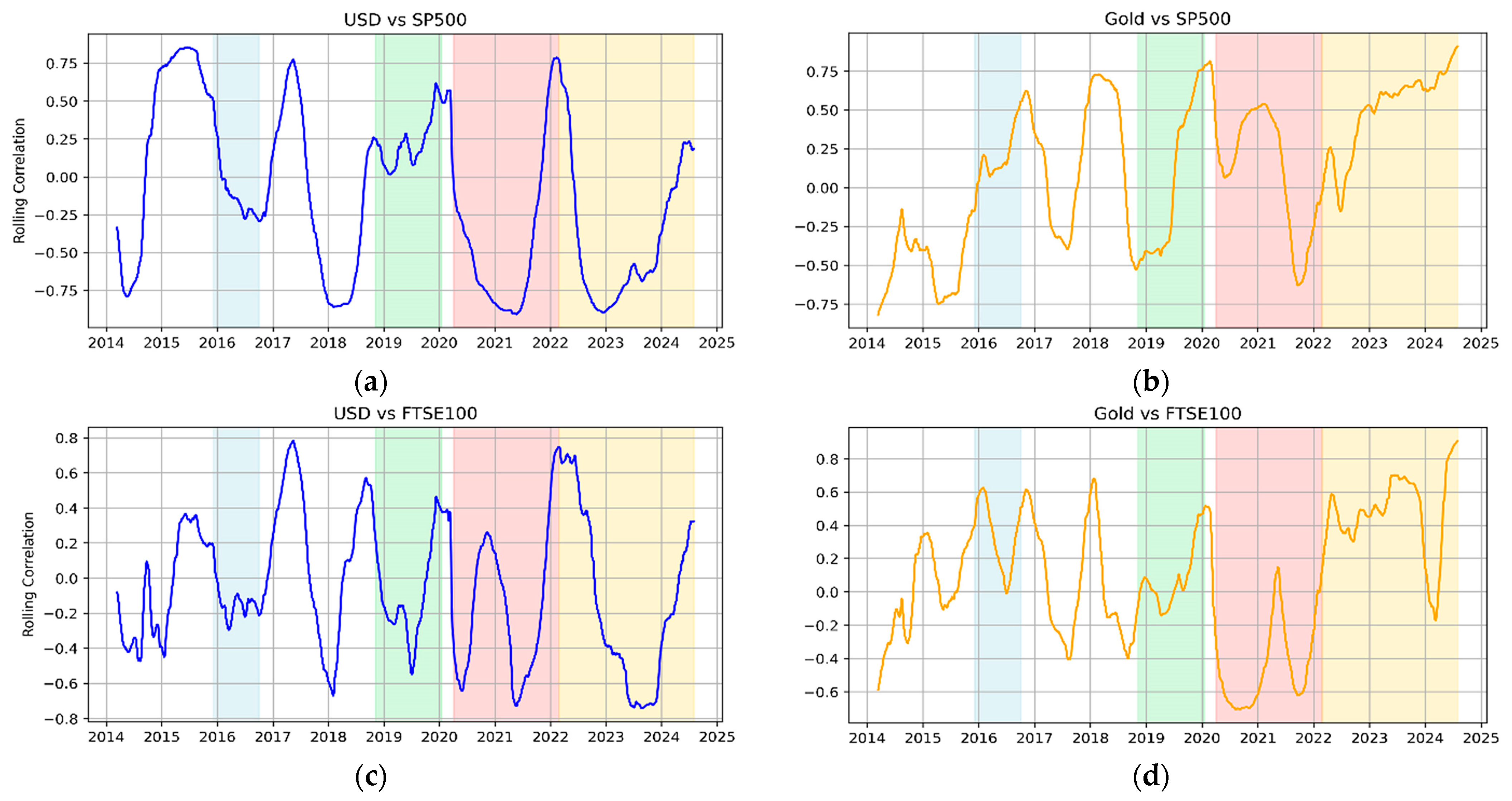
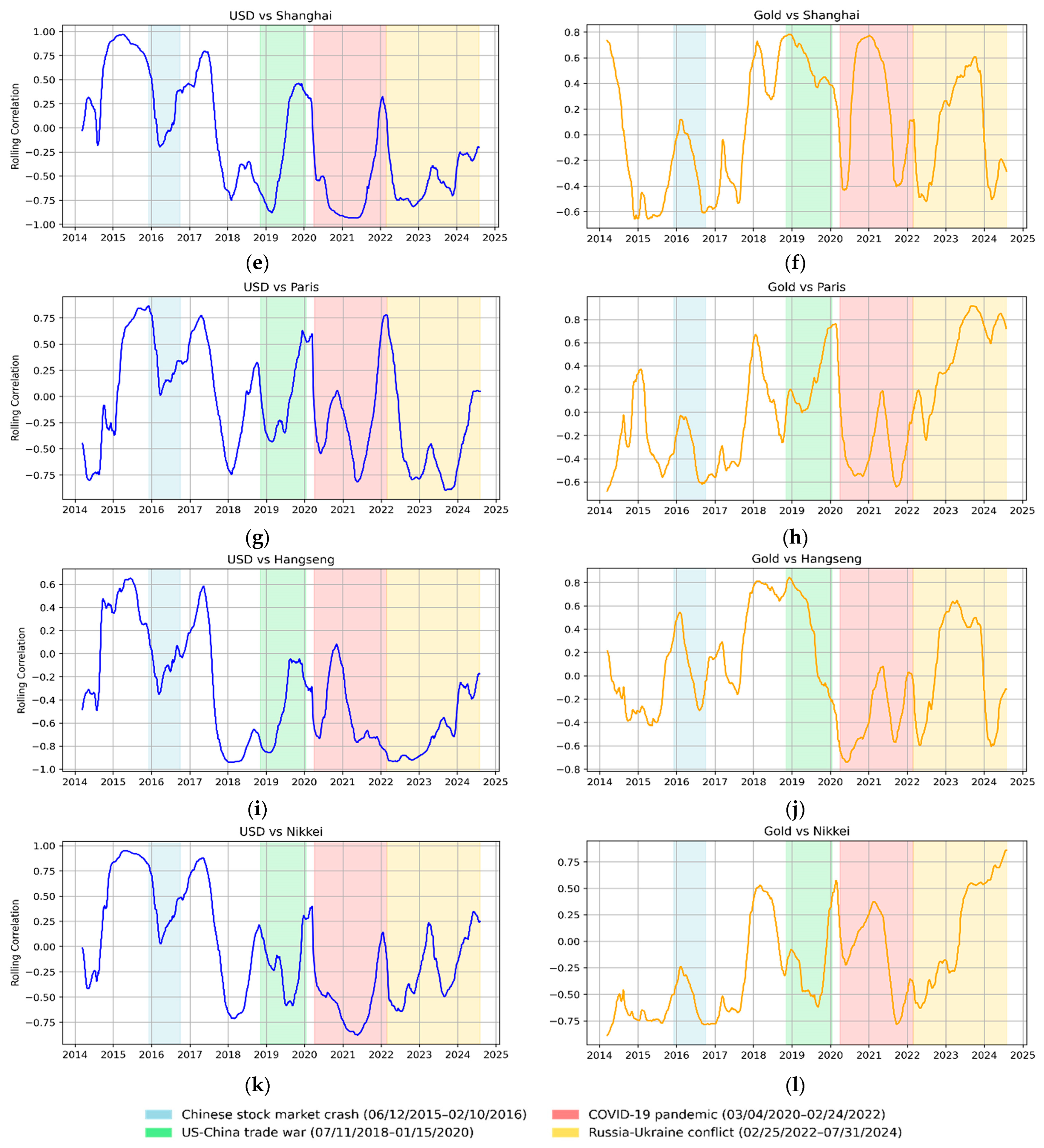
As exhibited in Figure 2, the rolling correlations between the USD, gold, and the six stock market indices further illuminate the time-varying nature of these relationships. For example, the correlation between the USD and the S&P 500 declined sharply during the US–China trade war (11 July 2018–15 January 2020), dropping from a positive correlation of around 0.4 in early 2018 to a negative correlation of −0.2 by mid-2019. This suggests that the USD’s role as a safe haven is not consistent across different crises.
In contrast, gold maintained a consistently negative correlation with the S&P 500 during the same period, which deepened further during the COVID-19 pandemic, reaching −0.6 in early 2021. The FTSE 100, which experienced a similar decline during these periods, also showed a negative correlation with gold, particularly in late 2020. Conversely, the Shanghai index showed more modest correlations with gold, reflecting a weaker relationship between the two during periods of market stress. These findings are consistent with the role of gold as a safe haven, particularly during periods of significant economic disruptions, while the USD’s role appears to be more variable and context-dependent. The evidence underscores the importance of understanding these dynamic relationships for investors seeking to manage risk, especially during periods of market turmoil.

4.5. Discussion and Implications

Our estimation results in the previous sections cover the crucial roles of gold and the US dollar as hedges, safe havens, and diversifiers for several classes of assets, focusing on stock markets during periods of financial instability. The study’s outcomes highlight that gold and the US dollar display outstanding roles, where the US dollar acts overall as a superior hedge and safe-haven asset. While gold serves primarily as a hedge or a diversifier under normal conditions, its role as a safe haven during periods of extreme market stress is well-supported by studies utilizing diverse methodologies, including those of Baur and Lucey (2010), Hood and Malik (2013), and Beckmann et al. (2015). Overall, these roles might change based on particular stock markets and dominant market conditions. During periods of market uncertainty, the US dollar functions as a primary safe-haven currency while gold exhibits hedging properties and, in certain conditions, serves as a safe-haven asset that mitigates portfolio risk (Hossain et al., 2024; Nittayakamolphun et al., 2024; Al-Nassar et al., 2023; Kakinuma, 2022).
Examining the average DCC for gold across various stock markets, we observed that, during the COVID-19 pandemic and the Russia–Ukraine conflict, gold lost its hedge attributes for several stock markets and acted predominantly as a diversifier. Notably, for the S&P 500 and FTSE 100 indices, gold shifted from being a hedge to a diversifier during these periods. However, in the context of the NASDAQ and the Nikkei 225 indices, gold consistently acted as a hedge, even during the heightened volatility of the pandemic. This dynamic can be understood within the broader economic context, where certain stock markets, influenced by varying degrees of exposure to global events, experienced different levels of investor reliance on gold as a protective asset. Our finding aligns with the study conducted by Yatie (2022), who stated that gold has completely lost its safe-haven characteristic during the Russia–Ukraine conflict. This suggests that, as the global economy recovered from the pandemic, the threat of rising inflation drove investors to seek refuge in gold. This behavior was further intensified when Russia declared its attack on Ukraine, heightening concerns over political risks and prompting investors to view gold as a safe haven for their assets.
In contrast, empirical studies (such as those of Thuy et al., 2024; Cheema et al., 2022; Akhtaruzzaman et al., 2021; Corbet et al., 2020; Hood & Malik, 2013) argued that, during the global financial crisis (2008), gold acted as a strong safe-haven commodity in Russia and a weak safe-haven asset in China, Turkey, and the US. However, during the COVID-19 pandemic, this characteristic weakened or completely disappeared.
On the other hand, the US dollar exhibits a more consistent role across the studied markets. As shown in Table 3, the US dollar serves as a clear safe-haven for the S&P 500, FTSE 100, and DAX indices, where DCC values are consistently negative or close to zero, reinforcing its classification as a safe haven. Meanwhile, for the Nikkei 225 and NASDAQ indices, the US dollar operates predominantly as a hedge, with DCC values fluctuating slightly but remaining predominantly negative. These samples emphasize that the US dollar maintains its role as a safe-haven asset among a broad range of stock markets, specifically in global market instability. During the Russia–Ukraine conflict and COVID-19 pandemic, the US dollar’s role as a safe-haven asset turned out to be more distinct, and its reinforcement had a considerable impact on global stock markets. For example, evidence from the ASEAN-6 market suggests that an appreciating US dollar imposes significant pressure on domestic currencies, frequently coinciding with a decrease in stock indices. These periods of turbulence strengthened the US dollar’s role as a reliable safe-haven asset (Tronzano, 2023; Thuy et al., 2024; Yilmazkuday, 2025).
Our finding is consistent with the results reported by Thuy et al. (2024), who examined the safe-haven role of the US dollar, gold, and Bitcoin during global financial crises, the Russia–Ukraine conflict, and the COVID-19 pandemic. Their findings support the strong safe-haven role of the US dollar in the UK, Germany, and the Netherlands over the three crises. Moreover, this study indicated that the US dollar’s safe-haven role was weak during the Russia–Ukraine conflict and stronger during the COVID-19 pandemic. It should be noted that, during the Russia–Ukraine conflict, other geopolitical events (such as the Israel–Hamas tensions) may have also influenced market dynamics. While our analysis focuses on the dominant crisis of the period, disentangling the effects of concurrent events remains a challenge and is an important topic for future research.
In conclusion, our results demonstrate the multifaceted roles of gold and the US dollar in the stock market globally. While the role of gold varies from being a diversifier and a hedge depending on particular markets and tie periods, the US dollar continuously acts as a safe-haven asset across various markets. This finding highlights the importance of considering both gold and the USD in investment portfolios, given their dynamic roles during financial crises, as evidenced by their diversification benefits, hedging capabilities, and time-varying relationships (Kayral et al., 2023; Shaik et al., 2023; Sharma et al., 2026).

5. Conclusions

In this study, we explored the roles of gold and the US dollar as hedges and safe-haven assets for particular stock indices, namely, the S&P 500, FTSE 100, CAC 40, Hang Seng, Shanghai Composite Index, and Nikkei 225. To do so, an in-depth analysis was performed, and the results stated that the roles of gold and the US dollar vary over these particular stock markets and change progressively over time.
Across several markets, the US dollar displays reliable hedging and safe-haven characteristics with strong evidence mainly for its role as a safe-haven asset against the S&P 500, FTSE 100, and Hang Seng. This finding was affirmed by dynamic copula assessments and the DCC-GARCH approach. Our findings support the idea that the US dollar serves consistently as a safe-haven asset, offering a negative correlation with the selected stock indices in times of market distress. During the Russia–Ukraine conflict, the US dollar consistently acted as a safe haven, demonstrating strong negative correlations with equity markets, while gold’s role was more variable. This suggests that, under sustained geopolitical risks, such as the ongoing Israel–Hamas conflict, similar dynamics may be observed.
In contrast, gold showcased a twofold function, serving as a hedge for the FTSE 100 and the S&P 500 during crisis times and acting as a diversifier for the CAC 40 and Shanghai Composite Index in times of market stability. This dynamic was specifically noticeable in the COVID-19 period, where gold’s hedging properties were outstanding and its role as a diversifier became more pronounced in the Paris and Shanghai markets. The reliable performance of the US dollar as a safe-haven asset and the dual role of gold make a convincing case for involving them in well-diversified portfolios, which allows investors to distribute the risk and protect their fortune, particularly during financial market turbulence.
Future studies can further explore this issue within the context of the portfolio selection problem. Possible areas include investigating the performance of portfolios using the indices explored in this study (with and without the US dollar and/or gold in its composition) to gauge their risk–return trade-offs during different crises, as well as the ability of investment portfolios to outperform the market barometer (Nor & Islam, 2016), portfolio formation involving higher-order moments (Ashfaq et al., 2021; Kim et al., 2014), and consideration of other time-series issues such as multifractals (Ameer et al., 2023). Additional analyses such as the investigation of optimal portfolio weights by Kroner and Ng (1998), the analysis of the hedge ratio by Kroner and Sultan (1993), and the exploration of hedge and safe-haven abilities by Ratner and Chiu (2013) may give more dimension to the study. Moreover, our approach utilizes Gaussian and Student-t copulas for interpretability and comparability with the prior literature. Since financial returns are known to exhibit heavy tails and skewness (Cont, 2001), future studies can extend this paper by utilizing the Lévy copula framework (see Barndorff-Nielsen & Lindner, 2007; Kallsen & Tankov, 2006; Tankov, 2010, 2016; Grothe & Nicklas, 2013). In addition, any significant difference in the returns of stock markets and asset classes during these different crises can be explored within a portfolio context.

Author Contributions

Conceptualization, M.I.A.A.; methodology, M.I.A.A.; software, M.I.A.A.; validation, D.C. and S.M.N.; formal analysis, M.I.A.A.; investigation, M.I.A.A.; resources, M.I.A.A.; data curation, M.I.A.A.; writing—original draft preparation, M.I.A.A., D.C. and S.M.N.; writing—review and editing, M.I.A.A., D.C., B.K. and S.M.N.; visualization, M.I.A.A. and S.M.N.; project administration, M.I.A.A. and S.M.N. All authors have read and agreed to the published version of the manuscript.

Funding

This research received no external funding.

Institutional Review Board Statement

Not applicable.

Informed Consent Statement

Not applicable.

Data Availability Statement

The data can be retrieved from the Yahoo Finance database.

Acknowledgments

The authors are grateful to the anonymous reviewers for their comments and suggestions, which have helped improve the paper.

Conflicts of Interest

The authors declare no conflicts of interest.

References

  1. Akhtaruzzaman, M., Boubaker, S., Lucey, B. M., & Sensoy, A. (2021). Is gold a hedge or a safe-haven asset in the COVID–19 crisis? Economic Modelling, 102, 105588. [Google Scholar] [CrossRef]
  2. Alam, M. K., Tabash, M. I., Billah, M., Kumar, S., & Anagreh, S. (2022). The impacts of the Russia–Ukraine invasion on global markets and commodities: A dynamic connectedness among G7 and BRIC markets. Journal of Risk and Financial Management, 15(8), 352. [Google Scholar] [CrossRef]
  3. Al-Nassar, N. S., Boubaker, S., Chaibi, A., & Makram, B. (2023). In search of hedges and safe havens during the COVID-19 pandemic: Gold versus Bitcoin, oil, and oil uncertainty. The Quarterly Review of Economics and Finance, 90, 318–332. [Google Scholar] [CrossRef]
  4. Ameer, S., Nor, S. M., Ali, S., & Zawawi, N. H. M. (2023). The impact of COVID-19 on BRICS and MSCI emerging markets efficiency: Evidence from MF-DFA. Fractal and Fractional, 7(7), 519. [Google Scholar] [CrossRef]
  5. Anand, R., & Madhogaria, S. (2012). Is gold a safe-haven? An econometric analysis? Procedia Economics and Finance, 1, 24–33. [Google Scholar] [CrossRef]
  6. Ashfaq, S., Ayub, U., Mujtaba, G., Raza, N., & Gulzar, S. (2021). Gainers and losers with higher order portfolio risk optimization. Physica A. Statistical Mechanics and Its Applications, 563, 125416. [Google Scholar] [CrossRef]
  7. Barndorff-Nielsen, O. E., & Lindner, A. M. (2007). Lévy copulas: Dynamics and transforms of Upsilon type. Scandinavian Journal of Statistics, 34, 298–316. [Google Scholar] [CrossRef]
  8. Basher, S. A., & Sadorsky, P. (2016). Hedging emerging market stock prices with oil, gold, VIX, and bonds: A comparison between DCC, ADCC and GO-GARCH. Energy Economics, 54, 235–247. [Google Scholar] [CrossRef]
  9. Batten, J. A., Ciner, C., & Lucey, B. M. (2014). On the economic determinants of the gold-inflation relation. Resources Policy, 41, 101–108. [Google Scholar] [CrossRef]
  10. Baur, D. G., & Lucey, B. M. (2010). Is gold a hedge or a safe haven? An analysis of stocks, bonds, and gold. The Financial Review, 45, 217–229. [Google Scholar] [CrossRef]
  11. Baur, D. G., & McDermott, T. K. J. (2010). Is gold a safe haven? International evidence. Journal of Banking & Finance, 34(8), 1886–1898. [Google Scholar] [CrossRef]
  12. Baur, D. G., & McDermott, T. K. J. (2016). Why is gold a safe haven? Journal of Behavioral and Experimental Finance, 10, 63–71. [Google Scholar] [CrossRef]
  13. Bear, A., Bensinger, S., Jara-Ettinger, J., Knobe, J., & Cushman, F. (2020). What comes to mind? Cognition, 194, 104057. [Google Scholar] [CrossRef]
  14. Beckmann, J., Berger, T., & Czudaj, R. (2015). Does gold act as a hedge or a safe haven for stocks? A smooth transition approach. Economic Modelling, 48, 16–24. [Google Scholar] [CrossRef]
  15. Bekiros, S., Boubaker, S., Nguyen, D. K., & Uddin, G. S. (2017). Black swan events and safe havens: The role of gold in globally integrated emerging markets. Journal of International Money and Finance, 73, 317–334. [Google Scholar] [CrossRef]
  16. Boubaker, S., Goodell, J. W., Pandey, D. K., & Kumari, V. (2022). Heterogeneous impacts of wars on global equity markets: Evidence from the invasion of Ukraine. Finance Research Letters, 48, 102934. [Google Scholar] [CrossRef]
  17. Boungou, W., & Yatié, A. (2022). The impact of the Ukraine–Russia war on world stock market returns. Economics Letters, 215, 110516. [Google Scholar] [CrossRef]
  18. Bouri, E., Jain, A., Biswal, P. C., & Roubaud, D. (2017a). Cointegration and nonlinear causality amongst gold, oil, and the Indian stock market: Evidence from implied volatility indices. Resources Policy, 52, 201–206. [Google Scholar] [CrossRef]
  19. Bouri, E., Molnár, P., Azzi, G., Roubaud, D., & Hagfors, L. I. (2017b). On the hedge and safe haven properties of Bitcoin: Is it really more than a diversifier? Finance Research Letters, 20, 192–198. [Google Scholar] [CrossRef]
  20. Bouri, E., Naji, J., Dutta, A., & Uddin, G. S. (2019). Gold and crude oil as safe-haven assets for clean energy stock indices: Blended copulas approach. Energy, 178, 544–553. [Google Scholar] [CrossRef]
  21. Bouri, E., Shahzad, S. J. H., Roubaud, D., Kristoufek, L., & Lucey, B. (2020). Bitcoin, gold, and commodities as safe havens for stocks: New insight through wavelet analysis. The Quarterly Review of Economics and Finance, 77, 156–164. [Google Scholar] [CrossRef]
  22. Cheema, M. A., Faff, R., & Szulczyk, K. R. (2022). The 2008 global financial crisis and COVID-19 pandemic: How safe are the safe haven assets? International Review of Financial Analysis, 83, 102316. [Google Scholar] [CrossRef]
  23. Chemkha, R., Bensaïda, A., Ghorbel, A., & Tayachi, T. (2021). Hedge and safe haven properties during COVID-19: Evidence from bitcoin and gold. Quarterly Review of Economics and Finance, 82, 71–85. [Google Scholar] [CrossRef]
  24. Cho, D., & Han, H. (2021). The tail behavior of safe haven currencies: A cross-quantilogram analysis. Journal of International Financial Markets, Institutions and Money, 70, 101257. [Google Scholar] [CrossRef]
  25. Ciner, C., Gurdgiev, C., & Lucey, B. M. (2013). Hedges and safe havens: An examination of stocks, bonds, gold, oil and exchange rates. International Review of Financial Analysis, 29, 202–211. [Google Scholar] [CrossRef]
  26. Conover, C. M., Jensen, G. R., Johnson, R. R., & Mercer, J. M. (2010). Is now the time to add commodities to your portfolio? The Journal of Investing, 19, 10–19. [Google Scholar] [CrossRef][Green Version]
  27. Cont, R. (2001). Empirical properties of asset returns: Stylized facts and statistical issues. Quantitative Finance, 1, 223–236. [Google Scholar] [CrossRef]
  28. Corbet, S., Larkin, C., & Lucey, B. (2020). The contagion effects of the COVID-19 pandemic: Evidence from gold and cryptocurrencies. Finance Research Letters, 35, 101554. [Google Scholar] [CrossRef]
  29. Coudert, V., & Raymond, H. (2011). Gold and financial assets: Are there any safe havens in bear markets? Economic Bulletin, 31, 1613–1622. [Google Scholar]
  30. Dempster, N., & Artigas, J. C. (2010). Gold: Inflation hedge and long-term strategic asset. The Journal of Wealth Management, 13(2), 69–75. [Google Scholar] [CrossRef]
  31. Dimitriou, D., & Kenourgios, D. (2013). Financial crises and dynamic linkages among international currencies. Journal of International Financial Markets, Institutions, and Money, 26, 319–332. [Google Scholar] [CrossRef]
  32. Dong, X., Li, C., & Yoon, S.-M. (2021). How can investors build a better portfolio in small open economies? Evidence from Asia’s four little dragons. North American Journal of Economics and Finance, 58, 101500. [Google Scholar] [CrossRef]
  33. Dyhrberg, A. H. (2016). Bitcoin, gold and the dollar–A GARCH volatility analysis. Finance Research Letters, 16, 85–92. [Google Scholar] [CrossRef]
  34. Engle, R. (1982). Autoregressive conditional heteroskedasticity with estimates of the variance of U.K. inflation. Econometrica, 50, 987–1008. [Google Scholar] [CrossRef]
  35. Engle, R. (2002). Dynamic conditional correlation: A simple class of multivariate generalized autoregressive conditional heteroskedasticity models. Journal of Business & Economic Statistics, 20, 339–350. [Google Scholar]
  36. Ghazali, M. F., Hooi, H. L., & Zakaria, B. (2015). Sharia-compliant gold investment in Malaysia: Hedge or safe haven? Pacific-Basin Finance Journal, 34, 192–204. [Google Scholar] [CrossRef]
  37. Goodell, J. W. (2020). COVID-19 and finance: Agendas for future research. Finance Research Letters, 35, 101512. [Google Scholar] [CrossRef]
  38. Green, T. (2007). The ages of gold. Gold Fields Minerals Services Ltd. [Google Scholar]
  39. Grothe, O., & Nicklas, S. (2013). Vine constructions of Lévy copulas. Journal of Multivariate Analysis, 119, 1–15. [Google Scholar] [CrossRef]
  40. Gürgün, G., & Ünalmış, I. (2014). Is gold a safe haven against equity market investment in emerging and developing countries? Finance Research Letters, 11, 341–348. [Google Scholar] [CrossRef]
  41. Hasan, B., Hassan, K., Rashid, M., & Alhenawi, Y. (2021). Are safe haven assets really safe during the 2008 global financial crisis and COVID-19 pandemic? Global Finance Journal, 50, 100668. [Google Scholar] [CrossRef]
  42. Henriksen, T. E. S. (2018). Properties of long/short commodity indices in stock and bond portfolios. The Journal of Alternative Investments, 20, 51–68. [Google Scholar] [CrossRef]
  43. Hood, M., & Malik, F. (2013). Is gold the best hedge and a safe haven under changing stock market volatility? Review of Financial Economics, 22(2), 47–52. [Google Scholar] [CrossRef]
  44. Hoque, M. E., Soo-Wah, L., Tee, L. T., Uddin, M. A., Kew, S.-R., Billah, M., & Bilgili, F. (2026). Contemporaneous and lagged connectedness among international categorical economic policy uncertainty and ASEAN-5 stock markets: Do policy uncertainty sources and determinants matter? Financial Innovation, 12, 93. [Google Scholar] [CrossRef]
  45. Hossain, A. T., Masum, A. A., & Saadi, S. (2024). The impact of geopolitical risks on foreign exchange markets: Evidence from the Russia–Ukraine war. Finance Research Letters, 59, 104750. [Google Scholar] [CrossRef]
  46. Husnul, H. M., Hidayat, R. R., & Sulasmiyati, S. (2017). Analisis pengaruh inflasi, kurs (IDR/USD), produk domestikbruto dan harga emas dunia terhadap indeks harga saham gabungan (studi pada Indonesia periode 2008–2016). Journal Administrasi Bisnis, 53, 66–74. [Google Scholar]
  47. Iuga, I. C., Mudakkar, S. R., & Dragolea, L. L. (2023). Time of COVID-19: Stability analysis of stocks, exchange rates, minerals and metals markets. Economic Research-Ekonomska Istraživanja, 36, 1527–1548. [Google Scholar] [CrossRef]
  48. Jain, A., & Biswal, P. C. (2016). Dynamic linkages among oil price, gold price, exchange rate, and stock market in India. Resources Policy, 49, 179–185. [Google Scholar] [CrossRef]
  49. Ji, Q., Zhang, D., & Zhao, Y. (2020). Searching for safe-haven assets during the COVID-19 pandemic. International Review of Financial Analysis, 71, 101526. [Google Scholar] [CrossRef]
  50. Kakinuma, Y. (2022). Nexus between Southeast Asian stock markets, bitcoin and gold: Spillover effect before and during the COVID-19 pandemic. Journal of Asia Business Studies, 16, 693–711. [Google Scholar] [CrossRef]
  51. Kallsen, J., & Tankov, P. (2006). Characterization of dependence of multidimensional Lévy processes using Lévy copulas. Journal of Multivariate Analysis, 97, 1551–1572. [Google Scholar] [CrossRef]
  52. Kayral, I. E., Jeribi, A., & Loukil, S. (2023). Are Bitcoin and gold a safe haven during COVID-19 and the 2022 Russia–Ukraine war? Journal of Risk and Financial Management, 16(4), 222. [Google Scholar] [CrossRef]
  53. Kim, W. C., Fabozzi, F. J., Cheridito, P., & Fox, C. (2014). Controlling portfolio skewness and kurtosis without directly optimizing third and fourth moments. Economics Letters, 122(2), 154–158. [Google Scholar] [CrossRef]
  54. Kroner, K. F., & Ng, V. K. (1998). Modeling asymmetric comovements of asset returns. Review of Financial Studies, 11(4), 817–844. [Google Scholar] [CrossRef]
  55. Kroner, K. F., & Sultan, J. (1993). Time-varying distributions and dynamic hedging with foreign currency futures. Journal of Financial and Quantitative Analysis, 28(4), 535–551. [Google Scholar] [CrossRef]
  56. Lilley, A., Maggiori, M., Neiman, B., & Schreger, J. (2022). Exchange rate reconnect. Review of Economics and Statistics, 104, 845–855. [Google Scholar] [CrossRef]
  57. Liu, C.-S., Chang, M.-S., Wu, X., & Chui, C.-M. (2016). Hedges or safe havens—Revisit the role of gold and USD against stock: A multivariate skew-t copula approach. Quantitative Finance, 16, 1763–1789. [Google Scholar] [CrossRef]
  58. Martiradonna, M., Romagnoli, S., & Santini, A. (2023). The beneficial role of green bonds as a new strategic asset class: Dynamic dependencies, allocation and diversification before and during the pandemic era. Energy Economics, 120, 106587. [Google Scholar] [CrossRef]
  59. McCown, J. R., & Zimmerman, J. R. (2006). Is gold a zero-beta asset? Analysis of the investment potential of precious metals [Working Paper]. SSRN. Available online: https://ssrn.com/abstract=920496 (accessed on 9 January 2025).
  60. Mensi, W., Shawkat, H., & Aviral, K. T. (2016). New evidence on hedges and safe havens for Gulf stock markets using the wavelet-based quantile. Emerging Markets Review, 28, 155–183. [Google Scholar] [CrossRef]
  61. Nittayakamolphun, P., Bejrananda, T., & Pholkerd, P. (2024). Geopolitical risk and responses to financial markets. ABAC Journal, 44, 360–376. [Google Scholar] [CrossRef]
  62. Nor, S. M., & Islam, S. M. N. (2016). Beating the market: Can evolutionary-based portfolio optimisation outperform the Talmudic diversification strategy? International Journal of Monetary Economics and Finance, 9(1), 90–99. [Google Scholar] [CrossRef]
  63. Ratner, M., & Chiu, C. C. (2013). Hedging stock sector risk with credit default swaps. International Review of Financial Analysis, 30, 18–25. [Google Scholar] [CrossRef]
  64. Raza, N., Ali, S., Shahzad, S. J. H., & Raza, S. A. (2018). Do commodities effectively hedge real estate risk? A multi-scale asymmetric DCC approach. Resource Policy, 57, 10–29. [Google Scholar] [CrossRef]
  65. Reboredo, J. C. (2013). Is gold a safe haven or a hedge for the US dollar? Implications for risk management. Journal of Banking and Finance, 37, 2665–2676. [Google Scholar] [CrossRef]
  66. Ronaldo, A., & Soderlind, P. (2007). Safe haven currencies (Discussion Paper; 2007–2022). University of St. Gallen. [Google Scholar]
  67. Shahzad, S. J. H., Bouri, E., Roubaud, D., & Kristoufek, L. (2020). Safe haven, hedge and diversification for G7 stock markets: Gold versus Bitcoin. Economic Modelling, 87, 212–224. [Google Scholar] [CrossRef]
  68. Shaik, M., Jamil, S. A., Hawaldar, I. T., Sahabuddin, M., Rabbani, M. R., & Atif, M. (2023). Impact of geo-political risk on stocks, oil, and gold returns during GFC, COVID-19, and Russian–Ukraine war. Cogent Economics & Finance, 11(1), 2190213. [Google Scholar]
  69. Sharma, I., Bamba, M., Verma, B., & Verma, B. (2026). Portfolio diversification opportunities in Indian stock and commodity markets using TVP-VAR extended joint connectedness approach. Afro-Asian Journal of Finance and Accounting, 16(1), 80–101. [Google Scholar] [CrossRef]
  70. Tachibana, M. (2022). Safe haven assets for international stock markets: A regime-switching factor copula approach. Research in International Business and Finance, 60, 101591. [Google Scholar] [CrossRef]
  71. Tankov, P. (2010). Lévy copulas. In Encyclopedia of quantitative finance. Wiley. [Google Scholar]
  72. Tankov, P. (2016). Lévy copulas: Review of recent results. In M. Podolskij, R. Stelzer, S. Thorbjørnsen, & A. E. D. Veraart (Eds.), The fascination of probability, statistics and their applications (pp. 127–151). Springer. [Google Scholar]
  73. Thuy, V. L. T., Oanh, T. T. K., & Ha, N. T. H. (2024). The roles of gold, US dollar, and bitcoin as safe-haven assets in times of crisis. Cogent Economics & Finance, 12(1), 2322876. [Google Scholar] [CrossRef]
  74. Todorova, V. (2020). “Safe Haven currencies,” economic alternatives (Vol. 4, pp. 579–591). University of National and World Economy. [Google Scholar]
  75. Triki, M. B., & Maatoug, A. B. (2021). The GOLD market as a safe haven against the stock market uncertainty: Evidence from geopolitical risk. Resources Policy, 70, 101872. [Google Scholar] [CrossRef]
  76. Tronzano, M. (2023). Safe-haven currencies as defensive assets in global stocks portfolios: A reassessment of the empirical evidence (1999–2022). Journal of Risk and Financial Management, 16, 273. [Google Scholar] [CrossRef]
  77. Wen, X., & Cheng, H. (2018). Which is the safe haven for emerging stock markets, gold or the US dollar? Emerging Markets Review, 35, 69–90. [Google Scholar] [CrossRef]
  78. Yatie, A. (2022). Failure of gold, Bitcoin and Ethereum as safe havens during the Ukraine-Russia war. In Bordeaux economics working papers 2022-07. Bordeaux School of Economics (BSE). [Google Scholar]
  79. Yilmazkuday, H. (2025). Geopolitical risks and exchange rates. Finance Research Letters, 74, 106769. [Google Scholar] [CrossRef]
Figure 1. Russia–Ukraine sub-period ellipsoids. Dynamic interrelations of USD and (a) S&P 500; (b) FTSE 100; (c) Shanghai; (d) Paris (CAC 40); (e) Hang Seng; (f) Nikkei 225. Dynamic interrelations of gold and (g) S&P 500; (h) FTSE 100; (i) Shanghai; (j) Paris (CAC 40); (k) Hang Seng; (l) Nikkei 225.
Jrfm 19 00308 g001aJrfm 19 00308 g001b
Figure 2. Rolling correlations between the USD, gold, and the six stock market indices: (a) USD vs. S&P 500; (b) gold vs. S&P 500; (c) USD vs. FTSE 100; (d) gold vs. FTSE 100; (e) USD vs. Shanghai; (f) gold vs. Shanghai; (g) USD vs. Paris (CAC 40); (h) gold vs. Paris (CAC 40); (i) USD vs. Hang Seng; (j) gold vs. Hang Seng; (k) USD vs. Nikkei; (l) gold vs. Nikkei.
Jrfm 19 00308 g002aJrfm 19 00308 g002b
Table 1. Descriptive statistics of log returns for the full sample.
USDGoldS&P 500FTSE 100ShanghaiCAC 40Hang SengNikkei 225
Mean0.00010.00020.00050.00010.00010.0003−0.00010.0005
Min−0.0240−0.0982−0.1277−0.1151−0.0891−0.1310−0.0657−0.0825
Max0.02440.05810.08970.08670.07550.08060.08690.0773
Std. Dev.0.00450.01030.01130.01040.01360.01270.01350.0137
Skew−0.0067−0.5649−0.9556−0.7825−0.9277−0.81390.0634−0.1730
Kurtosis2.18476.732016.486912.04497.54369.91353.24003.4817
JB489.44784.928,297.815,153.46198.110,366.21078.71256.2
Table 2. Descriptive statistics: the logarithmic returns for the four sub-intervals.
USDGoldS&P 500FTSE 100ShanghaiCAC 40Hang SengNikkei 225
Panel A. Chinese stock market crash
Mean0.00010.0002−0.0008−0.0011−0.0042−0.0013−0.0024−0.0017
Min−0.0240−0.0261−0.0402−0.0478−0.0891−0.0549−0.0602−0.0546
Max0.01560.04240.04750.05040.05600.04910.06990.0743
Std. Dev.0.00610.01060.01300.01440.03040.01790.01730.0192
Panel B. US–China trade war
Mean0.00010.00070.00050.00000.00030.00030.00000.0002
Min−0.0088−0.0228−0.0334−0.0464−0.0536−0.0474−0.0599−0.0397
Max0.01180.03530.02940.02240.05450.02430.04130.0253
Std. Dev.0.00330.00760.00890.00840.01270.00940.01160.0103
Panel C. COVID-19 pandemic
Mean0.00000.00040.00080.00020.00030.0005−0.00030.0005
Min−0.0194−0.0511−0.1277−0.1151−0.0460−0.1310−0.0572−0.0627
Max0.01580.05810.08970.08670.07550.08060.04720.0773
Std. Dev.0.00440.01250.01780.01520.01120.01720.01450.0153
Panel D. Russia–Ukraine conflict
Mean0.00010.00040.00050.0003−0.00030.0003−0.00050.0008
Min−0.0214−0.0288−0.0412−0.0391−0.0527−0.0509−0.0657−0.0334
Max0.02440.03110.05400.03840.03420.06880.08690.0399
Std. Dev.0.00500.00950.01150.00860.01000.01150.01730.0118
Table 3. Dynamic conditional correlation for the considered US dollar pairs.
AverageMinMaxStd. Dev.
Panel A. Full sample
Gold−0.2831−0.4484−0.12310.0694
S&P 500−0.1187−0.29380.13100.0866
FTSE 100−0.0726−0.35690.17910.0994
Shanghai−0.0351−0.22250.17070.0673
CAC 40−0.0941−0.38770.23660.1249
Hang Seng−0.0989−0.29500.17630.0790
Nikkei 2250.0028−0.21650.27970.0838
Panel B. Chinese stock market crash
Gold−0.2078−0.2423−0.14710.0198
S&P 5000.29620.26490.34530.0188
FTSE 1000.42350.36920.49880.0328
Shanghai0.08150.04520.13240.0178
CAC 400.46750.42290.52640.0253
Hang Seng0.20970.15380.29480.0388
Nikkei 2250.26570.16230.38320.0584
Panel C. US–China trade war
Gold−0.3104−0.4551−0.07710.0748
S&P 5000.0452−0.09960.19620.0833
FTSE 1000.1198−0.04060.29800.0853
Shanghai−0.0186−0.16460.09700.0614
CAC 400.0933−0.09250.26890.0995
Hang Seng−0.0875−0.1290−0.05700.0147
Nikkei 225−0.0049−0.14250.11100.0472
Panel D. COVID-19 pandemic
Gold−0.3031−0.4325−0.08600.0860
S&P 500−0.2003−0.30630.02880.0715
FTSE 100−0.1679−0.2610−0.00650.0636
Shanghai−0.2174−0.3104−0.09510.0514
CAC 40−0.2029−0.3218−0.02760.0592
Hang Seng−0.2658−0.4065−0.07640.0807
Nikkei 225−0.2283−0.3602−0.08510.0410
Panel E. Russia–Ukraine conflict
Gold−0.3318−0.5030−0.01570.1074
S&P 500−0.3167−0.4534−0.22350.0548
FTSE 100−0.2994−0.4635−0.14830.0603
Shanghai−0.0813−0.1353−0.02410.0223
CAC 40−0.3444−0.4949−0.19870.0747
Hang Seng−0.1548−0.2497−0.08480.0268
Nikkei 225−0.0587−0.16550.03530.0457
Table 4. Dynamic conditional correlation for the considered gold pairs.
AverageMinMaxStd. Dev.
Panel A. Full sample
S&P 5000.0515−0.15680.22820.0651
FTSE 1000.0459−0.15000.21360.0686
Shanghai0.0445−0.17070.22730.0762
CAC 400.0180−0.28530.21230.0863
Hang Seng0.0767−0.12770.22460.0636
Nikkei 225−0.0433−0.32090.32890.0897
Panel B. Chinese stock market crash
S&P 500−0.1775−0.29970.03580.0433
FTSE 100−0.2790−0.3155−0.24550.0187
Shanghai−0.0906−0.20850.05230.0420
CAC 40−0.3220−0.3554−0.29330.0171
Hang Seng−0.1999−0.2368−0.16310.0227
Nikkei 225−0.2071−0.2283−0.18780.0117
Panel C. US–China trade war
S&P 500−0.1812−0.2784−0.15290.0397
FTSE 100−0.1749−0.3556−0.06210.0719
Shanghai−0.0488−0.16830.09490.0586
CAC 40−0.1808−0.4235−0.07290.0988
Hang Seng−0.0556−0.19270.08260.0652
Nikkei 225−0.0895−0.25600.05800.0719
Panel D. COVID-19 pandemic
S&P 5000.0636−0.06300.18230.0607
FTSE 1000.0307−0.09040.22170.0702
Shanghai0.15460.02590.27110.0493
CAC 400.0287−0.13150.27750.0904
Hang Seng0.17460.05900.33420.0601
Nikkei 2250.0837−0.07280.38530.0823
Panel E. Russia–Ukraine conflict
S&P 5000.1509−0.07260.31000.0918
FTSE 1000.1613−0.06180.30750.0937
Shanghai0.0917−0.04030.17610.0381
CAC 400.1764−0.06810.37420.0963
Hang Seng0.14790.06170.21920.0275
Nikkei 2250.0636−0.01300.12010.0306
Disclaimer/Publisher’s Note: The statements, opinions and data contained in all publications are solely those of the individual author(s) and contributor(s) and not of MDPI and/or the editor(s). MDPI and/or the editor(s) disclaim responsibility for any injury to people or property resulting from any ideas, methods, instructions or products referred to in the content.