
UTAUT Antecedents Shaping Institutional Investors’ Intentions to Utilize ESG Information


Abstract
1. Introduction
2. Literature Review
2.1. Past, Present, and Future of ESG
2.1.1. The SRI Era and the Emergence of ESG (1990s–2000s)
2.1.2. Financialization and Standardization of ESG (2010s)
2.1.3. Regulatory Enforcement and Institutional Mandates (Late 2010s–2020s)
2.1.4. Operational Maturation of ESG (Present)
2.2. Unified Theory of Acceptance and Use of Technology (UTAUT)
2.2.1. UTAUT
2.2.2. UTAUT and ESG
3. Research Methodology and Materials
- Step 1:
- Identify expectancy-related factors discussed in the literature and use experts’ opinion to finalize factors
- Step 2:
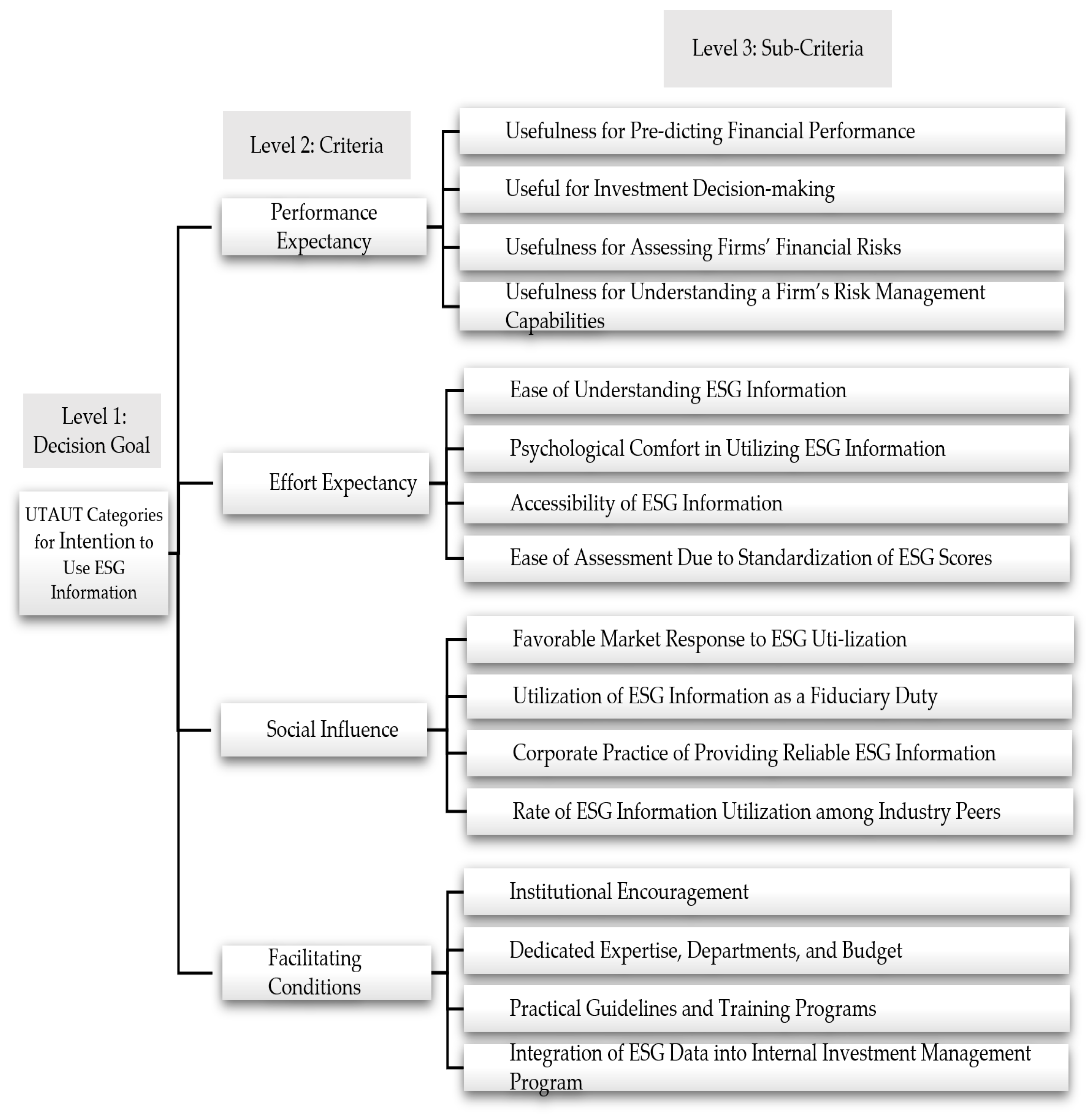
- Construct a hierarchical decision structure consisting of the four core intention-forming dimensions and their sub-factors.
- Step 3:
- Design and administer pairwise comparison questionnaires to domain experts.
- Step 4:
- Evaluate the consistency of expert judgments.
- Step 5:
- Derive priority weights and assess the results.
3.1. Identification of Expectancy-Related Factors Discussed in the Literature
3.2. Extraction of Sub-Factors for Each Dimension of UTAUT
3.2.1. Performance Expectancy and Sub-Categories
3.2.2. Effort Expectancy and Adoption Motivators
3.2.3. Social Influence and Adoption Motivators
3.2.4. Facilitating Conditions and Adoption Motivators
4. Analysis
4.1. Respondent Selection and Survey
4.1.1. Theoretical Rationale for Expert Group Selection
4.1.2. Survey Design and Sample Construction
4.1.3. Reliability, Validity, and Robustness of the Data
4.1.4. Logical Consistency
4.1.5. Representative Equilibrium
4.1.6. Methodological Adequacy
5. Results
5.1. Analysis of Local Weights of Each Dimension and Sub-Factor
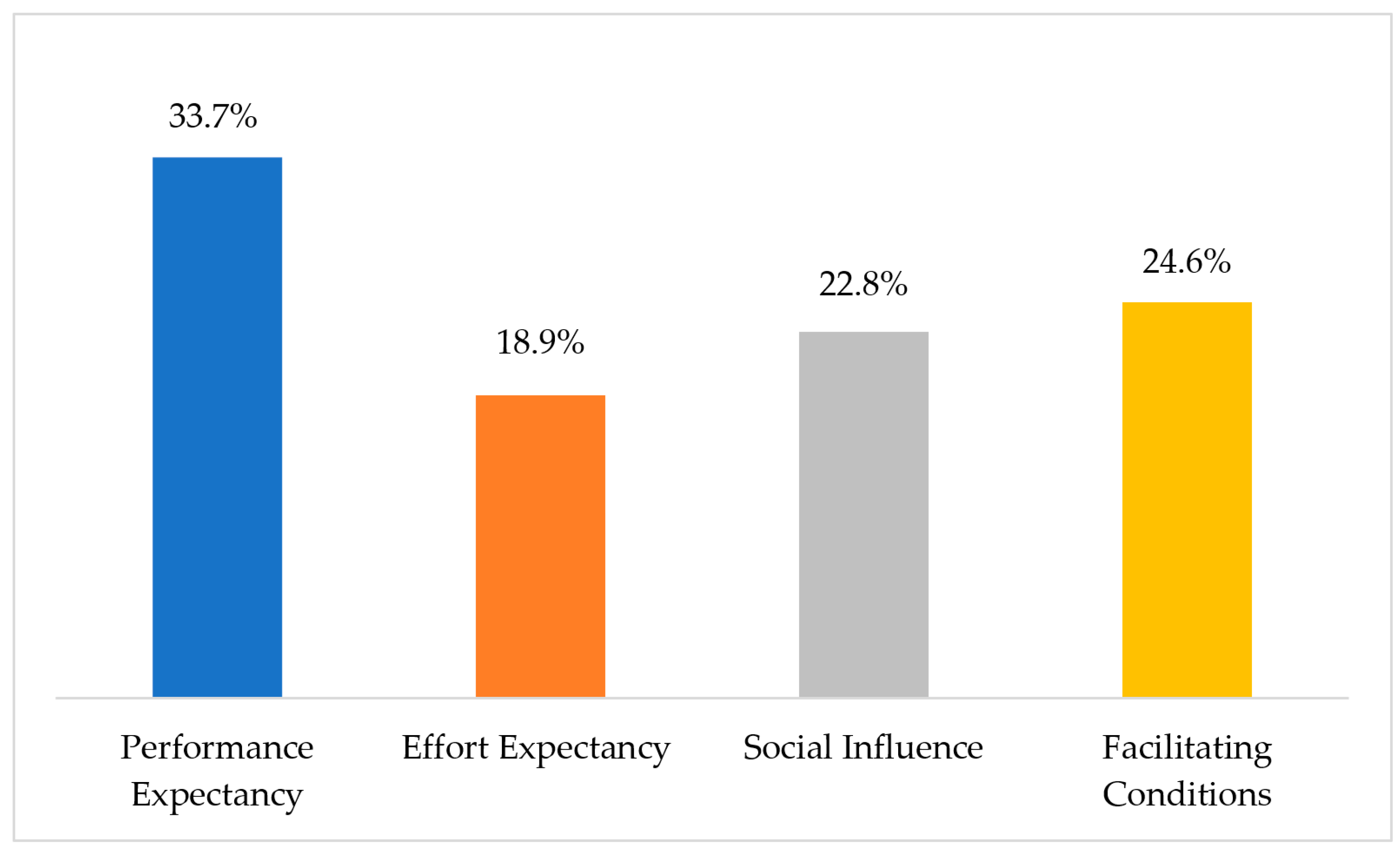
5.1.1. Local Weights of Primary Criteria (Level 2)
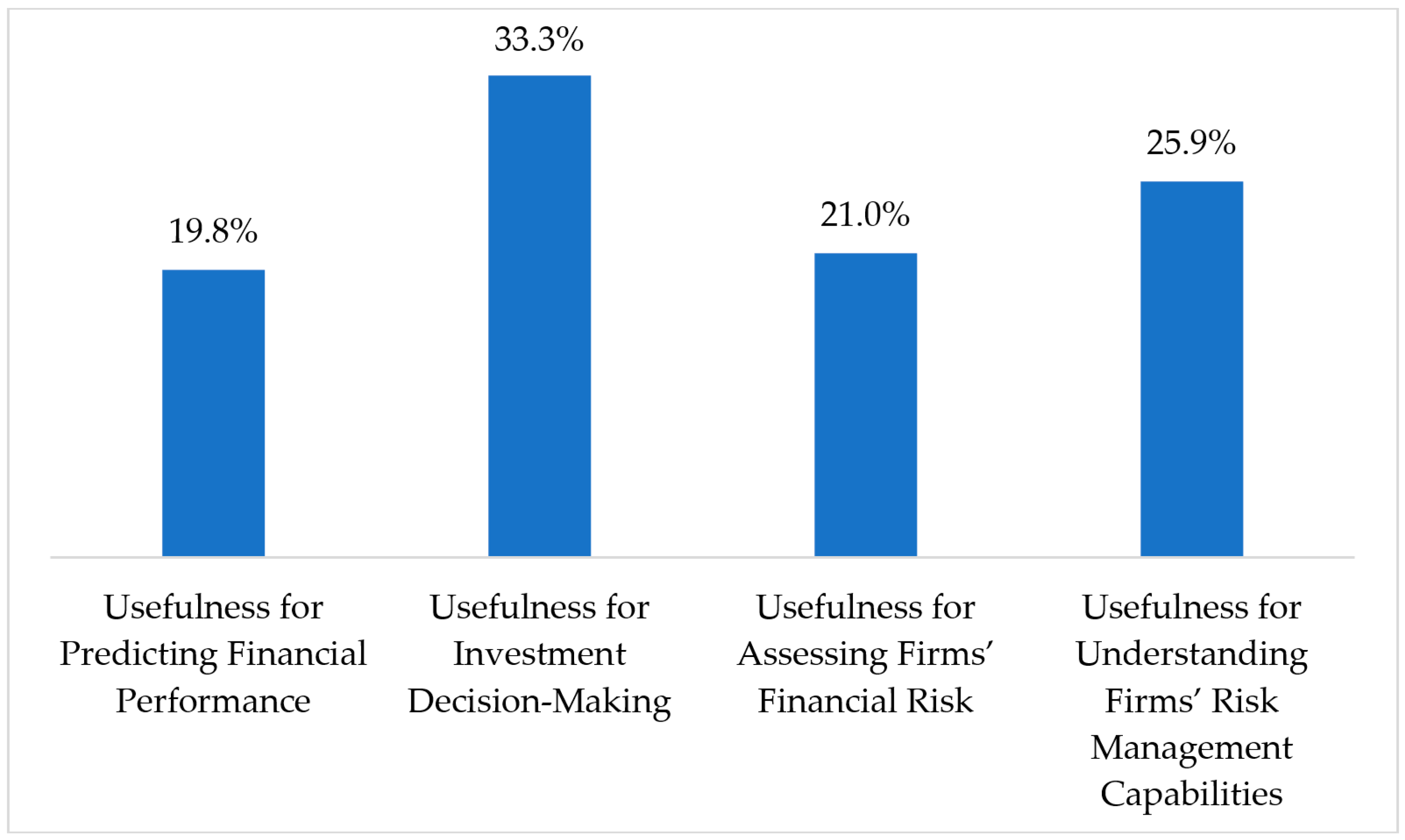
5.1.2. Local Weights of Performance Expectancy Sub-Factors (Level 3)
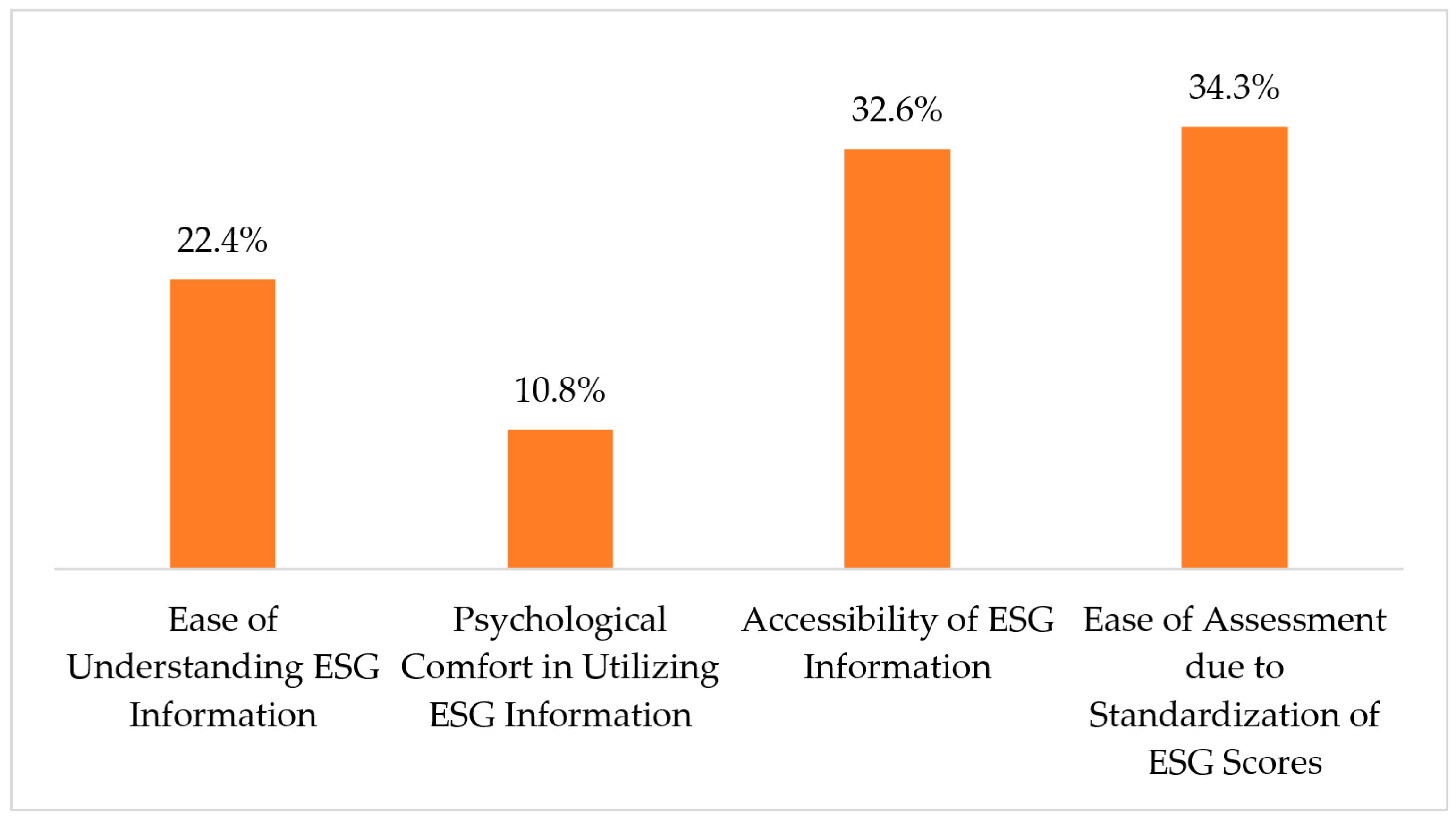
5.1.3. Local Weights of Effort Expectancy Sub-Factors (Level 3)
5.1.4. Local Weights of Social Influence Sub-Factors (Level 3)
5.1.5. Local Weights of Facilitating Conditions Sub-Factors (Level 3)
5.2. Empirical Analysis of Global Weights
6. Summary and Discussion
6.1. Summary of Findings
6.2. Theoretical Contributions
6.3. Practical and Managerial Implications
7. Conclusions
7.1. Conclusions
7.2. Research Limitations
7.3. Future Research Directions
Author Contributions
Funding
Institutional Review Board Statement
Informed Consent Statement
Data Availability Statement
Conflicts of Interest
Appendix A
Survey Questionnaire

| Demographic Questions |
|---|
|
|
|
|
|
|
|
|
- <Survey Directions>
- 1. Please answer the entire questions.
- 2. Answers must be logically consistent. For example, if A is more important than B and B is more important than C, then A is more important than C (A > B and B > C -> A > C).
- If you have any inquiry about the survey, please do not hesitate to contact us.
| Measurement Item | Evaluation Scale | Measurement Item |
|---|---|---|
| A | 5 4 3 2 1 2 3 4 5 | B |
| Extremely Important Equal Extremely Important |
| Criteria | Description | Measurement |
|---|---|---|
| Performance Expectancy | Performance expectancy captures the extent to which institutional investors expect ESG information to enhance investment outcomes in line with core risk–return objectives. Prior literature consistently identifies performance-related motivations | Sub-categories: usefulness for predicting financial performance, useful for investment decision-making, usefulness for assessing firms’ financial risks, and usefulness for understanding a firm’s risk management capabilities |
| Effort Expectancy | Effort expectancy reflects institutional investors’ motivation to adopt ESG information when it can be evaluated and incorporated into existing investment work-flows with manageable analytical effort | Sub-categories: ease of understanding ESG information, psychological comfort in utilizing ESG information, accessibility of ESG information, and ease of assessment due to standardization of ESG scores |
| Social Influence | Social influence captures motivations arising from perceived expectations and norms within the institutional investment environment | Sub-categories: favorable market response to ESG utilization, utilization of ESG information as a fiduciary duty, corporate practice of providing reliable ESG information, and rate of ESG information utilization among industry peers |
| Facilitating Factors | Facilitating conditions represent structural motivations that enable ESG adoption by lowering organizational and institutional barriers | Sub-categories: institutional encouragement, dedicated expertise, departments, and budget, practical guidelines & training programs, and integration of ESG data into internal investment management program |
| Measurement Item | Evaluation Scale | Measurement Item |
|---|---|---|
| Performance Expectancy | 5 4 3 2 1 2 3 4 5 | Effort Expectancy |
| Performance Expectancy | 5 4 3 2 1 2 3 4 5 | Social Influence |
| Performance Expectancy | 5 4 3 2 1 2 3 4 5 | Facilitating Factors |
| Effort Expectancy | 5 4 3 2 1 2 3 4 5 | Social Influence |
| Effort Expectancy | 5 4 3 2 1 2 3 4 5 | Facilitating Factors |
| Social Influence | 5 4 3 2 1 2 3 4 5 | Facilitating Factors |
- Performance Expectancy Factors
| Criteria | Sub-Criteria | Description | |
|---|---|---|---|
| Performance Expectancy | Usefulness for Predicting Financial Performance | When assessing a company’s short-term and long-term financial performance, using ESG information is considered useful, and because of that usefulness, I intend to use ESG information. | |
| Useful for Investment Decision-making | When making investment decisions, I believe that using ESG information is useful, and because of that usefulness, I intend to use ESG information. | ||
| Usefulness for Assessing Firms’ Financial Risks | When evaluating the financial risks a company holds, I believe that using ESG information is useful, and because of that usefulness, I intend to use ESG information. | ||
| Usefulness for Understanding a Firm’s Risk Management Capabilities | When identifying a company’s risk management capabilities, I believe that using ESG information is useful, and because of that usefulness, I intend to use ESG information | ||
| Measurement Item | Evaluation Scale | Measurement Item |
|---|---|---|
| Usefulness for Predicting Financial Performance | 5 4 3 2 1 2 3 4 5 | Useful for Investment Decision-making |
| Usefulness for Predicting Financial Performance | 5 4 3 2 1 2 3 4 5 | Usefulness for Assessing Firms’ Financial Risks |
| Usefulness for Predicting Financial Performance | 5 4 3 2 1 2 3 4 5 | Usefulness for Understanding a Firm’s Risk Management Capabilities |
| Useful for Investment Decision-making | 5 4 3 2 1 2 3 4 5 | Usefulness for Assessing Firms’ Financial Risks |
| Useful for Investment Decision-making | 5 4 3 2 1 2 3 4 5 | Usefulness for Understanding a Firm’s Risk Management Capabilities |
| Usefulness for Assessing Firms’ Financial Risks | 5 4 3 2 1 2 3 4 5 | Usefulness for Understanding a Firm’s Risk Management Capabilities |
- 2.
- Effort Expectancy Factors
| Criteria | Sub-Criteria | Description | |
|---|---|---|---|
| Effort Expectancy | Ease of Understanding ESG Information | The ESG information provided was easy to understand, and because of that ease, I intend to use ESG information. | |
| Psychological Comfort in Utilizing ESG Information | Using the ESG information provided felt psychologically comfortable and without burden, and because of that comfort, I intend to use ESG information. | ||
| Accessibility of ESG Information | The process of receiving or finding ESG information was easy, and because of that ease, I intend to use ESG information. | ||
| Ease of Assessment Due to Standardization of ESG Scores | There is standardization among the ESG scores provided by various rating agencies, and because it is easy to use those scores to compare or evaluate companies, I intend to use ESG information. | ||
| Measurement Item | Evaluation Scale | Measurement Item |
|---|---|---|
| Ease of Understanding ESG Information | 5 4 3 2 1 2 3 4 5 | Psychological Comfort in Utilizing ESG Information |
| Ease of Understanding ESG Information | 5 4 3 2 1 2 3 4 5 | Accessibility of ESG Information |
| Ease of Understanding ESG Information | 5 4 3 2 1 2 3 4 5 | Ease of Assessment Due to Standardization of ESG Scores |
| Psychological Comfort in Utilizing ESG Information | 5 4 3 2 1 2 3 4 5 | Accessibility of ESG Information |
| Psychological Comfort in Utilizing ESG Information | 5 4 3 2 1 2 3 4 5 | Ease of Assessment Due to Standardization of ESG Scores |
| Accessibility of ESG Information | 5 4 3 2 1 2 3 4 5 | Ease of Assessment Due to Standardization of ESG Scores |
- 3.
- Social Influence Factors
| Criteria | Sub-Criteria | Description | |
|---|---|---|---|
| Social Influence | Favorable Market Response to ESG Utilization | In the investment market, investment decisions that utilize ESG information are viewed favorably. Therefore, based on this perspective, I also intend to use ESG information. | |
| Utilization of ESG Information as a Fiduciary Duty | Asset management companies or pension funds use ESG information to fulfill their legal and ethical responsibility to prioritize the interests of beneficiaries when managing clients’ money. Because of this obligation, I also intend to use ESG information. | ||
| Corporate Practice of Providing Reliable ESG Information | Companies have a culture of providing reliable information to investors. Therefore, I intend to use such trustworthy ESG information. | ||
| Rate of ESG Information Utilization among Industry Peers | The proportion of ESG information usage among peers in the same industry is high. Following this trend, I also intend to use ESG information. | ||
| Measurement Item | Evaluation Scale | Measurement Item |
|---|---|---|
| Favorable Market Response to ESG Utilization | 5 4 3 2 1 2 3 4 5 | Utilization of ESG Information as a Fiduciary Duty |
| Favorable Market Response to ESG Utilization | 5 4 3 2 1 2 3 4 5 | Corporate Practice of Providing Reliable ESG Information |
| Favorable Market Response to ESG Utilization | 5 4 3 2 1 2 3 4 5 | Rate of ESG Information Utilization among Industry Peers |
| Utilization of ESG Information as a Fiduciary Duty | 5 4 3 2 1 2 3 4 5 | Corporate Practice of Providing Reliable ESG Information |
| Utilization of ESG Information as a Fiduciary Duty | 5 4 3 2 1 2 3 4 5 | Rate of ESG Information Utilization among Industry Peers |
| Corporate Practice of Providing Reliable ESG Information | 5 4 3 2 1 2 3 4 5 | Rate of ESG Information Utilization among Industry Peers |
- 4.
- Facilitating Conditions Factors
| Criteria | Sub-Criteria | Description | |
|---|---|---|---|
| Facilitating Conditions | Institutional Encouragement | My organization has a policy that encourages the use of ESG information. Therefore, because of this policy, I also intend to use ESG information. | |
| Dedicated Expertise, Departments, and Budget | My organization has specialized support staff, departments, and budgets dedicated to the use of ESG information. Because of this, I also intend to use ESG information. | ||
| Practical Guidelines and Training Programs | My organization provides practical guidelines and training programs for the use of ESG information. Therefore, because of this support, I also intend to use ESG information. | ||
| Integration of ESG Data into Internal Investment Management Program Management Capabilities | My organization’s internal investment management system integrates ESG information with existing data. Because of this integration, I also intend to use ESG information. | ||
| Measurement Item | Evaluation Scale | Measurement Item |
|---|---|---|
| Institutional Encouragement | 5 4 3 2 1 2 3 4 5 | Dedicated Expertise, Departments, and Budget |
| Institutional Encouragement | 5 4 3 2 1 2 3 4 5 | Practical Guidelines and Training Programs |
| Institutional Encouragement | 5 4 3 2 1 2 3 4 5 | Integration of ESG Data into Internal Investment Management Program |
| Dedicated Expertise, Departments, and Budget | 5 4 3 2 1 2 3 4 5 | Practical Guidelines and Training Programs |
| Dedicated Expertise, Departments, and Budget | 5 4 3 2 1 2 3 4 5 | Integration of ESG Data into Internal Investment Management Program |
| Practical Guidelines and Training Programs | 5 4 3 2 1 2 3 4 5 | Integration of ESG Data into Internal Investment Management Program |
References
- Aguarón, J., & Moreno-Jiménez, J. M. (2003). The geometric consistency index: Approximated thresholds. European Journal of Operational Research, 147(1), 137–145. [Google Scholar] [CrossRef]
- Albuquerque, R., Koskinen, Y., Yang, S., & Zhang, C. (2020). Resiliency of environmental and social stocks: An analysis of the exogenous COVID-19 market crash. The Review of Corporate Finance Studies, 9(3), 593–621. [Google Scholar] [CrossRef] [PubMed]
- Al-Emran, M. (2023). Beyond technology acceptance: Development and evaluation of technology-environmental, economic, and social sustainability theory. Technology in Society, 75, 102383. [Google Scholar] [CrossRef]
- Al-Mhdawi, M. K. S., Brito, M., Onggo, B. S., Qazi, A., O’Connor, A., & Namian, M. (2023). Construction risk management in Iraq during the COVID-19 pandemic: Challenges to implementation and efficacy of practices. Journal of Construction Engineering and Management, 149(9), 04023086. [Google Scholar] [CrossRef]
- Amel-Zadeh, A., & Serafeim, G. (2018). Why and how investors use ESG information: Evidence from a global survey. Financial Analysts Journal, 74(3), 87–103. [Google Scholar] [CrossRef]
- Berg, F., Kölbel, J. F., & Rigobon, R. (2022). Aggregate confusion: The divergence of ESG ratings. Review of Finance, 26(6), 1315–1344. [Google Scholar] [CrossRef]
- Bhushan, N., & Rai, K. (2004). Strategic decision making: Applying the analytic hierarchy process. Springer Nature Link. Available online: https://link.springer.com/book/10.1007/b97668 (accessed on 1 March 2026).
- Blut, M., Chong, A. Y. L., Tsiga, Z., & Venkatesh, V. (2022). Meta-analysis of the unified theory of acceptance and use of technology (UTAUT): Challenging its validity and charting a research agenda in the red ocean. Journal of the Association for Information Systems, 23(1), 13–95. [Google Scholar] [CrossRef]
- Bollen, N. P. B. (2007). Mutual fund attributes and investor behavior. Journal of Financial and Quantitative Analysis, 42(3), 683–708. [Google Scholar] [CrossRef]
- Bornstein, M. H., Jager, J., & Putnick, D. L. (2013). Sampling in developmental science: Situations, shortcomings, solutions, and standards. Developmental Review, 33(4), 357–370. [Google Scholar] [CrossRef]
- Bouteraa, M., Raja Hisham, R. R. I., & Zainol, Z. (2022). Challenges affecting bank consumers’ intention to adopt green banking technology in the UAE: A UTAUT-based mixed-methods approach. Journal of Islamic Marketing, 14(10), 2466–2501. [Google Scholar] [CrossRef]
- Carter, L., & Bélanger, F. (2005). The utilization of e-government services: Citizen trust, innovation and acceptance factors. Information Systems Journal, 15(1), 5–25. [Google Scholar] [CrossRef]
- Chen, C., & Delmas, M. (2011). Measuring corporate social performance: An efficiency perspective. Production and Operations Management, 20(6), 789–804. [Google Scholar] [CrossRef]
- Christensen, H. B., Hail, L., & Leuz, C. (2021). Mandatory CSR and sustainability reporting: Economic analysis and literature review: HB Christensen et al. Review of Accounting Studies, 26(3), 1176–1248. [Google Scholar] [CrossRef]
- Cochran, I., Mackenzie, C., & Brander, M. (2025). EU’s sustainable finance disclosure regulation: Does the hybrid reporting regime undermine the goal to reorient capital to climate action? Climate Policy, 25(1), 76–88. [Google Scholar] [CrossRef]
- Cumming, D., & Johan, S. (2007). Socially responsible institutional investment in private equity. Journal of Business Ethics, 75(4), 395–416. [Google Scholar] [CrossRef]
- DiMaggio, P. J., & Powell, W. W. (1983). The iron cage revisited: Institutional isomorphism and collective rationality in organizational fields. American Sociological Review, 48(2), 147–160. [Google Scholar] [CrossRef]
- Dwivedi, Y. K., Rana, N. P., Jeyaraj, A., Clement, M., & Williams, M. D. (2019). Re-examining the unified theory of acceptance and use of technology (UTAUT): Towards a revised theoretical model. Information Systems Frontiers, 21(3), 719–734. [Google Scholar] [CrossRef]
- Dyck, A., Lins, K. V., Roth, L., & Wagner, H. F. (2019). Do institutional investors drive corporate social responsibility? International evidence. Journal of Financial Economics, 131(3), 693–714. [Google Scholar] [CrossRef]
- Eccles, R. G., Kastrapeli, M. D., & Potter, S. J. (2017). How to integrate ESG into investment decision-making: Results of a global survey of institutional investors. Journal of Applied Corporate Finance, 29(4), 125–133. [Google Scholar] [CrossRef]
- Eccles, R. G., & Klimenko, S. (2019). The investor resolution: Shareholders are getting serious about sustainability. Harvard Business Review, 97(3), 106–116. [Google Scholar]
- Eccles, R. G., & Stroehle, J. C. (2018). Exploring social origins in the construction of ESG measures. SSRN Electronic Journal. Available online: https://ora.ox.ac.uk/objects/uuid:8b655ba6-a5d6-4774-a24f-8a235176a595 (accessed on 1 March 2026). [CrossRef]
- Flammer, C. (2021). Corporate green bonds. Journal of Financial Economics, 142(2), 499–516. [Google Scholar] [CrossRef]
- Friede, G., Busch, T., & Bassen, A. (2015). ESG and financial performance: Aggregated evidence from more than 2000 empirical studies. Journal of Sustainable Finance & Investment, 5(4), 210–233. [Google Scholar] [CrossRef]
- Galeone, G., Gianfrancesco, I., Ranaldo, S., & Shini, M. (2025). Exploring the relationship between ESG score and systematic risk in the European stock market. Journal of Management and Governance, 1–23. [Google Scholar] [CrossRef]
- Galeone, G., Ranaldo, S., & Fusco, A. (2024). ESG and FinTech: Are they connected? Research in International Business and Finance, 69, 102225. [Google Scholar] [CrossRef]
- Garefalakis, A., & Dimitras, A. (2020). Looking back and forging ahead: The weighting of ESG factors. Annals of Operations Research, 294(1), 151–189. [Google Scholar] [CrossRef]
- Garrett, J. B., Hoitash, R., & Prawitt, D. F. (2022). Perceptions of tone at the top from the inside: Insights into audit pricing. Auditing: A Journal of Practice & Theory, 41(1), 115–141. [Google Scholar] [CrossRef]
- Gatti, L., Seele, P., & Rademacher, L. (2019). Grey zone in—Greenwash out. A review of greenwashing research and implications for the voluntary-mandatory transition of CSR. Journal of Sustainable Business, 4(6), 1–15. [Google Scholar] [CrossRef]
- Gibson Brandon, R., Krueger, P., & Schmidt, P. S. (2021). ESG rating disagreement and stock returns. Financial Analysts Journal, 77(4), 104–127. [Google Scholar] [CrossRef]
- Gompers, P., Ishii, J., & Metrick, A. (2003). Corporate governance and equity prices. The Quarterly Journal of Economics, 118(1), 107–156. [Google Scholar] [CrossRef]
- Hallowell, M. R., & Gambatese, J. A. (2010). Qualitative research: Application of the Delphi method to CEM research. Journal of Construction Engineering and Management, 136(1), 99–110. [Google Scholar] [CrossRef]
- Holden, R. J., & Karsh, B.-T. (2010). The technology acceptance model: Its past and its future in health care. Journal of Biomedical Informatics, 43(1), 159–172. [Google Scholar] [CrossRef]
- Hrnjica, E., Veselinovic, L., & Cinjarevic, M. (2024). Exploring managerial intentions to implement ESG activities: The role of facilitating conditions in the UTAUT2 framework. Regional Science Policy & Practice, 16(10), 100126. [Google Scholar] [CrossRef]
- Ioannou, I., & Serafeim, G. (2015). The impact of corporate social responsibility on investment recommendations: Analysts’ perceptions and shifting institutional logics. Strategic Management Journal, 36(7), 1053–1081. [Google Scholar] [CrossRef]
- Ishizaka, A., & Labib, A. (2011). Review of the main developments in the analytic hierarchy process. Expert Systems with Applications, 38(11), 14336–14345. [Google Scholar] [CrossRef]
- Jansson, M., & Biel, A. (2014). Investment institutions’ beliefs about and attitudes toward socially responsible investment (SRI): A comparison between SRI and non-SRI management. Sustainable Development, 22(1), 33–41. [Google Scholar] [CrossRef]
- Kim, H., & Kim, J. (2022). Environment, social, and governance performance and financial performance with national pension fund investment: Evidence from Korea. Frontiers in Psychology, 13, 893535. [Google Scholar] [CrossRef] [PubMed]
- Klettner, A. (2021). Stewardship codes and the role of institutional investors in corporate governance: An international comparison and typology. British Journal of Management, 32(4), 988–1006. [Google Scholar] [CrossRef]
- Klir, G. J., & Folger, T. A. (1988). Fuzzy sets, uncertainty, and information. Prentice Hall. [Google Scholar]
- Korea Exchange. (2024). Market capitalization by investor category. Available online: https://data.krx.co.kr (accessed on 1 March 2026).
- Krueger, P., Sautner, Z., & Starks, L. T. (2020). The importance of climate risks for institutional investors. The Review of Financial Studies, 33(3), 1067–1111. [Google Scholar] [CrossRef]
- Li, Y., & Li, S. (2024). ESG performance and innovation quality. International Review of Economics & Finance, 92, 1361–1373. [Google Scholar] [CrossRef]
- Liang, J., Zhang, Y., & Li, Y. (2024). The role of ESG scores in ESG fund performance and institutional investor selection. Finance Research Letters, 65, 105553. [Google Scholar] [CrossRef]
- Lopez-de-Silanes, F., McCahery, J. A., & Pudschedl, P. C. (2024). Institutional investors and ESG preferences. Corporate Governance: An International Review, 32(6), 1060–1086. [Google Scholar] [CrossRef]
- Melillo, P., & Pecchia, L. (2016, August 4–7). What is the appropriate sample size to run analytic hierarchy process in a survey-based research? International Symposium on the Analytic Hierarchy Process, London, UK. [Google Scholar] [CrossRef]
- Meyer, J. W., & Rowan, B. (1977). Institutionalized organizations: Formal structure as myth and ceremony. American Journal of Sociology, 83(2), 340–363. [Google Scholar] [CrossRef]
- National Pension Service (NPS). (2023). ESG integration framework of public pension funds. National Pension Research Institute. [Google Scholar]
- Neves, C., Oliveira, T., Cruz-Jesus, F., & Venkatesh, V. (2025). Extending the unified theory of acceptance and use of technology for sustainable technologies context. International Journal of Information Management, 80, 102838. [Google Scholar] [CrossRef]
- Pant, S., Kumar, A., Ram, M., Klochkov, Y., & Sharma, H. K. (2022). Consistency indices in analytic hierarchy process: A review. Mathematics, 10(8), 1206. [Google Scholar] [CrossRef]
- Parise, G., & Rubin, M. (2025). Green window dressing. The Journal of Finance, 80(6), 3555–3588. [Google Scholar] [CrossRef]
- Park, S. R., & Jang, J. Y. (2021). The impact of ESG management on investment decision: Institutional investors’ perceptions of country-specific ESG criteria. International Journal of Financial Studies, 9(3), 48. [Google Scholar] [CrossRef]
- Park, S. R., & Oh, K.-S. (2022). Integration of ESG information into individual investors’ corporate investment decisions: Utilizing the UTAUT framework. Frontiers in Psychology, 13, 899480. [Google Scholar] [CrossRef]
- Parreiras, R. O., Ekel, P. Y., Martini, J. S. C., & Palhares, R. M. (2010). A flexible consensus scheme for multicriteria group decision making under linguistic assessments. Information Sciences, 180(7), 1075–1089. [Google Scholar] [CrossRef]
- Patelli, L., & Pedrini, M. (2015). Is tone at the top associated with financial reporting aggressiveness? Journal of Business Ethics, 126(1), 3–19. [Google Scholar] [CrossRef]
- Pierce, T. (2014). Extending the technology acceptance model: Policy acceptance model (PAM) [Ph.D. thesis, The George Washington University]. Available online: https://www.proquest.com/docview/1655904987/abstract/1E94A203FD864315PQ/1 (accessed on 1 March 2026).
- Renneboog, L., Ter Horst, J., & Zhang, C. (2008). Socially responsible investments: Institutional aspects, performance, and investor behavior. Journal of Banking & Finance, 32(9), 1723–1742. [Google Scholar] [CrossRef]
- Riedl, A., & Smeets, P. (2017). Why do investors hold socially responsible mutual funds? The Journal of Finance, 72(6), 2505–2550. [Google Scholar] [CrossRef]
- Rogers, E. M. (1983). Diffusion of innovations (3rd ed.). Free Press; Collier Macmillan. [Google Scholar]
- Rouidi, M., Elouadi, A. E., Hamdoune, A., Choujtani, K., & Chati, A. (2022). TAM-UTAUT and the acceptance of remote healthcare technologies by healthcare professionals: A systematic review. Informatics in Medicine Unlocked, 32, 101008. [Google Scholar] [CrossRef]
- Saaty, T. L. (1980). Portfolio selection through hierarchies. The Journal of Portfolio Management, 6(3), 16–21. [Google Scholar] [CrossRef]
- Saaty, T. L. (2003). Decision-making with the AHP: Why is the principal eigenvector necessary—ScienceDirect. European Journal of Operational Research, 145(1), 85–91. [Google Scholar] [CrossRef]
- Saaty, T. L. (2008). Decision making with the analytic hierarchy process. International Journal of Services Sciences, 1(1), 83–98. [Google Scholar] [CrossRef]
- Sun, W., Dedahanov, A. T., Shin, H. Y., & Kim, K. S. (2019). Extending UTAUT theory to compare south Korean and Chinese institutional investors’ investment decision behavior in Cambodia: A risk and asset model. Symmetry, 11(12), 1524. [Google Scholar] [CrossRef]
- Sun, Y., & Zhao, Z. (2024). Responsible investment: Institutional shareholders and ESG performance. Pacific-Basin Finance Journal, 85, 102357. [Google Scholar] [CrossRef]
- Thanki, H., Shah, S., Rathod, H. S., Oza, A. D., & Burduhos-Nergis, D. D. (2022). I am ready to invest in socially responsible investments (SRI) options only if the returns are not compromised: Individual investors’ intentions toward SRI. Sustainability, 14(18), 11377. [Google Scholar] [CrossRef]
- Tomashevskii, I. L. (2015). Eigenvector ranking method as a measuring tool: Formulas for errors. European Journal of Operational Research, 240(3), 774–780. [Google Scholar] [CrossRef]
- UNPRI. (n.d.). Collaboration_guidelines_476399. Available online: https://dwtyzx6upklss.cloudfront.net/Uploads/s/g/e/collaboration_guidelines_476399.pdf (accessed on 7 February 2026).
- Venkatesh, V., & Bala, H. (2008). Technology acceptance model 3 and a research agenda on interventions. Decision Sciences, 39(2), 273–315. [Google Scholar] [CrossRef]
- Venkatesh, V., Morris, M. G., Davis, G. B., & Davis, F. D. (2003). User acceptance of information technology: Toward a unified view. MIS Quarterly, 27(3), 425–478. [Google Scholar] [CrossRef]
- Venkatesh, V., Thong, J. Y. L., & Xu, X. (2012). Consumer acceptance and use of information technology: Extending the unified theory of acceptance and use of technology. MIS Quarterly, 36(1), 157–178. [Google Scholar] [CrossRef]
- Wang, Y.-S., Wu, M.-C., & Wang, H.-Y. (2009). Investigating the determinants and age and gender differences in the acceptance of mobile learning. British Journal of Educational Technology, 40(1), 92–118. [Google Scholar] [CrossRef]
- Williams, M. D., Rana, N. P., & Dwivedi, Y. K. (2015). The unified theory of acceptance and use of technology (UTAUT): A literature review. Journal of Enterprise Information Management, 28(3), 443–488. [Google Scholar] [CrossRef]
- Yoo, B. C. (2025). Exploring stakeholder and organizational influences on ESG management in the logistics sector. Sustainability, 17(9), 4243. [Google Scholar] [CrossRef]


| Type of Institution | Freq. | % | Main Business | Fre. | % | Service Period | Freq. | % |
|---|---|---|---|---|---|---|---|---|
| Asset Management | 5 | 25 | Bonds | 9 | 45 | 15–25 years | 16 | 80 |
| Pension Fund | 4 | 20 | Stocks | 6 | 30 | Over 25 years | 4 | 20 |
| Insurance Company | 3 | 15 | Alternatives | 5 | 25 | |||
| Securities Company | 5 | 25 | ||||||
| Bank | 3 | 15 | ||||||
| Total | 20 | 100 | Total | 20 | 100 | Total | 20 | 100 |
Disclaimer/Publisher’s Note: The statements, opinions and data contained in all publications are solely those of the individual author(s) and contributor(s) and not of MDPI and/or the editor(s). MDPI and/or the editor(s) disclaim responsibility for any injury to people or property resulting from any ideas, methods, instructions or products referred to in the content. |
© 2026 by the authors. Licensee MDPI, Basel, Switzerland. This article is an open access article distributed under the terms and conditions of the Creative Commons Attribution (CC BY) license.
Share and Cite
Jang, J.Y.; Park, S.R. UTAUT Antecedents Shaping Institutional Investors’ Intentions to Utilize ESG Information. J. Risk Financ. Manag. 2026, 19, 286. https://doi.org/10.3390/jrfm19040286
Jang JY, Park SR. UTAUT Antecedents Shaping Institutional Investors’ Intentions to Utilize ESG Information. Journal of Risk and Financial Management. 2026; 19(4):286. https://doi.org/10.3390/jrfm19040286
Chicago/Turabian StyleJang, Jae Young, and So Ra Park. 2026. "UTAUT Antecedents Shaping Institutional Investors’ Intentions to Utilize ESG Information" Journal of Risk and Financial Management 19, no. 4: 286. https://doi.org/10.3390/jrfm19040286
APA StyleJang, J. Y., & Park, S. R. (2026). UTAUT Antecedents Shaping Institutional Investors’ Intentions to Utilize ESG Information. Journal of Risk and Financial Management, 19(4), 286. https://doi.org/10.3390/jrfm19040286