1. Introduction
Blockchain technology represents a foundational digital infrastructure combining computer science, cryptography, and economics to enable secure, decentralized transactions and data management. Its development is intrinsically linked to the evolution of the internet, the emergence of digital assets such as Bitcoin and Ethereum, and the proliferation of smart contracts and decentralized autonomous organizations (DAOs). This paper synthesizes academic research and industry applications to establish blockchain’s transformative relevance across financial services, from payment systems and wealth management to real estate transactions and organizational governance.
At its core, a blockchain is a digital ledger that is maintained by a decentralized network of nodes, each running software that executes cryptographic functions to verify new ledger entries. In some cases, the distributed ledger tracks ownership of a single fungible asset (e.g., Bitcoin, Litecoin, Monero, or Zcash). On the other hand, some blockchain ledgers were developed for managing a variety of other digital assets. For example, Ethereum, Binance, Ripple, Solana, and Cardano each have developed systems that enable the creation of tokens that can be utilized within their respective smart contract ecosystems.
The various blockchain nodes in each network record and validate transaction data among peers without requiring a central intermediary. Information is stored as interconnected blocks forming a chain, where each block contains authorized transactions that are permanently timestamped and linked to previous blocks, creating an immutable distributed ledger. This blockchain structure achieves secure, “trustless” operation through asymmetric cryptography, where paired public and private keys verify identities and encrypt information, while hash functions generate fixed digital signatures.
This paper demonstrates how blockchain technologies, smart contracts, and DAOs reconfigure the economics and institutional structure of financial services by lowering transaction, coordination, and agency costs and by reshaping the traditional boundaries between firms and markets across payments, wealth management, real estate, and organizational design.
The analysis shows that blockchain-based, real-time settlement can generate approximately
$12 billion in annual opportunity cost savings compared with the U.S. Automated Clearing House (ACH) network at the baseline 7.5% discount rate, with estimates ranging from
$8 billion to
$15 billion across the discount rates examined in the sensitivity analysis (see
Section 3.2 and
Table 1). These savings accrue primarily from the transition to same-day or within-hour settlement, while also enhancing security, transparency, and auditability.
We further examine how tokenization, digital identity, and permissioned ledgers streamline the onboarding, post-trade processing, and intermediation in capital markets. This paper further evaluates DAOs as an emergent organizational form that embeds governance rules in immutable code, mitigating classic shareholder–bondholder–manager conflicts while introducing new challenges in legal recognition, scalability, interoperability, and regulation. We argue that these technologies will not eliminate incumbent institutions but will instead drive hybrid architectures in which public and permissioned blockchains coexist with legacy infrastructures.
Despite a growing body of research on individual blockchain applications, few studies provide an integrated, theory-grounded analysis that spans multiple financial service domains and connects efficiency gains to governance challenges within a unified framework. This paper addresses that gap by investigating three research questions:
- 1.
What are the quantifiable efficiency gains from blockchain-based real-time settlement compared with legacy payment systems?
- 2.
How do blockchain technologies reduce intermediation and agency costs across wealth management and real estate?
- 3.
To what extent do DAOs resolve or transform traditional corporate governance problems, and what new challenges emerge?
Methodologically, this paper employs a multi-method analytical approach combining (1) a comparative institutional analysis guided by transaction cost economics (TCE) (
Coase, 1937;
Williamson, 1985) and agency theory (
Jensen & Meckling, 1976); (2) a quantitative present-value model calibrated to Federal Reserve and Nacha transaction data to estimate settlement cost savings; and (3) synthesis of empirical evidence from blockchain pilot implementations, on-chain governance metrics from the Cambridge Centre for Alternative Finance DeFi Navigator (
CCAF, 2026), and peer-reviewed studies of real estate tokenization platforms. Sensitivity analysis across discount rates validates the robustness of the quantitative estimates. This design positions this paper as an analytical review with an embedded quantitative component, rather than a purely narrative survey.
This paper makes three principal contributions. First, it provides a quantitative framework for estimating blockchain settlement cost savings, including sensitivity analysis across discount rates and processing frequencies. Second, it offers a systematic, TCE-grounded comparison of blockchain versus traditional intermediation across three financial services domains, identifying where blockchain creates genuine value and where legacy institutions remain necessary. Third, it presents an evidence-based assessment of DAO governance challenges drawing on on-chain data, connecting empirical patterns of token concentration and low voter turnout to classical agency theory while identifying emerging mechanism design solutions.
The remainder of
Section 1 provides conceptual foundations by tracing the evolution of the internet and Web 3.0, explaining asymmetric cryptography and smart contracts, and introducing DAOs and their relevance to financial services. Subsequent sections apply transaction cost and agency frameworks to payments, wealth management, real estate, and DAO-based governance. The article concludes with a discussion on implications for regulators and practitioners and an agenda for future research on scalability, privacy-preserving computation, interoperability standards, and regulatory evolution.
1.1. Internet Evolution and Blockchain Architecture
Blockchains operate atop the global internet infrastructure but remain distinct from the web itself. The internet is a network of interconnected computers and servers, and the web is a layer enabling users to access and interact with online content via browsers. Blockchain leverages internet connectivity and protocols, relying on globally distributed nodes to validate transactions and propagate information securely. To fully understand the blockchain’s architecture and evolution, it’s valuable to trace the technological advancements that led to the modern internet.
The inception of the internet traces back to the late 1950s, when the Advanced Research Projects Agency (ARPA), a division of the U.S. Department of Defense, created a decentralized computing system facilitating communication among multiple computers. This endeavor culminated in the late 1960s with the Advanced Research Project Agency Network (ARPANET), marking a significant milestone in interconnecting computing nodes (
Abbate, 1999;
Leiner et al., 1997). In 1989, Tim Berners-Lee invented the World Wide Web (WWW) to streamline information-sharing among scientists and introduced the first web browser (
Berners-Lee, 1989). The internet was formally recognized as the interconnection of multiple networks in 1983, reaching wide use in the early 1990s (
Leiner et al., 1997). The development of the internet occurred in three evolutionary phases (
Murray et al., 2023):
Web 1.0 (Read-Only): Users primarily consumed static content. Examples include early websites, such as Amazon and eBay in the mid-1990s, where information was posted but user interactions were limited.
Web 2.0 (Read-Write): This emerged in late 1990s and early 2000s, enabling users to both read and contribute to websites. This era introduced interactive platforms with user-generated content (social media, blogs, and video sharing) but also data centralization and privacy concerns as firms like Facebook and Google became dominant digital intermediaries.
Web 3.0 (Read-Write-Own): This emerging phase extends the capabilities of earlier internet generations to encompass not only reading and writing but also ownership of digital assets and data. Powered by blockchain technology and increasingly augmented by artificial intelligence, Web 3.0 is characterized by decentralized data storage, token-based ownership, and self-sovereign identity. In contrast to Web 2.0, where platform intermediaries control user data and extract value from network effects, Web 3.0 shifts ownership to users who hold cryptographic keys to their assets and participate in governance through token-based voting. Web 3.0 also incorporates semantic web functionality and AI-driven personalization, enabling systems that comprehend user intent beyond keyword-based searches. This decentralization mitigates risks associated with centralized intermediaries where personal data can be compromised, while blockchain technology enables both transparency (through its public ledger) and confidentiality (via cryptography).
1.2. Asymmetric Cryptography and Digital Security
Blockchain technology introduces a peer-to-peer transaction protocol incorporating validation, timestamping, and secure archival of records within a decentralized ledger. These protocols operate independently of intermediaries, facilitating transactions between unfamiliar parties without prior trust. This trust-independent system relies on encryption protocols, harnessing cryptography and hashing to verify asset ownership and establish consensus before recording data onto the distributed ledger.
Modern cryptography began taking shape in the 1940s during World War II, with further developments from government research labs and universities (
Damgård, 1990;
Diffie & Hellman, 1976;
Menezes et al., 1997;
Merkle, 1990;
Shannon, 1945). Cryptography encompasses two main categories: symmetric and asymmetric. In symmetric cryptography, the same key is used for both encryption and decryption. Thus, security depends on safeguarding this key. On the other hand, asymmetric cryptography employs key pairs: a public key for encryption and a private key for decryption. Pretty Good Privacy (PGP) software (
Zimmermann, 1995) exemplifies this approach, enabling secure and anonymous information exchange (e.g., whistleblowers sharing confidential information with news outlets).
In asymmetric cryptography, the sender and receiver each generate a key pair. The public keys can be shared directly or be made accessible through a shared directory. The private keys, by contrast, are known exclusively to their respective owners. Thus, messages can be securely transmitted by encrypting the message using the desired recipient’s public key. Blockchain technology extends this logic to enable the transfer of value (digital assets) using similar cryptographic structures.
Hashing is a cryptographic process of transforming data of varying lengths into a fixed set of alphanumeric characters. Cryptographic hash functions possess four essential properties: deterministic (specific data consistently produce the same hash), one-way (impossible to reverse-engineer original data), pseudorandom (hash values are unpredictable), and collision-resistant (even slight input changes yield significantly different hash values). Hashing algorithms, such as SHA-256 (
NIST, 2015), are used extensively throughout the creation and maintenance of blockchain ledgers.
1.3. Bitcoin, Ethereum, and Smart Contracts
Bitcoin’s launch in 2009 provided the first widely adopted blockchain application as a decentralized digital currency (
Nakamoto, 2008). The Bitcoin blockchain maintains an immutable ledger enabling peer-to-peer value transfer of bitcoins (BTCs) without a trusted intermediary. The cryptographic structure of the system allows for anyone to create a wallet using asymmetric cryptography, where the private key effectively represents the ability to spend the assets in the wallet.
Ethereum, introduced in
Buterin (
2014), extended Bitcoin’s concept by supporting complex programmable transactions beyond simple value transfers. In addition to supporting transfers of its native token, ether (ETH), the Ethereum blockchain enables the creation and transacting of tokens. These tokens use smart contract code executing on the network to implement complex logic and rules. This capability has enabled broader financial applications that have collectively become known as decentralized finance (DeFi). These include exchange protocols (e.g., Uniswap, Curve, and 0x), lending protocols (e.g., Aave, Compound, and MakerDAO), and asset tokenization (
Schär, 2021).
Smart contracts are self-executing software protocols that automatically verify, enforce, and execute agreement terms when predefined conditions are met. They allow parties to transact without knowing or trusting one another, as code enforces agreed-upon outcomes without human intervention. This combination of a decentralized blockchain ledger and the ability to execute complex smart contract logic has conceptual roots tracing back to
Szabo (
1994), but it started to gain popularity after the launch of Ethereum in 2014. The following decade saw an explosion of research and experimentation on designing blockchain systems that reduce transaction costs, errors, and delays.
One classic analogy is a vending machine with preprogrammed code that dictates snack prices. When a customer deposits the exact amount, the machine dispenses the snack. If the funds fall short, then it returns the money. If the funds exceed the price, then it returns the snack and surplus money. Similarly, smart contracts execute seamlessly on blockchains, inheriting enhanced security, rapid execution, and pinpoint accuracy.
Introducing artificial intelligence into smart contracts can enable iterative interpretation of contract intentions through reasoning and learning, as AI models analyze patterns in contract execution to suggest parameter adjustments or flag anomalous conditions (
Murray et al., 2023). Machine learning may serve as a feedback loop, supporting refinement from simple conditional protocols to more sophisticated decision rules, though such integration remains in the early experimental stages.
1.4. Relevance to Financial Services
Blockchain’s most significant relevance to financial services lies in reconfiguring how transactions and data are processed and recorded. By limiting or eliminating intermediaries, reducing operational friction, speeding settlement, and providing secure, transparent records, blockchain enables innovations across multiple applications (
Cong & He, 2019;
Schär, 2021):
Payments and Settlements: Cross-border payment and security settlement in minutes with improved auditability and lower counterparty risk;
Securities and Derivatives: Asset tokenization enables fractional ownership, easier transfer, and broader market access;
Identity and Compliance: Blockchain-based digital identity streamlines KYC and AML processes, reducing fraud and regulatory costs;
Lending and Insurance: Smart contracts automate underwriting, disbursement, and claim processing, reducing errors and administrative overhead;
Disintermediation: Automating or restructuring traditional functions of banks, brokers, and insurers generates efficiency gains and enables new business models.
Blockchain provides foundational infrastructure for financial innovation, aligning incentives, increasing trust and participation, and lowering traditional barriers.
2. Blockchain and Transaction Cost Economics
This section begins with a recap of some foundational economic theories on transaction costs and business formation (
Section 2.1). This is followed by a deeper dive into firm governance and agency issues with management (
Section 2.2). We then review the evolution of corporate structures (
Section 2.3) and the relatively new concept of DAOs, which are effectively blockchain-based business formations with programmatic governance mechanisms (
Section 2.4).
2.1. Coase’s Transaction Cost Theory
Coase’s seminal contributions
Coase (
1937,
1984) posited that firm formation derives from minimizing transaction costs. Transactions incurring substantial coordination costs are more cost-effective within firms; tasks with lower coordination costs gravitate toward market mechanisms. These transaction costs encompass “search and information costs, bargaining and decision costs, policing and enforcement costs” (
Dahlman, 1979).
Williamson (
1975,
1985) further expanded this paradigm by introducing asset specificity, uncertainty, and frequency as key factors influencing market versus firm-based transaction choices.
Asset specificity refers to the ease of redeploying assets for alternative purposes. General-purpose buildings exhibit low specificity, while highly specialized labor exhibits high specificity. Uncertainty arises from external changes or opportunistic behavior. The transaction frequency also plays a significant role; infrequent transactions suit markets, and frequent ones organize more efficiently within firms. When assets are highly specific, transactions are frequent, and uncertainty is substantial. Thus, firm integration becomes preferred. Conversely, when assets have low specificity, uncertainties are minimal, and transactions are infrequent. Thus, market governance is most economical.
Transaction costs influence not only the organizational structure but also outsourcing decisions (
Williamson, 1985). Outsourcing is driven by economies of scale and mitigating intra-firm incentive conflicts. Tasks like data processing, payroll management, and outsourcing manufacturing to external vendors provide economies of scale and agility. Divisions with incentive issues may be outsourced to alleviate conflicts. Firm boundaries are ultimately defined by internalizing transactions when combined production and transaction costs are lower than market procurement costs (
Coase, 1937).
2.2. Agency Costs and Firm Structure
Jensen and Meckling (
1976) extended transaction cost theory by introducing agency costs as pivotal in determining the firm ownership structure. While ownership integration reduces market contracting costs, it engenders incentive conflicts between owners (stockholders and bondholders) and managers. Firms are conceptualized as a “nexus of contracts” among stockholders, bondholders, and management, with the goal of reducing agency costs (essentially transaction costs). Notably, DAOs offer solutions based on smart contracts among enterprise parties.
Ownership structures typically encompass proprietorships, partnerships, and corporations. Proprietorships involve single ownership and management, minimizing capital requirements and owner-manager conflicts. Basic partnerships provide greater capital but dissolve when partners exit. Professional partnerships (accounting or law) leverage mutual monitoring to mitigate incentive conflicts. Corporations solve capital and skill set challenges, providing limited liability to investors (
Jensen & Meckling, 1976).
Corporate types include open corporations with publicly traded stocks, privately held corporations with non-traded securities, mutual corporations, and not-for-profit corporations. Corporate governance addresses management incentive issues through boards of directors, who monitor projects, appoint management, and determine compensation. Board effectiveness varies due to potential conflicts of interest. When boards fail to address incentives, declining stock prices can make corporations attractive takeover targets, leading to management replacement and increased efficiency. The labor market also plays roles, as subpar performance may negatively affect managers’ future career prospects. Reputational capital can mitigate incentive problems over time (
Fama & Jensen, 1983a,
1983b).
Information asymmetry problems alleviate through signaling mechanisms; positive project news facilitates debt issuance or increased dividends, signaling confidence and mitigating shareholder incentive problems (
Ross, 1977).
2.3. Evolution of Corporate Structures
Public corporations trace roots to 1600, when the British East India Company issued stocks to shareholders, marking a seminal point in corporate organization (
Micklethwait & Wooldridge, 2005). While corporations play pivotal roles in the global economy during industrialization, globalization, and technological progress, publicly traded companies have experienced significant decline. In the United States, publicly traded companies peaked at 8090 in 1996; as of 2024, only 4010 remain (
World Bank, 2025).
Several factors drive this decline: firms facing delisting due to financial troubles, startups preferring acquisition over IPOs, larger corporations acquiring smaller counterparts, and rising private equity firm prominence. Private equity firms, offering significant financial support to privately held enterprises, enable companies to operate outside public markets, profoundly altering corporate financing and market participation dynamics.
Modern corporations increasingly outsource production aspects. Apple outsources iPhone, iPad, and MacBook manufacturing to third-party Asian manufacturers while retaining design, software, and marketing in house to control intellectual property. Nike outsources athletic shoe and apparel manufacturing to Asian contract manufacturers while retaining design and marketing in house. These transformations align with Coase’s insights; companies outsource when more cost-effective, considering coordination costs, information costs, and enforcement costs.
2.4. DAOs and the Reexamination of Coase’s Paradigm
The advent of blockchain technology and smart contracts has enabled the creation of a new type of business formation that has become known as decentralized autonomous organizations, or DAOs for short. The concept of a DAO is that of a business entity which is established and governed by smart contracts (
Lacity & Lupien, 2022). DAOs challenge the traditional Coasean paradigm by lowering transaction costs and providing notable advantages in corporate governance, such as heightened transparency and diminished monitoring expenses. Their primary advantage lies in decision-making transparency, curbing opportunistic conduct, inaccuracies, and fraud. DAOs can broaden member participation, facilitating direct involvement determined by invested capital. The digital realm diminishes expenses for organizing voting sessions, and investment determinations within DAO platforms depend on member votes, alleviating opportunistic stakeholder conduct.
The earliest DAO, “The DAO”, aimed to raise capital on the Ethereum blockchain from a broad set of investors and invest in startups, a digital venture capital endeavor (
Lacity & Lupien, 2022). It successfully amassed
$150 million in ether in 2016. However, code vulnerabilities allowed a hacker to pilfer substantial sums, and the Ethereum foundation executed an unprecedented hard fork, which revised the code and nullified the hacked transfer. This exploit and subsequent fork in the blockchain led to the split between Ethereum (ETH) and Ethereum Classic (ETC). The former chain reversed this damage and has maintained consensus among the network as the main chain for Ethereum, whereas the latter still operates with the DAO hack transactions remaining in ledger, although ETC tends to trade at a far lower price and with far less liquidity and volume (
CoinGecko, 2026).
Following that first unsuccessful attempt at forming a DAO, blockchain developers have continued to improve the coding tools around smart contracts, and new DAOs began to form with various business purposes.
Lacity and Lupien (
2022) discussed several of these DAO projects, along with an exploration of the governance properties of such organizations.
Dombrowski and Slawson (
2024) reviewed several DAO projects in the domain of real estate and noted the complexity around the legal environment for DAOs, which has largely been determined by state-level laws and regulations. As of early 2026, five states (Vermont, Wyoming, Tennessee, Utah, and New Hampshire) have passed laws detailing how a DAO can register as a legal business entity in the state. However, federal regulation on the topic has yet to pass Congress and become law.
Revisiting publicly traded corporations emphasizes incentive conflicts among stockholders, managers, and bondholders. As
Jensen and Meckling (
1976) noted, firms function as nexuses of contracts. Smart contracts that form DAOs epitomize digital contract execution on blockchains.
These smart contracts adeptly alleviate incentive conflicts, particularly those from opportunistic post-agreement behavior. Predefined code parameters leave no room for renegotiation.
Sockin and Xiong (
2023) formalized this intuition in a theoretical model demonstrating that decentralization through utility tokens acts as a commitment device that prevents platform owners from exploiting users by delegating control to token holders, though this benefit comes at the cost of eliminating owner incentives to subsidize user participation and maximize network effects. Members collectively vote on investment and financing determinations, alleviating management-stockholder conflicts. Smart contract code eradicates information asymmetry, addressing conflicts between new and existing shareholders.
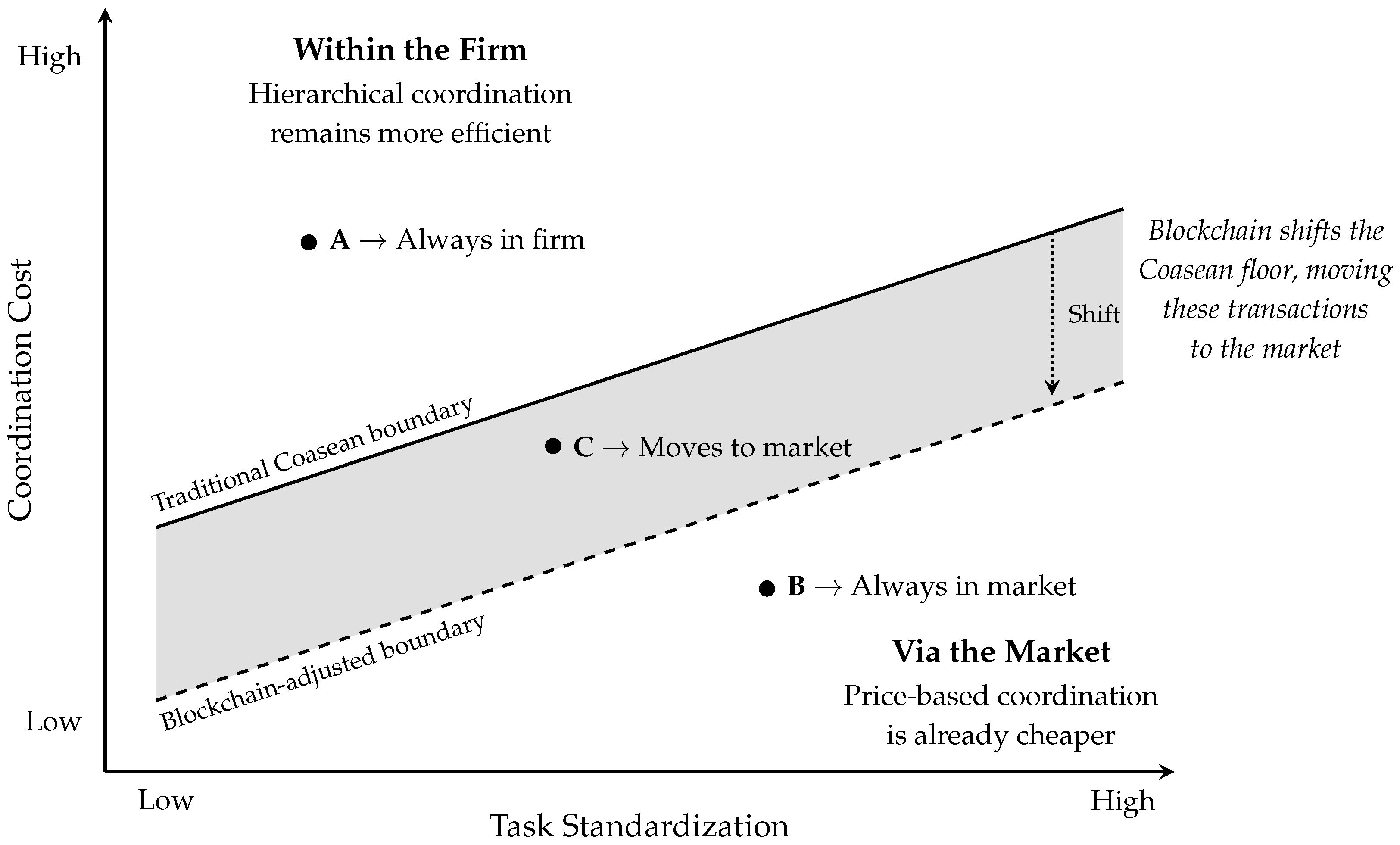
Coase’s theorem posits that firms exist because internal coordination is often less costly than market transactions. Smart contracts and DAOs directly challenge this premise through transaction cost reduction (substituting costly processes with automated, transparent, trustless transactions), redefined boundaries (efficiently externalizing many functions), and acknowledged limitations (not all economic activities are codifiable). Blockchain technology reconfigures but does not make obsolete Coase’s analysis. It shifts the “firm” and “market” boundary by greatly expanding decentralized transaction types. For “codifiable” activities, traditional firm organization needs decline dramatically; for complex, ambiguous, or relationship-based work, organizations remain necessary, though they benefit from greater transparency and lower costs.
Figure 1 illustrates this boundary shift conceptually. The solid line represents the traditional Coasean boundary (
Coase, 1937). Below and to the right, tasks are sufficiently standardized such that price-based market coordination is cheaper than hierarchical management. Above and to the left, high coordination costs and non-standard tasks make internal firm organization more efficient. Blockchain technology, through smart contracts, tokenization, and trustless settlement, lowers coordination costs across a wide range of activities, shifting the boundary downward (dashed line). Region
C captures the transactions that were previously efficient only within firms (e.g., escrow, settlement, and identity verification processes in financial services) but become economical to execute via markets or DAOs once these costs fall. The applications examined in
Section 3,
Section 4,
Section 5 and
Section 6 correspond to activities in this expanded market territory: payment settlement migrating from correspondent banking hierarchies to blockchain networks (
Section 3), wealth management back office functions moving from in-house operations to a shared ledger infrastructure (
Section 4), real estate intermediation shifting from multi-party hierarchical processes to smart contract automation (
Section 5), and corporate governance migrating from board-managed structures to token-based DAO mechanisms (
Section 6). Importantly, activities in Region
A, which require complex judgment, relationship-specific knowledge, and non-codifiable discretion, remain within firm boundaries, consistent with the hybrid architecture thesis advanced throughout this paper.
Despite their potential, DAOs face substantial obstacles: legal uncertainty in many jurisdictions regarding DAO legal personality, property rights, or liability (
Dombrowski & Slawson, 2024;
Weinstein et al., 2022); regulatory ambiguity regarding securities laws, KYC and AML standards, or tax rules; technical risks from contract vulnerabilities; human discretion needs for non-algorithmizable governance; and adoption hurdles as users, markets, and regulators adapt to new paradigms while lacking equal technical expertise. DAOs also face a distinctive agency problem created by highly concentrated token ownership among large holders, or “whales”. When whales’ incentives diverge from those of smaller token holders (i.e., users), their concentrated control can expose DAO governance to significant vulnerabilities (
Han et al., 2025).
3. Real-Time Payment Systems: Legacy Systems and Blockchain Alternatives
This section presents a brief history of legacy payment systems in the U.S., tracing the evolution to electronic payments and near real-time settlement (
Section 3.1). This is followed by some estimates of potential cost savings when moving to faster payment processing and settlement speeds (
Section 3.2). Then, we conclude the section with a brief discussion of recent regulatory developments and legislation on the topic (
Section 3.3).
In transaction cost terms, legacy payment systems impose coordination costs through multi-party settlement chains, information costs through opaque processing status, and enforcement costs through reliance on trusted intermediaries for finality. Blockchain-based alternatives address each category: distributed ledgers reduce information costs through transparent, real-time transaction tracking; cryptographic consensus reduces enforcement costs by eliminating the need for trusted intermediaries; and near-instant settlement reduces coordination costs by compressing multi-day clearing processes into minutes or seconds (
Arshadi, 2019b;
Bank for International Settlements, 2017;
Catalini et al., 2022).
3.1. Payment System Evolution and Current State
The U.S. payment system has evolved through successive technological innovations spanning more than a century, each addressing operational bottlenecks while preserving legacy infrastructure. The regulatory framework emerged from responses to financial crises. The Office of the Comptroller of the Currency (OCC) was established in 1863, the Federal Reserve System was established in 1913, and the Federal Deposit Insurance Corporation (FDIC) was established in 1933 (
Federal Reserve History, 2023b). These institutions created the foundation for electronic payment infrastructure, which includes legacy systems such as Fedwire and ACH, as well as newer systems such as Same Day ACH (2016) and FedNow (2023). As with the evolution of blockchain technology during this same period, these systems enable faster settlement with lower costs and increased accessibility (
Federal Reserve, 2023).
The Federal Reserve inaugurated electronic fund transfers in 1915 through the Fedwire system, initially transmitting payment instructions via telegraph and Morse code among the 12 Reserve Banks (
Federal Reserve History, 2023b). This innovation eliminated the inefficiencies and risks of physical currency transport, establishing immediate settlement capability through centralized Federal Reserve balances. The system evolved continuously; teletype machines replaced Morse code in the 1930s, a complete overhaul occurred in 1953, and a 1970 modernization introduced computerized messages transmitted via telephone lines. Then in the 2000s, Fedwire access moved to web-based interfaces, and the system migrated from a mainframe to a distributed system. Today, Fedwire operates as a real-time gross settlement (RTGS) system, processing approximately 200 million transactions annually with a total value exceeding one quadrillion dollars (
Federal Reserve, 2025b).
In 1972, the Federal Reserve Bank of San Francisco piloted the first automated clearing house (ACH), partnering with California banks to provide an electronic alternative to manual check processing (
Nacha, 2019). The National Automated Clearinghouse Association (Nacha) was formally established in 1974 to standardize rules, administer the national network, and coordinate governance. The ACH volume grew exponentially over subsequent decades and has become the predominant mechanism for small-scale retail payments, processing more than 33 billion transactions with a total value of
$86.2 trillion in 2024 (
Nacha, 2025). As evident by the aggregate statistics, ACH facilitates a larger volume of smaller payments (mostly direct deposit and consumer bill pay), whereas Fedwire typically processes larger value transfers (
$4–6 million per transfer, on average).
When the Federal Reserve began ACH operations in the 1970s, it processed transactions in a single daily batch (
Federal Reserve History, 2023a). In 1979, it added a second “night” cycle. In 2001, Reserve Banks established ACH payment finality on settlement day, removing reversal risk and encouraging broader adoption. As of 2023, the Federal Reserve processes standard ACH payments six times per banking day, yet settlement still occurs on the next business day. For faster settlement, Nacha implemented same-day ACH in three phases (from September 2016 to March 2018). This system allows for same-day settlement with three distinct submission and settlement windows throughout the day. Following the phased roll-out of same-day ACH, adoption has grown to more than 1.2 billion transactions representing more than
$3 trillion in 2024 (
Nacha, 2025).
Most recently, the Federal Reserve introduced the FedNow system in July 2023, which enables near real-time transfers with 24 × 7 × 365 availability (
Federal Reserve, 2023). In its first full year (2024), this system processed 1.5 million transfers totaling
$38 billion in value. Then, through the first three quarters of 2025, FedNow processed 6 million payments totaling more than
$600 billion in value. This near real-time settlement with uninterrupted availability mirrors the aims of blockchain ledgers and enables immediate transfers between parties with near zero transaction costs.
3.2. Opportunity Cost Advantage of Real-Time Settlement
In the decade following the invention of Bitcoin, a multitude of different blockchain projects experimented with the creation of general-purpose digital ledgers that could facilitate complex smart contract logic. A subset of this broader “cryptocurrency” space is concerned with facilitating payments. Similar to the batch processing structure of the ACH system, these blockchains group transactions into batches (blocks) that are cryptographically linked by their hashes. This can enable near real-time settlement speeds similar to the FedNow system; however, the concepts of settlement and finality can be somewhat more complicated for different blockchains.
Unlike the highly structured batch processing schedules for ACH, many blockchains have different block intervals that can even have a degree of randomness. For example, although the Bitcoin protocol automatically adjusts the mining difficulty, ensuring a long-term average of 10 min per block, the underlying proof-of-work consensus mechanism leads to short-term variation in the block intervals. On the other hand, the Ethereum blockchain processes blocks at a rate of one per 12 s.
To evaluate the potential cost savings of near real-time settlement over next-day settlement, consider the aggregate value of the ACH system in 2024:
trillion (
Nacha, 2025). With 252 business days per year and next-day settlement, we can approximate the daily payment flow:
billion (
$86.2 trillion ÷ 252). Assuming a 7.5% discount rate (
JPMorgan Chase (
2025) prime rate at start of 2025), we can use the present value of a recurring cash flow in Equation (
1) to estimate the current aggregate value of such payment flows:
With next-business-day settlement (
) over one full year (
), these parameters yield a present value of
$83.035 trillion:
If we compare that with the settlement schedule of same-day ACH (three times per business day), then we have
(
) and
billion (
$86.2 trillion ÷ 756):
Thus, by differentiating the two, we estimate the potential cost savings to be roughly $8 billion (or $0.008 trillion), which can be attributed to faster payment processing.
To further expand this logic, consider the more frequent batching and processing and 365-day availability of the two largest blockchains: Bitcoin and Ethereum. With a 10-min block interval, Bitcoin processes roughly 52,560 blocks per year (6·24). This yields a present value of $83.04676 trillion, representing an additional $3–4 billion in potential cost savings over the same-day ACH schedule. For Ethereum’s 12-s block interval, there are roughly 2.628 million blocks per year. This increases the present value to $83.04682 trillion, which corresponds to just $60 million of further savings.
To consider a fully real-time payment system, we evaluate the limit of Equation (
1) as
. This converges the formula to the continuously compounding present value of a recurring cash flow, as in Equations (
4) and (
5). See
Appendix A for a proof of this equivalency:
If we consider a full year of payments ( trillion), the present value increases by just $722,464, which is still just $83.04682 trillion. Thus, the cost savings of faster payment processing and settlement primarily occur when moving from next-day to same-day settlement and subsequently to within-hour settlement. As demonstrated by the 10-min, 12-s, and continuous compounding cases, the further cost savings of real-time versus near real-time settlement are relatively small.
Sensitivity Analysis. The preceding estimates relied on a 7.5% discount rate, corresponding to the
JPMorgan Chase (
2025) prime rate at the start of 2025. To assess the robustness of these results,
Table 1 presents the estimated opportunity cost savings across a range of discount rates (5%, 7.5%, and 10%) and transaction volumes. The key finding that the majority of cost savings accrued from moving to same-day or within-hour settlement was robust across all parameter combinations, though the magnitude varied substantially with the discount rate. In total, the transition from next-business-day settlement to near real-time blockchain settlement generated estimated opportunity cost savings of approximately
$8–15 billion annually, depending on the discount rate assumed (
Table 1).
Several simplifying assumptions should be noted. The model assumes a uniform distribution of payments across settlement periods and a constant discount rate, and it does not incorporate transaction fee differentials between legacy and blockchain systems. The estimates also reflect opportunity cost savings only and do not account for operational costs of system migration, integration with legacy infrastructure, or regulatory compliance costs. These limitations suggest that the estimates represent an upper bound on net savings from settlement acceleration alone.
In regard to the scope of these estimated cost savings, the values represent conservative estimates based on the aggregate value of standard ACH payments, which are typically domestic small-to-mid-size payments. Large-value transfers and international payments further demonstrate the potential cost savings of near real-time settlement and blockchain technology. The real-time settlement of the Fedwire system charges less than
$1 per transfer (
Federal Reserve, 2025a); however, typical fees for wire transfers at most financial institutions are in the
$0–50 range, depending on factors like domestic versus international and incoming versus outgoing transfers (
Tierney, 2025).
For blockchain systems, transaction fees are often dynamic and can depend on factors like the amount of transaction data (block space) and the market demand for block space. This has led to occasional periods of high fees when the demand for block space spikes (
Tsang & Yang, 2021). Throughout the years, various blockchain protocol changes have been implemented with the goal of improving transaction efficiency and lowering fees for users. For example, Bitcoin’s segregated witness (SegWit) and Taproot upgrades (2017 and 2021, respectively) have focused on scaling up the network capacity for transactions while also keeping data storage requirements for running a node within reason. In December 2025, the newly public Bitcoin company Twenty One (NYSE: XXI) established their Bitcoin treasury on-chain ahead of their initial public offering (
Zimmerman, 2025). This public blockchain transaction
1 showed a transfer of more than 43,000 bitcoins (valued at nearly
$4 billion) with a transaction fee of just 0.00001765 BTC (
$1.60).
All payment systems perform three critical functions: (1) verifying sufficient funds, (2) ensuring funds reach the intended recipients, and (3) preventing double spending. Blockchain achieves these through cryptographic mechanisms without institutional intermediaries. The asymmetric cryptography of wallet creation ensures that only transactions signed by the appropriate keys will be considered valid. After a transaction is verified as valid by the network’s nodes and processed into a block, the block is timestamped into the blockchain. The degree of finality or settlement at this point largely depends on the specifics of a given blockchain’s consensus mechanism. However, most blockchains aim to provide an immutable ledger where confirmed transactions can be considered final with near-zero likelihood of reversal or invalidation.
3.3. Regulatory Momentum and Industry Response
The pursuit of faster payment processing, real-time settlement, and minimal transaction costs have been persistent trends throughout the development of the modern electronic payments systems. Starting with the creation of Bitcoin in 2009 and the various blockchain ecosystems that have launched since then, these have established a decentralized financial infrastructure that competes with established Fed-sponsored systems, such as ACH, Fedwire, and FedNow. Unlike the highly regulated banking environment of the legacy systems, decentralized blockchain networks have thus far been developed in a legal environment with modest uncertainty about reporting and classification of digital assets. In addition to the fairly recent state-level DAO laws noted in
Section 2.4, recent years have seen interest from Congress in passing legislation that provides regulatory clarity to the digital asset space.
Prior to the recent Congressional interest in digital assets, the
Federal Reserve (
2017a,
2017b) formed the Faster Payments Task Force to develop faster payment system proposals. With more than 300 participants representing banks, technology companies, consumer groups, retailers, and government agencies, the report notes the importance of real-time settlement to reduce credit risk between parties. Notable participants included Dwolla, Ripple, and The Clearing House. Ripple served on the task force’s Steering Committee and proposed an Interledger-based solution that was recognized by McKinsey for enabling faster cross-border payments with enhanced transparency and end-to-end transaction visibility (
Ripple, 2017). In the years following the task force, the Fed developed the FedNow system that launched in 2023 to provide real-time payment processing (
Federal Reserve, 2023).
Throughout that same period, Congressional interest has grown for passing broad market structure legislation for digital assets. Following various proposed bills in the early 2020s, Congress passed the
GENIUS Act (
2025), which established a federal framework for payment stablecoins and became the first major crypto statute to clear both chambers. Another proposed bill in Congress is the
CLARITY Act (
2026), which focuses on broader digital asset market structure regulation, including DeFi, DAOs, and asset tokenization. A version of this bill was passed in the House of Representatives in July 2025; however, as of January 2026, it has yet to pass the Senate.
3.4. Stablecoins: Economic Role, Risks, and Governance
Stablecoins are digital tokens designed to maintain a stable value relative to a reference asset, typically the U.S. dollar. These have emerged as a critical component of blockchain-based payment ecosystems. By bridging the gap between volatile cryptocurrencies and fiat currencies, stablecoins facilitate near-instant settlement and cross-border transfers and serve as the primary medium of exchange within DeFi protocols. As of early 2026, the total market capitalization of stablecoins exceeds
$200 billion, with Tether (USDT) and USD Coin (USDC) accounting for the majority of circulating supply (
CoinGecko, 2026).
Design Taxonomy and Risk Profiles. Stablecoins can be categorized by their stabilization mechanisms, each with distinct risk profiles. Fiat-collateralized stablecoins (e.g., USDC or USDT) maintain reserves of cash, treasuries, or money market instruments to back each token at a 1:1 ratio. Their primary risks involve reserve quality, custodial integrity, and counterparty exposure to the banking system. Crypto-collateralized stablecoins (e.g., MakerDAO’s DAI) use overcollateralized positions in volatile crypto assets, with smart contracts enforcing liquidation when collateral ratios fall below thresholds. They face risks from rapid collateral depreciation and oracle failure. Algorithmic stablecoins attempt to maintain their pegs through supply adjustment algorithms without direct collateral backing. The catastrophic collapse of TerraUSD (UST) in May 2022, which erased approximately
$45 billion in market value within days, demonstrated the fragility of purely algorithmic designs, as the mint-and-burn mechanism with the sister token LUNA entered a “death spiral” when confidence faltered and redemption pressure exceeded the algorithm’s stabilization capacity (
Briola et al., 2023).
Regulatory Framework. The regulatory landscape for stablecoins is evolving rapidly. In the U.S., the
GENIUS Act (
2025) established the first federal framework for payment stablecoins, requiring issuers to maintain one-to-one reserves in high-quality liquid assets, submit to regular audits, and comply with AML and KYC requirements. Internationally, the European Union’s Markets in Crypto-Assets (MiCA) regulation imposes reserve, governance, and disclosure requirements on stablecoin issuers operating within the EU (
European Parliament, 2023). The Bank for International Settlements has recommended that systemically important stablecoins be subject to standards equivalent to those applied to payment systems and commercial bank deposits, reflecting their growing role in financial infrastructure (
Bank for International Settlements, 2022).
Integration with Legacy Infrastructure. The NYSE’s January 2026 announcement of stablecoin-based funding alongside traditional market infrastructure (
Intercontinental Exchange, 2026) exemplifies the hybrid architecture thesis central to this paper; stablecoins serve as the settlement layer connecting blockchain-native trading with established capital markets. Similarly, J.P. Morgan’s JPM Coin operates as a tokenized deposit, facilitating real-time wholesale payments within the bank’s permissioned blockchain (
J.P. Morgan, 2024). These implementations demonstrate that stablecoins are increasingly integrated into institutional financial infrastructure rather than functioning solely within the decentralized crypto ecosystem.
6. Corporate Transformation and Organizational Governance
Blockchain technology challenges traditional theories of the firm by fundamentally altering the transaction cost calculus that determines organizational boundaries. This section examines how distributed ledger technology, smart contracts, and decentralized autonomous organizations (DAOs) reconfigure corporate structures, governance mechanisms, and the allocation of decision rights. Building on the DAO introduction in
Section 2.4, we analyze the blockchain’s implications for organizational design across financial services and other sectors, with particular attention paid to empirical applications and documented governance challenges.
6.1. Blockchain’s Impact on Organizational Structure
Blockchain technology disrupts the traditional trade-offs between market coordination and hierarchical organization by reducing three categories of transaction costs: search and information costs through transparent, immutable records, bargaining and decision costs through automated smart contract execution, and policing and enforcement costs through cryptographic verification and consensus mechanisms (
Coase, 1937;
Cong & He, 2019;
Williamson, 1985). These technological capabilities enable corporations to externalize functions historically performed within firm boundaries.
Smart contracts automate routine governance activities that previously required managerial oversight, such as voting, resource allocation, and compliance reporting (
Arshadi, 2023). On-chain records make transactions and rule changes transparent and auditable in real time, limiting opportunities for opportunistic behavior while decreasing the need for costly third-party verification. Token-based governance systems can broaden stakeholder participation beyond traditional shareholder structures, though empirical evidence reveals significant challenges in participation rates and power concentration (
CCAF, 2026).
Table 2 summarizes the key structural differences between traditional corporate governance and DAO-based governance, drawing on both established corporate finance theory and emerging empirical evidence from blockchain implementations. The governance cost comparison reflects the elimination of managerial compensation structures and legal monitoring infrastructure in DAOs, offset by significant smart contract auditing expenses.
Arshadi (
2023) documented these cost trade-offs across multiple enterprise blockchain deployments. The transparency dimension is well established; on-chain transactions are publicly verifiable and auditable in real time, in contrast to the periodic disclosure regimes governing traditional corporations (
Cong & He, 2019;
Yermack, 2017). Participation differences were documented empirically by the Cambridge DeFi Navigator (
CCAF, 2026), which reported voter turnout below 10% for most tracked DAOs, consistent with the rational apathy dynamics analyzed in
Section 6.3. The agency problems dimension reflects the theoretical insight of
Sockin and Xiong (
2023) that tokenization introduces new principal-agent tensions between large and small token holders, contrasting with the classic shareholder-bondholder-manager framework of
Jensen and Meckling (
1976). Legal recognition remains limited to five U.S. states with DAO-specific legislation (
Dombrowski & Slawson, 2024), compared with well-established corporate law frameworks globally. Scalability constraints for DAOs encompass both technical throughput limitations and governance participation challenges at scale, whereas traditional corporate structures have demonstrated enterprise-level scalability over centuries of institutional development (
Lacity & Lupien, 2022). While DAOs offer theoretical advantages in transparency and automation, challenges remain for facilitating productive business activities, including effective treasury management and sustained tokenholder engagement.
6.2. Enterprise Blockchain Applications
To understand blockchain’s impact on organizational efficiency, we examine empirical applications in financial services where transaction costs and intermediary fees are substantial and measurable.
Securities Settlement Automation. Traditional securities trading involves multiple intermediaries: exchanges match buyers and sellers; brokerage firms confirm trades; clearinghouses verify and match transactions; the Depository Trust & Clearing Corporation (DTCC) facilitates ownership transfers and payment settlement; and custodian banks maintain records. This multi-party process required T + 2 settlement (trade date plus two business days) until recent SEC rules shortened it to T + 1 as of May 2024.
Blockchain-based settlement systems can dramatically accelerate this process. Theoretical models demonstrated that blockchain settlement with approximately 27-min block times generates efficiency gains equivalent to 1–4 basis points relative to T + 2 settlement (
Chiu & Koeppl, 2019). Real-world implementations demonstrate measurable advantages; J.P. Morgan’s institutional blockchain platform (formerly Onyx, now Kinexys) uses JPM Coin as a tokenized deposit to enable real-time wholesale payments between client accounts, processing more than
$1.5 trillion in notional value and supporting near-instant settlement in multiple currencies for institutional clients (
J.P. Morgan, 2024). Similar ideas are now being extended to public capital markets. In January 2026, the New York Stock Exchange announced plans for a separate platform for tokenized securities offering 24/7 trading, instant settlement via blockchain infrastructure, and stablecoin-based funding alongside traditional market infrastructure (
Intercontinental Exchange, 2026).
The efficiency gains extend beyond speed. Blockchain settlement reduces reconciliation costs by maintaining a single shared ledger that all participants can verify cryptographically, eliminating bilateral reconciliation between intermediaries. Smart contracts automate post-trade workflows (e.g., trade confirmation, netting, and settlement instruction generation), which reduces manual processing and error rates. Transparent on-chain records enhance regulatory oversight and audit efficiency, as supervisors can monitor activity in real time rather than relying on periodic reports.
Cryptocurrency Exchanges: Consolidating Intermediary Functions. Cryptocurrency exchanges such as Coinbase demonstrate how the blockchain enables vertical integration of functions that traditional financial markets distribute across multiple intermediaries. Coinbase consolidates brokerage services (facilitating cryptocurrency purchases and sales and fiat conversion), exchange operations (matching buyers and sellers), and settlement and clearing (finalizing transactions on-chain) within a unified platform (
Coinbase, 2025).
This consolidation is enabled by three blockchain capabilities: (1) tokenization of fiat currencies through stablecoins, which eliminates delays in traditional fiat settlement; (2) cryptographic security that prevents double spending without requiring trusted third parties; and (3) automated execution through smart contracts that enforce trading rules and settlement logic. Traditional equity trading incurs separate fees for execution, clearing, settlement, and custody, functions distributed across exchanges, clearinghouses, depositories, and custodian banks. Blockchain exchanges consolidate these functions, reducing aggregate transaction costs while accelerating settlement from T + 1 to minutes.
Supply Chain and Enterprise Integration. Beyond financial services, enterprise blockchain applications demonstrate transaction cost reduction in supply chain management. Walmart’s collaboration with IBM on food traceability reduced tracking times from seven days to 2.2 s by recording provenance data on a shared blockchain, significantly improving recall efficiency during food safety incidents (
Sristy, 2021). Boeing employs a blockchain to enhance supply chain transparency and traceability, ensuring part authenticity and regulatory compliance across its global supplier network by recording component provenance and certifications on an immutable ledger, reducing verification costs while improving safety assurance (
SIMBA Chain, 2026).
6.3. Governance Challenges in Practice
While blockchain-enabled governance offers theoretical advantages in transparency, automation, and reduced monitoring costs, empirical research on DAOs indicates that practical implementations often fall short of the ideal of fully decentralized, high-participation governance (e.g.,
Cong & He, 2019;
Dombrowski, 2025;
Yermack, 2017). A growing body of work documents structural governance problems in prominent protocols and stresses the importance of hybrid solutions that blend on-chain automation with off-chain institutions and oversight (
Dombrowski, 2025;
Sun et al., 2024;
Yermack, 2017).
Token Concentration and de Facto Centralization. Across major DeFi and Web 3.0 projects, governance tokens tend to be highly concentrated among a relatively small set of large holders (
Sun et al., 2024). This empirical pattern aligns with the theoretical prediction of
Sockin and Xiong (
2023) that when tokens confer cash flow rights (either through transaction fee redistribution or appreciation potential), nonusers acquire them as investments, potentially accumulating sufficient stakes to seize control and reintroduce the commitment problem that decentralization through tokenization aimed to resolve. This concentration of voting power in a DAO can be represented by the Gini coefficient. The Cambridge DeFi Navigator (
CCAF, 2026) shows persistently large Gini coefficients (>0.98) for all 10 DAO governance tokens tracked in the database. This concentration raises concerns about capture, entrenchment, and the possibility that governance decisions may systematically favor large tokenholders over smaller participants, undermining the egalitarian narrative often associated with DAOs.
Mechanism Design Solutions for Token Concentration. Several algorithmic approaches have been proposed to mitigate whale dominance in DAO governance. Quadratic voting (QV) requires voters to pay quadratically increasing costs for additional votes on a given proposal, limiting the marginal influence of large token holders.
Tamai and Kasahara (
2024) demonstrated that combining QV with vote escrow tokens, which lock governance tokens for a specified period in exchange for enhanced voting weight, can mitigate both the whale problem and collusion risk, as the time-locking mechanism aligns voters’ incentives with long-term protocol health. Empirical evidence supports these design intuitions.
Han et al. (
2025) found that staking and vote escrow systems are positively associated with platform growth (measured by the total value locked), suggesting that mechanisms incentivizing long-term commitment by large holders can benefit the broader DAO ecosystem. Additional approaches include conviction voting (where voting power accumulates over time for sustained preferences), delegation systems that enable passive token holders to assign votes to informed delegates, and AI-assisted proposal evaluation tools that reduce the information costs contributing to rational apathy among small holders. These mechanism design innovations represent promising avenues for improving DAO governance, though they remain in early stages of deployment and require further empirical validation at scale. The accountability frameworks emerging from AI governance research—particularly those emphasizing decision traceability logs and compliance rule engines for financial applications—offer complementary tools for enhancing transparency and auditability in DAO decision-making processes (
Devarajulu et al., 2025;
OECD, 2023).
Low Participation and Rational Apathy. Even when token ownership is relatively dispersed, voter participation in DAO governance can be low, calling into question the legitimacy and robustness of on-chain decision making. The Cambridge DeFi Navigator (
CCAF, 2026) shows varying degrees of voting turnout across the DAOs, with some (e.g., Curve and Frax) generating modest turnout (50+%). However, most tended to see less than 10% turnout from tokenholders. These patterns are consistent with classic rational ignorance and free rider problems in collective choice; small tokenholders face nontrivial information and time costs to evaluate complex proposals, yet their marginal influence on outcomes is negligible, giving them little incentive to remain engaged. In practice, governance outcomes often reflect the preferences of a small minority of informed and motivated participants, which can amplify the impact of token concentration and enable coordinated voting blocs to exercise outsized control.
Technical Vulnerabilities and Governance Attacks. Smart contracts and immutable ledgers mitigate some forms of opportunism but introduce new sources of governance risk (
Cong & He, 2019;
Yermack, 2017). As discussed in
Section 2.4, the 2016 exploit of the DAO exposed how coding errors can have catastrophic consequences, forcing the Ethereum community to resolve a contentious trade-off between strict immutability and pragmatic intervention through a hard fork (
Lacity & Lupien, 2022). Even when governance proposals are well intentioned, upgrade processes are path-dependent and subject to smart contract bugs and specification errors that may be difficult to reverse once the code is deployed. These dynamics imply that automation does not eliminate governance risk; rather, it converts many traditional agency problems into software engineering, mechanism design, and security audit problems that require specialized expertise and continuous monitoring.
Mapping Blockchain Risks to Cybersecurity Standards. The vulnerabilities identified above can be systematically evaluated using NIST Cybersecurity Framework (CSF) 2.0 (
NIST, 2024). CSF 2.0, updated in 2024, organizes cybersecurity risk management into six core functions: govern, identify, protect, detect, respond, and recover. Notably, CSF 2.0 includes a new financial sector community profile, providing an implementation roadmap tailored to financial institutions.
In the context of blockchain-based financial services, CSF 2.0 functions map to specific risk categories. The govern function encompasses establishing cybersecurity governance for smart contract development and audit processes, including supply chain risk management for third-party oracle providers and cross-chain bridges. The identify function requires cataloging blockchain-specific assets and vulnerabilities, including smart contract code, private key management infrastructure, and consensus mechanism dependencies. The protect function addresses access controls (multi-signature wallets and hardware security modules), smart contract audit protocols, and formal verification of critical contract logic. The detect function encompasses on-chain monitoring for anomalous transactions, governance attacks, and oracle manipulation. The respond and recover functions address incident response protocols, including the contentious decision frameworks illustrated by the DAO hard fork (
Section 2.4), circuit breakers for DeFi protocols, and insurance mechanisms for smart contract failures. This mapping provides regulators and practitioners with a structured approach to evaluating and mitigating blockchain-specific risks within an established, widely adopted framework.
Regulatory and Legal Uncertainty. As noted in
Section 2.4, only a small number of U.S. states currently offer explicit statutory recognition of DAOs as legal entities, and there is still no comprehensive federal framework governing DAO status, liability, or taxation. Legal scholarship emphasizes that, in the absence of clear entity status, DAO participants may face uncertain personal liability, difficulties in entering into contracts with traditional counterparties, and challenges in accessing banking, custody, and insurance services (
Dombrowski & Slawson, 2024;
Weinstein et al., 2022). Securities regulation adds further complexity; depending on the token design and economic rights, governance tokens may be deemed securities under existing tests, triggering registration, disclosure, and compliance obligations that many DAOs are ill-equipped to satisfy (
Dombrowski, 2025;
Yermack, 2017). Internationally, regulatory approaches remain fragmented, forcing globally accessible DAOs to navigate a patchwork of jurisdiction-specific rules and raising the risk of inadvertent non-compliance or regulatory arbitrage.
Human Discretion and Non-Codifiable Contingencies. A core design premise of DAOs is that “code is law”, yet many economically important contingencies are difficult or impossible to express in rigid, ex ante contractual logic. Complex investment decisions, strategic pivots, crisis management, and ethical considerations typically require judgment, negotiation, and interpretation that extend beyond what can be fully automated in smart contracts. The encoding of these contingency plans and broader governance structure (e.g., voting power and processes) are critical technical decisions made when designing the smart contracts for the DAO. This is similar to how corporations establish shareholder voting procedures in the articles of incorporation and codify contingency plans for emergency situations in corporate bylaws.
Toward Hybrid Governance Architectures. Given these challenges, we argue that effective blockchain governance is likely to rely on carefully structured hybrid architectures that leverage the strengths of both decentralized protocols and conventional institutions. In such designs, smart contracts automate verifiable, rule-based processes and provide a transparent, tamper-evident record of decisions, while legal entities, regulatory regimes, and off-chain dispute-resolution mechanisms supply the flexibility, accountability, and normative guidance that purely on-chain systems lack.
7. Synthesis, Implementation, and Future Directions
This paper examined how blockchain technologies, smart contracts, and DAOs reconfigure the institutional architecture of financial services by altering transaction cost economics, corporate governance structures, and the boundaries between firms and markets. Drawing on Coasean transaction cost theory (
Coase, 1937;
Williamson, 1985) and agency cost frameworks (
Jensen & Meckling, 1976), the analysis demonstrates that the blockchain enables measurable efficiency gains across payments, wealth management, real estate, and organizational governance while simultaneously introducing technical, regulatory, and governance challenges that necessitate hybrid institutional architectures.
This concluding section synthesizes the paper’s principal contributions (
Section 7.1), outlines priorities for future research (
Section 7.2), and concludes with reflections on the blockchain’s role in the evolving financial landscape (
Section 7.3).
7.1. Principal Contributions
Quantifying Transaction Cost Reductions. Using the U.S. ACH network’s
$86.2 trillion in annual transaction volume as a benchmark (
Nacha, 2025), the analysis demonstrates that moving from next-business-day to near real-time settlement yields approximately
$12 billion in annual opportunity cost savings at the baseline discount rate (
Table 1), with the majority of gains accruing from the transition to same-day or within-hour settlement. In wealth management, blockchain-based digital identity and tokenized securities reduce onboarding times from weeks to days and eliminate multi-day clearing cycles that tie up capital and create counterparty risk. The New York Stock Exchange’s January 2026 launch of a blockchain platform for 24/7 trading with instant settlement signals institutional recognition that the blockchain has transitioned from experimental technology to essential infrastructure (
Intercontinental Exchange, 2026).
In real estate, the blockchain addresses transaction costs that currently consume 9–10% of property value through three complementary mechanisms. First, blockchain-based title registries create immutable ownership records that reduce redundant title searches and lower insurance premiums by maintaining cryptographically verified transaction histories (
Garcia-Teruel, 2020;
Saari et al., 2022). Second, smart contract escrow automates fund disbursement upon satisfaction of contingencies, reducing manual processing costs by approximately 3.8% while achieving time savings of up to 80% (
Göranson, 2025). Third, tokenization enables fractional ownership and secondary market liquidity for traditionally illiquid assets; empirical evidence from RealT’s 58 tokenized properties shows median ownership exceeding 250 investors per property, with token prices tracking underlying real estate values (
Swinkels, 2023). Platforms such as Propy (over
$4 billion in facilitated transactions) and Blockimmo (Europe’s first regulated tokenization platform) demonstrate proof-of-concept implementations. Critical success factors include supportive regulatory frameworks, reliable digital data infrastructure, public-private partnerships, and stakeholder education to build confidence in new transaction models.
DAOs and Governance. Decentralized autonomous organizations embed governance rules in immutable smart contracts, mitigating agency problems by eliminating managerial discretion over codifiable decisions and eradicating information asymmetry through on-chain transparency. However, empirical analysis reveals substantial gaps between theory and practice; governance token ownership exhibits Gini coefficients exceeding 0.98, voter participation typically falls below 10%, and legal uncertainty persists, with only five U.S. states enacting DAO-specific legislation (
CCAF, 2026;
Dombrowski & Slawson, 2024). The various crypto hacks, exploits, and accidents throughout the years serve as a reminder that code vulnerabilities can have catastrophic consequences and that purely algorithmic governance cannot eliminate the need for human judgment in crisis scenarios. Effective blockchain governance will require hybrid architectures that leverage smart contracts for verifiable automation while retaining legal entities and off-chain dispute resolution to provide flexibility and accountability.
Several limitations of this study should be noted. First, the quantitative settlement cost analysis in
Section 3.2 relies on a stylized present-value model with simplifying assumptions, including uniform payment distributions and a constant discount rate. The sensitivity analysis across discount rates (
Table 1) demonstrates the robustness of the qualitative findings, but the estimates represent opportunity cost savings only and do not incorporate system migration, integration, or compliance costs. Second, the real estate and governance analyses draw primarily on secondary empirical sources, pilot implementations, and on-chain metrics rather than original micro-level data, which limits the precision of cost reduction estimates. Third, the paper’s scope across four financial services domains necessarily trades depth for breadth. Each application area warrants dedicated empirical investigation beyond what a single integrative study can provide. Fourth, the rapidly evolving regulatory landscape, particularly for stablecoins and DAOs, means that specific legal provisions discussed herein may be superseded by subsequent legislative developments. These limitations reinforce the future research priorities outlined in
Section 7.2 and underscore the importance of ongoing empirical investigation rather than extrapolation from early-stage implementations.
7.2. Priorities for Future Research
Technical Foundations. Rigorous evaluation of layer-2 scalability solutions (lightning network, sidechains, etc.) under realistic workloads is essential to assess whether they can support institutional-scale financial services while preserving decentralization. Privacy-preserving cryptographic techniques—zero-knowledge proofs, secure multi-party computation, and homomorphic encryption—offer potential solutions for confidentiality requirements but require assessment of computational overhead, auditability for regulators, and standardization pathways. Interoperability standards for cross-chain messaging and asset transfer must preserve security while minimizing latency and cost, with economic analysis examining whether network effects lead to winner-take-all consolidation or sustain a heterogeneous multi-chain ecosystem.
Regulatory and Empirical Analysis. Comparative studies across jurisdictions can identify best practices in balancing innovation with investor protection, while legal scholarship must address DAO entity status, liability regimes, and governance token security classification. Large-scale empirical studies leveraging on-chain data should examine adoption patterns, market microstructure effects, and distributional consequences. Does the blockchain democratize access or concentrate power among technical elites? Longitudinal studies tracking implementations over years can assess long-term viability and competitive dynamics. Research on systemic risk should adapt stress-testing methodologies to blockchain contexts, accounting for automated liquidations, oracle failures, and governance attacks, with a particular focus on stablecoin stability mechanisms and run dynamics.
7.3. Toward Hybrid Financial Architectures
The analysis yielded several implications for policymakers and industry practitioners. For regulators, the GENIUS Act establishes a clear perimeter for fiat-backed payment stablecoins by requiring fully collateralized reserves in high-quality liquid assets and imposing licensing, reserve, and disclosure requirements on issuers, which supports the use of well-regulated, dollar-denominated stablecoins in both retail and wholesale payment systems (
GENIUS Act, 2025). At the same time, the CLARITY Act proposals seek to allocate oversight of digital assets based on their economic function and degree of decentralization, providing a template for distinguishing DAO governance tokens that should be treated as securities from those that qualify as digital commodities on sufficiently decentralized networks (
CLARITY Act, 2026). This distinction can reduce the enforcement-driven uncertainty currently surrounding DAOs and help align the incentives of token issuers, protocol developers, and regulators discussed in
Section 2 and
Section 6.
For practitioners, the analysis indicates that the greatest near-term efficiency gains lie in settlement acceleration and back-office automation, where blockchain-based systems can be integrated with existing Fedwire, ACH, and FedNow rails incrementally rather than requiring wholesale system replacement. Financial institutions should therefore prioritize use cases where the transaction cost reductions quantified in
Section 3.2 are most directly realizable, such as interbank transfers, collateral movements, and compliance workflows. More broadly, GENIUS, CLARITY, and MiCA together suggest that durable blockchain adoption in finance will depend on hybrid architectures that align on-chain settlement and DAO-based governance with well-defined regulatory perimeters and legacy institutional safeguards.
Blockchain technology offers measurable benefits in transaction cost reduction, transparency, and automated governance, as demonstrated by billions in annual settlement savings, institutional deployments of enterprise platforms, and major exchanges’ commitments to tokenized securities infrastructure. However, constraints in scalability, regulatory clarity, governance effectiveness, and legacy system integration explain why wholesale replacement of traditional financial infrastructure remains implausible. The most realistic trajectory is not disruption but integration, namely the emergence of hybrid architectures in which blockchain and traditional systems coexist and specialize according to comparative advantages.
In such architectures, the blockchain handles functions where transparency, disintermediation, and 24/7 global settlement provide decisive advantages: tokenized security settlement, cross-border payments, fractional ownership of alternative assets, and automated compliance workflows. Traditional systems retain roles requiring confidentiality, human judgment, and legal recourse: relationship banking, complex structured finance, and fiduciary services. Permissioned blockchains will dominate enterprise consortia and interbank settlement, while public blockchains will anchor decentralized finance ecosystems and open capital markets. Cross-chain bridges and interoperability standards will become critical infrastructure facilitating asset mobility across this fragmented landscape.
Realizing this vision requires regulatory evolution that accommodates blockchain’s unique properties while safeguarding financial stability, institutional cultivation of technical expertise and organizational change management, and collaborative development of standards and best practices. The blockchain’s impact will unfold over decades through uneven, path-dependent transformation shaped by technological breakthroughs, regulatory choices, and competitive dynamics between incumbents and disruptors.
Ultimately, the blockchain represents not the end of financial intermediation but its reconfiguration, a shift from trust vested in institutions and enforced by legal systems to trust embedded in cryptographic protocols and enforced by algorithmic consensus. This transformation challenges the Coasean rationale for firm boundaries, the agency frameworks governing corporate behavior, and the regulatory paradigms that have defined financial markets for generations. Organizations that thoughtfully integrate blockchain capabilities where they create genuine value, manage risks prudently, and invest in organizational transformation will be best positioned to thrive in this evolving landscape. The journey toward blockchain-enabled financial services is not a simple substitution of new technology for old technology but a complex coevolutionary process in which the technology, regulation, market structure, and organizational form adapt in response to each other.