Article

Do Global Uncertainty Factors Matter More to Cryptocurrency?

1
School of Professional Studies, Columbia University, New York, NY 10027, USA
2
Martin Tuchman School of Management, New Jersey Institute of Technology, Newark, NJ 07103, USA
3
Department of Accounting and Finance, Deese College of Business and Economics, North Carolina A&T State University, Greensboro, NC 27411, USA
*
Author to whom correspondence should be addressed.
We extend our deep gratitude to Jixing Li for his insightful comments. Any remaining errors are solely our responsibility.
J. Risk Financial Manag. 2025, 18(11), 628; https://doi.org/10.3390/jrfm18110628
Submission received: 20 August 2025 / Revised: 13 October 2025 / Accepted: 27 October 2025 / Published: 10 November 2025
(This article belongs to the Special Issue Financial Technology (Fintech) and Sustainable Financing, 4th Edition)

Abstract

This study examines the intricate relationships between cryptocurrency and various uncertainties related to economic policy and global risk factors. It explores the interactions between cryptocurrency and global risk factors, comparing these with their relationships to different measures of economic policy uncertainty (EPU). We find that cryptocurrency returns are more sensitive to global risk factors than to the country-level EPU. Notably, gold exhibits bidirectional causality with cryptocurrency in returns and volatility. The research sheds light on the dynamic interactions within cryptocurrency markets, underscoring the importance of continuous monitoring and adaptive strategies to navigate the evolving financial landscape of the digital ecosystem.
JEL Classification:
G10; G19

1. Introduction

Cryptocurrency has emerged as a significant financial innovation over the past decade, gaining immense popularity and attracting substantial investments. Their high volatility relative to other traditional financial assets (Garcia-Jorcano & Benito, 2020; J. Wang & Micale, 2024) and the speculative nature of the market (Bauri et al., 2018) have prompted extensive research into the factors influencing cryptocurrency prices and market behavior. Since cryptocurrency represents global assets that can be traded worldwide, we infer that global uncertainty factors exert a greater influence on cryptocurrency than domestic EPU. Our study explores the linkages between cryptocurrency and various uncertainty factors, including U.S. categorical EPU and global risk factors.
We have contributed to the growing literature on cryptocurrency in several dimensions. Firstly, this study is unique in exploring the relative impact of uncertainty factors on cryptocurrency market dynamics at both the global and country-specific levels. There is no prior study attempting to answer which group of uncertainties has the greater impact on cryptocurrency. This is an important question because investors and regulators need to pay more attention to global risk factors for portfolio construction or policymaking, as global risk has a greater impact on cryptocurrency than country-level risk factors. Although researchers (Syed et al., 2022; Haq et al., 2023) evaluate the impact of some categorical EPU on cryptocurrency, there is still no evidence derived by comparing the relative ramification of global risk factors versus categorical U.S. EPU. Secondly, the study provides a comprehensive causality analysis of uncertainty factors and cryptocurrency, examining their relationships through positive asymmetric, negative asymmetric, and symmetric perspectives, respectively. Using the Granger–Mackey–Glass causality model, we capture nonlinear dynamics and delayed feedback mechanisms, which are critical for predicting chaotic market behaviors. In addition, a bivariate full BEKK-GARCH model offers comprehensive insights into market linkages and risk management strategies by capturing multivariate volatility and spillover effects. Thirdly, this study provides a granular analysis of causal relationships by focusing on categorical U.S. EPU indices. We are among the first to investigate the causal effects of categorical U.S. EPU on cryptocurrency markets, thereby reducing aggregation bias associated with the overall EPU index.
The study of EPU and its effects on financial markets has garnered significant attention in recent years (Yen & Cheng, 2021; Demir et al., 2018; Ali et al., 2023; Gill-de-Albornoz et al., 2024; P. Wang et al., 2020; Mokni, 2021). This interest is especially pertinent to the burgeoning cryptocurrency market characterized by its volatility and unique market dynamics (Lee et al., 2020; Corbet et al., 2019). As global digital assets continue gaining prominence (World Bank, 2023), understanding the uncertainty factors influencing their value becomes increasingly crucial for investors. The study of the impact of diverse uncertainty measures on the cryptocurrency market is a developing area of research. Previous studies have highlighted the liquidity and volatility of cryptocurrencies, illustrating the complex interplay between digital assets and broader economic conditions (Corbet et al., 2022), but they have not distinguished their varied responses to EPU. This study attempts to address an interesting and important question: How do cryptocurrencies respond differently to global and country-level uncertainty factors? We explore this by analyzing the dynamics of returns and volatility spillovers.
The economic motivation for this study arises from several dimensions. First, cryptocurrency represents a highly volatile asset class, making it an intriguing subject for understanding market dynamics and risk factors, in particular, in the context of the world currently experiencing an era of pervasive crises (Acemoglu, 2023)1. Second, cryptocurrency exhibits unique characteristics that distinguish it from conventional assets (J. Wang & Micale, 2024). Unlike traditional financial markets, which operate only on weekdays and allow investors to trade limited foreign assets, cryptocurrency can be traded 24 h a day, seven days a week. Cryptocurrency investors from all around the world can trade the same assets, such as Bitcoin and Ethereum. Bitcoin dominates the cryptocurrency market (J. Wang & Ngene, 2020). These distinctive features inspire our investigation into how cryptocurrency markets respond to global and domestic uncertainties, respectively.
Third, using the U.S. categorical EPU rather than the aggregate EPU allows for a more granular analysis of how specific economic policies affect the cryptocurrency market. As of the end of 2024, the U.S. holds the largest quantity of Bitcoin in the world2, making it the most important country in the cryptocurrency market. This specificity can help investors and policymakers identify the most influential U.S. EPU policies, enabling more targeted and effective interventions. Last, global and categorical uncertainty measures are intrinsically linked to cryptocurrency volatility through fear and hedging mechanisms (Yen & Cheng, 2021). According to the fear hypothesis, rising global or categorical policy uncertainty triggers the positive predictive power on cryptocurrency volatility, thus encouraging investors to reallocate their capital from cryptocurrency markets to safer financial assets, such as treasuries.
Our findings suggest that the global risk factors are stronger transmitters of both returns and volatility spillovers than categorical uncertainty factors. Notably, global risk factors exhibit stronger causality with cryptocurrency returns during market downturns than market upturns. This is interpreted by the loss aversion theory (Kahneman & Tversky, 1979), indicating that investors fear losses more than they value gains. We use the Mackey–Glass model to investigate the nonlinear causality of asset returns from both symmetric and asymmetric perspectives. The Mackey–Glass time-delay differential equation is well-suited for modeling the complex financial time series data. A bivariate full BEKK-GARCH model can help our study to discover multivariate spillover effects in terms of asset volatility. It is especially effective for identifying how each categorical EPU and global risk shock transmits to cryptocurrency volatility. The empirical findings are robust to the block BEKK-GARCH model.
This study has implications for both academia and practitioners. For investors and policymakers, understanding the impact of global risk factors on cryptocurrency markets is essential for developing strategic models that leverage these interconnections for informed decision-making. The findings can potentially leverage the risk monitoring systems in the crypto-financial landscape. For academia, further interdisciplinary research and methodological advancements are needed to deepen our understanding of these dynamics and their broader implications.
The remaining content is organized as follows: Section 2 discusses the literature review. Section 3 presents the data and methodology. Section 4 provides the empirical analysis, and Section 5 concludes.

2. Literature Review

Cryptocurrency represents a highly volatile asset class (Garcia-Jorcano & Benito, 2020), making it a compelling subject for analyzing the linkages between its market dynamics and uncertainty factors at both global and country levels. The adoption of uncertainty measures in this context is driven by several key motivations. First, categorical EPU indices provide more transparent and specific sources of uncertainty compared to aggregate EPU measures. Categorical EPU indices are derived from distinct economic datasets, accounting for the diverse and heterogeneous components. An in-depth investigation into how categorical EPU impacts cryptocurrency market dynamics aids in risk management by identifying specific U.S. EPU categories that can be hedged using cryptocurrency returns under various market conditions (Bouri et al., 2020). These indices offer additional insights by capturing specific uncertainties related to monetary, fiscal, and currency policies in the U.S., thereby equipping investors with more detailed information to assess the strength and magnitude of impacts from various sources of uncertainties on cryptocurrency markets.
Second, the U.S. EPU represents the country’s level of uncertainty in our study, as the U.S. has played the most important role in cryptocurrency markets. The U.S. is the first country to introduce Bitcoin futures contract trading3. Canada and several European countries have followed by approving cryptocurrency-related products. Existing literature suggests that U.S. EPU can be hedged with cryptocurrency under various market conditions (G. J. Wang et al., 2019). Specifically, Bitcoin, as the first cryptocurrency, acts as a diversifier during EPU shocks (G. J. Wang et al., 2019) and serves as a safe haven against global financial stress (Bouri et al., 2017). Additionally, U.S. financial, economic, and policy variables are identified as playing crucial roles in influencing global stock market returns (Chen et al., 2019).
Third, global risk factors such as geopolitical events, market manipulation, and macroeconomic indicators also play crucial roles in shaping cryptocurrency market dynamics. For instance, fluctuations in gold and oil prices and GPRD have been shown to influence cryptocurrency volatility (T. A. Hassan et al., 2019). Additionally, the COVID-19 pandemic brought new insights into the behavior of cryptocurrency under extreme market conditions, revealing their increased trading volumes and heightened volatility during periods of global uncertainty (Park, 2022).
Categorical EPU is applied to investigate the asymmetric relationships between EPU, cryptocurrency, and global green bonds, demonstrating the necessity of granular data to capture these complexities (Syed et al., 2022). Focusing on categorical EPU is particularly important as it allows for a more nuanced analysis of how specific policy areas influence the cryptocurrency market. The dynamic connectedness among EPU, energy, and sustainable cryptocurrency during the COVID-19 pandemic is explored (Haq et al., 2023), underscoring the importance of sector-specific uncertainties. However, the authors did not examine these relationships using categorical EPU. The findings from existing studies further suggest that the effects of EPU indices on the target variables are heterogeneous. The correlation between geopolitical risk (GPRD), EPU, and Bitcoin in P5+1 nations illustrates the advantages of detailed categorization in understanding cryptocurrency market dynamics (Singh et al., 2022).
As a digital asset class, cryptocurrency presents unique opportunities and challenges that impact the global financial system and investor behavior. Bitcoin exhibits increased volatility and trading activity following spikes in EPU, reflecting its sensitivity to U.S. economic policies (P. Wang et al., 2020). EPU-induced uncertainty has the potential to predict cryptocurrency trading volume (market activity) and negative sentiment among traders (Ngene & Wang, 2024). Furthermore, regulatory news and government policies play a significant role in shaping cryptocurrency markets4. Regulatory crackdowns in major markets can heighten volatility as investors respond to potential changes in market accessibility and legal frameworks (Cheng & Yen, 2020).
The existing studies explore the multiple impacts of global uncertainties on cryptocurrency markets, influencing their volatility and trading volume due to increased economic uncertainty. For example, increased market stress during the pandemic resulted in higher trading volume and volatility (Park, 2022). Cryptocurrency market liquidity increased significantly during the pandemic, highlighting the role of cryptocurrencies as potential safe-haven assets.
Higher GPRD indices predict increased volatility and reduced returns in Bitcoin, indicating that geopolitical events can destabilize the cryptocurrency market (Aysan et al., 2019). During periods of elevated GPRD, Bitcoin and other cryptocurrencies exhibit heightened volatility and demand additional risk premiums from investors. Notably, the price of Bitcoin tends to increase under such conditions, indicating that, similar to gold, it is perceived as a safe-haven asset and demonstrates potential as a hedge against GPRD.
The economic fundamentals and uncertainty indices, like the World Uncertainty Index (WUI), significantly influence long-term cryptocurrency volatility, indicating that global uncertainty is a key factor in market dynamics (Fang et al., 2020). Such uncertainty is likely to reduce or delay investment in cryptocurrency technology and heighten investors’ fears. This increased risk aversion would, in turn, lead to higher volatility in the cryptocurrency market. Studies on the effectiveness of gold as a hedge against cryptocurrency market volatility show that fluctuations in gold prices significantly influence cryptocurrency prices, highlighting the connection between these markets (Jin et al., 2019). Gold reliably correlates positively with cryptocurrency uncertainty indices, underscoring gold’s stable safe-haven properties amid cryptocurrency market fluctuations (M. K. Hassan et al., 2021). Significant co-volatility exists between gold and cryptocurrencies, especially during economic uncertainty, such as the COVID-19 pandemic.
Fluctuations in oil prices significantly affect cryptocurrency prices and volatility as well. This highlights the complex and dynamic relationship between the two markets. Studies show that oil market shocks have a significant impact on cryptocurrency volatility, with adverse shocks potentially increasing the appeal of cryptocurrencies as a hedge against economic instability. The dynamic relationship between oil prices and news-based uncertainty affects cryptocurrency’s volatility, indicating that oil market uncertainty is transmitted through informational channels. A recent study about the impact of investor sentiment on cryptocurrency returns finds that cryptocurrency prices tend to rise during bearish equity market conditions, indicated by high VIX levels (Anamika & Subramaniam, 2023), suggesting that cryptocurrency may be an alternative investment avenue during heightened market fear.
To further deepen our study of these complex market dynamics, we employ the Mackey–Glass (Mackey & Glass, 1977) and a bivariate full BEKK-GARCH model (Engle & Kroner, 1995), which are designed for analyzing nonlinear dynamics and multivariate volatility spillovers in delayed feedback mechanisms, thereby capturing the complex behaviors and interactions between uncertainty factors and cryptocurrency markets. We further verify the robustness of our findings using the block BEKK-GARCH framework developed from the full BEKK-GARCH (Engle & Kroner, 1995). The block BEKK framework accommodates more than two variables within a single block. Caporin and McAleer (2012) motivated the development of the block BEKK-GARCH model by addressing the computational complexity that arises when increasing the number of variables in a block. This framework has been applied in various areas, such as examining volatility spillovers between developed and developing markets (Li & Giles, 2015). Granger causality has been widely developed in econometrics. Vector autoregressive (VAR)-based Granger causality can efficiently estimate causal relationships in long time series by processing simulations with various systems that differ in the number of variables and the length of the time series (Papaspyropoulos & Kugiumtzis, 2024). Researchers use Granger causality in a wide range of applications, such as the high-dimensional relationships between VIX and News and the causal channel from macroeconomic factors to U.S. industrial production (Baum et al., 2025).
The Granger–Mackey–Glass model’s primary strength lies in its ability to account for nonlinear dynamics in delayed feedback mechanisms, making it particularly effective in predicting chaotic market behaviors. A recent study (J. Wang & Micale, 2024) has adopted the Mackey–Glass model to identify the causal relationships between real estate investment trust (REIT) and cryptocurrency. Another study (J. Wang, 2025) employs the Mackey–Glass model for examining the impact of government policy on nonlinear causal relationships between segmented technology sectors and cryptocurrency. In contrast, a bivariate full BEKK-GARCH model captures multivariate volatility and spillover effects, providing critical insights into market interdependencies and risk management strategies. A primary strength is that the model can capture volatility spillover effects, which is essential for understanding how shocks in one risk factor can influence the cryptocurrency market, as well as the interconnected nature of these markets (Ghorbel & Jeribi, 2021). The model further provides reliable parameter estimates and broad applicability across various financial assets (Chu et al., 2017). The BEKK-GARCH model has been widely applied to identify volatility spillover effects in financial economics, such as volatility spillover from climate policy uncertainty to energy markets (Zhao et al., 2025) and linkages between the international crude oil market and the Chinese stock market (Xie et al., 2021).

3. Data and Methodology

This study utilizes a comprehensive dataset encompassing EPU sub-indices, cryptocurrency market returns, and global uncertainty factors. The categorical EPU indices collected from the uncertainty dataset5 (Baker et al., 2016) are news-based uncertainty subindices capturing uncertainty relating to the U.S. monetary policy (MOP), fiscal policy (FIS), taxes (TAX), government spending (GOV), national security (NAC), entitlement programs (ENP), regulation (REG), financial regulation (FNG), trade policy (TRP), and sovereign debt and currency crises (SDC) (see Appendix A). The daily data on gold prices (GOLD), oil prices (OIL), volatility index (VIX), infectious disease equity market volatility (IDV), geopolitical risk (GPRD), and cryptocurrency markets (BGCI)6 are obtained from the Bloomberg terminal. The daily GPRD and WUI data are sourced from the WUI webpage7. The dataset spans 30 January 2020 to 28 March 2024 (T = 1045 daily observations per series) and contains seventeen risk factors plus cryptocurrency (N = 18), with 18,810 observations (N × T = 18 × 1045) on a daily frequency. The EPU dataset was transformed from monthly to daily intervals to maintain frequency consistency.
Table 1 presents the summary statistics for returns calculated as the natural log difference in the indices. High skewness and kurtosis values for GOLD, OIL, and VIX in panel A indicate non-normal distributions and the presence of extreme values or outliers in the return series. In panel B, categories such as FNG, ENP, and GOV exhibit significant kurtosis, suggesting potential extreme events impacting these returns. The BGCI shows high excess kurtosis and skewness in panel C, reflecting the volatility and the presence of large, unexpected changes in cryptocurrency prices.
We explore the impact of EPU and other uncertainties on cryptocurrency markets by employing the Mackey–Glass and a bivariate full BEKK-GARCH model for our analysis. The Mackey–Glass model presented in time-delay differential equations excels in modeling complex, nonlinear, and chaotic behaviors often observed in financial markets. The model provides an accurate representation of price movements and volatility and is well-suited for analyzing cryptocurrency markets, which are known for their chaotic behavior and sensitivity to initial conditions. It was used in a study of oil prices and the U.S. economic sectors (J. Wang & Ngene, 2018). Moreover, a bivariate full BEKK-GARCH model adeptly captures multivariate volatility and spillover effects, such as those between cryptocurrency and traditional financial assets (Demir et al., 2018; Ali et al., 2023). It is particularly effective in clarifying how each categorical EPU and global risk shock impacts the volatility of cryptocurrency. The model identifies time-varying correlations between assets, which is crucial for capturing the interconnectedness of financial markets and enhancing portfolio diversification (Mokni, 2021).
For the Mackey–Glass approach, parameters are estimated using nonlinear regression techniques.
Y i = α 11 Y i γ 1 1 + Y i γ 1 k 1 β 11 Y i 1 + α 12 X i γ 2 1 + X i γ 2 k 2 β 12 X i 1 + δ i , δ i ~ N 0,1
X i = α 21 Y i γ 1 1 + Y i γ 1 k 1 β 21 Y i 1 + α 22 X i γ 2 1 + X i γ 2 k 2 β 22 X i 1 + ε i , ε i ~ N 0,1
In this context, k and γ , established a priori, are the constant and delay parameters, respectively. The Akaike Information Criterion (AIC) is utilized to determine the optimal delay parameters, denoted as γ . By varying the delay terms, it is possible to develop multiple dynamic structures that describe the dependence dynamics between time series Y i and X i . In Equations (1) and (2), the coefficient α i j captures the complex nonlinear dynamics of the model. The nonlinear predictive power of X i on Y i is represented by X i γ 2 divided by 1 + X i γ 2 k 2 , with the null hypothesis being α 12 = 0 ( X i cannot nonlinearly predict Y i ). Conversely, the null hypothesis α 21 = 0 tests the nonlinear, non-predictive power of Y i on X i . The rejection of these hypotheses supports the presence of bidirectional nonlinear causal influences between Y i on X i .
The formal formulation of a bivariate full BEKK-GARCH model is as follows:
A t = B 0 B 0 + C θ t 1 θ t 1 C + D A t 1 D
A t = a 11 a 12 a 21 a 22 ,   C = c 11 c 12 c 21 c 22 ,   D = d 11 d 12 d 21 d 22
At time t , A t represents the covariance matrix, B is the lower triangular matrix of constants, and C is the matrix that links conditional variances with past squared errors, capturing the effects of shocks or the ARCH effects. The matrix D measures the persistence or decay of conditional volatility, indicating the GARCH effects. It demonstrates how past conditional variances influence the current levels of conditional variances. The covariance matrix A t is determined by its previous values A t 1 and earlier shocks θ t 1 θ t 1 . The bivariate full BEKK-GARCH model is parameterized as follows:
A t = B 0 B 0 + c 11 c 12 c 21 c 22 θ 1 ,   t 1 2 θ 1 ,   t 1 θ 2 ,   t 1 θ 1 ,   t 1 θ 2 ,   t 1 θ 2 ,   t 1 2 c 11 c 12 c 21 c 22 + d 11 d 12 d 21 d 22 A t 1 d 11 d 12 d 21 d 22
In Equation (4), the diagonal parameters c 11 and c 22 (or d 11 and d 22 ) represent the influence of past own-market shocks (volatility) on the conditional variance of each asset. The off-diagonal parameters illustrate the spillover effects, quantifying the cross-market effects of lagged shocks and lagged volatility of one market on another market. The BEKK-GARCH model assumes a constant correlation matrix of returns over time, given by a 12 , t divided by a 11 , t a 22 , t .
To ensure a parsimonious model, the BEKK-GARCH parameterization maintains that the constant covariance matrix A = A t is positive semidefinite. This allows the model to capture cross-market and own-market influences on the conditional variances. We utilize the log-likelihood function within a bivariate full BEKK-GARCH framework to generate efficient coefficient estimates, effectively capturing shock and volatility spillover effects between cryptocurrency and each uncertainty factor.
For the robustness test, we use a two-block BEKK-GARCH to compare the strength of volatility transmission from global risk factors and the categorical U.S. EPU to cryptocurrency. The formula for the two-block BEKK-GARCH model can be illustrated using the bivariate BEKK-GARCH framework. In fact, the bivariate BEKK model is a special case of the block BEKK model (Caporin & McAleer, 2012; Li & Giles, 2015), where each block contains only one variable. In contrast, the block BEKK model allows for multiple variables within each block, enabling more flexible modeling of group-level volatility spillovers.
The block BEEK-GARCH model is used to study the multivariate volatility for volatility spillovers across two groups. These two group risk factors are examined in different blocks, and their impact on cryptocurrency is evaluated separately. The framework is based on two blocks, consisting of block 1 (categorical U.S. EPU or global risk factors) and block 2 (cryptocurrency). We attempt to investigate whether block 2 is affected by volatility spillovers from block 1. Inconsistent with Equations (3) and (4), the BEKK-GARCH system is split into two blocks. c 21 captures ARCH effects for shock spillovers from group factors to cryptocurrency, while d 21 reflects GARCH effects for volatility spillovers from group factors to cryptocurrency. Both c 22 and d 22 reflect the dynamics of cryptocurrency, while c 11 and d 11 indicate dynamics within the group factors. The conditional variance of cryptocurrency at time t is influenced by c 21 · θ t 1 g r o u p · ( θ t 1 g r o u p ) to reflect the past squared shocks from group factors that impact cryptocurrency. d 21 · a t 1 g r o u p · ( d 21 ) evaluates volatility spillover to capture the past variances from group factors transmitted to cryptocurrency, which is an important indicator to measure how cryptocurrency is sensitive to group factors.
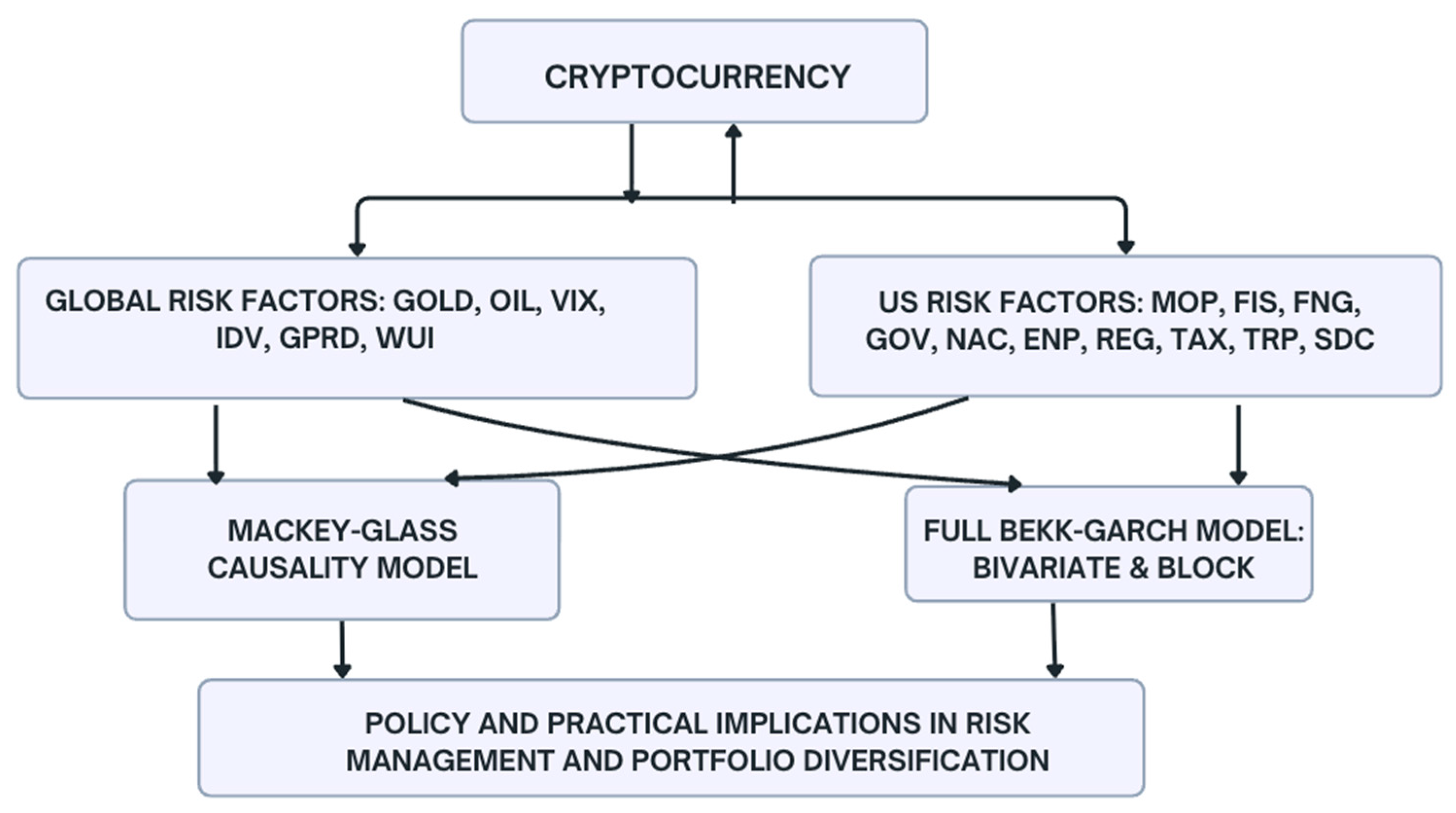
Figure 1 visually illustrates the causality pathways and methodological framework of the structure of our study.

4. Empirical Results

4.1. Preliminary Analysis

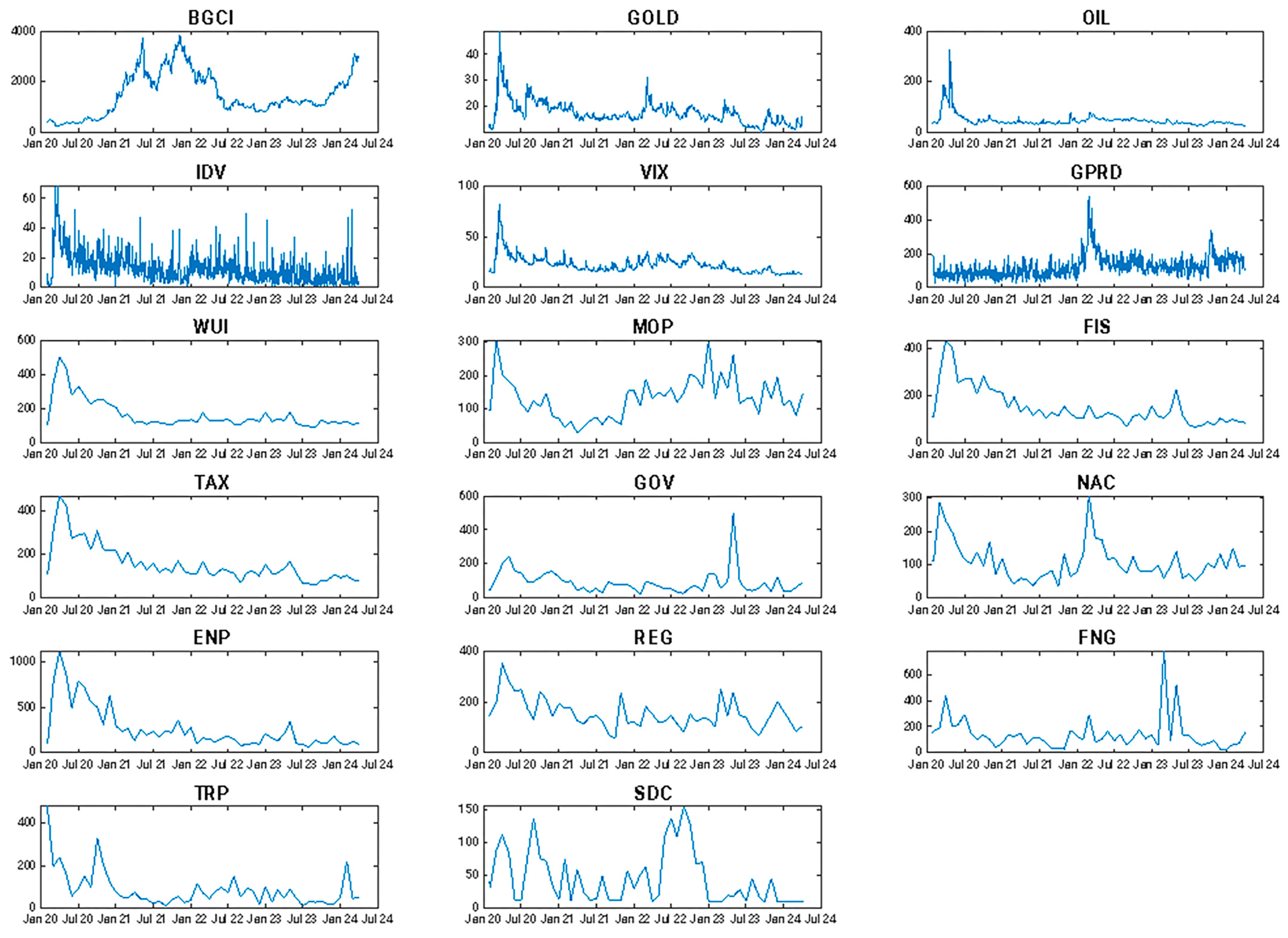
Figure 2 illustrates the historical trends of various indices over a specified period, demonstrating significant fluctuations that indicate the volatility and dynamic nature of the markets. The BGCI shows considerable volatility, with notable peaks and troughs throughout the observed period. This index represents a composite measure of major cryptocurrencies and highlights overall market sentiment and investor behavior in the cryptocurrency space. Gold, often considered a safe-haven asset, exhibits fluctuations that correlate with market uncertainty. The trends in the GOLD index reflect investor reactions to global economic events and market conditions. The OIL index shows significant price changes, reflecting the sensitivity of oil prices to geopolitical events, supply and demand dynamics, and economic indicators. The VIX further spikes during market stress and declines during stable periods. The trends in the VIX indicate overall market risk perception.

4.2. Results from the Mackey–Glass Model

Table 2 displays the results of the Mackey-Glass model for return spillovers. The Mackey-Glass model is applied to investigate the return spillovers between cryptocurrency and ten categorical EPU factors.
In panel A, the results indicate significant bidirectional causality between GOLD and BGCI, with both symmetric and asymmetric cases showing highly significant F-values with p < 0.01. This suggests that fluctuations in gold prices significantly influence cryptocurrency returns and vice versa. The F-statistics for the symmetric, asymmetric positive, and asymmetric negative cases are 8.8243, 53.1449, and 31.4277, respectively, showing strong bidirectional causality. This is consistent with findings by Jiang et al. (2021) and Ali et al. (2023). This is certainly because both assets are alternative hedges against market downturns, causing information flow between them during portfolio adjustment activities. This supports the hedging information transmission channel between cryptocurrency and gold, where investors may view both assets as substitute hedging instruments. The use (demand) of one of them will cause the price of the other to fall and volatility to rise, originating information flow.
The results of asymmetric negative cases are interpreted by the loss aversion theory (Kahneman & Tversky, 1979). This is demonstrated by a stronger causal connectedness between cryptocurrency returns and global risk factors, such as GOLD, OIL, VIX, and WUI, in market downturns compared to market upturns. The heightened fear of losing funds, coupled with global uncertainty, amplifies investors’ expectations of losses relative to potential gains in cryptocurrency markets. These reactions, in turn, intensify the overall uncertainty. The asymmetric cases (F-statistic of 3.0855 for the positive case and 7.8944 for the negative case) indicate that oil price changes impact cryptocurrency returns under specific conditions. In the symmetric case, the cryptocurrency market shows a significant causal relationship with GPRD, GOLD, VIX, and WUI (F-statistics of 4.7675, 8.8226, 8.7132, and 3.2708, respectively).
In Panel B, the interaction between categorical EPU and cryptocurrency returns reveals varied but less significant results. For instance, there is limited evidence of unidirectional causality effects from TAX (F-statistic of 2.94 for the negative case) and NAC (8.1053 for the positive case) to cryptocurrency returns. Strong unidirectional causality is observed from NAC to BGCI, particularly in positive case scenarios (coefficient of 8.1053).

4.3. Results of the BEKK-GARCH Model

The models of examining cross-market volatility and shock transmissions are consistent with Equations (3) and (4). The diagonal coefficients, C, capture own ARCH effects, while the parameters, D, explain own GARCH effects. In the off-diagonal matrices, the estimated parameters, C, quantify the degree of volatility and shock transmissions, indicating the source of destabilizing markets.
Table 3 presents the estimated bivariate variance–covariance parameters between cryptocurrency and each global risk factor. The coefficient estimate, C21, is significantly positive for the BGCI-GPRD and BGCI-WUI pairs, suggesting that the lagged shocks from GPRD and WUI amplify the current conditional volatility of BGCI. The estimates C21 are significantly negative for the BGCI-GOLD, BGCI-OIL, and BGCI-VIX, indicating that the lagged shocks from global risk factors such as GOLD, OIL, and VIX tend to temper the conditional volatility of BGCI (Hsu et al., 2021). This suggests that the assets (gold, oil, and VIX) are alternative portfolio hedging instruments to cryptocurrency.
Moreover, the estimates C12 suggest that the lagged shocks from BGCI positively (negatively) affect the current conditional volatility of OIL and VIX (GOLD). It suggests that cryptocurrency cannot be used as a hedge against volatility in the oil market, but it can be used as a hedge against the gold market. The negative sentiments in the cryptocurrency market, which may amplify volatility in the cryptocurrency market, can spread to the stock market via higher VIX. Additionally, the evidence of bidirectional volatility shocks provides empirical support for information flow and integration of the cryptocurrency market with other markets. It also reveals destabilizing activities in bidirectional volatility between BGCI and each global risk factor except for IDV.
The significant estimated coefficients D12 and D21 imply the existence of bidirectional or cross-market volatility spillover effects. Specifically, the statistically significant positive parameters, D12, show that the current conditional volatility of BGCI is not only captured by their own lagged volatility reflecting on D11 but also influenced by the lagged volatility of GOLD, OIL, VIX, and GPRD. The most important estimated coefficients, D21, represent cross-market conditional volatility spillover of GARCH effects from the global EPU to cryptocurrency. The positive (negative) parameters D21 suggest that the previous period’s conditional volatility of BGCI is sensitive to the heightened (dampened) current conditional volatility of overall global uncertainties, including GOLD, OIL, and VIX (IDV and GPRD). The significant volatility spillovers suggest cross-market financial integration, interdependence, and volatility co-movement. It also indicates that global investors have widely accepted cryptocurrency to warrant portfolio inclusion for hedging and diversification purposes.
The empirical results indicate that GOLD, OIL, IDV, VIX, and GPRD induce chaos in the conditional volatility of BGCI, thereby activating destabilizing effects on cryptocurrency markets. Volatility spillover measures the flow of information across markets and influences portfolio allocation decisions, also indicating the degree of integration between assets. In a comparison of the magnitude of coefficient estimates among these significant global risk factors, we find that VIX has the highest cross-market volatility impact on BGCI, followed by GOLD, GPRD, OIL, and IDV. This analysis provides insights for regulators, policymakers, and investors by identifying global risk factors as the primary transmitters of market shocks and cryptocurrency markets as their receptors. This is crucial for managing portfolio risk and developing policies aimed at stabilizing the financial system. Finally, the D11 parameters are larger in scale than C11 in BGCI-GOLD, BGCI-OIL, BGCI-IDV, BGCI-VIX, BGCI-GPRD, and BGCI-WUI pairs, implying that the own past conditional volatility triggers a higher destabilizing effect on cryptocurrency’s current conditional volatility than the own previous volatility shocks.
Table 4 summarizes the evidence from ten pairwise estimated variance–covariance parameters between cryptocurrency and each categorical U.S. EPU. The estimates for D21 are statistically insignificant for all except for FNR and SDC uncertainty factors. This suggests that the cryptocurrency market does not respond to most categorical U.S. EPU volatility. The lagged conditional volatility of the cryptocurrency market only contains predictive power on FNR and SDC volatility. However, global risk factors, including VIX, GOLD, OIL, IDV, and GPRD, can better explain cross-market volatility in cryptocurrency. Hedging opportunities exist between cryptocurrency and specific uncertainty factors by taking advantage of their negative conditional volatility spillover effects. Therefore, cryptocurrency is more sensitive to volatility spillover at the global market uncertainty level.
In contrast, all ten D12 estimates are significantly positive, indicating unidirectional volatility spillovers from the cryptocurrency market to each categorical EPU. The significant D12 parameters suggest that cryptocurrency volatility induces destabilizing effects on the U.S. EPU. Last, regarding the scale of estimates, parameters D11 are larger than C11 in each pair, suggesting that the own past conditional volatility triggers a higher destabilizing effect on cryptocurrency’s current conditional volatility than the own previous volatility shocks.
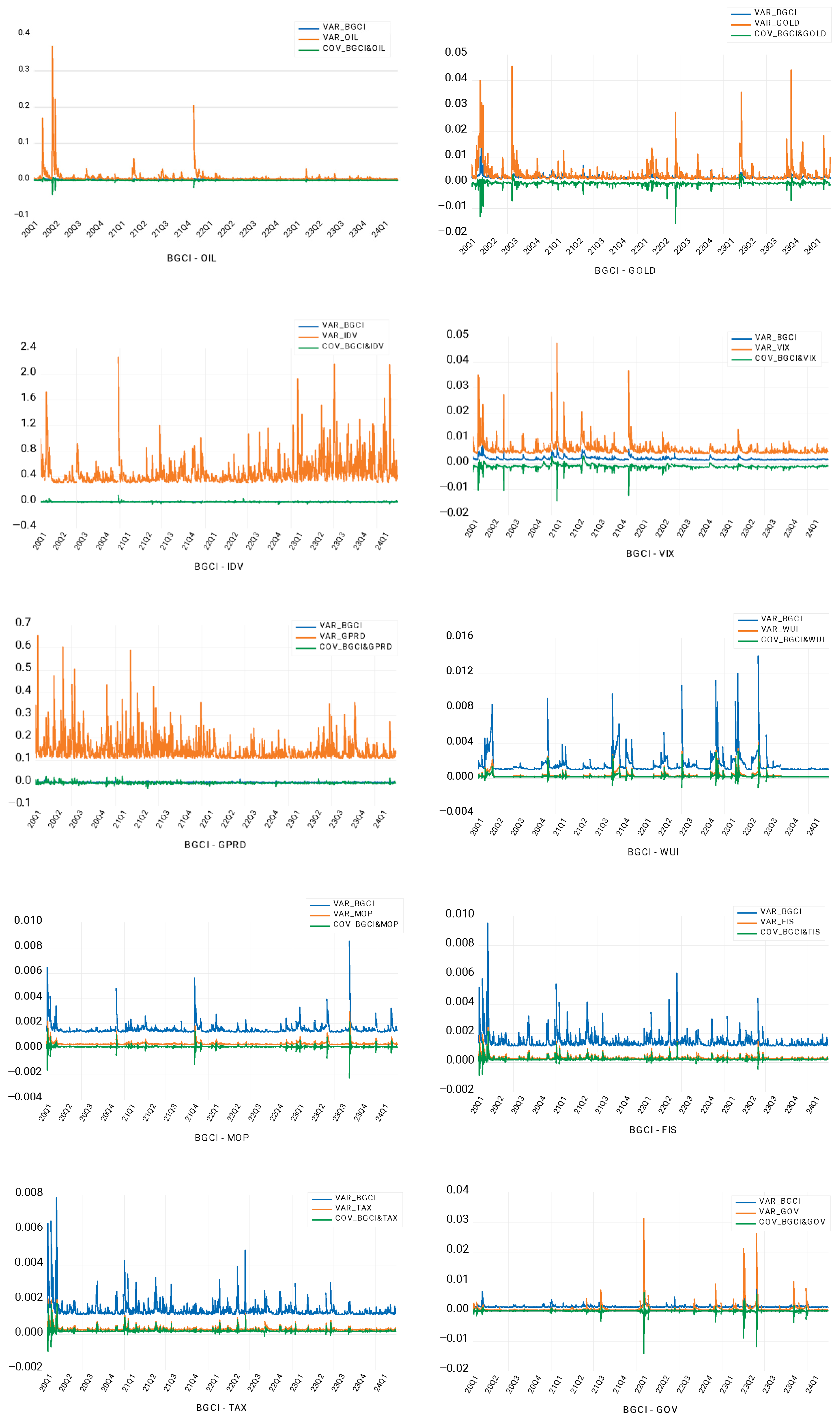
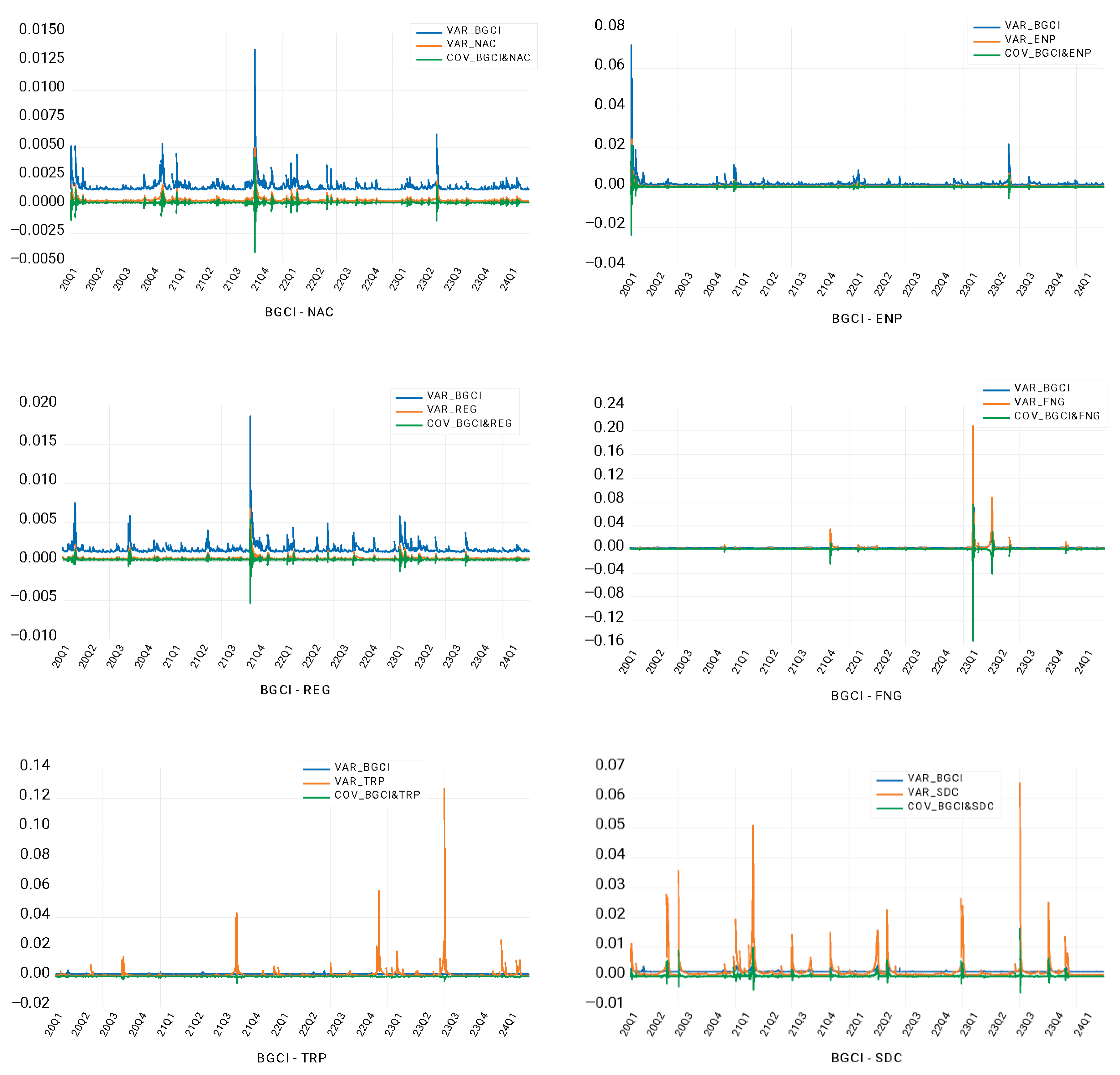
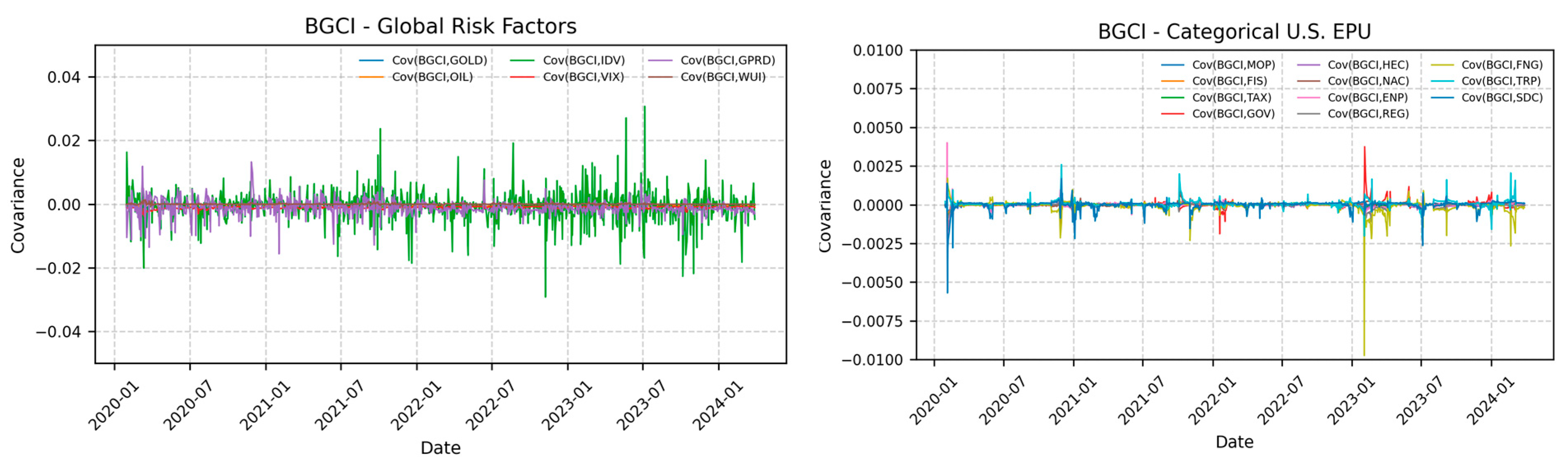
Figure 3 graphically presents (i) the variance of the cryptocurrency market returns; (ii) the variance of ten categorical EPU indices and six global risk factors; and (iii) the covariance between cryptocurrency market returns and each of the sixteen variables analyzed in the study. The observed covariances or spillover effects can be positive or negative. We observe intermittent negative covariances for BGCI-OIL, BGCI-GOLD, BGCI-VIX, and BGCI-ENP pairs. Specific categories, such as FIS and NAC, exhibit stronger correlations with BGCI volatility than other volatility transmissions.

4.4. Robustness Test

Table 5 demonstrates the results of the volatility transmission effects from risk factors (categorical U.S. EPU or global risk volatility) to the cryptocurrency market using a two-block BEKK-GARCH. The findings indicate that cryptocurrency reacts strongly to volatility spillovers originating from global risk factors. This is evidenced by the statistical significance for d 21 (−65.6841) and c 21 = d 21 (112.0083). These results confirm that both volatility spillovers and the joint effects of shocks and volatility persistence transmitted from global risk factors to the cryptocurrency market are statistically significant. In contrast, the results show that cryptocurrency does not exhibit significant volatility spillovers from the categorical U.S. EPU group. Specifically, at the joint level of volatility spillovers and shock effects, cryptocurrency price movements respond significantly to global risk factors but not to the categorical U.S. EPU. This suggests that cryptocurrency is primarily influenced by global risk factors rather than categorical U.S. EPU group factors. Furthermore, the maximum eigenvalues for both the global risk factors (0.9852) and the categorical U.S. EPU (0.9173) are less than one, confirming the robust fit statistics in the block BEKK specifications.
Figure 4 graphically demonstrates that a block BEKK-GARCH specification captures the dynamic volatility spillovers from each block factor to cryptocurrency. The graph of BGCI vs. global risk factors exhibits stronger and more persistent covariance patterns with the cryptocurrency market. The sustained volatility interactions suggest that global risk factors are a primary channel transmitted into the cryptocurrency market. On the other hand, the conditional covariances for BGCI vs. categorical U.S. EPU reveal a short-lived volatility spillover effect. This can be interpreted as categorical U.S. EPU factors being primarily idiosyncratic sources of volatility transmission rather than persistent systemic drivers. Overall, the cryptocurrency market is increasingly sensitive to global risk factors. The findings reinforce the evolving integration between cryptocurrency markets and global risk analysis.
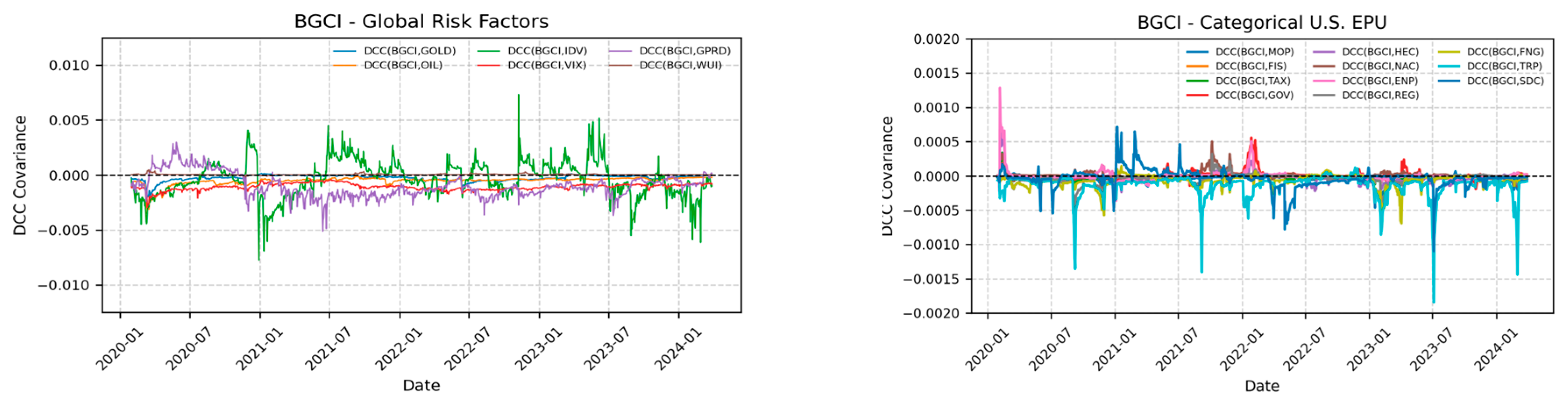
Figure 5 reveals a divergence between the impact of global and the categorical U.S. uncertainty on cryptocurrency volatility based on conditional covariance dynamics of the block-DCC model. The categorical U.S. EPU indicates only small and short-lived effects, whereas the global risk factors block exhibits significantly higher and more persistent conditional covariances. These findings are consistent with those illustrated in Figure 4. Overall, the results suggest that cryptocurrency volatility is primarily driven by global risk factors rather than the categorical U.S. EPU, confirming strong cross-market volatility integration and the sensitivity of cryptocurrency to global uncertainty factors.

5. Conclusions

This study contributes to the financial implications of EPU and global uncertainty factors in the digital ecosystem. We are the first to explore the comparative impact of global uncertainty and the categorical U.S. EPU on cryptocurrency markets. Specifically, our study offers an in-depth examination of the interplay between cryptocurrency and various economic and global uncertainty factors through the following channels: (i) symmetric and asymmetric nonlinear causality between cryptocurrency market returns and each of the categorical U.S. EPU indices and global risk factors; and (ii) volatility spillovers between the cryptocurrency market and each of the categorical U.S. EPU indices and global risk factors.
Our findings reveal that cryptocurrency returns are more sensitive to global risk factors than to country-level categorical EPU in both symmetric and asymmetric cases. It is noticed that gold exhibits bidirectional causality with cryptocurrency returns, further emphasizing its role as a significant global risk factor. Our findings demonstrate that all the global risk factors have predictive power on cryptocurrency returns. Specifically, GOLD consistently predicts cryptocurrency returns in both symmetric and asymmetric cases. For asymmetric causality, we observe that a group of global risk factors, including OIL, IDV, VIX, GPRD, and WUI, as well as specific categorical EPU indices such as TAX and NAS, exhibit predictive power over cryptocurrency returns.
Additionally, the study documents the significant influence of global risk factors on cryptocurrency volatility. Our analysis demonstrates that GOLD exhibits a bidirectional relationship with cryptocurrency in volatility spillovers. This finding has not been explicitly explored in prior literature (Gill-de-Albornoz et al., 2024; Park, 2022; Long et al., 2022). We find that global uncertainty factors provide superior explanatory power for cross-market volatility compared to the U.S. EPU. Our findings are robust to a block BEKK-GARCH model. Overall, the influence of global uncertainty on cryptocurrency is more significant than that of the U.S. EPU, affecting both returns and volatility. Investors and regulators could establish an early warning system for cryptocurrencies by incorporating a range of global risk factors, including VIX, GOLD, GPRD, OIL, WUI, and IDV. This further confirms that a country’s policy banning cryptocurrency has limited effectiveness in suppressing cryptocurrency’s impact on financial markets (J. Wang, 2025). Regulators and financial institutions should integrate these macroeconomic factors into cryptocurrency risk monitoring systems to better predict and manage systemic risks. For investors, our findings imply that incorporating global risk factors into portfolio construction may enhance diversification and hedging strategies.
Specifically, our findings suggest that investors should prioritize global factors over country-specific EPU when managing cryptocurrency returns and mitigating risk. Volatility spillovers provide critical insights for investors and regulators, helping to understand market interconnectedness, hedge risks, optimize portfolios, and anticipate potential disruptions, especially during times of crisis (Vo & Tran, 2020; Mensi et al., 2025). To enhance the use of cryptocurrency as an effective hedging instrument comparable to OIL, IDV, GPRD, FNR, and SDC in portfolio diversification, policymakers should focus on establishing a global risk monitoring system and strengthening the collaboration of global regulations and policies within the crypto-financial landscape.

Author Contributions

Conceptualization, J.W. and G.N.; methodology, J.W.; software, J.W.; validation, J.W. and G.N.; formal analysis, J.W. and G.N. investigation, J.W. resources, J.W. and G.N.; data curation, J.W.; writing—original draft preparation, M.W., R.V. and J.W.; writing—review and editing, M.W., R.V., J.W., G.N. and C.S.; visualization, J.W.; supervision, J.W. and C.S.; project administration, C.S. All authors have read and agreed to the published version of the manuscript.

Funding

This research received no external funding.

Institutional Review Board Statement

Not applicable.

Informed Consent Statement

Not applicable.

Data Availability Statement

Data available upon request.

Conflicts of Interest

The authors declare no conflict of interest.

Appendix A

This table describes the abbreviations of terms, including the U.S. categorical EPU, global risk factors, and cryptocurrency that are employed in the context.
Abbreviation of Terms:
Acronym Description
Panel A: The U.S. Categorical EPU
MOPMonetary Policy
FISFiscal Policy
TAXTaxes
GOVGovernment Spending
NACNational Security
ENPEntitlement Programs
REGRegulation
FNGFinancial Regulation
TRPTrade Policy
SDCSovereign Debt, Currency Crises
Panel B: Global Risk Factor
GOLDGold Volatility Index
OILOil Volatility Index
IDVInfectious Disease Equity Market Volatility Index
VIXCBOE Volatility Index
GPRDGeopolitical Risk Index
WUIWorld Uncertainty Index
Panel C: Cryptocurrency
BGCIBloomberg Cryptocurrency Index
Notes: Our analysis extends to examining the interactions between the BGCI and various global risk factors, as well as the U.S. categorical EPU. Panel A in the table provides terms for categorical EPU, while Panel B focuses on various global risk factors.

Notes

1
2024 Nobel Prize winner in Economics.
2
https://bitcointreasuries.net/ accessed on 8 July 2024.
3
SEC approved the first spot Bitcoin ETFs in January 2024 and CME launched Bitcoin futures trading in December of 2017 and the trading was discontinued in 2019.
4
In the U.S., cryptocurrencies are regulated by federal and state authorities, with the SEC treating them as securities, the CFTC as commodities, and the IRS taxing them as property (Krivoruchko et al., 2018). The EU has a more unified approach with regulations through the Markets in Crypto-Assets (MiCA) framework, which aims to establish comprehensive regulations across member countries (Hacker & Thomale, 2018). Tax policies vary by country, but some nations offer favorable tax rates to attract cryptocurrency investments.
5
6
The Bloomberg Galaxy Crypto Index is a benchmark, with its constituent weights of eleven largest cryptocurrencies including Bitcoin at 35%, Ethereum at 35%, Cardano at 6.62%, Polygon at 4.5%, Litecoin at 3.28%, Solana at 3.15%, Uniswap at 2.53%, Avalanche at 2.38%, Chainlink at 2.09% and Cosmos at 1.74% at the end of 2022. The combined weights of the two largest cryptocurrencies, BTC and ETH, constitute 70% of the index, mirroring the aggregate of their market capitalizations.
7
https://worlduncertaintyindex.com/data/ accessed on 5 April 2024.

References

  1. Acemoglu, D. (2023). The end of democratic capitalism? How inequality and insecurity fueled a crisis in the west. Foreign Affairs, 102(4), 172–180. [Google Scholar]
  2. Ali, M. H., Schinckus, C., Uddin, M. A., & Pahlevansharif, S. (2023). Asymmetric effects of economic policy uncertainty on Bitcoin’s hedging power. Studies in Economics and Finance, 40(2), 213–229. [Google Scholar] [CrossRef]
  3. Anamika, M. C., & Subramaniam, S. (2023). Does sentiment impact cryptocurrency? Journal of Behavioral Finance, 24(2), 202–218. [Google Scholar] [CrossRef]
  4. Aysan, A. F., Demir, E., Gozgor, G., & Lau, C. K. M. (2019). Effects of the geopolitical risks on Bitcoin returns and volatility. Research in International Business and Finance, 47, 511–518. [Google Scholar] [CrossRef]
  5. Baker, S. R., Bloom, N., & Davis, S. J. (2016). Measuring economic policy uncertainty. The Quarterly Journal of Economics, 131(4), 1593–1636. [Google Scholar] [CrossRef]
  6. Baum, C. F., Hurn, S., & Otero, J. (2025). The dynamics of U.S. industrial production: A time-varying Granger causality perspective. Econometrics and Statistics, 33, 13–22. [Google Scholar] [CrossRef]
  7. Bauri, D. G., Hong, K., & Lee, A. D. (2018). Bitcoin: Medium of exchange or speculative assets? Journal of International Financial Markets, Institutions and Money, 54, 177–189. [Google Scholar] [CrossRef]
  8. Bouri, E., Molnár, P., Azzi, G., Roubaud, D., & Hagfors, L. I. (2017). On the hedge and safe haven properties of Bitcoin: Is it really more than a diversifier? Finance Research Letters, 20, 192–198. [Google Scholar] [CrossRef]
  9. Bouri, E., Shahzad, S. J. H., Roubaud, D., Kristoufek, L., & Lucey, B. (2020). Bitcoin, gold, and commodities as safe havens for stocks: New insight through wavelet analysis. The Quarterly Review of Economics and Finance, 77, 156–164. [Google Scholar] [CrossRef]
  10. Caporin, M., & McAleer, M. (2012). Do we really need both BEKK and DCC? A tale of two multivariate GARCH models. Journal of Economic Surveys, 26(4), 736–751. [Google Scholar] [CrossRef]
  11. Chen, J., Jiang, F., Xue, S., & Yao, J. (2019). The world predictive power of US equity market skewness risk. Journal of International Money and Finance, 96, 210–227. [Google Scholar] [CrossRef]
  12. Cheng, H.-P., & Yen, K.-C. (2020). The relationship between the economic policy uncertainty and the cryptocurrency market. Finance Research Letters, 35, 101308. [Google Scholar] [CrossRef]
  13. Chu, J., Chan, S., Nadarajah, S., & Osterrieder, J. (2017). GARCH modelling of cryptocurrencies. Journal of Risk and Financial Management, 10(4), 17. [Google Scholar] [CrossRef]
  14. Corbet, S., Hou, Y. G., Hu, Y., Larkin, C., Lucey, B., & Oxley, L. (2022). Cryptocurrency liquidity and volatility interrelationships during the COVID-19 pandemic. Finance Research Letters, 45, 102137. [Google Scholar] [CrossRef]
  15. Corbet, S., Lucey, B., Peat, M., Vigne, S., Saadouni, B., & Mehandjiev, N. (2019). What sort of asset? Bitcoin analysed. In Enterprise applications, markets and services in the finance industry (Vol. 345, pp. 52–65). Springer International Publishing AG. [Google Scholar]
  16. Demir, E., Gozgor, G., Lau, C. K. M., & Vigne, S. A. (2018). Does economic policy uncertainty predict the Bitcoin returns? An empirical investigation. Finance Research Letters, 26, 145–149. [Google Scholar] [CrossRef]
  17. Engle, F., & Kroner, F. (1995). Multivariate simultaneous generalized arch. Econometrica, 11(1), 122–150. [Google Scholar] [CrossRef]
  18. Fang, T., Su, Z., & Yin, L. (2020). Economic fundamentals or investor perceptions? The role of uncertainty in predicting long-term cryptocurrency volatility. International Review of Financial Analysis, 71, 101566. [Google Scholar] [CrossRef]
  19. Garcia-Jorcano, L., & Benito, S. (2020). Studying the properties of the Bitcoin as a diversifying and hedging asset through a copula analysis: Constant and time-varying. Research in International Business and Finance, 54, 101300. [Google Scholar] [CrossRef]
  20. Ghorbel, A., & Jeribi, A. (2021). Investigating the relationship between volatilities of cryptocurrencies and other financial assets. Decisions in Economics and Finance, 44(2), 817–843. [Google Scholar] [CrossRef]
  21. Gill-de-Albornoz, B., Lafuente, J. A., Monfort, M., & Ordoñez, J. (2024). Bitcoin attention and economic policy uncertainty. Finance Research Letters, 60, 104839. [Google Scholar] [CrossRef]
  22. Hacker, P., & Thomale, C. (2018). Crypto-securities regulation: ICOs, token sales and cryptocurrencies under EU financial law. European Company and Financial Law Review, 15(4), 645–696. [Google Scholar] [CrossRef]
  23. Haq, I. U., Ferreira, P., Quintino, D. D., Huynh, N., & Samantreeporn, S. (2023). Economic policy uncertainty, energy and sustainable cryptocurrencies: Investigating dynamic connectedness during the COVID-19 pandemic. Economies, 11(3), 76. [Google Scholar] [CrossRef]
  24. Hassan, M. K., Hasan, M. B., & Rashid, M. M. (2021). Using precious metals to hedge cryptocurrency policy and price uncertainty. Economics Letters, 206, 109977. [Google Scholar] [CrossRef]
  25. Hassan, T. A., Hollander, S., van Lent, L., & Tahoun, A. (2019). Firm-level political risk: Measurement and effects. The Quarterly Journal of Economics, 134(4), 2135–2202. [Google Scholar] [CrossRef]
  26. Hsu, S. H., Sheu, C., & Yoon, J. (2021). Risk spillovers between cryptocurrencies and traditional currencies and gold under different global economic conditions. The North American Journal of Economics and Finance, 57, 101443. [Google Scholar] [CrossRef]
  27. Jiang, Y., Wu, L., Tian, G., & Nie, H. (2021). Do cryptocurrencies hedge against EPU and the equity market volatility during COVID-19?–New evidence from quantile coherency analysis. Journal of International Financial Markets, Institutions and Money, 72, 101324. [Google Scholar] [CrossRef]
  28. Jin, J., Yu, J., Hu, Y., & Shang, Y. (2019). Which one is more informative in determining price movements of hedging assets? Evidence from Bitcoin, gold and crude oil markets. Physica A: Statistical Mechanics and its Applications, 527, 121121. [Google Scholar] [CrossRef]
  29. Kahneman, D., & Tversky, A. (1979). Prospect theory: An analysis of decision under risk. Econometrica, 47(4), 263–291. [Google Scholar] [CrossRef]
  30. Krivoruchko, S., Ponamorenko, V., & Nebera, A. (2018). Central bank policy and cryptocurrencies. Journal of Reviews on Global Economics, 7(1), 549–561. [Google Scholar] [CrossRef]
  31. Lee, A. D., Li, M., & Zheng, H. (2020). Bitcoin: Speculative asset or innovative technology? Journal of International Financial Markets, Institutions and Money, 67, 101209. [Google Scholar] [CrossRef]
  32. Li, Y., & Giles, D. E. (2015). Modelling volatility spillover effects between developed stock markets and asian emerging stock markets. International Journal of Finance and Economics, 20(2), 155–177. [Google Scholar] [CrossRef]
  33. Long, H., Demir, E., Będowska-Sójka, B., Zaremba, A., & Shahzad, S. J. H. (2022). Is geopolitical risk priced in the cross-section of cryptocurrency returns? Finance Research Letters, 49, 103131. [Google Scholar] [CrossRef]
  34. Mackey, M. C., & Glass, L. (1977). Oscillation and chaos in physiological control systems. Science, 197, 287–289. [Google Scholar] [CrossRef]
  35. Mensi, W., Fasanya, I. O., Vo, X. V., & Kang, S. H. (2025). Dynamics of extreme spillovers across European sustainability markets. Eurasian Economic Review, 15, 225–258. [Google Scholar] [CrossRef]
  36. Mokni, K. (2021). When, where, and how economic policy uncertainty predicts Bitcoin returns and volatility? A quantiles-based analysis. The Quarterly Review of Economics and Finance, 80, 65–73. [Google Scholar] [CrossRef]
  37. Ngene, G., & Wang, J. (2024). Arbitrage opportunities and feedback trading in regulated bitcoin futures market: An intraday analysis. International Review of Economics and Finance, 89(B), 743–776. [Google Scholar] [CrossRef]
  38. Papaspyropoulos, K. G., & Kugiumtzis, D. (2024). On the validity of granger causality for ecological count time series. Econometrics, 12(2), 13. [Google Scholar] [CrossRef]
  39. Park, B. J. (2022). The COVID-19 pandemic, volatility, and trading behavior in the bitcoin futures market. Research in International Business and Finance, 59, 101519. [Google Scholar] [CrossRef]
  40. Singh, S., Bansal, P., & Bhardwaj, N. (2022). Correlation between geopolitical risk, economic policy uncertainty, and Bitcoin using partial and multiple wavelet coherence in P5 + 1 nations. Research in International Business and Finance, 63, 101756. [Google Scholar] [CrossRef]
  41. Syed, A. A., Ahmed, F., Kamal, M. A., Ullah, A., & Ramos-Requena, J. P. (2022). Is there an asymmetric relationship between economic policy uncertainty, cryptocurrencies, and global green bonds? evidence from the united states of America. Mathematics, 10(5), 720. [Google Scholar] [CrossRef]
  42. Vo, X. V., & Tran, T. T. A. (2020). Modelling volatility spillovers from the US equity market to ASEAN stock markets. Pacific-Basin Finance Journal, 59, 101246. [Google Scholar] [CrossRef]
  43. Wang, G. J., Xie, C., Wen, D., & Zhao, L. (2019). When Bitcoin meets economic policy uncertainty (EPU): Measuring risk spillover effect from EPU to Bitcoin. Finance Research Letters, 31, 489–497. [Google Scholar] [CrossRef]
  44. Wang, J. (2025). The connectedness between cryptocurrency and segmented technology sectors in different regulatory regimes: Causality and machine learning approaches. Available online: https://papers.ssrn.com/sol3/papers.cfm?abstract_id=5688882 (accessed on 19 August 2025).
  45. Wang, J., & Micale, J. A. (2024). What happens when the disruptive asset meets the conventional asset? An analysis of cryptocurrency and REIT. Applied Economics, 1–14. [Google Scholar] [CrossRef]
  46. Wang, J., & Ngene, G. (2018). Symmetric and asymmetric nonlinear causalities between oil prices and the U.S. economic sectors. Review of Quantitative Finance and Accounting, 51(1), 199–218. [Google Scholar] [CrossRef]
  47. Wang, J., & Ngene, G. M. (2020). Does Bitcoin still own the dominant power? An intraday analysis. International Review of Financial Analysis, 71, 101551. [Google Scholar] [CrossRef]
  48. Wang, P., Li, X., Shen, D., & Zhang, W. (2020). How does economic policy uncertainty affect the bitcoin market? Research in International Business and Finance, 53, 101234. [Google Scholar] [CrossRef]
  49. World Bank. (2023). Digital progress and trends report. World Bank. [Google Scholar]
  50. Xie, Q., Liu, R., Qian, T., & Li, J. (2021). Linkages between the international crude oil market and the Chinese stock market: A BEKK-GARCH-AFD approach. Energy Economics, 102, 105484. [Google Scholar] [CrossRef]
  51. Yen, K.-C., & Cheng, H.-P. (2021). Economic policy uncertainty and cryptocurrency volatility. Finance Research Letters, 38, 101428. [Google Scholar] [CrossRef]
  52. Zhao, L., Li, Y., & Yang, G. (2025). Effects of climate policy uncertainty on energy markets: Insights from the BEKK-GARCH model. Applied Economics Letters, 1–6. [Google Scholar] [CrossRef]
Figure 1. Schematic diagram.
Jrfm 18 00628 g001
Figure 2. Graph of the historical trend of the indices.
Jrfm 18 00628 g002
Figure 3. Bivariate BEKK-GARCH variance–covariance graphs.
Jrfm 18 00628 g003aJrfm 18 00628 g003b
Figure 4. Block BEKK-GARCH conditional covariance graphs.
Jrfm 18 00628 g004
Figure 5. Block-DCC conditional covariance graphs.
Jrfm 18 00628 g005
Table 1. Summary statistics for returns.
MeanMedianMaxMinStd. Dev.SkewnessExtra KurtosisJarque–Bera
Panel A: Global Risk Factors
GOLD0.0002−0.00470.3021−0.26570.05160.93544.9506*** 1218.3370
OIL−0.0002−0.00540.8577−0.62230.07492.057129.9782*** 39,829.4500
VIX−0.0001−0.00800.4802−0.26620.07511.25005.3397*** 1512.1790
IDV−0.0013−0.00723.7296−4.47010.8631−0.07762.0346*** 181.1230
GPRD−0.0016−0.00121.3573−1.63660.4318−0.10590.7912*** 29.1810
WUI−0.0008−0.00040.0567−0.08440.0180−0.62711.4387*** 158.4534
Panel B: U.S. Categorical EPU
MOP0.0004−0.00340.1051−0.09330.02240.57081.8211*** 200.9458
FIS−0.0002−0.00220.0901−0.07540.01550.81503.3007*** 589.5019
FNG0.00020.00100.5045−0.28860.04631.853620.4728*** 18,830.2500
GOV0.0006−0.00110.2281−0.24040.03540.50836.8008*** 2056.8750
NAC−0.0001−0.00080.1198−0.10970.02400.34731.8967*** 177.4765
ENP−0.0002−0.00470.2593−0.15940.02791.504113.6875*** 8543.2700
REG−0.0003−0.00650.1407−0.07700.02031.60505.7224*** 1872.7100
TAX−0.0003−0.00130.0926−0.04810.01491.03863.8988*** 848.9373
TRP−0.0022−0.00620.3174−0.24210.04720.40485.0155*** 1122.7650
SDC−0.0015−0.00080.2859−0.25950.0540−0.19724.2007*** 774.3412
Panel C: Cryptocurrency
BGCI0.00190.00250.1983−0.29610.0450−0.70224.8154*** 1094.4960
Notes: The returns are calculated as the natural log difference in the indices. Asterisks ***, **, and * indicate the significant level at 1%, 5%, and 10%, respectively.
Table 2. Results of the Mackey–Glass model for return spillovers.
Null Hypothesis(1)(2)(3)
Panel A: Global Risk Factor
GOLD does not cause BGCI*** 8.8243 *** 53.1449 *** 31.4277
BGCI does not cause GOLD*** 8.8226 *** 43.7976 *** 54.3834
OIL does not cause BGCI 0.0338* 3.0855 ** 7.8944
BGCI does not cause OIL* 3.0656*** 9.2897 *** 7.2923
IDV does not cause BGCI 0.00000.0320 ** 4.0890
BGCI does not cause IDV 0.40220.3517 1.1485
VIX does not cause BGCI1.0800 0.3515 * 2.7587
BGCI does not cause VIX*** 8.7132 *** 15.4818 *** 25.3716
GPRD does not cause BGCI 0.0899* 3.6441 0.2300
BGCI does not cause GPRD** 4.76751.6652 ** 5.6944
WUI does not cause BGCI 2.08810.1657 * 2.9408
BGCI does not cause WUI ** 3.2708** 6.2709 ** 5.2497
Panel B: Categorical US EPU
MOP does not cause BGCI0.0670 1.0635 1.1425
BGCI does not cause MOP0.4023 2.3808 0.7367
FIS does not cause BGCI0.0044 0.0955 1.7091
BGCI does not cause FIS0.1906 0.7324 1.1729
TAX does not cause BGCI0.2696 0.0272 * 2.9400
BGCI does not cause TAX0.3437 0.8402 0.6802
GOV does not cause BGCI0.4682 0.3764 0.1691
BGCI does not cause GOV1.8995 2.4315 * 3.4556
NAC does not cause BGCI0.1742 *** 8.1053 1.1851
BGCI does not cause NAC** 4.8099 *** 8.5128 0.8654
ENP does not cause BGCI0.0026 0.0808 0.7399
BGCI does not cause ENP0.1234 1.2414 0.1322
REG does not cause BGCI0.4937 0.4229 0.9869
BGCI does not cause REG** 5.5785 ** 5.1083 * 2.9511
FNG does not cause BGCI 0.54750.0516 1.0292
BGCI does not cause FNG 0.7653** 5.7147 1.3670
TRP does not cause BGCI 0.54210.1058 0.2767
BGCI does not cause TRP 1.0852** 4.5349 ** 5.2490
SDC does not cause BGCI0.5303 0.53030.0499
BGCI does not cause SDC** 4.0618 ** 4.06180.3989
Notes: This table reports the F-value of symmetric and asymmetric connectedness between the categorical EPU and cryptocurrency returns. We use AIC to select the parameter prior. Panel A displays the causality effect of global risk factors and cryptocurrency returns, while Panel B demonstrates the effect of categorical EPU and cryptocurrency returns. Asterisks *, **, and *** refer to the 1%, 5%, and 10% levels of significance, respectively. The main findings for causality relationships are as follows: (1) symmetric, positive asymmetric, and negative asymmetric nonlinear causalities from GOLD (gold prices) to BGCI (cryptocurrency market), BGCI to GOLD, BGCI to OIL (oil prices), BGCI to VIX (volatility index), and BGCI to WUI (world uncertainty index); (2) positive asymmetric nonlinear causality from NAC (national security) to BGCI and GPRD (geopolitical risk) to BGCI; (3) symmetric and positive asymmetric nonlinear from BGCI to NAC, BGCI to REG (regulation), and BGCI to SDC (currency crises); (4) symmetric and negative asymmetric nonlinear causality from GPRD to BGCI; (5) positive and negative asymmetric nonlinear causality from BGCI to TRP (trade policy); and (6) negative asymmetric nonlinear causality from IDV (infectious disease equity market volatility) to BGCI, VIX to BGCI, WUI to BGCI and TAX (taxes) to BGCI.
Table 3. Estimated variance–covariance coefficients for a BEKK-GARCH model—global risk factors.
BGCI-
GOLD
BGCI-
OIL
BGCI-
IDV
BGCI-
VIX
BGCI-
GPRD
BGCI-
WUI
μ 1 ** 0.0033* 0.0025*** 0.0038* 0.0023** 0.0033*** 0.003
(0.0014)(0.0014)(0.0014)(0.0014)(0.0014)(0.0008)
μ 2 ** −0.00280.0021−0.0034−0.0009−0.0015*** 0.002452
−(0.0029)(0.0015)(0.0031)(0.0023)(0.0023)(0.0006)
C11*** 0.3015*** −0.2454*** −0.4399*** 0.1119*** 0.4737** 0.0616
(0.0397)(0.0348)(0.0429)(0.0376)(0.0453)(0.0299)
C12*** −0.1509*** 0.2256−0.4342*** 0.37950.12020.0047
(0.0456)(0.2256)(0.7007)(0.0579)(0.3461)(0.0333)
C21*** −0.1141*** −0.09230.0029*** −0.1360** 0.0195*** 1.6164
(0.0239)(0.0178)(0.0033)(0.0315)(0.0063)(0.1229)
C22*** 0.6826*** 0.73148*** 0.5036*** 0.4599*** 0.5121* −0.2222
(0.0343)(0.0247)(0.0570)(0.0383)(0.0582)(0.1241)
B11*** 0.0351*** 0.0374*** −0.0331*** 0.0313−0.0025*** 0.0282
(0.0351)(0.0026)(0.0022)(0.0020)(0.0926)(0.0023)
B22* 0.01340.0127*** 0.44410.01760.04440.0000
(0.0081)(0.0163)(0.0381)(0.0149)(83.3383)(3.2743)
B21*** −0.0205*** −0.0208−0.0842*** −0.0561−0.3160−0.0014
(0.0033)(0.0070)(0.0595)(0.0061)(11.7218)(0.0038)
D11*** 0.5004*** 0.5003*** 0.5002*** 0.5098*** 0.5000*** 0.5004
(0.0633)(0.0967)(0.0674)(0.0973)(0.0839)(0.0847)
D21*** 0.2326*** 0.06157** −0.0145*** 0.3616*** −0.0875−0.1072
(0.0271)(0.0225)(0.0057)(0.0585)(0.0153)(0.5335)
D22*** 0.5000*** 0.6854*** 0.5612*** 0.4342** 0.2463−0.4143
(0.0482)(0.0232)(0.0797)(0.0793)(0.1233)(0.4568)
D12*** 0.4996*** 0.49970.4997*** 0.4989* 0.49990.4989
(0.0612)(0.1252)(0.7879)(0.0875)(0.2771)(0.0770)
LL3503.61703183.4940737.28733108.08901361.52204737.6990
AIC−6.6896−6.0757−1.3850−5.9311−2.5820−9.0560
SIC−6.6184−6.0045−1.3138−5.8600−2.5108−8.9848
HQ−6.6626−6.0487−1.3580−5.9041−2.5550−9.0290
Notes: This table demonstrates the results of estimated variance–covariance coefficients between BGCI and global risk factors. The asterisks ***, **, and * indicate the significant level at 1%, 5%, and 10%, respectively. Standard errors are presented within parentheses. LL refers to log-likelihood, AIC refers to Akaike information criterion, SIC indicates Schwarz criterion, and HQ means Hannan-Quinn criterion. The diagonal coefficients, C, capture the own ARCH effects, and the parameters, D, explain the own GARCH effects. In the off-diagonal matrices, the estimated parameters, C, qualify the degree of the volatility and shock transmissions. The parameters in this table are interpreted in Equations (3) and (4).
Table 4. Estimated variance–covariance coefficients for a BEKK-GARCH model—categorical EPU.
BGCI-MOPBGCI-FISBGCI-TAXBGCI-GOVBGCI-NACBGCI-ENPBGCI-REGBGCI-FNGBGCI-TRPBGCI-SDC
μ1** 0.0021** 0.00220.0018** 0.00220.0017* 0.00190.00150.0008** 0.0023* 0.0022
(0.0011)(0.0011)(0.0011)(0.0011)(0.0011)(0.0011)(0.0011)(0.0012)(0.0012)(0.0012)
μ20.0007−0.0015−0.0022* −0.00200.0001*** −0.0028*** −0.0035*** 0.0051*** −0.00500.0010
(0.0014)(0.0014)(0.0015)(0.0011)(0.0014)(0.0011)(0.0013)(0.0009)(0.0013)(0.0014)
C11*** −0.1298*** 0.2711*** 0.2342*** 0.2205*** −0.1589*** −0.2216*** 0.2079* −0.0470*** 0.1770*** −0.1387
(0.0346)(0.0375)(0.0408)(0.0304)(0.0277)(0.0280)(0.0281)(0.0241)(0.0398)(0.0317)
C12−0.0049−0.0009−0.0036−0.01780.01470.0054−0.0206−0.0151−0.03680.0112
(0.0417)(0.0383)(0.0476)(0.0316)(0.0288)(0.0409)(0.0264)(0.0317)(0.0390)(0.0408)
C21*** −0.7260*** −0.7876*** −0.8665*** −0.3629*** 0.7814*** 1.0315*** −0.9332*** −0.6544−0.0064*** 0.1889
(0.1472)(0.1570)(0.1694)(0.0824)(0.0989)(0.1123)(0.1360)(0.0770)(0.0534)(0.0610)
C22*** 0.2621** 0.2254* 0.1955*** 0.7851*** −0.3188*** −0.3568*** 0.3030*** 0.8715*** 0.8766*** 0.8043
(0.0878)(0.0909)(0.1170)(0.0557)(0.0669)(0.0685)(0.1103)(0.0646)(0.0550)(0.0501)
B11*** 0.0317*** 0.0284*** 0.0296*** 0.0326*** 0.0315*** 0.0301*** 0.0298*** 0.03250.0338*** 0.0328
(0.0031)(0.0021)(0.0029)(0.0025)(0.0023)(0.0012)(0.0024)(0.0026)(0.0037)(0.0043)
B220.00000.00000.00000.00000.00000.00000.00010.00000.00000.0000
(6.6878)(1.2860)(1.3621)(5.7173)(65.1881)(8.9826)(0.5620)(43.4214)(9.1016)(23.4822)
B21−0.0051−0.0015−0.0024−0.0038−0.0039** −0.0055*** −0.0031−0.0034−0.0100−0.0094
(0.0063)(0.0045)(0.0054)(0.0056)(0.0043)(0.0027)(0.0052)(0.0059)(0.0095)(0.0080)
D11*** 0.50030.5006*** 0.5004*** 0.5003*** 0.5003*** 0.5003*** 0.5004*** 0.5001*** 0.5001*** 0.5003
(0.1425)(0.1048)(0.1256)(0.1009)(0.0845)(0.0506)(0.0941)(0.1251)(0.1550)(0.1801)
D21−0.04720.1476−0.0902−0.1816−0.0721−0.08040.0053* −0.29240.0178*** −0.3377
(0.3338)(0.2415)(0.4781)(0.1409)(0.3493)(0.1909)(0.2616)(0.1751)(0.0657)(0.0422)
D22−0.2665** −0.4775−0.3869** −0.26857−0.3138*** −0.2350−0.3365−0.1889*** 0.1251*** 0.3499
(0.2946)(0.2255)(0.5361)(0.1330)(0.2469)(0.1388)(0.3355)(0.1449)(0.0372)(0.0742)
D12*** 0.4993*** 0.4958*** 0.4990*** 0.4995*** 0.4994*** 0.4993*** 0.4988*** 0.4997*** 0.4997*** 0.4985
(0.1281)(0.0971)(0.1179)(0.1168)(0.0792)(0.0486)(0.0950)(0.1260)(0.1763)(0.1404)
LL4533.27304750.34004756.48104315.27104529.42004434.28104635.13204105.92904031.46703932.9680
AIC−8.6640−9.0802−9.0920−8.2460−8.6566−8.4742−8.8593−7.8445−7.7018−7.5129
SIC−8.5928−9.0090−9.0208−8.1748−8.5854−8.4030−8.7881−7.7734−7.6306−7.4417
HQ−8.6370−9.0532−9.0650−8.2190−8.6296−8.4472−8.8323−7.8175−7.6748−7.4859
Notes: This table demonstrates the results of estimated variance–covariance coefficients between BGCI and each of the categorical U.S. EPUs. The asterisks ***, **, and * indicate the significant level at 1%, 5%, and 10%, respectively. Standard errors are presented within parentheses. LL refers to log-likelihood, AIC refers to Akaike information criterion, SIC indicates Schwarz criterion, and HQ means Hannan-Quinn criterion. The diagonal coefficients, C, capture the own ARCH effects, and the parameters, D, explain the own GARCH effects. In the off-diagonal matrices, the estimated parameters, C, qualify the degree of the volatility and shock transmissions. The parameters in this table are interpreted in Equations (3) and (4).
Table 5. Robustness test.
Null HypothesisCategorical U.S. EPU FactorsGlobal Risk Factors
c 21 = 0 −27.9192−6.6813
d 21 = 0 −27,774.362565.6841 ***
c 21 = d 21 = 0 −4693.8667112.0083 ***
Max Eigenvalue ( C C + D D ) 0.91730.9852
LL11,213.4302−2304.2687
AIC−21,694.864860.5373
BIC−19,882.865484.3400
HQ−21,007.625097.1298
Notes: This table reports the results of the block BEKK-GARCH model with log-likelihood (LL). Asterisk *** denotes statistical significance at the 1% level of ρ value. The degree of freedom (DF) for the categorical U.S. EPU is 11, 11, and 22 for three null hypotheses, respectively. The DF values for the global risk factors are 6, 6, and 12 for the three corresponding null hypotheses. The null hypothesis specifications are consistent with Equations (3) and (4) in Section 3.
Disclaimer/Publisher’s Note: The statements, opinions and data contained in all publications are solely those of the individual author(s) and contributor(s) and not of MDPI and/or the editor(s). MDPI and/or the editor(s) disclaim responsibility for any injury to people or property resulting from any ideas, methods, instructions or products referred to in the content.