


Digital Financial Inclusion and Financial Vulnerability: An Exploratory Analysis of Spanish Households
 , , and
Abstract
1. Introduction
2. Literature Review
3. Data and Methodology
3.1. Sample
3.2. Variables
3.3. Model Specification
4. Results and Discussion
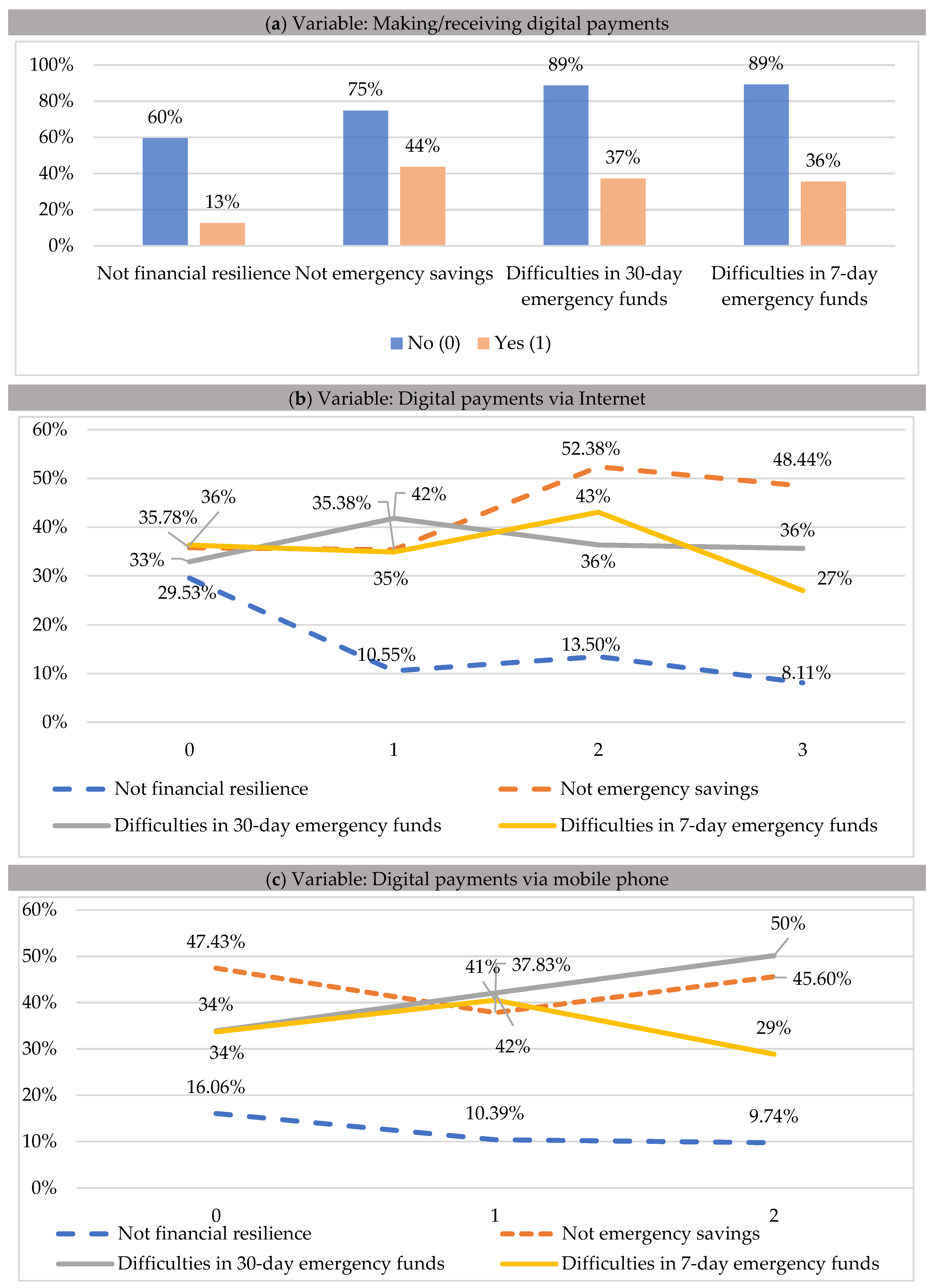
4.1. Descriptive Analysis
4.2. Multivariate Analysis
4.3. Endogeneity Issues
5. Conclusions
Author Contributions
Funding
Institutional Review Board Statement
Informed Consent Statement
Data Availability Statement
Conflicts of Interest
| 1 | Access to formal financial products, even when provided through offline channels, may be perceived as progress towards digitalisation in the context of less developed countries or those with nascent digital infrastructures. This interpretation is evident in the study by Xu et al. (2024), where access to credit cards is incorporated as a component of the DFI index. By contrast, research focusing on more developed economies, such as Norway (Seldal & Nyhus, 2022), excludes credit cards from the DFI construct, which is more narrowly defined in relation to digital tools and digital-only payment methods. |
| 2 | As defined, the variable lacking financial resilience is the opposite of that proposed by Verma and Chatterjee (2025). |
| 3 | The GFD also includes information on bank account ownership. However, these data are not available for Spain or for most developed economies. |
References
- Al Khub, A., Saeudy, M., & Gerged, A. M. (2024). Digital financial inclusion in emerging economies: Evidence from Jordan. Journal of Risk and Financial Management, 17(2), 66. [Google Scholar] [CrossRef]
- Cardona-Montoya, R. A., Cruz, V., & Mongrut, S. A. (2022). Financial fragility and financial stress during the COVID-19 crisis: Evidence from Colombian households. Journal of Economics, Finance and Administrative Science, 27(54), 376–393. [Google Scholar] [CrossRef]
- Demirgüç-Kunt, A., Klapper, L., Singer, D., & Ansar, S. (2022). The global findex database 2021: Financial inclusion, digital payments, and resilience in the age of COVID-19. World Bank. [Google Scholar] [CrossRef]
- Falkenström, F., Park, S., & McIntosh, C. N. (2023). Using copulas to enable causal inference from nonexperimental data: Tutorial and simulation studies. Psychological Methods, 28(2), 301. [Google Scholar] [CrossRef] [PubMed]
- Fernández-López, S., Álvarez-Espiño, M., & Rey-Ares, L. (2023). A comprehensive approach to measuring financial vulnerability and literacy: Unveiling connections. SAGE Open, 13(4), 1–16. [Google Scholar] [CrossRef]
- Fernández-López, S., Álvarez-Espiño, M., Rey-Ares, L., & Castro-González, S. (2024). Consumer financial vulnerability: Review, synthesis, and future research agenda. Journal of Economic Surveys, 38(4), 1045–1084. [Google Scholar] [CrossRef]
- Freedman, D. A. (2009). Statistical models: Theory and practice (2nd ed.). Cambridge University Press. [Google Scholar]
- Friedline, T., & West, S. (2016). Financial education is not enough: Millennials may need financial capability to demonstrate healthier financial behaviors. Journal of Family and Economic Issues, 37(4), 649–671. [Google Scholar] [CrossRef]
- FUNCAS. (2024). La adopción de la nueva tecnología bancaria en España y Europa. Observatorio de la Digitalización Financiera. Available online: https://www.funcas.es/wp-content/uploads/2024/09/ODF-Funcas-48-2024.pdf (accessed on 3 November 2025).
- Hair, J., Anderson, R., Tatham, R., & Black, W. (1998). Multivariate analysis (4th ed.). Prentice Hall International. [Google Scholar]
- Hu, L., Sheng, D., Ni, G., Wang, D., & Fang, X. (2024). Digital financial inclusion and poverty-alleviation resilience of Chinese rural households. Journal of Family and Economic Issues, 1–14. [Google Scholar] [CrossRef]
- Koomson, I., Villano, R. A., & Hadley, D. (2020). Effect of financial inclusion on poverty and vulnerability to poverty: Evidence using a multidimensional measure of financial inclusion. Social Indicators Research, 149(2), 613–639. [Google Scholar] [CrossRef]
- Little, R. J., & Rubin, D. B. (2019). Statistical analysis with missing data (3rd ed.). John Wiley & Sons, Inc. [Google Scholar]
- Liu, J., Chen, Y., Chen, X., & Chen, B. (2024). Digital financial inclusion and household financial vulnerability: An empirical analysis of rural and urban disparities in China. Heliyon, 10(15), e35540. [Google Scholar] [CrossRef]
- Liu, L., & Guo, L. (2023). Digital financial inclusion, income inequality, and vulnerability to relative poverty. Social Indicators Research, 170(3), 1155–1181. [Google Scholar] [CrossRef]
- Loaba, S. (2022). The impact of mobile banking services on saving behavior in West Africa. Global Finance Journal, 53, 100620. [Google Scholar] [CrossRef]
- Lodder, P. (2013). To impute or not impute: That’s the question. In J. A. Herman, & G. J. Mellenbergh (Eds.), Advising on research methods: Selected topics. Johannes van Kessel Publishing. [Google Scholar]
- Long, J. S., & Freese, J. (2014). Regression models for categorical dependent variables using Stata (3rd ed.). Stata Press. [Google Scholar]
- Mishra, D., Kandpal, V., Agarwal, N., & Srivastava, B. (2024). Financial inclusion and its ripple effects on socio-economic development: A comprehensive review. Journal of Risk and Financial Management, 17(3), 105. [Google Scholar] [CrossRef]
- OECD. (2018). G20/OECD INFE policy guidance on digitalisation and financial literacy. Available online: http://www.oecd.org/finance/G20-OECD-INFE-Policy-Guidance-Digitalisation-Financial-Literacy-2018.pdf (accessed on 10 June 2025).
- Ozili, P. K. (2023). Digital finance research and developments around the world: A literature review. International Journal of Business Forecasting and Marketing Intelligence, 8(1), 35–51. [Google Scholar] [CrossRef]
- Park, S., & Gupta, S. (2012). Handling endogenous regressors by joint estimation using copulas. Marketing Science, 31(4), 567–586. [Google Scholar] [CrossRef]
- Qiu, W., Wang, J., Zhou, W., & Yan, J. (2025). Click it and become vulnerable: The impact of online shopping on household financial fragility in China. Journal of Family and Economic Issues, 1–13. [Google Scholar] [CrossRef]
- Ridder, G., & Moffitt, R. (2007). The econometrics of data combination. In J. J. Heckman, & E. E. Leamer (Eds.), Handbook of econometrics (Vol. 6, pp. 5469–5547). Elsevier. [Google Scholar] [CrossRef]
- Rubin, D. B. (1976). Inference and missing data. Biometrika, 63(3), 581–592. [Google Scholar] [CrossRef]
- Saputro, C. A., Suherman, U., & Pranata, R. M. (2024). The effect of digital payments and financial vulnerability moderated by financial literacy. Journal of Resource Management, Economics and Business, 3(3), 1–14. [Google Scholar] [CrossRef]
- Schafer, J. L., & Graham, J. W. (2002). Missing data: Our view of the state of the art. Psychological Methods, 7(2), 147. [Google Scholar] [CrossRef]
- Seldal, M. N., & Nyhus, E. K. (2022). Financial vulnerability, financial literacy, and the use of digital payment technologies. Journal of Consumer Policy, 45(2), 281–306. [Google Scholar] [CrossRef] [PubMed]
- Sherraden, M. S. (2013). Building blocks of financial capability. In J. M. Birkenmaier, M. Sherraden, & J. Curley (Eds.), Financial capability and asset development: Research, education, policy, and practice (pp. 3–43). Oxford University Press. [Google Scholar]
- Shmueli, G. (2010). To explain or to predict? Statistical Science, 25(3), 289–310. [Google Scholar] [CrossRef]
- Simon, H. A. (2000). Bounded rationality in social science: Today and tomorrow. Mind & Society, 1(1), 25–39. [Google Scholar] [CrossRef]
- Thaler, R. (1980). Toward a positive theory of consumer choice. Journal of Economic Behavior & Organization, 1(1), 39–60. [Google Scholar] [CrossRef]
- Verma, R., & Chatterjee, D. (2025). Relative impact of digital and traditional financial inclusion on financial resilience: Evidence from 13 emerging countries. Journal of Economics and Business, 133, 106233. [Google Scholar] [CrossRef]
- Wang, X., & Guan, J. (2017). Financial inclusion: Measurement, spatial effects and influencing factors. Applied Economics, 49(18), 1751–1762. [Google Scholar] [CrossRef]
- Wang, X., & Mao, Z. (2023). Research on the impact of digital inclusive finance on the financial vulnerability of aging families. Risks, 11(12), 209. [Google Scholar] [CrossRef]
- Willard, L. B. (2012). Does inflation targeting matter? A reassessment. Applied Economics, 44(17), 2231–2244. [Google Scholar] [CrossRef]
- Wooldridge, J. M. (2010). Econometric analysis of cross section and panel data. MIT Press. [Google Scholar]
- Xu, F., & Zhang, L. (2025). The impact of digital payments on the financial vulnerability of rural households: Empirical evidence from China. Frontiers in Sustainable Food Systems, 9, 1553237. [Google Scholar] [CrossRef]
- Xu, F., Zhang, X., & Zhou, D. (2024). Does digital financial inclusion reduce the risk of returning to poverty? Evidence from China. International Journal of Finance & Economics, 29(3), 2927–2949. [Google Scholar] [CrossRef]



| Reference [Country (Year; Sample)] | Dependent FV Variables (Type of Variable—Type of Measure) [Detail]: (Statistical Model) | Level of DFI/FI: Main Independent Variable (Type of Variable—Type of Measure) [Detail] |
|---|---|---|
| Positive relationship | ||
| Loaba (2022) [Seven West African countries (2017; 6074 individuals)] * | Did you save any money during the past year? (0–1: yes—Obj.) [in a formal financial institution, informal financial institution, or both]: (SEM, probit and multinomial logit) | Digital individual/household level:
|
| Seldal and Nyhus (2022) [Norway (2018; 2202 adults)] |
| Digital individual/household level: Digital payment technologies (0–1: yes—use) [mobile payments (e.g., Vipps, MobilePay), online payments (e.g., PayPal, Klarna)] |
| Hu et al. (2024) [China (2013, 2015, 2017, and 2019; 3254 households)] ** | Absence of poverty (continuous variable—Obj.) [income per person and day]: (OLS) | Digital individual/household level: Availability of a formal loan, a bank deposit, ownership of commercial insurance, and possession of a credit card (continuous variable—access) Digital aggregated level: DFI index of the province where the household is located (continuous variable—mixed) |
| Qiu et al. (2025) [China (2017–2019; 35,603 households)] *** |
| Digital individual/household level:
|
| Verma and Chatterjee (2025) [13 emerging countries in America, Africa, and Asia (2014 and 2021; 33,933 individuals)] * | Financial resilience (0–1: yes—Obj.) [pay an amount (equivalent to 1/20 of the country’s gross national income (per capita) in the next 30 days due to an emergency)]: (Probit) | Digital individual/household level:
|
| Negative relationship | ||
| L. Liu and Guo (2023) [China (2015–2019; 29,625 households)] ** | FV index on relative household poverty (continuous variable—Obj.) [sum of economic, health, and quality of life variables]: (Multiple regression with fixed effects) | Digital aggregated level: DFI index of the city where the household is located (continuous variable—mixed) [overview of coverage, depth of use, and level of digital support] |
| Wang and Mao (2023) [China (2016 and 2018; 11,967 individuals)] | FV index (0 to 2—Obj.) [sum of situations: if savings do not exceed three months of daily expenses (0–1: yes) and annual debt-to-income ratio exceeds 30% (0–1: yes)]: (Ordered probit) | Digital aggregated level: DFI index of the district where the household is located (continuous variable—mixed) [log transformation] |
| J. Liu et al. (2024) [China (2019; 27,080 households)] ** | FV index (0 to 3—Obj.) [sum of situations: if expenses exceed annual income (0–1: yes), savings do not exceed three months of daily expenses (0–1: yes), and annual debt-to-income ratio exceeds 30% (0–1: yes)]: (ordered probit) | Digital aggregated level: DFI index of the province where the household is located (continuous variable—mixed) [log transformation] |
| Xu et al. (2024) [China (2017; 3156 individuals)] ** | Risk of returning to poverty (0–1: yes—Obj.) [substantial loss of health, education, well-being, and confidence]: (Probit) | Digital aggregated level: Household DFI index: (continuous variable—mixed) [degree of digitization (use of electronic payments and accounts); usability (purchase of commercial or social insurance, bank loans, and credit cards); coverage (distance from home to the nearest bank)] |
| Xu and Zhang (2025) [China (2017–2019; 12,801 rural households)] ** | Financial margin (0–1: <0—Obj.) [income + liquid assets − daily expenses – debts − unexpected expenses]: (Probit) | Digital individual/household level: Digital payment in 2017 (0–1: yes—use) [Alipay, WeChat Pay, mobile banking, etc., via devices like smartphones and tablets] |
| Non-significant relationship | ||
| Saputro et al. (2024) [Indonesia (2023; 95 management undergraduates)] *** | FV index (ordinal variable) [difficulty meeting unexpected expenses and covering basic costs, and use of consumer credit]: (Regressions) | Digital individual/household level: Digital payments (ordinal variable—use) |
| Name | Detail |
|---|---|
| Dependent variables | |
| Lacking financial resilience * | Cannot handle an emergency expense: (1) Cannot; (0) otherwise. |
| Lacking emergency savings * [resilient] | Source for emergency expense: (0) Savings; (1) Other sources (i.e., family, friends or relatives, salary advances, loans, selling assets, or other options). |
| Difficulties in 30-day emergency funds ** [resilient] | Obtaining emergency funds within 30 days is difficult: (1) Very/somewhat difficult; (0) not difficult. |
| Difficulties in 7-day emergency funds ** [resilient] | Obtaining emergency funds within 7 days is difficult: (1) Very/somewhat difficult; (0) not difficult. |
| Independent variables | |
| Making/receiving digital payments | Made or received digital payment: (1) Yes; (0) otherwise. |
| Invoice payment via Internet | Paid invoices online: (1) Yes; (0) otherwise. |
| Money transfer via Internet | Sent money online to a family member or friend: (1) Yes; (0) otherwise. |
| Online shopping via Internet | Purchased goods online: (1) Yes; (0) otherwise. |
| Digital payments via Internet 1 | Count of online payment types, from 0 (none) to 3 (invoice payment + money transfers + online shopping). |
| In-store payment via mobile phone | Paid in-store by mobile: (1) Yes; (0) otherwise. |
| Utility payment via mobile phone | Paid utilities by mobile: (1) Yes; (0) otherwise. |
| Digital payments via mobile phone 1 | Count of mobile payment types, from 0 (none) to 2 (in-store purchases + utilities). |
| Control variables | |
| Age 2 | Age in years. |
| Gender | (1) Female; (0) male. |
| Educational attainment 1 | Highest educational level achieved: (1) Primary or below, (2) secondary, and (3) tertiary or higher. |
| Income 1 | Household income quintile, from 1 (lowest) to 5 (highest). |
| Job situation | (1) Employee; (0) otherwise. |
| Debit card ownership/use 1 | Own/use of debit card in the last 12 months: (2) Owns and uses; (1) owns but not used; (0) does not own. |
| Credit card ownership/use 1 | Own/use of credit card in the last 12 months: (2) Owns and uses; (1) owns but not used; (0) does not own. |
| Number of Different Digital Payments | ||||||||||
|---|---|---|---|---|---|---|---|---|---|---|
| Internet | Mobile Phone | |||||||||
| 0 | 1 | 2 | 3 | χ2 | 0 | 1 | 2 | χ2 | ||
| Lacking financial resilience | No (0) | 108 78.83% | 283 90.13% | 286 89.38% | 216 94.32% | 21.98 | 554 87.80% | 299 92.00% | 40 90.91% | 4.09 |
| Yes (1) | 29 21.17% | 31 9.87% | 34 10.63% | 13 5.68% | 77 12.20% | 26 8.00% | 4 9.09% | |||
| Lacking emergency savings | No (0) | 59 54.63% | 190 67.14% | 150 52.45% | 105 48.61% | 20.55 | 295 53.25% | 186 62.21% | 23 57.50% | 6.35 |
| Yes (1) | 49 45.37% | 93 32.86% | 136 47.55% | 111 51.39% | 259 46.75% | 113 37.79% | 17 42.50% | |||
| Difficulties in 30-day emergency funds | No (0) | 72 66.67% | 169 59.72% | 198 69.23% | 157 72.69% | 10.52 | 393 70.94% | 182 60.87% | 21 52.50% | 12.69 |
| Yes (1) | 36 33.33% | 114 40.28% | 88 30.77% | 59 27.31% | 161 29.06% | 117 39.13% | 19 47.50% | |||
| Difficulties in 7-day emergency funds | No (0) | 71 65.74% | 183 64.66% | 179 62.59% | 151 69.91% | 3.01 | 376 67.87% | 186 62.21% | 22 55.00% | 4.75 |
| Yes (1) | 37 34.26% | 100 35.34% | 107 37.41% | 65 30.09% | 178 32.13% | 113 37.79% | 18 45.00% | |||
| Variable | Mean Values | |
|---|---|---|
| Age | 48.60 (years) | |
| Gender: female | 49.93% | |
| Educational attainment | (1) Primary or less | 20.51% |
| (2) Secondary | 73.29% | |
| (3) Tertiary or higher | 6.19% | |
| Income | (1) Poorest quintile (bottom 20%) | 19.96% |
| (2) Second quintile (20–40%) | 20.00% | |
| (3) Middle quintile (40–60%) | 20.02% | |
| (4) Fourth quintile (60–80%) | 19.86% | |
| (5) Richest quintile (top 20%) | 20.16% | |
| Job situation: employee | 55.97% | |
| Credit card ownership/use | (0) Does not own | 43.39% |
| (1) Owns but not used | 10.31% | |
| (2) Owns and uses | 46.29% | |
| Debit card ownership/use | (0) Does not own | 16.72% |
| (1) Owns but not used | 0.00% | |
| (2) Owns and uses | 83.28% | |
| (1) | (2) | (3) | (4) | (5) | (6) | (7) | (8) | (9) | (10) | (11) | (12) | (13) | (14) | (15) | (16) | (17) | (18) | (19) | ||
|---|---|---|---|---|---|---|---|---|---|---|---|---|---|---|---|---|---|---|---|---|
| (1) | Lacking financial resilience | 1 | ||||||||||||||||||
| (2) | Lacking emergency savings | 1 | 1 | |||||||||||||||||
| (3) | Difficulties in 30-day emergency funds | −0.051 | −0.051 | 1 | ||||||||||||||||
| (4) | Difficulties in 7-day emergency funds | 0.082 | 0.082 | 0.194 | 1 | |||||||||||||||
| (5) | Making/receiving digital payments | −0.136 | −0.070 | −0.095 | −0.109 | 1 | ||||||||||||||
| (6) | Invoice payment via Internet | −0.071 | −0.114 | 0.145 | 0.102 | −0.153 | 1 | |||||||||||||
| (7) | Money transfer via Internet | 0.071 | −0.016 | −0.148 | −0.018 | −0.122 | 0.067 | 1 | ||||||||||||
| (8) | Online shopping via Internet | −0.062 | −0.105 | 0.034 | −0.021 | −0.118 | 0.229 | 0.111 | 1 | |||||||||||
| (9) | Digital payments via Internet | 0.036 | 0.130 | −0.020 | −0.038 | 0.202 | −0.659 | −0.609 | −0.674 | 1 | ||||||||||
| (10) | Payment for in-store purchases via mobile phone | 0.135 | 0.104 | −0.113 | −0.057 | −0.119 | −0.071 | 0.192 | 0.059 | −0.094 | 1 | |||||||||
| (11) | Utility payment via mobile phone | −0.003 | −0.011 | −0.065 | −0.014 | −0.035 | 0.089 | 0.120 | 0.041 | −0.126 | 0.152 | 1 | ||||||||
| (12) | Digital payments via mobile phone | −0.115 | −0.089 | 0.114 | 0.045 | 0.120 | 0.015 | −0.199 | −0.074 | 0.133 | −0.885 | −0.642 | 1 | |||||||
| (13) | Age | −0.024 | −0.105 | 0.000 | −0.066 | 0.010 | 0.022 | 0.106 | 0.115 | −0.120 | 0.076 | 0.057 | −0.082 | 1 | ||||||
| (14) | Gender | −0.004 | 0.024 | −0.027 | 0.020 | 0.088 | 0.004 | 0.016 | −0.049 | 0.016 | −0.066 | −0.040 | 0.068 | 0.023 | 1 | |||||
| (15) | Educational attainment | 0.055 | 0.139 | −0.122 | −0.047 | 0.081 | −0.072 | −0.020 | −0.092 | 0.096 | 0.078 | 0.055 | −0.094 | −0.339 | 0.053 | 1 | ||||
| (16) | Income | −0.073 | −0.010 | −0.160 | −0.092 | 0.056 | 0.054 | −0.082 | 0.027 | 0.002 | −0.041 | 0.082 | −0.004 | 0.053 | 0.137 | 0.234 | 1 | |||
| (17) | Employee | −0.066 | −0.089 | 0.088 | −0.030 | 0.076 | 0.022 | −0.033 | 0.144 | −0.066 | 0.066 | 0.003 | −0.050 | 0.297 | −0.135 | −0.219 | −0.058 | 1 | ||
| (18) | Debit card ownership/use | 0.021 | 0.053 | −0.042 | −0.067 | 0.339 | −0.091 | 0.059 | −0.134 | 0.082 | −0.006 | −0.017 | 0.008 | 0.006 | 0.123 | 0.098 | −0.035 | −0.054 | 1 | |
| (19) | Credit card ownership/use | −0.077 | −0.051 | 0.023 | −0.062 | 0.173 | 0.030 | −0.082 | 0.007 | 0.027 | −0.096 | −0.064 | 0.110 | 0.050 | 0.048 | −0.032 | 0.076 | 0.031 | 0.033 | 1 |
| Lacking Financial Resilience | Lacking Emergency Savings | ||||||
|---|---|---|---|---|---|---|---|
| m1 | m2 | m3 | m4 | m5 | m6 | ||
| Making/receiving digital payments | −0.471 *** (0.142) | −0.314 * (0.156) | |||||
| Digital payments via Internet [Ref. (0) None] | (1) One | −0.124 *** (0.028) | −0.004 (0.070) | ||||
| (2) Two | −0.102 *** (0.031) | 0.169 * (0.068) | |||||
| (3) Three | −0.132 *** (0.027) | 0.128 † (0.071) | |||||
| Digital payments via mobile phone [Ref. (0) None] | (1) One | −0.052 * (0.026) | −0.098 * (0.047) | ||||
| (2) Two | −0.053 (0.052) | −0.018 (0.123) | |||||
| Offline FI with credit card [Ref. 0 Does not own] | (1) Owns but not used | 0.005 (0.044) | −0.001 (0.040) | −0.013 (0.041) | −0.022 (0.078) | −0.032 (0.076) | −0.022 (0.077) |
| (2) Owns and uses | −0.03 (0.028) | −0.034 (0.027) | −0.045 (0.028) | −0.035 (0.046) | −0.031 (0.045) | −0.037 (0.046) | |
| Gender: female | −0.014 (0.026) | −0.020 (0.025) | −0.025 (0.027) | 0.048 (0.045) | 0.043 (0.044) | 0.042 (0.045) | |
| Age | 0.0001 (0.005) | −0.001 (0.005) | −0.001 (0.005) | 0.0001 (0.009) | −0.002 (0.009) | −0.002 (0.009) | |
| Age squared | 0.0001 (0.0001) | 0.0001 (0.0001) | 0.0001 (0.0001) | 0.0001 (0.0001) | 0.0001 (0.0001) | 0.0001 (0.0001) | |
| Educational attainment [Ref. (1) Primary or less] | (2) Secondary | −0.016 (0.035) | −0.035 (0.037) | −0.047 (0.040) | 0.261 *** (0.067) | 0.249 *** (0.068) | 0.247 *** (0.069) |
| (3) Tertiary or higher | −0.053 (0.038) | −0.061 † (0.035) | −0.069 * (0.035) | 0.126 (0.094) | 0.100 (0.096) | 0.110 (0.094) | |
| Income quintile [Ref. (1) Poorest quintile (bottom 20%)] | (2) Second quintile (20–40%) | −0.098 *** (0.025) | −0.105 *** (0.023) | −0.105 *** (0.024) | −0.015 (0.081) | −0.034 (0.08) | −0.020 (0.08) |
| (3) Middle quintile (40–60%) | −0.082 ** (0.028) | −0.080 ** (0.028) | −0.076 ** (0.029) | −0.028 (0.081) | −0.028 (0.079) | −0.027 (0.080) | |
| (4) Fourth quintile (60–80%) | −0.095 ** (0.030) | −0.092 ** (0.030) | −0.093 ** (0.031) | −0.051 (0.076) | −0.055 (0.074) | −0.051 (0.074) | |
| (5) Richest quintile (top 20%) | −0.126 *** (0.030) | −0.121 *** (0.029) | −0.129 *** (0.030) | −0.036 (0.077) | −0.042 (0.076) | −0.039 (0.075) | |
| Job situation: employee | 0.024 (0.029) | 0.035 (0.026) | 0.039 (0.028) | 0.049 (0.050) | 0.047 (0.049) | 0.059 (0.050) | |
| Observations | 1000 | 1000 | 1000 | 893 | 893 | 893 | |
| Pseudolikelihood | −343.88 | −340.03 | −354.12 | −564.68 | −555.28 | −562.37 | |
| Wald χ2 (d.f.) | 60.41 (13) | 63.37 (15) | 42.81 (14) | 23.60 (13) | 32.27 (15) | 28.19 (14) | |
| R2 McFadden | 0.14 | 0.15 | 0.12 | 0.04 | 0.06 | 0.05 | |
| Akaike criterion (d.f.) | 715.75 (14) | 712.05 (16) | 738.23 (15) | 1157.36 (14) | 1142.55 (16) | 1154.74 (15) | |
| Difficulties in 30-Day Emergency Funds | Difficulties in 7-Day Emergency Funds | ||||||
|---|---|---|---|---|---|---|---|
| m1 | m2 | m3 | m4 | m5 | m6 | ||
| Making/receiving digital payments | −0.537 *** (0.096) | −0.531 *** (0.095) | |||||
| Digital payments via Internet [Ref. (0) None] | (1) One | 0.088 (0.070) | −0.014 (0.068) | ||||
| (2) Two | 0.034 (0.068) | 0.064 (0.070) | |||||
| (3) Three | 0.027 (0.072) | −0.091 (0.068) | |||||
| Digital payments via mobile phone [Ref. (0) None] | (1) One | 0.080 † (0.046) | 0.066 (0.046) | ||||
| (2) Two | 0.162 (0.118) | −0.048 (0.091) | |||||
| Offline FI with credit card [Ref. 0 Does not own] | (1) Owns but not uses | −0.019 (0.069) | −0.034 (0.069) | −0.032 (0.068) | −0.149 ** (0.057) | −0.149 ** (0.056) | −0.162 ** (0.055) |
| (2) Owns and uses | 0.034 (0.044) | 0.020 (0.044) | 0.016 (0.044) | −0.045 (0.044) | −0.048 (0.043) | −0.056 (0.043) | |
| Gender: female | 0.002 (0.043) | −0.004 (0.043) | −0.011 (0.043) | 0.027 (0.042) | 0.025 (0.042) | 0.025 (0.042) | |
| Age | −0.008 (0.008) | −0.009 (0.008) | −0.010 (0.008) | 0.006 (0.008) | 0.004 (0.008) | 0.004 (0.008) | |
| Age squared | 0.0001 (0.0001) | 0.0001 (0.0001) | 0.0001 (0.0001) | 0.0001 (0.0001) | 0.0001 (0.0001) | 0.0001 (0.0001) | |
| Educational attainment [Ref. (1) Primary or less] | (2) Secondary | −0.127 † (0.073) | −0.119 (0.073) | −0.104 (0.073) | −0.075 (0.073) | −0.077 (0.072) | −0.066 (0.074) |
| (3) Tertiary or higher | −0.122 (0.074) | −0.111 (0.076) | −0.098 (0.077) | −0.080 (0.080) | −0.087 (0.078) | −0.073 (0.081) | |
| Income quintile [Ref. (1) Poorest quintile (bottom 20%)] | (2) Second quintile (20–40%) | −0.024 (0.071) | −0.017 (0.073) | −0.025 (0.072) | −0.024 (0.072) | −0.040 (0.070) | −0.022 (0.073) |
| (3) Middle quintile (40–60%) | −0.110 † (0.063) | −0.097 (0.065) | −0.094 (0.065) | −0.011 (0.073) | −0.020 (0.071) | 0.003 (0.074) | |
| (4) Fourth quintile (60–80%) | −0.157 ** (0.059) | −0.149 * (0.061) | −0.153 * (0.061) | −0.083 (0.066) | −0.091 (0.064) | −0.075 (0.067) | |
| (5) Richest quintile (top 20%) | −0.154 * (0.063) | −0.155 * (0.063) | −0.156 * (0.063) | −0.088 (0.068) | −0.100 (0.066) | −0.088 (0.069) | |
| Job situation: employee | −0.061 (0.049) | −0.051 (0.049) | −0.057 (0.049) | 0.004 (0.046) | 0.007 (0.046) | 0.012 (0.046) | |
| Observations | 893 | 893 | 893 | 893 | 893 | 893 | |
| Pseudolikelihood | −545.78 | −548.54 | −546.26 | −545.47 | −543.29 | −547.35 | |
| Wald χ2 (d.f.) | 33.82 (13) | 22.80 (15) | 24.36 (14) | 31.26 (13) | 25.13 (15) | 19.41 (14) | |
| R2 McFadden | 0.04 | 0.04 | 0.04 | 0.03 | 0.03 | 0.03 | |
| Akaike criterion (d.f.) | 1119.56 (14) | 1129.08 (16) | 1122.52 (15) | 1118.94 (14) | 1118.58 (16) | 1124.70 (15) | |
| Lacking Financial Resilience | Lacking Emergency Savings | ||||||
|---|---|---|---|---|---|---|---|
| m1 | m2 | m3 | m4 | m5 | m6 | ||
| Making/receiving digital payments (including GC) | −0.445 ** (0.163) | −0.283 (0.179) | |||||
| Digital payments via Internet (including GC) [Ref. (0) None] | (1) One | −0.068 (0.043) | 0.015 (0.094) | ||||
| (2) Two | −0.017 (0.057) | 0.195 † (0.110) | |||||
| (3) Three | −0.032 (0.073) | 0.169 (0.155) | |||||
| Digital payments via mobile phone (including GC) [Ref. (0) None] | (1) One | −0.117 ** (0.036) | −0.162 * (0.072) | ||||
| (2) Two | −0.115 *** (0.027) | −0.120 (0.145) | |||||
| Offline FI with credit card [Ref. 0 Does not own] | (1) Owns but not used | −0.021 (0.041) | −0.048 (0.035) | −0.070 † (0.038) | −0.047 (0.075) | −0.065 (0.070) | −0.062 (0.073) |
| (2) Owns and uses | −0.014 (0.042) | −0.034 (0.036) | −0.054 (0.035) | −0.042 (0.078) | −0.052 (0.072) | −0.053 (0.077) | |
| Gender: female | −0.015 (0.026) | −0.019 (0.025) | −0.014 (0.026) | 0.047 (0.045) | 0.044 (0.044) | 0.047 (0.044) | |
| Age | 0.0003 (0.005) | −0.0006 (0.005) | −0.001 (0.005) | 0.0003 (0.009) | −0.002 (0.009) | −0.002 (0.009) | |
| Age squared | 0.00003 (0.0001) | 0.0003 (0.005) | 0.00003 (0.0001) | −0.00001 (0.0001) | −0.00001 (0.0001) | −0.00001 (0.0001) | |
| Educational attainment [Ref. (1) Primary or less] | (2) Secondary | −0.011 (0.034) | −0.027 (0.035) | −0.048 (0.041) | 0.266 *** (0.066) | 0.256 *** (0.067) | 0.241 *** (0.070) |
| (3) Tertiary or higher | −0.051 (0.039) | −0.060 † (0.035) | −0.073 * (0.035) | 0.137 (0.093) | 0.112 (0.096) | 0.106 (0.096) | |
| Income quintile [Ref. (1) Poorest quintile (bottom 20%)] | (2) Second quintile (20–40%) | −0.100 *** (0.025) | −0.109 *** (0.022) | −0.104 *** (0.024) | −0.017 (0.081) | −0.037 (0.080) | −0.024 (0.080) |
| (3) Middle quintile (40–60%) | −0.084 ** (0.028) | −0.082 ** (0.028) | −0.082 ** (0.029) | −0.035 (0.081) | −0.036 (0.079) | −0.044 (0.080) | |
| (4) Fourth quintile (60–80%) | −0.099 *** (0.030) | −0.098 *** (0.029) | −0.098 *** (0.030) | −0.054 (0.076) | −0.059 (0.075) | −0.058 (0.074) | |
| (5) Richest quintile (top 20%) | −0.132 *** (0.030) | −0.133 *** (0.028) | −0.135 *** (0.029) | −0.047 (0.077) | −0.056 (0.077) | −0.051 (0.076) | |
| Job situation: employee | 0.024 (0.029) | 0.032 (0.025) | 0.041 (0.029) | 0.048 (0.051) | 0.043 (0.049) | 0.058 (0.050) | |
| Observations | 1000 | 1000 | 1000 | 893 | 893 | 893 | |
| Pseudolikelihood | −344.78 | −337.53 | −347.68 | −564.68 | −554.98 | −561.18 | |
| Wald χ2 (d.f.) | 61.01 (14) | 70.94 (16) | 50.68 (15) | 24.26 (14) | 32.92 (16) | 29.77 (15) | |
| R2 McFadden | 0.14 | 0.16 | 0.13 | 0.04 | 0.06 | 0.05 | |
| Akaike criterion (d.f.) | 719.56 (15) | 709.06 (17) | 727.37 (16) | 1159.37 (15) | 1143.97 (17) | 1154.36 (16) | |
| Difficulties in 30-Day Emergency Funds | Difficulties in 7-Day Emergency Funds | ||||||
|---|---|---|---|---|---|---|---|
| m1 | m2 | m3 | m4 | m5 | m6 | ||
| Making/receiving digital payments (including GC) | −0.583 *** (0.079) | −0.579 *** (0.087) | |||||
| Digital payments via Internet (including GC) [Ref. (0) None] | (1) One | 0.015 (0.090) | −0.093 (0.091) | ||||
| (2) Two | −0.066 (0.102) | −0.047 (0.113) | |||||
| (3) Three | −0.123 (0.133) | −0.240 * (0.118) | |||||
| Digital payments via mobile phone (including GC) [Ref. (0) None] | (1) One | 0.093 (0.071) | 0.063 (0.072) | ||||
| (2) Two | 0.189 (0.149) | −0.047 (0.124) | |||||
| Offline FI with credit card [Ref. 0 Does not own] | (1) Owns but not used | 0.090 (0.067) | 0.045 (0.067) | 0.039 (0.067) | 0.017 (0.071) | −0.014 (0.067) | −0.027 (0.068) |
| (2) Owns and uses | 0.049 (0.072) | 0.005 (0.071) | −0.002 (0.071) | 0.011 (0.074) | −0.014 (0.070) | −0.031 (0.070) | |
| Gender: female | 0.004 (0.042) | 0.002 (0.043) | −0.010 (0.043) | 0.029 (0.042) | 0.032 (0.042) | 0.029 (0.043) | |
| Age | −0.008 (0.008) | −0.010 (0.008) | −0.010 (0.008) | 0.005 (0.008) | 0.003 (0.008) | 0.003 (0.009) | |
| Age squared | 0.00007 (0.0001) | 0.00007 (0.0001) | 0.0001 (0.0001) | −0.0001 (0.0001) | −0.00005 (0.0001) | −0.00005 (0.0001) | |
| Educational attainment [Ref. (1) Primary or less] | (2) Secondary | −0.135 † (0.073) | −0.117 (0.073) | −0.105 (0.074) | −0.072 (0.074) | −0.064 (0.071) | −0.058 (0.076) |
| (3) Tertiary or higher | −0.139 † (0.072) | −0.113 (0.077) | −0.105 (0.078) | −0.081 (0.080) | −0.074 (0.081) | −0.068 (0.084) | |
| Income quintile [Ref. (1) Poorest quintile (bottom 20%)] | (2) Second quintile (20–40%) | −0.024 (0.071) | −0.014 (0.073) | −0.025 (0.072) | −0.034 (0.072) | −0.046 (0.068) | −0.033 (0.072) |
| (3) Middle quintile (40–60%) | −0.101 (0.064) | −0.094 (0.065) | −0.086 (0.066) | −0.018 (0.073) | −0.035 (0.070) | −0.009 (0.073) | |
| (4) Fourth quintile (60–80%) | −0.153 * (0.060) | −0.151 * (0.061) | −0.151 * (0.062) | −0.090 (0.066) | −0.104 † (0.063) | −0.085 (0.067) | |
| (5) Richest quintile (top 20%) | −0.137 * (0.064) | −0.143 * (0.064) | −0.147 * (0.064) | −0.096 (0.068) | −0.110 † (0.066) | −0.103 (0.068) | |
| Job situation: employee | −0.058 (0.049) | −0.050 (0.049) | −0.056 (0.049) | 0.002 (0.047) | 0.004 (0.047) | 0.009 (0.047) | |
| Observations | 893 | 893 | 893 | 893 | 893 | 893 | |
| Pseudolikelihood | −544.27 | −547.33 | −545.86 | −549.80 | −546.49 | −552.58 | |
| Wald χ2 (d.f.) | 35.36 (14) | 25.09 (16) | 25.50 (15) | 25.59 (14) | 20.58 (16) | 12.52 (15) | |
| R2 McFadden | 0.05 | 0.04 | 0.04 | 0.02 | 0.03 | 0.02 | |
| Akaike criterion (d.f.) | 1118.54 (15) | 1128.67 (17) | 1123.72 (16) | 1129.61 (15) | 1126.99 (17) | 1137.17 (17) | |
Disclaimer/Publisher’s Note: The statements, opinions and data contained in all publications are solely those of the individual author(s) and contributor(s) and not of MDPI and/or the editor(s). MDPI and/or the editor(s) disclaim responsibility for any injury to people or property resulting from any ideas, methods, instructions or products referred to in the content. |
© 2026 by the authors. Licensee MDPI, Basel, Switzerland. This article is an open access article distributed under the terms and conditions of the Creative Commons Attribution (CC BY) license.
Share and Cite
Álvarez-Espiño, M.; Fernández-López, S.; Rey-Ares, L.; Rodríguez-Gulías, M.J. Digital Financial Inclusion and Financial Vulnerability: An Exploratory Analysis of Spanish Households. J. Risk Financial Manag. 2026, 19, 175. https://doi.org/10.3390/jrfm19030175
Álvarez-Espiño M, Fernández-López S, Rey-Ares L, Rodríguez-Gulías MJ. Digital Financial Inclusion and Financial Vulnerability: An Exploratory Analysis of Spanish Households. Journal of Risk and Financial Management. 2026; 19(3):175. https://doi.org/10.3390/jrfm19030175
Chicago/Turabian StyleÁlvarez-Espiño, Marcos, Sara Fernández-López, Lucía Rey-Ares, and María Jesús Rodríguez-Gulías. 2026. "Digital Financial Inclusion and Financial Vulnerability: An Exploratory Analysis of Spanish Households" Journal of Risk and Financial Management 19, no. 3: 175. https://doi.org/10.3390/jrfm19030175
APA StyleÁlvarez-Espiño, M., Fernández-López, S., Rey-Ares, L., & Rodríguez-Gulías, M. J. (2026). Digital Financial Inclusion and Financial Vulnerability: An Exploratory Analysis of Spanish Households. Journal of Risk and Financial Management, 19(3), 175. https://doi.org/10.3390/jrfm19030175