1. Introduction
In emerging markets, gold has historically maintained its status as a reliable investment vehicle and a hedge against high inflation and currency shocks. However, recent empirical studies highlight that the volatility dynamics of gold in these markets are not isolated but exhibit complex spillover effects with equity indices (
Alqahtani & Chevallier, 2020). Similarly, within the Turkish economy, a significant portion of household savings is held in the form of physical gold. In recent years, accompanied by the deepening and digitalization of financial markets, various financial innovation products have been developed to integrate these “under-the-mattress” savings into the formal financial system. One of the most prominent of these instruments is the Mint Gold Certificate (ALTINS1), issued by the General Directorate of Mint and Stamp Printing House of the T.R. Ministry of Treasury and Finance and traded on Borsa Istanbul.
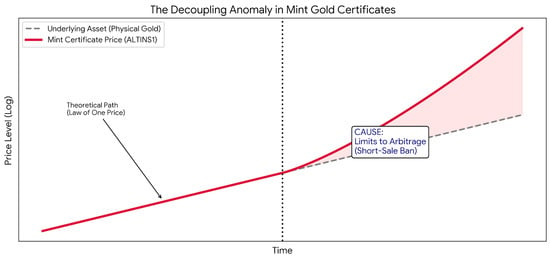
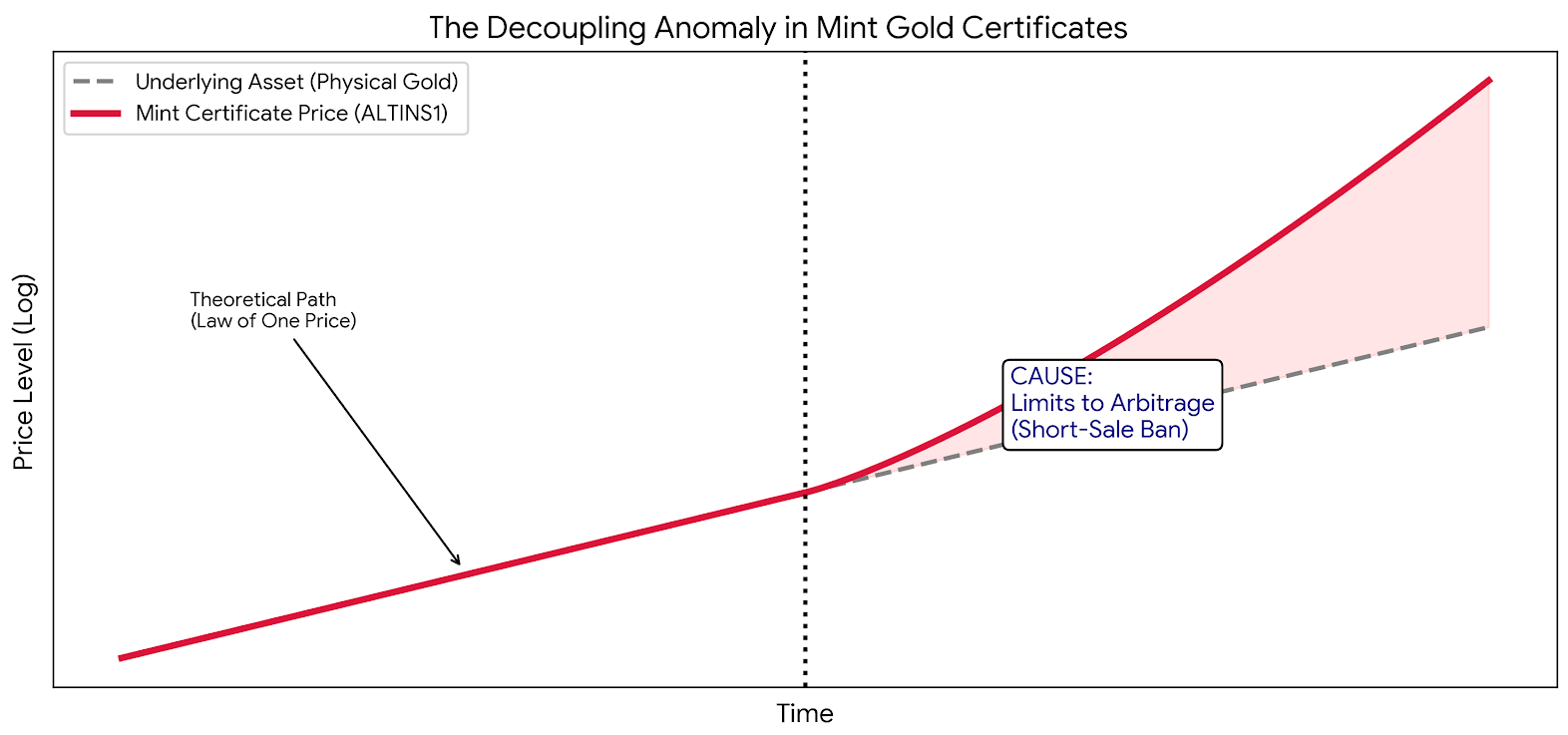
Within the framework of theoretical finance models and the “Law of One Price,” the price of this certificate—which is backed by 99.5% pure physical gold and offers the option of physical delivery at maturity—is expected to move simultaneously and in a one-to-one correlation with the spot gram gold price. In an efficient market, any potential deviation between the certificate price and the underlying asset price should be instantaneously exploited and eliminated by rational arbitrageurs.
However, contrary to these theoretical expectations, empirical observations and market data reveal that the Mint Gold Certificate has systematically decoupled from its underlying asset, particularly since the last quarter of 2024, and has been trading at a significant “premium.” This anomaly, known in the literature as the “Closed-End Fund Puzzle,” raises the question of why investors are willing to pay 20–30% more than the fundamental value for the same financial asset simply because it is exchange-traded.
The primary objective of this study is to econometrically analyze the dynamics, timing, and drivers of this irrational decoupling in certificate pricing. The study posits that the certificate has decoupled from the underlying asset not only in terms of returns but also regarding its risk (volatility) characteristics, entering a speculative pricing regime following a structural break identified on 19 March 2025.
While price deviations of financial assets are typically examined using static models in the existing literature, this study adopts a dynamic approach that accounts for the time-varying nature of market efficiency. In this context, trends in the premium series are analyzed using Mann–Kendall and Theil–Sen methods; regime changes via the Pettitt Structural Break Test; the evolution of investor sentiment through Rolling Window Regression; and the asymmetry in the price adjustment mechanism using the Threshold Error Correction Model (Threshold ECM). Furthermore, whether price movements have evolved into a speculative cycle is tested using Granger Causality tests and Rolling Volatility analysis.
The study’s findings demonstrate that the arbitrage mechanism in the certificate market has collapsed due to specific constraints (supply caps, short-selling bans, etc.), and that investors have generated a speculative bubble by treating the high premium not as a risk, but as a momentum opportunity. In this respect, the study aims to provide a timely and empirical contribution to ongoing discussions regarding financial literacy, market microstructure, and derivative product pricing in emerging markets.
2. Objective of the Study
The primary objective of this study is to empirically demonstrate deviations from the Efficient Market Hypothesis of
Fama (
1970) and the formation of speculative pricing by analyzing the pricing behavior of the Mint Gold Certificate (ALTINS1), which is traded on Borsa Istanbul and backed by 99.5% pure physical gold.
Specifically, the study investigates how the theoretical co-movement between the certificate and its underlying asset (gold) has deteriorated over time and how the market has drifted away from rational functioning mechanisms into a speculative bubble process.
In this context, the study seeks to answer the following fundamental research questions:
Is there a systematic deviation from the long-term equilibrium relationship between certificate prices and underlying asset prices?
Have investors’ risk perception and sensitivity (Beta) regarding certificate pricing undergone a structural change over time?
Does market efficiency exhibit an asymmetric structure depending on the premium level (overpricing)?
Have price movements entered a self-reinforcing speculative cycle independent of the fundamental value (underlying asset)?
By answering these questions, the study aims to contribute to the literature on pricing anomalies of assets characterized as closed-end funds and irrational investor behavior in emerging markets.
3. Data and Variables
In this study, daily time series data were employed to analyze the pricing behavior of the Mint Gold Certificate (ALTINS1) traded on Borsa Istanbul and its relationship with the underlying asset, Gram Gold (GAUTRY). The analysis period covers the trading days between 22 November 2022, when the certificate began trading, and 28 November 2025. Data for the Mint Gold Certificate and gram gold prices were obtained from the Investing platform, while data regarding Turkish Lira reference interest rates were sourced from the Central Bank of the Republic of Turkey (CBRT).
3.1. Variable Definitions and Calculation Methods
The key variables used in the study and the calculation methods employed for their derivation are detailed below:
Certificate Risk Premium (RCERT,t):
Calculated as the difference between the daily return of the certificate and the risk-free interest rate. First, the daily logarithmic return of the certificate was calculated, then adjusted by the daily compounded reference interest rate. The formulation is as follows:
Here, PCERT,t represents the closing price of the certificate on day t, and rTLREF,t represents the Turkish Lira Overnight Reference Rate (TLREF) valid for that day.
Gold Risk Premium (RGOLD,t):
Calculated as the difference between the daily return of the underlying asset (0.995 purity gram gold) and the risk-free interest rate. First, the daily logarithmic return of gram gold was calculated, then adjusted by the daily compounded reference interest rate.
This variable is used as the independent variable in the analyses and is expected to be the fundamental determinant of certificate pricing.
In this study, “Risk Premium” (Excess Return) adjusted for the risk-free rate (TLREF) was used instead of raw returns. According to Modern Portfolio Theory (MPT) and CAPM, investors are assumed to be rational and demand compensation solely for the risk undertaken (risk premium). Deducting the risk-free return (opportunity cost) when measuring an asset’s performance allows for the observation of the real return generated by that asset. Furthermore, high inflation and consequent high nominal interest rates were observed in the Turkish economy during the analyzed period. Using nominal returns would make it difficult to distinguish how much of the asset price increase stems from general money supply expansion (TLREF/Inflation) versus asset-specific demand shocks; therefore, accounting for the risk-free return provided a cleaner “asset demand” series by filtering out the monetary expansion effect. Additionally, regarding the calculation method, it should be noted that while logarithmic returns may theoretically diverge from arithmetic returns during periods of extreme volatility, for the daily frequency employed in this study, logarithmic returns serve as a consistent and robust approximation for percentage changes (
Brooks, 2019). Furthermore, empirical inspection of our dataset confirms that extreme outliers (e.g., >50%) that would cause significant divergence between logarithmic and arithmetic returns were not observed; thus, the approximation remains statistically unbiased for the analyzed period.
Premium Variable (PREMt):
This variable represents the divergence between the market price of the certificate and the theoretical value of the underlying asset. Since one gold certificate corresponds to 0.01 g of physical gold, the certificate price was multiplied by 100 to normalize the relationship, and the natural logarithm of its ratio to the gram gold price was taken:
This variable was used as the transition variable determining the market regimes (Low Premium and High Premium regimes) in the Threshold ECM model.
The logarithmic ratio was used as the threshold variable instead of the simple price difference (PCERT − PGOLD). Gold prices increased from 1000 TL to 3000 TL over time. A 10 TL difference at 1000 TL (1%) does not carry the same economic significance as a 10 TL difference at 3000 TL (0.33%). The logarithmic difference expresses the proportional divergence (percentage premium) independent of the price level. This allows a 5% premium at the beginning of the analysis to be considered econometrically equivalent to a 5% premium at the end.
3.2. Descriptive Statistics
The table below presents the summary statistics and stationarity test results for the three fundamental variables used in the study (Certificate Risk Premium, Gold Risk Premium, and Premium Variable).
As shown in
Table 1, the average daily risk-free adjusted return of the certificate (0.177%) is higher than that of the underlying asset, gram gold (0.144%). This indicates that the certificate provides a systematic excess return to its investors compared to gold. However, the standard deviation of the certificate (0.0145) is significantly higher than that of gram gold (0.0111). This finding suggests that the certificate is not a “safer” or “less volatile” instrument; rather, it exhibits a riskier structure.
As shown in
Table 2, according to the Augmented Dickey–Fuller (ADF) test results, both risk premium series (R
CERT and R
GOLD) are stationary at the 1% significance level (I(0)).
However, the Premium variable (PREM) contains a unit root with a probability value of 0.220 and is non-stationary (I(1)). This result confirms the necessity of using the difference in the Premium variable or its lagged value within the error correction mechanism in the analyses (especially in the Threshold ECM model), rather than its level value.
4. Related Literature
There is extensive literature on the divergences between underlying assets and derivative products or fund prices in financial markets, particularly within the framework of the “Closed-End Fund Puzzle” and “Limits to Arbitrage” theories. The literature forming the basis for the findings of this study is synthesized under three main headings: pricing anomalies, arbitrage constraints, and nonlinear (asymmetric) market behaviors.
Studies on the deviation of asset prices from their fundamental values indicate that this phenomenon cannot be fully explained by traditional finance theories. In his study examining the closed-end fund puzzle,
Charrón (
2009) stated that neither traditional nor behavioral finance explanations alone suffice to explain the emergence of this anomaly, and the issue remains controversial. Focusing on the causes of this divergence,
Manzler and Slezak (
2008) investigated the risk dimension of the relationship between fund returns and portfolio returns (NAV). The authors found that fund returns possess significantly higher risk and volatility compared to fundamental portfolio returns, and that these risk differences (idiosyncratic risk) explain the variation in premiums. This finding parallels the volatility decoupling between the certificate and gram gold identified in our study. Similarly,
Lenkey (
2015) drew attention to the role of factors such as management fees and information asymmetry in discount/premium formation, revealing a nonlinear relationship between fees and discounts.
While derivative instruments are extensively studied, a growing body of literature specifically focuses on the efficiency of gold markets in emerging economies, where gold serves as a primary hedge against currency volatility. For instance,
Baur and McDermott (
2010) highlight that gold acts as a strong safe haven in developing markets during periods of extreme market distress. Similarly, in the context of the Indian market, which shares structural similarities with Turkey in terms of gold demand,
Mishra et al. (
2010) argue that domestic gold prices are often cointegrated with international spot prices but can exhibit short-term deviations due to import restrictions and exchange rate shocks. In the Turkish context, recent studies suggest that the financialization of gold through banking channels and certificates has altered traditional pricing dynamics, yet empirical evidence on the efficiency of these specific instruments remains limited.
The persistence of price differentiations indicates that the arbitrage mechanism in the market is not functioning effectively. In their study on the S&P 500 market,
J. Chen et al. (
2022) identified an inverted-U relationship between mispricing and arbitrage activity. The researchers found that when mispricing becomes excessive, funding constraints become binding, and arbitrageurs withdraw from the market instead of correcting it. This situation theoretically supports the finding in our study regarding the “decrease in adjustment speed during high premium periods.”
The view that market dynamics are nonlinear and investor responses vary according to conditions is prominent in modern econometric studies.
Bansal and Stivers (
2025) found that the Beta coefficient of assets is not constant; rather, Beta rises in a nonlinear fashion when market fear (VIX) increases. This study serves as the basis in the literature for our “Rolling Window” analysis, which shows that the certificate’s sensitivity to the underlying asset changes over time. Examining asymmetry in price adjustments,
Yang and Ye (
2008) reached the finding known as the “Rockets and Feathers” effect, where prices react quickly to upward shocks and slowly to downward shocks.
Tang (
2025) determined that the expansion of price limits in the Chinese market increased volatility, and this effect was more pronounced when investor sentiment was high. While
Z. Chen et al. (
2023) observed asymmetric cointegration relationships in commodity markets,
Bloznelis (
2025) noted that futures prices exhibit a downward bias depending on the forecast horizon.
Finally, specific to the Turkish market,
Çağli and Mandaci (
2013) demonstrated that considering structural breaks is mandatory when examining the relationship between futures and spot prices, and that market efficiency is measured more accurately when breaks are included. This study confirms the importance of using the Pettitt structural break test in our analysis.
5. Econometric Method
In this study, a multi-stage econometric approach has been adopted to detect pricing anomalies, breakpoints in market efficiency, and speculative bubble formation in the pricing behavior of the Mint Gold Certificate. The analysis process consists of trend detection, structural break analysis, dynamic coefficient estimation, nonlinear regime analysis, and causality tests. All dataset manipulations, econometric modeling, and graphical representations in the study were performed using the Python 3.10 programming language (Python Software Foundation, Wilmington, DE, USA). The SciPy library formed the basis for structural break tests, trend analyses, and distribution tests, while the statsmodels econometrics library was used for unit root tests, rolling window regressions, and Threshold Error Correction Model (Threshold ECM) estimations.
5.1. Trend Analysis: Mann–Kendall and Theil-Sen Methods
Non-parametric tests were preferred to examine the decoupling process of the certificate from the underlying asset (the evolution of the premium series). In the first stage of the study, the Mann–Kendall Test is used to test the statistical significance of the trend in the premium series, while the Theil-Sen Estimator calculates the magnitude of this trend.
The Mann–Kendall test is a widely used non-parametric method for detecting trends in time series (
Hamed, 2008, p. 351). Being a non-parametric test implies that it does not assume a specific joint distribution of the data and is minimally affected by deviations from normality (
Blain, 2013, p. 393). Furthermore, it is less sensitive to outliers (
Hamed & Rao, 1998;
Hussain & Mahmud, 2019, p. 1). The Mann–Kendall test begins with the calculation of the S statistic (
Blain, 2013, p. 394). A positive S value indicates an increasing trend, while a negative value indicates a decreasing trend (
Güçlü, 2018, p. 686;
Güçlü et al., 2025, p. 2). The significance of the test is evaluated via the Z (or Z
MK) value obtained by standardizing the S statistic (
Güçlü, 2018, p. 686;
Güçlü et al., 2025, p. 2;
Blain, 2013, p. 395).
The Theil-Sen (TS) method has a significant place in the literature as a non-parametric and robust estimator originally developed to estimate the slope parameter in simple linear regression (SLR) models (
Dang et al., 2015, p. 1;
Peng et al., 2008, p. 183). In a simple linear model, given two distinct points Y
i and Y
j, the slope estimator is calculated as b
i,j = Y
i − Y
j)/(X
i − X
j), and the Theil-Sen estimator is defined as the median of all possible pairwise slopes (
Fernandes & Leblanc, 2005, p. 307;
Dang et al., 2015, p. 4). The Theil-Sen estimator possesses a high breakdown point (
Dang et al., 2015, p. 1;
Wright and Paterson, 2025, p. 12). Therefore, it demonstrates the ability to reduce the impact of outliers, directly addressing issues encountered by methods like OLS (
Ohlson & Kim, 2015, p. 397). It is applied in linear valuation models to resolve outlier and heteroscedasticity problems frequently encountered in OLS-based research (
Ohlson & Kim, 2015, p. 397).
Outliers and deviations from normal distribution, frequently encountered in financial series, can mislead classical linear trend analyses. Due to their robust structures against outliers, the Mann–Kendall and Theil-Sen methods were utilized in this study to most accurately reflect the true trend in the premium series.
5.2. Structural Break Test: Pettitt Test
The Pettitt test is a method used to detect abrupt changes in the mean of the distribution of the variable under study (
Mallakpour & Villarini, 2016, p. 243). The test performs both the detection and testing of the potential change point simultaneously (
Xie et al., 2014, p. 1644). It is widely employed because it requires no assumption about the distribution generating the data, such as normality (
Zhou & Guo, 2025, p. 6). The test establishes the null hypothesis (H
0) on the assumption that there is no abrupt change in the distribution (location parameter) of the sequence of random variables (
Das & Banerjee, 2021, p. 8;
Imani et al., 2025, p. 2054;
Xie et al., 2014, p. 1644). Introduced by
Pettitt (
1979), this method utilizes the U
t,T statistic, which is similar to the Mann–Whitney sample test (
Mallakpour & Villarini, 2016, p. 246;
Imani et al., 2025, p. 2054). The change point is identified at the position K
T where the U
t,T value is maximized. The reliability of the test is determined by calculating the significance probability (
p) value (
Das & Banerjee, 2021, p. 8;
Imani et al., 2025, p. 2054).
Identifying the point where market dynamics shift is one of the primary objectives of this study. In this context, the Pettitt Test was applied as a distribution-free method to detect the point of abrupt change in the mean of the time series. Regulatory decisions or sudden shifts in investor behavior in the certificate market can cause structural breaks in the dataset. Instead of determining the break date (t) a priori, the Pettitt test enabled the identification of the most probable break date on a scientific basis by deriving it endogenously from the internal dynamics of the dataset.
5.3. Time-Varying Parameters: Rolling Window Regression
Rolling Window Analysis (RWA) is a time-varying technique used to examine the behavior and coefficients of variables in a regression model across different time intervals (
Raza et al., 2018, p. 471). Rolling window estimation is employed to overcome reliability issues stemming from the constant parameter assumption of full-sample estimation methods (
Balcilar et al., 2010, p. 1398;
Destek & Koksel, 2019, p. 20). Structural changes in the economic system (e.g., technological advancements, economic crises, or major disasters) can cause causality relationships to change over time, and these changes can be detected via the rolling window method (
Zhang et al., 2018, p. 409). The method investigates whether the causal relationship (or long-term relationship) between variables is stable throughout the sample period (
Raza et al., 2018, p. 471;
Shahbaz & Shabbir, 2012, p. 125). By revealing how structural changes or regime shifts affect the causality relationship, it allows for the examination of structural changes (
Destek & Koksel, 2019, p. 7). In cases where the parameter stability assumed by full-sample estimations is untested or rejected, it ensures reliable results by demonstrating the sensitivity of estimates to the sample period (
Aslan et al., 2018, p. 405;
Balcilar et al., 2010, p. 140;
Balcilar & Ozdemir, 2013, p. 649). It offers models reflecting the dynamic sensitivity (rolling beta) of financial assets to market risk (
Fan & Shu, 2025, p. 12).
Since market efficiency is not a static phenomenon but a dynamic process that can evolve over time, a dynamic approach was adopted in this study instead of a static OLS model covering the entire period.
The Ordinary Least Squares (OLS) method was applied using 50-day rolling windows, and the α (alpha), β (beta) coefficients, and the model’s explanatory power (R2) were derived across the time dimension.
Classical models assume that the certificate’s sensitivity to gram gold (Beta) remains constant throughout the period. However, our hypothesis postulates that this sensitivity changes over time. Rolling window analysis allows for the real-time tracking of this evolution in investor behavior and the process of the certificate’s decoupling from the underlying asset.
5.4. Market Regime Analysis: Threshold Error Correction Model (Threshold ECM)
The Threshold Error Correction Model (TECM) is a significant class of models used in time series econometrics literature to analyze nonlinear dynamics and, specifically, asymmetric responses. These models are based on the assumption that the adjustment towards the long-term equilibrium relationship between variables changes depending on the magnitude or direction of the deviation from equilibrium (
Gonzalo & Pitarakis, 2006, p. 580;
Greb et al., 2011, p. 1). This method is an extension of traditional Vector Error Correction Models (VECM). When a cointegration relationship exists, VECMs utilize an error correction term (ECT) to guide short-term dynamics toward the long-term equilibrium (
R. Chen et al., 2025, p. 4;
Gonzalo & Pitarakis, 2006, p. 580). While the adjustment process is constant over time in standard VECMs, TECM relaxes this constraint and captures the possibility of “lumpy” or “discontinuous” adjustment (
Gonzalo & Pitarakis, 2006, p. 580). The primary objective of TECMs is to examine whether responses to shocks are asymmetric (
Carruth & Dickerson, 2003, p. 619). TECM is essentially a VECM where coefficients do not remain constant but vary depending on whether observations fall into the same regime (
Greb et al., 2011, p. 1). The transition between regimes is determined by whether a threshold variable (e.g., the error correction term itself or an external variable) exceeds predetermined threshold parameters (
Gonzalo & Pitarakis, 2006, p. 583). By adding the ECT for cases where differencing operations obscure long-term relationships, TECM restores lost long-term information and enables the analysis of non-stationary series (
R. Chen et al., 2025, p. 2). TECMs provide a powerful tool for modeling situations where market responses do not occur at a single speed but rather vary depending on the direction (positive/negative) or magnitude of the event (
Grasso & Manera, 2007, p. 157).
In this section of the study, whether market efficiency changes according to the “premium level” was tested. The Threshold Error Correction Model (Threshold ECM) estimates the speed of price reversion to equilibrium separately for values below and above a specific threshold. The model is constructed as follows:
Here λ (lambda) represents the optimal threshold value, while the rho (rho) coefficients indicate the speeds of adjustment. To determine the optimal threshold value λ, the Grid Search method proposed by
Hansen (
2000), which aims to minimize the Residual Sum of Squares (RSS), was employed. Values falling between the 15th and 85th percentiles of the Premium (PREM
t−1) data within each rolling window were designated as “candidate threshold values.” The exclusion of extreme values (the bottom and top 15% tails) was intended to ensure a sufficient number of observations for parameter estimation in both regimes (low and high premium), serving as a trimming parameter. The Threshold ECM regression was estimated separately for each candidate threshold value within the determined range. Among all candidates, the value that minimized the model’s Residual Sum of Squares (RSS) or equivalently maximized the R
2 was selected as the “Optimal Threshold Value λ* for that window.
The Jarque–Bera test results indicated that the data are nonlinear. Linear models assume that investors’ reaction to a 1% premium is identical to their reaction to a 30% premium. However, in behavioral finance, investor reactions emerge asymmetrically. By decomposing investor behavior into “low premium” and “high premium” periods, the Threshold ECM mathematically demonstrates at which level the rational market mechanism collapses (or where speculation begins).
5.5. Causality Analysis: Granger Causality Test
The Granger causality test is based on evaluating whether the past values of one time series provide more additional information in predicting the future values of another series than the information provided by that series’ own past values (
Shojaie & Fox, 2022, p. 290;
Diks & Panchenko, 2006, p. 1648). The primary aim is to characterize causal interactions from observational data (
Shojaie & Fox, 2022, p. 290;
Maziarz, 2015, p. 98). Granger causality tests are widely used across many scientific disciplines, particularly to examine the dynamic interactions of time series data (
Shojaie & Fox, 2022, p. 292). In the fields of econometrics and finance, they are utilized in research areas such as stock markets, crude oil, and geopolitical risk analyses (
Alabi & Ishola, 2025, p. 2;
Hong et al., 2025, p. 13;
Wang et al., 2025, p. 2;
Ren et al., 2025, p. 1).
Granger causality analysis evaluates the relationship between two time series (X
t and Y
t) within the framework of predictability (
Shojaie & Fox, 2022, p. 290). Accordingly, if the past and current values of Y provide additional information beyond that provided by X’s own past values in predicting the future values of X, one time series (Y) is considered the Granger cause of another series (X) (
Diks & Panchenko, 2006, p. 1648;
Maziarz, 2015, p. 91). Mathematically, this is determined by examining whether using Y’s history reduces the variance of X’s optimal prediction error (
Shojaie & Fox, 2022, p. 291).
In this study, the Granger causality test was employed to confirm the direction of price movements and the existence of a speculative bubble. Causality was analyzed by testing the explanatory power of the variables’ lagged values on each other using the F-test. Theoretically, the gram gold return is expected to determine the certificate premium. However, in speculative markets, increases in premiums can stimulate investor appetite and drive prices even higher. The Granger test was utilized to test this “feedback” mechanism and whether pricing has decoupled from the fundamental value.
5.6. Risk Channel Decoupling: Rolling Volatility Analysis
Rolling volatility is one of the simplest approaches for measuring time-varying volatility. The historical annualized rolling window volatility (σ
n,t) with a window size of n is obtained by calculating the standard deviation of logarithmic returns (r
s) within the selected window (
Modarresi et al., 2024, p. 18). This method determines a fixed sample size (T) to estimate the model parameters. Subsequently, both the start and end dates are shifted sequentially by one observation, and the model is re-estimated each time (t = 2, …, T + 1) (
Sahiner, 2022, p. 9).
Rolling volatility analysis serves as a simple yet effective tool for measuring the dynamic risk of time series data. For investors, gold is traditionally considered a “safe haven” with low volatility. In a scenario where the certificate ceases to be a derivative of the underlying asset and transforms into a speculative instrument, risk perception is expected to change in parallel. To test this hypothesis, the 30-day moving standard deviations of the certificate (RCERT) and gram gold (RGOLD) returns were compared.
6. Results
The results obtained from the analyses, the theoretical framework of which was outlined in the previous section, are presented in the following sections.
6.1. Trend Analysis Findings
The results of the Mann–Kendall trend test and Theil-Sen slope estimator, applied to determine whether the certificate price systematically deviates from the underlying asset price, are summarized in
Table 3.
As shown in
Table 3, according to the analysis results, the Mann–Kendall test
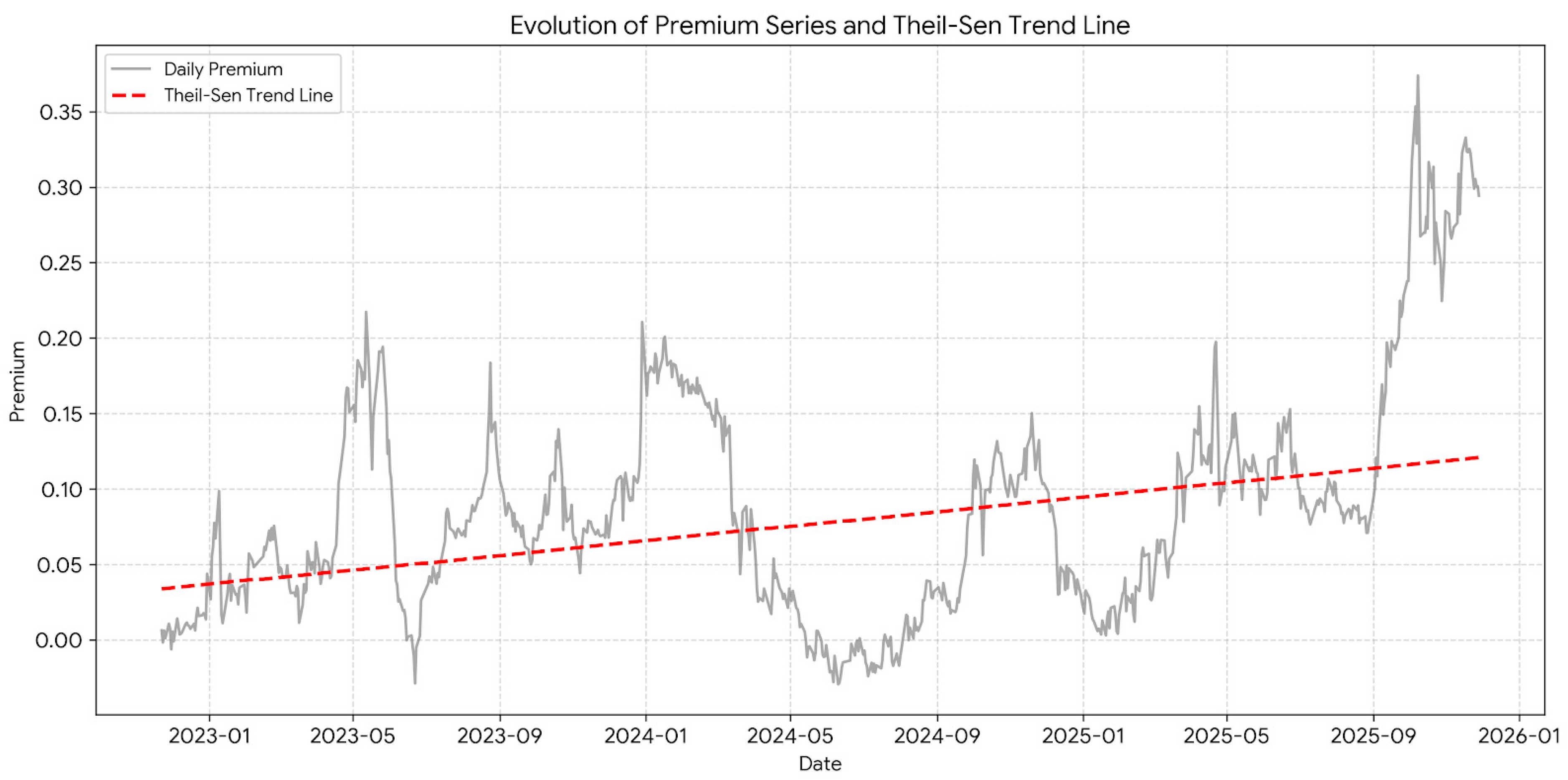
p-value being significantly lower than 0.05 (and even 0.01) reveals the presence of a statistically significant trend in the premium series. The positive Kendall’s Tau coefficient (0.243) and the positive value of the Theil-Sen slope estimator indicate that this trend is upward. This finding proves that since the day it began trading, the certificate has tended to increasingly diverge from the underlying gram gold price and be priced with a systematically higher premium, rather than converging to it. This situation contradicts the Efficient Market Hypothesis and indicates the accumulation of a speculative bubble in certificate pricing over time.
Figure 1 displays the logarithmic difference (premium) between the certificate’s market price and the underlying asset (physical gold). The gray line represents the realized daily premium levels, while the red line represents the median trend line calculated via the Theil-Sen estimator. The distinct upward slope of the trend line visualizes that the certificate has systematically diverged from the underlying asset in a positive direction over time.
6.2. Structural Break Analysis Findings
The results of the non-parametric Pettitt homogeneity test, applied to determine the timing of the regime change in certificate pricing, are presented below.
As shown in
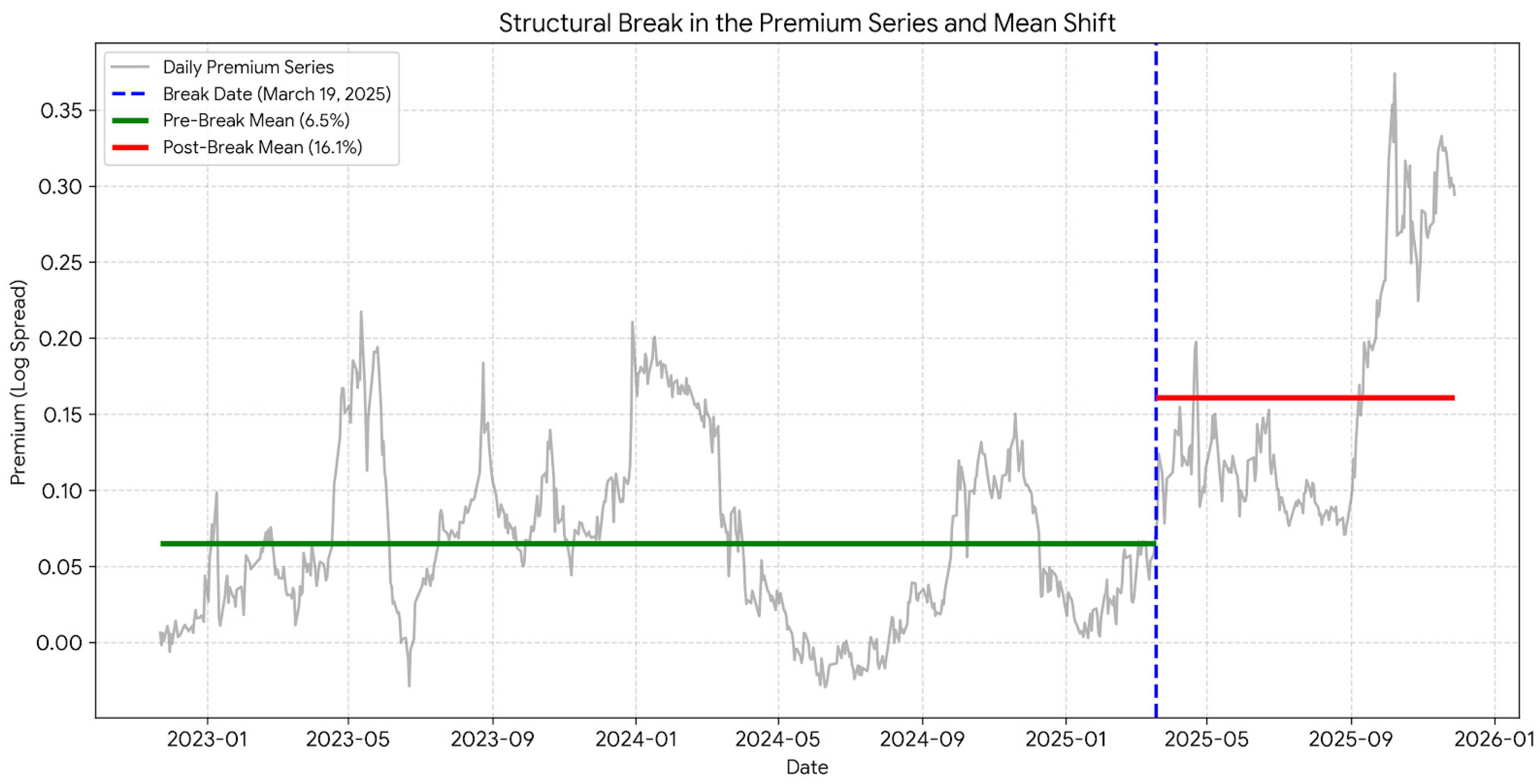
Table 4, according to the Pettitt structural break test results, the average premium value was 6.49% in the pre-break period, whereas it rose to 16.14% in the post-break period. The analysis results confirm the existence of a statistically significant structural break in the series, as the Pettitt test
p-value is less than 0.01. The date on which the test statistic reached its maximum and the break occurred was identified as 19 March 2025.
A significant shift occurred in the certificate market on this date. The premium, which hovered around an average of 6.5% prior to the break, made a jump and settled at an average of 16.1% thereafter. This approximately 150% increase in the mean indicates that market dynamics have changed and the certificate has distinctly decoupled from the underlying asset.
Figure 2 illustrates the structural break that occurred on 19 March 2025. The green line represents the pre-break average premium level (6.5%), while the red line represents the post-break average premium level (16.1%). The blue dashed line marks the break point where the Pettitt test statistic reached its maximum.
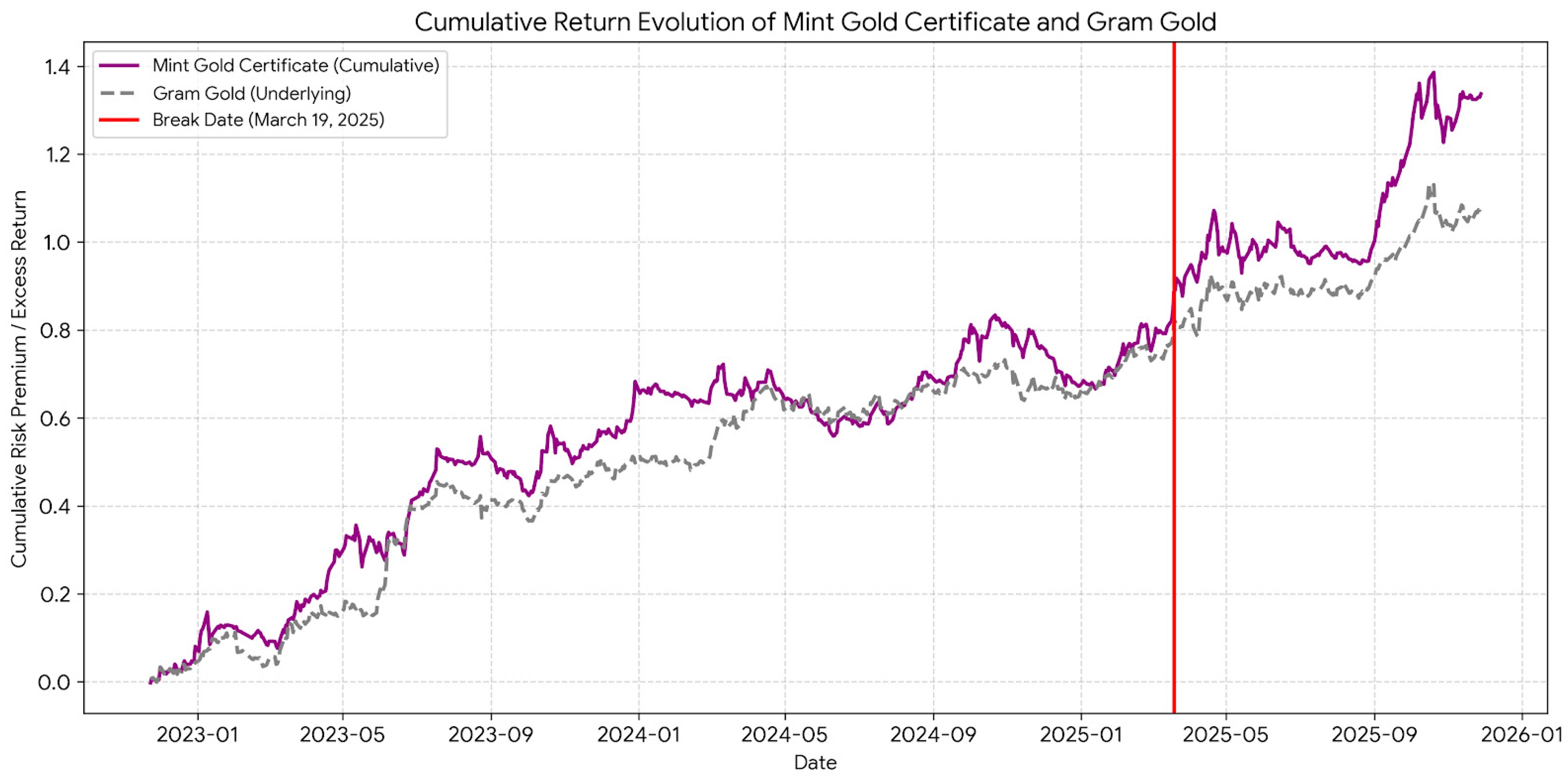
In addition to the findings stated above, to visually demonstrate the magnitude of the divergence between the certificate and the underlying asset, the cumulative risk premiums (excess returns) of both assets throughout the analysis period are compared in
Figure 3.
When
Figure 3 is examined, it is observed that the returns of the certificate (purple line) and gram gold (gray dashed line) moved in parallel with high correlation until late 2024. During this period, the certificate appeared to be an efficient investment vehicle tracking its underlying asset one-to-one. Although divergences were observed occasionally (e.g., May 2023 elections), equilibrium was restored in subsequent periods.
However, a significant divergence stands out starting from 19 March 2025, marked by the red vertical line on the graph. After this date, while the underlying asset return largely followed a course consistent with its historical trend, the certificate return gained a sharp upward momentum and decoupled from the underlying asset. This visual finding provides the first and strongest signal that a structural break occurred in the market and that the certificate entered its own unique pricing dynamic. The econometric tests in the following sections will examine the statistical foundations of this visual divergence.
6.3. Rolling Window Regression Findings
A dynamic regression analysis was conducted using 50-day rolling windows to examine the evolution of the certificate’s sensitivity to the underlying asset (Beta) and the excess return provided (Alpha) over time. The rolling window width was determined as 50 trading days. This choice is grounded in three fundamental motivations: First, the condition of a minimum sample size of N > 30, required for the statistical reliability of regression coefficients pursuant to the Central Limit Theorem, is satisfied. Second, 50 trading days corresponds to approximately one financial quarter (2.5 months), representing medium-term trend shifts in the market. Finally, to ensure the model captures sudden structural breaks in certificate pricing without delay, excessive smoothing effects were avoided, and the balance between noise and signal was optimized.
Additionally, average parameter values for the pre- and post-structural break periods are summarized in
Table 5.
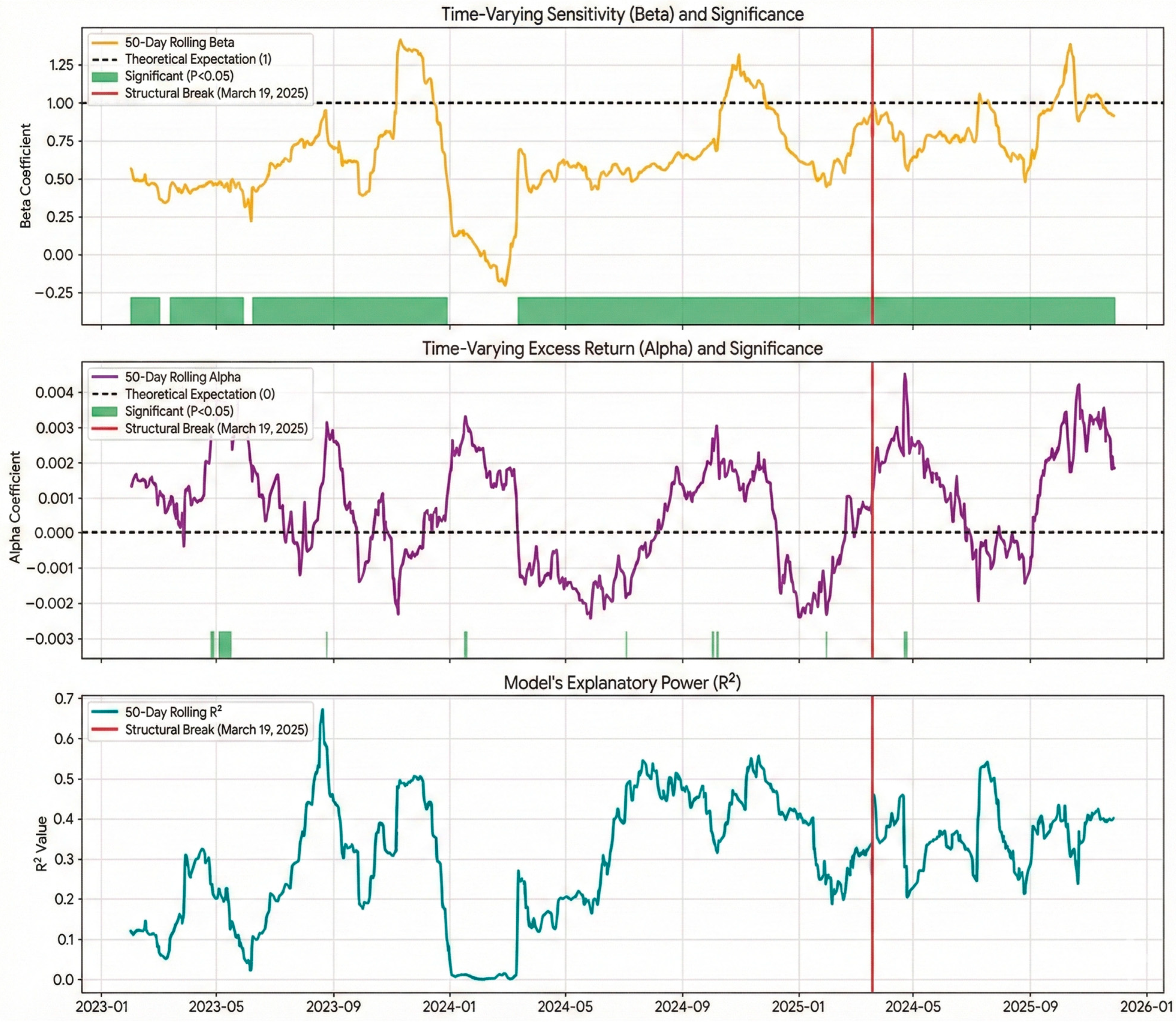
The results of the dynamic regression analysis are presented in
Figure 4.
In the graph, the orange line indicates the Beta coefficient, the purple line indicates the Alpha coefficient, and the turquoise line indicates the R2 value. The green bands on the X-axis represent days where the respective coefficient is statistically significant at the 5% level. The red vertical line marks the structural break on 19 March 2025.
The Beta coefficient hovered below the theoretical expectation of 1 throughout the analysis period. In terms of unit impact, this implies that for every 1% return generated by the underlying gold, the certificate reflects only about 0.61% to 0.85% of this return, failing to fully mirror the asset it tracks. Although the increase in the average after the break suggests an increased reaction of the certificate to gram gold, the instability of this relationship is evident from the changes in the R2 value.
The Alpha coefficient, shown by the purple line, mostly fluctuated around 0 throughout the period and remained statistically insignificant (scarcity of green bands). This indicates that the certificate moves with instantaneous and temporary pricing errors rather than generating a systematic “arbitrage profit.”
The fact that the model’s explanatory power remained in the 0.30–0.35 band reveals that, contrary to expectations, only about 30% of certificate price movements can be explained by the underlying asset (gram gold), while the remaining 70% is determined by speculative or other factors.
6.4. Market Regime Analysis: Threshold ECM Findings
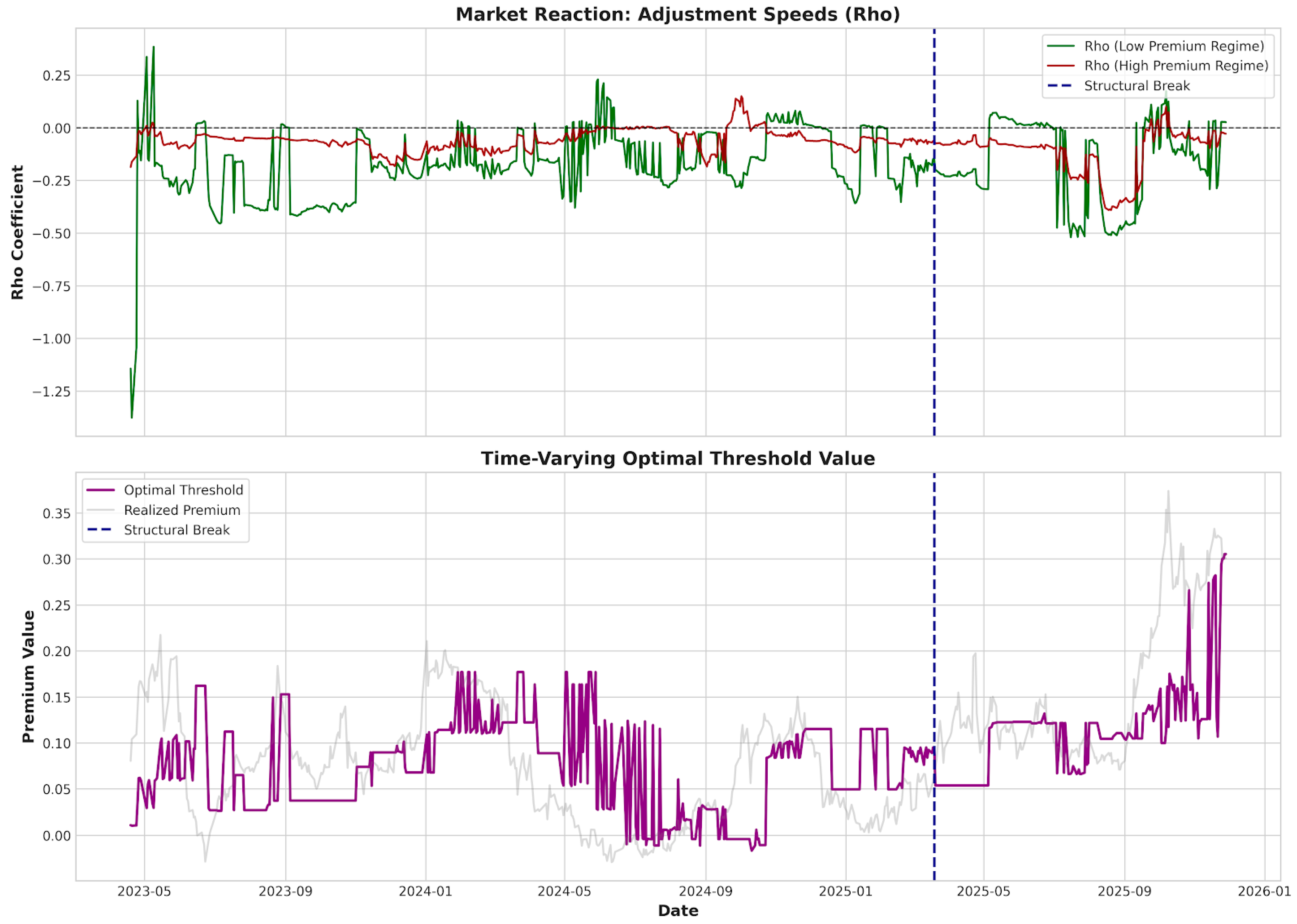
The results of the 100-day rolling window Threshold ECM analysis, conducted to test the asymmetry in investor behavior and the variation in market efficiency based on the premium level, are visualized in
Figure 5, and period averages are summarized in
Table 6. The widest window was selected to ensure the statistical reliability (low variance) of long-term relationship parameters such as the speed of reversion to equilibrium (rho) and the optimal threshold (λ). Cointegration models require a larger number of observations for robust estimation.
The most striking finding of the Threshold ECM analysis is the persistent upward shift in the threshold value. The purple line in
Figure 5 indicates the boundary value at which the market switches regimes. This threshold, which fluctuated around 7% until the break date (blue dashed line), rose rapidly after the break, reaching nearly 30% (end of the graph). This demonstrates that investors have accepted the high premium not as a rational risk, but as the “new normal.”
Theoretically, negative Rho coefficients (adjustment speeds) indicate that the market is reverting to equilibrium. However, at the end of the analysis period, particularly in the high premium regime (red line), the adjustment coefficient is observed to weaken and approach zero. This proves that no matter how high the premium rises, counterbalancing selling pressure does not emerge; on the contrary, speculative buying appetite persists.
The graph in the upper panel shows the adjustment speeds (Rho) in the low premium (green) and high premium (red) regimes. Negative values indicate reversion to equilibrium. In the lower panel, the purple line represents the optimal threshold value (investor tolerance level) determined by the model, while the gray line shows the realized premium level. The systematic increase in the threshold value following the break is noteworthy.
6.5. Confirmation of Speculative Cycle: Granger Causality Test Findings
The persistence of the high premium and the decoupling of prices from the underlying asset detected in regression analyses point to a potential “feedback” mechanism. To determine the direction of price movements and confirm the formation of a speculative bubble, the Granger Causality Test was applied for the post-structural break period (19 March 2025–November 2025).
The stationarity-ensured Certificate Return (RCERT,t) and Change in Premium (∆PREMt) variables were used in the test.
The results in
Table 7 reveal a bidirectional causality between the variables:
Premium → Return Channel: Increases in the premium (i.e., the certificate becoming expensive) do not scare investors into selling; instead, they create an expectation that “prices will rise further,” thereby increasing buying appetite (return). This can be interpreted as typical “Herding Behavior” and a momentum effect.
Return → Premium Channel: Increases in the certificate price (high returns) outpace the underlying asset price, causing the spread (premium) to widen further.
This mutual interaction corresponds to the mechanism defined in financial literature as “Irrational Exuberance” or a “Speculative Bubble.” Prices are now rising independently of the fundamental value (gram gold), driven by their own self-generated momentum. The Granger test provides econometric evidence of this mechanism, confirming the irrational movements of the Mint Gold Certificate.
6.6. Risk Channel Decoupling: Rolling Volatility Analysis Results
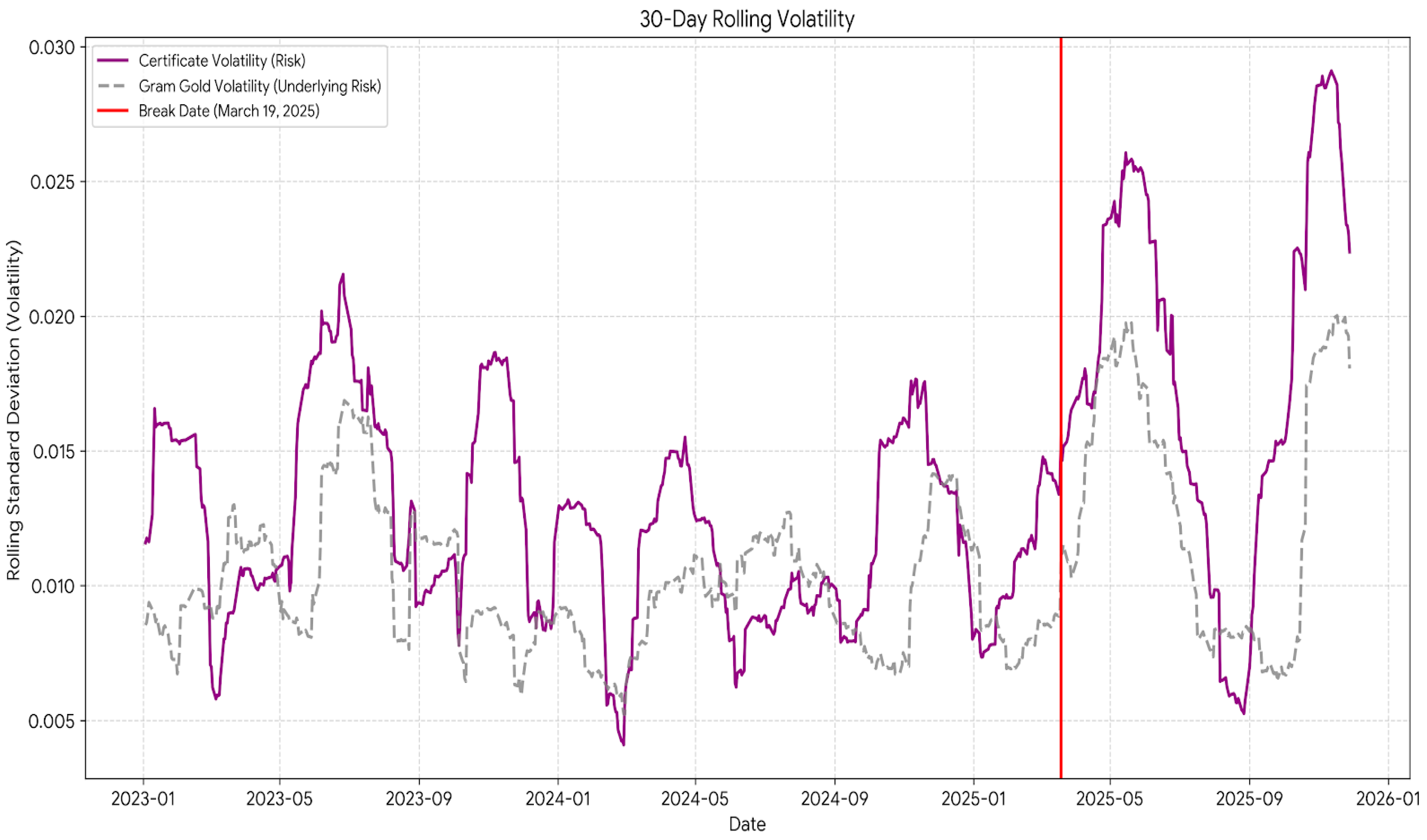
Figure 6 presents the changing volatility of both the Mint Gold Certificate and the underlying asset, gram gold, over the analyzed period using a 30-day rolling volatility window. Volatility is the financial parameter that reacts most rapidly to market shocks. This short window, selected in accordance with risk measurement standards (typically 20–30 days), allows for the observation of the sudden and high-frequency decoupling in the risk profile following the structural break without noise.
A closer inspection of
Figure 6 reveals two distinct regimes. Prior to the structural break date of 19 March 2025, the purple line (Certificate risk) and the gray dashed line (Gram Gold risk) move quite closely and in parallel. During this period, the certificate offers a risk profile similar to the underlying asset for its investors.
However, during this period, certificate volatility occasionally exceeded that of gram gold. Divergences are observed during periods such as the May 2023 elections and the last quarter of 2023, due to the imposition of quotas on gold imports. Immediately following the break date (red vertical line), the volatility of the certificate showed a significant increase and substantially decoupled from the volatility of the underlying asset. This analysis demonstrates that the anomaly in certificate pricing consists not merely of a temporary bubble on the “return” side, but that the asset’s risk characteristic has also structurally changed.
The fact that the certificate has become excessively volatile relative to the underlying asset confirms that it is now priced as a high-risk speculation instrument.
7. Conclusions and Discussion
In this study, the pricing efficiency of the Mint Gold Certificate (ALTINS1), traded on Borsa Istanbul and backed by 99.5% pure physical gold, was analyzed using structural break tests and dynamic econometric models. The primary objective of the study was to empirically demonstrate how a financial instrument, theoretically expected to move in tandem with its underlying asset (gram gold), decoupled from this relationship over time and evolved into a speculative pricing process.
The findings indicate that the certificate market experienced a sharp structural break on 19 March 2025, and has drifted away from the Efficient Market Hypothesis from that date onwards. This date coincides with a period of high macro uncertainty and increased regional risks.
Pettitt test and cumulative return analyses have proven that certificate prices have systematically and persistently decoupled from underlying asset prices. The average premium, which was at the 6.5% level prior to the break, rose to 16.1% post-break, and no market correction occurred to close this gap. This situation can be explained by the “Limits to Arbitrage” theory in financial literature; the existence of a supply cap on the certificate, the ban on short selling, or investor irrationality prevents prices from converging to the fundamental value. Due to the supply cap, the issuer cannot issue new certificates by purchasing additional gold from the market. Furthermore, short selling of the certificate is not permitted on Borsa Istanbul. Specifically, these two conditions prevent the premium on the certificate price from decreasing and the price from approaching the underlying asset. Additionally, the determination of the certificate bid-ask spread as a fixed 0.01 TL per certificate (1 TL margin on a gram basis) particularly attracts investor interest in a market where gram gold prices are rising, causing irrational price behavior. This aligns with the ‘Short-Sale Risk’ hypothesis put forward by
Engelberg et al. (
2018) in the literature. The authors demonstrated that when short selling is restricted or costly, overpricing cannot be corrected by arbitrageurs, and price deviations become permanent. Similarly, in his study examining arbitrage asymmetry in stock markets,
Bekjarovski (
2017) found that premiums exhibit a stubborn structure, especially in assets with supply constraints. The persistence of the certificate premium in our study is concrete evidence that institutional constraints in the Turkish market (short-selling ban and issuance cap) distort market efficiency, consistent with theoretical expectations.
It is also crucial to address the structural advantages of the Gold Certificate that distinguish it from physical gold. Unlike the spot market, the certificate offers significant benefits, including exemption from withholding tax on trading profits and the elimination of storage costs, given that the underlying asset is securely held by the Turkish State Mint. Additionally, the certificate provides tighter bid-ask spreads and higher liquidity through electronic trading platforms. While these institutional features could theoretically justify a marginal premium (e.g., 1–3%) representing a ‘convenience yield,’ they fail to account for the persistent and extreme premium (exceeding 16%) observed in this study. Therefore, while these benefits contribute to a positive basis, the magnitude of the decoupling confirms that the primary driver is not fundamental value, but rather speculative dynamics fueled by limits to arbitrage.
Under rational pricing, the regression model where the certificate is the dependent variable and gram gold is the independent variable should yield an alpha value of 0, a beta value of 1, and an R2 value of 100%. Such an expectation would confirm that the certificate moves in unison with the underlying asset. Rolling Regression results showed that the certificate’s sensitivity to the underlying asset (Beta) is unstable and consistently below 1, with the model’s explanatory power (R2) realized at around 30%. More importantly, Rolling Volatility analysis revealed that the certificate has lost its “safe haven” characteristic and assumed the identity of an asset that is riskier and more speculative than the underlying asset. Investors, while purchasing a gold-backed security to reduce risk, paradoxically assume a much higher risk.
Threshold ECM analysis has laid bare the extent of the loss of rationality in the market. The premium threshold accepted as “normal” by the market has risen over time from 7% to 12%, and recently up to 30%. The absence of selling pressure (negative Rho) to bring prices to equilibrium, especially during high premium periods—and indeed its convergence to zero—indicates that investors evaluate overpricing not as a risk, but as a momentum opportunity.
The increase in certificate volatility by decoupling from the underlying asset supports the ‘Liquidity Mismatch’ findings in the study on Exchange Traded Funds (ETFs) by
Ben-David et al. (
2017). The researchers noted that ETF prices becoming more volatile than the underlying asset creates a leverage effect for liquidity shocks in the market. In the Turkish case, the fact that the Mint Gold Certificate has become 3–4 times riskier than the underlying asset validates the thesis that financial innovation products can lose their ‘safe haven’ status during crisis periods and transform into sources of systemic risk.
Granger Causality tests confirmed a bidirectional speculative cycle where premium increases feed return increases, and return increases, in turn, feed the premium. This finding proves that certificate pricing is now shaped by its own self-generated speculative momentum rather than fundamental macroeconomic factors (gold price, interest rate, exchange rate). This detected feedback mechanism is consistent with the ‘Positive Feedback Trading’ phenomenon observed in retail-investor-dominated markets, such as gold coins, by
Charteris and Kallinterakis (
2021). The authors found that retail investors focus on past price trends rather than fundamental value when buying, which increases volatility. Furthermore,
Bouri et al. (
2019), in their study examining speculative spillover between gold and crypto assets, reported that a similar bidirectional causality relationship fuels asset bubbles. This aligns with findings by
C. Y.-H. Chen and Hafner (
2019), who argued that sentiment-induced behavior in innovative digital markets leads to persistent price decoupling and bubble formation. The strong causality found between certificate return and premium change in our study confirms that this asset has ceased to be an ‘investment tool’ and has transformed into a self-reinforcing speculative object.
Finally, it is worth noting that post-sample market observations further reinforce the findings of this study. Following the analysis period, the certificate premium surged to nearly 90% before experiencing a sharp correction back to the 25% levels. While this correction might seem like a normalization, a 25% premium still far exceeds any theoretical ‘cost of carry’ or tax advantage (typically estimated around 2–3% annually). In efficient global markets, gold-backed ETFs (e.g., GLD, Xetra-Gold) track spot prices with negligible tracking error. Thus, the persistence of a 25% divergence confirms that the market remains in a state of disequilibrium driven by limits to arbitrage, rather than having converged to a fundamental equilibrium.
Synthesizing these empirical findings, this study positions the observed anomaly explicitly within the ‘Limits to Arbitrage’ framework. The persistence of the premium is not merely a statistical deviation but a structural failure of the arbitrage mechanism. In a frictionless market, rational arbitrageurs would short the expensive certificate and buy physical gold, forcing convergence. However, the specific constraints identified in the Borsa Istanbul market—namely the prohibition of short selling on the certificate and the issuer’s supply cap—effectively paralyze this corrective mechanism. Consequently, the decoupling is not a temporary inefficiency but a systemic feature driven by regulatory and structural barriers, confirming that in the presence of strict limits to arbitrage, speculative bubbles can remain sustainable for extended periods.
Future Research Directions
To understand the origin of the “feedback” mechanism identified in the study, behavioral finance-oriented studies can be conducted. In future research, the relationship between the certificate premium and “Investor Sentiment Indexes” created using Google Trends search volumes or social media (Twitter/X, Telegram) data can be examined. Whether premium increases are simultaneous with increases in retail investor interest (FOMO effect) can be tested.
To gain a deeper understanding of why arbitrage is not functioning, focus can be placed on micro-structural data. Using Central Securities Depository (MKK) data, the change in the ownership structure of the certificate (domestic/foreign, institutional/retail investor ratio) can be analyzed. Specifically, whether institutional investors have withdrawn from the market in the post-structural break period and whether the market has been left entirely to “uninformed” retail investors can be investigated.
In future studies, the relationship of the certificate premium (spread) with macroeconomic variables can be investigated. The impact of variables such as country risk premium (CDS), exchange rate volatility, and inflation expectations on investors’ “cost of access to physical gold” (and thus the certificate premium) can be tested using models such as VAR or NARDL.
8. Policy Recommendations
The empirical findings of this study indicate that price stability in the Mint Gold Certificate market has deteriorated and market efficiency has been lost. To address the identified pricing anomalies and restore an efficiently functioning market structure, the following recommendations have been developed for market regulators and policymakers.
The finding from the study regarding the “lack of price correction during high premium periods” (Threshold ECM) points to a deficiency in mechanisms that would create downward price pressure in the market. To prevent overpricing in the certificate market, a controlled and supervised “Short Selling” mechanism or “Securities Lending Market” facilities for institutional investors must be introduced. Opening an arbitrage channel where investors can sell at a premium price and replace the asset from the spot market (or at maturity) would serve as the most effective market discipline to prevent the formation of speculative bubbles.
The systematic upward trend in the premium series (Mann–Kendall) suggests that the issuer is unable to provide sufficient liquidity to the market during periods when demand outweighs supply. As emphasized in the ETF literature, supply quantity must be adjusted dynamically in cases where prices deviate from the Net Asset Value (NAV). The issuing institution (The Mint) should establish a flexible “Liquidity Provision” mechanism that allows for the supply of additional certificates to the market when the spread between the market price and the underlying asset price exceeds a certain threshold (e.g., 1–2%), or for buybacks when the spread turns negative. It is recommended that the current “fixed issuance cap” practice be revised with a “dynamic supply” model sensitive to market conditions. Crucially, this dynamic supply mechanism should not aim to completely eliminate the spread but rather maintain it within a rational ‘fair value band.’ Regulatory interventions should distinguish between the ‘fundamental premium’ arising from tax and storage advantages (estimated around 1–3%) and the ‘speculative excess’ observed in this study. Targeting a spread within this fundamental band would preserve the instrument’s structural attractiveness while curbing irrational exuberance.
The “feedback loop” revealed by the Granger causality test indicates that retail investors do not fully grasp the nature of the product and perceive price increases as fundamental value appreciation. Investors must be informed more transparently that the certificate is not “gold itself,” but a “gold-based derivative instrument.” On the trading platforms of brokerage firms, alongside the instantaneous market price of the certificate, its current “Theoretical Value” (Price of 0.01 Grams of Gold) and the “Instantaneous Premium Rate (%)” should be displayed transparently. In this way, investors will be made aware that when purchasing a product with a 20% premium, they are effectively paying 20% above the market rate for gold. Furthermore, financial literacy campaigns should explicitly emphasize that paying a high speculative premium (e.g., >10%) mathematically negates the institutional benefits of the certificate, such as tax exemptions and zero storage costs. Investors must understand that purchasing at these levels renders the instrument strictly disadvantageous compared to physical gold, defeating the product’s original value proposition.