


Abstract
Digital services companies help in the digitalization and transformation of the industry in driving Malaysia by advancing the economy of the country. However, digital services companies often face financial risks in terms of liquidity, solvency, efficiency, profitability, and operational risks. These risks increase the chances of failure and financial volatility, which put the companies at a serious disadvantage. This paper proposes an integrated Entropy-Weight TOPSIS model to analyze the financial risks of the listed digital services companies within Malaysia. The entropy method helps to prevent subjective weights by reflecting on information obtained from the financial reports of the companies. This study also provides an analysis to show possible improvements for the companies. The interest coverage ratio (ICR), which measures the capability to settle interest on debt, shows the highest weight followed by the basic indicator approach (BIA) and return on asset (ROA) based on the entropy weighting method. In addition, CLOUDPT, ITMAX, and MSNIAGA are ranked as the top three digital services companies that give the highest relative closeness to the ideal solution. The results help the risk managers to identify the criteria that caused the greatest financial risk in digital services companies to formulate targeted strategies to improve the companies’ financial health.
1. Introduction
According to Deloitte’s survey (Deloitte, 2025), millennials and Generation Z are expected to comprise more than 70% of the total manpower worldwide by 2030. These generations are digital adopters and integrators whose personal and professional lives revolve around digital services for task settlement. According to Bursa Malaysia (2024), digital services refer to internet-related services such as web design, hosting, emails, e-commerce, or e-payments. Digital services help in task simplification and increase the rate of business-operation accomplishments. The application of digital services in the current world is multifold. Web3, a blockchain-based web, aims to enhance the privacy and ownership of consumers (Guan et al., 2023). SDG 11 highlights sustainable cities wherein digital solutions such as artificial intelligence (AI), cloud computing, and data analytics help in creating smart cities with sustainable and safer transport, energy, and risk management (Sengupta & Sengupta, 2022). Even though digital services companies play huge roles in innovation and societal transformation, they often face valuation and systematic risks which are driven by return on equity (ROE) and intangible assets (Perilla, n.d.). A slight disruption of an important digital services company could lead to billions of losses, as seen in the Cloudflare outage in November 2025 (Times of India, 2025). Digital services companies are customer-centric and encounter multifaceted customer expectations which are constantly evolving (Javaid et al., 2024).
This study aims to assess the performance of digital services companies in terms of risks associated with liquidity, default, solvency, cash flow, profitability, and operations. Digital services companies offering services such as Software as a Service (SaaS) and cloud services often require enormous initial investments on product development while clients tend to subscribe to the services on a monthly or annual basis, making revenues less predictable and leading to liquidity risks (C. H. Wu & Pambudi, 2025). Moreover, the churn rate of digital services companies such as providers of SaaS, could reach more than 15%, which is alarming for their liquidity position (Saias et al., 2022). The high capital expenditure on data centers and other intangible assets also add on to the liquidity risk of the companies (Greenberg et al., 2009). Liquidity risk is well-measured by the current ratio (CR) to assess a company’s ease of meeting short-term liabilities (Tarawallie et al., 2025). Solvency issues in digital services companies are critical problems which have rarely been discussed in the literature, even with real cases of bankruptcy (Parry, 2021). Solvency leads to outage in services, which are catastrophic to clients in terms of data losses and tedious retrieval (Parry & Bisson, 2020). The United States Federal Reserve (McCoy et al., 2020) noted that the interest coverage ratio (ICR) could potentially indicate vulnerabilities with a low ICR, hinting at greater chances of default and bankruptcy. The ICR serves as a criterion to analyze insolvencies with low error, with a high potential to spot a risk of financial distress (Ji, 2019). The debt-to-equity ratio (DER) is also a primary ratio in financial risk management. The DER is applied to determine the financial structure of a company (Lee, 2023). A high DER indicates instability and solvency risk (Tunçay et al., 2025).
Operational capability can be represented by the receivable turnover ratio (RTR) to evaluate the efficiency of a company when collecting payments (Lee, 2023). A high RTR signifies better cash flows with a lower risk of bad debt (Yin & Guo, 2026). When clients pay promptly, there is a stable cash flow to manage operational expenses such as cloud hosting and utilities to power data centers (T. Huang et al., 2025). Late client payment poses a high risk in a company’s short-term commitments, which could cause the company to resort to hefty third-party financing and adding to the existing financial burden (Lee, 2023). Profitability is also an important financial aspect for a company. Larger profit values portray a positive image of the company while showcasing good management behavior. Return on equity (ROE) explains a company’s equity deployment which investors look at when studying a company’s profile (Ichsani & Suhardi, 2015). Return on asset (ROA) discusses the efficiency of digital services companies in utilizing their intangible assets. The combination of ROA and ROE could well-measure a company’s financial risk and debt management (Tutcu et al., 2024). Technical glitches and vendor issues could increase the operational risk of a digital services company. As introduced by the Basel Committee (BCBS, 2017), the basic indicator approach (BIA) could measure the risks from internal and external process failures. The exposure to operational risk is highlighted by the capital charge calculated using BIA (Mitra, 2013).
In this study, CR, ICR, DER, RTR, ROA, ROE, and BIA are applied to the financial risk management of the digital services companies. The criteria are chosen based on their significance in assessing the financial health of a company. For a comprehensive review, liquidity, solvency, profitability, and cash flow ratios are adopted to evaluate a company to aid in management decision-making (Santos et al., 2021). CR and DER are important ratios which are widely applied to examine liquidity and solvency in financial risk assessments (M. R. Karim et al., 2021). ROA and ROE serve as industry benchmarks for company performance measurement and financial distress (Marozva et al., 2026; Metwally et al., 2025). The ICR assesses whether digital companies show vulnerabilities while meeting interest-expenses obligations, as a strong ICR has been reported to reflect low credit and solvency risks (Lee, 2023; McCoy et al., 2020). RTR serves as a critical ratio in measuring cash flow, especially in digital companies as they often receive payments on later dates (Yin & Guo, 2026). Meanwhile, BIA, an internationally accepted indicator, measures operational risk in digital services companies to assess the risk of potential day-to-day disruption (Mitra, 2013). These seven criteria are carefully considered for independence and significance in financial risk management. This complicated financial risk management process is commonly viewed as multi-criteria decision-making (MCDM) problems since different risks are to be considered for optimal decision-making. Technique for Order Preference by Similarity to Ideal Solution (TOPSIS) is a MCDM model which aims to select the leading alternative by comparing the separation of decision alternative towards the positive (PIS) and negative ideal solution (NIS) with vast applications in various fields such as information technology risk (Alshahrani et al., 2022), supply chain risk (Abdel-Basset & Mohamed, 2020; Mukherjee et al., 2024), and safety management (Tian et al., 2020). PIS maximizes the benefit criterion by presenting the largest value of the criterion while NIS displays the lowest value of the criterion for the minimization of non-benefit criterion (Dehdasht et al., 2020). In this study, the Shannon entropy weighting method is applied to determine the weight of the criteria by reflecting on the amount of valuable information that each criterion carries. The main assumption in entropy weighting is the measurement of dispersion in criteria (Y. Zhu et al., 2020). The greater the variability or dispersion, the smaller the entropy value, the more valuable information carried, and the greater the entropy weight of the criterion (Srivastava & Singh, 2025). The entropy weighting method is used in different fields to obtain the objective weights (Libório et al., 2024). Entropy is found to have high accuracy and sensitivity to assess criteria weights (R. M. X. Wu et al., 2022) The entropy weighting method is then incorporated into the TOPSIS model to analyze the financial risk management of decision alternatives (Le Roux et al., 2023).
Financial risk management is important for the development of companies (Slassi-Sennou et al., 2025). Based on past research, there is very limited comprehensive analysis performed in financial risk management of digital services companies for benchmarking purposes based on the financial ratios using the MCDM model. Zainuddin et al. (2018) and Eng et al. (2023) conducted prediction bankruptcy analyses for technology companies in Malaysia with financial data without a comprehensive focus on the listed digital services companies or the application of MCDM models. Using financial ratios, Abdullah (2020) performed a financial distress analysis of listed companies in Malaysia without the inclusion of digital services companies. Financial risk management has also been studied in the oil and gas industry (Y. F. A. Karim et al., 2017) and Shariah-compliant companies (Ghazali et al., 2018) but it is largely neglected in the digital services companies in Malaysia. Therefore, this study aims to fill the research gap by proposing a MCDM model to evaluate the financial risk of Malaysian listed digital services companies with the Entropy-Weight TOPSIS model. The idea of entropy is proposed to avoid subjective weights and to utilize the data obtained from the financial reports of the digital services companies (Chen, 2021). In addition, the TOPSIS model is proposed in this study because it is a well-known MCDM model which selects the optimal alternative based on the distance measurement (Y. Huang, 2025). Entropy reduces the bias and subjectivity of the decision-maker to improve the robustness of the TOPSIS model (Chen, 2021). Entropy, when combined with TOPSIS, provides high discriminatory power to evaluate the alternatives (Abughazalah & Khan, 2025; Jiang, 2025). The entropy-TOPSIS model has been widely applauded in construction and civil engineering (Dehdasht et al., 2020; Zhao et al., 2022), materials science (Dasgupta et al., 2025), and manufacturing (Tiwari et al., 2019). This section is followed by Section 2 which introduces the methods of this analysis that includes the development of the proposed Entropy-Weight TOPSIS model. Section 3 presents the empirical results with the proposed model. Section 4 concludes the paper.
2. Materials and Methods
2.1. Research Development
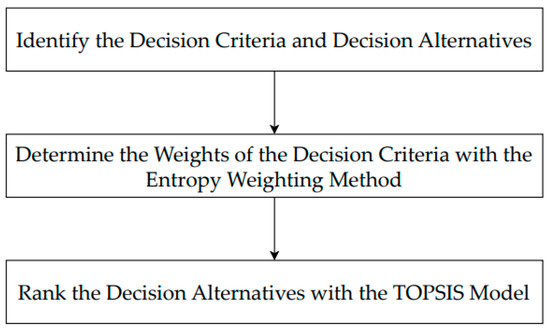
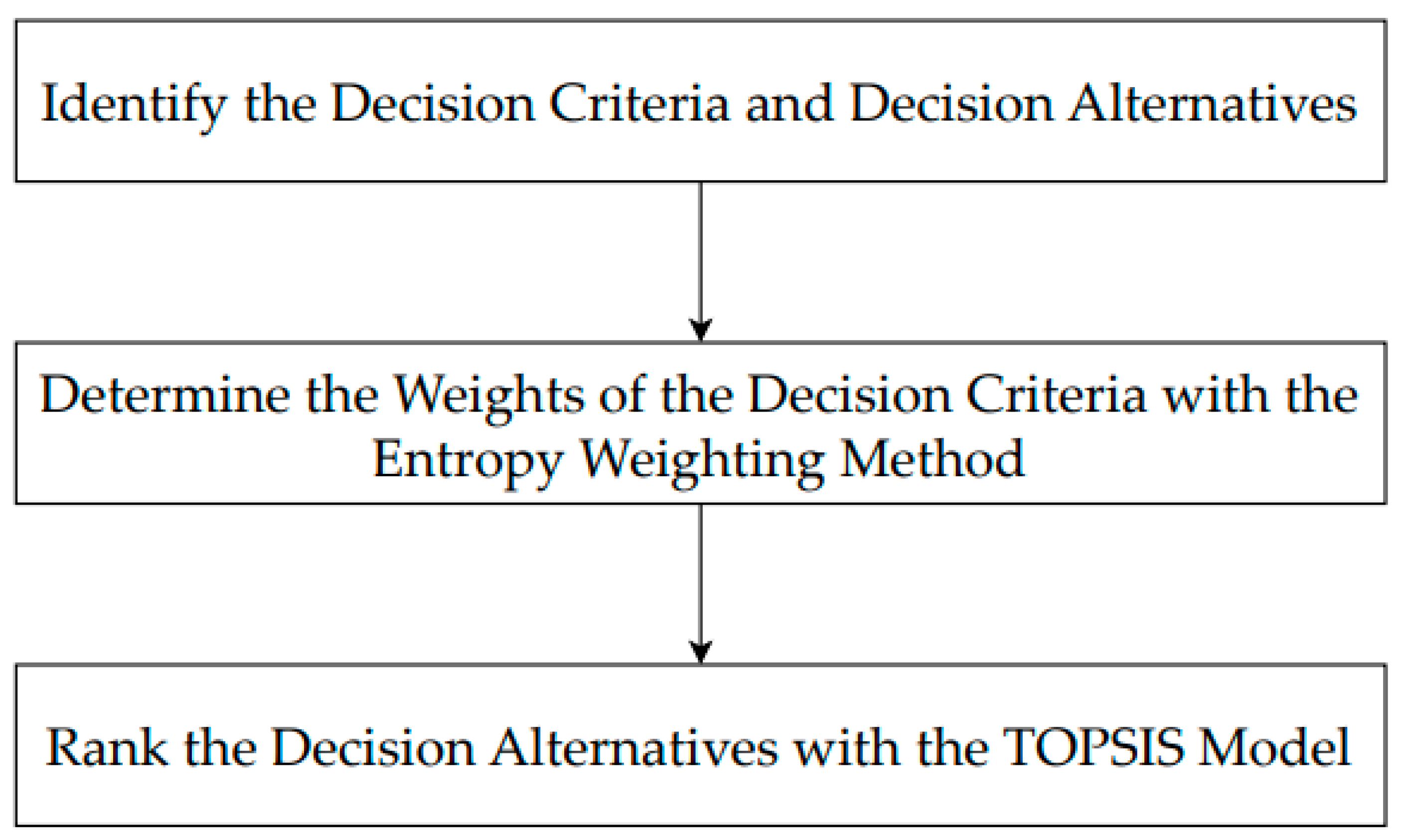
In this research, a MCDM model is proposed based on the hybrid of the entropy weighting method and TOPSIS model for the evaluation of financial risks among digital services companies (Y. Huang, 2025; Wang & Mao, 2023; H. Zhu & Mao, 2024). The advantage of the entropy weighting method is to determine the objective weight based on the measurement of indicators’ information (Chen, 2021). In addition, the optimal decision can be determined based on the PIS as well as a NIS with the TOPSIS model (Dehdasht et al., 2020). Figure 1 presents the three stages of analysis.
Figure 1.
Stages of analysis.
As shown in Figure 1, the analysis of this paper consists of three stages as follows.
Stage 1: Identify the decision criteria and alternatives for the analysis of financial risk management.
Stage 2: Determine the weights of decision criteria with the Entropy Weighting method.
Stage 3: Rank the decision alternatives with the TOPSIS model. The alternatives include all the listed digital services companies in Bursa Malaysia. The financial risk of digital services companies is evaluated and compared based on the PIS and NIS.
Table 1 presents the hierarchy structure for the evaluation of financial risk among listed digital services companies in the Malaysian stock market with the proposed Entropy-Weight TOPSIS model. All the companies under the “Digital Services” subsector in Bursa Malaysia are the decision alternatives of this study.
Table 1.
Hierarchy Structure.
This study investigates listed digital services companies in Malaysia through data analysis in the companies’ financial reports from 2020 to 2024 with the proposed Entropy-Weight TOPSIS model. All the listed digital services companies, with complete financial statements from 2020 to 2024 on Bursa Malaysia, are included in this study. Based on past studies, the decision criteria such as CR, ICR, RTR, ROA, and ROE are needed to be maximized whereas DER and BIA are needed to be minimized (Lin et al., 2013; Osemudiamwen et al., 2025).
2.2. Entropy Weighting Method
Entropy weighting method is proposed to determine the objective weights based on the measurement on indicators’ information. Entropy is a concept that determines the importance of criterion based on the differences between the criterion’s values across given alternatives (Y. Zhu et al., 2020). A higher difference implies a larger weight for the criterion. Weights obtained from the entropy suggest more accuracy and higher reliability as the subjective weighting method may cause biasness (Qu et al., 2022). The steps for the entropy weighting method are shown as follows:
Step 1. Formulate a decision matrix with m decision criteria and n decision alternatives.
Step 2. Construct a normalized decision matrix using normalization as follows:
Step 3. Compute entropy value that measures the utility value of the indicator’s information.
with
Step 4. Calculate objective weight of each criterion.
2.3. Technique for Order Preference by Similarity to Ideal Solution (TOPSIS)
In this study, the entropy weight is incorporated into the TOPSIS model. The steps of TOPSIS model are as follows (An & Wang, 2025):
Step 1. Normalized the decision matrix into using the normalization method below:
Step 2. Form a weighted normalized decision matrix using the entropy weight obtained from Equation (5).
Step 3. Determine the positive ideal solution and negative ideal solution.
where
Step 4. Calculate separation measures using Euclidean distance. Separation measure is the separation distance of each alternative from the PIS and NIS.
Step 5. Measure the relative closeness of each decision alternative towards the ideal solution as follows.
The higher value of denotes that the alternative has longer distance from the NIS and shorter distance to the PIS. Therefore, the alternative that has a higher value of ci gives better performance.
3. Empirical Results and Discussion
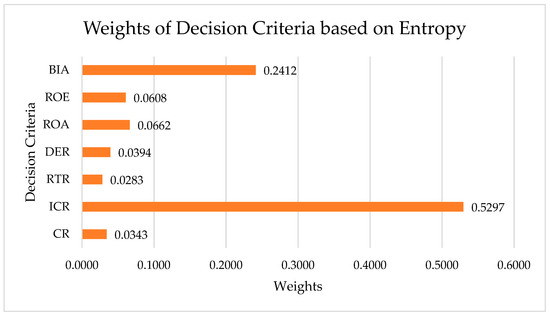
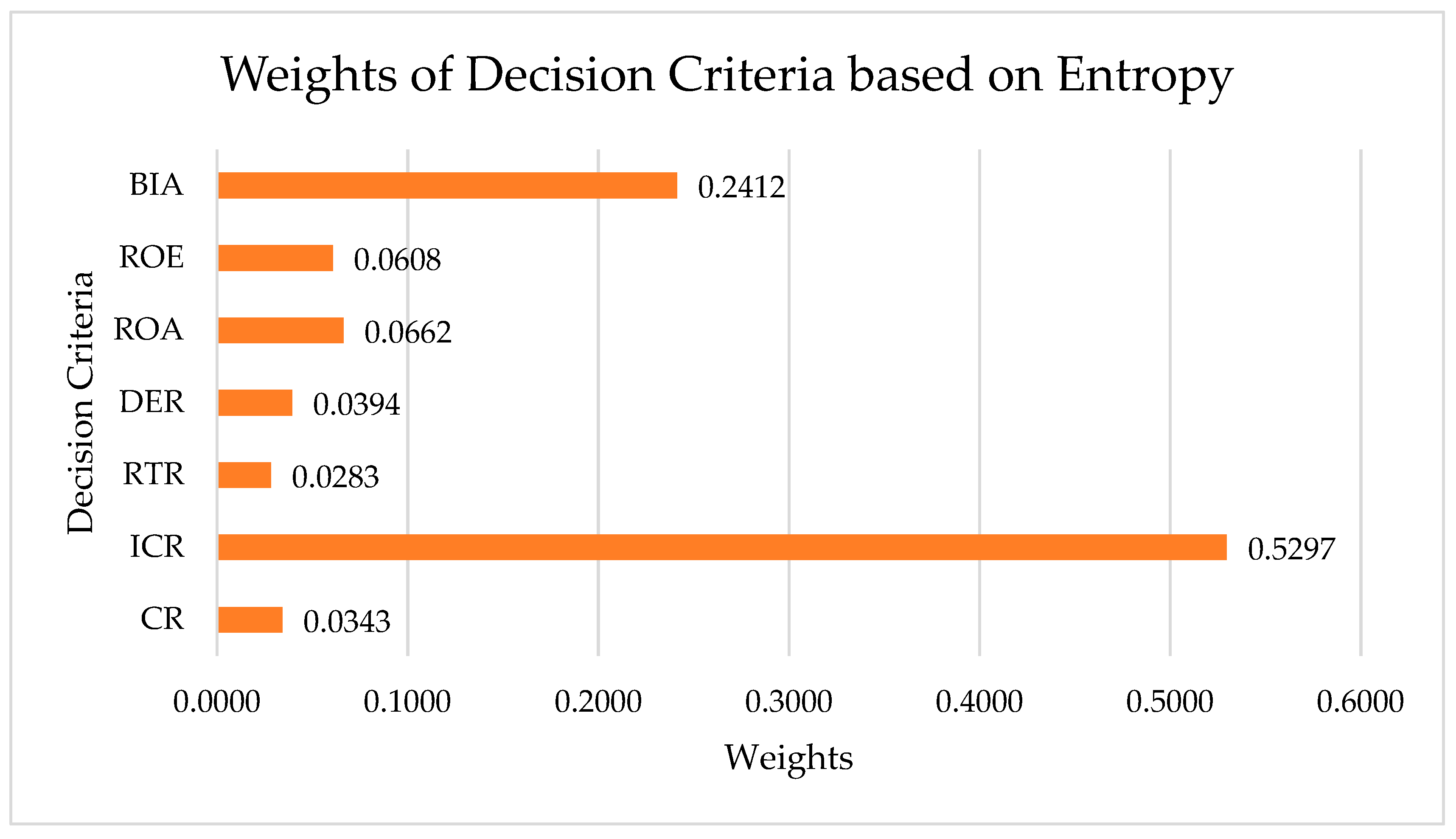
This section presents the results and discussion of the financial risk of the listed digital services companies with the Entropy-TOPSIS model (Duong & Thao, 2021; Öztürk & Gökçen, 2023). Based on the entropy weighting method, Figure 2 presents the weight of the decision criteria for the evaluation of financial risk of the listed digital services companies. From Figure 2, the weights for the decision criteria are ICR (0.5297), BIA (0.2412), ROA (0.0662), ROE (0.0608), DER (0.0394), CR (0.0343), and RTR (0.0283). ICR, which indicates a digital services company’s capability to settle interest payments of its liabilities, is weighted greatly in this study.
Figure 2.
Weight of the decision criteria for evaluation of financial risk.
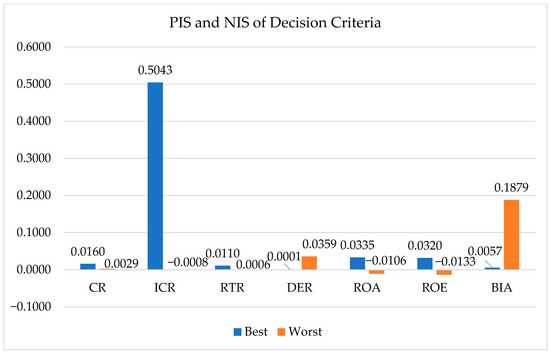
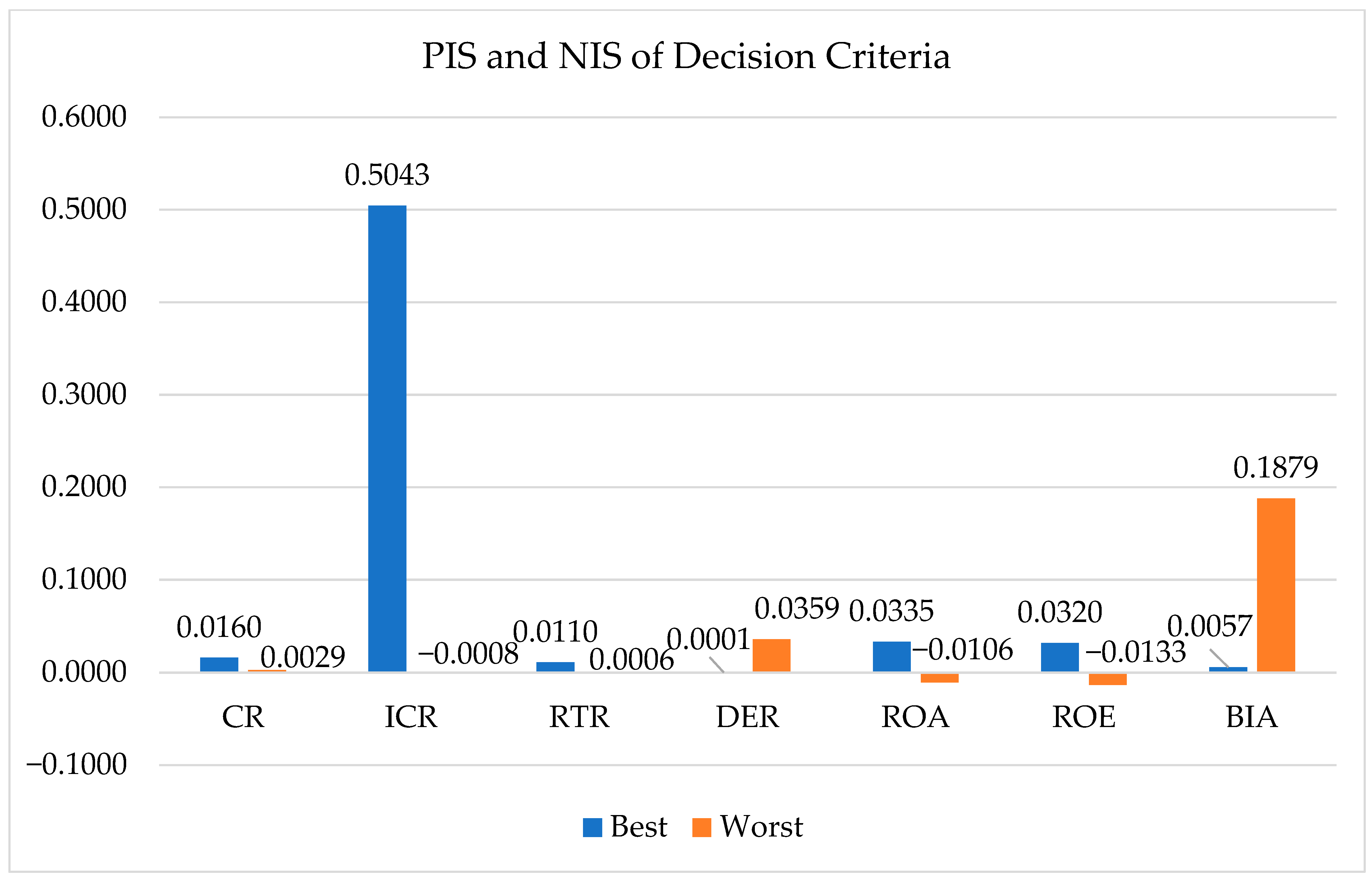
The weight generated from the entropy method is incorporated into the TOPSIS model to form a weighted normalized decision matrix. Based on the matrix, the PIS and NIS are identified for each criterion using Equations (8) and (9). Figure 3 presents the value for the PIS and NIS of all criteria. A shorter distance from the PIS and longer distance from the NIS indicate the highest significant criterion (Barbat et al., 2022).
Figure 3.
PIS and NIS of each decision criterion.
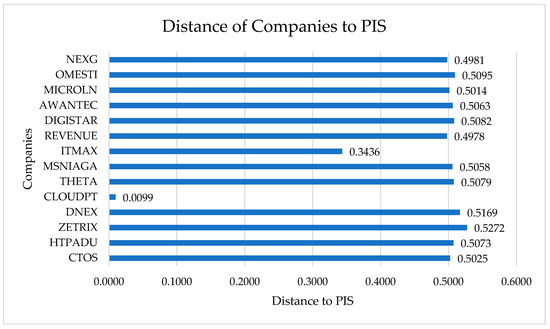
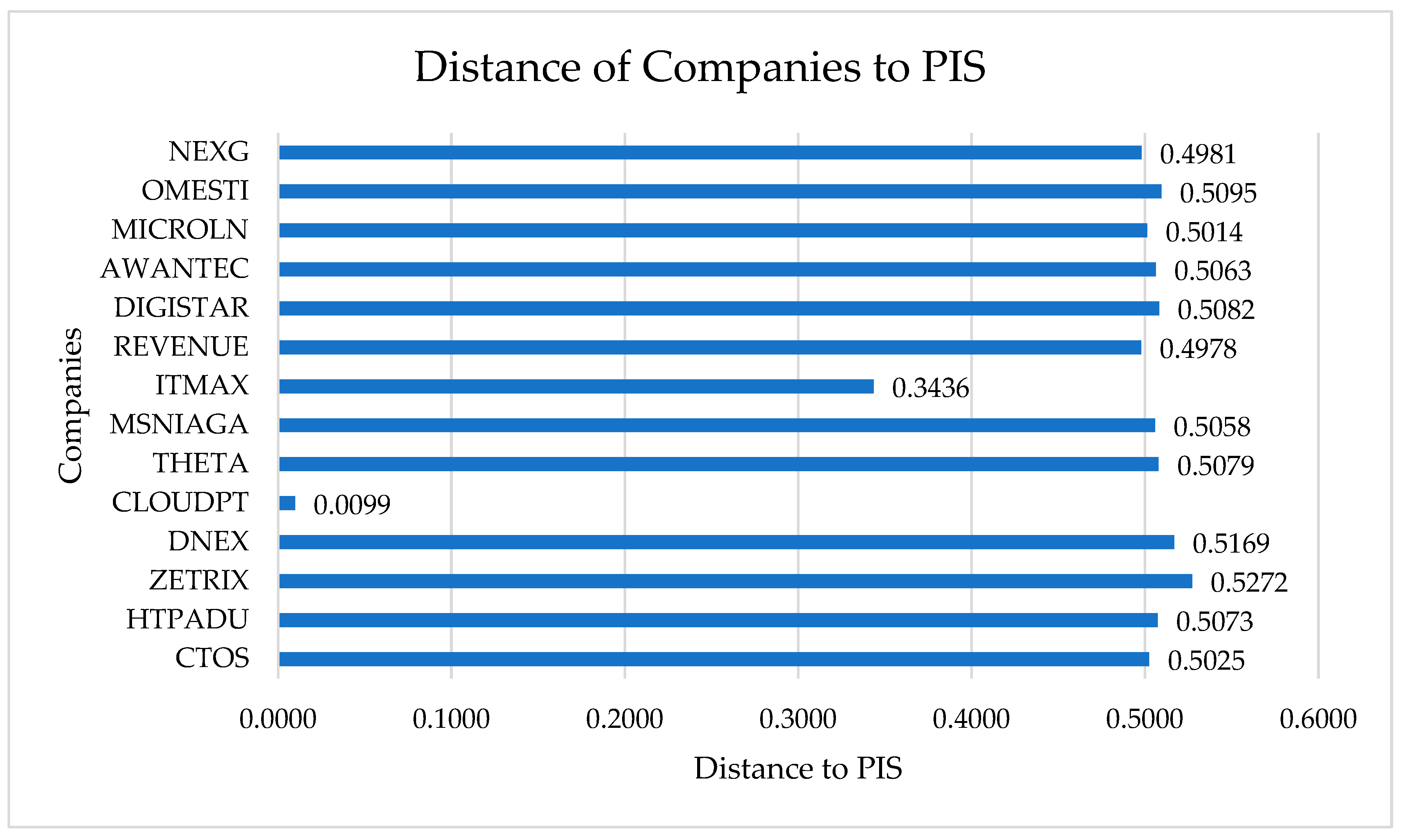
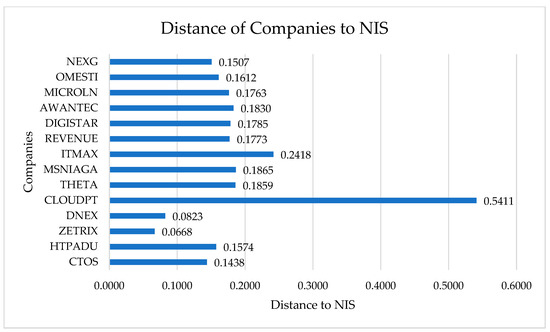
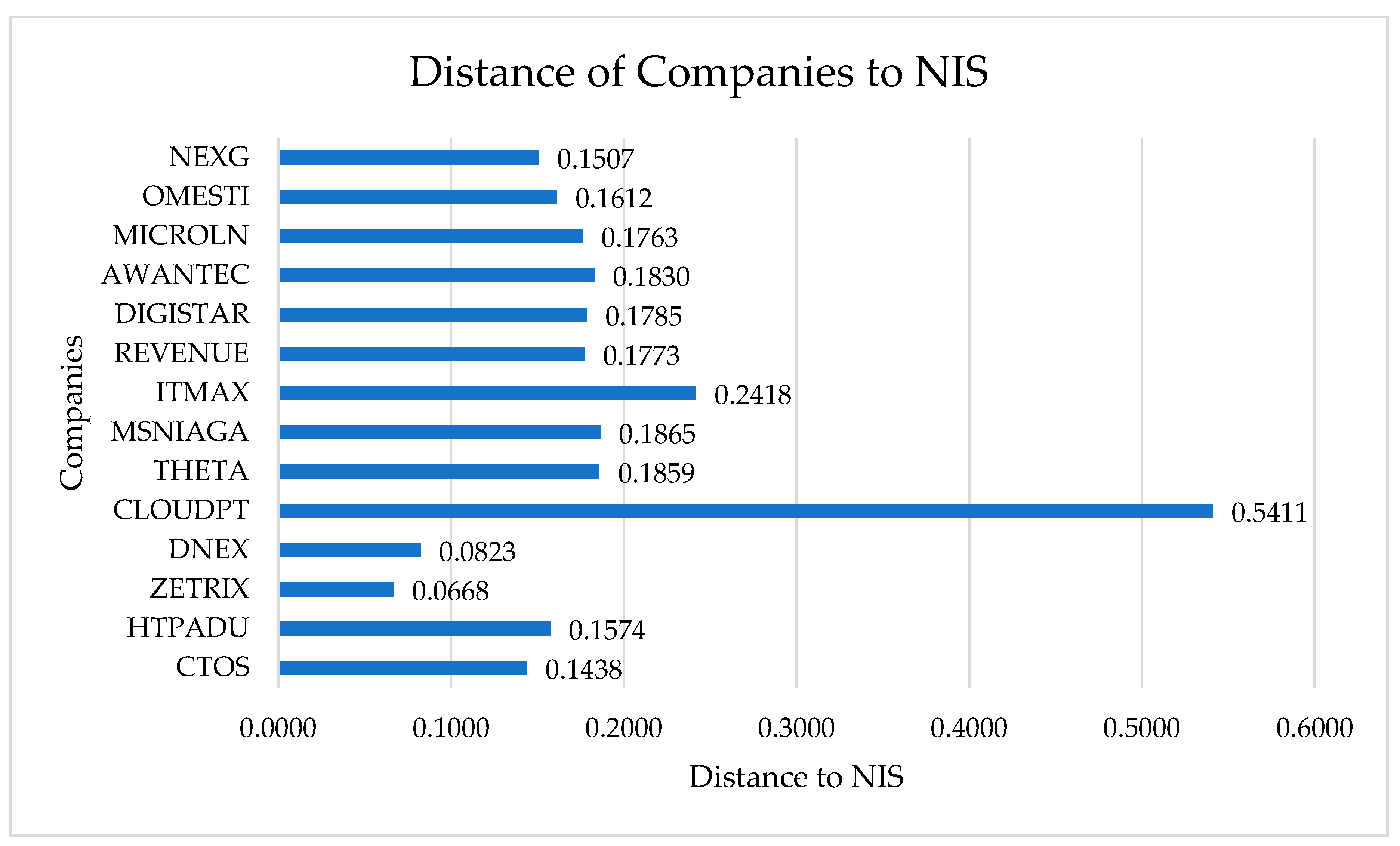
The separation measure for all decision alternatives from the PIS and NIS are calculated using Equations (10) and (11). Figure 4 and Figure 5 present the separation distance of each company from the PIS and NIS, respectively.
Figure 4.
Separation distance of each company to the PIS.
Figure 5.
Separation distance of companies to the NIS.
As shown in Figure 4, CLOUDPT is the closest to the PIS with a separation of only 0.0099, which is the best among all of the fourteen listed digital services companies. This is followed by ITMAX (0.3436), REVENUE (0.4978), NEXG (0.4981), MICROLN (0.5014), CTOS (0.5025), MSNIAGA (0.5058), AWANTEC (0.5063), HTPADU (0.5073), THETA (0.5079), DIGISTAR (0.5082), OMESTI (0.5095), DNEX (0.5169), and ZETRIX (0.5272).
Based on Figure 5, CLOUDPT (0.5411) has the furthest location to the NIS, indicating the best risk management among all companies. ITMAX (0.2418), MSNIAGA (0.1865), THETA (0.1859), and AWANTEC (0.1830) are the top two to five companies which are far away from the NIS. REVENUE, MICROLIN, OMESTI, HTPADU, NEXG, CTOS, DNEX, and ZETRIX are located 0.1773, 0.1763, 0.1612, 0.1574, 0.1507, 0.1438, 0.0823, and 0.0668 away from the NIS.
Table 2 presents the relative closeness and ranking of the financial risk of the listed digital services companies. The last step in Equation (12) identifies financial risk management as well as the relative closeness of decision alternatives towards the ideal solution.
Table 2.
Relative closeness and ranking of listed digital services companies.
The best alternative has the shortest distance to the PIS and yet the farthest distance from the NIS. As shown in Table 2, CLOUDPT, ITMAX, and MSNIAGA are ranked as the top three digital services companies with the best financial risk management based on the highest relative closeness of 0.9820, 0.4131, and 0.2694, respectively. CLOUDPT is the best digital services company in financial risk management because CLOUDPT has the highest value for ICR and ROA, which lies directly on the PIS of the ICR (0.5043) and ROA (0.0335). CLOUDPT has the second proximity to the PIS of ROE, immediately after ITMAX. CLOUDPT also has the lowest DER value directly on the PIS of DER (0.0001). This implies that CLOUDPT has the best management of solvency and profitability. The success of CLOUDPT, a key information technology (IT) company focusing on delivering IT infrastructure and software, can be observed as the company took only two years to ascend from the Access, Certainty, Efficiency (ACE) market to the Main Market of Bursa Malaysia in October 2025 (Fathina, 2025). CLOUDPT has also secured a large number of contracts to aid in long-term cashflows (Jalil, 2025). ITMAX has the best ROE value, which falls on the PIS of ROE (0.0320). ITMAX is the closest to the PIS of CR and ICR, and third closest to the PIS of ROA, hence, it is ranked second in financial risk management. MSNIAGA has the smallest BIA value falling on the PIS of BIA (0.0057) and the second closest to the PIS of DER, hence, it obtains the third place in financial risk management. These top three companies provide business-to-government (B2G) and business-to-business (B2B) services. THETA, AWANTEC, REVENUE, MICROLN, DIGISTAR, OMESTI, and HTPADU are placed fourth to tenth in the financial risk management based on the Entropy-Weight TOPSIS model. The four lowest-ranking companies are NEXG, CTOS, DNEX, and ZETRIX with the relative closeness of 0.2323, 0.2225, 0.1374, and 0.1125, respectively. ZETRIX lies directly at the NIS of BIA and is the third closest to the NIS of RTR, which causes ZETRIX to be ranked last in financial risk management. ZETRIX faced operational stability issues due to low corporate governance which led to a reprimand by Bursa Malaysia, and this may be one of the reasons for low financial risk management of the digital services company (Zainul, 2025). The ranking is crucial in financial risk management because the ranking of competitors in the same sector can be identified for benchmarking purposes (Abdel-Basset et al., 2020). The results of this study show that the proposed Entropy-Weight TOPSIS model is capable to solve MCDM problems in evaluating and ranking of financial risks. MCDM is an important process of analyzing decisions by considering multiple decision criteria in the selection of the best alternative.
Table 3 displays the validation of ranking results based on the comparison of the financial risk management between the proposed Entropy-TOPSIS model and Entropy-Weighted Sum Model (WSM) (Al-Bayati & Al-Zubaidy, 2020; O’Shea et al., 2026).
Table 3.
Comparison between Entropy-TOPSIS and Entropy-WSM.
Based on Table 3, the results of the Entropy-TOPSIS are consistent with the results of Entropy-WSM. The rankings of the top five companies, which are CLOUDPT, ITMAX, MSNIAGA, THETA, and AWANTEC, are identical in both models. The results are consistent with the findings by Mulliner et al. (2016) when comparing MCDM models. Spearman’s rho correlation between the proposed Entropy-TOPSIS and Entropy-WSM is 0.7363 (Kabassi, 2021b, 2021a).
Sensitivity analysis is carried out by creating a 10% increase and 10% decrease in the weight of the most influential criterion, which is the ICR (Roy & Shaw, 2021; Więckowski & Sałabun, 2023). The outcome of the sensitivity analysis is shown in Table 4.
Table 4.
Sensitivity analysis.
The sensitivity analysis highlights that the rankings of the companies remain highly consistent in Table 4. When there is a 10% increase in the ICR, Spearman’s rho correlation is 0.9956; a 10% increase in the ICR shows that all the rankings remain similar, hence Spearman’s rho correlation is 1.0000.
4. Conclusions
The entropy-Weight TOPSIS model is proposed in this study to evaluate the financial risk of listed digital services companies in Malaysia. The entropy weighting method is used to avoid biasness on subjective weighting to determine the objective weight for each criterion prior to the ranking of the digital services companies with the TOPSIS model. The TOPSIS model is proposed in this study because it can determine the ranking of the financial risk management of the companies based on the distance of alternatives from the PIS as well as NIS. The optimal alternative gives the shortest distance towards the PIS yet the farthest distance from the NIS. The results of this study show that the ICR is the most important criterion in financial risk management, followed by BIA, ROA, ROE, DER, CR, and RTR. In addition, CLOUDPT achieves the best financial risk management, followed by ITMAX, MSNIAGA, THETA, and AWANTEC. Apart from academic implications, this research also provides practical implications to listed digital services companies for benchmarking and future improvement. This research provides an analysis on the separation distance from the PIS as well as NIS of each digital services company. The company can identify their strengths and weaknesses based on the criteria examined. The results help the risk managers to identify the criteria that caused the greatest financial risk in digital services companies to formulate targeted strategies to improve the companies’ financial health. This study helps investors to distinguish low-risk and high-risk digital services companies beyond traditional financial ratio analysis. The risk profiles of the digital services companies are clearly presented by the results of this Entropy-TOPSIS model in this study to aid investors in adjusting their portfolios or investment decisions and is part of the risk-adjusted return. This study focuses on the financial risk management of the listed digital services companies only. In the future, non-financial criteria such as churn risk or cybersecurity risk can be analyzed to uncover the non-financial risk mitigation of the companies. The application of the proposed Entropy-Weight TOPSIS model can be extended to the MCDM problems in the other fields for future research.
Author Contributions
Conceptualization, W.S.L. and W.H.L.; methodology, W.S.L., W.H.L. and P.F.L.; software, W.S.L. and P.F.L.; validation, W.S.L., W.H.L. and P.F.L.; formal analysis, W.S.L., W.H.L. and P.F.L.; investigation, W.S.L., W.H.L. and P.F.L.; resources, W.S.L., W.H.L. and P.F.L.; data curation, W.S.L., W.H.L. and P.F.L.; writing—original draft preparation, W.S.L., W.H.L. and P.F.L.; writing—review and editing, W.S.L., W.H.L. and P.F.L.; visualization, W.S.L., W.H.L. and P.F.L.; supervision, W.S.L. and W.H.L.; project administration, W.S.L. and W.H.L. All authors have read and agreed to the published version of the manuscript.
Funding
This research received no external funding.
Institutional Review Board Statement
Not applicable.
Informed Consent Statement
Not applicable.
Data Availability Statement
The data presented in this study are available on request from the corresponding author.
Acknowledgments
This study is supported by the Universiti Tunku Abdul Rahman, Malaysia.
Conflicts of Interest
The authors declare no conflicts of interest.
References
- Abdel-Basset, M., Ding, W., Mohamed, R., & Metawa, N. (2020). An integrated plithogenic MCDM approach for financial performance evaluation of manufacturing industries. Risk Management, 22(3), 192–218. [Google Scholar] [CrossRef] [Scilit]
- Abdel-Basset, M., & Mohamed, R. (2020). A novel plithogenic TOPSIS-CRITIC model for sustainable supply chain risk management. Journal of Cleaner Production, 247, 119586. [Google Scholar] [CrossRef] [Scilit]
- Abdullah, A. M. (2020). Identifying the determinants of financial distress for public listed companies in Malaysia. Jurnal Pengurusan, 59, 11–24. Available online: https://www.ukm.my/jurnalpengurusan/wp-content/uploads/2022/10/jp_59-3.pdf (accessed on 10 December 2025).
- Abughazalah, N., & Khan, M. (2025). A dual hesitant fuzzy entropy-TOPSIS framework for multi-criteria evaluation of medical E-learning systems. Scientific Reports, 15(1), 40752. [Google Scholar] [CrossRef] [Scilit] [PubMed]
- Al-Bayati, I. I., & Al-Zubaidy, S. S. (2020). Applying the analytical hierarichy process and weighted sum model for small project selection in Iraq. IOP Conference Series: Materials Science and Engineering, 671(1), 012158. [Google Scholar] [CrossRef] [Scilit]
- Alshahrani, H. M., Alotaibi, S. S., Ansari, M. T. J., Asiri, M. M., Agrawal, A., Khan, R. A., Mohsen, H., Hilal, A. M., Alshahrani, H. M., Alotaibi, S. S., Ansari, M. T. J., Asiri, M. M., Agrawal, A., Khan, R. A., Mohsen, H., & Hilal, A. M. (2022). Analysis and ranking of IT risk factors using fuzzy TOPSIS-based approach. Applied Sciences, 12(12), 5911. [Google Scholar] [CrossRef] [Scilit]
- An, D., & Wang, N. (2025). Application of multi-objective decision-making based on entropy weight-TOPSIS method and RSR method in the analysis of orthopedic disease. Discover Artificial Intelligence, 5(1), 208. [Google Scholar] [CrossRef] [Scilit]
- Barbat, S., Barkhordariahmadi, M., & Kermani, V. (2022). Extension of the TOPSIS Method for decision making problems under complex fuzzy data based on the central point index. Advances in Fuzzy Systems, 2022(1), 1477098. [Google Scholar] [CrossRef] [Scilit]
- BCBS. (2017). Basel III: Finalising post-crisis reforms. Available online: https://www.bis.org/bcbs/publ/d424.htm (accessed on 10 December 2025).
- Bursa Malaysia. (2024). Bursa Malaysia sector classification of applicants or listed issuers. Available online: https://www.bursamalaysia.com/sites/5bb54be15f36ca0af339077a/content_entry5ce3b50239fba2627b2864be/5ce3bda239fba262ff56e9e9/files/BURSA_MALAYSIA_SECTOR_CLASSIFICATION_OF_APPLICANTS_OR_LISTED_ISSUERS_Nov2024.pdf?1736733389 (accessed on 10 December 2025).
- Chen, C.-H. (2021). A hybrid multi-criteria decision-making approach based on ANP-entropy TOPSIS for building materials supplier selection. Entropy, 23(12), 1597. [Google Scholar] [CrossRef] [Scilit]
- Dasgupta, A., Sen, B., Dutta, P., Rachchh, N., Patil, N., Mahapatro, A., & Karthikeyan, A. (2025). Entropy-TOPSIS-based material selection for sustainable polymer composite: An MCDM framework promoting circular economy. Journal of Elastomers & Plastics, 57(5), 703–729. [Google Scholar] [CrossRef] [Scilit]
- Dehdasht, G., Ferwati, M. S., Zin, R. M., & Abidin, N. Z. (2020). A hybrid approach using entropy and TOPSIS to select key drivers for a successful and sustainable lean construction implementation. PLoS ONE, 15(2), e0228746. [Google Scholar] [CrossRef] [Scilit] [PubMed]
- Deloitte. (2025). 2025 gen Z and millennial survey. Available online: https://www.deloitte.com/content/dam/assets-shared/docs/campaigns/2025/2025-genz-millennial-survey.pdf (accessed on 10 December 2025).
- Duong, T. T. T., & Thao, N. X. (2021). TOPSIS model based on entropy and similarity measure for market segment selection and evaluation. Asian Journal of Economics and Banking, 5(2), 194–203. [Google Scholar] [CrossRef] [Scilit]
- Eng, H. K., Yee, O. J., Ting, Y. L., Tee, K. N. K., Yusof, Z. M., & Misiran, M. (2023). Prediction bankruptcy for technology sector company using Altman’s Z-score model. Data Analytics and Applied Mathematics (DAAM), 4, 25–32. [Google Scholar] [CrossRef] [Scilit]
- Fathina, A. (2025, October 13). Cloudpoint moves to main market, looks to capitalise on AI growth. The Edge Malaysia. Available online: https://theedgemalaysia.com/node/773859 (accessed on 10 December 2025).
- Ghazali, A. W., Suffian, M. T. M., Sanusi, Z. M., & Alsudairi, F. S. (2018). Managerial opportunism: Monitoring financial risk of Malaysian shariah-compliant companies. Global Journal Al-Thaqafah, 99–115. [Google Scholar] [CrossRef] [Scilit]
- Greenberg, A., Hamilton, J., Maltz, D. A., & Patel, P. (2009). The cost of a cloud: Research problems in data center networks. SIGCOMM Computer Communication Review, 39(1), 68–73. [Google Scholar] [CrossRef] [Scilit]
- Guan, C., Ding, D., Guo, J., & Teng, Y. (2023). An ecosystem approach to Web3.0: A systematic review and research agenda. Journal of Electronic Business & Digital Economics, 2(1), 139–156. [Google Scholar] [CrossRef] [Scilit]
- Huang, T., Huang, W., Zhang, B., Chen, W., & Pan, X. (2025). Optimizing energy consumption in centralized and distributed cloud architectures with a comparative study to increase stability and efficiency. Energy and Buildings, 333, 115454. [Google Scholar] [CrossRef] [Scilit]
- Huang, Y. (2025, July 25–27). Research on the entropy weight-TOPSIS evaluation management of corporate financial performance based on computer technology. ICEMBDA ’25: Proceedings of the 2025 International Conference on Economic Management and Big Data Application (pp. 918–924), Shenzhen, China. [Google Scholar] [CrossRef] [Scilit]
- Ichsani, S., & Suhardi, A. R. (2015). The effect of return on equity (ROE) and return on investment (ROI) on trading volume. Procedia—Social and Behavioral Sciences, 211, 896–902. [Google Scholar] [CrossRef] [Scilit]
- Jalil, A. (2025, September 12). Cloudpoint tipped to win bulk of RM230mil tenders—PublicInvest. NST Online. Available online: https://www.nst.com.my/business/corporate/2025/09/1273997/cloudpoint-tipped-win-bulk-rm230mil-tenders-%E2%80%94-publicinvest (accessed on 10 December 2025).
- Javaid, M., Haleem, A., Singh, R. P., & Sinha, A. K. (2024). Digital economy to improve the culture of industry 4.0: A study on features, implementation and challenges. Green Technologies and Sustainability, 2(2), 100083. [Google Scholar] [CrossRef] [Scilit]
- Ji, H. (2019). The impact of interest coverage ratio on value relevance of reported earnings: Evidence from South Korea. Sustainability, 11(24), 7193. [Google Scholar] [CrossRef] [Scilit]
- Jiang, S. (2025). Evaluation of new quality productive forces in Henan province based on improved entropy weight-TOPSIS method and deep learning. Scientific Reports, 15(1), 35434. [Google Scholar] [CrossRef] [Scilit]
- Kabassi, K. (2021a). Application of multi-criteria decision-making models for the evaluation cultural websites: A framework for comparative analysis. Information, 12(10), 407. [Google Scholar] [CrossRef] [Scilit]
- Kabassi, K. (2021b). Comparing multi-criteria decision making models for evaluating environmental education programs. Sustainability, 13(20), 11220. [Google Scholar] [CrossRef] [Scilit]
- Karim, M. R., Shetu, S. A., & Razia, S. (2021). COVID-19, liquidity and financial health: Empirical evidence from South Asian economy. Asian Journal of Economics and Banking, 5(3), 307–323. [Google Scholar] [CrossRef] [Scilit]
- Karim, Y. F. A., Syed-Noh, S. N., & Zaid, N. A. M. (2017). Financial risk and leverage relationship of oil and gas local companies in Malaysia. International Journal of Business, Economics and Law, 14(1), 13–17. [Google Scholar]
- Lee, C.-C. (2023). Analyses of the operating performance of information service companies based on indicators of financial statements. Asia Pacific Management Review, 28(4), 410–419. [Google Scholar] [CrossRef] [Scilit]
- Le Roux, D., Olivès, R., & Neveu, P. (2023). Combining entropy weight and TOPSIS method for selection of tank geometry and filler material of a packed-bed thermal energy storage system. Journal of Cleaner Production, 414, 137588. [Google Scholar] [CrossRef] [Scilit]
- Libório, M. P., Karagiannis, R., Diniz, A. M. A., Ekel, P. I., Vieira, D. A. G., Ribeiro, L. C., Libório, M. P., Karagiannis, R., Diniz, A. M. A., Ekel, P. I., Vieira, D. A. G., & Ribeiro, L. C. (2024). The use of information entropy and expert opinion in maximizing the discriminating power of composite indicators. Entropy, 26(2), 143. [Google Scholar] [CrossRef] [Scilit] [PubMed]
- Lin, T. T., Lee, C.-C., & Kuan, Y.-C. (2013). The optimal operational risk capital requirement by applying the advanced measurement approach. Central European Journal of Operations Research, 21(1), 85–101. [Google Scholar] [CrossRef] [Scilit]
- Marozva, R. R., Maloa, F., Marozva, R. R., & Maloa, F. (2026). The effects of fintech adoption on CEO compensation: Evidence from JSE-listed banks. Journal of Risk and Financial Management, 19(1), 56. [Google Scholar] [CrossRef] [Scilit]
- McCoy, J., Palomino, F., Perez-Orive, A., Press, C., & Sanz-Maldonado, G. (2020). Interest coverage ratios: Assessing vulnerabilities in nonfinancial corporate credit. Available online: https://www.federalreserve.gov/econres/notes/feds-notes/interest-coverage-ratios-assessing-vulnerabilities-in-nonfinancial-corporate-credit-20201203.html (accessed on 10 December 2025).
- Metwally, A. B. M., Yasser, M. M., Ahmed, E. A., Ali, M. A. S., Metwally, A. B. M., Yasser, M. M., Ahmed, E. A., & Ali, M. A. S. (2025). Financial and economic determinants of banks financial distress in MENA region. Economies, 13(2), 56. [Google Scholar] [CrossRef] [Scilit]
- Mitra, S. (2013). Operational risk of option hedging. Economic Modelling, 33, 194–203. [Google Scholar] [CrossRef] [Scilit]
- Mukherjee, S., De, A., & Roy, S. (2024). Supply chain risk prioritization: A multi-criteria based intuitionistic fuzzy TOPSIS approach. International Journal of Quality & Reliability Management, 41(6), 1693–1725. [Google Scholar] [CrossRef] [Scilit]
- Mulliner, E., Malys, N., & Maliene, V. (2016). Comparative analysis of MCDM methods for the assessment of sustainable housing affordability. Omega, 59, 146–156. [Google Scholar] [CrossRef] [Scilit]
- Osemudiamwen, O., Abdulwasiu, K., & Alamu, R. (2025). Interest coverage ratio as a mediator between leverage and profitability in retail firms. Available online: https://www.researchgate.net/publication/393793506_Interest_Coverage_Ratio_as_a_Mediator_Between_Leverage_and_Profitability_in_Retail_Firms (accessed on 10 December 2025).
- O’Shea, R., Deeney, P., Triantaphyllou, E., Diaz-Balteiro, L., & Armagan Tarim, S. (2026). Weight stability intervals for multi-criteria decision analysis using the weighted sum model. Expert Systems with Applications, 296, 128460. [Google Scholar] [CrossRef] [Scilit]
- Öztürk, B. C., & Gökçen, H. (2023). Ranking strategic goals with fuzzy entropy weighting and fuzzy TOPSIS methods: A case of the scientific and technological research council of Türkiye. Applied Sciences, 13(14), 8060. [Google Scholar] [CrossRef] [Scilit]
- Parry, R. (2021). An assessment of the risk of service supplier bankruptcies as a cybersecurity threat. In M. Sarfraz (Ed.), Cybersecurity threats with new perspectives. IntechOpen. [Google Scholar] [CrossRef] [Scilit]
- Parry, R., & Bisson, R. (2020). Legal approaches to management of the risk of cloud computing insolvencies. Journal of Corporate Law Studies, 20, 421–451. [Google Scholar] [CrossRef] [Scilit]
- Perilla, L. N. T. (n.d.). Financial valuation and systematic risk in technology and traditional firms. Journal of Corporate Accounting & Finance, 37, 144–153. [Google Scholar] [CrossRef] [Scilit]
- Qu, W., Li, J., Song, W., Li, X., Zhao, Y., Dong, H., Wang, Y., Zhao, Q., Qi, Y., Qu, W., Li, J., Song, W., Li, X., Zhao, Y., Dong, H., Wang, Y., Zhao, Q., & Qi, Y. (2022). Entropy-weight-method-based integrated models for short-term intersection traffic flow prediction. Entropy, 24(7), 849. [Google Scholar] [CrossRef] [Scilit]
- Roy, P., & Shaw, K. (2021). A multicriteria credit scoring model for SMEs using hybrid BWM and TOPSIS. Financial Innovation, 7, 77. [Google Scholar] [CrossRef] [Scilit]
- Saias, J., Rato, L., Gonçalves, T., Saias, J., Rato, L., & Gonçalves, T. (2022). An approach to churn prediction for cloud services recommendation and user retention. Information, 13(5), 227. [Google Scholar] [CrossRef] [Scilit]
- Santos, L. L., Gomes, C., Malheiros, C., Lucas, A., Santos, L. L., Gomes, C., Malheiros, C., & Lucas, A. (2021). Impact factors on Portuguese hotels’ liquidity. Journal of Risk and Financial Management, 14(4), 144. [Google Scholar] [CrossRef] [Scilit]
- Sengupta, U., & Sengupta, U. (2022). SDG-11 and smart cities: Contradictions and overlaps between social and environmental justice research agendas. Frontiers in Sociology, 7, 995603. [Google Scholar] [CrossRef] [Scilit] [PubMed]
- Slassi-Sennou, S., Es-salmani, M., Slassi-Sennou, S., & Es-salmani, M. (2025). Navigating financial risk in the digital age: The mediating role of performance and indebtedness. Journal of Risk and Financial Management, 18(6), 325. [Google Scholar] [CrossRef] [Scilit]
- Srivastava, P., & Singh, V. P. (2025). Optimization through combined compromise solution and weight determination through Shannon-entropy for multi criteria decision making in tribological testing of ultrahigh molecular weight polyethylene nano-composite in SBF environment and compression testing with it’s invitro analysis. Journal of Thermoplastic Composite Materials, 38(6), 2253–2280. [Google Scholar] [CrossRef] [Scilit]
- Tarawallie, F. A. B., Bein, M., Tarawallie, F. A. B., & Bein, M. (2025). The moderating effect of size on the relationship between liquidity management and sustainable profitability: Evidence from BRICS financial firms. Sustainability, 17(18), 8128. [Google Scholar] [CrossRef] [Scilit]
- Tian, C., Li, H., Tian, S., & Tian, F. (2020). Risk assessment of safety management audit based on fuzzy TOPSIS method. Mathematical Problems in Engineering, 2020(1), 1612538. [Google Scholar] [CrossRef] [Scilit]
- Times of India. (2025, November 19). How cloudflare outage may have cost financial service brokers $1.6 billion in trading volume. The Times of India. Available online: https://timesofindia.indiatimes.com/technology/tech-news/how-cloudflare-outage-may-have-cost-financial-service-brokers-1-6-billion-in-trading-volume/articleshow/125437080.cms (accessed on 10 December 2025).
- Tiwari, V., Jain, P. K., & Tandon, P. (2019). An integrated Shannon entropy and TOPSIS for product design concept evaluation based on bijective soft set. Journal of Intelligent Manufacturing, 30(4), 1645–1658. [Google Scholar] [CrossRef] [Scilit]
- Tunçay, C. M., Grzegorczyk-Akın, E., Tunçay, C. M., & Grzegorczyk-Akın, E. (2025). Credit rationing, its determinants and non-performing loans: An empirical analysis of credit markets in polish banking sector. Econometrics, 13(4), 51. [Google Scholar] [CrossRef] [Scilit]
- Tutcu, B., Kayakuş, M., Terzioğlu, M., Uyar, G. F. Ü., Talaş, H., Yetiz, F., Tutcu, B., Kayakuş, M., Terzioğlu, M., Uyar, G. F. Ü., Talaş, H., & Yetiz, F. (2024). Predicting financial performance in the IT industry with machine learning: ROA and ROE analysis. Applied Sciences, 14(17), 7459. [Google Scholar] [CrossRef] [Scilit]
- Wang, L., & Mao, G. (2023). Application of entropy weight TOPSIS method in financial risk assessment of liquor listed companies: Take Shanxi Fenjiu as an example. Frontiers in Business, Economics and Management, 9(2), 168–173. [Google Scholar] [CrossRef] [Scilit]
- Więckowski, J., & Sałabun, W. (2023). Sensitivity analysis approaches in multi-criteria decision analysis: A systematic review. Applied Soft Computing, 148, 110915. [Google Scholar] [CrossRef] [Scilit]
- Wu, C. H., & Pambudi, P. D. L. (2025). Digital transformation in fintech: Choosing between application and software as a service (SaaS). Asia Pacific Management Review, 30(2), 100342. [Google Scholar] [CrossRef] [Scilit]
- Wu, R. M. X., Zhang, Z., Yan, W., Fan, J., Gou, J., Liu, B., Gide, E., Soar, J., Shen, B., Fazal-e-Hasan, S., Liu, Z., Zhang, P., Wang, P., Cui, X., Peng, Z., & Wang, Y. (2022). A comparative analysis of the principal component analysis and entropy weight methods to establish the indexing measurement. PLoS ONE, 17(1), e0262261. [Google Scholar] [CrossRef] [Scilit] [PubMed]
- Yin, M., & Guo, M. (2026). Complex forecasting and investment strategy optimization via chain-of-thought of large language models. Expert Systems with Applications, 298, 129913. [Google Scholar] [CrossRef] [Scilit]
- Zainuddin, Z., Tapa, A., & Rahim, A. I. A. (2018). Examine the financial health of the listed technology companies in Malaysia using Altman’s Z-score test. In AIP conference proceedings (p. 020144). AIP Publishing LLC. [Google Scholar] [CrossRef] [Scilit]
- Zainul, E. (2025, July 14). Zetrix AI, formerly MyEG, reprimanded as seven directors fined over misleading announcements. The Edge Malaysia. Available online: https://theedgemalaysia.com/node/762569 (accessed on 10 December 2025).
- Zhao, D.-Y., Ma, Y.-Y., Lin, H.-L., Zhao, D.-Y., Ma, Y.-Y., & Lin, H.-L. (2022). Using the entropy and TOPSIS models to evaluate sustainable development of islands: A case in China. Sustainability, 14(6), 3707. [Google Scholar] [CrossRef] [Scilit]
- Zhu, H., & Mao, L. (2024). Research on financial performance evaluation of xiaoxiong electric appliance based on entropy weight-TOPSIS method. Academic Journal of Management and Social Sciences, 9, 125–133. [Google Scholar] [CrossRef] [Scilit]
- Zhu, Y., Tian, D., & Yan, F. (2020). Effectiveness of entropy weight method in decision-making. Mathematical Problems in Engineering, 2020(1), 3564835. [Google Scholar] [CrossRef] [Scilit]

Disclaimer/Publisher’s Note: The statements, opinions and data contained in all publications are solely those of the individual author(s) and contributor(s) and not of MDPI and/or the editor(s). MDPI and/or the editor(s) disclaim responsibility for any injury to people or property resulting from any ideas, methods, instructions or products referred to in the content. |
© 2026 by the authors. Licensee MDPI, Basel, Switzerland. This article is an open access article distributed under the terms and conditions of the Creative Commons Attribution (CC BY) license.