1. Introduction
Research in the field of Corporate Social Responsibility (CSR) studies has developed very significantly, and the results of these studies have attracted interest not only from stakeholders (government, investors, suppliers, employees, and communities) but also from researchers in accounting and finance. This has caused many companies to compete to disclose not only information related to their annual financial performance but also non-financial information. This non-financial information is considered relevant and can assist companies in improving their future economic performance while demonstrating their commitment to sustaining social and environmental aspects. This line of research specifically views non-financial information as relevant to company value and functioning as supplementary information, not only for stakeholders and market participants but also for companies to maintain their financial performance in the future (
Waddock & Graves, 1997;
Brooks & Oikonomou, 2018;
Kim & Oh, 2019;
Usman et al., 2023).
One of the common topics and financial information studied by researchers in accounting and finance is corporate social responsibility (CSR). CSR reports contain information regarding environmental, social, and governance impacts, often abbreviated as ESG (
Usman & Yennita, 2018;
Yoon et al., 2018;
Tandelilin & Usman, 2023). The performance of this non-financial information is generally expected to enhance a company’s future economic performance because corporate attention to sustainability issues in environmental, social, and governance aspects becomes a sensitive concern for stakeholders (
GRI, 2014). However, if not optimized properly, corporate expenditures on CSR may not serve as an investment but instead become activities that reduce profitability, meaning that corporate involvement in CSR activities fails to provide any positive impact on company value.
Previous research by
Waagstein (
2011) and
Tandelilin and Usman (
2023) highlights the institutional context governing CSR/ESG implementation in Indonesia, emphasizing that CSR disclosure has evolved from a voluntary to a regulated practice. Indonesian public companies were initially required to disclose CSR activities under Bapepam–LK Regulation No. XK6 (7 December 2006), which mandated the reporting of activities and expenditures related to corporate social and environmental responsibility. This requirement was subsequently strengthened through Law No. 40/2007 on Limited Liability Companies, obliging firms to report their social and environmental programs. More recently, the regulatory framework has been further consolidated under POJK No. 51/POJK.03/2017, which mandates issuers and financial institutions to implement sustainable finance principles and publish sustainability reports covering environmental, social, and governance (ESG) aspects, including CSR, with SEOJK No. 16/2021 providing detailed guidance on the form and content of such disclosures, thereby reinforcing the institutionalization of non-financial disclosure in Indonesia.
Several studies reveal that businesses implementing CSR policies tend to gain many conveniences and benefits.
Dhaliwal et al. (
2012) reported that companies publishing non-financial (CSR) information to the public can assist financial analysts in reducing information asymmetry by narrowing the error gap in potential earnings estimates for the future. Furthermore, research conducted by
Cheng et al. (
2014) shows that non-financial information disclosed to the public can help companies gain easier access to funding sources. Other studies also indicate that companies can gain social recognition, whereby society as a public entity provides legitimacy for companies to operate (
Bebbington et al., 2008).
Research by
Usman et al. (
2020) found that CSR information can help the public reduce information asymmetry. However, excessive CSR-related information disclosed by companies can obscure other substantial information. This also indicates that CSR reporting may reflect managerial motives to engage in reputation risk management efforts. Furthermore, research by
Afeltra et al. (
2021), using bibliometric analysis on previous literature published in reputable CSR journals, found that CSR studies have rapidly developed into five clusters, namely: (i) factors influencing companies to disclose social information, (ii) CSR assurance practices and CSR reporting, (iii) integrated reporting and sustainability reporting, (iv) the relationship between intellectual capital disclosure and corporate governance, and (v) the relevance of emerging theories on contemporary CSR topics.
Although previous research has explained the benefits of corporate involvement in CSR activities, studies that specifically examine how stakeholders respond to CSR information disclosures through social media platforms and their impact on corporate financial performance remain very limited. Therefore, using public companies in Indonesia as the study setting is particularly interesting for further exploration. Given the dynamic nature of stakeholders in responding to market information, public companies are seen as needing to enhance the impact of their CSR activities by disclosing more information beyond traditional methods, namely by shifting to social media platforms. Furthermore, the potential for broader market penetration and efforts to improve a company’s strategic reputation can also be optimized through the use of social media. With an increasing number of stakeholders engaging with and responding to CSR information, companies will benefit from achieving organizational legitimacy through CSR activities legitimized by stakeholders. This situation is expected to positively impact profitability or financial performance, aligning with the business model and CSR practices implemented by the company. However, this assumption still requires in-depth empirical investigation by posing two research questions: (i) Does stakeholder engagement with CSR disclosures influence corporate financial performance? (ii) Does stakeholder engagement, viewed through the lens of different social media platforms, have consistent or inconsistent impacts on corporate financial performance?
Furthermore, the literature highlights that one of the factors influencing the impact of CSR disclosure on corporate financial performance is stakeholder engagement (
Barnett, 2007). In CSR discourse, the success of CSR initiatives is often associated with stakeholder engagement because this involves representatives from businesses, non-governmental organizations, regulatory bodies, and other public sectors to identify and address CSR aspects that truly relate to society. This can help companies gain legitimacy among business players, developers, and society as a whole (
Michelon et al., 2016).
Building strong relationships between companies and stakeholders can also improve financial performance because such relationships facilitate access to external resources (
Kapstein, 2001) and help build a strong reputation (
Agyemang & Ansong, 2017).
Waddock and Graves (
1997) argue that CSR disclosures that do not involve stakeholders tend not to provide any meaningful feedback for companies. Previous researchers have generally recommended involving stakeholders such as communities, customers, and strategic partners in CSR efforts because they are likely to contribute to improvements in corporate financial performance. Conversely, companies with low stakeholder engagement in CSR activities are likely to face disinterest from stakeholders, which can lead to a decline in financial performance.
Studies on CSR disclosures published on social media have begun to develop within CSR literature (
She, 2019). Research on CSR disclosures, which previously focused only on company-issued reports such as sustainability reports, has now expanded to domains with greater interaction between stakeholders and companies, namely social media. Previously, stakeholders focused solely on CSR disclosures in the form of annual reports, standalone sustainability reports, and corporate websites. CSR information disclosures were traditionally conducted through printed reports, which often made it difficult for the public to access up-to-date information on company activities. Unlike annual reports or standalone sustainability reports, social media platforms facilitate two-way, real-time communication, allowing stakeholders not only to receive CSR information but also to actively respond to it through observable reactions such as likes, comments, shares, and views (
Inversini & Derchi, 2024;
Han et al., 2024). Within the perspectives of stakeholder theory and legitimacy theory, these reactions represent stakeholders’ attention, evaluation, and feedback regarding corporate social and environmental activities. Accordingly, stakeholder responses on social media can be interpreted as concrete manifestations of stakeholder engagement, reflecting the extent to which CSR disclosures resonate with stakeholders and contribute to the ongoing process of legitimacy construction (
She, 2019;
Jiang & Park, 2022).
Rapid developments in information technology, now an integral part of daily life, have caused a paradigm shift in corporate information disclosure practices. Companies have started transitioning from printed (traditional) reports to online-based disclosures (internet and social media content). This shift is marked by the increasing use of digital platforms such as company websites and official corporate social media accounts. However, the use of social media by businesses has now progressed to a higher level, where CSR information reporting no longer appears monotonous or dull but has become more informative, concise, and engaging (
Jung et al., 2018).
Miller and Skinner (
2015) argue that social media platforms for delivering CSR information can attract significantly more attention from readers compared to traditional media (printed CSR reports). Although the current use of social media holds greater potential, its role as a tool for optimizing CSR disclosure remains underexplored in the literature (
Jung et al., 2018;
Miller & Skinner, 2015;
Zhou et al., 2015), particularly within the Indonesian research context.
Companies generally have official social media accounts managed professionally. Several social media platforms commonly used by companies include Facebook, Twitter, Instagram, and YouTube. Facebook is the most widely used social media platform for companies to interact with stakeholders. This is evidenced by the large number of companies publishing their CSR activities through Facebook. Facebook itself offers comprehensive features, as users can post news, comment on specific topics under discussion, and react more accurately using available emoticons. Facebook posts generally lean toward being entertaining and informative.
In contrast, Twitter has relatively limited features for stakeholder interaction, restricted to likes, comments, and retweets. However, Twitter has its own advantage: its users tend to engage in critical thinking regarding trending issues (
Baboukardos et al., 2021). Meanwhile, Instagram serves a slightly different segment compared to other social media platforms. Instagram typically focuses on spreading information about the company, its products, and other updates presented with visually appealing content. Interactions on Instagram generally revolve around company activities or products. Lastly, YouTube focuses on visual content in the form of videos. The attractive packaging of videos on YouTube is believed to have a partial impact on a company’s performance.
The shift in CSR disclosures from traditional media to digital platforms allows stakeholders to react to CSR disclosures made by companies through their official social media accounts. This change has enabled two-way communication between companies and stakeholders. Each CSR post shared via social media can reflect stakeholders’ views about the company, which in turn may influence the company’s financial performance. Corporate financial performance provides an overview of the company’s financial condition over a specific period (
Islahuzzaman & Hidayat, 2012). Research by
Omar and Zallom (
2016) investigated industries by analyzing 26 companies across three industrial sectors in Jordan, revealing that CSR has a positive impact on financial performance. Similarly,
Usman et al. (
2023) explained that social responsibility positively affects financial performance.
In line with the discourse on the role of social media in engaging stakeholders, this study aims to examine the relationship between stakeholder engagement—measured through stakeholder reactions on social media—and the financial performance of companies listed on the Indonesia Stock Exchange (IDX). This study focuses on stakeholder responses to CSR disclosures made by companies on their official social media accounts, namely Facebook, Instagram, Twitter, and YouTube. The companies selected as the research sample are those listed on the Indonesia Stock Exchange, with several additional sampling criteria. This study is also expected to contribute to the development of knowledge in the fields of accounting, economics, and business management, as well as serve as a reference for further research related to stakeholder engagement with CSR information published via social media and its impact on corporate financial performance.
In addition, the practical implications of this research are expected to contribute to the development and management strategies of companies concerning reporting activities and the disclosure of CSR information to the public in a more effective and efficient manner. For potential investors and financial analysts, CSR information published through social media is expected to assist them in analyzing the company’s condition, particularly its financial and non-financial performance.
This study contributes to the accounting and finance literature in several ways. First, the researcher examines the relationship between stakeholder engagement in responding to CSR information published by companies on social media and corporate financial performance, which highlights the limited empirical literature in Indonesia. In this context, the researcher investigates the idea that variations in corporate financial performance are a function of stakeholder engagement with CSR information published via social media platforms. Second, to the researcher’s knowledge, this study represents one of the first empirical studies to specifically outline the interaction between stakeholder engagement and its relationship with corporate financial performance viewed through the lens of social media. Previous empirical studies have only considered the role of two social media platforms (i.e., Facebook and Twitter) in explaining stakeholder engagement and its impact on corporate financial performance. However, this study is distinct because its novelty captures the phenomenon of stakeholder engagement through a broader social media lens, namely, Facebook, Twitter, Instagram, and YouTube.
3. Methodology
3.1. Data and Sample
This study seeks to identify the dynamics of stakeholder engagement with CSR information published by companies through their social media accounts and its impact on corporate financial performance. Social media platforms were chosen as the research context because numerous studies suggest that traditional CSR publication methods (such as company brochures, newspapers, and magazines) are deemed ineffective in reaching a wider audience. For this reason, prior studies have utilized Facebook and Twitter. However, this research expands the scope by including corporate Instagram and YouTube accounts due to the increasing prominence of CSR information prepared in audio-visual formats. As a result, the total number of social media platforms identified for this study consists of four applications: Facebook, Twitter, Instagram, and YouTube. In line with this, the researcher argues that the variation in the types of social media platforms used by companies targets different audiences and segments. To address this, data extraction was conducted in several steps based on the required sample groups. First, engagement data were collected using the web scraping method across the four social media platforms. Web scraping is a technique for automatically extracting information from web pages using computers or web bots. This process involves “scraping” data from web pages by accessing their HTML structures or other elements on those pages.
The steps in performing web scraping required two research assistants, who followed these procedures, and involved the following: selecting data sources, analyzing the HTML structure of the four platforms, accessing web pages, extracting data using coding, cleaning the data, and storing the data. More specifically, CSR-related social media content was identified through a systematic content screening process. Posts published on firms’ official social media accounts were classified as CSR-related if they explicitly referred to corporate social responsibility activities, including but not limited to environmental initiatives, social programs, employee welfare, community engagement, sustainability practices, or ethical governance. Posts focused solely on product promotion, sales campaigns, or purely financial announcements were excluded. To enhance the reliability of the classification, the CSR identification process followed predefined coding guidelines adapted from prior CSR disclosure and social media studies. Two independent coders reviewed the social media posts and classified them as CSR-related or non-CSR-related based on the established criteria. Any discrepancies were discussed and resolved through consensus. These steps were applied to the four applications that serve as the locus of this research.
Furthermore, financial information for the companies was obtained from commercial database providers such as Thomson Reuters. To be included as a research sample, public companies listed on the Indonesia Stock Exchange (IDX) must meet the following purposive sampling criteria: (i) The sample must consist of public companies listed on the IDX between 2019 and 2022. (ii) The sample companies must have an official account on at least one of the four social media platforms. (iii) The sample companies must have complete financial data. The annual observation period from 2019 to 2022 was also selected based on the surge in the number of active users recorded on each platform, particularly during the COVID-19 pandemic. This period saw increased user engagement on social media accounts due to restrictions on physical activities outside the home. A more detailed description of the research sampling procedure can be found in
Table 1.
3.2. Operational Definitions
In this study, stakeholder engagement is operationalized through observable stakeholder reactions on corporate social media platforms, as these reactions represent direct and measurable expressions of stakeholder attention and interaction with CSR disclosures. To better understand the operationalization of each variable, this study also provides the definitions of the variables and their data sources as follows (
Table 2).
3.3. Regression Model
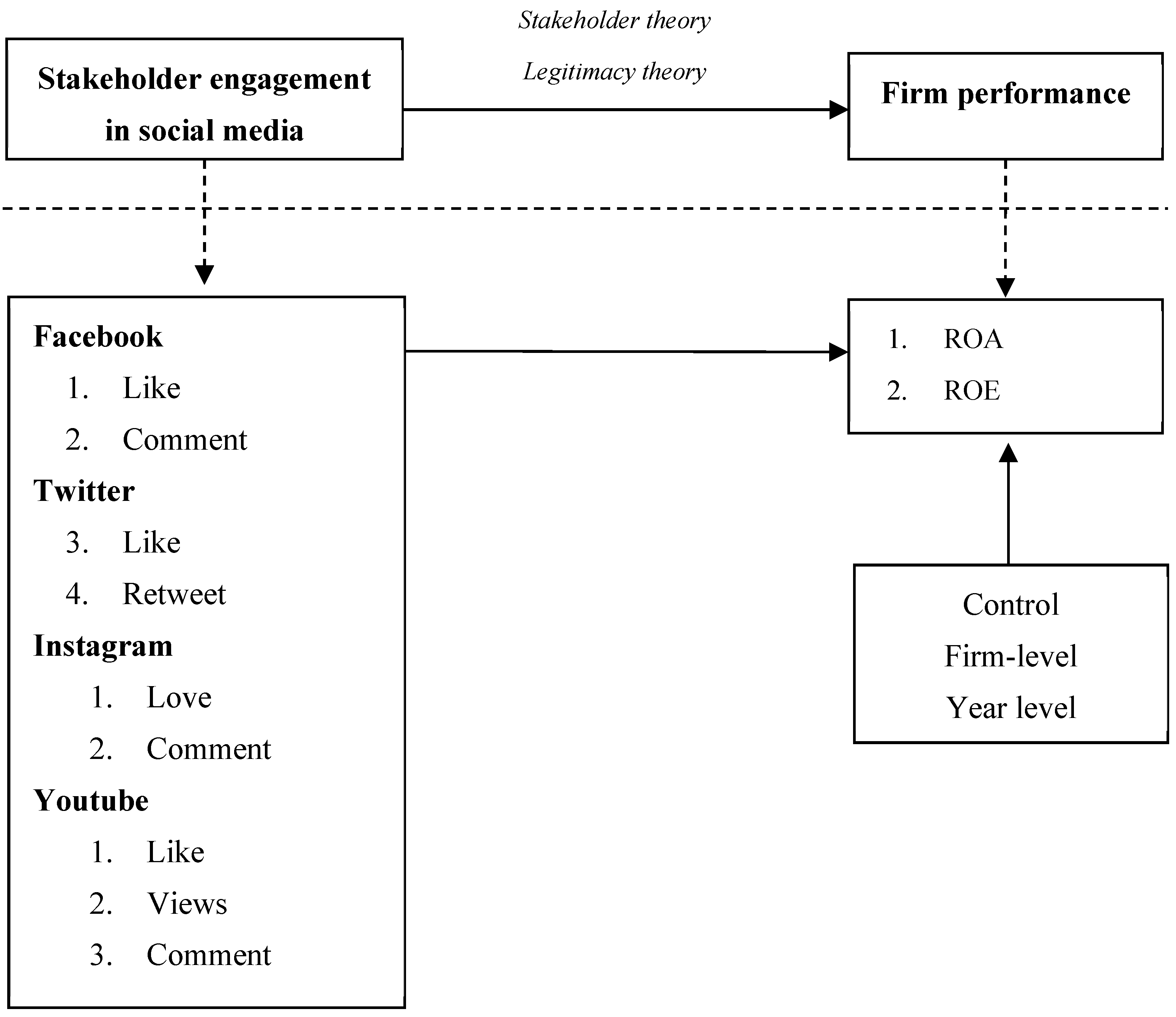
The researcher uses longitudinal panel data analysis to empirically examine the relationships among the variables of interest. As previously explained in the research model, the researcher employs corporate performance as the conceptual dependent variable, while stakeholder engagement with CSR publications—analyzed through the lens of four social media platforms (Facebook, Twitter, Instagram, and YouTube)—is utilized as the conceptual independent variable. To proceed with the technical procedures, corporate performance is measured using three proxies: two are market-based measures (Return and Return on Equity), and the third is an accounting-based measure (Return on Assets). Referring to the use of dependent variable proxies, the researcher designed three statistical notations, where Ret, ROA, and ROE are considered functions of stakeholder engagement with CSR information published through social media platforms (FB_Like, FB_Comment, TW_Like, TW_RT, IG_Love, IG_Comment, YT_Like, YT_Views, YT_Comment).
In addition, to address potential endogeneity issues (e.g., eliminating correlated variable bias), the researcher also performs panel data regression analysis using a set of control variables at both the corporate level and the country level. Furthermore, within the panel data structure, observations are grouped along the time dimension and/or individual dimension. This structure indicates that standard OLS regression is unsuitable for making accurate inferences with longitudinal (panel) data, as it will produce statistically misspecified outputs when any form of correlation occurs among the independent variables (
Mertens et al., 2016). Therefore, the White test standard error correction is applied to address heteroskedasticity problems, where the observed variable size or values differ across units but not over time, or cross-sectional dependence exists within the data. As a result, the researcher uses a fixed-effects model at the corporate level. The regression model notations for each dependent variable, grouped by social media platform sample, are formulated as follows:
The econometric model for testing the Facebook sample group is written as follows:
The econometric model for testing the Twitter sample group is written as follows:
The econometric model for testing the Instagram sample group is written as follows:
The econometric model for testing the YouTube sample group is written as follows:
3.4. Variable Definitions
3.4.1. Dependent Variable
The subscript i in the statistical notation indicates information related to company i, while the subscript t denotes information about a variable in year t. As shown in the empirical notation above, the researcher proposes three statistical models. Each statistical model represents a different test using distinct proxies for corporate performance. In more detail, the first proxy for corporate performance is Return (Ret), the second is Return on Assets (ROA), and the third proxy is Return on Equity (ROE). The rationale for selecting these three dependent variables as proxies for corporate performance is based on prior literature. Most previous studies utilized market-based and accounting-based information, with stock returns (Ret), return on equity (ROE), and return on assets (ROA) standing among the most popular indicators of corporate performance (
Platonova et al., 2018;
Kim & Oh, 2019).
3.4.2. Independent Variable
The researcher proposes a concept as the main independent variable, namely stakeholder engagement. This concept is measured using several proxies. As this study utilizes four social media platforms, each platform has unique and distinct measurement characteristics. Therefore, the research sample is divided into four groups: the Facebook sample group, the Twitter sample group, the Instagram sample group, and the YouTube sample group. In the first sample group (Facebook group), two measurement proxies are employed: FB_Like and FB_Comment. FB_Like represents the total number of likes given by Facebook user stakeholders to the CSR information published by the company through its corporate Facebook account. FB_Comment, on the other hand, represents the total number of comments made by Facebook user stakeholders on CSR information published by the company through its corporate Facebook account. In the second sample group, namely Twitter, two proxies are used: TW_Like and TW_RT. TW_Like measures the total number of likes, while TW_RT measures the number of retweets made by stakeholders on the company’s CSR publications. In the third sample group, namely the Instagram sample group, two measurement proxies are employed: IG_Love and IG_Comment. IG_Love measures the total number of loves, and IG_Comment measures the total number of comments made by stakeholders on the company’s CSR publications. The final sample group is the YouTube sample group. In this group, three measurement proxies are utilized: YT_Like, YT_Views, and YT_Comment. What differentiates the measurement used in the YouTube sample group from the other sample groups is the inclusion of the total number of views of a company’s CSR content, measured using the variable YT_Views.
The selection of stakeholder engagement metrics is platform-specific and reflects the dominant interaction mechanisms embedded within each social media application. For Facebook, Twitter, and Instagram, stakeholder engagement is primarily expressed through likes, comments, and shares/retweets, which represent users’ active evaluative responses to CSR disclosures. In contrast, YouTube operates as a video-centric platform, where content consumption precedes interactive responses. Accordingly, the number of views is included as a key proxy for stakeholder engagement on YouTube, as it captures the breadth of stakeholder exposure and attention to CSR-related video content. Comparable and consistently observable view metrics are not uniformly available or conceptually equivalent for Facebook posts; therefore, views are not employed as an engagement indicator for Facebook in this study.
3.5. Control Variable
In addition to the primary independent variable, the researcher also considers the issue of omitted variable bias that could lead to inefficiency in the research parameters. Considering this, it becomes essential to control for unobserved company characteristics over time that may correlate with the explanatory variables in the proposed model. Previous studies also suggest that the relationship between stakeholder engagement and company performance should be examined by controlling for a set of specific variables at the company and industry levels. To address this issue, the researcher includes control variables that represent company- and industry-level characteristics. Given the heterogeneous nature of the sample (cross-industry), the researcher also considers controlling for industry influence (IND). Furthermore, the researcher takes into account firm-specific attributes such as size and age.
3.6. Additional Analysis
Aware of the potential for endogeneity to hinder the estimation of research results, the researcher decided to conduct additional analyses to ensure that the main analytical results obtained are robust. The researcher designed two additional analyses by considering a lagged model (X
i,t−1) of the independent variables and incorporating alternative measurements within the Facebook sample group, which has the largest number of observations. In the first additional analysis, the researcher implemented a lag model using data from the previous year.
Imbens and Wooldridge (
2009) emphasized that independent variables from a prior time period (t − 1) are not correlated with the error term in the contemporaneous period (t0). Therefore, lagged independent variables are considered exogenous and relevant factors in explaining the variation in the dependent variable in the contemporaneous period (t0). For this reason, the researcher anticipates consistent estimation outputs from both the additional analysis using the contemporaneous regression model and the lagged regression model. The statistical notation for the lag model involves transforming the econometric model used in the main analysis into its lagged form.
Subsequently, in the second additional alternative analysis, alternative proxy measurements were included, specifically stakeholder engagement responses measured through emoticon reactions. These responses consist of the total counts of love emoticons (FB_Love), care emoticons (FB_Care), haha emoticons (FB_Haha), wow emoticons (FB_Wow), sad emoticons (FB_Sad), and angry emoticons (FB_Angry). This additional analysis was applied exclusively to the Facebook sample group since these data could only be extracted through web scraping from the Facebook application.
4. Results
4.1. Descriptive Statistic Analysis
Descriptive statistical analysis plays a critical role in understanding the characteristics of the data used in this study, which include company financial performance, social media activities, and specific attributes such as company size and age. By exploring these variables, this analysis provides insights into variations and patterns among the companies within the sample, enabling us to identify the extent to which differences in financial performance and social media engagement influence overall business strategies and outcomes. This descriptive portrayal of the data serves as an essential initial step for further investigating the relationships between variables and uncovering factors that potentially affect company performance in the digital era. The results of the analysis for the descriptive statistics of the research variables are presented in
Table 3 below.
Table 3 presents a general descriptive statistical overview of the variables used in the study, encompassing company financial performance, social media activities, and firm characteristics. This analysis is essential to understand the variation and distribution of the data (Panel A) as well as sample distribution by industry (Panel B) to identify patterns that can serve as a foundation for further analysis.
In terms of financial performance, the Return on Assets (ROA) indicates that, on average, companies in the sample generate a net income of 4.04% from their total assets, although there are significant differences between firms. A standard deviation of 8.806 and a range of values from −27.61 to 31.32 highlight that while some companies are highly efficient in utilizing their assets, others incur losses or exhibit inefficiencies. Similarly, Return on Equity (ROE) has an average of 8.113 with a higher standard deviation of 21.064, suggesting substantial variability in companies’ abilities to generate profits from equity. The minimum ROE of −96.38 reveals companies with significant losses or very low equity, while the maximum value of 86 demonstrates highly effective management of equity to generate returns.
Social media activity demonstrates considerable variation in user engagement across platforms. On Facebook, the average number of “likes” is 249.917, with a standard deviation of 812.945, showing that while some companies attract thousands of likes, others receive none. For “comments,” the average is 21.742 with a standard deviation of 95.940, indicating that most companies receive few comments, although some manage to garner significant attention from users. Activity on Twitter is lower compared to Facebook and Instagram, with an average of 8.347 “likes” and 4.528 “retweets,” highlighting minimal user response to most Twitter posts. Meanwhile, Instagram exhibits high levels of engagement, with an average of 1665.448 likes and a standard deviation of 10148.9, along with an average of 21.765 comments, reflecting that some companies successfully attract substantial attention on this platform. YouTube shows wide variation in activity, with an average of 52.095 likes and 3140.709 views, suggesting that while some videos gain significant traction, many receive limited attention. The fact that the number of “dislikes” is zero indicates that negative responses are rare or unrecorded.
Company characteristics, such as size and age, also exhibit intriguing patterns. Firm size, measured by market value, has an average of 30.110 with a standard deviation of 3.266, indicating relatively small variation in firm size across the sample. This suggests that the sample consists of companies of fairly consistent size, although differences exist between smaller and larger firms. Meanwhile, firm age varies widely, with an average of 17.920 years and a range from 1 to 42 years. This variation includes companies at different developmental stages, from newly listed firms to those with long-standing operations, which can influence their performance and social media strategies.
The descriptive statistical analysis highlights significant variation in financial performance, social media activities, and firm characteristics. While some companies effectively generate profits, others experience considerable losses. Social media activity demonstrates that firms leverage various platforms with varying degrees of success in attracting user attention and engagement. These findings suggest that more effective social media strategies, particularly on platforms with high engagement potential such as Instagram and YouTube, offer opportunities to enhance firm performance. Additionally, variation in firm size and age underscores the importance of considering company-specific contexts when assessing performance and designing digital communication strategies.
4.2. Correlation Analysis
Next, a correlation analysis was conducted to identify and measure the strength and direction of the relationships between the variables under study, such as company financial performance and social media activities. Through this analysis, we can understand the extent to which changes in one variable may be associated with changes in another variable. For instance, it can reveal how activities across various social media platforms may contribute to Return on Assets (ROA) or Return on Equity (ROE). By identifying these correlation patterns, we gain insights into which factors potentially influence firm performance, while also providing a solid foundation for further analysis of the effectiveness of corporate digital communication and marketing strategies on various platforms. The results of the correlation analysis in this study can be seen in
Table 4.
The Pearson correlation analysis results provide insights into the relationship between corporate financial performance and social media activity. A strong and significant correlation was found between Return on Assets (ROA) and Return on Equity (ROE) (r = 0.746, p < 0.001). This indicates that companies effectively utilizing their assets to generate profits are also likely to perform well in terms of equity returns to shareholders. However, when examining the relationship between financial performance and social media activity, the correlations are generally very weak. For example, both ROA and ROE show weak and negative correlations with the number of comments on YouTube (yt_comment), suggesting that higher engagement in the form of comments on this platform might be associated with lower financial performance.
Activity on various social media platforms, such as Facebook, Twitter, and Instagram, reveals distinct interaction patterns. On Facebook, there is a positive correlation between the number of “likes” and comments (r = 0.329, p < 0.001), indicating that posts receiving more “likes” also tend to garner more comments. On Twitter, the correlation between “likes” and “retweets” is very strong (r = 0.818, p < 0.001), suggesting that content attracting “likes” is also likely to go viral through retweets. The relationship on Instagram differs slightly; while there is a positive correlation between “likes” and comments (r = 0.152, p < 0.01), it is weaker than on other platforms, which may reflect differences in user interaction with content on Instagram.
Cross-platform correlations are also noteworthy. For instance, the number of “likes” and comments on Twitter has a significant positive relationship with the number of “likes” and comments on Facebook. This suggests that companies capable of achieving high engagement on one platform often replicate this success on others, likely due to consistent and effective content strategies across social media channels. Conversely, the number of comments on YouTube shows only weak correlations with other variables, except for a slight positive relationship with comments on Instagram, implying that engagement patterns on YouTube may differ from other platforms or are more specific to certain content types.
Company size and age exhibit minimal significant relationships with most variables. Firm size does not appear to directly influence social media activity or financial performance in this sample. However, firm age shows some interesting correlations, such as a positive relationship with the number of “likes” on Facebook (r = 0.164, p < 0.01), which may indicate that older companies tend to have more followers or are more experienced in engaging users on this platform. While overall relationships between these variables appear weak, these findings can guide companies in understanding how various factors interact and how social media strategies might be tailored to support their financial goals.
4.3. Main Analysis
Regression analysis is utilized to evaluate the extent to which independent variables, such as social media activities and firm characteristics, influence financial performance measured through Return on Assets (ROA) and Return on Equity (ROE). By employing panel data regression models, this analysis identifies which variables significantly impact a company’s financial outcomes, while also determining the direction and magnitude of these effects. This approach enables deeper insights into how various factors—both digital aspects like social media engagement and traditional factors like firm size and age—contribute to a firm’s financial achievements. By understanding these relationships, companies can develop more effective strategies to enhance their performance in increasingly competitive markets.
Table 5 presents the results of panel data regression analysis assessing how independent variables, particularly social media activities, influence firms’ financial performance as measured by Return on Assets (ROA). Five different regression models were used to explore the impact of variables such as the number of “likes” and “comments” on Facebook, Twitter, Instagram, and YouTube, as well as firm size and age. Each model incorporates fixed effects by year and industry, with clustered standard errors to enhance the reliability of results.
A key finding from the analysis is the significant positive relationship between Instagram activity and firms’ ROA. In Models 3 and 5, the number of “likes” received by firms on Instagram shows a positive and significant coefficient (0.0004 and 3.08 × 10⁻⁵, respectively, p < 0.05), indicating that user engagement through “likes” on Instagram correlates with improved financial performance. Similarly, the number of comments on Instagram exhibits a significant positive relationship with ROA in Model 5 (coefficient = 0.007, p < 0.05). These results underscore the importance of active interactions on Instagram, where increased “likes” and comments potentially enhance firms’ operational effectiveness, reflected in higher ROA.
In addition to Instagram, YouTube activity also positively influences ROA. The number of “likes” on YouTube shows significant positive coefficients in Models 4 and 5 (0.0002, p < 0.01, and 0.0006, p < 0.05, respectively), suggesting that video content receiving more “likes” may be associated with improved financial performance. However, other YouTube-related variables, such as the number of “views” and comments, do not exhibit significant relationships. This may imply that the quality of engagement (e.g., “likes”) is more critical than the quantity (e.g., “views” or comments) in affecting firms’ financial performance.
On the other hand, firm size and age variables do not show significant effects on ROA across all models analyzed. The coefficients for these variables remain small and statistically insignificant, indicating that size and age may not be primary determinants of financial performance in this study’s context. Additionally, the low R-squared values across all models (ranging from 0.026 to 0.047) suggest that the regression models explain only a small proportion of the variance in ROA. These findings indicate that other factors beyond the examined variables—such as management strategies, macroeconomic conditions, or product and service innovation—may play a more substantial role in determining firms’ financial performance.
Table 6 presents the results of panel data regression analysis evaluating the impact of independent variables on firms’ Return on Equity (ROE). This analysis uses five distinct regression models, each controlling for fixed effects by year and industry, with clustered standard errors to enhance the reliability of results. The goal is to understand the extent to which social media activities and firm characteristics influence financial performance as measured by ROE.
The analysis reveals that social media activities on certain platforms significantly influence ROE. Notably, the number of comments on Instagram (ig_comment) demonstrates a significant positive relationship with ROE in Model 3 (coefficient = 0.011, p < 0.01) and remains significant in Model 5 (coefficient = 0.012, p < 0.1). This indicates that user interactions in the form of comments on Instagram have the potential to enhance firms’ equity returns. Additionally, the number of “likes” on YouTube (yt_like) consistently shows a significant positive relationship with ROE in Models 4 and 5 (coefficient = 0.0006, p < 0.01), suggesting that higher engagement through “likes” on YouTube correlates with improved financial performance.
Furthermore, the number of “views” on YouTube (yt_views) shows a significant positive relationship with ROE in Model 4 (coefficient = 0.000249, p < 0.01), though this effect is not significant in Model 5. This suggests that while “views” can be an important indicator of engagement, their impact on ROE may not be as substantial as “likes.” Other variables, such as the number of “likes” and “retweets” on Twitter (tw_like and tw_rt) and “likes” on Instagram (ig_like), do not exhibit significant effects on ROE across the tested models.
Firm size and age also fail to show significant relationships with ROE across all models. While the coefficients for these variables are positive, their low t-statistics indicate that their impact on equity returns is not strong enough to be deemed significant in this research context. The low R-squared values in all models (ranging from 0.034 to 0.067) suggest that the variables included in these models account for only a small proportion of the variance in ROE, implying that other factors beyond those examined may play a larger role in determining firms’ financial performance.
5. Discussion
The panel data regression analysis reveals that social media activities on specific platforms, such as Instagram and YouTube, have a positive relationship with corporate financial performance, measured through Return on Assets (ROA) and Return on Equity (ROE). The study employs five regression models to evaluate the influence of key independent variables, including the number of “likes” and “comments” on various social media platforms, alongside firm characteristics such as size and age, on financial performance.
The key findings indicate that social media activity on visual platforms, particularly Instagram and YouTube, significantly impacts financial performance. The number of comments on Instagram is positively associated with ROE, suggesting that increased user interactions through comments correlate with higher equity returns for firms. These results align with
Paniagua and Sapena’s (
2014) study, which demonstrated that user interactions on social media, such as “likes” and comments, enhance brand visibility and strengthen customer relationships, ultimately contributing to improved business performance. Furthermore, the number of “likes” on YouTube also positively influences both ROA and ROE, emphasizing the importance of user engagement through video content in bolstering brand image and improving financial outcomes, as highlighted by
De Vries et al. (
2012). Given that, the economic magnitude of the estimated effects reinforces the study’s central argument that stakeholder engagement on social media—particularly on visual-based platforms—has tangible financial implications (
Inversini & Derchi, 2024). Although individual engagement metrics may appear small in isolation, their cumulative impact can be substantial for firms with large digital audiences (
Han et al., 2024). This pattern is consistent with legitimacy theory, which emphasizes that repeated and visible signals of societal approval can gradually translate into improved economic outcomes. In this regard, the stronger financial relevance of stakeholder engagement on Instagram and YouTube can also be further understood by considering the Indonesian context. Indonesia is characterized by a young and digitally active population, with high levels of social media usage driven predominantly by mobile devices. In such an environment, visual content in the form of images and videos is more accessible, engaging, and easily consumed than text-heavy information. From a cultural perspective, visual storytelling resonates strongly with Indonesian audiences, facilitating emotional connection and shared social meaning, which enhances the effectiveness of CSR communication.
Moreover, not all social media activities showed significant effects. Variables such as the number of “likes” and “retweets” on Twitter, as well as “likes” on Facebook, did not significantly influence ROA or ROE. This suggests that not all forms of social media engagement have equal impacts on financial performance, and the effectiveness of social media strategies heavily depends on the platform and content type (
Macca et al., 2024). These findings support
Hoffman and Fodor’s (
2010) perspective, which emphasized that the success of digital marketing increasingly relies on companies’ ability to strategically leverage various digital channels. The absence of statistically significant relationships between stakeholder engagement on Facebook and Twitter and corporate financial performance may be attributed to several platform-specific factors. First, both platforms are predominantly text-oriented and information-dense, which may limit the emotional salience and symbolic richness of CSR communication compared to visual-based platforms (
Ngai & Singh, 2021). Second, user interactions on Facebook and Twitter often occur in highly fragmented environments characterized by information overload and rapid content turnover, potentially reducing the visibility and persistence of CSR-related messages. Third, these platforms tend to host a more heterogeneous and, at times, critical user base, where engagement may reflect debate or skepticism rather than endorsement. As a result, stakeholder engagement on Facebook and Twitter may generate weaker legitimacy signals, limiting its ability to translate into observable financial outcomes.
Beyond basic engagement indicators such as likes, comments, and views, firms may benefit from tracking more nuanced social media metrics to better assess stakeholder responses to CSR communication (
Choi & Varian, 2012). For example, comment sentiment analysis can help distinguish between supportive, neutral, and critical stakeholder reactions, thereby capturing the qualitative dimension of engagement. Share of voice and engagement rate can provide insights into a firm’s relative visibility and influence within broader CSR-related online conversations. In addition, metrics related to content diffusion, such as reposts, shares, or video completion rates, can help firms evaluate the extent to which CSR messages resonate and spread across digital networks (
Han et al., 2024). Incorporating these advanced metrics may enable firms to better understand the effectiveness of their CSR communication strategies and strengthen the link between stakeholder engagement and organizational outcomes. Interestingly, firm size and age showed no significant relationship with financial performance in this study. Although larger or older firms are often assumed to have competitive advantages, these results suggest that in today’s digital economy, factors such as market adaptability, innovation, and responsiveness may play a more critical role. As
Choi and Varian (
2012) noted, in a rapidly evolving business environment, a firm’s ability to innovate and adapt quickly is a more significant determinant of success than its size or age.
Despite the contributions of this study, several limitations should be acknowledged. First, although the analysis employs lagged stakeholder engagement variables to mitigate simultaneity concerns, potential endogeneity—particularly reverse causality—cannot be entirely ruled out. Firms with stronger financial performance may possess greater resources and incentives (selection bias) to invest in CSR communication and social media engagement, which could influence the observed relationships. While the lagged model helps establish temporal ordering, it does not fully eliminate this concern.
Future research is therefore encouraged to address endogeneity more rigorously by employing alternative empirical strategies, such as instrumental variable approaches, dynamic panel estimators, Generalized Method of Moment, or quasi-experimental designs. In addition, access to more granular data—such as exogenous shocks to social media visibility, regulatory changes, or platform-level policy shifts—could further strengthen causal inference. Expanding the analysis to different institutional settings or longer observation periods may also enhance the generalizability of the findings and provide deeper insights into the dynamic relationship between CSR-related social media engagement and corporate financial performance.
6. Conclusions
This study contributes to the growing literature on corporate social responsibility and digital communication by examining how stakeholder engagement with CSR disclosures across multiple social media platforms relates to corporate financial performance. Rather than treating social media engagement as a uniform phenomenon, this study highlights the importance of platform-specific dynamics in shaping the effectiveness of CSR communication.
From a theoretical perspective, the findings reinforce and extend legitimacy and stakeholder theories by demonstrating that legitimacy-building and stakeholder engagement are conditional on the communication environment. Visual-based platforms enable firms to convey CSR activities in a more tangible, credible, and socially visible manner, thereby strengthening legitimacy signals and stakeholder endorsement. At the same time, the absence of significant effects on certain platforms underscores that not all forms of digital engagement translate into economic value, suggesting important boundary conditions for both theories in digital contexts.
From a practical standpoint, this study offers important implications for managers and communication strategists. The findings indicate that firms should move beyond a one-size-fits-all approach to social media and align their CSR communication strategies with platform-specific engagement dynamics and sector characteristics. In emerging markets such as Indonesia, where digital engagement is increasingly mobile and visually oriented, image- and video-based platforms—particularly Instagram and YouTube—play a crucial role in enhancing corporate reputation and financial performance. Consumer-oriented sectors, including retail, consumer goods, and hospitality, are therefore encouraged to prioritize visually rich CSR content such as storytelling posts, short videos, and community-focused narratives that foster meaningful stakeholder interaction. In contrast, firms operating in B2B, industrial, infrastructure, and financial sectors may benefit more from selective, credibility-driven CSR communication on platforms such as Twitter and Facebook, focusing on governance practices, sustainability commitments, and risk management disclosures. Overall, aligning CSR content strategies with both platform characteristics and sector-specific stakeholder expectations is essential for maximizing the economic value of social media-based stakeholder engagement.




 ,
,