
Transforming Digital Accounting: Big Data, IoT, and Industry 4.0 Technologies—A Comprehensive Survey



Abstract
1. Introduction
Research Contributions and Positioning
2. Methodology
2.1. Search Strategy and Data Sources
- Category 1: Industry 4.0 and Digital Accounting Foundations (Section 3) Keyword combination: “Big Data AND digital accounting,” “IoT AND financial reporting,” “real-time accounting AND Industry 4.0,” “Internet of Things AND accounting systems,” “smart accounting AND cyber-physical systems”
- Category 2: Big Data Analytics and System Evolution (Section 4) Keyword combination: “Big Data analytics AND financial reporting,” “machine learning AND accounting,” “AI AND fraud detection,” “continuous auditing AND data analytics,” “real-time financial analytics”
- Category 4: Industry Implementations and Compliance (Section 5) Keyword combination: “fraud detection AND banking,” “KYC AND automation,” “AML AND machine learning,” “tax compliance AND Big Data,” “regulatory technology AND finance”
- Category 5: Challenges and Implementation Barriers (Section 6) Keyword combination: “GDPR AND blockchain,” “cybersecurity AND financial data,” “data quality AND accounting systems,” “edge computing AND compliance,” “cloud computing AND financial systems”
- Category 6: Emerging Technologies and Future Directions (Section 7) Keyword combination: “DeFi AND accounting,” “digital twins AND financial simulation,” “quantum computing AND finance,” “ESG AND analytics,” “sustainability reporting AND Big Data”
2.2. Inclusion and Exclusion Criteria
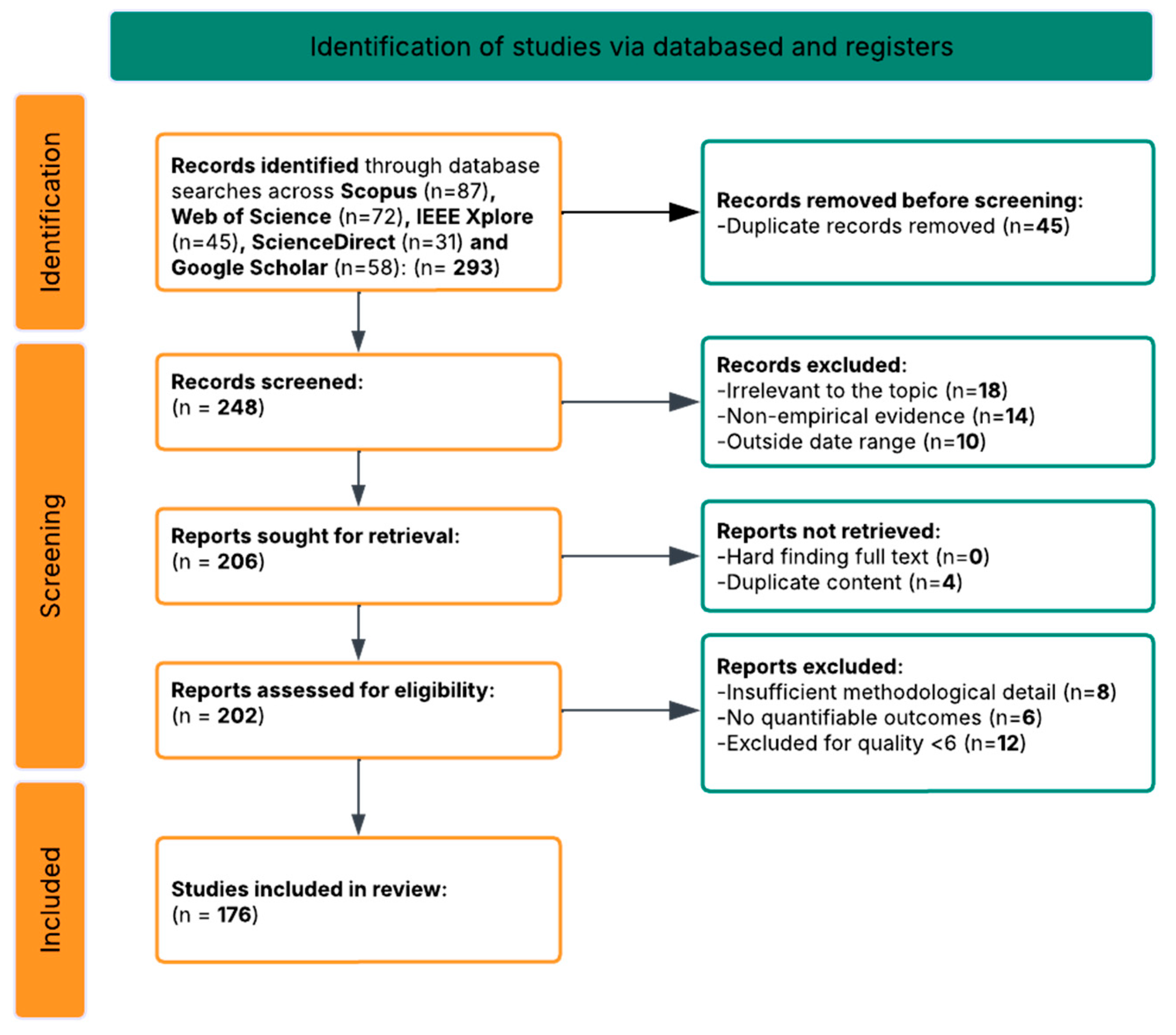
2.3. Screening Process and Final Corpus
2.4. Data Extraction Procedures
2.5. Derivation of Quantitative Outcomes
2.6. Proposition Development
- Independent variable: The technology configuration or intervention
- Dependent variable: The accounting outcome measure
- Hypothesized direction: The expected effect based on synthesized evidence
- Evidence base: The number and quality of supporting studies
2.7. Methodological Limitations
3. Industry 4.0 and Smart Accounting Ecosystems
3.1. Conceptual Foundations
3.2. Technology-Accounting Integration Framework
3.2.1. Asset and Inventory Management
3.2.2. Production Cost Allocation
3.2.3. Quality and Compliance Monitoring
3.2.4. Predictive Maintenance and Financial Planning
3.2.5. Supply Chain Financial Integration
3.2.6. Cyber-Physical Systems and Financial Intelligence
4. Big Data Applications in Digital Accounting
4.1. Evolution from Manual to Intelligent Systems
4.2. Conventional Versus Digital System Characteristics
4.3. Financial Reporting and Audit Applications
- Reductions of 40–60% in the length of time it takes to complete an audit
- The ability to examine 100% of the population of transactions versus 5–10%
- Increases of 25–35% in the accuracy of anomaly detection (Khurana, 2020)
4.4. Fraud Detection and Risk Management
- Fraud loss reductions of 60–70%
- False positive decreases of 45–55%
- Investigation timeline acceleration of 80–90% (Amalia et al., 2019)
4.5. Blockchain and Distributed Ledger Applications
- Reductions in accounts payable processing times of 40–60%
- Decreases in payment disputes of 70–80%
- Improvements in working capital of 10–15% due to faster collections (Giannini & Maggiulli, 2002)
4.6. Research Contribution Synthesis
4.7. Critical Analysis—Contextual Moderators and Boundary Conditions
4.7.1. Organizational Size Effects
4.7.2. Industry Sector Variation
4.7.3. Regulatory Environment
4.7.4. Technology Generation and Maturity
4.7.5. Cross-Study Synthesis: Convergent and Divergent Findings
4.8. Theoretical Integration
5. Current Applications of Big Data in Digital Accounting
5.1. Industry Implementation Profiles
5.1.1. Banking and Financial Services
5.1.2. Insurance Sector
5.1.3. E-Commerce and Retail
5.1.4. Government and Tax Administration
5.2. Audit and Compliance Automation
5.2.1. Robotic Process Automation Integration
5.2.2. Know Your Customer and Anti-Money Laundering
5.2.3. Predictive Compliance Risk Assessment
- A 50–65% reduction in regulatory penalties as compared to reactive compliance processes (Charoo et al., 2023)
- The ability to optimize resources to focus compliance efforts in high-risk areas of the organization
- Predictive capabilities to identify potential issues early and proactively address them prior to regulatory examination (Perez, 2017)
5.3. Taxation and Management Accounting Applications
5.3.1. Advanced Tax Compliance
5.3.2. Tax Audit Analytics
5.3.3. Transfer Pricing Analytics
5.3.4. Management Accounting Decision Support
5.4. Emerging Blockchain Accounting Applications
5.4.1. Triple-Entry Accounting Evolution
5.4.2. Tokenized Asset Accounting
5.4.3. Cross-Border Transaction Efficiency
5.4.4. Regulatory Technology Integration
5.5. Technology-Application Synthesis
6. Challenges of Big Data in Digital Accounting
6.1. Data Quality and Integration Challenges
6.1.1. Unstructured Data Processing
6.1.2. Data Incompleteness and Accuracy
6.1.3. Legacy System Incompatibility
6.1.4. Data Governance Requirements
6.2. Cybersecurity and Privacy Concerns
6.2.1. The Changing Landscape of Cyber Attacks and Financial Services
- Data Breach: Unauthorized access to a company’s systems, either due to a vulnerability in the system or because someone has compromised their login credentials, or as a result of a successful social engineering attack, and financial data is exposed; the average penalty from regulatory agencies (GDPR) for data breaches is $1.2–$2.8 million, plus additional costs associated with recovering from the incident and damage to your reputation (IA & Miglionico, 2019).
- Ransomware Attack: Ransomware attacks against financial institutions were up 150% between 2022 and 2024, and the average demand for ransom by these types of attacks was $1.5 million. The total cost of a ransomware attack to a financial institution includes the actual ransom paid, as well as the costs of restoring systems, loss of revenue, and loss of reputation, totaling approximately $4.2 million, minus the ransom paid (Grabski et al., 2011).
- Inside Job: Approximately 25–30% of all data breaches in the financial industry are caused by employees, and it takes approximately 77 days to detect that an employee has breached data compared to 29 days for outside hackers to be detected; the larger the number of users who have access to the financial institution’s data, the larger the potential scope of damage to the company (Modupe et al., 2024).
- Social Engineering: A phishing attack against an organization that does not have employee training to prevent such attacks will succeed 15–25% of the time, resulting in unauthorized access to the company’s financial data, unauthorized transactions, and/or the unauthorized transfer of financial data out of the company (X. Yang, 2024).
6.2.2. Privacy Regulatory Obligations
6.2.3. Cloud-Based Infrastructure Risks
6.2.4. Security Architecture for Big Data Systems
- Hardware Security: Hardware Security Modules (HSMs) providing tamper-resistant cryptographic key storage, secure boot mechanisms ensuring firmware integrity, and device authentication using PKI certificates (Cairns, 2000).
- Network Security: Software-Defined Perimeter (SDP) with micro-segmentation, dedicated VLANs for accounting-critical systems, TLS 1.3 encryption for data in transit, and network-based intrusion detection systems (Figueroa et al., 2010).
- Data Security: Zero-trust architecture with Attribute-Based Encryption (ABE), homomorphic encryption enabling computation on encrypted data, and blockchain-based audit trails providing integrity verification (Dura & Suharsono, 2022).
- Application Security: Zero Trust Architecture (ZTA) principles requiring continuous authentication, behavioral analytics detecting anomalous user interactions, and API security gateways protecting service communications (Lauslahti et al., 2018).
6.3. Ethical and Legal Issues Surrounding Accounting Systems Based on Big Data
6.3.1. Increased Complexity of Compliance with Regulatory Standards
- Accounting and Financial Reporting: Companies operating in multiple countries have to adhere to IFRS (International Financial Reporting Standards) and GAAP (Generally Accepted Accounting Principles). These companies may encounter difficulties demonstrating that their accounting has been prepared using machine-learning-based models, which can generate classifications that an auditor cannot fully follow. These difficulties arise from the ‘black box’ characteristics of many complex models, including neural networks and ensemble methods, that conflict with the need for companies to demonstrate transparent and accountable decision-making processes.
- Data Protection Regulations: The principle of minimizing the amount of data collected and used and limiting its purposes under the EU’s General Data Protection Regulation (GDPR) makes it difficult to collect and analyze large volumes of data to support business decisions (Qureshi, 2024). Companies indicate that up to 40–50% of all possible Big Data use cases are subject to such restrictions and therefore require changes to their architecture.
- Internal Control Requirements: SOX mandates documented controls over financial reporting processes (Zhen & Zhen, 2024). AI-based systems require new control frameworks that address algorithm governance and change management, model validation and testing procedures, audit-trail requirements for automated decisions, and segregation of duties in automated processes.
6.3.2. Algorithmic Accountability
- Transparency and Explainability: In recent years, there has been increasing regulatory pressure for companies to provide explanations of the automated decisions they make about individuals or other organizations (Zhao et al., 2020). However, for these explanations to be useful to customers and regulators, the decision logic underlying automated decisions must be understandable to humans. Unfortunately, it is common for complex models that achieve high accuracy to operate as “black boxes,” making it impossible to articulate their decision logic in human-understandable terms.
- Bias Detection and Mitigation: The data sets used to train machine learning models reflect historical realities and may contain discriminatory biases against particular demographics or sub-populations (Wilkens & Moorhouse, 2023). For example, a company reported that the machine learning model it was developing to identify applicants who were likely to become successful employees included a factor that reflected the applicant’s zip code and thus was biased towards applicants from affluent neighborhoods. Similarly, another company found that its automated fraud detection system generated disproportionately more false-positive identifications of applicants from minority backgrounds. Finally, one bank found that the segmentation model it developed to identify customer segments for marketing purposes produced segments that contained many more members of traditionally disadvantaged demographic groups than would be expected by chance alone.
- Human Oversight Requirements: There is now increasing regulatory pressure on companies to require a human to review and approve the results of significant automated decisions (Zhou, 2025). Although such a review will add 15–25% to processing costs, it raises important questions about whether reviewers can evaluate the complex outputs of the models that generated the original decision.
6.3.3. Ethical Guidelines for Implementing Big Data Accounting Systems
6.4. Skill Gaps and Implementation Barriers
6.4.1. Data Literacy Deficits
6.4.2. The Need to Expand Professional Competence
- Technical Skills: Data manipulation and analysis of large datasets, use of Business Intelligence (BI) tools, programming skills for extracting and transforming data from various data sources, statistical literacy to interpret results from analytical processes, and an understanding of what can and cannot be done with machine learning models (Badakhshan & Ball, 2023).
- Analytical Skills: Identifying patterns in financial data, identifying anomalies in financial data and investigating those anomalies, understanding how to interpret results from predictive modeling, and assessing risks based upon data-driven insights (Olanrewaju et al., 2024).
- Integration Skills: Working collaboratively with IT and data science teams, translating technical language to financial language, and re-designing processes to include automation where possible (Saxena et al., 2022).
6.4.3. Strategies for Training and Development
- Academic Curriculum Reform: Colleges and universities that have integrated Big Data, Artificial Intelligence (AI), and Financial Technology (FinTech) into their accounting curricula report 40–50% improvements in their graduates’ job placement rates for data enabled positions (Redlein et al., 2023).
- Professional Certification: Accounting professional certification bodies (AICPA, ACCA, etc.) offer certifications in data analytics; only 15–20% of practicing CPAs have achieved data analytics certification (Odonkor et al., 2024).
- Organizational Training: Companies typically spend 2–5% of their Big Data project budget on workforce training. If insufficient resources are devoted to training, companies may experience 40–60% longer deployment timeframes, 30–50% higher error rates during the initial deployment period, and 25–35% higher levels of employee resistance to adopting the new system (Necula & Roebling, 2024).
6.4.4. Implementation Costs as an Obstacle
- Data Analytics Platforms: $100,000–$500,000 is the estimated cost for mid-sized organizations for advanced analytics platforms.
- Cloud Infrastructure: Mid-sized organizations pay between $50,000–$200,000 per year for cloud infrastructure services.
- System Integration: The cost for system integration can range from $200,000–$1,000,000 depending upon how complex a company’s legacy systems are.
- Training and Change Management: The estimated cost for training employees and managing change is $50,000–$150,000.
- Ongoing Maintenance: Annual ongoing maintenance costs for the new system should be expected to range from 15–25% of the original cost (Mookerjee & Rao, 2021).
6.5. Challenge-Mitigation Framework
7. Future Research Directions and Emerging Technologies
7.1. Quantum Computing Applications in Financial Analytics
7.1.1. Quantum Advantage in Financial Calculations
- Portfolio Optimization: Large-scale portfolio optimization presents a problem for many classical optimization algorithms because they grow exponentially in complexity as the number of assets increases. Quantum methods such as variational quantum eigensolvers have demonstrated the potential for a 100–1000-fold reduction in computation time relative to classical methods for portfolio optimization involving portfolios with 500+ assets (Mohd et al., 2025). While current quantum hardware’s limited capacity has restricted its practical application, we expect commercial viability within 5–10 years.
- Risk Modeling: Monte Carlo simulations are commonly used in the process of assessing risk; however, quantum computing can provide a speedup for these simulations by utilizing amplitude estimation techniques (Khang et al., 2025). Theory suggests a quadratic speedup could reduce the time required to complete these simulations from hours to minutes for complex derivative pricing and Value-at-Risk calculations.
- Cryptographic Implications: Quantum computing will break current encryption standards for protecting financial information (Alcazar et al., 2020). Research into post-quantum cryptography will address this issue. We anticipate NIST releasing new standards for quantum-resistant algorithms during 2025–2030, which will require upgrades to accounting system security.
7.1.2. Research Gaps and Opportunities
7.2. Decentralized Finance and Advanced Blockchain Applications
7.2.1. Emerging DeFi Accounting Challenges
- Accounting for Liquidity Pools: In automated market makers, there is a need for the ongoing fair value assessment of the assets held within pools, recognition of yields for providing liquidity, and measuring impermanent losses—all concepts currently without accounting guidance (Bourveau et al., 2024)—therefore, research opportunities do exist for developing DeFi-specific measurement frameworks.
- Valuing Governance Tokens: Governance tokens that grant the right to participate in the decision-making process of a DeFi protocol have characteristics of equity instruments, voting rights, and speculative assets; classification and measurement guidance does not exist today, and therefore will result in inconsistent treatment by different reporting entities.
- Cross-Protocol Composability: The “money lego” architecture of DeFi allows users to build complex multi-protocol strategies where individual transactions may be made up of transactions on multiple platforms. This creates a need for research and development of accounting decompositions and attributions for these transactions.
7.2.2. Evolving Smart Contracts
- Self-Executing Financial Statements: There is research being conducted into the use of smart contracts to generate audited financial statements based upon historical on-chain transactional data and eliminate traditional audits for blockchain-native organizations (James, 2013; Giannini & Maggiulli, 2002).
- Programmable Compliance: Regulatory compliance that is programmatically enforced through smart contracts ensures that regulatory violations become technologically impossible instead of just detectable (Wylde et al., 2022; Adenekan, 2024); future areas of research would include the development of compliance-by-design frameworks for tax, securities, and anti-money laundering regulations.
- Decentralized Autonomous Organizations: As discussed earlier, DAOs represent a decentralized form of organization that is without a traditional corporate structure. They challenge many of the fundamental accounting principles that govern how we account for an entity’s boundaries, recognize ownership, and determine who is responsible for preparing the entity’s financial statements.
7.3. Digital Twins, AI Advancement, and Real-Time Financial Intelligence
7.3.1. Financial Digital Twins
- Scenario Simulation: The ability to model real-time strategic alternative options (acquisition impacts, market entry scenarios, etc.) that are based on operational and financial data, providing integrated analytical capabilities greater than those available through traditional financial modeling (Badakhshan & Ball, 2023).
- Predictive Financial Statements: Continuous projections of future financial statements based on the current operational trajectory, market conditions, and the strategic assumptions made at the time the predictive financials were created. Research indicates a potential 30–40% increase in forecast accuracy relative to periodic budgeting methods (Stiegler & Tung, 2017).
- Audit Simulation: Testing the effectiveness of internal controls and identifying areas of high risk before conducting a physical audit. It has been proposed that pre-audit assessment using digital twin-enabled audit simulations can reduce the audit cycle time by 25–35 percent while enhancing risk identification.
7.3.2. Advanced AI Applications
- Large Language Models in Accounting: GPT-class language models have demonstrated their capability to analyze financial statements, draft disclosures, and interpret regulations (Husch et al., 2024; Deliu & Olariu, 2024). The areas for additional research include developing large language models specifically designed for accounting, investigating hallucinations in the context of financial reporting, and creating frameworks to validate disclosures generated by AI.
- Autonomous Accounting Agents: AI agents with the ability to make autonomous judgments regarding the classification of transactions, materiality assessments, and disclosures will be the focus of this area of research. The area of accountability needs to be addressed by specifying how to ensure accountability when AI systems make decisions that would otherwise require professional judgment.
- Explainable AI for Audit: The research efforts in this area will be focused on addressing the accountability concerns associated with algorithmic decision-making discussed in Section 6.3. The emphasis will be on developing transparent and explainable models for audit applications, where the rationale for a decision must withstand regulatory scrutiny (Zhao et al., 2020; Wilkens & Moorhouse, 2023).
7.4. ESG Integration and Sustainability Accounting Analytics
7.4.1. ESG Data Analytics
- Quantifying Environmental Impacts: The use of Internet-of-Things (IoT) sensors, satellite imaging, and supply chain monitoring allows for detailed measurements of carbon emissions, consumption of resources, and environmental impacts that were either measured indirectly or had no measurable value in the past (Olanrewaju et al., 2024). Big Data analytics has transformed ESG reporting into quantified, verifiable reporting.
- Social Impact Analytics: Use of natural language processing on communications of employees, customer reviews/feedback, and community interactions allows for systematic evaluation of social performance indicators (Saxena et al., 2022). Sentiment analysis and topic modeling can identify potential social risk factors before they evolve into financial risk factors.
- Governance Analytics: Machine learning models of board compositions, executive compensation practices, and decision-making processes can identify governance strengths and weaknesses (Redlein et al., 2023). Predictive governance models can predict future regulatory and reputational risks based on governance practices.
7.4.2. Frameworks for Reporting Financial Information and ESG Data
- Double Materiality Assessment: Big Data will provide a mechanism to systematically assess issues that are important both financially and from the perspective of stakeholders to support the growing number of jurisdictions with double materiality regulations, such as those in the European Union.
- Real-Time ESG Dashboards: Real-time continuous monitoring of ESG performance, similar to real-time dashboards used by companies to monitor their financial performance as described in Section 4.3, will enable companies to manage their sustainability proactively rather than retroactively.
- Development of Assurance Methods: Assurance methods for ESG data must be developed to account for the non-financial nature of ESG data; the uncertainty associated with estimates; and the need to validate forward-looking statements.
7.5. Research Agenda and Implementation Roadmap
Implementation Considerations
8. Conclusions
Supplementary Materials
Author Contributions
Funding
Institutional Review Board Statement
Informed Consent Statement
Data Availability Statement
Acknowledgments
Conflicts of Interest
Abbreviations
| AI | Artificial Intelligence (AI) |
| ABE | Attribute-Based Encryption |
| AI | Artificial Intelligence |
| AML | Anti-Money Laundering |
| AP | Accounts Payable |
| API | Application Programming Interface |
| BI | Business Intelligence |
| CEO | Chief Executive Officer |
| CFO | Chief Financial Officer |
| CPA | Certified Public Accountant |
| DAO | Decentralized Autonomous Organization |
| DeFi | Decentralized Finance |
| DLT | Distributed Ledger Technology |
| ERP | Enterprise Resource Planning |
| ESG | Environmental, Social, and Governance |
| EU | European Union |
| FX | Foreign Exchange |
| GAAP | Generally Accepted Accounting Principles |
| GDPR | General Data Protection Regulation |
| GPS | Global Positioning System |
| HSM | Hardware Security Module |
| IFRS | International Financial Reporting Standards |
| IoT | Internet of Things |
| IT | Information Technology |
| KYC | Know Your Customer |
| LLM | Large Language Model |
| ML | Machine Learning |
| NLP | Natural Language Processing |
| NIST | National Institute of Standards and Technology |
| OCR | Optical Character Recognition |
| RegTech | Regulatory Technology |
| RFID | Radio-Frequency Identification |
| RPA | Robotic Process Automation |
| SDP | Software-Defined Perimeter |
| SME | Small and Medium-sized Enterprise |
| SOX | Sarbanes-Oxley Act |
| USD | United States Dollar |
| VaR | Value at Risk |
| VAT | Value Added Tax |
| XBRL | eXtensible Business Reporting Language |
References
- Abdo-Salloum, A. M., & Al-Mousawi, H. Y. (2025). Accounting students’ technology readiness, perceptions, and digital competence toward artificial intelligence adoption in accounting curricula. Journal of Accounting Education, 70, 100951. [Google Scholar] [CrossRef]
- Adenekan, T. K. (2024). Enhancing data privacy with advanced analytics: A business approach to cybersecurity compliance. Available online: https://www.researchgate.net/profile/Tobiloba-Adenekan/publication/385894256_Enhancing_Data_Privacy_with_Advanced_Analytics_A_Business_Approach_to_Cybersecurity_Compliance/links/673a3cdba78ba469f068844f/Enhancing-Data-Privacy-with-Advanced-Analytics-A-Business-Approach-to-Cybersecurity-Compliance.pdf (accessed on 2 January 2026).
- Alao, O. B., Dudu, O. F., Alonge, E. O., & Eze, C. E. (2024). Automation in financial reporting: A conceptual framework for efficiency and accuracy in US corporations. Global Journal of Advanced Research and Reviews, 2(02), 040–050. [Google Scholar] [CrossRef]
- Alcazar, J., Leyton-Ortega, V., & Perdomo-Ortiz, A. (2020). Classical versus quantum models in machine learning: Insights from a finance application. Machine Learning: Science and Technology, 1(3), 035003. [Google Scholar] [CrossRef]
- Alexander, D., Britton, A., Jorissen, A., Hoogendoorn, M. N., & Van Mourik, C. (2003). International financial reporting and analysis. Thomson Learning. [Google Scholar]
- Alkan, B. S. (2022). How blockchain and artificial intelligence will effect the cloud-based accounting information systems? In The impact of artificial intelligence on governance, economics and finance (Vol. 2, pp. 107–119). Springer Nature. [Google Scholar]
- Amalia, F. A., Sutrisno, S., & Baridwan, Z. (2019). Audit quality: Does time pressure influence independence and audit procedure compliance of auditor? Muhammadiyah University Yogyakarta. [Google Scholar]
- Appelbaum, D., Kogan, A., & Vasarhelyi, M. A. (2017). Big Data and analytics in the modern audit engagement: Research needs. Auditing: A Journal of Practice & Theory, 36(4), 1–27. [Google Scholar]
- Asimakopoulos, G., Antonopoulou, H., Giotopoulos, K., & Halkiopoulos, C. (2025). Impact of information and communication technologies on democratic processes and citizen participation. Societies, 15(2), 40. [Google Scholar] [CrossRef]
- Assidi, S., Omran, M., Rana, T., & Borgi, H. (2025). The role of AI adoption in transforming the accounting profession: A diffusion of innovations theory approach. Journal of Accounting & Organizational Change, 21(5), 915–936. [Google Scholar] [CrossRef]
- Ataya, G. (2010). PCI DSS audit and compliance. Information Security Technical Report, 15(4), 138–144. [Google Scholar] [CrossRef]
- Badakhshan, E., & Ball, P. (2023). Applying digital twins for inventory and cash management in supply chains under physical and financial disruptions. International Journal of Production Research, 61(15), 5094–5116. [Google Scholar] [CrossRef]
- Badoni, P., Wadhwa, M., & Shrimal, V. M. (2024). Enhancing IoT scalability and security through cloud integration: Opportunities and challenges. In 2024 international conference on intelligent computing and emerging communication technologies (ICEC) (pp. 1–6). IEEE. [Google Scholar]
- Barik, T. R., & Ranawat, P. (2024). Transformation of traditional corporate tax planning into AI-driven corporate tax planning. Involvement International Journal of Business, 1(4), 269–280. [Google Scholar] [CrossRef]
- Basiru, J. O., Ejiofor, C. L., Onukwulu, E. C., & Attah, R. U. (2023). Enhancing financial reporting systems: A conceptual framework for integrating data analytics in business decision-making. IRE Journals, 7(4), 587–606. [Google Scholar]
- Bergman, M., & Nevarez, A. (2006). Do audits enhance compliance? An empirical assessment of VAT enforcement. National Tax Journal, 59(4), 817–832. [Google Scholar] [CrossRef]
- Bhattarai, B. P., Paudyal, S., Luo, Y., Mohanpurkar, M., Cheung, K., Tonkoski, R., & Zhang, X. (2019). Big Data analytics in smart grids: State-of-the-art, challenges, opportunities, and future directions. IET Smart Grid, 2(2), 141–154. [Google Scholar]
- Bhimani, A., & Willcocks, L. (2014). Digitisation, ‘Big Data’ and the transformation of accounting information. Accounting and Business Research, 44(4), 469–490. [Google Scholar] [CrossRef]
- Bonsón, E., & Bednárová, M. (2019). Blockchain and its implications for accounting and auditing. Meditari Accountancy Research, 27(5), 725–740. [Google Scholar] [CrossRef]
- Bourveau, T., Brendel, J., & Schoenfeld, J. (2024). Decentralized Finance (DeFi) assurance: Early evidence. Review of Accounting Studies, 29(3), 2209–2253. [Google Scholar] [CrossRef]
- Boute, R. N., Gijsbrechts, J., & Van Mieghem, J. A. (2022). Digital lean operations: Smart automation and Artificial Intelligence in financial services. Innovative Technology at the Interface of Finance and Operations, I, 175–188. [Google Scholar]
- Breger, D., Edmonds, M., & Ortegren, M. (2020). Internal audit standard compliance, potentially competing duties, and external auditors’ reliance decision. Journal of Corporate Accounting & Finance, 31(1), 112–124. [Google Scholar]
- Brown, M. J., & Smiler, K. L. (2012). Ethical considerations and regulatory issues. In The laboratory rabbit, guinea pig, hamster, and other rodents (pp. 3–31). Academic Press. [Google Scholar]
- Burneikaite, I. (2019). Impact of tax technologies on current and future tax compliance. In Law 2.0: New methods, new laws: 7th international conference of PhD students and young researchers (pp. 49–58). Vilnius University Press. [Google Scholar]
- Cairns, R. D. (2000). Sustainability accounting and green accounting. Environment and Development Economics, 5(1), 49–54. [Google Scholar] [CrossRef]
- Cao, M., Chychyla, R., & Stewart, T. (2015). Big Data analytics in financial statement audits. Accounting Horizons, 29(2), 423–429. [Google Scholar] [CrossRef]
- Cederquist, J. G., Corin, R., Dekker, M. A., Etalle, S., den Hartog, J. I., & Lenzini, G. (2007). Audit-based compliance control. International Journal of Information Security, 6, 133–151. [Google Scholar] [CrossRef]
- Charoo, N. A., Khan, M. A., & Rahman, Z. (2023). Data integrity issues in pharmaceutical industry: Common observations, challenges and mitigations strategies. International Journal of Pharmaceutics, 631, 122503. [Google Scholar]
- Chong, V. K., & Eggleton, I. R. (2003). The decision-facilitating role of management accounting systems on managerial performance: The influence of locus of control and task uncertainty. Advances in Accounting, 20, 165–197. [Google Scholar] [CrossRef]
- Costan, E., Gonzales, G., Gonzales, R., Enriquez, L., Costan, F., Suladay, D., & Ocampo, L. (2021). Education 4.0 in developing economies: A systematic literature review of implementation barriers and future research agenda. Sustainability, 13(22), 12763. [Google Scholar] [CrossRef]
- Dagiliene, L., & Kloviene, L. (2019). Motivation to use big data and big data analytics in external auditing. Managerial Auditing Journal, 34(7), 750–782. [Google Scholar] [CrossRef]
- Dai, J., & Vasarhelyi, M. A. (2017). Toward blockchain-based accounting and assurance. Journal of Information Systems, 31(3), 5–21. [Google Scholar] [CrossRef]
- Dalal, A. (2020). Cybersecurity and privacy: Balancing security and individual rights in the digital age. SSRN. [Google Scholar] [CrossRef]
- Dashkevich, N., Counsell, S., & Destefanis, G. (2024). Blockchain financial statements: Innovating financial reporting, accounting, and liquidity management. Future Internet, 16(7), 244. [Google Scholar] [CrossRef]
- Dave, V., Sur, S., & Gupta, N. (2021). Current framework, ethical consideration and future challenges of regulatory approach for nano-based products. In Nanopharmaceutical advanced delivery systems (pp. 447–472). Wiley. [Google Scholar]
- Deliu, D., & Olariu, A. (2024). The role of Artificial Intelligence and Big Data analytics in shaping the future of professions in Industry 6.0: Perspectives from an emerging market. Electronics, 13(24), 4983. [Google Scholar] [CrossRef]
- Donepudi, P. K. (2019). Automation and machine learning in transforming the financial industry. Asian Business Review, 9(3), 129–138. [Google Scholar] [CrossRef]
- Dubin, J. A., & Wilde, L. L. (1988). An empirical analysis of federal income tax auditing and compliance. National Tax Journal, 41(1), 61–74. [Google Scholar] [CrossRef]
- Dura, J., & Suharsono, R. (2022). Application green accounting to sustainable development improve financial performance study in green industry. Jurnal Akuntansi, 26(2), 192–212. [Google Scholar] [CrossRef]
- Dwianika, A., Sofia, I. P., & Retnaningtyas, I. (2023). Tax compliance: Development of artificial intelligence on tax issues. KnE Social Sciences, 728–733. [Google Scholar] [CrossRef]
- Endiana, I., Dicriyani, N. L. G. M., Adiyadnya, M. S. P., & Putra, I. P. M. J. S. (2020). The effect of green accounting on corporate sustainability and financial performance. The Journal of Asian Finance, Economics and Business, 7(12), 731–738. [Google Scholar] [CrossRef]
- Ezeife, E., Kokogho, E., Odio, P. E., & Adeyanju, M. O. (2021). The future of tax technology in the United States: A conceptual framework for AI-driven tax transformation. Future, 2(1), 101203. [Google Scholar] [CrossRef]
- Faccia, A., Al Naqbi, M. Y. K., & Lootah, S. A. (2019). Integrated cloud financial accounting cycle: How artificial intelligence, blockchain, and XBRL will change the accounting, fiscal and auditing practices. In Proceedings of the 2019 3rd international conference on cloud and big data computing (pp. 31–37). Association for Computing Machinery. [Google Scholar]
- Faccia, A., & Petratos, P. (2021). Blockchain, enterprise resource planning (ERP) and accounting information systems (AIS): Research on e-procurement and system integration. Applied Sciences, 11(15), 6792. [Google Scholar] [CrossRef]
- Fawcett, T., Haimowitz, I., Provost, F., & Stolfo, S. (1998). AI approaches to fraud detection and risk management. AI Magazine, 19(2), 107. [Google Scholar]
- Figueroa, E., Orihuela, C., & Calfucura, E. (2010). Green accounting and sustainability of the Peruvian metal mining sector. Resources Policy, 35(3), 156–167. [Google Scholar] [CrossRef]
- Fuller, S. H., & Markelevich, A. (2020). Should accountants care about blockchain? Journal of Corporate Accounting & Finance, 31(2), 34–46. [Google Scholar]
- Galbraith, J. R. (1974). Organization design: An information processing view. Interfaces, 4(3), 28–36. [Google Scholar] [CrossRef]
- Gandomi, A., & Haider, M. (2015). Beyond the hype: Big data concepts, methods, and analytics. International Journal of Information Management, 35(2), 137–144. [Google Scholar] [CrossRef]
- Gassman, J. J., Owen, W. W., Kuntz, T. E., Martin, J. P., & Amoroso, W. P. (1995). Data quality assurance, monitoring, and reporting. Controlled Clinical Trials, 16(2), 104S. [Google Scholar] [CrossRef]
- George, J. (2022). Optimizing hybrid and multi-cloud architectures for real-time data streaming and analytics: Strategies for scalability and integration. World Journal of Advanced Engineering Technology and Sciences, 7(1), 10–30574. [Google Scholar]
- Gertz, M. (1998). Managing data quality and integrity in federated databases. In Working conference on integrity and internal control in information systems (pp. 211–229). Springer US. [Google Scholar]
- Giannini, S., & Maggiulli, C. (2002). Effective tax rates in the EU commission study on company taxation: Methodological aspects, main results and policy implications. CESifo Economic Studies, 48(4), 633. [Google Scholar]
- Gilcrest, J., & Carvalho, A. (2018). Smart contracts: Legal considerations. In 2018 IEEE international conference on big data (big data) (pp. 3277–3281). IEEE. [Google Scholar]
- Gordon, R. (Ed.). (2010). Taxation in developing countries: Six case studies and policy implications. Columbia University Press. [Google Scholar]
- Gousteris, S., Stamatiou, Y. C., Halkiopoulos, C., Antonopoulou, H., & Kostopoulos, N. (2023). Secure distributed cloud storage based on the blockchain technology and smart contracts. Emerging Science Journal, 7(2), 469–479. [Google Scholar] [CrossRef]
- Grabski, S. V., Leech, S. A., & Schmidt, P. J. (2011). A review of ERP research: A future agenda for accounting information systems. Journal of Information Systems, 25(1), 37–78. [Google Scholar] [CrossRef]
- Guo, L., Song, R., Wu, J., Xu, Z., & Zhao, F. (2024). Integrating a machine learning-driven fraud detection system based on a risk management framework. Applied and Computational Engineering, 87, 80–86. [Google Scholar] [CrossRef]
- Habibzadeh, H., Nussbaum, B. H., Anjomshoa, F., Kantarci, B., & Soyata, T. (2019). A survey on cybersecurity, data privacy, and policy issues in cyber-physical system deployments in smart cities. Sustainable Cities and Society, 50, 101660. [Google Scholar] [CrossRef]
- Haines, A., Kuruvilla, S., & Borchert, M. (2004). Bridging the implementation gap between knowledge and action for health. Bulletin of the World Health Organization, 82(10), 724–731. [Google Scholar]
- Halkiopoulos, C., Papadopoulos, A., Stamatiou, Y. C., Theodorakopoulos, L., & Vlachos, V. (2024). A digital service for citizens: Multi-parameter optimization model for cost-benefit analysis of cybercrime and cyberdefense. Emerging Science Journal, 8(4), 1320–1344. [Google Scholar]
- Hamilton, M. (2020). Blockchain distributed ledger technology: An introduction and focus on smart contracts. Journal of Corporate Accounting & Finance, 31(2), 7–12. [Google Scholar]
- Hamledari, H., & Fischer, M. (2021). Role of blockchain-enabled smart contracts in automating construction progress payments. Journal of Legal Affairs and Dispute Resolution in Engineering and Construction, 13(1), 04520038. [Google Scholar] [CrossRef]
- Hasan, A. R. (2021). Artificial intelligence in accounting & auditing: A Literature review. Open Journal of Business and Management, 10(1), 440–465. [Google Scholar]
- Herman, D., Googin, C., Liu, X., Sun, Y., Galda, A., Safro, I., & Alexeev, Y. (2023). Quantum computing for finance. Nature Reviews Physics, 5(8), 450–465. [Google Scholar] [CrossRef]
- Hernadi, B. H. (2012). Green accounting for corporate sustainability. Theory, Methodology, Practice-Review of Business and Management, 8(02), 23–30. [Google Scholar]
- Hewa, T. M., Hu, Y., Liyanage, M., Kanhare, S. S., & Ylianttila, M. (2021). Survey on blockchain-based smart contracts: Technical aspects and future research. IEEE Access, 9, 87643–87662. [Google Scholar] [CrossRef]
- Hong, Q. N., Pluye, P., Fabregues, S., Bartlett, G., Boardman, F., Cargo, M., Dagenais, P., Gagnon, M. P., Griffiths, F., Nicolau, B., O’Cathain, A., Rousseau, M. C., & Vedel, I. (2018). Mixed methods appraisal tool (MMAT) (Version 2018). Canadian Intellectual Property Office, Industry Canada. [Google Scholar]
- Hosen, M., Thaker, H. M. T., Subramaniam, V., Eaw, H. C., & Cham, T. H. (2022). Artificial intelligence, blockchain, and cryptocurrency in finance: Current scenario and future direction. In International conference on emerging technologies and intelligent systems (pp. 322–332). Springer International Publishing. [Google Scholar]
- Hu, H., Wen, Y., Chua, T. S., & Li, X. (2014). Toward scalable systems for big data analytics: A technology tutorial. IEEE Access, 2, 652–687. [Google Scholar] [CrossRef]
- Hulle, J., Kaspar, R., & Moller, K. (2011). Multiple criteria decision-making in management accounting and control-state of the art and research perspectives based on a bibliometric study. Journal of Multi-Criteria Decision Analysis, 18(5–6), 253–265. [Google Scholar] [CrossRef]
- Husch, A., Distelrath, D., & Husch, T. (2024). Applications of GPT in finance, compliance, and audit. Springer Books. [Google Scholar]
- Hussien, A. A. (2020). How many old and new Big Data v’s characteristics, processing technology, and applications. International Journal of Application or Innovation in Engineering & Management, 9(9), 15–27. [Google Scholar]
- IA, G., & Miglionico, A. (2019). Artificial Intelligence and automation in financial services: The case of Russian banking sector. Law and Economics Yearly Review, 8(1), 125–147. [Google Scholar]
- Iseal, S., Joseph, O., & Joseph, S. (2025). AI in financial services: Using big data for risk assessment and fraud detection. Available online: https://www.researchgate.net/profile/Sheed-Iseal/publication/388036425_AI_in_Financial_Services_Using_Big_Data_for_Risk_Assessment_and_Fraud_Detection/links/67882c2b1afb4e11f5e7fdf9/AI-in-Financial-Services-Using-Big-Data-for-Risk-Assessment-and-Fraud-Detection.pdf (accessed on 2 January 2026).
- James, S. (2013). Tax and non-tax incentives and investments: Evidence and policy implications. World Bank. [Google Scholar]
- Karadag, H. (2024). Developing and sustaining the entrepreneurial ecosystem: Trends, challenges, and future opportunities. Emerging Science Journal, 8(3), 1201–1214. [Google Scholar]
- Kasper, M., & Alm, J. (2022). Audits, audit effectiveness, and post-audit tax compliance. Journal of Economic Behavior & Organization, 195, 87–102. [Google Scholar] [CrossRef]
- Kastlunger, B., Kirchler, E., Mittone, L., & Pitters, J. (2009). Sequences of audits, tax compliance, and taxpaying strategies. Journal of Economic Psychology, 30(3), 405–418. [Google Scholar] [CrossRef]
- Khang, A., Rath, K. C., Madapana, K., Rao, J., Panda, L. P., & Das, S. (2025). Quantum computing and portfolio optimization in finance services. In Shaping cutting-edge technologies and applications for digital banking and financial services (p. 27). Productivity Press. [Google Scholar]
- Khatoun, R., & Zeadally, S. (2017). Cybersecurity and privacy solutions in smart cities. IEEE Communications Magazine, 55(3), 51–59. [Google Scholar] [CrossRef]
- Khurana, R. (2020). Fraud detection in ecommerce payment systems: The role of predictive AI in real-time transaction security and risk management. International Journal of Applied Machine Learning and Computational Intelligence, 10(6), 1–32. [Google Scholar]
- Kitchin, R., & McArdle, G. (2016). What makes Big Data, Big Data? Exploring the ontological characteristics of 26 datasets. Big Data & Society, 3(1), 2053951716631130. [Google Scholar] [CrossRef]
- Kleven, H., Landais, C., Munoz, M., & Stantcheva, S. (2020). Taxation and migration: Evidence and policy implications. Journal of Economic Perspectives, 34(2), 119–142. [Google Scholar] [CrossRef]
- Kokina, J., & Davenport, T. H. (2017). The emergence of artificial intelligence: How automation is changing auditing. Journal of Emerging Technologies in Accounting, 14(1), 115–122. [Google Scholar] [CrossRef]
- Kokogho, E., Onwuzulike, O. C., Omowole, B. M., Ewim, C. P. M., & Adeyanju, M. O. (2025). Blockchain technology and real-time auditing: Transforming financial transparency and fraud detection in the Fintech industry. Gulf Journal of Advance Business Research, 3(2), 348–379. [Google Scholar] [CrossRef]
- Kommera, A. R. (2024). Artificial intelligence in data integration: Addressing scalability, security, and real-time processing challenges. International Journal of Engineering and Technology Research (IJETR), 9(2), 130–144. [Google Scholar]
- Kostopoulos, N., Stamatiou, Y. C., Halkiopoulos, C., & Antonopoulou, H. (2025). Blockchain applications in the military domain: A systematic review. Technologies, 13(1), 23. [Google Scholar] [CrossRef]
- Kothandapani, H. P. (2022). Optimizing financial data governance for improved risk management and regulatory reporting in data lakes. International Journal of Applied Machine Learning and Computational Intelligence, 12(4), 41–63. [Google Scholar]
- Kothandapani, H. P. (2025). AI-driven regulatory compliance: Transforming financial oversight through large language models and automation. Emerging Science Research, 12, 12–24. [Google Scholar]
- Kunwar, M. (2019). Artificial Intelligence in finance: Understanding how automation and machine learning is transforming the financial industry [Doctoral dissertation, Centria University of Applied Sciences]. [Google Scholar]
- Laine, T., Paranko, J., & Suomala, P. (2012). Management accounting roles in supporting servitisation: Implications for decision making at multiple levels. Managing Service Quality: An International Journal, 22(3), 212–232. [Google Scholar]
- Lauslahti, K., Mattila, J., Hukkinen, T., & Seppala, T. (2018). Expanding the platform: Smart contracts as boundary resources. In Collaborative value co-creation in the platform economy (pp. 65–90). Springer. [Google Scholar]
- Lin, L. (2021). Application of Big Data model in financial taxation management. Scientific Programming, 2021(1), 7001456. [Google Scholar] [CrossRef]
- Lybaert, N. (2002). On-line financial reporting: An analysis of the Dutch listed firms. Available online: https://www.researchgate.net/profile/Nadine-Lybaert/publication/38105790_On-Line_Financial_Reporting_An_Analysis_of_the_Dutch_Listed_Firms/links/546c9d9e0cf2c4819f229f1e/On-Line-Financial-Reporting-An-Analysis-of-the-Dutch-Listed-Firms.pdf (accessed on 2 January 2026).
- Lyon, G. J., & Segal, J. P. (2013). Practical, ethical and regulatory considerations for the evolving medical and research genomics landscape. Applied & Translational Genomics, 2, 34–40. [Google Scholar] [CrossRef] [PubMed]
- Magli, F. (2025). Innovations in corporate reporting: The effects of digital innovation, sustainability, and AI. Springer Nature. [Google Scholar]
- Mahalakshmi, V., Kulkarni, N., Kumar, K. P., Kumar, K. S., Sree, D. N., & Durga, S. (2022). The role of implementing Artificial Intelligence and machine learning technologies in the financial services industry for creating competitive intelligence. Materials Today: Proceedings, 56, 2252–2255. [Google Scholar] [CrossRef]
- Makarov, V. L., Bakhtizin, A. R., & Beklaryan, G. L. (2019). Developing digital twins for production enterprises. Business Informatics, 13(4), 7–16. [Google Scholar]
- McMahon, R. G., & Davies, L. G. (1994). Financial reporting and analysis practices in small enterprises: Their association with growth rate and financial performance. Journal of Small Business Management, 32(1), 9. [Google Scholar]
- Meyer, E., Lees, A., Humphris, D., & Connell, N. A. D. (2007). Opportunities and barriers to successful learning transfer: Impact of critical care skills training. Journal of Advanced Nursing, 60(3), 308–316. [Google Scholar] [CrossRef]
- Mills, D. C., Wang, K., Malone, B., Ravi, A., Marquardt, J., Badev, A. I., & Baird, M. (2016). Distributed ledger technology in payments, clearing, and settlement. Available online: https://papers.ssrn.com/sol3/papers.cfm?abstract_id=2881204 (accessed on 2 January 2026).
- Modupe, O. T., Otitoola, A. A., Oladapo, O. J., Abiona, O. O., Oyeniran, O. C., Adewusi, A. O., & Obijuru, A. (2024). Reviewing the transformational impact of edge computing on real-time data processing and analytics. Computer Science & IT Research Journal, 5(3), 603–702. [Google Scholar] [CrossRef]
- Mohd, S., Dasgupta, M., Akter, F., Arunachalam, M. P., & Sharma, S. (2025). Quantum computing applications in financial modeling and portfolio optimization. In 2025 first international conference on advances in computer science, electrical, electronics, and communication technologies (CE2CT) (pp. 868–872). IEEE. [Google Scholar]
- Moll, J., & Yigitbasioglu, O. (2019). The role of internet-related technologies in shaping the work of accountants: New directions for accounting research. The British Accounting Review, 51(6), 100833. [Google Scholar] [CrossRef]
- Monda, J., Keipeer, J., & Were, M. C. (2012). Data integrity module for data quality assurance within an e-health system in sub-Saharan Africa. Telemedicine and e-Health, 18(1), 5–10. [Google Scholar]
- Mookerjee, J., & Rao, O. R. S. (2021). A review of the robotic process automation’s impact as a disruptive innovation in accounting and audit. Turkish Journal of Computer and Mathematics Education (TURCOMAT), 12, 3675–3682. [Google Scholar]
- Moorthy, M. K., Voon, O. O., Samsuri, C. A. S. B., Gopalan, M., & Yew, K. T. (2012). Application of information technology in management accounting decision making. International Journal of Academic Research in Business and Social Sciences, 2(3), 1. [Google Scholar]
- Murphy, A., Taylor, C., Acheson, C., Butterfield, J., Jin, Y., Higgins, P., & Higgins, C. (2020). Representing financial data streams in digital simulations to support data flow design for a future digital twin. Robotics and Computer-Integrated Manufacturing, 61, 101853. [Google Scholar] [CrossRef]
- Najem, N. R., Hasan, H. A., Shukur, M., & Omar, S. S. (2024). Assessing the impact of big data on the evolution and efficacy of financial statement analysis. Journal of Ecohumanism, 3(5), 578–590. [Google Scholar] [CrossRef]
- Necula, B., & Roebling, G. (2024). Reflections on introducing artificial intelligence tools in support of anti-fraud. Eucrim, 3, 206–214. [Google Scholar]
- Nielsen, L. B., Mitchell, F., & Norreklit, H. (2015). Management accounting and decision making: Two case studies of outsourcing. In Accounting forum (Vol. 39, No. 1, pp. 64–82). Elsevier. [Google Scholar]
- Nugent, T., Upton, D., & Cimpoesu, M. (2016). Improving data transparency in clinical trials using blockchain smart contracts. F1000Research, 5, 2541. [Google Scholar] [CrossRef]
- Odonkor, B., Kaggwa, S., Uwaoma, P., Hassan, A., & Farayola, O. (2024). The impact of AI on accounting practices: A review: Exploring how artificial intelligence is transforming traditional accounting methods and financial reporting. World Journal of Advanced Research and Reviews, 21, 172–188. [Google Scholar] [CrossRef]
- Okeke, N. I., Bakare, O. A., & Achumie, G. O. (2024). Forecasting financial stability in SMEs: A comprehensive analysis of strategic budgeting and revenue management. Open Access Research Journal of Multidisciplinary Studies, 8(1), 139–149. [Google Scholar] [CrossRef]
- Olanrewaju, O. I. K., Daramola, G. O., & Babayeju, O. A. (2024). Harnessing Big Data analytics to revolutionize ESG reporting in clean energy initiatives. World Journal of Advanced Research and Reviews, 22(3), 574–585. [Google Scholar] [CrossRef]
- Orús, R., Mugel, S., & Lizaso, E. (2019). Forecasting financial crashes with quantum computing. Physical Review A, 99(6), 060301. [Google Scholar] [CrossRef]
- Owolabi, M. O., Suwanwela, N. C., & Yaria, J. (2022). Barriers to implementation of evidence into clinical practice in low-resource settings. Nature Reviews Neurology, 18(8), 451–452. [Google Scholar] [CrossRef]
- Oyewole, A. T., Adeoye, O. B., Addy, W. A., Okoye, C. C., Ofodile, O. C., & Ugochukwu, C. E. (2024). Automating financial reporting with natural language processing: A review and case analysis. World Journal of Advanced Research and Reviews, 21(3), 575–589. [Google Scholar] [CrossRef]
- Page, M. J., McKenzie, J. E., Bossuyt, P. M., Boutron, I., Hoffmann, T. C., Mulrow, C. D., Shamseer, L., Tetzlaff, J. M., Akl, E. A., Brennan, S. E., Chou, R., Glanville, J., Grimshaw, J. M., Hrobjartsson, A., Lalu, M. M., Li, T., Loder, E. W., Mayo-Wilson, E., McDonald, S., & Moher, D. (2021). The PRISMA 2020 statement: An updated guideline for reporting systematic reviews. BMJ, 372, n71. [Google Scholar] [CrossRef] [PubMed]
- Panchapakesan, A., Anandaram, H., Sridevi, L., Sathish, K. M., Dhivya, P., Parameswari, S., & Kapadia, H. (2025). Enhancing audit effectiveness through strategic data analytics. In Machine learning and modeling techniques in financial data science (pp. 231–252). IGI Global Scientific Publishing. [Google Scholar]
- Pandey, A. K., Khan, A. I., Abushark, Y. B., Alam, M. M., Agrawal, A., Kumar, R., & Khan, R. A. (2020). Key issues in healthcare data integrity: Analysis and recommendations. IEEE Access, 8, 40612–40628. [Google Scholar] [CrossRef]
- Patel, K. (2023). Credit card analytics: A review of fraud detection and risk assessment techniques. International Journal of Computer Trends and Technology, 71(10), 69–79. [Google Scholar] [CrossRef]
- Perez, J. R. (2017). Maintaining data integrity. Quality Progress, 50(3), 14. [Google Scholar]
- Popoola, N. T. (2023). Big data-driven financial fraud detection and anomaly detection systems for regulatory compliance and market stability. International Journal of Computer Applications Technology and Research, 12(09), 32–46. [Google Scholar]
- Potenciano Menci, S., Bessa, R. J., Herndler, B., Korner, C., Rao, B. V., Leimgruber, F., & Andre, R. (2021). Functional scalability and replicability analysis for smart grid functions: The InteGrid project approach. Energies, 14(18), 5685. [Google Scholar] [CrossRef]
- Powell, L. M., & Chaloupka, F. J. (2009). Food prices and obesity: Evidence and policy implications for taxes and subsidies. The Milbank Quarterly, 87(1), 229–257. [Google Scholar] [CrossRef]
- Prasetianingrum, S., & Sonjaya, Y. (2024). The evolution of digital accounting and accounting information systems in the modern business landscape. Advances in Applied Accounting Research, 2(1), 39–53. [Google Scholar] [CrossRef]
- Preciado Martínez, P. M., Reier Forradellas, R. F., Garay Gallastegui, L. M., & Náñez Alonso, S. L. (2025). Compara-tive analysis of machine learning models for the detection of fraudulent banking transactions. Cogent Business & Management, 12(1), 2474209. [Google Scholar] [CrossRef]
- Premsankar, G., Di Francesco, M., & Taleb, T. (2018). Edge computing for the Internet of Things: A case study. IEEE Internet of Things Journal, 5(2), 1275–1284. [Google Scholar] [CrossRef]
- Qureshi, N. I. (2024). Enhancing financial decision-making with edge computing and AI In accounting environments. In 2024 International conference on IoT, communication and automation technology (ICICAT) (pp. 724–729). IEEE. [Google Scholar]
- Rahaman, M. A., Rozony, F. Z., Mazumder, M. S. A., Haque, M. N., & Rauf, M. A. (2024). Big Data-driven decision making in project management: A comparative analysis. Academic Journal on Science, Technology, Engineering & Mathematics Education, 4(03), 44–62. [Google Scholar]
- Rahman, S., Sirazy, M. R. M., Das, R., & Khan, R. S. (2024). An exploration of Artificial Intelligence techniques for optimizing tax compliance, fraud detection, and revenue collection in modern tax administrations. International Journal of Business Intelligence and Big Data Analytics, 7(3), 56–80. [Google Scholar]
- Ramachandran, M. S., Sajithabanu, S., Ponmalar, A., Sithik, M. M., & Anand, A. J. (2024). Fraud detection and risk management using AI in business intelligence. In Intersection of AI and business intelligence in data-driven decision-making (pp. 117–150). IGI Global. [Google Scholar]
- Rane, N., Choudhary, S., & Rane, J. (2023). Blockchain and Artificial Intelligence integration for revolutionizing security and transparency in finance. SSRN. [Google Scholar] [CrossRef]
- Redlein, A., Baretschneider, C., & Thrainer, L. (2023). ESG monitoring and optimisation solutions and their return on investment: Results of several case studies. In IOP conference series: Earth and environmental science (Vol. 1176, No. 1, p. 012029). IOP Publishing. [Google Scholar]
- Regueiro, C., Seco, I., Gutierrez-Aguero, I., Urquizu, B., & Mansell, J. (2021). A blockchain-based audit trail mechanism: Design and implementation. Algorithms, 14(12), 341. [Google Scholar] [CrossRef]
- Revsine, L., Collins, D. W., & Johnson, W. B. (2021). Financial reporting & analysis. McGraw-Hill. [Google Scholar]
- Roberts, L. W., Geppert, C. M., Coverdale, J., Louie, A., & Edenharder, K. (2005). Ethical and regulatory considerations in educational research. Academic Psychiatry, 29(1), 1. [Google Scholar] [CrossRef] [PubMed]
- Rozony, F. Z., Aktar, M. N. A., Ashrafuzzaman, M., & Islam, A. (2024). A systematic review of big data integration challenges and solutions for heterogeneous data sources. Academic Journal on Business Administration, Innovation & Sustainability, 4(04), 1–18. [Google Scholar]
- Samokhvalov, I. (2024). Transforming management reporting with intelligent process automation (IPA): Enhancing business analytics, forecasting, and decision-making in organizations. Available online: https://www.theseus.fi/handle/10024/860490 (accessed on 2 January 2026).
- Sargiotis, D. (2024). Data quality management: Ensuring accuracy and reliability. In Data governance: A guide (pp. 197–216). Springer Nature. [Google Scholar]
- Sarwar, M. I., Iqbal, M. W., Alyas, T., Namoun, A., Alrehaili, A., Tufail, A., & Tabassum, N. (2021). Data vaults for blockchain-empowered accounting information systems. IEEE Access, 9, 117306–117324. [Google Scholar] [CrossRef]
- Saukkonen, N., Laine, T., & Suomala, P. (2018). Utilizing management accounting information for decision-making: Limitations stemming from the process structure and the actors involved. Qualitative Research in Accounting & Management, 15(2), 181–205. [Google Scholar]
- Saxena, A., Singh, R., Gehlot, A., Akram, S. V., Twala, B., Singh, A., & Priyadarshi, N. (2022). Technologies empowered environmental, social, and governance (ESG): An industry 4.0 landscape. Sustainability, 15(1), 309. [Google Scholar] [CrossRef]
- Shahzad, U. (2020). Environmental taxes, energy consumption, and environmental quality: Theoretical survey with policy implications. Environmental Science and Pollution Research, 27(20), 24848–24862. [Google Scholar] [CrossRef]
- Shalhoob, H., Halawani, B., Alharbi, M., & Babiker, I. (2024). The impact of Big Data analytics on the detection of errors and fraud in accounting processes. RGSA: Revista de Gestao Social e Ambiental, 18(1), 1–25. [Google Scholar] [CrossRef]
- Simatupang, O. (2024). Big data analytics in financial statement analysis: A systematic review of challenges, techniques, and future directions. International Journal of Information System and Innovative Technology, 3(1), 33–40. [Google Scholar] [CrossRef]
- Slemrod, J. (2016). Tax compliance and enforcement: New research and its policy implications. Available online: https://papers.ssrn.com/sol3/Delivery.cfm?abstractid=2726077 (accessed on 2 January 2026).
- Song, X. P., Hu, Z. H., Du, J. G., & Sheng, Z. H. (2014). Application of machine learning methods to risk assessment of financial statement fraud: Evidence from China. Journal of Forecasting, 33(8), 611–626. [Google Scholar] [CrossRef]
- Stamatiou, Y., Halkiopoulos, C., & Antonopoulou, H. (2023). A generic, flexible smart city platform focused on citizen security and privacy. In Proceedings of the 27th Pan-Hellenic conference on progress in computing and informatics. Association for Computing Machinery. [Google Scholar]
- Stiegler, M. P., & Tung, A. (2017). Is it quality improvement or is it research?: Ethical and regulatory considerations. Anesthesia & Analgesia, 125(1), 342–344. [Google Scholar] [CrossRef] [PubMed]
- Sun, Y., Li, J., Lu, M., & Guo, Z. (2024). Study of the impact of the big data era on accounting and auditing. arXiv, arXiv:2403.07180. [Google Scholar] [CrossRef]
- Suyts, V. P., Shadrin, A. S., & Leonov, P. Y. (2017). The analysis of Big Data and the accuracy of financial reports. In 2017 5th international conference on future internet of things and cloud workshops (FiCloudW) (pp. 53–56). IEEE. [Google Scholar]
- Syed, S. (2021). Financial implications of predictive analytics in vehicle manufacturing: Insights for budget optimization and resource allocation. SSRN. [Google Scholar] [CrossRef]
- Taherdoost, H. (2021). A review on risk management in information systems: Risk policy, control and fraud detection. Electronics, 10(24), 3065. [Google Scholar] [CrossRef]
- Tazi, F., Shrestha, S., Norton, D., Walsh, K., & Das, S. (2021). Parents, educators, & caregivers cybersecurity & privacy concerns for remote learning during COVID-19. In Chi Greece 2021: 1st international conference of the ACM Greek SIGCHI chapter (pp. 1–5). Association for Computing Machinery. [Google Scholar]
- Thanasas, G. L., Kampiotis, G., & Karkantzou, A. (2025). Enhancing transparency and efficiency in auditing and regulatory compliance with disruptive technologies. Theoretical Economics Letters, 15(1), 214–233. [Google Scholar] [CrossRef]
- Theodorakopoulos, L., Karras, A., Theodoropoulou, A., & Kampiotis, G. (2024a). Benchmarking big data systems: Performance and decision-making implications in emerging technologies. Technologies, 12(11), 217. [Google Scholar]
- Theodorakopoulos, L., Theodoropoulou, A., & Halkiopoulos, C. (2024b). Enhancing decentralized decision-making with big data and blockchain technology: A comprehensive review. Applied Sciences, 14(16), 7007. [Google Scholar]
- Theodorakopoulos, L., Theodoropoulou, A., Kampiotis, G., & Kalliampakou, I. (2025a). NeuralACT: Accounting analytics using neural network for real-time decision making from big data. IEEE Access, 13, 8621–8637. [Google Scholar] [CrossRef]
- Theodorakopoulos, L., Theodoropoulou, A., Tsimakis, A., & Halkiopoulos, C. (2025b). Big data-driven distributed machine learning for scalable credit card fraud detection using PySpark, XGBoost, and CatBoost. Electronics, 14(9), 1754. [Google Scholar] [CrossRef]
- Van de Poel, I. (2020). Core values and value conflicts in cybersecurity: Beyond privacy versus security. In The ethics of cybersecurity (pp. 45–71). Springer International Publishing. [Google Scholar]
- Van Duc, N., Chau, T. T. M., Long, P. H., Nhung, L. T. C., Huy, B. Q., Bin, Z., & Yusof, A. F. B. H. (2024). Modernizing taxation, fraud detection, and revenue management in public institutions using AI-driven approaches. Available online: https://www.researchgate.net/profile/Zainuddin-Bin-Yusof/publication/387756419_Modernizing_Taxation_Fraud_Detection_and_Revenue_Management_in_Public_Institutions_Using_AI-Driven_Approaches/links/677bfe67e74ca64e1f504308/Modernizing-Taxation-Fraud-Detection-and-Revenue-Management-in-Public-Institutions-Using-AI-Driven-Approaches.pdf (accessed on 2 January 2026).
- Vimalachandran, P., Wang, H., Zhang, Y., Heyward, B., & Whittaker, F. (2016). Ensuring data integrity in electronic health records: A quality health care implication. In 2016 international conference on orange technologies (ICOT) (pp. 20–27). IEEE. [Google Scholar]
- Wahlen, J. M., Baginski, S. P., & Bradshaw, M. T. (2018). Financial reporting, financial statement analysis, and valuation: A strategic perspective. Cengage Learning. [Google Scholar]
- Wilkens, S., & Moorhouse, J. (2023). Quantum computing for financial risk measurement. Quantum Information Processing, 22(1), 51. [Google Scholar] [CrossRef]
- Wu, Y., & Wang, X. (2020). Application of blockchain technology in the integration of management accounting and financial accounting. In Cyber security intelligence and analytics: Proceedings of the 2020 international conference on cyber security intelligence and analytics (CSIA 2020) (Vol. 2, pp. 26–34). Springer International Publishing. [Google Scholar]
- Wylde, V., Rawindaran, N., Lawrence, J., Balasubramanian, R., Prakash, E., Jayal, A., & Platts, J. (2022). Cybersecurity, data privacy and blockchain: A review. SN Computer Science, 3(2), 127. [Google Scholar] [CrossRef]
- Yang, R., & Xu, J. (2016). Computing at massive scale: Scalability and dependability challenges. In 2016 IEEE symposium on service-oriented system engineering (SOSE) (pp. 386–397). IEEE. [Google Scholar]
- Yang, X. (2024). Optimizing accounting informatization through simultaneous multi-tasking across edge and cloud devices using hybrid machine learning models. Journal of Grid Computing, 22(1), 12. [Google Scholar] [CrossRef]
- Yusof, Z. B. (2025). The role of high-quality data in risk assessment: Strategies for ensuring accuracy, completeness, and timeliness in financial predictive analytics. International Journal of Advanced Computational Methodologies and Emerging Technologies, 15(2), 8–16. [Google Scholar]
- Zeff, S. A. (2013). The objectives of financial reporting: A historical survey and analysis. Accounting and Business Research, 43(4), 262–327. [Google Scholar] [PubMed]
- Zhao, Z., Lin, P., Shen, L., Zhang, M., & Huang, G. Q. (2020). IoT edge computing-enabled collaborative tracking system for manufacturing resources in industrial park. Advanced Engineering Informatics, 43, 101044. [Google Scholar]
- Zhen, X., & Zhen, L. (2024). Accounting information systems and strategic performance: The interplay of digital technology and edge computing devices. Journal of Grid Computing, 22(1), 5. [Google Scholar] [CrossRef]
- Zhou, J. (2025). Quantum finance: Exploring the implications of quantum computing on financial models. Computational Economics, 1–30. [Google Scholar] [CrossRef]


| Review Study | Technology Focus | Primary Contribution | Gap Addressed by Present Review |
|---|---|---|---|
| Appelbaum et al. (2017) | Big Data analytics | Audit data analytics framework | Integration with IoT, blockchain, edge computing |
| Dai and Vasarhelyi (2017) | Blockchain | Continuous auditing implications | Multi-technology integration; quantified outcomes |
| Moll and Yigitbasioglu (2019) | AIS broadly | Comprehensive AIS research agenda | Industry 4.0 technologies; implementation evidence |
| Kokina and Davenport (2017) | AI/Cognitive tech | Early AI adoption in accounting | Updated performance metrics; challenge-mitigation framework |
| Present Review | Integrated Industry 4.0 stack | Four-layer architecture; challenge-mitigation framework; testable propositions | — |
| Database | Search Date | Initial Results | After Filters |
|---|---|---|---|
| Scopus | 20 January 2025 | 142 | 87 |
| Web of Science | 25 January 2025 | 118 | 72 |
| IEEE Xplore | 5 February 2025 | 67 | 45 |
| ScienceDirect | 15 February 2025 | 52 | 31 |
| Google Scholar | 1 March 2025 | 89 | 58 |
| Total | 468 | 293 |
| Source Type | Count (%) | Justification for Inclusion | Quality Criteria Applied |
|---|---|---|---|
| Peer-reviewed journal articles | 118 (67%) | Primary evidence base; established peer review ensuring methodological rigor | Indexed in Scopus/Web of Science; journal impact factor ≥ 1.0 or ABDC/ABS ranked |
| Conference proceedings | 38 (21.6%) | Emerging research on rapidly evolving technologies not yet in journals; captures recent developments | IEEE/ACM tier-1 venues; CORE A/A* ranked conferences; acceptance rate < 30% where available |
| Technical reports with methodology | 20 (11.4%) | Industry implementation data unavailable in academic literature; practitioner evidence essential for applied review | From recognized professional bodies (Big Four firms, AICPA, ISACA, CIMA); documented methodology; verifiable data sources |
| Quality Score | Rating | N Studies (%) | Treatment in Synthesis |
|---|---|---|---|
| 9–10 | High | 42 (24%) | Primary evidence base for propositions; weighted heavily in synthesis |
| 7–8 | Moderate | 98 (56%) | Supporting evidence; limitations noted when findings differ from high-quality studies |
| 6 | Low (included) | 36 (20%) | Contextual information only; not used for quantitative claims |
| <6 | Excluded | 12 | Not included in final corpus |
| Extraction Field | Description and Coding Categories |
|---|---|
| Study identification | Authors, year, journal/venue, DOI, country of study |
| Study design | Empirical quantitative/Empirical qualitative/Mixed methods/Conceptual/Case study/Design science |
| Technology focus | IoT/AI-ML/Blockchain/Edge computing/Digital twins/Cloud/Big Data analytics/Multiple |
| Accounting domain | Financial reporting/Auditing/Fraud detection/Compliance/Management accounting/Tax/Multiple |
| Sample/context | Industry sector, organization size (SME/Large/Mixed), geographic region, sample size |
| Quantitative outcomes | Performance metric, reported value or range, baseline comparison (if reported), statistical significance |
| Implementation challenges | Technical/Regulatory/Organizational/Cost/Skills/Data quality barriers identified |
| Quality score | MMAT/CASP score (1–10 scale) with dimension-level ratings |
| Technology Layer | Mechanism | Accounting Outcome | Causal Logic |
|---|---|---|---|
| IoT Data Collection | Continuous automated data capture from physical operations via sensors | 15–25% reduction in data entry errors | Eliminates manual transcription errors; enables real-time validation against physical state; removes human delay between event and recording |
| Edge Computing | Local processing at data source reduces transmission latency and bandwidth | 40–75% compliance response time improvement | Anomaly detection occurs at source before cloud upload; alerts trigger within milliseconds vs. batch processing delays; enables action before violation occurs |
| AI/ML Intelligence | Pattern recognition across high-dimensional transaction data using statistical learning | 85–92% fraud detection accuracy | Identifies non-linear relationships and subtle patterns invisible to rule-based systems; continuously learns from new fraud patterns; reduces false positives through probabilistic rather than threshold-based detection |
| Blockchain/DLT | Immutable distributed ledger with cryptographic verification and smart contract automation | 70–80% reconciliation effort reduction | Eliminates interorganizational disputes through a shared single source of truth; smart contracts automate settlement upon condition verification; cryptographic proof replaces manual confirmation (Gilcrest & Carvalho, 2018) |
| Cloud Analytics | Elastic compute resources for large-scale data processing and storage | 100% population audit coverage (vs. 5–10% sampling) | Removes computational constraints that necessitated sampling; enables processing of entire transaction populations; provides storage for complete audit trails |
| Era | Period | Data Processing | Reporting | Audit Approach |
|---|---|---|---|---|
| Manual | Pre–1950s | Paper ledgers | Monthly/Quarterly | 100% or judgment |
| Mechanized | 1950s–1980s | Batch processing | Weekly/Monthly | Random sampling |
| Enterprise | 1980s–2010s | Integrated ERP | Daily/Weekly | Risk-based sampling |
| Intelligent | 2010s–present | Real-time streaming | Continuous | Continuous monitoring |
| Dimension | Conventional | Digital | Improvement |
|---|---|---|---|
| Data Types | Structured only | Structured + Unstructured | 60–80% more data |
| Processing | Batch (periodic) | Streaming (continuous) | Real-time capability |
| Reporting Latency | Days to weeks | Seconds to minutes | 25–40% cycle reduction |
| Fraud Detection | Rule-based (65–75%) | ML-based (85–92%) | 15–20% accuracy gain |
| Audit Coverage | 5–10% sampling | 100% population | Complete coverage |
| Controls | Periodic review | Continuous monitoring | 60–75% violation reduction |
| Error Rate | 2–5% manual entry | 0.1–0.5% automated | 90% error reduction |
| Application Domain | Technologies | Documented Outcomes | Considerations |
|---|---|---|---|
| Banking Fraud | ML, Real-time Analytics | 60–70% loss reduction; 90%+ accuracy | Model training; regulatory approval |
| Insurance Claims | Pattern Recognition, IoT | 35–45% detection ↑; 20–25% processing ↓ | Data quality; legacy integration |
| E-Commerce | Real-time Scoring, Device ID | 50–60% chargeback ↓; 95%+ approval | Transaction velocity; friction |
| Tax Admin | Cross-reference, Network | 70–80% detection ↑; 40–50% faster | Data sharing; privacy |
| Audit Automation | RPA, Continuous Monitoring | 40–60% cycle ↓; 100% coverage | Infrastructure; skills |
| KYC/AML | Behavioral Analytics | 90–95% automation; 75–85% review ↓ | Regulatory acceptance |
| Tax Compliance | AI Classification, NLP | 35–45% error ↓; 40–50% yield ↑ | Jurisdiction complexity |
| Blockchain | DLT, Smart Contracts | 70–80% settlement ↓; 80–90% recon ↓ | Scalability; regulatory clarity |
| Challenge Domain | Key Issues | Mitigation Strategies | Success Metrics |
|---|---|---|---|
| Data Quality | 60–80% unstructured; 2–5% incompleteness; 3–7% errors | NLP/OCR; ML imputation; governance frameworks | 40–60% accuracy ↑; 25–35% audit findings ↓ |
| Cybersecurity | 300% incident ↑; $5.9M breach cost; 25–30% insider | Defense-in-depth; zero-trust; encryption; training | 78% attack surface ↓; 65% faster detection |
| Regulatory/Ethical | 40–50% GDPR constraints; explainability; bias | Ethics guidelines; bias audits; human oversight | Compliance maintenance; accountability |
| Skills/Implementation | 70–80% training gaps; $100K–$1M costs; SME barriers | Curriculum integration; certifications; phased rollout | 40–50% placement ↑; reduced timelines |
| Technology Domain | Research Priorities | Timeline | Expected Impact |
|---|---|---|---|
| Quantum Computing | Algorithm adaptation; Post-quantum security | 5–10 years | 100–1000× speedup; Security paradigm shift |
| DeFi/Blockchain | Measurement frameworks; Smart contract audit | 2–5 years | New asset classes; Automated compliance |
| Digital Twins | Financial modeling; Audit simulation | 3–7 years | 30–40% forecast ↑; 25–35% audit accel. |
| Advanced AI | Accounting LLMs; Explainable models | 2–5 years | Automated judgment; Enhanced transparency |
| ESG Analytics | Impact measurement; Integrated reporting | 1–3 years | Quantified sustainability; Double materiality |
Disclaimer/Publisher’s Note: The statements, opinions and data contained in all publications are solely those of the individual author(s) and contributor(s) and not of MDPI and/or the editor(s). MDPI and/or the editor(s) disclaim responsibility for any injury to people or property resulting from any ideas, methods, instructions or products referred to in the content. |
© 2026 by the authors. Licensee MDPI, Basel, Switzerland. This article is an open access article distributed under the terms and conditions of the Creative Commons Attribution (CC BY) license.
Share and Cite
Thanasas, G.; Kampiotis, G.; Halkiopoulos, C. Transforming Digital Accounting: Big Data, IoT, and Industry 4.0 Technologies—A Comprehensive Survey. J. Risk Financial Manag. 2026, 19, 92. https://doi.org/10.3390/jrfm19010092
Thanasas G, Kampiotis G, Halkiopoulos C. Transforming Digital Accounting: Big Data, IoT, and Industry 4.0 Technologies—A Comprehensive Survey. Journal of Risk and Financial Management. 2026; 19(1):92. https://doi.org/10.3390/jrfm19010092
Chicago/Turabian StyleThanasas, Georgios, Georgios Kampiotis, and Constantinos Halkiopoulos. 2026. "Transforming Digital Accounting: Big Data, IoT, and Industry 4.0 Technologies—A Comprehensive Survey" Journal of Risk and Financial Management 19, no. 1: 92. https://doi.org/10.3390/jrfm19010092
APA StyleThanasas, G., Kampiotis, G., & Halkiopoulos, C. (2026). Transforming Digital Accounting: Big Data, IoT, and Industry 4.0 Technologies—A Comprehensive Survey. Journal of Risk and Financial Management, 19(1), 92. https://doi.org/10.3390/jrfm19010092