
Article

Socio-Cultural and Behavioral Determinants of FinTech Adoption and Credit Access Among Ecuadorian SMEs

by
Reyner Pérez-Campdesuñer
1,
Alexander Sánchez-Rodríguez
2,*,
Rodobaldo Martínez-Vivar
1,
Roberto Xavier Manciati-Alarcón
1,
Margarita De Miguel-Guzmán
3 and
Gelmar García-Vidal
1
1
Faculty of Law, Administrative and Social Sciences, Universidad UTE, Quito 170527, Ecuador
2
Faculty of Engineering Sciences and Industries, Universidad UTE, Quito 170527, Ecuador
3
Departament of Administration, Instituto Superior Tecnológico Atlantic, Santo Domingo 230201, Ecuador
*
Author to whom correspondence should be addressed.
J. Risk Financial Manag. 2026, 19(1), 64; https://doi.org/10.3390/jrfm19010064
Submission received: 11 November 2025 / Revised: 6 January 2026 / Accepted: 9 January 2026 / Published: 14 January 2026
(This article belongs to the Special Issue Fintech, Digital Finance, and Socio-Cultural Factors)

Abstract

This study analyzes the socio-cultural and behavioral determinants of FinTech adoption and access to credit among Ecuadorian SMEs. A probabilistic sample of 600 firms, operating in the services, commerce, information and communication technologies (ICT), and industry sectors, was surveyed to ensure representation of the country’s productive structure. The model integrates financial literacy, institutional trust, and perceived accessibility as key independent variables, with FinTech adoption as a digital behavioral factor and access to credit and credit conditions as the primary dependent outcomes. Using Partial Least Squares Structural Equation Modeling (PLS-SEM), complemented by multi-group invariance tests and cluster analysis, the study evaluates seven hypotheses linking cognitive, perceptual, and digital mechanisms to financing behavior and firm performance. Results show that financial literacy and institutional trust significantly improve access to formal credit, with perceived accessibility acting as a partial mediator. FinTech adoption enhances credit conditions but remains limited among micro and small firms. Based on these findings, the study recommends strengthening financial education programs, simplifying credit procedures to reduce perceived barriers, and developing trust-building regulatory frameworks for digital finance. The results highlight the importance of socio-cultural and behavioral factors in shaping SME financing decisions and contribute to the understanding of financial inclusion dynamics in emerging economies.

1. Introduction

Small and medium-sized enterprises (SMEs) are fundamental to the economic and social fabric of emerging economies. In Latin America, they comprise over 99% of all productive units and account for more than 60% of employment and a substantial share of GDP (Herrera, 2020). In Ecuador, SMEs represent more than 90% of the business landscape, playing a pivotal role in fostering productive diversification, innovation, and inclusive development (Feijó-Cuenca, 2023).
Despite their centrality, SMEs in the region face chronic barriers to accessing external financing. These barriers have been widely documented and include limited collateral, asymmetric information, informality, high perceived risk, and credit markets biased toward large firms (Beck et al., 2006; World Bank, 2025). However, beyond these traditional constraints, a growing body of recent literature highlights the importance of behavioral, perceptual, and socio-cultural factors in shaping financing outcomes. Entrepreneurs’ financial literacy, trust in financial institutions, perceptions of accessibility, attitudes toward debt, and confidence in digital tools play decisive roles in credit-seeking behavior and financial decision-making (OECD, 2022; Ismail & Rashidi, 2025; Abu et al., 2025).
From a behavioral finance perspective, SME financing decisions are not solely based on objective financial information. Instead, they are shaped by heuristics, cognitive limitations, emotional trust, and perceived complexity. In many cases, entrepreneurs avoid applying for formal credit not due to rejection, but because they anticipate excessive requirements, perceive the process as intimidating, or lack the confidence to engage with financial intermediaries (Feijó-Cuenca, 2023; Basha et al., 2023; OECD, 2022). This self-exclusion is particularly common among microenterprises, reinforcing cycles of financial informality, underinvestment, and dependence on short-term or informal financing mechanisms. Recent national diagnostics indicate that over 60% of Ecuadorian SMEs abstain from applying for credit due to perceived procedural barriers or distrust in financial institutions (World Bank, 2025), underscoring the relevance of cognitive and socio-cultural determinants (Kautonen et al., 2020; Aracil et al., 2025).
In this context, FinTech platforms have emerged as potential catalysts for expanding SME access to credit. The Latin American FinTech ecosystem has experienced rapid growth in recent years, with over 2400 platforms offering services such as alternative credit scoring, embedded lending, peer-to-peer finance, and digital payment systems (Inter-American Development Bank, 2021). These innovations promise to overcome traditional frictions by lowering transaction costs, enhancing accessibility, and leveraging non-traditional data to evaluate borrower creditworthiness (Sanga & Aziakpono, 2023). Models such as embedded lending—where credit is offered through platforms SMEs already use—illustrate the shift toward inclusive, data-driven financial solutions designed to reach firms that have historically been underserved by banks (Guo et al., 2024).
Nonetheless, the adoption of FinTech by SMEs in Latin America remains uneven and often constrained by cognitive and emotional barriers. Studies indicate that low financial literacy, digital illiteracy, institutional distrust, and risk aversion continue to inhibit the uptake of digital financial solutions, particularly among micro and informal enterprises (Ismail & Rashidi, 2025; Abu et al., 2025; Nugraha et al., 2022). In Ecuador, these dynamics are especially relevant. While digital financing options are expanding, many SMEs continue to rely on informal mechanisms or abstain from credit altogether, deterred by real or perceived barriers (World Bank, 2025). These patterns reveal a clear digital and cognitive divide that interacts with structural limitations.
The existing literature reveals at least three significant academic gaps that motivate this study. First, there is a lack of integrative models that simultaneously combine structural factors (e.g., institutional conditions), cognitive–behavioral mechanisms (such as perceptions, trust, and managerial capabilities), and digital dimensions (FinTech adoption) in the analysis of SME access to credit. Prior studies have primarily examined these determinants in isolation, thereby overlooking their potential interaction effects and joint explanatory power (OECD, 2022; Abu et al., 2025). Second, empirical evidence remains scarce in the Latin American context—particularly in Ecuador—regarding the role of FinTech adoption and behavioral factors in shaping SMEs’ access to finance. Most existing studies focus on Asian, European, or North American economies, leaving emerging Latin American markets underrepresented in this line of research (Sanga & Aziakpono, 2023; World Bank, 2025). The Ecuadorian case, in particular, has received minimal systematic empirical attention. Third, the financial inclusion literature has devoted insufficient attention to perceptual and self-selection mechanisms in SME financing decisions. Factors such as institutional distrust, limited financial literacy, and anticipated procedural barriers often lead entrepreneurs to self-exclude from formal credit markets, even in the absence of objective rejection. These behavioral mechanisms remain underexplored despite their relevance for understanding persistent credit gaps among SMEs (Ismail & Rashidi, 2025; Abu et al., 2025). Together, these limitations constrain the explanatory capacity of existing approaches to SME credit access in emerging economies.
By explicitly addressing these shortcomings, this study advances an integrative framework that jointly examines structural, cognitive–behavioral, and digital determinants of access to credit. Drawing on original empirical evidence from Ecuadorian SMEs, it clarifies the role of financial literacy, institutional trust, and perceived accessibility as cognitive foundations of financing behavior. It analyzes how these mechanisms interact with FinTech adoption to influence credit outcomes. Using survey data from 600 firms operating in the services, commerce, ICT, and industry sectors, the study applies Partial Least Squares Structural Equation Modeling (PLS-SEM) to estimate the relationships among financial literacy, institutional trust, perceived accessibility, FinTech adoption, and access to credit. In addition, a cluster analysis is conducted to identify distinct behavioral profiles that differentiate SMEs according to their levels of financial capability, institutional trust, and digital engagement. By integrating behavioral and digital dimensions into a unified empirical framework, this study provides a more comprehensive and behaviorally informed understanding of SME financing decisions, with implications for inclusive financial policy, digital-finance regulation, and ecosystem-level strategies in emerging economies.
From a theoretical perspective, this study contributes to the literature on SME financing in emerging economies by integrating behavioral finance and digital finance into a unified analytical framework. By empirically modeling the roles of financial literacy, institutional trust, and perceived accessibility alongside FinTech adoption, this research advances existing research that has traditionally focused on structural or supply-side determinants of credit access. The findings provide evidence on how cognitive and perceptual mechanisms interact with digital engagement to shape financing outcomes, thereby extending behavioral approaches to financial inclusion for SMEs.
From a practical perspective, the results offer relevant insights for policymakers, financial institutions, and FinTech providers seeking to expand inclusive access to credit. The identification of behavioral profiles among SMEs highlights the need for differentiated strategies in financial education, trust-building, and digital infrastructure development. These insights can inform the design of targeted financial literacy programs, the regulation of digital financial services, and the development of FinTech solutions tailored to the behavioral characteristics of SMEs in emerging economies.

2. Literature Review

The analysis of SME financing has evolved from traditional structural approaches to more contemporary frameworks that incorporate behavioral and cognitive dimensions. While early studies emphasized the influence of firm characteristics such as size, age, and legal formality on access to credit (Beck et al., 2006), more recent literature highlights how financial digitalization, sector-specific conditions, and institutional support mechanisms are reshaping these structural determinants. To address these changes, this study adopts an integrative framework structured around three analytical domains: (1) behavioral and cognitive determinants of credit access, (2) adoption of financial technologies (FinTech), and (3) structural and institutional conditions. Together, these domains provide a comprehensive lens for understanding SME access to external financing in emerging economies.

2.1. Behavioral and Cognitive Determinants of SME Financing

Recent research has emphasized that entrepreneurs’ behaviors, attitudes, and perceptions are critical in shaping credit access, beyond what structural market conditions alone can explain. In this study, these behavioral and cognitive factors are conceptualized at the level of SME owners and managers, who ultimately make the financing decisions for their firms. Financial literacy—understood as the ability of these decision-makers to comprehend interest rates, loan terms, and repayment costs—is a central cognitive factor. Entrepreneurs with higher levels of financial literacy are better positioned to evaluate financing options, avoid excessive dependence on informal sources, and allocate borrowed capital more efficiently. Evidence suggests that financial education positively influences both the intention and the actual use of external credit, with both direct and indirect effects on entrepreneurial financing decisions (OECD, 2022; Basha et al., 2023; Oktora et al., 2025).
Perceptions of credit accessibility constitute another key attitudinal factor. When entrepreneurs perceive credit procedures as bureaucratic, time-consuming, or costly—due to collateral requirements, high interest rates, or complex documentation—they are less likely to apply for formal loans. Feijó-Cuenca (2023), for example, finds that perceived complexity in application processes is a significant deterrent for small businesses seeking formal credit in Ecuador.
Attitudes toward debt and financial risk vary significantly across entrepreneurs. Those with higher risk tolerance tend to diversify their sources of credit and adopt innovative financial instruments. At the same time, more risk-averse individuals may avoid external borrowing altogether, even when it could benefit their firm. Recent evidence from Southeast Asia shows that risk tolerance mediates the adoption of FinTech products, further supporting the idea that entrepreneurial psychology shapes financing decisions (Abu et al., 2025; Pham et al., 2025).
Trust in financial institutions also plays a decisive role. Entrepreneurs’ trust or distrust in banks, cooperatives, or FinTech platforms strongly influences their choice of credit provider. High levels of institutional trust tend to foster stable lending relationships. In contrast, previous negative experiences or unfamiliarity with new financial actors can lead to the rejection of otherwise beneficial financing opportunities. Recent studies show that trust perceptions mediate the relationship between firm characteristics and the likelihood of adopting digital credit services (Ismail & Rashidi, 2025; Guo et al., 2024).
Finally, credit search and usage behavior reveal strategic differences across entrepreneurs. Some actively compare offers, analyze contract terms, and diversify their financial providers, while others concentrate their borrowing in a single institution. These behaviors have direct implications for how credit is allocated—whether to working capital, innovation, or debt restructuring. Pham et al. (2025) document that proactive credit-seeking behavior and provider diversification are associated with more productive credit use in SMEs. Collectively, these behavioral and cognitive factors—financial knowledge, attitudes, perceptions, trust, and decision-making strategies—form a multidimensional psychological profile that complements structural determinants and helps explain SMEs’ financing choices in a more nuanced way. This profile provides the behavioral foundation for the variables included in the empirical model of this study (Sánchez-Rodríguez et al., 2017).

2.2. FinTech Adoption as a Behavioral-Cognitive Process

The adoption of digital financial tools—particularly FinTech platforms—has emerged as a disruptive and potentially inclusive force in SME financing. In recent years, the increasing use of digital banking services, crowdfunding platforms, and alternative credit solutions has begun to reduce information asymmetries between lenders and borrowers and lower transaction costs. These innovations have improved access to financing for many small businesses, offering more agile and customized alternatives to traditional bank lending (Sanga & Aziakpono, 2023; Guo et al., 2024). In this sense, FinTech is increasingly recognized as a mechanism that expands financial inclusion for SMEs that traditionally face informational or collateral-related disadvantages.
As digital finance gains ground, the adoption of FinTech has become a key variable in understanding access to credit. These platforms leverage alternative data and algorithmic decision-making to evaluate creditworthiness in ways that are often more flexible and inclusive than conventional scoring methods. Embedded lending, in particular—where credit is integrated into platforms already used by SMEs—illustrates a shift toward contextual and real-time financing solutions (Guo et al., 2024). Because these mechanisms bypass traditional formal requirements, they enable inclusion of borrowers who were previously excluded from credit markets, thereby strengthening the connection between digital adoption and financial inclusion.
However, adoption is not uniform across the SME sector. Microenterprises and firms operating in more traditional or rural environments often face digital gaps, including limited internet access, low technological literacy, and insufficient understanding of digital tools. In addition to these structural limitations, emotional and cognitive barriers, such as distrust of unfamiliar technologies, fear of online fraud, or perceived complexity of use, contribute to reluctance to adopt (Ismail & Rashidi, 2025). These cognitive and socio-cultural barriers indicate that financial inclusion is not only a matter of technological availability but also of digital readiness and trust.
Empirical studies from Sub-Saharan Africa and Southeast Asia reveal that smaller firms, even when they could benefit from FinTech services, often refrain from using them due to a combination of skill constraints and institutional mistrust (Sanga & Aziakpono, 2023). These findings highlight the importance of viewing FinTech adoption not merely as a matter of access or infrastructure, but as a behavioral and cognitive decision process, shaped by entrepreneurs’ confidence, trust, knowledge, and perceived self-efficacy in digital environments (Nugraha et al., 2022; Maleh et al., 2024). Consequently, FinTech adoption depends not only on the existence of digital tools but also on whether SMEs perceive these tools as credible, secure, and beneficial—factors strongly associated with both financial inclusion and institutional trust (Nugraha et al., 2022).
In response, global institutions such as the World Bank (2025) have emphasized the need to complement financial innovation with digital financial literacy programs and trust-building strategies. The integration of FinTech adoption into analytical models of SME financing is therefore essential to fully capture the evolving dynamics of credit access under digital transformation, especially in emerging markets such as Ecuador. For financially excluded SMEs, strengthening digital literacy and trust is a prerequisite for translating technological availability into actual adoption.

2.3. Structural and Institutional Factors

While behavioral and digital dimensions have gained prominence in recent years, traditional structural characteristics of firms continue to play a central role in explaining access to credit. Variables such as firm size, age, and legal formality have long been considered among the strongest predictors of credit eligibility. Larger and more established firms typically have longer credit histories, more collateral, and more formal documentation, which lowers perceived lending risk for financial institutions (Beck et al., 2006). However, contemporary evidence shows that SMEs’ access to credit increasingly depends on additional structural indicators—such as cash-flow stability, repayment history, lender diversification, and organizational formality—widely used by lenders in both traditional and digital evaluations (World Bank, 2025). These multidimensional elements provide a more accurate representation of how credit access is determined in practice, especially for SMEs that may lack conventional collateral.
Sectoral characteristics also influence credit access. SMEs operating in sectors with stable cash flows—such as commerce or basic services—are often considered less risky and more creditworthy than firms in volatile or niche sectors. Crawford et al. (2024) argues, however, that the growing use of alternative data and digital evaluation models is shifting this pattern. FinTech and hybrid lenders are increasingly able to serve smaller or younger firms that previously lacked the documentation required by traditional banks. Through automated scoring, digital transactional histories, and real-time performance indicators, these lenders reduce the weight of traditional collateral and place greater emphasis on financial behavior, operational activity, and payment consistency—mechanisms that broaden access and strengthen financial inclusion. These structural features shape firms’ operational stability, documentation practices, and managerial capabilities, which in turn affect perceived lending risk and eligibility criteria (Guzmán et al., 2018).
At the institutional level, government support programs and financial inclusion policies significantly shape the financing landscape for SMEs. Public credit programs, loan guarantees, and training or advisory services can improve access conditions for firms that would otherwise face exclusion. Recent evidence shows that in countries with well-designed guarantee schemes or active development banks, small firms tend to obtain loans with more favorable interest rates and repayment terms (World Bank, 2025; Crawford et al., 2024). Guarantee schemes are significant in contexts where SMEs lack traditional collateral, as they substitute the firm’s assets for institutional backing, thereby reducing lenders’ perceived risk and increasing the likelihood of approval.
In addition, regulatory frameworks that foster financial innovation—such as sandbox environments and laws supporting FinTech and entrepreneurship—help expand the range of financing alternatives available to SMEs. In the Latin American and Ecuadorian context, such policies are particularly relevant, given the longstanding credit gap faced by smaller firms. When combined with digital infrastructure and trust-enhancing measures, these policies can help level the playing field and catalyze inclusive growth through access to external capital. Institutional trust interacts with these structural elements: transparent regulatory frameworks, predictable rules, and credible supervision strengthen SME confidence in financial intermediaries, which in turn increases their willingness to apply for credit and adopt digital financing channels. Thus, institutional trust operates as a complementary institutional factor that reinforces the effectiveness of financial inclusion policies and digital-finance initiatives.

2.4. Theoretical Foundations Supporting the Study

To strengthen the theoretical grounding of the proposed hypotheses, this study explicitly draws on three complementary theoretical perspectives that are widely used in research on SME finance, behavioral decision-making, and digital adoption: (i) Behavioral Finance Theory, (ii) Institutional Trust Theory, and (iii) Financial Inclusion and Digital Finance Theory. Together, these perspectives provide a coherent foundation for the relationships specified in the conceptual model.

2.4.1. Behavioral Finance Theory

Behavioral finance theory posits that economic agents do not always behave as fully rational decision-makers, but rather rely on heuristics, perceptions, and cognitive limitations when evaluating financial options (Kahneman & Tversky, 1979; Ismail & Rashidi, 2025). In the context of SMEs, owners’ and managers’ financial decisions are shaped by subjective interpretations of risk, cost, and complexity, rather than by objective financial information alone. This perspective explains why financially constrained firms may self-exclude from formal credit markets even when credit is available. Within this study, behavioral finance theory underpins the role of financial literacy and perceived accessibility, supporting the hypotheses that link cognitive capabilities and subjective evaluations to access to credit.

2.4.2. Institutional Trust Theory

Institutional trust theory emphasizes the importance of confidence in formal institutions for reducing uncertainty and enabling economic exchange. In financial markets, trust in banks, cooperatives, and regulated intermediaries lowers perceived transaction risk and encourages long-term relational engagement (Kautonen et al., 2020; Guo et al., 2024). For SMEs operating in environments characterized by information asymmetries and regulatory complexity, institutional trust functions as an intangible asset that facilitates access to external finance. This theoretical lens directly supports the hypothesized relationship between institutional trust and access to credit, as well as its indirect effect through perceived accessibility.

2.4.3. Financial Inclusion and Digital Finance Theory

Financial inclusion theory focuses on reducing barriers that prevent firms and individuals from accessing appropriate and affordable financial services. Recent extensions of this framework incorporate digital finance, emphasizing the role of FinTech in lowering transaction costs, mitigating information asymmetries, and expanding access to underserved segments. From this perspective, FinTech adoption represents not only a technological choice but also a behavioral response to institutional and procedural constraints. This theory provides the foundation for hypotheses linking FinTech adoption to access to credit and improved credit conditions, particularly in emerging economies.
Together, these three theoretical perspectives offer an integrated explanation of how cognitive capabilities, institutional confidence, and digital engagement interact to shape SME financing outcomes. They directly inform the development of the hypotheses presented in Section 2.6 and ensure that the empirical model is grounded in established theoretical traditions.

2.5. Key Variables in the Study

To synthesize the analytical dimensions explored in this study, Table 1 summarizes the key variables, classified by their theoretical domain—cognitive, behavioral, digital, or structural—and paired with representative references from the literature.
This table reflects the multidimensional perspective of the research, combining traditional determinants with psychological and technological drivers that are especially relevant in emerging market contexts. These variables are also operationalized in the measurement model detailed in the following section.
As shown in Table 1, the determinants of SME access to credit span a diverse set of domains, ranging from financial capabilities and attitudinal dispositions to technological adoption and institutional context. This multidimensionality reflects the increasing complexity of credit decision-making in emerging markets, where structural constraints coexist with behavioral, cognitive, and digital divides. By integrating these variables into a unified framework, this study goes beyond isolated explanations and seeks to capture the interplay between entrepreneurs’ perceptions, competencies, and external conditions. These relationships give rise to a series of empirically testable hypotheses, which structure the conceptual model and guide the methodological design described in the next section.

2.6. Hypotheses Development and Research Model

Building on the behavioral, digital, and institutional perspectives reviewed in Section 2.1, Section 2.2 and Section 2.3, this study develops a set of hypotheses that explain access to credit among Ecuadorian SMEs through an integrated socio-cognitive framework. Consistent with behavioral finance and financial inclusion literature, the model emphasizes how entrepreneurs’ knowledge, perceptions, and trust interact with digital adoption and structural firm characteristics to shape financing outcomes.

2.6.1. Financial Literacy and Access to Credit

Financial literacy reflects the ability of SME owners or managers to understand interest rates, credit costs, repayment schedules, and basic financial planning. Prior research consistently shows that financially literate entrepreneurs are better positioned to evaluate financing alternatives, engage with formal lenders, and avoid suboptimal borrowing decisions (OECD, 2022; Basha et al., 2023). In emerging economies, limited financial knowledge often leads to avoidance of formal credit markets or excessive reliance on informal sources. Accordingly, higher levels of financial literacy are expected to facilitate access to formal credit.
H1. 
Financial literacy of SME owners/managers has a positive and significant effect on access to credit.

2.6.2. Institutional Trust and Access to Credit

Institutional trust refers to entrepreneurs’ confidence in financial institutions, including banks, cooperatives, and regulated financial intermediaries. Trust reduces perceived uncertainty and transaction-related anxiety, thereby encouraging engagement with formal credit providers (Ismail & Rashidi, 2025). Empirical evidence indicates that stable banking relationships and positive institutional experiences increase the likelihood of credit approval and continuity of financing. In contexts characterized by information asymmetries and regulatory complexity, such as Ecuador, trust functions as a critical intangible asset. Consistent with trust-based banking theory, SMEs that have greater trust in lenders are more willing to apply for loans and tend to obtain more credit (Kautonen et al., 2020). We therefore hypothesize:
H2. 
Institutional trust has a positive and significant effect on access to credit.

2.6.3. Perceived Accessibility as a Mediating Mechanism

Perceived accessibility captures entrepreneurs’ subjective evaluation of credit procedures, including documentation requirements, collateral demands, processing time, and overall cost. Even financially literate and institutionally trusting entrepreneurs may refrain from applying for credit if they perceive access conditions as excessively restrictive or opaque (Feijó-Cuenca, 2023). Behavioral finance theory suggests that such perceptions operate as cognitive filters that mediate objective capabilities. Therefore, perceived accessibility is expected to transmit the effects of both financial literacy and institutional trust on access to credit.
H3. 
Perceived accessibility mediates the relationship between financial literacy and access to credit.
H4. 
Perceived accessibility mediates the relationship between institutional trust and access to credit.

2.6.4. FinTech Adoption and Access to Credit

FinTech adoption represents the firm’s engagement with digital financial tools such as online banking, digital wallets, and alternative lending platforms. These technologies reduce informational frictions, simplify application processes, and introduce alternative credit scoring mechanisms (Sanga & Aziakpono, 2023). However, adoption itself is shaped by behavioral and trust-related factors. SMEs that adopt FinTech solutions are expected to benefit from improved accessibility and more flexible credit conditions, particularly when traditional banking channels are restrictive.
H5. 
FinTech adoption has a positive and significant effect on access to credit.

2.6.5. Structural Firm Characteristics and Credit Access

Despite the growing relevance of behavioral and digital determinants, traditional structural characteristics—such as firm size, age, and sector—continue to influence lending decisions. Larger and more established firms typically exhibit greater formality, documentation, and repayment capacity, which reduces perceived risk for lenders (Beck et al., 2006). These factors are therefore incorporated as control variables to account for persistent structural asymmetries in credit markets.
H6. 
Structural firm characteristics (size, age, and sector) significantly influence access to credit.

2.6.6. Behavioral Heterogeneity Among SMEs

The literature on SME finance increasingly emphasizes heterogeneity in entrepreneurial behavior and financial capability. SMEs differ systematically in financial literacy, trust profiles, digital engagement, and financing outcomes, giving rise to distinct behavioral patterns (World Bank, 2025). Identifying these profiles provides additional insight into how combinations of cognitive, institutional, and digital factors shape credit access.
H7. 
Distinct behavioral profiles exist among SMEs that differ significantly in financial literacy, institutional trust, FinTech adoption, and access to credit.
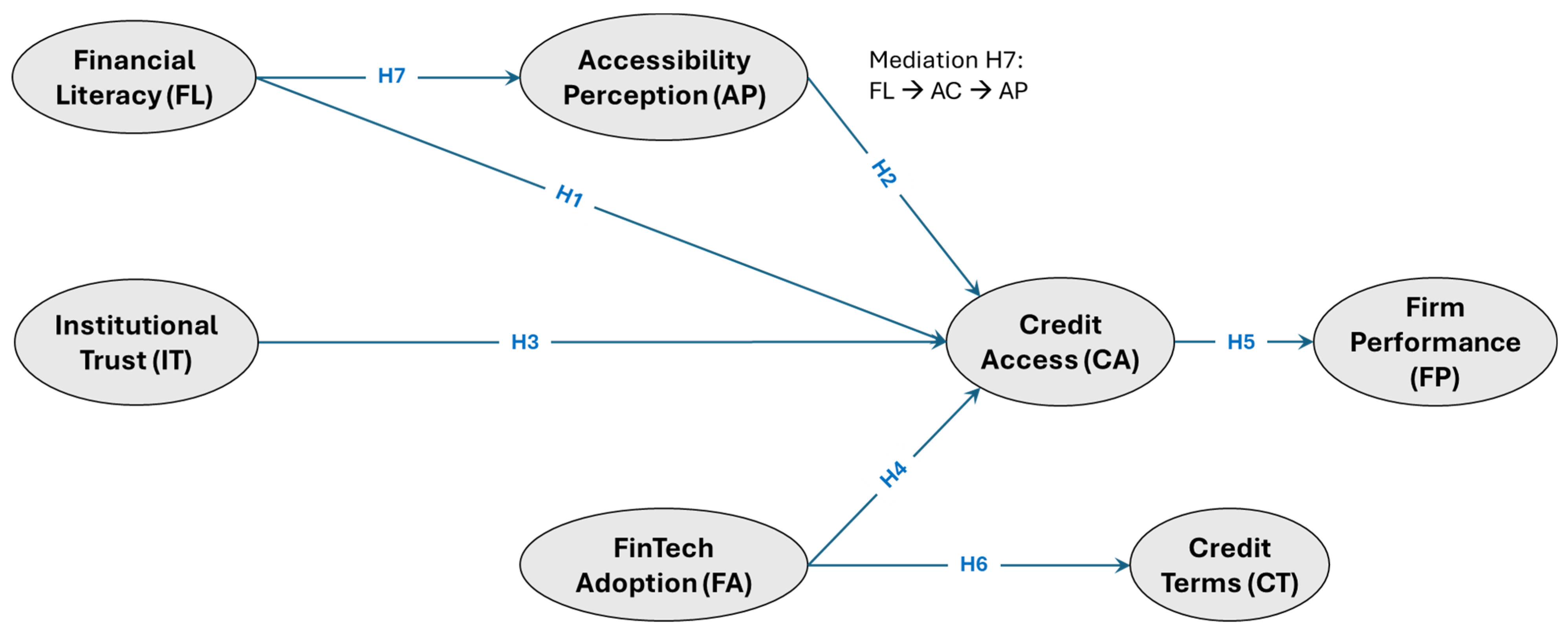
Together, these hypotheses define the research model tested empirically through PLS-SEM and cluster analysis. The hypothesized relationships are visually summarized in Figure 1, which illustrates the direct, mediating, and structural pathways linking behavioral, digital, and institutional determinants to SME access to credit.

3. Materials and Methods

A quantitative, cross-sectional, and explanatory design was adopted, utilizing a probabilistic stratified sampling approach based on economic sector and firm size (micro, small, and medium). This methodological framework is appropriate for the study of MSMEs, as it integrates behavioral variables—financial literacy, perceptions of accessibility, attitudes toward indebtedness, and institutional trust—with digital adoption variables (use of fintech tools).

3.1. Population and Sample

The target population consisted of all micro-, small, and medium-sized enterprises in Ecuador, as shown in Table 2. The sample was obtained through probabilistic stratified sampling by region (Coast and Highlands). The Amazon region was excluded because it represents only about 6% of total firms and exhibits high geographic dispersion. The study focused on services, commerce, information technology, and industry, which together account for approximately 90% of the national business structure.
Sample composition: 561 microenterprises (93.6%), 32 small enterprises (5.4%), and seven medium-sized enterprises (1%). The final sample size of 600 firms ensured adequate statistical power for multivariate analyses and estimator stability under bootstrap procedures in PLS-SEM (Hair et al., 2022). Using the standard formula for sample size determination in finite populations, the margin of error (e) was established at 4%, as shown in Equation (1):
e = Z 2   p   q   ( N n ) n ( N 1 ) = 0.9604 × ( 1,282,528 600 ) 600 × ( 1,282,528 1 ) = 0.04
where
e = margin of error
Z = standard normal constant = 1.96 (for a 95% confidence level)
p = probability of success = 0.5
q = probability of failure = 0.5
N = population size = 1,282,528
n = sample size = 600
Although the study’s title refers to SMEs, the sampling frame includes microenterprises because they constitute more than 90% of Ecuador’s formal business structure and are officially categorized together with small and medium firms under the national MSME classification. Including microenterprises ensures that the sample reflects the actual distribution of firms in the country and captures the behavioral and financial dynamics that characterize the majority of Ecuadorian businesses. For this reason, the terminology “MSMEs” is used throughout the Materials and Methods section when referring to the complete sample.

3.2. Instrument Design

The data collection instrument was a structured survey, validated through expert review and a pilot test. The validation process involved 12 experts—all holding doctoral or master’s degrees in management or economics, with over five years of experience in teaching and research. Additionally, a pilot application of 30 questionnaires was conducted to identify potential adjustments and confirm the instrument’s validity and reliability.
The survey design comprised ten thematic blocks, each corresponding to one or more study variables:
  • Firm information: Company size, year of establishment, sector of activity, legal registration status (active tax ID/RUC), and approximate annual sales (in ranges).
  • Owner or manager profile: Educational level, years of managerial experience, and financial training.
  • Perception of risk: Assessed through a single item using a Likert-type scale.
  • Financial literacy: Assessed through three items on a Likert-type scale.
  • Perceptions of accessibility: Assessed through three items using a Likert-type scale.
  • Trust in financial institutions: Assessed through three items on a Likert-type scale.
  • Banking relationship and credit conditions: Years of relationship with the leading financial institution, existence of active loans, total loan amount (in ranges), main credit conditions (term, interest rate), evaluation of alternative financing sources, and number of financing sources used.
  • Digital adoption and fintech usage: Assessed through three items using a Likert-type scale.
  • Use and purpose of credit: Allocation of credit to (a) maintenance of capacities (technology and infrastructure), (b) capacity expansion, (c) improvement and innovation (product development, digitalization), (d) market development (commercialization), and (e) debt repayment or working capital.
  • Firm performance outcomes: Variations in sales, number of employees, liquidity, and accounts payable improvements.
The data collection process combined face-to-face and online surveys. During administration, informed consent, anonymity, and exclusive academic use of the data were guaranteed.

3.3. Data Processing

The data analysis was conducted in several complementary phases to examine both the theoretical relationships proposed and the exploratory behavioral patterns of SME credit users in Ecuador.

Statistical Analysis and Interpretation

To ensure analytical rigor, multiple complementary statistical methods were applied. Partial Least Squares Structural Equation Modeling (PLS-SEM) was selected for its suitability for predictive behavioral models, its robustness to non-normal data, and its capacity to simultaneously incorporate multiple reflective constructs (Hair et al., 2022). Nonparametric contrast tests (Kruskal–Wallis and Mann–Whitney) were employed to compare behavioral and financial variables across firm size, sector, and educational levels, addressing the non-normal distribution commonly observed in SME datasets.
Cluster analysis using MiniBatch K-Means allowed the identification of behavioral profiles, while Principal Component Analysis (PCA) facilitated visualization and dimensionality reduction. Measurement invariance across subgroups was assessed using the MICOM procedure, enabling valid multi-group comparisons. Together, these methods strengthen the internal consistency of the analysis and the empirical validation of the proposed behavioral–cognitive model.
The first phase involved data cleaning and preparation, including detecting and treating outliers and missing values, as well as assessing internal consistency. Subsequently, descriptive analyses were performed for each variable, followed by nonparametric contrast tests (Kruskal–Wallis and Mann–Whitney) by sector and firm size, and by cluster analysis (k-means) to identify distinct financial management profiles.
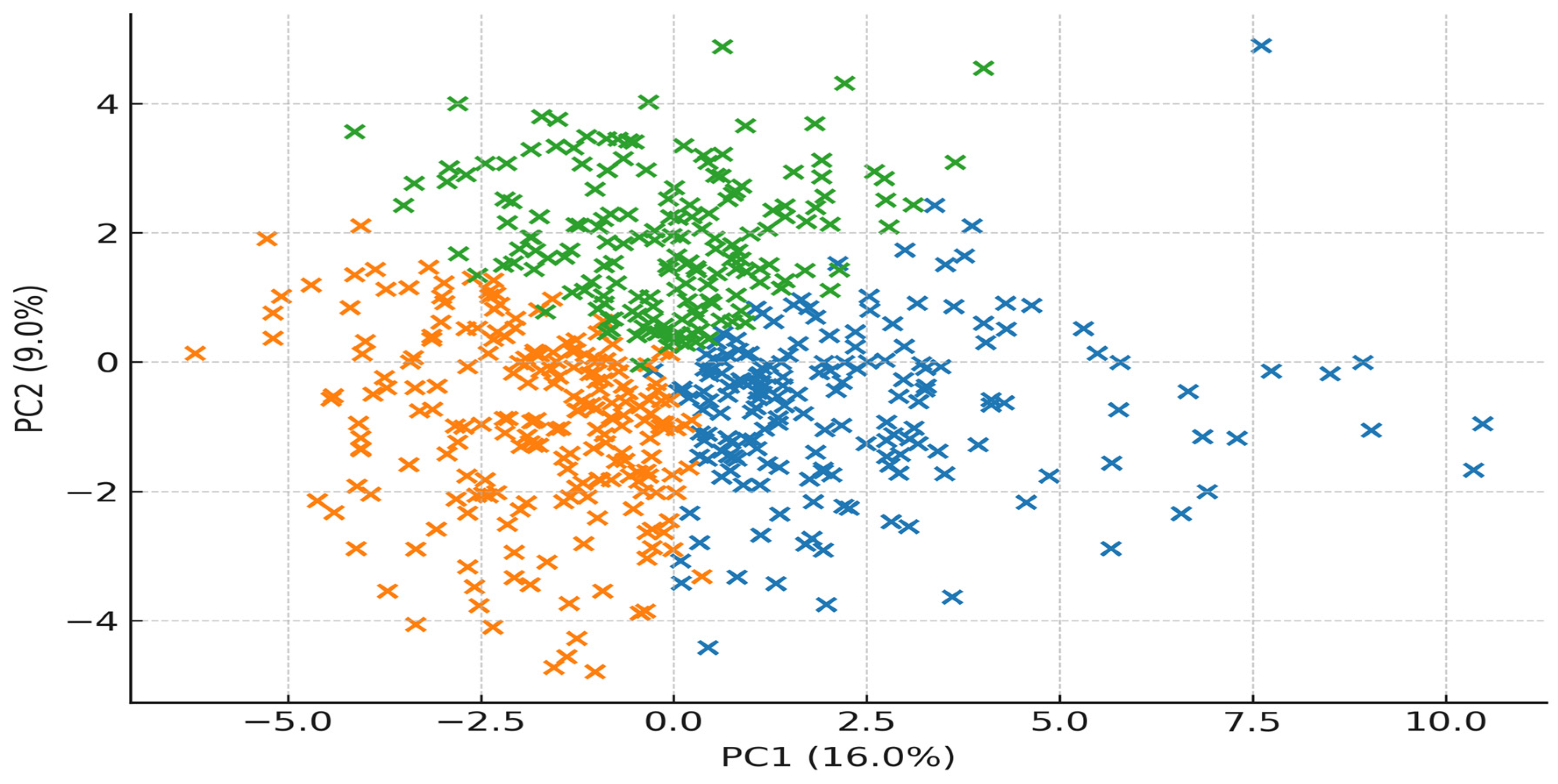
For segmentation, a non-hierarchical cluster analysis was applied using the MiniBatch K-Means algorithm, chosen for its efficiency with medium-sized datasets and its ability to handle both numerical and transformed categorical variables simultaneously. Numerical variables were standardized using z-score normalization after median imputation. In contrast, categorical variables were processed using Feature Hashing, a technique that represents high-cardinality categories in a compact numerical space with minimal information loss. The number of clusters was set to k = 3, based on parsimony and segmentation stability criteria. A Principal Component Analysis (PCA) was subsequently applied to reduce dimensionality and visualize the group structure in a two-dimensional plane, preserving the highest possible proportion of explained variance.
Hypotheses and Analytical Model. Based on the conceptual framework and hypotheses outlined in Section 2.6, the empirical phase tested seven relationships integrating behavioral, digital, and structural variables. Specifically, the model evaluated the influence of financial literacy (FL), accessibility perception (AP), institutional trust (CF), and fintech adoption (FA) on access to credit (CA), credit terms (CT), and firm performance (FP). The mediating role of perceived accessibility in the relationship between financial literacy and credit access was also examined.
The specific hypotheses tested were:
  • H1. Higher financial literacy (FL) → greater access to formal credit (CA).
  • H2. Better perceptions of accessibility (AP) → greater access (AC).
  • H3. Greater institutional trust (IT) → greater access (AC).
  • H4. Higher fintech adoption (FA) → greater access (AC).
  • H5. Greater access (AC) → better firm performance (FP).
  • H6. Fintech adoption (FA) → improved credit terms (CT).
  • H7. (mediation). The effect of financial literacy (FL) on access (AC) is mediated by perceived accessibility (AP).
Structural Equation Modeling. Partial Least Squares Structural Equation Modeling (PLS-SEM) was employed to test the direct hypotheses (H1–H6) and the proposed mediation (H7). This approach was deemed appropriate given the exploratory and predictive nature of the study, the multidimensional structure of the constructs involved (behavioral, perceptual, and structural), and the combination of reflective and formative indicators within the model. Moreover, this method is robust to non-normal data distributions and suitable for medium-sized samples, such as the one used in this research (Hair et al., 2022; Guenther et al., 2023).
The measurement model was assessed against the reliability and validity criteria commonly recommended in the literature: Cronbach’s alpha (α ≥ 0.70), composite reliability (CR ≥ 0.70), average variance extracted (AVE ≥ 0.50), and discriminant validity assessed by the heterotrait–monotrait ratio (HTMT).
For the structural model, the following metrics were reported: path coefficients, coefficients of determination (R2), effect sizes (f2), predictive relevance (Q2), and out-of-sample predictive assessment using PLS-Predict. Statistical significance and robustness of the estimates were evaluated through bootstrapping with 5000 resamples.

4. Results

The analysis of results was structured progressively, beginning with a descriptive characterization of key variables by firm size and economic sector, and subsequently advancing to statistical contrasts and structural modeling. This initial descriptive stage provides an overview of the general behavioral patterns in financial management, credit access, and digital adoption that differentiate Ecuadorian micro-, small, and medium-sized enterprises (MSMEs). In this phase, the study examines the main business, financial, and behavioral indicators, including firm age, credit utilization, performance outcomes, credit conditions, levels of institutional trust, fintech adoption, perceptions of accessibility, and financial literacy.
The expanded statistical procedures outlined in the previous section inform the interpretation of the following results. The descriptive findings and nonparametric contrasts reveal systematic behavioral and financial differences across MSMEs, while the PLS-SEM model provides evidence of the structural relationships hypothesized in the literature. These results are interpreted not merely as numerical outputs but as behavioral patterns consistent with prior research on financial inclusion, institutional trust, and FinTech adoption (OECD, 2022; Ismail & Rashidi, 2025; Abu et al., 2025).
Table 3 summarizes the average behavior of these variables by firm size and sector, providing a comparative view of structural and attitudinal differences across business groups. These descriptive results serve as the foundation for subsequent nonparametric and segmentation analyses to identify distinct financial management profiles within the Ecuadorian MSME landscape.
To ensure complete alignment with the statistical procedures described in Section 3, the presentation of results has been reorganized to explicitly reflect the study’s analytical sequence. The descriptive characterization is followed by nonparametric contrast tests, which determine whether observed differences across firm size, sector, and educational level are statistically significant. These tests provide the empirical foundation for interpreting variations in financial behavior, digital adoption, and credit conditions across MSME groups.
Subsequently, the segmentation analysis using MiniBatch K-Means and PCA is linked directly to the behavioral patterns observed in the descriptive statistics, illustrating how these patterns cluster into three distinct financial profiles. Finally, the PLS-SEM results integrate the behavioral, perceptual, and digital variables into a structural explanation of credit access, with the reported path coefficients, R2 values, and bootstrapped confidence intervals reflecting the model’s statistical rigor. This structure ensures that all results are directly anchored to the statistical methods applied and enhances the transparency and interpretability of the empirical findings.
As shown in Table 3, apparent differences emerge across firm sizes and sectors in terms of credit use, performance, and digital adoption. Medium-sized firms exhibit more diversified credit purposes and stronger financial literacy, whereas microenterprises exhibit greater dependence on working capital and weaker relationships with financial institutions. According to the results, younger firms are concentrated among small enterprises, whereas micro- and medium-sized firms exhibit greater temporal stability. The industrial sector stands out as the oldest, with an average age of 8.13 years.
In terms of credit use, microenterprises show a strong dependence on working capital (64%) and debt repayment (46%). In contrast, small and medium-sized firms diversify their credit utilization toward expansion (62%) and innovation (50%), reflecting a more strategic financial orientation. Notably, microenterprises report almost no allocation of credit to product or process innovation, whereas medium-sized firms allocate half of their credit to innovation activities. It should also be noted that credit can be allocated to multiple purposes, which explains overlapping percentages across categories.
Regarding performance outcomes, a clear upward pattern emerges as firm size increases: variations in sales, employment, and liquidity all rise from micro to medium-sized firms. Industrial firms show the strongest liquidity improvements, outperforming commerce and services. Credit conditions also improve with size, as small and medium-sized enterprises secure more favorable loan terms and interest rates. An atypical result is that microenterprises face slightly higher interest rates, suggesting higher perceived risk and lower investment recovery capacity among these smaller firms.
Beyond performance indicators, Table 3 reveals several statistically significant differences across firm sizes. Kruskal–Wallis tests confirm that financial literacy, institutional trust, and FinTech adoption vary meaningfully between micro-, small, and medium-sized firms (p < 0.05). Medium-sized firms consistently exhibit stronger managerial capabilities—reflected in higher scores on cost calculation, budget preparation, and accounting records—and report higher trust in banks and cooperatives, indicating more stable, long-term financial relationships. Although differences in sales variation (2.96, 3.24, 3.75) may appear modest, Mann–Whitney pairwise comparisons show that they are statistically significant, and their economic relevance lies in their cumulative effect on liquidity, reinvestment capacity, and resilience. Credit-use patterns also differ substantially: microenterprises rely heavily on working capital and debt repayment, whereas medium-sized firms diversify toward expansion and innovation. These contrasts are consistent with the behavioral profiles identified in the cluster analysis, in which more digitally and financially mature firms exhibit stronger performance outcomes.
A related pattern appears in credit access. The average number of years of relationship with the leading financial institution increases sharply with firm size (from 2.56 years among microenterprises to 7.5 years among medium-sized firms). Sectorally, commerce and industry show unusually short relationships—around two years—suggesting weaker or more unstable financial linkages. This may reflect limited perceived solvency, irregular documentation practices, or restrictive institutional mechanisms that inhibit sustained access to formal credit sources.
In terms of institutional trust, banks receive the highest ratings—particularly among medium-sized firms (4.63)—while FinTech institutions obtain the lowest scores. Interestingly, cooperatives are rated very highly by medium-sized enterprises (also 4.63), a pattern not observed in smaller firms. Regarding digital adoption, both microenterprises and the commerce sector show a notable lag (digital wallet and online sales usage below 2.7). Medium-sized firms again lead in online sales (3.63), although these levels remain relatively modest overall.
For perceived accessibility, microenterprises assign lower scores (2.5 for total cost) than medium-sized firms (3.75–4.0), consistent with the previously discussed differences in credit conditions. By sector, industrial firms express the most critical perceptions (2.25 for total cost); however, this should be interpreted with caution since this sector, although older on average, is less represented in both the population and the sample.
Finally, regarding financial literacy, medium-sized enterprises demonstrate higher proficiency in cost calculation (4.62), whereas microenterprises remain significantly behind in accounting records (2.59).
An additional analysis examined the behavior of the variables by the owner’s or manager’s educational level, as presented in Table 4.
According to the previous results, a higher educational level is associated with greater diversification in credit use, particularly toward expansion and commercialization activities. In contrast, managerial experience shows minimal variation across educational levels (approximately three years on average), though it is slightly lower among Level I respondents.
Regarding financial training, higher education does not necessarily translate into greater participation. This suggests that individuals with advanced degrees often specialize in non-administrative or technical areas related to their business activity, rather than in management or finance. In terms of risk aversion, respondents with lower educational attainment are more risk-averse (3.67 at Level I) than those at higher levels (3.43 at Levels III and IV). As for performance outcomes, improvements in liquidity and accounts payable are associated with a higher educational level.
When analyzing credit conditions, both loan terms and interest rates improve with education, reaching the most favorable values at Level IV. Concerning institutional trust, banks receive the highest evaluations at Level II (3.46), while cooperatives are rated more positively at Level I (3.33). The adoption of FinTech technologies receives consistently low ratings across all educational groups, indicating that their implementation and use remain incipient in the Ecuadorian context. In perceived accessibility, indicators improve with education—particularly total cost perception, which rises to 2.98 at Level IV. Similarly, financial literacy scores increase with education level: cost calculation rises from 2.66 at Level I to 2.91 at Level III, showing a clear progression in financial competence among more educated managers.
To determine whether these observed differences were statistically significant, the nonparametric Kruskal–Wallis test was applied to compare the means of numerical variables across three factors: firm size, economic sector, and educational level.
With reference to Table 5, it is important to clarify that not all of the variables listed are treated as dependent variables.
Consistent with the proposed conceptual framework and the PLS-SEM specification, financial literacy and institutional trust are modeled as exogenous constructs. Perceived accessibility and FinTech adoption operate as mediating variables that transmit behavioral and digital effects within the model. Access to credit is specified as the endogenous outcome variable. This structure reflects the hypothesized relationships among behavioral, perceptual, and digital mechanisms shaping SMEs’ financing outcomes.
The variables showing statistically significant differences (p < 0.05) and the direction of their effects are reported below. As shown, most variables exhibit statistically significant mean differences according to firm size. However, among the other demographic factors, sectoral differences were observed only in perceived total cost. At the same time, educational level showed significant differences only in credit access, as measured by the number of sources.
The cluster analysis (see Figure 2) enabled the representation of the three clusters derived from all variables in the dataset within a two-dimensional space. The first principal component (PC1) explains a substantial proportion of the total variance, capturing overall behavioral differences among the groups. In contrast, the second component (PC2) adds complementary variation associated with specific firm characteristics.
The first group is characterized by the highest values in variables associated with firm performance and is predominantly composed of enterprises or individuals with higher educational levels and income. This represents the most consolidated or advanced profile within the sample. The second group shows intermediate values across most variables, reflecting a balanced situation. The distribution of categories reveals a mixed composition, combining features of both the most consolidated and the least developed groups. This cluster represents a transitional or moderate position within the overall structure. The third group is distinguished by lower average scores across variables and a greater concentration of categories linked to lower experience and information levels. In relative terms, it comprises units with limited performance and capability development.
Taken together, the results reveal a clear tripartite structure: a consolidated group with evident advantages, an intermediate group, and a lagging group. These differences may serve as a foundation for targeted support, training, and policy interventions tailored to the specific needs of each segment.
To apply the Partial Least Squares Structural Equation Modeling (PLS-SEM) approach, the constructs were first validated, as summarized in Table 6.
According to the results presented in the table above, the Kaiser–Meyer–Olkin (KMO) values, Bartlett’s test of sphericity, and the Cronbach’s alpha coefficients all exceed the minimum acceptable thresholds, confirming the construct validity and internal consistency of the measurement scales.
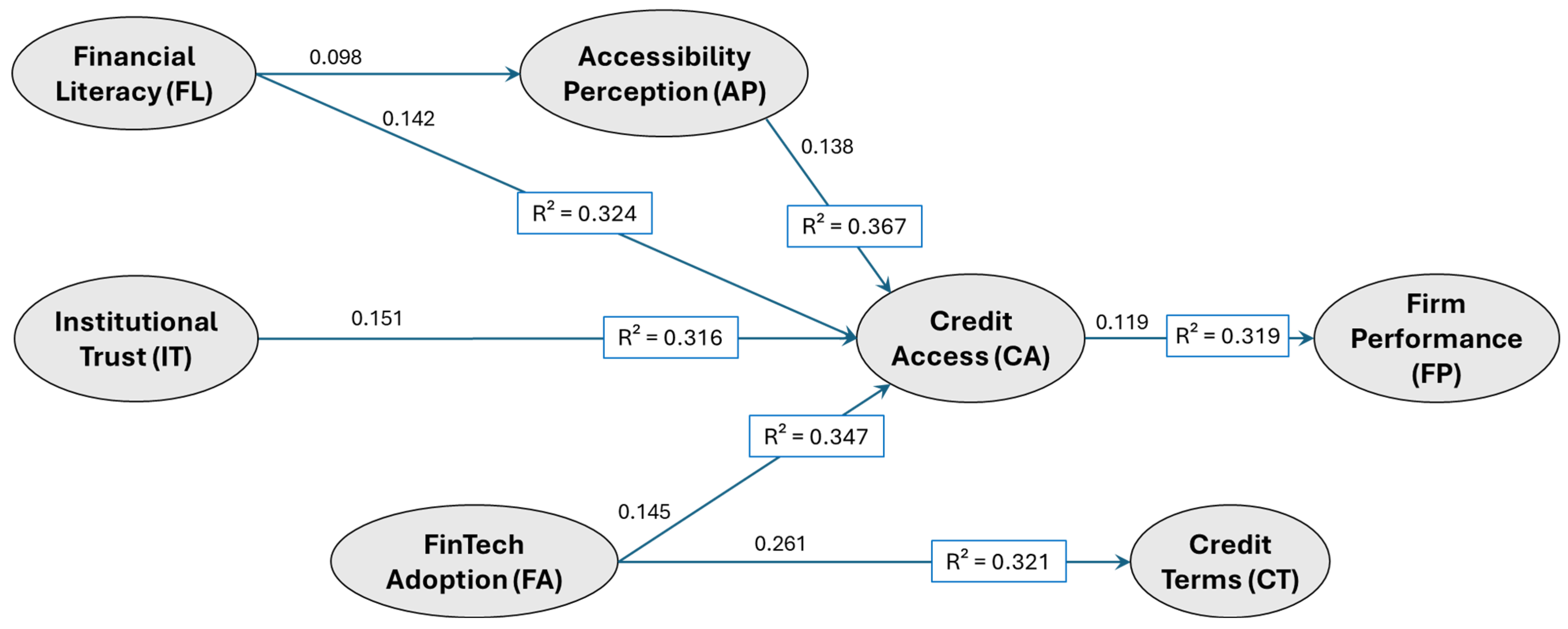
Once construct validation was completed, the Partial Least Squares Structural Equation Modeling (PLS-SEM) analysis was applied to assess the seven proposed hypotheses. The structural model and the relationships among the variables are illustrated in Figure 3.
Although the R2 values for the endogenous constructs (ranging from 0.316 to 0.367) may appear modest when compared with classical regression benchmarks, they are well within acceptable ranges for PLS-SEM models. Unlike ordinary least squares regression, which prioritizes explanatory power, PLS-SEM emphasizes predictive accuracy and is widely used in behavioral, perceptual, and technological adoption research where complex psychological mechanisms typically yield moderate coefficients. In such contexts, R2 values around 0.25–0.40 are considered meaningful indicators of substantive explanatory capacity (Hair et al., 2022). Therefore, the R2 values obtained in Figure 3 reflect adequate predictive relevance for the socio-behavioral and digital variables analyzed in this study.
Table 7 presents the estimated coefficients and associated indicators of the structural model.
The estimated β coefficients and their 95% confidence intervals (CI) support the proposed hypotheses, indicating positive and statistically consistent relationships. Although the β values are not particularly high, all confidence intervals are above zero, confirming the directionality of the effects.
Furthermore, the bootstrapped p-values are below 0.005 for all paths, except for the mediation hypothesis (H7), which slightly exceeds the significance threshold (Chin, 1998). Similarly, the R2 values fall within acceptable ranges, validating the explanatory capacity of the structural relationships tested (Hair et al., 2022).
Multi-Group Analysis and Measurement Invariance. To assess the robustness of the structural relations across socio-demographic subgroups, a multi-group analysis (MGA) was conducted following the Measurement Invariance of Composite Models (MICOM) procedure recommended by Henseler et al. (2015). The analysis compared path coefficients between (a) micro vs. small/medium enterprises and (b) lower vs. higher educational levels of the owner or manager.
The MICOM assessment proceeded in three stages: (1) configural invariance, verified by identical data treatment and model specification across groups; (2) compositional invariance, tested via a 5000-sample permutation procedure to ensure that construct scores were statistically indistinguishable across groups (p > 0.05); and (3) equality of composite means and variances, which confirmed partial measurement invariance—sufficient for meaningful comparison of structural paths.
Results indicated that all main relationships (financial literacy → access to credit; perceived accessibility → access to credit; institutional trust → access to credit; FinTech adoption → access to credit) remained positive and significant across groups, with no statistically significant differences in path coefficients (Δβ, p > 0.05). The mediation of perceived accessibility also retained its sign and magnitude, suggesting that the structural model is stable across socio-demographic strata.
These findings support the robustness and generalizability of the proposed behavioral–cognitive framework: while group-level means differ (as reported in Table 5), the underlying mechanisms linking financial literacy, trust, and digital adoption to credit access appear invariant across firm sizes and education levels.
Table 8 presents the quality indicators used to assess the model’s overall performance. The composite reliability (CR) values range from 0.70 to 0.95, and the average variance extracted (AVE) values are all above 0.50 [15, 19, 20]. Based on these indicators, the model demonstrates satisfactory reliability, convergent validity, and overall measurement quality.
The results in Table 8 confirm that all constructs exhibit high internal consistency and adequate convergent validity. Composite reliability (CR) values range between 0.81 and 0.91, comfortably exceeding the recommended threshold of 0.70, while all AVE values are above 0.50, demonstrating satisfactory variance extraction and construct validity. These findings indicate that the measurement model meets the reliability and validity standards commonly accepted in structural equation modeling (Hair et al., 2022; Fornell & Larcker, 1981; Henseler et al., 2015).
Overall, the results provide robust empirical support for the proposed structural relationships, confirming that behavioral, perceptual, and digital factors significantly influence MSMEs’ access to credit and financial outcomes. The validated constructs and satisfactory quality indicators reinforce the reliability of the measurement model and the consistency of the structural paths tested through PLS-SEM.
These findings establish a solid foundation for the following Discussion section, which interprets the statistical results in light of the theoretical framework, highlighting their conceptual implications, contextual relevance, and policy significance for the financial inclusion of MSMEs in Ecuador.

5. Discussion

The results confirm the relevance of behavioral and perceptual factors in shaping the financial management and credit access of Ecuadorian MSMEs, aligning with recent evidence from emerging economies (Basha et al., 2023; Oktora et al., 2025). The empirical findings demonstrate that financial literacy (FL), perceived accessibility (PA), and trust in financial institutions (CF) exert statistically significant effects on access to credit (AC), although with moderate effect sizes. This pattern suggests that while cognitive abilities and financial attitudes are essential, their influence is conditioned by persistent structural constraints—echoing observations by Abu et al. (2025) on the moderating role of institutional frameworks and government support in FinTech ecosystems (Maleh et al., 2024).
The positive relationship between financial literacy and access to credit (H1) supports the OECD (2022) argument that a stronger understanding of interest rates, loan conditions, and financial costs enhances entrepreneurs’ capacity to evaluate alternatives and make informed borrowing decisions. However, the partial mediation effect of perceived accessibility (H7) indicates that financial knowledge alone is insufficient when entrepreneurs continue to perceive credit procedures, collateral requirements, or administrative processes as restrictive. This finding reinforces the idea that perceived barriers can constrain financial inclusion even among financially literate firms, a dynamic previously highlighted in the Ecuadorian context by Feijó-Cuenca (2023).
Institutional trust also emerges as a significant determinant of access to credit (H2). The structural model reports a statistically significant path (β = 0.151, p < 0.001), indicating that higher trust in banks and cooperatives increases the likelihood of obtaining formal credit. This result is consistent with the descriptive evidence presented in Table 3, which shows that medium-sized firms—characterized by longer and more stable banking relationships—exhibit both higher trust scores and more favorable credit conditions. Non-parametric tests further confirm that trust in banks, cooperatives, and FinTech platforms varies significantly by firm size (p < 0.001), suggesting that institutional trust co-evolves with credit maturity and financial formalization. The cluster analysis reinforces this interpretation, showing that the most consolidated MSME group combines higher institutional trust with superior credit performance. Together, these converging results support the confirmation of H2 and align with recent literature emphasizing institutional legitimacy and relationship-based confidence as key drivers of SME credit behavior in emerging markets (Reyes-Ramírez et al., 2022).
Taken together, this evidence indicates that trust does not operate merely as an attitudinal preference but as a behavioral mechanism that reduces perceived risk and facilitates engagement with formal financial intermediaries. In this sense, trust functions as an intangible asset that enables firms to navigate credit markets more effectively, particularly in institutional environments characterized by information asymmetries and regulatory complexity.
Similarly, trust in financial institutions (H3) significantly influences credit access, confirming that prior relationships with banks or cooperatives and perceptions of institutional transparency contribute to financial legitimacy (Crawford et al., 2024). The comparatively lower levels of trust in FinTech platforms among microenterprises corroborate the digital trust gap identified by Sanga and Aziakpono (2023), who argue that limited familiarity and concerns over security and reliability hinder FinTech adoption in developing contexts. This pattern underscores the behavioral dimension of digital finance, where adoption depends not only on technological availability but also on confidence, familiarity, and perceived institutional safeguards.
The PLS-SEM results further confirm that access to credit positively affects firm performance (H5), in line with evidence reported by Pham et al. (2025) and the World Bank (2025) for Latin American enterprises. Nevertheless, the moderate coefficient (β = 0.119) suggests that credit availability alone does not guarantee substantial productivity or innovation gains without complementary managerial, organizational, and strategic capabilities. The cluster analysis provides additional insight by identifying three distinct MSME profiles: a consolidated group characterized by high financial literacy, strong institutional trust, robust credit access, and superior performance; an intermediate, transitional group; and a lagging group marked by weak financial relationships and low levels of digital adoption. This typology reinforces the notion of entrepreneurial heterogeneity in emerging economies, where financial outcomes reflect both internal capabilities and external institutional conditions (Guenther et al., 2023).
Firm size also plays a decisive role in shaping credit conditions. The finding that medium-sized enterprises enjoy more favorable terms, diversified credit use, and stronger performance aligns with prior research linking size to formality, bargaining power, and institutional embeddedness (Beck et al., 2006). At the same time, the persistence of outlier cases—particularly microenterprises facing higher interest rates and weaker banking relationships—confirms ongoing structural inequities in access to finance. This observation resonates with World Bank (2025) diagnostics, emphasizing the need to reduce transaction costs and improve risk-sharing mechanisms in concentrated financial systems.
Overall, the findings support the importance of integrating structural, behavioral, and cognitive dimensions in the analysis of SME financing decisions, consistent with contemporary behavioral finance perspectives (Ismail & Rashidi, 2025). The inclusion of FinTech adoption (H4, H6) as an explanatory variable introduces an additional layer of analysis, showing that financial digitalization can expand access to credit and improve credit conditions by enhancing transparency and efficiency. These results are consistent with those of Guo et al. (2024), who argue that digital transformation strengthens financial resilience in constrained credit environments.
Beyond firm-level mechanisms, the results are also consistent with a socio-cultural interpretation of financial inclusion in Latin America. In the Ecuadorian context, precautionary norms toward formal finance, past experiences with high effective interest rates, and limited exposure to digital channels shape entrepreneurs’ perceptions of accessibility and institutional trust. Consequently, the positive effects of financial literacy and trust on credit access operate not only as cognitive mechanisms but also as culturally embedded dispositions. Descriptive patterns in the sample support this interpretation: microenterprises report lower literacy levels and weaker banking ties, which coincide with lower trust in FinTech providers and more critical evaluations of costs and requirements.
These dynamics also reflect persistent digital divides across educational levels and firm sizes. Even when basic digital tools are available, adoption is influenced by social cues, perceived self-efficacy, and provider credibility. In this sense, the Ecuadorian MSME ecosystem illustrates how socio-cultural factors—such as trust norms, financial socialization, and informal learning—mediate the translation of financial knowledge into effective access to credit. This perspective helps explain why moderate path coefficients coexist with substantial between-group differences in credit outcomes.
A related dimension concerns perceived risk in digital finance. Regional reports and complementary qualitative evidence indicate that concerns over cybersecurity, data misuse, and redress mechanisms can depress trust and slow FinTech adoption, particularly among microenterprises and first-time users. Although perceived digital risk was not explicitly modeled, the observed patterns of low trust in FinTech and modest levels of digital adoption among smaller firms are consistent with risk-based hesitation. Future research may benefit from explicitly incorporating perceived cyber-risk and consumer protection awareness as mediating constructs.
Finally, the multi-group and MICOM analyses confirm the robustness of the proposed behavioral–cognitive model. Despite significant mean differences across firm sizes and education levels, the structural relationships among financial literacy, perceived accessibility, institutional trust, and FinTech adoption remain statistically invariant. The absence of significant differences in path coefficients across subgroups suggests that the underlying behavioral mechanisms shaping access to credit are structurally stable, even in the presence of socio-demographic heterogeneity. This consistency strengthens the internal validity of the model and provides a solid empirical foundation for the concluding synthesis.

6. Conclusions

6.1. Theoretical Contributions

This study contributes to the literature on SME financing in emerging economies by establishing behavioral, cognitive, and digital factors as core explanatory dimensions of access to credit (Oktora et al., 2025; Ismail & Rashidi, 2025; Sanga & Aziakpono, 2023). By integrating financial literacy, institutional trust, perceived accessibility, and FinTech adoption within a unified analytical framework, the research advances existing models that have traditionally emphasized structural firm characteristics. The findings reinforce the argument that financing decisions cannot be fully understood without incorporating entrepreneurs’ perceptions, knowledge, and trust-related judgments into analytical frameworks.
A central theoretical contribution lies in the empirical validation of perceived accessibility as a mediating mechanism between financial literacy and access to credit. This result extends behavioral finance theory by demonstrating that cognitive capabilities alone are insufficient to ensure financial inclusion when procedural requirements, costs, or institutional practices are perceived as restrictive. In this sense, the study provides theoretical support for self-exclusion mechanisms operating even among financially informed entrepreneurs, highlighting the interaction between knowledge and perceptions in shaping financing outcomes (Feijó-Cuenca, 2023; OECD, 2022).
Institutional trust is also positioned as a key explanatory construct within the model. The study contributes to theory by conceptualizing trust as an intangible asset that facilitates engagement with formal financial intermediaries, reduces perceived risk, and enhances firms’ capacity to secure favorable credit conditions. Our findings empirically demonstrate that higher trust in institutions leads to greater credit uptake and better loan terms, aligning with trust-based theories of SME finance (Kautonen et al., 2020). Moreover, the observed differences in trust toward FinTech platforms across firm sizes enrich the theoretical understanding of digital finance adoption, illustrating how cultural and maturity-related factors condition the diffusion of financial innovations in emerging markets.
Finally, incorporating FinTech adoption as a behavioral–digital construct represents an additional theoretical advance. By demonstrating that financial digitalization influences both access to credit and credit conditions, the study links digital transformation to behavioral heterogeneity among MSMEs (Guo et al., 2024; Sanga & Aziakpono, 2023). The identification of distinct firm profiles through cluster analysis further contributes to the literature by explicitly connecting variations in literacy, trust, and digital engagement with differentiated financial trajectories, offering a more nuanced and behaviorally informed perspective on SME financing in emerging economies.

6.2. Practical and Policy Implications

From a practical and policy perspective, the findings provide concrete guidance for strengthening SME financial inclusion in Ecuador and comparable emerging economies. The first implication concerns the design of targeted financial and digital literacy programs, particularly for microenterprises and first-time borrowers. These initiatives should move beyond basic financial concepts and explicitly address procedural knowledge, cost evaluation, and practical navigation of formal credit channels, thereby reducing self-exclusion driven by perceived complexity.
A second implication relates to the simplification and standardization of credit procedures. The evidence highlights perceptions of complexity, cost, and collateral requirements as critical barriers to credit access. Policy measures such as plain-language disclosures, transparent and standardized collateral criteria, and streamlined application processes can directly reduce perceived inaccessibility, even in contexts where financial knowledge is already present.
Third, the results underscore the importance of trust-building regulatory frameworks for FinTech platforms. Given the comparatively low levels of digital trust among microenterprises, regulators should prioritize data protection, cybersecurity standards, SME-adapted KYC requirements, and accessible complaint-handling and redress mechanisms. Strengthening these safeguards can mitigate perceived risk and foster broader adoption of digital financial services without inhibiting innovation.
Finally, the findings point to the value of coordinated strategies involving public institutions, financial cooperatives, and FinTech providers. Such coordination can support hybrid financing schemes that combine alternative credit scoring models with robust consumer protection frameworks. Aligning financial innovation with the behavioral characteristics and constraints of MSMEs can facilitate more inclusive, transparent, and technology-enabled pathways to credit.

6.3. Limitations

Despite its contributions, this study presents several limitations that should be considered when interpreting the results. First, the analysis is confined to the Ecuadorian context and to four economic sectors—services, commerce, information technology, and industry. Although these sectors represent a substantial share of national economic activity, excluding others, such as agriculture, health, or construction, limits the generalizability of the findings across sectors and territories.
Second, the cross-sectional research design restricts the ability to establish causal relationships and to capture temporal dynamics in financing behavior. While the use of PLS-SEM enabled the examination of complex interactions among behavioral, structural, and digital variables, it does not allow for the observation of changes over time or for assessing responses to macroeconomic or regulatory shocks.
Third, although the model explains an acceptable proportion of variance in access to credit, some constructs—particularly trust in FinTech and perceived accessibility—may be influenced by unobserved factors such as organizational culture, business networks, or gender-related dynamics. In addition, the reliance on self-reported measures may introduce social desirability bias or differences in scale interpretation across respondents, which could affect the precision of specific estimates.

6.4. Directions for Future Research

Future research should build on these limitations by extending the analysis to broader and more diverse samples, including additional economic sectors and underrepresented regions. Longitudinal or panel data designs would be particularly valuable for examining how financial literacy, institutional trust, and FinTech adoption evolve over time and in response to regulatory reforms or macroeconomic shocks.
Further studies could enrich the proposed framework by incorporating additional behavioral and contextual variables, such as perceived digital risk, cybersecurity concerns, data privacy awareness, and consumer-protection knowledge, to understand better their mediating or moderating effects on FinTech adoption and access to credit. Complementary mixed-method approaches—combining survey data with interviews, administrative records, or credit registry information—would also help validate self-reported measures and provide deeper insight into underlying decision-making processes.
Finally, future research could differentiate among specific FinTech tools, such as crowdfunding platforms, blockchain-based financial services, or AI-driven credit scoring systems, to assess their heterogeneous impacts on financial inclusion and firm performance in emerging economies, thereby refining the understanding of digital finance mechanisms across different institutional contexts.

Author Contributions

Conceptualization, R.P.-C.; methodology, G.G.-V., M.D.M.-G., R.X.M.-A., and R.P.-C.; software, R.P.-C. and R.X.M.-A.; validation, M.D.M.-G. and R.X.M.-A.; formal analysis, A.S.-R. and G.G.-V.; investigation, A.S.-R., G.G.-V., M.D.M.-G., R.P.-C., R.X.M.-A., and R.M.-V.; resources, R.M.-V.; data curation, R.P.-C. and R.M.-V.; writing—original draft preparation, R.P.-C.; writing—review and editing, A.S.-R.; visualization, M.D.M.-G. and R.X.M.-A.; supervision, G.G.-V.; R.M.-V.; project administration, G.G.-V. All authors have read and agreed to the published version of the manuscript.

Funding

This research received no external funding.

Institutional Review Board Statement

Ethical review and approval were waived for this study as it involved no biomedical or clinical procedures and was considered minimal-risk research. In accordance with the national regulations of Ecuador (Acuerdo Ministerial 4883, 2013), formal ethical review is required only for research posing physical or psychological risks, while our data were collected through anonymous surveys and interviews with adult participants. All procedures complied with the ethical principles of the Declaration of Helsinki, ensuring informed consent, privacy, voluntary participation, and the right to withdraw without consequence.

Informed Consent Statement

Verbal and written informed consent were obtained from all participants involved in the study.

Data Availability Statement

The original contributions presented in this study are included in the article. Further inquiries can be directed to the corresponding author.

Acknowledgments

The authors thank the anonymous reviewers of the journal for their constructive suggestions, which significantly improved the quality of the article.

Conflicts of Interest

The authors declare no conflicts of interest.

References

  1. Abu, N., da Silva, F. P., & Pedro Rino Vieira, P. R. (2025). Government support for SMEs in the Fintech Era: Enhancing access to finance, survival, and performance. Digital Business, 5(1), 100099. [Google Scholar] [CrossRef]
  2. Aracil, E., Fernández-Méndez, L., Roch-Dupré, D., & Fuertes, F. J. (2025). Trust and financial inclusion: A literature review with reference to the digital transformation. Heliyon, 11(16), e44128. [Google Scholar] [CrossRef]
  3. Basha, S. A., Iqbal, J., & Mohammed, P. (2023). Financial literacy, financial development, and leverage of small firms. International Review of Financial Analysis, 86, 102510. [Google Scholar] [CrossRef]
  4. Beck, T., Demirgüç-Kunt, A., & Maksimovic, V. (2006). Small and medium-size enterprises: Access to finance as a growth constraint. Journal of Banking & Finance, 30(11), 2931–2943. [Google Scholar] [CrossRef]
  5. Chin, W. W. (1998). The partial least squares approach for structural equation modeling. In G. A. Marcoulides (Ed.), Modern methods for business research (pp. 295–336). Lawrence Erlbaum Associates Publishers. [Google Scholar]
  6. Crawford, J., Cui, Z. Y. A., & Kewley, D. (2024). Government finance, loans, and guarantees for small and medium enterprises (SMEs) (2000–2021): A systematic review. Journal of Small Business Management, 62(5), 2607–2637. [Google Scholar] [CrossRef]
  7. Feijó-Cuenca, N. (2023). Behavioral patterns that influence the financing choice of entrepreneurs in Latin America: Focus on Ecuador. Sustainability, 15(8), 6790. [Google Scholar] [CrossRef]
  8. Fornell, C., & Larcker, D. F. (1981). Evaluating structural equation models with unobservable variables and measurement error. Journal of Marketing Research, 18(1), 39–50. [Google Scholar] [CrossRef]
  9. Guenther, P., Guenther, M., Ringle, C. M., Zaefarian, G., & Cartwright, S. (2023). Improving PLS-SEM use for business marketing research. Industrial Marketing Management, 111, 127–142. [Google Scholar] [CrossRef]
  10. Guo, L., Xu, L., Wang, J., & Li, J. (2024). Digital transformation and financing constraints of SMEs: Evidence from China. Asia-Pacific Journal of Accounting & Economics, 31(6), 966–986. [Google Scholar] [CrossRef]
  11. Guzmán, M. M., Campdesuñer, R. P., Rodríguez, A. S., Vidal, G. G., & Vivar, R. M. (2018). Determination of qualitative and quantitative personnel requirements in hotel organizations. International Journal of Business and Management Science, 8(1), 1–19. [Google Scholar]
  12. Hair, J. F., Hult, G. T. M., Ringle, C. M., & Sarstedt, M. A. (2022). Primer on partial least squares structural equation modeling (PLS-SEM) (3rd ed.). Sage Publications. [Google Scholar] [CrossRef]
  13. Henseler, J., Ringle, C. M., & Sarstedt, M. (2015). A new criterion for assessing discriminant validity in variance-based structural equation modeling. Journal of the Academy of Marketing Science, 43(1), 115–135. [Google Scholar] [CrossRef]
  14. Herrera, D. (2020). MSME financing instruments in Latin America and the Caribbean during COVID-19. Inter-American Development Bank. Available online: https://bit.ly/4732feH (accessed on 25 September 2025).
  15. Inter-American Development Bank. (2021). Annual report 2021: Financial statements. Inter-American Development Bank. Available online: https://bit.ly/48GqctF (accessed on 20 September 2025).
  16. Ismail, I. J., & Rashidi, F. U. (2025). Linking dynamic entrepreneurial capabilities and behavioral intentions to adopt FinTech in small and medium enterprises through digital financial innovation. Cogent Business & Management, 12(1). [Google Scholar] [CrossRef]
  17. Kahneman, D., & Tversky, A. (1979). Prospect theory: An analysis of decision under risk. Econometrica, 47(2), 263–291. [Google Scholar] [CrossRef]
  18. Kaiser, H. F. (1974). An index of factorial simplicity. Psychometrika, 39(1), 31–36. [Google Scholar] [CrossRef]
  19. Kautonen, T., Fredriksson, A., Minniti, M., & Moro, A. (2020). Trust-based banking and SMEs’ access to credit. Journal of Business Venturing Insights, 14, e00191. [Google Scholar] [CrossRef]
  20. Maleh, Y., Zhang, J., & Hansali, A. (Eds.). (2024). Advances in emerging financial technology and digital money (1st ed.). CRC Press. [Google Scholar] [CrossRef]
  21. Nugraha, D. P., Setiawan, B., Nathan, R. J., & Fekete-Farkas, M. (2022). Fintech adoption drivers for innovation for SMEs in Indonesia. Journal of Open Innovation: Technology, Market, and Complexity, 8(4), 208. [Google Scholar] [CrossRef]
  22. OECD. (2022). OECD/INFE toolkit for measuring financial literacy and financial inclusion 2022. OECD Publishing. Available online: http://www.oecd.org/financial/education/2022-INFE-Toolkit-Measuring-Finlit-Financial-Inclusion.pdf (accessed on 25 September 2025).
  23. Oktora, Y. S., Pratikto, H., Restuningdiah, N., & Winarno, A. (2025). The impact of entrepreneurial orientation, financial literacy, and financial technology on SME business performance: The mediating role of risk management practices. Edelweiss Applied Science and Technology, 9(9), 1357–1366. [Google Scholar] [CrossRef]
  24. Pham, T., Le, D. V., Le, H. T. T., & Vo, L. V. (2025). External financing and innovation in small and medium enterprises—The case of Vietnam. Asian Economic Papers, 24(2), 59–86. [Google Scholar] [CrossRef]
  25. Reyes-Ramírez, L. A., Leyva-Del Toro, C., Pérez-Campdesuñer, R., & Sánchez-Rodríguez, A. (2022). Variables of corporate social responsibility: A structural equation model. Retos Ecuador, 12(24), 286–305. [Google Scholar] [CrossRef]
  26. Sanga, D., & Aziakpono, M. (2023). FinTech and SMEs financing: A systematic literature review and bibliometric analysis. Digital Business, 3, 100067. [Google Scholar] [CrossRef]
  27. Sánchez-Rodríguez, A., Martínez-Vivar, R., & Moreno-Lázaro, J. (2017). Labor competency management within the context of the process of political and economic changes in Cuba. Innovar, 27(66), 169–184. [Google Scholar] [CrossRef]
  28. World Bank. (2025). Access to finance for MSMEs in Ecuador: A firm-level evaluation. World Bank Publications. Available online: https://openknowledge.worldbank.org/handle/10986/41703 (accessed on 22 September 2025).
Figure 1. Conceptual model and representation of the hypotheses.
Jrfm 19 00064 g001
Figure 2. Cluster analysis.
Jrfm 19 00064 g002
Figure 3. Structural equation model of the variables under analysis.
Jrfm 19 00064 g003
Table 1. Key variables influencing SME access to credit: domains and representative literature.
VariableAnalytical DomainKey References
Financial literacyCognitive/behavioralBasha et al. (2023); Oktora et al. (2025)
Perceived accessibilityAttitudinal/perceptualFeijó-Cuenca (2023)
Attitudes toward debt and financial riskBehavioral/psychologicalAbu et al. (2025)
Institutional trustPerceptual/emotionalFeijó-Cuenca (2023); Guo et al. (2024)
Credit search and usage behaviorBehavioral/strategicPham et al. (2025)
FinTech adoptionDigital/innovativeIsmail & Rashidi (2025)
Public policy and credit guaranteesStructural/institutionalCrawford et al. (2024); World Bank (2025)
Firm size, age, and sectorStructural/demographicBeck et al. (2006); Crawford et al. (2024); Sanga and Aziakpono (2023); World Bank (2025)
Table 2. Characterization of the population and the sample.
SectorMicroSmallMediumTotal%Cumulative %Sample Size
Services486,71519,3202415508,45039.6439.64276
Commerce364,63817,4773618385,73330.0869.72209
Information Technology125,78612,8642204140,85410.9880.7076
Industry67,653323164671,5305.5886.2839
Total of sectors considered1,044,79252,89288831,106,56786.28600
Table 3. Behavior of variables by firm size and economic sector.
VariablesFirm SizeEconomic Sector
MicroSmallMediumCommerceIndustryITServices
Years since establishment3.842.834.253.528.133.713.90
Usage
patterns
Maintenance36485039753635
Expansion35625039384333
Innovation 521508017
Commercialization82150110117
Debt repayment46212538634249
Working capital64282564505960
Firms
performance
Sales variation2.963.243.752.903.253.093.01
Employee variation2.983.453.502.993.132.993.03
Liquidity improvement2.983.453.883.013.253.053.01
Accounts payable improvement2.993.593.252.983.253.083.03
Credit
terms
Loan term3.033.413.503.073.003.183.00
Interest rate3.093.382.753.113.383.133.07
Credit accessYears with a leading financial institution2.564.417.502.722.002.872.79
Active loans3.013.483.883.052.883.113.04
Evaluation of alternatives3.023.413.633.073.003.013.03
Number of financing sources2.983.453.883.022.883.003.01
Institutional trustBanks3.363.664.633.333.383.433.43
Cooperatives2.993.314.632.973.003.033.09
FinTechs2.692.934.002.732.752.702.72
Fintech
adoption
FinTech use2.843.724.382.882.882.822.95
Digital wallet2.613.523.882.662.502.632.70
Online sales2.423.313.632.472.752.492.48
Accessibility perceptionAccess to credit2.893.454.002.922.882.892.95
Collateral requirements2.703.174.132.772.752.672.75
Total cost2.503.173.752.562.252.552.56
Financial
literacy
Cost calculation2.963.824.623.013.003.003.05
Budget preparation2.783.654.122.823.002.762.88
Accounting records2.593.414.122.602.382.612.71
Table 4. The behavior of variables by the educational level of the owner or manager.
VariableEducational Level
IIIIIIIV
Manager’s personal dataYears since establishment4.674.133.594.13
Administrative experience3.033.243.083.25
Percentage with financial training66.6748.0341.1342.86
Risk aversion3.673.563.433.43
Usage
patterns
Maintenance33.3333.0738.0339.29
Expansion23.3335.4336.0642.86
Innovation0.005.517.891.19
Market development2.057.099.309.52
Debt repayment66.6744.8844.2344.05
Working capital100.0062.9960.8558.33
Firms performanceSales variation3.002.942.973.11
Employment variation3.332.973.023.00
Liquidity improvement3.003.023.013.07
Accounts payable improvement3.332.943.033.10
Credit termsLoan term2.673.023.043.17
Interest rate3.333.193.053.15
Credit accessYears of relationship1.672.842.682.79
Active loans3.003.093.043.01
Evaluation of alternatives2.673.063.002.99
Number of financing sources3.003.023.052.93
Institutional trustBanks3.003.463.363.43
Cooperatives3.333.162.993.02
FinTechs3.002.752.712.70
Fintech adoptionFinTech use3.003.052.872.82
Digital wallet3.002.712.672.62
Online sales2.002.512.472.51
Aaccessibility perceptionAccess to credit2.652.722.792.88
Collateral requirements2.672.792.852.85
Total cost2.682.722.812.98
Financial literacyCost calculation2.662.812.912.88
Budget preparation2.692.872.872.77
Accounting records2.772.882.882.85
Table 5. Results of the mean comparison tests.
Dependent VariableDemographic VariableStatisticp-ValueSignificance
Managerial experiencesize233.4900.0000(***)
Credit use for innovationsize376.3460.0000(***)
Credit use for commercializationsize231.0570.0000(***)
Credit access: years of relationshipsize754.2460.0000(***)
Credit access: number of sourcessize407.1540.0000(***)
Credit terms: amountsize238.0000.0000(***)
Credit access: evaluation of alternativessize350.3790.0000(***)
Trust in bankssize228.0230.0000(***)
Trust in cooperativessize305.4180.0000(***)
Trust in FinTechssize219.6460.0000(***)
FinTech adoptionsize544.1110.0000(***)
Digital wallet usesize500.5030.0000(***)
Online sales adoptionsize435.8070.0000(***)
Perceived access to creditsize418.2590.0000(***)
Perceived collateral requirementssize474.7980.0000(***)
Perceived total costsize513.9360.0000(***)
Credit use for working capitalsize193.9250.0001(**)
Accounts payable improvementsize141.0570.0009(**)
Liquidity improvementsize110.4860.0040(**)
Employment variationsize92.9810.0096(**)
Credit use for capacity expansionsize91.7340.0102(*)
Credit use for debt repaymentsize83.9420.0150(*)
Credit access: number of sourcesEducational level92.3260.0264(*)
Perceived total costsector91.3890.0275(*)
Active credit accountssize65.9970.0369(*)
Sales variationsize64.6370.0395(*)
Note: Only variables with statistically significant differences are included. Significance levels are interpreted as follows: p < 0.05 → Significant (*); p < 0.01 → Highly significant (**); and p < 0.001 → Very highly significant (***).
Table 6. Validation of the associated constructs.
ConstructInitial ItemsKMO
(Value/Reference)
Bartlett’s Test (p)Cronbach’s Alpha (Value/Reference)
Financial literacy30.72/≥0.70p < 0.0010.78/≥0.70
Credit access 60.77/≥0.70p < 0.0010.81/≥0.70
Accessibility perceptions30.75/≥0.70p < 0.0010.79/≥0.70
Institutional trust 30.73/≥0.70p < 0.050.74/≥0.70
FinTech adoption30.76/≥0.70p < 0.050.75/≥0.70
Credit terms20.71/≥0.70p < 0.050.78/≥0.70
Firms performance40.77/≥0.70p < 0.050.76/≥0.70
Note: Kaiser (1974) and Hair et al. (2022).
Table 7. Estimated values in the model.
HypothesisEstimated β95% CIpbootR2
H1: FL → CA0.142[0.046, 0.114]0.0010.324
H2: AP → CA0.138[0.091, 0.121]0.0000.367
H3: IT → CA0.151[0.079, 0.112]0.0000.316
H4: FA → CA0.145[0.057, 0.227]0.0020.347
H5: CA → FP0.119[0.104, 0.155]0.0030.319
H6: FA → CT0.261[0.153, 0.271]0.0010.321
H7: FL → AP0.098[0.013, 0.118]0.006
Note: FL = Financial Literacy; CA = Credit Access; AP = Accessibility Perception; IT = Institutional trust; FA = FinTech Adoption; FP = Firm Performance; CT = Credit Terms.
Table 8. Model quality indicators.
DimensionComposite Reliability (CR)Average Variance Extracted (AVE)
FL (Financial Literacy)0.8120.761
CA (Credit Access)0.8730.645
AP (Accessibility Perception)0.9070.733
IT (Institutional Trust)0.8290.589
FA (FinTech Adoption)0.8380.748
FP (Firm Performance)0.8570.815
CT (Credit Terms)0.8910.783
Disclaimer/Publisher’s Note: The statements, opinions and data contained in all publications are solely those of the individual author(s) and contributor(s) and not of MDPI and/or the editor(s). MDPI and/or the editor(s) disclaim responsibility for any injury to people or property resulting from any ideas, methods, instructions or products referred to in the content.