Article

Novel Insights into the Enigmatic Genetics of Male Breast Cancer in China

1
Key Laboratory of Breast Cancer in Shanghai, Department of Breast Surgery, Precision Cancer Medicine Center, Fudan University Shanghai Cancer Center, Shanghai 200032, China
2
Shanghai Key Laboratory of Systems Regulation and Clinical Translation for Cancer, State Key Laboratory of Systems Medicine for Cancer, Shanghai Cancer Institute, Shanghai 200127, China
*
Author to whom correspondence should be addressed.
Pathophysiology 2026, 33(1), 9; https://doi.org/10.3390/pathophysiology33010009

Submission received: 30 November 2025 / Revised: 4 January 2026 / Accepted: 15 January 2026 / Published: 20 January 2026
(This article belongs to the Collection Feature Papers in Pathophysiology)

Abstract

Objectives: The molecular characterization of male breast cancer (MaBC) has long been understudied, primarily due to its rare occurrence. Clinical management of MaBC remains profoundly challenging, with current therapeutic strategies largely extrapolated from female breast cancer protocols. Methods: Through panel-based sequencing targeting BRCA1, BRCA2, and PALB2 variants, we delineated the genomic landscape of 96 MaBC cases. Subsequent whole-exome sequencing (WES) of 84 BRCA1/2- and PALB2-mutation-negative MaBC patients, compared against 4480 healthy controls, revealed compelling findings. Results: Pathogenic variants in BRCA1/2 and PALB2 were identified in 14.6% (14/96) of MaBC cases, with BRCA2 mutations predominating at 12.5% (n = 12). Notably, one patient harbored the BRCA1 c.4015G > T stop-gained mutation, while another exhibited the PALB2 c.481_482dupGA alteration. Our analysis further uncovered 170 pathogenic/likely pathogenic mutations, with RAD50, DMD, ARSA, and ABCC6 demonstrating recurrent mutations in MaBC. Conclusions: As the inaugural germline genomic investigation of MaBC in a Han Chinese population, this work reveals clinically actionable alterations with diagnostic and therapeutic implications. These discoveries not only advance our understanding of MaBC’s molecular architecture but also underscore the critical need for dedicated research into this malignancy.
Keywords: male breast cancer; panel-based sequencing; whole-exome sequencing; BRCA1/2; PALB2 male breast cancer; panel-based sequencing; whole-exome sequencing; BRCA1/2; PALB2
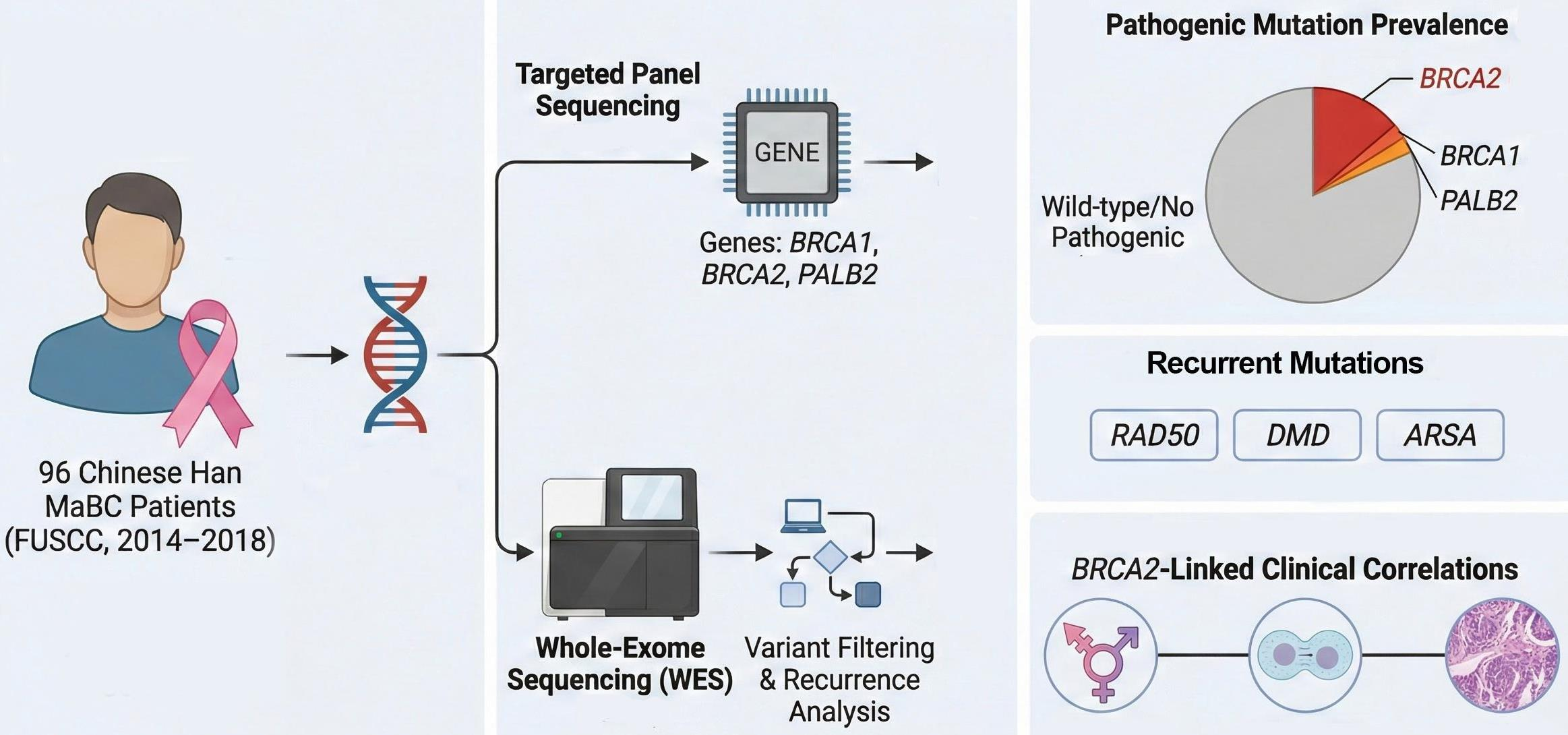
Graphical Abstract