Article

Novel Insights into the Enigmatic Genetics of Male Breast Cancer in China

1
Key Laboratory of Breast Cancer in Shanghai, Department of Breast Surgery, Precision Cancer Medicine Center, Fudan University Shanghai Cancer Center, Shanghai 200032, China
2
Shanghai Key Laboratory of Systems Regulation and Clinical Translation for Cancer, State Key Laboratory of Systems Medicine for Cancer, Shanghai Cancer Institute, Shanghai 200127, China
*
Author to whom correspondence should be addressed.
Pathophysiology 2026, 33(1), 9; https://doi.org/10.3390/pathophysiology33010009

Submission received: 30 November 2025 / Revised: 4 January 2026 / Accepted: 15 January 2026 / Published: 20 January 2026
(This article belongs to the Collection Feature Papers in Pathophysiology)

Abstract

Objectives: The molecular characterization of male breast cancer (MaBC) has long been understudied, primarily due to its rare occurrence. Clinical management of MaBC remains profoundly challenging, with current therapeutic strategies largely extrapolated from female breast cancer protocols. Methods: Through panel-based sequencing targeting BRCA1, BRCA2, and PALB2 variants, we delineated the genomic landscape of 96 MaBC cases. Subsequent whole-exome sequencing (WES) of 84 BRCA1/2- and PALB2-mutation-negative MaBC patients, compared against 4480 healthy controls, revealed compelling findings. Results: Pathogenic variants in BRCA1/2 and PALB2 were identified in 14.6% (14/96) of MaBC cases, with BRCA2 mutations predominating at 12.5% (n = 12). Notably, one patient harbored the BRCA1 c.4015G > T stop-gained mutation, while another exhibited the PALB2 c.481_482dupGA alteration. Our analysis further uncovered 170 pathogenic/likely pathogenic mutations, with RAD50, DMD, ARSA, and ABCC6 demonstrating recurrent mutations in MaBC. Conclusions: As the inaugural germline genomic investigation of MaBC in a Han Chinese population, this work reveals clinically actionable alterations with diagnostic and therapeutic implications. These discoveries not only advance our understanding of MaBC’s molecular architecture but also underscore the critical need for dedicated research into this malignancy.

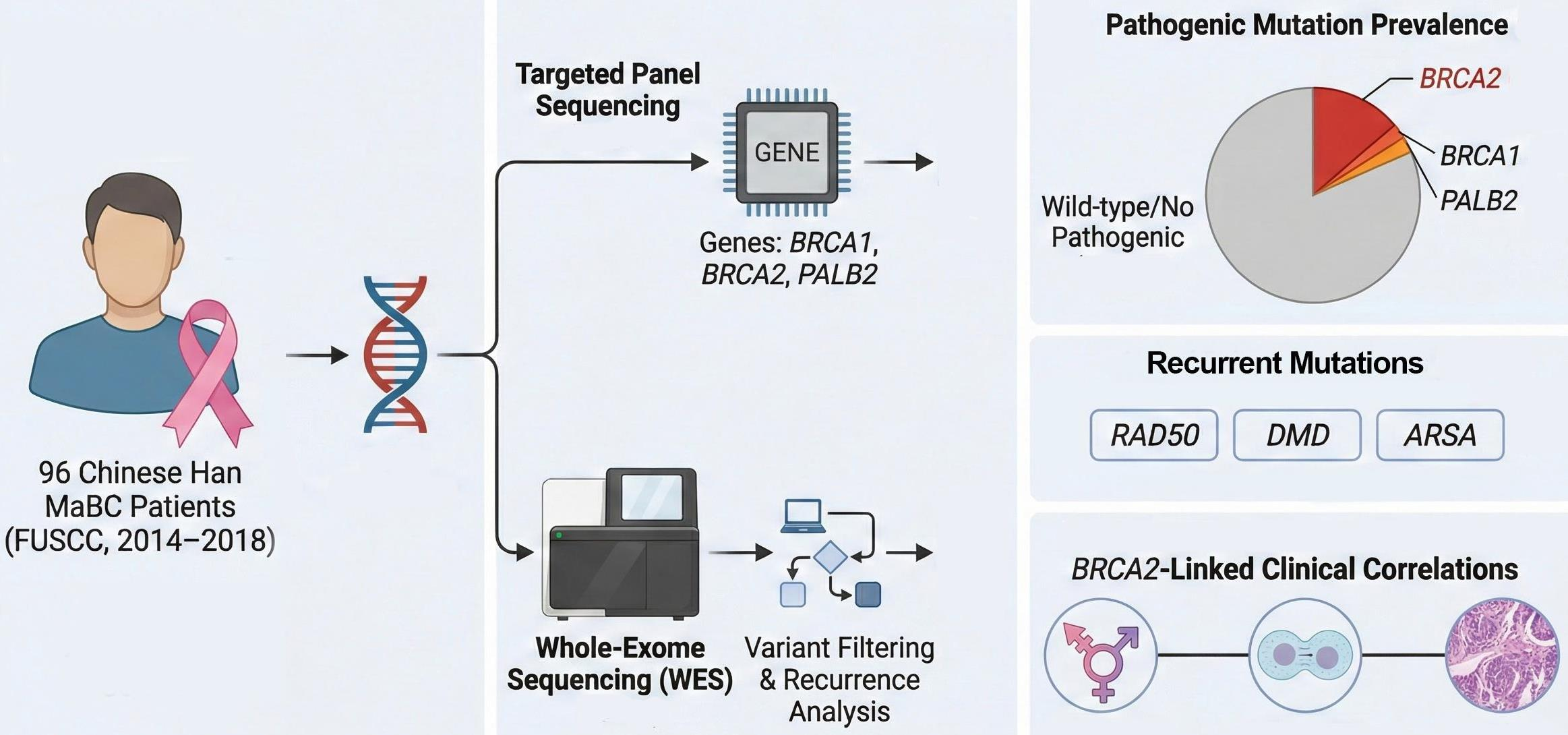
Graphical Abstract

1. Introduction

Male breast cancer (MaBC) represents a rare malignancy, constituting approximately 1% of all breast carcinomas and less than 1% of total cancer diagnoses in males [1,2]. Epidemiological data from 2016 estimated 2400 new cases and 440 breast cancer-associated mortalities among MaBC patients in the United States [3]. The limited availability of comprehensive clinical data—including patient demographics, tumor biology, therapeutic interventions, and prognostic outcomes—stems from the disease’s low incidence. Current clinical management predominantly relies on therapeutic paradigms extrapolated from female breast cancer studies, with insufficient characterization of MaBC-specific clinicopathological features. Furthermore, molecular profiling of MaBC remains inadequately explored. In this investigation, we performed panel-based sequencing analysis of BRCA1, BRCA2, and PALB2 genes in 96 consecutive MaBC patients of Chinese Han ethnicity. Our primary objectives were to (1) determine the prevalence and spectrum of germline mutations in BRCA1/2 and PALB2 among Chinese male breast cancer patients and (2) conduct whole-exome sequencing (WES) to identify potential driver mutations underlying clinical manifestations in MaBC.

2. Materials and Methods

2.1. Study Population

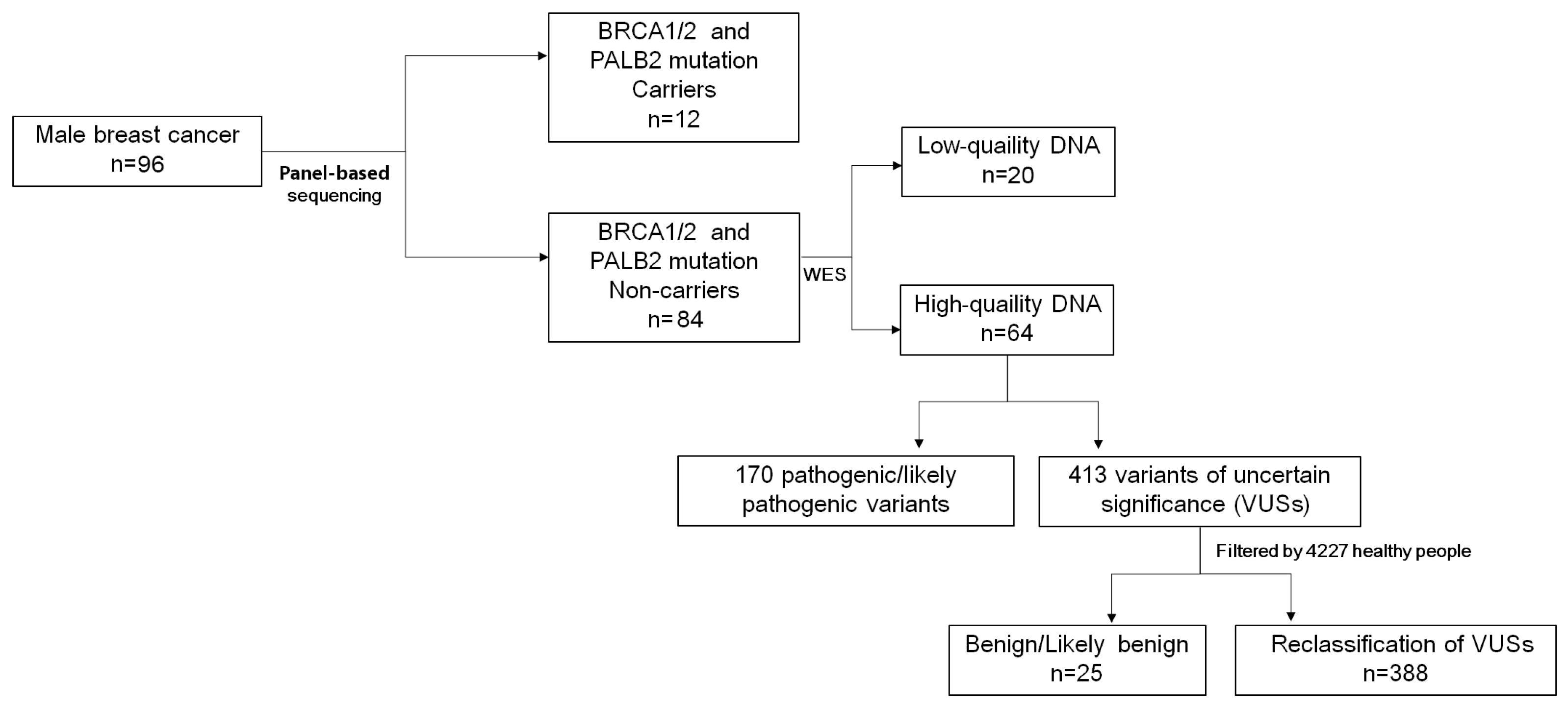
A cohort comprising 96 MaBC patients was consecutively enrolled at Fudan University Shanghai Cancer Center (Shanghai, China) between January 2014 and November 2018. The study cohort comprised 4480 healthy control subjects obtained from a publicly available genetic database maintained by Zhejiang University School of Medicine (Hangzhou, China) [1,2,3]. Each participant signed a written informed consent form and ethical consent. This study received ethical approval from the Institutional Review Board of Fudan University Shanghai Cancer Center, with written informed consent obtained from all participants prior to sample collection and data acquisition. Clinically significant germline mutations were determined in our cohort of 96 unselected MaBC patients, according to Figure 1.

2.2. Targeted Sequencing

Peripheral blood specimens and comprehensive phenotypic data were systematically collected from all study participants. Genomic DNA extraction was performed using the VAZYME Blood Genomic DNA Kit (Vazyme Medical Technology, Nanjing, China) following the manufacturer’s protocols. The target-specific primers for the coding sequences of BRCA1 (NM_007300), BRCA2(NM_000059) and PALB2 (NM_024675) were designed using Primer3 as described previously [1]. The universal sequences (CS1: ACACTGACGACATGGTTCTACA; CS2: TACGGTAGCAGAGACTTGGTCT) were appended at the 5′-end of each left and right primer, respectively. Pre-amplification for tagged amplicon deep sequencing (TAm-Seq): The coding sequences of the two genes were amplified using a 6 µL PCR reaction mixture containing 3 µL of KAPA 2G Robust HotStart ReadyMix (2X) (Kapa Biosystems, Boston, MA, USA), 1 µL of primer mix with a 500 nM final concentration, and 2 µL of DNA template (10 ng/µL). The PCR conditions were as follows: initial denaturation for 2 min at 95 °C; 45 cycles of denaturation for 30 s at 95 °C, 30 s of annealing at 56 °C, and 1 min of extension at 72 °C; and a final extension step for 5 min at 72 °C. Following PCR amplification, 1.5 µL of Shrimp Aalkaline Phosphatase (SAP, Affymetrixx, Santa Clara, CA, USA)/Exonuclease I (Exo I, BioLabss, Ipswich, MA, USA) mix was added to 2.5 µL of PCR product and incubated for 60 min at 37 °C and then for 20 min at 80 °C. The SAP/Exo I mix contained 600 µL of SAP (1 U/µL), 240 µL of SAP buffer, 150 µL of Exo I (20,000 U/mL), 200 µL of Exo I buffer, and 3000 µL of ddH2O.
Sequencing adaptor and barcode primer addition were performed as described previously. The barcode primers (Fluidigmm Corporation, South San Francisco, CA, USA) consisted of the PE1 and PE2 sequences for Illumina cluster generation, a 10 bp barcode, and the CS1 and CS2 adaptors, used in pairs: PE1-CS1 with PE2-BC-CS2, and PE1-CS2 with PE2-BC-CS1. For each sample, 1 μL of the 100-fold-diluted PCR product was added to one of two PCR plates containing 9 μL of pre-sample mix containing 0.4 μL of 1 U/μL KAPA HiFi HotStart DNA Polymerase, 4 μL of 5× KAPA HiFi Buffer, 120 μM of each dNTP, and 4 μL of ddH2O. On the first plate, 10 μL of one primer pair containing an individual 10-base barcode (BC) sequence and tags for reading in one direction (PE1-BC-CS1 + PE2-CS2) was added to each well. On the second plate, 10 μL of primers containing (PE1-BC-CS2 + PE2-CS1) was added to each well. The corresponding wells on both plates contained primers with the same barcode sequence. Plated reaction products were amplified for 12 cycles: 95 °C for 10 min; 12 cycles of 95 °C for 15 s; 60 °C for 30 s; 72 °C for 3 min; and 1 cycle of 72 °C for 3 min.
For the DNA library, PCR products were barcoded and analyzed using gel electrophoresis to ensure that the expected insertion size was obtained. The products were then pooled together with an equal volume and purified using AMPure XP beads (Beckman Coulter, Indianapolis, IN, USA). The targeted DNA fragment was selected and extracted using E-Gel Precast Agarose Electrophoresis (ThermoFisher Scientific, Waltham, MA, USA) and the QIAquick Gel Extraction Kit (Qiagen, Santa Clara, CA, USA). The library was quantified by Agilent BioAnalyzer (Agilent, Santa Clara, CA, USA) and sequenced using the Illumina Xten platforms with paired-end reads of 150 bp as per the manufacturer’s instructions. Custom sequencing primers targeted to CS1 and CS2 targeted the paired reads and 10-base indexing (barcode) read as per the recommendations of Fluidigm.

2.3. Whole-Exome Sequencing

Briefly, 1 µg of DNA was sheared into short fragments (200–300 bp) using a Covaris S220 ultrasonicator (Covaris, Woburn, MA, USA). The DNA fragments were then end-repaired to generate adenylated 3′ ends. Adaptors with barcode sequences were then ligated to both ends of the fragments, and E-Gels were used to select DNA fragments of the targeted size. Next, 10 PCR cycles were performed, and the resulting product was purified. Whole-exome capture was performed using a TruSeq Exome Enrichment kit (Illumina, San Diego, CA, USA) according to the manufacturer’s protocol with slight modifications. After the Illumina sequencing libraries were amplified with 10 PCR cycles, capture probes were added, and the reaction mixtures were incubated at 65 °C for 24 h. The hybridized mixtures were then amplified with an additional 10 PCR cycles. The captured DNA libraries were sequenced with the Illumina HiSeq 2500 Genome Analyzer (Illumina, San Diego, CA, USA), yielding 200 (2 × 100) base pairs from the final library fragments.

2.4. NGS Data Processing and Variant Calling

Sequencing reads were aligned to the hg19 reference genome using Burrows-Wheeler Aligner (BWA, v0.7.13) [4], and the Genome Analysis Toolkit (GATK, v3.4) [5] was used for base quality score recalibration, indel realignment, and variant calling. We used GATK to filter the variants, with (i) QD < 2.0, (ii) MQ < 40.0, (iii) MQRankSum < −12.5, and (iv) ReadPosRankSum < −8.0 required. Variant functions were predicted using SnpEff (http://snpeff.sourceforge.net, accessed on 15 February 2018), PolyPhen-2 (http://genetics.bwh.harvard.edu/pph2/, accessed on 15 February 2018), PROVEAN (http://provean.jcvi.org/index.php, accessed on 15 February 2018), and SIFT (https://sift.bii.a-star.edu.sg/, accessed on 15 February 2018). Variant population frequency was annotated with ExAC (http://exac.broadinstitute.org, accessed on 15 February 2018), the 1000 Genomes database, and an internal database.

2.5. Variant Interpretation

In this study, only novel variants or variants with <1% population frequency in 1000 Genomes or ExAC were collected. The clinical significance of each variant was annotated according to the ACMG/AMP guidelines, using association results from this study, known clinical significance information from ClinVar (http://www.ncbi.nlm.nih.gov/clinvar/, accessed on 15 February 2018), computational data from in silico programs, and functional data. We manually inspected each variant using the Integrative Genomics Viewer to rule out false positives. After the annotation, the results were compared with classifications in ClinVar to identify additional information and determine the final classification of each variant, collapsed from a 5-tier to 3-tier classification system: pathogenic, benign, and uncertain significance. Variants classified to be pathogenic or likely pathogenic were considered pathogenic in this study. All pathogenic variants were validated by Sanger sequencing.

2.6. Statistical Analysis

Statistical comparisons of mutational status across clinicopathological characteristics in BRCA mutation carriers were conducted using Pearson’s chi-square test supplemented by Fisher’s exact test where appropriate. All statistical analyses were performed with SPSS Statistics software (Version 20.0; IBM Corporation, Armonk, NY, USA). A two-tailed alpha level of 0.05 was established a priori as the threshold for statistical significance throughout the study.

3. Results

3.1. BRCA1/2 and PALB2 Germline Mutations in Male Breast Cancer

Through targeted sequencing, our present investigation identified twelve deleterious germline mutations in BRCA1/2 and PALB2 genes among twelve of ninety-seven unselected MaBC patients, as detailed in Table 1. The observed prevalence rates exhibited marked heterogeneity in their distribution patterns: BRCA1 mutations were identified in a single MaBC case, BRCA2 mutations manifested in ten cases, and PALB2 mutations were detected in a separate case. Molecular characterization revealed that the ten BRCA2 mutations comprised six nonsense variants and four frameshift alterations. Notably, one patient exhibited a pathogenic BRCA1 c.4015G > T stop-gained mutation, while another carried a PALB2 c.481_482dupGA frameshift mutation confirmed as deleterious through clinical interpretation.

3.2. Frequent Germline Variants in Male Breast Cancer

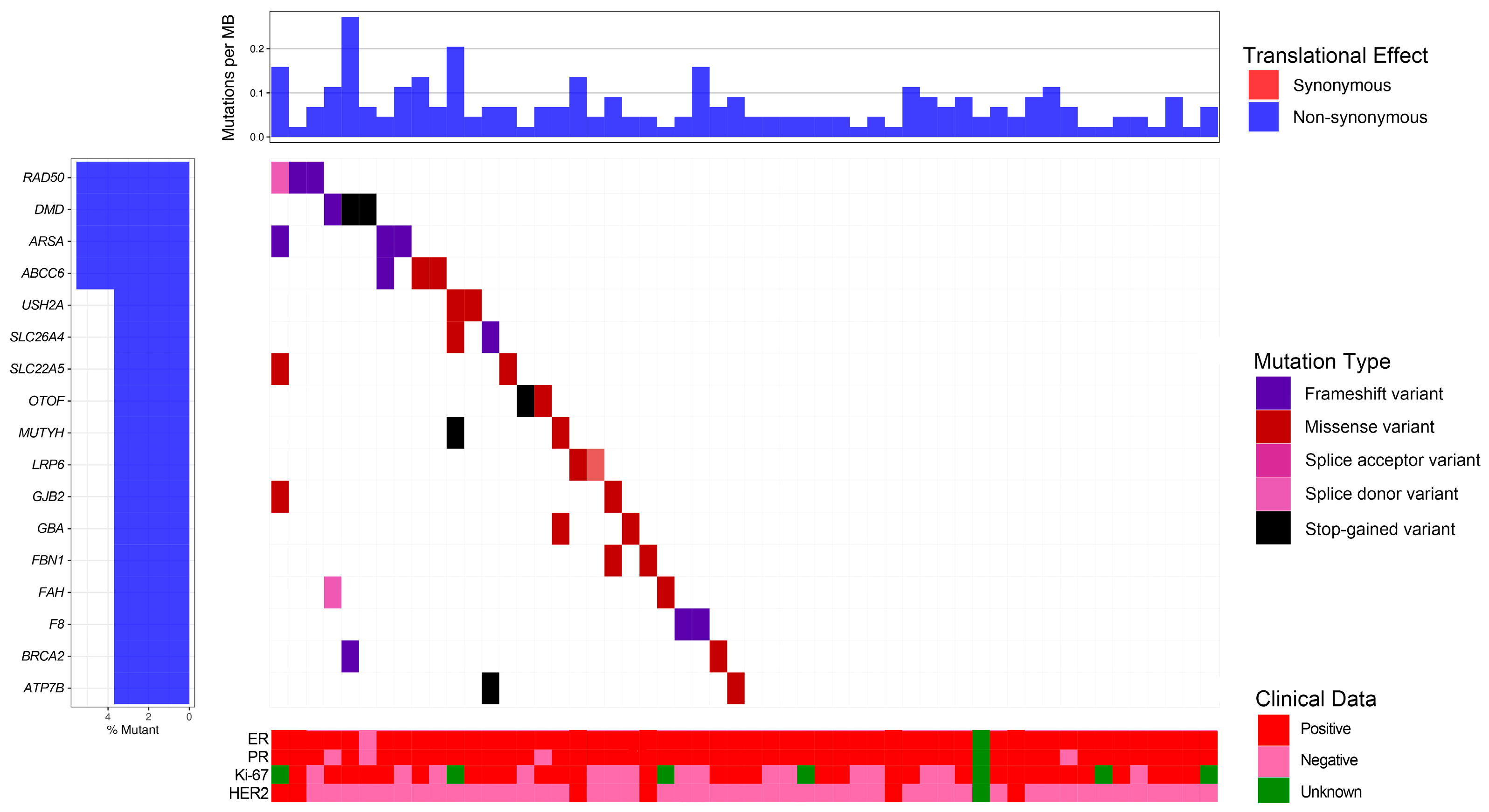
Subsequently, we employed whole-exome sequencing (WES) to investigate other frequent variants in the rest of 84 BRCA1/2 non-mutated samples. Following quality control assessment, 20 patients were excluded due to insufficient DNA integrity and quantity (15 samples for low DNA amount, 4 samples for low sequencing depths, and 1 sample for pollution). Comprehensive analysis of WES data derived from the remaining 64 MaBC cases revealed 170 pathogenic variants (Figure 2 and Supplementary Table S1) alongside 388 variants of uncertain significance (VUSs) (Supplementary Table S2), with 25 VUSs excluded based on comparative analysis with control population data. Our WES analysis revealed two additional BRCA2 mutations (c.5073delA and c.3387G > C) that were not detected in the targeted sequencing platform. Table 2 enumerates the four most prevalent pathogenic/likely pathogenic germline mutations identified, notably the RAD50, DMD, ARSA, and ABCC6 genes, which were recurrently identified in three or more cases. These genetic aberrations potentially constitute impact on the oncogenesis and progression of MaBC. The mutational spectrum of the seven most frequently identified VUS-associated genes—TTN, ATN1, ATXN3, SCN5A, DYSF, MYO7A, and POLE—is exhaustively documented in Supplementary Table S2.

3.3. Associations Between MaBC Patients’ Characteristics and Mutation Status

We further explored the correlations between clinicopathological features of MaBCs and BRCA1/2 or PALB2 gene mutation status, with detailed results presented in Table 3. All identified mutations occurred in invasive breast carcinomas, including one case of encapsulated papillary carcinoma. All mutation carriers exhibited ER/PR-positive and HER2-negative molecular subtypes. Comparative analysis revealed potential differences in proliferative activity and tumor differentiation between mutation-positive and -negative groups. Specifically, the group with a BRCA1/2 or PALB2 mutation demonstrated a trend toward higher Ki-67 expression levels (85.7% vs. 59.8% with ≥15% positivity threshold; p = 0.061). Similarly, histological grading showed a higher proportion of grade 3 tumors in the mutation-positive cohort (42.9% vs. 18.3%; p = 0.077), though neither comparison reached statistical significance. Both groups demonstrated comparable distributions in tumor size (T classification), lymph node status, and TNM staging parameters.

4. Discussion

The number of cases of MaBC diagnosed is limited, and it has worse outcomes compared with female breast cancer [6]. Therefore, multi-institutional collaborative efforts will be essential to identify specific biomarkers for MaBC and further elucidate the molecular pathogenesis of this malignancy. Utilizing a hospital-based cohort, this investigation presents the first comprehensive genomic landscape of MaBC in the Chinese population. Our analysis revealed 14 deleterious germline mutations in the BRCA1/2 and PALB2 genes, along with 170 pathogenic/likely pathogenic variants and 388 VUSs. This study establishes foundational germline mutation profiles for MaBC, which constitutes a valuable reference for advancing mechanistic research and therapeutic development in this understudied disease entity.
Accurate interpretation of BRCA1/2 variants is critical for risk assessment and precise treatment of breast cancer [7,8,9]. PALB2 is an important DNA repair gene that is essential for its function in homologous recombination [10]. In the DNA damage response, PALB2 links BRCA1 and BRCA2, implementing the recombinational repair and checkpoint functions of BRCA2 in maintaining genome integrity [11]. This genomic profiling study systematically analyzed BRCA1/2 and PALB2 mutations in 96 consecutive MaBC cases without familial predisposition screening. The mutation spectrum revealed recurrent pathogenic variants in BRCA2 (12.5%), significantly exceeding mutation rates observed in BRCA1 (1.04%) and PALB2 (1.04%). Targeted sequencing identified four exon 11 truncating mutations in BRCA2 (p.Leu824 *, p.Glu2139 *, p.Leu1908fs, p.Gln1037 *), with whole-exome sequencing uncovering two additional exon 11 variants (p.Lys1691fs and p.Gln1129His), documented in Supplementary Table S1. Notably, two novel exon 22 mutations (p.Gln2960 * and p.Gln2941fs) were detected in functionally critical regions of BRCA2. These findings corroborate our prior research cohort (n = 46) showing 15.2% BRCA2 mutation prevalence without BRCA1 carriers. Comparatively, population-level data from UK MaBC cases demonstrates a 6% BRCA2 mutation frequency, consistent with the established predominance of BRCA2 over BRCA1 alterations in male breast prediposition [12]. A US-based study examined 115 male breast cancer patients and identified 18 individuals carrying pathogenic BRCA2 genetic mutations [13]. Our analysis demonstrates a statistically significant predominance of BRCA2 mutations over BRCA1 mutations in male breast cancer cohorts. Genetic profiling within our cohort identified a pathogenic BRCA1 nonsense mutation (c.4015G > T, p.Glu1339Ter) in one patient and a deleterious PALB2 frameshift variant (c.482_483delAG, p.Asp161GlyfsTer7) in another case. These findings align with previous research by Silvestri et al., who reported the recurrent BRCA1 c.1984A > T (p.Lys662 *) nonsense mutation through targeted sequencing of PALB2 in 48 BRCA1/2-negative MaBC specimens [14]. The mutagenic characteristics elucidated through our panel-based genomic profiling advance our understanding of the epidemiological distribution and mutational landscape of BRCA1/2 and PALB2 genes in MaBC.
No statistically significant associations were observed between mutation status and clinicopathological features. This lack of significance is likely attributable to limited statistical power, stemming from two main factors: the rarity of male breast cancer (which constitutes only about 1% of all breast cancer cases) and the low mutation-positive rate within our cohort. Nonetheless, potential trends in the data—such as a higher prevalence of invasive carcinoma (p = 0.061) and higher tumor grade (p = 0.077) in the mutation-positive group—may suggest a tendency toward more aggressive disease in this population. However, these observations should be interpreted with caution due to the small sample size, which restricts the generalizability and definitive interpretation of the findings.
The current study describes an in-depth exome analysis of the germline mutational landscape of MaBC. Among the significant MaBC-related genes identified in our study, RAD50, DMD, ARSA and ABCC6 were detected multi-foci mutations. RAD50, a cancer susceptibility gene, encodes a component of MRN (Mre11-RAD50-Nbs1), which participates in DNA double-strand break repair and DNA-damage checkpoint activation [15,16,17,18]. DMD plays roles in numerous biochemical processes [19,20]. ARSA takes part in nervous system development [21,22]. ABCC6 is involved in cardiovascular diseases [23,24]. The role of these deleterious mutations in MaBC progress remains to be defined.
In summary, this study constitutes a comprehensive exome-wide profiling of MaBC mutations. Our panel-based and whole-exome sequencing analyses delineated distinctive mutational characteristics specific to Chinese MaBC populations. These novel findings significantly advance our comprehension of mutational processes in MaBC pathogenesis through their genotoxic manifestations. The identification of recurrently mutated novel target genes provides critical insights into the evolutionary dynamics underlying complex mutational profiles during MaBC progression. Moreover, prioritizing the investigation of mutagenic mechanisms implicated in MaBC initiation should constitute a critical research focus. Systematic functional validation studies will be conducted to elucidate the potential utility of these genetic markers for MaBC risk assessment and early detection.

Supplementary Materials

The following supporting information can be downloaded at https://www.mdpi.com/article/10.3390/pathophysiology33010009/s1. Table S1: The 170 pathogenic/likely pathogenic germline mutations in 64 male breast cancer cases. Table S2. The 413 VUS germline mutations in 64 male breast cancer cases.

Author Contributions

Conceptualization, Z.-M.S. and Z.H.; methodology, Y.L.; software, Y.L.; validation, X.-L.W. and G.-T.L. and Z.H.; formal analysis, X.-L.W.; data curation, Y.L.; writing—original draft preparation, G.-T.L.; writing—review and editing, G.-T.L. and Z.H.; visualization, X.-L.W. and X.H.; supervision, Z.H. All authors have read and agreed to the published version of the manuscript.

Funding

This research received no external funding.

Institutional Review Board Statement

The study was conducted in accordance with the Declaration of Helsinki and approved by the Institutional Review Board of Fudan University Shanghai Cancer Center (approval code: 1905202-3; approval date: 10 June 2019).

Informed Consent Statement

Informed consent was obtained from all subjects involved in the study.

Data Availability Statement

The original contributions presented in this study are included in the article/Supplementary Materials. Further inquiries can be directed to the corresponding authors.

Acknowledgments

All authors have reviewed and edited the output and take full responsibility for the content of this publication.

Conflicts of Interest

The authors declare no conflicts of interest.

Abbreviations

The following abbreviations are used in this manuscript:
MaBCMale breast cancer
BRCABreast Cancer Susceptibility Gene
WESWhole-exome sequencing
VUSVariant of uncertain significance

References

  1. Zhu, X.W.; Liu, K.Q.; Wang, P.Y.; Liu, J.Q.; Chen, J.Y.; Xu, X.J.; Xu, J.J.; Qiu, M.C.; Sun, Y.; Liu, C.; et al. Cohort profile: The Westlake BioBank for Chinese (WBBC) pilot project. BMJ Open 2021, 11, e045564. [Google Scholar] [CrossRef]
  2. Cong, P.K.; Bai, W.Y.; Li, J.C.; Yang, M.Y.; Khederzadeh, S.; Gai, S.R.; Li, N.; Liu, Y.H.; Yu, S.H.; Zhao, W.W.; et al. Genomic analyses of 10,376 individuals in the Westlake BioBank for Chinese (WBBC) pilot project. Nat. Commun. 2022, 13, 2939. [Google Scholar] [CrossRef]
  3. Cong, P.K.; Khederzadeh, S.; Yuan, C.D.; Ma, R.J.; Zhang, Y.Y.; Liu, J.Q.; Yu, S.H.; Xu, L.; Gao, J.H.; Pan, H.X.; et al. Identification of clinically actionable secondary genetic variants from whole-genome sequencing in a large-scale Chinese population. Clin. Transl. Med. 2022, 12, e866. [Google Scholar] [CrossRef]
  4. Li, H.; Durbin, R. Fast and accurate short read alignment with Burrows-Wheeler transform. Bioinformatics 2009, 25, 1754–1760. [Google Scholar] [CrossRef]
  5. McKenna, A.; Hanna, M.; Banks, E.; Sivachenko, A.; Cibulskis, K.; Kernytsky, A.; Garimella, K.; Altshuler, D.; Gabriel, S.; Daly, M.; et al. The Genome Analysis Toolkit: A MapReduce framework for analyzing next-generation DNA sequencing data. Genome Res. 2010, 20, 1297–1303. [Google Scholar] [CrossRef]
  6. Xie, J.; Ying, Y.Y.; Xu, B.; Li, Y.; Zhang, X.; Li, C. Metastasis pattern and prognosis of male breast cancer patients in US: A population-based study from SEER database. Ther. Adv. Med. Oncol. 2019, 11, 1758835919889003. [Google Scholar] [CrossRef] [PubMed]
  7. Sun, J.; Meng, H.; Yao, L.; Lv, M.; Bai, J.; Zhang, J.; Wang, L.; Ouyang, T.; Li, J.; Wang, T.; et al. Germline Mutations in Cancer Susceptibility Genes in a Large Series of Unselected Breast Cancer Patients. Clin. Cancer Res. 2017, 23, 6113–6119. [Google Scholar] [CrossRef] [PubMed]
  8. Findlay, G.M.; Daza, R.M.; Martin, B.; Zhang, M.D.; Leith, A.P.; Gasperini, M.; Janizek, J.D.; Huang, X.; Starita, L.M.; Shendure, J. Accurate classification of BRCA1 variants with saturation genome editing. Nature 2018, 562, 217–222. [Google Scholar] [CrossRef] [PubMed]
  9. Bhaskaran, S.P.; Chandratre, K.; Gupta, H.; Zhang, L.; Wang, X.; Cui, J.; Kim, Y.C.; Sinha, S.; Jiang, L.; Lu, B.; et al. Germline variation in BRCA1/2 is highly ethnic-specific: Evidence from over 30,000 Chinese hereditary breast and ovarian cancer patients. Int. J. Cancer 2019, 145, 962–973. [Google Scholar] [CrossRef]
  10. Zhang, F.; Ma, J.; Wu, J.; Ye, L.; Cai, H.; Xia, B.; Yu, X. PALB2 links BRCA1 and BRCA2 in the DNA-damage response. Curr. Biol. CB 2009, 19, 524–529. [Google Scholar] [CrossRef]
  11. Sy, S.M.; Huen, M.S.; Zhu, Y.; Chen, J. PALB2 regulates recombinational repair through chromatin association and oligomerization. J. Biol. Chem. 2009, 284, 18302–18310. [Google Scholar] [CrossRef]
  12. Basham, V.M.; Lipscombe, J.M.; Ward, J.M.; Gayther, S.A.; Ponder, B.A.; Easton, D.F.; Pharoah, P.D. BRCA1 and BRCA2 mutations in a population-based study of male breast cancer. Breast Cancer Res. 2002, 4, R2. [Google Scholar] [CrossRef] [PubMed]
  13. Ding, Y.C.; Steele, L.; Kuan, C.J.; Greilac, S.; Neuhausen, S.L. Mutations in BRCA2 and PALB2 in male breast cancer cases from the United States. Breast Cancer Res. Treat. 2011, 126, 771–778. [Google Scholar] [CrossRef] [PubMed]
  14. Silvestri, V.; Zelli, V.; Valentini, V.; Rizzolo, P.; Navazio, A.S.; Coppa, A.; Agata, S.; Oliani, C.; Barana, D.; Castrignano, T.; et al. Whole-exome sequencing and targeted gene sequencing provide insights into the role of PALB2 as a male breast cancer susceptibility gene. Cancer 2017, 123, 210–218. [Google Scholar] [CrossRef]
  15. Apessos, A.; Agiannitopoulos, K.; Pepe, G.; Tsaousis, G.N.; Pitta, P.; Bili, C.; Florentin, L.; Saloustros, E.; Kampletsas, E.; Tryfonopoulos, D.; et al. Genetic Predisposition to Male Breast Cancer: A Case Series. Anticancer Res. 2022, 42, 5795–5801. [Google Scholar] [CrossRef] [PubMed]
  16. Karamat, U.; Ejaz, S. Overexpression of RAD50 is the Marker of Poor Prognosis and Drug Resistance in Breast Cancer Patients. Curr. Cancer Drug Targets 2021, 21, 163–176. [Google Scholar] [CrossRef]
  17. George, T.J.; Lee, J.H.; DeRemer, D.L.; Hosein, P.J.; Staal, S.; Markham, M.J.; Jones, D.; Daily, K.C.; Chatzkel, J.A.; Ramnaraign, B.H.; et al. Phase II Trial of the PARP Inhibitor, Niraparib, in BAP1 and Other DNA Damage Response Pathway-Deficient Neoplasms. JCO Precis. Oncol. 2024, 8, e2400406. [Google Scholar] [CrossRef]
  18. Zetrini, A.E.; Abbasi, A.Z.; He, C.; Lip, H.; Alradwan, I.; Rauth, A.M.; Henderson, J.T.; Wu, X.Y. Targeting DNA damage repair mechanism by using RAD50-silencing siRNA nanoparticles to enhance radiotherapy in triple negative breast cancer. Mater. Today Bio 2024, 28, 101206. [Google Scholar] [CrossRef]
  19. Le Borgne, J.; Gomez, L.; Heikkinen, S.; Amin, N.; Ahmad, S.; Choi, S.H.; Bis, J.; Grenier-Boley, B.; Rodriguez, O.G.; Kleineidam, L.; et al. X-chromosome-wide association study for Alzheimer’s disease. Mol. Psychiatry 2025, 30, 2335–2346. [Google Scholar] [CrossRef]
  20. Jepsen, W.M.; Fazenbaker, A.; Ramsey, K.; Bonfitto, A.; Naymik, M.; Turner, B.; Sloan, J.; Tiwari, N.; Bernes, S.M.; Neilson, D.E.; et al. Duchenne Muscular Dystrophy in Two Half-Brothers Due to Inherited 306 Kb Inverted Insertion of 10p15.1 into Intron 44 of the Dp427m Transcript of the DMD Gene. Int. J. Mol. Sci. 2024, 25, 11922. [Google Scholar] [CrossRef]
  21. Mahendran, G.; Breger, K.; McCown, P.J.; Hulewicz, J.P.; Bhandari, T.; Addepalli, B.; Brown, J.A. Multi-Omics Approach Reveals Genes and Pathways Affected in Miller-Dieker Syndrome. Mol. Neurobiol. 2025, 62, 5073–5094. [Google Scholar] [CrossRef] [PubMed]
  22. Rabin, R.; Hirsch, Y.; Booth, K.T.A.; Hall, P.L.; Yachelevich, N.; Mistry, P.K.; Ekstein, J.; Pappas, J. ARSA Variant Associated With Late Infantile Metachromatic Leukodystrophy and Carrier Rate in Individuals of Ashkenazi Jewish Ancestry. Am. J. Med. Genet. Part A 2025, 197, e63919. [Google Scholar] [CrossRef]
  23. Harmsen, I.M.; Visseren, F.L.J.; Kok, M.; de Jong, P.A.; Spiering, W. Arterial calcification volume is associated with a higher risk of cardiovascular events in pseudoxanthoma elasticum. Atherosclerosis 2024, 400, 119051. [Google Scholar] [CrossRef] [PubMed]
  24. Desai, D.; Maheta, D.; Agrawal, S.P.; Soni, Z.; Frishman, W.H.; Aronow, W.S. Cardiovascular Manifestations of Pseudoxanthoma Elasticum: Pathophysiology, Management, and Research. Cardiol. Rev. 2024. Epub ahead of printing. [Google Scholar] [CrossRef] [PubMed]
Figure 1. Study design and workflow.
Pathophysiology 33 00009 g001
Figure 2. The spectrum of the pathogenic/likely pathogenic germline mutations by whole-exome sequencing analysis.
Pathophysiology 33 00009 g002
Table 1. Pathogenic/likely pathogenic BRCA1/2 and PALB2 mutations identified in 12 male breast cancer cases.
SampleGeneSystematic NomenclatureHGVS Protein ChangeAnnotationClinical Significance
1BRCA2c.8878C > Tp.Gln2960 *Stop-gainedPathogenic
2BRCA2c.2471T > Gp.Leu824 *Stop-gainedPathogenic
3BRCA2c.7558C > Tp.Arg2520 *Stop-gainedPathogenic
4BRCA2c.8172delGp.Trp2725fsFrameshiftLikely pathogenic
5BRCA2c.6415G > Tp.Glu2139 * Stop-gainedLikely pathogenic
6BRCA2c.5722_5723delCTp.Leu1908fsFrameshiftPathogenic
7PALB2c.481_482dupGAp.Asp161fsFrameshiftLikely pathogenic
8BRCA2c.37G > Tp.Glu13 *Stop-gainedPathogenic
9BRCA2c.1773_1776delTTATp.Ile591fsFrameshiftPathogenic
10BRCA2c.3109C > Tp.Gln1037 *Stop-gainedPathogenic
11BRCA2c.8820_8823delACAAp.Gln2941fsFrameshiftLikely pathogenic
12BRCA1c.4015G > Tp.Glu1339 *Stop-gainedPathogenic
* Terminal Codon.
Table 2. The top four pathogenic/likely pathogenic germline mutation-genes in 64 male breast cancer cases.
IDGeneSystematic NomenclatureHGVS Protein ChangeAnnotationClinical Significance
ly6876RAD50c.2165delAp.Lys722fsFrameshiftPathogenic
ly6853RAD50c.1245 + 2C > A Splicing variantLikely pathogenic
ly6762RAD50c.2165dupAp.Glu723fsFrameshiftPathogenic
ly6825DMDc.4000G > Tp.Gly1334 *Stop-gainedPathogenic/Likely pathogenic
ly6885DMDc.5697delAp.Lys1899fsFrameshiftPathogenic
ly6886DMDc.5530C > Tp.Arg1844 *Stop-gainedPathogenic
ly6820ARSAc.418delCp.His140fsFrameshiftLikely pathogenic
ly6870ARSAc.1492delCp.Arg498fsFrameshiftLikely pathogenic
ly6853ARSAc.302delGp.Gly101fsFrameshiftPathogenic
ly6884ABCC6c.1990C > Tp.Pro664SerMissensePathogenic
ly6820ABCC6c.196dupTp.Ser66fsFrameshiftPathogenic
ly6865ABCC6c.3412C > Tp.Arg1138TrpMissensePathogenic
* Terminal Codon.
Table 3. Association of MaBC characteristics with BRCA1/2 or PALB2 mutation status.
CharacteristicsNo. of PatientsMutation Statusp
Non-Carriers (N = )Carriers (N = )
No.%No.%
Histologic classification
Carcinoma in situ667.3%0 0.0%0.061
Invasive ductal carcinoma675465.9%13 92.9%
Other invasive carcinoma232226.8%1 7.1%
ER status
Negative333.7%0 0.0%0.525
Positive927895.1%14 100.0%
Unknown111.2%0 0.0%
PR status
Negative889.8%0 0.0%0.224
Positive877389.0%14 100.0%
Unknown111.2%0 0.0%
HER2 status
Negative887490.2%14 100.0%0.267
Positive667.3%0 0.0%
Unknown222.4%0 0.0%
Ki67 status
<15%252429.3%1 7.1%0.112
≥15%614959.8%12 85.7%
Unknown10911.0%1 7.1%
Tumor size
≤2 cm736275.6%11 78.6%0.556
>2 cm232024.4%3 21.4%
Tumor grade
I222.4%0 0.0%0.077
II463947.6%7 50.0%
III211518.3%6 42.9%
Unknown272631.7%1 7.1%
Cancer emboli
Negative272429.3%3 21.4%0.301
Positive524251.2%10 71.4%
Unknown171619.5%1 7.1%
Lymph node status
Negative685769.5%11 78.6%0.367
Positive282530.5%3 21.4%
Stage
0667.3%0 0.0%0.458
I494150.0%8 57.1%
II292429.3%5 35.7%
III121113.4%1 7.1%
Disclaimer/Publisher’s Note: The statements, opinions and data contained in all publications are solely those of the individual author(s) and contributor(s) and not of MDPI and/or the editor(s). MDPI and/or the editor(s) disclaim responsibility for any injury to people or property resulting from any ideas, methods, instructions or products referred to in the content.