
Learning Curve and Video-Based Technical Assessment of a Standardized Vesicourethral Anastomosis in Novice Robotic Surgeons

 , , ,
, , ,  , ,
, ,
Simple Summary
Abstract
1. Introduction
2. Materials and Methods
2.1. Study Design, Surgeon and Patient Selection
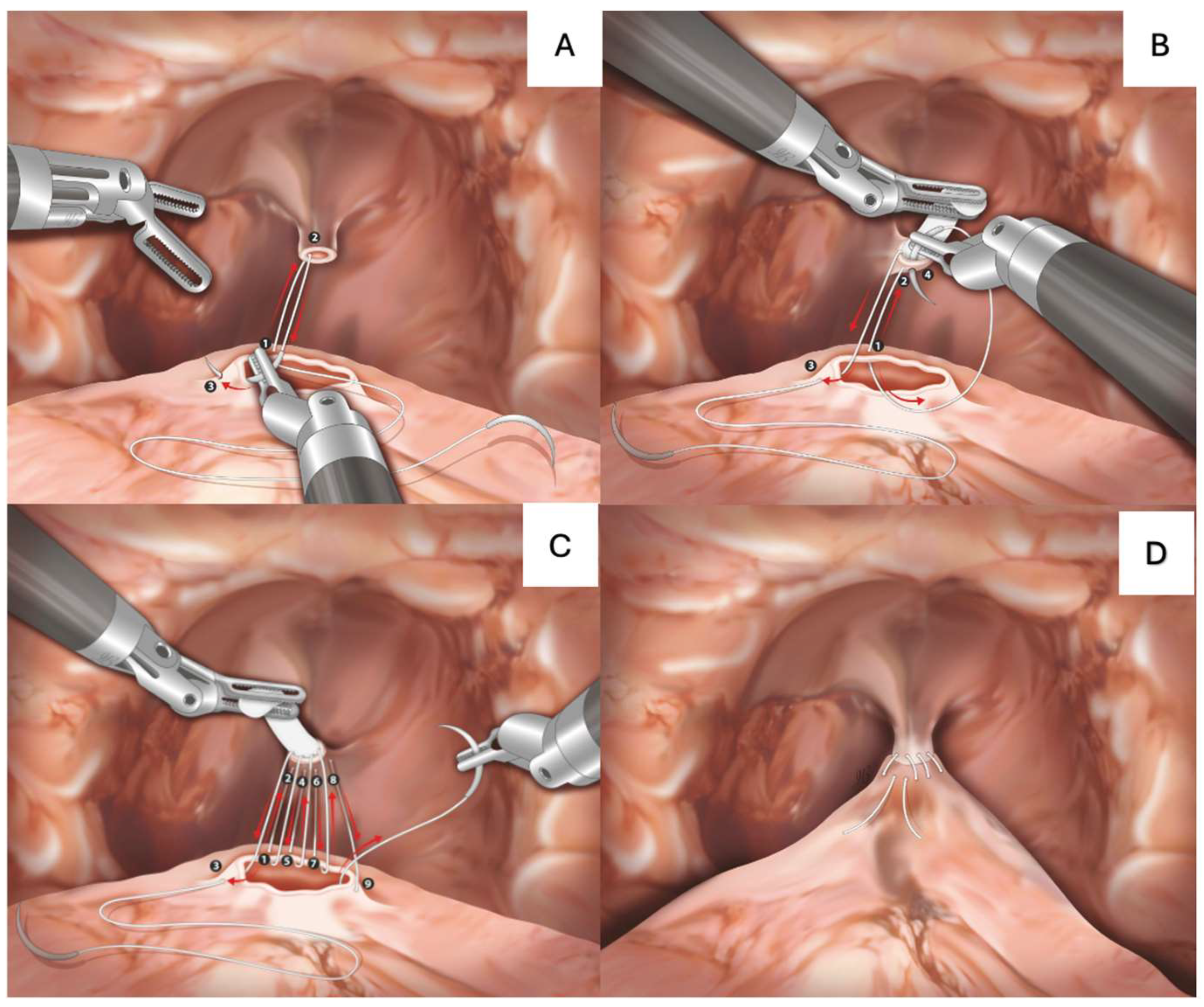
2.2. Surgical Technique
2.3. Operative Video Review and Technical Assessment
2.4. Learning Curve Definition
2.5. Statistical Analysis
3. Results
3.1. Baseline
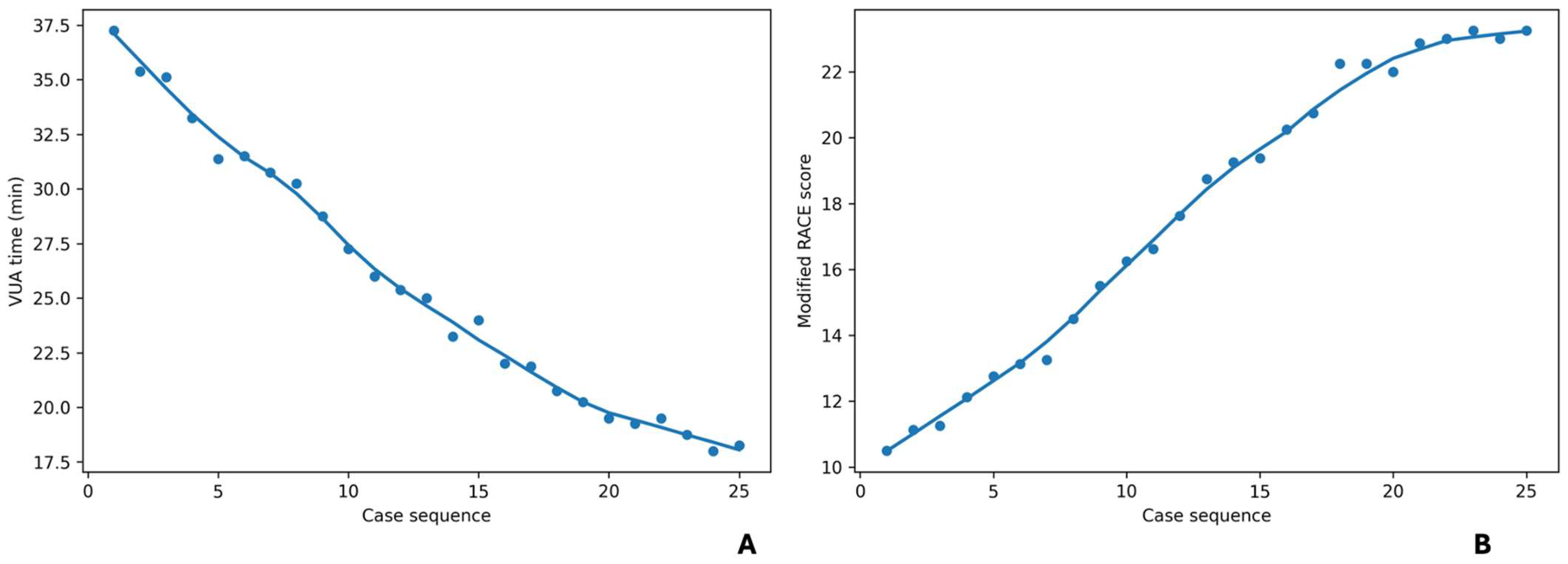
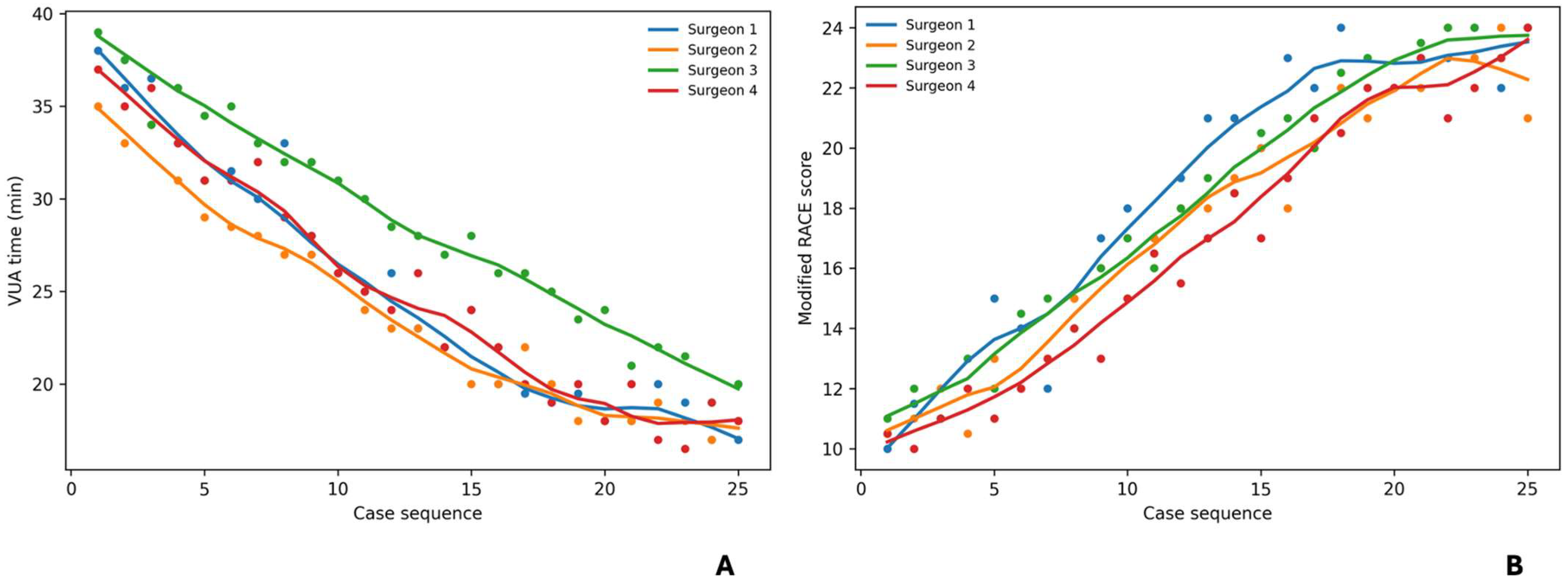
3.2. Learning Curve and Technical Performance
3.3. Anastomosis-Related Intraoperative and Perioperative Outcomes
4. Discussion
5. Limitations
6. Conclusions
Supplementary Materials
Author Contributions
Funding
Institutional Review Board Statement
Informed Consent Statement
Data Availability Statement
Acknowledgments
Conflicts of Interest
Abbreviations
| BMI | Body Mass Index |
| BNS | Bladder Neck Stricture |
| CI | Confidence Interval |
| DM | Diabetes Mellitus |
| HoLEP | Holmium Laser Enucleation of the Prostate |
| ICC | Intraclass Correlation Coefficient |
| IQR | Interquartile Range |
| ISUP | International Society of Urological Pathology |
| LOWESS | Locally Weighted Scatterplot Smoothing |
| MeTS | Metabolic Syndrome |
| PCa | Prostate Cancer |
| PLND | Pelvic Lymph Node Dissection |
| PSA | Prostate-Specific Antigen |
| QoL | Quality of Life |
| RACE | Robotic Anastomosis Competency Evaluation |
| RARP | Robot-Assisted Radical Prostatectomy |
| SD | Standard Deviation |
| TUIP | Transurethral Incision of the Prostate |
| TURP | Transurethral Resection of the Prostate |
| UC | Urinary Continence |
| VUA | Vesicourethral Anastomosis |
References
- Gandaglia, G.; Leni, R.; Bray, F.; Fleshner, N.; Freedland, S.J.; Kibel, A.; Stattin, P.; Van Poppel, H.; La Vecchia, C. Epidemiology and Prevention of Prostate Cancer. Eur. Urol. Oncol. 2021, 4, 877–892. [Google Scholar] [CrossRef] [Scilit]
- Al Salhi, Y.; Sequi, M.B.; Valenzi, F.M.; Fuschi, A.; Martoccia, A.; Suraci, P.P.; Carbone, A.; Tema, G.; Lombardo, R.; Cicione, A.; et al. Cancer Stem Cells and Prostate Cancer: A Narrative Review. Int. J. Mol. Sci. 2023, 24, 7746. [Google Scholar] [CrossRef] [Scilit]
- Vaccarella, S.; Li, M.; Bray, F.; Kvale, R.; Serraino, D.; Lorenzoni, V.; Auvinen, A.; Dal Maso, L. Prostate cancer incidence and mortality in Europe and implications for screening activities: Population based study. BMJ 2024, 386, e077738. [Google Scholar] [CrossRef] [Scilit]
- Raza, S.J.; Field, E.; Jay, C.; Eun, D.; Fumo, M.; Hu, J.C.; Lee, D.; Mehboob, Z.; Nyquist, J.; Peabody, J.O.; et al. Surgical competency for urethrovesical anastomosis during robot-assisted radical prostatectomy: Development and validation of the robotic anastomosis competency evaluation. Urology 2015, 85, 27–32. [Google Scholar] [CrossRef] [Scilit]
- Kakutani, S.; Takeshima, Y.; Yamada, Y.; Fujimura, T.; Nagamoto, S.; Enomoto, Y.; Hakozaki, Y.; Kimura, N.; Teshima, T.; Akiyama, Y.; et al. Clinical significance and risk factors of urethrovesical anastomotic urinary leakage following robot-assisted radical prostatectomy: A multi-institutional study. BMC Urol. 2021, 21, 75. [Google Scholar] [CrossRef] [Scilit]
- Khan, H.; Kozlowski, J.D.; Hussein, A.A.; Sharif, M.; Ahmed, Y.; May, P.; Hammond, Y.; Stone, K.; Ahmad, B.; Cole, A.; et al. Use of Robotic Anastomosis Competency Evaluation (RACE) for assessment of surgical competency during urethrovesical anastomosis. Can. Urol. Assoc. J. 2019, 13, E10–E16. [Google Scholar] [CrossRef] [Scilit]
- Ma, R.; Reddy, S.; Vanstrum, E.B.; Hung, A.J. Innovations in Urologic Surgical Training. Curr. Urol. Rep. 2021, 22, 26. [Google Scholar] [CrossRef] [Scilit]
- Pires, R.d.S.; Pereira, C.W.A.; Alves Favorito, L. Is the learning curve of the urology resident for conventional radical prostatectomy similar to that of staff initiating robot-assisted radical prostatectomy? Int. Braz. J. Urol. 2024, 50, 335–345. [Google Scholar] [CrossRef] [Scilit]
- Ambinder, D.; Wang, S.; Siddiqui, M.M. Determining the component-based operative time learning curve for robotic-assisted radical prostatectomy. Curr. Urol. 2022, 16, 240–245. [Google Scholar] [CrossRef] [Scilit]
- Rahimi, A.M.; Uluç, E.; Hardon, S.F.; Bonjer, H.J.; van der Peet, D.L.; Daams, F. Training in robotic-assisted surgery: A systematic review of training modalities and objective and subjective assessment methods. Surg. Endosc. 2024, 38, 3547–3555. [Google Scholar] [CrossRef] [Scilit]
- Flammia, R.S.; Bologna, E.; Anceschi, U.; Tufano, A.; Licari, L.C.; Antonelli, L.; Proietti, F.; Alviani, F.; Gallucci, M.; Simone, G.; et al. “Single Knot-Single Running Suture” Vesicourethral Anastomosis with Posterior Musculofascial Reconstruction during Robot-Assisted Radical Prostatectomy: A Step-by-Step Guide of Surgical Technique. J. Pers. Med. 2023, 13, 1072. [Google Scholar] [CrossRef] [Scilit]
- Van Velthoven, R.F.; Ahlering, T.E.; Peltier, A.; Skarecky, D.W.; Clayman, R.V. Technique for laparoscopic running urethrovesical anastomosis:the single knot method. Urology 2003, 61, 699–702. [Google Scholar] [CrossRef] [Scilit]
- Albisinni, S.; Aoun, F.; Peltier, A.; van Velthoven, R. The Single-Knot Running Vesicourethral Anastomosis after Minimally Invasive Prostatectomy: Review of the Technique and Its Modifications, Tips, and Pitfalls. Prostate Cancer 2016, 2016, 1481727. [Google Scholar] [CrossRef] [Scilit]
- Ticonosco, M.; Pissavini, A.; Collà Ruvolo, C.; Frego, N.; Belmonte, M.; Barletta, F.; Morra, S.; Rebuffo, S.; Sorce, G.; Marin, F.; et al. From simulation to surgery, advancements and challenges in robotic training for radical prostatectomy: A narrative review. Chin. Clin. Oncol. 2024, 13, 55. [Google Scholar] [CrossRef] [Scilit]
- Goldenberg, M.G.; Goldenberg, L.; Grantcharov, T.P. Surgeon Performance Predicts Early Continence After Robot-Assisted Radical Prostatectomy. J. Endourol. 2017, 31, 858–863. [Google Scholar] [CrossRef] [Scilit]
- Fuschi, A.; Sequi, M.B.; Al Salhi, Y.; Suraci, P.P.; Valenzi, F.M.; Rera, O.A.; Antonioni, A.; Graziani, D.; Martino, G.; Candita, G.; et al. Comparative Analysis of Cold Versus Thermal Dissection in Nerve-Sparing Robot-Assisted Radical Prostatectomy. Cancers 2025, 17, 1831. [Google Scholar] [CrossRef] [Scilit]
- Valenzi, F.M.; Fuschi, A.; Al Salhi, Y.; Sequi, M.B.; Suraci, P.P.; Pacini, M.; Scalzo, S.; Rera, O.A.; Antonioni, A.; Graziani, D.; et al. Is early continence recovery related to the length of spared urethra? A prospective multicenter study comparing preoperative MRI and histologic specimen measurements after robotic radical prostatectomy. Eur. J. Surg. Oncol. 2024, 50, 108319. [Google Scholar] [CrossRef] [Scilit]
- Bianchi, L.; Turri, F.M.; Larcher, A.; De Groote, R.; De Bruyne, P.; De Coninck, V.; Goossens, M.; D’Hondt, F.; De Naeyer, G.; Schatteman, P.; et al. A Novel Approach for Apical Dissection During Robot-assisted Radical Prostatectomy: The “Collar” Technique. Eur. Urol. Focus 2018, 4, 677–685. [Google Scholar] [CrossRef] [Scilit]
- Porpiglia, F.; Bertolo, R.; Manfredi, M.; De Luca, S.; Checcucci, E.; Morra, I.; Passera, R.; Fiori, C. Total Anatomical Reconstruction During Robot-assisted Radical Prostatectomy: Implications on Early Recovery of Urinary Continence. Eur. Urol. 2016, 69, 485–495. [Google Scholar] [CrossRef] [Scilit]
- Hoznek, A.; Salomon, L.; Rabii, R.; Ben Slama, M.R.; Cicco, A.; Antiphon, P.; Abbou, C.C. Vesicourethral anastomosis during laparoscopic radical prostatectomy: The running suture method. J. Endourol. 2000, 14, 749–753. [Google Scholar] [CrossRef] [Scilit]
- Yang, J.; Shao, P.F.; Lv, Q.; Song, N.H.; Li, J.; Zhang, W.; Li, P.; Hua, L.X.; Yin, C.J. Continuous suture of a single absorbable suture: A new simplified vesicourethral anastomosis technique in laparoscopic radical prostatectomy. Int. Surg. 2014, 99, 656–661. [Google Scholar] [CrossRef] [Scilit]
- Bernie, A.M.; Caire, A.A.; Conley, S.P.; Oommen, M.; Boylu, U.; Thomas, R.; Lee, B.R. Posterior reconstruction before anastomosis improves the anastomosis time during robot-assisted radical prostatectomy. JSLS J. Soc. Laparoendosc. Surg. 2010, 14, 520–524. [Google Scholar] [CrossRef] [Scilit]
- Chapman, S.; Turo, R.; Cross, W. Vesicourethral anastomosis using V-Loc™ barbed suture during robot-assisted radical prostatectomy. Cent. Eur. J. Urol. 2011, 64, 236. [Google Scholar] [CrossRef] [Scilit]
- Zorn, K.C.; Trinh, Q.D.; Jeldres, C.; Schmitges, J.; Widmer, H.; Lattouf, J.B.; Sammon, J.; Liberman, D.; Sun, M.; Bianchi, M.; et al. Prospective randomized trial of barbed polyglyconate suture to facilitate vesico-urethral anastomosis during robot-assisted radical prostatectomy: Time reduction and cost benefit. BJU Int. 2012, 109, 1526–1532. [Google Scholar] [CrossRef] [Scilit]
- Suraci, P.P.; Sequi, M.B.; Valenzi, F.M.; Al Salhi, Y.; Rera, O.A.; Di Dio, M.; Graziani, D.; Martino, G.; Candita, G.; Gianfrancesco, F.; et al. Improved Early Urinary Continence After Robot-Assisted Radical Prostatectomy Using a Modified Vesicourethral Anastomosis with Posterior Musculofascial Reconstruction: A Prospective Comparative Study. J. Clin. Med. 2026, 15, 2933. [Google Scholar] [CrossRef] [Scilit]
- Lovegrove, C.; Ahmed, K.; Novara, G.; Guru, K.; Mottrie, A.; Challacombe, B.; der Poel, H.V.; Peabody, J.; Dasgupta, P. Modular Training for Robot-Assisted Radical Prostatectomy: Where to Begin? J. Surg. Educ. 2017, 74, 486–494. [Google Scholar] [CrossRef] [Scilit]
- Lovegrove, C.; Novara, G.; Mottrie, A.; Guru, K.A.; Brown, M.; Challacombe, B.; Popert, R.; Raza, J.; Van der Poel, H.; Peabody, J.; et al. Structured and Modular Training Pathway for Robot-assisted Radical Prostatectomy (RARP): Validation of the RARP Assessment Score and Learning Curve Assessment. Eur. Urol. 2016, 69, 526–535. [Google Scholar] [CrossRef] [Scilit]
- Kato, D.; Namiki, S.; Ueda, S.; Takeuchi, Y.; Takeuchi, S.; Kawase, M.; Kawase, K.; Nakai, C.; Takai, M.; Iinuma, K.; et al. Validation of standardized training system for robot-assisted radical prostatectomy: Comparison of perioperative and surgical outcomes between experienced surgeons and novice surgeons at a low-volume institute in Japan. Minim. Invasive Ther. Allied Technol. 2022, 31, 1103–1111. [Google Scholar] [CrossRef] [Scilit]
- Dadashian, E.; Wager, P.; Tsai, R.G.; Varghese, J.; Yang, C.; Ghaffar, U.; Heard, J.; Lo, E.; Olsen, R.G.; Deo, A.; et al. Training Feedback Tailored to Technical Skills Expedites Proficiency in Performing Watertight Vesicourethral Anastomoses: A Randomized Controlled Trial. J. Surg. Educ. 2026, 83, 103937. [Google Scholar] [CrossRef] [Scilit]
- Nagai, T.; Etani, T.; Shimizu, N.; Gonda, M.; Aoki, M.; Morikawa, T.; Iwatsuki, S.; Taguchi, K.; Naiki, T.; Mizuno, K.; et al. Learning curve of multiple surgeons for robot-assisted radical prostatectomy using the cumulative sum method: A retrospective single-institution study. J. Robot. Surg. 2024, 18, 389. [Google Scholar] [CrossRef] [Scilit]
- Ou, Y.C.; Yang, C.R.; Wang, J.; Cheng, C.L.; Patel, V.R. Robotic-assisted laparoscopic radical prostatectomy: Learning curve of first 100 cases. Int. J. Urol. 2010, 17, 635–640. [Google Scholar] [CrossRef] [Scilit]
- Ramos-Carpinteyro, R.; Ferguson, E.L.; Chavali, J.S.; Geskin, A.; Soputro, N.; Kaouk, J. Single-port Transvesical Robot-assisted Radical Prostatectomy: The Surgical Learning Curve of the First 100 Cases. Urology 2023, 178, 76–82. [Google Scholar] [CrossRef] [Scilit]
- Trinh, L.; Mingo, S.; Vanstrum, E.B.; Sanford, D.I.; Aastha; Ma, R.; Nguyen, J.H.; Liu, Y.; Hung, A.J. Survival Analysis Using Surgeon Skill Metrics and Patient Factors to Predict Urinary Continence Recovery After Robot-assisted Radical Prostatectomy. Eur. Urol. Focus 2022, 8, 623–630. [Google Scholar] [CrossRef] [Scilit]



| Variable | Surgeon A (n = 25) | Surgeon B (n = 25) | Surgeon C (n = 25) | Surgeon D (n = 25) | p-Value |
|---|---|---|---|---|---|
| Age, years, median (IQR) | 61 (58–64) | 64 (62–66) | 62 (60–66) | 62 (60–66) | 0.21 |
| BMI, kg/m2, median (IQR) | 26.1 (24.9–26.8) | 27.7 (25.3–29.0) | 27.8 (25.1–28.2) | 26.2 (24.3–28.0) | 0.39 |
| Preoperative PSA, ng/mL, median (IQR) | 7.0 (6.2–8.2) | 7.4 (6.6–9.4) | 7.6 (6.1–8.6) | 7.2 (5.5–8.6) | 0.74 |
| Prostate volume, mL, median (IQR) | 62 (47–71) | 53 (35–67) | 51 (42–68) | 56 (44–67) | 0.62 |
| Diabetes mellitus, n (%) | 6 (24%) | 12 (48%) | 9 (36%) | 13 (52%) | 0.17 |
| Metabolic syndrome, n (%) | 4 (16%) | 7 (28%) | 4 (16%) | 7 (28%) | 0.55 |
| Nerve-sparing status, n (%) | 0.97 | ||||
| Bilateral | 14 (56%) | 11 (44%) | 12 (48%) | 12 (48%) | |
| Unilateral | 7 (28%) | 8 (32%) | 9 (36%) | 9 (36%) | |
| None | 4 (16%) | 6 (24%) | 4 (16%) | 4 (16%) | |
| PLND, n (%) | 10 (40%) | 12 (48%) | 12 (48%) | 12 (48%) | 0.92 |
| ISUP grade (final pathology), n (%) | 0.89 | ||||
| Grade 1–2 | 13 (52%) | 11 (44%) | 12 (48%) | 14 (56%) | |
| Grade 3–5 | 12 (48%) | 14 (56%) | 13 (52%) | 11 (44%) | |
| Pathological stage, n (%) | 0.77 | ||||
| pT2 | 18 (72%) | 21 (84%) | 19 (76%) | 19 (76%) | |
| pT3a | 6 (24%) | 3 (12%) | 5 (20%) | 6 (24%) | |
| pT3b | 1 (4%) | 1 (4%) | 1 (4%) | 0 (0%) | |
| Positive surgical margins, n (%) | 4 (16%) | 3 (12%) | 4 (16%) | 3 (12%) | 0.95 |
| Variable | Early Phase (n = 40) | Late Phase (n = 40) | p-Value |
|---|---|---|---|
| VUA time, min. (IQR) | 32 (29–37) | 19 (18–20.3) | <0.001 |
| RACE score (IQR) | 13 (11–15) | 22 (21–23) | <0.001 |
| Positive leak test, % | 15 (37.5%) | 5 (12.5%) | 0.03 |
| Additional stitches | 1 (1–2) | 0 (0–1) | <0.001 |
| Catheter days, median (IQR) | 8 (7–9) | 6 (6–7) | <0.001 |
| Postoperative urinary leak, n (%) | 7 (17.5%) | 2 (5%) | 0.16 |
| Continence 30 days, n (%) | 15 (37.5%) | 26 (65%) | 0.025 |
| Continence 90 days, n (%) | 24 (60%) | 34 (85%) | 0.04 |
| Continence 180 days, n (%) | 33 (82.5%) | 37 (92.5%) | 0.48 |
| Continence 360 days, n (%) | 35 (87.5%) | 38 (95%) | 0.43 |
Disclaimer/Publisher’s Note: The statements, opinions and data contained in all publications are solely those of the individual author(s) and contributor(s) and not of MDPI and/or the editor(s). MDPI and/or the editor(s) disclaim responsibility for any injury to people or property resulting from any ideas, methods, instructions or products referred to in the content. |
© 2026 by the authors. Licensee MDPI, Basel, Switzerland. This article is an open access article distributed under the terms and conditions of the Creative Commons Attribution (CC BY) license.
Share and Cite
Germinale, F.; Sequi, M.B.; Di Domenico, A.; Benelli, A.; Dotta, F.; Ennas, M.; Guano, G.; Brusasco, C.; Tosi, M.; Manfredi, M.; et al. Learning Curve and Video-Based Technical Assessment of a Standardized Vesicourethral Anastomosis in Novice Robotic Surgeons. Curr. Oncol. 2026, 33, 502. https://doi.org/10.3390/curroncol33090502
Germinale F, Sequi MB, Di Domenico A, Benelli A, Dotta F, Ennas M, Guano G, Brusasco C, Tosi M, Manfredi M, et al. Learning Curve and Video-Based Technical Assessment of a Standardized Vesicourethral Anastomosis in Novice Robotic Surgeons. Current Oncology. 2026; 33(9):502. https://doi.org/10.3390/curroncol33090502
Chicago/Turabian StyleGerminale, Federico, Manfredi Bruno Sequi, Antonia Di Domenico, Andrea Benelli, Federico Dotta, Marco Ennas, Giovanni Guano, Claudia Brusasco, Mattia Tosi, Martina Manfredi, and et al. 2026. "Learning Curve and Video-Based Technical Assessment of a Standardized Vesicourethral Anastomosis in Novice Robotic Surgeons" Current Oncology 33, no. 9: 502. https://doi.org/10.3390/curroncol33090502
APA StyleGerminale, F., Sequi, M. B., Di Domenico, A., Benelli, A., Dotta, F., Ennas, M., Guano, G., Brusasco, C., Tosi, M., Manfredi, M., Pastore, A. L., Carbone, A., Fuschi, A., & Introini, C. (2026). Learning Curve and Video-Based Technical Assessment of a Standardized Vesicourethral Anastomosis in Novice Robotic Surgeons. Current Oncology, 33(9), 502. https://doi.org/10.3390/curroncol33090502