
Identifying Barriers and Strategies to Support a Community Navigator-Driven Approach for Lung Cancer Screening

 , , , , , , , and
Simple Summary
Abstract
1. Introduction
2. Materials and Methods
2.1. Participant Recruitment
2.2. Data Collection
2.3. Data Extraction
2.4. Matrix Analysis
3. Results
3.1. Logistical Barriers to Screening
3.1.1. Physical Infrastructure
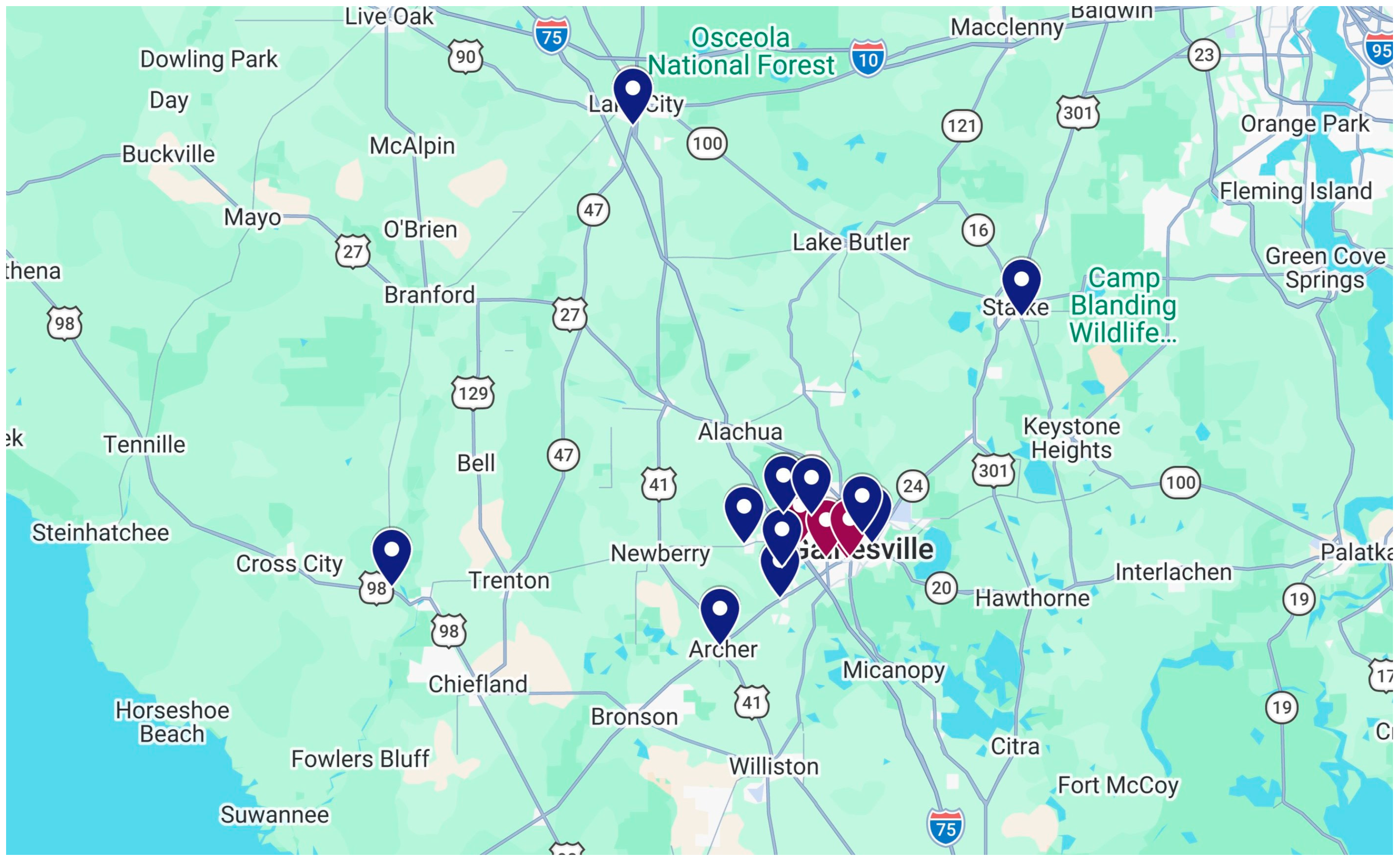
“The furthest town in Levy County is over an hour away from Gainesville … [It’s] difficult you know for some to get from that part of Levy County to Gainesville for the different tests and … people just kind of ignore their signs, because they think it’s gonna get better. It’s gonna clear because they can’t get to where they need.”Participant H, Community Scientist
“With your average asymptomatic [rural clinic] patient who’s maybe on disability doesn’t have a very good car, would have to pay their neighbor 20 bucks one way to take them into Gainesville? Yeah, it’s a high bar to convince that person to do something… I mean people in [rural town] don’t like going to Gainesville almost without exception. They hate it. They hate going to Gainesville. I can sometimes I say, ‘OK, well, you know where the [suburban mall] is- you’re not going to hit the bad part of traffic. It’s easy to park, easy to get in and out.’ I can use that to my advantage. If I’m telling them to go all the way to the hospital, to deal with the parking nightmare, the confusion of our buildings and where radiology is and this that, and the other. I mean, it’s a very, very high bar to convince somebody to want to do that.”Participant M, Primary Care Provider
3.1.2. Patient Needs and Resources
3.1.3. Addressing Patient Access
“I think it needs to be made clear from step one that this is free… I think a lot of people think CT, they think money, copay, they’re not seeing the screening part of it. Traditionally screenings are free, [but] because … they don’t understand that and … we can help with that.”Participant O, Community Scientist
3.1.4. IT Infrastructure
“The [EMR health maintenance tab] including lung cancer screening is a huge value. I think that otherwise it very well could get lost in the shuffle [with] lung cancer screening being semi-new to the game in terms of cancer screenings. [It] continues to be the one that you have to really kind of remember.”Participant C, Primary Care Provider
“If you don’t input the pack years exactly correctly in the EMR, it doesn’t show up correctly … and also the way that you put in the smoking history is really weird in the EMR because you have to put in date by date, how many cigarettes? … It’s supposed to auto calculate pack years, but it doesn’t do it perfectly.”Participant J, Primary Care Provider
“I have no issue with [EMR] cause I’m someone who used that, even though I’m kind of old. I mean, I’m not old, old, but I mean, so I’ve no qualms with telemedicine that kind of use of portals and EMR data. … I use those all the time with my primary care physician, … [it’s] almost 90% of our communications.”Participant K, Community Scientist
3.1.5. Work Infrastructure
“I think the [medical assistants] have a lot to do when they’re rooming the patient, especially if the patient’s late and this and that. So it’s like a little bit of a, ‘Hey, do we spend a lot of time with the patient prior to the physician coming in or not?’ So I think staffing levels in terms of that, but like someone has to do the smoking history and who is it and how much time do you spend on it before the physician comes.”Participant J, Primary Care Provider
3.1.6. Assessing and Redesigning Workflows
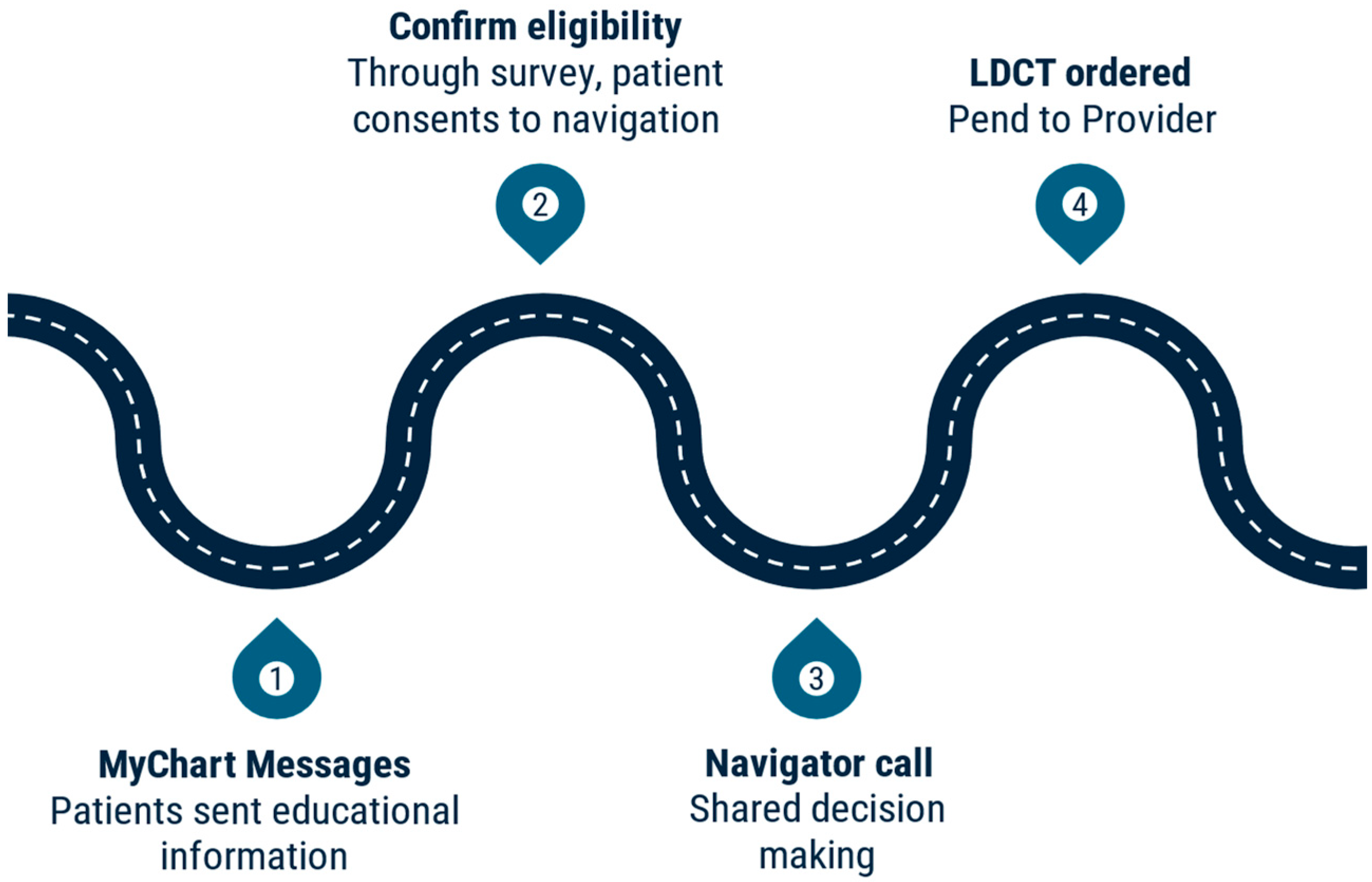
“I think that like a large part of our job is taking over the logistics of getting people set up like even for example like mammograms, … We’re the ones scheduling it and updating them throughout … I think it just kind of keeps them informed throughout the process but also takes a lot of the like tasks that they need to do off of their back.”Participant E, Clinical Community Navigator
“It’s a lot to get people where they need to be, and then once I get them going, they tend to do a lot better. You know, once I sit them down and say here this is how easy it is to use [EMR]. Oh, I never knew that it’s like well. Yeah, you can come up here anytime you need to. If you need to connect to the Internet, just come on up here and you know, so that does work pretty well. But it just takes a lot of reinforcement and a lot of knowing what the patient needs to do next.”Participant P, Clinical Community Navigator
“I really think that this is the future of medicine that we are not doing enough of, whether it’s lung cancer, whether it is reminding people about mammograms, waiting for someone to come for their annual exam. And for me to remember to go through every one of the things is good, but it’s not perfect. I think having both your primary care doctor having it on their radar on part of their workflow is great, but separately, having the chart reviewed electronically identifying people, offering them a workflow I think is really important.”Participant F, Primary Care Provider
3.2. Difficulty Prioritizing Lung Cancer Screening
3.2.1. Relative Priority
“It’s a level B recommendation, so … there’s probably some clinicians that it’s not on the top of their priority list. There’s a lot of stuff to do in primary care, and so if it’s not for some reason, really flashing red, you know, it’s easy to lose track of stuff. I mean, I think that’s just a general thing you’ll hear from any primary care doctor ever.”Participant M, Primary Care Provider
“I come to the table wanting to do all of the screening things that are appropriate for our patient and go through all of the things that can promote health. Patients walk into their annual exam and their expectations are very different. It is very often that they walk in and say, ‘OK, I’m here for my annual. I’ve been having headaches. My ears seem to ring. Sometimes my elbow bothers me occasionally. [I] twisted my ankle 4 weeks ago, it seems like it’s feeling better, but every once in a while it bothers me. I’ve got dry eyes.’ And their idea of an annual exam is the 40 or 50 things they experienced over the past year that they want to address. Whereas I’m looking at health promotion disease prevention, and so it is very hard to balance their expectations and the time it takes.”Participant F, Primary Care Provider
3.2.2. Relational Connections
“The other thing is patients here really like their doctors. So if I say hi, I’m calling from [health system] … they may not even listen to me, but if I say hey, I’m calling from Doctor [Name], he wanted me to follow up with you on this X-ray. Ohh. OK. Well, you know, it’s a total difference on how they receive that information.”Participant P, Clinical Community Navigator
3.2.3. Identifying and Preparing Clinical Champions
“We are a huge department, but we are pretty close, so if we know like this person loves hormone replacement therapy and even if there’s not a champion in my office, I’m like I’m going to go to a person in [other clinic] and just shoot them a quick message. So even if there wasn’t an office person, a departmental person would be the next best thing.”Participant F, Primary Care Provider
3.2.4. Auditing and Providing Feedback
“Iterative feedback is really important, whether it’s on a personal level or clinic level. I think it would be very helpful for our clinic to see, you know, for the six months, January to June the year prior. You guys had done, you know, 26 referrals for lung cancer screening with the new initiative you guys have done 80. …It’s not just you referred 6 people last month. It’s you did 6 … but every one of your peers did 34 like those are the kind of things that make you say, man, am I taking as good a care of people as I should?”Participant F, Primary Care Provider
3.3. Knowledge of Lung Cancer Screening
3.3.1. Access to Knowledge and Information
“I think part of it is going to be education because people know- mammograms are drilled into our brain now, so we got mammograms down to some extent. Men’s PSA testing is kind of there, but a lot of people probably don’t realize that they can use radiology and determine if they have a lung cancer screening situation.”Participant K, Community Scientist
3.3.2. Financing
“I mean, some people might not realize that their insurance covers it or how much their insurance does, even with, like, mammograms. Some patients have been like, ‘I want to at least, like, postpone this mammogram, because I don’t know if I have to pay for it.’ Even though, like, insurance companies are required to pay for it, like cover the screening mammogram once every year, once every two years. It’s just an understanding of like, how insurance works.”Participant G, Clinical Community Navigator
3.3.3. Conducting Educational Meetings
“I think coming to the monthly clinic meetings is pretty important. It builds trust as a team member…It serves the dual purpose of providing reinforcing education on lung cancer screening guidelines … and discussing the implementation of the project.”Participant C, Primary Care Provider
3.3.4. Raising Patient Awareness of Intervention
“Even though [health system] would come to these communities once a month. Not everyone knew, so they’re not- you’re coming, but you’re going to a health department that is no longer a primary care type health department…. So you’re tapping into a resource that’s not as visible themselves per se. So … connecting to the community organizers, the community leaders, the churches, the pastors who have that would be the key.”Participant H, Community Scientist
“There’s sort of a misconception about CT scans; and many people who have not had them … don’t realize how easy these scans are and how quick they are … I’ve been involved in some studies where patients have heard from other patients. But I’m wondering if either a couple of interviews with patients who’ve had the lung screening could be provided either by video or written template.”Participant N, Community Scientist
4. Discussion
5. Conclusions
Supplementary Materials
Author Contributions
Funding
Institutional Review Board Statement
Informed Consent Statement
Data Availability Statement
Acknowledgments
Conflicts of Interest
Abbreviations
| EMR | Electronic medical record |
| LDCT-LCS | Low-dose computed tomography for lung cancer screening |
| IT | Information technology |
| UF | University of Florida |
| USPSTF | US Preventative Services Task Force |
References
- National Cancer Institute. Cancer Stat Facts: Lung and Bronchus Cancer; National Cancer Institute: Rockville, MD, USA, 2025.
- Krist, A.H.; Davidson, K.W.; Mangione, C.M.; Barry, M.J.; Cabana, M.; Caughey, A.B.; Davis, E.M.; Donahue, K.E.; Doubeni, C.A.; Kubik, M.; et al. Screening for Lung Cancer: US Preventive Services Task Force Recommendation Statement. JAMA 2021, 325, 962–970. [Google Scholar] [CrossRef] [Scilit] [PubMed]
- Ritzwoller, D.P.; Meza, R.; Carroll, N.M.; Blum-Barnett, E.; Burnett-Hartman, A.N.; Greenlee, R.T.; Honda, S.A.; Neslund-Dudas, C.; Rendle, K.A.; Vachani, A. Evaluation of Population-Level Changes Associated with the 2021 US Preventive Services Task Force Lung Cancer Screening Recommendations in Community-Based Health Care Systems. JAMA Netw. Open 2021, 4, e2128176. [Google Scholar] [CrossRef] [Scilit] [PubMed]
- American Lung Association. State of Lung Cancer 2024 Report; American Lung Association: Chicago, IL, USA, 2024. [Google Scholar]
- Goddard, K.A.B.; Feuer, E.J.; Umar, A.; Castle, P.E. Accelerating Progress to Reduce the Cancer Burden through Prevention and Control in the United States. J. Natl. Cancer Inst. 2025, 117, 20–28. [Google Scholar] [CrossRef] [Scilit] [PubMed]
- Leopold, K.T.; Carter-Bawa, L. Barriers to Lung Cancer Screening Access from the Perspective of the Patient and Current Interventions. Thorac. Surg. Clin. 2023, 33, 343–351. [Google Scholar] [CrossRef] [Scilit] [PubMed]
- Draucker, C.B.; Rawl, S.M.; Vode, E.; Carter-Harris, L. Understanding the Decision to Screen for Lung Cancer or Not: A Qualitative Analysis. Health Expect. 2019, 22, 1314–1321. [Google Scholar] [CrossRef] [Scilit] [PubMed]
- Delmerico, J.; Hyland, A.; Celestino, P.; Reid, M.; Cummings, K.M. Patient Willingness and Barriers to Receiving a CT Scan for Lung Cancer Screening. Lung Cancer Amst. Neth. 2014, 84, 307–309. [Google Scholar] [CrossRef] [Scilit] [PubMed]
- Lin, Y.A.; Hong, Y.T.; Lin, X.J.; Lin, J.L.; Xiao, H.M.; Huang, F.F. Barriers and Facilitators to Uptake of Lung Cancer Screening: A Mixed Methods Systematic Review. Lung Cancer 2022, 172, 9–18. [Google Scholar] [CrossRef] [Scilit] [PubMed]
- Simmons, V.N.; Gray, J.E.; Schabath, M.B.; Wilson, L.E.; Quinn, G.P. High-Risk Community and Primary Care Providers Knowledge about and Barriers to Low-Dose Computed Topography Lung Cancer Screening. Lung Cancer 2017, 106, 42–49. [Google Scholar] [CrossRef] [Scilit] [PubMed]
- Williamson, T.J.; Walsh, L.E.; Rawl, S.M.; Carter-Bawa, L. Slipping through the Cracks: Who Is Eligible but Does Not Receive a Healthcare Provider Recommendation for Lung Cancer Screening? Lung Cancer Amst. Neth. 2023, 179, 107185. [Google Scholar] [CrossRef] [Scilit] [PubMed]
- Coughlin, J.M.; Zang, Y.; Terranella, S.; Alex, G.; Karush, J.; Geissen, N.; Chmielewski, G.W.; Arndt, A.T.; Liptay, M.J.; Zimmermann, L.J.; et al. Understanding Barriers to Lung Cancer Screening in Primary Care. J. Thorac. Dis. 2020, 12, 2536–2544. [Google Scholar] [CrossRef] [Scilit] [PubMed]
- Modin, H.E.; Fathi, J.T.; Gilbert, C.R.; Wilshire, C.L.; Wilson, A.K.; Aye, R.W.; Farivar, A.S.; Louie, B.E.; Vallières, E.; Gorden, J.A. Pack-Year Cigarette Smoking History for Determination of Lung Cancer Screening Eligibility. Comparison of the Electronic Medical Record versus a Shared Decision-Making Conversation. Ann. Am. Thorac. Soc. 2017, 14, 1320–1325. [Google Scholar] [CrossRef] [Scilit] [PubMed]
- Triplette, M.; Thayer, J.H.; Pipavath, S.N.; Crothers, K. Poor Uptake of Lung Cancer Screening: Opportunities for Improvement. J. Am. Coll. Radiol. JACR 2019, 16, 446–450. [Google Scholar] [CrossRef] [Scilit] [PubMed]
- Monu, J.; Triplette, M.; Wood, D.E.; Wolff, E.M.; Lavallee, D.C.; Flum, D.R.; Farjah, F. Evaluating Knowledge, Attitudes, and Beliefs About Lung Cancer Screening Using Crowdsourcing. Chest 2020, 158, 386–392. [Google Scholar] [CrossRef] [Scilit] [PubMed]
- Williams, R.M.; Beck, K.H.; Butler, J.; Lee, S.; Wang, M.Q.; Taylor, K.L.; Knott, C.L. Lung Cancer Screening Decisional Needs Among African American Smokers of Lower Socioeconomic Status. Ethn. Health 2020, 27, 565–583. [Google Scholar] [CrossRef] [Scilit] [PubMed]
- Henderson, L.M.; Jones, L.M.; Marsh, M.W.; Brenner, A.T.; Goldstein, A.O.; Benefield, T.S.; Anne, M.; Hickman, G.; Molina, P.L.; Rivera, M.P.; et al. Opinions, Practice Patterns, and Perceived Barriers to Lung Cancer Screening among Attending and Resident Primary Care Physicians. Risk Manag. Healthc. Policy 2018, 10, 189–195. [Google Scholar] [CrossRef] [Scilit] [PubMed]
- Triplette, M.; Kross, E.K.; Mann, B.A.; Elmore, J.G.; Slatore, C.G.; Shahrir, S.; Romine, P.E.; Frederick, P.D.; Crothers, K. An Assessment of Primary Care and Pulmonary Provider Perspectives on Lung Cancer Screening. Ann. Am. Thorac. Soc. 2018, 15, 69–75. [Google Scholar] [CrossRef] [Scilit] [PubMed]
- Hong, Y.-R.; Wheeler, M.; Wang, R.; Karanth, S.; Yoon, H.-S.; Meza, R.; Kaye, F.; Bian, J.; Jeon, J.; Gould, M.K.; et al. Patient-Provider Discussion About Lung Cancer Screening by Race and Ethnicity: Implications for Equitable Uptake of Lung Cancer Screening. Clin. Lung Cancer 2024, 25, 39–49. [Google Scholar] [CrossRef] [Scilit] [PubMed]
- Carter-Bawa, L.; Walsh, L.E.; Schofield, E.; Williamson, T.J.; Hamann, H.A.; Ostroff, J.S. Lung Cancer Screening Knowledge, Attitudes, and Practice Patterns Among Primary and Pulmonary Care Clinicians. Nurs. Res. 2023, 72, 3–11. [Google Scholar] [CrossRef] [Scilit] [PubMed]
- Carter-Harris, L.; Comer, R.S.; Slaven, J.E.; Monahan, P.O.; Vode, E.; Hanna, N.H.; Ceppa, D.K.P.; Rawl, S.M. Computer-Tailored Decision Support Tool for Lung Cancer Screening: Community-Based Pilot Randomized Controlled Trial. J. Med. Internet Res. 2020, 22, e17050. [Google Scholar] [CrossRef] [Scilit] [PubMed]
- Carter-Harris, L.; Comer, R.S.; Goyal, A.; Vode, E.C.; Hanna, N.; Ceppa, D.; Rawl, S.M. Development and Usability Testing of a Computer-Tailored Decision Support Tool for Lung Cancer Screening: Study Protocol. JMIR Res. Protoc. 2017, 6, e8694. [Google Scholar] [CrossRef] [Scilit] [PubMed]
- Holtrop, J.S.; Dorsey-Holliman, B.; Hamilton, A.B. Navigating Qualitative Methods Choices in Dissemination and Implementation Research. Implement. Sci. 2025, 21, 11. [Google Scholar] [CrossRef] [Scilit] [PubMed]
- Fereday, J.; Muir-Cochrane, E. Demonstrating Rigor Using Thematic Analysis: A Hybrid Approach of Inductive and Deductive Coding and Theme Development. Int. J. Qual. Methods 2006, 5, 80–92. [Google Scholar] [CrossRef] [Scilit]
- Kowalski, C.P.; Nevedal, A.L.; Finley, E.P.; Young, J.P.; Lewinski, A.A.; Midboe, A.M.; Hamilton, A.B. Planning for and Assessing Rigor in Rapid Qualitative Analysis (PARRQA): A Consensus-Based Framework for Designing, Conducting, and Reporting. Implement. Sci. 2024, 19, 71. [Google Scholar] [CrossRef] [Scilit] [PubMed]
- Valle, N.; Brishke, J.; Shenkman, E.; Ritzhaupt, A.D. Design, Development and Evaluation of the Citizen Science Cancer Curriculum (CSCC): A Design and Development Case Study. TechTrends 2022, 66, 666–680. [Google Scholar] [CrossRef] [Scilit]
- Damschroder, L.J.; Aron, D.C.; Keith, R.E.; Kirsh, S.R.; Alexander, J.A.; Lowery, J.C. Fostering Implementation of Health Services Research Findings into Practice: A Consolidated Framework for Advancing Implementation Science. Implement. Sci. 2009, 4, 50. [Google Scholar] [CrossRef] [Scilit] [PubMed]
- Damschroder, L.J.; Reardon, C.M.; Widerquist, M.A.O.; Lowery, J. The Updated Consolidated Framework for Implementation Research Based on User Feedback. Implement. Sci. 2022, 17, 75. [Google Scholar] [CrossRef] [Scilit] [PubMed]
- Powell, B.J.; Waltz, T.J.; Chinman, M.J.; Damschroder, L.J.; Smith, J.L.; Matthieu, M.M.; Proctor, E.K.; Kirchner, J.A.E. A Refined Compilation of Implementation Strategies: Results from the Expert Recommendations for Implementing Change (ERIC) Project. Implement. Sci. 2015, 10, 21. [Google Scholar] [CrossRef] [Scilit] [PubMed]
- Waltz, T.J.; Powell, B.J.; Fernández, M.E.; Abadie, B.; Damschroder, L.J. Choosing Implementation Strategies to Address Contextual Barriers: Diversity in Recommendations and Future Directions. Implement. Sci. 2019, 14, 42. [Google Scholar] [CrossRef] [Scilit] [PubMed]
- Hero, J.O.; Goodrich, D.E.; Ernecoff, N.C.; Qureshi, N.; Ashcraft, L.; Newberry, S.J.; Phares, A.D.; Rogal, S.S.; Chinman, M. Implementation Strategies for Evidence-Based Practice in Health and Health Care: A Review of the Evidence Evidence of Strategy Effectiveness and Use Patterns Prepared for the Patient-Centered Outcomes Research Institute; RAND Health Care: Santa Monica, CA, USA, 2023. [Google Scholar]
- Hamilton, A.B.; Finley, E.P. Qualitative Methods in Implementation Research: An Introduction. Psychiatry Res. 2019, 280, 112516. [Google Scholar] [CrossRef] [Scilit] [PubMed]
- Nevedal, A.L.; Reardon, C.M.; Opra Widerquist, M.A.; Jackson, G.L.; Cutrona, S.L.; White, B.S.; Damschroder, L.J. Rapid versus Traditional Qualitative Analysis Using the Consolidated Framework for Implementation Research (CFIR). Implement. Sci. 2021, 16, 67. [Google Scholar] [CrossRef] [Scilit] [PubMed]
- Gale, R.C.; Wu, J.; Erhardt, T.; Bounthavong, M.; Reardon, C.M.; Damschroder, L.J.; Midboe, A.M. Comparison of Rapid vs In-Depth Qualitative Analytic Methods from a Process Evaluation of Academic Detailing in the Veterans Health Administration. Implement. Sci. 2019, 14, 11. [Google Scholar] [CrossRef] [Scilit] [PubMed]
- Taylor, B.; Henshall, C.; Kenyon, S.; Litchfield, I.; Greenfield, S. Can Rapid Approaches to Qualitative Analysis Deliver Timely, Valid Findings to Clinical Leaders? A Mixed Methods Study Comparing Rapid and Thematic Analysis. BMJ Open 2018, 8, e019993. [Google Scholar] [CrossRef] [Scilit]
- Nevedal, A.L.; Kowalski, C.P.; Finley, E.P.; Fix, G.M.; Hamilton, A.B.; Koenig, C.J. Optimizing Qualitative Methods in Implementation Research: A Resource for Editors, Reviewers, Authors, and Researchers to Dispel Ten Common Misperceptions about Qualitative Research Methods. Implement. Sci. 2025, 21, 4. [Google Scholar] [CrossRef] [Scilit] [PubMed]
- Cofie, N.; Braund, H.; Dalgarno, N. Eight Ways to Get a Grip on Intercoder Reliability Using Qualitative-Based Measures. Can. Med. Educ. J. 2022, 13, 73–76. [Google Scholar] [CrossRef] [Scilit] [PubMed]
- Averill, J.B. Matrix Analysis as a Complementary Analytic Strategy in Qualitative Inquiry. Qual. Health Res. 2002, 12, 855–866. [Google Scholar] [CrossRef] [Scilit] [PubMed]
- Sandelowski, M. Whatever Happened to Qualitative Description? Res. Nurs. Health 2000, 23, 334–340. [Google Scholar] [CrossRef] [Scilit]
- Sandelowski, M. Combining Qualitative and Quantitative Sampling, Data Collection, and Analysis Techniques in Mixed-Method Studies. Res. Nurs. Health 2000, 23, 246–255. [Google Scholar] [CrossRef]
- Sedani, A.E.; Davis, O.C.; Clifton, S.C.; Campbell, J.E.; Chou, A.F. Facilitators and Barriers to Implementation of Lung Cancer Screening: A Framework-Driven Systematic Review. J. Natl. Cancer Inst. 2022, 114, 1449–1467. [Google Scholar] [CrossRef] [Scilit] [PubMed]
- U.S. Preventive Services Task Force Appendix I. Congressional Mandate Establishing the U.S. Preventive Services Task Force. Available online: https://www.uspreventiveservicestaskforce.org/uspstf/about-uspstf/methods-and-processes/procedure-manual/procedure-manual-appendix-i (accessed on 6 November 2025).
- Cavers, D.; Nelson, M.; Rostron, J.; Robb, K.A.; Brown, L.R.; Campbell, C.; Akram, A.R.; Dickie, G.; Mackean, M.; van Beek, E.J.R.; et al. Understanding Patient Barriers and Facilitators to Uptake of Lung Screening Using Low Dose Computed Tomography: A Mixed Methods Scoping Review of the Current Literature. Respir. Res. 2022, 23, 374. [Google Scholar] [CrossRef] [Scilit] [PubMed]
- Carter-Harris, L.; Davis, L.L.; Rawl, S.M. Lung Cancer Screening Participation: Developing a Conceptual Model to Guide Research. Res. Theory Nurs. Pract. 2016, 30, 333–352. [Google Scholar] [CrossRef] [Scilit] [PubMed]
- Kummer, S.; Waller, J.; Ruparel, M.; Cass, J.; Janes, S.M.; Quaife, S.L. Mapping the Spectrum of Psychological and Behavioural Responses to Low-dose CT Lung Cancer Screening Offered within a Lung Health Check. Health Expect. 2020, 23, 433–441. [Google Scholar] [CrossRef] [Scilit] [PubMed]
- Hasson, R.M.; Fay, K.A.; Phillips, J.D.; Millington, T.M.; Finley, D.J. Rural Barriers to Early Lung Cancer Detection: Exploring Access to Lung Cancer Screening Programs in New Hampshire and Vermont. Am. J. Surg. 2021, 221, 725–730. [Google Scholar] [CrossRef] [Scilit] [PubMed]
- Tonge, J.E.; Atack, M.; Crosbie, P.A.; Barber, P.V.; Booton, R.; Colligan, D. “To Know or Not to Know…?” Push and Pull in Ever Smokers Lung Screening Uptake Decision-making Intentions. Health Expect. 2019, 22, 162–172. [Google Scholar] [CrossRef] [Scilit] [PubMed]
- Jensen, T.S.; Chin, J.; Baldwin, J.; Evans, M.; Long, K.; Li, C.; Mukherjee, D. Decision Memo for Screening for Lung Cancer with Low Dose Computed Tomography (LDCT); Centers for Medicare & Medicaid Services: Washington, DC, USA, 2022.
- Bernstein, E.; Bade, B.C.; Akgün, K.M.; Rose, M.G.; Cain, H.C. Barriers and Facilitators to Lung Cancer Screening and Follow-Up. Semin. Oncol. 2022, 49, 213–219. [Google Scholar] [CrossRef] [Scilit] [PubMed]
- Kale, M.S.; Wisnivesky, J.; Taioli, E.; Liu, B. The Landscape of US Lung Cancer Screening Services. Chest 2019, 155, 900–907. [Google Scholar] [CrossRef] [Scilit] [PubMed]
- Chua, W.; Acevedo, E.; Ghandehari, S. Addressing Smoking History Documentation as a Step towards Improving Lung Cancer Screening Rates. CHEST 2023, 164, A4181. [Google Scholar] [CrossRef] [Scilit]
- Yang, S.; Huang, Y.; Lou, X.; Lyu, T.; Wei, R.; Mehta, H.J.; Wu, Y.; Alvarado, M.; Salloum, R.G.; Braithwaite, D.; et al. Toward a Computable Phenotype for Determining Eligibility of Lung Cancer Screening Using Electronic Health Records. JCO Clin. Cancer Inform. 2025, 9, e2400139. [Google Scholar] [CrossRef] [Scilit] [PubMed]
- Use and Experiences with Patient Portals Among Older Adults. Available online: https://ihpi.umich.edu/national-poll-healthy-aging/national-findings/use-and-experiences-patient-portals-among-older (accessed on 9 December 2025).
- Bhurosy, T.; Bover Manderski, M.T.; Heckman, C.J.; Gonsalves, N.J.; Delnevo, C.D.; Steinberg, M.B. Perceived Effectiveness of Cancer Screening among Family Medicine and Internal Medicine Physicians in the United States. Prev. Med. Rep. 2022, 28, 101842. [Google Scholar] [CrossRef] [Scilit] [PubMed]
- Lowenstein, M.; Karliner, L.; Livaudais-Toman, J.; Gregorich, S.; Velazquez, A.I.; Vijayaraghavan, M.; Walsh, J.M.E.; Kaplan, C.P. Barriers and Facilitators to Lung Cancer Screening: A Physician Survey. Am. J. Health Promot. 2022, 36, 1208–1212. [Google Scholar] [CrossRef] [Scilit] [PubMed]



| CFIR Domain | CFIR Construct | Example | Corresponding ERIC Strategy | Example | |
|---|---|---|---|---|---|
| Outer Setting | Patient needs and resources *+ | Time off work, cost, travel | → | Address patient access *+ | Travel voucher, weekend clinics, clarify insurance coverage |
| Financing *+ | Confusion over insurance coverage | ||||
| Inner Setting | Physical infrastructure *+ | Distance to CT scanner | |||
| IT infrastructure *+ | Smoking documentation | ||||
| Work infrastructure *+ | Staffing, scheduling process | → | Assess and redesign workflows | Clinical community navigators | |
| Relative priority *+ | Busy primary care visit | → | Audit and provide feedback * | Information on current screening rates | |
| Access to knowledge and information *+ | Provider awareness of eligibility, patient awareness of eligibility | → | Identify and prepare clinical champions * | ||
| Conduct educational meetings *+ | Educate on eligibility | ||||
| Raise patient awareness of intervention *+ | Health education materials |
Disclaimer/Publisher’s Note: The statements, opinions and data contained in all publications are solely those of the individual author(s) and contributor(s) and not of MDPI and/or the editor(s). MDPI and/or the editor(s) disclaim responsibility for any injury to people or property resulting from any ideas, methods, instructions or products referred to in the content. |
© 2026 by the authors. Licensee MDPI, Basel, Switzerland. This article is an open access article distributed under the terms and conditions of the Creative Commons Attribution (CC BY) license.
Share and Cite
Reid, M.J.; LeLaurin, J.H.; Ali, S.; Sorial, C.; Bylund, C.L.; Woodard, J.N.; Wollney, E.N.; Goede, D.L.; Lee, J.-H.; Nelson, D.S.; et al. Identifying Barriers and Strategies to Support a Community Navigator-Driven Approach for Lung Cancer Screening. Curr. Oncol. 2026, 33, 499. https://doi.org/10.3390/curroncol33090499
Reid MJ, LeLaurin JH, Ali S, Sorial C, Bylund CL, Woodard JN, Wollney EN, Goede DL, Lee J-H, Nelson DS, et al. Identifying Barriers and Strategies to Support a Community Navigator-Driven Approach for Lung Cancer Screening. Current Oncology. 2026; 33(9):499. https://doi.org/10.3390/curroncol33090499
Chicago/Turabian StyleReid, Miranda J., Jennifer H. LeLaurin, Saba Ali, Caroline Sorial, Carma L. Bylund, Jennifer N. Woodard, Easton N. Wollney, Dianne L. Goede, Ji-Hyun Lee, Danielle S. Nelson, and et al. 2026. "Identifying Barriers and Strategies to Support a Community Navigator-Driven Approach for Lung Cancer Screening" Current Oncology 33, no. 9: 499. https://doi.org/10.3390/curroncol33090499
APA StyleReid, M. J., LeLaurin, J. H., Ali, S., Sorial, C., Bylund, C. L., Woodard, J. N., Wollney, E. N., Goede, D. L., Lee, J.-H., Nelson, D. S., Carter-Bawa, L., & Salloum, R. G. (2026). Identifying Barriers and Strategies to Support a Community Navigator-Driven Approach for Lung Cancer Screening. Current Oncology, 33(9), 499. https://doi.org/10.3390/curroncol33090499