Evolving First-Line Endocrine Therapy in HR+/HER2− Metastatic Breast Cancer: CDK4/6 Inhibition, Biomarker-Guided Strategies and Emerging Therapeutic Paradigms



Simple Summary
Abstract
1. Introduction
2. Methods
3. Mechanisms of Endocrine Resistance and Therapeutic Implications
3.1. ESR1 Mutations
3.2. Activation of Alternative Signaling Pathways
3.3. Tumor Heterogeneity and Clonal Evolution
3.4. Emerging Resistance Biomarkers
4. Initial Assessment and Biomarker Testing
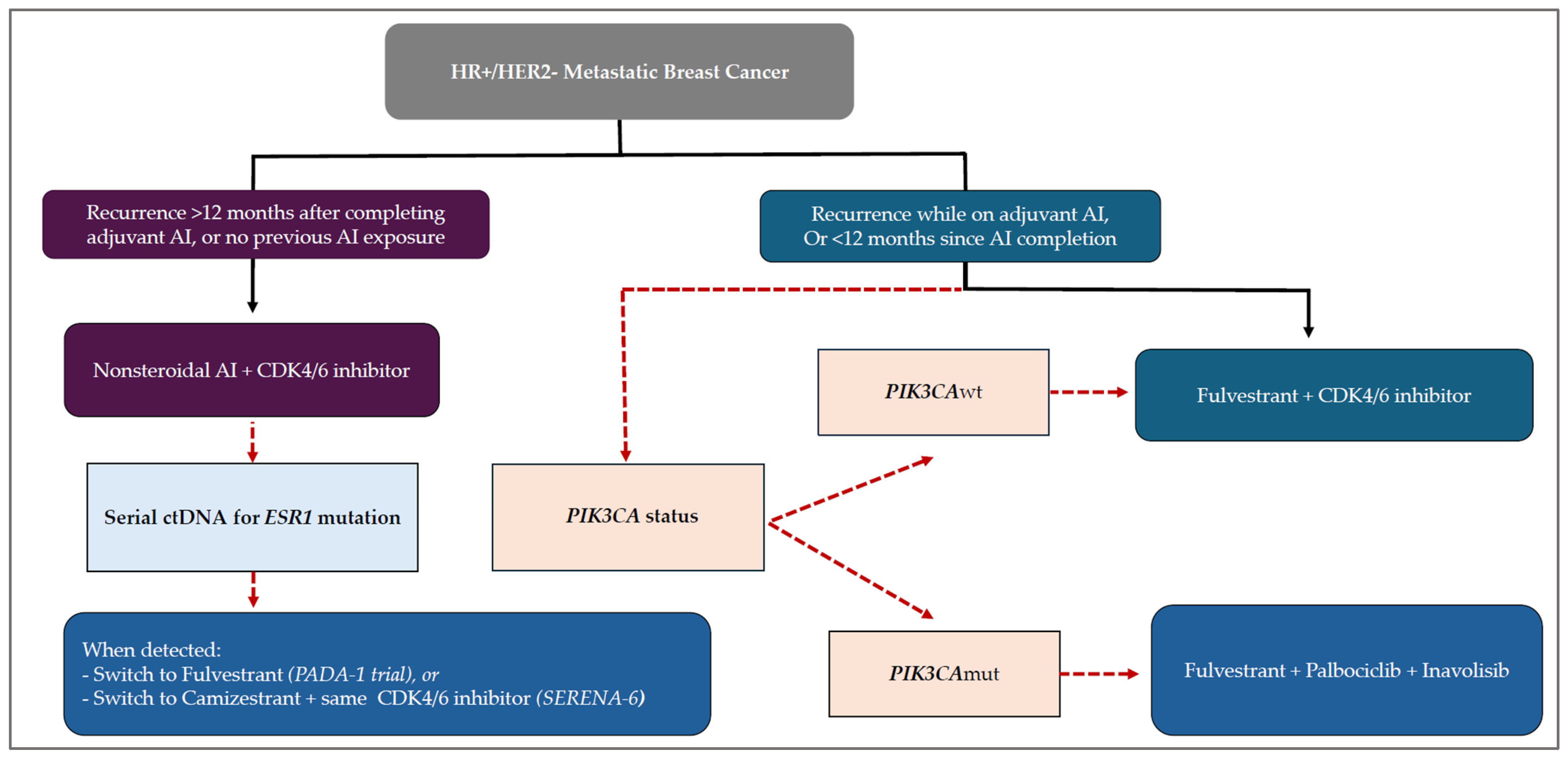
5. Current Standard of Care in First-Line HR+/HER2 MBC
5.1. CDK4/6 Inhibitors Plus Endocrine Therapy: A Paradigm Shift
5.1.1. Clinical Evidence Supporting CDK4/6 Inhibitors in First-Line Therapy
5.1.2. Choice of Endocrine Partner: Evidence from the PARSIFAL Trial
5.1.3. CDK4/6 Inhibitors in Visceral Metastasis
The RIGHT Choice Trial
The PADMA Trial
The ABIGAIL Trial
5.1.4. Tolerability and Quality of Life
5.2. Fulvestrant
5.3. New and Emerging First-Line Therapeutic Strategies
5.3.1. Next-Generation SERDs
5.3.2. Targeted Combinations Addressing Resistant Pathways
5.3.3. Unresolved Controversies and Implementation Challenges
5.4. Biomarker-Guided Preemptive Therapy
6. Conclusions and Future Directions
Author Contributions
Funding
Data Availability Statement
Acknowledgments
Conflicts of Interest
References
- Siegel, R.L.; Kratzer, T.B.; Wagle, N.S.; Sung, H.; Jemal, A. Cancer statistics, 2026. CA Cancer J. Clin. 2026, 76, e70043. [Google Scholar] [CrossRef] [PubMed]
- Howlader, N.; Altekruse, S.F.; Li, C.I.; Chen, V.W.; Clarke, C.A.; Ries, L.A.G.; Cronin, K.A. US incidence of breast cancer subtypes defined by joint hormone receptor and HER2 status. J. Natl. Cancer Inst. 2014, 106, dju055. [Google Scholar] [CrossRef] [PubMed]
- Osborne, C.K.; Schiff, R. Mechanisms of endocrine resistance in breast cancer. Annu. Rev. Med. 2011, 62, 233–247. [Google Scholar] [CrossRef] [PubMed]
- Early Breast Cancer Trialists’ Collaborative Group (EBCTCG); Davies, C.; Godwin, J.; Gray, R.; Clarke, M.; Cutter, D.; Darby, S.; McGale, P.; Pan, H.C.; Taylor, C.; et al. Relevance of breast cancer hormone receptors and other factors to the efficacy of adjuvant tamoxifen: Patient-level meta-analysis of randomised trials. Lancet 2011, 378, 771–784. [Google Scholar] [PubMed]
- Mouridsen, H.; Gershanovich, M.; Sun, Y.; Pérez-Carrión, R.; Boni, C.; Monnier, A.; Apffelstaedt, J.; Smith, R.; Sleeboom, H.P.; Jaenicke, F.; et al. Phase III study of letrozole versus tamoxifen as first-line therapy of advanced breast cancer in postmenopausal women: Analysis of survival and update of efficacy from the International Letrozole Breast Cancer Group. J. Clin. Oncol. 2003, 21, 2101–2109. [Google Scholar] [CrossRef] [PubMed]
- Neven, P.; Fasching, P.A.; Chia, S.; Jerusalem, G.; De Laurentiis, M.; Im, S.A.; Petrakova, K.; Bianchi, G.V.; Martín, M.; Nusch, A.; et al. Updated overall survival from the MONALEESA-3 trial in postmenopausal women with HR+/HER2− advanced breast cancer receiving first-line ribociclib plus fulvestrant. Breast Cancer Res. 2023, 25, 103. [Google Scholar] [CrossRef] [PubMed]
- Lu, Y.S.; Im, S.A.; Colleoni, M.; Franke, F.; Bardia, A.; Cardoso, F.; Harbeck, N.; Hurvitz, S.; Chow, L.; Sohn, J.; et al. Updated overall survival of ribociclib plus endocrine therapy versus endocrine therapy alone in pre- and perimenopausal patients with HR+/HER2- advanced breast cancer in MONALEESA-7: A phase III randomized clinical trial. Clin. Cancer Res. 2022, 28, 851–859. [Google Scholar] [PubMed]
- Gao, Y.; Yu, Y.; Zhang, M.; Yu, W.; Kang, L. Mechanisms of endocrine resistance in hormone receptor-positive breast cancer. Front. Oncol. 2024, 14, 1448687. [Google Scholar] [CrossRef] [PubMed]
- Brett, J.O.; Spring, L.M.; Bardia, A.; Wander, S.A. ESR1 mutation as an emerging clinical biomarker in metastatic hormone receptor-positive breast cancer. Breast Cancer Res. 2021, 23, 85. [Google Scholar] [CrossRef] [PubMed]
- Toy, W.; Shen, Y.; Won, H.; Green, B.; Sakr, R.A.; Will, M.; Li, Z.; Gala, K.; Fanning, S.; King, T.A.; et al. ESR1 ligand-binding domain mutations in hormone-resistant breast cancer. Nat. Genet. 2013, 45, 1439–1445. [Google Scholar] [CrossRef] [PubMed]
- Chandarlapaty, S.; Chen, D.; He, W.; Sung, P.; Samoila, A.; You, D.; Bhatt, T.; Patel, P.; Voi, M.; Gnant, M.; et al. Prevalence of ESR1 mutations in cell-free DNA and outcomes in metastatic breast cancer: A secondary analysis of the BOLERO-2 trial. JAMA Oncol. 2016, 2, 1310–1315. [Google Scholar] [CrossRef] [PubMed]
- Truong, T.H.; Roman Ortiz, N.I.; Ufondu, C.A.; Lee, S.J.; Ostrander, J.H. Emerging mechanisms of therapy resistance in metastatic ER+ breast cancer. Endocrinology 2025, 166, bqaf127. [Google Scholar] [CrossRef] [PubMed]
- Jeselsohn, R.; Buchwalter, G.; De Angelis, C.; Brown, M.; Schiff, R. ESR1 mutations—A mechanism for acquired endocrine resistance in breast cancer. Nat. Rev. Clin. Oncol. 2015, 12, 573–583. [Google Scholar] [CrossRef] [PubMed]
- Dawson, S.J.; Tsui, D.W.; Murtaza, M.; Biggs, H.; Rueda, O.M.; Chin, S.F.; Dunning, M.J.; Gale, D.; Forshew, T.; Mahler-Araujo, B.; et al. Analysis of circulating tumor DNA to monitor metastatic breast cancer. N. Engl. J. Med. 2013, 368, 1199–1209. [Google Scholar] [CrossRef] [PubMed]
- Corti, C.; De Angelis, C.; Bianchini, G.; Malorni, L.; Giuliano, M.; Hamilton, E.; Jeselsohn, R.; Jhaveri, K.; Curigliano, G.; Criscitiello, C. Novel endocrine therapies: What is next in estrogen receptor positive, HER2 negative breast cancer? Cancer Treat. Rev. 2023, 117, 102569. [Google Scholar] [CrossRef] [PubMed]
- Araki, K.; Miyoshi, Y. Mechanism of resistance to endocrine therapy in breast cancer: The important role of PI3K/Akt/mTOR in estrogen receptor-positive, HER2-negative breast cancer. Breast Cancer 2018, 25, 392–401. [Google Scholar] [PubMed]
- Fusco, N.; Malapelle, U.; Fassan, M.; Marchiò, C.; Buglioni, S.; Zupo, S.; Criscitiello, C.; Vigneri, P.; Dei Tos, A.P.; Maiorano, E.; et al. PIK3CA mutations as a molecular target for hormone receptor-positive, HER2-negative metastatic breast cancer. Front. Oncol. 2021, 11, 644737. [Google Scholar] [CrossRef] [PubMed]
- André, F.; Ciruelos, E.; Rubovszky, G.; Campone, M.; Loibl, S.; Rugo, H.S.; Iwata, H.; Conte, P.; Mayer, I.A.; Kaufman, B.; et al. Alpelisib for PIK3CA-mutated, hormone receptor-positive advanced breast cancer. N. Engl. J. Med. 2019, 380, 1929–1940. [Google Scholar] [CrossRef] [PubMed]
- Baselga, J.; Campone, M.; Piccart, M.; Burris, H.A., III; Rugo, H.S.; Sahmoud, T.; Noguchi, S.; Gnant, M.; Pritchard, K.I.; Lebrun, F.; et al. Everolimus in postmenopausal hormone-receptor-positive advanced breast cancer. N. Engl. J. Med. 2012, 366, 520–529. [Google Scholar] [CrossRef] [PubMed]
- AlFakeeh, A.; Brezden-Masley, C. Overcoming endocrine resistance in hormone receptor-positive breast cancer. Curr. Oncol. 2018, 25, S18–S27. [Google Scholar] [CrossRef] [PubMed]
- Kavan, S.; Kruse, T.A.; Vogsen, M.; Hildebrandt, M.G.; Thomassen, M. Heterogeneity and tumor evolution reflected in liquid biopsy in metastatic breast cancer patients: A review. Cancer Metastasis Rev. 2022, 41, 433–446. [Google Scholar] [CrossRef] [PubMed]
- Addanki, S.; Meas, S.; Sarli, V.N.; Singh, B.; Lucci, A. Applications of circulating tumor cells and circulating tumor DNA in precision oncology for breast cancers. Int. J. Mol. Sci. 2022, 23, 7843. [Google Scholar] [CrossRef] [PubMed]
- Schiavon, G.; Hrebien, S.; Garcia-Murillas, I.; Cutts, R.J.; Pearson, A.; Tarazona, N.; Fenwick, K.; Kozarewa, I.; Lopez-Knowles, E.; Ribas, R.; et al. Analysis of ESR1 mutation in circulating tumor DNA demonstrates evolution during therapy for metastatic breast cancer. Sci. Transl. Med. 2015, 7, 313ra182. [Google Scholar] [CrossRef] [PubMed]
- Kingston, B.; Cutts, R.J.; Bye, H.; Beaney, M.; Walsh-Crestani, G.; Hrebien, S.; Swift, C.; Kilburn, L.S.; Kernaghan, S.; Moretti, L.; et al. Genomic profile of advanced breast cancer in circulating tumour DNA. Nat. Commun. 2021, 12, 2423. [Google Scholar] [CrossRef] [PubMed]
- Bhave, M.A.; Quintanilha, J.C.F.; Tukachinsky, H.; Li, G.; Scott, T.; Ross, J.S.; Pasquina, L.; Huang, R.S.P.; McArthur, H.; Levy, M.A.; et al. Comprehensive genomic profiling of ESR1, PIK3CA, AKT1, and PTEN in HR(+)HER2(−) metastatic breast cancer: Prevalence along treatment course and predictive value for endocrine therapy resistance in real-world practice. Breast Cancer Res. Treat. 2024, 207, 599–609. [Google Scholar] [CrossRef] [PubMed]
- Ma, J.; Li, L.; Ma, B.; Liu, T.; Wang, Z.; Ye, Q.; Peng, Y.; Wang, B.; Chen, Y.; Zhang, Y.; et al. MYC induces CDK4/6 inhibitor resistance by promoting pRB1 degradation. Nat. Commun. 2024, 15, 1382. [Google Scholar] [CrossRef] [PubMed]
- Costa, C.; Wang, Y.; Ly, A.; Hosono, Y.; Murchie, E.; Walmsley, C.S.; Huynh, T.; Healy, C.; Peterson, R.; Yanase, S.; et al. PTEN loss mediates clinical cross-resistance to CDK4/6 and PI3Kα inhibitors in breast cancer. Cancer Discov. 2020, 10, 72–85. [Google Scholar] [CrossRef] [PubMed]
- Kan, Z.; Wen, J.; Bonato, V.; Webster, J.; Yang, W.; Ivanov, V.; Kim, K.H.; Roh, W.; Liu, C.; Mu, X.J.; et al. Real-world clinical multi-omics analyses reveal bifurcation of ER-independent and ER-dependent drug resistance to CDK4/6 inhibitors. Nat. Commun. 2025, 16, 932. [Google Scholar] [CrossRef] [PubMed]
- Grinda, T.; Joyon, N.; Lusque, A.; Lefèvre, S.; Arnould, L.; Penault-Llorca, F.; Macgrogan, G.; Treilleux, I.; Vincent-Salomon, A.; Haudebourg, J.; et al. Phenotypic discordance between primary and metastatic breast cancer in the large-scale real-life multicenter French ESME cohort. npj Breast Cancer 2021, 7, 41. [Google Scholar] [CrossRef] [PubMed]
- Rossi, S.; Basso, M.; Strippoli, A.; Dadduzio, V.; Cerchiaro, E.; Barile, R.; D’ARgento, E.; Cassano, A.; Schinzari, G.; Barone, C. Hormone receptor status and HER2 expression in primary breast cancer compared with synchronous axillary metastases or recurrent metastatic disease. Clin. Breast Cancer 2015, 15, 307–312. [Google Scholar] [CrossRef] [PubMed]
- Cabel, L.; Berger, F.; Bachelot, T.; Pistilli, B.; Dalenc, F.; de la Motte Rouge, T.; Sabatier, R.; Lortholary, A.; Marques, S.; Vibert, J.; et al. Kinetics and determinants of ESR1 mutation detection in metastatic breast cancer. Ann. Oncol. 2026, 37, 329–340. [Google Scholar] [CrossRef] [PubMed]
- Fillbrunn, M.; Signorovitch, J.; André, F.; Wang, I.; Lorenzo, I.; Ridolfi, A.; Park, J.; Dua, A.; Rugo, H.S. PIK3CA mutation status, progression and survival in advanced HR+/HER2− breast cancer: A meta-analysis of clinical trials. BMC Cancer 2022, 22, 1002. [Google Scholar] [CrossRef] [PubMed]
- Zundelevich, A.; Dadiani, M.; Kahana-Edwin, S.; Itay, A.; Sella, T.; Gadot, M.; Cesarkas, K.; Farage-Barhom, S.; Saar, E.G.; Eyal, E.; et al. ESR1 mutations are frequent in newly diagnosed metastatic and loco-regional recurrence of endocrine-treated breast cancer and carry worse prognosis. Breast Cancer Res. 2020, 22, 16. [Google Scholar] [CrossRef] [PubMed]
- Clatot, F.; Perdrix, A.; Augusto, L.; Beaussire, L.; Delacour, J.; Calbrix, C.; Sefrioui, D.; Viailly, P.-J.; Bubenheim, M.; Moldovan, C.; et al. Kinetics, prognostic and predictive values of ESR1 circulating mutations in metastatic breast cancer progressing on aromatase inhibitor. Oncotarget 2016, 7, 74448–74459. [Google Scholar] [CrossRef] [PubMed]
- Burstein, H.J. Systemic therapy for estrogen receptor-positive, HER2-negative breast cancer. N. Engl. J. Med. 2020, 383, 2557–2570. [Google Scholar] [CrossRef] [PubMed]
- Finn, R.S.; Martin, M.; Rugo, H.S.; Jones, S.; Im, S.A.; Gelmon, K.; Harbeck, N.; Lipatov, O.N.; Walshe, J.M.; Moulder, S.; et al. Palbociclib and letrozole in advanced breast cancer. N. Engl. J. Med. 2016, 375, 1925–1936. [Google Scholar] [CrossRef] [PubMed]
- Hortobagyi, G.N.; Stemmer, S.M.; Burris, H.A.; Yap, Y.S.; Sonke, G.S.; Paluch-Shimon, S.; Campone, M.; Blackwell, K.L.; André, F.; Winer, E.P.; et al. Ribociclib as first-line therapy for HR-positive, advanced breast cancer. N. Engl. J. Med. 2016, 375, 1738–1748. [Google Scholar] [CrossRef] [PubMed]
- Goetz, M.P.; Toi, M.; Campone, M.; Sohn, J.; Paluch-Shimon, S.; Huober, J.; Park, I.H.; Trédan, O.; Chen, S.C.; Manso, L.; et al. MONARCH 3: Abemaciclib as Initial Therapy for Advanced Breast Cancer. J. Clin. Oncol. 2017, 35, 3638–3646. [Google Scholar] [CrossRef] [PubMed]
- Gao, T.; Sun, Y.; Leng, P.; Liu, D.; Guo, Q.; Li, J. CDK4/6 inhibitors in breast cancer therapy: Mechanisms of drug resistance and strategies for treatment. Front. Pharmacol. 2025, 16, 1549520. [Google Scholar] [CrossRef] [PubMed]
- Gao, J.J.; Cheng, J.; Bloomquist, E.; Sanchez, J.; Wedam, S.B.; Singh, H.; Amiri-Kordestani, L.; Ibrahim, A.; Sridhara, R.; Goldberg, K.B.; et al. CDK4/6 inhibitor treatment for patients with hormone receptor-positive, HER2-negative, advanced or metastatic breast cancer: A US Food and Drug Administration pooled analysis. Lancet Oncol. 2020, 21, 250–260. [Google Scholar] [CrossRef] [PubMed]
- Hui, R.; de Boer, R.; Lim, E.; Yeo, B.; Lynch, J. CDK4/6 inhibitor plus endocrine therapy for hormone receptor-positive, HER2-negative metastatic breast cancer: The new standard of care. Asia Pac. J. Clin. Oncol. 2021, 17, 3–14. [Google Scholar] [CrossRef] [PubMed]
- Shao, H.; Zhao, M.; Guan, A.J.; Shao, T.; Zhou, D.; Yu, G.; Tang, W. A network meta-analysis of efficacy and safety for first-line and second/further-line therapies in postmenopausal women with hormone receptor-positive, HER2-negative, advanced breast cancer. BMC Med. 2024, 22, 13. [Google Scholar] [CrossRef] [PubMed]
- Li, J.; Fu, F.; Yu, L.; Huang, M.; Lin, Y.; Mei, Q.; Lv, J.; Wang, C. Cyclin-dependent kinase 4 and 6 inhibitors in hormone receptor-positive, human epidermal growth factor receptor-2 negative advanced breast cancer: A meta-analysis of randomized clinical trials. Breast Cancer Res. Treat. 2020, 180, 21–32. [Google Scholar] [CrossRef] [PubMed]
- Deng, Y.; Ma, G.; Li, W.; Wang, T.; Zhao, Y.; Wu, Q. CDK4/6 Inhibitors in Combination with Hormone Therapy for HR+/HER2- Advanced Breast Cancer: A Systematic Review and Meta-analysis of Randomized Controlled Trials. Clin. Breast Cancer 2018, 18, e943–e953. [Google Scholar] [CrossRef] [PubMed]
- National Comprehensive Cancer Network. NCCN Clinical Practice Guidelines in Oncology: Breast Cancer. Version 1. 2026. Available online: https://www.nccn.org/professionals/physician_gls/pdf/breast.pdf (accessed on 20 February 2026).
- Burstein, H.J.; Somerfield, M.R.; Barton, D.L.; Dorris, A.; Fallowfield, L.J.; Jain, D.; Johnston, S.R.D.; Korde, L.A.; Litton, J.K.; Macrae, E.R.; et al. Endocrine Treatment and Targeted Therapy for Hormone Receptor-Positive, Human Epidermal Growth Factor Receptor 2-Negative Metastatic Breast Cancer: ASCO Guideline Update. J. Clin. Oncol. 2021, 39, 3959–3977. [Google Scholar] [CrossRef] [PubMed]
- Pogoda, K.; Pawlik, H.; Balata, A.; Czopowicz, M.; Bak, A.; Twardowska, I.; Meluch, M.; Wojda, M.; Mlodzinska, A.; Szombara, E.; et al. Management Strategies and Outcomes in HR+/HER2− Metastatic Breast Cancer Receiving CDK4/6 Inhibitors and Subsequent Therapies. Breast Cancer 2025, 17, 1307–1319. [Google Scholar] [CrossRef] [PubMed]
- Rugo, H.S.; Finn, R.S.; Diéras, V.; Ettl, J.; Lipatov, O.; Joy, A.A.; Harbeck, N.; Castrellon, A.; Iyer, S.; Lu, D.; et al. Palbociclib plus letrozole as first-line therapy in estrogen receptor-positive/human epidermal growth factor receptor 2-negative advanced breast cancer with extended follow-up. Breast Cancer Res. Treat. 2019, 174, 719–729. [Google Scholar] [CrossRef] [PubMed]
- Hu, X.; Zhang, Q.; Sun, T.; Yin, Y.; Li, H.; Yan, M.; Tong, Z.; Li, M.; Teng, Y.; Oppermann, C.P.; et al. Abemaciclib plus non-steroidal aromatase inhibitor or fulvestrant in women with HR+/HER2- advanced breast cancer: Final results of the randomized phase III MONARCH plus trial. Chin. Med. J. (Engl.) 2025, 138, 1477–1486. [Google Scholar] [PubMed]
- Johnston, S.; Martin, M.; Di Leo, A.; Im, S.A.; Awada, A.; Forrester, T.; Frenzel, M.; Hardebeck, M.C.; Cox, J.; Barriga, S.; et al. MONARCH 3 final PFS: A randomized study of abemaciclib as initial therapy for advanced breast cancer. npj Breast Cancer 2019, 5, 5. [Google Scholar] [CrossRef] [PubMed]
- Hortobagyi, G.N.; Stemmer, S.M.; Burris, H.A.; Yap, Y.S.; Sonke, G.S.; Paluch-Shimon, S.; Campone, M.; Petrakova, K.; Blackwell, K.L.; Winer, E.P.; et al. Updated results from MONALEESA-2, a phase III trial of first-line ribociclib plus letrozole versus placebo plus letrozole in hormone receptor-positive, HER2-negative advanced breast cancer. Ann. Oncol. 2018, 29, 1541–1547. [Google Scholar] [CrossRef] [PubMed]
- Hortobagyi, G.N.; Stemmer, S.M.; Burris, H.A.; Yap, Y.S.; Sonke, G.S.; Hart, L.; Campone, M.; Petrakova, K.; Winer, E.P.; Janni, W.; et al. Overall Survival with Ribociclib plus Letrozole in Advanced Breast Cancer. N. Engl. J. Med. 2022, 386, 942–950. [Google Scholar] [CrossRef] [PubMed]
- Slamon, D.J.; Neven, P.; Chia, S.; Fasching, P.A.; De Laurentiis, M.; Im, S.A.; Petrakova, K.; Val Bianchi, G.; Esteva, F.J.; Martín, M.; et al. Phase III Randomized Study of Ribociclib and Fulvestrant in Hormone Receptor-Positive, Human Epidermal Growth Factor Receptor 2-Negative Advanced Breast Cancer: MONALEESA-3. J. Clin. Oncol. 2018, 36, 2465–2472. [Google Scholar] [CrossRef] [PubMed]
- Sledge, G.W., Jr.; Toi, M.; Neven, P.; Sohn, J.; Inoue, K.; Pivot, X.; Burdaeva, O.; Okera, M.; Masuda, N.; Kaufman, P.A.; et al. The Effect of Abemaciclib Plus Fulvestrant on Overall Survival in Hormone Receptor-Positive, ERBB2-Negative Breast Cancer That Progressed on Endocrine Therapy-MONARCH 2: A Randomized Clinical Trial. JAMA Oncol. 2020, 6, 116–124. [Google Scholar] [CrossRef] [PubMed]
- Sledge, G.W., Jr.; Toi, M.; Neven, P.; Sohn, J.; Inoue, K.; Pivot, X.; Burdaeva, O.; Okera, M.; Masuda, N.; Kaufman, P.A.; et al. MONARCH 2: Abemaciclib in Combination with Fulvestrant in Women with HR+/HER2− Advanced Breast Cancer Who Had Progressed While Receiving Endocrine Therapy. J. Clin. Oncol. 2017, 35, 2875–2884. [Google Scholar] [CrossRef] [PubMed]
- Slamon, D.J.; Diéras, V.; Rugo, H.S.; Harbeck, N.; Im, S.A.; Gelmon, K.A.; Lipatov, O.N.; Walshe, J.M.; Martin, M.; Chavez-MacGregor, M.; et al. Overall Survival with Palbociclib Plus Letrozole in Advanced Breast Cancer. J. Clin. Oncol. 2024, 42, 994–1000. [Google Scholar] [CrossRef] [PubMed]
- Tripathy, D.; Im, S.A.; Colleoni, M.; Franke, F.; Bardia, A.; Harbeck, N.; Hurvitz, S.A.; Chow, L.; Sohn, J.; Lee, K.S.; et al. Ribociclib plus endocrine therapy for premenopausal women with hormone-receptor-positive, advanced breast cancer (MONALEESA-7): A randomised phase 3 trial. Lancet Oncol. 2018, 19, 904–915. [Google Scholar] [CrossRef] [PubMed]
- Im, S.A.; Lu, Y.S.; Bardia, A.; Harbeck, N.; Colleoni, M.; Franke, F.; Chow, L.; Sohn, J.; Lee, K.S.; Campos-Gomez, S.; et al. Overall Survival with Ribociclib plus Endocrine Therapy in Breast Cancer. N. Engl. J. Med. 2019, 381, 307–316. [Google Scholar] [CrossRef] [PubMed]
- Di Cosimo, S.; Pérez-García, J.M.; Bellet, M.; Dalenc, F.; Gil Gil, M.J.; Ruiz Borrego, M.; Gavilá, J.; Sampayo-Cordero, M.; Aguirre, E.; Schmid, P.; et al. Palbociclib with fulvestrant or letrozole in endocrine-sensitive patients with HR-positive/HER2-negative advanced breast cancer: A detailed safety analysis of the randomized PARSIFAL trial. Oncologist 2023, 28, 23–32. [Google Scholar] [PubMed]
- Lu, Y.S.; Mahidin, E.I.B.M.; Azim, H.; Eralp, Y.; Yap, Y.S.; Im, S.A.; Gokmen, E.; El Bastawisy, A.; Karadurmus, N.; Lim, Y.N.; et al. Final Results of RIGHT Choice: Ribociclib Plus Endocrine Therapy Versus Combination Chemotherapy in Premenopausal Women with Clinically Aggressive Hormone Receptor-Positive/Human Epidermal Growth Factor Receptor 2-Negative Advanced Breast Cancer. J. Clin. Oncol. 2024, 42, 2812–2821. [Google Scholar] [CrossRef] [PubMed]
- Loibl, S.; Thill, M.; Rey, J.; Rautenberg, B.; Bjelic-Radisic, V.; Decker, T.; Rom, J.; Kögel, M.; Lübbe, K.; Nacke, A.; et al. Abstract LB1-03: Primary results of the randomised Phase III trial comparing first-line ET plus palbociclib vs standard mono-chemotherapy in women with high risk HER2−/HR+ metastatic breast cancer and indication for chemotherapy—PADMA study. Clin. Cancer Res. 2025, 31, LB1-03. [Google Scholar] [CrossRef]
- Orlandi, A. Should CDK4/6 inhibitors replace chemotherapy in HR+ /HER2− metastatic breast cancer with visceral crisis? Evaluating the emerging evidence. Discov. Oncol. 2025, 16, 982. [Google Scholar] [CrossRef] [PubMed]
- ClinicalTrials.gov. ABIGAIL Trial: Abemaciclib, ET ± Paclitaxel in Aggressive HR+/HER2− MBC. NCT04603183. Available online: https://clinicaltrials.gov/study/NCT04603183 (accessed on 16 February 2026).
- de la Haba Rodriguez, J.; Cortes, J.; Di Cosimo, S.; Blancas López-Barajas, I.; Cortez Castedo, S.P.; ∙López, A.; López-Miranda, E.; Pla Juher, H.; Albacar Miro, C.R.; Ponce, J.; et al. LBA23 ABIGAIL: Randomized phase II study of abemaciclib plus endocrine therapy (ET) with or without a short course of induction paclitaxel in patients (pts) with previously untreated HR-positive/HER2-negative advanced breast cancer (HR+/HER2− ABC) with aggressive disease criteria. Ann. Oncol. 2024, 35, S1215–S1216. [Google Scholar] [CrossRef]
- Harbeck, N.; Iyer, S.; Turner, N.; Cristofanilli, M.; Ro, J.; André, F.; Loi, S.; Verma, S.; Iwata, H.; Bhattacharyya, H.; et al. Quality of life with palbociclib plus fulvestrant in previously treated hormone receptor-positive, HER2-negative metastatic breast cancer: Patient-reported outcomes from the PALOMA-3 trial. Ann. Oncol. 2016, 27, 1047–1054. [Google Scholar] [CrossRef] [PubMed]
- Goetz, M.P.; Martin, M.; Tokunaga, E.; Park, I.H.; Huober, J.; Toi, M.; Stoffregen, C.; Shekarriz, S.; Andre, V.; Gainford, M.C.; et al. Health-Related Quality of Life in MONARCH 3: Abemaciclib plus an Aromatase Inhibitor as Initial Therapy in HR+, HER2− Advanced Breast Cancer. Oncologist. 2020, 25, e1346–e1354. [Google Scholar] [CrossRef] [PubMed]
- Sanò, M.V.; Martorana, F.; Lavenia, G.; Rossello, R.; Prestifilippo, A.; Sava, S.; Ricciardi, G.R.; Vigneri, P. Ribociclib efficacy in special populations and analysis of patient-reported outcomes in the MONALEESA trials. Expert Rev. Anticancer Ther. 2022, 22, 343–351. [Google Scholar] [CrossRef] [PubMed]
- Robertson, J.F.R.; Bondarenko, I.M.; Trishkina, E.; Dvorkin, M.; Panasci, L.; Manikhas, A.; Shparyk, Y.; Cardona-Huerta, S.; Cheung, K.L.; Philco-Salas, M.J.; et al. Fulvestrant 500 mg versus anastrozole 1 mg for hormone receptor-positive advanced breast cancer (FALCON): An international, randomised, double-blind, phase 3 trial. Lancet 2016, 388, 2997–3005. [Google Scholar] [CrossRef] [PubMed]
- Noguchi, S.; Ellis, M.J.; Robertson, J.F.R.; Thirlwell, J.; Fazal, M.; Shao, Z. Progression-free survival results in postmenopausal Asian women: Subgroup analysis from a phase III randomized trial of fulvestrant 500 mg vs anastrozole 1 mg for hormone receptor-positive advanced breast cancer (FALCON). Breast Cancer 2018, 25, 356–364. [Google Scholar] [CrossRef] [PubMed]
- Robertson, J.F.; Lindemann, J.P.; Llombart-Cussac, A.; Rolski, J.; Feltl, D.; Dewar, J.; Emerson, L.; Dean, A.; Ellis, M.J. Fulvestrant 500 mg versus anastrozole 1 mg for the first-line treatment of advanced breast cancer: Follow-up analysis from the randomized ‘FIRST’ study. Breast Cancer Res. Treat. 2012, 136, 503–511. [Google Scholar] [CrossRef] [PubMed]
- Kaklamani, V.G.; Gradishar, W.J. Endocrine Therapy in the Current Management of Postmenopausal Estrogen Receptor-Positive Metastatic Breast Cancer. Oncologist 2017, 22, 507–517. [Google Scholar] [CrossRef] [PubMed]
- Zhang, J.; Huang, Y.; Wang, C.; He, Y.; Zheng, S.; Wu, K. Efficacy and safety of endocrine monotherapy as first-line treatment for hormone-sensitive advanced breast cancer: A network meta-analysis. Medicine 2017, 96, e7846. [Google Scholar] [CrossRef] [PubMed]
- Reinert, T.; Barrios, C.H. Overall survival and progression-free survival with endocrine therapy for hormone receptor-positive, HER2-negative advanced breast cancer: Review. Ther. Adv. Med. Oncol. 2017, 9, 693–709. [Google Scholar] [CrossRef] [PubMed]
- Mehta, R.S.; Barlow, W.E.; Albain, K.S.; Vandenberg, T.A.; Dakhil, S.R.; Tirumali, N.R.; Lew, D.L.; Hayes, D.F.; Gralow, J.R.; Linden, H.H.; et al. Overall Survival with Fulvestrant plus Anastrozole in Metastatic Breast Cancer. N. Engl. J. Med. 2019, 380, 1226–1234. [Google Scholar] [CrossRef] [PubMed]
- Sharaf, B.; Hajahjeh, A.; Bani Hani, H.; Abdel-Razeq, H. Next generation selective estrogen receptor degraders in postmenopausal women with advanced-stage hormone receptor-positive, HER2-negative breast cancer. Front. Oncol. 2024, 14, 1385577. [Google Scholar] [CrossRef] [PubMed]
- Neupane, N.; Bawek, S.; Gurusinghe, S.; Ghaffary, E.M.; Mirmosayyeb, O.; Thapa, S.; Falkson, C.; O’Regan, R.; Dhakal, A. Oral SERD, a Novel Endocrine Therapy for Estrogen Receptor-Positive Breast Cancer. Cancers 2024, 16, 619. [Google Scholar] [CrossRef] [PubMed]
- Huang, X.; Yu, Y.; Luo, S.; Fu, W.; Zhang, J.; Song, C. The value of oral selective estrogen receptor degraders in patients with HR-positive, HER2-negative advanced breast cancer after progression on ≥ 1 line of endocrine therapy: Systematic review and meta-analysis. BMC Cancer 2024, 24, 21, Erratum in BMC Cancer 2024, 24, 205. [Google Scholar] [CrossRef] [PubMed]
- Jhaveri, K.L.; Bellet, M.; Turner, N.C.; Loi, S.; Bardia, A.; Boni, V.; Sohn, J.; Neilan, T.G.; Villanueva-Vázquez, R.; Kabos, P.; et al. Phase Ia/b Study of Giredestrant ± Palbociclib and ± Luteinizing Hormone-Releasing Hormone Agonists in Estrogen Receptor-Positive, HER2-Negative, Locally Advanced/Metastatic Breast Cancer. Clin. Cancer Res. 2024, 30, 754–766. [Google Scholar] [PubMed]
- Turner, N.C.; Jhaveri, K.L.; Bardia, A.; Niikura, N.; Bellet, M.; Barrios, C.H.; Diéras, V.; Im, S.-A.; Mueller, V.; Song, E.; et al. Giredestrant (GIRE) + palbociclib (PALBO) vs letrozole (LET) + PALBO as first-line (1L) therapy in patients (pts) with estrogen receptor–positive, HER2-negative locally advanced or metastatic breast cancer (ER+, HER2– LA/mBC): Primary analysis of the phase III persevERA BC trial. J. Clin. Oncol. 2026, 44, LBA1006. [Google Scholar] [CrossRef]
- Mayer, E.; Tolaney, S.; Martin, M.; Vidal, G.; Moscetti, L.; Jhaveri, K.; Brufsky, A.; Gradishar, W.; Schneeweiss, A.; Niikura, N.; et al. LBA16 Giredestrant (GIRE), an oral selective oestrogen receptor (ER) antagonist and degrader, + everolimus (E) in patients (pts) with ER-positive, HER2-negative advanced breast cancer (ER+, HER2– aBC) previously treated with a CDK4/6 inhibitor (i): Primary results of the phase III evERA BC trial. Ann. Oncol. 2025, 36, S1561–S1562. [Google Scholar] [CrossRef]
- Bardia, A.; Schmid, P.; Martin, M.; Hurvitz, S.; Jung, K.; Rimawi, M.; Saji, S.; Werutsky, G.; Harbeck, N.; Loi, S.; et al. Giredestrant vs standard-of-care endocrine therapy as adjuvant treatment for patients with estrogen receptor-positive, HER2-negative early breast cancer: Results from the global Phase III lidERA Breast Cancer trial. SABCS 2025, 32, GS1-10. [Google Scholar]
- Hamilton, E.; Oliveira, M.; Turner, N.; García Corbacho, J.; Hernando, C.; Ciruelos, E.M.; Kabos, P.; Ruiz-Borrego, M.; Armstrong, A.; Patel, M.R.; et al. A phase I dose escalation and expansion trial of the next generation oral SERD camizestrant in women with ER-positive, HER2-negative advanced breast cancer: SERENA 1 monotherapy results. Ann. Oncol. 2024, 35, 707–717. [Google Scholar] [CrossRef] [PubMed]
- Oliveira, M.; Pominchuk, D.; Nowecki, Z.; Hamilton, E.; Kulyaba, Y.; Andabekov, T.; Hotko, Y.; Melkadze, T.; Nemsadze, G.; Neven, P.; et al. Camizestrant, a next-generation oral SERD, versus fulvestrant in post-menopausal women with oestrogen receptor-positive, HER2-negative advanced breast cancer (SERENA-2): A multi-dose, open-label, randomised, phase 2 trial. Lancet Oncol. 2024, 25, 1424–1439. [Google Scholar] [CrossRef] [PubMed]
- Bidard, F.C.; Mayer, E.L.; Park, Y.H.; Janni, W.; Ma, C.; Cristofanilli, M.; Bianchini, G.; Kalinsky, K.; Iwata, H.; Chia, S.; et al. SERENA-6: First-Line Camizestrant for Emerging ESR1-Mutated Advanced Breast Cancer. N. Engl. J. Med. 2025, 393, 569–580. [Google Scholar] [CrossRef] [PubMed]
- Jhaveri, K.L.; Neven, P.; Casalnuovo, M.L.; Kim, S.B.; Tokunaga, E.; Aftimos, P.; Saura, C.; O’Shaughnessy, J.; Harbeck, N.; Carey, L.A.; et al. Imlunestrant with or without Abemaciclib in Advanced Breast Cancer. N. Engl. J. Med. 2025, 392, 1189–1202. [Google Scholar] [CrossRef] [PubMed]
- US National Library of Medicine. A Study of Imlunestrant Versus Standard Adjuvant Endocrine Therapy in Patients with HR+/HER2− Early Breast Cancer (EMBER-4). ClinicalTrials.gov Identifier: NCT05511779. Available online: https://clinicaltrials.gov/study/NCT05514054 (accessed on 17 June 2026).
- Anderson, E.J.; Mollon, L.E.; Dean, J.L.; Warholak, T.L.; Aizer, A.; Platt, E.A.; Tang, D.H.; Davis, L.E. A Systematic Review of the Prevalence and Diagnostic Workup of PIK3CA Mutations in HR+/HER2– Metastatic Breast Cancer. Int. J. Breast Cancer 2020, 2020, 3759179. [Google Scholar] [CrossRef] [PubMed]
- Vernieri, C.; Corti, F.; Nichetti, F.; Ligorio, F.; Manglaviti, S.; Zattarin, E.; Rea, C.G.; Capri, G.; Bianchi, G.V.; de Braud, F. Everolimus versus alpelisib in advanced hormone receptor-positive HER2-negative breast cancer: Targeting different nodes of the PI3K/AKT/mTORC1 pathway with different clinical implications. Breast Cancer Res. 2020, 22, 33. [Google Scholar] [CrossRef] [PubMed]
- André, F.; Ciruelos, E.M.; Juric, D.; Loibl, S.; Campone, M.; Mayer, I.A.; Rubovszky, G.; Yamashita, T.; Kaufman, B.; Lu, Y.S.; et al. Alpelisib plus fulvestrant for PIK3CA-mutated, hormone receptor-positive, human epidermal growth factor receptor-2-negative advanced breast cancer: Final overall survival results from SOLAR-1. Ann. Oncol. 2021, 32, 208–217. [Google Scholar] [CrossRef] [PubMed]
- Rugo, H.S.; Lerebours, F.; Ciruelos, E.; Drullinsky, P.; Ruiz-Borrego, M.; Neven, P.; Park, Y.H.; Prat, A.; Bachelot, T.; Juric, D.; et al. Alpelisib plus fulvestrant in PIK3CA-mutated, hormone receptor-positive advanced breast cancer after a CDK4/6 inhibitor (BYLieve): One cohort of a phase 2, multicentre, open-label, non-comparative study. Lancet Oncol. 2024, 25, e629–e638. [Google Scholar] [CrossRef] [PubMed]
- Turner, N.C.; Im, S.A.; Saura, C.; Juric, D.; Loibl, S.; Kalinsky, K.; Schmid, P.; Loi, S.; Sunpaweravong, P.; Musolino, A.; et al. Inavolisib plus palbociclib and fulvestrant in PIK3CA-mutated, hormone receptor-positive, HER2-negative advanced breast cancer. N. Engl. J. Med. 2024, 391, 1584–1596. [Google Scholar] [CrossRef] [PubMed]
- Jhaveri, K.L.; Im, S.A.; Saura, C.; Loibl, S.; Kalinsky, K.; Schmid, P.; Loi, S.; Thanopoulou, E.; Shankar, N.; Jin, Y.; et al. Overall Survival with Inavolisib in PIK3CA-Mutated Advanced Breast Cancer. N. Engl. J. Med. 2025, 393, 151–161. [Google Scholar] [CrossRef] [PubMed]
- US Food and Drug Administration. FDA Approves Inavolisib with Palbociclib and Fulvestrant for Endocrine Resistant, PIK3CA Mutated, HR Positive, HER2 Negative Advanced Breast Cancer; FDA: Silver Spring, MD, USA, 2024. Available online: https://www.fda.gov/drugs/resources-information-approved-drugs/fda-approves-inavolisib-palbociclib-and-fulvestrant-endocrine-resistant-PIK3CA-mutated-hr-positive (accessed on 24 March 2026).
- Turner, N.C.; Oliveira, M.; Howell, S.J.; Dalenc, F.; Cortes, J.; Gomez, H.L.; Hu, X.; Jhaveri, K.; Krivorotko, P.; Loibl, S.; et al. Capivasertib in hormone receptor-positive advanced breast cancer. N. Engl. J. Med. 2023, 388, 2058–2070. [Google Scholar] [CrossRef] [PubMed]
- Amato, O.; Giannopoulou, N.; Ignatiadis, M. Circulating tumor DNA validity and potential uses in metastatic breast cancer. npj Breast Cancer 2024, 10, 21. [Google Scholar] [CrossRef] [PubMed]
- Fribbens, C.; Garcia Murillas, I.; Beaney, M.; Hrebien, S.; O’Leary, B.; Kilburn, L.; Howarth, K.; Epstein, M.; Green, E.; Rosenfeld, N.; et al. Tracking evolution of aromatase inhibitor resistance with circulating tumour DNA analysis in metastatic breast cancer. Ann. Oncol. 2018, 29, 145–153. [Google Scholar] [CrossRef] [PubMed]
- Lawson, M.; Cureton, N.; Ros, S.; Cheraghchi-Bashi, A.; Urosevic, J.; D’Arcy, S.; Delpuech, O.; DuPont, M.; Fisher, D.I.; Gangl, E.T.; et al. The Next-Generation Oral Selective Estrogen Receptor Degrader Camizestrant (AZD9833) Suppresses ER+ Breast Cancer Growth and Overcomes Endocrine and CDK4/6 Inhibitor Resistance. Cancer Res. 2023, 83, 3989–4004. [Google Scholar] [CrossRef] [PubMed]
- Berger, F.; Marce, M.; Delaloge, S.; Hardy-Bessard, A.C.; Bachelot, T.; Bièche, I.; Pradines, A.; De La Motte Rouge, T.; Canon, J.L.; André, F.; et al. Randomised, open-label, multicentric phase III trial to evaluate the safety and efficacy of palbociclib in combination with endocrine therapy, guided by ESR1 mutation monitoring in oestrogen receptor-positive, HER2-negative metastatic breast cancer patients: Study design of PADA-1. BMJ Open 2022, 12, e055821. [Google Scholar] [CrossRef] [PubMed]
- Bidard, F.C.; Hardy-Bessard, A.C.; Dalenc, F.; Bachelot, T.; Pierga, J.Y.; de la Motte Rouge, T.; Sabatier, R.; Dubot, C.; Frenel, J.S.; Ferrero, J.M.; et al. Switch to fulvestrant and palbociclib versus no switch in advanced breast cancer with rising ESR1 mutation during aromatase inhibitor and palbociclib therapy (PADA-1): A randomised, open-label, multicentre, phase 3 trial. Lancet Oncol. 2022, 23, 1367–1377. [Google Scholar] [CrossRef] [PubMed]
- Turner, N.C.; Johnston, S.R.D. Endocrine therapy for advanced breast cancer: Evolving paradigms and precision medicine. Nat. Rev. Clin. Oncol. 2017, 14, 663–674. [Google Scholar]
- Bidard, F.C.; Kaklamani, V.G.; Neven, P.; Streich, G.; Montero, A.J.; Forget, F.; Mouret-Reynier, M.A.; Sohn, J.H.; Taylor, D.; Harnden, K.K.; et al. Elacestrant versus standard endocrine therapy for estrogen receptor-positive, HER2-negative advanced breast cancer (EMERALD). J. Clin. Oncol. 2022, 40, 3246–3256. [Google Scholar] [CrossRef] [PubMed]
- Lopetegui-Lia, N.; Varma, R.; Abraham, J.; Roesch, E. Current and Novel Treatment Options in Hormone Receptor-Positive, Human Epidermal Growth Factor Receptor 2-Negative Metastatic Breast Cancer. JCO Oncol. Pract. 2025, 21, 145–154. [Google Scholar] [CrossRef] [PubMed]
- Trapani, D.; Martins-Branco, D.; Curigliano, G.; Gennari, A.; Pentheroudakis, G.; Harbeck, N.; ESMO Guidelines Committee. Updated systemic treatment recommendations from ESMO MBC Living Guideline. Ann. Oncol. 2025, 36, 1414–1418. [Google Scholar] [CrossRef] [PubMed]
- Modi, S.; Jacot, W.; Yamashita, T.; Sohn, J.; Vidal, M.; Tokunaga, E.; Tsurutani, J.; Ueno, N.T.; Prat, A.; Chae, Y.S.; et al. Trastuzumab deruxtecan in previously treated HER2-low advanced breast cancer. N. Engl. J. Med. 2022, 387, 9–20. [Google Scholar] [CrossRef] [PubMed]
- Rugo, H.S.; Bardia, A.; Marmé, F.; Cortes, J.; Schmid, P.; Loirat, D.; Trédan, O.; Ciruelos, E.; Dalenc, F.; Gómez Pardo, P.; et al. Overall survival with sacituzumab govitecan in hormone receptor-positive and HER2-negative metastatic breast cancer (TROPiCS-02): A randomised, open-label, multicentre, phase 3 trial. Lancet 2023, 402, 1423–1433. [Google Scholar] [CrossRef] [PubMed]
- Kalinsky, K.; Bianchini, G.; Hamilton, E.; Graff, S.L.; Park, K.H.; Jeselsohn, R.; Demirci, U.; Martin, M.; Layman, R.M.; Hurvitz, S.A.; et al. Abemaciclib plus fulvestrant in advanced breast cancer after progression on CDK4/6 inhibition: Results from the phase III postMONARCH trial. J. Clin. Oncol. 2025, 43, 1101–1112. [Google Scholar] [CrossRef] [PubMed]
- Kalinsky, K.; Accordino, M.K.; Chiuzan, C.; Mundi, P.S.; Sakach, E.; Sathe, C.; Ahn, H.; Trivedi, M.S.; Novik, Y.; Tiersten, A.; et al. Randomized phase II trial of endocrine therapy with or without ribociclib after progression on cyclin-dependent kinase 4/6 inhibition in hormone receptor-positive, HER2-negative metastatic breast cancer: MAINTAIN trial. J. Clin. Oncol. 2023, 41, 4004–4013. [Google Scholar] [CrossRef] [PubMed]
- Mayer, E.L.; Ren, Y.; Wagle, N.; Mahtani, R.; Ma, C.; DeMichele, A.; Cristofanilli, M.; Meisel, J.; Miller, K.D.; Abdou, Y.; et al. PACE: A randomized phase II study of fulvestrant, palbociclib, and avelumab after progression on cyclin-dependent kinase 4/6 inhibitor and aromatase inhibitor for hormone receptor-positive/HER2-negative metastatic breast cancer. J. Clin. Oncol. 2024, 42, 2050–2060. [Google Scholar] [CrossRef] [PubMed]


| PALOMA-2 [48] (N = 666) | MONARCH-3 [49,50] (N = 493) | MONALEESA-2 [51] (N = 668) | MONALEESA-3 [53] (N = 726) † | MONALEESA-7 [57,58] (N = 672) | |
|---|---|---|---|---|---|
| Line of therapy | First-line | First-line | First-line | First and second line | First-line |
| Patient population | Postmenopausal advanced BC; no previous systemic treatment | Locally advanced or metastatic BC; postmenopausal; no previous systemic treatment | Postmenopausal advanced BC with recurrent or MBC; no previous systemic treatment | Postmenopausal advanced BC; ≤1 prior ET for advanced BC | Premenopausal/ perimenopausal advanced BC; no previous ET for advanced BC |
| Treatment arms | Letrozole ± palbociclib | Anastrozole or letrozole ± abemaciclib | Letrozole ± ribociclib | Fulvestrant ± ribociclib | Tamoxifen, anastrozole, or letrozole ± ribociclib |
| Median PFS CDK4/6i + ET vs. ET, months | 27.6 vs. 14.5 (HR: 0.56) | 29.0 vs. 14.8 (HR: 0.54) | 25.3 vs. 16.0 (HR: 0.57) | 20.5 vs. 12.8 (HR: 0.59) | 23.8 vs. 13.0 (HR: 0.55) |
| Median OS CDK4/6i + ET vs. ET, months | 53.9 vs. 51.2 (HR: 0.96) | 66.8 vs. 53.7 (HR: 0.80) | 63.9 vs. 51.4 (HR: 0.76) | 67.6 vs. 51.8 (HR: 0.67) | 58.7 vs. 48.0 (HR: 0.76) |
| Feature | RIGHT Choice [60] | PADMA [61] * | ABIGAIL [63,64] |
|---|---|---|---|
| Phase/Design | Phase 2, randomized | Phase 3, randomized | Phase 2, randomized |
| Patient population | Pre/perimenopausal women with clinically aggressive MBC, including symptomatic visceral metastases, visceral crisis, or rapid progression | MBC with indication for chemotherapy (e.g., visceral metastases, rapid progression) | MBC with ≥1 aggressive feature: symptomatic visceral disease, liver metastases, ≥3 metastatic sites, or early relapse |
| CDK4/6 inhibitor | Ribociclib | Palbociclib | Abemaciclib |
| Comparator | Physician’s choice combination chemotherapy | Mono-chemotherapy | Paclitaxel (12 weeks induction) |
| Endocrine therapy backbone | Letrozole or anastrozole + goserelin | ET (varied) | Standard ET |
| Number of patients | 222 | 130 (120 included in the analysis) | 162 |
| Primary endpoint | PFS | TTF/PFS | 12-week objective response rate (ORR) |
| Median PFS (Months) | 21.8 (Ribociclib + ET) vs. 12.8 (CT), HR 0.61, p = 0.003 | 18.7 vs. 7.8 HR 0.45, 95% CI 0.29–0.70, p < 0.001 | Not powered for PFS (ORR-driven) |
| ORR (%) | 66.1 (Ribociclib + ET) vs. 61.8 (CT) | Not reported | 58.8 (Abemaciclib + ET) vs. 40.2 (Paclitaxel) [OR 2.11; 95% CI, 1.13–3.96; p = 0.0193] |
| Tolerability | Fewer symptomatic AEs and fewer discontinuations with Ribociclib + ET | Better tolerability than chemotherapy | Similar safety, trend toward better tolerability with Abemaciclib + ET |
| Outcome | Inavolisib + Palbociclib + Fulvestrant | Placebo + Palbociclib + Fulvestrant | Treatment Effect |
|---|---|---|---|
| Number of patients | 161 | 164 | — |
| Median follow-up (Months) | 34.2 | 32.3 | — |
| Median PFS (Months) | 17.2 | 7.3 | HR 0.42 (95% CI: 0.32–0.55) |
| Median Overall Survival (OS) (Months) | 34.0 (95% CI, 28.4–44.8) | 27.0 (95% CI, 22.8–38.7) | HR 0.67 (95% CI: 0.48–0.94), p = 0.02 |
| Objective Response Rate (ORR) | 62.7% (95% CI, 54.8–70.2) | 28.0% (95% CI, 21.3–35.6) | p < 0.0001 |
| Median Time to Chemotherapy (Months) | 35.6 (95% CI, 25.4–NR) | 12.6 (95% CI, 10.4–16.1) | HR 0.43 |
| Median duration of response (Months) | 19.2 (95% CI, 14.7–28.3) | 11.1 (95% CI, 8.5–20.2) | — |
| Discontinuation due to AEs | 6.8% | 0.6% | — |
| Feature | PADA-1 [98,99] | SERENA-6 [84] | |
|---|---|---|---|
| Design | Phase 3, open-label, randomized | Phase 3, double-blind, randomized | |
| Population | HR+/HER2− MBC on AI + palbociclib with emergent ESR1 mutation in ctDNA but no radiologic progression | HR+/HER2− MBC on AI + CDK4/6 inhibitor with emergent ESR1 mutation in ctDNA (prospective monitoring) and no radiologic progression | |
| Randomization trigger | Rising ESR1 mutation detected before imaging progression | Newly detected ESR1 mutation during routine ctDNA surveillance | |
| Study Arms | Experimental | Switch to fulvestrant + palbociclib | Switch to camizestrant + same CDK4/6 inhibitor |
| Control | Continue AI + palbociclib | Continue AI + same CDK4/6 inhibitor | |
| Primary endpoint | PFS from randomization at ESR1 detection | PFS | |
| Median PFS | 11.9 months (switch) vs. 5.7 months (continue AI) | 16.0 months (camizestrant switch) vs. 9.2 months (continue AI) | |
| Hazard ratio (PFS) | 0.61 (significant benefit for early switch) | 0.44 (highly significant benefit for early switch) | |
| Key clinical message | Early ctDNA-guided switch to fulvestrant upon ESR1 emergence doubles PFS vs. waiting for radiologic progression | Prospective ctDNA surveillance enabling early switch to a next-gen SERD (camizestrant) provides substantial PFS gain and delays clinical progression | |
Disclaimer/Publisher’s Note: The statements, opinions and data contained in all publications are solely those of the individual author(s) and contributor(s) and not of MDPI and/or the editor(s). MDPI and/or the editor(s) disclaim responsibility for any injury to people or property resulting from any ideas, methods, instructions or products referred to in the content. |
© 2026 by the authors. Licensee MDPI, Basel, Switzerland. This article is an open access article distributed under the terms and conditions of the Creative Commons Attribution (CC BY) license.
Share and Cite
Abdel-Razeq, H.; Sharaf, B. Evolving First-Line Endocrine Therapy in HR+/HER2− Metastatic Breast Cancer: CDK4/6 Inhibition, Biomarker-Guided Strategies and Emerging Therapeutic Paradigms. Curr. Oncol. 2026, 33, 421. https://doi.org/10.3390/curroncol33070421
Abdel-Razeq H, Sharaf B. Evolving First-Line Endocrine Therapy in HR+/HER2− Metastatic Breast Cancer: CDK4/6 Inhibition, Biomarker-Guided Strategies and Emerging Therapeutic Paradigms. Current Oncology. 2026; 33(7):421. https://doi.org/10.3390/curroncol33070421
Chicago/Turabian StyleAbdel-Razeq, Hikmat, and Baha Sharaf. 2026. "Evolving First-Line Endocrine Therapy in HR+/HER2− Metastatic Breast Cancer: CDK4/6 Inhibition, Biomarker-Guided Strategies and Emerging Therapeutic Paradigms" Current Oncology 33, no. 7: 421. https://doi.org/10.3390/curroncol33070421
APA StyleAbdel-Razeq, H., & Sharaf, B. (2026). Evolving First-Line Endocrine Therapy in HR+/HER2− Metastatic Breast Cancer: CDK4/6 Inhibition, Biomarker-Guided Strategies and Emerging Therapeutic Paradigms. Current Oncology, 33(7), 421. https://doi.org/10.3390/curroncol33070421