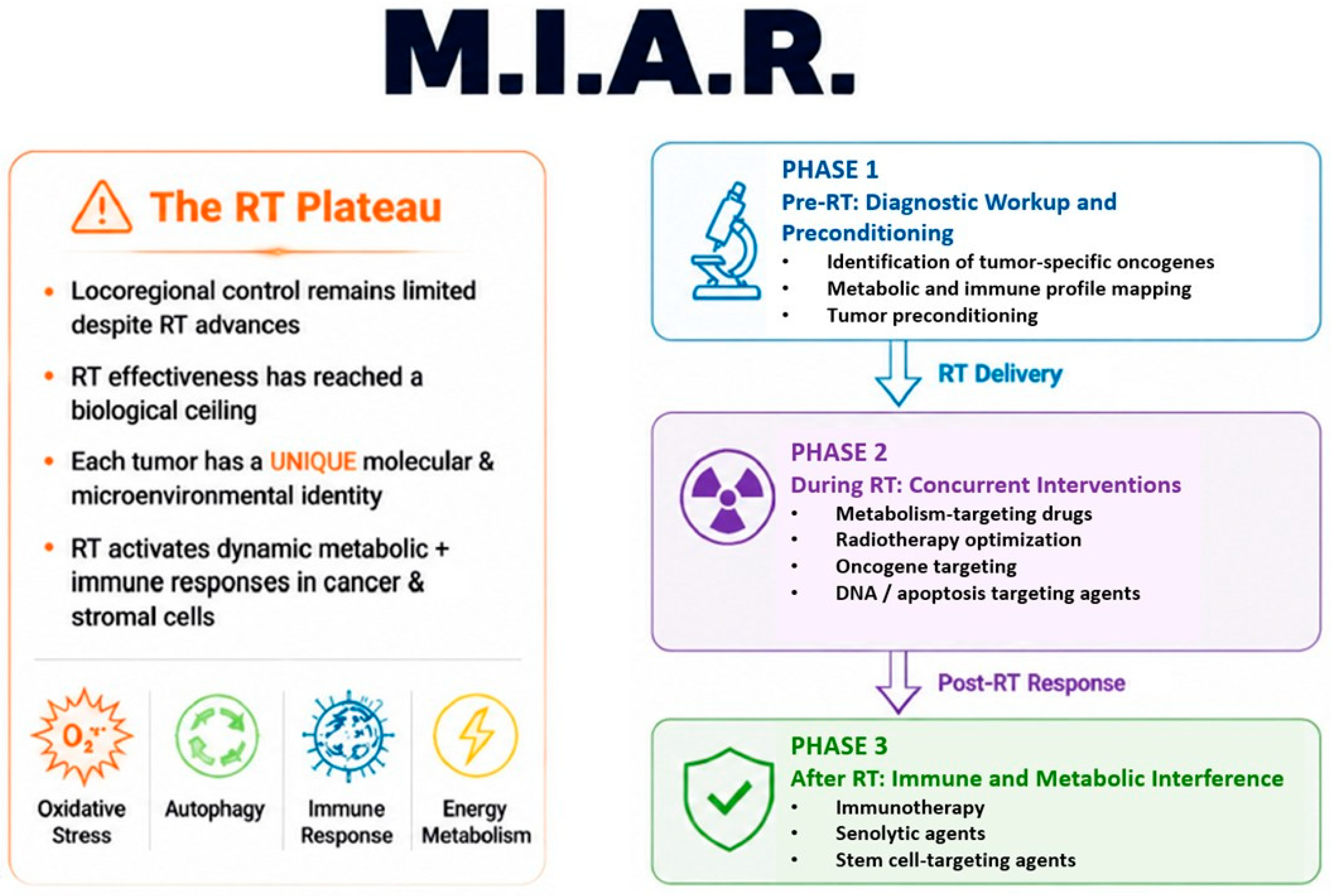
Metabolism and Immunity-Adapted Radiotherapy (M.I.A.R): A Conceptual Framework for Overcoming the Therapeutic Plateau in Clinical Radiotherapy

 and
and 
Simple Summary
Abstract
1. Introduction
2. From Oncogenic Drivers to Functional Metabolic Axes
- i.
- Buffering radiation-induced oxidative stress;
- ii.
- Providing adequate energy for damage repair;
- iii.
- Supplying biomolecular substrates for DNA synthesis and repair;
- iv.
- Securing metabolic adaptation to microenvironmental conditions;
- v.
- Escaping from immune surveillance.
3. Metabolic Pathways Underlying Radiation Response
3.1. Oxidative Stress Response
3.2. DNA Damage and Apoptosis
3.3. Glycolysis and Oxidative Phosphorylation
3.4. The Pentose Phosphate Pathway
3.5. Aminoacid Metabolism
3.6. Lipid Metabolism
3.7. Autophagy
4. Stemness and Senescence as Targets for M.I.A.R
5. Metabolic and Immune Pathways Underlying Post-Irradiation Tumor Clearance
5.1. Oxidative Stress Response
5.2. Glycolysis
5.3. ATP and Adenosine Production
5.4. Amino Acid Metabolism-Related Immunosuppression
5.5. Autophagy and HLA-Class-I Expression
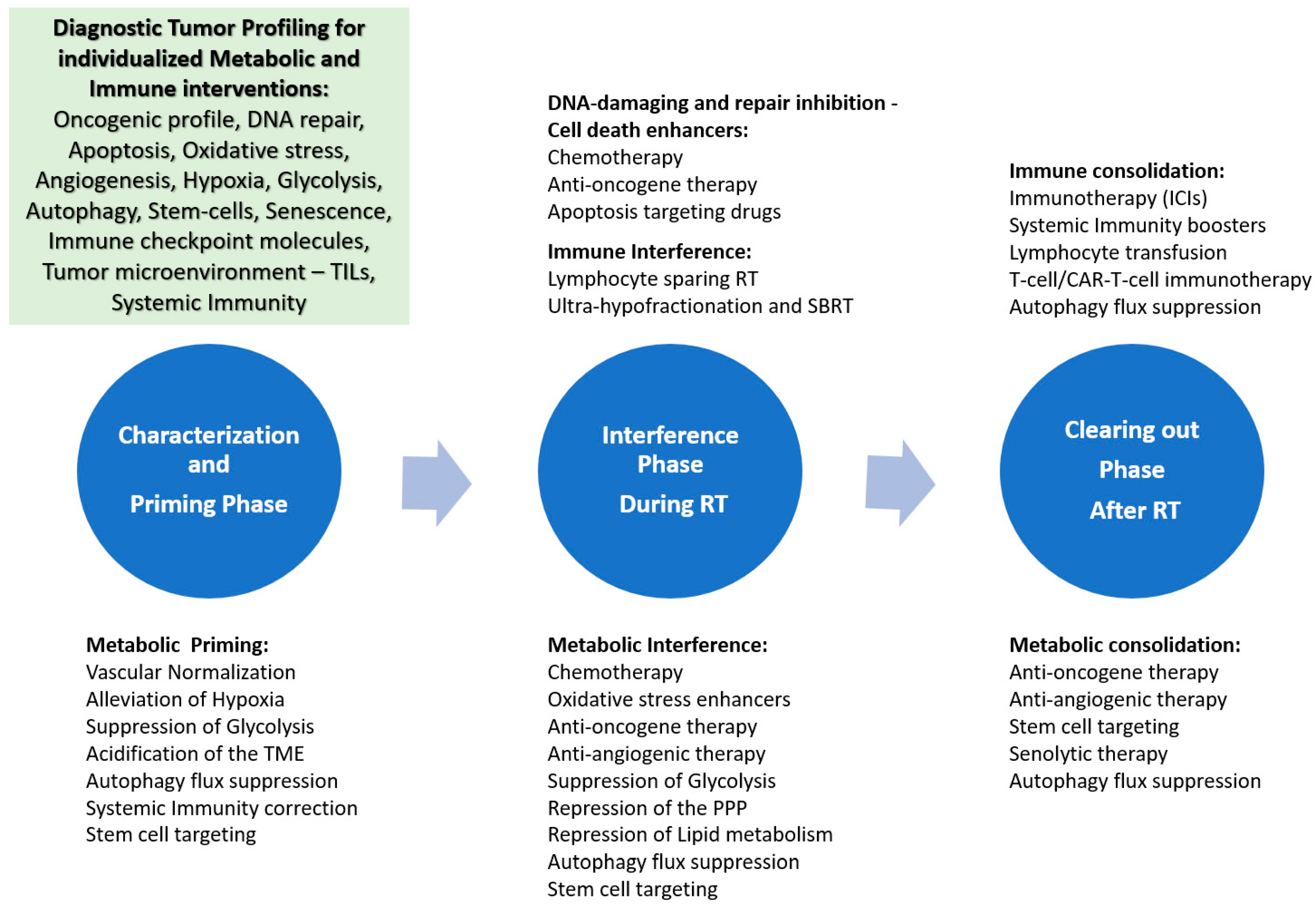
6. Timing of Metabolic and Immune Interventions
6.1. Characterizing and Priming
6.2. Interfering Phase
6.3. Clearing out Phase
7. Additional Considerations
7.1. Protons and Heavy Particles
7.2. Safety Assurance
7.3. Cost Effectiveness
7.4. Tissue Availability
8. Conclusions
Author Contributions
Funding
Institutional Review Board Statement
Informed Consent Statement
Data Availability Statement
Acknowledgments
Conflicts of Interest
References
- Hoque, S.; Dhar, R.; Kar, R.; Mukherjee, S.; Mukherjee, D.; Mukerjee, N.; Nag, S.; Tomar, N.; Mallik, S. Cancer stem cells (CSCs): Key player of radiotherapy resistance and its clinical significance. Biomarkers 2023, 28, 139–151. [Google Scholar] [CrossRef] [PubMed]
- Goldstein, M.; Kastan, M.B. The DNA Damage Response: Implications for Tumor Responses to Radiation and Chemotherapy. Annu. Rev. Med. 2015, 66, 129–143. [Google Scholar] [CrossRef] [PubMed]
- Marampon, F.; Codenotti, S.; Megiorni, F.; Del Fattore, A.; Camero, S.; Gravina, G.L.; Festuccia, C.; Musio, D.; De Felice, F.; Nardone, V.; et al. NRF2 orchestrates the redox regulation induced by radiation therapy, sustaining embryonal and alveolar rhabdomyosarcoma cells radioresistance. J. Cancer Res. Clin. Oncol. 2019, 145, 881–893. [Google Scholar] [CrossRef] [PubMed]
- Kim, W.; Lee, S.; Seo, D.; Kim, D.; Kim, K.; Kim, E.; Kang, J.; Seong, K.M.; Youn, H.; Youn, B. Cellular Stress Responses in Radiotherapy. Cells 2019, 8, 1105. [Google Scholar] [CrossRef] [PubMed]
- Lee, N.Y.; Sherman, E.J.; Schöder, H.; Wray, R.; Boyle, J.O.; Singh, B.; Grkovski, M.; Paudyal, R.; Cunningham, L.; Zhang, Z.; et al. Hypoxia-Directed Treatment of Human Papillomavirus–Related Oropharyngeal Carcinoma. J. Clin. Oncol. 2024, 42, 940–950. [Google Scholar] [CrossRef] [PubMed]
- Koukourakis, I.M.; Koukourakis, M.I. Combining the past and present to advance immuno-radiotherapy of cancer. Int. Rev. Immunol. 2021, 42, 26–42. [Google Scholar] [CrossRef] [PubMed]
- Spigel, D.R.; Faivre-Finn, C.; Gray, J.E.; Vicente, D.; Planchard, D.; Paz-Ares, L.; Vansteenkiste, J.F.; Garassino, M.C.; Hui, R.; Quantin, X.; et al. Five-Year Survival Outcomes From the PACIFIC Trial: Durvalumab After Chemoradiotherapy in Stage III Non–Small-Cell Lung Cancer. J. Clin. Oncol. 2022, 40, 1301–1311. [Google Scholar] [CrossRef] [PubMed]
- Bourhis, J.; Aupérin, A.; Borel, C.; Lefebvre, G.; Racadot, S.; Geoffrois, L.; Sun, X.S.; Saada, E.; Cirauqui, B.; Rutkowski, T.; et al. Nivolumab added to cisplatin and radiotherapy versus cisplatin and radiotherapy alone after surgery for people with squamous cell carcinoma of the head and neck at a high risk of relapse (GORTEC 2018-01 NIVOPOST-OP): A randomised, open-label, phase 3 trial. Lancet 2025, 407, 363–374. [Google Scholar] [CrossRef] [PubMed]
- Lorusso, D.; Xiang, Y.; Hasegawa, K.; Scambia, G.; Leiva, M.; Ramos-Elias, P.; Acevedo, A.; Cvek, J.; Randall, L.; Gomes, A.J.P.d.S.; et al. Pembrolizumab or placebo with chemoradiotherapy followed by pembrolizumab or placebo for newly diagnosed, high-risk, locally advanced cervical cancer (ENGOT-cx11/GOG-3047/KEYNOTE-A18): Overall survival results from a randomised, double-blind, placebo-controlled, phase 3 trial. Lancet 2024, 404, 1321–1332. [Google Scholar] [CrossRef] [PubMed]
- Kelly, R.J.; Ajani, J.A.; Kuzdzal, J.; Zander, T.; Van Cutsem, E.; Piessen, G.; Mendez, G.; Feliciano, J.; Motoyama, S.; Lièvre, A.; et al. Adjuvant Nivolumab in Resected Esophageal or Gastroesophageal Junction Cancer. N. Engl. J. Med. 2021, 384, 1191–1203. [Google Scholar] [CrossRef] [PubMed]
- Xia, F.; Wang, Y.; Wang, H.; Shen, L.; Xiang, Z.; Zhao, Y.; Zhang, H.; Wan, J.; Zhang, H.; Wang, Y.; et al. Randomized Phase II Trial of Immunotherapy-Based Total Neoadjuvant Therapy for Proficient Mismatch Repair or Microsatellite Stable Locally Advanced Rectal Cancer (TORCH). J. Clin. Oncol. 2024, 42, 3308–3318. [Google Scholar] [CrossRef] [PubMed]
- Kant, R.; Manne, R.K.; Anas, M.; Penugurti, V.; Chen, T.; Pan, B.-S.; Hsu, C.-C.; Lin, H.-K. Deregulated transcription factors in cancer cell metabolisms and reprogramming. Semin. Cancer Biol. 2022, 86, 1158–1174. [Google Scholar] [CrossRef] [PubMed]
- Krishnamurthy, H.K.; Rajavelu, I.; Pereira, M.; Jayaraman, V.; Krishna, K.; Wang, T.; Bei, K.; Rajasekaran, J.J. Inside the genome: Understanding genetic influences on oxidative stress. Front. Genet. 2024, 15, 1397352. [Google Scholar] [CrossRef] [PubMed]
- Yamamoto, M.; Kensler, T.W.; Motohashi, H. The KEAP1-NRF2 System: A Thiol-Based Sensor-Effector Apparatus for Maintaining Redox Homeostasis. Physiol. Rev. 2018, 98, 1169–1203. [Google Scholar] [CrossRef] [PubMed]
- Patel, R.; Saab, K.; Luo, L.; Ma, Y.; Osman, R.A.; Williams, N.T.; Everitt, J.; Zelazowski, M.J.; Castro, P.; Decker, W.K.; et al. Nrf2 Hyperactivation as a Driver of Radiotherapy Resistance and Suppressed Antitumor Immunity in Head and Neck Squamous Cell Carcinoma. Clin. Cancer Res. 2025, 31, 4184–4195. [Google Scholar] [CrossRef] [PubMed]
- Hirose, W.; Oshikiri, H.; Taguchi, K.; Yamamoto, M. The KEAP1-NRF2 System and Esophageal Cancer. Cancers 2022, 14, 4702. [Google Scholar] [CrossRef] [PubMed]
- Adinolfi, S.; Patinen, T.; Deen, A.J.; Pitkänen, S.; Härkönen, J.; Kansanen, E.; Küblbeck, J.; Levonen, A.-L. The KEAP1-NRF2 pathway: Targets for therapy and role in cancer. Redox Biol. 2023, 63, 102726. [Google Scholar] [CrossRef] [PubMed]
- Oberacker, T.; Kraft, L.; Schanz, M.; Latus, J.; Schricker, S. The Importance of Thioredoxin-1 in Health and Disease. Antioxidants 2023, 12, 1078. [Google Scholar] [CrossRef] [PubMed]
- Patwardhan, R.S.; Sharma, D.; Sandur, S.K. Thioredoxin reductase: An emerging pharmacologic target for radiosensitization of cancer. Transl. Oncol. 2022, 17, 101341. [Google Scholar] [CrossRef] [PubMed]
- Cao, Y.; Zhou, X.; Nie, Q.; Zhang, J. Inhibition of the thioredoxin system for radiosensitization therapy of cancer. Eur. J. Med. Chem. 2024, 268, 116218. [Google Scholar] [CrossRef] [PubMed]
- Gudkov, A.V.; Komarova, E.A. The role of p53 in determining sensitivity to radiotherapy. Nat. Rev. Cancer 2003, 3, 117–129. [Google Scholar] [CrossRef] [PubMed]
- Reijnen, C.; Küsters-Vandevelde, H.V.; Prinsen, C.F.; Massuger, L.F.; Snijders, M.P.; Kommoss, S.; Brucker, S.Y.; Kwon, J.S.; McAlpine, J.N.; Pijnenborg, J.M. Mismatch repair deficiency as a predictive marker for response to adjuvant radiotherapy in endometrial cancer. Gynecol. Oncol. 2019, 154, 124–130. [Google Scholar] [CrossRef] [PubMed]
- Church, D.N.; Stelloo, E.; Nout, R.A.; Valtcheva, N.; Depreeuw, J.; ter Haar, N.; Noske, A.; Amant, F.; Tomlinson, I.P.M.; Wild, P.J.; et al. Prognostic Significance of POLE Proofreading Mutations in Endometrial Cancer. JNCI J. Natl. Cancer Inst. 2014, 107, 402. [Google Scholar] [CrossRef] [PubMed]
- IKoukourakis, M.; Giatromanolaki, A.; Kakolyris, S.; Sivridis, E.; Georgoulias, V.; Funtzilas, G.; Hickson, I.D.; Gatter, K.C.; Harris, A.L. Nuclear expression of human apurinic/apyrimidinic endonuclease (HAP1/Ref-1) in head-and-neck cancer is associated with resistance to chemoradiotherapy and poor outcome. Int. J. Radiat. Oncol. 2001, 50, 27–36. [Google Scholar] [CrossRef]
- Yakkala, P.A.; Penumallu, N.R.; Shafi, S.; Kamal, A. Prospects of Topoisomerase Inhibitors as Promising Anti-Cancer Agents. Pharmaceuticals 2023, 16, 1456. [Google Scholar] [CrossRef] [PubMed]
- Seiple, L.A.; Cardellina, J.H., 2nd; Akee, R.; Stivers, J.T. Potent inhibition of human apurinic/apyrimidinic endonuclease 1 by ar-ylstibonic acids. Mol. Pharmacol. 2008, 73, 669–677. [Google Scholar] [CrossRef] [PubMed]
- Rai, G.; Vyjayanti, V.N.; Dorjsuren, D.; Simeonov, A.; Jadhav, A.; Wilson, D.M.; Maloney, D.J. Small Molecule Inhibitors of the Human Apurinic/apyrimidinic Endonuclease 1 (APE1). In Probe Reports from the NIH Molecular Libraries Program; National Center for Biotechnology Information: Bethesda, MD, USA, 2010. [Google Scholar]
- Sun, C.; Chu, A.; Song, R.; Liu, S.; Chai, T.; Wang, X.; Liu, Z. PARP inhibitors combined with radiotherapy: Are we ready? Front. Pharmacol. 2023, 14, 1234973. [Google Scholar] [CrossRef] [PubMed]
- Post, C.C.B.; de Boer, S.M.; EPowell, M.; Mileshkin, L.; Katsaros, D.; Bessette, P.; Leary, A.; Ottevanger, P.B.; McCormack, M.; Khaw, P.; et al. Adjuvant chemoradiotherapy versus radiotherapy alone in women with high-risk endometrial cancer (PORTEC-3): 10-year clinical outcomes and post-hoc analysis by molecular classification from a randomised phase 3 trial. Lancet Oncol. 2025, 26, 1370–1381. [Google Scholar] [CrossRef] [PubMed]
- Sallman, D.A.; Komrokji, R.S.; Dezern, A.E.; Sebert, M.; Garcia-Manero, G.; Rahmé, R.; Winer, E.S.; Lehmann-Che, J.; Roboz, G.J.; Madelaine, I.; et al. Long-term follow-up and combined Phase 2 results of eprenetapopt and azacitidine in patients with TP53 mutant MDS/AML. HemaSphere 2025, 9, e70164. [Google Scholar] [CrossRef] [PubMed]
- Endo, M.; Nishioka, T.; Numazaki, K.; Hasegawa, H.; Takahashi, T.; Sugawara, S.; Tada, H. Reactivation of p53 by RITA Induces Apoptosis in Human Oral Squamous Cell Carcinoma Cells. Anticancer Res. 2022, 42, 2931–2937. [Google Scholar] [CrossRef] [PubMed]
- Bourhis, J.; Licitra, L.F.; Burtness, B.; Psyrri, A.; Haddad, R.; Harrington, K.; Cohen, E.E.; Tao, Y.; Tiscoski, K.A.; Matitashvili, A.; et al. Xevinapant or Placebo Plus Platinum-Based Chemoradiotherapy in Unresected Locally Advanced Squamous Cell Carcinoma of the Head and Neck (TrilynX): A Randomized, Phase III Study. J. Clin. Oncol. 2025, 43, 3209–3220. [Google Scholar] [CrossRef] [PubMed]
- Vogler, M.; Braun, Y.; Smith, V.M.; Westhoff, M.-A.; Pereira, R.S.; Pieper, N.M.; Anders, M.; Callens, M.; Vervliet, T.; Abbas, M.; et al. The BCL2 family: From apoptosis mechanisms to new advances in targeted therapy. Signal Transduct. Target. Ther. 2025, 10, 91. [Google Scholar] [CrossRef] [PubMed]
- Liu, J.; Li, S.; Wang, Q.; Feng, Y.; Xing, H.; Yang, X.; Guo, Y.; Guo, Y.; Sun, H.; Liu, X.; et al. Sonrotoclax overcomes BCL2 G101V mutation–induced venetoclax resistance in preclinical models of hematologic malignancy. Blood 2024, 143, 1825–1836. [Google Scholar] [CrossRef] [PubMed]
- Farhana, A.; Lappin, S.L. Biochemistry, Lactate Dehydrogenase; StatPearls Publishing Copyright © 2026; StatPearls Publishing LLC: Treasure Island, FL, USA, 2026. [Google Scholar]
- Chaudhry, R.; Varacallo, M.A. Biochemistry, Glycolysis; StatPearls Publishing Copyright © 2026; StatPearls Publishing LLC: Treasure Island, FL, USA, 2026. [Google Scholar]
- Bellazzo, A.; Montico, B.; Guerrieri, R.; Colizzi, F.; Steffan, A.; Polesel, J.; Fratta, E. Unraveling the role of hypoxia-inducible factors in cutaneous melanoma: From mechanisms to therapeutic opportunities. Cell Commun. Signal. 2025, 23, 1–19. [Google Scholar] [CrossRef] [PubMed]
- Semenza, G.L. HIF-1 mediates metabolic responses to intratumoral hypoxia and oncogenic mutations. J. Clin. Investig. 2013, 123, 3664–3671. [Google Scholar] [CrossRef] [PubMed]
- Dengler, V.L.; Galbraith, M.; Espinosa, J.M. Transcriptional regulation by hypoxia inducible factors. Crit. Rev. Biochem. Mol. Biol. 2014, 49, 1–15. [Google Scholar] [PubMed]
- Song, C.W.; Kim, H.; Kim, M.-S.; Park, H.J.; Paek, S.-H.; Terezakis, S.; Cho, L.C. Role of HIF-1α in the Responses of Tumors to Radiotherapy and Chemotherapy. Cancer Res. Treat. 2025, 57, 1–10. [Google Scholar] [CrossRef] [PubMed]
- Huang, R.; Zhou, P.-K. HIF-1 signaling: A key orchestrator of cancer radioresistance. Radiat. Med. Prot. 2020, 1, 7–14. [Google Scholar] [CrossRef]
- Koukourakis, M.I.; Bentzen, S.M.; Giatromanolaki, A.; Wilson, G.D.; Daley, F.M.; Saunders, M.I.; Dische, S.; Sivridis, E.; Harris, A.L. Endogenous Markers of Two Separate Hypoxia Response Pathways (hypoxia inducible factor 2 alpha and carbonic anhydrase 9) Are Associated With Radiotherapy Failure in Head and Neck Cancer Patients Recruited in the CHART Randomized Trial. J. Clin. Oncol. 2006, 24, 727–735. [Google Scholar] [CrossRef] [PubMed]
- Koukourakis, M.I.; Giatromanolaki, A.; Winter, S.; Leek, R.; Sivridis, E.; Harris, A.L. Lactate Dehydrogenase 5 Expression in Squamous Cell Head and Neck Cancer Relates to Prognosis following Radical or Postoperative Radiotherapy. Oncology 2009, 77, 285–292. [Google Scholar] [CrossRef] [PubMed]
- Palayoor, S.T.; Mitchell, J.B.; Cerna, D.; DeGraff, W.; John-Aryankalayil, M.; Coleman, C.N. PX-478, an inhibitor of hypoxia-inducible factor-1α, enhances radiosensitivity of prostate carcinoma cells. Int. J. Cancer 2008, 123, 2430–2437. [Google Scholar] [CrossRef] [PubMed]
- Ren, J.; Wang, B.; Wu, Q.; Wang, G. Combination of niclosamide and current therapies to overcome resistance for cancer: New frontiers for an old drug. Biomed. Pharmacother. 2022, 155, 113789. [Google Scholar] [CrossRef] [PubMed]
- Han, J.H.; Lee, E.-J.; Park, W.; Ha, K.-T.; Chung, H.-S. Natural compounds as lactate dehydrogenase inhibitors: Potential therapeutics for lactate dehydrogenase inhibitors-related diseases. Front. Pharmacol. 2023, 14, 1275000. [Google Scholar] [CrossRef] [PubMed]
- Dubois, L.; Peeters, S.; Lieuwes, N.G.; Geusens, N.; Thiry, A.; Wigfield, S.; Carta, F.; Mcintyre, A.; Scozzafava, A.; Dogné, J.-M.; et al. Specific inhibition of carbonic anhydrase IX activity enhances the in vivo therapeutic effect of tumor irradiation. Radiother. Oncol. 2011, 99, 424–431. [Google Scholar] [CrossRef] [PubMed]
- Temre, M.K.; Kumar, A.; Singh, S.M. An appraisal of the current status of inhibition of glucose transporters as an emerging antineoplastic approach: Promising potential of new pan-GLUT inhibitors. Front. Pharmacol. 2022, 13, 1035510. [Google Scholar] [CrossRef] [PubMed]
- Su, H.; Li, X.; Wang, S.; Yang, X.; Jiang, L.; Luo, H.; Li, Y.; Zhou, J.; Huang, Y.; Li, M. SGLT2 Inhibitors in Combination Therapies for Tumors: A Novel Approach to Synergistic Treatment Strategies. Drug Des. Dev. Ther. 2025, 19, 11817–11847. [Google Scholar] [CrossRef] [PubMed]
- Wigfield, S.M.; Winter, S.C.; Giatromanolaki, A.; Taylor, J.; Koukourakis, M.L.; Harris, A.L. PDK-1 regulates lactate production in hypoxia and is associated with poor prognosis in head and neck squamous cancer. Br. J. Cancer 2008, 98, 1975–1984. [Google Scholar] [CrossRef] [PubMed]
- Mohan, A.; Griffith, K.A.; Wuchu, F.; Zhen, D.B.; Kumar-Sinha, C.; Crysler, O.; Hsiehchen, D.; Enzler, T.; Dippman, D.; Gunchick, V.; et al. Devimistat in Combination with Gemcitabine and Cisplatin in Biliary Tract Cancer: Preclinical Evaluation and Phase Ib Multicenter Clinical Trial (BilT-04). Clin. Cancer Res. 2023, 29, 2394–2400. [Google Scholar] [CrossRef] [PubMed]
- Yu, O.H.Y.; Suissa, S. Metformin and Cancer: Solutions to a Real-World Evidence Failure. Diabetes Care 2023, 46, 904–912. [Google Scholar] [CrossRef] [PubMed]
- Liao, W.-C.; Shokr, H.; Faivre-Finn, C.; Dempsey, C.; Williams, K.J.; Chen, L.-C. Survival and Radiotherapy-Related Adverse Events in Patients Receiving Radiotherapy and Concurrent Metformin: A Systematic Review and Meta-Analysis of Randomised Controlled Trials and Cohort Studies. Pharmaceuticals 2025, 18, 1390. [Google Scholar] [CrossRef] [PubMed]
- TeSlaa, T.; Ralser, M.; Fan, J.; Rabinowitz, J.D. The pentose phosphate pathway in health and disease. Nat. Metab. 2023, 5, 1275–1289. [Google Scholar] [CrossRef] [PubMed]
- Guo, D.; Meng, Y.; Jiang, X.; Lu, Z. Hexokinases in cancer and other pathologies. Cell Insight 2023, 2, 100077. [Google Scholar] [CrossRef] [PubMed]
- Tang, Y.-C.; Hsiao, J.-R.; Jiang, S.-S.; Chang, J.-Y.; Chu, P.-Y.; Liu, K.-J.; Fang, H.-L.; Lin, L.-M.; Chen, H.-H.; Huang, Y.-W.; et al. c-MYC-directed NRF2 drives malignant progression of head and neck cancer via glucose-6-phosphate dehydrogenase and transketolase activation. Theranostics 2021, 11, 5232–5247. [Google Scholar] [CrossRef] [PubMed]
- Riganti, C.; Gazzano, E.; Polimeni, M.; Aldieri, E.; Ghigo, D. The pentose phosphate pathway: An antioxidant defense and a crossroad in tumor cell fate. Free Radic. Biol. Med. 2012, 53, 421–436. [Google Scholar] [CrossRef] [PubMed]
- Cho, E.S.; Cha, Y.H.; Kim, H.S.; Kim, N.H.; Yook, J.I. The Pentose Phosphate Pathway as a Potential Target for Cancer Therapy. Biomol. Ther. 2018, 26, 29–38. [Google Scholar] [CrossRef] [PubMed]
- Ramanathan, B.; Jan, K.-Y.; Chen, C.-H.; Hour, T.-C.; Yu, H.-J.; Pu, Y.-S. Resistance to Paclitaxel Is Proportional to Cellular Total Antioxidant Capacity. Cancer Res. 2005, 65, 8455–8460. [Google Scholar] [CrossRef] [PubMed]
- Guo, J.; Ding, W.; Cai, S.; Ren, P.; Chen, F.; Wang, J.; Fang, K.; Li, B.; Cai, J. Polydatin radiosensitizes lung cancer while preventing radiation injuries by modulating tumor-infiltrating B cells. J. Cancer Res. Clin. Oncol. 2023, 149, 9529–9542. [Google Scholar] [CrossRef] [PubMed]
- Read, G.H.; Bailleul, J.; Vlashi, E.; Kesarwala, A.H. Metabolic response to radiation therapy in cancer. Mol. Carcinog. 2021, 61, 200–224. [Google Scholar] [CrossRef] [PubMed]
- Ren, L.-L.; Mao, T.; Meng, P.; Zhang, L.; Wei, H.-Y.; Tian, Z.-B. Glutamine addiction and therapeutic strategies in pancreatic cancer. World J. Gastrointest. Oncol. 2023, 15, 1852–1863. [Google Scholar] [CrossRef] [PubMed]
- Halama, A.; Suhre, K. Advancing Cancer Treatment by Targeting Glutamine Metabolism—A Roadmap. Cancers 2022, 14, 553. [Google Scholar] [CrossRef] [PubMed]
- Li, X.; Peng, X.; Li, Y.; Wei, S.; He, G.; Liu, J.; Li, X.; Yang, S.; Li, D.; Lin, W.; et al. Glutamine addiction in tumor cell: Oncogene regulation and clinical treatment. Cell Commun. Signal. 2024, 22, 1–18. [Google Scholar] [CrossRef] [PubMed]
- Shen, Y.-A.; Chen, C.-L.; Huang, Y.-H.; Evans, E.E.; Cheng, C.-C.; Chuang, Y.-J.; Zhang, C.; Le, A. Inhibition of glutaminolysis in combination with other therapies to improve cancer treatment. Curr. Opin. Chem. Biol. 2021, 62, 64–81. [Google Scholar] [CrossRef] [PubMed]
- Sung, Y.; Yu, Y.C.; Lee, M.; Lim, S.; Lee, Y.; Kang, M.; Kwon, D.; Parajulee, A.; Choi, J.; Min, D.S.; et al. Targeting cancer glutamine dependency with a first-in-class inhibitor of the mitochondrial glutamine transporter SLC1A5_var. Nat. Commun. 2025, 16, 1–25. [Google Scholar] [CrossRef] [PubMed]
- Li, D.; Fu, Z.; Chen, R.; Zhao, X.; Zhou, Y.; Zeng, B.; Yu, M.; Zhou, Q.; Lin, Q.; Gao, W.; et al. Inhibition of glutamine metabolism counteracts pancreatic cancer stem cell features and sensitizes cells to radiotherapy. Oncotarget 2015, 6, 31151–31163. [Google Scholar] [CrossRef] [PubMed]
- Patel, R.; Cooper, D.E.; Kadakia, K.T.; Allen, A.; Duan, L.; Luo, L.; Williams, N.T.; Liu, X.; Locasale, J.W.; Kirsch, D.G. Targeting glutamine metabolism improves sarcoma response to radiation therapy in vivo. Commun. Biol. 2024, 7, 1–14. [Google Scholar] [CrossRef] [PubMed]
- Sun, W.; Zhao, E.; Cui, H. Target enzymes in serine-glycine-one-carbon metabolic pathway for cancer therapy. Int. J. Cancer 2022, 152, 2446–2463. [Google Scholar] [CrossRef] [PubMed]
- Sánchez-Castillo, A.; Vooijs, M.; Kampen, K.R. Linking Serine/Glycine Metabolism to Radiotherapy Resistance. Cancers 2021, 13, 1191. [Google Scholar] [CrossRef] [PubMed]
- Sánchez-Castillo, A.; Heylen, E.; Hounjet, J.; Savelkouls, K.G.; Lieuwes, N.G.; Biemans, R.; Dubois, L.J.; Reynders, K.; Rouschop, K.M.; Vaes, R.D.W.; et al. Targeting serine/glycine metabolism improves radiotherapy response in non-small cell lung cancer. Br. J. Cancer 2023, 130, 568–584. [Google Scholar] [CrossRef] [PubMed]
- Cheng, H.; Wang, M.; Su, J.; Li, Y.; Long, J.; Chu, J.; Wan, X.; Cao, Y.; Li, Q. Lipid Metabolism and Cancer. Life 2022, 12, 784. [Google Scholar] [CrossRef] [PubMed]
- Gouw, A.M.; Margulis, K.; Liu, N.S.; Raman, S.J.; Mancuso, A.; Toal, G.G.; Tong, L.; Mosley, A.; Hsieh, A.L.; Sullivan, D.K.; et al. The MYC Oncogene Cooperates with Sterol-Regulated Element-Binding Protein to Regulate Lipogenesis Essential for Neoplastic Growth. Cell Metab. 2019, 30, 556–572.e5. [Google Scholar] [CrossRef] [PubMed]
- Zhang, R.; Peng, X.; Du, J.X.; Boohaker, R.; Estevao, I.L.; Grajeda, B.I.; Cox, M.B.; Almeida, I.C.; Lu, W. Oncogenic KRASG12D Reprograms Lipid Metabolism by Upregulating SLC25A1 to Drive Pancreatic Tumorigenesis. Cancer Res. 2023, 83, 3739–3752. [Google Scholar] [CrossRef] [PubMed]
- Shen, G.-M.; Zhao, Y.-Z.; Chen, M.-T.; Zhang, F.-L.; Liu, X.-L.; Wang, Y.; Liu, C.-Z.; Yu, J.; Zhang, J.-W. Hypoxia-inducible factor-1 (HIF-1) promotes LDL and VLDL uptake through inducing VLDLR under hypoxia. Biochem. J. 2011, 441, 675–683. [Google Scholar] [CrossRef] [PubMed]
- Piatrikova, V.; Kocianova, E.; Skvarkova, L.; Golias, T. Fuelling resistance: Lipid metabolic rewiring in cancer response to chemotherapy and radiotherapy. Biomed. Pharmacother. 2025, 193, 118715. [Google Scholar] [CrossRef] [PubMed]
- Göttgens, E.-L.; Heuvel, C.N.v.D.; de Jong, M.C.; Kaanders, J.H.; Leenders, W.P.; Ansems, M.; Bussink, J.; Span, P.N. ACLY (ATP Citrate Lyase) Mediates Radioresistance in Head and Neck Squamous Cell Carcinomas and is a Novel Predictive Radiotherapy Biomarker. Cancers 2019, 11, 1971. [Google Scholar] [CrossRef] [PubMed]
- Glick, D.; Barth, S.; Macleod, K.F. Autophagy: Cellular molecular mechanisms. J. Pathol. 2010, 221, 3–12. [Google Scholar] [CrossRef] [PubMed]
- Signorelli, S.; Tarkowski, Ł.P.; Van Den Ende, W.; Bassham, D.C. Linking autophagy to abiotic and biotic stress responses. Trends Plant Sci. 2019, 24, 413–430. [Google Scholar] [CrossRef] [PubMed]
- Zada, S.; Hwang, J.S.; Ahmed, M.; Lai, T.H.; Pham, T.M.; Elashkar, O.; Kim, D.R. Cross talk between autophagy and oncogenic signaling pathways and implications for cancer therapy. Biochim. Biophys. Acta (BBA)—Rev. Cancer 2021, 1876, 188565. [Google Scholar] [CrossRef] [PubMed]
- Ferreira, A.; Pereira, F.; Reis, C.; Oliveira, M.J.; Sousa, M.J.; Preto, A. Crucial Role of Oncogenic KRAS Mutations in Apoptosis and Autophagy Regulation: Therapeutic Implications. Cells 2022, 11, 2183. [Google Scholar] [CrossRef] [PubMed]
- Koukourakis, M.I.; Kalamida, D.; Mitrakas, A.; Pouliliou, S.; Kalamida, S.; Sivridis, E.; Giatromanolaki, A. Intensified autophagy compromises the efficacy of radiotherapy against prostate cancer. Biochem. Biophys. Res. Commun. 2015, 461, 268–274. [Google Scholar] [CrossRef] [PubMed]
- Karagounis, I.V.; Kalamida, D.; Mitrakas, A.; Pouliliou, S.; Liousia, M.V.; Giatromanolaki, A.; Koukourakis, M.I. Repression of the autophagic response sensitises lung cancer cells to ra-diation and chemotherapy. Br. J. Cancer 2016, 115, 312–321. [Google Scholar] [CrossRef] [PubMed]
- Gao, J.; Lu, F.; Yan, J.; Wang, R.; Xia, Y.; Wang, L.; Li, L.; Chang, L.; Li, W. The role of radiotherapy-related autophagy genes in the prognosis and immune infiltration in lung adenocarcinoma. Front. Immunol. 2022, 13, 992626. [Google Scholar] [CrossRef] [PubMed]
- Sudo, M.; Tsutsui, H.; Hayashi, S.; Yasuda, K.; Mitani, K.; Iwami, N.; Anzai, M.; Tsubouchi, T.; Ishida, M.; Satoi, S.; et al. Autophagy Inhibition Increased Sensitivity of Pancreatic Cancer Cells to Carbon Ion Radiotherapy. Cell. Physiol. Biochem. 2023, 57, 212–225. [Google Scholar] [CrossRef] [PubMed]
- Sun, C.; Han, C.; Jiang, Y.; Han, N.; Zhang, M.; Li, G.; Qiao, Q. Inhibition of GRP78 abrogates radioresistance in oropharyngeal carcinoma cells after EGFR inhibition by cetuximab. PLoS ONE 2017, 12, e0188932. [Google Scholar] [CrossRef] [PubMed]
- Sun, Y.; Chen, K.; Lin, G.; Wan, F.; Chen, L.; Zhu, X. Silencing c-Jun inhibits autophagy and abrogates radioresistance in nasopharyngeal carcinoma by activating the PI3K/AKT/mTOR pathway. Ann. Transl. Med. 2021, 9, 1085. [Google Scholar] [CrossRef] [PubMed]
- Zheng, W.; Chen, Q.; Liu, H.; Zeng, L.; Zhou, Y.; Liu, X.; Bai, Y.; Zhang, J.; Pan, Y.; Shao, C. SDC1-dependent TGM2 determines radiosensitivity in glioblastoma by coordinating EPG5-mediated fusion of autophagosomes with lysosomes. Autophagy 2022, 19, 839–857. [Google Scholar] [CrossRef] [PubMed]
- Ren, J.; Liu, T.; Han, Y.; Wang, Q.; Chen, Y.; Li, G.; Jiang, L. GSK-3β inhibits autophagy and enhances radiosensitivity in non-small cell lung cancer. Diagn. Pathol. 2018, 13, 33. [Google Scholar] [CrossRef] [PubMed]
- Harary, P.M.; Hori, Y.S.; Annagiri, S.; Abe, K.; Tatekoshi, Y.; Hosoda, R.; Saga, Y.; Park, D.J.; Kuno, A.; Chang, S.D. Enhancing radiation sensitivity in malignant brain tumors with chloroquine: A systematic review. J. Neuro-Oncol. 2025, 176, 106. [Google Scholar] [CrossRef] [PubMed]
- Tang, F.; Hu, P.; Yang, Z.; Xue, C.; Gong, J.; Sun, S.; Shi, L.; Zhang, S.; Li, Z.; Yang, C.; et al. SBI0206965, a novel inhibitor of Ulk1, suppresses non-small cell lung cancer cell growth by modulating both autophagy and apoptosis pathways. Oncol. Rep. 2017, 37, 3449–3458. [Google Scholar] [CrossRef] [PubMed]
- Morozova, A.; Chan, S.C.; Bayle, S.; Sun, L.; Grassie, D.; Iermolaieva, A.; Kalaga, M.N.; Frydman, S.; Sansil, S.; Schönbrunn, E.; et al. Development of potent and selective ULK1/2 inhibitors based on 7-azaindole scaffold with favorable in vivo properties. Eur. J. Med. Chem. 2023, 266, 116101. [Google Scholar] [CrossRef] [PubMed]
- Zhang, S.; Peng, X.; Yang, S.; Li, X.; Huang, M.; Wei, S.; Liu, J.; He, G.; Zheng, H.; Yang, L.; et al. The regulation, function, and role of lipophagy, a form of selective autophagy, in metabolic disorders. Cell Death Dis. 2022, 13, 1–11. [Google Scholar] [CrossRef] [PubMed]
- Lamprou, I.; Kakouratos, C.; Tsolou, A.; Pavlidis, P.; Xanthopoulou, E.T.; Nanos, C.; Tsaroucha, A.; Sivridis, E.; Giatromanolaki, A.; Koukourakis, M.I. Lipophagy-Related Protein Perilipin-3 and Resistance of Prostate Cancer to Radiation Therapy. Int. J. Radiat. Oncol. 2022, 113, 401–414. [Google Scholar] [CrossRef] [PubMed]
- Manni, W.; Min, W. Signaling pathways in the regulation of cancer stem cells and associated targeted therapy. Medcomm 2022, 3, e176. [Google Scholar] [CrossRef] [PubMed]
- Yang, L.; Shi, P.; Zhao, G.; Xu, J.; Peng, W.; Zhang, J.; Zhang, G.; Wang, X.; Dong, Z.; Chen, F.; et al. Targeting Cancer Stem Cell Pathways for Cancer Therapy. Signal Transduct. Target. Ther. 2020, 5, 8. [Google Scholar] [CrossRef] [PubMed]
- Tsolou, A.; Lamprou, I.; Fortosi, A.-O.; Liousia, M.; Giatromanolaki, A.; Koukourakis, M.I. Stemness’ and ‘senescence’ related escape pathways are dose dependent in lung cancer cells surviving post irradiation. Life Sci. 2019, 232, 116562. [Google Scholar] [CrossRef] [PubMed]
- Bao, S.; Wu, Q.; McLendon, R.E.; Hao, Y.; Shi, Q.; Hjelmeland, A.B.; Dewhirst, M.W.; Bigner, D.D.; Rich, J.N. Glioma stem cells promote radioresistance by preferential activation of the DNA damage response. Nature 2006, 444, 756–760. [Google Scholar] [CrossRef] [PubMed]
- Milella, M.; Rutigliano, M.; Pandolfo, S.D.; Aveta, A.; Crocetto, F.; Ferro, M.; D’amati, A.; Ditonno, P.; Lucarelli, G.; Lasorsa, F. The Metabolic Landscape of Cancer Stem Cells: Insights and Implications for Therapy. Cells 2025, 14, 717. [Google Scholar] [CrossRef] [PubMed]
- IKoukourakis, M.; Giatromanolaki, A.; Tsakmaki, V.; Danielidis, V.; Sivridis, E. Cancer stem cell phenotype relates to radio-chemotherapy outcome in locally advanced squamous cell head–neck cancer. Br. J. Cancer 2012, 106, 846–853. [Google Scholar] [CrossRef]
- Rubatto, M.; Sciamarrelli, N.; Borriello, S.; Pala, V.; Mastorino, L.; Tonella, L.; Ribero, S.; Quaglino, P. Classic and new strategies for the treatment of advanced melanoma and non-melanoma skin cancer. Front. Med. 2023, 9, 959289. [Google Scholar] [CrossRef] [PubMed]
- Menon, N.A.; Kumar, C.D.; Ramachandran, P.; Blaize, B.; Gautam, M.; Cordani, M.; Kumar, L.D. Small-molecule inhibitors of WNT signalling in cancer therapy and their links to autophagy and apoptosis. Eur. J. Pharmacol. 2024, 986, 177137. [Google Scholar] [CrossRef] [PubMed]
- You, W.-K.; Schuetz, T.J.; Lee, S.H. Targeting the DLL/Notch Signaling Pathway in Cancer: Challenges and Advances in Clinical Development. Mol. Cancer Ther. 2022, 22, 3–11. [Google Scholar] [CrossRef] [PubMed]
- Venugopal, C.; Hallett, R.; Vora, P.; Manoranjan, B.; Mahendram, S.; Qazi, M.A.; McFarlane, N.; Subapanditha, M.; Nolte, S.M.; Singh, M.; et al. Pyrvinium Targets CD133 in Human Glioblastoma Brain Tumor-Initiating Cells. Clin. Cancer Res. 2015, 21, 5324–5337. [Google Scholar] [CrossRef] [PubMed]
- Kumari, R.; Jat, P. Mechanisms of Cellular Senescence: Cell Cycle Arrest and Senescence Associated Secretory Phenotype. Front. Cell Dev. Biol. 2021, 9, 645593. [Google Scholar] [CrossRef] [PubMed]
- Kim, J.H.; Brown, S.L.; Gordon, M.N. Radiation-induced senescence: Therapeutic opportunities. Radiat. Oncol. 2023, 18, 1–11. [Google Scholar] [CrossRef] [PubMed]
- Blagosklonny, M.V. Anti-aging: Senolytics or gerostatics (unconventional view). Oncotarget 2021, 12, 1821–1835. [Google Scholar] [CrossRef] [PubMed]
- Tomimatsu, N.; Di Cristofaro, L.F.M.; Kanji, S.; Samentar, L.; Jordan, B.R.; Kittler, R.; AHabib, A.; Espindola-Netto, J.M.; Tchkonia, T.; Kirkland, J.L.; et al. Targeting cIAP2 in a novel senolytic strategy prevents glioblastoma recurrence after radiotherapy. EMBO Mol. Med. 2025, 17, 645–678. [Google Scholar] [CrossRef] [PubMed]
- Zhu, Y.; Tchkonia, T.; Fuhrmann-Stroissnigg, H.; Dai, H.M.; Ling, Y.Y.; Stout, M.B.; Pirtskhalava, T.; Giorgadze, N.; Johnson, K.O.; Giles, C.B.; et al. Identification of a novel senolytic agent, navitoclax, targeting the Bcl-2 family of anti-apoptotic factors. Aging Cell 2016, 15, 428–435. [Google Scholar] [CrossRef] [PubMed]
- Spiegel, M. Fisetin as a Blueprint for Senotherapeutic Agents—Elucidating Geroprotective and Senolytic Properties with Molecular Modeling. Chem.—A Eur. J. 2025, 31, e202403755. [Google Scholar] [CrossRef] [PubMed]
- Lhuillier, C.; Rudqvist, N.-P.; Elemento, O.; Formenti, S.C.; Demaria, S. Radiation therapy and anti-tumor immunity: Exposing immunogenic mutations to the immune system. Genome Med. 2019, 11, 1–10. [Google Scholar] [CrossRef] [PubMed]
- Koukourakis, I.M.; Xanthopoulou, E.; Sgouras, T.I.; Kouroupi, M.; Giatromanolaki, A.; Kouloulias, V.; Tiniakos, D.; Zygogianni, A. Preoperative chemoradiotherapy induces multiple pathways related to anti-tumour immunity in rectal cancer. Br. J. Cancer 2023, 129, 1852–1862. [Google Scholar] [CrossRef] [PubMed]
- Koukourakis, M.I.; Giatromanolaki, A. Tumor microenvironment, immune response and post-radiotherapy tumor clearance. Clin. Transl. Oncol. 2020, 22, 2196–2205. [Google Scholar] [CrossRef] [PubMed]
- Blaser, H.; Dostert, C.; Mak, T.W.; Brenner, D. TNF and ROS Crosstalk in Inflammation. Trends Cell Biol. 2016, 26, 249–261. [Google Scholar] [CrossRef] [PubMed]
- Patwardhan, R.S.; Singh, B.; Pal, D.; Checker, R.; Bandekar, M.; Sharma, D.; Sandur, S.K. Redox regulation of regulatory T-cell differentiation and functions. Free Radic. Res. 2020, 54, 947–960. [Google Scholar] [CrossRef] [PubMed]
- Aboelella, N.S.; Brandle, C.; Kim, T.; Ding, Z.-C.; Zhou, G. Oxidative Stress in the Tumor Microenvironment and Its Relevance to Cancer Immunotherapy. Cancers 2021, 13, 986. [Google Scholar] [CrossRef] [PubMed]
- Sogbein, O.; Paul, P.; Umar, M.; Chaari, A.; Batuman, V.; Upadhyay, R. Bortezomib in cancer therapy: Mechanisms, side effects, and future proteasome inhibitors. Life Sci. 2024, 358, 123125. [Google Scholar] [CrossRef] [PubMed]
- Guan, C.; Zhou, X.; Li, H.; Ma, X.; Zhuang, J. NF-κB inhibitors gifted by nature: The anticancer promise of polyphenol compounds. Biomed. Pharmacother. 2022, 156, 113951. [Google Scholar] [CrossRef] [PubMed]
- Menk, A.V.; Scharping, N.E.; Moreci, R.S.; Zeng, X.; Guy, C.; Salvatore, S.; Bae, H.; Xie, J.; Young, H.A.; Wendell, S.G.; et al. Early TCR Signaling Induces Rapid Aerobic Glycolysis Enabling Distinct Acute T Cell Effector Functions. Cell Rep. 2018, 22, 1509–1521. [Google Scholar] [CrossRef] [PubMed]
- Chang, C.-H.; Qiu, J.; O’Sullivan, D.; Buck, M.D.; Noguchi, T.; Curtis, J.D.; Chen, Q.; Gindin, M.; Gubin, M.M.; van der Windt, G.J.W.; et al. Metabolic Competition in the Tumor Microenvironment Is a Driver of Cancer Progression. Cell 2015, 162, 1229–1241. [Google Scholar] [CrossRef] [PubMed]
- Liu, X.; Zhao, Y.; Wu, X.; Liu, Z.; Liu, X. A novel strategy to fuel cancer immunotherapy: Targeting glucose metabolism to remodel the tumor microenvironment. Front. Oncol. 2022, 12, 931104. [Google Scholar] [CrossRef] [PubMed]
- Gu, X.-Y.; Yang, J.-L.; Lai, R.; Zhou, Z.-J.; Tang, D.; Hu, L.; Zhao, L.-J. Impact of lactate on immune cell function in the tumor microenvironment: Mechanisms and therapeutic perspectives. Front. Immunol. 2025, 16, 1563303. [Google Scholar] [CrossRef] [PubMed]
- Rahman, A.; Yadab, M.K.; Ali, M.M. Emerging Role of Extracellular pH in Tumor Microenvironment as a Therapeutic Target for Cancer Immunotherapy. Cells 2024, 13, 1924. [Google Scholar] [CrossRef] [PubMed]
- Chafe, S.C.; McDonald, P.C.; Saberi, S.; Nemirovsky, O.; Venkateswaran, G.; Burugu, S.; Gao, D.; Delaidelli, A.; Kyle, A.H.; Baker, J.H.E.; et al. Targeting Hypoxia-Induced Carbonic Anhydrase IX Enhances Immune-Checkpoint Blockade Locally and Systemically. Cancer Immunol. Res. 2019, 7, 1064–1078. [Google Scholar] [CrossRef] [PubMed]
- Mellouk, A.; Hutteau-Hamel, T.; Legrand, J.; Safya, H.; Benbijja, M.; Mercier-Nomé, F.; Benihoud, K.; Kanellopoulos, J.M.; Bobé, P. P2X7 purinergic receptor plays a critical role in maintaining T-cell homeostasis and preventing lupus pathogenesis. Front. Immunol. 2022, 13, 957008. [Google Scholar] [CrossRef] [PubMed]
- Giatromanolaki, A.; Kouroupi, M.; Pouliliou, S.; Mitrakas, A.; Hasan, F.; Pappa, A.; Koukourakis, M.I. Ectonucleotidase CD73 and CD39 expression in non-small cell lung cancer relates to hypoxia and immunosuppressive pathways. Life Sci. 2020, 259, 118389. [Google Scholar] [CrossRef] [PubMed]
- Allard, B.; Longhi, M.S.; Robson, S.C.; Stagg, J. The ectonucleotidases CD39 and CD73: Novel checkpoint inhibitor targets. Immunol. Rev. 2017, 276, 121–144. [Google Scholar] [CrossRef] [PubMed]
- Xing, J.; Zhang, J.; Wang, J. The Immune Regulatory Role of Adenosine in the Tumor Microenvironment. Int. J. Mol. Sci. 2023, 24, 14928. [Google Scholar] [CrossRef] [PubMed]
- Yang, Y.; Zhu, L.; Xu, Y.; Liang, L.; Liu, L.; Chen, X.; Li, H.; Liu, H. The progress and prospects of targeting the adenosine pathway in cancer immunotherapy. Biomark. Res. 2025, 13, 1–34. [Google Scholar] [CrossRef] [PubMed]
- An, R.; Wu, C.; Tang, C.; Zhang, C.; Han, F.; Xu, Z.; Zou, Y.; Wang, J.; Yuan, Z.; Jiang, S.; et al. Blockade of CD73 potentiates radiotherapy antitumor immunity and abscopal effects via STING pathway. Cell Death Discov. 2024, 10, 404. [Google Scholar] [CrossRef] [PubMed]
- Huang, J.; Zhang, D.; Bai, Y.; Yang, P.; Xing, L.; Yu, J. A2AR Antagonism with DZD2269 Augments Antitumor Efficacy of Irradiation in Murine Model. J. Cancer 2020, 11, 3685–3692. [Google Scholar] [CrossRef] [PubMed]
- Drill, M.; Kan, L.K.; Sequeira, R.P.; Jayakrishnan, P.C.; Hunn, M.; Jones, N.C.; O’bRien, T.J.; Monif, M. Purinergic P2X receptor 7 (P2X7R) inhibition induced cytotoxicity in glioblastoma. PLoS ONE 2025, 20, e0332212. [Google Scholar] [CrossRef] [PubMed]
- Li, H.; Huang, S.-Y.; Shi, F.-H.; Gu, Z.-C.; Zhang, S.-G.; Wei, J.-F. α4β7 integrin inhibitors: A patent review. Expert Opin. Ther. Pat. 2018, 28, 903–917. [Google Scholar] [CrossRef] [PubMed]
- Giatromanolaki, A.; Fiska, A.; Koffa, M.; Koukourakis, M.I. Kynureninase expression is associated with immunologically hot tumors and better prognosis in IDO1/TDO2-expressing breast carcinomas. Pathol. Res. Pract. 2025, 272, 156069. [Google Scholar] [CrossRef] [PubMed]
- Yang, Y.; Zheng, X.; Ni, P.; Li, D.; Dan, Q.; Wang, X.; Wang, Y.; Sun, Y.; Liu, K.; Dong, Z.; et al. Targeting the STAT5A/IDO1 axis overcomes radioresistance and reverses the immunosuppressive tumor microenvironment in NSCLC. Int. J. Oncol. 2022, 62, 12. [Google Scholar] [CrossRef] [PubMed]
- Chen, B.; Alvarado, D.M.; Iticovici, M.; Kau, N.S.; Park, H.; Parikh, P.J.; Thotala, D.; Ciorba, M.A. Interferon-Induced IDO1 Mediates Radiation Resistance and Is a Therapeutic Target in Colorectal Cancer. Cancer Immunol. Res. 2020, 8, 451–464. [Google Scholar] [CrossRef] [PubMed]
- Fox, E.; Oliver, T.; Rowe, M.; Thomas, S.; Zakharia, Y.; Gilman, P.B.; Muller, A.J.; Prendergast, G.C. Indoximod: An Immunometabolic Adjuvant That Empowers T Cell Activity in Cancer. Front. Oncol. 2018, 8, 370. [Google Scholar] [CrossRef] [PubMed]
- Wheatley, D.N. Controlling cancer by restricting arginine availability–arginine-catabolizing enzymes as anticancer agents. Anti-Cancer Drugs 2004, 15, 825–833. [Google Scholar] [CrossRef] [PubMed]
- Giatromanolaki, A.; Harris, A.L.; Koukourakis, M.I. The prognostic and therapeutic implications of distinct patterns of ar-gininosuccinate synthase 1 (ASS1) and arginase-2 (ARG2) expression by cancer cells and tumor stroma in non-small-cell lung cancer. Cancer Metab. 2021, 9, 28. [Google Scholar] [CrossRef] [PubMed]
- Taheri, F.; Ochoa, J.B.; Faghiri, Z.; Culotta, K.; Park, H.J.; Lan, M.S.; Zea, A.H.; Ochoa, A.C. L-Arginine regulates the expression of the T-cell receptor zeta chain (CD3zeta) in Jurkat cells. Clin. Cancer Res. 2001, 7, 958s–965s. [Google Scholar] [PubMed]
- Zou, Z.; Hu, X.; Luo, T.; Ming, Z.; Chen, X.; Xia, L.; Luo, W.; Li, J.; Xu, N.; Chen, L.; et al. Naturally-occurring spinosyn A and its derivatives function as argininosuccinate synthase activator and tumor inhibitor. Nat. Commun. 2021, 12, 2263. [Google Scholar] [CrossRef] [PubMed]
- Giatromanolaki, A.; Michos, G.D.; Xanthopoulou, E.; Koukourakis, M.I. HLA-class-I expression loss, tumor microenvironment and breast cancer prognosis. Cell. Immunol. 2024, 399–400, 104816. [Google Scholar] [CrossRef] [PubMed]
- Koukourakis, I.M.; Giatromanolaki, A.; Mitrakas, A.; Koukourakis, M.I. Loss of HLA-class-I expression in non-small-cell lung cancer: Association with prognosis and anaerobic metabolism. Cell. Immunol. 2022, 373, 104495. [Google Scholar] [CrossRef] [PubMed]
- Gestal-Mato, U.; Herhaus, L. Autophagy-dependent regulation of MHC-I molecule presentation. J. Cell. Biochem. 2024, 125, e30416. [Google Scholar] [PubMed]
- Yamamoto, K.; Venida, A.; Yano, J.; Biancur, D.E.; Kakiuchi, M.; Gupta, S.; Sohn, A.S.W.; Mukhopadhyay, S.; Lin, E.Y.; Parker, S.J.; et al. Autophagy Promotes Immune Evasion of Pancreatic Cancer by Degrading MHC-I. Nature 2020, 581, 100–105. [Google Scholar] [CrossRef] [PubMed]
- Zhan, L.; Zhang, J.; Wei, B.; Cao, Y. Selective autophagy of NLRC5 promotes immune evasion of endometrial cancer. Autophagy 2022, 18, 942–943. [Google Scholar] [CrossRef] [PubMed]
- Xanthopoulou, E.; Lamprou, I.; Mitrakas, A.G.; Michos, G.D.; Zois, C.E.; Giatromanolaki, A.; Harris, A.L.; Koukourakis, M.I. Autophagy Blockage Up-Regulates HLA-Class-I Molecule Expression in Lung Cancer and Enhances Anti-PD-L1 Immunotherapy Efficacy. Cancers 2024, 16, 3272. [Google Scholar] [CrossRef] [PubMed]
- Roskoski, R. Properties of FDA-approved small molecule protein kinase inhibitors: A 2023 update. Pharmacol. Res. 2022, 187, 106552. [Google Scholar] [CrossRef] [PubMed]
- Georgakopoulos, I.; Kouloulias, V.; Ntoumas, G.; Desse, D.; Koukourakis, I.; Kougioumtzopoulou, A.; Charpidou, A.; Syrigos, K.N.; Zygogianni, A. Combined use of radiotherapy and tyrosine kinase inhibitors in the management of metastatic non-small cell lung cancer: A literature review. Crit. Rev. Oncol. 2024, 204, 104520. [Google Scholar] [CrossRef] [PubMed]
- IKoukourakis, M.; Giatromanolaki, A.; Sivridis, E.; Simopoulos, K.; Pissakas, G.; Gatter, K.C.; Harris, A.L. Squamous cell head and neck cancer: Evidence of angiogenic regeneration during radiotherapy. Anticancer Res. 2002, 21, 4301–4309. [Google Scholar]
- Willett, C.G.; Kozin, S.V.; Duda, D.G.; di Tomaso, E.; Kozak, K.R.; Boucher, Y.; Jain, R.K. Combined Vascular Endothelial Growth Factor–Targeted Therapy and Radiotherapy for Rectal Cancer: Theory and Clinical Practice. Semin. Oncol. 2006, 33, S35–S40. [Google Scholar] [CrossRef] [PubMed]
- Koukourakis, M.I.; Giatromanolaki, A.; Tsoutsou, P.; Lyratzopoulos, N.; Pitiakoudis, M.; Kouklakis, G.; Chloropoulou, P.A.; Manolas, K.; Sivridis, E. Bevacizumab, Capecitabine, Amifostine, and Preoperative Hypofractionated Accelerated Radiotherapy (HypoArc) for Rectal Cancer: A Phase II Study. Int. J. Radiat. Oncol. 2011, 80, 492–498. [Google Scholar] [CrossRef] [PubMed]
- Willett, C.G.; Duda, D.G.; di Tomaso, E.; Boucher, Y.; Ancukiewicz, M.; Sahani, D.V.; Lahdenranta, J.; Chung, D.C.; Fischman, A.J.; Lauwers, G.Y.; et al. Efficacy, Safety, and Biomarkers of Neoadjuvant Bevacizumab, Radiation Therapy, and Fluorouracil in Rectal Cancer: A Multidisciplinary Phase II Study. J. Clin. Oncol. 2009, 27, 3020–3026. [Google Scholar] [CrossRef] [PubMed]
- Koukourakis, M.I.; Xanthopoulou, E.; Koukourakis, I.M.; Fortis, S.P.; Kesesidis, N.; Kakouratos, C.; Karakasiliotis, I.; Baxevanis, C.N. Next-Generation Sequencing Analysis of Mutations in Circulating Tumor DNA from the Plasma of Patients with Head–Neck Cancer Undergoing Chemo-Radiotherapy Using a Pan-Cancer Cell-Free Assay. Curr. Oncol. 2023, 30, 8902–8915. [Google Scholar] [CrossRef] [PubMed]
- Tanimoto, T.; Tsuda, H.; Imazeki, N.; Ohno, Y.; Imoto, I.; Inazawa, J.; Matsubara, O. Nuclear expression of cIAP-1, an apoptosis inhibiting protein, predicts lymph node metastasis and poor patient prognosis in head and neck squamous cell carcinomas. Cancer Lett. 2005, 224, 141–151. [Google Scholar] [CrossRef] [PubMed]
- Zhou, S.; Ye, W.; Shao, Q.; Qi, Y.; Zhang, M.; Liang, J. Prognostic significance of XIAP and NF-κB expression in esophageal carcinoma with postoperative radiotherapy. World J. Surg. Oncol. 2013, 11, 288. [Google Scholar] [CrossRef] [PubMed]
- Kyndi, M.; Sørensen, F.B.; Knudsen, H.; Alsner, J.; Overgaard, M.; Nielsen, H.M.; Overgaard, J. Impact of BCL2 and p53 on postmastectomy radiotherapy response in high-risk breast cancer. A subgroup analysis of DBCG82 b&c. Acta Oncol. 2008, 47, 608–617. [Google Scholar] [CrossRef] [PubMed]
- Ataman, Ö.U.; Bentzen, S.M.; Wilson, G.D.; Daley, F.M.; Richman, P.I.; Saunders, M.I.; Dische, S. Molecular biomarkers and site of first recurrence after radiotherapy for head and neck cancer. Eur. J. Cancer 2004, 40, 2734–2741. [Google Scholar] [CrossRef] [PubMed]
- Daoud, T.; Chen, J.; Wei, P.; Wong, F.; Yap, T.A.; Lin, L.L. Baseline PARP-1 PET imaging in patients with advanced solid tumors with DNA damage response mutations. Eur. J. Nucl. Med. 2025, 53, 3095–3103. [Google Scholar] [CrossRef] [PubMed]
- Dellas, K.; Bache, M.; Pigorsch, S.U.; Taubert, H.; Kappler, M.; Holzapfel, D.; Zorn, E.; Holzhausen, H.-J.; Haensgen, G. Prognostic Impact of HIF-1α Expression in Patients with Definitive Radiotherapy for Cervical Cancer. Strahlenther. Onkol. 2008, 184, 169–174. [Google Scholar] [CrossRef] [PubMed]
- Huang, X.; Liu, M.; Sun, H.; Wang, F.; Xie, X.; Chen, X.; Su, J.; He, Y.; Dai, Y.; Wu, H.; et al. HK2 is a radiation resistant and independent negative prognostic factor for patients with locally advanced cervical squamous cell carcinoma. Int. J. Clin. Exp. Pathol. 2015, 8, 4054–4063. [Google Scholar] [PubMed]
- Ou, D.; Garberis, I.; Adam, J.; Blanchard, P.; Nguyen, F.; Levy, A.; Casiraghi, O.; Gorphe, P.; Breuskin, I.; Janot, F.; et al. Prognostic value of tissue necrosis, hypoxia-related markers and correlation with HPV status in head and neck cancer patients treated with bio- or chemo-radiotherapy. In Proceedings of the 15th International Wolfsberg Meeting on Molecular Radiation Biology/Oncology, Ermatingen, Switzerland, 17 June 2017; pp. 116–124. [Google Scholar]
- Tokmak, H.; Demir, N.; Çulpan, H.C. Total Lesion Glycolysis (TLG) on 18F-FDG PET/CT as a Potential Predictor of Pathological Complete Response in Locally Advanced Rectal Cancer After Total Neoadjuvant Therapy: A Retrospective Study. Diagnostics 2025, 15, 1800. [Google Scholar] [CrossRef] [PubMed]
- Kalamida, D.; Giatromanolaki, A.; Koukourakis, M.I. Characterization of the “Autophagic Flux” in Prostate Cancer Tissue Biopsies by LC3A/LAMP2a Immunofluorescence and Confocal Microscopy. Methods Mol. Biol. 2019, 1880, 555–560. [Google Scholar] [CrossRef] [PubMed]
- Chen, S.; Song, X.; Chen, Z.; Li, X.; Li, M.; Liu, H.; Li, J. CD133 Expression and the Prognosis of Colorectal Cancer: A Systematic Review and Meta-Analysis. PLoS ONE 2013, 8, e56380. [Google Scholar] [CrossRef] [PubMed]
- Giatromanolaki, A.; Kouroupi, M.; Balaska, K.; Koukourakis, M.I. A Novel Lipofuscin-detecting Marker of Senescence Relates With Hypoxia, Dysregulated Autophagy and With Poor Prognosis in Non-small-cell-lung Cancer. Vivo 2020, 34, 3187–3193. [Google Scholar] [CrossRef] [PubMed]
- Koukourakis, I.M.; Gkegka, A.G.; Xanthopoulou, E.; Nanos, C.; Giatromanolaki, A.; Koukourakis, M.I. Prognostic and Predictive Relevance of Tumor-Infiltrating Lymphocytes in Squamous Cell Head–Neck Cancer Patients Treated with Radical Radiotherapy/Chemo-Radiotherapy. Curr. Oncol. 2022, 29, 4274–4284. [Google Scholar] [CrossRef] [PubMed]
- Wang, M.; Shi, J.; Xu, K.; Yu, L.; Yin, X.; Wang, J.; Zhu, L.; Yang, X.; Qian, J.; Wang, W.; et al. T Cell Exhaustion and Dendritic Cell-Mediated Tertiary Lymphoid Structures (TLSs) Modulation Affect Response to Neoadjuvant Chemoradiotherapy in Microsatellite Stable Rectal Cancer. Adv. Sci. 2025, 13, e14332. [Google Scholar] [CrossRef] [PubMed]
- Larimer, B.M. PET Imaging for Monitoring Cellular and Immunotherapy of Cancer. Cancer J. 2024, 30, 153–158. [Google Scholar] [CrossRef] [PubMed]
- Wild, A.T.; Herman, J.M.; Dholakia, A.S.; Moningi, S.; Lu, Y.; Rosati, L.M.; Hacker-Prietz, A.; Assadi, R.K.; Saeed, A.M.; Pawlik, T.M.; et al. Lymphocyte-Sparing Effect of Stereotactic Body Radiation Therapy in Patients With Unresectable Pancreatic Cancer. Int. J. Radiat. Oncol. 2016, 94, 571–579. [Google Scholar] [CrossRef] [PubMed]
- Ohue, Y.; Nishikawa, H. Regulatory T (Treg) cells in cancer: Can Treg cells be a new therapeutic target? Cancer Sci. 2019, 110, 2080–2089. [Google Scholar] [CrossRef] [PubMed]
- Spitzer, M.H.; Carmi, Y.; Reticker-Flynn, N.E.; Kwek, S.S.; Madhireddy, D.; Martins, M.M.; Gherardini, P.F.; Prestwood, T.R.; Chabon, J.; Bendall, S.C.; et al. Systemic Immunity Is Required for Effective Cancer Immunotherapy. Cell 2017, 168, 487–502.e15. [Google Scholar] [CrossRef] [PubMed]
- Sittel, C.; Ruiz, S.; Volling, P.; Kvasnicka, H.; Jungehülsing, M.; Eckel, H. Prognostic significance of Ki-67 (MIB1), PCNA and p53 in cancer of the oropharynx and oral cavity. Oral Oncol. 1999, 35, 583–589. [Google Scholar] [CrossRef] [PubMed]
- Wang, J.Z.; Li, X.A. Impact of tumor repopulation on radiotherapy planning. Int. J. Radiat. Oncol. 2005, 61, 220–227. [Google Scholar] [CrossRef] [PubMed]
- Li, G.; Volz, L.; Sokol, O.; Scifoni, E.; Durante, M.; Xiao, G.; Li, Q.; Graeff, C. Combining IMPT and spot-scanning hadron arc to efficiently boost dose and LET in hypoxic target volumes. Med. Phys. 2025, 52, e70176. [Google Scholar] [CrossRef] [PubMed]
- Xanthopoulou, E.T.; Lamprou, I.; Koukourakis, I.M.; Mitrakas, A.G.; Michos, G.D.; Polyzoidou, A.; Antoniadis, F.G.; Giatromanolaki, A.; Koukourakis, M.I. Interferon-Type-I Response and Autophagy Independently Regulate Radiation-Induced HLA-Class-I Molecule Expression in Lung Cancer. Curr. Issues Mol. Biol. 2025, 48, 28. [Google Scholar] [CrossRef] [PubMed]
- Damen, P.J.J.; Lin, S.H.; van Rossum, P.S.N. Editorial: Updates on radiation-induced lymphopenia. Front. Oncol. 2024, 14, 1448658. [Google Scholar] [CrossRef] [PubMed]
- Pasquier, C.; Chaltiel, L.; Massabeau, C.; Rabeau, A.; Lebas, L.; Lusque, A.; Texier, J.-S.; Moyal, E.C.-J.; Mazières, J.; Khalifa, J. Impact of radiation on host immune system in patients treated with chemoradiotherapy and durvalumab consolidation for unresectable locally advanced non-small cell lung cancer. Front. Oncol. 2023, 13, 1186479. [Google Scholar] [CrossRef] [PubMed]
- Jing, W.; Xu, T.; Wu, L.; Lopez, P.B.; Grassberger, C.; Ellsworth, S.G.; Mohan, R.; Hobbs, B.P.; Blumenschein, G.R.; Tu, J.; et al. Severe Radiation-Induced Lymphopenia Attenuates the Benefit of Durvalumab After Concurrent Chemoradiotherapy for NSCLC. JTO Clin. Res. Rep. 2022, 3, 100391. [Google Scholar] [CrossRef] [PubMed]
- Colomb, A.; Allignet, B.; Lamkhioued, M.; Swalduz, A.; Falchero, L.; Kienlen, A.; Duruisseaux, M.; Moncharmont, C. Prognostic value of neutrophil to lymphocyte ratio and lymphocyte counts before durvalumab consolidation after radio-chemotherapy in locally advanced non-small cell lung cancer. Radiat. Oncol. 2024, 19, 1–11. [Google Scholar] [CrossRef] [PubMed]
- Mickel, T.; Moon, D.; Avkshtol, V.; Pham, N.-L.; Shah, J.; Hughes, R.; Sumer, B.; Sher, D. Relationship Between Elective Neck Irradiation and Severe Lymphopenia in Patients Treated With Head and Neck Chemoradiotherapy. Clin. Oncol. 2025, 44, 103873. [Google Scholar] [CrossRef] [PubMed]
- Zhao, Q.; Chen, G.; Ye, L.; Shi, S.; Du, S.; Zeng, Z.; He, J. Treatment-duration is related to changes in peripheral lymphocyte counts during definitive radiotherapy for unresectable stage III NSCLC. Radiat. Oncol. 2019, 14, 86. [Google Scholar] [CrossRef] [PubMed]
- Nanos, C.; Koukourakis, I.M.; Mulita, A.; Avgousti, R.; Kouloulias, V.; Zygogianni, A.; Koukourakis, M.I. Lymphopenia Induced by Different Neoadjuvant Chemo-Radiotherapy Schedules in Patients with Rectal Cancer: Bone Marrow as an Organ at Risk. Curr. Oncol. 2024, 31, 5774–5788. [Google Scholar] [CrossRef] [PubMed]
- Gaudian, K.; Koh, M.J.; Jermain, P.; Khan, I.; Kallam, D.; Lee, Z.; Collins, R.R.; Zwart, Z.; Danner, M.; Zwart, A.; et al. Late radiation-related lymphopenia after prostate stereotactic body radiation therapy plus or minus supplemental pelvic irradiation. Front. Oncol. 2024, 14, 1459732. [Google Scholar] [CrossRef] [PubMed]
- Koukourakis, M.I.; Ktenidou-Kartali, S.; Bourikas, G.; Kartalis, G.; Tsatalas, C. Amifostine protects lymphocytes during radiotherapy and stimulates expansion of the CD95/Fas and CD31 expressing T-cells, in breast cancer patients. Cancer Immunol. Immunother. 2003, 52, 127–131. [Google Scholar] [CrossRef] [PubMed]
- Wei, X.X.; Chan, S.; Kwek, S.; Lewis, J.; Dao, V.; Zhang, L.; Cooperberg, M.R.; Ryan, C.J.; Lin, A.M.; Friedlander, T.W.; et al. Systemic GM-CSF Recruits Effector T Cells into the Tumor Microenvironment in Localized Prostate Cancer. Cancer Immunol. Res. 2016, 4, 948–958. [Google Scholar] [CrossRef] [PubMed]
- Campian, J.L.; Ye, X.; Gladstone, D.E.; Ambady, P.; Nirschl, T.R.; Borrello, I.; Golightly, M.; King, K.E.; Holdhoff, M.; Karp, J.; et al. Pre-radiation lymphocyte harvesting and post-radiation reinfusion in patients with newly diagnosed high grade gliomas. J. Neuro-Oncol. 2015, 124, 307–316. [Google Scholar] [CrossRef] [PubMed]
- E Gladstone, D.; Davis-Sproul, J.; Campian, J.; Lemas, M.V.; Malatyali, S.; Borrello, I.; King, K.; AGrossman, S. Infusion of cryopreserved autologous lymphocytes using a standard peripheral i.v. catheter. Bone Marrow Transplant. 2014, 49, 1119–1120. [Google Scholar] [CrossRef] [PubMed]
- Einloth, K.R.; Gayfield, S.; McMaster, T.; Didier, A.; Dworkin, L.; Creeden, J.F. The application, safety, and future of ex vivo immune cell therapies and prognosis in different malignancies. BioImpacts 2023, 13, 439–455. [Google Scholar] [CrossRef] [PubMed]
- Szlasa, W.; Sztuder, A.; Kaczmar-Dybko, A.; Maciejczyk, A.; Dybko, J. Efficient combination of radiotherapy and CAR-T—A systematic review. Biomed. Pharmacother. 2024, 174, 116532. [Google Scholar] [CrossRef] [PubMed]
- Li, Y.; Fan, X.; Yu, Q.; Zhai, H.; Mo, M.; Sun, J.; Mi, J.; Lu, R.; Mao, J.; Chen, J.; et al. Proton and Carbon Ion Radiation Therapy Decreased Severe Lymphopenia by Reducing Thoracic Vertebra and Aortic Doses in Non-Small Cell Lung Cancer Versus Intensity Modulated Radiation Therapy. Int. J. Radiat. Oncol. 2022, 116, 579–589. [Google Scholar] [CrossRef] [PubMed]
- Durante, M. Kaplan lecture 2023: Lymphopenia in particle therapy. Int. J. Radiat. Biol. 2024, 100, 669–677. [Google Scholar] [CrossRef] [PubMed]
- Liu, S.; He, X.; Liang, S.; Wu, A.; Liu, L.; Hu, W. Carbon ion irradiation mobilizes antitumor immunity: From concept to the clinic. Radiat. Oncol. 2025, 20, 85. [Google Scholar] [CrossRef] [PubMed]
- Burckel, H.; Nicol, A.; Mura, C.; Rousseau, M.; Bou-Gharios, J.; Froidurot, L.; Richard, C.; Morgand, V.; Laurent, P.-A.; Limagne, E.; et al. Distinct immune responses to proton and photon radiotherapy: Implications for anti-PD-L1 combination therapy in colorectal cancer. J. Transl. Med. 2025, 23, 360. [Google Scholar] [CrossRef] [PubMed]
- Hu, Y.; Paris, S.; Sahoo, N.; Wang, Q.; Wang, Q.; Barsoumian, H.B.; Huang, A.; Da Silva, J.; Bienassis, C.; Leyton, C.S.K.; et al. Superior antitumor immune response achieved with proton over photon immunoradiotherapy is amplified by the nanoradioenhancer NBTXR3. J. Nanobiotechnol. 2024, 22, 597. [Google Scholar] [CrossRef] [PubMed]
- van Aken, E.S.; Devnani, B.; Castelo-Branco, L.; De Ruysscher, D.; Martins-Branco, D.; Marijnen, C.A.; Muoio, B.; Belka, C.; Lordick, F.; Kroeze, S.; et al. ESMO-ESTRO framework for assessing the interactions and safety of combining radiotherapy with targeted cancer therapies or immunotherapy. Radiother. Oncol. 2025, 208, 110910. [Google Scholar] [CrossRef] [PubMed]
- van Aken, E.; Devnani, B.; Prelaj, A.; Castelo-Branco, L.; Marijnen, C.; Martins-Branco, D.; Gambacorta, M.; Lamarca, A.; Harrington, K.; Minniti, G.; et al. ESMO–ESTRO consensus statements on the safety of combining radiotherapy with immune checkpoint inhibitors, VEGF(R) inhibitors, or multitargeted tyrosine kinase inhibitors. Ann. Oncol. 2025, 37, 17–32. [Google Scholar] [CrossRef] [PubMed]
- van Aken, E.S.; Gandhi, A.K.; O’cAthail, S.M.; Borst, G.; Barriuso, J.; Fokas, E.; Castelo-Branco, L.; Ree, A.H.; de Azambuja, E.; Kroeze, S.; et al. ESMO-ESTRO consensus statements on the safety of combining radiotherapy with CDK4/6, HER2, PARP, or mTOR inhibitors. Radiother. Oncol. 2025, 215, 111330. [Google Scholar] [CrossRef] [PubMed]
- Mangoni, M.; Vozenin, M.-C.; Biti, G.; Deutsch, E. Normal tissues toxicities triggered by combined anti-angiogenic and radiation therapies: Hurdles might be ahead. Br. J. Cancer 2012, 107, 308–314. [Google Scholar] [CrossRef] [PubMed][Green Version]
- Koukourakis, M.I.; Giatromanolaki, A.; Sheldon, H.; Buffa, F.M.; Kouklakis, G.; Ragoussis, I.; Sivridis, E.; Harris, A.L.; for the Tumour and Angiogenesis Research Group. Phase I/II Trial of Bevacizumab and Radiotherapy for Locally Advanced Inoperable Colorectal Cancer: Vasculature-Independent Radiosensitizing Effect of Bevacizumab. Clin. Cancer Res. 2009, 15, 7069–7076. [Google Scholar] [CrossRef] [PubMed]
- Edwards, D.M.; Sankar, K.; Alseri, A.; Jiang, R.; Schipper, M.; Miller, S.; Dess, K.; Strohbehn, G.W.; Elliott, D.A.; Moghanaki, D.; et al. Pneumonitis After Chemoradiotherapy and Adjuvant Durvalumab in Stage III Non-Small Cell Lung Cancer. Int. J. Radiat. Oncol. 2023, 118, 963–970. [Google Scholar] [CrossRef] [PubMed]
- Han, J.E.; Diplas, B.H.; Paudyal, R.; Oh, J.H.; Shridhar, A.K.; Aliotta, E.; Deasy, J.; Sherman, E.; Schöder, H.; Hatzoglou, V.; et al. Apparent Diffusion Coefficient Magnetic Resonance Imaging as a Predictive Biomarker for Hypoxia, Treatment De-escalation, and Recurrence in Human Papillomavirus-Associated Oropharyngeal Cancer. Int. J. Radiat. Oncol. 2025, 124, 1015–1023. [Google Scholar] [CrossRef]
- Khan, H.M.; Ramsey, S.; Shankaran, V. Financial Toxicity in Cancer Care: Implications for Clinical Care and Potential Practice Solutions. J. Clin. Oncol. 2023, 41, 3051–3058. [Google Scholar] [CrossRef] [PubMed]
- Kitaw, T.A.; Tilahun, B.D.; Zemariam, A.B.; Getie, A.; Bizuayehu, M.A.; Haile, R.N. The financial toxicity of cancer: Unveiling global burden and risk factors—A systematic review and meta-analysis. BMJ Glob. Health 2025, 10, e017133. [Google Scholar] [CrossRef] [PubMed]
- Jazowski, S.A.; Nayak, R.K.; Dusetzina, S.B. The high costs of anticancer therapies in the USA: Challenges, opportunities and progress. Nat. Rev. Clin. Oncol. 2024, 21, 888–899. [Google Scholar] [CrossRef] [PubMed]
- Sorin, M.; Rezanejad, M.; Karimi, E.; Fiset, B.; Desharnais, L.; Perus, L.J.M.; Milette, S.; Yu, M.W.; Maritan, S.M.; Doré, S.; et al. Single-cell spatial landscapes of the lung tumour immune microenvironment. Nature 2023, 614, 548–554. [Google Scholar] [CrossRef] [PubMed]
- Zhang, W.; Brown, E.L.; Usmani, A.; Earland, N.; Kang, M.; Olelewe, C.; Viswanathan, A.; Chauhan, P.S.; Steen, C.B.; Jeon, H.S.; et al. Non-invasive profiling of the tumour microenvironment with spatial ecotypes. Nature 2026. Online ahead of print. [Google Scholar] [CrossRef] [PubMed]


| Metabolic Pathway | Oncogenes and Genes Involved | Endpoints | Targeting Drugs |
|---|---|---|---|
| Oxidative stress response | SOD, GPX, GDD, CAT, HMOX1, Keap1/Nrf1, Thoredocin/TRXR |
|
|
| DNA repair | Topoisomerase I and II, HAP1, MMR genes |
|
|
| Apoptosis | P53. Bcl-2, cIAP/XIAP |
|
|
| Oxidative phosphorylation—TCA cycle | HIF, c-myc, p52, EGFR, ras/BRAF, AKT, mTOR |
|
|
| Glycolysis and the Warburg effect | HIF, AKT, mTOR, LDHA, CA9, GLUTs, SLC5A, viral genes (EBV, HPV) |
|
|
| The pentose phosphate pathway | Hexokinase, G6PD, wnt, c-myc, mTOR, Nrf2/EGFR, Src |
|
|
| Amino-acid metabolism | mTOR, c-myc, EGFR, Kras, amino-acid transporters (ASCT2) |
|
|
| Lipid metabolism | c-myc, Kras, c-jun, HIF, citrate transporter, ACSL1 and FASN synthase, ACLY |
|
|
| Autophagy and Lipophagy | ULK1, MAP1LC3, HIF, AKT, p52, mTOR, bcl-2, PLNs |
|
|
| Metabolic Pathway | Therapeutic Targets to Enhance/Unblock Anti-Tumor Immune Response | Targeting Drugs |
|---|---|---|
| Oxidative stress response |
|
|
| Glycolysis and the Warburg effect |
|
|
| ATP and adenosine pathway |
|
|
| Amino-acid metabolism |
|
|
| Autophagy |
|
|
| Essential Biomarkers for Guiding M.I.A.R. | ||
|---|---|---|
| A. Biomarkers already in clinical use Validated tests (companion or established diagnostic or prognostic tests) that directly inform diagnosis, staging, or selection of an approved therapy. | ||
| Oncogene profiling | Next-generation sequencing |
|
| In situ hybridization/FISH |
| |
| Proliferation | Immunohistochemistry |
|
| Tumor-suppressor/apoptosis | NGS/Immunohistochemistry |
|
| DNA-damage-repair/homologous-recombination status | NGS/genomic assay |
|
| Immune-checkpoint molecules | IHC/NGS/PCR |
|
| Functional imaging | PET/CT |
|
| B. Biomarkers extensively validated and studied in translational research Hallmark-based markers with mechanistic rationale validated extensively in translational studies; not currently used to guide clinical research or routine treatment decisions. | ||
| Angiogenesis | Immunohistochemistry |
|
| Apoptosis | NGS/IHC/PET-CT |
|
| Hypoxia | IHC/PET-CT |
|
| Glycolysis | IHC/Serum-Plasma ELISA |
|
| Autophagy | IHC/Confocal microscopy |
|
| Stem cell | Immunohistochemistry |
|
| Senescence | Immunohistochemistry |
|
| Immune-checkpoint molecules | Immunohistochemistry |
|
| Immunosuppressive microenvironment | Immunohistochemistry |
|
| Tumour-infiltratinglymphocytes | IHC/multiplex IF/PET-CT |
|
| Tumour-infiltrating macrophages | Immunohistochemistry |
|
| Systemic immunity | Flow cytometry |
|
Disclaimer/Publisher’s Note: The statements, opinions and data contained in all publications are solely those of the individual author(s) and contributor(s) and not of MDPI and/or the editor(s). MDPI and/or the editor(s) disclaim responsibility for any injury to people or property resulting from any ideas, methods, instructions or products referred to in the content. |
© 2026 by the authors. Licensee MDPI, Basel, Switzerland. This article is an open access article distributed under the terms and conditions of the Creative Commons Attribution (CC BY) license.
Share and Cite
Maravelis, G.; Koukourakis, I.M.; Skarlos, P.; Koukourakis, M.I. Metabolism and Immunity-Adapted Radiotherapy (M.I.A.R): A Conceptual Framework for Overcoming the Therapeutic Plateau in Clinical Radiotherapy. Curr. Oncol. 2026, 33, 364. https://doi.org/10.3390/curroncol33060364
Maravelis G, Koukourakis IM, Skarlos P, Koukourakis MI. Metabolism and Immunity-Adapted Radiotherapy (M.I.A.R): A Conceptual Framework for Overcoming the Therapeutic Plateau in Clinical Radiotherapy. Current Oncology. 2026; 33(6):364. https://doi.org/10.3390/curroncol33060364
Chicago/Turabian StyleMaravelis, Georgios, Ioannis M. Koukourakis, Pantelis Skarlos, and Michael I. Koukourakis. 2026. "Metabolism and Immunity-Adapted Radiotherapy (M.I.A.R): A Conceptual Framework for Overcoming the Therapeutic Plateau in Clinical Radiotherapy" Current Oncology 33, no. 6: 364. https://doi.org/10.3390/curroncol33060364
APA StyleMaravelis, G., Koukourakis, I. M., Skarlos, P., & Koukourakis, M. I. (2026). Metabolism and Immunity-Adapted Radiotherapy (M.I.A.R): A Conceptual Framework for Overcoming the Therapeutic Plateau in Clinical Radiotherapy. Current Oncology, 33(6), 364. https://doi.org/10.3390/curroncol33060364